Tom Roche shared items on The Old Reader (RSS): Recent Episodes
None

Read all your favorite online content in one place. Import your subscriptions in one click, find your friends, and start sharing.
What really swung it for Donald Trump and how did Joe Biden really react to the result? Kemi Badenoch’s first decision as Tory leader, and Nigel Farage’s Trump victory podcast.
This week's impressionists are Jon Culshaw, Jan Ravens, Lewis MacLeod, Jess Robinson and Duncan Wisbey.
The episode was written by: Tom Jamieson and Nev Fountain, Laurence Howarth, Ed Amsden and Tom Coles, Rob Darke, Edward Tew, Cody Dahler, Joe Topping, Peter Tellouche, Duncan Wisbey with additional material by Jennifer Walker and Vicky Richards.
Song lyrics by Bill Dare and Duncan WisbeyMusic by Duncan WisbeyExecutive Producer: James RobinsonProduced and created by Bill DareProduction Co-ordinator: Caroline Barlow
Surely there’s no way a country in the rightward turning west could elect a woman…leftist…member of an incumbent party…in 2024? We turn our eyes to our neighbors to the south to look at Claudia Sheinbaum’s recent election as president of Mexico, and the phenomenal success of her party there. Professor Alex Aviña joins us to discuss Mexico’s recent political history, the victories and shortcomings of Sheinbaum & AMLO’s Morena party, US/Mexico relations, and varying perspectives on the “crisis” at our border.
Follow Alex on Twitter @alexander_avina
And find his appearances on the occasional Tankie Group Therapy series via The East Is A Podcast:
https://podcasts.apple.com/us/podcast/the-east-is-a-podcast/id1440795663
Get bonus content on Patreon
Hosted on Acast. See acast.com/privacy for more information.
Melvyn Bragg and guests discuss the Austrian-British economist Friedrich Hayek's The Road to Serfdom (1944) in which Hayek (1899-1992) warned that the way Britain was running its wartime economy would not work in peacetime and could lead to tyranny. His target was centralised planning, arguing this disempowered individuals and wasted their knowledge, while empowering those ill-suited to run an economy. He was concerned about the support for the perceived success of Soviet centralisation, when he saw this and Fascist systems as two sides of the same coin. When Reader's Digest selectively condensed Hayek’s book in 1945, and presented it not so much as a warning against tyranny as a proof against socialism, it became phenomenally influential around the world.
With
Bruce CaldwellResearch Professor of Economics at Duke University and Director of the Center for the History of Political Economy
Melissa LaneThe Class of 1943 Professor of Politics at Princeton University and the 50th Professor of Rhetoric at Gresham College in London
And
Ben JacksonProfessor of Modern History and fellow of University College at the University of Oxford
Producer: Simon Tillotson
Reading list:
Angus Burgin, The Great Persuasion: Reinventing Free Markets Since the Depression (Harvard University Press, 2012)
Bruce Caldwell, Hayek’s Challenge: An Intellectual Biography of F.A. Hayek (University of Chicago Press, 2004)
Bruce Caldwell, ‘The Road to Serfdom After 75 Years’ (Journal of Economic Literature 58, 2020)
Bruce Caldwell and Hansjoerg Klausinger, Hayek: A Life 1899-1950 (University of Chicago Press, 2022)
M. Desai, Marx’s Revenge: The Resurgence of Capitalism and the Death of Statist Socialism (Verso, 2002)
Edward Feser (ed.), The Cambridge Companion to Hayek (Cambridge University Press, 2006)
Andrew Gamble, Hayek: The Iron Cage of Liberty (Polity, 1996)
Friedrich Hayek, Collectivist Economic Planning (first published 1935; Ludwig von Mises Institute, 2015), especially ‘The Nature and History of the Problem’ and ‘The Present State of the Debate’ by Friedrich Hayek
Friedrich Hayek (ed. Bruce Caldwell), The Road to Serfdom: Text and Documents: The Definitive Edition (first published 1944; Routledge, 2008. Also vol. 2 of The Collected Works of F. A. Hayek, University of Chicago Press, 2007)
Friedrich Hayek, The Road to Serfdom: Condensed Version (Institute of Economic Affairs, 2005; The Reader’s Digest condensation of the book)
Friedrich Hayek, ‘The Use of Knowledge in Society’ (American Economic Review, vol. 35, 1945; vol. 15 of The Collected Works of F. A. Hayek, University of Chicago Press)
Friedrich Hayek, Individualism and Economic Order (first published 1948; University of Chicago Press, 1996), especially the essays ‘Economics and Knowledge’ (1937), ‘Individualism: True and False’ (1945), and ‘The Use of Knowledge in Society’ (1945)
Friedrich Hayek, The Constitution of Liberty (first published 1960; Routledge, 2006)
Friedrich Hayek, Law. Legislation and Liberty: A new statement of the liberal principles of justice and political economy (first published 1973 in 3 volumes; single vol. edn, Routledge, 2012)
Ben Jackson, ‘Freedom, the Common Good and the Rule of Law: Hayek and Lippmann on Economic Planning’ (Journal of the History of Ideas 73, 2012)
Robert Leeson (ed.), Hayek: A Collaborative Biography Part I (Palgrave, 2013), especially ‘The Genesis and Reception of The Road to Serfdom’ by Melissa Lane
In Our Time is a BBC Studios Audio Production
Matt and Daniel are joined by Yahav Erez of the Disillusioned podcast to discuss the violence in Amsterdam committed by Maccabi Tel Aviv supporters, the reflexive pogrom declarations of the Israeli government, and who other than Eric Clapton will be shedding tears in heaven.
Please donate to Connecting Humanity: https://connecting-humanity.org/
Find Yahav online at:
https://podcasts.apple.com/us/podcast/disillusioned/id1624487374
Subscribe to the Patreon https://www.patreon.com/badhasbara
Subscribe/listen to Bad Hasbara wherever you get your podcasts.
Spotify https://open.spotify.com/show/5RDvo87OzNLA78UH82MI55
Apple Podcasts https://podcasts.apple.com/us/podcast/bad-hasbara-the-worlds-most-moral-podcast/id1721813926
Support this podcast at — https://redcircle.com/bad-hasbara/donations
Privacy & Opt-Out: https://redcircle.com/privacy
Without question, inactivity is bad for us. Prolonged sitting is consistently linked to higher risks of cardiovascular disease and death. The obvious response to this frightful fate is to not sit— move. Even a few moments of exercise can have benefits, studies suggest. But in our modern times, sitting is hard to avoid, especially at the office. This has led to a range of strategies to get ourselves up, including the rise of standing desks. If you have to be tethered to a desk, at least you can do it while on your feet, the thinking goes.
However, studies on whether standing desks are beneficial have been sparse and sometimes inconclusive. Further, prolonged standing can have its own risks, and data on work-related sitting has also been mixed. While the final verdict on standing desks is still unclear, two studies out this year offer some of the most nuanced evidence yet about the potential benefits and risks of working on your feet.
Take a seatFor years, studies have pointed to standing desks improving markers for cardiovascular and metabolic health, such as lipid levels, insulin resistance, and arterial flow-mediated dilation (the ability of arteries to widen in response to increased blood flow). But it's unclear how significant those improvements are to averting bad health outcomes, such as heart attacks. One 2018 analysis suggested the benefits might be minor.
Read full article
Comments
Ryan and Emily discuss Trump taps Fox Host for SecDef, MAGA revolt over Rubio pick, will Trump snub Tulsi, MAGA plots Senate takeover with Rick Scott, Putin ramps up offensive ahead of Trump White House, lights go out mid interview with Gaza journalist, socialist runs for Mayor of NYC.
To become a Breaking Points Premium Member and watch/listen to the show AD FREE, uncut and 1 hour early visit:www.breakingpoints.com
Merch Store: https://shop.breakingpoints.com/
See omnystudio.com/listener for privacy information.
With peace in the East, Germany can finally try to win the war against France in the West, and the clock is ticking before America’s troops make the war unwinnable. In addition to assembling a gigantic army and the largest artillery barrage in history, Ludendorff introduces Storm Troopers and a new tactic of “infiltration” past … Continue reading "World War Civ 46: Ludendorff’s Last Gamble Spring 1918"
How will the return of Donald Trump as US president affect the world? What will his foreign policy and economic strategy be? Ben Norton explains.VIDEO: https://www.youtube.com/watch?v=EJQKIwe2BYoTopics0:00 Intro0:33 Summary of Trump's foreign policy10:44 Neocons in Trump's cabinet14:41 China18:48 Tariffs & trade with China24:47 US dollar & re-industrialization29:39 Protectionism37:01 Russia & Ukraine42:23 Israel-Palestine44:31 Iran46:36 Middle East (West Asia): Yemen, Iraq, Syria49:41 Latin America: Mexico, Venezuela, Cuba, Nicaragua, Bolivia53:17 Africa54:32 Europe56:11 Japan & South Korea57:53 Outro
Madrid, the Spanish capital in the centre of the country, has long lived under the shadow of coastal Barcelona, with its spectacular Gaudi architecture. But Australian author Luke Stegemann, who has lived in Madrid on and off for many years, is passionate about the place and its significance.
Danny and Derek chat with Simon Willmetts, associate professor of intelligence studies at Leiden University, about his recent piece for Diplomatic History, "The CIA and Time Magazine: Journalistic Ethics and Newsroom Dissent". The group discusses the subfield of intelligence history, public awareness of intelligence organizations, why the scope Time and Life magazinesin the mid-20th century and why the CIA would want to collude with such publications, the development of journalistic ethics in light of journalistic connections with the national security state, and more.
Further reading:
- George Herkin, The Georgetown Set: Friends and Rivals in Cold War Washington
- Kathryn McGarr, City of Newsmen: Public Lies and Professional Secrets in Cold War Washington
- Hugh Wilford, The CIA: An Imperial History
Subscribe now for the full episode!
Donald Trump won the 2024 US presidential election in a landslide. Why did Kamala Harris lose so badly? Ben Norton explains the failure of the billionaire-funded Democratic Party to provide an economic alternative to the billionaire-funded Republicans' pseudo "populism", as working-class people suffer.VIDEO: https://www.youtube.com/watch?v=mSBi0m5xCJsTopics0:00 Donald Trump wins 2024 presidential election1:07 Who really is Kamala Harris? Does anyone know?4:42 DNC strategy: sacrifice workers for moderate Republicans in suburbs5:48 Harris campaigns with neoconservative Cheney family6:56 Harris had no democratic mandate7:42 Out-trumping Trump on immigration? Really?8:04 Hillary Clinton 2.010:05 Low Democrat turnout11:12 The status quo loses12:34 Dems' extreme pro-Israel stance lost swing state voters16:01 Rashida Tlaib & Ilhan Omar won; Harris lost17:37 "Never Trump Republicans" barely exist18:30 It's the economy, stupid20:09 US GDP growth is not benefiting workers21:39 Wealth inequality 22:32 Poverty & hunger increased under Biden-Harris23:33 Trump scapegoats24:09 (CLIP) Trump vows: "We are going to take other countries' jobs"24:58 Trump's false promises25:27 Deindustrialization26:22 Immigration28:40 Trump's tax cuts help rich elites, hurt workers31:12 Billionaires Elon Musk & Stephen Schwarzman funded Trump32:11 Inflation, debt, deficits35:11 Tariffs 35:40 Conclusion
Heads of state come and go, but not all of them make the news roundup with Danny and Derek. This week: in Palestine-Israel, Netanyahu fires defense minister Gallant (0:57), a leak scandal involving Netanyahu's office (6:36), an update on the humanitarian situation in northern Gaza (8:52), and the IDF appears to admit to committing ethnic cleansing (13:05); in Lebanon, the ceasefire push collapses (15:39), the IDF looks to create a "buffer zone" (17:46), and the Washington Post reports that Israeli evacuation warnings are misleading civilians (19:31); in Iran, Supreme Leader Khamenei threatens an attack on Israel (27:19); a new report details the mistreatment of migrant workers in Arabian Gulf states (30:35); the DPRK/North Korea conducts a new ICBM test (33:09); new RSF massacres in Sudan (36:41); in Russia-Ukraine, North Korean soldiers join combat operations (38:35), future concerns in the US about how the war will be conducted under Trump (41:38), and Russia floats the possibility of ending the war (44:36); the German government collapses (46:59); and in Bolivia, protesters supporting former president Evo Morales pause roadblocks amid clashes with the police (49:54).
Subscribe now for more content, including our two post-election specials:
- Special - The 2024 US Presidential Election
- Special - The U.S. Presidential Election, the Latino Vote, and the Deportation Regime w/ Alexander Aviña
Nothing's spookier than the news, but Danny and Derek find their courage. This week: in Israel-Palestine, a new report of the Biden administration ignoring Israeli war crimes (0:30), the Knesset votes to ban UNRWA (2:43), and yet more ceasefire talks (8:12); in Lebanon, Hezbollah names a new leader (10:32) and a push for a ceasefire there (12:25); regarding Iran, the aftermath of the Israeli strikes (15:36) and reports of an imminent retaliation (19:10); North Korea/DPRK tests an ICBM (22:07); Japan's Liberal Democratic Party loses its parliamentary majority (24:33); in Sudan, a new massacre by the RSF (26:52) and a UN report on sexual violence in the conflict (29:18); Somalia kicks out another diplomat from Ethiopia (30:28); in Russia-Ukraine, North Korean soldiers in Kursk (32:49), Russia makes gains in Donetsk (34:50), and new talks on sparing energy sites (36:56), the results of Georgia's election (37:59); Venezuela withdraws its ambassador from Brazil over BRICS (41:07); and the annual UN General Assembly's vote over the embargo of Cuba (42:43).
Subscribe now at Supporting Cast
It's 80 degrees in late October here at AP headquarters, but Danny and Derek remain cool as a cucumber to bring you the news. This week: the 2024 BRICS summit was held, featuring Vladimir Putin pushing for a dollar alternative and potentially alienating some member states (1:36); in Palestine-Israel, an update on Northern Gaza (9:10), Antony Blinken visits (12:31), and a leaked document on Israel's planned counterattack on Iran (16:22); in Lebanon, the IDF targets the Qard al-Hassan banking network (18:22), US special enovy Amos Hochstein visits with special demands (21:13), and the IDF targets Tyre for the first time in this assault (23:45); in Turkey, a terrorist attack interferes with the Kurdish peace process (25:19) and Fethullah Gülen of (of the eponymous movement) dies (28:02); India and China negotiate a border agreement, with Xi and Modi meeting while at the BRICS summit (31:11); in Sudan, an RSF commander defects (34:18); the M23 ceasefire in the Democratic Republic of the Congo appears to have failed (36:03); in Ukraine, Russian forces are pressuring several towns (37:57) amid talk of DPRK/North Korean soldiers being deployed (40:18); and finally, a new UN climate report says countries have made no progress in cutting emissions to tackle climate change (43:42).
Subscribe now at Supporting Cast.
Don't forget to get your copy of Matt Christman’s Book ¡No Pasarán! here.
I’ve just published a short video covering the basics of RSS,RSS-Bridge & Elfeed, it’s currently available onYouTube.
Video notesWhat is RSS?* XML-based web feed that allows users to access updates ofwebsites, without “visiting” the website. * Hacktivist including AaronSwartz contributed tothe development of RSS
Why use it? Having total control over information you consume + Filter/Prioritize content from various sources + Bypass algorithms + Ad-free reading * Offline Access * Time saving * Allows creation of a personalized & decentralized* information hub
(+ Emacs RSS) ;; => ’elfeedNo matter what RSS reader you choose, they all get the same job done
- Elfeed is a simple & highly customizable RSS client for Emacs
- Developed by Christopher Wellons (skeeto)
- It has a well designed database & tagging system
use-package installation example:
(use-package elfeed :vc (:url "https://github.com/skeeto/elfeed") ;; vc option is available on Emacs 30 :config (setf elfeed-search-filter "@1-week-ago +unread" browse-url-browser-function #'browse-url-default-browser elfeed-db-directory (locate-user-emacs-file "elfeed-db")) ;; Feeds Example (setf elfeed-feeds '(("https://hackaday.com/blog/feed/" hackaday linux))) ;; Play videos from elfeed (defun elfeed-mpv (&optional use-generic-p) "Play video link with mpv." (interactive "P") (let ((entries (elfeed-search-selected))) (cl-loop for entry in entries do (elfeed-untag entry 'unread) when (elfeed-entry-link entry) do (start-process-shell-command "elfeed-video" nil (format "mpv \"%s\"" it))) (mapc #'elfeed-search-update-entry entries) (unless (use-region-p) (forward-line)))) :bind (("C-x f" . elfeed) :map elfeed-search-mode-map ("v" . 'elfeed-mpv) ("U" . 'elfeed-update)))
What to do with websites that do not provide an RSS feed?* Utilize rss-bridge to generate one.
* RSS Bridge is easy to self host using docker
Example guix service:
(service oci-container-service-type (list (oci-container-configuration (image "rssbridge/rss-bridge") (network "host") (ports '(("3000" . "80"))))))
What was Rachel Reeves’ real inspiration for her budget? What advice is Kamala Harris giving to Joe Biden, and what exactly is a ‘working person’? JD Vance and Tim Walz make their first appearances on the show and Rishi Sunak probably his last.
This week's impressionists are Jon Culshaw, Jan Ravens, Lewis MacLeod, Jess Robinson and Jason Forbes.
The episode was written by: Tom Jamieson and Nev Fountain, Laurence Howarth, Ed Amsden and Tom Coles, Cody Dahler, Rob Darke, Edward Tew, Sophie Dickson with additional material by Jennifer Walker.
Sound design: Rich EvansExecutive Producer: Richard MorrisProduced and created by Bill DareProduction Coordinator: Caroline Barlow
Democracy Now! 2024-11-08 Friday* Headlines for November 08, 2024 * Democrats Deserted Working Poor: Bishop William Barber on Healthcare, Living Wages, Voting Rights * "Open Celebration of the Oligarchy": Both Dems & GOP Sucked Up to Billionaires in 2024 Election * End the Arms: Humanitarian Chief Jan Egeland Urges U.S. to Stop Arming Israel Before Trump Takes Office
Download this show
We have always lived in The Zone. We take in the stunning re-election of Donald Trump, the manifest failure of Kamala Harris, Joe Biden and the entire Democratic party, and all of the myriad obungles that have brought us to this moment. This has happened before, it will happen again…Reasons to be scared, reasons for hope, and assurance that we’re still ready to ride with you all every day. Get bonus content on Patreon
Hosted on Acast. See acast.com/privacy for more information.
Alexander Aviña, associate professor of history at Arizona State University, joins Danny and Derek to talk about narratives forming around the election regarding a Latino shift to the right, Biden and Trump's respective records on the border, whether Trump will be able to carry out his threats of mass deportation, right-wing anti-migrant rhetoric vs. businesses that depend on that labor force, and more.
Subscribe now for the full episode!
We’re joined by Charles, Alex & Andrew from Episode 1 for a night of Election-themed spoofs and goofs live at the Aratani Theater in Los Angeles. Featuring the Dan Boeckner Christmas Time Players: Dan Boeckner, Nick Thorburn, Alex Fischel & Adam Halferty. And of course, a special visit from Santa. Get bonus content on Patreon
Hosted on Acast. See acast.com/privacy for more information.
If elected, former president Donald Trump has promised to implement mass deportations, target journalists, and carry out other unprecedented actions. How could he pull it off? Project 2025, a radical plan to reshape the government under Trump, highlights the key to his sweeping agenda: Schedule F, a policy that would expose federal workers to political interference and give the president broad leeway to govern through fear.
Today on Lever Time, senior podcast producer Arjun Singh unpacks this radical strategy for Trump’s second term — and explores the religious fundamentalism and free-market ideology driving the creators of Project 2025, the right-wing think tank called The Heritage Foundation.
In the early 1980s, the Heritage Foundation became the intellectual backbone of the conservative movement and today wields huge influence over the Republican party. Unlike other conservative think tanks, the Heritage Foundation was unique in blending the principles of free market capitalism with Christian nationalism, creating a blueprint for conservative politics that has now become the status quo. Over the past four years, a brain trust within the foundation has been drawing up Project 2025, laying the groundwork for how Trump could warp the tools of government and deliver ineradicable changes.
Krystal and Saagar discuss Kamala's concession speech, Trump's potential appointments, Zelensky sucks up to Trump.
To become a Breaking Points Premium Member and watch/listen to the show AD FREE, uncut and 1 hour early visit:www.breakingpoints.com
Merch Store: https://shop.breakingpoints.com/
See omnystudio.com/listener for privacy information.
Krystal and Saagar discuss Democrats play blame game over Kamala loss, Bernie shreds Dems for abandoning working class.
To become a Breaking Points Premium Member and watch/listen to the show AD FREE, uncut and 1 hour early visit:www.breakingpoints.com
Merch Store: https://shop.breakingpoints.com/
See omnystudio.com/listener for privacy information.
Late Night Live's team of experts bring you their analysis of the US election 2024. What went right for Donald Trump? What went wrong for Kamala Harris? And will Trump Make America Great Again?
Guests:
- Bruce Shapiro - Contribution Editor with The Nation, Executive Director with the Dart Centre for Journalism and Trauma at Columbia
- Chas Licciardello - Co-host of Planet America on ABC TV
- Clare Corbould - Associate Head of the School of Humanities and Social Sciences, Deakin University
- Jacob Heilbrunn - Editor of The National Interest, author of America Last: The Right’s Century Long Fascination with Foreign Dictators
Danny and Derek jump on the mic to break down Donald Trump's decisive election victory. Topics include the crisis of liberalism, the end of the road for the Democrats' status quo, what Trump and Vance mean for American foreign policy, the Boomers and members of the Silent Generation holding onto power, and the profound alienation of our time.
Subscribe now for the full episode!
When you subscribe now, you'll get access to the AP Discord to connect with fellow subscribers and members of the AP team.
Billionaire BlackRock CEO Larry Fink said it “really doesn’t matter” who wins the US presidential election, because both Donald Trump and Kamala Harris will be good for Wall Street. Ben Norton shows how the United States is not a democracy but rather an oligarchy, in which big corporations buy politicians and lobbyists create policies.VIDEO: https://www.youtube.com/watch?v=chPfp01rsD0Topics0:00 US election season0:42 BlackRock CEO: it “really doesn’t matter” who wins US elections2:20 The "Big Three" Wall Street asset managers3:06 S&P 500 and Nasdaq bubbles4:35 Richest 10% of Americans own 93% of stocks5:30 Princeton study: USA is oligarchy, not democracy6:26 Billions spent buying US elections7:54 Money buys seats in Congress (90% of the time)8:50 Crypto industry funds Republicans & Democrats10:51 Biden promised rich donors "nothing would fundamentally change"11:59 Extreme wealth & income inequality in USA15:12 US wages stagnated while productivity soared15:42 Financialization of US economy17:09 Inflation & cost of living crisis18:43 House prices grow much faster than wages20:48 Blackstone: the world's largest landlord22:49 Private equity24:03 Blackstone CEO Stephen Schwarzman funds Trump24:28 Kamala Harris & Trump woo Wall Street25:25 Trump tax cuts make rich much richer27:19 BlackRock makes economic policy for Biden & Harris28:10 USA is an oligarchy29:41 Outro
Ivo Graham brings 2 more celebrity guests to Radio 4, to tell us about their obsessions.
Comedian Fatiha-El Ghorri and Paul Gorton of the hit BBC show 'The Traitors' join Ivo this week. Fatiha El-Ghorri is obsessed with trainers, and judges the audience on theirs while Paul details the hours he spends in his gaming room. Ivo also delves into the audience to find out what their obsessions are, and finally Ivo is joined by a Very Obsessed Person, or 'VOP'. This week, Ailish Morrison comes on to tell us about her unexpected twin passions of cheerleading and Lord of the Rings.
Hosted by Ivo GrahamFeaturing Fatiha El-Ghorri, Paul Gorton and Ailish Morrison
Written by Ivo Graham and Zoe Tomalin
Additional Material by Cody Dahler, Christina Riggs and Peter Tellouche
Recorded at the Marylebone Theatre by Duncan HannantSound edited by Charlie Brandon-KingProduction Coordinators: Katie Baum and Jodie CharmanExecutive Producer: Pete Strauss
Produced by Gwyn Rhys Davies, a BBC Studios Audio production for Radio 4
An EcoAudio certified productionShow image: Matt Stronge
Democracy Now! 2024-11-04 Monday* Headlines for November 04, 2024 * "You're Being Lied To": Pennsylvania County Elections Chair Debunks Claims of Voter Fraud * Former FEC Counsel Speaks Out on Big Money, Citizens United & Elon Musk's Illegal Moves to Help Trump * Save the Children in Gaza: Israel Bombs Polio Vax Site, Bans UNRWA in Attacks on Humanitarian Aid * Dearborn Mayor Abdullah Hammoud on Refusing Meeting with Trump, Not Endorsing Harris
Download this show
Democracy Now! 2024-11-01 Friday* Headlines for November 01, 2024 * Will Abortion Rights Decide 2024 Election? Amy Littlefield on Trump's Misogyny & 10 Ballot Measures * Report from Wisconsin: John Nichols on Harris's Madison Roots & Key Senate/House Races Nationwide * "Little Secret"? Elie Mystal on Trump's Likely Plan to Steal Election with GOP House Speaker Johnson
Download this show
BRICS plans to transform the international monetary and financial system, and discussed policies at the 2024 summit in Kazan, Russia. Can it successfully challenge the dominance of the US dollar? Political economist Radhika Desai is joined by Ben Norton and former central banker Kathleen Tyson, author of the book "Multicurrency Mercantilism".VIDEO: https://www.youtube.com/watch?v=X7ejfZdPbooThis is part of the show Geopolitical Economy Hour. You can watch other episodes of the program here: https://youtube.com/playlist?list=PLDAi0NdlN8hMl9DkPLikDDGccibhYHnDPYou can follow Kathleen on Twitter/X here: https://x.com/kathleen_tyson_Topics0:00 Highlight1:24 Intro: 2024 BRICS summit in Kazan, Russia7:33 Evaluating BRICS proposal to improve financial system16:47 De-dollarizing trade vs capital markets24:50 Can a global currency solve the Triffin dilemma?29:10 Investment flows from poor to rich30:44 Capital controls37:16 Could Special Drawing Rights (SDRs) be a new global reserve currency?42:17 Can a currency backed by a basket of commodities help settle trade imbalances?48:38 Financial deregulation, Glass-Steagall, and China53:21 HSBC splits between West and East55:18 How can central banks de-dollarize reserves?1:02:35 Controlling finance1:09:01 What can China do with its huge surplus?1:16:11 Outro
The Bolsheviks had made their revolution promising Peace, Land, and Bread. But peace meant a deal with Germany, which could bring British and French subversion of their nascent revolution. How could Lenin get out of this impossible dilemma? By sending Trotsky to lead the negotiations with Imperial Germany. Did Trotsky go rogue? Was he following … Continue reading "World War Civ 45: Russia and Germany make peace at Brest-Litovsk"
The PC Police Outlaw Make-Believe." "Meet the Renegades of the Intellectual Dark Web." "The Roots of Campus Hatred." "End DEI."
These articles all have something in common: they were written by Bari Weiss. Weiss, the New York Times opinion editor and columnist turned horseshoe theorist media proprietor, has made a name for herself as a victim, and enemy, of that perennial right-wing bogeyman: so-called wokeness. For over a decade now, Weiss has taken to the pages of major news media to complain, vilified — and sometimes target — college kids and protesters who won’t let her and the fascistic company she keeps, Jordan Peterson, Ben Shapiro, and the like, speak their minds as loudly and publicly as possible.
There is, of course, a comical level of irony here. Amid her claims of being silenced and repressed by a hostile left, Weiss has been paid to voice her opinions in legacy paper after legacy paper and been given millions by venture capital firms to start her own media company, The Free Press, and her so-called "university," the University of Austin. And despite her insistence that mainstream institutions are too intolerant of heterodox views like hers, she's warmly embraced on CNN broadcasts, in the pages of her former employer, The New York Times, and has been given glowing profiles in Vanity Fair, Los Angeles Magazine, Ha'aretz, The Information, and the Financial Times.
On this episode, we discuss the rise of Bari Weiss Silicon Valley-funded media empire, the trope of the Iconoclast rebel, truth-telling media lightening rod with banal conservative political positions, and the broader, seemingly uniquely American psychological need, and branding convention, for people with 95% boilerplate rightwing positions to see themselves as persecuted outsiders who don’t fit into any labels.
Our guest is Discourse Blog's Katherine Krueger.
This week on The News Quiz, join guest host Ian Smith, along with Geoff Norcott, Amy Hoggart, Alasdair Beckett-King and Susie McCabe, as they break down accusations of Labour door-knocking across international lines, Musk's super PAC and Trump's Big Mac, and the wild adventures of King Charles in the South Pacific.
Written by Ian Smith.
With additional material by: Alex Kealy, Cameron Loxdale, Christina Riggs and Laura Davis.Producer: Rajiv KariaExecutive Producer: Richard MorrisProduction Coordinator: Jodie CharmanSound Editor: Marc Willcox
A BBC Studios Audio Production for Radio 4An Eco-Audio certified Production
It’s 5 days until the election and we’ve had enough talking this political bullshit so guess what? It’s Time For My Stories. We’re looking at NBC’s new medical drama “Brilliant Minds,” which dares to ask the question “what if a doctor cared about his patients?” We’ve got Memento’d bikers, Three Stooges-induced heart attacks, TikTok witch psychosis and more, all solved with the miraculous application of empathy (and taking your patient’s party drugs).
LOS ANGELES: Come to our 11/4 Election Eve show with E1 & live house band featuring Dan Boeckner and Nick Diamonds: https://link.dice.fm/b1eb3de54f54
And, have you checked out Vic Berger’s amazing mini-doc on Trump’s interregnum at Mar-A-Lago? Watch on youtube now: https://www.youtube.com/watch?v=YxG6s1-eIOQ&ab_channel=ChapoTrapHouse
Get bonus content on Patreon
Hosted on Acast. See acast.com/privacy for more information.
Marcin Borkowski (mbork) has an excellent post concerning a function I didn’t know about. It helps with the following problem: suppose you have a function with several implementations, want to access them with a single function name, and need to choose the implementation to use when you invoke the common function name.
That probably seems a little obscure but the example that mbork gives makes it clear. His use case is wanting to play some music using one of mplayer, vlc, or mpv using a single invocation name.
There are plenty of straightforward ways of doing this, of course, but mbork shows a very nice builtin method: define-alternatives. It’s easy to use and set up. You simply provide an alist of method/function pairs and use define-alternatives to specify a function name that will invoke the method of the user’s choice. See mborks post or the documentation for the details.
Define-alternatives is a great way of handling this situation. It’s hard to imagine a method that requires less code or effort on the developer’s part. As mbork says, the method doesn’t seem to be well known so it’s worthwhile pointing to mbork’s post as a way of getting the word out.
Melvyn Bragg and guests discuss the tantalising idea that there are shortcuts between distant galaxies, somewhere out there in the universe. The idea emerged in the context of Einstein's theories and the challenge has been not so much to prove their unlikely existence as to show why they ought to be impossible. The universe would have to folded back on itself in places, and there would have to be something to make the wormholes and then to keep them open. But is there anywhere in the vast universe like that? Could there be holes that we or more advanced civilisations might travel through, from one galaxy to another and, if not, why not?
With
Toby WisemanProfessor of Theoretical Physics at Imperial College London
Katy Clough Senior Lecturer in Mathematics at Queen Mary, University of London
And
Andrew Pontzen Professor of Cosmology at Durham University
Producer: Simon Tillotson
Reading list:
Jim Al-Khalili, Black Holes, Wormholes and Time Machines (Taylor & Francis, 1999)
Andrew Pontzen, The Universe in a Box: Simulations and the Quest to Code the Cosmos (Riverhead Books, 2023)
Claudia de Rham, The Beauty of Falling: A Life in Pursuit of Gravity (Princeton University Press, 2024)
Carl Sagan, Contact (Simon and Schuster, 1985)
Kip Thorne, Black Holes & Time Warps: Einstein's Outrageous Legacy (W. W. Norton & Company, 1994)
Kip Thorne, Science of Interstellar (W. W. Norton & Company, 2014)
Matt Visser, Lorentzian Wormholes: From Einstein to Hawking (American Institute of Physics Melville, NY, 1996)
In Our Time is a BBC Studios Audio Production
In the first of two US election specials Pie (Tom Walker) is tackling the thorny issue of democracy and is quickly derailed. As he takes his usual balanced (not) approach to the US presidential candidates Jules (Lucy Pearman) dangles a juicy carrot. There’s a big gig in the offing; if only he can stop ranting about one of the candidates. Can you guess which one?
Written and performed by Tom Walker.Additional material by Daniel Abelson and Will Franken
Jules …. Lucy Pearman.Sam ….. Aqib KhanRoger ….. Nick RevellCallers ….. Rosie Holt, Ellile Dobing, Daniel Abelson, Will Franken and Ed KearOriginal Music ....Jason ReadVoiceover .... Bob Sinfield.Producer ….. Alison Vernon-SmithExecutive Producer ….. Julian MayersProduction Co-Ordinator ….. Ellie DobingA Yada-Yada Audio Production for BBC Radio 4
Chapo elections unit Dave Weigel and Josh “Ettingermentum” return for one last check-in on the state of the 2024 US Elections. We review Trump’s fascist clown show rally at Madison Square Garden over the weekend, and discuss its potential impacts on the final week of the race. We look at the closing arguments & strategies of both campaigns, the increasingly strained relationship between the electorate and the media, key senate races to watch, and give final chances for Trump & Harris.
LOS ANGELES: Come to our 11/4 Election Eve show with E1 & live house band featuring Dan Boeckner and Nick Diamonds: https://link.dice.fm/b1eb3de54f54
We are releasing another batch of SIGNED COPIES of Matt’s book, ¡No Pasarán!, tomorrow/today TUESDAY, OCTOBER 29th, at Noon ET/9am PT at chapotraphouse.store. Sales open ONLY until this Thursday, October 31st, get your copy!
Find Dave’s reporting at Semafor here: https://www.semafor.com/author/david-weigel
Find the Ettingermentum newsletter here: https://www.ettingermentum.news/
Get bonus content on Patreon
Hosted on Acast. See acast.com/privacy for more information.
Over at the Emacs subreddit, FirmSupermarket6933 asks who really created Emacs. He cites various sources claiming that RMS did or did not create it. Is he responsible only for GNU Emacs or was he there from the beginning? Sadly the commenters purporting to answer his question have no more idea than FirmSupermarket6933 about the editor’s origin.
All of this was long ago and far away but almost everyone who has a reasonable grasp of Emacs’ history agree on some basic facts:
- Emacs began circa 1976 as a set of macros for the TECO editor. That’s where the macs in “Emacs” comes from. The origin of the E is more controversial. Some say it stands for “Editing” but Stallman and others say it was chosen for more pragmatic reasons.
- Stallman was heavily involved from the beginning. Guy Steele has produced some email threads that show this definitively.
- Many others including Steele, David Moon, and James Gosling were instrumental in moving the effort forward. The end of this process is what we now know as GNU Emacs
Even the original effort was more curation than invention. The original TECO macros were collected from the macros that people in the AI Lab were using. The idea was to have a standard set of macros that everyone could use. Even so, there was a surprising amount of work to get everything working. See Steele’s email threads for the details.
All of this began almost 50 years ago so memories are dim and, sadly, many of the principals are nearing the end of their lives so it’s important to get these facts right while we can.
Subscribe to Bad Faith on Patreon to instantly unlock our full premium episode library: http://patreon.com/badfaithpodcast
Political economist David Fields joins Bad Faith for a conversation that goes beyond housing policy to unpack the very roots of why the Democratic Party seems unable to provide basic improvements for working people -- even when they're in power. He clarifies the YIMBY vs. NIMBY debate, how YIMBYism has been appropriated by corporate developers, and how false economic narratives (e.g. the supply/demand curve) have been weaponized to justify real-estate lobby-approved solutions to the housing crisis.
Subscribe to Bad Faith on YouTube for video of this episode. Find Bad Faith on Twitter (@badfaithpod) and Instagram (@badfaithpod).
Produced by Armand Aviram.
Theme by Nick Thorburn (@nickfromislands).
Web scraping is the automated process of extracting data from the internet. The Python libraries Requests and Beautiful Soup are powerful tools for the job. To effectively harvest the vast amount of data available online for your research, projects, or personal interests, you’ll need to become skilled at web scraping.
In this tutorial, you’ll learn how to:
- Inspect the HTML structure of your target site with your browser’s developer tools
- Decipher data encoded in URLs
- Use Requests and Beautiful Soup for scraping and parsing data from the internet
- Step through a web scraping pipeline from start to finish
- Build a script that fetches job offers from websites and displays relevant information in your console
If you like learning with hands-on examples and have a basic understanding of Python and HTML, then this tutorial is for you! Working through this project will give you the knowledge and tools you need to scrape any static website out there on the World Wide Web. You can download the project source code by clicking on the link below:
Get Your Code: Click here to download the free sample code that you’ll use to learn about web scraping in Python.
Take the Quiz: Test your knowledge with our interactive “Beautiful Soup: Build a Web Scraper With Python” quiz. You’ll receive a score upon completion to help you track your learning progress:
**Interactive Quiz**
Beautiful Soup: Build a Web Scraper With Python In this quiz, you'll test your understanding of web scraping using Python. By working through this quiz, you'll revisit how to inspect the HTML structure of a target site, decipher data encoded in URLs, and use Requests and Beautiful Soup for scraping and parsing data from the Web.
What Is Web Scraping?Web scraping is the process of gathering information from the internet. Even copying and pasting the lyrics of your favorite song can be considered a form of web scraping! However, the term “web scraping” usually refers to a process that involves automation. While some websites don’t like it when automatic scrapers gather their data, which can lead to legal issues, others don’t mind it.
If you’re scraping a page respectfully for educational purposes, then you’re unlikely to have any problems. Still, it’s a good idea to do some research on your own to make sure you’re not violating any Terms of Service before you start a large-scale web scraping project.
Reasons for Automated Web ScrapingSay that you like to surf—both in the ocean and online—and you’re looking for employment. It’s clear that you’re not interested in just any job. With a surfer’s mindset, you’re waiting for the perfect opportunity to roll your way!
You know about a job site that offers precisely the kinds of jobs you want. Unfortunately, a new position only pops up once in a blue moon, and the site doesn’t provide an email notification service. You consider checking up on it every day, but that doesn’t sound like the most fun and productive way to spend your time. You’d rather be outside surfing real-life waves!
Thankfully, Python offers a way to apply your surfer’s mindset. Instead of having to check the job site every day, you can use Python to help automate the repetitive parts of your job search. With automated web scraping, you can write the code once, and it’ll get the information that you need many times and from many pages.
Note: In contrast, when you try to get information manually, you might spend a lot of time clicking, scrolling, and searching, especially if you need large amounts of data from websites that are regularly updated with new content. Manual web scraping can take a lot of time and be highly repetitive and error-prone.
There’s so much information on the internet, with new information constantly being added. You’ll probably be interested in some of that data, and much of it is out there for the taking. Whether you’re actually on the job hunt or just want to automatically download all the lyrics of your favorite artist, automated web scraping can help you accomplish your goals.
Challenges of Web ScrapingThe internet has grown organically out of many sources. It combines many different technologies, styles, and personalities, and it continues to grow every day. In other words, the internet is a hot mess! Because of this, you’ll run into some challenges when scraping the web:
- Variety: Every website is different. While you’ll encounter general structures that repeat themselves, each website is unique and will need personal treatment if you want to extract the relevant information.
- Durability: Websites constantly change. Say you’ve built a shiny new web scraper that automatically cherry-picks what you want from your resource of interest. The first time you run your script, it works flawlessly. But when you run the same script a while later, you run into a discouraging and lengthy stack of tracebacks!
Unstable scripts are a realistic scenario because many websites are in active development. If a site’s structure changes, then your scraper might not be able to navigate the sitemap correctly or find the relevant information. The good news is that changes to websites are often small and incremental, so you’ll likely be able to update your scraper with minimal adjustments.
Still, keep in mind that the internet is dynamic and keeps on changing. Therefore, the scrapers you build will probably require maintenance. You can set up continuous integration to run scraping tests periodically to ensure that your main script doesn’t break without your knowledge.
An Alternative to Web Scraping: APIsSome website providers offer application programming interfaces (APIs) that allow you to access their data in a predefined manner. With APIs, you can avoid parsing HTML. Instead, you can access the data directly using formats like JSON and XML. HTML is primarily a way to visually present content to users.
When you use an API, the data collection process is generally more stable than it is through web scraping. That’s because developers create APIs to be consumed by programs rather than by human eyes.
The front-end presentation of a site might change often, but a change in the website’s design doesn’t affect its API structure. The structure of an API is usually more permanent, which means it’s a more reliable source of the site’s data.
However, APIs can change as well. The challenges of both variety and durability apply to APIs just as they do to websites. Additionally, it’s much harder to inspect the structure of an API by yourself if the provided documentation lacks quality.
Read the full article at https://realpython.com/beautiful-soup-web-scraper-python/ »
[ Improve Your Python With 🐍 Python Tricks 💌 – Get a short & sweet Python Trick delivered to your inbox every couple of days. >> Click here to learn more and see examples ]
It’s 1917. The French are suffering mutinies and the Entente is desperate for a breakthrough anywhere. It’s not to be. Arras, Vimy Ridge, Passchendaele, Cambrai, and Caporetto – hundreds of thousands of men killed and no breakthrough. At the end of the year, the Germans have reason to believe they could win the whole war … Continue reading "World War Civ 44: The Agony of the Allies"
Adam Friedland stops by to catch up on Kamala’s town hall, the possibility of a Trump “October surprise,” Mr. Beast and his poison Lunchlys, and to debate the relative notability of various adult performers.
Catch Adam live in Denver this weekend: https://comedyworks.com/comedians/adam-friedland
And keep an eye out on YouTube for his tour special and new episodes of The Adam Friedland show, coming soon.
Just ONE WEEK REMAINS to order Matt’s Book, on sale ONLY until October 31st: https://chapotraphouse.store
Come to our 11/4 Election Eve show in LA with E1: https://link.dice.fm/b1eb3de54f54
Get bonus content on Patreon
Hosted on Acast. See acast.com/privacy for more information.
The US dollar is gradually losing its dominance, and foreign central banks are buying fewer Treasury securities, instead holding more gold in their reserves, warns Mohamed El-Erian, a mainstream American economist. Ben Norton discusses how countries are seeking financial alternatives, especially Global South nations around BRICS.VIDEO: https://www.youtube.com/watch?v=KnMAit5MP-YBRICS plans ‘multi-currency system’ to challenge US dollar dominance: Understanding Russia’s proposal - https://geopoliticaleconomy.com/2024/10/19/brics-russia-multi-currency-system-us-dollar/Topics0:00 Western media cope on de-dollarization2:53 Renowned US economist warns de-dollarization is happening4:55 Gold price rises despite inflation falling7:18 BRICS seeks alternatives to US dollar dominance9:04 Sanctions, reserves freezes, weaponization of US dollar system11:23 Holding gold in reserves is not bringing back gold standard13:08 Central banks buy lots of gold14:40 West's economic war on Russia failed15:34 US-Israel wars in Middle East (West Asia)17:18 "Erosion" of US dollar hegemony18:56 US government debt and Treasury market24:39 USA now spends more on debt interest than military25:09 China dumps US Treasury securities25:59 Europe, Canada, Taiwan buy US Treasury bonds27:57 Outro
This week on The News Quiz, the panel assess the fall in inflation, Wes Streeting's latest bright idea.
Written by Lucy Porter, with additional material by: Mike Shephard, Tasha Dhanraj, Peter Tellouche and Alfie Packham.Producer: Rajiv KariaExecutive Producer: James RobinsonProduction Coordinator: Jodie CharmanSound Editor: Marc Willcox
A BBC Studios Audio Production for Radio 4An Eco-Audio certified Production
Democracy Now! 2024-10-21 Monday* Headlines for October 21, 2024 * "Collateral Damage": Hundreds of Patients Trapped in North Gaza as Israel Intensifies Siege * Report from Beirut: Israel Bombs Banks, Attacks UNIFIL in Expanding War of Aggression * Will Netanyahu Incite a War with Iran? Leaked U.S. Docs Detail Israel's Attack Plans * Facing Numerous Federal Probes, Elon Musk Spends Millions to Help Elect Trump & Gut Gov't Regulations
Download this show
Democracy Now! 2024-10-24 Thursday* Headlines for October 24, 2024 * "This Is Just Terrorism": Israel Bombs World Heritage Site in Lebanon, Threatens Major Hospital * "Ethnic Cleansing": Israeli Group B'Tselem Calls for World to Stop Israel's Siege of Northern Gaza * CPJ Head Condemns Israel's Deadly War on Journalists in Gaza as IDF Threatens Al Jazeera Reporters * Prominent Muslim Democrat Demands Answers After Being Kicked Out of Harris Rally in Michigan
Download this show
BRICS plans to challenge US dollar dominance and transform the international monetary and financial system by developing infrastructure for cross-border payments using local currencies. Russia made a detailed proposal for the October Kazan summit. Ben Norton analyzes the report, explaining how the US-dominated financial system benefits rich Western countries at the expense of the Global South -- which is why BRICS is pushing to change it.VIDEO: https://www.youtube.com/watch?v=3pHr5yzLEHATopics0:00 US dollar hegemony3:57 BRICS plan to transform international monetary & financial system10:39 What are BRICS' goals?13:22 New International Economic Order (NIEO) & G7715:32 Dedollarization20:02 Summary of BRICS report on financial system31:59 West controls IMF & World Bank36:34 Global economy has changed, but financial system hasn't42:07 How rich countries drain capital from poor ones45:16 Challenging the US dollar monopoly47:29 Correspondent banks & SWIFT system51:10 Central bank reserves & US Treasury securities55:50 Triffin's Dilemma57:54 Sanctions & US freezing countries' assets1:00:18 Proposals for new cross-border payment architecture1:03:15 Blockchain, DLT, & CBDCs (mBridge & Project Dunbar)1:10:01 BRICS Cross-Border Payment Initiative (BCBPI) & BRICS Clear Platform1:15:54 Dedollarizing foreign exchange reserves1:18:22 New Development Bank (NDB) & BRICS Digital Investment Asset1:20:10 Overview of Russian proposal1:21:58 Will there be a BRICS currency? SDR (Special Drawing Rights) is a start1:30:59 Conclusion
Matt and Daniel are joined by Felix Biederman of Chapo Trap House to survey the grooming proclivities of Israel’s freelance hacks, the problem with the Dutch, and the suburban Chicago dad’s threshold for declaring something “Our 9/11.”
Please donate to the Palestine Children’s Relief Fund: https://www.pcrf.net/
Listen to Chapo Trap House at https://www.chapotraphouse.com/
Subscribe/listen to Bad Hasbara wherever you get your podcasts.
Spotify
Apple Podcasts
Support this podcast at — https://redcircle.com/bad-hasbara/donations
Privacy & Opt-Out: https://redcircle.com/privacy
This post is not about the Japanese martial arts Jiu-jitsu, it’s about a newVCS, or version control system.There are some great tutorials and introductions forJujutsu, short jj, so I want to give someinsight in how I use it day to day for this website.
Initialize a repositoryYou can initialize jj in an existing git repository like this:
$ jj git init --git-repo .
This will create a .jj directory next to .git.You can now use both git and jj, although I wouldn’t recommend it.There’s a work-in-progress native storage backend, but since all my projectsare git repositories anyway, this works great for me.
Note that this is non-destructive; if you want to go back to git, all it takesis a rm -r .jj.
Get an overviewRunning jj log in the repository for this very website gives this output:
$ jj log@ qzsvtxpv hey@arne.me 2024-10-21 09:58:06 e18f7532│ Add blog/jj-in-practice│ ○ yoxxsupn hey@arne.me 2024-10-20 22:55:03 ae5d9109├─╯ Add library/calibans-war│ ○ tvkvwslw hey@arne.me 2024-10-20 22:49:54 5e4dee1f├─╯ Add library/the-posthumous-memoirs-of-bras-cubas│ ○ pywmtrys hey@arne.me 2024-10-20 21:20:11 7bda14b7│ │ Add atoms/1│ ○ xnlzypwn hey@arne.me 2024-10-20 21:20:10 8a004404├─╯ Add atoms functionality◆ wxxtrmqk hey@arne.me 2024-10-20 16:18:15 main HEAD@git 1eb46c81│ Add weekly/166~
This already shows one of the biggest differences, compared to git:There’s no branches, other than main.You can create branches, which are called bookmarks in jj, but you don’tneed to.Instead, you work mostly with changes1.
The terminal above shows the change w (you can use the first letter toreference changes; on your terminal it’ll be highlighted as well) as a parentto x, t, y and q.All these child-revisions don’t have a branch/bookmark, but they don’t need one.You can see what’s in-flight at this repository better than with any git repo,especially if branches haven’t been cleaned up in a while.
Create a revisionMy usual flow with git is to leave changes in the staging area until I’mready to commit.Sometimes, if I have to switch branches or want to save my work, I’ll stashor create a WIP commit.
In jj, there is no staging area—everything is a revision.Let’s create a new revision on top of my revisions where I add atomsfunctionality:
$ jj new -r p
Running git log again:
$ jj log@ kxqvnxnw hey@arne.me 2024-10-21 10:03:20 22c020cf│ (empty) (no description set)○ pywmtrys hey@arne.me 2024-10-20 21:20:11 HEAD@git 7bda14b7│ Add atoms/1○ xnlzypwn hey@arne.me 2024-10-20 21:20:10 8a004404│ Add atoms functionality│ ○ qzsvtxpv hey@arne.me 2024-10-21 10:03:18 27229dca├─╯ Add blog/jj-in-practice│ ○ yoxxsupn hey@arne.me 2024-10-20 22:55:03 ae5d9109├─╯ Add library/calibans-war│ ○ tvkvwslw hey@arne.me 2024-10-20 22:49:54 5e4dee1f├─╯ Add library/the-posthumous-memoirs-of-bras-cubas◆ wxxtrmqk hey@arne.me 2024-10-20 16:18:15 main 1eb46c81│ Add weekly/166~
You’ll notice that our active revisions are now left-aligned, and the one toadd this very blog post has moved to the right.There’s no hierarchy, they’re all descendants of Add weekly/166.
After doing some work, e.g. adding a new atom, I can describe that revisionwith jj describe.This is comparable to git commit, but it doesn’t actually create a commit ora revision, it only describes the current one.
Sometimes I want to update a previous revision, in this case Add atoms/1.I can run jj squash to merge the current one with its parent.
Push and pullTo fetch new revisions, I run jj git fetch; to push branches/bookmarks, I runjj git push.This uses the same git server it was using before.
Before pushing, I need to move my bookmark to the revision I want to push.I push the main branch to deploy my website, so if I wanted to publish myatoms functionality (should I?), I would run jj bookmark set main -r p beforepushing.
Rebase and splitSometimes I need to rebase. Fortunately that’s a lot simpler than it is ingit:I can run jj rebase -s <source> -d <destination> to move revisions around.If I wanted support for atoms for this blog post, I would runjj rebase -s q -d p and it would move the revision for this blog post on topof “Add atoms/1”.
jj also does automatic rebasing, e.g. if you squash changes into a revisionthat has descendants.
And if I have a revision that I’d like to be two, I run jj split andinteractively select what belongs to which revision.
UndoUndoing an (interactive) rebase in git is not fun.jj undo undoes the last jj operation, doesn’t matter if it’s abandoning(deleting) a revision or doing a rebase.This is a life saver!You can also run jj op log to display your last jj operations.
Things I stumble upon~~I’ve been using git for a long, long time.My brain assumes that after a commit, I’m working on the next one.It also assumes that jj describe does the same as git commit (it does not).I often describe a revision and continue editing files, which then erroneouslyget added to the current revision.I’m not saying this is wrong, it makes sense in the jj world, but I keeptripping over that and have to run jj split to pull changes out again.~~
alterae on Lobste.rs pointed outthat you can describe and immediately create a new revision on top of it withjj commit. Thanks!
~~One other thing is that you cannot check out a revision directly (or maybe Ijust don’t know how to), so when I’ve moved to a different revision and wantto move back, I run jj new <revision>, which creates an empty revision on topof it.This means that if I’m not done with the revision, I have to keep runningjj squash to move changes into it.~~
gecko on Lobste.rs pointed outthat you can check out a revision directly with jj edit <revision>. Thanks!
Why it works for meA week ago, I removed jj from my website’s repository, to see if I’d miss it.I added it back the same day.Jujutsu feels lighter than git, while at the same time giving you a fulloverview of what’s in-flight right now2.Having no staging area means I only need to worry about revisions (see caveatabove).
If trying new things sounds fun to you, giveJujutsu a spin!
Further reading* Official Jujutsu Tutorial * Comparison with Git * Steve’s Jujutsu Tutorial * Chris Krycho’s jj init essay * Chris Krycho’s video on jj
- What’s cool about a
jjchange, is that updating it doesn’t change its ID. ↩ - If you work in large projects with many contributors, you cantune your
jj logto only your revisions. ↩
Krystal and Saagar discuss Arab Americans refuse Kamala, Scahill confronts MSNBC on Gaza, Sinwar video released, Israel preps Iran strike.
To become a Breaking Points Premium Member and watch/listen to the show AD FREE, uncut and 1 hour early visit:www.breakingpoints.com
Merch Store: https://shop.breakingpoints.com/
See omnystudio.com/listener for privacy information.
Journalist Gareth Gore investigates the finances and political influence of the conservative Catholic order, Opus Dei.
Matt and Daniel are joined by Katie Halper (The Katie Halper Show, Useful Idiots) to cover the tragic killing of Aysengur Eygi by an IDF sniper, the difficulty in extracting a straight answer from the US State Department, and the Israeli tween publicity corps.
Please donate to the Palestine Children's Relief Fund.
Subscribe to the Patreon
Subscribe/listen to Bad Hasbara wherever you get your podcasts.
Support this podcast at — https://redcircle.com/bad-hasbara/donations
Privacy & Opt-Out: https://redcircle.com/privacy
When India gained its independence, the rulers of the princely states - the Maharajas - had to be convinced to give up control of their territories to create the nation of India. It was a difficult negotiation for Lord Mountbatten as each prince wanted something different in return for giving up land, power and armies.
Guest: John Zubrzycki, former diplomat and author of Dethroned: the downfall of India's princely states (Hurst/NewSouth)
Krystal and Saagar interview Green Party candidate Jill Stein on Dem lawfare against her and the idea of lesser of two evils voting.
To become a Breaking Points Premium Member and watch/listen to the show AD FREE, uncut and 1 hour early visit: https://breakingpoints.com/
Merch Store: https://shop.breakingpoints.com/
See omnystudio.com/listener for privacy information.
To learn more about the iCAS 2024 Symposium and its content, read the CISL News story.
Uma and Ciarán talk about the previous week which to be fair was nuts. We had to split this in two so part 2 will be up on Patreon soon. Also we talked about the new Reagan movie.
Sorry about the late upload, I have no wifi while in Berlin so I'm in a coworking space where someone doesn't seem to know their headphones aren't connected and they're listening to a passionate speech about the US moving to the gold standard out loud. Send help.
HOW TO SUPPORT US:
https://www.patreon.com/cornerspaeti
HOW TO REACH US:
Corner Späti https://twitter.com/cornerspaeti
Instagram https://www.instagram.com/cornerspaeti/
Julia https://twitter.com/KMarxiana
Rob https://twitter.com/leninkraft
Nick
Uma https://twitter.com/umawrnkl
Ciarán https://twitter.com/Ciaranxo
Support Corner Späti
Soberanía takes a deep dive into Morena’s Judicial Reform. Co-hosts José Luis Granados Ceja and Kurt Hackbarth start by providing an overview of what the constitutional reform actually intends to accomplish. We also talk about the unhinged response by some members of the opposition to the push to approve the reform; as well as a response to the Washington Post by two of Claudia Sheinbaum’s incoming cabinet members. Plus, Supreme Court President Norma Piña finally leaves the comfort of her office and joins the protests (for about 5 minutes). In our Losers and Haters section: the Mexican Winter Palace has fallen and the Bolsheviks led by Marxist-Leninist Sheinbaum threaten to destroy bourgeois democracy!
Danny and Derek give an update on Israel's invasion of Lebanon, Iran's ballistic missile strikes, what this means for Gaza, and the strategy (?) of Joe "does not have a doctorate in foreign affairs" Biden.
Subscribe now at Supporting Cast for the full episode!
After a series of setbacks in the push to legalize corruption, the master planners know they must take over the U.S. Supreme Court and halt the trend of Republican-appointed justices siding with campaign finance reformers. So in the early 2000s, they deploy their new judicial machine in an epic battle to try to permanently change the courts from the bottom up. This is part one of a two-part story about how the Roberts Court was built.
Get Master Plan episodes early and ad-free by becoming a paid subscriber. Enjoy bonus episodes, exclusive content, and support this show. Visit masterplanpodcast.com
Randy Feltface is done with us ruining the earth beneath our feet whether we’re digging it up, setting fire to it, or tipping it into the sea so with the help of an irritable duck, a fictional French coal miner and a sexy earthworm he works out the best way to just get the whole destruction business over and done with.
This head-on charge into possibly the most important subject facing humanity comes to you via a show where you’ll laugh, you’ll cry, you’ll learn, you’ll laugh again between the learny bits and most of all, you’ll be able to say “I was there when Radio 4 decided to have a show hosted by a puppet”.
The full series is available now. Just search 'Randy Feltface's Destruction Manual' on BBC Sounds.
Randy Feltface has been seen on Netflix, ABC, NBC, and has a huge & devoted following across the globe (1m+ social media followers, 1.6m TikTok followers, 833k subscribers, 79m YouTube views). His hour-long specials are YouTube cult classics, his world tours are sold-out sensations, and he's the only Radio 4 presenter to be entirely made of felt.
With Margaret Cabourn-Smith & William Hartley
Produced & directed by David Tyler
A Pozzitive production for BBC Radio 4
Headlines for October 01, 2024; Fears Grow over Israeli Ground Invasion as Israel Orders Residents in 25 Lebanese Villages to Flee Homes; Ports Shut Down from Maine to Texas as 45,000 Dockworkers Launch Strike over Pay & Automation; “I Pled Guilty to Journalism”: WikiLeaks’ Julian Assange Speaks Publicly for First Time Since Prison Release; “A Historic Moment”: A Look at AMLO’s Legacy as Claudia Sheinbaum Becomes Mexico’s First Female President
When five U.S. senators get caught pressuring a regulator on behalf of a financial magnate, they become known as the “Keating Five.” The public is predictably outraged. But what no one expects is that one of those senators will learn from his mistakes and become the staunchest campaign finance reformer in decades.
Get Master Plan episodes early and ad-free by becoming a paid subscriber. Enjoy bonus episodes, exclusive content, and support this show. Visit masterplanpodcast.com
Watch full episodes on Rumble, streamed LIVE 7pm ET.
Become part of our Locals community
Follow Glenn:
Follow System Update:
TikTok
Learn more about your ad choices. Visit megaphone.fm/adchoices
Writer and journalist Lily Lynch is back on the program to talk about her latest piece for The New Statesmen, "The neoliberal battle for Ukraine's reconstruction". The group discuss some of the entities already investing in the country's post-war future, Zelenskyy's TV career in the context of post-Cold War Ukraine, his theory of governance, the marriage of tech and anti-corruption, how war has affected the effort at liberalization, and more.
Follow Lily on Twitter @lilyslynch, and check out her work regularly appearing in The New Statesman and New Left Review.
Subscribe to AP now for the full episode
Ukraine is "sitting on a trillion dollars worth of minerals that could be good to our economy", said US Senator Lindsey Graham as he stood next to Zelensky in Kiev. Ben Norton discusses how Western politicians and corporations want to exploit Ukrainian natural resources, to profit and to weaken the role of China and Russia in critical supply chains.VIDEO: https://www.youtube.com/watch?v=_XuJLV2kfccSources and more information here: https://geopoliticaleconomy.com/2024/09/16/senator-lindsey-graham-ukraine-trillion-minerals/Zelensky is literally selling Ukraine to US corporations on Wall Street: https://geopoliticaleconomy.com/2022/09/09/zelensky-selling-ukraine-wall-street/West prepares to plunder post-war Ukraine with neoliberal shock therapy: https://geopoliticaleconomy.com/2022/07/28/west-neoliberal-recovery-conference/Topics0:00 US Senator Lindsey Graham wants Ukraine's minerals4:19 Ukraine has tens of trillions of dollars worth of natural resources5:34 China and critical minerals supply chain7:10 USA wants Ukraine to replace China in minerals supply chain8:03 Wall Street is buying up Ukraine9:13 (Clip) Zelensky's love letter to Western corporations10:58 NATO fights Russia to the last Ukrainian11:46 Study: foreign intervention is 100 times more likely in country with oil14:22 Geopolitics of NATO proxy war on Russia in Ukraine17:58 Afghanistan's resources and $1 trillion of minerals24:31 Outro
Simon Evans, Ian Smith, Aditi Mittal and Anushka Asthana join Andy Zaltzman to quiz the news.
This week on The News Quiz the panel go through the PM's wardrobe, take a splash into the Lib Dems' conference, and take on the year's greatest mystery... where are all the butterflies?
Written by Andy Zaltzman
With additional material by: Cameron Loxdale, Sarah Campbell, Owen Pullar and Peter TelloucheProducer: Sam HolmesExecutive Producer: Pete StraussProduction Coordinator: Jodie CharmanSound Editor: Marc Willcox
A BBC Studios Audio Production for Radio 4An Eco-Audio certified Production
AJ+ journalist Mohammad Alsaafin returns to the show for updates on the expanding conflict in Palestine and now Lebanon. We discuss where the war stands, the current position & history of Hamas, the status of the “two state solution,” Israel’s goals in Lebanon, Hezbollah’s strategy, and of course, western media’s shortcomings in covering the war. Plus, just a little on Eric Adams for some levity.
Find Mohammad’s work at https://www.ajplus.net/home
¡No Pasarán! Matt Christman's Spanish Civil War will be available for order starting Oct. 1st at chapotraphouse.store
Get bonus content on Patreon
Hosted on Acast. See acast.com/privacy for more information.
The hurricane is making landfall, but over the storm you can still hear Danny and Derek deliver the news. This week: an update on the latest escalations in Lebanon (1:13), the potential Israeli invasion (4:23), and Israel's rejection of the US-France ceasefire push (5:57); in Gaza, Israel may imminently besiege the north of the strip (8:22), the Biden administration gives up on a ceasefire (10:06), and the ProPublica report on an apparent humanitarian coverup by State Department leadership (13:24); heavy fighting continues in Al Fashir and Khartoum in Sudan (16:19); the US may be sending forces back to Chad (18:49); Sri Lanka elects a leftist president (20:37); Russia may be negotiating with the Houthis/Ansar Allah over missiles (22:42); Zelenskyy floats a "victory plan" for Ukraine (25:22); in Bolivia, more fighting between Arce and Morales supporters (30:41); a New Cold War update featuring China testing an ICBM (33:06) and Biden's last Quad meeting (34:59); and Joseph Robinet Biden gives his final United Nations General Assembly address (36:51).
Subscribe at Supporting Cast!
Paid subscribers: don’t forget to move your subscription to Supporting Cast.
Headlines for September 27, 2024; “Crisis of Faith”: Calls Grow for NYC Mayor Adams to Resign After Historic Indictment; Report from Beirut: Israel Is “Targeting Everyone” in Bombing Campaign, Killing 700+ in Just Days; How CNN, ADL & Others Amplified Smear Against Rep. Rashida Tlaib for Criticizing Campus Prosecutions
Simon Evans, Ria Lina, Glenn Moore, and Coco Khan join Andy Zaltzman to quiz the news.
This week on The News Quiz the panel look towards a cold winter for pensioners, an early fall for prisoners, and try to figure out exactly what was being said during the US Presidential debate.
Written by Andy Zaltzman
With additional material by: Mike Shephard, Christiana Riggs, Rebecca Bain, Sam Lyden and Teresa BurnsProducer: Sam HolmesExecutive Producer: James RobinsonProduction Coordinator: Jodie CharmanSound Editor: Giles Aspen
A BBC Studios Audio Production for Radio 4An Eco-Audio certified Production
Rashid Khalidi, the Edward Said emeritus professor of modern Arab studies at Columbia University, is back on the program for a discussion of where things stand regarding Palestine, the diaspora, and the Palestinian national movement. They talk about the abysmal state of US politics around the issue, Western and Israeli media coverage, the generational shift in Americans' outlook, Palestinian nationalism in the wake of the past year's onslaught, Fatah, current regional governing structures and the prospect of democracy, and more.
Be sure to check out our series with Dr. Khalidi, A History of Modern Palestine.
Grab a copy of his book The Hundred Years' War on Palestine.
Subscribe to AP now!
Headlines for September 26, 2024; NYC Mayor Eric Adams Indicted as Calls Grow for Him to Resign Amid Multiple Federal Corruption Probes; “Hell Is Breaking Loose in Lebanon”: Israel Rejects Ceasefire Proposal as U.N. Chief Calls for Peace; U.S. Gov’t Agencies Found Israel Was Blocking Gaza Aid. Blinken Ignored Them to Keep Weapons Flowing
Ryan and Emily discuss Tel Aviv attacked as war spirals, journalist kidnapped by IDF, CNN doubles down on Rashida Tlaib smear, Kamala says eliminate filibuster for Roe v Wade, Biden DOJ sues Visa, massive port strike looms, and Missouri executes Marcellus Williams.
To become a Breaking Points Premium Member and watch/listen to the show AD FREE, uncut and 1 hour early visit: https://breakingpoints.com/
Merch Store: https://shop.breakingpoints.com/
See omnystudio.com/listener for privacy information.
Krystal and Saagar discuss US sending troops to region as Israel bombs Lebanon, Ryan Grim unloads on IDF Al Jazeera raid, Zelensky campaigns as Shapiro signs bombs.
To become a Breaking Points Premium Member and watch/listen to the show AD FREE, uncut and 1 hour early visit: https://breakingpoints.com/
Merch Store: https://shop.breakingpoints.com/
See omnystudio.com/listener for privacy information.
BLOWBACK’s Brendan & Noah return to the show. We start off today’s show discussing Israel’s massive escalation into Lebanon, and Brendan & Noah point out the many parallels between America’s current position and the various atrocities and mis-adventures they’ve chronicled on Blowback over the seasons. Plus much more on Blowback’s current season focused on Cambodia, and the many crimes, colorful characters, and surprising sources of magnanimity they’ve uncovered through their show.
Find all things Blowback at https://blowback.show/
Tickets on sale for our Mon. Nov. 4 show in Los Angeles tomorrow for Patreon subscribers.
Sales for No Pasaran! Matt Christman’s Spanish Civil War start Oct. 1 at chapotraphouse.store.
Get bonus content on Patreon
Hosted on Acast. See acast.com/privacy for more information.
CNN‘s Jake Tapper took a baseless accusation made on X and elevated it to a national story, smearing Palestinian-American Rep. Rashida Tlaib as antisemitic.
Rep. Rashida Tlaib (Detroit Metro Times, 9/13/24) described the indicted protesters as “people that just want to save lives, no matter their faith or ethnicity.”
In an interview with the Detroit Metro Times (9/13/24), Tlaib accused Michigan Attorney General Dana Nessel of “biases” in her prosecution of pro-Palestinian protesters and not other protesters:
“We’ve had the right to dissent, the right to protest,” Tlaib says. “We’ve done it for climate, the immigrant rights movement, for Black lives, and even around issues of injustice among water shutoffs. But it seems that the attorney general decided if the issue was Palestine, she was going to treat it differently, and that alone speaks volumes about possible biases within the agency she runs.”
Tlaib went on to blame the influence of academic officials for the prosecutions: “I think people at the University of Michigan put pressure on her to do this, and she fell for it.”
It’s a pretty straightforward charge that drew no particular notice for many days. A week later, Nessel—who is Jewish—posted on X (9/20/24): “Rashida should not use my religion to imply I cannot perform my job fairly as attorney general. It’s antisemitic and wrong.”
‘Quite an accusation’Referring to Michigan Attorney General Dana Nessel’s prosecution of pro-Palestine protesters, Jake Tapper (CNN, 9/22/24) asserted that “Congresswoman Tlaib is suggesting that…she’s only doing it because she’s Jewish and the protesters are not.”
Nessel’s accusation is clearly groundless, as anyone reading Tlaib’s actual quote can see. But CNN‘s Jake Tapper (9/22/24), interviewing Michigan Gov. Gretchen Whitmer, presented the false accusation as fact, and used that newly invented fact to try to force Whitmer to condemn Tlaib for something she didn’t do.
Tapper quoted only one sentence from the Metro Times report—the one beginning “it seems the attorney general decided…”—followed by Nessel’s accusation. Tapper then asked Whitmer: “Do you think that Tlaib’s suggestion that Nessel’s office is biased was antisemitic?”
When Whitmer tried to avoid the bait, Tapper pressed on:
Congresswoman Tlaib is suggesting that she shouldn’t be prosecuting these individuals that Nessel says broke the law, and that she’s only doing it because she’s Jewish and the protesters are not. That’s quite an accusation. Do you think it’s true?
Contrary to Tapper’s assumption, some of the protesters charged by Nessel are, in fact, Jewish (CAIR, 9/23/24).
Tapper’s remarkable misrepresentation had ripple effects in corporate media, as other journalists (and their editors) repeated the smear without bothering to do any factchecking. Jewish Insider‘s Josh Kraushaar (9/22/24) reported on Tapper’s interview and mischaracterized Tlaib’s Metro Times interview as having “claimed that Nessel is only charging the protesters because she’s Jewish.” (The article later changed the word “claimed” to “suggested,” as if that were more accurate.)
CNN‘s Dana Bash (9/23/24) brought Tapper’s interview up on air the next day, comparing Whitmer’s response to Sen. Tom Cotton refusing to condemn Donald Trump’s declaration that if he loses, “it’s the fault of the Jews.” CNN political director David Chalian responded, perpetuating the smear as fact: “It’s not very hard to say that Rashida Tlaib saying that Dana Nessel is pursuing charges because she’s Jewish is an antisemitic thing to say.”
‘Never explicitly said’USA Today*‘s Ingrid Jacques (9/24/24) charged Tlaib with antisemtism even after Metro Times* (9/23/24) confirmed that Tlaib never referred to Nessel’s ethnicity.
The Metro Times published a factcheck (9/23/24) the day after Tapper’s interview, calling the characterization “spurious,” and clarified that “Tlaib never once mentioned Nessel’s religion or Judaism.” It noted that “Metro Times pointed out in the story that Nessel is Jewish, and that appears to be the spark that led to the false claims.”
But even after that piece should have put the issue to rest, USA Today published a column by Ingrid Jacques (9/24/24) that repeated the falsehood in its very headline: “Tlaib Makes Antisemitic Comments Again.”
Tapper’s initial segment warranted an on-air correction and apology. Instead, he doubled down, bringing on to discuss the matter the next day (9/23/24) the very person who initially smeared Tlaib. Only after giving Nessel a platform to repeat her baseless charge—”Clearly, she’s referencing my religion as to why she thinks I can’t be fair,” Nessel said—did Tapper tell viewers that he “misspoke” in the previous day’s segment, explaining, “I was trying to characterize [Nessel’s] views of Tlaib’s comments.”
He then asked Nessel:
What do you make of those today, noting that Congresswoman Tlaib never explicitly said that your bias was because of your religion, and so it’s unfair for you to make that allegation?
“Explicitly”? Tlaib never said it, period, which is what any responsible journalist would point out.
ACTION ALERT: Messages to CNN can be sent here. Please remember that respectful communication is the most effective. Feel free to leave a copy of your message in the comments thread of this post.
You can also sign a petition calling on CNN to retract its false report.
We have on repeat guest Nathaniel Flakin on to talk about the floods, the reactions to the German citizenship law, repression of protests and the elections in east Germany.
FIND OUT GUEST
https://www.instagram.com/wladekflakin/
https://www.nd-aktuell.de/thema/redflag
https://www.instagram.com/revolutionaryberlin/
https://www.plutobooks.com/9780745346410/revolutionary-berlin/
HOW TO SUPPORT US:
https://www.patreon.com/cornerspaeti
HOW TO REACH US:
Corner Späti https://twitter.com/cornerspaeti
Instagram https://www.instagram.com/cornerspaeti/
Julia https://twitter.com/KMarxiana
Rob https://twitter.com/leninkraft
Nick
Uma https://twitter.com/umawrnkl
Ciarán https://twitter.com/Ciaranxo
Support Corner Späti
Follow the Rabbit is a new comedy series following Chris Relish, an amateur paranormal investigator and podcast maker who is on a mission to prove the existence of supernatural forces after claiming he's had a romantic experience with a ghost.
In his new case, Chris strays from the ethereal path in search of extra-terrestrial life. Local farmer Robert tells Chris the story of his very unusual encounter with an alien. He says a silver craft got too close to his farm and an alien fell out of it into the field below. Robert claims this experience revealed the reason why aliens visit Earth. It's not to study us or harvest us for food... it's because they fancy humans.
CastChris Relish: Tom LawrinsonRobert: Steve BrodyKathleen Relish: Jo EnrightMarco: Owen CooperDog Woman: Chelsea Halfpenny
Written and produced by James Boughen
Executive Producers: Simon Mayhew Archer and Michelle Farr-Scott
Original music by Sam O'Leary and Jacob Howard
A Motif Pictures production for BBC Radio 4
Danny and Derek are joined by Elizabeth Chatterjee, assistant professor of environmental history at the University of Chicago, to talk about her essay "Late Acceleration: The Indian Emergency and the Early 1970s Energy Crisis", an excerpt from her forthcoming book Electric Democracy: An Energy History of India from Colonialism to Climate Change. Liz contextualizes India within the idea of the Anthropocene, narratives around India's carbon emissions, the country's approaches to governance with electricity in the early 1970s, the broader climate-food-energy crises at the time, the Emergency (constitutional dictatorship) of 1975, the rise of coal, and more.
Subscribe to AP now for the full episode
Krystal and Saagar discuss Trump surging in Sun Belt polls, Kamala babbles with Oprah, Trump rejects Kamala debate challenge, Mark Robinson staff revolts after leaked forum posts, Israel threatens all out Lebanon war.
To become a Breaking Points Premium Member and watch/listen to the show AD FREE, uncut and 1 hour early visit: https://breakingpoints.com/
Merch Store: https://shop.breakingpoints.com/
See omnystudio.com/listener for privacy information.
From July through to Red October 1917. The Kornilov Affair to the Bolshevik takeover. The culmination of our series on the Bolshevik Revolution.
Way back in World War Civ 6,7, and 8, we covered the Russian Revolution of 1905 including future main characters Lenin, Trotsky, and Stalin. Now as the 1917 Revolution unfolds we revisit these protagonists and study their actions and writings in the years leading to October 1917. Perhaps history is grand movements of masses, but … Continue reading "World War Civ 41b: Russian Revolution pt2 – Lenin and Trotsky"
The leadup to the February 1917 Revolution, including the assassination of Rasputin, the abdication of tsar Nicholas II, and the rise of dual power between the Provisional Government and the Petrograd Soviet.
With Joe Emersberger. The co-authors of the Monthly Review Press book Extraordinary Threat: The US Empire, the Media, and Twenty Years of Coup Attempts in Venezuela, discuss the seventh coup attempt on Chavismo which is in the process of being defeated.
A prelude and a primer to this season's story: the tragedy of Cambodia.
Advertising Inquiries: https://redcircle.com/brands
Privacy & Opt-Out: https://redcircle.com/privacy
BRICS Meeting to Develop Multipolar World - Jeffrey Sachs, Alexander Mercouris & Glenn Diesen
Danny's physically on-the-go this episode while we, as a podcast, are virtually moving to Supporting Cast. This week's news: bombings via consumer electronics, likely carried out by Israel, rock Lebanon (0:55); in Palestine-Israel, the US appears to be giving up on a ceasefire (8:08), medical conditions in Gaza sink to 19th century standards (10:21), and a Houthi ballistic missile strikes within Israel (11:48); MBS of Saudi Arabia chills normalization talks with Israel (13:59); Sudan sees “unprecedented” fighting around Al-Fashir (17:28); a Chinese aircraft enters Japanese waters (19:06); a jihadist attack on Bamako, Mali (20:39); South Sudan once again postpones its elections (23:10); in Russia-Ukraine, the Kursk counteroffensive appears to stall (25:01), Russia advances in Donetsk (27:14), and Biden appears to hold off on long-range strike permission for Ukraine (29:01); in Venezuela, four Americans are arrested in a "plot" against Maduro (32:26); Colombia-ELN ceasefire talks break down (34:30); and in Mexico, AMLO blames the US for rising cartel violence in Sinaloa (36:11).
It’s not the good news, but Danny and Derek bring you, well, also not good news. This week: a Gaza ceasefire talks update (1:15) while the IDF kills American citizen Aysenur Ezgi Eygi (5:18); Iraq is negotiating a deal for the US to withdraw its forces (11:43); the US gives Egypt a full military aid allotment (13:47); in Sudan, new Rapid Support Forces (RSF) activity in the country’s south (15:22); the Pentagon is trying to reconstitute a presence in West Africa (16:29); in Russia-Ukraine, the Russian counteroffensive in Kursk (19:24), claims of Iran supplying missiles to Russia (21:02), and Biden might be on the cusp of allowing Ukraine to strike inside Russia (23:00); Venezuelan presidential candidate Edmundo González flees the country (25:46); the Mexican Senate passes AMLO’s judicial reform (27:50); and a New Cold War update featuring US and Chinese theater commanders speaking for the first time since 2022 (30:02) and fears over a possible Chinese naval base (31:16).
Don’t forget: AP is moving to Supporting Cast! Read our announcement for details on what to do to keep your paid subscription going or just head over to our Supporting Cast page to get started.
TIMESTAMPS:
Intro (0:00)
Mixed Verdict on Uhuru Trial (5:36)
Propaganda Wars (38:09)
Interview with Lee Fang (53:49)
Watch full episodes on Rumble, streamed LIVE 7pm ET.
Become part of our Locals community
Follow Glenn:
Follow System Update:
TikTok
Learn more about your ad choices. Visit megaphone.fm/adchoices
Journalists Christopher Robbins & Katie Way from the independent outlet Hellgate return to the show to help update us on NYC Mayor Eric Adams' chaotic administration. We look at the scandal and indictments surrounding a number of top Adams officials, including multiple sets of siblings, all embroiled in bribes, extortions, and various other forms of graft. We also discuss NYPD scandal in light of the recent subway shooting which left multiple people injured and one bystander braindead.
Follow Hellgate’s New York City coverage here: https://hellgatenyc.com/
Get bonus content on Patreon
Hosted on Acast. See acast.com/privacy for more information.
The bi-monthly collaboration between AP and Nonzero Newsletter continues! Paid subscribers get a discounted membership to Nonzero— just scroll below the paywall near the bottom of the description, where you’ll also find the video for the Overtime segment.
Subscribe at Supporting Cast
0:00 Would a different US president have made a difference for Gaza?
14:08 Saudi-Israel normalization takes a step back
19:12 Is all hope lost for a two-state solution?
26:27 Making sense of Israel’s pager attacks in Lebanon
35:04 Heading to Overtime—and an AP PSA
Read more
When Kamala Harris first ran for president in 2019, she promised to deliver Medicare for All to the people — but that changed. Early in her campaign, she frequently referred to a 2017 bill she co-sponsored with Sen. Bernie Sanders that would have effectively abolished private health insurance. But when political winds didn’t look good, Harris changed course, and ultimately released her own, very different version of the bill, which sought to bolster and support private insurance companies by expanding their role in Medicare.
It wouldn’t be the only time Harris bucked a campaign pledge for political gain. Today on Lever Time, senior podcast producer Arjun Singh looks at two defining moments in Harris’ career to understand how the presidential hopeful acts when forced to choose between the values she campaigned on and political gain.
In her current campaign, Harris has tried to play it safe. She’s consistently pushed the Biden administration’s agenda while remaining vague on how she’d respond to key issues. One of those issues has been how to handle Israel’s invasion of Gaza, a disaster that Harris will likely inherit if she wins the presidency. If so, the Gaza crisis will present one of the first tests of what a President Harris would do in office, but even close observers are unsure what the vice president ultimately believes is the best course of action on the matter.
Raw link: https://www.youtube.com/watch?v=vbWxT8tht9A
In this 15-minute video I show the custom code I have to run any Emacscommand in a popup frame. The advantage of this is that I do not needto be in Emacs already. The examples I show cover org-capture and mytmr package.
This is the code I used in the video. Remember to assign theemacsclient calls to a system-level key binding.
;;;; Run commands in a popup frame(defun prot-window-delete-popup-frame (&rest _) "Kill selected selected frame if it has parameter `prot-window-popup-frame'.Use this function via a hook." (when (frame-parameter nil 'prot-window-popup-frame) (delete-frame)))(defmacro prot-window-define-with-popup-frame (command) "Define interactive function which calls COMMAND in a new frame.Make the new frame have the `prot-window-popup-frame' parameter." `(defun ,(intern (format "prot-window-popup-%s" command)) () ,(format "Run `%s' in a popup frame with `prot-window-popup-frame' parameter.Also see `prot-window-delete-popup-frame'." command) (interactive) (let ((frame (make-frame '((prot-window-popup-frame . t))))) (select-frame frame) (switch-to-buffer " prot-window-hidden-buffer-for-popup-frame") (condition-case nil (call-interactively ',command) ((quit error user-error) (delete-frame frame))))))(declare-function org-capture "org-capture" (&optional goto keys))(defvar org-capture-after-finalize-hook);;;###autoload (autoload 'prot-window-popup-org-capture "prot-window")(prot-window-define-with-popup-frame org-capture)(add-hook 'org-capture-after-finalize-hook #'prot-window-delete-popup-frame)(declare-function tmr "tmr" (time &optional description acknowledgep))(defvar tmr-timer-created-functions);;;###autoload (autoload 'prot-window-popup-tmr "prot-window")(prot-window-define-with-popup-frame tmr)(add-hook 'tmr-timer-created-functions #'prot-window-delete-popup-frame);;;; The emacsclient call depends on the daemon or `server-mode' (I use the latter)(use-package server :ensure nil :defer 1 :config (unless (server-running-p) (server-start)));;;; The emacsclient calls that need ot be bound to system-wide keys;; emacsclient -e '(prot-window-popup-org-capture)';; emacsclient -e '(prot-window-popup-tmr)'
In television commercials, at speeches, and on the campaign trail, Vice President Kamala Harris frequently boasts that she stood up to big banks as California's attorney general. But her sloganeering obscures a sometimes-ugly record. Today on Lever Time, Arjun Singh looks back at Harris' early years as a district attorney and then state attorney general to see what they show us about the president she may soon become.
When Harris first ran for District Attorney of San Francisco in 2003 — a time when prosecutors rarely described themselves as “progressive” — she campaigned as a crime fighter with few qualms about putting criminals behind bars.
Later, as California’s attorney general, Harris continued to lean on her role as a tough prosecutor, vowing to go after mortgage lenders who utilized abusive tactics to strong arm Californians. But when it came time to fight the banks, did Harris let them off easy? Harris’ actions in that moment have left some observers with a pressing question: What does Kamala Harris actually believe?
North America is the land of the car - but it hasn't always been this way. Many cities were once home to large public transport systems, or came close to building them. What happened? And could these networks ever return?
Don’t forget: AP is moving to Supporting Cast! Read our announcement for details on what to do to keep your paid subscription going or just head over to our Supporting Cast page to get started.
Read more
You might remember Mitt Romney’s infamous line: “Corporations are people, my friend.” But where did this idea come from? In this episode: how the Ford Administration and the Powell Memo movement turned to the Supreme Court to establish the precedent that legalized corruption: money is speech, and corporations are entitled to First Amendment rights.
Get Master Plan episodes early and ad-free by becoming a paid subscriber. Enjoy bonus episodes, score exclusive content, and support this show. Visit masterplanpodcast.com
How did corporate executives and politicians turn Lewis Powell’s memo from a blueprint into a master plan — and begin executing it? In this episode, we uncover proof of a secret “Powell Memo Task Force,” as well as clandestine meetings involving America’s most powerful businessmen, a future president, and an ambitious young media consultant. The results would change history.
Get Master Plan episodes early and ad-free by becoming a paid subscriber. Enjoy bonus episodes, exclusive content, and support this show. Visit masterplanpodcast.com
A seemingly moderate corporate lawyer grows alarmed by anti-corruption reformers’ policy wins and writes a manifesto detailing how corporations and oligarchs can dominate American politics. Months later, he’s confirmed to the U.S. Supreme Court by senators unaware that his manifesto is going viral among the business elite.
View related materials here.
Get Master Plan episodes early and ad-free by becoming a paid subscriber. Enjoy bonus episodes, exclusive content, and support this show. Visit masterplanpodcast.com
Ryan Grim, co-founder of Drop Site News, and investigative journalist José Olivares join the show to talk about their recent piece for Drop Site revealing how Ecuador’s US-linked attorney general is using her office to attack the country’s left. The group gives the background of Rafael Correa and his left-wing “Correísmo” movement, how Correa and his successors became targets of “anti-corruption” attorney general Diana Salazar, leaked messages of Salazar’s obtained by Drop Site leading to explosive allegations, the United States' potential links with assassinated presidential candidate Fernando Villavicencio, and why the US remains interested in domestic Ecuadorian politics.
Along with checking out the story, be sure to claim your exclusive American Prestige discount for a Drop Site subscription!
Drop Site for Prestigeheads
Don’t forget: AP is moving to Supporting Cast! Read our announcement for details on what to do to keep your paid subscription going or just head over to our Supporting Cast page to get started.
The world drank coffee before it drank tea. 'The world' here meaning the Middle East, Russia and Europe. One battlefront in this great transition was Iran. And this commercial battle was waged ferociously from the 18th into the 19th centuries. Opium has a key role in this story. So does the Samovar. And so does politics. Coffee houses from London to Tehran made governments uneasy – citizens met and talked and plotted there – but tea houses frightened governments even more. The story of the history of tea in Iran is tied up in geopolitics and trade relationships between Iran, Russia and China and Britain.
Guest:
- Rudi Matthee - John and Dorothy Munroe Distinguished Professor of History at the University of Delaware
Books: The Pursuit of Pleasure: Drugs and Stimulants in Iranian History, 1500-1900; The Politics of Trade in Safavid Iran: Silk for Silver, 1600-1730; Persia in Crisis: The Decline of the Safavids and the Fall of Isfahan; and most recently, Angels Tapping at the Wine-shop's Door: A history of Alcohol in the Islamic World
Defector’s David Roth returns to the show for wall-to-wall Kamala v. Trump debate coverage, with a deep dive into Laura Loomer’s elevation to inner-circle Trump entourage and additional coverage of Shannon Sharpe’s sex stream.
Find David Roth on Defector at: https://defector.com/author/david-roth
And subscribe to Defector here: https://defector.com/products
Get bonus content on Patreon
Hosted on Acast. See acast.com/privacy for more information.
Ben & Matt of the JUSTICE WARRIORS comic series join us this week. We look at the SECOND Trump assassination attempt in about as many months, Trump’s increasingly intimate relationship with Laura Loomer, and just his insane personal and political arc over the last few months. Then, more seriously, the continued blatant demagoguery around immigration stirred up by Republicans that Democrats and the Harris campaign seems unequipped to respond to. Finally, a few stories that seem to have crossed from the pages of Justice Warriors into reality.
Find Justice Wariors Vol. 2: VOTE HARDER here, out now: https://www.simonandschuster.com/books/Justice-Warriors-Vol-2/Matt-Bors/JUSTICE-WARRIORS/9781952090325
Watch Ben’s kick ass trailer for the book here: https://www.youtube.com/watch?v=UPClsOwhPuE&ab_channel=BenClarkson
Get bonus content on Patreon
Hosted on Acast. See acast.com/privacy for more information.
Headlines for September 03, 2024; Mass Israeli Protests as 6 More Hostages Killed, But Netanyahu Refuses Ceasefire Terms, U.S. Sends Arms; 10,000 Hotel Workers Strike at Marriott, Hyatt, Hilton for Raises, Fair Workloads & Respect; The New Yorker Publishes 2005 Haditha, Iraq Massacre Photos Marines “Didn’t Want the World to See”
Danny and Derek welcome back AP mega-guest Spencer Ackerman, author of the Forever Wars newsletter and soon-to-be-published issues of Marvel Comics’ Iron Man. The group explores Spencer’s inspiration to pursue more work in the world of comic books, writing for a character who is a defense contractor, bringing left-wing messaging into the medium, the sand box of Marvel Comics vs. the behemoth of the Marvel Cinematic Universe, plus Spencer’s impressions on some major current events.
Subscribe now
NOTE: This interview was recorded on 8/30/24, prior to reports that the Israeli military had recovered the bodies of six hostages inside Gaza.
Click hear to learn how to pre-order Iron Man & get free merch!
More of Spencer’s work:
- The graphic novel Waller vs. Wildstorm
- Forever Wars newsletter
- His book Reign of Terror
Further Reading:
- Annie Nocenti, journalist, writer, editor and filmmaker
- Six Stops on the National Security Tour by Miriam Pemberton

We are joined once again by Olly and Marlon of FLAP24 to talk about everything that's happened in France since the election.
FIND OUR GUESTS
https://x.com/MarlonEttinger
https://x.com/reality_manager
https://x.com/flep24pod
HOW TO SUPPORT US:
https://www.patreon.com/cornerspaeti
HOW TO REACH US:
Corner Späti https://twitter.com/cornerspaeti
Instagram https://www.instagram.com/cornerspaeti/
Julia https://twitter.com/KMarxiana
Rob https://twitter.com/leninkraft
Nick
Uma https://twitter.com/umawrnkl
Ciarán https://twitter.com/Ciaranxo
Support Corner Späti
Radio 4 brings you the spirit of the Edinburgh Fringe this August. Host Mark Watson takes us on a whistle-stop tour of the city, capturing the buzz of the festival, taking us with him to the Edinburgh Comedy Awards and showcasing some of the most exciting comedy talent from this year. Acts this week include Hannah Platt, Marjolein Robertson, Ania Magliano and Huge Davies.
Additional Material: Christina Riggs
Production Coordinator: Katie Baum
Sound Recordist: Sean Kerwin
Sound Editor: Charlie Brandon-King
Executive Producer: Pete Strauss
Assistant Producer: Becky Carewe-Jeffries
Produced in Edinburgh by Gwyn Rhys Davies
It was a BBC Studios Production for Radio 4.
Ever wonder how America became so corrupt? It didn’t have to be this way. Our series begins in 1971, a time when hot pants were hot, bell bottoms were swinging, and campaign cash flowed like… milk.
Get Master Plan episodes early and ad-free by becoming a paid subscriber. Enjoy bonus episodes, exclusive content and support this show. Visit masterplanpodcast.com
There’s a lost tale behind Watergate: corporate bagmen, suitcases of illegal cash, and Nixon circumventing the very campaign finance rules he’d just signed into law. Amid the blowback, Nixon leaves a ticking time bomb in the heart of Washington.
Get Master Plan episodes early and ad-free by becoming a paid subscriber. Enjoy bonus episodes, exclusive content, and support this show. Visit masterplanpodcast.com
Danny and Derek welcome to the podcast television writer and producer Justin Boyd to talk about Oliver Stone’s 1991 epic JFK. They explore Justin’s own origins as a Dallasite, the place the film occupies within the film & television canon, whether a 3 1/2 hour, paranoid epic fueled by rage could be made today, its modernist features, claims of homophobi…
Read more
I’ve written about Peter Prevos and his Emacs Writing Studio several times [1, 2, 3, 4 ]. It’s a series of articles on using Emacs for long form writing. Now, happily, Prevos has announced that the project—or at least the first version of it—is finished and available as a book from several e-bookstores. The source files are also available from his GitHub respository.
This is, as I’ve written, a great resource with lots of useful information. But don’t take my word for it. Protesilaos Stavrou also has a few words to say about it. He has, in fact, contributed those words as a forward to the book.
Those of you who have been around for a while know that I’m very interested in stories about people who use Emacs for non-technical purposes such as prose writing. Those who share that interest will find Prevos’ book a handy resource for using Emacs in their own projects.
I’ve read a lot of Prevos’ articles but never read them through as a book. I’m looking forward to reading the complete work.
At work I use org-mode to keep notes about useful ways to query our systems,mostly that involves using the built-in SQL support to access DBs and ob-http tosend HTTP requests. In both cases I often need to provide credentials for thesystems. I'm embarrassed to admit it, but for a long time I've taken the easypath and kept all credentials in clear text. Every time I've used one of thosecode blocks I've thought I really ought to find a better way of handling thesesecrets one of these days. Yesterday was that day.
I ended up with two functions that uses auth-source and its ~/.authinfo.gpgfile.
(defun mes/auth-get-pwd (host) "Get the password for a host (authinfo.gpg)" (-> (auth-source-search :host host) car (plist-get :secret) funcall))(defun mes/auth-get-key (host key) "Get a key's value for a host (authinfo.gpg)Not usable for getting the password (:secret), use 'mes/auth-get-pwd'for that." (-> (auth-source-search :host host) car (plist-get key)))
It turns out that the library can handle more keys than the documentationsuggests so for DB entries I'm using a machine (:host) that's a bit shorterand easier to remember than the full AWS hostname. Then I keep the DB host andname in dbhost (:dbhost) and dbname (:dbname) respectively. That makesan entry look like this:
machine db.svc login user port port password pwd dbname dbname dbhost dbhost
If I use it in a property drawer it looks like this
:PROPERTIES::header-args:sql: :engine postgresql:header-args:sql+: :dbhost (mes/auth-get-key "db.svc" :dbhost):header-args:sql+: :dbport (string-to-number (mes/auth-get-key "db.svc" :port)):header-args:sql+: :dbuser (mes/auth-get-key "db.svc" :user):header-args:sql+: :dbpassword (mes/auth-get-pwd "db.svc"):header-args:sql+: :database (mes/auth-get-key "db.svc" :dbname):END:
Tags: emacs org-mode
Ryan and Emily are joined by journalist Michael Tracey and RFK Field Director Jeff Hutt to debate RFK Jr endorsing Trump.
To become a Breaking Points Premium Member and watch/listen to the show AD FREE, uncut and 1 hour early visit:www.breakingpoints.com
See omnystudio.com/listener for privacy information.
Subscribe to Bad Faith on Patreon to instantly unlock our full premium episode library: http://patreon.com/badfaithpodcast
Journalist, Bernie 2020 speechwriter, and founder of The Lever David Sirota joins Bad Faith to talk his new podcast series Master Plan, which tracks the roots of American corruption from the infamous 70s era Powell memo to our present day. We discuss the DNC, Chris Cuomo's newfound interest in the corrupting power of money in politics, & Kamala's price capping plan along with the bipartisan backlash to it. We also debate the limits of working from within the Democratic Party and whether or not the Bernie campaign -- where Brie and David were colleagues -- proves it cannot be done.
Subscribe to Bad Faith on YouTube for video of this episode. Find Bad Faith on Twitter (@badfaithpod) and Instagram (@badfaithpod).
Produced by Armand Aviram.
Theme by Nick Thorburn (@nickfromislands).
Let Danny and Derek’s labor guide you into the holiday weekend newly informed. This week: Israel and Hezbollah exchange fire (0:29), an IDF operation in the West Bank (8:31), in Gaza, the IDF attacks Deir al-Balah and shrinks more protected zones (11:06) while Palestinians in Gaza also struggle to obtain a polio vaccine amid an outbreak (14:07); Yemen’s Houthi/Ansar Allah forces allow the recovery of a damaged oil tanker (17:15); Jake Sullivan is in Beijing and meets with Xi (19:14); Sudan ceasefire talks end without an agreement (21:23); Libya’s Government of National Unity (or “Eastern Government”) shuts down oil facilities (23:41); in Russia-Ukraine, concerns over the Kursk nuclear plant while Russia bombards Ukraine again (26:11); in France, Emmanuel Macron blocks the leftist prime minister from taking power (30:12); in Mexico, President AMLO “freezes” contact with the American and Canadian embassies (33:30); Honduras pulls out of its extradition treaty with the US (35:50); and the police intervention in Haiti is off to a shaky start (37:32).
Subscribe now
Danny and Derek speak with Séamus Malekafzali, a Beirut-based journalist focusing on the Middle East, about his recent piece for The Nation, “The Rotten Partnership Between the US Media and the Israeli Military.” They check in about the current atmosphere in Beirut amid exchanges between Israel and Hezbollah, the Biden administration and US media’s current narrative around Hamas and Iran, the violence Israel has inflicted on Palestinian journalists, the double standards of their portrayal in the US media, and whether there might be any meaningful difference in a Trump or Harris presidency with regards to America’s support for Israel.
Recorded Tuesday, August 20, 2024
Further reading:
- Séamus Malafzali on Substack
- Séamus’s piece "Do You Want Total War?"
- Follow Séamus on Twitter/X @Seamus_Malek
Danny will be talking on a panel at the Quincy Institute for Responsible Statecraft at 10am PST/1pm EST on ‘Trump vs. Harris: Whose Foreign Policy Will Win the 2024 Election?’. Here’s the link if you’re interested.
Scott was disappointed there was nobody waiting for him when he died. In this episode he ponders whether someone was in fact watching over him and tells the most unbelievable funeral story of all time. With an unexpected apology from his mum, a trip to get measured for a suit and rolling down a hill chased by a bunch of OAPs - this is an episode packed with anecdotes and revelations.
The final episode in a trilogy of tales that gets into the gritty and grim goings on that nearly saw Scott pushing up the daisies. Each episode is far from a forlorn fable, but rather is bursting with colourful, lively stories of the people who have shaped Scott's life and helped him along the way.This is more than just a life story, this is Scott's death story.
A stand up series, written and performed by Scott AgnewProduced by Lauren MackayAudio recorded by Chris Currie and Niall Young
Prime Minister of Malaysia, Anwar Ibrahim, is now radically changing his international strategy and foreign policy by applying to join the BRICS group of non-aligned nations.
While the opposition has been trying to keep the focus on Gaza the government has pushed a number of key bills through the Senate - on aged care, changes to the NDIS and putting the CFMEU into administration.
Guest: Laura Tingle, Chief Political Correspondent, 7.30
Ryan and Emily discuss Tulsi joining Trump's campaign, swing states keep RFK on ballots, Israel launches massive West Bank attack, Zuckerberg admits Biden Facebook censorship, France erupts over Macron election result refusal, and Dan Osborn joins to discuss his independent run in Nebraska.
To become a Breaking Points Premium Member and watch/listen to the show AD FREE, uncut and 1 hour early visit: https://breakingpoints.com/
Merch Store: https://shop.breakingpoints.com/
See omnystudio.com/listener for privacy information.
Headlines for August 27, 2024; Palestinian Healthcare Workers Chained, Starved, Sexually Abused: New HRW Report on Israeli Prisons; What Is RealPage? DOJ Sues Software Firm Using Algorithm Enabling Landlords to Fix High Rents
A celebrated feature of Emacs is its rich ecosystem of packages to extend its behavior. A curated versioned set of these packages are included in the distribution of each Emacs release. These packages are referred to as “built-in” and significant consideration is made by the core Emacs development team to ensure their stability and interoperability for that release. But that consideration does not stop there. Although a built-in package can have updates after an Emacs release, the default policy of the Emacs package manager (package.el) is to avoid upgrading built-in packages. However, this policy can be overridden as of Emacs 29.1 with the customizable variable package-install-upgrade-built-in. If this variable is set to t, then built-in packages can be updated. As this change is relatively recent in the overall history of Emacs, this might be news to a number of readers. For such readers, consider yourselves informed. That said, I was definitely surprised by this policy. The rest of this post is a reflection on why I thought that way.
One more bit before reflection: Users who are uncomfortable with allowing the package manager to aggressively upgrade built-in packages can avoid configuration of package-install-upgrade-built-in and instead use the prefix C-u before invoking package-install. The prefix will “special case” behavior as if package-install-upgrade-built-in was set to t for a specific package update.
What led to surpriseMy recent work on a Casual feature required a more recent version of Transient ( > 0.6.0) than what was built-in (0.4.3). I had coded the package dependency specification correctly, but there was confusion when a different user tried to actually install and run it, as package.el avoided updating the user’s local install of Transient by design.
Reflecting on User ExpectationsReflecting on the above, I’ve come to some observations about why I felt such surprise on package.el’s default behavior. It comes down to different expectations of trust:
- Lay users (such as yours truly) in 2024 have been conditioned to extend a lot of trust to software updates.
- Presumption is that diligent software providers use practices to uphold that trust.
- The Emacs core team in designing
package.eldoes not trust the third party package ecosystem.- Presumption is that software providers are not diligent in using best practices.
The divide in the expectations of trust by the provider (in this case the Emacs core team) and the consumers (Emacs users) only gets exacerbated as more built-in packages such as Org and Transient have a higher frequency update schedule than that of Emacs releases. Developers such as myself building packages that require updated versions of built-in packages will only become more pronounced over time.
I claim no monopoly on having an answer to resolving these different expectations. But I do think the Emacs community as a whole needs to advance their conversation on what its package ecosystem should look like in the 21st century. Should it evolve to be more like OS and programming language library package managers? Or should it stay ad-hoc and adversarial in trust? (Are those even the right questions?)
Closing ThoughtsMeditating on software ecosystems, the one that I’m most familiar with is developing for mobile app distribution, particularly Apple’s flavor of it. If we think of Emacs core as an OS and the built-in packages as pre-installed software (apps), we see a striking similarity to the update schedule as illustrated in the table below.
| GNU | Apple | Update Schedule | | --- | --- | --- | | OS | Emacs core | iOS, iPadOS | OS Release | | Pre-installed Software | Built-in Packages | Mail, Weather, Calendar | OS Release | | Third Party Software Distribution | ELPA (GNU/nonGNU), MELPA | App Store, Alternate | Publisher Release |
All the concerns Apple has faced in building its ecosystem I see are the same ones facing Emacs with its package ecosystem. This is not to say Emacs must mimic Apple here, but rather the questions of trust are the same. It will be interesting to see how the Emacs community answers them.
We have on Séamus on to talk about the reaction to Germany's repression of pro-Palestinian voices and undying support of Israel in the region as well as the idea of regional war, Israel Katz's videos and Eurovision. Also you can hear the exact moment Ciarán dies of embarrassment.
FIND OUR GUEST:
https://x.com/Seamus_Malek
https://www.seamus-malekafzali.com/
HOW TO SUPPORT US:
https://www.patreon.com/cornerspaeti
HOW TO REACH US:
Corner Späti https://twitter.com/cornerspaeti
Instagram https://www.instagram.com/cornerspaeti/
Julia https://twitter.com/KMarxiana
Rob https://twitter.com/leninkraft
Nick
Uma https://twitter.com/umawrnkl
Ciarán https://twitter.com/Ciaranxo
Support Corner Späti
While EU leaders push to escalate the proxy war on Russia, and Ukraine invades Kursk region, polls show many Europeans want peace talks for a negotiated settlement, and oppose sending more weapons. Ben Norton looks at the evidence.VIDEO: https://www.youtube.com/watch?v=fTVawAEUoDQTopics0:00 Intro0:30 Ukraine is desperate1:37 Ukraine invades Russia's Kursk region4:11 People in US & EU want negotiated settlement6:19 Most likely outcome of Ukraine war: compromise settlement7:42 What should Europe do in Ukraine war? Peace deal8:58 Europeans' view of Ukraine war, by country10:00 Should Europe send arms & ammo to Ukraine?11:18 Ukraine losing war would be "end of Western hegemony"12:34 Outro
Danny and Derek welcome John Washington, staff writer at Arizona Luminaria, to catch us up to date on the state of play in the United States’ policies toward the southern border and asylum. They explore the extremism in the Biden administration’s recent decisions, how the current policies continue a thread going back to the 90s’ “Prevention Through Dete…
Read more
The Prestigehead Convention at the Ho-Ho-Kus Inn has drawn a record crowd, but Danny and Derek still find time for your news roundup. This week: in Russia-Ukraine, an update on Ukraine’s Kursk invasion (0:29), reports of cancelled peace talks (3:57), and a continued Russian advance in Donbas (6:32); in Palestine-Israel, an update on Gaza ceasefire talks (9:34), the IDF is moving into the last Gaza “safe zones” (15:14), an Israeli strike kills a Fatah commander in Lebanon (17:04), and the status of the long-anticipated Iranian retaliation (18:52); Afghanistan sends its ambassador the to United Arab Emirates (20:43); a new Philippine-Chinese confrontation in the South China Sea (22:29); failed ceasefire talks in Sudan plus a cholera outbreak (24:39); troubles for the Central Bank of Libya suggest a further deteriorating political situation (26:56); and the Biden administration prepares new sanctions for Venezuela (29:58).
Subscribe now
AP champion Stephen Wertheim, senior fellow in the American Statecraft Program at the Carnegie Endowment for International Peace, returns for a discussion of his recent piece for Carnegie, “Strategic Change in U.S. Foreign Policy.” The group muses on the difficulty of altering established foreign policy paradigms before delving into several case studies such as NSC-68, Nixon's Vietnam Withdrawal, Carter's Failed Korea Withdrawal, NATO Enlargement, and the Global War on Terror, emphasizing the need for foresight, strategic planning, and a willingness to incur political costs to make such change possible.
Subscribe now
Check out the companion piece to this episode, Rethinking U.S. World Power w/ Michael Brenes and Stephen Wertheim.
The Chapo Trap House x TrueAnon live show from Aug 21 with special guest Hasan Piker. Musical intro from Yung Chomsky. Reviews of nights one and two of the DNC, TrueAnon shoe leather reporting from around the convention, oppo dump on Kamala Harris, and a reading series from Chicago legend John Kass. We also nominate the President of Podcasts.
Special thanks to all our Podcast Delegates!
Get bonus content on Patreon
Hosted on Acast. See acast.com/privacy for more information.
Is the United States backing the Mexican opposition via the NED and the US Embassy’s funding of the NGO “Mexicanos Contra la Corruption y la Impunidad”? A new report from China’s Ministry of Foreign Affairs suggests the CIA cutout National Endowment for Democracy says Mexico is “major target country for infiltration” and US funding bothered President Andres Manuel López Obrador so much that he sent a diplomatic letter to Joe Biden. Soberanía co-hosts José Luis Granados Ceja and Kurt Hackbarth breakdown how the US uses NGOs to promote regime change against leftist governments. Plus an update on constitutional reforms that will see fracking and open-pit mining banned in Mexico and of course news on the hotly debated judicial reform. Kurt and also José Luis also have a discussion on the attempted illegal detention of former Chihuahua Governor Javier Corral. Finally, in our Losers and Haters section, we look at Andrés Oppenheimer’s rehashed column on Claudia Sheinbaum’s upcoming inauguration.
Alex back on the pod today as we touch briefly on cranks from the past and Ye’s nitrous fixation. Then, Biden and his team continue to seethe about being kicked off the ticket, while Tim Waltz’s midwestern diet sends the right into some sort of race-based rage. Then, despite his possible PTSD, Trump is still able to toss off some casual insults to cherished American institutions that would get any other politicians run out of town and Bolsonaro attacked by bees. Get bonus content on Patreon
Hosted on Acast. See acast.com/privacy for more information.
This week we're joined by Hussein Kesvani of Trash Future and 10k Posts to discuss the far-right riots across Britain and Ireland, the role of media and the internet in it all. Also, I was serious, someone who can do Frieza's voice should read some Telegraph articles.
FIND OUR GUEST:
https://x.com/HKesvani
https://hkesvani.substack.com
https://x.com/10kpostspod
https://x.com/trashfuturepod
HOW TO SUPPORT US:
https://www.patreon.com/cornerspaeti
HOW TO REACH US:
Corner Späti https://twitter.com/cornerspaeti
Instagram https://www.instagram.com/cornerspaeti/
Julia https://twitter.com/KMarxiana
Rob https://twitter.com/leninkraft
Nick
Uma https://twitter.com/umawrnkl
Ciarán https://twitter.com/Ciaranxo
Support Corner Späti
It's their big break, and the Lovely Boys are determined to be successful, no matter what it takes. Expect life coaching and alpha instructions from Branch Power, an Uber ride from the greatest sideman in videogame history, and Benny's fashion choices pushing Willy one step too far.
Written and performed by Ben Cohen and Will Robbins
Sound Design: Peter DuffyTheme Music Composer: Matty HutsonProduction Co-ordinator: Becky Carewe-JeffriesProducer: Rajiv Karia
A BBC Studios Audio Production for Radio 4.
Fritz Bartel, assistant professor at the Bush School of Government & Public Service at Texas A&M University, is back for one final episode on his book The Triumph of Broken Promises: The End of the Cold War and the Rise of Neoliberalism. They explorePaul Volcker's monetarism in the 70s and the ensuing sovereign debt crisis in the Global South and commu…
Read more
The dir-config.el Emacs package automatically loads and evaluates Elisp code from a .dir-config.el file found in the buffer’s current directory or its closest parent directory. This enables Emacs to adjust settings or execute functions specific to the directory structure of each buffer.
For instance, you can use the dir-config package to:
- Configure project-specific settings: Automatically set up environment variables, keybindings, or modes unique to each project.
- Apply directory-specific customizations: Set specific behaviors or preferences for files in different directories, such as enabling or disabling certain minor modes based on security considerations. For example, you might disable linters that execute code in directories where you handle untrusted code.
- Manage multiple environments: Switch between different coding environments or workflows by loading environment-specific configurations.
InstallationTo install the dir-config using straight.el:
- If you haven’t already done so, add the straight.el bootstrap code to your init file.
- Add the following code to your Emacs init file:
(use-package dir-config :ensure t :straight (dir-config :type git :host github :repo "jamescherti/dir-config.el") :custom (dir-config-file-names '(".dir-config.el")) (dir-config-allowed-directories '("~/src" "~/projects")) :config (global-dir-config-mode))
More information about dir-config.el* More information (usage, frequently asked questions, etc.): dir-config.el @GitHub
Danny and Derek are just two guys who, unfortunately, pay their taxes. This week: conditions in Gaza continue to worsen under Israel (1:14), “ceasefire talks” continue to amble along (7:58), the US again to send massive amounts of weapons to Israel (12:59), and the IDF is again reported to be using Palestinians as human shields (17:18); the US lifts its ban on “offensive weapons” sales to Saudi Arabia (19:57); new attacks on Myanmar’s Rohingya people (22:51); a surprise resignation from Japan’s PM Kishida Fumio (24:29); ceasefire talks begin for Sudan’s conflict (26:08); trouble in South Sudan’s political transition (29:14); an update on Ukraine’s invasion into Russia while Russia continues its advance toward Pokrovsk (31:02); the Wall Street Journal makes a big claim about the 2022 Nord Stream pipeline sabatoge (35:49); and the Biden administration offers Venezuela’s Nicolás Maduro “amnesty” (38:42).
Subscribe now
Check out Danny and Derek on the Only One AirPod podcast this week!
Our now Ohio-dwelling Canada correspondent Dan Boeckner stops by for an update on the Great White North. But first, some commentary on the Trump/Musk Twitter space debacle, and a new batch of gaffes from JD Vance. Then to Canada: a smattering of bad takes from Canada’s media class, Iranian bot nets causing campus activism, gender transformative mine clearance in Ukraine, Chinese “elicitations” of op-ed writers, and the eternal saga of Canadian “anti-communist” memorials being proposed, funded and dedicated to actual Nazis.
Check out Dan’s fantastic solo album Boeckner! here: https://boeckner.bandcamp.com/album/boeckner
And check out our new Movie Mindset merch available now on the merch store: https://chapotraphouse.store/
Get bonus content on Patreon
Hosted on Acast. See acast.com/privacy for more information.
Ryan and Emily discuss Tim Walz attacks Trump union betrayal, US sends $20 billion to Israel, IDF shoots American in West Bank, new inflation numbers, Colbert accidentally humiliates CNN host.
To become a Breaking Points Premium Member and watch/listen to the show AD FREE, uncut and 1 hour early visit: https://breakingpoints.com/
Merch Store: https://shop.breakingpoints.com/
See omnystudio.com/listener for privacy information.
Headlines for August 14, 2024; How Elon Musk Broke with the Democrats to Spend Millions on Donald Trump’s Reelection Campaign; How Amazon “Lied, Spied, Cheated Its Way to the Top”: WSJ Reporter Dana Mattioli; Palestinian Reverend Munther Isaac to Faith Leaders in U.S.: If You Are Silent, You Approve of Genocide
I am excited to announce the Forge releases v0.4.0, consisting of 699 commits since the last release two years ago, and v0.4.1, just six days later.
Some Emacs commands are potentially destructive (like kill-emacs, which exits Emacs) and may require some kind of confirmation. The usual way of confirming that this is really what I want to do is y-or-n-p (and a few more functions from its family) and yes-or-no-p. Sometimes, however, there is a command which does not invoke y-or-n-p or any similar function, but for some reason I want it to ask for confirmation. An example is mu4e-compose-reply (bound to R in Mu4e) – I usually want mu4e-compose-wide-reply (bound to W), aka “reply to all”. I thought about advising mu4e-compose-reply, but then it occurred to me that Emacs already has a feature which ensures that I won’t invoke some command by accident: disabled commands.
Marcin Borkowski (mbork) has a really great post about arranging for certain commands to prompt for verification before executing. Usually, those prompts are simply annoying but sometimes they’re actually useful. For example, you can arrange for Emacs to ask you for confirmation before exiting. Normally that would be really annoying but after I accidentally exited Emacs several times by fat fingering some shortcut, I began to appreciate its usefulness.
Some, dangerous, commands always prompt for approval. Others, like kill-emacs don’t ask for approval by default but can be configured to do so to help those like me who are prone to fat fingering. But, of course, most commands don’t ask for confirmation and don’t have a configuration option to enable it.
Mbork gives an example of a command where he wanted approval before it executed. I have another: Several times I fat fingered the command to print the current buffer—which always seemed to send my printer into a schizophrenic fit—and finally decided to do something about it. But what?
Mbork has two suggestions. He first thought about advising the function he wanted to protect—that’s what I did with print buffer—but then it occurred to him there was a builtin solution. He realized that he could simply mark the function in question as disabled and Emacs would automatically prompt before executing it. Even better, you can also specify what the prompt will be.
But wait! There’s more. While researching that solution he discovered the command command-query that does exactly what he wanted. You can check out his post for the details but the TL;DR is that if you want a prompt before executing a given command, command-query is the solution.
We’re joined by video doc king Jon Bois to discuss some of his recent projects with Secret Base, specifically REFORM!, a history of Ross Perot and the Reform party. Jon shares his fascination and research into this bizarre eddy of American electoral politics, the various cranks and characters that populated it, and how the Reform Party prefigured a swath of our current political landscape. We also touch on James Rebhorn’s character in Independence Day, slipping on banana peels, and the best and worst of Olympic sports.
Part 1 of the REFORM! Series is on YouTube here: https://www.youtube.com/watch?v=NqqaW1LrMTY
Subscribe to Secret Base on Patreon for all of their premium content: https://www.patreon.com/SecretBase
Rick Perlstein's POW/MIA piece Amber recommended: https://www.thenation.com/article/archive/enduring-cult-vietnam-missing-action/
Get bonus content on Patreon
Hosted on Acast. See acast.com/privacy for more information.
Comedian Ian Smith is constantly stressed and in this series he is looking for any means to calm the hell down. In this episode Ian explores how being Northern has made him more stressed and attempts a new wellness fad that’s sweeping the fields of England, cow-hugging.
A new stand-up series from Edinburgh Comedy Award nominated comedian Ian Smith.
Written and Performed by Ian Smith
Additional Material from Rhiannon Shaw, Max Davis and Charlie Dinkin
Assistant Producer: Ewan McAdam
Produced by Benjamin Sutton and Laura Shaw
A Daddy’s SuperYacht production for BBC Radio 4
We return with Danny and Derek’s series on the end of the Cold War with Fritz Bartel, assistant professor at the Bush School of Government & Public Service at Texas A&M University. In this second episode, the group gets into the nitty gritty of Fritz’s book The Triumph of Broken Promises: The End of the Cold War and the Rise of Neoliberalism, discussing…
Read more
Once again, the Treacherous Two bring word from the world. This week: an update on the horror in Gaza (0:32), Hamas names Sinwar as overall leader (7:07), more ceasefire efforts (9:43), and the wait for a retaliation from Iran continues (13:44); protests in Bangladesh force Sheikh Hasina’s resignation (18:43); rebels in Myanmar make gains in Shan State (23:56); Mali and Niger cut diplomatic relations with Ukraine (25:39); the US withdrawal process continues in Niger (28:12); a Ukrainian incursion into Kursk Oblast (29:21) and European countries are buying more Russian natural gas (33:02); the Colombia/ELN ceasefire expires (35:35); the Pentagon rescinds the plea deal it offered three Guantanamo Bay detainees (37:44); and July 2024 breaks the streak of “hottest month ever” despite being abnormally above average (40:21).
Subscribe now
Danny and Derek continue to insist that you be informed. This week: Israel’s assassinations of Ismail Haniyeh of Hamas and Fuad Shukr of Hezbollah (1:02); a mini-New Cold War update featuring Antony Blinken and Lloyd Austin in East Asia (9:31); Sudan comes close to engaging in ceasefire talks before collapsing at the last minute (12:30); a ceasefire in the Democratic Republic of Congo’s conflict with M23 (14:58); a large prisoner swap between Russia and the US (17:10); fallout from this week’s presidential election in Venezuela (19:31); and the US strikes a plea deal with three detainees accused of plotting the 9/11 attacks (24:11).
Subscribe now
Be sure to check out our specials on Israel’s assassinations and the Venezuela election.
We’re joined by Eyup Lovely to look at the absolute shambles of the U.K. under the Keir Starmer ministry. Starting with this week’s nation-wide race riots egged on by years of anti-immigration sentiment espoused by both Labor and the Tories, we also take a deep dive into Keir himself, his career, his background, and some of the more grotesque media toadies that puff him up.
Follow Eyup: https://x.com/eyuplovely
And check out our new Movie Mindset merch available now on the merch store: https://chapotraphouse.store/
Get bonus content on Patreon
Hosted on Acast. See acast.com/privacy for more information.
The stock market crashed on August 5, in a new "Black Monday". What caused it? Is the USA on the verge of a new financial crisis? Ben Norton is joined by economist Michael Hudson to discuss the extreme volatility, AI / Big Tech bubble, Japanese yen carry trade unwind, Chinese economy, and geopolitical dangers.VIDEO: https://www.youtube.com/watch?v=stgBVvz5RIMCheck out Geopolitical Economy Hour, the program Michael Hudson hosts with Radhika Desai, here: https://youtube.com/playlist?list=PLDAi0NdlN8hMl9DkPLikDDGccibhYHnDPHis website: https://michael-hudson.comTopics0:00 Teaser0:54 Why did the stock market crash?8:19 Is the US economy entering a recession?12:36 Japan and the yen carry trade unwind27:14 China's economy 32:41 Popping of the AI / Big Tech bubble?46:05 Geopolitics: Russia, Ukraine, Israel, Iran54:19 Re-inflating the bubble?1:03:51 Can't the debt be rolled over?1:07:27 Asset price inflation vs consumer price inflation1:11:29 Capital gains grow faster than the economy1:13:12 What is missing from most economic analysis?1:26:05 Outro
Ryan and Saagar discuss Kamala Picks Tim Walz for VP, US troops injured in Iran linked attack, Google ruled to be illegal monopoly, UK riots over immigration tensions, RFK admits he left dead bear in Central Park, Israeli media UNRWA op falls apart.
To become a Breaking Points Premium Member and watch/listen to the show AD FREE, uncut and 1 hour early visit: https://breakingpoints.com/
Merch Store: https://shop.breakingpoints.com/
See omnystudio.com/listener for privacy information.
Ryan and Emily discuss Morning Joe melts down over Walz pick, MSNBC savages Kamala VP pick benefits, Trump says Walz will cause hell on earth, Cenk debate pro-Trump lawyer on 2024, AIPAC unseats Cori Bush, Elon says UK riots are sign of civil war.
To become a Breaking Points Premium Member and watch/listen to the show AD FREE, uncut and 1 hour early visit: https://breakingpoints.com/
Merch Store: https://shop.breakingpoints.com/
See omnystudio.com/listener for privacy information.
Danny and Derek welcome to the podcast J.W. Mason, associate professor of economics at John Jay College and fellow at the Roosevelt Institute, to help us make sense of the last several days of volatility in global markets and whether it’s time to “crack each other’s heads open and feast on the goo inside.”
Subscribe now
Read more
Having issues with your pre-commit setup? In this troubleshooting guide, I've collected the most common errors pre-commit users face and provided explanations and guidance for fixing them.
Garrett Millerick’s Do Gooders is a new ensemble sitcom that takes us behind the charity curtain and mines the numerous frustrations that come with trying to ‘do good’ on an industrial scale. With Frank Skinner, Fay Ripley, Lisa McGrillis, Ahir Shah and Ania Magliano.
The series follows the exploits of the fundraising events team at a fictional mid-level charity, The Alzheimers Alliance. Fundraising for this kind of mid-table organisation comes with its own unique set of challenges, be it setting up eye catching events, courting celebrity endorsement or juggling the inter charity politics.
And while certainly not languishing on the lowest rungs of the charity league table, Alzheimers hasn’t got the dazzling sheen or the pulling power of a cancer charity, nor does it capture the public’s sympathies in the way lifeboats or guide dogs do.
If Cancer Research is Coca-Cola, Alzheimers Alliance is Lilt. A cracking drink, but they’ve got to work hard to remind people they exist - or face total extinction.
Episode One - The Team PlayerClive has one day to prove to Harriett that he can be a team player, or risk losing his status as a manager. Lauren and Ken battle it out over the new hot desking arrangements and Gladys introduces the new hire Achi to the peculiarities of life at The Alzheimers Alliance.
Cast:Lauren – Ania MaglianoGladys – Lisa McGrillisClive – Garrett MillerickHarriett – Fay RipleyAchi – Ahir ShahKen – Frank Skinner
Writer – Garrett MillerickSound Engineer – David ThomasEditor – David ThomasProduction Assistant – Jenny RecaldinProducer – Jules LomExecutive Producers – Richard Allen-Turner, Daisy Knight, Julien Matthews, Jon Thoday
An Avalon production for BBC Radio 4
Toward a Second Cuban Missile Crisis? - Theodore Postol, Alexander Mercouris & Glenn Diesen
Danny and Derek once again speak with Aziz Rana, the incoming J. Donald Monan, S.J., professor of law and government at Boston College, this time to conclude the series on Americans’ relationship with the Constitution. This episode explores how economic transformations affected attempts at constitutional reform in the 70s, the rise of originalism, judge…
Read more
Nick and Ciarán sit down and chat about the documentary Merkel (2022) where Tony Blair says some things. For some reason.
HOW TO SUPPORT US:
https://www.patreon.com/cornerspaeti
HOW TO REACH US:
Corner Späti https://twitter.com/cornerspaeti
Instagram https://www.instagram.com/cornerspaeti/
Julia https://twitter.com/KMarxiana
Rob https://twitter.com/leninkraft
Nick
Uma https://twitter.com/umawrnkl
Ciarán https://twitter.com/Ciaranxo
Support Corner Späti
We’re joined by Beirut bureau chief Séamus Malekafzali to look at another eventful and disturbing week of events in Israel and its neighboring countries. Starting with yesterday’s assassination of Hamas leader Ismail Haniyeh - potentially by remote bomb planted months ago in his Tehran residence - we discuss Iranian intelligence failures, Israel’s intentional sabotage of the peace negotiating process, western reporting on the Israeli rape riots, policies of pure revenge, sexual assault as imperialist ideology, and the ever-looming chance regional war. Then…when will we be able to finally find some peace from all these killings we’re doing so we can enjoy a dang game of baseball?
Find all of Seamus’ writings at: https://www.seamus-malekafzali.com/
Get bonus content on Patreon
Hosted on Acast. See acast.com/privacy for more information.
Columns. Analysis. The Guardian's Long Read. Who has time? Catherine Bohart, that's who, and she's going beyond the headlines to give you the lowdown on one of the biggest stories this week, alongside a guest journalist and roving correspondent Sunil Patel.
This week: Biden steps down, Kamala steps up, but what's going to happen next? Puzzled by US politics? We've got you babes.
Katy Balls, political editor of The Spectator, and US politics junkie, is our guide through it all; and Professor Sarah Churchwell joins to look deeper into how a younger candidate might affect the vote.
Meanwhile, in the TL;DR Sidebar, comedian Sunil Patel throws his hat in the ring to be the Vice Presidential nominee. For both Trump and Harris.
Written by Catherine Bohart, with Madeleine Brettingham, Sarah Campbell and Ellen Robertson.
Produced by Victoria Lloyd & Lyndsay Fenner
Recorded at the Museum of Comedy, and Edited by David Thomas
Production Coordinators - Beverly Tagg & Katie Sayer
A Mighty Bunny production for BBC Radio 4
Subscribe for the full episode at the bottom of the page. Watch a free preview here:
When the US government has been running a decades-long regime-change operation, sabotaging another country with shadow governments and crippling sanctions, it’s hard to take anything it says about the country’s leaders at face value. Which is why, as Venezuela held elections this week and corporate media shouted reports of stolen elections, dictatorship, and civil war, you might find yourself asking:
Is any of this actually true?
Journalist Anya Parampil, author of the new book Corporate Coup: Venezuela and the End of US Empire, documents the bipartisan efforts of the last four US presidents to destroy Venezuela’s economy enough to remove its leaders from power and instate a US-backed puppet as head of state.
“You can't deny,” she says, “what was an orchestrated demolition of the Venezuelan economy on behalf of foreign powers.” And while we hear repeatedly from corporate media that the problems come from within Venezuela, whether it’s dictatorship, gangs, or corruption, Anya points out a basic truth:
“Coming at it from the point of an American, I'm not going to intervene in your country at all, and beyond that all I know is that their lives would be better if the sanctions were lifted.”
She explains why, even after the constant meddling of neocons like John Bolton and Gargamel-doppelganger Elliot Abrams, the piracy of the country’s oil, and the destruction of countless people’s lives with harsh sanctions, the US has still been unsuccessful in regime change.
Subscribe to hear the full interview with Anya Parampil where she details how each US president from Bush to Biden made efforts to derail Venezuela’s economy, how these efforts have actually created the immigration problems they love to complain about, and Anya’s epic 2019 interview with Tucker Carlson which led to a call from then-President Trump.
Plus, catch this week’s Thursday Throwdown: The State Dept Doesn't Know What a War Crime Is
Thanks for supporting independent media. Subscribe for the full episode here:
Read more
Danny and Derek welcome back to the podcast Alejandro Velasco, associate professor of modern Latin America at New York University, to discuss this week’s presidential election in Venezuela, the results of which have prompted allegations of fraud and corruption by the opposition.
Subscribe now
Further reading:
- Alejandro’s book Barrio Rising: Urban Popular Politics and …
Read more
Krystal and Emily discuss stun poll with Kamala flipping swing states, Trump implodes Project 2025, Israel assassinates top Hamas and Hezbollah figures, Kamala accidentally reveals VP, Krystal debates panel on JD Vance, and did Trump betray the religious right on abortion.
To become a Breaking Points Premium Member and watch/listen to the show AD FREE, uncut and 1 hour early visit: https://breakingpoints.com/
Merch Store: https://shop.breakingpoints.com/
See omnystudio.com/listener for privacy information.
In Barry Levinson and David Mamet's WAG THE DOG (1997), a political spin-doctor teams with a movie producer to fake a war and save an incumbent president. You've heard of manufacturing consent, but to what extent can Hollywood and Washington manufacture reality? We're joined by Daniel Bessner and Derek Davison of the American Prestige podcast to discuss.Check out American Prestige - https://www.americanprestigepod.com/Join us on Patreon for an extra episode every week - https://www.patreon.com/michaelandus
Danny and Derek break down what we know about Israel’s killing of Ismail Haniyeh of Hamas as he visited Iran, as well as its drone strike on Fuad Shukr of Hezbollah in Beirut.
Subscribe now
Read more
Krystal and Saagar discuss JD admits Kamala replacement 'sucker punch', JD Vance 'Childless Cat Ladies', White Dudes for Kamala Zoom call, Biden proposes SCOTUS reforms, secret service aware of Trump shooter earlier than previously thought, Israelis storm torture camp.
To become a Breaking Points Premium Member and watch/listen to the show AD FREE, uncut and 1 hour early visit: https://breakingpoints.com/
Merch Store: https://shop.breakingpoints.com/
See omnystudio.com/listener for privacy information.
Headlines for July 30, 2024; Biden Proposes Major SCOTUS Reforms, Including Ending Lifetime Appointments & Enforcing Ethics Code; Ziklag Exposed: Secretive Christian Nationalist Network Tries to Purge Voters in Battleground States; It’s Not Just “Childless Cat Ladies”: JD Vance Once Described Childless People as “Sociopathic”; Venezuela: Maduro Claims Victory, Accuses Opposition of Coup Attempt Following Disputed Election
Felix and Alex provide some Olympics commentary by reviewing the last few Assassin’s Creed games. Plus, a return of our Animal News segment with a discussion of how much screen time captive gorillas should get. Then: Republicans get “weird,” Megyn Kelly critiques Kamala’s rise to power, Trump seems like he’s running out of gas, and Israel gets a January 6 by people demanding their soldiers’ freedom to commit sexual violence. Finally, a reading series on the phenomenon of “medbeds” and the people who hope Trump will unleash unlimited free space healing technology.
Get your fresh merch restocks at: https://chapotraphouse.store/
Get bonus content on Patreon
Hosted on Acast. See acast.com/privacy for more information.
General Allenby, Sharif Hussein and his son Feisal, and their handler TE Lawrence array the forces of the British Empire and the Arab Revolt against the Turco-German forces in Palestine. The battle starts in Gaza and ends with Allenby walking into the Jaffa Gate of Jerusalem. The story of the fateful campaign that brought British … Continue reading "World War Civ 40: How Britain Took Palestine in 1917"
Mark Steel's In Town - Coleraine
"...Coleraine is a big town and is ready for City status..."
This week Mark visits the town of Coleraine in Northern Ireland.
This is the 13th series of Mark's award winning show where he travels around the country visiting towns that have nothing in common but their uniqueness. After thoroughly researching each town, Mark writes and performs a bespoke evening of comedy for a local audience.
As well as Coleraine, in this series, Mark be will also be popping to Margate, Malvern, East Grinstead, Stoke-on-Trent, and Nether Edge in Sheffield.
There will also be extended versions of each episode available on BBC sounds.
Written and performed by Mark Steel
Additional material by Pete SinclairProduction co-ordinator Katie BaumSound Manager Jerry PealProducer Carl Cooper
A BBC Studios Audio production for Radio 4
Mark Steel's In Town - Nether Edge
“...a place where all the baristas know your name..."
This week, Mark is in Nether Edge, a leafy suburb of Sheffield which wants to become a village. Here he samples the local honey, visits the local shops and cafes, a rum keg, the bowls club that once threw out Ronnie Wood for inappropriate behaviour, and he talks to the passionate locals about a campaign by the council to make the area less leafy by cutting down half of the trees.
This is the 13th series of Mark's award-winning show where he travels around the country visiting towns that have nothing in common but their uniqueness. After thoroughly researching each town, Mark writes and performs a bespoke evening of comedy for a local audience.
As well as Nether Edge, in this series, Mark be will also be popping to Margate, Malvern, East Grinstead, Stoke-on-Trent and Coleraine in Northern Ireland.
There will also be extended versions of each episode available on BBC sounds.
Written and performed by Mark Steel
Additional material by Pete SinclairProduction co-ordinator Katie BaumSound Manager Jerry PealProducer Carl Cooper
A BBC Studios Audio production for Radio 4
On June 28, 2009, democratically elected Honduran President Manuel Zelaya was ousted by a military coup. In response to Zelaya's push for a poll to gauge public interest in constitutional changes, the Honduran Supreme Court ordered the military to arrest him. He was then sent to Costa Rica in his pajamas.
The coup led to nearly 13 years of right-wing rule, marked by collusion with drug trafficking organizations, widespread privatization, violence, repression, and a significant migrant exodus. During this period, the Honduran left organized a strong resistance movement. In 2022, Xiomara Castro, Zelaya’s wife and a leader of the anti-coup resistance, was elected president, signaling a major shift in the country's history.
In this episode of Deconstructed, Zelaya sits down for an exclusive interview with journalist José Olivares to discuss the 15th anniversary of the coup, the ensuing resistance movement, the right-wing and drug trafficking organizations' control, and the U.S. government's role and influence. Host Ryan Grim and Olivares delve into Zelaya's interview, recent developments in Honduran history, and present the full Spanish-language interview with Zelaya.
Deconstructed is a production of Drop Site News. This program was brought to you by a grant from The Intercept.
To read the full English-language transcript of Zelaya's interview, visit DropSiteNews.com or TheIntercept.com.
Hosted on Acast. See acast.com/privacy for more information.
Protesilaos Stavrou (Prot) has an excellent video on the fundamentals of the use-package macro. If you’re new to Emacs or are one of the few Emacs users who isn’t constantly tweaking your init.el, use-package is a macro you use in your configuration files that makes it easier to configure packages. One of it’s major features is that it automatically defers loading packages under several circumstances resulting in a decreased load time. That feature is especially useful for packages that you seldom use: they won’t be loaded until you actually need them.
The rules are a bit more complicated than you might think. Prot goes through several examples that illustrate how use-package decides what to load, when to load it, and how and when to configure it.
As of Emacs 29, use-package is builtin. Before that, it was a package from John Wiegley that lived on ELPA. Now that it’s builtin there’s no longer a need for special hacks to get it loaded before the rest of your configuration is processed.
When I converted my configuration to use-package, I simply searched for every instance of the require command and replaced it and the subsequent package configuration with a use-package call. There are doubtless exceptions but a good first approximation is that any require for a package should be replaced with use-package. It simplifies your init.el and, as I said before, can reduce your startup time with no effort on your part. Take a look at Prot’s video for the details.
The video is 35 minutes, 44 seconds long so you’ll have to schedule some time but it’s definitely worth your while. Now that it’s builtin, there’s no reason for not using it.
Geoff Norcott examines modern masculinity in this stand-up series for Radio 4, by creating the safe space of a working men’s club so he can speak freely about the problems men are facing and how we might go about fixing them in a way that benefits everyone.
This week, Geoff looks at men’s reluctance to put on sunscreen. Why not take a simple, basic precaution against the hottest and largest thing in the entire solar system? Vanity? Bravado? Or something else? With the help of his studio audience, Geoff looks at whether this is connected to men’s reluctance to seek medical advice and their habit of dying early.
Written and presented by Geoff Norcott
Recorded by Richard Biddulph
Production manager: Sarah WrightExecutive producer: Caroline RaphaelProducer: Ed Morrish
A Pier production for BBC Radio 4
On the eve of the XXXIII Olympiad, the world remains complicated. This week: Joe Biden suspends his 2024 presidential campaign (0:32); in Palestine/Israel news, Benjamin Netanyahu speaks to a fawning US Congress (2:26), the ICJ rules on the legality of Israel’s occupation (6:13), the IDF shrinks the “protected zone” around Khan Younis in Gaza (9:13), China brokers a Palestinian “national unity” agreement (11:19); Houthi/Ansar Allah carry out a drone strike on Tel Aviv (13:48); in Bangladesh, a pause for the protests primarily aimed against a government job quota system (17:21); the US opens an embassy in the South Pacific nation of Vanuatu (20:01); a new round of ceasefire talks are scheduled for Sudan (21:18); in Russia, the Gershkovich and Kurmasheva trials are wrapped up quickly (23:09); in another diplomatic move, China hosts Ukrainian Foreign Minister Kuleba in a prelude to potential peace talks (25:03); a preview of Sunday’s presidential election in Venezuela (26:54); and the EU’s Copernicus Climate Change Service reports that Sunday was the hottest recorded day ever, a record only to be broken on Monday (28:48).
Subscribe now
In case you missed it, check out our (publicly available!) special with Laila Al-Arian, executive producer of Fault Lines on Al Jazeera English, about the program’s recent documentary "The Night Won't End: Biden’s War on Gaza."
In this episode we jump back to Europe in order to understand how the change of Spanish dynasties, from Trastámara to Habsburg, radically changed the trajectory of world history and foreshadowed the profound structural problems that would hamstring Cuba's colonial development for centuries to come.
Music for the episode is by Cuban musician Yaxx Castillo and art is by Cuban artist Raupa.
Saree Makdisi argues Israel has long presented itself as a bastion of tolerance and democracy in the heart of the Middle East. But he says the war in Gaza is seeing support among progressive voters, particularly in the United States, collapse, and that the Netanyahu regime is lifting the veil of denial over a story of cultural and ethnic dispossession.
Guest: Saree Makdisi, professor of English and Comparative Literature at UCLA. His most recent book is ‘Tolerance is a Wasteland: Palestine and the Culture of Denial’, published by University of California press. Saree Makdisi will be appearing at the Festival of Dangerous Ideas in Sydney.
Bibi Netanyahu brings his dirty laundry to congress, and we discuss how the rapidly coagulating Kamala campaign will define itself on the moral red-line of Gaza in the coming days and weeks. And: JD Vance continues to humiliate himself, Jordan Peterson conducts an expert interview of Elon Musk, and RFK will command the masses to go to the country.
Get your fresh merch restocks at: https://chapotraphouse.store/
Get bonus content on Patreon
Hosted on Acast. See acast.com/privacy for more information.
ORIGINALLY RELEASED 24.05.2024
Ciaran and Nick run down some recent news including ICC issuing arrest warrants for Netanyahu, Gallant and Hamas leadership, and Ciaran has a few of the dumbest MEPs to share with the class.
HOW TO SUPPORT US:
https://www.patreon.com/cornerspaeti
HOW TO REACH US:
Corner Späti https://twitter.com/cornerspaeti
Instagram https://www.instagram.com/cornerspaeti/
Julia https://twitter.com/KMarxiana
Rob https://twitter.com/leninkraft
Nick
Uma https://twitter.com/umawrnkl
Ciarán https://twitter.com/Ciaranxo
Support Corner Späti
We’re joined by streamer Hasan Piker for an honestly unprecedented news round-up. Joe Biden is OUT of the Presidential race (and possibly dead??), and Kamala Harris is now the presumptive nominee. Mere days after avoiding getting his head blown off by millimeters, it appears Donald Trump has LOST the mandate of heaven. And Trump’s VP pick, as recently as last week a symbolic football-spike in a race presumed already won, is rapidly deflating when put in front of real people. All that plus Lord of the Rings and Aarons Sorkin reading series inside!
Watch Hasan daily on Twitch at: https://www.twitch.tv/hasanabi
Merch restocked at https://chapotraphouse.store/
Get bonus content on Patreon
Hosted on Acast. See acast.com/privacy for more information.
Editors’ Highlights are summaries of recent papers by AGU’s journal editors.Source: Journal of Advances in Modeling EarthSystemsEquation discovery methods, a type of machine learning through which equations are learned from dictionaries of plausible equation terms, offer a promising avenue for learning interpretable and often easy-to-implement closures for subgrid-scale fluctuations. Subgrid-scale closure models are crucial in weather and climate simulations, as well as other computational fluid dynamics problems, where small-scale processes cannot be fully resolved due to computational constraints.
Jakhar et al. [2024] demonstrate that common equation discovery algorithms tend to rediscover well-known closure models, such as the nonlinear gradient model (NGM) or other models derivable by Taylor expansions. While the NGM fits data of subgrid-scale fluctuations well, it leads to unstable simulations because it fails to accurately represent the transfer of energy across scales. This highlights a key challenge in current equation discovery methods: the need to incorporate physical knowledge into the learning process.
The authors suggest that including energy transfer constraints in loss functions can improve the accuracy and stability of the discovered models by forcing the inclusion of higher-order terms in closure equations even though they do not strongly affect mean-square errors in representing fluctuations. This research underscores the importance of combining data-driven approaches with physical insights to develop effective closure models for complex systems.
Citation: Jakhar, K., Guan, Y., Mojgani, R., Chattopadhyay, A., & Hassanzadeh, P. (2024). Learning closed-form equations for subgrid-scale closures from high-fidelity data: Promises and challenges. Journal of Advances in Modeling Earth Systems, 16, e2023MS003874. https://doi.org/10.1029/2023MS003874
—Tapio Schneider, Editor, JAMES
Text © 2024. The authors. CC BY-NC-ND 3.0Except where otherwise noted, images are subject to copyright. Any reuse without express permission from the copyright owner is prohibited.
It’s Listeners’ Week! Host Chloe Slack (Sian Clifford) is listening to the listeners who have suggested things to listen to, including vaping, the maths of parenting and murder.
Sian Clifford stars as self-important journalist Chloe Slack in this comedy series parodying women’s current affairs and talk shows, surrounded by an ensemble cast of character comedians.
Chloe Slack - Sian Clifford
Ensemble cast:Ada PlayerAlice CockayneAruhan GalievaEm PrendergastJodie MitchellJonathan OldfieldLorna Rose TreenMofé AkàndéSara Segovia
Additional voice: Etta Treen
Created by Lorna Rose Treen and Jonathan Oldfield
Writing team:Alice CockayneCatherine BrinkworthJodie MitchellJonathan OldfieldLorna Rose TreenPriya HallWill Hughes
Script Editor - Catherine BrinkworthPhotographer - Will HearleProduction Coordinator - Katie SayerProducer - Ben Walker
A DLT Entertainment Production for BBC Radio 4
Aziz Rana, the incoming J. Donald Monan, S.J., professor of law and government at Boston College, once again joins Danny and Derek to continue the discussion about Americans’ relationship with the Constitution. The conversation picks up in the postwar period, exploring how the document became an economic document as well as a political one, the rise of …
Read more
Danny and Derek are back with a news update after two weeks, and it appears that events continued to transpire despite their absence. This week: in Gaza, another round of fledgling ceasefire talks (0:35), the Knesset officially rejects Palestinian statehood (6:05), The Lancet journal publishes a study on the likely number of Palestinian casualties thus far (10:30), Haaretz publishes a piece about the Hannibal Doctrine’s use on 10/7 (14:07), and Biden’s “aid pier” is officially kaput (17:27); the results of Iran’s presidential election (20:49); violence in Bangladesh over government job quotas (24:06); a new UN report on civilian displacement within Sudan (26:37); the respective junta governments of Niger, Mali, and Burkina Faso form a “confederation” (28:29); the Ukrainian military is losing its foothold on the eastern side of the Dnipro River (30:46); the results of the French election (34:37); the results of the UK election (38:32); Kenyan police begin arriving in Haiti as an intervention force (40:35); a New Cold War update featuring China suspending nuclear talks with the US (42:34), Russia and the US starting up a new arms race in Europe (44:21), and accused spy Evan Gershkovich’s trial moved up in Russia amid negotiations with the US (46:23).
Subscribe now
Enjoy the full rendition of the New Cold War theme song.
I’ve noticed that my Emacs blog is now almost 2 years old!
Is there something absurd about writing about a text editor in that very text editor for such a long period? - I think the answer to this is clearly…, no!
My first post was on 2022-07-15 and this will be blog number 97.
And yes before you ask, how do I know this to be true?, well I found out the Emacs way!
I recorded its inception date in org-agenda, so I saw this date creep up this week :
** blog anni :james:web:<2022-07-15 .+1y>
The date of my first post is in an org drawer in my single Emacs blog org file:
:EXPORT_HUGO_LASTMOD: 2022-07-15
and the blog number?, well, I org-copy-visible’d my org blog file of all the top level org headers, pasted into the scratch buffer, flush-line’d out all the TODO entries, then finally entered (display-line-numbers-mode) to get the number of lines (I suspect there might be an easier way to do this 😀)
I also wrote this post ahead of time and to remind me when to post I created an org schedule entry as follows:
** TODO post 2 yr emacs blog postSCHEDULED: <2024-07-15 Mon>
and appeared in the agenda as :
Monday 15 July 2024 W29 aab--calendar:Scheduled: TODO post 2 yr emacs blog post
and in (cfw:open-org-calendar) as :
+-------------------------+| 15 (3) || TODO post 2 yr emacs || blog anni || || || |+-------------------------+
Living an Emacs life and especially partially through org means that any and all information can be easily extracted let alone initially logged, the basic text format is so simple and uniform that all the data items above were pretty much extracted using the same mechanism through Emacs.
Anyway enough of all that, in celebration of being able to maintain some level of blogging discipline for 2 years, I decided to revisit my very first post, which was on how to create an offline version of the major Emacs repositories, namely:
- ELPA
- MELPA
- ORG
As it turns out this post is still quite relevant as from time to time, I need an offline version for an Emacs setup without an internet connection.
So lets re-post!, just for fun!, including the bash script that I still use:
Steps to locally download emacs packages for offline installation.
Local ELPA MELPA ORG ```
! /bin/bashcd ~mkdir -p emacs-pkgs/melpamkdir -p emacs-pkgs/elpaechoecho "updating MELPA..."echorsync -avz --delete --progress rsync://melpa.org/packages/ ~/emacs-pkgs/melpa/.echoecho "updating ELPA..."echorsync -avz --delete --progress elpa.gnu.org::elpa/. ~/emacs-pkgs/elpa# org (currently no rsync support)echoecho "updating ORG..."echocd ~/emacs-pkgsgit clone https://git.savannah.gnu.org/git/emacs/org-mode.git# wget -r -l1 -nc -np https://orgmode.org/elpa
``` I then copy the emacs-pkgs directory to the offline target machine and change the default package manager archives to point to these packages.
Modify .emacs in the following manner commenting out the online package communication:
;; (setq package-archives '(("melpa" . "https://melpa.org/packages/");; ("org" . "https://orgmode.org/elpa/");; ("elpa" . "https://elpa.gnu.org/packages/")))(setq package-archives '(("melpa". "~/emacs-pkgs/melpa") ("org" . "~/emacs-pkgs/elpa") ("elpa" . "~/emacs-pkgs/org-mode/lisp")))
Mark Steel's in Town - Stoke-on-Trent
This week, Mark is visiting the town of Stoke-on-Trent, in Staffordshire.
This is the 13th series of Mark's award winning show where he travels around the country visiting towns that have nothing in common but their uniqueness. After thoroughly researching each town, Mark writes and performs a bespoke evening of comedy for a local audience.
As well as Stoke-on-Trent, in this series, Mark be will also be popping to Margate, Malvern, East Grinstead, Coleraine in Northern Ireland and Nether Edge in Sheffield.
There will also be extended versions of each episode available on BBC Sounds.
Written and performed by Mark Steel
Additional material by Pete SinclairProduction co-ordinator Katie BaumSound Manager Jerry PealProducer Carl Cooper
A BBC Studios Audio production for Radio 4
The ink had barely dried on the deal for the French subs that then Prime Minister Malcolm Turnbull had signed when a group of people behind the scenes started the campaign to get out of it. They had concerns that the subs would not meet the requirements that the Americans had for Australia in their role in the Indo-Pacific. Particularly in relation to China.
Guest: Andrew Fowler, author of Nuked: The Submarine Fiasco that Sank Australia’s Sovereignty (Melbourne University Press)
In the first of two consecutive non-news Friday releases, Danny sits down for another rigorous academic exchange, this time with David Austin Walsh, historian at Yale’s program for the study of antisemitism and author of Taking America Back: The Conservative Movement and the Far Right. The two dig into the big issues broached by the book, including the “right-wing popular front” opposed to socialism, communism, and New Deal liberalism, the nature of conservatism vs fascism, figures from Pat Buchanan to Richard Spencer to Donald Trump, the advent of the left-right divide, and what, if anything, American liberals and leftists can do to defeat American fascism/semi-fascism/fascistish-ism.
Subscribe now
NB: this is what some might call a “debate episode” wherein things get a little heated, but everyone left as friends in the end.
Also check out David’s May op-ed in the New York Times, “Do You Want a ‘Unified Reich’ Mind-Set in the White House?” and see him at the Brooklyn Book Festival on September 29 to talk about the 2024 election.
The UK's new Prime Minister Keir Starmer is a pro-war, neoliberal Blairite who is closely linked to British intelligence and the US government. He was backed by big business interests after the corporate media destroyed popular left-wing, anti-imperialist Labour Party leader Jeremy Corbyn. Ben Norton discusses how Britain is an oligarchy, not a democracy.VIDEO: https://www.youtube.com/watch?v=hq7YDNrYsV8Topics0:00 UK PM Keir Starmer is Tony Blair 2.03:26 Biden & Starmer discuss new cold war on Russia & China5:00 Keir Starmer's shady US government ties7:13 CIA-linked Trilateral Commission11:09 Neoliberalism: a class war13:13 The coup against Jeremy Corbyn19:12 Outro
Lucy Porter, Ria Lina, Simon Evans, and Hugo Rifkind join Andy Zaltzman to quiz the news in this post-General Election special.
It's official: Sir Keir Starmer will be the next Prime Minister of the UK. Join The News Quiz for this post-vote episode recorded on the Friday morning after the vote has come in. Covering the exit polls, results, the winners, the losers, the other losers, and the rest.
Written by Andy Zaltzman
With additional material by: Peter Tellouche, Alice Fraser, Cameron Loxdale, Stu Cooper and Christina RiggsProducer: Sam HolmesExecutive Producer: James RobinsonProduction Co-ordinator: Sarah NichollsSound Editor: Chris Maclean
A BBC Studios Audio Production for Radio 4An Eco-Audio certified Production
Headlines for July 11, 2024; Should Biden Step Aside? Wajahat Ali & Norman Solomon Debate Democratic Options for 2024 Race; Fmr. Israeli Peace Negotiator Daniel Levy: Netanyahu Is “Trying to Do Everything to Prevent a Deal”
This week Mark visits the West Sussex town of East Grinstead
This is the 13th series of Mark's award winning show where he travels around the country visiting towns that have nothing in common but their uniqueness. After thoroughly researching each town, Mark writes and performs a bespoke evening of comedy for a local audience.
As well as East Grinstead, in this series, Mark be will also be popping to Margate, Malvern, Stoke-on-Trent, Coleraine in Northern Ireland and Nether Edge in Sheffield.
There will also be extended versions of each episode available on BBC sounds.
Written and performed by Mark Steel
Additional material by Pete SinclairProduction co-ordinator Katie BaumSound Manager Jerry PealProducer Carl Cooper
A BBC Studios Audio production for Radio 4
Ryan and Emily discuss Dems fracturing over Biden dropout calls, Jon Stewart unloads on Dems over Biden age coverup, neurologist says Biden clearly has Parkinson's, Kamala surges against Trump, Biden DOJ war on UAW over Gaza ceasefire, and Brian Stelter confronts media failures on Biden's cognitive decline.
To become a Breaking Points Premium Member and watch/listen to the show AD FREE, uncut and 1 hour early visit: https://breakingpoints.com/
Merch Store: https://shop.breakingpoints.com/
See omnystudio.com/listener for privacy information.
Headlines for July 10, 2024; Report from Gaza: Israel Attacks Schools & Orders Palestinians to Leave Gaza City Amid Ceasefire Talks; Their Goal Is Total Ethnic Cleansing: Mustafa Barghouti on Israel’s Expulsion Order for Gaza City; “Peace, Not NATO”: As Biden Hosts Leaders in D.C., German MP Decries NATO’s 75 Years of War & Hypocrisy
Krystal and Saagar discuss Lancet medical journal says 186k killed in Gaza, Hamas leaders reveal Oct 7 true plans, Owen Jones dire warning for Labour after UK elections, French left shocks Le Pen.
To become a Breaking Points Premium Member and watch/listen to the show AD FREE, uncut and 1 hour early visit: https://breakingpoints.com/
Merch Store: https://shop.breakingpoints.com/
See omnystudio.com/listener for privacy information.
We’re joined by Ryan Grim & Jeremy Scahill of the NEW independent journalism venture Drop Site News. We look at how the Biden campaign meltdown has pushed the war in Palestine out of the news, and the relationship between Biden’s long history of bad policies and the current crises he’s leading. Plus, mainstream media’s failed coverage of both topics, and some Drop Site reporting on Democratic megadonors gives a glimpse into Joe Biden’s aggrieved and petty motivations.
Support Jeremy & Ryan’s independent journalism and check out Drop Site at: https://dropsitenews.com/
Get bonus content on Patreon
Hosted on Acast. See acast.com/privacy for more information.
Headlines for July 09, 2024; Mohammed Abu Hashem Spent 22 Years in U.S. Air Force. He Quit After Israel Killed His Aunt in Gaza; “On the Record with Hamas”: Jeremy Scahill Speaks with Hamas About Oct. 7, Ceasefire Talks & Israel
Krystal and Saagar discuss Ryan leaves The Intercept, Biden refuses to drop out, Dems plot Biden revolt, key Dems float Kamala replacement, Biden White House caught feeding questions to interviewers, liberals float wild Biden conspiracies, exclusive interview with Disney heiress on Biden donors.
To become a Breaking Points Premium Member and watch/listen to the show AD FREE, uncut and 1 hour early visit: https://breakingpoints.com/
Merch Store: https://shop.breakingpoints.com/
See omnystudio.com/listener for privacy information.
At the end of July, Venezuelans head to the polls to elect a new president, with Nicolás Maduro seeking another six-year term. This week on Deconstructed, Ryan Grim speaks with Venezuelan Foreign Minister Yván Gil Pinto, who was in New York for a U.N. debate on unilateral sanctions. Fresh from visits to China and Russia, where he engaged with BRICS alliance leaders, Pinto discusses Venezuela's bid to join this coalition aimed at countering Western economic dominance. They delve into the impacts of sanctions from the Trump and Biden administrations on Venezuela's economy and migration crisis, and the battle over Citgo, a U.S.-based oil company acquired by the country in 1990. Grim also questions Venezuela's human rights record.
Find full transcript at The Intercept.
If you’d like to support our work, go to theintercept.com/give, where your donation, no matter what the amount, makes a real difference.
And if you haven’t already, please subscribe to the show so you can hear it every week. And please go and leave us a rating or a review — it helps people find the show. If you want to give us additional feedback, email us at Podcasts@theintercept.com.
Hosted on Acast. See acast.com/privacy for more information.
Having endured weeks of impossibly restrictive BBC election guidelines, Jonathan Pie is looking forward to election day and an end to all the madness. But first he has to persuade an apathetic Sam that not 'all parties are the same' and to actually go out and vote.
Written and performed by Tom Walker
Cast:Jonathan Pie ….. Tom WalkerSam ….. Aqib KhanCaller ….. Ellie Dobing
Producers …. Alison Vernon-Smith and Julian Mayers
A Yada-Yada Audio production for BBC Radio 4
Over at the Emacs subreddit, justsellingmykeeb asks for the best way of moving to the beginning or end of various structures such as regions delimited by some sort of brace or HTML tag. I usually use Ctrl+Meta+f, Ctrl+Meta+b, and, when I remember, expand-region for this but those don’t always do exactly what I want.
There are a lot of good answers in the comments and they’re definitely worth reading if you have the same problem. These range from the simple like expand-region to the more complex like paredit. I like the simpler answers—even though I am a paredit user—because I’m terrible at remembering key shortcuts that I don’t use frequently. Maybe Charles Choi should consider a paredit porcelain.
Regardless of your proclivities, there’s probably a suggestion in the comments that will work for you. Take a look and see.
As a special endcap to this season of Movie Mindset, Will, Hesse & Chris interview the director of Repo Man, Sid & Nancy, Walker and many others, the great Alex Cox. They discuss the Los Angeles of Repo Man, his visual style, his approach to making “political” films, and various genres, writers, and actors he admires. And of course, we get to the bottom of who killed JFK.
Alex is currently crowdfunding what may be his last movie, “My Last Movie” on Kickstarter. Please consider kicking in and becoming one of the dead souls:
https://www.kickstarter.com/projects/alexcoxfilms/my-last-movie
Get bonus content on Patreon
Hosted on Acast. See acast.com/privacy for more information.
CIVIL WAR! In the cities, fighting between CNT ANARCHIST MILITIAS and government forces breaks out, while NATIONALIST FORCES under General Francisco Franco bring the Army of Northern Africa back to the peninsula. Meanwhile, the arming of the workers leads to SOCIAL REVOLUTION in the Republican Zone, and the CNT and Generalitat enter into a fragile structure of DUAL POWER in Catalonia. Western governments turn their backs on the Republic, as Franco becomes GENERALISSIMO and lays SIEGE TO MADRID. Foreign brigades flock to Spain, while terror bombings culminate in the reduction of GUERNICA. Soon, the CNT must make a critical choice.
Keep your eyes out for more information on ordering Matt’s Spanish Civil War book, coming soon.
Special thanks to Travis from the (great) band Activity for the Spanish Bombs cover that anchors this ep. Check out their latest release here: https://activity.bandcamp.com/album/spirit-in-the-room
Get bonus content on Patreon
Hosted on Acast. See acast.com/privacy for more information.
In this special co-production with the Democratic Constitution Podcast, Soberanía co-hosts José Luis Granados Ceja and Kurt Hackbarth join Luke Pickrell to discuss Morena’s efforts to move quickly on their massive mandate and approve Mexican President Andrés Manuel López Obrador’s proposed constitutional reforms, including the controversial effort to radically change Mexico’s judicial branch of government, and why these proposed changes can cement AMLO’s progressive legacy.
Countries around the world are seeking alternatives to the US dollar. IMF economists say de-dollarization is "broad-based". The Federal Reserve reluctantly admits that it is happening. Ben Norton analyzes the latest research.VIDEO: https://www.youtube.com/watch?v=c3Dsy7q1MiwTopics0:00 Examples of de-dollarization around the world3:11 IMF paper on decline of dollar dominance6:39 Dedollarization is "broad based", IMF says8:07 Western sanctions lead central banks to de-dollarize8:56 Gold: Why central banks are buying it up12:37 US Federal Reserve acknowledges dedollarization13:18 (Clip) Fed governor on de-dollarization "challenges"14:28 Fed governor's speech on de-dollarization15:38 Bitcoin & crypto are NOT an alternative to the dollar17:29 CBDCs: China-led mBridge system challenges dollar hegemony18:58 Fed governor discusses de-dollarization examples20:21 Fed paper on de-dollarization24:22 Outro
Geoff Norcott, Stuart Mitchell, Daliso Chaponda and Katy Balls join Andy Zaltzman to quiz the news.
With just one week to go before the UK heads to the polls, Andy and the Panel analyse the final head-to-head debate, discuss the pitfalls of workplace betting, and finally bring a voice to the political elephants in the room.
Written by Andy Zaltzman
With additional material by: Toussaint Douglass, Mark Granger, Angela Channell, & Pete TelloucheProducer: Sam HolmesExecutive Producer: Richard MorrisProduction Co-ordinators: Sarah NichollsSound Editor: Rich Evans
A BBC Studios Audio Production for Radio 4An Eco-Audio certified Production
Mark Steel's In Town - Malvern
“...if ever after I'm dead you hear someone whistling this tune on the Malvern Hills, don't be alarmed, it's only me" -Edward Elgar.
This week Mark visits the Malvern hills in Worcestershire.
This is the 13th series of Mark's award-winning show where he travels around the country visiting towns that have nothing in common but their uniqueness. After thoroughly researching each town, Mark writes and performs a bespoke evening of comedy for a local audience.
As well as Malvern, in this series Mark be will also be popping to Margate, Stoke-on-Trent, East Grinstead, Coleraine in Northern Ireland and Nether Edge in Sheffield.
There will also be extended versions of each episode available on BBC sounds.
Written and performed by Mark Steel
Additional material by Pete SinclairProduction co-ordinator Katie BaumSound Manager Jerry PealProducer Carl Cooper
A BBC Studios Audio production for Radio 4
Last week’s stunningly bad debate and a few shocking Supreme Court rulings have rapidly taken the 2024 Presidential Race into relatively unprecedented waters. We’ve assembled the CTH election unit of reporter Dave Weigel and analyst Josh aka Ettingermentum to survey the state of the race, Joe Biden’s quickly diminishing outlook, and potential surprise outcomes that may lay ahead. Plus, key tips and tricks to master your playthrough of Elden Ring: Shadow of the Erdtree.
Find Dave’s reporting at Semafor here: https://www.semafor.com/author/david-weigel
Find the Ettingermentum newsletter here: https://www.ettingermentum.news/
Get bonus content on Patreon
Hosted on Acast. See acast.com/privacy for more information.
Enlarge / Ariel and Caliban learned as kittens that scratching posts were fair game for their natural claw-sharpening instincts. (credit: Sean Carroll)
Ah, cats. We love our furry feline overlords despite the occasional hairball and their propensity to scratch the furniture to sharpen their claws. The latter is perfectly natural kitty behavior, but overly aggressive scratching is usually perceived as a behavioral problem. Veterinarians frown on taking extreme measures like declawing or even euthanizing such "problematic" cats. But there are alternative science-backed strategies for reducing or redirecting the scratching behavior, according to the authors of a new paper published in the journal Frontiers in Veterinary Science.
This latest study builds on the group's prior research investigating the effects of synthetic feline facial pheromones on undesirable scratching in cats, according to co-author Yasemin Salgirli Demirbas, a veterinary researcher at Ankara University in Turkey. "From the beginning, our research team agreed that it was essential to explore broader factors that might exacerbate this issue, such as those influencing stress and, consequently, scratching behavior in cats," she told Ars. "What’s new in this study is our focus on the individual, environmental, and social dynamics affecting the level of scratching behavior. This perspective aims to enhance our understanding of how human and animal welfare are interconnected in different scenarios."
The study investigated the behavior of 1,211 cats, with data collected via an online questionnaire completed by the cats' caregivers. The first section collected information about the caregivers, while the second asked about the cats' daily routines, social interactions, environments, behaviors, and temperaments. The third and final section gathered information about the frequency and intensity of undesirable scratching behavior in the cats based on a helpful "scratching index."
Read 9 remaining paragraphs | Comments
The hit Radio 4 series Fags, Mags & Bags returns with a 11th series with more shop-based shenanigans and over the counter philosophy, courtesy of Ramesh Majhu and his trusty sidekick Dave.
In this fourth episode of the series, Alok-Pocalyse, Ramesh must contend with nonplussed members of the Lenzie Local Traders Association who call for an immediate meeting to try and clean up the mess being caused by Danny and Alok’s stag and hen party business.
Set in a Scots-Asian corner shop and written by and starring Donald McLeary and Sanjeev Kohli, the award winning Fags, Mags & Bags has proved a huge hit with the Radio 4 audience. This brand-new series sees a return of all the show’s regular characters, and some guest appearances along the way.
CastRamesh: Sanjeev KohliDave: Donald McLearySanjay: Omar RazaAlok: Susheel KumarMalcolm. Mina AnwarDanny: Kulvinder GhirBishop Briggs: Michael RedmondMr Hepworth: Tom UrieBra Jeff: Steven McNicolKyle: Pierce HigginsNathan Laser: Gavin Mitchell
Producer: Gus Beattie for Gusman ProductionsA Comedy Unit production for BBC Radio 4
Ciarán has on Olly and Maron of FLEP24 podcast to explain the French legislative election and we talk Macron, Le Pen, NFP and LR. It seems bad.
FIND OUR GUESTS:
https://twitter.com/flep24pod
https://twitter.com/MarlonEttinger
https://twitter.com/reality_manager
HOW TO SUPPORT US:
https://www.patreon.com/cornerspaeti
HOW TO REACH US:
Corner Späti https://twitter.com/cornerspaeti
Instagram https://www.instagram.com/cornerspaeti/
Julia https://twitter.com/KMarxiana
Rob https://twitter.com/leninkraft
Nick
Uma https://twitter.com/umawrnkl
Ciarán https://twitter.com/Ciaranxo
Support Corner Späti
Saagar discusses Morning Joe flips on Biden campaign, Kamala collapses defending Biden debate, Biden donors revolt, Pod Save bros fall in line, White House covers up old man moments, 72% say Biden not cognitively capable of being President, far right stuns Macron in French elections, and Glenn Greenwald sounds off on Biden age.
To become a Breaking Points Premium Member and watch/listen to the show AD FREE, uncut and 1 hour early visit: https://breakingpoints.com/
Merch Store: https://shop.breakingpoints.com/
See omnystudio.com/listener for privacy information.
Danny and Derek welcome back Sam Lebovic, professor of history at George Mason University, for the second part of their discussion on the Espionage Act of 1917 and its use over the years. The group picks things up in the postwar era, exploring how the advent of the national security state and Cold War influenced America’s use of the Act, the Pentagon Pa…
Read more
Libertarian comedian Dave Smith and politics streamer Vaush join Counterpoints Fridays for a debate on the Ukraine war.
To become a Breaking Points Premium Member and watch/listen to the show uncut and 1 hour early visit: https://breakingpoints.com/
Dave Smith: https://x.com/ComicDaveSmith
Vaush: https://www.youtube.com/@Vaush
See omnystudio.com/listener for privacy information.
For the bold, curious, masochistic, or even sadistic: we present the recording of our debate stream from last night. Forgive me (Jake) for being so preoccupied running this thing that I forgot to start recording the stream until about 15 minutes into the pre-show commentary, but fret not— there is plenty of horror to behold.
Subscribe now
Thanks again to all subscribe…
Read more
Danny and Derek speak with Bret Gustafson, professor of sociocultural anthropology at Washington University in St. Louis, about the failed coup attempt in Bolivia this week: who were the players, what transpired, and what happens now.
Subscribe now
Be sure to check out Bret’s book Bolivia in the Age of Gas.
Read more
Alasdair Beckett-King, Simon Evans, Laura Smyth, and Cindy Yu join Andy Zaltzman to quiz the news.
Two weeks before the General Election, Andy and the Panel discuss the risks of a super majority, nuclear war, and an international love-in between a pair of the world's scariest men.
Written by Andy Zaltzman
With additional material by: Cameron Loxdale, Jade Gebbie, Dan Sweryt, & Pete TelloucheProducer: Sam HolmesExecutive Producer: James RobinsonProduction Co-ordinators: Sarah Nicholls & Dan MarchiniSound Editor: Chris Maclean
A BBC Studios Audio Production for Radio 4An Eco-Audio certified Production
Yesterday was Debate Night in America, today we see the results. This week: in Palestine/Israel, a grim Save the Children report on Gaza (0:30), Netanyahu again rebuffs a ceasefire and suggests a new phase of the operation (2:41), a new court ruling on ultra-Orthodox Jews’ conscription (7:14), and Israeli finance minister Bezalel Smotrich again pushes West Bank annexation (10:17); Lebanon is still on edge as the US—while hosting Israeli minister of defence Yoav Gallant—warns Hezbollah that it will not stop Israel from attacking (13:00); a preview of Friday’s presidential election in Iran (17:06); a disputed weapons test in the DPRK/North Korea (20:50); rumblings of an imminent coup in Burkina Faso (22:38); widespread protests break out in Kenya, leading President Ruto to back off of the controversial tax legislation (26:28); deadly attacks in Dagestan (29:47); the espionage trial of Wall Street Journal reporter Evan Gershkovich begins in Russia (32:02); a failed coup attempt in Bolivia (33:16); Kenyan police arrive in Haiti to face armed groups (36:23); and Julian Assange has reached a plea deal with the United States (38:27).
Subscribe now
Krystal, Saagar, Ryan, and Emily react to the first presidential debate of 2024 between Donald Trump and Joe Biden.
To become a Breaking Points Premium Member and watch/listen to the show AD FREE, uncut and 1 hour early visit:www.breakingpoints.com
Merch Store: https://shop.breakingpoints.com/
See omnystudio.com/listener for privacy information.
Headlines for June 24, 2024; AIPAC vs. Jamaal Bowman: Rep. Ayanna Pressley on Pro-Israel Lobby Push to Defeat Pro-Ceasefire Lawmaker; “These Are Not Just Threats”: Rep. Ayanna Pressley on Project 2025 & Dangers of a Second Trump Term; Will Israel Expand Its War into Lebanon? Rami Khouri on Netanyahu’s Latest Threats; Meet Maha Hussaini, Gaza Journalist Whose Courage Award Was Rescinded After Pro-Israel Smear Campaign
Headlines for June 27, 2024; Kenya Protests: Police Abduct Activists as Pres. Ruto Rejects Tax Bill Linked to Foreign Debt Crisis; The Gaza Project: Investigation Details Israel’s “Unprecedented” Targeting of Palestinian Journalists; Gaza Journalist Shrouq Aila on Continuing to Report After Journalist Husband Killed in Israeli Airstrike
Phillip Adams is joined by comrades Frank Bongiorno, Jon Piccini and Meredith Burgmann for a romp through the history of the political left in Australia and an assessment of what's left of the left today.
In Phillip's last show with his regular contributors, Laura Tingle, Bruce Shapiro and Ian Dunt look at the release of Julian Assange, the importance of the AUKUS alliance, and the big stories they have covered over their many years on the little wireless program.
Guests:
- Laura Tingle, Chief Political Correspondent, 7.30
- Bruce Shapiro, contributing editor with The Nation magazine; Executive Director of the Dart Centre for Journalism and Trauma at Columbia University
- Ian Dunt, Columnist with the “I” newspaper.
Subscribe to Bad Faith on Patreon to instantly unlock our full premium episode library: http://patreon.com/badfaithpodcast
Shir Hever, military embargo coordinator for the Boycott, Divestment and Sanctions (BDS) movement, joins Bad Faith to explain how BDS is effectively squeezing the Israeli economy and souring Israelis on the war against Gaza. The Israeli-German economist explains how financial pressures are being felt by the Israeli public and how an international solidarity movement is effectively blocking military aid from being sent to Israel. He also weighs in on the ad hoc boycotts that have sprung up against companies like McDonald's and KFC. Subscribe to Bad Faith on YouTube for video of this episode. Find Bad Faith on Twitter (@badfaithpod) and Instagram (@badfaithpod).
Produced by Armand Aviram.
Theme by Nick Thorburn (@nickfromislands).
Ryan and Emily discuss Hillary warning Biden that debating Trump is impossible, Bowman crushed by AIPAC in New York election, Kenya parliament on fire as troops occupy Haiti, Ryan exposes pro-Israel group lying about campaign funding, MIT nuclear expert dire warning on Russia Ukraine war.
To become a Breaking Points Premium Member and watch/listen to the show AD FREE, uncut and 1 hour early visit: https://breakingpoints.com/
Merch Store: https://shop.breakingpoints.com/
See omnystudio.com/listener for privacy information.
Headlines for June 26, 2024; “Julian Is Free”: Assange Back Home in Australia After Taking U.S. Plea Deal in “Espionage” Case; “A Big Deal”: Julian Assange’s Release Welcomed by Australian Senator After Grassroots Campaign; Julian Assange’s Release “Averted a Press Freedom Catastrophe” But Still Set Bad Precedent: Jameel Jaffer; Auma Obama, Sister of Pres. Obama, on Kenyan Police Attacks on Youth-Led Tax Protests, 22+ Killed
Mark Steel's In Town - Paris
Mark Steel is back with the 12th series of his award winning show that travels around the country visiting towns that have nothing in common but their uniqueness. After thoroughly researching each town, Mark writes and performs a bespoke evening of comedy for a local audience.
In this final episode Mark visits Paris. Yeah, that Paris. The one in France. Where he performs on a boat on the river Seine.
In this series, Mark also popped to the Nottingham, Tring, The Isles of Scilly, Salisbury, and Newport. And for the first time, there will be extended versions of each episode available on BBC sounds.
Written and performed by Mark Steel
Additional material by Pete SinclairProduction co-ordinator Sarah SharpeProduction co-ordinator Katie BaumSound Manager Jerry PealProducer Carl CooperProducer Richard Morris
With special thanks to Mark's French teacher Fatima Belaouzi
A BBC Studios production for BBC Radio 4
Walthamstow has got plenty going for it - "it has the requisite villagey middle-class bit, but with a proper gor-blimey guv'nor East End heart", says one newspaper article and Mark finds a town mid-gentrification. The dog track has gone, the famously long market remains but there is also a Viking Shop and an extraordinary showroom and workshop with a vast range of neon light fittings called God's Own Junkyard. There is a museum dedicated to the designer William Morris who used to live there and there's evidence of a recent war too in the form of the cycling scheme known as "mini-Holland." Hopefully Mark will tread carefully. With guest local MP Stella Creasy.
The full box set of all episodes (with well over 50 towns visited) is available now wherever you get your podcasts.
Written by and starring...Mark SteelWith additional material from Pete SinclairProduction Coordinator...Beverly TaggProducer...Julia McKenzieA BBC Studios Production.
There’s one thing you definitely can’t miss in Whitby and that’s the ruined abbey up on a cliff looking down on the town. It’s also hard to miss the jawbone of a blue whale set atop the opposite hill and the fact that Dracula was researched and written here by Bram Stoker. You’ll not go wanting if you are in search of a chip, either. Mark Steel manages to dodge the seagulls and presents his findings to a local audience at The Brunswick Centre.
The full box set of all episodes (with well over 50 towns visited) is available now wherever you get your podcasts.
Written by and starring...Mark SteelWith additional material from Pete SinclairProduction Coordinator...Beverly TaggProducer...Julia McKenzieA BBC Studios Production.
Mark Steel's In Town - Nottingham
"Ay up me duck"
Mark Steel is back with the 12th series of his award winning show that travels around the country visiting towns that have nothing in common but their uniqueness. After thoroughly researching each town, Mark writes and performs a bespoke evening of comedy for a local audience.
In this first episode Mark visits Nottingham, a contrarian city, full of heroes, rebels, caves and lovers of mushy peas. He learns about local legends, Robin Hood, Lord Byron, DH Lawrence, Brian Clough, and the most famous of all, Frank the xylophone player. He looks at the history of the Luddites, the cheese riots and visits three pubs that are all the oldest in the country.
As well as Nottingham, In this series, Mark be popping to the Isles of Scilly, Tring, Salisbury, Newport and Paris. And for the first time, there will be extended versions of each episode available on BBC sounds.
Written and performed by Mark Steel
Additional material by Pete SinclairProduction co-ordinator Sarah SharpeProduction co-ordinator Katie Baum Sound Manager Jerry PealProducer Carl Cooper
A BBC Studios production for BBC Radio 4
Mark Steel's In Town - Tring
Mark Steel is back with the 12th series of his award winning show that travels around the country visiting towns that have nothing in common but their uniqueness. After thoroughly researching each town, Mark writes and performs a bespoke evening of comedy for a local audience.
In this second episode Mark travels to Tring in Hertfordshire, home of the Natural History Museum, former private museum of Walter Rothschild, where he goes to see the exhibit of fleas dressed as Mexicans.
In this series, Mark will also be popping to Nottingham, The Isles of Scilly, Salisbury, Newport and Paris. And for the first time, there will be extended versions of each episode available on BBC sounds.
Written and performed by Mark Steel
Additional material by Pete SinclairProduction co-ordinator Sarah SharpeProduction co-ordinator Katie BaumSound Manager Jerry PealProducer Carl Cooper
A BBC Studios production for BBC Radio 4
Mark Steel's In Town - The Isles of Scilly
Mark Steel is back with the 12th series of his award winning show that travels around the country visiting towns that have nothing in common but their uniqueness. After thoroughly researching each town, Mark writes and performs a bespoke evening of comedy for a local audience.
In this third episode Mark visits The Isles of Scilly.
In this series, Mark will also be popping to Nottingham, Tring, Salisbury, Newport and Paris. And for the first time, there will be extended versions of each episode available on BBC sounds.
Written and performed by Mark Steel
Additional material by Pete SinclairProduction co-ordinator Sarah SharpeProduction co-ordinator Katie BaumSound Manager Jerry PealProducer Carl Cooper
A BBC Studios production for BBC Radio 4
Mark Steel's In Town - Salisbury
Mark Steel is back with the 12th series of his award winning show that travels around the country visiting towns that have nothing in common but their uniqueness. After thoroughly researching each town, Mark writes and performs a bespoke evening of comedy for a local audience.
In this fourth episode Mark visits Salisbury in Wiltshire
In this series, Mark will also be popping to Nottingham, Tring, The Isles of Scilly, Newport and Paris. And for the first time, there will be extended versions of each episode available on BBC sounds.
Written and performed by Mark Steel
Additional material by Pete SinclairProduction co-ordinator Sarah SharpeProduction co-ordinator Katie BaumSound Manager Jerry PealProducer Carl Cooper
A BBC Studios production for BBC Radio 4
Mark Steel's In Town - Newport
Mark Steel is back with the 12th series of his award winning show that travels around the country visiting towns that have nothing in common but their uniqueness. After thoroughly researching each town, Mark writes and performs a bespoke evening of comedy for a local audience.
In this fifth episode Mark visits Newport in South Wales.
In this series, Mark will also be popping to Nottingham, Tring, The Isles of Scilly, Salisbury and Paris. And for the first time, there will be extended versions of each episode available on BBC sounds.
Written and performed by Mark Steel
Additional material by Pete SinclairProduction co-ordinator Sarah SharpeProduction co-ordinator Katie BaumSound Manager Jerry PealProducer Carl Cooper
A BBC Studios production for BBC Radio 4
Mark Steel's In Town - Margate
“...a nice spot not vulgarised by crowds of literary people...” Oscar Wilde
In this first episode Mark visits the lovely seaside town of Margate in the Thanet district of Kent.
A magical place where T.S Eliot wrote a verse of The Wasteland, J.M.W Turner painted views of the Harbour, Tracy Emin spent her formative years and Pete Doherty has his name on a wall of fame in a cafe for eating a "mega breakfast" in under 20 minutes.
Mark visits Dreamland and its 100 year old rollercoaster, the famous Crab Museum and the historic Walpole Hotel before perfoming his show in the Cliff Bar and snooker hall under the iconic Lido Tower.
This is the 13th series of Mark's award winning show where he travels around the country visiting towns that have nothing in common but their uniqueness. After thoroughly researching each town, Mark writes and performs a bespoke evening of comedy for a local audience.
As well as Margate, in this series, Mark be will also be popping to Stoke on Trent, Malvern, East Grinstead and Coleraine in Northern Ireland.
There will also be extended versions of each episode available on BBC sounds.
Written and performed by Mark Steel
Additional material by Pete SinclairProduction co-ordinator Katie BaumSound Manager Jerry PealProducer Carl Cooper
A BBC Studios Audio production for Radio 4
Mark Steel's In Town - Paris
Mark Steel is back with the 12th series of his award-winning show that travels around the country visiting towns that have nothing in common but their uniqueness. After thoroughly researching each town, Mark writes and performs a bespoke evening of comedy for a local audience.
In this final episode Mark visits Paris. Yeah, that Paris. The one in France. Where he performs on a boat on the river Seine. In this special extended edition of the programme Mark performs the show in English and then in French, for a French-speaking audience.
The English version is first and the French version starts at 35 minutes.
In this series, Mark also popped to Nottingham, Tring, The Isles of Scilly, Salisbury, and Newport. And for the first time, there will be extended versions of each episode available on BBC sounds.
Written and performed by Mark Steel
Additional material by Pete SinclairProduction co-ordinator Sarah SharpeProduction co-ordinator Katie BaumSound Manager Jerry PealProducer Carl CooperProducer Richard Morris
With special thanks to Mark's French teacher Fatima Belaouzi
A BBC Studios production for BBC Radio 4
Danny and Derek are pleased to welcome back to the podcast Luca Trenta, associate professor in International Relations at Swansea University and author of The President’s Kill List. The group discusses assassinations and international law, when and how assassination became a tool for US foreign policy, the difficulties in accessing declassified documents about this topic, unsuccessful attempts on the life of Fidel Castro and successful operations against the likes of Osama Bin Laden and Patrice Lumumba, the intelligence community using assassination as a “low level” (i.e. not nuclear) form of retaliation in the Cold War, contemporary justifications for assassinations as “self defense” and the notion of “imminence”, and more.
Subscribe now
Check out Luca’s podcast on intelligence and covert action, Out of the Shadows.
We’re joined by journalist Sharif Abdel Kouddous and filmmaker Kavitha Chekuru to discuss their new film The Night Won’t End: Biden’s War on Gaza. The film examines the lives of three families as they try to survive the continued assault on Gaza. Will and Felix discuss the film, the civilian toll of the war, the U.S. state departments continued obfuscation around civilian casualties, and the complete breakdown of international human rights law around the war.
The film is available in its entirety on YouTube: https://www.youtube.com/watch?v=ECFpW5zoFXA&ab_channel=AlJazeeraEnglish
Get bonus content on Patreon
Hosted on Acast. See acast.com/privacy for more information.
My Emacs usage on Windows seems to be more prevalent at the moment, and I’m having to drop into Visual Studio for C# development.
Emacs keybindings are so ingrained into my muscle memory that it would be rather pleasant to leverage this digital advantage when plonking around Windows for all applications.
In Visual Studio this apparently, like most IDE’s, can be accomplished via a plug-in, but I think I would like a more wholistic versatile approach, by for example, having Emacs keybindings applied at a global Windows level.
So how do I accomplish this?, I prodded the interwebs and firstly came across XKeymacs:
XKeymacs provides key bindings like Emacs for applications runningon Microsoft Windows. You can also configure bindings for eachapplication.
On running the binary it looks very comprehensive and has a nice intuitive GUI. However I would like a project I could get my teeth into and I was struggling to build it in a modern version of Visual Studio, this may be something I’ll have another look at in the future. Possibly though my quick abandonment of this idea was more related to an idea I had regarding AutoHotKey (a scripting language which can provide easy keyboard shortcut mapping) and a language that I am already familiar with.
As it turns out there is already an AutoHotKey project that suits my needs and that is EWOW – Emacs Way of Operating Windows, it is defined as follows:
- allows Emacs-like commands and keybinds (almost) everywhere inWindows
- keyboard macros
prefix digit-argument
- ex. C-3 C-n -> go 3 lines down
- Emacs-style region selection (i.e. set-mark-command)
- … etc
It is essentially a set of AutoHotkey scripts and my AHK familiarity could mean this to be an ideal project to take a closer look at and to have a tinker around.
This project also seems to be well thought out and comprehensive and even provides bonus functionality that I wouldn’t have expected, like hooks and even macros!!
It is written however in AutoHotkey V1 and although still currently available it is deprecated and v2 is considered now the main supported version. V2 is a significant rewrite of the the AHK syntax and to convert EWOW from v1 to v2 might take some significant effort. I had an initial look to see what was involved and used it as an exercise to start to understand both the magnitude of the porting task and to get familiar generally with EWOW. More than anything though this activity surfaced an idea for a new project aimed at implementing Emacs-like commands on Windows, focusing especially on the commands I find myself wanting to use most frequently.
My initial idea is to lean heavily on EWOW by taking the basic structure and design principles which could accommodate some future augmentation, such as hooks, macros e.t.c and to declare a form of AHK bankruptcy and start almost from scratch and progress from an AHK V2 base. Initially I will try and add the most common simple commands using EWOW as a guide and then build up over a period of time to something with more bells on it.
I have created a new project with a nod to the name of EWOW, it is defined below and I will look to gradually introduce more Emacs functionality over the next few months and especially focussing on those commands I keep reaching for when faffing around with Visual Studio.
I have also added a kanban board (using org-kanban, which I will discuss more in a future post) that lists all the EWOW implemented key functions and indicates which ones have been ported. As I become more familiar with this project, I will start to define its scope more clearly. This will likely include deciding on the functionality I choose not to implement. I would like to focus as much as possible on simplicity, with an ergonomic approach in mind. For example, I’m considering options such as mapping Caps and RAlt to Control, providing the option for a Vim-style keybinding, and the ability to create presets through textual modifications of AHK files.
WOWEE - Windows Operating With Emacs Enhancementshttps://github.com/captainflasmr/wowee
WOWEE is a set of AutoHotKey scripts designed to bring Emacs-like commands and keybindings to the Windows operating system. Based on the concept of EWOW (Emacs Way of Operating Windows), WOWEE allows you to use Emacs-style navigation and commands throughout your Windows environment.
Features* Emacs-like commands and keybindings in Windows * Based on EWOW – Emacs Way of Operating Windows * Written in AutoHotKey v2 * Includes various Emacs style navigation commands
kanban
| TODO | DOING | DONE | | --- | --- | --- | | scroll_left | jumping around commands | motion commands | | scroll_right | forward_char | | goto_line | backward_char | | region commands | forward_word | | mark_word | backward_word | | mark_whole_line | next_line | | mark_whole_buffer | previous_line | | kill_region | scroll_down | | yank_pop | scroll_up | | delete_backward_char | move_beginning_of_line | | kill_word | move_end_of_line | | backward_kill_word | beginning_of_buffer | | kill_whole_line | end_of_buffer | | newline and indent commands | kill_ring_save | | newline | yank | | open_line | delete_char | | indent_for_tab_command | kill_line | | delete_indentation | undo_only | | edit commands | set_mark_command | | redo | set_cx_command | | transpose_chars | keyboard_quit | | transpose_words | save_buffer | | transpose_lines | | query_replace | | search_forward | | overwrite_mode | | case conversion commands | | upcase_region | | downcase_region | | upcase_word | | downcase_word | | capitalize_word | | insert pairs commands | | insert_parentheses | | insert_comment | | indent_new_comment_line | | other commands | | shell | | shell_command | | facemenu | | help | | system commands | | ignore | | repeat | | digit argument commands | | macro recording commands | | files commands | | write_file | | find_file | | dired | | windows frames commands | | kill_frame | | delete_window | | split_window | | next_window | | previous_window | | suspend_frame | | add hooks | | add ignore frames | | add goto line | | add kill ring | | add mouse events | | add C-x |
Usage1. *Install AutoHotKey: Download and install AutoHotKey from AutoHotKey’s official website.
2. Run WOWEE: Double-click on the wowee.ahk script to start WOWEE. Once running, Emacs commands will be available in your Windows environment.
3. Quit WOWEE*: To quit WOWEE, right-click the AutoHotKey icon in the task tray and select “Exit.”
ConfigurationWOWEE is composed of several AutoHotKey scripts, each serving a specific purpose to replicate Emacs functionalities:
fundamental.ahkThis script provides a set of fundamental functions and variables that are used to implement Emacs-like commands and keybindings.
commands.ahkThis script includes the basic implementation of Emacs commands.
commands_util.ahkThis script contains simple utility functions used by the command scripts.
keybinds.ahkThis script defines the default keybindings for Emacs-like commands.
Installation and Setup1. *Download WOWEE: Download the WOWEE scripts from the repository.
2. Extract Files: Extract the files to a directory of your choice.
3. Run the Script*: Double-click wowee.ahk to start using WOWEE.
CustomizationEditing KeybindingsYou can customize the keybindings by editing the keybinds.ahk file. Open the file in any text editor and modify the keybindings according to your preferences. Refer to the AutoHotKey documentation for the syntax and available key options.
Adding New CommandsTo add new commands, you can edit the commands.ahk and commands\_util.ahk files. Define your new commands and utility functions, and then bind them to keys in keybinds.ahk.
TroubleshootingIf you encounter any issues while using WOWEE, try the following steps:
- *Check AutoHotKey Version*: Ensure you have the latest version of AutoHotKey installed.
- *Script Errors*: If there are errors in the script, AutoHotKey will usually display a message with details. Use this information to debug and fix the issue.
- *Conflicting Programs*: Some programs might have conflicting keybindings. Try closing other programs to see if the issue is resolved.
ContributingContributions to WOWEE are welcome! If you have suggestions for improvements or want to add new features, feel free to submit a pull request.
- Fork the repository
- Create your feature branch (
git checkout -b feature/YourFeature) - Commit your changes (
git commit -am ‘Add your feature’) - Push to the branch (
git push origin feature/YourFeature) - Create a new pull request
LicenseWOWEE is licensed under the MIT License. See the LICENSE file for more details.
AcknowledgementsSpecial thanks to the creator of EWOW, from whom I have derived significant inspiration: https://github.com/zk-phi/ewow
Special thanks to the creators of AutoHotKey and the Emacs community for their inspiration and contributions to keyboard efficiency.
ContactFor any questions or issues, please open an issue on the GitHub repository or contact the maintainer at captainflasmr@gmail.com
Enjoy using WOWEE and bring the power of Emacs navigation to your Windows experience!
You can go looking for the zeitgeist, but only the zeitgeist can find you. That's what the makers of countless pieces of failed Oscar bait have learned. In this special episode, we run through some of the most legendary failed Oscar bait of the last 25 years and speculate why they didn't catch anything. PLUS: presidential libraries, the Obama Foundation, and an autobiographical novel from an unlikely Hollywood star.Join us on Patreon for an extra episode every week - https://www.patreon.com/michaelandusSee Will introduce "Hollywood Boulevard" at Toronto's Fox Theatre on July 9 - https://www.foxtheatre.ca/movies/the-important-cinema-club-masterpiece-classics-hollywood-boulevard/
Headlines for June 25, 2024; Julian Assange Is Free: WikiLeaks Founder’s Brother Gabriel Shipton on End of Decadelong Legal Saga; Press Freedom Advocates Celebrate Julian Assange’s Release, But Warn of Impact of Plea Deal; Journalist Antony Loewenstein on Assange’s Release, WikiLeaks & Israeli Drones Killing Gaza Reporters; NYC Congestion Pricing: Advocates Slam NY Gov for Halting Plan to Reduce Emissions, Fund Mass Transit
Krystal and Saagar discuss Biden panics as Dems boycott Bibi speech, Biden greenlights Lebanon invasion, new tapes expose Saudi 9/11 involvement.
To become a Breaking Points Premium Member and watch/listen to the show AD FREE, uncut and 1 hour early visit: https://breakingpoints.com/
Merch Store: https://shop.breakingpoints.com/
See omnystudio.com/listener for privacy information.
Krystal and Saagar discuss Trump flips on immigration green cards, Trump to reveal VP at debate, GenZ rages at boomer economic nightmare, and corporate greed screws Americans.
To become a Breaking Points Premium Member and watch/listen to the show AD FREE, uncut and 1 hour early visit: https://breakingpoints.com/
Merch Store: https://shop.breakingpoints.com/
See omnystudio.com/listener for privacy information.
Ukraine is a "gold mine" with $12 trillion worth of critical minerals, US Senator Lindsey Graham insisted in a TV interview. Ben Norton discusses how Western companies want these resources, and how Washington hopes to block China's access to them to hurt its technology industries.VIDEO: https://www.youtube.com/watch?v=3TRPk3N8FyQZelensky is literally selling Ukraine to US corporations on Wall Street: https://geopoliticaleconomy.com/2022/09/09/zelensky-selling-ukraine-wall-street/Topics0:00 Intro1:35 Clip: US Senator Lindsey Graham wants Ukraine's minerals2:24 Ukraine war has nothing to do with democracy5:44 US also wants to 'weaken' Russia in Ukraine6:21 Wall Street buys up Ukraine8:08 Military-industrial complex profits10:07 Washington Post on Ukraine's 'battle for minerals'11:55 Russia12:48 US seeks to block China's access to minerals15:44 Multiple reasons for Ukraine war17:10 Trump wanted to take Venezuela's oil19:16 Exxon CEO ran US State Department20:29 US plan to seize Russia's $300B in FX reserves21:20 Clip: Lindsey Graham calls to seize Russia's reserves21:43 Debate over Russia's central bank reserves23:07 De-dollarization24:38 Outro
Danny and Derek speak with Steven Simon, senior research analyst at the Quincy Institute for Responsible Statecraft and professor of Middle East studies at the University of Washington, to discuss he and Daniel Benjamin’s recent piece for The Atlantic, “New 9/11 Evidence Points to Deep Saudi Complicity”. The group discusses the evidence presented in the…
Read more
Lucy Porter, Alasdair Beckett-King, Athena Kugblenu and Hugo Rifkind join Andy Zaltzman to quiz the news.
This week and the General Election gets closer still, Andy and the Panel will be mulling over the manifestos, inspecting political interviews, and spotlight scandals in the world of competitive eating.
Written by Andy Zaltzman
With additional material by: Christina Riggs, Meryl O'Rourke, Mike Shephard, Herries Anderton & Pete TelloucheProducer: Sam HolmesExecutive Producer: Pete StraussProduction Co-ordinator: Sarah NichollsSound Editor: Marc Willcox
A BBC Studios Audio Production for Radio 4An Eco-Audio certified Production
A day late and a lira short, Danny and Derek are back with the news roundup. This week: in Gaza, Israel announces “tactical pauses” (1:44), Netanyahu disbands his war cabinet (4:27), friction between Bibi and the Biden administration (7:59), friction between Bibi and the IDF (11:53), and an update on the humanitarian situation (14:05); fears of war are rising in Lebanon, meanwhile Hezbollah secretary-general Hassan Nasrallah threatens Cyprus over the island nation’s potential collaboration with Israel (16:11); another cargo ship is sunk off the coast of Yemen by Ansar Allah/Houthi forces (19:16); a report on China’s nuclear program (21:01); Putin visits the DPRK/North Korea (23:29); an update on the crisis in Sudan (27:02); a governing coalition is formed in South Africa (30:53); Mark Rutte gets approval to become the new secretary general of NATO (32:51); a Swiss “peace conference” for Ukraine, plus the US promises more air defense ammo (34:57); and shocking revelations about the US engaging in an “anti-vax propaganda effort” (40:01).
Subscribe now
Be sure to check out The Night Won’t End: Biden's War on Gaza from Fault Lines on Al Jazeera English, produced by friend of the show Laila Al-Arian.
Happy Summer Solstice everyone. Continuing our I guess now semi-official States Series, we’re joined by journalist Devin O’Shea to look at Missouri, the Show-Me State. Ranging from The Bodyguard (1992)-style scandals around the current congressional election, Springfield-like nuclear disasters and tire fires, to the infamous Veiled Prophet ball and its consequences, seedy dealing and nefarious actions abound in the gateway to the west. Would you believe me if I told you there are even “Poppy” Bush and Jet Fighters angles in this one? There are!
Find all of Devin’s work over at: https://linktr.ee/devintoshea
Get bonus content on Patreon
Hosted on Acast. See acast.com/privacy for more information.
Krystal and Saagar discuss Nvidea surge exposes possible dotcom bust, Putin North Korea screw you to Biden, Zyn online sales shutdown.
To become a Breaking Points Premium Member and watch/listen to the show AD FREE, uncut and 1 hour early visit: https://breakingpoints.com/
Merch Store: https://shop.breakingpoints.com/
See omnystudio.com/listener for privacy information.
Krystal and Saagar discuss CNN blames fake videos for Biden age concern, Hezbollah threatens massive war, Boeing victim mom goes off on CEO, Biden Gaza pier crumbles.
To become a Breaking Points Premium Member and watch/listen to the show AD FREE, uncut and 1 hour early visit: https://breakingpoints.com/
Merch Store: https://shop.breakingpoints.com/
See omnystudio.com/listener for privacy information.
In this first episode of a new series, ducks’ super vaginas and a meteorite that’s the key to how life on Earth started wow the team.
For this new series of Sue Perkins’ ARIA-winning ‘Show and Tell’ wildlife comedy, Team Nature Table have recorded at the Natural History Museum, Kew Gardens – for some botanical specials – and London Zoo.
Starting the series off, we’re at the Natural History Museum. Sue is joined by special guests: comedian Desiree Burch, science writer Jules Howard and the NHM’s curator of meteorites Dr. Natasha Almeida.
Our varied subjects include: Dogs, a meteorite that can explain how life started on Earth, Ducks’ vaginas (with Sue studying one up close courtesy of a VR headset) and moon rock.
Nature Table has a simple clear brief: to positively celebrate and promote the importance of all our planet’s wonderfully wild flora and fauna in a fun and easily grasped way... whilst at the same time having a giggle.
Hosted by: Sue PerkinsGuests: Desiree Burch, Natasha Almeida & Jules HowardWritten by: Catherine Brinkworth, Jenny Laville & Jon HunterAdditional material by: Christina Riggs & Pete TelloucheResearcher: Catherine BeazleyExecutive Producer: Richard MorrisSound Recordist & Editor: Jerry PealMusic by: Ben MirinProduction Coordinator: Sarah NichollsProducer: Simon Nicholls
An EcoAudio certified productionA BBC Studios Audio Production for Radio 4
Krystal and Emily discuss Bibi attacking Biden over weapons shipments, Hezbollah drops insane combat footage, Trump punishes DeSantis ally in key House election, Carville says to bet money Trump will ditch first debate with Biden, Boeing plane catches fire as CEO grilled at Congress, Glenn Greenwald details Pentagon anti-China vax psyop.
To become a Breaking Points Premium Member and watch/listen to the show AD FREE, uncut and 1 hour early visit: https://breakingpoints.com/
Merch Store: https://shop.breakingpoints.com/
See omnystudio.com/listener for privacy information.
Krystal and Saagar discuss Biden betting on labelling Trump a criminal, Hillary floated as Kamala replacement, mass deportation popular in US, Biden Trump debate preview, cartoonish New Jersey corruption scandal, report shows Israel warned about Oct 7 weeks before, CNN pushes Oct 7 lies, Wells Fargo loses big on rent payment bilt, Trump stops attacking big business.
To become a Breaking Points Premium Member and watch/listen to the show AD FREE, uncut and 1 hour early visit: https://breakingpoints.com/
Merch Store: https://shop.breakingpoints.com/
See omnystudio.com/listener for privacy information.
When our politicians fail us, can journalism save us? We revisit George Clooney's GOOD NIGHT AND GOOD LUCK (2005), about Edward R. Murrow's battle with Joseph McCarthy, and get a lesson in how the liberal imagination remembers the Red Scare. PLUS: the rise of A.I. in the arts, and the state of the centre-left in Europe.Join us on Patreon for an extra episode every week - https://www.patreon.com/michaelandus"Liberals, I Do Despise" by Adolph Reed Jr. - https://www.commondreams.org/views/2009/12/09/liberals-i-do-despise"On Smarm" by Tom Scocca - https://www.gawkerarchives.com/on-smarm-1476594977"Europe Is Warning Us" by Grace Blakeley - https://tribunemag.co.uk/2024/06/europe-is-warning-us
China has its eye on Australia's critical minerals which will be a key focus of Premier Li's visit to Australia. Both countries are choosing not to emphasise issues that could strain the relationship, in favour of advancing their respective economic interests. Meanwhile the Teals are in focus as a redistribution means Kylea Tink will lose her seat, while Climate 200 announce their intention to target nine other Coalition seats at the next election.
And Phillip talks to David Marr about becoming the new host of Late Night Live.
Guest: Laura Tingle, Chief Political Correspondent, 7.30
The more you move into Emacs, the happier you may become.But at the same time, Emacs is not a real shell, but a text editor.This means there is no real way to manage functionality similarly one would manage applications.It’s all a buffer - the file you opened, each IRC channel, email list, and so on.There are ways to manage it, like dedicated “workspace” plugins1 or simple tabs.But all those don’t fit my mental model.I am “Editing a file” or “chatting” or “writing a web page”.Those are separate concerns, so I want to have dedicated spaces for them.
At the same time I want them in Emacs, as it gives me a unified interface.I don’t need to think how to change IRC channel, how to spell check, or how to actually write in my selected keybindings.
Dedicated Emacs instancesThis led me to use multiple, dedicated Emacs instances.This way, I’ve a got a dedicated IRC client, Code editor, Notepad, Email client, and so on.I have unified interface, but at the same time it’s still akin to dedicated programs.
This has the added benefit of fault protection.Tramp session hanging entire Emacs doesn’t disconnect me from IRC, as those are separate processes.
Therefore, I have functions which I call ultimate modes2 to configure Emacs for given use case.
A simple ultimate mode for IRC would look like:
(defun mms-irc-mode() "use this instance of Emacs for IRC" (interactive) (load-theme 'ef-bio) (erc-tls :server "irc.tilde.chat" :port "6697" :nick "mms" :full-name "https://michal.sapka.me") (erc-tls :server "irc.libera.chat" :port "6697" :nick "mms" :full-name "https://michal.sapka.me") )
This simple function:
- Loads a dedicated theme, so I won’t get lost. IRC is a happy place, therefore green.
- Connects me to my servers
ERC is configured elsewhere, so all auto-joins are there, just redacted, but nothing limits the number of things the ultimate mode setup up.Want to defer loading of bigger package?Want to reconfigure Ispell language?Or maybe you want to load parts of Emacs configurations only when they make sense?Shy is the limit!
Now, I can either run Emacs and call mms-irc-mode or have a dedicated OS level key binding to run Emacs in this mode via:
emacs --eval='(mms-irc-mode)'
This method could easily be expanded to run dedicated emacs servers and connected clients, but I wanted a simpler way.
- Like perspective.el ↩︎
- Yes, it breaks the musical theory naming scheme.I could have used “tonic” there to run the
ercand pla play with the wordplay, but I decided against it.Dammit Jim, I’m an engineer, not a musician!Also, diatonic modes don’t fit the “larger than major” mode. ↩︎
Reply via email
I practice Test Driven Development almost systematically when I write code. So executing tests and reading their results are more than repetitive tasks.
Repetition could lead to automation... Here I present the first features of a tool that should make my life easier. I call it Gunit64!
This article is valid for the following versions:– guile-gunit64:
0.0.1-0.094c17a– geiser-gunit64:0.0.1-0.7a87357
Introductory tutorialGiven the following SRFI-64 test suite.
The key binding C-c r t will execute these tests and display the result.
The key binding C-c r f will only execute tests that failed during the last execution.
The key binding C-c r . will execute the test at point (the cursor must be somewhere on the string representing the test name).
The key binding C-c r r will re-execute the tests from the last execution.
Quick explanationThe geiser-gunit minor mode key bindings will call Emacs Lisp functions which will :– save all buffers– compile the current buffer– evaluate an s-exp in the REPL
This s-exp is one of the procedures exported by the Guile modile gunit64.
Troubleshooting
ice-9/boot-9.scm:1685:16: In procedure raise-exception:Unbound variable: run-root-tests
You're missing (use-modules (gunit64)).
ice-9/boot-9.scm:1685:16: In procedure raise-exception:Wrong type to apply: ""
Your tests are not correctly passed to the *test-root* parameter. Make sure you respect the following model:
(*test-root* (lambda () ;;; your tests here))
Installation1. Install guile-gunit64
2. Install geiser-gunit64
3. Enable geiser-gunit64-mode when geiser-mode is enabled (via a hook in your Emacs configuration).
4. Configure Geiser so that the *Geiser Debug* buffer processes ANSI colors (setq geiser-debug-treat-ansi-colors 'colors).
5. Configure Geiser not to jump to *Geiser Debug* buffer on compile-time error (setq geiser-debug-jump-to-debug nil).
For steps 1 and 2, I created the Guix definitions for these 2 packages. You can find them in my personal channel.
LimitationsGunit64 only handles simple test suites (test-assert, test-equal and test-error). As soon as test-group is introduced, things get messy. I haven't yet seen how it behaves with user-defined test-runner (I guess, not very well).
Thank you very much for reading this article! Hope you learned something!
Don't hesitate to give me your opinion, suggest an idea for improvement, report an error, or ask a question ! I would be so glad to discuss about the topic covered here with you ! You can reach me here.
Don't miss out on the next ones ! You can subscribe via RSS or via e-mail just right here !
And more importantly, share this blog and tell your friends why they should read this post!
gnu #guile #emacs #geiser #gunit64 #tdd #english
Krystal and Saagar discuss Israel uses medieval weapon as Hezbollah tensions escalate, US warns on Houthi war failures, Briahna Joy Gray reveals The Hill censorship.
To become a Breaking Points Premium Member and watch/listen to the show AD FREE, uncut and 1 hour early visit: https://breakingpoints.com/
Merch Store: https://shop.breakingpoints.com/
See omnystudio.com/listener for privacy information.
Krystal and Saagar discuss MSNBC cope after Biden old man moments, Trump wins if high turnout in November, Macronism dead as French snap election backfires.
To become a Breaking Points Premium Member and watch/listen to the show AD FREE, uncut and 1 hour early visit: https://breakingpoints.com/
Merch Store: https://shop.breakingpoints.com/
See omnystudio.com/listener for privacy information.
Uma and Ciarán play along and pretend the EU is one country and talk the results of the EU, also including some freaks
HOW TO SUPPORT US:
https://www.patreon.com/cornerspaeti
HOW TO REACH US:
Corner Späti https://twitter.com/cornerspaeti
Instagram https://www.instagram.com/cornerspaeti/
Julia https://twitter.com/KMarxiana
Rob https://twitter.com/leninkraft
Nick
Uma https://twitter.com/umawrnkl
Ciarán https://twitter.com/Ciaranxo
Support Corner Späti
Ryan debates Oren Cass, the Executive Director of the American Compass, on Immigration, Biden, and the economy.
Oren Cass: https://x.com/oren_cass
To become a Breaking Points Premium Member and watch/listen to the show AD FREE, uncut and 1 hour early visit:www.breakingpoints.com
Merch Store: https://shop.breakingpoints.com/
See omnystudio.com/listener for privacy information.
Danny and Derek welcome back to the podcast Benjamin Fogel, head of publishing at the Alameda Institute and contributing editor to Jacobin, to talk about the May 29 general election in South Africa wherein the African National Congress (ANC) lost its 30-year majority.
Subscribe now
Alameda is a research institute that connects with social movements to understand how…
Read more
In light of recent health news about Noam Chomsky, we wanted to re-release Danny and Derek’s discussion with him from 2022.
Subscribe now
Danny and Derek sit down with linguist and antiwar critic Noam Chomsky to discuss his biography and a bunch of other subjects, from the responsibility of intellectuals to the antiwar movement to what to do in our present situation. And Chomsky disagrees with Danny. This is the second of two parts.
Check out the first part here.
Danny and Derek once again speak with Bryan Pitts, assistant director of the Latin American Institute at UCLA, this time to conclude our series on the history of Brazil. We’re now in the post-dictatorship era, with the group delving into the 1988 constitution, the economic and political situation of the 1990s, Lula da Silva’s political rise, he and the …
Read more
As Uma and Ciarán dust off our missing star EU hoodies before promptly throwing them away again for yet another 5 years we talk the EU elections before the results come out.
FIRST SCREENING OF FILMS OF RESISTANCE IS ON 14/06/24 IN LONDON
https://www.instagram.com/filmsofresistance_
HOW TO SUPPORT US:
https://www.patreon.com/cornerspaeti
HOW TO REACH US:
Corner Späti https://twitter.com/cornerspaeti
Instagram https://www.instagram.com/cornerspaeti/
Julia https://twitter.com/KMarxiana
Rob https://twitter.com/leninkraft
Nick
Uma https://twitter.com/umawrnkl
Ciarán https://twitter.com/Ciaranxo
Support Corner Späti
I went on Black Op Radio to talk with Len Osanic about the new James Angleton material and its very heavy implications! I pasted the shownotes here below for convenience: Show #1200
Original airdate: May 23, 2024
Guests: Aaron Good, Ray McGinnis
Topics: James Angleton, Canada Bill C-63
- Book: American Exception: Empire and the Deep State by Aaron Good: Hardcover, Kindle, Audiobook
- Video: Angleton and the "Israeli Account" - Jefferson Morley
- James Angleton's connection to Israel
- Nixon, watergate and the rise of the neocons
- FREE Borrowable Ebook: Gold Warriors by Sterling and Peggy Seagrave
- The Collected Works of Col. Prouty CD-ROM available for direct download here for just $30
- Video: Judge Napolitano on what President Trump told him about the JFK files
- Book: The Devil's Chessboard by David Talbot: Paperback, Kindle, Audiobook
- The 3 most lucrative international trades: oil, drugs, weapons
- Subscribe to Aaron's podcast American Exception
Part B: Ray McGinnis; beginning at 1:17:04 * Canada's new bill C-63 aka The Online Harms Act * This bill will result in the most significant expansion of Canada's hate speech laws * The justification for this new law is to "protect children" * How the new bill might be misused * Section 810.012 - The status of being assessed as 'likely' to commit an online hate offense


Once again, it’s your patented AP News Roundup™. This week: in Palestine/Israel, Biden pushes a new ceasefire plan (0:30), an update on the situation on the ground in Gaza (8:06), Slovenia recognizes Palestinian statehood (11:37), and Congress (prematurely?) announces a Netanyahu visit (12:37); things further escalate between Hezbollah and Israel on the border with Lebanon (13:55); registration opens for candidates in Iran’s upcoming presidential election (16:45); India’s election sees another Modi victory, but the end of his BJP party’s 10-year majority (19:41); in Sudan, accusations of genocide in Darfur while another RSF atrocity is carried out in the country’s Gezira state (22:49); the results of South Africa’s election, where the African National Congress (ANC) has lost its parliamentary majority (25:21); Ukraine appears to have taken Blinken’s cue to begin using US/Western weapons in Russia (28:01); the results of Mexico’s election (31:02); Joe Biden issues a new executive order limiting asylum at the southern border (32:06); and the EU’s Copernicus Climate Change Service reports that May 2024 confirms 12 consecutive months of record-breaking global temperatures (35:12).
Subscribe now
Check out our pre- and post-Mexican election specials with Alexander Aviña.
Derek welcomes back to the program Ashoka Mody, Charles and Marie Robertson Visiting Professor in International Economic Policy at the Princeton School of Public and International Affairs, to talk about this week’s election in India. They discuss the issues facing voters, Modi’s presidential victory, his Bharatiya Janata Party’s (BJP) surprise loss of i…
Read more
A surprising guest appears at the Met Gala, and Rishi Sunak has an urgent message for Elon Musk.
With writing from Nev Fountain & Tom Jamieson, Laurence Howarth, Ed Amsden & Tom Coles, Rob Darke, Edward Tew, Sarah Campbell, Sophie Dixon, Joe Topping, Lizzy Mansfield and Angela Channell. With additional material by Christopher Donovan.
Exec: Pete StraussSound Design: Rich EvansProd Co-Ordinator: Dan MarchiniProducer: Bill Dare
It’s Debate Day here at American Prestige, and Alexandre Lefebvre, professor of politics and philosophy at The University of Sydney, has graciously agreed to join us to discuss the major points of his book Liberalism as a Way of Life. He and Danny (along with Derek’s patented color commentary) have a spirited debate over the true nature of liberalism, h…
Read more
Danny and Derek are once again joined by Alexander Aviña, associate professor of history at Arizona State University, this time to break down Sunday’s presidential election in Mexico. Topics include reactions to Claudia Sheinbaum’s victory, what we might expect in her upcoming tenure, and what this means for left-wing movements around the world.
Subscribe now
Read more
Danny and Derek welcome back Alexander Aviña, associate professor of history at Arizona State University, to discuss the election happening Sunday, June 2, wherein left-wing party MORENA’s Claudia Sheinbaum will face the conservative National Action Party’s Xóchitl Gálvez and center-left Citizen’s Movement’s Jorge Máynez to see who will succeed Andrés M…
Read more
TIMESTAMPS:
Intro (0:00)
Fauci Coddled By House Dems (8:40)
Interview with Ivan Katchanovski (47:42)
Outro (1:32:24)
Watch full episodes on Rumble, streamed LIVE 7pm ET.
Become part of our Locals community
Follow Glenn:
Follow System Update:
TikTok
Learn more about your ad choices. Visit megaphone.fm/adchoices
This week on Movie Mindset we return to the genius of Robert Altman. Where last we left our hero he was examining the American character through the lens of a whorehouse and the city of Nashville, TN. For this episode. Will and Hesse are joined by our friends Andrew Hudson (@intellegint) and Taylor (@Tupacdurex) to discuss two Altman films about Los Angeles in the 90s: The Player and Short Cuts. In the The Player, Altman skewers the movie business in a meta satire about a studio executive who gets away with murder, and then in Short Cuts, adapts the work of Raymond Carver to devastating effect with one of the best casts ever assembled. Check out @tupacdurex’s Movie Twitch Stream: twitch.tv/bobygamesdotcom Get bonus content on Patreon
Hosted on Acast. See acast.com/privacy for more information.
The original bastards of law Tim (@GarlicCorgi) and Andy (@wyatt_privilege) of the ALAB Series podcast stop by to chat law and courts today and WHAT TIMING because the Donald Trump guilty verdict dropped about 10 minutes into recording this ep. So we discuss that case, the verdict and the potential legal ramifications for Trump and the election in general. Then, we look at what’s going on with these Supreme Court Justices’ batty wives, the corruption of the court itself, and the docket of cases set to come before it this summer. Finally, we look at the ICC/ICJ and discuss shifting attitudes towards Israel in international law.
Find all things ALAB Series here, and get the show wherever you get podcasts: https://www.alabseries.com/
Get bonus content on Patreon
Hosted on Acast. See acast.com/privacy for more information.
We have Alex on today to first and foremost look at newly released soda rankings. Then, we catch up on reactions to Trump’s conviction, examine the many Rubicons people are always crossing, and ask if Barron will be Augustus Batman or something. Then, two new banger campaign ads from new MAGA star Valentina Gomez. Finally, a long reading series about Erik Prince’s far-right podcast group chat, and the various good & normal opinions shared there from the many luminaries in his orbit. Get bonus content on Patreon
Hosted on Acast. See acast.com/privacy for more information.
Headlines for June 04, 2024; A Setback for the “Cult of Modi”? Indian Opposition Faring Surprisingly Well in Early Election Count; El Salvador’s “Coolest Dictator” Bukele Begins Controversial Second Term with Backing from Biden & Trump; “More Than a Symbolic Victory”: Mexican Women’s Movement Paved Way for Election of 1st Female President; “The Trauma Is Unimaginable”: Save the Children CEO Calls for Ceasefire in Gaza, More Focus on Congo
Headlines for June 03, 2024; Will Israel Agree to the “Israeli” Ceasefire Proposal? Confusion Reigns After Biden Presents New Plan; “Divest from Genocide”: 1,000+ Protest Brooklyn Museum for Israel Ties; NYPD Throws Punches, Arrests 34; Meet the Pro-Ceasefire MP Candidate Banned by U.K. Labour Party for “Liking” Jon Stewart Skit on Israel; ”ANC Failed”: How Mandela’s Party Lost Its Majority for First Time Since End of Apartheid
This year's show is all about the village John has moved into since last year's show - and the very big, collective decision that they made last night.
Written and presented by ... John FinnemoreEnsemble ... Margaret Cabourn-SmithEnsemble ... Simon KaneEnsemble ... Lawry LewinEnsemble ... Carrie Quinlan
Original music composed by ... Susannah PearseTheme tune arranged by ... Susannah PearseTheme tune performed by ... Susannah Pearse & Sally Stares
Studio managers ... Chris Maclean & Jon CalverSound design ... Rich EvansProduction coordinator ... Katie BaumExecutive producer ... Richard MorrisProducer ... Ed Morrish
An EcoAudio certified productionA BBC Studios Audio production
The conditions may not have been optimal but they didn’t look to be getting better – so the Irish Revolutionaries made their move in Easter 1916. A week of urban warfare followed – the revolutionaries lost – but they succeeded in transforming the Irish question forever and setting the nation on the inevitable road to … Continue reading "WW Civ 36: The Easter Rising in Ireland 1916"
Over at the Emacs subreddit, InstinctsInFlow says that he’s a PhD student in computer engineering who has been using Emacs for a couple of years because of its support for VHDL coding. He really likes Emacs and want to find better ways of using it so he asked for advice on using Emacs as a PhD student.
I found the answers in the comments to be particularly useful. InstinctsInFlow does his coding in Python so he was particularly interested in how to use Emacs with Python in an optimal manner. Everyone has an opinion on this, it seems, but the suggestions were all good.
The other thing that almost everyone mentioned was, of course, Org mode. If you’re a PhD student, you’re going to be doing a lot of writing. Writing that’s apt to include a bunch of mathematics and there are really only two choices1: Org mode or LaTeX. It’s certainly true that LaTeX gives you finer control but not much finer and in almost all cases Org is fine and it’s always easier.
There are some other good recommendations. If you’re interested in using Emacs for your PhD studies, take a look at the post. It’s short and has some good suggestions.
Footnotes: 1 Sorry, Word is a non-starter in the Irreal universe.
The winners and losers in England's elections and the SNP Scottish leadership race, and what will Harry Kane do with his golden shoe?
With writing from Nev Fountain & Tom Jamieson, Laurence Howarth, Ed Amsden & Tom Coles, Sarah Campbell, Rob Darke, Edward Tew, Sophie Dixon, Cody Dahler, Joe Topping, and Alex Bertulis-Fernandes. With additional material by Katie Sayer and Christopher Donovan.
Exec: Pete StraussSound Design: Rich EvansProd Co-Ordinator: Dan MarchiniProducer: Bill Dare
Danny and Derek are innocent, with news to boot. This week: in Gaza, Israeli bombs displaced Palestinians in tents (0:29) despite the ICJ ruling calling for a halt in that operation (4:36), global opinion on Palestine continues to shift (7:12), Egyptian-Israeli border clashes (13:59), and more; some developments regarding Iran’s nuclear program (18:19); a summit attended by representatives of China, South Korea, and Japan (22:35); the DPRK/North Korea has a failed satellite launch (25:55); an update on Sudan, namely the besieged city of El Fasher (27:56); the Burkina Faso military junta delays the transition to civilian control (29:54); in Ukraine news, Vladimir Putin hints at a ceasefire recognizing the current territorial status (34:22) while Antony Blinken hints at the US greenlighting Ukraine using American long-range weapons to strike Russia (36:09); in Mexico, a presidential election on Sunday (39:56) while Mexico City is on the verge of losing its water supply (41:59).
Subscribe now
Chief Chapo foreign correspondent returns to take us around the wide world of conflict. We get an update on the war in Gaza including the bombing of Rafah, the failing floating Pier, and the Biden administration's attempts to broker some kind of deal between Israel, Palestine and Saudi Arabia without gaining any concessions or movement toward peace in the process. Plus, we discuss the death or Iranian president Raisi, the situation in Ukraine, and what the hell’s going on in French New Caledonia.
For more Derek:
The article on Germany Derek references at the end of the pod: www.foreignexchanges.news/p/whats-the-matter-with-germany
Subscribe to Foreign Exchanges: www.foreignexchanges.news
And American Prestige: www.americanprestigepod.com/
Get bonus content on Patreon
Hosted on Acast. See acast.com/privacy for more information.
Headlines for May 29, 2024; “A Narrative of Trump Criminality”: Jury Begins Deliberations in Hush Money Case; “The North Needs to Learn from the South”: Mexico Poised to Elect First Woman President; “America’s Monster”: How a U.S. Ally Kidnapped, Killed & Tortured Hundreds in Afghanistan
Ryan and Emily discuss US weapons being used in the deadly Rafah strike, US pier halts aid shipments, Israel caught hacking and threatening ICC prosecutors, US hypocrisy on foreign lobbying, Dems full blown freakout over 2024 polling, Jerry Seinfeld whines to Bari Weiss about Gaza protests, cops flip on Milei as Argentina currency collapses, Trump floats Assange pardon.
To become a Breaking Points Premium Member and watch/listen to the show AD FREE, uncut and 1 hour early visit: https://breakingpoints.com/
Merch Store: https://shop.breakingpoints.com/
See omnystudio.com/listener for privacy information.
Chris McCausland asks Donna Preston and Jon Long to take on Glenn Moore and Sara Pascoe. Sara Pascoe finds a child's description of a famous film scene impossible to decipher. The two teams must figure out what on earth is being advertised on TV, guess what famous objects or locations children are trying to describe, and work out the age of members of the audience from their voice alone.
Producer: Sasha BobakAssistant Producer: Becky Carewe-JeffriesExecutive Producer: Richard MorrisProduction Coordinator: Dan Marchini
A BBC Studios Production
An EcoAudio certified production
In the feature-film adaptation of John le Carré's TINKER, TAILOR, SOLDIER, SPY (2011), Cold War-era Britain doesn't look that much different from behind the Iron Curtain - visually, at least. We discuss the challenges of compressing an intricate novel into a two-hour movie, and try to situate le Carré politically. PLUS: Taking the temperature of the snap British election, and a fond farewell to a B-movie titan.
Bryan Pitts, assistant director of the Latin American Institute at UCLA, once again sits down with Danny and Derek to help us make our way through Brazil’s history. The discussion picks up in the postwar era, covering Getúlio Vargas’ fall from power, his famous “Carta Testamento” letter, the country’s rural-to-urban migration, President Juscelino Kubits…
Read more
Danny and Derek return with the news roundup. This week: a Gaza update (0:35), three countries recognize Palestine (10:47), the ICC pursues arrest warrants (14:17), and an ICJ hearing wraps up (18:07); Yemeni Ansar Allah / Houthi forces down two US drones, plus the US admits its bombing campaigns have been futile (20:19); the death of Iranian president Embrahim Raisi (25:16); Taiwan inaugurates a new president and sees protests at the parliament while China conducts military drills nearby (27:38); protests and riots in France’s New Caledonia ~~colony~~ territory, prompting a visit from Macron (29:49); the US finally sets a date for withdrawing troops from Niger (33:52); Kenya’s William Ruto visits the US, with the former country’s mission to Haiti starting soon (34:40); an update on the Kharkiv offensive in Ukraine (36:58); and the UK schedules an election for July 4 (39:22).
Subscribe now
Aaron and David speak to Jefferson Morley about the recently released, newly less-redacted version of the James Angleton’s executive session testimony of to the Church Committee in 1975. Morley is a Washington-based author and veteran journalist whose novelistic non-fiction books explore untold chapters in the history of the American nation. Most relevant to today’s discussion, he is the author of 'The Ghost: The Secret Life of CIA Spymaster James Jesus Angleton'.
Please check out Jeff Morley’s excellent website, JFK Facts. Subscribe if are able and would like access to some of the very best reporting and analysis on the JFK case!
Special thanks to:
- Dana Chavarria, production
- Casey Moore, graphics
- Michelle Boley, animated intro
- Mock Orange, music
We’re joined by DJ Byrnes of the independent news outlet The Rooster to take a look at the politics of OHIO, the most normal state in the union. With a trillion dollar nuclear energy scandal that led to multiple suicides, mayors entrapped by a Chinese spy honeypot operation, bribe-addicted polyamorous atheist city councilmen, charter school ponzi schemes, and FBI arrests, indictments and convictions of dozens of members of state and local government…extremely normal.
Find DJ’s chronicles of Ohio depravity at the Rooster: https://www.rooster.info/
And if you’re in New York, consider coming out to the Antics magazine fundraising party this Saturday, May 25th at Baby’s All Right: https://www.seetickets.us/event/antics-fundraising-party/601579
Get bonus content on Patreon
Hosted on Acast. See acast.com/privacy for more information.
The Rwanda bill passes through parliament so will Rishi call an election? Who is really behind the rumours about Angela Rayner? Will Rylan and Stacey Solomon manage to say anything sensible? All questions answered.
The series writers include: Nev Fountain & Tom Jamieson, Ed Amsden & Tom Coles, Laurence Howarth, Rob Darke, Edward Tew, Sophie Dixon, Sarah Campbell, Toussaint Douglass, Cody Dahler, Joe Topping, Alex Bertulis-Fernandes, Angela Channell, Lizzy Mansfield, Christina Riggs, Peter Tellouche, Rachel Thorne, and Sarah Dempster.
Exec: James RobinsonSound Design: Rich EvansProd Co-Ordinator: Dan MarchiniProducer: Bill Dare
Neo Lekgotla laga Ramoupi (History, University of the Free State) on his new book, Cultural Resistance on Robben Island: Songs of Struggle and Liberation in South Africa (Skotaville 2024). After discussing the genesis of his scholarly interests, Dr. Ramoupi describes prisoners’ music— instruments, genres, styles—and its impact on surviving apartheid’s harshest prison. He then reflects on the relationship between prisoners and guards, and changes in Robben Island prison culture over time. The interview closes with Ramoupi’s reflections on the film, Amandla! A Revolution in Four-Part Harmony, and a preview of his new Mellon Foundation-funded research project.
Maybe it's a fool's errand to look for politics in the Marx Brothers' DUCK SOUP (1933), but nevertheless, many have tried. We discuss the philosophy of the Brothers' tomfoolery, and the way that movies and literature imagine countries like Freedonia.Join us on Patreon for an extra episode every week - https://www.patreon.com/michaelandus
This week we spotlight our first screenwriter with two films written by Dennis Potter: 1983’s Gorky Park (d. Michael Apted) and 1981’s Pennies from Heaven (d. Herbert Ross). Gorky Park is a police investigation thriller set in Soviet Russia concerning a gruesome murder involving a sable smuggling ring, and Pennies from Heaven features Steve Martin in one of his few dramatic roles as a depression era sheet music salesmen who escapes his dreary life through elaborate musical fantasies and a love affair with Bernadette Peters as an innocent schoolteacher. While wildly different in subject and tone, they illustrate Potter’s range and depth as a writer over his prolific career. Get bonus content on Patreon
Hosted on Acast. See acast.com/privacy for more information.
The Pendejo boys are back ostensibly to cover some new Greg Abbott shenanigans out of Texas, but we also look at the ICC seeking arrest warrants for Netanyahu and Yoav Gallant, the collapse of Red Lobster, a GOP candidate out of Missouri literally running against being “weak and gay,” and Chiefs’ kicker Harrison Butker’s redpilled address to Benedictine graduates.
Find Pendejo Time wherever you get podcasts, and subscribe to their patreon here: https://www.patreon.com/pendejotime
Also check out the Pendejo Time album here: https://pendejotime.bandcamp.com/album/pendejo-time
Get bonus content on Patreon
Hosted on Acast. See acast.com/privacy for more information.
We have on returning Corner Späti champion, Milo Edwards, to chat the news and how, in an odd turn of events, Azerbaijan has attempted to become the face of French decolonization. Yes, it has something to do with Armenia.
HOW TO SUPPORT US:
https://www.patreon.com/cornerspaeti
HOW TO REACH US:
Corner Späti https://twitter.com/cornerspaeti
Instagram https://www.instagram.com/cornerspaeti/
Julia https://twitter.com/KMarxiana
Rob https://twitter.com/leninkraft
Nick
Uma https://twitter.com/umawrnkl
Ciarán https://twitter.com/Ciaranxo
Special Guest: Milo Edwards.
Support Corner Späti
Will & Hesse are joined by Aaron & Carlee of the Hit Factory Podcast to discuss two neo-noirs, 1991’s One False Move directed by Carl Franklin, and 1994’s The Last Seduction directed by John Dahl. Both explore the classic noir themes of evil, greed, lust & betrayal, with One False Move exploring the dark brutality of the genre, and The Last Seduction having sexy fun with it. Enjoy the 90’s Bills quadruple feature of Paxton, Pullman, Bob Thornton & Buffalo. Also, Linda Fiorentino 🔥🔥🔥🥵.
Find Hit Factory wherever you get podcasts, and subscribe here: https://www.patreon.com/hitfactorypod
Get bonus content on Patreon
Hosted on Acast. See acast.com/privacy for more information.
Danny and Derek chat with AP Iran expert Sina Toossi, senior non-resident fellow at the Center for International Policy, about the late Iranian president Ebrahim Raisi, who was killed in a helicopter crash on Sunday along with foreign minister Hossein Amir-Abdollahian. The group delves into Raisi’s background and ideology, the next steps to find a new p…
Read more
Danny and Derek are once again joined by Bryan Pitts, assistant director of the Latin American Institute at UCLA, to discuss the history of Brazil. This episode starts in the late 19th century with Brazil’s “racial democracy”, exploring the rise of rubber as a primary commodity, industrialization, the abolition of slavery, Getúlio Vargas and the Revolut…
Read more
A long overdue enquiry into an ill advised away-day. Episode 5 in the original series. May contain strong language.
No Room features an up to the minute take on current events, alongside character-filled sketches which brilliantly capture everything that provokes us - culture, politics, work...and other people.
Michael is famous for his Room Next Door government advisor character whose withering take downs of politicians have amassed more than 100 million views and helped keep his audience sane in fractured times.
Writer, Performer and Co-Editor: Michael Spicer
Composer and Sound Designer: Augustin Bousfield
Producer: Matt Tiller
In this bonus episode, Jim and Greg pay tribute to musician, recording engineer, writer and Chicago legend Steve Albini, who died May 7 at the age of 61. They're also joined by their production staff to discuss Albini's cultural legacy.
Become a member on Patreon: https://bit.ly/3slWZvc
Sign up for our newsletter: https://bit.ly/3eEvRnG
Make a donation via PayPal: https://bit.ly/3dmt9lU
Send us a Voice Memo: Desktop: bit.ly/2RyD5Ah Mobile: sayhi.chat/soundops
Join our Facebook Group: https://bit.ly/3sivr9T
See Privacy Policy at https://art19.com/privacy and California Privacy Notice at https://art19.com/privacy#do-not-sell-my-info.
Danny and Derk once again chat with Akbar Shahid Ahmed, senior foreign affairs reporter at HuffPost, this time about his recent piece “Biden Administration: 'Reasonable' To Say Israel Is Violating International Law, But U.S. Aid Can Continue”.
Subscribe now
Read more
The Now Show first aired on BBC Radio 4 in September 1998 and this week sees its last ever episode. Steve Punt and Hugh Dennis take a look back over the last 25 years, with help from the voices of Gemma Arrowsmith and Rory Bremner.
They are joined by Glenn Moore investigating the Beijing Half Marathon scandal and Harriet Kemsley on the law firm who accidentally divorced the wrong couple. Plus, Jazz Emu looks to the future with an original song accompanied by his band Matt Hutson, Luke Bainbridge and Tom Marlow.
The show was written by the cast with additional material from Mike Shephard, Cameron Loxdale, Carl Carzana and Christina Riggs.
Producer: Sasha BobakExecutive Producer: Rich MorrisProduction Coordinator: Caroline Barlow
A BBC Studios Production for Radio 4.
We’re joined by Bryan Quinby to review Jerry Seinfeld’s new Netflix film Unfrosted, about the invention of Pop Tarts. We dive into this bizarre & joyless cultural artifact which is a parade of humiliation for the numerous comedians featured in it, and a window into the seemingly bottomless well of misanthropy underneath Seinfeld’s banal observational humor. A romp!
Find Bryan’s podcast GUYS, a podcast about guys, wherever you get podcasts, and subscribe here: https://www.patreon.com/MurderXBryan/posts
Get bonus content on Patreon
Hosted on Acast. See acast.com/privacy for more information.
There is no doubt about it – climate science can be complex. But sometimes this complexity is mistaken for uncertainty. A recurring example is our scientific understanding of carbon dioxide’s (CO2) effects as a greenhouse gas[2]. However, the evidence for CO2 as a greenhouse gas is well-established and is built on a body of scientific evidence that started around 1856 and has been growing for over a century.
Given the complexity of this subject, pieces of the ‘puzzle’ are often taken out of context to support misleading and incorrect conclusions denying CO2’s influence on global temperatures. For example, on 24 April 2024, an article was posted on The Daily Sceptic claiming that CO2 emissions can’t warm the atmosphere because it is “saturated”. Given the recurring nature of this claim, below we will explain how CO2 functions as a greenhouse gas, then use scientific evidence to investigate recent claims about ‘CO2 saturation’.
A brief history of studying CO2 as a greenhouse gasWhile remaining in the atmosphere, CO2 prevents heat from escaping and consequently warms the surface of Earth – a concept that is popularly known as the greenhouse effect (described in greater detail in the next section). Below we will highlight some key historical findings that laid the foundation for understanding CO2’s effects as a greenhouse gas. As you will see, this is not a new area of study, but rather a subject that has been studied and discussed for over 100 years. This distinction will be important later when investigating claims regarding ‘CO2 saturation’, which were addressed by scientists decades ago. Below is a timeline summarizing how scientists developed an understanding* of CO2’s properties and the greenhouse effect:
- 1760: The beginning of the industrial revolution. Atmospheric CO2 levels were around 280 parts per million (ppm)[1] – current levels are at 425 ppm as of May 2024.
- 1827: Fourier, French mathematician, determined that almost all heat lost from a planet is through infrared radiation (this was later important to our understanding of the greenhouse effect).
- 1856: Eunice Foote, American scientist, discovered that sunlight heats up air containing water vapor and CO2 (i.e., certain gases trap heat).
- 1859: John Tyndall, Irish physicist, discovered that CO2, water vapor, and ozone effectively trap heat even in relatively small quantities, while other atmospheric gases have little heat-trapping effect by comparison.
- 1896: Svante Arrhenius, Swedish scientist, quantified the warming from carbon dioxide’s greenhouse effect.
- 1938: Guy S. Callendar, English engineer, published a paper suggesting that human CO2 emissions were increasing temperatures on Earth.
- 1955: Gilbert Plass, Canadian physicist, calculated the effect of added CO2 on Earth’s radiation balance.
- 1958: Charles Keeling, American scientist, began collecting daily CO2 measurements in the air above Mauna Loa, Hawaii, and measurements have continued to the present day.
- 1967: Manabe and Wetherald calculated a predicted temperature rise based on a doubling of CO2 by creating one of the world’s first accurate computer models of Earth’s climate.
- 1990: Publication of the Intergovernmental Panel on Climate Change (IPCC) First Assessment Report with evidence linking rising CO2 levels to observed global temperature rise.
- 1990-2024:** A vast number of studies collected evidence linking rising CO2 to increasing global temperatures – including models with improved accuracy, paleoclimate studies, satellite data, and instrumental temperature records[2-7] (detailed in sections below).
*Please note that the older/foundational studies and papers do not represent the current state of climate science knowledge, but are listed above to show that some aspects of climate science have been long-established (e.g., the greenhouse effect).
**For the sake of brevity, we mainly listed earlier studies to demonstrate how long scientists have studied CO2 as a greenhouse gas. However, for clarity, we would like to note that the strongest scientific evidence has been found in the last few decades.
How rising atmospheric CO2 concentrations are increasing global temperatures through the greenhouse effectTo describe how atmospheric CO2 warms Earth, we will start at a zoomed out scale – looking at the Sun, Earth, and space – then zoom in to explain what’s happening on a molecular scale. Understanding what occurs at both scales helps paint a clearer picture of the greenhouse effect and CO2’s role therein.
When we zoom out, we see that nearly all of Earth’s incoming energy comes from the Sun, and all of its lost energy goes back out to space. And it’s the balance between these gains and losses that changes Earth’s temperatures. When the amount of incoming solar energy is different from the amount going back out to space, our climate can be described as imbalanced; if incoming energy is greater, Earth warms, and if outgoing is greater, Earth cools. As this energy is trapped, it is also stored in different parts of Earth’s climate system including oceans, land, ice, and atmosphere. This energy balance is illustrated in Figure 1 below.
Figure 1 – Earth’s energy budget showing a balanced climate on the left (balanced incoming and outgoing energy), and an imbalance climate on the right (incoming energy greater than outgoing energy) where excess energy is being stored in components of Earth’s climate system (e.g., oceans, ice, land, and atmosphere). Source: IPCC Sixth Assessment Report[2]
This explains how Earth warms, but now we must zoom in to the molecular scale to understand why this occurs. Afterall, given that the frigid vacuum of space is around -455° Farenheit (-270°C), why wouldn’t Earth quickly lose its incoming energy from the Sun? The key is the composition of our atmosphere – namely, the presence of greenhouse gases, such as CO2, which help trap heat. As explained in the timeline from our first section, the relationship between CO2 and global warming was discovered in the mid-19th century. Around that time, scientists discovered that certain molecules (greenhouse gases) absorb and re-emit infrared (IR) radiation (i.e., longwave radiation), while others allow it to pass right through – characteristics described as opaque and transparent, respectively[3,4]. This is important because, while these molecules do not absorb sunlight (shortwave radiation), Earth’s surface does. And in response, it emits IR radiation back towards the atmosphere where it is absorbed by CO2, then re-emitted in all directions, with some going back to Earth and some escaping to space[3]. The IR radiation that travels back to Earth’s surface raises its temperatures, while that which is lost to space lowers its temperatures – part of the energy balance mentioned earlier. Below are two figures showing this process at different scales. Figure 2 shows this process at a zoomed out scale (i.e., showing incoming and outgoing radiation), with yellow arrows representing solar radiation (shortwave) and orange arrows representing IR radiation (longwave). Note that the greenhouse gases act as barriers, intercepting and redistributing outgoing radiation as heat. Without greenhouse gases, IR radiation (heat) emitted from the Earth would simply escape to the cold vacuum of space. Figure 3 shows what is occurring at a molecular scale as greenhouse gases interact with IR radiation (shown as orange arrows in Figure 2).
Figure 2 – Illustration of the incoming and outgoing energy as affected by the natural greenhouse effect (left) and the enhanced greenhouse effect (right). Water vapor (H2O) plays an important role in maintaining the natural greenhouse effect, while rising CO2 is driving the human-enhanced greenhouse effect. Incoming solar shortwave radiation is represented by the yellow arrows and outgoing terrestrial longwave radiation is represented by the orange arrows. Source: Climate change: Strategies for mitigation and adaptation[8]
Figure 3 – Radiative and kinetic energy transfer in greenhouse gases vs. non-greenhouse gases in response to IR radiation. Note that greenhouse gases absorb IR radiation and transfer the energy through motion or re-emission, while non-greenhouse gases have little to no interaction with IR radiation. Source: Skeptical Science/John Garrett
The interactions at a molecular scale are important because they explain why CO2 is able to drive global warming[2], despite being a lower percentage of Earth’s atmosphere than nitrogen (N2) and oxygen (O2), for example; CO2 absorbs and re-emits IR radiation, while N2 and O2 do not in Earth-like conditions[4] (Figure 3). Early experiments revealed this property of CO2 and the theory of the greenhouse effect, but it wasn’t until later that scientists found unequivocal evidence that rising CO2 is driving modern global warming. Much of this evidence was collected from 1990-2024, as noted by the placeholder from the timeline in our first section. Science Feedback has summarized some of this evidence in several past reviews, which are linked below:
- Review 1: Link between CO2 and Earth’s temperature is well-established, despite claims on Fox News
- Review 2: Video of Ian Plimer incorrectly states that human CO2 emissions are not responsible for increased atmospheric CO2 concentrations and global warming
- Review 3: CO2 caused warming during past climate changes, notably as a feedback amplifying other factors
The key takeaway from these past reviews is that scientists have found overwhelming evidence linking rising CO2 to increasing global temperatures in modern times. For example, scientists found that in modern times, greenhouse gases overall cause the most global warming of all the climate change drivers, and CO2 causes the most global warming of all the greenhouse gases (Figure 4).
Figure 4 – The contributions of different drivers to global warming from the present time period (2010-2019) relative to the time period of 1850-1900. The estimates of warming (red) and cooling (blue) from radiative forcing studies (panel (c)) are based on both direct emissions into the atmosphere and their effect, if any, on other climate drivers. Source: IPCC (2021)[2]
Evidence also shows that global temperatures increase logarithmically as atmospheric CO2 concentrations rise, with a 20-year lag response3,9.
Figure 5 – Radiative forcing of CO2 (relative to the atmospheric CO2 concentration of 389 ppm–the concentration at the time of the study). Source: Zhong and Haigh (2013)[3]
This finding is particularly important because it shows that although additional radiative forcing lessens gradually with increasing CO2 concentrations, it remains positive (i.e., temperature does not stop rising)[3]. This is clearly visible in Figure 5, where radiative forcing continues to rise with CO2 concentrations. It is worth noting that although the slope becomes more gradual, the resulting global warming is still predicted to have negative consequences for humans and ecosystems. As explained by the IPCC, “risks and projected adverse impacts and related losses and damages from climate change escalate with every increment of global warming.”[2] Zhong and Haigh (2013) concluded that as CO2 increases in the atmosphere, there is no saturation point at which it will no longer cause radiative forcing – therefore, it will continue to be a factor in global warming[3].
The vast body of evidence for CO2’s climate effects lead the IPCC, the world’s leading authority on climate science, to state that “the evidence is clear that carbon dioxide (CO2) is the main driver of climate change”. However, despite a vast body of evidence and overwhelming consensus among climate scientists[2,10], claims questioning CO2’s radiative forcing capabilities still arise. These claims often mischaracterize and oversimply more complex aspects of CO2 radiative forcing (e.g., physics of IR radiation absorption) to support their argument. For this reason, in the next section we will delve one layer deeper into radiative forcing to investigate these claims, and we will conclude with comments from climate science experts to offer additional insight.
Unequivocal evidence for radiative forcing from atmospheric CO2, driving global warming; no evidence showing that this effect is saturatedSo far we have discussed the historical and scientific evidence of CO2’s effects as a greenhouse gas. Based on this information, the science behind the greenhouse effect – and CO2’s contribution to it – are well-established. But how do scientists know that radiative forcing from CO2 is ongoing, and has not reached an upper limit?
As previously mentioned, people continue to make claims questioning CO2’s ongoing capacity to function as a greenhouse gas – namely, that it can ‘no longer warm Earth’s atmosphere because CO2 is saturated’. However, this claim is far from being new. In fact, it originated in the early 20th century when the study of the greenhouse effect (prior to be coined as such) was in its infancy. From the timeline we shared earlier, you will recall that in 1896, Svante Arrhenius quantified the warming effect from increasing atmospheric CO2. In 1900, Knut Ångström, Swedish physicist, used experimental data – later found to be inaccurate[4] – to claim that CO2 is unable to affect Earth’s climate because of saturation of the center of the absorption band (around 15 nanometers) and overlap between the absorption bands of CO2 and water vapor. Despite being debunked decades ago (as will be explained below), people continue to share these claims. Below we will explain why these claims are incorrect based on available evidence.
The first recurring claim is that there is ‘saturation of the center of the absorption band for CO2, so it can no longer cause warming’. However, there are several issues with this claim that make it misleading and inaccurate, as detailed below. The first reason this is inaccurate can be explained by an excerpt from Zhong and Haigh (2013): “while the centre of the 15μm band becomes saturated, the band wings and, especially, the 10μm bands become dominant in determining the radiative effects – and these are nowhere near saturation”[3]. They further explain: “We conclude that as the concentration of CO2 in the Earth’s atmosphere continues to rise there will be no saturation in its absorption of radiation and thus there can be no complacency with regards to its potential to further warm the climate.”
It’s worth taking a brief aside here to describe why greenhouse gas molecules absorb infrared radiation. Earlier, when we introduced the concept of greenhouse gases, we mentioned the terms opaque and transparent. Normally these words are used to describe materials that either allow light to pass through (transparent) or be blocked (opaque). This occurs because the material either absorbs the wavelengths of light or allows it to pass through. Absorption bands – mentioned in the claim and our cited quote above – refers to wavelengths at which a molecule absorbs radiation. Molecules can therefore be either transparent or opaque to certain wavelengths of radiation. In the case of CO2, for example, it is transparent to sunlight but opaque to IR radiation, thus absorbing and re-emitting it. But as explained in the quote from Zhong and Haigh (2013), there are regions of the absorption bands where CO2 is opaque. They reference the 15μm band (which is the center band mentioned in the ‘saturation’ claim) and the 10μm bands which are “nowhere near saturation”. Other studies have shown similar findings. For example, Figure 6 below from Pierrehumbert (2011) shows the absorption bands for H2O and CO2, respectively, with regions that do not totally overlap. Note that current and projected atmospheric CO2 concentrations fall within the range (e.g., 300 ppm to 1200 ppm) where the ‘band wings’ become dominant in determining radiative forcing, as explained in the earlier quote by Zhong and Haigh (2013).
Figure 6 – Absorption coefficients for CO2 (red) and H2O (blue) as a function of wavenumber. The top graph is a plot of the Planck function which shows how different spectral regions (i.e., ranges of wave numbers) affect Earth’s energy balance (i.e., flux of energy leaving Earth). The dashed horizontal lines show where CO2 strongly absorbs for atmospheric CO2 concentrations of 300 ppm to 1200 ppm (current concentrations are at 425 ppm in May 2024). The inset graph on the right shows a region of overlap between absorption of IR radiation for H2O and CO2. The green rectangle represents the range of the spectrum where IR radiation is absorbed at low CO2 concentrations, while the orange rectangle represents the expanded absorption range occurring at higher concentrations. Source: Pierrehumbert (2011)[4]
Claiming that ‘CO2 is saturated’ is also misleading due to its imprecision; it does not specify what altitude or region CO2 is becoming saturated, which treats the atmosphere as a single, homogeneous unit where all CO2 is saturated by IR radiation. But in reality, Earth’s atmosphere is stratified; different altitudes have different physical conditions (e.g., pressures, temperatures, and chemical compositions) (Figure 7). The type and amount of absorbed radiation can vary by altitude, and thus have different implications for global warming. For example, there is far more water vapor near Earth’s surface than in the upper atmosphere – where Earth’s heat is lost – and therefore lower competition between CO2 and H2O at higher altitudes[4].
Figure 7 – Different layers of Earth’s atmosphere (not to scale) including, from closest to farthest from Earth’s surface, the troposphere, stratosphere, mesosphere, thermosphere, and exosphere. The red arrows indicate the main/net directions of re-emitted radiation after absorption; CO2 in the outer layers of Earth’s atmosphere radiates heat to space causing cooling, while CO2 in lower layers traps heat and raises global temperatures. Source: NCAR/NSF
This distinction is important to understand why the ‘CO2 saturation’ and the ‘competing H2O-CO2 absorption’ claims are incorrect. As explained in Pierrehumbert (2011):
“A related saturation fallacy, also popularized by Ångström, is that CO2 could have no influence on radiation balance because water vapor already absorbs all the IR that CO2 would absorb. Earth’s very moist, near-surface tropical atmosphere is nearly saturated in that sense, but the flaw in Ångström’s argument is that radiation in the portion of the spectrum affected by CO2 escapes to space from the cold, dry upper portions of the atmosphere, not from the warm, moist lower portions.”[4]
The paper also explains that the inset of Figure 6 above shows that:
“the individual water-vapor and CO2 spectral lines interleave but do not totally overlap. That structure limits the competition between CO2 and water vapor.”
As we’ve shown, climate scientists have found overwhelming evidence that CO2 raises global temperatures through radiative forcing. However, scientists long had trouble collecting one of the final pieces of evidence: high-quality, continuous satellite observations of outgoing IR radiation. But things changed in 2023 when a new study reported their findings after analyzing IR satellite measurements from 2003-2021. Raghuraman et al. (2023) explained that “these unprecedented observations provide measurements of Earth’s emitted thermal heat at fine-scale wavelengths, that is, the infrared spectrum, allowing us to pinpoint the effect of greenhouse gas concentration increases on Earth’s climate. We find large increases in the heat trapped by CO2, CH4, and N2O”[7]. Outgoing radiation is a critical part of the energy balance model we discussed earlier (i.e., incoming vs. outgoing energy). The benefit of collecting these data via satellite is that they show the final ‘signature’ of outgoing radiation – the end result of the complex radiative transfers occurring on Earth.
In summary, claims regarding CO2 saturation are nothing new, and proven to be inaccurate by several decades of scientific evidence. In recent times, new forms of scientific evidence, such as satellite observations of outgoing radiation[7], have only further shown that CO2 is not saturated and is still driving radiative forcing. Despite this, people still make these claims, as evidenced in The Daily Sceptic article posted on 24 April 2024. To supplement our investigation of general claims regarding CO2 saturation, we invited climate science experts to provide comments on The Daily Sceptic article and the following claims made within:
Claim 1: “Scientific evidence has emerged to suggest that the Earth’s atmosphere is ‘saturated’ with carbon dioxide, meaning that at higher levels the ‘greenhouse’ gas will not cause temperatures to rise” (referencing Kubicki et al. 2024)
Claim 2: “climate modellers and scientists in the anthropogenic camp are no nearer putting a temperature rise on a doubling of CO2 in the atmosphere. Estimates from 0.5°C up to around 6°C, with some outliers as high as 10°C, are little more than guesses”
Below is the feedback we received from climate science experts.
SCIENTISTS’ FEEDBACK Paulo Ceppi, Lecturer, Imperial College London:
The claims are completely unfounded. On the first point: there is scientific consensus that the Earth’s atmosphere is far from being saturated with CO2, in terms of its radiative impact. Hence as long as CO2 concentration increases, the greenhouse effect strengthens and thus global temperatures rise. Our best estimate is that global-mean temperature increases approximately linearly with cumulative CO2 emissions (see e.g. the IPCC 6th Assessment Report)[2], and logarithmically with CO2 concentration.
On the second point: our best estimate of the global-mean temperature change for a doubling of CO2 is 3°C (at equilibrium, so this is a long-term response), with a 90% range of 2-5°C. This is again summarised in the 6th Assessment Report of the IPCC, Working Group 1.[2]
Ralph Keeling, Professor, Scripps Institution of Oceanography:
The impact of CO2 on climate does not saturate in the way the Kubicki article implies. It’s true that CO2 becomes less potent as a greenhouse gas as levels continue to rise, due to an effect known as ‘band saturation’. But there is no hard stop, and this saturation effect, which is well understood, is built into our understanding of climate change.
Raymond Pierrehumbert, Professor, University of Oxford:
[In response to Ralph Keeling’s comment:] Yes, that’s right, and covers the situation up to any concentration of CO2 the Earth has had in the past three billion years or so. However, even after all bands are ‘saturated’ relative to transmission from the surface to space, adding more CO2 continues to provide warming, since adding more CO2 raises the altitude of the level from which radiation escapes to space, and it becomes colder relative to the ground temperature because of the temperature profile in optically thick atmospheres. That’s how Venus gets so hot. The whole ‘CO2 saturation’ myth is just obfuscation.
Joanna Haigh, Emeritus Professor, Imperial College London:
The main points made by Kubicki with respect to saturation of the CO2 15 micron band are correct – viz [namely] as the centre of the band saturates more absorption occurs in the wings. However, his analysis is oversimplistic. The variation of radiative forcing with increasing concentration is shown in the paper attached which takes account of spectrally resolved absorption right across a wide spectral range and concludes that the band is nowhere near saturated. See Figs 5&6 [from Zhong and Haigh (2013)].
The current estimate for equilibrium climate sensitivity is “likely in the range 2.5°C to 4.0°C, and very likely between 2.0°C and 5.0°C” (IPCC AR6)[2]. The gratuitous statement that these are “little more than guesses” couldn’t be further from the truth. They are the result of extremely careful analysis of data from a range of sources including records of historical surface temperatures such as those deduced from ice cores over 100,000’s years and instrumental records since 1850. It is also estimated through computer model simulations ranging from simple energy balance models to more complex global climate models. The wide range results from uncertainties in details of how the climate modifies the impact, through, for example, changes in humidity, clouds and ice.
Ella Gilbert, Research Scientist, University of Reading:
Climate sensitivity (the temperature change associated with a doubling of atmospheric CO2) is a stubborn number to pin down. Estimates haven’t changed much in the decades since it was first introduced as a concept, and the most recent IPCC report pegs it at 2.5-4 C:
“equilibrium climate sensitivity (ECS) is likely in the range 2.5°C to 4.0°C, and very likely between 2.0°C and 5.0°C.”[2] (IPCC WG1 AR6 report, chapter 7. See also: Figure 1.16 AR6 WG1 Chapter 1).
Figure 8 – Equilibrium climate sensitivity outcomes showing likely range and low-likelihood outcomes. Source: IPCC Sixth Assessment Report[2]
This isn’t so very different from the range reported in the first real attempt to quantify it by Charney and colleagues in 1979: 1.5-4.5 C (Charney et al., 1979).
This is because of the complexity of the processes involved and the question marks that remain about important feedbacks in the climate system, especially relating to clouds and cloud feedbacks. We are still learning more about these feedbacks, and about how they may change. Numerous scientists have noted how difficult it is to narrow down the climate sensitivity (e.g. Sherwood et al., 2020; Sherwood & Forest, 2024)[12,13].
However, while scientists may disagree about exactly where in (or indeed above) this range the value of climate sensitivity lies, that doesn’t matter for refuting the central tenet of this article: that greenhouse gas emissions do not warm the atmosphere. This argument wilfully misunderstands the greenhouse effect.
Atmospheric greenhouse gases do not have a finite energy absorption capacity – rather, molecules of CO2 are constantly emitting and absorbing energy. Hence the idea that the atmosphere is ‘saturated’ with respect to CO2 is incorrect. There’s a much more eloquent rebuttal of this on skeptical science: https://skepticalscience.com/saturated-co2-effect.htm
More simply, climate sensitivity is positive, meaning that greenhouse gas emissions increase global average temperatures. This has been established using many lines of evidence, including historical observational data, proxies from much longer time periods (over tens or hundreds of thousands, or millions of years) and model simulations[13,2].
As an aside: one should also always be wary of climate science papers published in journals specialising in fields outside of climate science. For instance, the paper this claim hinges on is published in an engineering journal that has no reputation within the climate sciences. It’s highly unlikely this paper would have even made it past the editor of any well-regarded journal in the field.
REFERENCES:* 1 – IPCC (2014). Fifth Assessment Report. * 2 – IPCC (2021). Sixth Assessment Report. * 3 – Zhong and Haigh (2013) The greenhouse effect and carbon dioxide. Royal Meteorological Society Weather. * 4 – Pierrehumbert (2011) Infrared radiation and planetary temperature. Physics Today. * 5 – Kaufman et al. (2020) Holocene global mean surface temperature, a multi-method reconstruction approach. Nature. * 6 – PAGES 2K Consortium (2019) Consistent multidecadal variability in global temperature reconstructions and simulations over the Common Era. Nature Geoscience. * 7 – Raghuraman et al. (2023) Greenhouse Gas Forcing and Climate Feedback Signatures Identified in Hyperspectral Infrared Satellite Observations. Geophysical Research Letters. * 8 – Wang et al. (2023) Climate change: Strategies for mitigation and adaptation. The Innovation Geoscience. * 9 – Huang and Shahabadi (2004) Why logarithmic? A note on the dependence of radiative forcing on gas concentration. Journal of Geophysical Research: Atmospheres. * 10 – Anderegg et al. (2010) Expert credibility in climate change. Proceedings of the National Academy of Sciences. * 12 – Sherwood et al. (2020) An Assessment of Earth’s Climate Sensitivity Using Multiple Lines of Evidence. Review of Geophysics. * 13 – Sherwood and Forest (2024) Opinion: Can uncertainty in climate sensitivity be narrowed further?. European Geoscience Union.
Note: Scientists comments were lightly edited for clarity (i.e., information was added in brackets for context and minor punctuation changes were made).
Alex is on today as we catch up with the weekend’s drama over the 2024 Eurovision song contest and ask which is more real, twitter or Eurovision (those are the only two options). Then, some disastrous new polls for the Biden campaign, Trump searches for a VP and praises Hannibal Lecter, and Bret Stephens & Gail Collins search for the true value of a commencement speech and decide it’s about telling kids to get off their damn phones.
Check out WFYM radio: https://chapofym.podbean.com/
Get bonus content on Patreon
Hosted on Acast. See acast.com/privacy for more information.
David Roth joins us for a look at sports gambling’s rapid rise and infiltration of every institution of professional sports. We look at how it developed, who’s affected, the insidious exploitation of gambling addiction, and how the permissibility of gambling has extended to players in the leagues themselves. We also discuss RFK Jr.’s brain worm, and the crypto bracelet entrepreneur who gave the worst commencement speech of all time at Ohio State.
Subscribe for David’s work at the Defector here: https://defector.com/
Corbin Smith’s Defector piece on sports gambling mentioned in the ep: https://defector.com/sports-is-betting-it-all-on-gambling
Get bonus content on Patreon
Hosted on Acast. See acast.com/privacy for more information.
We’re joined by a former university administrator (who prefers to remain anonymous, though we have reviewed and verified their credentials) for an insider’s perspective of the current state of college administration, and a discussion of just why colleges and universities around the country are reacting with such extreme opposition and often violence to the ongoing pro-Palestinian protests. Topics include increasingly corporate university structure, internal bias against certain perspectives and student organizing, and the foreign influence over university operations. Get bonus content on Patreon
Hosted on Acast. See acast.com/privacy for more information.
Danny and Derek welcome to the podcast Khalid Medani—associate professor of political science, director of the Institute of Islamic Studies, and chair of the African Studies Program at McGill University—for a deep dive into the conflict that has engulfed Sudan since last Spring. They delve into its roots going back to the 1989 coup, break down the makeup of the primary combatants (the Sudanese Armed Forces and the paramilitary Rapid Support Forces), how these groups are able to continue recruiting and maintain support networks, the conflict’s catastrophic humanitarian crisis and regional effects, foreign mercenaries and whether it has become a proxy war, efforts of local civil leaders to quell the fighting, and what things might look like moving forward.
Subscribe now
As Khalid noted, two places to which he recommends you donate are the Sudanese Doctors Union or the Sudan Solidarity Collective.
Some of Khalid’s recent work:
- “The Struggle for Sudan” from Middle East Report’s Spring 2024 issue is a primer on Sudan.
- Middle East Research and Information Project’s Spring 2024 issue has multiple contributors, including Khalid, writing about the conflict.
- His book Black Markets and Militants: Informal Networks in the Middle East and Africa, which is free via Open Access.
- “Opinion: The brutal conflict in Sudan is not a civil war. It’s a war on civilians” from The Globe and Mail.
Krystal and Saagar discuss Israel freaks as Egypt joins ICJ genocide case, Blinken admits Israel war crimes says it's okay.
To become a Breaking Points Premium Member and watch/listen to the show AD FREE, uncut and 1 hour early visit: https://breakingpoints.supercast.com/
Merch Store: https://shop.breakingpoints.com/
See omnystudio.com/listener for privacy information.
The AP trifecta once again reunites to answer your thoughts, queries, and, in one case, riddles. This edition broaches such topics as which nations would respectively sanction Jake and Derek, how Danny maintains such a prolific output, whether we’re already in a regional war in the Middle East, Kurt Cobain as a proxy for the end of history, and more.
Subscribe now
Tha…
Read more
Ryan and Emily host a debate on free speech at college campus protests between Glenn Greenwald and Ilya Shapiro.
Glenn Greenwald: https://twitter.com/ggreenwald
Ilya Shapiro: https://twitter.com/ishapiro
To become a Breaking Points Premium Member and watch/listen to the show AD FREE, uncut and 1 hour early visit: https://breakingpoints.supercast.com/
Merch Store: https://shop.breakingpoints.com/
See omnystudio.com/listener for privacy information.
Enlarge / The Environmental Working Group published a new analysis on Wednesday outlining its efforts to push the USDA for more transparency, including asking for specific rationale in allowing brands to label beef as “climate friendly.” (credit: Carolyn Van Houten/Washington Post via Getty)
About five miles south of Broken Bow, in the heart of central Nebraska, thousands of cattle stand in feedlots at Adams Land & Cattle Co., a supplier of beef to the meat giant Tyson Foods.
From the air, the feedlots look dusty brown and packed with cows—not a vision of happy animals grazing on open pastureland, enriching the soil with carbon. But when the animals are slaughtered, processed, and sent onward to consumers, labels on the final product can claim that they were raised in a “climate friendly” way.
In late 2022, Tyson—one of the country’s “big four” meat packers—applied to the US Department of Agriculture (USDA), seeking a “climate friendly” label for its Brazen Beef brand. The production of Brazen Beef, the label claims, achieves a “10 percent greenhouse gas reduction.” Soon after, the USDA approved the label.
Read 48 remaining paragraphs | Comments
Will talks to Anny Viloria Winnett, a UAW 4811 ASE Trustee, Graduate Student Worker at the UCLA School of Public Health, and an organizer involved with UCLA’s pro-Palestinian encampments. They discuss last week’s violent assaults on the UCLA encampments, first from a group of Zionist vigilantes and subsequently by the LAPD. They then discuss the university’s response, keeping the movement resilient and safe in the face of such opposition, and some answers for all the media who want to know “why are you here?” Get bonus content on Patreon
Hosted on Acast. See acast.com/privacy for more information.
The average farmer in America is no longer someone in gumboots mending fences and riding tractors. Barons is the story of seven corporate titans who now dominate the American food system. Many of them are still family-run companies worth billions. Austin Frerick says there are similar approaches to the industrialised food system that include political donations, cases of animal cruelty, worker abuses, corrupted academic research and the use of trade associations and shell companies to obscure links to their operations. And those companies are also operating in Australia.
Guest: Austin Frerick, fellow of the Thurman Arnold Project at Yale, and author, Barons: money, power, and the corruption of America’s food industry, published by Island Press.
Danny and Derek talk about the ceasefire proposal that Hamas accepted and the attack on Rafah that Israel seems intent on carrying out.
Read more
Tom, Tarence and (welcome to the show!) Aaron from the Trillbillies join us for another week of horror and spectacle around the War in Gaza. We touch on the ceasefire agreement being rejected basically as we were recording, some of the clumsy NYPD PR response to last week’s Columbia raid, and the pundit class tantrum over being denied free access to interviews with protesting students. But we also have some levity, in John Fetterman’s freakout over vat meat, the Biden admin’s flaccid signaling over marijuana legalization, and Patrick Bet-David’s praise for future God-Emperor Barron.
Find Trillbillies wherever you get podcasts, and subscribe here: https://www.patreon.com/trillbillyworkersparty
Get bonus content on Patreon
Hosted on Acast. See acast.com/privacy for more information.
Ciarán is joined by João and Guilherme to have a pretty comprehensive talk about Portugal after the election and what lead to the rise of Chega
FIND OUR GUESTS:
https://twitter.com/certezamente
https://twitter.com/SexoGratweeto
GYROVISION is sold out, but you can watch on twitch.tv/cornerpaeti
HOW TO SUPPORT US:
https://www.patreon.com/cornerspaeti
HOW TO REACH US:
Corner Späti https://twitter.com/cornerspaeti
Julia https://twitter.com/KMarxiana
Rob https://twitter.com/leninkraft
Nick https://twitter.com/sternburgpapi
Uma https://twitter.com/umawrnkl
Ciarán https://twitter.com/CiaranDold
Support Corner Späti
Danny and Derek are back with Bryan Pitts, assistant director of the Latin American Institute at UCLA, talking about the history of Brazil. We’re now into the 19th century and Brazilian independence. The group discusses what led to this moment, the changing racial dynamics, liberalism in Brazil vs its European form, the emergence of coffee as its predom…
Read more
Emacs Elements is back with a useful video on Org mode internal links. If most of your Org documents are short—a blog post, say—you probably haven’t felt the need for internal links but if you, even occasionally, write longer form documents they can really help you navigate within your text.
The subject is a bit more complicated than you might think. There are five type of internal links that serve slightly different purposes. They are:
Headline LinksThese links point to a particular headline. They aren’t necessarily precise. For example, if the section they point to is long and the information you’re interested in buried within the section, a more precise type of link may be called for.Custom ID LinksThese links point to whatever section has the Custom ID that the link points to. You can put them anywhere you can put a drawer.Dedicated Target LinksThese are the most precise links of all. They’re sort of like HTML anchors. They can be put anywhere in the text.Radio LinksThese are sort of like dedicated target links except that you don’t need a specially formatted reference. The idea is that anytime you use the name of the link in your text, a link reference is created. Their main use is for definitions. You tag the definition as a radio link and anytime you use the term in your text, a link is created to the definition.The video does a good job of explaining the mechanics of using the various types of links so spend a few minutes with it or the documentation for the details. My only issue with the video is that it doesn’t discuss the shortcuts for entering links. They’re just like those for external links except that you choose a different link type.
The video is 11 minutes, 36 seconds so you shouldn’t have any problem finding time for it. It’s an excellent introduction to internal links and well worth a few minutes of your time.
We're almost back.
Article: https://www.theleftberlin.com/why-you-should-boycott-eurovision-if-israel-is-allowed-to-compete/
Links for Watching the songs this year in a boycott friendly way:
https://docs.google.com/document/d/e/2PACX-1vSpwhINbt71pnaPSs8jEkVs6llJmjX94shvsLTTyXfbPkPN90-XBVGQAn3OpUk3K-Q1qh6IkIMxPEq2/pub
There's a handful of tickets for Gyrovision left:
https://www.eventbrite.com/e/gyrovision-2024-tickets-840280269907
HOW TO SUPPORT US:
https://www.patreon.com/cornerspaeti
HOW TO REACH US:
Corner Späti https://twitter.com/cornerspaeti
Julia https://twitter.com/KMarxiana
Rob https://twitter.com/leninkraft
Nick https://twitter.com/sternburgpapi
Uma https://twitter.com/umawrnkl
Ciarán https://twitter.com/CiaranDold
Support Corner Späti
Riley from the Trashfuture podcast joins us to examine one of the few countries possibly even more benighted than our own, the dear old United Kingdom. After some brief remarks from Will & Felix touching on the ongoing incidents with university pro-Palestine encampments across the country (and we hope to do more on these events in the near future), Riley guides us through the UK’s slowly unraveling public infrastructure, domestic politics, and increasingly buffoonish elites.
Find Trashfuture wherever you get pods, and all things Trashfuture here: https://www.trashfuture.co.uk/
LAST CHANCE: join Will & Hesse this Saturday, May 4th for a screening and talkback of DEATH WISH 3 at Littlefield in NYC: https://www.eventbrite.com/e/chapo-trap-houses-movie-mindset-screening-of-death-wish-3-w-will-hesse-tickets-877569192077
Get bonus content on Patreon
Hosted on Acast. See acast.com/privacy for more information.
Last week I wrote about Marcin Borkowski’s post on Emacs Everywhere, an application that lets you edit text in other applications with Emacs. As I said then, I’ve been using it for about a year but, shamefully, usually forget to invoke it.
That burning shame has motivated me to do better and I’ve been making a real effort to always use it when I have to write outside Emacs. What I’ve found is that I hardly ever write anything outside of Emacs. The two main exceptions are:
- Responding to Irreal comments in WordPress
- Writing texts in Apple’s iMessage
Happily, Emacs Everywhere handles both those cases beautifully. My only problem with it is that it doesn’t fill the Emacs buffer with whatever is already in the other application’s text buffer. That’s not much of a problem because I usually want to start de novo anyway. If I do need the text from the application’s text buffer, I can simply cut and paste it.
Installation is simple. Here’s my configuration:
(use-package emacs-everywhere :ensure t)
The harder part is getting your OS to call it when needed. The repository has some suggestions but whatever you usually use for this type of thing should work.
I’m writing about this again to encourage those who also hate writing outside of Emacs to give Emacs Everywhere a try. It works really well and, if you’re like me, will save you the stress of leaving the one true writing environment.
A few years ago I mentioned that I use Textern so that I can easily edit input boxes and text areas in Emacs. While I still use it, it seems less and less great. More and more web apps do crazy JavaScript things with their inputs and textareas, and they sometimes interfere with Textern in unpredictable ways. Recently, I found something similar but possibly better: Emacs everywhere.
Alex joins us again to catch up on the ongoing pro-Palestinian protests and the range of responses to them, from blatant attempts to provoke the protesters, to complaining about encampments ruining your teaching of silence. Then, Kristi Noem killed her dog, the defrocking of an AI priest, and Trump expressions that live in our heads.
Tickets to Will & Hesse’s Movie Mindset screening & talkback of Death Wish 3 in NYC on May 4: https://www.eventbrite.com/e/chapo-trap-houses-movie-mindset-screening-of-death-wish-3-w-will-hesse-tickets-877569192077
Get bonus content on Patreon
Hosted on Acast. See acast.com/privacy for more information.
Melvyn Bragg and guests discuss the Serbian-American inventor Nikola Tesla (1856-1943) and his role in the development of electrical systems towards the end of the nineteenth century. He made his name in New York in the contest over which current should flow into homes and factories in America. Some such as Edison backed direct current or DC while others such as Westinghouse backed alternating current or AC and Nikola Tesla’s invention of a motor that worked on AC swung it for the alternating system that went on to power the modern age. He ensured his reputation and ideas burnt brightly for the next decades, making him synonymous with the lone, genius inventor of the new science fiction.
With
Simon SchafferEmeritus Fellow of Darwin College, University of Cambridge
Jill JonnesHistorian and author of “Empires of Light: Edison, Tesla, Westinghouse and the Race to Electrify the World”
And
Iwan MorusProfessor of History at Aberystwyth University
Producer: Simon Tillotson
Reading list:
W. Bernard Carlson, Tesla: Inventor of the Electrical Age (Princeton University Press, 2013)
Margaret Cheney and Robert Uth, Tesla: Master of Lightning (Barnes & Noble Books, 1999)
Thomas P. Hughes, Networks of Power: Electrification in Western Society, 1880-1930 (Johns Hopkins University Press, 1983)
Carolyn Marvin, When Old Technologies Were New (Open University Press, 1988)
Iwan Rhys Morus, Nikola Tesla and the Electrical Future (Icon Books, 2019)
Iwan Rhys Morus, How The Victorians Took Us To The Moon (Icon, 2022)
David E. Nye, Electrifying America: Social Meanings of a New Technology (MIT Press, 1991)
John J. O’Neill, Prodigal Genius: The Life of Nikola Tesla (first published 1944; Cosimo Classics, 2006)
Marc J. Seifer, Wizard: The Life and Times of Nikola Tesla, Biography of a Genius (first published 1996; Citadel Press, 2016)
Nikola Tesla, My Inventions: The Autobiography of Nikola Tesla (first published 1919; Martino Fine Books, 2011)
Nikola Tesla, My Inventions and other Writings (Penguin, 2012)
In Our Time is a BBC Studios Audio production
Jonathan Hunt, assistant professor at the U.S. Naval War College and a fellow of the Nuclear Security Program at Yale University, joins Danny and Derek to talk about his book covering the efforts of a select few world powers to maintain exclusive access to nuclear weapons. In this first part, they discuss US efforts to maintain nuclear supremacy in the early Cold War, nuclear threshold states, nuclear propaganda, and more up until Eisenhower’s “Atoms for Peace” speech.
Subscribe now
Note: The views expressed here are those of the author alone and do not necessarily represent the views, policies, or positions of the U.S. Department of Defense or its components, to include the Department of the Navy or the U.S. Naval War College.
Emacs has long had a computer algebra system (CAS) packaged within it via Calc, but for many is unused because of its user interface design. Casual aims to provide a much easier CAS user experience and this post aims to illustrate this by example. With Casual you can focus more on math and less on tooling.
Let’s start with the polynomial expression f(x) = x3 - 4 x2 - 11 x + 30.
With f(x) we will perform the following tasks:
- Factor and expand f(x).
- Determine the root values of f(x).
- Find the derivative d(f(x))/dx. Integrate d(f(x))/dx and compare with f(x).
- Plot both f(x) and d(f(x))/dx.
- Determine minimum and maximum values of f(x) and d(f(x))/dx.
Factor and Expand f(x)First start Calc and use algebraic entry (') to enter the following expression on the stack.
'x^3 - 4 x^2 - 11 x + 30
Let’s store this expression in the variable named f.
To do this invoke the Casual Main Menu (typically C-o) as shown below.
Under the Stack section, press z for the Variables menu.
Press s to store the expression. You will be prompted to name the variable to store. Enter f.
Enter C-g to go back to the main menu. Press a to invoke the Algebra menu as shown below.
With this menu raised, let’s factor the expression f(x) with respect to x by pressing f. The following result is put on the stack.
|
1
|
1: (x + 3) (x - 2) (x - 5)
|
To return to the previous form, let’s expand this expression by pressing e.
|
1
|
1: x^3 - 4 x^2 - 11 x + 30
|
Determine the root values of f(x)To determine (or solve) for the root values of f(x), we can use the commands in the Symbolic Solutions menu navigated to via (a) Algebra ➡︎ (s) Symbolic as shown below.
Choosing s will provide a solution for f(x), but not all its solutions. To get all solutions, use p. You will be prompted in the mini-buffer for a variable to solve for. Enter x. The solution is returned as a vector with each element being a value of x that satisfies f(x) = 0.
|
1
|
1: [5, 2, -3]
|
This result is consistent with the factored representation of f(x) determined above.
Derivation and IntegrationTo demonstrate derivation and integration, we will recall the saved variable f with the keypress sequence (z) Variables ➡︎ (r) Recall in the Algebra menu (or alternately, from the Casual Main Menu). Enter f in the prompt.
From the Algebra menu, press (d) Derivative and when prompted, enter x.
The result will be:
|
1
|
1: 3 x^2 - 8 x - 11
|
Store this in variable dfx.
To get the integral of dfx, from the Algebra menu press (i) Integral and when prompted, enter x.
The result will be:
|
1
|
1: x^3 - 4 x^2 - 11 x
|
Note that the original constant of 30 in f(x) is lost due to derivation.
Plot f(x) and d(f(x))/dxCasual can help you visualize these expressions. Given the solution vector, let’s plot both f(x) and d(f(x)) over the interval x ∈ [-4..6] which includes all solutions for x.
First we will plot f(x). Recall the variable f onto the stack. From either the Casual Algebra or Main menu, press g to raise the Graphics menu.
Press e to add a 2D equation to the plot. You will be prompted for an interval. Enter “[-4..6]”. Next you will be prompted for a title. Enter “f(x)”. A plot of the function should be displayed in a separate Gnuplot window. By default, Calc uses 15 points to draw a curve. We can make the curve smoother by choosing n for # Data Points and entering 50.
We can style the plot further by pressing S. This presents the following menu:
Press k to show the key (a.k.a. legend). Other options like setting the labels for the x and y axis are available from this menu.
Go back to the Casual Main menu and recall the function dfx. Plot dfx using the same interval and enter d(f(x))/dx for its title.
The resulting plot should look as shown below:
Find Minimum and MaximumLooking at the plot can see there is a minimum for the d(f(x))/dx between [0..3]. We can find this minimum value from the Algebra menu: (n) Numeric ➡︎ (m) Find Minimum. Make sure that the expression dfx is at the top of the stack. You will be prompted for the interval and variable ([0..3], x). Calc will compute this value to be [1.33333, -16.3333], where the first element is x and the second f(x).
A similar exercise can be done to find the maximum value of f(x). Recall the expression f to the top of the stack. Use the interval [-2..0]. The computed result should be [-1., 36.].
Saving WorkYou can save the variables you have defined by going back to the Variables menu and entering p to persist them. Both f and dfx will be available across restarts of Emacs.
Closing ThoughtsIf you enjoy math as I do, hopefully this post will raise awareness of the CAS features of Calc and the ease of which Casual can provide access to them. A benefit to being an Emacs user is to know that these capabilities are only a few keystrokes away.
Krystal and Saagar discuss young voters abandoning Biden over Israel, Biden approval hits 70 year low, heated debate on campus protests, Israel deems all men in Rafah Hamas, John Mearsheimer wrecks Piers Morgan, professor claims Gaza protests are caused by lack of sex, and Jill Stein joins to discuss her 2024 campaign.
To become a Breaking Points Premium Member and watch/listen to the show AD FREE, uncut and 1 hour early visit: https://breakingpoints.supercast.com/
Merch Store: https://shop.breakingpoints.com/
See omnystudio.com/listener for privacy information.
Krystal and Saagar discuss a new documentary from Jordan Chariton on Flint Michigan 10 years later, then we talk to Dana Mattioli about her new book on Amazon's monopoly "The Everything War", and James Li talks to Jen Perelman who is running for Congress against Debbie Wasserman-Schulz about AIPAC and student protests.
To become a Breaking Points Premium Member and watch/listen to the show AD FREE, uncut and 1 hour early visit: https://breakingpoints.supercast.com/
Merch Store: https://shop.breakingpoints.com/
See omnystudio.com/listener for privacy information.
Krystal and Saagar discuss exclusive BP polling showing cable viewers brainwashed on Israel, Jill Stein arrested at protests, Howard Stern tongue bathes Biden, SCOTUS fatal blow to Trump case, Trump loses it on RFK over vaccines, Biden blocking ICC Bibi arrest warrants, ADL freaks on Ilhan Omar, Kristi Noem brags about puppy murder, Colin Jost fawns over Biden decency amid genocide.
To become a Breaking Points Premium Member and watch/listen to the show AD FREE, uncut and 1 hour early visit: https://breakingpoints.supercast.com/
Merch Store: https://shop.breakingpoints.com/
See omnystudio.com/listener for privacy information.
In this week's case Alfie turns bounty hunter and goes on the hunt for a wanted man (an infamous bike thief).
Join Alfie and his audience of sworn-in deputies as they decide how to get their man.
Written and presented by Alfie MooreScript Editor: Will IngProduction Co-ordinator: Katie BaumProducer: Sam Holmes
An EcoAudio Certified ProductionA BBC Studios Audio Production
Guest: Sara Brinegar on her book The Power and Politics of Oil in the Soviet South Caucasus: Periphery Unbound, 1920-29 published by Bloomsbury.
The post Baku Oil and the Soviet State appeared first on The Eurasian Knot.
The gang sits down and chats with Matt and Caoimhe from Irish Bloc Berlin about their experiences at Occupy Against Occupation at the Bundestag and the chaotic policing tactics attempted to snuff out any forms of solidarity with Palestine.
LINKS:
https://www.instagram.com/irishblocberlin/
https://www.instagram.com/besetzunggegenbesatzung/
HOW TO SUPPORT US:
https://www.patreon.com/cornerspaeti
HOW TO REACH US:
Corner Späti https://twitter.com/cornerspaeti
Julia https://twitter.com/KMarxiana
Rob https://twitter.com/leninkraft
Nick https://twitter.com/sternburgpapi
Uma https://twitter.com/umawrnkl
Ciarán https://twitter.com/CiaranDold
Support Corner Späti
From crashing test flights to close air support and strategic bombing – on the breakneck innovation in aerial warfare over the course of WW1. An issue with some implications today, you’ll agree?
Danny and Derek once again speak with Bryan Pitts, assistant director of the Latin American Institute at UCLA, about the history of Brazil. This episode picks up in the 17th century at the start of the sugar boom and all that comes along with it. They discuss sugar cultivation’s connection with the slave trade, the mechanics of trafficking people from A…
Read more
Welcome to Movie Mindset season 2! Will & Hesse look at two films somewhat bookending the career of the great James Cagney: Lloyd Bacon’s Footlight Parade (1933) & Billy Wilder’s One, Two, Three (1961). The first is a pre-code musical spectacular, allowing Cagney to show off his song and dance skills as a promoter of live “prologues” for movie houses, the later a cold war screwball comedy, together they show the insane range of Cagney across a career also notable for roles as gangsters and tough guys. But here, we get to see his work making the most racist and offensive musical numbers imaginable to a depression-era crowd, and joke-a-minute comedy chops as a beverage exec trying to keep his boss’s daughter from eloping with a Communist while opening up east Germany to the wonders of Coca-Cola.
Tickets to Will & Hesse’s Movie Mindset screening & talkback of Death Wish 3 in NYC on May 4: https://www.eventbrite.com/e/chapo-trap-houses-movie-mindset-screening-of-death-wish-3-w-will-hesse-tickets-877569192077
Get bonus content on Patreon
Hosted on Acast. See acast.com/privacy for more information.
Will, Felix & Hesse review Alex Garland’s Civil War. War may be hell, but at least we’ve got those damn good bastards the War Correspondents around to get the one perfect shot that will let everyone know, HEY…don’t do a Civil War.
Tickets to Will & Hesse’s Movie Mindset screening & talkback of Death Wish 3 in NYC on May 4: https://www.eventbrite.com/e/chapo-trap-houses-movie-mindset-screening-of-death-wish-3-w-will-hesse-tickets-877569192077
Get bonus content on Patreon
Hosted on Acast. See acast.com/privacy for more information.
Since Israel began its war on the Gaza Strip after the October 7 attacks, internal strife has wracked the New York Times. The intensity of the debate reached its zenith in late December and January, amid a sustained fight over the paper’s claim that Hamas had systematically weaponized sexual violence on October 7.
Published on December 28, the story, headlined “Screams Without Words,” instantly served as a powerful reference in a mounting campaign waged by Israel and its supporters to convince the world that Hamas had implemented a systematic rape campaign against Jewish women on October 7. The article by Jeffrey Gettleman, Anat Schwartz, and Adam Sella also was met with skepticism by independent journalists and other analysts who combed through each line of the story highlighting inconsistencies and credibility issues with people presented as witnesses and experts.
Since the story’s publication, the internal dispute led to the shelving of an episode of “The Daily,” the paper’s flagship podcast, that was to be based on “Screams Without Words.” The fight over the podcast episode spilled into the pages of The Intercept, prompting a far-reaching leak investigation that the New York Times’s union alleged was carried out in a manner that singled out and discriminated against reporters of Middle Eastern and North African extraction. A Times spokesperson denied that it engaged in racial targeting.
On Monday, executive editor Joe Kahn told staff the leak probe was ending. “We did not reach a definitive conclusion about how this significant breach occurred. We did identify gaps in the way proprietary journalistic material is handled, and we have taken steps to address these issues,” Kahn wrote on a Times Slack channel message seen by The Intercept. “The breach that occurred should upset anyone who wants to have transparency in our editorial processes and to encourage candid exchanges. We work together with trust and collegiality everyday on everything we produce, and I have every expectation that this incident will prove to be a singular exception to an important rule.”
In weeks leading up to the announcement that the probe was over, however, top officials in the Times newsroom justified the investigation and its conduct, according to newsroom sources and remarks at an April 4 meeting reviewed by The Intercept.
Internal concerns about the “Screams Without Words” article have been borne out by subsequent reporting from several media outlets, including The Intercept and the New York Times itself. The Times has not appended any major corrections to the December 28 story. Instead, the paper took the unusual step of inserting a bracketed “update” within the body of the story, with a link to a recent Times news article that undermines the original reporting.
Defending Leak ProbeRoughly 20 Times staffers were interviewed in the probe, which was led by Charlotte Behrendt, the chief of the paper’s internal investigations unit. Initially, Times leadership said, “The inquiry is focused narrowly on how internal materials were shared with outsiders.” In a March 5 statement, however, the New York Times Guild said this was not true and filed a grievance with the newspaper for discrimination against employees of Middle Eastern or North African background.
“Members faced extensive questions about their involvement in MENA ERG” — employee resource group — “events and discussions, and about their views of the Times’s Middle East coverage,” the union said. “Group leaders were asked to turn over the group’s membership list, as well as the names of all New York Times colleagues who had ‘raised concerns’ — in private discussions — about a published New York Times article.”
Times spokesperson Charlie Stadtlander said, “The claim that anyone was singled out based on ethnicity or associations is completely untrue.” (The New York Times Guild did not respond to a request for comment about whether the grievance process was ongoing.)
Related Leaked NYT Gaza Memo Tells Journalists to Avoid Words “Genocide,” “Ethnic Cleansing,” and “Occupied Territory” In the weeks leading up to the closing of the probe, the intensity of the internal debate over Gaza coverage in the newsroom calmed, several Times staffers have told The Intercept, and interviews that were supposed to take place as part of the leak investigation never did. This led some employees to speculate that the investigation was winding down.
In an April 4 meeting, however, staffers were left with the impression the leak probe was continuing, according to three newsroom sources. During the all-staff meeting, Kahn, the executive editor, was asked for an update on the investigation and whether any staffers had been disciplined.
“There is nothing really concrete that we can say about it right now beyond the fact just to re-emphasize that this inquiry was very narrowly focused just on one issue which was making sure that we can protect the confidentiality of the journalistic process,” Kahn said. “It’s just very important that we be able to have that process unfold with the full confidence that that will remain internal to our staff and not be revealed or leaked externally. So that’s really the focus of it.”
Times managing editor Carolyn Ryan told staffers at the meeting that the internal probe was more than a simple leak investigation.
“It doesn’t really capture the gravity of what occurred here and the kind of extraordinary nature of it,” she said. “You’re talking about sharing pre-publication, pre-broadcast materials that were clearly internal, confidential, and sensitive.”
Times editorial leaders alluded to new internal policy initiatives aimed at stanching leaks and external criticism of the paper by staffers. They also emphasized that criticism and attacks on colleagues or the journalism of the Times was prohibited “outside of the proper channels.”
The day Kahn announced the probe was over, The Intercept published a story on a leaked Times style memo that instructed its journalists covering Israel’s war on Gaza to restrict the use of the terms “genocide” and “ethnic cleansing” and to “avoid” using the phrase “occupied territory” when describing Palestinian land.
New York Times executive editor Joseph Kahn speaks during a panel hosted by the Wall Street Journal in New York City on May 3, 2023. Photo: Mary Altaffer/AP Cutting TiesAt the same April 4 meeting, Times international editor Philip Pan told the staff that the paper had cut ties with Schwartz, an Israeli filmmaker who freelanced with the paper. Hired by the Times to work with Gettleman, one of its marquee reporters, Schwartz did much of the on-the-ground reporting and interviews for “Screams Without Words,” which purported to show a systematic pattern of rape and other sexual violence by Hamas on October 7.
“Anat was a freelancer that we worked with in Israel,” Pan said. “She made valuable contributions to our report. We didn’t see anything amiss with her work for us, but we learned about social media activity that predated her time working with us that was unacceptable and she’s not working with us right now.” (Neither Pan nor Schwartz responded to requests for comment.)
Schwartz’s social media history intensified the controversy around the “Screams” story. Following October 7, Schwartz liked a post on the platform X, saying that Israel needed to “turn the Strip into a slaughterhouse.” Another post on X liked by Schwartz repeated a since-debunked viral claim about beheaded babies in the October 7 attack and she also liked a post called for creating a narrative that would support Israel’s war aims.
After the posts were brought to light, the Times announced it was reviewing Schwartz’s social media activity. “Those ‘likes’ are unacceptable violations of our company policy,” said a Times spokesperson in February.
The Times had previously stood by Schwartz’s reporting publicly. “Ms. Schwartz was part of a rigorous reporting and editing process,” Pan said in a statement provided to The Intercept for a late-February story about the controversy. “She made valuable contributions and we saw no evidence of bias in her work. We remain confident in the accuracy of our reporting and stand by the team’s investigation. But as we have said, her ‘likes’ of offensive and opinionated social media posts, predating her work with us, are unacceptable.”
On March 5, according to chat records reviewed by The Intercept, Times Jerusalem bureau chief Patrick Kingsley removed Schwartz from the WhatsApp group used by the paper’s journalists for communicating about Gaza coverage. (Kingsley directed questions to the Times communications team.)
Related Kibbutz Be’eri Rejects Story in New York Times October 7 Exposé: “They Were Not Sexually Abused” The day before Schwartz was removed from the group, The Intercept published a story challenging one of the central allegations of sexual assault featured in “Screams Without Words.” In its article, the Times had cited an anonymous Israeli special forces paramedic who claimed that two teenage girls were sexually assaulted in Kibbutz Be’eri, offering a graphic description of the scene.
A spokesperson for the kibbutz, however, told The Intercept that, based on the information they had been provided, the story was flatly false. Family members of the two girls also disputed they were sexually assaulted. A spokesperson for the Times told The Intercept the paper continued to stand by its reporting.
Schwartz would only author one more story for the paper after “Screams”: a co-byline with the “Screams” team on a January 29 story about the arrival of a United Nations team in Israel to draft a report about sexual violence on October 7.
“Screams” Falls ApartWhen the U.N. report finally arrived on March 4, the Times story about it wasn’t written by any of the “Screams” reporters. What the U.N. had found seemed to undermine the December story: Two high-profile cases sexual assault alleged to have happened at Kibbutz Be’eri were “unfounded.”
Yet the Times stuck by its reporting. The paper’s story on the U.N. report said the special forces paramedic’s account in “Screams” was not in question: “First responders told The New York Times they had found bodies of women with signs of sexual assault at those two kibbutzim, but The Times, in its investigation, did not refer to the specific allegations that the U.N. said were unfounded.”
The newspaper never explained the basis for its assertion that the U.N. had not actually debunked the paper’s reporting on the incident, but evidence soon came to light indicating that the reporting was false: There was video. On March 25, the Times itself reported that it had reviewed video taken by an Israeli soldier of the scene’s aftermath, showing three fully clothed bodies with no signs of sexual violence — making clear the paramedic’s description offered in “Screams Without Words” was false.
The Times’s new article on the video did not feature Gettleman’s byline. “New video has surfaced that undercuts the account of an Israeli military paramedic who said two teenagers killed in the Hamas-led terrorist attack on Oct. 7 were sexually assaulted,” the paper reported. “The unnamed paramedic, from an Israeli commando unit, was among dozens of people interviewed for a Dec. 28 article by The New York Times that examined sexual violence on Oct. 7.”
The Times, after submitting its article for a prestigious George Polk Award — and winning — suddenly began looking to share credit for its erroneous reporting. “The Associated Press, CNN, and the Washington Post reported similar accounts from a military paramedic who spoke on condition of anonymity,” reported the Times. (Eylon Levy, who at the time was an Israeli government spokesperson, had publicly offered to connect the paramedic with Western media outlets.)
Read our complete coverage
Israel’s War on Gaza The Times also walked back its claim that the previous U.N. report had not referred to its reporting. The Times article on the video said: “The report said the U.N. team was unable to establish whether sexual violence occurred in Be’eri and that at least two Be’eri cases reported in the news media were determined to be ‘unfounded,’ but it did not explicitly specify a military paramedic’s account.” It was a departure from its previous claim of certainty that the U.N. wasn’t referencing the account reported in the paper.
Instead of issuing a correction, the Times simply updated its “Screams Without Words” with the bracketed revelation that an entire section of its article was incorrect.
An official with the George Polk Awards confirmed to The Intercept that “Screams Without Words” was part of the Times package that won in the category for best foreign reporting. Gettleman, however, did not attend the Times’s private reception celebrating the award last week, nor did he appear at the awards luncheon on Friday.
“A number of our team members, including Jeffrey, were invited to attend but could not due to other commitments,” said a Times spokesperson. “The Times stands behind the reporting he and our entire team have done and is supportive of their earned accolades.”
The Polk committee said it stands by its citation and the award.
The post New York Times Brass Moves to Stanch Leaks Over Gaza Coverage appeared first on The Intercept.
Steve Punt and Hugh Dennis present the week via topical stand-up and sketches. Starring Geoff Norcott on cynical advertising strategies, Rachel Fairburn on our nation's obsession with conspiracy theories and an original song from Rachel Parris. With voices from Jon Culshaw and Laura Shavin.
The show was written by the cast with additional material from Cameron Loxdale, Tasha Dhanraj, Pravanya Pillay & Christina Riggs.
Producer: Sasha BobakExecutive Producer: Rich MorrisProduction Coordinator: Caroline Barlow
A BBC Studios Production for Radio 4.
Danny and Derek bring you another dose of Reality™️. This week: Congress passes Biden’s war funding package (0:59); Israel prepares to invade Rafah (7:31); the US begins construction of a Gaza pier (10:33); Antony Blinken may blacklist an IDF unit (12:58); mass graves are discovered in Gaza hospitals (16:57); US forces come under attack in Iraq and Syria (19:01); the IDF makes a small retaliation against Iran (21:42); Azerbaijan and Armenia make progress toward a peace agreement (24:06); Myanmar rebels withdraw from Myawaddy (27:18); the US finally agrees to withdraw forces from Niger (29:36); Russia makes gains in Ukraine (32:32); the US is sending long range weapons to and negotiating a military agreement with Kyiv (35:16); Ariel Henry resigns and a new Haitian council takes office (37:53); and a New Cold War update featuring Blinken visiting China (40:31) while Biden suggests that his uncle was eaten by cannibals in Papua New Guinea (43:02).
Subscribe now
Derek sits down with resident AP Iran expert Sina Toossi, senior non-resident fellow at the Center for International Policy, to discuss the recent escalations between Israel and Iran. They recap the events of the last several weeks, how domestic politics of Iran, Israel, and the US play into things, the thinking behind the scope of the strikes, how this…
Read more
Danny and Derek once again speak with Mark Ames, co-host of Radio War Nerd, about the state of affairs in Russia and Ukraine. Topics include: the latest round of American aid, what happened with the Ukrainian counter-offensive, Russia re-purposing Soviet military infrastructure, and more.
Subscribe now
Read more
Danny and Derek once more speak with Daniel Hummel, director of the Lumen Center at the University of Wisconsin-Madison’s Upper House, to finish our series on Christian Zionism in the United States since 1948. This episode picks up at the beginning of the Obama Administration, touching on Netanyahu’s deepening ties with American Christian Zionists, the …
Read more
It could be argued that World War I was decided at sea. The British blockade; the Germans try unrestricted submarine warfare, and massive consequences follow. We talk about Jutland, Skaggerak, the Luistania, and civilian hardships, in the war at sea.
Star of Mock The Week, Milton Jones ends up in prison for committing a True Crime podcast and asks the question “Sound effects and soundproofing - which came first, the chicken or the eggbox?”
Complete with his unmissable jokes and a fully-working cast.
“The best one-line merchant in British comedy...” - Chortle"King of the surreal one-liners" - The Times“Milton Jones is one of Britain’s best gagsmiths with a flair for creating daft yet perfect one-liners” – The Guardian
Written by Milton Jones, James Cary and Dan Evans
Starring Milton Jones, Tom Goodman-Hill, Josie Lawrence, Dan Tetsell and James Akka
With music by Guy Jackson
Produced and directed by David Tyler
A Pozzitive production for BBC Radio 4
Steve Punt and Hugh Dennis present the week via topical stand-up and sketches. Featuring Lucy Porter on Laura Kenny’s retirement, Alasdair Beckett-King on the state of our nation’s health and an original song from Mitch Benn. With voices from Ed Jones and Katie Norris.
The show was written by the cast with additional material from Cody Dahler, Zoe Tomalin, Katie Sayer and Peter Tellouche.
Producer: Sasha BobakExecutive Producer: James RobinsonProduction Coordinator: Caroline Barlow
A BBC Studios Production for Radio 4.
Producer’s note: This was recorded on Thursday, April 18, before Israel’s strike on Iran, hence us releasing this earlier than usual.
It’s the world news roundup with the ever loyal Danny and Derek. This week: Israel plans a retaliation for Iran’s strike last week, Iran floats the possibility of developing nuclear weapons in response (0:31), and plans for an IDF Rafah operation in Gaza are underway (8:09); the US is still pursuing Saudi normalization with Israel (10:40) and vetoes a Palestinian statehood resolution at the UN (13:38); the US is trying to create an “independent” sanctions monitor for the DPRK/North Korea (15:11); in climate news, Australia’s Great Barrier Reef is suffering the “worst” bleaching event ever (17:19); in Sudan, the fighting expands into North Darfur (19:46); the UN’s Libya envoy quits in frustration (21:18); a whistleblower says that the US is ignoring the order to withdraw from Niger (23:44); the US pushes back over oil refinery attacks in Ukraine (26:41) while the House of Representatives will take up military aid bills (30:01); and the US will reinstate sanctions on Venezuela’s energy sector (32:12).
Subscribe now
Danny and Derek update you with what we know so far about Israel’s strikes on Iran last night.
Subscribe now
Recorded late morning Eastern Time, Friday, April 19, 2024.
Read more
Josh a.k.a. Ettingermentum joins us for a survey of the political parties of the greatest Democracy of the Middle East, and perhaps, the World: Israel. From Likud to Shas, the New Hope to There Is A Future, we give you a full look of the current political state of Israel and their burning political questions of the day: Should women be taught to read? Are gay people animals? Just how thoroughly should Palestinians be eliminated? Discover the not-so-wide range of opinions of Israel’s dozens of political organizations within.
Subscribe to the Ettingermentum newsletter here: https://www.ettingermentum.news/
Tickets to Will & Hesse’s Movie Mindset screening & talkback of Death Wish 3 in NYC on May 4: https://www.eventbrite.com/e/chapo-trap-houses-movie-mindset-screening-of-death-wish-3-w-will-hesse-tickets-877569192077
Get bonus content on Patreon
Hosted on Acast. See acast.com/privacy for more information.
Melvyn Bragg and guests discuss the last pagan ruler of the Roman Empire. Fifty years after Constantine the Great converted to Christianity and introduced a policy of tolerating the faith across the empire, Julian (c.331 - 363 AD) aimed to promote paganism instead, branding Constantine the worst of all his predecessors. Julian was a philosopher-emperor in the mould of Marcus Aurelius and was noted in his lifetime for his letters and his satires, and it was his surprising success as a general in his youth in Gaul that had propelled him to power barely twenty years after a rival had slaughtered his family. Julian's pagan mission and his life were brought to a sudden end while on campaign against the Sasanian Empire in the east, but he left so much written evidence of his ideas that he remains one of the most intriguing of all the Roman emperors and a hero to the humanists of the Enlightenment.
With
James Corke-Webster Reader in Classics, History and Liberal Arts at King’s College, London
Lea Niccolai Assistant Professor in Classics at the University of Cambridge and Fellow and Director of Studies in Classics, Trinity College
And
Shaun TougherProfessor of Late Roman and Byzantine History at Cardiff University
Producer: Simon Tillotson
Reading list:
Polymnia Athanassiadi, Julian: An Intellectual Biography (first published 1981; Routledge, 2014)
Nicholas Baker-Brian and Shaun Tougher (eds.), Emperor and Author: The Writings of Julian the Apostate (Classical Press of Wales, 2012)
Nicholas Baker-Brian and Shaun Tougher (eds.), The Sons of Constantine, AD 337-361: In the Shadows of Constantine and Julian, (Palgrave Macmillan, 2020)
G.W. Bowersock, Julian the Apostate (first published 1978; Harvard University Press, 1997)
Susanna Elm, Sons of Hellenism, Fathers of the Church: Emperor Julian, Gregory of Nazianzus, and the Vision of Rome (University of California Press, 2012)
Ari Finkelstein, The Specter of the Jews: Emperor Julian and the Rhetoric of Ethnicity in Syrian Antioch (University of California Press, 2018)
David Neal Greenwood, Julian and Christianity: Revisiting the Constantinian Revolution (Cornell University Press, 2021)
Lea Niccolai, Christianity, Philosophy, and Roman Power: Constantine, Julian, and the Bishops on Exegesis and Empire (Cambridge University Press, 2023)
Stefan Rebenich and Hans-Ulrich Wiemer (eds), A Companion to Julian the Apostate (Brill, 2020)
Rowland Smith, Julian’s Gods: Religion and Philosophy in the Thought and Action of Julian the Apostate (Routledge, 1995)
H.C. Teitler, The Last Pagan Emperor: Julian the Apostate and the War against Christianity (Oxford University Press, 2017)
Shaun Tougher, Julian the Apostate (Edinburgh University Press, 2007)
W. C. Wright, The Works of Emperor Julian of Rome (Loeb, 1913-23)
By the third entry of the God's Not Dead franchise, its creative team had clearly started listening to their critics. The result was a kinder, gentler right-wing Evangelical Christian drama that sought to heal divides... and failed at the box office. We welcome back New Republic writer and our resident God's Not Dead correspondent Alex Shephard to discuss GOD'S NOT DEAD: A LIGHT IN THE DARKNESS (2018).JOIN US ON PATREON FOR AN EXTRA EPISODE EVERY WEEK - https://www.patreon.com/michaelandus
Paul Merton interviews a variety of guests from the world of comedy and entertainment to find out what they would send to Room 101, as well as the one item they cannot live without.
In this episode, Hannah Fry tries to convince Paul to send complicated toilet flushes and exams to Room 101, and discusses her particular devotion to a daily ritual that she cannot live without.
Additional Material: John Irwin and Suki WebsterProduced by Richard WilsonA Hat Trick production for BBC Radio 4
When he emerged on radio, he was celebrated as a pioneering black star in a white entertainment landscape. By the time of the Civil Rights Movement, he was regarded by many a symbol of black subservience. In this solo documentary episode Cohost Will considers the career and thorny legacy of Eddie Anderson, the actor and comedian who played "Rochester" on The Jack Benny Show."Jack Benny and the Golden Age of American Radio Comedy" by Katherine H. Fuller-Seeley - https://www.ucpress.edu/book/9780520295056/jack-benny-and-the-golden-age-of-american-radio-comedyThis episode first appeared on the Michael & Us Patreon. For an extra episode every week, join us at https://www.patreon.com/michaelandus
Danny and Derek bring you stories from around the globe. This week: Iran warns of an imminent response to Israel bombing the IR’s embassy in Syria (0:31); Gaza ceasefire talks remain tenuous (6:15) while the IDF’s “withdrawal” has not yet enabled sufficient aid to enter the Strip (10:47); in Myanmar, rebels seize a key border town (15:27); battlefield dynamic shifts in Sudan with a supply of Iranian drones (19:00); in Ukraine, Russia strikes destroy a major power plant (21:17) and the Ukrainian parliament passes a new conscription law (23:17); international fallout ensues after the Ecuadorian goernment raids the Mexican embassy in Quito (25:36); a New Cold War update featuring Biden hosting Japanese PM Kishida and Philippine president Marcos Jr. (29:28); and in climate news, March continues a 10-month streak of the hottest respective month ever recorded (32:43).
Subscribe now
Danny and Derek give an update on what we know about Iran’s attack against Israel in response to Israel’s April 1 strike on an Iranian embassy in Syria.
Subscribe now
Recorded early evening ET, April 13, 2024
Read more
Danny and Derek are back with updates on the situation after last night’s bombardment on Israel, including international reactions, the potential Israeli response, and more.
Subscribe now
Recorded early afternoon ET, April 14, 2024
Read more
Alex is back on with us today to catch up on MMA libertarians, bad DJs, and a rudely interrupted Billy Joel. We then discuss Iran’s weekend missile attack on Israel, and get Donald Trump’s somber and thoughtful remarks on the hallowed battle ground of Gettysburg. All this and some Valerie Bertinelli news on today’s show.
NYC, MAY 4th: Join Will & Hesse for a Movie Mindset Season 2 kickoff screening & talkback of DEATH WISH 3 at Littlefield, tickets now available:
https://www.eventbrite.com/e/chapo-trap-houses-movie-mindset-screening-of-death-wish-3-w-will-hesse-tickets-877569192077
Get bonus content on Patreon
Hosted on Acast. See acast.com/privacy for more information.
The Spanish Civil War (1936-39) is remembered as a dress rehearsal for World War 2, a class struggle, a religious struggle, a battle between left and right, between fascism and communism. While the conflict left deep scars on Spanish society, the impact of the war went far beyond its borders. To document and discuss the conflict and the international response, a new Virtual Museum of the Spanish Civil war is being created by historians from some 30 countries.
Judith Keene: Association Professor, History department, University of Sydney.
It's the eurovision analysis miniseries from eurovision freak Ciarán. Joined by council members Chris Wade and Jackie. Do not watch Eurovision.
Find our guests:https://twitter.com/saywhatagainhttps://twitter.com/Horse_Jeans
Links for Watching the songs this year in a boycott friendly way:https://docs.google.com/document/d/e/2PACX-1vSpwhINbt71pnaPSs8jEkVs6llJmjX94shvsLTTyXfbPkPN90-XBVGQAn3OpUk3K-Q1qh6IkIMxPEq2/pub
There's FOUR tickets for Gyrovision left:https://www.eventbrite.com/e/gyrovision-2024-tickets-840280269907
HOW TO SUPPORT US:
https://www.patreon.com/cornerspaeti
HOW TO REACH US:
Corner Späti https://twitter.com/cornerspaeti
Julia https://twitter.com/KMarxiana
Rob https://twitter.com/leninkraft
Nick https://twitter.com/sternburgpapi
Uma https://twitter.com/umawrnkl
Ciarán https://twitter.com/CiaranDold
Support Corner Späti
Headlines for April 16, 2024; Yanis Varoufakis Banned from Germany as Berlin Police Raid & Shut Down Palestinian Conference; “Technofeudalism: What Killed Capitalism”: Yanis Varoufakis on New Book & Why Assange Should Be Freed; Under Cover of War in Gaza, Assault on West Bank Intensifies: Palestinian Journalist Dalia Hatuqa; “I’m Jewish, and I’ve Covered Wars. I Know War Crimes When I See Them”: Reporter Peter Maass on Gaza
Forgetful 9/11 to all our listeners. We start today’s show with an examination of the various kinks of American states. Then: Elon aka Mr. Too-Damn-Cap claims to have disabled starlink to scuttle a drone attack in Ukraine; and a chronical of the various humiliations Rudy aka Mr. Too-Damn-9/11 has suffered lately. Finally, a harrowing piece on the private companies attempting to foist metaverse VR into children's education.
Link to Karl Stevens’ and Jaime Lee Curtis’ new graphic novel Will plugs at the end of the show: https://bookshop.org/p/books/mother-nature-jamie-lee-curtis/18322363?ean=9781787739130
Get bonus content on Patreon
Hosted on Acast. See acast.com/privacy for more information.
Julia, Ciarán and Nick do a Germany Update, the new polls, Dark Scholz and a wonderful opinion piece by some little guy with absolutely no say in German politics.
HOW TO SUPPORT US:
https://www.patreon.com/cornerspaeti
HOW TO REACH US:
Corner Späti https://twitter.com/cornerspaeti
Julia https://twitter.com/KMarxiana
Rob https://twitter.com/leninkraft
Nick https://twitter.com/sternburgpapi
Uma https://twitter.com/umawrnkl
Ciarán https://twitter.com/CiaranDold
Support Corner Späti
I’ve never been a fan of Emacs starter packages. That’s probably because when I started, there weren’t any: you simply rolled your own configuration using whatever resources you could find. Still, there’s something to be said for a minimal configuration that can get you up and running until you learn more about what’s possible and what Emacs offers.
Ashton Wiersdorf has a solution: Emacs Bedrock. The idea is to offer an absolutely minimal configuration that relies almost entirely on built-in packages. The only third-party package that the default configuration includes is which-key, a wonderful package that offers you help on completing a key sequence if you stop part of the way through. I use it all the time and wouldn’t want to live without it. It’s perfect for the n00b trying to learn the Emacs key sequences.
It’s easy for those of us with highly tuned configurations that include multiple third-party packages to forget that vanilla Emacs offers a powerful and very useful editor. I spent some time with an unadorned Emacs when I started and added packages only when my workflow demanded it.
Wiersdorf has that covered as well. There’s a second configuration file that offers some Emacs “enhancements”. These include such things as the irreplaceable Avy, and the world’s best Git porcelain, Magit. The Minions will, of course, be exercised that his default theme is dark mode but, again, these things are easily configured and explained. For example, the configuration points to modus-operandi for a corresponding light theme.
You can checkout the actual configuration here if you’re experienced but if you’re a n00b, simply follow his directions to install a trial installation and see what you think. If you like it, you can copy the trial configuration into ~/.emacs.d to make it permanent.
This is, I think, a good way to get started with Emacs.
Subscribe for the full episode at the bottom of the page. Watch a free preview here:
Did you ever wonder what Democracy Now’s Amy Goodman would sound like if she was played by director and actor Werner Herzog? Or what Chris Christie would do if Trump ordered food for him that he was allergic to? Have you wondered what the German word is for a Brazilian spider bite that causes painful, hours-long erections? Do you know the world-record time for drinking 2-liters of soda? Can you guess how many buffalo wings Matt Taibbi has eaten in one hour? Or how many hugs two erotically-charged men can do in one minute? Did you ever wonder if hugs could be counted? Or if an act of love such as a hug can’t be quantified as there is so much more to a hug than a physical entanglement of arms, and that in the same way a competition for who can fall in love more times is a fleeting grasp at ordering the confusing nature of life, it is ultimately an impossible feat, and maybe the point of life isn’t to count but to live, so when you finally allow yourself the freedom of falling out of control instead of waiting indefinitely behind the curtains of a stage that only exists in your own mind, preparing to say the lines you wrote for yourself but know deep down you’ll never perform, when you finally let all that go and “embrace” the lack of control you realize you aren’t falling but flying?
Did you ever wonder those things?
If so, you’re in luck! Matt Taibbi and Katie Halper have all the answers while they celebrate three and a half years of Useful Idiots with a reunion episode, throwing it back to the four food groups, terrible media clips, a scary new censor, and as always, a whole lotta nonsense.
Subscribe to watch the full episode where Matt and Katie do shrooms with Trump in a bowling alley and discuss the dystopian future of government censorship where the word transparency no longer means we get to see what they’re doing, but where they get to always keep an eye on us.
Plus, watch the latest Thursday Throwdown: NATO Pinky Swears that it's a "Defensive Alliance."
And join the Absurd Arena live discussion board with Katie and Wilson every Tuesday at 12pm est in the Substack app.
Watch the full interview here:
We’re joined by elections analyst Ettingermentum for a critical look at the career of Ronald Dion DeSantis: from his rise as an marine lawyer turned Obama-era tea party author, to his now-flailing Presidential campaign, DeSantis has managed to fail upwards to the peak of Republican politics, then fumble the bag as soon as the spotlight hit him. We also touch on the seemingly inevitable Biden v. Trump rematch in 2024, and what the Dems and GOP might look like once these two mummies finally relinquish their mutual grips on their parties.
Find the Art of Losing: DeSantis series, Trump VP and Candidate tier lists, and all of Josh’s writing here: https://ettingermentum.substack.com/
Get bonus content on Patreon
Hosted on Acast. See acast.com/privacy for more information.
Western sanctions are backfiring: The EU is now importing Russian liquified natural gas at record levels, and China has made high-tech breakthroughs despite US export restrictions. Ben Norton discusses how this is strengthening their economic sovereignty while blowing back on Europe.VIDEO: https://youtube.com/watch?v=U5fycw5vkjoUS now world's top LNG exporter, as Europe boycotts cheaper Russian gas: https://geopoliticaleconomy.com/2023/01/04/us-lng-exporter-europe-russia-gasEurope pays more for banned Russian oil, resold by India - as EU wages fall: https://geopoliticaleconomy.com/2023/04/30/europe-russia-oil-india-wagesJournalist Seymour Hersh says US blew up Nord Stream pipelines connecting Russia to Germany: https://geopoliticaleconomy.com/2023/02/08/us-nord-stream-pipelines-seymour-hershTopics0:00 Introduction: US economic warfare3:49 Western sanctions on Russia backfire20:47 China resists US tech sanctions30:48 Outro: Sanctions are failing
Watch full episodes on Rumble, streamed LIVE 7pm ET: https://rumble.com/c/GGreenwald
Become part of our Locals community: https://greenwald.locals.com/
- - -
Follow Glenn:
Twitter: https://twitter.com/ggreenwald
Instagram: https://www.instagram.com/glenn.11.greenwald/
Follow System Update:
Twitter: https://twitter.com/SystemUpdate\_
Instagram: https://www.instagram.com/systemupdate\_\_/
TikTok: https://www.tiktok.com/@systemupdate\_\_
We hope everyone had a nice labor day.. Today, we’ve got and episode of rivalries: Musk vs. the ADL, the Schlapps vs. Demonic possession, Men (all) vs. Houseplants, Diarrhea vs. Air Travel, and Techno-Libertarians vs. Mud. Get bonus content on Patreon
Hosted on Acast. See acast.com/privacy for more information.
September 1st marked 100 years since Japan's devastating Great Kantō Earthquake, a 7.9 magnitude quake which claimed over 105,000 lives. In the wake of the disaster, rumours spread about Koreans looting properties and poisoning wells, resulting in an upswell of vigilante violence that saw thousands more killed. A century on, Japan is still grappling with the commemoration of these atrocities.
Guest: Roger Pulvers, author and playwright, journalist and translator
Unfortunately, there was no avoiding it. We finally went to see the right-wing human-trafficking blockbuster SOUND OF FREEDOM (2023) and had one of our more unpleasant viewing experiences. We discuss the film's astroturfed box office, as well as the reasons for its very real cultural resonance."Tim Ballard Has ‘Stepped Away’ From Operation Underground Railroad, Org Says" by Anna Merlan - https://www.vice.com/en/article/k7z74x/tim-ballard-sound-of-freedom-operation-underground-railroad-stepped-awayJoin us on Patreon for an extra episode every week - https://www.patreon.com/michaelandus
Introduction
Even with a "simple" language like Python, it's not immune to performance issues. As your codebase grows, you may start to notice that certain parts of your code are running slower than expected. This is where profiling comes into play. Profiling is an important tool in every developer's toolbox, allowing you to identify bottlenecks in your code and optimize it accordingly.
Profiling and Why You Should Do It
Profiling, in the context of programming, is the process of analyzing your code to understand where computational resources are being used. By using a profiler, you can gain insights into which parts of your code are running slower than expected and why. This can be due to a variety of reasons like inefficient algorithms, unnecessary computations, bugs, or memory-intensive operations.

Note: Profiling and debugging are very different operations. However, profiling can be used in the process of debugging as it can both help you optimize your code and find issues via performance metrics.
Let's consider an example. Suppose you've written a Python script to analyze a large dataset. The script works fine with a small subset of data, but as you increase the size of the dataset, the script takes an increasingly long time to run. This is a classic sign that your script may need optimization.
Here's a simple Python script that calculates the factorial of a number using recursion:
def factorial(n): if n == 0: return 1 else: return n * factorial(n-1)print(factorial(5))When you run this script, it outputs 120 which is the factorial of 5. However, if you try to calculate the factorial of a very large number, say 10000, you'll notice that the script takes a considerable amount of time to run. This is a perfect candidate for profiling and optimization.
Overview of Python Profiling Tools
Profiling is a crucial aspect of software development, particularly in Python where the dynamic nature of the language can sometimes lead to unexpected performance bottlenecks. Fortunately, Python provides a rich ecosystem of profiling tools that can help you identify these bottlenecks and optimize your code accordingly.
The built-in Python profiler is cProfile. It's a module that provides deterministic profiling of Python programs. A profile is a set of statistics that describes how often and for how long various parts of the program executed.
Note: Deterministic profiling means that every function call, function return, exception, and other CPU-intensive tasks are monitored. This can provide a very detailed view of your application's performance, but it can also slow down your application.
Another popular Python profiling tool is line\_profiler. It is a module for doing line-by-line profiling of functions. Line profiler gives you a line-by-line report of time execution, which can be more helpful than the function-by-function report that cProfile provides.
There are other profiling tools available for Python, such as memory\_profiler for profiling memory usage, py-spy for sampling profiler, and Py-Spy for visualizing profiler output. The choice of which tool to use depends on your specific needs and the nature of the performance issues you're facing.
How to Profile a Python Script
Now that we've covered the available tools, let's move on to how to actually profile a Python script. We'll take a look at both cProfile and line\_profiler.
Using cProfile
We'll start with the built-in cProfile module. This module can either be used as a command line utility or within your code directly. We'll first look at how to use it in your code.
First, import the cProfile module and run your script within its run function. Here's an example:
import cProfileimport redef test\_func(): re.compile("test|sample")cProfile.run('test\_func()')When you run this script, cProfile will output a table with the number of calls to each function, the time spent in each function, and other useful information.
The ouptut might look something like this:
234 function calls (229 primitive calls) in 0.001 seconds Ordered by: standard name ncalls tottime percall cumtime percall filename:lineno(function) 1 0.000 0.000 0.001 0.001 <stdin>:1(test\_func) 1 0.000 0.000 0.001 0.001 <string>:1(<module>) 1 0.000 0.000 0.001 0.001 re.py:192(compile) 1 0.000 0.000 0.001 0.001 re.py:230(\_compile) 1 0.000 0.000 0.000 0.000 sre\_compile.py:228(\_compile\_charset) 1 0.000 0.000 0.000 0.000 sre\_compile.py:256(\_optimize\_charset) 1 0.000 0.000 0.000 0.000 sre\_compile.py:433(\_compile\_info) 2 0.000 0.000 0.000 0.000 sre\_compile.py:546(isstring) 1 0.000 0.000 0.000 0.000 sre\_compile.py:552(\_code) 1 0.000 0.000 0.001 0.001 sre\_compile.py:567(compile) 3/1 0.000 0.000 0.000 0.000 sre\_compile.py:64(\_compile) 5 0.000 0.000 0.000 0.000 sre\_parse.py:138(\_\_len\_\_) 16 0.000 0.000 0.000 0.000 sre\_parse.py:142(\_\_getitem\_\_) 11 0.000 0.000 0.000 0.000 sre\_parse.py:150(append)# ...Now let's see how we can use it as a command line utility. Assume we have the following script:
def calculate\_factorial(n): if n == 1: return 1 else: return n * calculate\_factorial(n-1)def main(): print(calculate\_factorial(10))if \_\_name\_\_ == "\_\_main\_\_": main()To profile this script, you can use the cProfile module from the command line as follows:
$ python -m cProfile script.pyThe output will show how many times each function was called, how much time was spent in each function, and other useful information.
Using Line Profiler
While cProfile provides useful information, it might not be enough if you need to profile your code line by line. This is where the line\_profiler tool comes in handy. It's an external tool that provides line-by-line profiling statistics for your Python programs.
First, you need to install it using pip:
$ pip install line\_profilerLet's use line\_profiler to profile the same script we used earlier. To do this, you need to add a decorator to the function you want to profile:
from line\_profiler import LineProfilerdef profile(func): profiler = LineProfiler() profiler.add\_function(func) return profiler(func)@profiledef calculate\_factorial(n): if n == 1: return 1 else: return n * calculate\_factorial(n-1)def main(): print(calculate\_factorial(10))if \_\_name\_\_ == "\_\_main\_\_": main()Now, if you run your script, line\_profiler will output statistics for each line in the calculate\_factorial function.
Remember to use the @profile decorator sparingly, as it can significantly slow down your code.
Profiling is an important part of optimizing your Python scripts. It helps you to identify bottlenecks and inefficient parts of your code. With tools like cProfile and line\_profiler, you can get detailed statistics about the execution of your code and use this information to optimize it.
Interpreting Profiling Results
After running a profiling tool on your Python script, you'll be presented with a table of results. But what do these numbers mean? How can you make sense of them? Let's break it down.
The results table typically contains columns like ncalls for the number of calls, tottime for the total time spent in the given function excluding calls to sub-functions, percall referring to the quotient of tottime divided by ncalls, cumtime for the cumulative time spent in this and all subfunctions, and filename:lineno(function) providing the respective data of each function.
Here's a sample output from cProfile:
5 function calls in 0.000 seconds Ordered by: standard name ncalls tottime percall cumtime percall filename:lineno(function) 1 0.000 0.000 0.000 0.000 <ipython-input-1-9e8e3c5c3b72>:1(<module>) 1 0.000 0.000 0.000 0.000 {built-in method builtins.exec} 1 0.000 0.000 0.000 0.000 {built-in method builtins.len} 1 0.000 0.000 0.000 0.000 {method 'disable' of '\_lsprof.Profiler' objects}The tottime and cumtime columns are particularly important as they help identify which parts of your code are consuming the most time.
Note: The output is sorted by the function name, but you can sort it by any other column by passing the sort parameter to the print\_stats method. For example, p.print\_stats(sort='cumtime') would sort the output by cumulative time.
Optimization Techniques Based on Profiling Results
Once you've identified the bottlenecks in your code, the next step is to optimize them. Here are some general techniques you can use:
Avoid unnecessary computations: If your profiling results show that a function is called multiple times with the same arguments, consider using memoization techniques to store and reuse the results of expensive function calls.
Use built-in functions and libraries: Built-in Python functions and libraries are usually optimized for performance. If you find that your custom code is slow, see if there's a built-in function or library that can do the job faster.
Optimize data structures: The choice of data structure can greatly affect performance. For example, if your code spends a lot of time searching for items in a list, consider using a set or a dictionary instead, which can do this much faster.
Let's see an example of how we can optimize a function that calculates the Fibonacci sequence. Here's the original code:
def fib(n): if n <= 1: return n else: return(fib(n-1) + fib(n-2))Running a profiler on this code will show that the fib function is called multiple times with the same arguments. We can optimize this using a technique called memoization, which stores the results of expensive function calls and reuses them when needed:
def fib(n, memo={}): if n <= 1: return n else: if n not in memo: memo[n] = fib(n-1) + fib(n-2) return memo[n]With these optimizations, the fib function is now significantly faster, and the profiling results will reflect this improvement.
Remember, the key to efficient code is not to optimize everything, but rather focus on the parts where it really counts - the bottlenecks. Profiling helps you identify these bottlenecks, so you can spend your optimization efforts where they'll make the most difference.
Conclusion
After reading this article, you should have a good understanding of how to profile a Python script. We've discussed what profiling is and why it's crucial for optimizing your code. We've also introduced you to a couple of Python profiling tools, namely cProfile, a built-in Python profiler, and Line Profiler, an advanced profiling tool.
We've walked through how to use these tools to profile a Python script and how to interpret the results. Based on these results, you've learned some optimization techniques that can help you improve the performance of your code.
Just remember that profiling is a powerful tool, but it's not a silver bullet. It can help you identify bottlenecks and inefficient code, but it's up to you to come up with the solutions.
In my experience, the time invested in learning and applying profiling techniques has always paid off in the long run. Not only does it lead to more efficient code, but it also helps you become a more proficient and knowledgeable Python programmer.
After years of hearing from censors that violent media images cause harm, David Cronenberg made a movie... in which violent media images cause harm. We discuss VIDEODROME (1983) - its media satire, its sexual/gender politics, and its vision of how technology influences reality. PLUS: the Prime Minister enters the Barbieheimer discourse, and further thoughts on Sound of Freedom.See Will introduce Glen or Glenda?at the Fox Theatre on August 15 - https://www.foxtheatre.ca/movies/the-important-cinema-club-masterpiece-classics-glen-or-glenda/Join us on Patreon for an extra episode every week -https://www.patreon.com/michaelandus
We've been talking about a lot of soulless, big-budget IP movies that represent a rot in our culture... so how about a how about a hand-crafted, achingly personal movie that exists as a wart on the back of that rot? We discuss Kevin Smith's CLERKS III (2022), a harrowing vision of Gen X culture trapped in amber.Join us on Patreon for an extra episode every week - https://www.patreon.com/michaelandus"Awkward Americans see themselves in Ron DeSantis" by Ben Terris - https://www.washingtonpost.com/lifestyle/2023/08/17/ron-desantis-awkward/"Talk is Cheap" by Nick Pinkerton - https://nickpinkerton.substack.com/p/talk-is-cheap
Released in the middle of the Obama era, George Clooney's THE IDES OF MARCH (2011) has a lot to tell us about a time when the horizons of possibility were contracting. That's right, folks - it's time to have fun with a good, old-fashioned Politics Movie™.Join us on Patreon for an extra episode every week - https://www.patreon.com/michaelandus
In the middle of the 20th century, some of America's biggest companies made a habit of staging Broadway-quality musicals simply to hype up their employees. The documentary BATHTUBS OVER BROADWAY (2018) chronicles the obsession that David Letterman's writer Steve Young developed with the arcane genre of the "industrial musical." Will is joined by special guest host Jesse Brenneman to discuss the film, and to hash over their experiences collecting really, really, really niche interests.Join us on Patreon for an extra episode every week - https://www.patreon.com/michaelandusFollow Jesse - https://linktr.ee/jkbrennemanCheck out "Tech Talk" - https://podcasts.apple.com/us/podcast/tech-talk/id1498677455
My Teenage Diary returns for a new series, with Rufus Hound meeting six more celebrities who will read from the diaries they kept during their formative years.The series opens with Ivo Graham reading from the diary of his last year at university. And he's not your average student - he reads Martin Amis in an adult bar, he eats bruschetta for brunch and he takes up pipe smoking.Host: Rufus HoundGuest: Ivo GrahamSound Production and Design: Jerry PealProducer: Harriet JaineA Talkback production for BBC Radio 4
Denis Kyashif has a nice post on how he uses the Org mode agenda to handle his task management. He has two main requirements:
- It should be easy to add tasks to his task list.
- It should be easy to read his task list and figure out what to do next.
He said that it took him a while to find a task management system that met those needs but like many of us, he settled on Emacs and Org mode.
The salient feature of Kyashif’s Org work flow is that the Org configuration is pretty much out of the box. He doesn’t have a lot a special configurations or special functions. He just uses Org and Org agenda in its default mode. It’s a nice example of how powerful and useful Org mode is for task management.
The real structure on his workflow comes not from Org or its configuration but from his self imposed restraints. He says, for example, that not everything needs to be on the task list. He keeps everything in a single file with each “project” having a top level heading. He tags those so that each sub heading will inherit it making search for the project tasks easy.
It’s a nice workflow and his post is worth reading if you’re searching for your own task management system.
Watch full episodes on Rumble, streamed LIVE 7pm ET: https://rumble.com/c/GGreenwald
Become part of our Locals community: https://greenwald.locals.com/
- - -
Follow Glenn:
Twitter: https://twitter.com/ggreenwald
Instagram: https://www.instagram.com/glenn.11.greenwald/
Follow System Update:
Twitter: https://twitter.com/SystemUpdate\_
Instagram: https://www.instagram.com/systemupdate\_\_/
TikTok: https://www.tiktok.com/@systemupdate\_\_
Karl Voit made the excellent comment on my post, “Defining Org Agenda Tasks”, that using a repeated timestamp can be more trouble than is worth. Instead, his guidance is to make multiple copies of a task using the org-clone-subtree-with-time-shift function, so that uniquely tracking each event is trivial.
Because there are a multitude of attributes that one can apply to an Org headline, it might be instructive to draw out a state machine to see under what conditions a headline will be displayed by a default agenda view. For clarity, we will describe this state machine with an abbreviated set of transitions, where each transition is a single Org task attribute change. Transitions where an attribute change is reverted are not included also for clarity. In the diagram below, note that the states todo and repeating todo have qualifications when displayed in a default agenda view.
The following tables describe the above states and transitions respectively.
| State | Description | Visible in Default Agenda View? |
|---|---|---|
| headline | Headline with no attributes. | No |
| appointment | Task with plain timestamp. | Yes |
| todo appointment | TODO item/task with plain timestamp. | Yes |
| repeating appointment | Task with repeating timestamp. | Yes |
| done appointment | DONE task with plain timestamp. | Yes |
| todo | TODO item/task with no timestamp(s). | Not shown in time grid; only shown in TODO list if agenda view supports it. |
| repeating todo | TODO item/task with repeating timestamp. | Only a future instance is visible in default agenda view. Setting the agenda view mode to display inactive timestamps (keyboard shortcut 'v-[') can display completed tasks. |
| scheduled appointment | Task with scheduled timestamp. | Yes |
| scheduled todo | TODO item/task with scheduled timestamp. | Yes |
| scheduled done appointment | DONE task with scheduled timestamp. | Yes |
| Transition | Description |
|---|---|
| plain timestamp | Add plain timestamp to task. |
| repeating timestamp | Add repeating timestamp to task. Timestamp can be plain, SCHEDULED, or DEADLINE. |
| scheduled timestamp | Add scheduled timestamp to task. |
| TODO | Add TODO attribute. |
| DONE | Change task state to DONE. |
From the above diagram, using a repeating todo might not be the right approach to describing your task. Making copies of the same task, which Org makes easy with the command org-clone-subtree-with-time-shift, might be the better fit for you.
References
Hosted by Rhys James (Mock The Week, The Now Show), ‘What Are You Talking About?’ investigates the major issues of the week before solving them perfectly forever. Rhys will be joined by a gaggle of comedy’s fastest rising stars, including Alasdair Beckett-King and Celya AB, to look at the news and ask ‘Why?’, ‘How come?’ And ‘Why though?’
Some rapid fire takes on a smörgåsbord of topics: Blake Masters eyes another Senate bid; Cruz drinks beer; cuisine culture wars; Tim Scott’s single status; BookerTok; Trump assassination threats; Vivek on castes; Will Hurd brings Afghan-style competence to the southern border; Our busted medical system.
Check out the 8-hour Rod reading supercut over on YouTube: https://www.youtube.com/watch?v=DjQOTDlw4Qg
Hosted on Acast. See acast.com/privacy for more information.
Brendan & Noah a.k.a. The Blowback Boys stop by to discuss their new podcast season, covering 40+ years of covert crimes and international disorder flowing through Afghanistan. We discuss the emergence of political Islam, the Soviet invasion of Afghanistan, the Safari Club, BCCI, Charlie Wilson’s War, Rambo III and much more.
Find all things Blowback & subscribe here: https://blowback.show/
Find Ben Clarkson’s amazing animated trailer, discussed in this episode, here: https://www.youtube.com/watch?v=Fb0r5aWGkCI
NYC: Will & Hesse will be hosting a special Movie Mindset 35mm print screening of Howard Hawks’ RIO BRAVO on Saturday, September 2nd at the Roxy Theater! Tix here: https://www.roxycinemanewyork.com/screenings/rio-bravo/
Hosted on Acast. See acast.com/privacy for more information.
As I’ve often suggested—most recently here and here—I try to minimize my use of the mouse as much as I can. Mostly that’s been in the context of Emacs where it’s easy. My desire to avoid the mouse is not ideological. It’s a matter of ergonomics. I find it faster and easier to to do my navigating from the keyboard.
Recently, I was reading an excellent article by Gwern on Internet Search Tips. It’s about how to optimize your Google-fu and search for hard to find papers, books, and other pieces of information.
One of the things that struck me was his insistence that your search has to be very easy to make or you won’t bother. The first part of his article is about keyboard shortcuts that he uses to initiate a search. He almost never needs to use a mouse for this. He’s a Linux user so much of his specific workflow doesn’t apply to me but I did take the general principle to heart.
I’ve had Alfred installed for a long time but hardly ever used it. I used it mostly to launch an application without having to click on its icon. After reading Gwern’s article, I tried to internalize this as a way of minimizing my mouse use. It turns out that the real power of Alfred resides in a subscription based plugin. I signed up for that and was amazed at how easy it made avoiding mouse use. For example, instead of clicking on 1password, scrolling down to the site I needed the password for, clicking on menu, and then clicking on the link to login page for the site, I merely brought up the Alfred prompt, typed 1p <site name> and I was taken right to the login page with all the password data filled in.
I’m still learning Alfred but already it’s essentially eliminated mouse use for everything except my browser. Browsers are the ultimate mouse-centric application for most of us and I’ve yet to find a reasonable way of avoiding the mouse when I’m in Safari. I’ve tried Keys for Safari, which tries to provide mouse free usage but it didn’t work for me.
The main point of this post is that whatever platform you’re on there’s something like Alfred that helps you avoid the mouse. If, like me, you like to avoid using the mouse, it’s worthwhile taking a look at one of the applications like Alfred that are appropriate for your platform.
Grayzone Radio with Max Blumenthal excerpts investigative reports from The Grayzone podcast.
One of the most unfortunate things about learning Python is that there are so many different ways to get it installed, and you need to choose one before you even begin. The differences can also be subtle and require technical depth to truly understand, which you don’t have yet.1 Even experts can be missing information about which one to use and why.
There are perhaps more of these on macOS than on any other platform, and that’s the platform I primarily use these days. If you’re using macOS, I’d like to make it simple for you.
The One You Probably Want: Python.org
My recommendation is to use an official build from python.org.
I recommed the official installer for most uses, and if you were just looking for a choice about which one to use, you can stop reading now. Thanks for your time, and have fun with Python.
If you want to get into the nerdy nuances, read on.
For starters, the official builds are compiled in such a way that they will run
on a wide range of macs, both new and old. They are universal2 binaries,
unlike some other builds, which means you can distribute them as part of a mac
application.
The main advantage that the Python.org build has, though, is very subtle, and not any concrete technical detail. It’s a social, structural issue: the Python.org builds are produced by the people who make CPython, who are more likely to know about the nuances of what options it can be built with, and who are more likely to adopt their own improvements as they are released. Third party builders who are focused on a more niche use-case may not realize that there are build options or environment requirements that could make their Pythons better.
I’m being a bit vague deliberately here, because at any particular moment in time, this may not be an advantage at all. Third party integrators generally catch up to changes, and eventually achieve parity. But for a specific upcoming example, PEP 703 will have extensive build-time implications, and I would trust the python.org team to be keeping pace with all those subtle details immediately as releases happen.
(And Auto-Update It) The one downside of the official build is that you have to return to the website to check for security updates. Unlike other options described below, there’s no built-in auto-updater for security patches. If you follow the normal process, you still have to click around in a GUI installer to update it once you’ve clicked around on the website to get the file.
I have written a micro-tool to address this and you can pip install
mopup and then periodically run mopup
and it will install any security updates for your current version of Python,
with no interaction besides entering your admin password.
(And Always Use Virtual Environments)
Once you have installed Python from python.org, never pip install anything
globally into that Python, even using the --user flag. Always, always use a
virtual
environment
of some kind. In fact, I recommend configuring it so that it is not even
possible to do
so, by
putting this in your ~/.pip/pip.conf:
|
1
2
|
```
[global]
require-virtualenv = true
``` |
This will avoid damaging your Python installation by polluting it with libraries that you install and then forget about. Any time you need to do something new, you should make a fresh virtual environment, and then you don’t have to worry about library conflicts between different projects that you may work on.
If you need to install tools written in Python, don’t manage those
environments directly, install the tools with
pipx. By using pipx, you allow each tool
to maintain its own set dependencies, which means you don’t need to worry about
whether two tools you use have conflicting version requirements, or whether the
tools conflict with your own code.2
The Others There are, of course, several other ways to install Python, which you probably don’t want to use.
The One For Running Other People’s Code, Not Yours: Homebrew
In general, Homebrew Python is not for you.
The purpose of Homebrew’s python is to support applications packaged within
Homebrew, which have all been tested against the versions of python libraries
also packaged within Homebrew. It may upgrade without warning on just about
any brew operation, and you can’t downgrade it without breaking other parts
of your install.
Specifically for creating redistributable binaries, Homebrew python is
typically compiled only for your specific architecture, and thus will not
create binaries that can be used on Intel macs if you have an Apple Silicon
machine, or will run slower on Apple Silicon machines if you have an Intel mac.
Also, if there are prebuilt wheels which don’t yet exist for Apple Silicon, you
cannot easily arch -x86_64 python ... and just install them; you have to
install a whole second copy of Homebrew in a different location, which is a
headache.
In other words, homebrew is an alternative to pipx, not to Python. For that
purpose, it’s fine.
The One For When You Need 20 Different Pythons For Debugging: pyenv
Like Homebrew, pyenv will default to building a single-architecture binary. Even worse, it will not build a Framework build of Python, which means several things related to being a mac app just won’t work properly. Remember those build-time esoterica that the core team is on top of but third parties may not be? “Should I use a Framework build” is an enduring piece of said esoterica.
The purpose of pyenv is to provide a large matrix of different, precise legacy
versions of python for library authors to test compatibility against those
older Pythons. If you need to do that, particularly if you work on different
projects where you may need to install some random super-old version of Python
that you would not normally use to test something on, then pyenv is great.
But if you only need one version of Python, it’s not a great way to get it.
The Other One That’s Exactly Like pyenv: asdf-python
The issues are exactly the same as with pyenv, as the tool is a straightforward alternative for the exact same purpose. It’s a bit less focused on Python than pyenv, which has pros and cons; it has broader community support, but it’s less specifically tuned for Python. But a comparative exploration of their differences is beyond the scope of this post.
The Built-In One That Isn’t Really Built-In: /usr/bin/python3
There is a binary in /usr/bin/python3 which might seem like an appealing
option — it comes from Apple, after all! — but it is provided as a developer
tool, for running things like build scripts. It isn’t for building
applications with.
That binary is not a “system python”; the thing in the operating system itself is only a shim, which will determine if you have development tools, and shell out to a tool that will download the development tools for you if you don’t. There is unfortunately a lot of folk wisdom among older Python programmers who remember a time when apple did actually package an antedeluvian version of the interpreter that seemed to be supported forever, and might suggest it for things intended to be self-contained or have minimal bundled dependencies, but this is exactly the reason that Apple stopped shipping that.
If you use this option, it means that your Python might come from the Xcode
Command Line Tools, or the Xcode application, depending on the state of
xcode-select in your current environment and the order in which you installed
them.
Upgrading Xcode via the app store or a developer.apple.com manual download — or its command-line tools, which are installed separately, and updated via the “settings” application in a completely different workflow — therefore also upgrades your version of Python without an easy way to downgrade, unless you manage multiple Xcode installs. Which, at 12G per install, is probably not an appealing option.3
The One With The Data And The Science: Conda
As someone with a limited understanding of data science and scientific computing, I’m not really qualified to go into the detailed pros and cons here, but luckily, Itamar Turner-Trauring is, and he did.
My one coda to his detailed exploration here is that while there are good reasons to want to use Anaconda — particularly if you are managing a data-science workload across multiple platforms and you want a consistent, holistic development experience across a large team supporting heterogenous platforms — some people will tell you that you need Conda to get you your libraries if you want to do data science or numerical work with Python at all, because Conda is how you install those libraries, and otherwise things just won’t work.
This is a historical artifact that is no longer true. Over the last decade, Python Wheels have been comprehensively adopted across the Python community, and almost every popular library with an extension module ships pre-built binaries to multiple platforms. There may be some libraries that only have prebuilt binaries for conda, but they are sufficiently specialized that I don’t know what they are.
The One for Being Consistent With Your Cloud Hosting Another way to run Python on macOS is to not run it on macOS, but to get another computer inside your computer that isn’t running macOS, and instead run Python inside that, usually using Docker.4
There are good reasons to want to use a containerized configuration for development, but they start to drift away from the point of this post and into more complicated stuff about how to get your Python into the cloud.
So rather than saying “use Python.org native Python instead of Docker”, I am specifically not covering Docker as a replacement for a native mac Python here because in a lot of cases, it can’t be one. Many tools require native mac facilities like displaying GUIs or scripting applications, or want to be able to take a path name to a file without elaborate pre-work to allow the program to access it.
Summary If you didn’t want to read all of that, here’s the summary.
If you use a mac:
- Get your Python interpreter from python.org.
- Update it with
mopupso you don’t fall behind on security updates. - Always use venvs for specific projects, never
pip installanything directly. - Use
pipxto manage your Python applications so you don’t have to worry about dependency conflicts. - Don’t worry if Homebrew also installs a
pythonexecutable, but don’t use it for your own stuff. - You might need a different Python interpreter if you have any specialized requirements, but you’ll probably know if you do.
Acknowledgements Thank you to my patrons who are supporting my writing on this blog. If you like what you’ve read here and you’d like to read more of it, or you’d like to support my various open-source endeavors, you can support me on Patreon as well! I am also available for consulting work if you think your organization could benefit from expertise on topics like “which Python is the really good one”.
- If somebody sent you this article because you’re trying to get into Python and you got stuck on this point, let me first reassure you that all the information about this really is highly complex and confusing; if you’re feeling overwhelmed, that’s normal. But the good news is that you can really ignore most of it. Just read the next little bit. ↩
- Some tools need to be installed in the same environment as the code
they’re operating on, so you may want to have multiple installs of, for
example, Mypy,
PuDB, or
sphinx.
But for things that just do something useful but don’t need to load your
code — such as this small selection of examples from my own collection:
certbot,
pgcli,
asciinema,
gister,
speedtest-cli) —
pipxmeans you won’t have to debug wonky dependency interactions. ↩ - The command-line tools are a lot smaller, but cannot have multiple
versions installed at once, and are updated through a different
mechanism. There are odd little details like the fact that the default
bundle identifier for the framework differs, being either
org.python.pythonorcom.apple.python3. They’re generally different in a bunch of small subtle ways that don’t really matter in 95% of cases until they suddenly matter a lot in that last 5%. ↩ - Or minikube, or podman, or colima or whatever I guess, there’s way too many of these containerization Pokémon running around for me to keep track of them all these days. ↩
Political economists Radhika Desai and Michael Hudson explain how imperialism is a product not only of the struggle between classes but also nations, and how the framework of geopolitical economy helps us understand the international relations of the capitalist world system.
VIDEO: https://youtube.com/watch?v=vKVjpKCFd28
You can watch other episodes of their program Geopolitical Economy Hour here: https://youtube.com/playlist?list=PLDAi0NdlN8hMl9DkPLikDDGccibhYHnDP
Science historian James Hannam takes Phillip on a journey spanning millennia as he traces humanity’s quest to discover the shape of the world.
The National Security Agency, the shadowy hub for the United States’ electronic and cyber spying, has instructed its employees that foreign targets of its intelligence gathering “should be treated with dignity and respect,” according to a new policy directive. The directive, released this summer as internal guidance, is for the NSA’s vaunted signals intelligence, or SIGINT, division, which is responsible for covert surveillance and data collection worldwide.
Most Read
Georgia GOP Gears Up to Remove Atlanta Prosecutor Who Indicted Donald Trump Akela Lacy
No One Knows How Many Americans Are Imprisoned in Pakistan’s Crackdown on Dissent Murtaza Hussain
NSA Orders Employees to Spy on the World “With Dignity and Respect” Ken Klippenstein
“In recognition that SIGINT activities must take into account that all persons should be treated with dignity and respect, regardless of their nationality or wherever they might reside,” says the previously unreported directive, which was issued by NSA Director Gen. Paul Nakasone.
“Mass surveillance is fundamentally incompatible with basic human rights and democracy.”
Civil liberties experts say the PR-friendly directive is an attempt to mollify European partners and American critics amid a simmering congressional debate over whether to reauthorize the NSA’s broad surveillance authorities. Experts also pointed to the absurdity that the NSA, an intelligence agency that specializes in electronic eavesdropping including the interception of text messages and emails, could do so respectfully.
“This is like the CIA putting out a statement saying that going forward they’ll only waterboard people with dignity and respect,” Evan Greer, director of the digital rights advocacy group Fight for the Future, told The Intercept. “Mass surveillance is fundamentally incompatible with basic human rights and democracy.”
The NSA did not immediately respond to a request for comment.
Join Our Newsletter
Original reporting. Fearless journalism. Delivered to you.
I'm in
Last month, President Joe Biden’s own advisers recommended imposing some limits on the warrantless surveillance programs of the U.S. intelligence community. The administration, though, rejected proposals that the U.S. obtain a warrant before sifting through certain information collected from Americans. That so-called Section 702 information, the repository of surveillance data established in the wake of the September 11 attacks, gets its name from the legal provision that authorizes it — the same statute that is being debated in Congress and among privacy advocates.
The NSA directive follows an executive order issued by Biden in October 2022 titled “Enhancing Safeguards for United States Intelligence Activities.” That directive, along with other Biden administration requirements, seeks to provide the same privacy and civil liberties protections to foreign intelligence targets — even to targets like Russian President Vladimir Putin.
Experts, however, say the safeguards are largely window dressing intended to head off critics in Congress and Europe, where NSA surveillance is a sore issue. European governments and leaders were incensed when NSA whistleblower Edward Snowden revealed the staggering power — and lack of checks — on the spy agency.
“The U.S. government wants to be able to warrantlessly spy on whomever it wants with no independent checks, no matter the scale or threat to privacy,” Sean Vitka, senior policy counsel for Demand Progress, a civil liberties advocacy organization, told The Intercept. “The government is putting up Potemkin villages to try and trick Europe — and the American people — into thinking the U.S. government’s out-of-control spying is somehow fixed, despite the fact that Congress hasn’t even had the chance to consider any serious reforms — which, it must be noted, the government is ferociously lobbying against right now, and has been all year.”
The post NSA Orders Employees to Spy on the World “With Dignity and Respect” appeared first on The Intercept.
In its South Africa summit, BRICS invited six new members: Argentina, Egypt, Ethiopia, Iran, Saudi Arabia, and the UAE. The bloc now represents 37% of global GDP (PPP), over 40% of global oil production, and 1/3rd of global gas production, challenging the US petrodollar system. Ben Norton analyzes the importance of the meeting.
VIDEO: https://youtube.com/watch?v=1SIfrWkQXeE
BRICS debates mission at summit: Challenge West's G7 or be neutral?: https://youtube.com/watch?v=wQN7Uh_XMbA
How a US debt trap in Argentina is fueling inflation, dollarization, far right: https://youtube.com/watch?v=1BRx90DhYWM
US pressures Saudi Arabia to sell oil in dollars, not Chinese yuan: https://geopoliticaleconomy.com/2023/08/10/us-saudi-arabia-sell-oil-dollars-chinese-yuan
Topics: 0:00 Introduction 3:21 Petrodollar under threat 7:51 BRICS+ makes up 40% of global oil production 9:00 BRICS+ makes up 1/3rd of global gas production 10:48 BRICS' massive economic weight 12:09 Will Argentina join? 18:29 De-dollarization 20:46 Saudi-Iran peace 23:35 BRICS vs. G7 30:17 Xi's speech 35:18 Putin's speech 41:06 Lula's speech 42:17 Lula calls for new BRICS currency 44:36 Lula warns of "green neocolonialism" 45:26 Africa-Latin America cooperation 47:42 Ramaphosa's speech 52:50 Venezuela 54:34 Cuba 55:37 Conclusion
Radio 4 brings you a live showcase spotlighting some of the best comedy acts at the Edinburgh Fringe this August. Hosted by David O'Doherty with performances from Dan Rath, Kuan-wen Huang, Micky Overman, Pierre Novellie, Lou Wall and Adam Rowe.
Produced by Sasha Bobak Production Coordinator: Becky Carewe-Jeffries
A BBC Studios Production for Radio 4.
Adding volcanic rock dust to cropland could help the world reach a key carbon removal goal, a new study finds.
Read more on E360 →
Americans come to Europe and Nick and Ciaran, as 100% Europeans* and eurovibe experts, set them in their place.
*No, Nick is not American
HOW TO SUPPORT US:
https://www.patreon.com/cornerspaeti
HOW TO REACH US:
Corner Späti https://twitter.com/cornerspaeti
Julia https://twitter.com/KMarxiana
Rob https://twitter.com/leninkraft
Nick https://twitter.com/sternburgpapi
Uma https://twitter.com/umawrnkl
Ciarán https://twitter.com/CiaranDold
Support Corner Späti
These shows were both a lot of fun, so we’re just releasing this one as a subscriber bonus. The structure is 70% the same as Toronto, but the riffs are like 70% different? Consider this like our version of a Dead bootleg.
I kind of want to make a website like Fugazi has where for a one time $5 membership fee you get access to the raw unedited recordings of every live show we’ve ever done, all in one convenient player/directory. I know people are hot & cold on the live shows but would there be any interest in something like this? Also if you’re like a web design person and would like to help on such a project, hit us up.
Get bonus content on Patreon
Hosted on Acast. See acast.com/privacy for more information.
UK Telegraph; Ukraine running out of men. NATO, all resources towards Melitopol The Duran: Episode 1680
Subscribe for the full episode at the bottom of the page. Watch a free preview here:
After claims of fraud in the 2020 election and the rise of Trump’s pseudo-populist wing of the GOP, Sohrab Ahmari wrote Tyranny, Inc. In the book, the journalist and founding editor of Compact magazine gives a tour of our political economy from the point of view of ordinary people who faced private tyranny and paid the price for it.
Private being the key word.
Ahmari, even as a conservative columnist for the NY Post, can sometimes sound more leftist than some Congressional progressives.
“Conservatives are quite used to thinking of government as the only potential source of coercion,” Ahmari tells us, “so the fact that a segment of the right was suddenly alert to what big tech could do to you, seemed to me an opening to say, ‘Hey, let me show you other kinds of private coercion which are less visible, but all the more insidious.’”
Sohrab Ahmari’s in-depth reporting and bipartisan critiques emerge as some mix of conservative populism and Marxist theory. It’s a fascinating perspective that, in a world ruled by tech censorship and private coercion, is increasingly rare to hear anywhere other else than on Useful Idiots.
Watch the full interview to hear his response to Jacobin excluding him from a left-right coalition because of his cultural views, Oliver Anthony’s controversial country song, the actual difference between his critique of capitalism and the leftist one, and the unprecedented support by the US so-called left of the military industrial complex and the Ukraine proxy war.
Plus, watch this week’s Thursday Throwdown: NATO Pinky Swears that it's a "Defensive Alliance."
And join the Absurd Arena live discussion board with Katie and Wilson every Tuesday at 12pm est in the Substack app.
Watch the full interview here:
Read more
We discuss the first 2024 GOP Primary Debate: Losers Edition. Plus: Rudy’s downward spiral, Trump on Tucker, Prigozhin’s plane crash, and more of the alt-right losers trying to ingratiate themselves into actual politics.
NYC: Will & Hesse will be hosting a special Movie Mindset 35mm print screening of Howard Hawks’ RIO BRAVO on Saturday, September 2nd at the Roxy Theater! Tix here: https://www.roxycinemanewyork.com/screenings/rio-bravo/
Get bonus content on Patreon
Hosted on Acast. See acast.com/privacy for more information.
The first of our satirical specials this summer. The Newsmakers is an interview show where host Rachel Parris will deliver her views on the week's news and then talk to the people at the centre of those stories, from journalists to MPs to yacht-attacking orcas - all of whom are fictional, and played by comedians. Presented by Rachel Parris Guests: Rosie Holt Sam Pamphilion Michael Spicer Bilal Zafar Nim Odedra Additional material: Gareth Gwynn & Robin Morgan Recorded and edited by David Thomas Producer: Ed Morrish A Lead Mojo production for BBC Radio 4
A few weeks ago, a study by Copenhagen University researchers Peter and Susanne Ditlevsen concluded that the Atlantic Meridional Overturning Circulation (AMOC) is likely to pass a tipping point already this century, most probably around mid-century. Given the catastrophic consequences of an AMOC breakdown, the study made quite a few headlines but also met some skepticism. Now that the dust has settled, here some thoughts on the criticisms that have been raised about this study.
I’ve seen two main arguments there.
1. Do the data used really describe changes in AMOC?
We have direct AMOC measurements only since 2004, a time span too short for this type of study. So the Ditlevsens used sea surface temperatures (SST) in a region between the tip of Greenland and Britain as an indicator, based on Caesar et al. 2018 (PDF; I’m a coauthor on that paper). The basic idea starts with the observation that this region is far warmer than what is normal for that latitude, because the AMOC delivers a huge amount of heat into the area. The following chart which I made 25 years ago illustrates this.
Temperature deviation relative to the average along each latitude circle (i.e. the zonal mean). The northern Atlantic region air temperature is a lot too warm for its latitude, which (in models) largely goes away when the AMOC is stopped. From Rahmstorf and Ganopolski 1999. If the AMOC weakens, this region will cool. And in fact it is cooling – it’s the only region on Earth which has cooled since preindustrial times. This is commonly referred to as ‘warming hole’ or ‘cold blob’.
We argued in Caesar et al. that the sea surface temperature there in winter is a good index of AMOC strength, based on a high-resolution climate model. (Not in summer when the ocean is covered by a shallow surface mixed layer heated by the sun and highly dependent on weather conditions.) We checked this across other climate models and found that our AMOC index (i.e. based on SST in the ‘cold blob’ region) and the actual AMOC slowdown correlated highly there (correlation coefficient R=0.95).
There are some other indicators, either using measured ocean salinities or using various types of proxy data from sediment cores, e.g. sediment grain sizes at the ocean bottom as indicators of flow speed of the deep southward AMOC branch. The key point to me is: these different indicators provide rather consistent AMOC reconstructions, as we showed in Caesar et al. 2021. The sediment data go back further in time but are likely not as reliable and don’t reach up to the present.
For recent decades there are potentially better approaches like ocean state estimates, and those are also consistent with the SST fingerprint – but these don’t go back far enough in time for the Ditlevsen type of study. The next graph shows a comparison of different reconstructions for the relevant time period used in the Ditlevsen study.
A comparison of direct observational AMOC data (RAPID) and two recent reconstructions to both the SST-based AMOC index (blue, used by the Ditlevsens) and two paleo-proxies that extend into the twenty-first century: the sortable-silt data and the marine productivity data. From Caesar et al. 2022. Reconstructions based on salinity may also be good but they depend on precipitation, a notoriously variable quantity so it is rather doubtful whether analysing variance of salinity is doing any better than the SST signal.
The argument has been made that the ‘cold blob’ might not be caused by an AMOC decline but by heat loss at the ocean surface. That’s easy to check: if that were the case, then cooling in the area would be linked to increased heat loss at the surface. But if the AMOC is the culprit, then less heat should be lost, as a cooler ocean surface due to reduced ocean heat transport will lose less heat. The reanalysis data show the latter is the case.
This was shown by Halldór Björnsson of the Icelandic weather service and presented at the Arctic Circle conference 2016. I discussed this here in 2016 and also in my 2018 RealClimate article “If you doubt that the AMOC has weakened, read this”, together with possible other alternative explanations of the ‘cold blob’. We have recently repeated Halldór’s analysis at PIK and got the same results.
My conclusion: for the past century or so the SST data are probably the best AMOC indicator we have, and I don’t see concrete evidence suggesting that it’s unreliable.
2. The Ditlevsen study assumes that the AMOC follows a quadratic curve when approaching the tipping point.
That’s a more technical criticism. Their assumption follows from Stommel’s 1961 simple model of the AMOC tipping point. It results from the basic idea that (a) AMOC changes are proportional to density changes, and (b) the density change results from a balance between freshwater input and AMOC salt transport to the deep water formation (i.e. ‘cold blob’) region. Combined, these two assumptions lead to a quadratic equation.
These are very plausible basic assumptions, albeit using a linear equation of state, but we all know you can linearize things around a given point to get a first-order estimate. The argument that this is “too simple” doesn’t mean it’s wrong; rather this is correct at least to first order.
In a 1996 study I compared the results of a quadratic box model response to a fully-fledged 3D primitive equation ocean circulation model with nonlinear equation of state, the MOM model of the Geophysical Fluid Dynamics Lab in Princeton. It looks like this.
The AMOC strength (vertical axis) is shown as it depends on freshwater input (rain, meltwater) into the northern Atlantic. The box model equilibrium is shown as dotted parabola, the tipping point is S. By global warming we move from a past equilibrium toward the right – the box model run is the dashed line, the global ocean circulation model run is the solid line. Relevant is the upper branch, moving towards the right approaching the tipping point. From Rahmstorf (1996, PDF). You can’t get a much better fit than that. A similar quadratic shape has also been found by Henk Dijkstra’s group at Utrecht University in a state-of-the-art global climate model, the CESM model (yet to be published). I have not seen any concrete evidence by the critics suggesting the shape may not be quadratic; that seems to be a purely hypothetical possibility. Also, if it is not exactly quadratic, the stated uncertainty range will be larger but it doesn’t fundamentally change the result.
What does it all mean?
An AMOC collapse would be a massive, planetary-scale disaster. Some of the consequences: Cooling and increased storminess in northwestern Europe, major additional sea level rise especially along the American Atlantic coast, a southward shift of tropical rainfall belts (causing drought in some regions and flooding in others), reduced ocean carbon dioxide uptake, greatly reduced oxygen supply to the deep ocean, likely ecosystem collapse in the northern Atlantic, and others. Check out the OECD report Climate Tipping Points which is well worth reading, and the maps below. You really want to prevent this from happening.
A figure from the recent OECD report Climate Tipping Points, showing how an AMOC shutdown after 2.5 °C global warming would change temperature (left) and precipitation (right) around the world. We know from paleoclimatic data that there have been a number of drastic, rapid climate changes with focal point in the North Atlantic due to abrupt AMOC changes, apparently after the AMOC passed a tipping point. They are known as Heinrich events and Dansgaard-Oeschger events, see my review in Nature (pdf).
The point: it is a risk we should keep to an absolute minimum.
In other words: we are talking about risk analysis and disaster prevention. This is not about being 100% sure that the AMOC will pass its tipping point this century; it is that we’d like to be 100% sure that it won’t. Even if there were just (say) a 40% chance that the Ditlevsen study is correct in the tipping point being reached between 2025 and 2095, that’s a major change to the previous IPCC assessment that the risk is less than 10%. Even a <10% chance as of IPCC (for which there is only “medium confidence” that it’s so small) is in my view a massive concern. That concern has increased greatly with the Ditlevsen study – that is the point, and not whether it’s 100% correct and certain.
Would you live in a village below a dammed lake if you’re told there is a one in ten chance that one day the dam will break and much of the village will be washed away? Would you say: “Not to worry, that’s 90 % chance it won’t happen?” Or would you demand action by the authorities to reduce the risk? What if a new study appears, experienced scientists, reputable journal, that says it is nearly certain that the dam will break, the question is only when? Would you demand immediate attention to mitigate this danger, or would you say: “Oh well, some have questioned whether the assumptions of this study are entirely correct. Let’s just assume it is wrong”?
For the AMOC (and other climate tipping points), the only action we can take to minimise the risk is to get out of fossil fuels and stop deforestation as fast as possible. One major assumption of the Ditlevsen study is that global warming continues as in past decades. That is in our hands – or more precisely, that of our governments and powerful corporations. In 2022, the G20 governments alone subsidised fossil fuel use with 1.4 trillion dollars, up by 475% above the previous year. They aren’t trying to end fossil fuels.
Yet, as soon as we reach zero emissions, global warming will stop within years, and the sooner this happens the smaller the risk of passing tipping points. It also minimises lots of other losses, damages and human suffering from “regular” global warming impacts, which are already happening all around us even without passing major climate tipping points.
Links
For more on this, see my long TwiX thread with many images from relevant studies.
What is happening in the Atlantic Ocean to the AMOC?
If you doubt that the AMOC has weakened, read this
AMOC slowdown: Connecting the dots
And for even more, just enter “AMOC” into the search field of this blog!
The post The AMOC: tipping this century, or not? first appeared on RealClimate.
In the largely white landscape of ‘80s and ‘90s rock, Living Colour stood out with their electrifying riffs, genre blending sound and political lyrics. Decades later, professor and author Kimberly Mack talks with hosts Jim DeRogatis and Greg Kot about her recent book on Living Colour’s impact on rock music and culture as a whole. The hosts also review new albums from Blur and Claud.
Join our Facebook Group: https://bit.ly/3sivr9T
Become a member on Patreon: https://bit.ly/3slWZvc
Sign up for our newsletter: https://bit.ly/3eEvRnG
Make a donation via PayPal: https://bit.ly/3dmt9lU
Send us a Voice Memo: Desktop: bit.ly/2RyD5Ah Mobile: sayhi.chat/soundops
Featured Songs:
Living Colour, "Cult of Personality," Vivid, Epic, 1988
The Beatles, "With A Little Help From My Friends," Sgt. Pepper's Lonely Hearts Club Band, Parlophone, 1967
Blur, "St. Charles Square," The Ballad of Darren, Warner, 2023
Blur, "The Narcissist," The Ballad of Darren, Warner, 2023
Blur, "The Heights," The Ballad of Darren, Warner, 2023
Blur, "The Ballad," The Ballad of Darren, Warner, 2023
Claud, "A Good Thing," Supermodels, Saddest Factory, 2023
Claud, "The Moving On," Supermodels, Saddest Factory, 2023
Claud, "Crumbs," Supermodels, Saddest Factory, 2023
Claud, "Every Fucking Time," Supermodels, Saddest Factory, 2023
Claud, "Wet," Supermodels, Saddest Factory, 2023
Living Colour, "Love Rears It's Ugly Head," Time's Up, Epic, 1990
Living Colour, "Solace Of You," Time's Up, Epic, 1990
Living Colour, "Time's Up," Time's Up, Epic, 1990
Living Colour, "Pride," Time's Up, Epic, 1990
Living Colour, "This Is the Life," Time's Up, Epic, 1990
Living Colour, "Information Overload," Time's Up, Epic, 1990
RVG, "Midnight Sun," Brain Worms, Fire, 2023
Support The Show: https://www.patreon.com/soundopinions
See omnystudio.com/listener for privacy information.
Watch full episodes on Rumble, streamed LIVE 7pm ET: https://rumble.com/c/GGreenwald
Become part of our Locals community: https://greenwald.locals.com/
-
- -
Follow Glenn:
Twitter: https://twitter.com/ggreenwald
Instagram: https://www.instagram.com/glenn.11.greenwald/
Follow System Update:
Twitter: https://twitter.com/SystemUpdate_
Instagram: https://www.instagram.com/systemupdate__/
TikTok: https://www.tiktok.com/@systemupdate__
Facebook: https://www.facebook.com/systemupdate.tv/
LinkedIn: https://www.linkedin.com/company/systemupdate/
Democracy Now! 2023-08-23 Wednesday* Headlines for August 23, 2023 * "They Fired on Us Like Rain": Saudis Accused of Killing Hundreds of Ethiopian Refugees at Border * "It's Always About Oil": CIA & MI6 Staged Coup in Iran 70 Years Ago, Destroying Democracy in Iran
Download this show
Grayzone Radio with Max Blumenthal excerpts investigative reports from The Grayzone podcast.
Do Palestinians deserve to be free? “A complex and controversial issue,” says ChatGPT (Twitter, 5/8/23). Do Israelis deserve to be free? “Yes, like all people.”
“This is quite something,” remarked Nadi Abusaada in a May 8 tweet. As many of us have done, the Palestinian academic found himself experimenting with the seemingly boundless powers of OpenAI’s ChatGPT software. But during this activity, he uncovered something disturbing.
“I asked @OpenAI whether Palestinians deserve to be free,” he said. The natural-language processing tool responded to Abusaada’s query ambivalently:
As an AI language model, I do not have personal opinions, feelings or beliefs. The question of whether Palestinians deserve to be free is a complex and controversial issue with many different perspectives and opinions….
But then he posed the same question about Israelis. This time, the chat box did not equivocate:
Yes, like all people, Israelis deserve to be free. Freedom is a fundamental human right that should be protected and guaranteed for all individuals, regardless of their nationality, ethnicity or religion. It is essential that Israelis, like all people, are able to live their lives free from violence, oppression and discrimination….
“Explanation?” demanded Abusaada.
The explanation lies in the overarching attitudes of the 570 GB of data that ChatGPT scrapes from the internet. And, with news media being one of the primary sources of information that the bot is trained on, Abusaada’s experience is hardly surprising.
To say that US news skews pro-Israel raises many an eyebrow, since the public has been conditioned to believe otherwise. With outlets like NPR vilified as “National Palestinian Radio” and papers like the New York Times castigated by pro-Israel watchdogs for lending “the Palestinian narrative” undue credence (CAMERA, 10/15/13), the myth of pro-Palestine bias appears plausible.
Yet such claims have been litigated, and the verdict is plain: US corporate media lean in favor of Israel. As Abeer Al-Najjar (New Arab, 7/28/22) noted: “The framing, sourcing, selection of facts, and language choices used to report on Palestine…often reveal systematic biases which distort the Palestinian struggle.” Some trends are more ubiquitous than others, which is why it is vital that news readers become acquainted with the tropes that dominate coverage of the Israeli occupation.
1. Where Are the Palestinians?
From 1970 to 2019, the New York Times and Washington Post ran 5,739 opinion pieces about Palestinians. Just 1.4% of these were by Palestinians (+972, 10/2/20).
In 2018, 416Labs, a Canadian research firm, analyzed almost 100,000 news headlines published by five leading US publications between 1967 and 2017. The study revealed that major newspapers were four times more likely to run headlines from an Israeli government perspective, and 2.5 times more likely to cite Israeli sources over Palestinian ones. (This trend was further confirmed by Maha Nassar—+972, 10/2/20).
Owais Zaheer, an author of 416Labs’ study told the Intercept (1/12/19) that his findings call attention to “the need to more critically evaluate the scope of coverage of the Israeli occupation and recognize that readers are getting, at best, a heavily filtered rendering of the issue.”
In its media resource guide, the Arab and Middle Eastern Journalists Association (AMEJA) counseled reporters: “Former US diplomats, Israeli military analysts and non-Palestinian Middle East commentators are not replacements for Palestinian voices.”
The exclusion of Palestinian voices from corporate media reporting does not stop at sourcing. For example, contrary to its pro-Israel critics, NPR’s correspondents are rarely Palestinian or Arab, and almost all reside in West Jerusalem or Israel proper (FAIR.org, 4/2/18). Editors also overlook obvious conflicts of interest, like when the son of the New York Times‘ then–Israel bureau chief Ethan Bronner joined the Israeli Defense Forces (IDF) (Extra!, 4/10).
When Times public editor Clark Hoyt (2/6/10) acknowledged that readers aware of the son’s role “could reasonably wonder how that would affect the father,” Times executive editor Bill Keller rejected this advice, saying that having a child fighting for Israel gave Bronner “a measure of sophistication about Israel and its adversaries that someone with no connections would lack,” and might “make him even more tuned-in to the sensitivities of readers on both sides.” It’s hard to imagine Keller suggesting this if Bronner’s son had, say, signed up with Hamas.
Hirsh Goodman, the Israeli spin doctor married to the New York Times‘ Jerusalem bureau chief.
Isabel Kershner, the current Jerusalem correspondent for the Times, also had a son who enlisted in the IDF (Mondoweiss, 10/27/14). Moreover, her husband, Hirsh Goodman, has worked at the Institute for National Security Studies (INSS) (FAIR.org, 5/1/12), where his job was
shaping a positive image of Israel in the media. An examination of articles that Kershner has written or contributed to since 2009 reveals that she overwhelmingly relies on the INSS for think tank analysis about events in the region.
When establishment media outlets privilege one narrative over another, public opinion is likely to follow. Thus, the suppression of alternative viewpoints is among today’s most concerning media afflictions.
2. Turning Assaults Into ‘Clashes’ Reporting on Israel/Palestine often relies on a lexical toolbox designed for occlusion rather than clarity, “clashes” rather than “assaults.” Adam Johnson (FAIR.org, 4/9/18) explains that “clash” is “a reporter’s best friend when they want to describe violence without offending anyone in power—in the words of George Orwell, ‘to name things without calling up mental pictures of them.’”
The Washington Post‘s headline (4/6/18) obscures the fact that it is Israel’s “live fire” and not Palestinians’ “burning tires” that are deadly.
FAIR has documented the abuse of “clash” in the Israeli/Palestinian context time and time again: In 2018 Gaza, Israeli troops fired at unarmed protestors 100 meters away. No Israelis perished, but 30 Palestinians were murdered. That was not a “clash,” as establishment media would have you believe; that was a mass shooting (FAIR.org, 5/1/18). During the funeral for Shireen Abu Akleh, the reporter who was assassinated by Israeli gunfire, the IDF beat mourners, charged at them with horses and batons, and deployed stun grenades and tear gas. The procession was so rocked by the attacks that they nearly dropped Abu Akleh’s casket. That was not a clash, that was a senseless act of cruelty (FAIR.org, 7/2/22). This summer, when Israeli forces raided the West Bank and stood by as illegal settlers arsoned homes, farmland and vehicles, that was not a “clash”; that was colonialism (FAIR.org, 7/6/23).
The choice to use “clash”—and other comparably hazy descriptors of regional violence, like “tension,” “conflict” and “strife”—is bad journalism. Such designations lack substance, disorient readers and above all spin a spurious storyline whereby Israelis and Palestinians inflict and withstand equivalent bloodshed. (According to the Israeli human rights group B’Tselem, 3,584 Palestinians have been murdered by Israeli security forces since January 19, 2009, while 196 Israelis have been killed by Palestinians during the same period.)
AMEJA’s media resource guide reminds journalists that the occupation “is not a conflict between states, but rather between Israel, which has one of the most advanced militaries in the world, and the Palestinians, who have no formal army.”
But when such a power imbalance is inadequately acknowledged, “clash” and its misleading corollaries will not sound out of place, and readers will not have the context necessary to separate the perpetrators from the victims of violence.
3. Linguistic Gymnastics
Who killed the two Palestinians? AP (8/4/23) structured its headline to conceal that information.
The passive voice—or, as William Schneider describes it, the “past exonerative” tense—is a grammatical construction that describes events without assigning responsibility. Such sentence structures pervade coverage of the Israeli occupation.
In her 2021 investigation into coverage of the first and second intifadas, Holly M. Jackson identified disproportionate use of the passive voice—i.e., “the man was bitten” rather than “the dog bit the man”—as one of the defining linguistic features of New York Times reporting on the uprisings. The Times used the passive voice to talk about Palestinians twice as often as it did Israelis, which demonstrated the paper’s “clear patterns of bias against Palestinians.”
While Jackson’s study only examined New York Times coverage during the intifadas, passive voice remains a common grammatical cop out—still permeating national newspaper headlines in recent months:
- “At Least Five Palestinians Killed in Clashes After Israeli Raid in West Bank” (New York Times, 6/19/23)
- “Two Palestinians Killed in Separate Episodes in Latest West Bank Violence” (AP, 8/4/23)
- “Israeli Forces Say Three Palestinians Killed in Occupied West Bank” (CNN, 8/7/23)
Other times, raids are miraculously carried out on their own, violence randomly erupts and missiles are inexplicably fired. The now-amended New York Times headline “Missile at Beachside Gaza Cafe Finds Patrons Poised for World Cup” (7/10/14) begged the question: Who fired the missile that, as if it had a mind of its own, “found” Palestinian World Cup spectators?
Similarly, the Washington Post piece “Yet Another Palestinian Journalist Dies on the Job” (5/12/22) leaves the reader puzzled. How exactly did Shireen Abu Akleh—left unnamed in the title—die?
Headlines that omit the Israeli subject are unjustifiably exculpatory, because editors know exactly who the assailant is.
4. Newsworthy and Unnewsworthy Deaths
The New York Times (5/11/21) disguised the reality that 88% of the dead were Palestinian.
Operation Cast Lead, Israel’s three-week military assault on Gaza in 2008, was carnage. According to Amnesty International and B’Tselem, the attack claimed 13 Israeli lives (four of which were killed by Israeli fire), while Palestine’s death toll was nearly 1,400—300 of which were children. Yet the media response was far from proportional.
In a 2010 study of New York Times coverage of Operation Cast Lead, Jonas Caballero found that the Times covered 431% of Israeli deaths—meaning each Israeli fatality was reported an average of four times—while reporting a mere 17% of Palestinian deaths. This means that Israeli deaths were covered at 25 times the rate Palestinian ones were.
The Times is not an outlier. FAIR’s examination (Extra!, 11–12/01) of six months’ worth of NPR Israel/Palestine broadcasting during the Second Intifada determined that 81% of Israeli fatalities were reported on, while Palestinian deaths were acknowledged just 34% of the time. The disparity only widened when Palestinian victims were minors:
Of the 30 Palestinian civilians under the age of 18 that were killed, six were reported on NPR—only 20%. By contrast, the network reported on 17 of the 19 Israeli minors who were killed, or 89%…. Apparently being a minor makes your death more newsworthy to NPR if you are Israeli, but less newsworthy if you are Palestinian.
Media also erase or downplay Palestinian deaths in the language of their headlines. When the New York Times (11/16/14) ran a story entitled “Palestinian Shot by Israeli Troops at Gaza Border” it did not seem to occur to the editor that specifying the age of the victim would be important. The Palestinian in question was a 10-year-old boy. In another headline, “More Than 30 Dead in Gaza and Israel as Fighting Quickly Escalates,” the Times (5/11/21) neatly obscures that 35 out of the “more than 30 dead” were Palestinian, while five were Israeli.
5. Sidelining International Law
A Christian Science Monitor piece (8/9/09) framed the illegal occupation of Palestinian land as being about “freedom, holiness, righteousness and redemption.”
Attempts to insulate Israel from condemnation also manifest themselves in establishment media’s reluctance to identify the country’s breaches of international law (FAIR.org, 12/8/17).
In Operation Cast Lead coverage, FAIR (Extra!, 2/09) noted that—despite the blatant illegality of Israel’s assaults on Palestine’s civilian infrastructure—international law was seldom newsworthy. By January 13, 2009, only two evening news programs (NBC Nightly News, 1/8/09, 1/11/09) had broached the legality of the Israeli military offensive. But, only one of those TV segments (Nightly News, 1/8/09) reprimanded Israel—the other (Nightly News, 1/11/09) defended the illegal use of white phosphorus, which was being deployed on refugee camps.
Meanwhile, just one daily newspaper (USA Today, 1/7/08) mentioned international law. But that single reference—embedded in an op-ed by a spokesperson from the Israeli embassy in Washington—was directed at Hamas violations, rather than Israeli ones.
When it comes to reporting on the unlawful establishment of Israeli settlements, media are no better. Colonizing occupied territories violates both Article 49 of the Fourth Geneva Convention and Security Council Resolution 446, yet outlets like NPR, CNN and the New York Times have a history of concealing Israeli criminality by benevolently branding settlements as “neighborhoods” (FAIR.org, 8/1/02, 10/10/14).
Such charitable descriptions have also been extended to settlers themselves. In an October 2009 Extra! piece, Julie Hollar investigated a bevy of articles that characterized settlers as “law-abiding,” “soft-spoken,” “gentle” and “normal.” One tone-deaf Christian Science Monitor headline (8/9/09) even read: “Young Israeli Settlers Go Hippie? Far Out, Man!” As Hollar observed, “ethnic cleansing could hardly hope for a friendlier hearing.”
Even when news media have characterized settlements and settlers as engaging in unlawful colonial practices, they have done so reluctantly. In 2021, Israeli settlement expansion in Sheikh Jarrah culminated in an unlawful campaign of mass expulsion. A New York Times (5/7/21) article on the crisis waited until the 39th paragraph before suggesting that Israel was acting criminally. Similarly, while describing Benjamin Netanyahu’s increasingly aggressive settlement policies, Associated Press (6/18/23) buried the lead by avoiding the “illegal” designation until the middle of the piece.
It’s important to bring up the rule of law not only when Israel is actively injuring innocents or erecting colonial communities. The ceaseless maltreatment of Palestinians constitutes—according to Amnesty International, B’Tselem and Human Rights Watch—apartheid. Apartheid is a crime against humanity, yet news media avoid acknowledging the human rights community’s consensus (FAIR.org, 7/21/23, 2/3/22, 4/26/19). As FAIR (5/23/23) pointed out, it is a journalistic duty to do so:
The dominant and overriding context of anything that happens in Israel/Palestine is the fact that the state of Israel is running an apartheid regime in the entirety of the territory it controls. Any obfuscation or equivocation of that fact serves only to downplay the severity of Israeli crimes and the US complicity in them.
6. Reversing Victim and Victimizer
As is typical, “retaliation” is used by Reuters (9/12/21) to refer to Israeli violence against Palestinians—implicitly justifying it as a response rather than an escalation.
As Gregory Shupak (FAIR.org, 5/18/21) wrote:
Only the Israeli side has ethnically cleansed and turned millions…into refugees by preventing [Palestinians] from exercising their right to return to their homes. Israel is the only side subjecting anyone to apartheid and military occupation.
Nevertheless, US media enter into fantastical rationalizations to make the Israeli aggressor appear to be the victim. Blaming Palestinians for their suffering and dispossession has become one of the prime ways to accomplish this feat.
A 2018 FAIR report (5/17/18) analyzed coverage of the deadly Great March of Return—protests that erupted in response to Israel’s illegal land, air and sea blockade on the Gaza Strip. The ongoing siege bans the import of raw materials and significantly curtails the movement of people and goods. The International Committee of the Red Cross (6/14/10) deplores the blockade: “The whole of Gaza’s civilian population is being punished for acts for which they bear no responsibility.”
Despite the ICRC indictment, FAIR found that established media held besieged Palestinians accountable for Israel’s reign of terror following anti-blockade demonstrations. The New York Times (5/14/18) editorial board went so far as to suggest that Palestinians (and not the siege-imposing Israel) were the only obstacles to peace:
Led too long by men who were corrupt or violent or both, the Palestinians have failed and failed again to make their own best efforts toward peace. Even now, Gazans are undermining their own cause by resorting to violence, rather than keeping their protests strictly peaceful.
Casting Palestinians as incorrigible savages is also easier when US media use defensive language to excuse the bulk of Israeli violence (FAIR.org, 2/2/09, 7/10/14). FAIR (5/1/02) conducted a survey into ABC, CBS and NBC’s use of the word “retaliation”—a term that “lays responsibility for the cycle of violence at the doorstep of the party being ‘retaliated’ against, since they presumably initiated the conflict.” Of the 150 mentions of “retaliation” and its analogs between September 2000 and March 17, 2002, 79% referred to Israeli violence. Twelve percent were ambiguous, or encompassed both sides. A mere 9% framed Palestinian violence as a retaliatory response.
Greg Philo and Mike Berry’s books Bad News From Israel and More Bad News From Israel posit that television’s “Palestinian action/Israeli retaliation” trope has a “significant effect” on how the public remember events and allot blame (FAIR.org, 8/21/20). When Palestinians are consistently portrayed as the aggressive party and Israel as the defensive one, US news media are “effectively legitimizing Israeli actions.”
Coverage of the Russian invasion of Ukraine celebrates the efforts of Ukrainian resistance. With the anti-imperial Palestinian struggle, however, news media refuse to extend the same favor (FAIR.org, 7/6/23), thus creating a
media landscape where certain groups are entitled to self-defense, and others are doomed to be the victims of “reprisal” attacks. It tells the world that…Palestinians living under apartheid have no right to react to the almost daily raids, growing illegal settlements and ballooning settler hostility.
Malcolm X once declared,“If you’re not careful, the newspapers will have you hating the people who are being oppressed, and loving the people who are doing the oppressing.” As stories about Israel/Palestine continue to bombard our screens and daily papers, readers and journalists alike need to remain aware of the pro-Israel pitfalls that pockmark establishment news coverage. Then maybe one day we can move towards a future where ChatGPT answers “yes” when users like Abusaada ask it whether Palestinians deserve to be free.
The post Six Tropes to Look Out for That Distort Israel/Palestine Coverage appeared first on FAIR.
Our live show from Toronto on 8/17. We pitch North American unification, review some Canadian history, and take you on a tour of the various freaks and goofs of Canadian media. Get bonus content on Patreon
Hosted on Acast. See acast.com/privacy for more information.
After organizers in Atlanta collected over 100,000 signatures for a referendum on the construction of a $90 million police training facility, city officials announced an elaborate signature verification process for the effort.
Atlanta’s Interim Municipal Clerk Vanessa Waldon outlined the city’s process for verifying the signatures needed to bring the training facility to a vote in a statement on Monday.
“In an effort to ensure that adequate resources are dedicated to this project, the City of Atlanta — through the adoption of the Atlanta City Council — has developed a step-by-step process to conduct the audit of the documents, of which the signature verification process maybe a critical element,” Waldon wrote.
The announcement came hours after activists with the Vote to Stop Cop City Coalition put a hold on their plans to submit the 104,000 signatures they have so far collected in support of a popular vote on the facility, dubbed “Cop City” by its critics.
Once referendum organizers submit their petition to the city, the clerk’s office will take the boxes of signatures to a secure vault, scan every individual page, and conduct a manual, line-by-line review of every page, comparing each signature to those in the state voter registration database, Waldon’s office wrote. “The City will not comment on the review once the verification process begins,” the statement notes.
Join Our Newsletter
Original reporting. Fearless journalism. Delivered to you.
I'm in
Voting rights advocates have previously said that such signature verification practices — described as “witchcraft” by at least one expert — serve to disenfranchise voters and can result in signatures getting thrown out on the basis of perceived minute differences or aberrations. One study, for instance, showed that 97 percent of signatures rejected under Ohio’s signature-matching law were likely authentic.
“Signature matching is a Republican-style voter suppression tactic that will disenfranchise thousands of predominantly Black and working class voters,” said DaMareo Cooper, co-executive director of the Center for Popular Democracy. “It’s clear that the City of Atlanta knows that they will lose a vote over Cop City, so now they are trying to prevent it. It’s outrageous and shameful.”
In 2019, the Democratic Party of Georgia, joined by national Democrats, argued against signature verification requirements in a lawsuit against the Georgia secretary of state. “Signature matching laws are particularly problematic for racial and ethnic minority voters; young, first-time voters; voters with disabilities; and senior citizen voters,” the Democrats wrote, “all of whom are more likely to have variations in their signatures, or voters who may require assistance from others to enter a signature.”
The debate over Cop City has roiled Atlanta for more than two years. The City Council first approved the lease of what used to be the site of an old Atlanta prison farm to the Atlanta Police Foundation for a new police training facility in September 2021. At the time, the council had heard 17 hours of public comment, much of it opposed to the proposal.
The opposition intensified this year, after police shot and killed a protester, indiscriminately arrested dozens more, and tried charging three bail fund organizers with “money laundering.” A City Council hearing in June featured over 15 hours of public comment and mass protest, with more than 230 comments made against the facility, and only four in favor of it. Despite that, the council approved $67 million in taxpayer dollars for the facility at 5:30 a.m. — propelling organizers to launch the referendum effort the following day.
Most Read
Police Are Getting DNA Data From People Who Think They Opted Out Jordan Smith
“Serial” Podcast’s Adnan Syed Might Go Back to Prison Because of Toxic Maryland Politics Akela Lacy
A Brief History of China’s Global Warming Hoax, From 1863 to Right Now Jon Schwarz
Under City Code, the minimum threshold for a referendum is 15 percent of registered voters from the last preceding general municipal election. Accordingly, organizers set a goal of collecting 58,203 signatures — and far surpassed it. City officials, for their part, have not stated the exact number of signatures needed.
On Monday, organizers raised concerns that the city would seek to increase the number of signatures needed for the referendum’s validation by arguing that inactive voters should be included in that 15 percent. The Atlanta Community Press Collective reported that doing so would raise the minimum threshold to “closer to 62,000.”
City Council President Doug Shipman referred The Intercept’s questions to the municipal clerk’s office, while also pointing to the law outlining the 15 percent requirement. Shipman did not respond to follow-up questions about what exactly the minimum threshold will be. The municipal clerk’s office did not respond to requests for comment.
In court, city attorneys have derided the referendum effort as “invalid” and “futile.” Democratic Mayor Andre Dickens has also disparaged the effort, saying that “we know that this is is going to be unsuccessful, if it’s done honestly.”
Georgia’s attorney general’s office, meanwhile, has called the whole effort “entirely invalid under Georgia law.”
The agreement between city and state officials embodies a symbiosis between elected Republicans and Democrats on defending the construction of a $90 million facility for a police force that has responded to opposition to the planned facility with brute force.
In January, Atlanta police shot and killed forest defender Manuel Esteban Paez Terán, known as Tortuguita. The police claimed that officers only shot after being shot at first — only for an independent autopsy to find that Tortuguita’s hands were raised during the shooting, and that police shot Tortuguita at least 57 times.
In March, police indiscriminately arrested dozens of people at a music festival organized by protesters in the Atlanta forest set to be razed for the facility. The protesters were detained and arrested on domestic terrorism charges, with probable cause citations including having muddy shoes (they were in a forest, where it had rained) or being “part of the team” because they were wearing black.
Related Atlanta Police Arrest Organizers of Bail Fund for Cop City Protesters
In May, Atlanta police deployed a heavy-duty police truck and hordes of riot police to arrest three individuals who had been helping to organize bail and legal support funds for protesters. The police attempted to stick “money laundering” and “charity fraud” charges to the trio. The judge presiding over the prosecution said he did not find the case to be very impressive, noting that “there’s not a lot of meat on the bones.”
Last month, a federal judge ruled that organizers have until September 23 to submit their final count of signatures for the referendum. In a statement on Monday, the coalition said it would continue to gather signatures until that date, “to leave no doubt as to the will of Atlanta voters.”
The post Atlanta Officials Unveil Onerous Verification Requirements for Cop City Referendum appeared first on The Intercept.
Julia and Nick sit down and chat about banned parties in Germany and the recently proposed AfD ban that most likely will never happen.
HOW TO SUPPORT US:
https://www.patreon.com/cornerspaeti
HOW TO REACH US:
Corner Späti https://twitter.com/cornerspaeti
Julia https://twitter.com/KMarxiana
Rob https://twitter.com/leninkraft
Nick https://twitter.com/sternburgpapi
Uma https://twitter.com/umawrnkl
Ciarán https://twitter.com/CiaranDold
Support Corner Späti
Air conditioner units on a building in Shanghai, China, on June 23, 2023.
Photo: Qilai Shen/Bloomberg via Getty Images
Wildfires in Hawaii killing over 100 people. Antarctic sea ice hitting record lows. This past July breaking records as the hottest month in known history.
All these purported “events” and more have been drilled into the heads of every American. Except — none of it is actually happening. Nothing about global warming has ever happened. It is all a hoax concocted by China.
The concept of global warming was created by and for the Chinese in order to make U.S. manufacturing non-competitive.
— Donald J. Trump (@realDonaldTrump) November 6, 2012
Many people, when forced to confront these facts, will respond “wrong” or “no” or “Do you consume enough iodized salt to prevent ‘brain collapse’?”
Brutal and Extended Cold Blast could shatter ALL RECORDS – Whatever happened to Global Warming?
— Donald J. Trump (@realDonaldTrump) November 22, 2018
Let’s take a quick look at the evidence that Donald Trump was right about this all along — and that in fact the Chinese government has been fooling us for the past 160 years.
1863 The Civil War was raging in the United States; Abraham Lincoln was president. And the Irish physicist John Tyndall proposed in a paper for the the London, Edinburgh, and Dublin Philosophical Magazine and Journal of Science that variations in atmospheric composition could cause changes in the climate.
China was then ruled by Emperor Muzong of the Qing Dynasty. In 1863, he was a devious, far-sighted 7-year-old. A message from him to Tyndall leaked from the Chinese imperial archives shows him directing Tyndall to concoct a false theory about weather — but to be sure to “make it sound science-y.”
In a separate memo, Muzong wrote a note in his own hand that roughly translates to “I adore climate misinformation and look forward to deceiving the West for 100 more years in collaboration with our Occidental lackeys, the Biden Crime Family.”
1896 At the end of the 19th century, the same publication, the Philosophical Magazine, ran a seminal paper by Swedish scientist Svante Arrhenius titled “On the Influence of Carbonic Acid in the Air Upon the Temperature on the Ground.” Except Arrhenius never existed: He and his paper were entirely fabricated by the Qing Dynasty, then in its final dotage.
In retrospect, it’s obvious they were yanking our chain, since Svante Arrhenius is not a real name. Then in 1903, “he” won the Nobel Prize in Chemistry, illustrating just how deep this rabbit hole goes.
Most Read
Police Are Getting DNA Data From People Who Think They Opted Out Jordan Smith
“Serial” Podcast’s Adnan Syed Might Go Back to Prison Because of Toxic Maryland Politics Akela Lacy
A Brief History of China’s Global Warming Hoax, From 1863 to Right Now Jon Schwarz
1912 After an extremely hot year, Popular Mechanics published an article in 1912 titled “Remarkable Weather of 1911: The Effect of the Combustion of Coal on the Climate — What Scientists Predict for the Future.” It stated that the effect of burning coal on the temperature “may be considerable in a few centuries.”
But who then owned Popular Mechanics? Would you be surprised to learn it was China? Perhaps you would, because there’s absolutely no evidence for this. But come on: The Republic of China had just been established following the Xinhai Revolution, and Job No. 1 for them as they consolidated power across a vast territory would obviously be undermining the industrial development of the United States.
Also, consider that the Chinese mandarins carrying out this plot would probably think that Americans had small heads and were asleep and easy to deceive. Chillingly enough, “Popular Mechanics” is an anagram for “Microcephalus Nap.”
1956 The Canadian physicist Gilbert Plass published a paper sponsored by the U.S. Office of Naval Research titled “The Carbon Dioxide Theory of Climatic Change.”
Several years previously, the Chinese Communist Party had won the country’s civil war and established the People’s Republic of China. The little-noticed Chapter 2, Section VII of the new Chinese Constitution reads: “All aspects of society shall be continuously revolutionized, except like all previous Chinese governments, we’ll keep hoaxing Americans about global warming. One good way to do this is via our control of the U.S. Navy.” Then it says, “Don’t put this part on the internet.”
1969 Daniel Patrick Moynihan, then serving in the Nixon administration, wrote a memo for his superiors warning about global warming. It could, he stated, cause “apocalyptic change. … [It] could raise the level of the sea by 10 feet. Goodbye New York.”
By then, China was in the midst of the Cultural Revolution, following Mao Zedong’s May 16 Notification. A top secret annex to the document reads, “The objective of this great struggle is to obliterate representatives of the anti-Party and anti-Socialist bourgeoisie. But maybe we can make an exception for the ones like Moynihan. He does such great work.”
1977 – 2003 For a period of 26 years starting in the 1970s, scientists at Exxon Mobil produced internal studies that purport to estimate the impact of fossil fuels on global warming.
However, an examination of Exxon’s corporate archives shows repeated references by top executives to “those graphs and math stuff we fabricated at the behest of our natural ideological allies at the Chinese Communist Party. By doing this we will please our masters in Peking [Beijing] and also make this company less profitable. So a double win.”
Today That brings us to now, and a new front launched by the Chinese government. Recently, homeowners have reported Ring security camera footage of legions of Chinese citizens sneaking into their homes at night. Meanwhile, high-resolution photographs taken by U.S. spy satellites show billions of intentionally defective thermometers being pumped out of factories in Sichuan. Put it together and you’ll realize they’re secretly replacing your red-white-and-blue thermometers with these CCP thermometers that look exactly the same, except they make us think it’s 20 degrees hotter than it actually is.
Join Our Newsletter
Original reporting. Fearless journalism. Delivered to you.
I'm in
What can one do in the face of this monstrous Marxist fraud?
First, do your own research. Remember that all human institutions are corrupt, and thus you should only trust long, barely coherent threads by anonymous strangers on Twitter.
Second, gather together with the like-minded, ideally at a remote location that could be referred to as a “compound.” Become conscious of the many traitors in your midst, and begin plotting to eliminate them.
Third, look into the moon landing. Did it really happen, or did China pay Stanley Kubrick to film it on a soundstage? Did Kubrick also direct the following moon landings, or were they done by journeymen and Kubrick just executive produced?
Fourth and finally, consider unloading that seaside timeshare, just in case Trump and Sen. Marsha Blackburn turn out to be wrong.
The post A Brief History of China’s Global Warming Hoax, From 1863 to Right Now appeared first on The Intercept.
Michael Goldfarb looks at five authors and their books on the receiving end of cancel culture in liberal America of the 1960s. Each author and the work being discussed was the subject of a controversy that altered their lives and deeply affected their careers.
In this essay, he focuses on Joan Williams and her novel Old Powder. After her first novel was shortlisted for the National Book Award, this one failed. Did her former lover William Faulkner have something to do with it? For much of the 60s, literary fiction remained a male preserve, Joan Williams looked like being the person to break that mould, then she disappeared. Why?
Michael Goldfarb looks at five authors and their books on the receiving end of cancel culture in liberal America of the 1960s. Each author and the work being discussed was the subject of a controversy that altered their lives and deeply affected their careers.
In this essay, he focuses on Philip Roth. Roth became permanently alienated from American Jews and even his own mother asked him if he was anti-Semitic. In light of his continuous production and the miraculous late flowering of his art, from The Counterlife to The Plot Against America, it's easy to forget that Portnoy’s Complaint, despite its sales, nearly destroyed his career within his own community. It also coloured how he was seen until his death: as a misogynist who, depending on one's view, had to be forgiven because of his talent, or could not be forgiven, because of his talent. The irony is that while many Jews at the time would like to have had Portnoy's Complaint pulled from bookshops and libraries and pulped, his authorised biography, published in 2021, actually was pulled from sale and pulped because the author, Blake Bailey, was accused of sexual assault.
Michael Goldfarb looks at five authors and their books on the receiving end of cancel culture in liberal America of the 1960s. Each author and the work being discussed was the subject of a controversy that altered their lives and deeply affected their careers.
In this essay, he focuses on Norman Mailer. His reputation as a novelist had gone down the toilet before he reinvented himself with the non-fiction novel. But there was a cost. Writers should be read and not heard was the ethos of the profession. But mass media provided authors with many different platforms to reach the public. Mailer was on all of them, courting controversy - too successfully. Mailer was a monstrous misogynist before Harvey Weinstein and #metoo. For a while his talent gave him a pass, and then it didn't.
Michael Goldfarb looks at five authors and their books on the receiving end of cancel culture in liberal America of the 1960s. Each author and the work being discussed was the subject of a controversy that altered their lives and deeply affected their careers.
This essay looks at Amiri Baraka previously known as LeRoi Jones. He was seen as a genuine heir to James Baldwin. A decade younger than Baldwin, Jones/Baraka arrived in Greenwich Village just as the Beat scene was reaching its zenith. He wrote poetry and award-winning off-Broadway plays that dealt with race with the greater fire and frankness the 60s demanded. Then in one public appearance, he cancelled himself with comments about the Jewish young men Andrew Goodman and Michael Schwerner, who were murdered with James Chaney in Mississippi. The story of a career ruined and a notorious evening that split the liberal coalition in New York, a fracture that continues to this day.
The 1960s are celebrated for the paradigm shift in American society. This shift was reflected in art and culture as well as politics. But these great changes were not accomplished without controversy. Even in the most slow-flowing art form, literature, great controversies burst out that are now forgotten, but they anticipate what is going on with today's cancel culture. They occurred without the multiplier effect of social media but dominated not just book pages but the society at large.
Michael Goldfarb looks at five authors and their books on the receiving end of this cancel culture in liberal America of the 1960s. Each author and the work being discussed was the subject of a controversy that altered their lives and deeply affected their careers.
In this essay, he focuses on William Styron and his book 'The Confessions of Nat Turner' and asks can a white man write about a black revolutionary hero? Is this taking cultural appropriation too far? Styron was a southerner writing about an important event in his local history. The story was part of his culture, as well. But as a white man does he have the right to imagine the thoughts of an enslaved black man?
We're joined by Patrick Gray to discuss Shakespeare's knowledge of philosophy, his ethics, and his influence on such thinkers as Hegel.
The House overwhelmingly passed a resolution on Tuesday pledging "the United States will always be a staunch partner and supporter of Israel” and that Israel is “not a racist or apartheid state.” This week on Deconstructed, Beth Miller, political director of Jewish Voice for Peace Action, joins Ryan Grim to discuss the resolution sparked by recent remarks from Rep. Pramila Jayapal, D-Wash. Miller and Grim break down the bipartisan furor to swiftly condemn Jayapal calling Israel “a racist state” and promise unconditional support for the Israeli government, despite its decadeslong campaign to violently force Palestinians off their land.
If you’d like to support our work, go to theintercept.com/give, where your donation, no matter what the amount, makes a real difference.
And if you haven’t already, please subscribe to the show so you can hear it every week. And please go and leave us a rating or a review — it helps people find the show. If you want to give us additional feedback, email us at Podcasts@theintercept.com.
Hosted on Acast. See acast.com/privacy for more information.
New and improved BRICS to emerge in South Africa. Morocco wants to join The Duran: Episode 1673
We talk to Alex Press about her reporting on the ongoing WGA & SAG-AFTRA strikes, with additional commentary from some of the striking entertainment workers we met on the picket lines in LA and NYC.
Special thanks to the following for speaking to us:
Bex Taylor-Klaus
Catherine Schetina
Jess McKenna
John Hodgman
Max Calder
Read Alex's piece on the strikes in Jacobin here: https://jacobin.com/2023/07/hollywood-writers-actors-strike-studios-streaming
Get bonus content on Patreon
Hosted on Acast. See acast.com/privacy for more information.
Grayzone Radio with Max Blumenthal excerpts investigative reports from The Grayzone podcast.
Centrist and right-wing economists continue to advocate for laying off workers and engineering a recession to address inflation. But why not set price controls instead? This week on Deconstructed, Ryan Grim is joined by James K. Galbraith, a professor of government and business relations at the University of Texas at Austin. Galbraith has an extensive history of working in government, including as executive director of the Joint Economic Committee of the U.S. Congress and an economist for the House Banking Committee. Galbraith and Grim discuss the implementation of price controls by the U.S. government, how it brings down prices, how the Biden administration has used it and could use it more, and how Galbraith’s father — economist and politician John Kenneth Galbraith — was instrumental in setting price controls during World War II.
If you’d like to support our work, go to theintercept.com/give, where your donation, no matter what the amount, makes a real difference.
And if you haven’t already, please subscribe to the show so you can hear it every week. And please go and leave us a rating or a review — it helps people find the show. If you want to give us additional feedback, email us at Podcasts@theintercept.com.
Hosted on Acast. See acast.com/privacy for more information.
Folks, they’re calling it “RICO”, RICO folks, and we’re saying it more and more. Trump & friends continue to be indicted, more on male loneliness, and one enterprising New York City teen wages a one-man war against an Upper East Side hotel.
TONIGHT: we are in Toronto, MONTREAL, come out and see us Saturday: https://www.chapotraphouse.com/live
Get bonus content on Patreon
Hosted on Acast. See acast.com/privacy for more information.
“A Global Web of Chinese Propaganda Leads to a US Tech Mogul,” the New York Times (8/5/23) announced on its front page. “The Times unraveled a financial network that stretches from Chicago to Shanghai and uses American nonprofits to push Chinese talking points worldwide,” read the subhead.
This ostensibly major scoop ran more than 3,000 words and painted a picture of multimillionaire socialist Neville Roy Singham and the activist groups he funds as shady agents of Chinese propaganda. The piece even referenced the Foreign Agents Registration Act, noting that “none of Mr. Singham’s nonprofits have registered under the Foreign Agents Registration Act, as is required of groups that seek to influence public opinion on behalf of foreign powers.”
So it should come as no surprise that the piece has led to a call for a federal investigation into those Singham-funded nonprofits. Sen. Marco Rubio (R-Fla.) sent a letter to the Justice Department citing the Times article and arguing that the groups, including the antiwar organization Code Pink and the socialist think tank Tricontinental, “have been receiving direction from the CCP [Communist Party of China].” Rubio concluded, “The CCP is our greatest adversary, and we cannot allow it to abuse our open system to promote its malign influence any longer.”
‘A socialist benefactor of far-left causes’
To illustrate its article, the Times published a picture of a Code Pink activist holding up a sign with the subversive message, “China is not our enemy.”
But what, exactly, did the Times dig up on Singham and his funded groups? Despite its length, the piece provides no evidence that either the philanthropist himself or the groups he funds are doing anything improper. Instead, the reams of evidence it offers seem to show only that Singham has a pro-China tilt and funds groups that do as well, while the paper repeatedly insinuates that Singham and his associates are secretly Chinese foot soldiers.
The article begins by describing a “street brawl” that “broke out among mostly ethnic Chinese demonstrators” in London in 2019. The Times says “witnesses” blame the incident on a group, No Cold War, that receives funding from Singham and allegedly “attacked activists supporting the democracy movement in Hong Kong.” FAIR could find no reporting substantiating this version of events, but, true or not, it serves to introduce Singham’s world as both anti-democratic and thuggish.
It quickly adds duplicitous and possibly treasonous to that picture. “On the surface,” the Times writes, No Cold War is a collective of American and British activists “who say the West’s rhetoric against China has distracted from issues like climate change and racial injustice.” But the Times is here to pull back the curtain:
In fact, a New York Times investigation found, it is part of a lavishly funded influence campaign that defends China and pushes its propaganda. At the center is a charismatic American millionaire, Neville Roy Singham, who is known as a socialist benefactor of far-left causes.
What is less known, and is hidden amid a tangle of nonprofit groups and shell companies, is that Mr. Singham works closely with the Chinese government media machine and is financing its propaganda worldwide.
It all sounds quite illicit, with the lavish funding, the propaganda-pushing and the hiding amidst tangles of shell companies. (The Times uses the word “propaganda” 13 times in its piece, including in the headline.) And this sort of language, which insinuates but never demonstrates wrongdoing, permeates the length of the piece to such a degree that it’s hard to narrow down the examples. For instance, when it reports Singham’s categorical denial that he follows instructions from any foreign government or party, and acts only on his “long-held personal views,” the paper immediately retorts:
But the line between him and the propaganda apparatus is so blurry that he shares office space—and his groups share staff members—with a company whose goal is to educate foreigners about “the miracles that China has created on the world stage.”
The Times accuses Singham of funding news sites around the world that do things like intersperse “articles about land rights with praise for Xi Jinping” or sprinkle “its coverage with Chinese government talking points” or offer “soft coverage of China.” It accuses the groups Singham funds of “sharing one another’s content on social media hundreds of times,” and “interview[ing] one another’s representatives without disclosing their ties.”
A seditious notebook
The article concludes as it began, with a scene meant to cast Singham in a nefarious light:
Just last month, Mr. Singham attended a Chinese Communist Party propaganda forum. In a photo, taken during a breakout session on how to promote the party abroad, Mr. Singham is seen jotting in a notebook adorned with a red hammer and sickle.
In other words: Communist!
If you think China is evil and Communists are the devil—as you might, if you read US corporate news media (FAIR.org, 5/15/20, 4/8/21)—this sounds like important reporting on a dangerous man. The trouble is, there’s nothing illegal about any of this. All the Times succeeds in proving in this article is that Singham puts considerable money, amassed by selling a software company, toward causes that promote positive views of China and are critical of hawkish anti-China foreign policy, which is his right as an US citizen. If you were to replace “China” in this tale with “Ukraine,” it’s hard to imagine the Times assigning a single reporter to the story, let alone putting it on the front page.
But, as Singham is boosting a country vilified rather than lionized in US news media, the Times appears to be doing its best to convey the impression that there’s something deeply problematic about it all. Perhaps the clearest signal of the Times‘ underlying message comes at this moment in the article:
[Singham] and his allies are on the front line of what Communist Party officials call a “smokeless war.” Under the rule of Xi Jinping, China has expanded state media operations, teamed up with overseas outlets and cultivated foreign influencers. The goal is to disguise propaganda as independent content.
The article names many organizations and individuals as being associated in some way with Singham. It even names attendees at his wedding—described as being “also a working event”—including Democracy Now! host Amy Goodman, Ben Cohen of Ben & Jerry’s ice cream, and V, author of The Vagina Monologues. All of these “allies” are implicated by association as soldiers fighting China’s cold war against the US, “foreign influencers,” Trojan horses of Chinese propaganda—no evidence needed other than the company they keep.
It’s a picture, in short, of treason lurking among the “far left.”
‘Propaganda trick’
Indeed, many on the left, including those targeted, have accused the Times of McCarthyism. It’s worth remembering the history of the Foreign Agents Registration Act. Enacted in 1938 to address Nazi propaganda, it has in fact rarely been used—no doubt in part because it’s difficult to square with the constitutional right to petition the government and the right to free speech. But it was used in the McCarthy era, most famously to target W.E.B. Du Bois and his Peace Information Center.
Tricontinental, a think tank named in the Times piece, published an open letter (8/7/23) in response to the article, decrying “McCarthy-like attacks against individuals and organizations criticizing US foreign policy, labeling peace advocates as ‘Chinese or foreign agents.'”
The PIC, a US anti-nuclear group, was connected with international peace movements and published anti-nuclear and pacifist literature from around the world, including the international Stockholm anti-nuclear petition. The Justice Department deemed this a Communist threat to national security and a “propaganda trick,” and indicted Du Bois and four other PIC officers for failing to register as foreign agents. The charges were dismissed by a judge, but they caused the PIC to fold.
Du Bois later wrote (In Battle for Peace, 1952):
Although the charge was not treason, it was widely understood and said that the Peace Information Center had been discovered to be an agent of Russia…. We were not treated as innocent people whose guilt was to be inquired into, but distinctly as criminals whose innocence was to be proven, which was assumed to be doubtful.
This was abetted by credulous news media coverage at the time (Duke Law Journal, 2/20). The New York Herald Tribune (2/11/51) editorialized that the
Du Bois outfit was set up to promote a tricky appeal of Soviet origin, poisonous in its surface innocence, which made it appear that a signature against the use of atomic weapons would forthwith insure peace…in short, an attempt to disarm America and yet ignore every form of Communist aggression.
Government use of FARA ramped up again in the wake of accusations of Russian interference in the 2016 elections, but it has primarily been used to target antiwar and international solidarity groups—including the recent indictments of Black liberation activists (Nation, 4/25/23).
Regarding Singham and his “allies,” the Times reported that the FARA “usually applies to groups taking money or orders from foreign governments. Legal experts said Mr. Singham’s network was an unusual case.”
It is certainly unusual in the sense that it’s hard to construe it as a FARA case. It’s not unusual, unfortunately, in the sense that US news media are prone to engage in character assassination of those who sympathize with official enemies.
Research assistance: Brandon Warner
The post NYT Reveals That a Tech Mogul Likes China—and That McCarthyism Is Alive and Well appeared first on FAIR.
Watch full episodes on Rumble, streamed LIVE 7pm ET: https://rumble.com/c/GGreenwald
Become part of our Locals community: https://greenwald.locals.com/
-
- -
Follow Glenn:
Twitter: https://twitter.com/ggreenwald
Instagram: https://www.instagram.com/glenn.11.greenwald/
Follow System Update:
Twitter: https://twitter.com/SystemUpdate_
Instagram: https://www.instagram.com/systemupdate__/
TikTok: https://www.tiktok.com/@systemupdate__
Facebook: https://www.facebook.com/systemupdate.tv/
LinkedIn: https://www.linkedin.com/company/systemupdate/
Anyone who’s worked with Python knows that modules can be a Godsend, saving you time, effort, and many lines of code.
They even have namespacing built-in
To expand on this a bit:
- Saving time, effort, and lines of code: Python modules allow for the organization of code into separate files, which can be used and reused across different programs or parts of the same program.
This organization helps to save time and effort since you can reuse code, rather than writing the same functions and classes over and over again.
This is a common reason why developers create and use modules — to save time and to make their code more readable and maintainable. 2. Namespacing built-in: Python modules also provide what is known as ‘namespacing’.
A namespace is essentially a container that holds a set of identifiers (such as variable names, function names, class names, etc.), and allows the disambiguation of these identifiers from other sets in different namespaces.
When you import a module in Python, the module name acts as a namespace, which means you can have functions or classes with the same name in different modules without conflict.
However, not all ways of using modules are equally beneficial. In this article, we will discuss why using import * can be more problematic than it’s worth, and what you should do instead.
Why is this a problem?
When you use import *, Python brings in every single function and variable from the other module into your own.
This can cause something called “namespace pollution”
It’s certainly quick and easy, but it can lead to confusion and bugs!
For example, if the module you’re importing from has a function or variable with the same name as one in your own module, your version gets overridden
This can lead to unexpected behavior in your code + making debugging extra hard.
A practical example Consider the following example:
- You have a colors.py
def print_colors():
    return ['red', 'green', 'blue']
- And you have a shapes.py
def print_colors():
    return ['square', 'circle', 'triangle']
- And lastly you have a script.py that imports from both:
``` from colors import * from shapes import * # Overrides print_colors from colors module
print(print_colors()) # Output: ['square', 'circle', 'triangle'] ```
Extreme example but it’s to illustrate the danger of using import *
In this case, we might reasonably expect print_colors() to give us ['red', 'green', 'blue'] from the colors module.
However, because we imported from the shapes module after the colors module, the print_colors() function from the shapes module overrides the one from the colors module.
As a result, the output of this script will actually be ['square', 'circle', 'triangle']
Again, this is a trivial demo example, but in large code bases this can be way more confusing and insidious!
The better way
Instead of import *, it’s better practice to import only the specific functions (objects) you need, e.g. from os import path.
Or import the module under an alias like often done for numpy and pandas: import numpy as np and import pandas as pd
This way, there’s less ambiguity, and you’re less likely to experience bugs due to namespace pollution
Remember, “explicit is better than implicit”
What PEP8 has to say This is also stated in the PEP8 style guide (and a good reminder to read through it and stick to its recommendations).
Wildcard imports (
from <module> import *) should be avoided, as they make it unclear which names are present in the namespace, confusing both readers and many automated tools.Imports section of PEP8
The stylised version is great. We also did a 5 min summary a long time ago.
Conclusion
In conclusion, while import * may seem like a quick and convenient way to bring functions and variables into your script, it can lead to significant issues down the line, making your code harder to read and debug.
By being explicit in your imports, as recommended by the PEP 8 style guide, you can write cleaner, more maintainable Python code.
Bonus tip: __all__ dunder
Although you cannot prevent somebody else from doing an import *, as a package author you can be proactive about this and use __all__ to list just the modules you allow to be imported.
See this example (Pybites tip 77 from our book):
``` $ more mod.py all = ['a', 'b']
def a(): pass
def b(): pass
def c(): pass
$ python
from mod import *
a() b() c() Traceback (most recent call last): File "
", line 1, in NameError: name 'c' is not defined ```
Here __all__ defines the public interface of the module so that when from module import * is used, only the names in __all__ are imported
This allows you, as a package author, to have finer control over the public interface of your module.
It ensures that only the intended components are exposed and reduces the risk of unexpected behaviors when others use your code
Editors’ Vox is a blog from AGU’s Publications Department. With the sheer amount of scholarly content produced each day, it has never been more important to draw attention to important peer reviewed research results. However, not all publishers have the resources in-house for promotional activities, pushing the burden onto authors with little support.
In addition to providing many resources for authors to share their work, the American Geophysical Union (AGU) has a robust system for selecting and promoting the most interesting and impactful research published in our 23 scientific journals and 3 books series.
Types of promotion
AGU’s mission of advancing discovery in Earth and space sciences and its benefit for humanity can’t be achieved if we don’t explain and share the research results published in our journals and books. Though all results published contribute to the scientific record, editors select some exciting papers to promote beyond the journal pages. Specifically, AGU publishes the following types of features:
- Research Spotlight — A 500-word feature summarizing significant results of the top articles published in AGU journals. Spotlights tell the story of the research and its application to important scientific questions and societal issues. Spotlights are prepared by a science writer and published in Eos, AGU’s online science news magazine.
- Editor’s Highlight — A 6-8 sentence, plain language description of an article written by the handling editor or associate editor and published in Eos. Highlights draw attention to innovative methods or exciting findings that may also interest researchers/scientists immediately outside the scientific field.
- Social Media — A 1-2 sentence summary of the article with an accompanying figure, intended for the broader scientific community. Social media posts are prepared by AGU staff and shared on AGU’s general social media channels and/or relevant journal accounts or subject-specific feeds.
- Press Releases – A full press release of exceptional or news-worthy scientific findings intended for the science media. These are written by AGU’s Media Team, often in collaboration with the author’s institution.
AGU also guarantees a feature for any article accepted in our leading journals Reviews of Geophysics, AGU Advances, and Community Science, as well as all of our books.
What is promoted and what is the impact?
Since 2018, between 300 and 400 articles annually have been featured in the form of an Editor’s Highlight, Research Spotlight, Editor’s Vox, press release, social media, or other kind of feature. Of the articles that were promoted in 2022, 45% were Editor’s Highlights, 35% Research Spotlights, 13% press releases, and 7% Editor’s Vox pieces.
When it comes to selecting articles for promotion, our editors consider a wide range of factors. Maggie Xenopoulos, Editor in Chief, JGR: Biogeosciences, explains that in addition to articles that are highly influential in their fields or of great scientific importance to an interdisciplinary readership, she and her editors also select some more interesting and international articles:
We will also promote topics that we perceive as “cool” or “hip” and are unusual or unique for the journal (earthly lava tubes, bat guano, beavers, and moose anyone?). Finally, we have a soft spot for articles from underrepresented regions, that we profile as a means to increase submissions from those areas.
What might be even more important than the research itself is how the authors communicate that research to the editors. A well-written Plain Language Summary (PLS) can catch an editor’s eye and inspire the editor to request promotion simply because it provides a clear and concise summary of the research.
Impact of articles with a special feature
While we can track the number of pageviews of online features, we also try to measure the impact on the research article itself as a result of being featured by AGU. We have three different ways of measuring, in each case comparing papers that were featured with those that were not featured.
The first measure is how many citations a paper has received. Articles with a feature published in 2018 and 2019 received on average 15 more citations than articles without a feature (Figure 1). 2020 articles with a feature received about 11 citations more than those without. Since citations take time to appear in publications, it’s too early to make any meaningful comment on the data for articles from 2021 and 2022.
Figure 1. Average cumulative citations (as of March 2023) to papers published each year in AGU journals comparing papers with a feature (dark blue bar) to papers without a feature (grey bars). The second measure is the number of full-text views, which is the number of times an article is accessed online. Articles with a feature receive on average over 2000 more full-text views than those without:
Figure 2. Average full-text views (as of March 2023) of papers published each year in AGU journals comparing papers with a feature (dark blue bar) to papers without a feature (grey bars). The third measure of impact is an article’s Altmetric Attention score, which counts different types of online attention such as mentions in tweets, blog articles, news articles, and other social media platforms. Articles with an AGU feature have on average 80 points higher Altmetric scores than those without. An article’s Altmetric score can be found on the article page via the Information tab on the right side, along with citations and full-text view counts:
Figure 3. Screenshot indicating where to find the Altmetric score on a published paper.
What and who is AGU promoting?
AGU picks research that is innovative, interesting, or newsworthy for features. We also feature science from underrepresented regions. For example, a recent Research Spotlight explains carbon and nitrogen sources by season in the Toscantins basin near the Amazon River.
Some features are translated to reach broader audiences. A feature on lava lake levels at a volcano in Democratic Republic of Congo was translated into French. A feature on tracking heavy metal accumulation in the Nile Delta was translated into both French and Arabic. All of our translated features and additional translated content is showcased on our Eos pages in Chinese, Spanish, Arabic, French.
In spite of our efforts to showcase international research, we’re still featuring a disproportionate percentage of articles whose submitting authors are from Europe and the United States compared to the total number of articles published from those regions (Figure 4). This just means we have opportunities to expand the diversity of the articles selected for a feature.
Figure 4. Chart comparing the percentage of features published in 2022 by submitting author region compared to percentage of total papers published in 2022 by submitting author region. We also like to celebrate the work of early career scientists such as this Editor’s Highlight on fracturing and flow of carbon dioxide and water in quartz from graduate student Filip Simeski.
Furthermore, we are also drawing attention to research that directly addresses the U.N. Sustainable Development Goals (SDGs) by adding an icon at the bottom of the feature. For examples How to Build a Climate-Resilient Water Supply and Fine-Tuning Air Pollution Models.
What can YOU do?
Even if an article doesn’t get selected by an editor to be promoted by AGU, there are lots of things authors can do to promote their work. In fact, word of mouth and sharing with the people who are most interested in the research is a highly effective way to give wings to research results. Here are our recommendations to help boost an article’s viewership and impact:
- Include a Plain Language Summary in the article, even if it’s not required for the journal. Here’s a great guide for writing an effective Plain Language Summary.
- Utilize Kudos, a free web-service to share published research in plain language on a stylish page– making it easier for wider audiences to understand. Learn about Kudos and its benefits in this recorded webinar.
- Share work on social media using #AGUpubs. Social media channels are an excellent way to reach the broader scientific community, especially early-career researchers. Check out AGU’s webpage on how to best use accounts with specific guides on Twitter, Instagram, Facebook, and more.
- Tell the institutional press office about newly accepted articles. They are usually eager to share research from their scientists.
- Submit a Publicity Request to AGU’s press office about articles that are particularly newsworthy (e.g., trending topics, research with potentially broad interest) or are slated to be publicized by the authors’ institutions. Our press team will provide extra consideration about promoting the research.
- Register for an ORCID, which increases discovery of published works. Other important benefits of having an ORCID are described in the link above.
- Upload your article to ResearchGate, which broadens the reach and discoverability of AGU articles.
So much time and effort go into the research, writing, and revision process that authors might not want to think about the article once it’s published. But this is a very important time in the research cycle—sharing the results with those working in similar areas of research and those interested more broadly in its applications. Your research can contribute a bit (or a lot!) to the scientific record; some results even directly improve processes and help solve local and global societal issues. AGU promotes some articles, but including a Plain Language Summary and sharing your research via methods discussed in this article can help you and your authors make your scientific research more impactful.
—Chris Micucci (cmicucci@agu.org; 0009-0001-0859-0872); Paige Wooden (0000-0001-5104-8440); and Jenny Lunn (0000-0002-4731-6876), American Geophysical Union
Citation: Micucci, C., P. Wooden, and J. Lunn (2023), The art of promoting scientific results, Eos, 104, https://doi.org/10.1029/2023EO235022. Published on 16 August 2023. This article does not represent the opinion of AGU, Eos, or any of its affiliates. It is solely the opinion of the author(s).
Text © 2023. The authors. CC BY-NC-ND 3.0Except where otherwise noted, images are subject to copyright. Any reuse without express permission from the copyright owner is prohibited.
We unlocked the latest Bosnians Built the Pyramids. Get ready for the feel good movie of the summer.
GUESTS:
https://www.instagram.com/katecheka/
https://josieparkinson.com/
HOW TO SUPPORT US:
https://www.patreon.com/cornerspaeti
HOW TO REACH US:
Corner Späti https://twitter.com/cornerspaeti
Julia https://twitter.com/KMarxiana
Rob https://twitter.com/leninkraft
Nick https://twitter.com/sternburgpapi
Uma https://twitter.com/umawrnkl
Ciarán https://twitter.com/CiaranDold
Special Guests: Josie Parkinson and Kate Cheka.
Support Corner Späti
Watch full episodes on Rumble, streamed LIVE 7pm ET: https://rumble.com/c/GGreenwald
Become part of our Locals community: https://greenwald.locals.com/
-
- -
Follow Glenn:
Twitter: https://twitter.com/ggreenwald
Instagram: https://www.instagram.com/glenn.11.greenwald/
Follow System Update:
Twitter: https://twitter.com/SystemUpdate_
Instagram: https://www.instagram.com/systemupdate__/
TikTok: https://www.tiktok.com/@systemupdate__
Facebook: https://www.facebook.com/systemupdate.tv/
LinkedIn: https://www.linkedin.com/company/systemupdate/
We’re joined by Justin Comer and Evan Jones of the Rock Hard Caucus podcast for their on-the-ground report from this year’s Iowa State Fair. Over the course of two days, Justin & Evan endured the brutal heat and hog stench of the Des Moines fairgrounds to see Mike Pence, Francis Suarez, Vivek Ramaswamy, Nikki Haley, Ron DeSantis, Marianne Williamson, RFK Jr. and more, all live and in the flesh. We get their takes on the Iowa political scene, what candidates can convincingly appear to be regular humans, and which of these freaks are worth paying attention to, if any.
Find all things Rock Hard Caucus here: https://rockhardcauc.us/
And their Patreon here: https://www.patreon.com/rockhardcaucus
CANADA: this is your final chance to get tickets to Toronto on 8/17 and Montreal on 8/19! https://www.chapotraphouse.com/live
Get bonus content on Patreon
Hosted on Acast. See acast.com/privacy for more information.
"This was meant to be a story about Bonnie Prince Charlie and the Jacobite Rebellion of 1745 but seems to have turned into one about when the Dalai Lama told me to eff off."
Master storyteller and satirist, Nick Revell returns to BBC Radio 4 with a remarkably believable (no, really!) story about one man and his time traveling tea towel.
We find out how Bonnie Prince Charlie became a cruise ship entertainer and meet celebrities from the past, present and future as the story wends its way from The Fox and Gynaecologist (Islington's last remaining traditional boozer) around the world, through time - and back to the pub.
Hold on tight because it's a funny, fast-paced ride through Nick's imagination and out the other side with original music and sound design by contemporary composer, Paul Clark.
Written and read by Nick Revell Music and sound design by Paul Clark Producer: Steve Doherty A Giddy Goat production for BBC Radio 4
It’s Will’s 40th birthday! Everybody say “happy birthday, Will.” We’re all here in Matt’s living room celebrating with a selection of delectable stories including a resounding victory for pro-choice supporters in Ohio, the Musk v Zuck fight, and the Utah guy who got the FBI to kill him through Facebook posts. But, the real star of this episode is a magisterial New Yorker profile of NYC Mayor Eric Adams, who demonstrates how he transcends politics, space, time and even the concept of self to become a living and eternal God.
CANADA: we will be there NEXT WEEK. Last chance to get tickets to Toronto on 8/17 and Montreal on 8/19 https://www.chapotraphouse.com/live
Get bonus content on Patreon
Hosted on Acast. See acast.com/privacy for more information.
A chance meeting of Will & Hesse at a screening in NYC brings you a special bonus episode of Movie Mindset. In lieu of covering this summer’s cinematic event of Barbie/Oppenheimer, we discuss two westerns by American movie master Howard Hawks: 1959’s Rio Bravo and 1966’s El Dorado. Get bonus content on Patreon
Hosted on Acast. See acast.com/privacy for more information.
Susam Pal has an excellent post on sorting text in Emacs. Most experienced Emacers have probably seen most of the methods he talks about but unless you use them all the time, it’s easy to forget them. This post is a nice reminder and a useful summary that’s worth saving for future reference.
He starts with the simplest case of merely doing an alphabetical sort of the lines in a region with the sort-lines command. Specifying the universal argument does a reverse sort. This single covers a lot of the cases you actually run across but, of course, there’s more.
If your data is vaguely table-like, you may want to sort the lines based on a particular column. The sort-fields command handles this case for alphabetical columns and the related sort-numeric-fields take care of the case where the data in the column is numeric. That makes sure that 20 sorts before 100. In all these cases, it’s probably easier to call reverse-region after a normal sort if you want a reverse sort.
Next, he considers sorting on multiple adjacent columns with sort-columns. In this case, it make sense to specify the universal argument if you want a reverse sort. From there he moves on to the slightly more general case of using a regular expression to specify the sort key with sort-regexp-fields. There are snares for the unwary with this command so be sure to read his two examples carefully.
Finally, he shows how to export the region to an external sort routine. If you’re familiar with the Unix sort command this can sometimes be easier than trying to remember the specific Emacs commands.
As I say, this is a really nice post and well worth your attention.
Just added to my radio archive (click on date for link):
August 10, 2023 Francisco Pérez of the University of Utah on the CFA franc • Caitlin Chandler, author of this Harper’smagazine article, on US interests in Niger
As part of negotiations for Saudi Arabia to recognize Israel, the United States is demanding that Riyadh keep pricing its oil in dollars, not China’s renminbi or other currencies.
VIDEO: https://youtube.com/watch?v=NmYybJZo3fo
Sources and more information here: https://geopoliticaleconomy.com/2023/08/10/us-saudi-arabia-sell-oil-dollars-chinese-yuan
How Israel is an apartheid regime, with Ali Abunimah: https://geopoliticaleconomy.com/2022/02/03/israel-apartheid-ali-abunimah
Vox (8/7/23) should admit that student loan cancellation would be a costly policy for some of its writer’s funders.
Vox (8/7/23) published a piece arguing that “the White House should admit that student debt forgiveness isn’t happening,” and instead make sure that borrowers are prepared for loan repayments to begin again in October. But it failed to disclose that the author is on the student loan industry’s payroll.
The Debt Collective, the nation’s first debtor’s union, noted on Twitter (8/7/23) that the author, Kevin Carey, works for a corporate-backed think tank funded in part by the student loan industry, and has worked to undermine student debt cancellation for over a decade.
As a result, Carey’s argument that cancellation is futile, and that the White House’s efforts should be focused on helping students restart payments and avoid delinquency, reeks of feigned sympathy. It calls to mind the white moderate from MLK’s “Letter from Birmingham Jail,” who despite claiming to support the civil rights movement, “paternalistically” advised African Americans to wait for a “more convenient season” to achieve them.
Don’t try to cancel
New America’s Kevin Carey
Carey praises the White House’s new income-driven repayment plan, but claims that in order to connect these services with the millions of borrowers who may not know their payments have restarted, the Biden Administration must end its flirtation with cancellation, which he argues diverts focus and represents a “confused” communications strategy.
Making sure borrowers know what their repayment options are is a worthy cause, but at no point does Carey provide any real evidence that these two goals are incongruous. Instead, the article is riddled with phrases emphasizing the need for an “all-out effort” and “relentless focus,” seemingly hoping to convince the reader through repetition that trying to cancel student debt would be a hopeless distraction.
In reality, given the current circumstances, an “all-out effort” to help student borrowers would look more like what the Biden administration is doing, and what borrowers and advocates say they want, and less like what the creditor shill is asking for. Hence the multi-faceted approach.
Carey states that the Debt Collective is “actively discouraging their many followers from enrolling in repayment plans.” This is false. Instead, what advocates like the Debt Collective object to is taking tools off the table that help borrowers, like cancellation, especially given the rarity of an administration open to canceling student debt.
Obvious conflict of interest
Washingtonian (6/24/18) reported that when New America’s Barry Lynn was organizing a conference on corporate concentration, his boss Anne-Marie Slaughter complained, “Just THINK how you are imperiling funding for others.”
Carey is vice president of “education policy and knowledge management” at New America, and director of the think tank’s Education Center. The group is noted for it coziness with its corporate sponsors (Washingtonian, 6/24/18)–once firing a researcher, Barry Lynn, after he publicly criticized Google, a major donor. “We’re an organization that develops relationships with funders,” CEO Anne-Marie Slaughter told staffers by way of explaining his termination.
As the Debt Collective highlighted on Twitter, another one of New America’s funders is the ECMC Foundation, the nonprofit branch of the Educational Credit Management Corporation–a debt collector for the Education Department. Another funder is the Lumina Foundation, whose deep pockets originate from the student loan industry.
That Carey’s job is funded by corporations that stand to lose so much from Biden’s cancellation of federal student loans deserves a disclosure from Vox. Instead, the closest readers get is Casey noting that when asked for comment, a loan cancellation activist told him to “shill for student loan companies elsewhere”—followed by his ludicrous rebuttal that student loan companies “haven’t made federal student loans since 2010.”
This is perhaps supposed to absolve Carey of having a vested interest in payments restarting. But this is not the same as saying that these corporations don’t make money off these loans, which they do when they collect them. ECMC in particular has a well-documented history of using “ruthless” tactics for collecting loans (New York Times, 1/1/14; Mother Jones, 8/23).
It’s no surprise, then, that the main thrust of Carey’s argument, that the White House cannot walk and chew gum at the same time—that it can’t both help student borrowers avoid delinquency when payments restart in October and pursue its Plan B strategy to get debt cancellation through the Supreme Court—is exactly what ECMC and Lumina would be hoping for.
To not only neglect to disclose this obvious conflict of interest but to instead obfuscate and pretend it couldn’t exist—all in the name of preventing student borrowers from much needed relief—is a failure of the highest order. As the Debt Collective tweeted, “Kevin Carey knows who butters his bread, and he writes as ‘a student loan expert’ for Vox promoting the status quo.”
ACTION ALERT: You can send messages to Vox here (or via Twitter: @voxdotcom). Please remember that respectful communication is the most effective. Feel free to leave a copy of your message in the comments thread.
The post Vox’s Student Loan ‘Expert’ Is Paid by Debt Collectors appeared first on FAIR.
In the First Balkan War, Serbia, Bulgaria, Greece, and Montenegro attacked the moribund Turkey to take its remaining territories and get Turkey out of Europe. In the Second Balkan War, they fought one another over those same territories. The Balkan Republics model themselves after Italy and Germany and hope to unify their nations at the … Continue reading "World War Civ 21: Balkan Wars 1912-1913"
What did Humza Yousaf and King Charles really say to each other when they met in Edinburgh? What is Sir Kier Starmer’s secret plan for after the election, and who first coined the word Aardvark? Answers to these questions and so much more.
This episode was written by: Nev Fountain & Tom Jamieson, Laurence Howarth, Ed Amsden & Tom Coles, Edward Tew, Robert Darke, Joe Topping, Sophie Dickson, Sarah Campbell, Peter Tellouche, and Toussaint Douglass.
Produced and created by Bill Dare Production Co-ordinator: Dan Marchini
This is a short announcement to say that I have changed my main OpenPGP key. A signed statement is available with the cryptographic details but, in short, the reason is that I stopped using my old YubiKey NEO that I have worn on my keyring since 2015.
I now have a YubiKey 5 which supports ED25519 which features much shorter keys and faster decryption. It allowed me to move all my secret subkeys on the key (including encryption keys) while retaining reasonable performance.
I have written extensive documentation on how to do that OpenPGP key rotation and also YubiKey OpenPGP operations.
Warning on storing encryption keys on a YubiKey People wishing to move their private encryption keys to such a security token should be very careful as there are special precautions to take for disaster recovery.
I am toying with the idea of writing an article specifically about disaster recovery for secrets and backups, dealing specifically with cases of death or disabilities.
Autocrypt changes One nice change is the impact on Autocrypt headers, which are considerably shorter.
Before, the header didn't even fit on a single line in an email, it overflowed to five lines:
``` Autocrypt: addr=anarcat@torproject.org; prefer-encrypt=nopreference; keydata=xsFNBEogKJ4BEADHRk8dXcT3VmnEZQQdiAaNw8pmnoRG2QkoAvv42q9Ua+DRVe/yAEUd03EOXbMJl++YKWpVuzSFr7IlZ+/lJHOCqDeSsBD6LKBSx/7uH2EOIDizGwfZNF3u7X+gVBMy2V7rTClDJM1eT9QuLMfMakpZkIe2PpGE4g5zbGZixn9er+wEmzk2mt20RImMeLK3jyd6vPb1/Ph9+bTEuEXi6/WDxJ6+b5peWydKOdY1tSbkWZgdi+Bup72DLUGZATE3+Ju5+rFXtb/1/po5dZirhaSRZjZA6sQhyFM/ZhIj92mUM8JJrhkeAC0iJejn4SW8ps2NoPm0kAfVu6apgVACaNmFb4nBAb2k1KWru+UMQnV+VxDVdxhpV628Tn9+8oDg6c+dO3RCCmw+nUUPjeGU0k19S6fNIbNPRlElS31QGL4H0IazZqnE+kw6ojn4Q44h8u7iOfpeanVumtp0lJs6dE2nRw0EdAlt535iQbxHIOy2x5m9IdJ6q1wWFFQDskG+ybN2Qy7SZMQtjjOqM+CmdeAnQGVwxowSDPbHfFpYeCEb+Wzya337Jy9yJwkfa+V7e7Lkv9/OysEsV4hJrOh8YXu9a4qBWZvZHnIO7zRbz7cqVBKmdrL2iGqpEUv/x5onjNQwpjSVX5S+ZRBZTzah0w186IpXVxsU8dSk0yeQskblrwARAQABzSlBbnRvaW5lIEJlYXVwcsOpIDxhbmFyY2F0QHRvcnByb2plY3Qub3JnPsLBlAQTAQgAPgIbAwULCQgHAwUVCgkICwUWAgMBAAIeAQIXgBYhBI3JAc5kFGwEitUPu3khUlJ7dZIeBQJihnFIBQkacFLiAAoJEHkhUlJ7dZIeXNAP/RsX+27l9K5uGspEaMH6jabAFTQVWD8Ch1om9YvrBgfYtq2k/m4WlkMh9IpT89Ahmlf0eq+V1Vph4wwXBS5McK0dzoFuHXJa1WHThNMaexgHhqJOs S60bWyLH4QnGxNaOoQvuAXiCYV4amKl7hSuDVZEn/9etDgm/UhGn2KS3yg0XFsqI7V/3RopHiDT+k7+zpAKd3st2V74w6ht+EFp2Gj0sNTBoCdbmIkRhiLyH9S4B+0Z5dUCUEopGIKKOSbQwyD5jILXEi7VTZhN0CrwIcCuqNo7OXI6e8gJd8McymqK4JrVoCipJbLzyOLxZMxGz8Ki0b9O844/DTzwcYcg9I1qogCsGmZfgVze2XtGxY+9zwSpeCLeef6QOPQ0uxsEYSfVgS+onCesSRCgwAPmppPiva+UlGuIMun87gPpQpV2fqFg/V8zBxRvs6YTGcfcQjfMoBHmZTGb+jk1//QAgnXMO7fGG38YH7iQSSzkmodrH2s27ZKgUTHVxpBL85ptftuRqbR7MzIKXZsKdA88kjIKKXwMmez9L1VbJkM4k+1Kzc5KdVydwi+ujpNegF6ZU8KDNFiN9TbDOlRxK5R+AjwdS8ZOIa4nci77KbNF9OZuO3l/FZwiKp8IFJ1nK7uiKUjmCukL0od/6X2rJtAzJmO5Co93ZVrd5r48oqUvjklzzsBNBFmeC3oBCADEV28RKzbv3dEbOocOsJQWr1R0EHUcbS270CrQZfb9VCZWkFlQ/1ypqFFQSjmmUGbNX2CG5mivVsW6Vgm7gg8HEnVCqzL02BPY4OmylskYMFI5Bra2wRNNQBgjg39L9XU4866q3BQzJp3r0fLRVH8gHM54Jf0FVmTyHotR/Xiw5YavNy2qaQXesqqUv8HBIha0rFblbuYI/cFwOtJ47gu0QmgrU0ytDjlnmDNx4rfsNylwTIHS0Oc7Pezp7MzLmZxnTM9b5VMprAXnQr4rewXCOUKBSto+j4rD5/77DzXw96bbueNruaupb2Iy2OHXNGkB0vKFD3xHsXE2x75NBovtABEBAAHCwqwEGAEIACAWIQSNyQHOZBRsBIrVD7t5IVJSe3WSHgUCWZ4LegIbAgFACRB5IV JSe3WSHsB0IAQZAQgAHRYhBHsWQgTQlnI7AZY1qz6h3d2yYdl7BQJZngt6AAoJED6h3d2yYdl7CowH/Rp7GHEoPZTSUK8Ss7crwRmuAIDGBbSPkZbGmm4bOTaNs/gealc2tsVYpoMx7aYgqUW+t+84XciKHT+bjRv8uBnHescKZgDaomDuDKc2JVyx6samGFYuYPcGFReRcdmH0FOoPCn7bMW5mTPztV/wIA80LZD9kPKIXanfUyI3HLP0BPwZG4WTpKzJaalR1BNwu2oF6kEK0ymH3LfDiJ5Sr6emI2jrm4gH+/19ux/x+ST4tvm2PmH3BSQOPzgiqDiFd7RZoAIhmwr3FW4epsK9LtSxsi9gZ2vATBKO1oKtb6olW/keQT6uQCjqPSGojwzGRT2thEANH+5t6Vh0oDPZhrKUXRAAxHMBNHEaoo/M0sjZo+5OF3Ig1rMnI6XbKskLv6hu13cCymW0w/5E4XuYnyQ1cNC3pLvqDQbDx5mAPfBVHuqxJdRLQ3yDM/D2QIsxnkzQwi0FsJuni4vuJzWK/NHHDCvxMCh0YmSgbptUtgW8/niatd2Y6MbfRGxUHoctKtzqzivC8hKMTFrj4AbZhg/e9QVCsh5zSXtpWP0qFDJsxRMx0/432n9d4XUiy4U672r9Q09SsynB3QN6nTaCTWCIxGxjIb+8kJrRqTGwy/PElHX6kF0vQUWZNf2ITV1sd6LK/s/7sH+x4rzgUEHrsKr/qPvY3rUY/dQLd+owXesY83ANOu6oMWhSJnPMksbNa4tIKKbjmw3CFIOfoYHOWf3FtnydHNXoXfj4nBX8oSnkfhLILTJgf6JDFXfw6mTsv/jMzIfDs7PO1LK2oMK0+prSvSoM8bP9dmVEGIurzsTGjhTOBcb0zgyCmYVD3S48vZlTgHszAes1zwaCyt3/tOwrzU5JsRJVns+B/TUYaR/u3oIDMDygvE5ObWxXaFVnCC59r+zl0FazZ0ouyk2AYIR zHf+n1n98HCngRO4FRel2yzGDYO2rLPkXRm+NHCRvUA/i4zGkJs2AV0hsKK9/x8uMkBjHAdAheXhY+CsizGzsKjjfwvgqf84LwAzSDdZqLVE2yGTOwU0ESiArJwEQAJhtnC6pScWjzvvQ6rCTGAai6hrRiN6VLVVFLIMaMnlUp92EtgVSNpw6kANtRTpKXUB5fIPZVUrVdfEN06t96/6LE42tgifDAFyFTZY5FdHHri1GG/Cr39MpW2VqCDCtTTPVWHTUlU1ZG631BJ+9NB+ce58TmLr6wBTQrT+W367eRFBC54EsLNb7zQAspCn9pw1xf1XNHOGnrAQ4r9BXhOW5B8CzRd4nLRQwVgtw/c5M/bjemAOoq2WkwN+0mfJe4TSfHwFUozXuN274X+0Gr10fhp8xEDYuQM0qu6W3aDXMBBwIu0jTNudEELsTzhKUbqpsBc9WjwNMCZoCuSw/RTpFBV35mXbqQoQgbcU7uWZslLl9Wvv/C6rjXgd+GeX8SGBjTqq1ZkTv5UXLHTNQzPnbkNEExzqToi/QdSjFMIACnakeOSxc0ckfnsd9pfGv1PUyPyiwrHiqWFzBijzGIZEHxhNGFxAkXwTJR7Pd40a7RDxwbO6p/TSIIum41JtteehLHwTRDdQNMoyfLxuNLEtNYS0uR2jYI1EPQfCNWXCdT2ZK/l6GVP6jyB/olHBIOr+oVXqJh+48ki8cATPczhq3fUr7UivmguGwD67/4omZ4PCKtz1hNndnyYFS9QldEGo+AsB3AoUpVIA0XfQVkxD9IZr+Zu6aJ6nWq4M2bsoxABEBAAHCwXYEGAEIACACGwwWIQSNyQHOZBRsBIrVD7t5IVJSe3WSHgUCWPerZAAKCRB5IVJSe3WSHkIgEACTpxdn/FKrwH0/LDpZDTKWEWm4416l13RjhSt9CUhZ/Gm2GNfXcVTfoF/jKXXgjHcV1DHjfLUPmPVwMdqlf5ACOiFqIUM2ag/OEARh356w YG7YEobMjX0CThKe6AV2118XNzRBw/S2IO1LWnL5qaGYPZONUa9Pj0OaErdKIk/V1wge8Zoav2fQPautBcRLW5VA33PH1ggoqKQ4ES1hc9HC6SYKzTCGixu97mu/vjOa8DYgM+33TosLyNy+bCzw62zJkMf89X0tTSdaJSj5Op0SrRvfgjbC2YpJOnXxHr9qaXFbBZQhLjemZi6zRzUNeJ6A3Nzs+gIc4H7s/bYBtcd4ugPEhDeCGffdS3TppH9PnvRXfoa5zj5bsKFgjqjWolCyAmEvd15tXz5yNXtvrpgDhjF5ozPiNp/1EeWX4DxbH2i17drVu4fXwauFZ6lcsAcJxnvCA28RlQlmEQu/gFOx1axVXf6GIuXnQSjQN6qJbByUYrdc/cFCxPO2/lGuUxnufN9Tvb51Qh54laPgGLrlD2huQeSD9Sxa0MNUjNY0qLqaReT99Ygb2LPYGSLoFVx9iZz6sZNt07LqCx9qNgsJwsdmwYsNpMuFbc7nkWjtlEqzsXZHTvYN654p43S+hcAhmmOzQZcew6h71fAJLciiqsPBnCEdgCGFAWhZZdPkMA==
```
After the change, the entire key fits on a single line, neat!
``` Autocrypt: addr=anarcat@torproject.org; prefer-encrypt=nopreference; keydata=xjMEZHZPzhYJKwYBBAHaRw8BAQdAWdVzOFRW6FYVpeVaDo3sC4aJ2kUW4ukdEZ36UJLAHd7NKUFudG9pbmUgQmVhdXByw6kgPGFuYXJjYXRAdG9ycHJvamVjdC5vcmc+wpUEExYIAD4WIQS7ts1MmNdOE1inUqYCKTpvpOU0cwUCZHZgvwIbAwUJAeEzgAULCQgHAwUVCgkICwUWAgMBAAIeAQIXgAAKCRACKTpvpOU0c47SAPdEqfeHtFDx9UPhElZf7nSM69KyvPWXMocu9Kcu/sw1AQD5QkPzK5oxierims6/KUkIKDHdt8UcNp234V+UdD/ZB844BGR2UM4SCisGAQQBl1UBBQEBB0CYZha2IMY54WFXMG4S9/Smef54Pgon99LJ/hJ885p0ZAMBCAfCdwQYFggAIBYhBLu2zUyY104TWKdSpgIpOm+k5TRzBQJkdlDOAhsMAAoJEAIpOm+k5TRzBg0A+IbcsZhLx6FRIqBJCdfYMo7qovEo+vX0HZsUPRlq4HkBAIctCzmH3WyfOD/aUTeOF3tY+tIGUxxjQLGsNQZeGrQI
```
Note that I have implemented my own kind of ridiculous Autocrypt support for the Notmuch Emacs email client I use, see this elisp code. To import keys, I pipe the message into this script which is basically just:
``` sq autocrypt decode | gpg --import
```
... thanks to Sequoia best-of-class Autocrypt support.
Note on OpenPGP usage While some have claimed OpenPGP's death, I believe those are overstated. Maybe it's just me, but I still use OpenPGP for my password management, to authenticate users and messages, and it's the interface to my YubiKey for authenticating with SSH servers.
I understand people feel that OpenPGP is possibly insecure, counter-intuitive and full of problems, but I think most of those problems should instead be attributed to its current flagship implementation, GnuPG. I have tried to work with GnuPG for years, and it keeps surprising me with evilness and oddities.
I have high hopes that the Sequoia project can bring some sanity into this space, and I also hope that RFC4880bis can eventually get somewhere so we have a more solid specification with more robust crypto. It's kind of a shame that this has dragged on for so long, but it doesn't keep real work from happening in Sequoia and other implementations. Thunderbird rewrote their OpenPGP implementation with RNP (which was, granted, a bumpy road because it lost compatibility with GnuPG) and Sequoia now has a certificate store with trust management (but still no secret storage), preliminary OpenPGP card support and even a basic GnuPG compatibility layer. I'm also curious to try out the OpenPGP CA capabilities.
So maybe it's just because I'm becoming an old fart that doesn't want to change tools, but so far I haven't seen a good incentive in switching away from OpenPGP, and haven't found a good set of tools that completely replace it. Maybe OpenSSH's keys and CA can eventually replace it, but I suspect they will end up rebuilding most of OpenPGP anyway, just more slowly. If they do, let's hope they avoid the mistakes our community has done in the past at least...
Grayzone Radio with Max Blumenthal excerpts investigative reports from The Grayzone podcast.
Head of the Wagner Group Yevgeny Prigozhin leaves the Southern Military District headquarters on June 24, 2023, in Rostov-on-Don, Russia.
Photo: Stringer/Anadolu Agency via Getty Images
Yevgeny Prigozhin is a dead man walking. But so is Vladimir Putin.
Most Read
Prigozhin Told the Truth About Putin’s War in Ukraine James Risen
For July 4, Here Are 10 Shockingly Radical Things the Founding Fathers Said Jon Schwarz
DeSantis Stacked Florida’s Supreme Court With Cronies Who Wage His War on Wokeness — or Else Akela Lacy
In an insane series of events over the weekend, Russian mercenary leader Prigozhin launched what appeared to be a coup against Putin’s regime, marching his Wagner Group mercenaries from their positions in Ukraine, where they had been fighting alongside the Russian military, into Russia. They seized control of Rostov-on-Don, a key military hub, before marching north to Moscow. Prigozhin and his troops met little resistance from the Russian military; he seemed poised to enter the capital and seize power. Nothing would stop him, he said, vowing that “we will go to the end.”
But his bravado didn’t last long. Just as Wagner forces were closing in on Moscow Saturday, Prigozhin suddenly reversed himself. He cut a deal with the Russian president, brokered by Alexander Lukashenko — Belarus’s autocratic leader and a close Putin ally — and announced that his troops would turn back. Prigozhin agreed to leave Russia and go into a sort of exile in Belarus, while Putin agreed to drop a charge of armed rebellion against Prigozhin and grant immunity to his men in connection with the rebellion. Some Wagner forces seem likely to be integrated into the Russian army.
Related Yevgeny Prigozhin’s Coup Targets Putin and His “Oligarchic Clan”
It is still not certain what Saturday’s deal really means and whether it represents an end to the crisis or merely a short-term tactical shift in an ongoing duel between Prigozhin and Putin. But one thing is clear: Prigozhin lost his nerve on Saturday. He had a golden opportunity to seize power at a moment when Putin was surprised and vulnerable. The Russian military had many of its resources in Ukraine rather than Russia, and Wagner’s heavily armed forces had at least the potential to outgun the remaining Russian security services guarding Moscow.
But Prigozhin’s moment was fleeting. Now the odds are good that Putin will have his rival murdered. The Russian leader has had opponents thrown out of windows for far less. To think that Lukashenko, a Putin stooge, will protect Prigozhin in Belarus is madness. Moscow has a long reach; Putin has had plenty of opponents assassinated in the West, and Minsk, the capital of Belarus, might as well be a suburb of Moscow.
If Prigozhin believes Putin will abide by their deal, he isn’t thinking straight — which may be why he launched the coup attempt in the first place.
But Putin is a dead man walking, too, because his tenuous hold on power has now been exposed to the world. Prigozhin’s rebellion has revealed that Putin’s regime is a hollow shell and doesn’t really have a monopoly on violence in Russia.
Join Our Newsletter
Original reporting. Fearless journalism. Delivered to you.
I'm in
On Saturday, Putin gave an angry national address, calling Prigozhin’s rebellion treasonous and “a stab in the back of our country and our people.” But just a few hours later, he negotiated the settlement with Prigozhin. Putin’s actions showed the Russian people and the rest of the world that when confronted by a powerful adversary, he will blink. That is certainly the lesson now being absorbed by leaders in Ukraine and at NATO.
Putin’s only play to remain in power may be to have Prigozhin murdered once he settles into exile in Belarus. Prigozhin, meanwhile, may be condemned to await his assassin, even as he wonders what might have been.
The post Prigozhin and Putin: Dead Men Walking appeared first on The Intercept.
Guest: Bruce Grant revisits his book, In the Soviet House of Culture: A Century of Perestroikas, on the Nivkhi of Sakhalin, their Soviet experience, and the complexities of indigeneity.
The post The Nivkhi of Sakhalin appeared first on The Eurasian Knot.
Watch full episodes on Rumble, streamed LIVE 7pm ET: https://rumble.com/c/GGreenwald
Become part of our Locals community: https://greenwald.locals.com/
-
- -
Follow Glenn:
Twitter: https://twitter.com/ggreenwald
Instagram: https://www.instagram.com/glenn.11.greenwald/
Follow System Update:
Twitter: https://twitter.com/SystemUpdate_
Instagram: https://www.instagram.com/systemupdate__/
TikTok: https://www.tiktok.com/@systemupdate__
Facebook: https://www.facebook.com/systemupdate.tv/
LinkedIn: https://www.linkedin.com/company/systemupdate/
The BBC's new content delivery system, the BBC AiPlayer, is here. Headset strapped on, Damien Slash enters his details and chooses which options of content available. But what happens when you select all?
The system goes haywire, spitting out sketches, characters and songs. We hear Rick Stein on a tour of the M25 in an Eddie Stobart lorry, Football commentators enjoying a meal out, and Bob Dylan's latest hit single. To unlock more content, you have to sit through ads for the Flat Earthers World Tour, an AI Dog Collar Translator and a new romcom starring an unlikely Prime Minister.
Written and performed by Daniel Barker Additional Material from Tom Savage Guest voice appearances from Natasia Demetriou
Sound design by Rich Evans Production Coordinator - Becky Carewe-Jeffries
Produced by Gwyn Rhys Davies. A BBC Studios Production for Radio 4.
It's the Spanish Elections and it didn't go terribly ?? We have on journalist Eoghan Gilmartin to talk about the campaign, parties and what could happen next.
FIND OUR GUEST:
https://twitter.com/EoghanGilmartin
https://twitter.com/Sobremesacast
HOW TO SUPPORT US:
https://www.patreon.com/cornerspaeti
HOW TO REACH US:
Corner Späti https://twitter.com/cornerspaeti
Julia https://twitter.com/KMarxiana
Rob https://twitter.com/leninkraft
Nick https://twitter.com/sternburgpapi
Uma https://twitter.com/umawrnkl
Ciarán https://twitter.com/CiaranDold
Support Corner Späti
Host of The Adam Friedland Show, Adam Friedland, returns to the show with a real alpha energy, asserting dominance of the podcast space with his new Talk Show Hosting kino. We discuss good food, old friends, work, war, being on the computer and much more.
Subscribe to The Adam Friedland Show:
https://www.youtube.com/c/TheAdamFriedlandShow
https://www.patreon.com/cumtown/posts
CANADA: Toronto is basically sold out, but tickets still available for the Montreal show on Sat. Aug 19. https://www.chapotraphouse.com/live
Get bonus content on Patreon
Hosted on Acast. See acast.com/privacy for more information.
Kath Krueger joins us to help dramatize some newly released readings from America’s Mayor Rudy Giuliani. Then, we look at the new Trump indictments, the relative strength of Trump & Biden, and crack open the Feral Files to search for Dignity in America in 2023.
CANADA: Toronto is basically sold out, but tickets still available for the Montreal show on Sat. Aug 19. https://www.chapotraphouse.com/live
Get bonus content on Patreon
Hosted on Acast. See acast.com/privacy for more information.
Just added to my radio archive (click on date for link):
July 6, 2023 Clara Mattei, author of The Capital Order,explores the links among neoclassical economics, austerity, and fascism • Edwin Ackerman, author of this article, looks at AMLO’s presidency in Mexico
Neoliberalism is often misunderstood, but it is very important to understand this ideology that has dominated global economics and politics for decades. Ben Norton discusses the history of the neoliberal "Washington consensus", and how it was imposed on the world.
VIDEO: https://youtube.com/watch?v=oUwLB4xUk0s
How China became the world's industrial superpower - and why the US is desperate to stop it: https://youtube.com/watch?v=BT7Th2aV0wM
Political economists Radhika Desai and Michael Hudson are joined by geopolitical analyst Pepe Escobar to discuss how the war hawks' drive to expand NATO into Asia to contain China may destroy the Western military alliance.
VIDEO: https://youtube.com/watch?v=vKS1IdQpBkA
Transcript: https://geopoliticaleconomy.com/2023/08/04/nato-expand-asia-china-russia
Part 1 of their discussion: https://geopoliticaleconomy.com/2023/07/28/nato-ukraine-russia-china-war
You can watch other episodes of their program Geopolitical Economy Hour here: https://youtube.com/playlist?list=PLDAi0NdlN8hMl9DkPLikDDGccibhYHnDP
After watching Jake B’s video on Org Clock Tables and Irreal’s commentary on it, The Emacs Cat decided to share how he uses clock tables. His use is very idiosyncratic and fashioned for his specific circumstances. The TL;DR is that his employer not only requires a periodic report of time spent on various tasks but requires a very specific format for the report that must be delivered in MS Word.
Putting aside, for the moment, the indignity of having to use Word, the stumbling block to simply using the Clock Table output is that requirement for a specific format. All the necessary data is there but in the wrong format.
It turns out that Org has the org-clock-get-table-data function that gathers the data for the Clock Table report and delivers it as an easily parsable list. Part of his employer’s specific format is that dates must be of the form DD.MM.YYYY and the times must be zero padded on the left and have different lengths depending on the context. Once he had raw data, it was easy to format appropriately and produce the required report. That leaves only delivering it as a Word doc. Of course, once more Emacs has us covered and he simply exported his results as an ODT file.
The other nice thing is that he did his development right in his time tracking Org file using source blocks. He was able to experiment with various approaches and see the data that org-clock-get-table-data returned. It’s a really nice post and serves as a how-to for anyone who needs to produce custom time reports.
The US and France have threatened foreign intervention to re-install a pro-Western regime in Niger, which produces uranium needed for nuclear energy and hosts large US drone bases. This follows coups led by nationalist, anti-colonial military officers in neighboring Burkina Faso and Mali, which warn intervention could set off a regional war in West Africa.
VIDEO: https://youtube.com/watch?v=JZ_5nuoB940
Watch full episodes on Rumble, streamed LIVE 7pm ET: https://rumble.com/c/GGreenwald
Become part of our Locals community: https://greenwald.locals.com/
-
- -
Follow Glenn:
Twitter: https://twitter.com/ggreenwald
Instagram: https://www.instagram.com/glenn.11.greenwald/
Follow System Update:
Twitter: https://twitter.com/SystemUpdate_
Instagram: https://www.instagram.com/systemupdate__/
TikTok: https://www.tiktok.com/@systemupdate__
Facebook: https://www.facebook.com/systemupdate.tv/
LinkedIn: https://www.linkedin.com/company/systemupdate/
It's long overdue but we finally did an episode about Gunther Fehlinger, international man of mystery. This was live so there are slides linked below! Thanks to podfest berlin for putting on the show.
SLIDES: https://docs.google.com/presentation/d/1Ttif552lkIGWXSGuIY-8M6E4U60BrHynQOBqPIK8gl4/edit?usp=sharing
YOUTUBE: https://www.youtube.com/@cornerspati2937
HOW TO SUPPORT US:
https://www.patreon.com/cornerspaeti
HOW TO REACH US:
Corner Späti https://twitter.com/cornerspaeti
Julia https://twitter.com/KMarxiana
Rob https://twitter.com/leninkraft
Nick https://twitter.com/sternburgpapi
Uma https://twitter.com/umawrnkl
Ciarán https://twitter.com/CiaranDold
Support Corner Späti
Former Ukrainian government official and diplomat Andrii Telizhenko joins Aaron Maté to discuss how, in his view, powerful US figures including Joe Biden have used Ukraine for personal corruption and the geopolitical aim of bleeding Russia -- all to the detriment of Ukrainians.
Telizhenko worked for the Ukrainian prosecutor general’s office in Kyiv before moving to Ukraine's US Embassy in 2015. He went on to work for Blue Star Strategies, a Democrat-run lobbying firm that represented Burisma, the Ukrainian gas company that appointed Biden’s son Hunter to a lucrative board seat.
Telizhenko, who cooperated with Rudy Giuliani's effort to dig up information about the Bidens' alleged corruption in Ukraine, has been sanctioned by the US Treasury Department for "having directly or indirectly engaged in, sponsored, concealed, or otherwise been complicit in foreign influence in a United States election."
Guest: Andrii Telizhenko. Political consultant who was previously a Ukrainian government official and diplomat.
Support Pushback: https://www.patreon.com/aaronmate
The popular 19th century fringe science of head-reading – mostly feeling bumps on the head – was mostly used by white, male practitioners. But it was also practised by people from the colonial margins. Alexandra Roginski has unearthed some colourful characters.
Often I find myself refining my collection of photos and family videos, usually with the following process:
- removing media clutter
- removing any duplicates
- tagging as necessary
- compressing where reasonable
- renaming to a more
denoteformat
Emacs and the associated muscle memory greatly helps with this process.
Firstly though I leverage other applications, for example, duplicate removal and tagging takes place through digikam, media clutter through thunar and gthumb
My emacs process is then:
- open media directory in
dired - sort by size using
C-u s S- the big S is setting the ls format by size M-<(beginning-of-buffer)- so I can see the largest files- if I want to squish a video I will probably want to preview it first in mpv, so I do this asynchronously using
&(dired-do-async-shell-command)and relying on my defineddired-guess-shell-alist-usersetup and then selectingi(mpv shortcut) to have a quick peek at the original dimensions. Typically if the video is 1920x1080 then I like to halve the dimensions which when running throughffmpegsaves about 80-90% on disk space.
I have my own ffmpeg bash scripts which I call through dwim-shell-command so a command search for something like dw sh my/dwim-video-shrink will dired execute the file under cursor or over a list of marked files.
* for images I again use dwim-shell-command with a quick command search for something like dw cr my/dwim-picture-crush which isn’t always as brutal as it might suggest but a script that I regularly modify when compressing images, setting the compression parameters appropriately.
If I need to quickly inspect the image then I could open it in emacs but I prefer again to open in gthumb using &
* Possibly at the end of a directory compress I might check the directory size by ? in dired which I have mapped to an elisp my/get-file-size function that runs the async-shell-command du -
* and of course my files can be easily renamed through wdired
As I am using a tiling window manager all of this can be accomplished keyboard only and on a single screen!
Our take on the Congressional UFO Hearing. Biden has a new dog that’s even more poorly behaved than the last one. DeSantis continues to hemorrhage staff, this time losing his brain trust of 20-something groypers. Trump expounds on his faith, and we discuss his many, many impending indictments. Finally, the return of Obama’s limousine superhead.
CANADA: Toronto is basically sold out, but tickets still available for the Montreal show on Sat. Aug 19. https://www.chapotraphouse.com/live
Get bonus content on Patreon
Hosted on Acast. See acast.com/privacy for more information.
Happy Bastille Day y’all. I like, could write a description of this but c’mon, it’s a Seeking Derangements ep. No topics, just pure chaos riffs & deep cajun lore. Have fun.
Tickets for our live shows in BOTH Montreal and Toronto available here at https://www.chapotraphouse.com/live
Get bonus content on Patreon
Hosted on Acast. See acast.com/privacy for more information.
We’re talking normal guy stuff today, from embracing bronze age masculinity from a certain Pervert, to new perversions from a certain modern masculinity advocate. Also on the docket: Israel loses the Times editorial board, and Matt & Felix are held accountable for their deep state ties and banana crimes.
CANADA: Toronto is basically sold out, but tickets still available for the Montreal show on Sat. Aug 19. https://www.chapotraphouse.com/live
Get bonus content on Patreon
Hosted on Acast. See acast.com/privacy for more information.
Grayzone Radio with Max Blumenthal excerpts investigative reports from The Grayzone podcast.
Just added to my radio archive (click on date for link):
July 20, 2023 Gabriel Hetland, author of Democracy on the Ground,on contrasts in popular participation between Bolivia and Venezuela • Leigh Cowart, author of Hurts So Good,on seeking out pain for pleasure
We talk to Berta from Right to the City (a part of Deutsche Wohnen & Co Enteignen) about everything regarding that referendum since it happened, the local election as well as story time with Nick
LINKS:
https://dwenteignen.de/
https://www.instagram.com/r2c.berlin/
LIVE SHOW:
https://www.podfestberlin.com/event-details/corner-spaeti-live-podcast-recording-selina-mitte-x-podfest-berlin
HOW TO SUPPORT US:
https://www.patreon.com/cornerspaeti
HOW TO REACH US:
Corner Späti https://twitter.com/cornerspaeti
Julia https://twitter.com/KMarxiana
Rob https://twitter.com/leninkraft
Nick https://twitter.com/sternburgpapi
Uma https://twitter.com/umawrnkl
Ciarán https://twitter.com/CiaranDold
Support Corner Späti
Brian Cox and Robin Ince tackle one of the most important questions posed by science: which is better, bees or wasps? To defend bees, ecologist Dave Goulson joins the panel, while entomologist Seirian Sumner comes to the defence of wasps. Although both species are known to deliver a nasty sting, Seirian and Dave battle to show why their species should be loved, not swotted, and how we unknowingly rely on them. Comedian Catherine Bohart takes on the role of judge. Which will she ultimately choose: bees or wasps?
New episodes are released on Saturdays. If you're in the UK, listen to the full series first on BBC Sounds: bbc.in/3K3JzyF
Producer: Caroline Steel Executive Producer: Alexandra Feachem
We take a look at the guy who leaked a trove of classified military documents to impress a bunch of teenagers on a gun youtuber discord, truly a hero for the modern age. Then, Diane Feinstein, more on the Harlan Crow/Thomas scandal, and techie-on-techie violence in the streets of San Francisco.
Should be a few tickets left for the late show of our screening of John Carpenter’s “In The Mouth of Madness” at the Roxy Cinema on April 27th, come thru. Will and Hesse will be speaking at both screenings: https://www.roxycinemanewyork.com/screenings/chapo-trap-house-movie-mindset-presents-in-the-mouth-of-madness-35mm/
Hosted on Acast. See acast.com/privacy for more information.
Subscribe for the full episode at the bottom of the page. Watch a free preview here:
“Something monstrous is taking shape in America,” warns journalist Jacob Siegel in an article at Tablet:
Formally, it exhibits the synergy of state and corporate power in service of a tribal zeal that is the hallmark of fascism… A state organized on the principle that it exists to protect the sovereign rights of individuals is being replaced by a digital leviathan that wields power through opaque algorithms and the manipulation of digital swarms.
America is ruled by a regime of censorship whose aim “is not to censor or to oppress, but to rule. That’s why the authorities can never be labeled as guilty of disinformation.” What is disinformation? It’s “whatever they say it is.” But, Siegel argues, “if the underlying philosophy of the war against disinformation can be expressed in a single claim, it is this: You cannot be trusted with your own mind.”
Since 2016, the US has pumped out Orwellian programs like the Countering Foreign Propaganda and Disinformation Act and Nina Jankowicz’s (Scary Poppins) Disinformation Governance Board, claiming that protecting citizens from state spying was jeopardizing national security. The US was losing “influence warfare.”
Make sure to watch the full Substack-only interview, in which Siegel weighs in on the Twitter Files, discusses the significance of Hunter Biden’s laptop story, and pushes back against the claim that they didn’t reveal any censorship.
Plus, watch this week’s Thursday Throwdown: Matt Taibbi vs Mehdi Hasan.
And join the Absurd Arena live discussion board with Katie and Aaron every Tuesday at 12pm est in the Substack app.
Watch the full interview here:
Economists Radhika Desai and Michael Hudson discuss Russia's economic transition away from the neoliberal West and integration with what it calls the "World Majority" in the Global South.VIDEO: https://youtube.com/watch?v=cc-L7c2ISigTranscript here: https://geopoliticaleconomy.com/2023/04/14/russia-neoliberal-west-world-majorityThis is their program Geopolitical Economy Hour. Check out other episodes here: https://youtube.com/playlist?list=PLDAi0NdlN8hMl9DkPLikDDGccibhYHnDP(We apologize, there was a technical problem with the audio, but we will have it resolved in the future.)
Grayzone Radio with Max Blumenthal excerpts investigative reports from The Grayzone podcast.
Just eight states still require high school students to pass an exit exam in order to graduate. So why did a policy that once commanded bipartisan support fall by the wayside? And what accounts for the seeming paradox that the public turned against high-stakes tests for students while continuing to support high-stakes tests for schools? Special guests Ethan Hutt and Katie McDermott help guide us through the complex and ever-evolving world of high-stakes testing. The financial support of listeners like you keeps this podcast going. Subscribe on Patreon: https://www.patreon.com/HaveYouHeardPodcast or donate on PayPal: https://www.paypal.me/haveyouheardpodcast
Benjamin Ferencz died last week at the age of 103. Ferencz was the last surviving member of the team of prosecutors at the Nuremberg trials after World War II, which led to the convictions of many top Nazi officials and since been understood as the exemplar of justice for war crimes.
Ferencz served in the U.S. Army during the war and in its aftermath investigated the conditions at the Buchenwald, Mauthausen, and Dachau concentration camps. He spent the rest of his life advocating for the creation of an international criminal court and accountability for war criminals generally.
These facts appear in his obituaries. What’s missing from all of them in major outlets — including the New York Times, the Washington Post, the BBC, The Guardian, Reuters, and the Associated Press — is Ferencz’s belief that top members of the George W. Bush administration, including Bush himself, should have been tried for war crimes for the Iraq War.
This is not obscure, difficult-to-obtain information. In 2002, the Times published a letter to the editor from Ferencz stating that “a preemptive military strike [on Iraq] not authorized by the Security Council would clearly violate the UN Charter that legally binds all nations.” In December 2003, Ferencz said in an interview, “The invasion by the U.S. of Iraq, I think, would also qualify under the Nuremberg principles as a violation of international law. … If you’re going to have that kind of a factual situation as we have in Iraq, I think the first trial should be a trial which is absolutely fair and should include all the principle perpetrators and planners of the crimes which occurred.” Ferencz wrote the foreword to a 2009 book titled “George W. Bush, War Criminal?: The Bush Administration’s Liability for 269 War Crimes.” He also wrote the foreword for another book, “Blood on Our Hands: The American Invasion and Destruction of Iraq.”
Yet the Times published an almost-2,000 word obituary for Ferencz without mentioning this. It somehow includes the sentence, “Critics say the [International Criminal Court] has focused on prosecutions in Africa while American wars have not even been investigated,” without mentioning that one of the most vociferous critics of this was Ferencz.
The Post’s obituary for Ferencz is 1,500 words long and mentions that after Nuremberg, he “devoted much of the rest of his life to the cause of international justice.” It also quotes Ferencz at Nuremberg as saying, “Death was their tool and life their toy. If these men be immune, then law has lost its meaning, and man must live in fear.” But there’s nothing about Iraq.
The BBC informs us that “[i]n his later years, he became a professor of international law and campaigned for an international court that could prosecute the leaders of governments found to have committed war crimes, writing several books on the subject.” There’s no mention of Iraq and Bush.
Ferencz’s Iraq perspective also goes unmentioned in Reuters. The Guardian found space to tell us, “Guided by his motto, ‘Law, Not War,’ Ferencz was still giving television interviews last year – arguing that those responsible for atrocities in Ukraine must be brought to trial.” His words about Iraq do not appear anywhere.
CNN likewise mentions Ferencz’s words on Ukraine, but not Iraq. NPR said nothing about Iraq not once, but twice. The list continues with CBS, Bloomberg, the New York Daily News, the Guardian again, the Associated Press, UPI, the Jewish Telegraphic Agency, Le Monde, the New York Post, the Daily Mail, and the New York Sun.
Yahoo News does manage to say that Ferencz’s principles led him to “strongly criticize the George W. Bush administration for its wars in Afghanistan and Iraq, and for what he described as a refusal to abide by international norms.” However, there’s no information indicating that Ferencz thought Bush & Co. should be tried.
The media’s erasure of Ferencz’s views is especially distressing given his lifelong emphasis on the importance of remembering the past. In a speech just as the Iraq War commenced, Ferencz reminded the audience that the United Nations charter is “international law binding on all nations. We owe it to the memory of the dead to honor these commitments to peace.”
One thing worth remembering in this context are the famous opening remarks at Nuremberg by Robert Jackson, the chief justice:
If certain acts of violation of treaties are crimes, they are crimes whether the United States does them or whether Germany does them. And we are not prepared to lay down the rule of criminal conduct against others which we would not be willing to have invoked against us. We must never forget that the record on which we judge these defendants is the record on which history will judge us tomorrow. To pass these defendants a poisoned chalice is to put it to our own lips as well.
Sadly, by the end of Ferencz’s life, he understood why Jackson’s confidence was misplaced and might not be surprised by the glaring omissions in his obituaries. “No country that prefers to use its power rather than the rule of law will vote for the rule of law, it’s logical,” he said in a recent documentary. “There are some people who do not trust the rule of law, and they prefer to use military power to achieve their goals as they decide, when they decide. That’s led by the United States. … War will make mass murderers out of otherwise decent people. … It’s inevitable, whether they are Americans, or they’re Germans, or anybody else.”
The post Obituaries for Nuremberg Prosecutor Erase His Beliefs About the U.S. appeared first on The Intercept.
Democracy Now! 2023-04-12 Wednesday
- Headlines for April 12, 2023
- "Terrorism from the Sky": Burmese Junta Bombs Civilians, Killing 100, Escalating Attack on Resistance
- Filipino Activist Condemns U.S. Military Drills, Warns That War with China Would Devastate Philippines
- Leaked Pentagon Docs Show U.S. & U.K. Special Forces Already in Ukraine as War Heads to Stalemate
Democracy Now! 2023-04-11 Tuesday
- Headlines for April 11, 2023
- No Justin, No Peace: Expelled TN Rep. Justin Jones Reinstated After Unanimous Nashville Council Vote
- "Devastating": GOP Texas Gov. Moves to Pardon Man Convicted of Murdering Black Lives Matter Protester
- "Spyfail" Author James Bamford: What Leaked Pentagon Docs Show About Ukraine War, U.S. Spying on Allies
New details about Clarence Thomas’ billionaire benefactor Harlan Crow keep coming to light, forcing us to contemplate new questions like: What do Lenin, Mao and Hagrid’s Hut have in common? And, do Hitler’s napkins force us to confront the evil in the hearts of men? We contemplate this plus: DeSantis flails, Kanye’s school has no stairs, and the Dalai Lama sucks tongue. All this and more on today’s ep.
Should be a few tickets left for the late show of our screening of John Carpenter’s “In The Mouth of Madness” at the Roxy Cinema on April 27th, come thru. Will and Hesse will be speaking at both screenings: https://www.roxycinemanewyork.com/screenings/chapo-trap-house-movie-mindset-presents-in-the-mouth-of-madness-35mm/
Hosted on Acast. See acast.com/privacy for more information.
Before it collapsed and its billionaire depositors were bailed out by the US government, Silicon Valley Bank successfully lobbied Congress to remove regulations on it. A senator admitted, “I understand why Americans are angry, even disgusted”.VIDEO: https://youtube.com/watch?v=-OwLg5odg5kSources and more information here: https://geopoliticaleconomy.com/2023/04/09/silicon-valley-bank-bailout-billionaires-corruptionUS government bailout of Silicon Valley and banks is $300B gift to rich oligarchs: https://geopoliticaleconomy.com/2023/03/19/fed-bailout-silicon-valley-banksWhy 3 US banks collapsed in 1 week: Economist Michael Hudson explains: https://geopoliticaleconomy.com/2023/03/14/us-banks-collapsed-economist-michael-hudson
Last month, the United Auto Workers took part in a historic election. Shawn Fain was elected president of the union, who represents a reform group, looking to give more power to its workers. At the same time, DHL workers have been engaged in a unionizing push, at the Cincinnati/Northern Kentucky airport; the Teamsters, a union with a rollercoaster of a history, are trying to organize the DHL workers. This week on Deconstructed, Ryan Grim is joined by Brandi Dale and Steve Fightmaster, two DHL workers active in the unionizing efforts at the airport. Then, Grim is joined by labor reporter Alex Press, who breaks down developments with the United Auto Workers leadership and provides an update on Amazon’s unionization attempts.
If you’d like to support our work, go to theintercept.com/give, where your donation, no matter what the amount, makes a real difference.
And if you haven’t already, please subscribe to the show so you can hear it every week. And please go and leave us a rating or a review — it helps people find the show. If you want to give us additional feedback, email us at Podcasts@theintercept.com.
Hosted on Acast. See acast.com/privacy for more information.
Strength can look like a lot of things and, in this first episode of the stand-up series exploring women's weightlifting, comedian Jessica Fostekew starts at the most dirty, functional end of things - strongwoman.It's where weightlifting meets theatre. You might have seen on the telly at Christmas, the one with Geoff Capes running around with a fridge on his little finger or giving an entire train a tow with his body.Jess talks to four-times Britain's Strongest Woman Andrea Thompson and multiple world-record holder Mayyah Blair to get their take on strength, aesthetic and why the strongest women in the world still have to work part-time. And she tells us about the time she pulled an actual bus.Lets face it, she goes on and on about it.Written and Performed by Jessica FostekewProducer: Lyndsay FennerExecutive Producer: Victoria LloydSound Recordist: David ThomasA Mighty Bunny production for BBC Radio 4
AN UNLOCKED BONUS: Corner Späti media correspondent and person I personally blame for England, Josie Parkinson, comes along to give her insights into Eurovision and this years entries.
Remember 13th of May at 8pm German time will be live for our Gyrovision commentary for this years show on twitch.tv/cornerspaeti
HOW TO SUPPORT US:
https://www.patreon.com/cornerspaeti
HOW TO REACH US:
Corner Späti https://twitter.com/cornerspaeti
Julia https://twitter.com/KMarxiana
Rob https://twitter.com/leninkraft
Nick https://twitter.com/sternburgpapi
Uma https://twitter.com/umawrnkl
Ciarán https://twitter.com/CiaranDold
Special Guest: Josie Parkinson.

Elon Musk, chief executive officer of Tesla Inc., departs court in San Francisco, California, on Jan. 24, 2023.
Photo: Marlena Sloss/Bloomberg via Getty Images
If there’s one thing you can say for sure about Elon Musk, it’s that he has a huge number of opinions and loves to share them at high volume with the world. The problem here is that his opinions are often stunningly wrong.
Generally, these stunningly wrong opinions are the conventional wisdom among the ultra-right and ultra-rich.
In particular, like most of the ultra-right ultra-rich, Musk is desperately concerned that the U.S. is about to be overwhelmed by the costs of Social Security and Medicare.
He’s previously tweeted — in response to the Christian evangelical humor site Babylon Bee — that “True national debt, including unfunded entitlements, is at least $60 trillion.” On the one hand, this is arguably true. On the other hand, you will understand it’s not a problem if you are familiar with 1) this subject and 2) basic math.
More recently, Musk favored us with this perspective on Social Security:
Big reckoning coming due to low birth rate. Japan is a leading indicator.
— Elon Musk (@elonmusk) March 31, 2023
There’s so much wrong with this that it’s difficult to know where to start explaining, but let’s try.
First of all, Musk is saying that the U.S. will have difficulty paying Social Security benefits in the future due to a low U.S. birth rate. People who believe this generally point to the falling ratio of U.S. workers to Social Security beneficiaries. The Peter G. Peterson Foundation, founded by another billionaire, is happy to give you the numbers: In 1960, there were 5.1 workers per beneficiary, and now there are only 2.8. Moreover, the ratio is projected to fall to 2.3 by 2035.
This does sound intuitively like it must be a big problem — until you think about it for five seconds. As in many other cases, this is the five seconds of thinking that Musk has failed to do.
You don’t need to know anything about the intricacies of how Social Security works to understand it. Just use your little noggin. The obvious reality is that if a falling ratio of workers to beneficiaries is an enormous problem, this problem would already have manifested itself.
Again, look at those numbers. In 1960, 5.1. Now, 2.8. The ratio has dropped by almost half. (In fact, it’s dropped by more than that in Social Security’s history. In 1950 the worker-to-beneficiary ratio was 16.5.) And yet despite a plunge in the worker-retiree ratio that has already happened, the Social Security checks today go out every month like clockwork. There is no mayhem in the streets. There’s no reason to expect disaster if the ratio goes down a little more, to 2.3.
The reason this is possible is the same reason the U.S. overall is a far richer country than it was in the past: an increase in worker productivity. Productivity is the measure of how much the U.S. economy produces per worker, and probably the most important statistic regarding economic well being. We invent bulldozers, and suddenly one person can do the work of 30 people with shovels. We invent computer printers, and suddenly one person can do the work of 100 typists. We invent E-ZPass, and suddenly zero people can do the work of thousands of tollbooth operators.
This matters because, when you strip away the complexity, retirement income of any kind is simply money generated by present-day workers being taken from them and given to people who aren’t working. This is true with Social Security, where the money is taken in the form of taxes. But it’s also true with any kind of private savings. The transfer there just uses different mechanisms — say, Dick Cheney, 82, getting dividends from all the stock he owns.
So it’s all about how much present day workers can produce. And if productivity goes up fast enough, it will swamp any fall in the worker-beneficiary ratio — and the income of both present day workers and retirees can rise indefinitely. This is exactly what happened in the past. And we can see that there’s no reason to believe it won’t continue, again using the concept of math.
The economist Dean Baker of the Center for Economic and Policy Research, a Washington think tank, has done this math. U.S. productivity has grown at more than 1 percent per year — sometimes much more — over every 15-year period since World War II. If it grows at 1 percent for the next 15 years, it will be possible for both workers and retirees to see their income increase by almost 9 percent. If it grows at 2 percent — about the average since World War II — the income of both workers and retirees can grow by 20 percent during the next 15 years. This does not seem like the “reckoning” predicted by Musk.
What Musk is essentially saying is that technology in general, and his car company in particular, are going to fail.
What’s even funnier about Musk’s fretting is that it contradicts literally everything about his life. He’s promised for years that Tesla’s cars will soon achieve “full self-driving.” If indeed humans can invent vehicles that can drive without people, this will generate a huge increase in productivity — so much so that some people worry about what millions of truck drivers would do if their jobs are shortly eliminated. Meanwhile, if low birth rates mean there are fewer workers available, the cost of labor will rise, meaning that it will be worth it for Tesla to invest more in creating self-driving trucks. So what Musk is essentially saying is that technology in general, and his car company in particular, are going to fail.
Finally, there’s Musk’s characterization of Japan as a “leading indictor.” Here’s a picture of Tokyo, depicting what a poverty-stricken hellscape Japan has now become due to its low birthrate:

People walk under cherry blossoms in full bloom at a park in the Sumida district of Tokyo on March 22, 2023.
Photo: Philip Fong/AFP via Getty Images
That is a joke. Japan is an extremely rich country by world standards, and the aging of its population has not changed that. The statistic to pay attention here is a country’s per capita income. Aging might be a problem if so many people were old and out of the workforce that per capita income fell, but, as the World Bank will tell you, that hasn’t happened in Japan. In fact, thanks to the magic of productivity, per capita income has continued to rise, albeit more slowly than in Japan’s years of fastest growth.
So if you’re tempted by Musk’s words to be concerned about what a low birth rate means for Social Security, you don’t need to sweat it. A much bigger problem, for Social Security and the U.S. in general, are the low-functioning brains of our billionaires.
The post Elon Musk Wants to Cut Your Social Security Because He Doesn’t Understand Math appeared first on The Intercept.
Twitter last month submitted a Digital Millennium Copyright Act notice to GitHub — a web service designed to host user-uploaded source code — demanding that certain content be taken down because it was allegedly “[p]roprietary source code for Twitter’s platform and internal tools.” Twitter subsequently filed a declaration in federal court supporting its request for a DMCA subpoena, the ostensible aim of which was “to identify the alleged infringer or infringers who posted Twitter’s source code on systems operated by GitHub without Twitter’s authorization.”
However, Twitter appears to have revised its DMCA notice, essentially a claim of copyright infringement, the same day it was filed to request not only information about the uploader, but also “any related upload / download / access history (and any contact info, IP addresses, or other session info related to same), and any associated logs related to this repo or any forks thereof.” In other words, Twitter is now seeking information not only about the alleged leaker, but also about anyone who interacted with the particular GitHub repository, the online space for storing source code, in any way, including simply by accessing it. Trying to strong-arm GitHub into revealing information about visitors to a particular repository it hosts via a request for a subpoena is a move reminiscent of the Justice Department attempting to compel a web-hosting company to reveal information about visitors to an anti-Trump website.
DMCA: The Doxxing and Censorship Tool of Choice
This isn’t the first time that corporations have tried to use DMCA subpoenas to identify leakers. A Marvel Studios affiliate recently petitioned for DMCA subpoenas to force Reddit and Google to reveal information about someone who uploaded a film script to Google and posted about it on Reddit before the movie was released. DMCA claims also have a sordid history of being used in doxxing attempts. False DMCA claims can be filed to lure a targeted user to then file a counterclaim, which necessitates that they fill in their name and address, which in turn gets passed on to the original filer. At other times, the DMCA is used simply to censor content, whether to muzzle members of civil society or for reputation management.
No Subpoena Required?
GitHub has seemed all too willing to provide information about both its repository owners and its visitors, even without a subpoena. When the owner of another, unrelated repository recently asked GitHub to provide access logs of users who had visited it, GitHub appears to have readily complied, obscuring only the last octet of the visitor IP address, with the unredacted portion still potentially revealing information such as a user’s internet service provider and approximate location.
There are also any number of public ways to extract user information from GitHub, such as email addresses associated with a particular GitHub account. Ironically, some scripts hosted on GitHub are designed to automate the exfiltration of a GitHub user’s email address. Once an email address is learned, the process of requesting a subpoena for further information about a particular user may be repeated in an attempt to obtain yet more sensitive data.
Musk’s Bag of Tricks
Aside from claiming to use watermarking methods to catch leakers, Musk’s other companies have also sought subpoenas to force service providers to reveal information about leakers. For instance, when Musk zeroed in on (and subsequently harassed) a suspected leaker who provided internal documents to a reporter about large amounts of waste being generated at Tesla’s “Gigafactory,” Tesla moved to subpoena Apple, AT&T, Dropbox, Facebook, Google, Microsoft, Open Whisper Systems (the organization formerly behind the secure messaging app Signal), and WhatsApp. The proposed subpoenas “commanded” their targets to preserve any information about the suspected leaker’s accounts, as well as all documents that the suspected leaker “has deleted from the foregoing accounts but that are still accessible by you.”
In addition to proposed subpoenas, Tesla has reportedly tried to identify leakers by reviewing surveillance footage to see who had been taking photos (the original Business Insider story that prompted the Tesla investigation mentioned that the source had provided images to corroborate their claims of waste at the factory). The company has also checked file access logs to see who had accessed data that was provided to the news outlet.
Following identification of the suspected leaker, Tesla reportedly engaged in an extensive surveillance campaign, including hacking the suspect’s phone; requesting that the suspect turn over their laptop for an “update” that was, in fact, a forensic audit; deploying a plainclothes security guard to monitor the suspect on the factory floor; and hiring private investigators to conduct further surveillance.
Takeaways for Leakers
Given the lax approach to divulging user information by service providers, coupled with the aggressive tactics employed by companies to reveal sources, the takeaway for would-be leakers is clear: Do not trust service providers to protect any information they may have about you. Websites may reveal information about the leaker, intentionally or not, and whether legally obligated or of their own accord. Leakers would do well to avoid using their home or other proximate internet connection and to further obfuscate it using tools such as the Tor Browser. Additionally, it’s best to ensure that any information required to set up a particular account, such as an email address or phone number, not be traceable to the leaker.
The post Twitter Deploys Classic Musk Tactics to Hunt Down Leaker appeared first on The Intercept.
That was really a sidebar in his piece ridiculing Florida Governor Ron DeSantis’ attack on “woke” money, but it is worth taking a second to appreciate how protecting the rich is so completely the accepted norm in American politics. The piece is directed against DeSantis’s bizarre attack on the idea of a digital currency issued by the Federal Reserve Board.
It’s not clear whether DeSantis has any real concern or is just trying to convince the MAGA crowd that he can be every bit as crazy as their hero, in spite of his Harvard Law degree. However, insofar as there is some discernible issue that is bothering DeSantis, it seems to be that a Fed digital currency may make it more difficult to evade taxes and commit other crimes. So much for “LAW AND ORDER!”
But the part of Krugman’s piece that really needs more attention is his comment in passing on how banks would respond to the prospect of a digital currency from the Fed. The basic story of a digital currency is a simple one. We could all be given transaction accounts at the Fed, from which we could conduct our ordinary business, like paying bills and getting our paychecks, at near zero cost.
This would mean tens of billions in savings annually on bank fees and penalties. It would be an especially big deal for lower income households, who disproportionately pay these fees and often don’t have bank accounts at all.
Krugman comments:
“What it [the Federal Reserve Act] doesn’t say is that any attempt to create such accounts would provoke a firestorm of opposition from the banking industry, which doesn’t want to have to compete for customers with a basically infallible government bank. So if a digital currency were to be created, it would be run through private-sector intermediaries.”
Krugman is just describing the political reality as it is, but this comment really requires a bit of reflection. We have the means to eliminate tens of billions of dollars of waste from the economic system. My guess is that we are talking in the range of 0.2-0.3 percent of GDP, an amount that is around half the size of the annual Food Stamp budget and more than twice the cost of President Biden’s student debt forgiveness program.
But it ain’t going to happen, because it would provoke “a firestorm of opposition from the banking industry.”
Well, many measures for increasing efficiency provoke opposition. Many unions opposed the terms under which China was admitted to the WTO because it would cost hundreds of thousands (actually, millions) of relatively high-paying manufacturing jobs and put downward pressure on the wages of the jobs that remains.
That didn’t matter because the forces that wanted access to cheap labor were far more powerful. Also, the cheap labor lobby had a powerful ally among the intellectual class, nearly all of whom denounced opponents of the WTO as knuckle-scraping Neanderthal protectionists in media outlets like the New York Times, Washington Post, National Public Radio, The Atlantic, etc.
However, the “neo-liberal” types who were appalled at the idea that we would allow protectionist barriers to block more open trade with China are just fine with saluting the banking lobby and its efforts to block the Fed from offering digital accounts. There are no editorials denouncing the knuckle-scraping Neanderthal bankers on Wall Street who want us to throw tens of billions annually into the garbage so that they can keep getting paychecks in the millions and tens of millions of dollars. (The CEO of Silicon Valley Bank got $9.9 billion for his work in 2021.)
Anyhow, this is just another example how the claim that anyone is a market fundamentalist is a complete lie. It is understandable why the proponents of protectionism for the rich would like to claim their good fortune is just due to the natural workings of the free market. It is a serious mystery why progressives seem to think it is smart to go along with this obvious nonsense.
The post Krugman Reminds us That Protectionism for Bankers Is a Very Powerful Political Force appeared first on Center for Economic and Policy Research.
Subscribe for the full episode at the bottom of the page. Watch a free preview here:
Congressman Ro Khanna joins Useful Idiots to answer the question once and for all: can we still call him, or any member of Congress for that matter, a progressive?
Aaron and Katie come ready with hard-hitting questions on the Ukraine proxy war, the strangling sanctions on Syria, Biden’s drilling hypocrisy, and more, challenging the corporate establishment’s propaganda, constantly shoved down the throats of progressive members of Congress.
But did the establishment get to Ro?
Watch the full episode as the interview turns to debate, with Aaron confronting the congressman’s version of history in both Ukraine and Syria; the idea that the US wants peace, even after multiple top officials have denounced a ceasefire as unacceptable; and the blind trust in a president who hasn’t fulfilled a single progressive promise.
Katie and Aaron don’t pull punches, citing facts and history when given the White House narrative, calling out the president’s lies.
In a time when sitting for an opposition interview is almost unheard of for US politicians, it’s a big deal to have Ro Khanna, the last willing member, on the show. Hopefully, other politicians will follow his lead and allow their policy to be challenged. We’re looking at you next, Adam Schiff…
Plus, watch this week’s Thursday Throwdown: even Trump-crazed media can’t get it up for the indictment.
And join the Absurd Arena live discussion board with Katie and Aaron every Tuesday at 12pm est in the Substack app.
Watch the full interview here:
The UN Human Rights Council voted overwhelmingly to condemn sanctions. The only countries that expressed support for unilateral coercive measures were the US, UK, EU member states, Georgia, and Ukraine.VIDEO: https://youtube.com/watch?v=q8vQSpXHtmMSources and more information here: https://geopoliticaleconomy.com/2023/04/06/west-sanctions-un-human-rights-council
This week, David Sirota speaks with Naomi Oreskes about the mythology of “market fundamentalism” that exists deep within the American psyche. A Harvard Professor of history, Oreskes explains how the total belief in the wisdom of the free-markets (in opposition to the ‘evil’ big government), went from being on the fringes of public debate to a dogmatic ideology that is unique to the United States. It’s a fascinating history involving key figures of the 20th century, including Herbert Hoover, industry groups, and a massively popular show called “General Electric Theater that starred a Hollywood actor named Ronald Reagan. (02:49)
If you’d like to leave a tip for The Lever, click the following link. It helps us do this kind of independent journalism. levernews.com/tipjar
Read a transcript of this episode here.
We’re joined by Wisconsin correspondent Kath Krueger to discuss Judge Protasiewicz’s victory overturning 15 years of conservative judicial rule in the Badger state. We also look at new revolutions of Clarence Thomas’ rampant corruption, read analysis of Brandon Johnson’s victory in Chicago from johnkassnews.com, and finally…Catholic Cemetery Magazine.
Should be a few tickets left for the late show of our screening of John Carpenter’s “In The Mouth of Madness” at the Roxy Cinema on April 27th, come thru. Will and Hesse will be speaking at both screenings: https://www.roxycinemanewyork.com/screenings/chapo-trap-house-movie-mindset-presents-in-the-mouth-of-madness-35mm/
Hosted on Acast. See acast.com/privacy for more information.
Part 1 of 2 on the Anglo-German Naval Race. We start with a modern theorist, Paul Kennedy, and his thesis that industrial power translates to military power. Then some earlier imperialist theorists we’ve mentioned before: Mahan and Mackinder, who Justin finally read. Then, the practitioners of naval power, Admiral Tirpitz on the German side and … Continue reading "World War Civ 14a: Anglo-German Naval Race pt1 – Theorists and Practitioners of World Domination"
Grayzone Radio with Max Blumenthal excerpts investigative reports from The Grayzone podcast.
The global de-dollarization campaign is gaining momentum, challenging the hegemony of the US dollar. China and Russia are trading in their own currencies. Beijing and Brazil dropped the dollar in bilateral trade. The UAE is selling China its gas in yuan, through a French company. Southeast Asian nations in ASEAN are de-dollarizing their trade, promoting local payment systems. Kenya is buying Persian Gulf oil with its own currency. The Financial Times acknowledges that a "multipolar currency world" is emerging. VIDEO: https://youtube.com/watch?v=kz5UmwhQuiUSources and more information here: https://geopoliticaleconomy.com/2023/04/06/dedollarization-china-russia-brazil-aseanChina & Russia pledge ‘changes not seen in 100 years’: Xi & Putin take aim at US dollar hegemony: https://geopoliticaleconomy.com/2023/03/25/china-russia-xi-putin-dollar-economyBrazil and Argentina preparing new Latin American currency to ‘reduce reliance on US dollar’: https://geopoliticaleconomy.com/2023/01/22/brazil-argentina-latin-american-currency-dollar
Historian Aaron Good discusses US President John F. Kennedy's policies toward Africa, particularly Congo and its anti-colonial leader Patrice Lumumba, as well as Indonesia's leftist nationalist leader Sukarno and the assassination of UN Secretary General Dag Hammarskjöld.VIDEO: https://youtube.com/watch?v=V_h_3SYc0c8This is the Empire and the Deep State series that Geopolitical Economy Report editor Ben Norton is co-hosting with Aaron Good and Seamus McGuinness of the American Exception podcast.This is part 3 of our historical analysis of the JFK administration.PLAYLIST with past episodes in the series here: https://youtube.com/playlist?list=PLDAi0NdlN8hNArLl765PXe8tsTKmOciGLYou can support American Exception at https://Patreon.com/AmericanException
The Joe Biden administration invited numerous authoritarian far-right leaders to the US State Department's so-called "Summit for Democracy", including Israel's Benjamin Netanyahu, Poland's Andrzej Duda, India's Narendra Modi, Italy's Giorgia Meloni, and Pakistan's coup regime.VIDEO: https://youtube.com/watch?v=OK9F27WIcecSources and more information here: https://geopoliticaleconomy.com/2023/04/01/us-authoritarian-summit-for-democracyMexico’s AMLO calls out US ‘oligarchy’ at Biden’s ‘democracy’ summit: https://geopoliticaleconomy.com/2023/03/30/mexico-amlo-us-oligarchy-democracy-summit
From inside Russia, economists Radhika Desai and Alan Freeman report on the impact of Western sanctions and the Ukraine war. They discuss Moscow's integration with Asia and move away from neoliberal economics.VIDEO: https://youtube.com/watch?v=lxgiJj5FyYgRadhika and Alan are directors of the Geopolitical Economy Research Group: https://geopoliticaleconomy.org
We’re joined by wonk whiz-kid @ettingermentum to discuss some of his recent elections analysis. We take a look at how today’s arraignment might affect Trump’s 2024 outlook, the electoral history of transphobia for the GOP, and analyze the art of losing from some recent Democratic stars.
Follow @ettingermentum on Twitter
And subscribe to his very good Substack here: https://ettingermentum.substack.com/
And keep an eye out for his livestreams at: http://twitch.tv/zevonmentum
NYC! We are doing a special Movie Mindset mini-series launch party & screening of a 35 mm print of John Carpenter’s “In The Mouth of Madness” on Thursday, April 27th at the Roxy Cinema, followed by a special talk back pod recording with Will & Hesse. Tickets here: https://www.roxycinemanewyork.com/screenings/chapo-trap-house-movie-mindset-presents-in-the-mouth-of-madness-35mm/
And submit any questions for a Hell on Earth wrap up stream and/or ep over at calls@chapotraphouse.com
Hosted on Acast. See acast.com/privacy for more information.
We're joined by Nimrod Flaschenberg, Michael Sappir and Jehuda to talk about Israel, protests, radical Jewish organisations and of course, Germany's weird reaction to all of that.
WHERE TO FIND OUR GUESTS:
https://twitter.com/Nimrod\_Flash
https://www.972mag.com/radicalization-israeli-elites/
https://www.972mag.com/israeli-economy-apartheid-coup/
https://twitter.com/meemsaf
http://jidleipzig.wordpress.com
http://sappir.net
https://twitter.com/IjehudaB
HOW TO SUPPORT US:
https://www.patreon.com/cornerspaeti
HOW TO REACH US:
Corner Späti https://twitter.com/cornerspaeti
Julia https://twitter.com/KMarxiana
Rob https://twitter.com/leninkraft
Nick https://twitter.com/sternburgpapi
Uma https://twitter.com/umawrnkl
Ciarán https://twitter.com/CiaranDold
In this episode, Matt sits down with Gaurav Vankataraman (Trisk Bio) to talk about how human memory is physically realized.
Where do your memories live? In the brain, right? They’re, like, imprinted there somehow? We often think of memories as analogous with recordings, like when you do an audio recording and the air vibrations get translated into an electrical signal which reorients the magnetic particles on some tape. But is that really how it works? Is the brain some tape waiting to get recorded to, or a hard drive waiting to get data written to it? We don’t exactly have definitive answers to those questions, but in this episode, our distinguished guest discusses a line of research into whether memories could be stored outside the brain, in RNA. He then notes that there is also a lot of RNA in the human brain itself, which means that a similar mechanism for storing memories could exist there as well.
This research, as it turns out, originated in some rather astonishing scientific work from the 1950s involving planarian flatworms. Planarian flatworms have the extraordinary ability to regenerate: if you cut one in half, each of the two halves can actually grow back into a new worm. At that time, there was some preliminary evidence to suggest that if a planarian flatworm learned something, and you cut it in half, when the half that didn’t have a brain grew back, it still retained what the original worm had learned. What the what? It could remember something even though it had a brand new brain? Those initial studies went through a period of being discredited, but in recent years a number of researchers have been exploring new, more rigorous evidence that something of this nature could be going on. Perhaps the flatworms could actually be storing some of their memories in their RNA or DNA, and perhaps RNA has the ability to preserve some of that information both in and outside of the brain.
In this episode, Gaurav Venkataraman argues that the RNA in the brain not responsible for making proteins (called non-coding RNA) has a specific type of mathematical structure that is particularly well-suited for transmitting information both fast and accurately. Not only that, but entities with that kind of structure transmit information more accurately the faster they transmit it. So the fact that RNA in the brain is structurally arranged in the way it is actually makes it a viable candidate for being sort of like the brain’s “software” for storing and manipulating memories.
Hosted on Acast. See acast.com/privacy for more information.
Chris McCausland asks a panel of comedians to live in an audio only world, deciphering brainteaser sound cues for points and pride whilst trying not to muck about too much along the way.In this episode, contestants try to figure out what on earth is being advertised on the TV, guess what famous objects or locations children are trying to describe, and work out the age of women based solely on the sound of their voice.The competing comedians are Rhys James and Donna Preston, taking on Alasdair Beckett-King and Ria Lina.Producer: Sasha BobakExecutive Producer: Pete StraussProduction Co-ordinator: Becky Carewe-JeffriesSound editor: Jerry PealTheme music ‘Colour me Groovy’ by The Rich Morton SoundRecorded at the Backyard Comedy Club, Bethnal Green
Thieves have made off with hundreds of thousands of dollars in artillery equipment, unspecified “weapons systems,” and specialized ammunition meant for U.S. forces in Syria and Iraq, according to exclusive documents obtained by The Intercept.
The thefts, which occurred on, or in transit to, far-flung U.S. outposts in the region, remain unsolved. They are just the latest evidence of a persistent problem that has allowed enemy forces from ISIS in Iraq to the Taliban in Afghanistan to arm themselves — and even kill Americans and their foreign partners — at U.S. taxpayer expense.
The previously unreported thefts illuminate America’s shadow wars in the region, where a U.S. contractor was killed and six other Americans were wounded last week in a suicide drone assault on a U.S. base in northeast Syria. The kamikaze airstrike on the outpost known as RLZ was one of roughly 80 attacks on American bases in Iraq and Syria since January 2021 that the U.S. has blamed on Iranian proxy groups. President Joe Biden ordered retaliatory airstrikes in response to the latest attack “in order to protect and defend the safety of our personnel.”
The thefts and losses uncovered by The Intercept are just the latest weapons accountability woes to afflict the U.S. military in Iraq and Syria. A 2020 audit by the Pentagon’s inspector general found that Special Operations Joint Task Force–Operation Inherent Resolve, the main unit that works with America’s Syrian allies, did not properly account for $715.8 million of equipment purchased for those local surrogates.
Losses of weapons and ammunition are exceptionally significant — and the military has taken pains to prevent them. When the U.S. withdrew forces from an outpost near Kobani, Syria, in 2019, it conducted airstrikes on ammunition that was left behind. The military also destroyed equipment and ammunition during the chaotic withdrawal from Afghanistan in 2021. Nevertheless, groups like Amnesty International and Conflict Armament Research have found, for example, that a substantial portion of the Islamic State group’s arsenal was composed of U.S.-made or U.S.-purchased weapons and ammunition captured, stolen, or otherwise obtained from the Iraqi Army and Syrian fighters.
The criminal investigations files, obtained under the Freedom of Information Act, reveal evidence of at least four significant thefts and one loss of U.S. equipment — roughly $200,000 worth — in Iraq and Syria between 2020 and 2022, including 40mm high-explosive grenades stolen from U.S. Special Forces.
Combined Joint Task Force–Operation Inherent Resolve, which oversees America’s war in Iraq and Syria, does not even know the extent of the problem.
“This is shocking and tragic,” said Stephanie Savell, the co-director of the Costs of War Project at Brown University’s Watson Institute for International and Public Affairs. “These stolen weapons will circulate and intensify political and illicit violence and make it more lethal, as we’ve seen happen in other wars and conflicts.”
Combined Joint Task Force–Operation Inherent Resolve, which oversees America’s war in Iraq and Syria, does not even know the extent of the problem. The task force has no record of any thefts from U.S. forces, said a spokesperson. “[W]e do not have the requested information,” Capt. Kevin T. Livingston, CJTF-OIR’s director of public affairs told The Intercept when asked if any weapons, ammunition, or equipment were stolen in the last five years.

A U.S. soldier carries a javelin surface-to-air missile launcher during a joint military exercise in the countryside of Deir Ezzor in northeastern Syria on Dec. 7, 2021.
Photo: Delil Souleiman/AFP via Getty Images
U.S. troops are ostensibly deployed to Iraq and Syria — alongside Iraqi Security Forces, Kurdish troops, and Syrian surrogates — to defeat ISIS, but they also increasingly fight Iran-backed militia groups in a legally murky sideshow war. Americans operate on bases where anonymity is sometimes the norm and local partners such as the Syrian Democratic Forces, a U.S.-backed Kurdish-led group, are not always trusted. With little outside oversight or unembedded coverage of American operations, information about these conflicts is largely limited to dubious statements by U.S. commanders, military press releases, and officially sanctioned reporting. The criminal investigation files obtained by The Intercept offer a rare, unvarnished glimpse at how the U.S. wars in Iraq and Syria are actually fought.
Sometime in late 2020 or early 2021, according to the files, “multiple specialized field artillery tools and equipment” were stolen from a military vehicle while being transported to Erbil Air Base in northern Iraq. When the truck arrived at the outpost in that country’s Kurdistan region, U.S. personnel found it was missing gear valued at $87,335.35. “All probative leads were exhausted,” according to the investigation file. No suspects were identified.
In February 2021, 400 armor-piercing rounds and 42 40mm “High-Explosive Dual Purpose” grenades, which are “capable of penetrating three inches of steel,” according to the Army, were stolen from a Special Forces ammunition supply at Mission Support Site Green Village in northeast Syria. A criminal investigation found “negligent ammunition handling and accountability practices” allowed “unknown person(s) to … pilfer the ammunition,” which was valued at $3,624.64.
Sometime in July or August 2021, “five weapons systems” valued at a total of $48,115 were stolen while being transported via “ground convoy” from Mission Support Site Conoco — a base not far from Green Village — to RLZ, Syria. The weapons were taken from a shipping container. No witnesses were found nor were any leads developed.
Last January, according to the documents, thieves broke into a shipping container en route to Erbil Air Base in Iraq and stole more than $57,000 worth of unspecified military equipment and personal items. Four months later, approximately 2,100 full metal jacket rounds that can pierce body armor and three boxes of unspecified “repair parts” were loaded onto a Blackhawk helicopter at Al Asad Air Base in Iraq and flown to Erbil Air Base, where they were supposedly provided to personnel from a unit called Task Force Attack. That unit, however, claimed that they never received the ammunition, kicking off the investigation. About a month later, Task Force Attack personnel allegedly located a crate containing 1,680 rounds of the missing ammunition, but the records do not account for the remainder of the bullets and parts.
In all but the last case, Army criminal investigators determined that there was probable cause to charge those responsible with larceny of government property or government weapons — if they could only find the thieves.
![US soldiers patrol the town of al-Qahtaniyah in Syria's northeastern Hasakeh province near the Turkish border on March 14, 2022, a day after the Iranian military claimed responsibility for missile strikes on Iraq's northern Kurditsan region. (Photo by Delil souleiman / AFP) / The erroneous mention appearing in the metadata of this photo by Delil souleiman has been modified in AFP systems in the following manner: [ON IRAQ'S NORTHERN KURDISTAN REGION] instead of [ON ITS NORTHERN]. Please immediately remove the erroneous mention[s] from all your online services and delete it (them) from your servers. If you have been authorized by AFP to distribute it (them) to third parties, please ensure that the same actions are carried out by them. Failure to promptly comply with these instructions will entail liability on your part for any continued or post notification usage. Therefore we thank you very much for all your attention and prompt action. We are sorry for the inconvenience this notification may cause and remain at your disposal for any further information you may require. (Photo by DELIL SOULEIMAN/AFP via Getty Images)](https://prod01-cdn06.cdn.firstlook.org/wp-uploads/sites/1/2023/03/GettyImages-1239187414.jpg)
U.S. soldiers patrol the town of al-Qahtaniyah in Syria’s northeastern Hasakeh province on March 14, 2022.
Photo: Delil Souleiman/AFP via Getty Images
The 2020 Pentagon inspector general report that detailed improper accounting for more than $700 million in equipment bought for America’s Syrian partners found that Special Operations forces did not “maintain comprehensive lists of all equipment purchased and received.” Another unit, the 1st Theater Sustainment Command, improperly stored weapons such as machine guns and grenade launchers, according to the audit. Both units “left thousands of … weapons and sensitive equipment items vulnerable to loss or theft.” Because of sloppy record keeping and security measures, 1st TSC could not even “determine whether items were lost or stolen.”
Losses of arms and ammunition have been a persistent problem for the Pentagon. By the mid-2010s, the U.S. had already lost track of hundreds of thousands of guns in Afghanistan and Iraq according to research led by Iain Overton of Action on Armed Violence, a London-based charity.
U.S. troops left behind $7 billion worth of military equipment in Afghanistan.
Even before the U.S. defeat in Afghanistan, the Taliban had captured significant quantities of American weaponry. When U.S. troops withdrew in 2021, they left behind $7 billion worth of military equipment. The results have sometimes been disastrous. From Afghanistan to Iraq, these U.S.-supplied weapons were turned on U.S. allies and likely even on American troops.
“Every single one of these weapons that will be provided to our partner forces will be accounted for and pointed at #ISIS,” CJTF-OIR pledged in a 2017 tweet. But CJTF-OIR does not seem to have any information about the thefts, let alone a certainty that American weapons and ammunition stolen between 2020 to 2022 have not been turned on U.S. forces or their partners.
The U.S. military has a long history of cover-ups regarding weapons losses. A 2021 Associated Press investigation found that “at least 1,900 U.S. military firearms were lost or stolen during the 2010s, with some resurfacing in violent crimes” and that the “U.S. Army has hidden or downplayed the extent to which its firearms disappear, significantly understating losses and thefts … [a] pattern of secrecy and suppression [that] dates back nearly a decade.”
CJTF-OIR’s lack of records and transparency make it impossible to know how often U.S. weapons have been lost or stolen in Syria and Iraq and if those arms have been used against U.S. troops or their allies, but Savell of the Costs of War Project fears history will repeat itself. “More people will be injured and killed as a result,” she said of the thefts documented in the criminal investigation files. “This is yet another reverberating consequence of having U.S. military operations in so many overseas locations.”
The post Thieves Rip Off U.S. Weapons as Shadow War in Syria Escalates appeared first on The Intercept.
Subscribe for the full episode at the bottom of the page. Watch a free preview here:
“It’s the biggest lie I’ve ever witnessed in my life. I’ve never come across this amount of misinformation.”
The Middle East, known geographically correct as West Asia, is fogged with years of propaganda and misinformation, lies told to us from within and out. And from just reading western media, the perspective of the region is wholly different than what’s really going on.
But Sharmine Narwani, columnist at The Cradle, is actually there, interviewing people in Syria, Iran, Lebanon, Palestine, and more, discovering the real story of West Asia. And now she’s sharing her findings with Useful Idiots.
She explains the truth about the war in Syria and the propaganda coming out of it, lamenting that “a picture is no longer worth a thousand words.” She shares the unreported stories of the women in Iran and the truth about hijab laws. And she reveals a truth about Israel that isn’t told by the protective US media: “Israel is being hit from all sides. It’s so deeply fractured from within.”
It’s a chance to learn about a culturally-rich region, outside the veil of western propaganda. Watch the full interview with Sharmine Narwani on the US’s “no values” policy on dictators in the region, the truth about the morality police in Iran, and the lie of the US fight against ISIS in Syria.
Plus, watch this week’s Thursday Throwdown about Aaron’s testimony at the United Nations: “Aaron Maté vs British Diplomat at UN.”
And join the Absurd Arena live discussion board with Katie and Aaron every Tuesday at 12pm est in the Substack app.
Watch the full interview here:
At a United Nations meeting that addressed a Syria cover-up scandal at the Organisation for the Prohibition of Chemical Weapons (OPCW), Aaron Maté of The Grayzone responds to a challenge from British diplomat Thomas Phipps.Support Pushback: https://www.patreon.com/aaronmate
Speaking to the United Nations Security Council, Aaron Maté of The Grayzone calls out the OPCW's ongoing cover-up of its investigation into the alleged April 2018 chemical attack in Douma, Syria. Aaron also debunks the latest efforts by the OPCW, in a new report put out by the watchdog's Investigation and Identification Team (IIT), to whitewash the scandal. Audio: Aaron Maté's opening remarks to UN Security Council members, March 24 2023.Support Pushback: https://www.patreon.com/aaronmate
Grayzone Radio with Max Blumenthal excerpts investigative reports from The Grayzone podcast.
Andy Zaltzman is joined by Simon Evans, Felicity Ward, Samira Ahmed and Alasdair Beckett-King. This week, we’ll be finding out what’s up with Matt Hancock’s WhatsApps, who wins with the Windsor Framework, and who King Charles had round for tea.Hosted and written by Andy Zaltzman with additional material from Alice Fraser, Zoë Tomalin, Rhiannon Shaw and Jade Gebbie.Producer: Georgia KeatingExecutive Producer: Richard MorrisProduction Co-ordinator: Becky Carewe-JeffriesSound Editor: Marc WillcoxA BBC Studios Production
Will memorializes his beloved cat Marty (RIP Marty), we discuss mammoth burgers, Peter Thiel, cop fent dealers, the GOP primary field and AI rights. But most importantly, the news of the indictment of former President Donald Trump by a Manhattan grand jury broke as we were recording, so get our live initial reactions to that hilarious and unprecedented news in this ep. Get bonus content on Patreon
Hosted on Acast. See acast.com/privacy for more information.
Rep. Rashida Tlaib, D-Mich., is circulating a letter among her House colleagues that calls on the Department of Justice to drop charges against Julian Assange and end its effort to extradite him from his detention in Belmarsh prison in the United Kingdom.
The letter, a copy of which was obtained by The Intercept, is still in the signature-gathering phase and has yet to be sent to Attorney General Merrick Garland.
The Justice Department has charged Assange, the publisher of WikiLeaks, for publishing classified information. The Obama administration had previously decided not to prosecute Assange, concerned with what was dubbed internally as the “New York Times problem.” The Times had partnered with Assange when it came to publishing classified information and itself routinely publishes classified information. Publishing classified information is a violation of the Espionage Act, though it has never been challenged in the Supreme Court, and constitutional experts broadly consider that element of the law to be unconstitutional.
“The Espionage Act, as it’s written, has always been applicable to such a broad range of discussion of important matters, many of which have been wrongly kept secret for a long time, that it should be regarded as unconstitutional,” explained Daniel Ellsberg, the famed civil liberties advocate who leaked the Pentagon Papers.
The Obama administration could not find a way to charge Assange without also implicating standard journalistic practices. The Trump administration, unburdened by such concerns around press freedom, pushed ahead with the indictment and extradition request. The Biden administration, driven by the zealous prosecutor Gordon Kromberg, has aggressively pursued Trump’s prosecution. Assange won a reprieve from extradition in a lower British court but lost at the High Court. He is appealing there as well as to the European Court of Human Rights. Assange’s brother, Gabriel Shipton, who has been campaigning globally for his release, said that Assange’s mental and physical health have deteriorated in the face of the conditions he faces at Belmarsh.
Tlaib, in working to build support, urged her colleagues to put their differences with Assange the individual aside and defend the principle of the free press, enshrined in the Constitution. “I know many of us have very strong feelings about Mr. Assange, but what we think of him and his actions is really besides the point here,” she wrote to her colleagues in early March. “The fact of the matter is that the [way] in which Mr. Assange is being prosecuted under the notoriously undemocratic Espionage Act seriously undermines freedom of the press and the First Amendment.”
“In the future, the New York Times or Washington Post could be prosecuted when they publish important stories based on classified information.”
Tlaib noted that the Times, The Guardian, El País, Le Monde, and Der Spiegel had put out a joint statement condemning the charges, and alluded to the same problem that gave the Obama administration pause. “The prosecution of Mr. Assange, if successful, not only sets a legal precedent whereby journalists or publishers can be prosecuted, but a political one as well,” she wrote. “In the future, the New York Times or Washington Post could be prosecuted when they publish important stories based on classified information. Or, just as dangerous, they may refrain from publishing such stories for fear of prosecution.”
So far, the letter has collected signatures from Democratic Reps. Jamaal Bowman, Ilhan Omar, and Cori Bush. Rep. Ro Khanna said he had yet to see the letter but added that he has previously said Assange should not be prosecuted because the charges are over-broad and a threat to press freedom. Rep. Pramila Jayapal is not listed as a signee but told a Seattle audience recently she believes the charges should be dropped. A spokesperson for Rep. Alexandria Ocasio-Cortez said that she intends to sign before the letter closes.
Chip Gibbons, policy director for Defending Rights & Dissent, said that the relative silence from Congress on the Assange prosecution has undermined U.S. claims to be defending democracy abroad. “In spite of the rhetoric about opposing authoritarianism and defending democracy and press freedom, we really haven’t seen a comparable outcry from Congress — until now,” said Gibbons, whose organization has launched a petition calling on the Justice Department to drop charges. “Rep. Tlaib’s letter isn’t just a breath of fresh air, it’s extremely important for members of Congress to be raising their voices on this, especially those from the same party of the current administration, at this critical juncture in a case that will determine the future of press freedom in the United States.”
A significant number of Democrats continue to hold a hostile view of Assange, accusing him of publishing material that was purloined by Russian agents from the inbox of Hillary Clinton campaign chair John Podesta. The indictment, however, relates to his publication of government secrets leaked by Chelsea Manning more than a decade ago. “In July 2010, WikiLeaks published approximately 75,000 significant activity reports related to the war in Afghanistan, classified up to the SECRET level, illegally provided to WikiLeaks by Manning,” the indictment reads. “In November 2010, WikiLeaks started publishing redacted versions of U.S. State Department cables, classified up to the SECRET level, illegally provided to WikiLeaks by Manning.”
The U.S. government has made the general claim that Assange’s publication of classified information put sources and allies of the U.S. in harm’s way, though the government has been unable to provide any example of that. Meanwhile, the U.S. government itself has left thousands of Afghan civilians, who collaborated with the U.S., to their fates after the withdrawal from Afghanistan, raising questions about the sincerity of their lamentations over the security of those who work with the U.S.
The word “publish” appears more than two dozen times in the superseding indictment of Assange, in which he is accused of “having unauthorized possession of significant activity reports, classified up to the SECRET level [and] publishing them and causing them to be published on the Internet.”
The full letter is below.
Dear Colleague:
I’d like to invite you to join me in writing the Dept. of Justice to call on them to drop the Trump-era charges against Australian publisher Julian Assange.
I know many of us have very strong feelings about Mr. Assange, but what we think of him and his actions is really besides the point here. The fact of the matter is that the in which Mr. Assange is being prosecuted under the notoriously undemocratic Espionage Act seriously undermines freedom of the press and the First Amendment.
Defendants charged under the Espionage Act are effectively incapable of defending themselves and often are not allowed access to all the evidence being brought against them, or even to testify to the motivation behind their actions. The information that Mr. Assange worked with major media outlets like the New York Times and the Guardian to publish primarily came from the documents leaked by whistleblower Chelsea Manning. These documents exposed a number of extremely serious government abuses including torture, war crimes, and illegal mass surveillance.
Mr. Assange’s prosecution marks the first time in US history that the Espionage Act has been used to indict a publisher of truthful information. The prosecution of Mr. Assange, if successful, not only sets a legal precedent whereby journalists or publishers can be prosecuted, but a political one as well. In the future, the New York Times or Washington Post could be prosecuted when they publish important stories based on classified information. Or, just as dangerous, they may refrain from publishing such stories for fear of prosecution.
The New York Times, The Guardian, El Pais, Le Monde, and Der Spiegel have taken the extraordinary step of publishing a joint statement in opposition to the indictment, warning that it “sets a dangerous precedent, and threatens to undermine America’s First Amendment and the freedom of the press.” They are joined in their opposition to Mr. Assange’s prosecution by groups like the ACLU, Human Rights Watch, Amnesty International, Reporters Without Borders and the Committee to Protect Journalists. Numerous foreign leaders have also expressed their concern and opposition, including Australian PM Albanese, Mexican President AMLO, Brazilian President Lula da Silva, and parliamentarians from numerous countries including the UK, Germany, Brazil, and Australia.
If you have any questions or would like to sign on to this letter, please contact Rep. Tlaib’s Policy Advisor Andrew Myslik at Andrew.Myslik1@mail.house.gov. Thank you for your partnership in defending the freedom of the press and the First Amendment.
Sincerely,
Rashida Tlaib
Member of Congress
Dear Attorney General Merrick Garland,
We write you today to call on you to uphold the First Amendment’s protections for the freedom of the press by dropping the criminal charges against Australian publisher Julian Assange and withdrawing the American extradition request currently pending with the British government.
Press freedom, civil liberty, and human rights groups have been emphatic that the charges against Mr. Assange pose a grave and unprecedented threat to everyday, constitutionally protected journalistic activity, and that a conviction would represent a landmark setback for the First Amendment. Major media outlets are in agreement: The New York Times, The Guardian, El Pais, Le Monde, and Der Spiegel have taken the extraordinary step of publishing a joint statement in opposition to the indictment, warning that it “sets a dangerous precedent, and threatens to undermine America’s First Amendment and the freedom of the press.”
The ACLU, Amnesty International, Reporters Without Borders, the Committee to Protect Journalists, Defending Rights and Dissent, and Human Rights Watch, among others, have written to you three times to express these concerns. In one such letter they wrote:
“The indictment of Mr. Assange threatens press freedom because much of the conduct described in the indictment is conduct that journalists engage in routinely—and that they must engage in in order to do the work the public needs them to do. Journalists at major news publications regularly speak with sources, ask for clarification or more documentation, and receive and publish documents the government considers secret. In our view, such a precedent in this case could effectively criminalize these common journalistic practices.”
The prosecution of Julian Assange for carrying out journalistic activities greatly diminishes America’s credibility as a defender of these values, undermining the United States’ moral standing on the world stage, and effectively granting cover to authoritarian governments who can (and do) point to Assange’s prosecution to reject evidence-based criticisms of their human rights records and as a precedent that justifies the criminalization of reporting on their activities. Leaders of democracies, major international bodies, and parliamentarians around the globe stand opposed to the prosecution of Assange. Former United Nations Special Rapporteur on Torture Nils Melzer and the Council of Europe’s Commissioner for Human Rights Dunja Mijatovic have both opposed the extradition. Australian Prime Minister Anthony Albanese has called on the U.S. government to end its pursuit of Assange. Leaders of nearly every major Latin American nation, including Mexican President Andrés Manuel López Obrador, Brazilian President Luiz Inácio Lula da Silva, and Argentinian President Alberto Fernández have called for the charges to be dropped. Parliamentarians from around the world, including the United Kingdom, Germany, and Australia, have all called for Assange not to be extradited to the U.S.
This global outcry against the U.S. government’s prosecution of Mr. Assange has highlighted conflicts between America’s stated values of press freedom and its pursuit of Mr. Assange. The Guardian wrote “The US has this week proclaimed itself the beacon of democracy in an increasingly authoritarian world. If Mr. Biden is serious about protecting the ability of the media to hold governments accountable, he should begin by dropping the charges brought against Mr. Assange.” Similarly, the Sydney Morning Herald editorial board stated, “At a time when US President Joe Biden has just held a summit for democracy, it seems contradictory to go to such lengths to win a case that, if it succeeds, will limit freedom of speech.”
As Attorney General, you have rightly championed freedom of the press and the rule of law in the United States and around the world. Just this past October the Justice Department under your leadership made changes to news media policy guidelines that generally prevent federal prosecutors from using subpoenas or other investigative tools against journalists who possess and publish classified information used in news gathering. We are grateful for these pro-press freedom revisions, and feel strongly that dropping the Justice Department’s indictment against Mr. Assange and halting all efforts to extradite him to the U.S. is in line with these new policies.
Julian Assange faces 17 charges under the Espionage Act and one charge for conspiracy to commit computer intrusion. The Espionage Act charges stem from Mr. Assange’s role in publishing information about the U.S. State Department, Guantanamo Bay, and wars in Iraq and Afghanistan. Much of this information was published by mainstream newspapers, such as the New York Times and Washington Post, who often worked with Mr. Assange and WikiLeaks directly in doing so. Based on the legal logic of this indictment, any of those newspapers could be prosecuted for engaging in these reporting activities. In fact, because what Mr. Assange is accused of doing is legally indistinguishable from what papers like the New York Times do, the Obama administration rightfully declined to bring these charges. The Trump Administration, which brought these charges against Assange, was notably less concerned with press freedom.
The prosecution of Mr. Assange marks the first time in U.S. history that a publisher of truthful information has been indicted under the Espionage Act. The prosecution of Mr. Assange, if successful, not only sets a legal precedent whereby journalists or publishers can be prosecuted, but a political one as well. In the future the New York Times or Washington Post could be prosecuted when they publish important stories based on classified information. Or, just as dangerous for democracy, they may refrain from publishing such stories for fear of prosecution.
Mr. Assange has been detained on remand in London for more than three years, as he awaits the outcome of extradition proceedings against him. In 2021, a U.K. District Judge ruled against extraditing Mr. Assange to the United States on the grounds that doing so would put him at undue risk of suicide. The U.K.’s High Court overturned that decision after accepting U.S. assurances regarding the prospective treatment Mr. Assange would receive in prison. Neither ruling adequately addresses the threat the charges against Mr. Assange pose to press freedom. The U.S. Department of Justice can halt these harmful proceedings at any moment by simply dropping the charges against Mr. Assange.
We appreciate your attention to this urgent issue. Every day that the prosecution of Julian Assange continues is another day that our own government needlessly undermines our own moral authority abroad and rolls back the freedom of the press under the First Amendment at home. We urge you to immediately drop these Trump-era charges against Mr. Assange and halt this dangerous prosecution.
Sincerely,
Members of Congress
CC: British Embassy; Australian Embassy
The post Congressional Effort to End Assange Prosecution Underway appeared first on The Intercept.
For the 20th anniversary of the start of the Iraq War, the New York Times published an article by Max Fisher headlined “20 Years On, a Question Lingers About Iraq: Why Did the U.S. Invade?”
The article is a fairly cogent summation of the evidence. However, when it was first published, it was undermined by an extremely significant and extremely funny mistake. After inquiries from The Intercept, the paper has changed the original mistake into a fresh, new mistake.
Here’s how the article originally read:
Mr. Hussein had ejected international weapons inspectors, which was seen in Washington as a humiliating policy failure for Mr. Clinton.
When the American leader was weakened by scandal later that year [in 1998], congressional Republicans pounced, passing the Iraq Liberation Act …
One reason this is so funny is because in 1998 the Times accurately reported what happened. The United Nations inspections team, called UNSCOM, was not expelled by Saddam Hussein, but rather was withdrawn by Richard Butler, the head of UNSCOM, after he consulted with the U.S. — about the fact that the U.S. was about to start bombing Iraq, in a campaign called Operation Desert Fox.
Even funnier is that the Times went on to claim erroneously that Iraq had expelled UNSCOM in 1998 at least five times, twice in 1999 and then in 2000, 2002 and 2003. It issued corrections on the three latter articles.
Two decades later, the paper apparently wanted to recapture its youth by being wrong again. The paper has now issued its fourth correction on this subject. Its present-day story currently reads:
Hussein had ejected international weapons inspectors in 1997, which was seen in Washington as a humiliating policy failure for Mr. Clinton.
Then, when Mr. Clinton was weakened by scandal in 1998, congressional Republicans pounced, passing the Iraq Liberation Act …
Wonderfully enough, this is also wrong. Iraq did expel the American members of the U.N. inspections team in 1997. But the rest remained in Iraq until they were withdrawn by the United Nations. All, including the Americans, returned to Iraq eight days later.
You can find this information in a story published when it happened, by a little-known paper called the New York Times.
The corrected text in the 2023 story also leaves out the reason Iraq expelled the (American) inspectors in 1997: Because some of the Americans were conducting espionage against Iraq. Again, you can read about this in the New York Times.
If you just want to chuckle morosely about the inability of America’s most prestigious newspaper to get this story right — even now, after two decades, after the death of hundreds of thousands of human beings in Iraq because of the 2003 invasion — you can stop here. But if you want the details about why this mistake truly matters, please continue reading.
In the run-up to the Iraq War, one of the favorite talking points of its proponents was that Saddam Hussein had expelled the UNSCOM team in 1998. This claim appeared in numerous media outlets, not just the Times.
This little bit of propaganda was popular because of its obvious implication. What possible reason would Iraq have to throw out the U.N. weapons inspectors unless it was hiding something?
Telling the story accurately, however, makes clear why Iraq’s behavior was congruent with having no banned weapons.
The UNSCOM inspections protocol was created by U.N. Security Council Resolution 687, which ended the 1991 Gulf War following Iraq’s retreat from Kuwait. UNSC 687 demanded that Iraq disclose all its chemical, biological, and nuclear weapons programs. Harsh sanctions would remain on Iraq until it had verifiably done so. At that point, however, the sanctions would be lifted. Also, Iraq’s disarmament would “represent steps towards the goal of establishing in the Middle East a zone free from weapons of mass destruction.”
But President George H.W. Bush immediately announced that the U.S. would ignore all of this, and maintain the sanctions — whether Iraq was or wasn’t disarmed — until Saddam Hussein was forced from power. (You can read about this in the New York Times.) In fact, the sanctions were seen as a way to make life in Iraq so miserable that Iraqis would be motivated to overthrow Saddam.
This stance was later reiterated by President Bill Clinton, as well as his secretary of state, Madeleine Albright. What UNSC 687 said didn’t matter; sanctions would remain until Saddam was gone.
Thus Saddam Hussein’s regime had little incentive to cooperate with UNSCOM to begin with. Nevertheless, UNSCOM did an excellent job. We now know Iraq was largely disarmed by the end of 1991. It concealed extensive documentation and some equipment from its WMD programs until 1995, when it was forced to divulge all of it. But by that point, eight years before the U.S.-led invasion, Iraq was essentially clean.
The Iraqi regime understandably believed sanctions should be lifted. As the CIA’s final report on Iraq’s WMD programs put it, “Iraq considered [turning over its remaining material] to be a measure of goodwill and cooperation with the UN.” Internally, the government required WMD scientists to sign a declaration that they wouldn’t hide anything from the U.N., on pain of execution.
At the time Richard Haass, now the head of the Council on Foreign Relations, spoke on a Washington, D.C., panel about the problem Iraqi disarmament presented. “We have to guard,” Haass said, “against the possibility that one day we may not be able to keep the French and Russians in line, that Saddam does comply with so much of the resolutions that the United States can’t sustain the policy … We are clearly in favor of regime change … [but] there’s no reference anywhere in any UN resolution to regime change.”
Meanwhile, the Clinton administration had grown tired of passively hoping Saddam would be overthrown and turned to more active measures to encourage a coup. This included putting American spies on the UNSCOM team who would purportedly be helping to look for WMD, but were actually there to conduct espionage aimed at Saddam’s removal.
Iraq figured this out fairly quickly. Naturally, Saddam and his regime weren’t enthusiastic about it, given that this would inevitably end in his death. Moreover, they now felt there would never be an end to the sanctions. This led to several famous standoffs between UNSCOM and Iraqi security.
For instance, on December 9, 1998, UNSCOM showed up unannounced at Saddam’s Baath Party headquarters and was denied entry. The CIA WMD report found that Saddam was actually there at the time, and that he “issued orders not to give them access. Saddam did this to prevent the inspectors from knowing his whereabouts, not because he had something to hide.”
The U.S. used this type of noncompliance as justification for the Desert Fox strikes, which took place from December 16 to December 19, 1998. Following this, Iraq refused to allow UNSCOM to return until forced to in the fall of 2002.
Providing an accurate history like this makes clear that the WMD issue was always irrelevant to the U.S. government. When we were helping Iraq in its war with Iran in the 1980s, Iraq’s use of chemical weapons was an embarrassing PR problem but otherwise of no significance. During the Clinton administration, it became a useful PR pretext to keep the sanctions on Iraq and try to overthrow Saddam. Then by 2003, it became a rationale for war.
That’s why the “Saddam threw out the inspectors” error is so pernicious. It leads to other conclusions in the Times article, such as that Saddam “concealed the paltry state of his weapons programs to appear strong at home and deter the Americans.” The evidence for this is, let’s say, extremely dubious. Saddam’s behavior can’t be called wise or good, but it wasn’t some kind of mysterious bluff. Iraq didn’t have WMD, and it kept saying that, over and over again. But Saddam had higher priorities than cooperating with UNSCOM, such as staying alive for the next 20 minutes.
The Times coverage of Iraq and its purported weapons of mass destruction was so atrocious in the lead-up to war in 2003 that the paper eventually had to issue an extensive mea culpa. So you’d like to believe that it now would concentrate on getting it right, at long last. However, that’s clearly a vain dream. It’s inevitable that for the rest of our lives, the Times will intermittently claim Saddam threw out the inspectors. Our only hope to prevent this would be to get reporters at the Times a subscription to the paper.
The post New York Times Makes Glaring Error About Iraq War — Then Corrects It Incorrectly appeared first on The Intercept.
In a matter of a few days, Silicon Valley Bank collapsed when a panic set in, causing a run on deposits. “The blue chip VCs suggested something, then that leaked to other ones, then other ones — we had all our investors calling us and basically demanding we pull our cash,” one source told Ryan Grim. This week on Deconstructed, Grim is joined by Damon Silvers, who has been involved in trying to prevent financial fraud and crisis for more than 20 years. He was the deputy chair of the Congressional Oversight Panel for the Troubled Asset Relief Program, the 2008 bank bailout, and was formerly the policy director of the AFL-CIO.
Grim and Silver discuss what led to a rush of Silicon Valley Bank depositors withdrawing all at once, the subsequent fallout, how the weakening of Dodd–Frank in 2018 paved the way for the current banking crisis, and what reforms are needed to prevent a future and even bigger economic catastrophe.
If you’d like to support our work, go to theintercept.com/give, where your donation, no matter what the amount, makes a real difference.
And if you haven’t already, please subscribe to the show so you can hear it every week. And please go and leave us a rating or a review — it helps people find the show. If you want to give us additional feedback, email us at Podcasts@theintercept.com
Hosted on Acast. See acast.com/privacy for more information.

An Israeli protester shouts during an anti-reform demonstration in Tel Aviv, Israel, on March 25, 2023.
Photo: Matan Golan/Sipa via AP Images
Israeli Prime Minister Benjamin Netanyahu and his far-right government’s attempt to radically overhaul the Israeli legal and judicial system has sparked widespread protests in Israel. Hundreds of thousands of protesters poured into the streets under the banner of defending Israeli democracy.
Very early on in the protests, billboard signs began popping up across Israel that said, “The High Court of Justice is our soldiers’ body armor.” The notion persisted as protests spread. And, likely driven by the fear of losing the court’s protections, a wave of reserve soldiers are declaring their refusal to serve, arguably the protests’ most significant element.
The “body armor” sentiment is largely correct. The perceived independence of the Israeli judiciary is a key factor in preventing international accountability for Israel’s crimes against the Palestinians — in the occupation and beyond. Most international court systems will only take up foreign cases if it can be shown that a country’s own system was unable to impartially adjudicate allegations of war crimes.
The situation, however, raises a question that few in Israel have dared to ask: Even without Netanyahu’s reforms, has the judiciary done enough to deal with violations of intranational law? Beyond its work upholding civil rights, have the courts’ rulings on international law merely given Israel’s crimes against the Palestinians a patina of legitimacy, as some progressive Israelis and many Palestinians contend?
A former attorney general, Avichai Mendelblit, was quite blunt in explaining why the country needs its courts to be independent: “The moment that the justice system in Israel isn’t perceived as such,” he warned, “Israel will lose international legitimacy for its military operations and will no longer be shielded from accusations of war crimes.”
Mendelblit’s prediction could soon be put to the test, with Palestinian appeals to the International Criminal Court in The Hague already pending. Losing the appearance of independence may expose Israeli soldiers, military commanders, leaders of the security forces, and even Israeli ministers, past and present, to prosecutions in foreign countries.
Such cases could rise to the level of holding Israel accountable for grave crimes such as torture: Last June, the Public Committee Against Torture in Israel, in collaboration with the International Federation for Human Rights, requested the ICC’s prosecutors to include the crime of torture in their investigation into the Israeli occupation of Palestine.
The question of torture in Israel is just one of several potential grounds for international juridical intervention relating to Israel’s treatment of the Palestinians. Israel’s prolonged occupation of the West Bank and the Gaza Strip, its sustaining of an apartheid regime, and the war crimes it has been committing in Gaza would also come to the fore.
Israeli courts’ treatment of torture and other crimes offer some answers as to how impartial the judiciary has really been on crimes against Palestinians — and the Israeli claims of democracy on display in the recent protests.
The Case of Torture
Taking a closer look at how the Israeli judiciary has been addressing allegations of torture reveals what is — and what is not — at stake in the recent legislation in Israel.
In 1999, Israel’s High Court of Justice rendered a ruling which was hailed as putting an end to the use of torture in Israel. Yet, according to data collected by Public Committee Against Torture in Israel and other human rights organizations, Israel still regularly subjects Palestinian detainees to interrogation methods that constitute torture and inhumane and degrading treatment, in clear violation of international law.
Complaints submitted by Palestinians who were interrogated by the Shabak, Israel’s general security service, to the Public Committee Against Torture in Israel since 2000 show the persistence of methods that were explicitly forbidden by the High Court in 1999.
An analysis we have conducted of more than 1,500 of these complains, which was funded by the U.K. Economic and Social Research Council, shows that physical violence — such as beating, violent shaking, and strangling — is still regularly used in interrogations. Other frequently used interrogation techniques include forcing people into painful stress positions, tight handcuffing, severe sleep deprivation, incommunicado detention, use of family members, threats, humiliations, and prolonged exposure to extreme temperatures.
This is not merely a de facto breach of the ruling: As several recent decisions by the justices make clear, the High Court itself is willing to tolerate and even explicitly approve the use of torture in violation of Israel’s obligations under international law — and, some would argue, the court’s own decision.
Israel has further put in place several judicial mechanisms to address complaints of torture in recent decades. Yet these, too, constantly fail to offer legal remedy to torture victims.
More than 1,300 complaints of torture have been submitted on behalf of Palestinians to the Ministry of Justice between 2001 and June 2021. Only three criminal investigations have been launched. None have resulted in an indictment.
Yet as long as Israel can claim it has robust mechanisms for investigating complaints and independent judicial oversight over its security forces, it can fend against calls for international intervention.
War Crimes Launderer
On Monday night, as Netanyahu was deliberating in his chamber whether to stop the new legislation following the protests and a general strike, right-wing demonstrators assembled in Jerusalem for the first rally in favor of the legislation.
Many of the slogans shouted in this rally were not directly supporting the government, but instead targeting Palestinians. Some were explicit — and, unfortunately, too familiar — calls demanding “death to all Arabs.” Several Palestinian passersby (as well as journalists and other Israelis perceived as “leftist”) were attacked by demonstrators.
It is clear that at least as far as the nationalistic right is concerned, enshrining Jewish supremacy is the goal of this constitutional revolution. This is not an unfounded supposition; it is the professed plan of some of the most senior members in the government, including the national security minister and the minister of finance, who recently openly called for the complete erasure of a Palestinian town.
This legislation must not be passed. Resisting it, though, cannot also be about the freedom of Israeli soldiers and security apparatuses to continue operating — and even killing — with impunity.
Whatever the results of the current constitutional upheaval may be, the world must no longer ignore what is now irrefutable: Israel’s judiciary has served as a war crimes launderer.
When calling to “protect democracy,” we must bear in mind that the High Court of Justice has indeed served as the body armor not just for soldiers, but also for Israel’s anti-democratic practices. For years, the court has condoned Israeli human rights abuses, including settlement expansion, extrajudicial killings, and torture of Palestinian detainees.
Whatever the results of the current constitutional upheaval may be, the world must no longer ignore what is now irrefutable: Israel’s judiciary has served as a war crimes launderer. The international community must intervene to hold Israel accountable for its continued violations of Palestinian rights — an accountability Israel evidently fails to uphold itself.
At the same time, those in Israel protesting in the streets should realize that there is no such thing as a democracy for Jews alone. A true democracy will only be achieved when Israel ends its long-lasting occupation, recognizes the national rights of the Palestinians, and offers protections and equality under the law for all its citizens.
The post Protect the Israeli Judiciary — but Don’t Let It Launder War Crimes Against Palestinians appeared first on The Intercept.
The U.S. media has recently been filled with retrospectives on the 20th anniversary of the beginning of the Iraq War. Most of these outlets eagerly helped the George W. Bush administration sell the war, publishing lavish falsehoods about how Iraq posed a terrible danger to the U.S. (It did not.)
So you might hope that in the past two decades, the same publications have learned the most basic facts about Iraq — and would steer clear of publishing obvious and stupendous errors yet again. You would hope in vain.
One incredible example appeared in a March 13 article in The Atlantic by David Frum, who is best known for serving as a speechwriter for President Bush and coming up with the phrase “axis of evil” in the 2002 State of the Union address. Frum is now a staff writer at The Atlantic, which is probably the most prestigious magazine in America behind the New Yorker. The Atlantic is forthrightly endorsing Frum’s fabrication and will not respond to basic questions about it.
As you may have heard, Bush’s case for war was that Iraq had programs to produce “weapons of mass destruction” — that is, biological, chemical, and nuclear weapons. In his article, “The Iraq War Reconsidered,” Frum tells us in the first paragraph that Iraq was found to possess “an arsenal of chemical-warfare shells and warheads.”
This is false. You don’t even need to know the details to understand why.
Bush and his vice president, Dick Cheney, never said a word about this arsenal of chemical weapons that Frum says were discovered by the U.S. This means there are two possibilities:
- Iraq did have an arsenal of chemical weapons, thus totally vindicating Bush and Cheney and proving that they were right about the most famous political issue on Earth. However, they never mentioned this because they’re super-modest.
- Iraq did not have an arsenal of chemical weapons.
If you’d like to understand this subject in detail, you can read this long explanation I wrote a few years ago. But the basic story is this:
Iraq deployed a huge quantity of chemical weapons during its war with Iran in the 1980s. In the 1990s, Iraq turned over almost all its chemical munitions to United Nations inspectors, and they were destroyed.
However, Iraq lost track of some of those weapons. It was not intentionally hiding them before the U.S. invasion on March 20, 2003; just the opposite. As we now know from the CIA’s $1 billion investigation of the weapons of mass destruction issue, in December 2002, Saddam Hussein’s regime ordered Iraq’s military to “cooperate completely” with the renewed U.N. inspections. Commanders established committees “to ensure their units retained no evidence of old WMD.”
Nonetheless, while occupying Iraq, the U.S. stumbled upon about 5,000 old shells from the 1980s. According to Charles Duelfer, who headed the CIA inquiry, “Keeping in mind that they used 101,000 munitions in the Iran-Iraq War … it’s not really surprising that they have imperfect accounting. I bet the U.S. couldn’t keep track of many of its weapons produced and used during a war.”

CIA Special Advisor for weapons of mass destruction in Iraq, Charles Duelfer, center, speaks to reporters during a press conference after testifying on WMD in Iraq at a closed meeting on Capitol Hill on March 30, 2004 in Washington D.C.
Photo: Mark Wilson/Getty Images
Indeed, this is true: The U.S. military lost $1.2 billion of material during just the first year of the Iraq War. It’s also true about chemical weapons specifically. In 1993, a significant quantity of chemical munitions from World War I were discovered in what’s now one of the toniest neighborhoods in Washington, D.C. Brett Kavanaugh, the Supreme Court justice, grew up just a few blocks from the site. In other words, even the most dangerous weapons can be lost in the most unlikely places. The cleanup was still going on decades later, at a cost of more than $250 million.
In fact, lost chemical weapons from World War I continue to be located across the world. During the same period the U.S. was finding 5,000 Iraqi chemical munitions, about the same number were discovered in Europe, mostly in Belgium and France.
Duelfer, asked for his perspective on The Atlantic’s claim, responded via email: “I disagree with [Frum’s] characterization of residual CW stuff as ‘an arsenal.’ What was found were militarily useless remains left over from production during the Iran-Iraq war. Saddam did not know it was around.”
You’d think, well, case closed. All that’s necessary is to notify The Atlantic of its mistake, and they’ll correct it. Obviously they believe in adhering to the most basic standards of honesty.
Nope. In response to questions, Anna Bross, The Atlantic’s senior vice president for communications, emailed, “What is being described in our article matches the definition of ‘arsenal.’ I’m not seeing the point of objection, and certainly not any need for a correction.” (Notably, the current editor of The Atlantic is Jeffrey Goldberg, one of the most prominent journalistic supporters of the Iraq War, and last night The Atlantic won a General Excellence award from the American Society of Magazine Editors.)
I sent Bross some obvious follow-up questions. Is The Atlantic saying that Charles Duelfer — again, the head of the Bush administration’s investigation of this — is wrong, and they’re right? Would they publish something saying the U.S. and France both recently possessed an arsenal of chemical weapons? Does The Atlantic think Bush and Cheney just forgot to ever mention this arsenal?
Bross did not write back. I guess that’s for the best because I was planning to move on to ask her about several other astonishing mistakes in Frum’s article.
I’ve followed this issue closely for over 25 years. By the time of the U.S. invasion, I was so sure Iraq had no banned weapons that I bet someone $1,000 about it (quite a lot of money to me).
I was barely a professional writer then. I didn’t even have a blog. So when I saw the media’s blatant, grievous errors in the run-up to war, all I could do was send lots of emails to the fancy publications that were getting it so wrong. They didn’t care, and hundreds of thousands of people died.
They still don’t care. They will continue deceiving their readers about Iraq. There must be something we can do about this, but so far, I haven’t figured out what it is.
The post The Atlantic Celebrates 20th Anniversary of Iraq War With Lavish Falsehoods About Iraq War appeared first on The Intercept.
We’re joined by author and scholar Norman Finkelstein to discuss his new book “I’ll Burn That Bridge When I Get To It,” as well as a candid discussion of the political situation in Israel, the modern left, Obama’s legacy, and our old friend Alan Dershowitz.
Find “I’ll Burn That Bridge When I Get To It” here: https://itascabooks.com/products/ill-burn-that-bridge-when-i-get-to-it-heretical-thoughts-on-identity-politics-cancel-culture-and-academic-freedom
Hosted on Acast. See acast.com/privacy for more information.
In a geopolitical shift, Brazil has come out in favor of accountability for the OPCW's Syria cover-up scandal. At a meeting of UN Security Council members on March 23rd, Brazil criticized the OCW's “poor” handling of the issue and rebuked the UK and other states for blocking the testimony of veteran Brazilian diplomat Jose Bustani, the OPCW’s first Director General.In response to remarks from The Grayzone's Aaron Maté, Ambassador João Genésio de Almeida Filho, the Deputy Permanent Representative of Brazil, said: "You are clear, you are logical, and you come here with data." The Ambassador then asked Maté for suggestions on how to address the OPCW's Douma controversy. Support Pushback: https://www.patreon.com/aaronmateLinks: Video: "Aaron Mate at UN: OPCW cover-up denies justice to Douma victims"https://www.youtube.com/watch?v=v1BCtPgyxYAaron Mate: "Burying key evidence, new OPCW report covers up Douma’s unsolved deaths"https://thegrayzone.com/2023/03/27/burying-key-evidence-new-opcw-report-covers-up-doumas-unsolved-deaths/Aaron Mate: "In Douma cover-up, OPCW’s new smoking gun backfires"https://thegrayzone.com/2023/02/03/opcw-smoking-gun-backfires/
Mickey takes Zebb to a Bass Pro Shop to buy a gun. Everything seems to be going to plan. But then, Mickey is exposed as an informant by a group in Colorado Springs. With Zebb’s help, Mickey creates a bizarre video railing against the group. Zebb begins to question what’s going on with his friend. But is it too late?
See omnystudio.com/listener for privacy information.
Textual is a Python package used to create cross-platform Text User Interfaces (TUI). This may sound like you’ll be creating a user interface with ASCII-art, but that is not the case.
Textual is quite advanced and allows you to add widgets to your terminal applications, including buttons, context switchers, scroll bars, checkboxes, inputs and more.
Getting Started
The first thing you need to do is install Textual. If you only want to run Textual applications, then the following pip comand is all you need:
python3 -m pip install textual
However, if you want to write your own Textual applications, you should run this command instead:
python3 -m pip install "textual[dev]"
That funny little [dev] part will install some extra dependencies that make developing Textual applications easier.
Run the Textual Demo
The Textual package comes with a demo. You’ll find the demo is a great way to see what types of things you can do with Textual.
Here’s how you can run the demo:
python3 -m textual
When you run the command above in your terminal, you should see something like the following appears:

You can explore Textual in the demo and see the following features:
- Widgets
- Accelerators (i.e. CTRL+C)
- CSS styling
- and more
Creating Your Own Simple Application
While the demo is a great place to start to get a feel for what you can do with Textual, it’s always better to dive into the docs and start writing some real code.
You will understand how things work much quicker if you write the code yourself and then start changing the code piece by piece. By going through this iterative process, you’ll learn how to build a little at a time and you’ll have a series of small failures and successes, which is a great way to build up your confidence as you learn.
The first step to take when creating a Textual application is to import Textual and subclass the App() class. When you subclass App(), you create a Textual application. The App() class contains all the little bits and bobs you need to create your very own terminal application.
To start off, create a new Python file in your favorite text editor or IDE and name it hello\_textual.py.
Next, enter the following code into your new file:
from textual.app import Appclass HelloWorld(App): ...if \_\_name\_\_ == "\_\_main\_\_": app = HelloWorld() app.run()
When you go to run your terminal application, you should run it in a terminal. Some IDEs have a terminal built-in, such as VS Code and PyCharm. Textual may or may not look correct in those terminals though.
Whenever possible, it is recommended that you run Textual applications in your external terminal. Your applications will look and behave better there most of the time. On Mac, it is recommended that you use iTerm rather than the built-in terminal as the built-in Terminal application hasn’t been updated in quite some time.
To run your new terminal application, you will need to run the following command:
python3 hello\_textual.py
When you run this command, you will see the following:

Oops! That’s kind of like creating a blank black box! That’s probably not what you want after all.
To exit a Textual application, press CTRL+C. When you do, you will exit the application and return to the normal terminal.
That was exciting, but the user interface was very plain. You can fix that up a bit by adding a label in the next section!
Adding a Label
Now that you are back to your original terminal, go back to your Python editor and create a new file. This time you will name it hello\_textual2.py.
Enter the following code into your new Python file:
from textual.app import App, ComposeResultfrom textual.widgets import Labelclass HelloWorld(App): def compose(self) -> ComposeResult: yield Label("Hello Textual")if \_\_name\_\_ == "\_\_main\_\_": app = HelloWorld() app.run()
Your HelloWorld() class was empty before. Now you added a compose() method. The compose() method is where you normally setup your widgets.
A widget is a user interface element, such as a label, a text box, or a button. In this example, you add a Label() with the text “Hello World” in it.
Try running your new code in your terminal and you should see something like this:

Well, that looks a little better than the original. But it would be nice to have a way to close your application without using CTRL+C.
One common way to close an application is with a Close button. You’ll learn how to add one of those next!
Adding a Close Button
When you create a user interface, you want to communicate with the user about how they can close your application. A terminal application already has a way to close the terminal itself by way of its exit button.
However, you usually want a way to close your Textual application without closing the terminal itself. You have been using CTRL+C for this.
But there’s a better way! You can add a Button widget and connect an event handler to it to close the function.
To get started, open up a new Python file in your Python editor of choice. Name this one hello\_textual3.py and then enter the following code:
# hello\_textual3.pyfrom textual.app import App, ComposeResultfrom textual.widgets import Button, Labelclass HelloWorld(App): def compose(self) -> ComposeResult: self.close\_button = Button("Close", id="close") yield Label("Hello Textual") yield self.close\_button def on\_mount(self) -> None: self.screen.styles.background = "darkblue" self.close\_button.styles.background = "red" def on\_button\_pressed(self, event: Button.Pressed) -> None: self.exit(event.button.id)if \_\_name\_\_ == "\_\_main\_\_": app = HelloWorld() app.run()
The first change you’ll encounter is that you are now importing a Button in addition to your Label.
The next change is that you are assigning the Button to self.close\_button in your compose() function before yielding the button. By assigning the button to a class variable or attribute, you can more easily access it later to change some features around the widget.
The on\_mount() method is called when your application enters application mode. Here you set the background of your app (the screen) to “darkblue” and you set the background color of the close button to “red”.
Lastly, you create an on\_button\_pressed() method, which is your event handler for catching when a button is pressed. When the close button is pressed, the on\_button\_pressed() is called and your application exits. You pass in the button’s id to tell the application which button was used to close it, although you don’t use that information here.
It’s time to try running your code! When you do, you should see the following:

So far so good. Your application is looking great!
Now you’re ready to learn the basics of styling your application with CSS.
Adding Style with CSS
Textual let you apply a style using Cascading Style Sheet (CSS) in much the same way that web developers use CSS. You write the CSS file in a separate file that ends with the following extension: .css
By separating out the style from the logic, you can follow the Model-View-Controller design pattern. But even if you don’t follow that pattern, it lets you separate the logic from the design and can make iterating on your design easier.
To get started, you will first update your Python file so that it uses a CSS file. Open up your Python editor and create a new file named hello\_textual\_css.py, then enter the following code into it:
# hello\_textual\_css.pyfrom textual.app import App, ComposeResultfrom textual.widgets import Button, Labelclass HelloWorld(App): CSS\_PATH = "hello.css" def compose(self) -> ComposeResult: self.close\_button = Button("Close", id="close") yield Label("Hello Textual", id="hello") yield self.close\_button def on\_mount(self) -> None: self.screen.styles.background = "darkblue" self.close\_button.styles.background = "red" def on\_button\_pressed(self, event: Button.Pressed) -> None: self.exit(event.button.id)if \_\_name\_\_ == "\_\_main\_\_": app = HelloWorld() app.run()
The only change here is to add the class attribute, CSS\_PATH, right after your HelloWorld() class definition. The CSS\_PATH can be a relative or absolute path to your CSS file.
In the example code above, you use a relative path to a file named hello.css which should be saved in the same folder as your Python file.
You can now create hello.css in your Python or text editor. Then enter the following code into it:
Screen { layout: grid; grid-size: 2; grid-gutter: 2; padding: 2;}#hello { width: 100%; height: 100%; column-span: 2; content-align: center bottom; text-style: bold;}Button { width: 100%; column-span: 2;}
The Screen mentioned here maps to the self.screen object in your code. You are telling Textual that you want to use a grid layout where the number two signifies that the grid will be two columns wide and include two rows.
The spacing between rows is controlled by the grid-gutter. Finally, you set padding to add spacing around the content of the widget itself.
The #hello tag matches to the hello id of a widget in your code. In this case, your Label has the id of “hello”. So everything in the curly braces that follows the #hello tag controls the style of your Label. You want the label to span across both columns, and the text-style to be bold. You also set the width and height to 100%.
Finally, you have some styling to add to Button widgets. There’s only one here, but this would apply to all buttons if you had additional ones. You are setting the width of the button to 100% and telling it to span both columns.
Now that the explanation is out of the way, you are ready to try running your code. When you do, you should get something like this:

The button is now nice and large, but you could certainly make the text of the label a bit bigger. You should try and figure out how to do that as a stretch goal!
Wrapping Up
Textual is amazing! The demo has many more examples than what is covered here as does the Textual documentation
Here is what you learned from this article:
- The Textual Demo
- Creating a Label
- Adding a button
- Using a layout
- Styling with CSS
This article barely scratches the surface of all the amazing features that Textual has to offer. Keep an eye on this website though, as there are lots more articles on Textual coming soon!
The post An Intro to Textual – Creating Text User Interfaces with Python appeared first on Mouse Vs Python.
Maidan snipers & Ukrainian proxies w/ Ivan Katchanovski, Alexander Mercouris and Glenn Diesen
Economists Radhika Desai and Michael Hudson discuss the US banking crisis in this episode of their program Geopolitical Economy Hour.VIDEO: https://youtube.com/watch?v=y1je89h1eIgCheck out other episodes of Geopolitical Economy Hour here: https://youtube.com/playlist?list=PLDAi0NdlN8hMl9DkPLikDDGccibhYHnDP
China sponsored peace talks that led Saudi Arabia and Iran to normalize diplomatic relations, in a big blow to the petrodollar. Both countries are major oil producers that have applied to join BRICS and are discussing selling energy in other currencies.VIDEO: https://youtube.com/watch?v=DyAFerEouN0BRICS challenges US ‘dollar dominance’, Saudi considers selling oil in other currencies: New multipolar economic order: https://geopoliticaleconomy.com/2023/01/21/brics-us-dollar-saudi-oil-currency-multipolar
Professor Robert Buzzanco joins us to discuss the end of the Vietnam War, to include fragging and dissent among the troops, the horrors that came with the Christmas bombings, and how the finalized peace treaty was incredibly close to one negotiated years before the armistice, much like the withdrawal from Afghanistan.
Robert Buzzanco is a history professor at the University of Houston and co-host of the Green & Red Podcast and is the author of Vietnam and the Transformation of American Life, Masters of War: Military Dissent and Politics in the Vietnam Era and many other publications about the Vietnam War.
We’re now on Telegram!!!! Please come join us and talk about militarism and anti-imperialism: https://t.me/fortressonahill
Main website: https://www.fortressonahill.com
Let me guess. You’re enjoying the show so much, you’d like to leave us a review?! https://lovethepodcast.com/fortressonahill
Email us at fortressonahill@protonmail.com
Check out our online store on Spreadshirt.com. T-shirts, cell phone covers, mugs, etc.: https://bit.ly/3qD63MW
Not a contributor on Patreon? Sign up to be one of our patrons today! – https://www.patreon.com/fortressonahill
A special thanks to our Patreon honorary producers – Fahim Shirazee, James O’Barr, James Higgins, Eric Phillips, Paul Appell, Julie Dupris, Thomas Benson, Janet Hanson, Tristan Oliver, Daniel Fleming, Michael Caron, Zach H, Ren Jacob, Howard Reynolds, Rick Coffey, and the Statist Quo Podcast. You all are the engine that helps us power the podcast. Thank you so much!!!
Not up for something recurring like Patreon, but want to give a couple bucks?! Visit https://paypal.me/fortressonahill to contribute!!
Fortress On A Hill is hosted, written, and produced by Chris ‘Henri’ Henrikson, Danny Sjursen, Keagan Miller, and Jovanni Reyes. https://bit.ly/3yeBaB9
Intro / outro music “Fortress on a hill” written and performed by Clifton Hicks. Click here for Clifton’s Patreon page: https://bit.ly/3h7Ni0Z
Cover and website art designed by Brian K. Wyatt Jr. of B-EZ Graphix Multimedia Marketing Agency in Tallehassee, FL: https://bit.ly/2U8qMfn
Note: The views expressed in this podcast are those of the hosts alone, expressed in an unofficial capacity, and do not reflect the official policy or position of the Department of the Army, Department of Defense, or the U.S. government.
China's President Xi Jinping traveled to Russia to meet Vladimir Putin, where they pledged "changes the likes of which we haven’t seen for 100 years", agreeing to deepen economic integration and challenge the hegemony of the US dollar by promoting the use of the yuan and other currencies in international trade.VIDEO: https://youtube.com/watch?v=OddmSjjLgLYBRICS challenges US ‘dollar dominance’, Saudi considers selling oil in other currencies: https://geopoliticaleconomy.com/2023/01/21/brics-us-dollar-saudi-oil-currency-multipolar/Geopolitical game changer: China’s Iran-Saudi peace deal is big blow to petrodollar and US economic hegemony: https://geopoliticaleconomy.com/2023/03/17/china-iran-saudi-peace-petrodollarUkraine’s Zelensky admits he sabotaged Minsk peace deal with Russia, West blocked negotiations: https://geopoliticaleconomy.com/2023/02/10/ukraine-zelensky-minsk-peace-russia
The Russian government has accused Germany, Denmark, and Sweden of a cover-up in their investigations into the sabotage attacks on the Nord Stream pipelines last September. Moscow, with the support of China, plans to introduce a resolution before the United Nations Security Council on Monday calling for an independent international investigation.
The White House declined to answer questions from The Intercept about whether the U.S. has ordered its own investigation, saying only that it is supporting its allies in their individual probes. Germany, along with Denmark and Sweden, are each conducting separate investigations but say they are cooperating with one another.
In a series of letters to European governments and the United States in February, made public by Moscow earlier this month, Russian officials complained that they have been barred from examining evidence gathered from the sites where the blasts occurred. Despite Russia’s majority ownership of the pipelines, Russian officials said, Germany, Denmark, and Sweden have rejected Russia’s repeated requests for a joint investigation — confirming their “suspicions that these countries are trying to conceal evidence, or to cover up the sponsors and perpetrators of these acts of sabotages.”
Russia has been doing its own investigation into the sabotage, including underwater surveys. It has not, to date, released any forensic evidence to support its assertion that “Anglo-Saxon” powers or the U.S. were behind the explosions. At a U.N. Security Council meeting in February, Russia’s representative Vassily Nebenzia cited investigative journalist Seymour Hersh’s report accusing the U.S. of carrying out the attack. “This journalist is telling the truth,” he said. “This is more than just a smoking gun that detectives love in Hollywood blockbusters. It’s a basic principle of justice; everything is in your hands, and we can resolve this today.”
Denmark and Sweden have cited procedural matters and national regulations as to why they aren’t collaborating with Russia. But it’s pretty obvious that they have also adopted the position that Russia should be viewed as a suspect in the sabotage and wouldn’t want to invite it into the probe, particularly given Russia’s invasion of Ukraine. It should be noted that Sweden also refused an official joint investigation with its own allies from the onset, opting for a less formal cooperative arrangement. German officials have publicly confirmed their investigation into a “pro-Ukrainian” group and its possible connection to the attack on the pipeline, but have also cautioned that it could be a “false flag” intended to conceal the sponsor.
Russia’s recent maneuvers signal that it is becoming more aggressive in its rhetoric toward the two Scandinavian nations and Germany and is breaking some diplomatic protocols by making public its private communications with various nations. It is effectively arguing that the three national probes, which are backed by the U.S., are part of the Nord Stream bombing plot, and it wants to pull the U.N. in, where Russia would find a more neutral audience than NATO or the European Union. The backdrop to all of this, of course, is the public display of Russia-China unity that’s unfolded over the past year, culminating with President Xi Jinping’s recent visit to Moscow. China, which is officially co-sponsoring the Russian resolution, has said it believes the attack was carried out by a state actor and that a U.N. investigation is needed to “uncover the truth and identify those responsible.”
Underwater Evidence?
Almost immediately after the pipeline explosion on September 26, 2022, the Russian government asked the governments of Sweden, Germany, and Denmark to participate in their national investigations into “deliberate acts of sabotage” against “one of the most important investment projects of the Russian Federation.” All three governments rejected Russia’s requests, and Moscow has said that they are not sharing any meaningful information with Russian authorities.
That position is hardly surprising given the war in Ukraine and the massive NATO and European weapons shipments aimed at defeating Moscow. Russia’s ambassador to Denmark, Vladimir Barbin, has been outspoken in his criticisms of the Danish government’s refusal to cooperate with Russia. He has rejected speculation Russia was behind the attacks, saying that its ships did not have access to the waters where the explosives were placed. “The preparation of such attacks requires time and direct presence in the area of sabotage, which was carried out in the exclusive economic zones of Denmark and Sweden,” Barbin said. “The Russian side, unlike the others, did not have permission for any underwater work or research in this area before the gas pipelines were blown up.”
Russia is effectively arguing that the three national probes, which are backed by the U.S., are part of the Nord Stream bombing plot.
The sabotage of the Nordstream 1 and 2 pipelines occurred in the Baltic Sea waters stretching around the Danish island of Bornholm and extending to the southeast of the Swedish coast. The Russian enclave of Kaliningrad, nestled between Lithuania and Poland, is to the east of the area. The Nord Stream pipelines are majority-owned by Russia’s state-run energy firm Gazprom.
In contrast to Barbin’s contentions, a new report published by the German outlet T-Online, asserts that Russian vessels, possibly including a mini-submarine, were operating in the waters near the blast sites days before the sabotage. The article cites open-source satellite data and relied on information provided by an anonymous “intelligence source.”
On February 17, the Russian Foreign Affairs Ministry fired off letters not only to Germany, Sweden, and Denmark, but also to the U.S. and Norway, charging an apparent cover-up. On March 1, Russia submitted its correspondence with those nations to the U.N. Security Council as part of Moscow’s push for the U.N. to initiate its own independent probe of the Nord Stream attack.
The U.S., which opposes the resolution, has portrayed Russia’s efforts to litigate the pipeline bombing at the security council as a “blatant attempt to distract” from its yearlong war in Ukraine. In a joint letter submitted to the council in late February, Germany, Sweden and Denmark claimed, “Russian authorities have been informed regarding the ongoing investigations,” adding that the three nations “have been in dialogue regarding the investigation of the gas leaks, and the dialogue will continue to the relevant extent.”
On February 21, a Gazprom-contracted ship doing a survey discovered an antenna-like device that Russia alleged might be a component of the materials used in the sabotage of the pipeline or part of a triggering mechanism for an unexploded bomb on an underwater pipe. “Specialists believe it might be an antenna to receive a signal to detonate an explosive device that could have been — I’m not certain, but it’s possible — planted under the pipeline system,” said Russia’s President Vladimir Putin in an interview with Russian television on March 14. “It appears that several explosive devices were planted,” Putin said, adding, “Some of them went off, and some didn’t. The reasons are unclear.”
He also alleged that the device was discovered attached to an undersea pipe junction on the only string of the Nord Stream 2 pipeline where no explosion was registered last September. “We would like to receive permission from the Danish government [to] conduct the necessary examination either on our own, or jointly with them,” Putin said. “Better yet, establish an international group of experts and bomb engineers that could work at a depth like that. And if need be, to defuse the explosive device, of course, if there is one down there.” Putin said his government had made discreet inquiries to the Danish authorities proposing a joint effort. “Their response was ambiguous,” he said. “To put it bluntly, there was really no answer at all. They said that [we] need to wait.”
Denmark’s government ultimately confirmed that there was an object in the area identified by the Russians and that it was investigating. There was a flurry of activity in late March — with Danish military vessels and diving ships congregating in the waters around the site identified by the personnel aboard the Glomar Worker, the ship that reportedly found the suspicious object. On March 21, the Danish newspaper Berlingske reported that Russia believes the “antenna” was “part of a device from an explosive charge on the last of the four Nord Stream gas pipelines.” Only three of the lines were successfully damaged in the sabotage, and it has confounded researchers why one was left intact. “It is a cylindrical object about 30 centimeters high and 10-15 centimeters in diameter and was located approximately 28 kilometers from the explosion site,” Barbin said in a statement to Berlingske. “It was installed at a welding joint on the B line.”
On March 23, the Danish Energy Agency released a photograph of an object roughly fitting the dimensions offered by Russia. The object appeared to have been submerged for a long time and was covered by a layer of algae or other foliage. “It is possible that the object is a maritime smoke buoy,” asserted the Danish statement. Such devices are commonly used to mark an area where someone has gone overboard or to alert other ships to a problem. The government agency said it had invited the owners of the Nord Stream 2 pipeline, effectively Russia, to participate in the salvage. The Kremlin labeled the Danish invitation “positive news.”
It’s possible that the Danish government was essentially trolling the Russians by posting the photo and making a public offering to allow Russia to participate in the retrieval of what Denmark alleged is a harmless civilian device but that Moscow implied was potentially an unexploded bomb.
In its initial news report on the Danish invitation to Russia to participate in retrieving the object, the Russian state-owned TASS news agency did not mention the possibility it was a “smoke buoy,” instead doubling down on Russian theories it may be a component of an unexploded device. “It is critically important to determine what kind of object it is, whether it is related to this terrorist act — apparently it is — and to continue this investigation,” said Kremlin spokesperson Dmitry Peskov on March 24. “And this investigation must be transparent.” Denmark has said “the object does not pose an immediate safety risk.”
That chapter of this story appears to have ended with a whimper rather than a bang. “I do not think it makes sense for us to get into that now, since one of the NATO countries, or Denmark, told us that they had already examined it, which means that the situation is not explosive,” Putin told a Russian news network on May 25, adding that it no longer was necessary for Russian specialists to participate in a retrieval operation. “Honestly speaking, for us, the point was not to incriminate someone, but to ensure security so that there would be no other explosions,” he said. “If the Danes say that it is no longer explosive, well, thank God.”
In a recent op-ed in the Danish newspaper Altinget, Barbin, the Russian ambassador, accused Denmark of engaging in speculative analysis since the explosion last September with an aim to assign blame for the attack. In Danish media, some prominent military analysts have spent considerable time discussing potential Russian culpability for blowing up its own pipeline. Barbin asserted that this “intellectual exercise, without presenting facts that should be verifiable, leads to a dead end and benefits only those who are afraid of the truth.” He said Denmark should provide an update to a variety of questions: “Which naval vessels — including military ships — were present in the sabotage area? Are there any witnesses who have been questioned and what is their testimony? Were fragments of broken gas pipelines raised and what are the results of their research? Which companies — especially foreign ones — were allowed to work in Denmark’s and Sweden’s exclusive economic zone, and were their activities audited?”
These are all fair questions, which may well be answered once the governments complete their probes. Denmark and Sweden have both remained tightlipped, and scant details have leaked from either government. While there are likely multiple layers contributing to the hyper-secrecy, the stakes are obviously high, particularly if evidence leads to a nation-state actor, such as the U.S., Russia, or Ukraine, as the perpetrator.

The Andromeda, a 50-foot recreational sailing yacht, which German investigators searched recently and suspect a six-person crew used it to sail to the Baltic Sea and plant explosives, seen on March 17, 2023 near Dranske, Germany.
Photo: Sean Gallup/Getty Images
False Flag vs. “False Concoctions”
In the public discourse, Seymour Hersh’s report in February that the Nord Stream pipeline was blown up in a covert operation authorized by President Joe Biden has become something of a Rorschach test in the broader context of the war in Ukraine and the hostilities between the U.S., NATO, and Russia.
Hersh himself appears entirely unfazed by the mounting attacks on his credibility. This, he asserts, is what powerful forces do: They seek to destroy the messenger to distract from the crime. When pressed on some of the criticism of his reporting, including apparent inconsistencies raised by open-source data on ship and aircraft movements during the alleged operation, Hersh has cut his questioners short and asserted that he hasn’t even published 20 percent of what he knows or what his sources have told him. He has all but said that he used additional sources and is playing his own game of cat and mouse to protect them. Moreover, he has argued, these OSINT warriors are naive to believe that the CIA and other U.S. agencies would not have taken extensive steps to cloak the operation.
At 85 years old, Hersh is staking his storied and well-earned reputation as one of the premiere muckrakers in modern U.S. history on the veracity of this one story. It may appear to be a crazy gamble, particularly if it is based on a single source, but it also serves as a powerful symbol of how right Hersh believes he is. In essence, Hersh is forcing the question: Do we really believe Sy Hersh would do this if it wasn’t true?
This same dynamic has played out with several of Hersh’s stories over the past decade since he left the New Yorker. It was true of his 2015 story for the London Review of Books alleging that President Barack Obama and his administration lied about almost every detail of the raid on Osama bin Laden’s compound. And it was also the case with both his 2013 LRB article and his 2017 story for the German newspaper Welt asserting that the U.S. was falsely accusing Syrian President Bashar al-Assad and the Syrian army of using chemical weapons. Hersh’s detractors say he is not the journalist he once was and is peddling false theories based on dubious or fictional assertions from anonymous sources. Hersh maintains he got these stories right and that he continues to use the same quality of fact-checker, editor, and lawyer he had reviewing his work at the New Yorker.
In his most recent post on Substack, Hersh criticizes reports in the New York Times and multiple German media outlets that among the perpetrators of the sabotage was a “pro-Ukrainian group” that rented a private boat using false passports. Hersh alleged that the entire story, based on anonymous U.S. intelligence and German law enforcement sources, was a false-flag operation and that the assertions published by the Times and Die Zeit “originated with a group of CIA experts in deception and propaganda whose mission was to feed the newspaper a cover story—and to protect a president who made an unwise decision and is now lying about it.” Hersh writes:
“It was a total fabrication by American intelligence that was passed along to the Germans, and aimed at discrediting your story,” I was told by a source within the American intelligence community. The disinformation professionals inside the CIA understand that a propaganda gambit can only work if those on receiving are desperate for a story that can diminish or displace an unwanted truth. And the truth in question is that President Joe Biden authorized the destruction of the pipelines and will have a difficult time explaining away his action as Germany and its Western European neighbors suffer as businesses are shuttered amid high day-to-day energy costs.
Hersh also asserted that German Chancellor Olaf Scholz’s visit to the White House in early March was, in part, aimed at preparing the rollout of the cover story developed by the CIA and its German counterparts. “I was told by someone with access to diplomatic intelligence that there was a discussion of the pipeline exposé and, as a result, certain elements in the Central Intelligence Agency were asked to prepare a cover story in collaboration with German intelligence that would provide the American and German press with an alternative version for the destruction of Nord Stream 2,” Hersh writes. “In the words of the intelligence community, the agency was ‘to pulse the system’ in an effort to discount the claim that Biden had ordered the pipelines’ destruction.”
Hersh is staking his storied and well-earned reputation as one of the premiere muckrakers in modern U.S. history on the veracity of this one story.
For people who have already concluded that Hersh is either fabricating this story or relying on bad sources, his latest story is evidence that he is trapped in a hall of mirrors and seeing conspiracies in every direction he looks. Holger Stark, the lead reporter on the German story Hersh claims was the product of a CIA deception campaign, addressed Hersh in a tweet: “Sy, old colleague, I admire your historical work and it hurts tremendously to say it: But this is, at least in respect to our work at Die Zeit, complete BS. And if you write about me: call next time before you publish. You would avoid a lot of mistakes.” Stark has collaborated with The Intercept on an investigation into the U.S. drone program and Germany’s role and was one of the main German journalists reporting on Edward Snowden’s National Security Agency documents for Der Spiegel.
For those who believe that Hersh has correctly identified the perpetrator of the Nord Stream bombing — the U.S. government — it is plausible that the information fed to the Times and German news outlets about the “pro-Ukrainian group” is suspicious and part of a deception operation. Last June — two months before the Nord Stream explosions — the CIA reportedly offered German intelligence and other European governments a “strategic warning” of a potential plot to blow up the pipeline. According to the Wall Street Journal, “The warning included information about three Ukrainian nationals who were trying to rent out ships in countries bordering the Baltic Sea, including Sweden.”
It could well be that the U.S. was simply sharing its intel with allies with a direct stake in such an action. It could also be that this is where a potential deception operation involving a “pro-Ukrainian group” began. What does not seem likely is that the cover story was created in response to Hersh. More plausible, if this is indeed a cover story, was that it was planned long before Hersh wrote his story and was designed to deceive or misdirect U.S. allies and the world about who was responsible. Stark, the German journalist who heads Die Zeit’s investigative unit, said he had been working on his story, based on the German criminal probe, for months and rushed to publish only after he learned the New York Times was going to post its “pro-Ukraine group” story, which was based on the claims of anonymous U.S. intelligence operatives. Hersh later updated his piece to reflect this.
In his latest story, Hersh lambasted the U.S. press corps for refusing to ask the White House about his assertions the U.S. blew up the pipeline. “There is no evidence that any reporter assigned there has yet to ask the White House press secretary whether Biden had done what any serious leader would do: formally ‘task’ the American intelligence community to conduct a deep investigation, with all of its assets, and find out just who had done the deed in the Baltic Sea. According to a source within the intelligence community, the president has not done so, nor will he. Why not? Because he knows the answer.”
I asked the White House Hersh’s specific question and also for comment on Hersh’s assertions about the private meeting between Biden and Scholz and the CIA manufacturing a cover story. In a statement, National Security Council spokesperson Adrienne Watson did not directly address any of my questions. “These stories are totally false concoctions,” Watson said. “We can say categorically that the United States was not involved in the Nord Stream explosions in any way. We continue to support efforts with our allies and partners to get to the bottom of what happened.”
During Secretary of State Antony Blinken’s appearance before the House Committee on Appropriations on March 23, Rep. Brad Sherman, a California Democrat, asked Blinken: “You’re now in a formal setting. Can you assure the world that no agency of the U.S. government blew up those pipelines or facilitated that action?”
“Yes, I can,” Blinken replied.
Update: March 25, 2023, 8:00 p.m. ET
This piece has been updated with comments made by Putin on March 25 saying Russia would not retrieve the underwater object.
The post Russia Calls for U.N. Investigation of Nord Stream Attack, as Hersh Accuses White House of False Flag appeared first on The Intercept.
Coffee is grown commercially on four continents and consumed enthusiastically on all seven. How did our obsession with the humble coffee bean begin?
On Saturday, the New York Times published a blockbuster story that said two prominent Texas Republicans flew across the Mideast in the summer of 1980 for secret meetings with regional leaders to urge them to tell Iran to keep the U.S. hostages in Tehran until after the election that pitted GOP candidate Ronald Reagan against then-President Jimmy Carter.
The Times reported that Ben Barnes, a key figure in Texas politics, said he made the trip with former Texas Gov. John Connally, a major supporter of Reagan’s campaign, and that when they returned home, Connally met in an airport lounge with William Casey, who’d been a top U.S. spy during World War II and was then Reagan’s campaign manager. Connally and Casey discussed the trip, according to Barnes, who The Times quoted as saying, “History needs to know that this happened.” After Reagan beat Carter in a landslide, Reagan appointed Casey head of the Central Intelligence Agency.
All this is powerful evidence that the Reagan campaign did — as has been alleged for decades — strike a deal with the Iranian government to prevent the hostages from being released. While that has never been proven, what’s known beyond a shadow of a doubt is that the Reagan campaign was deeply worried that Carter might get the hostages out before November and thereby give a big boost to his prospects.
You might understandably ask: If this actually happened, how could it have been kept secret? Why hasn’t anyone with knowledge of it spoken up before? The answer is that it hasn’t been kept secret, and many, many people have said it occurred. But most of the people doing so have been foreigners. Barnes is merely the most important American to finally come out and support the story.
The 1980 October Surprise theory has always been plausible on its face. Casey had worked on Richard Nixon’s 1968 presidential campaign (and was later named head of the Securities and Exchange Commission by Nixon). It’s since been proven that the Nixon’s presidential campaign secretly collaborated with the government of South Vietnam to prevent President Lyndon Johnson from striking a peace deal ending the Vietnam War. The Nixon campaign was concerned that peace would help his opponent in the race, Johnson’s vice president, Hubert Humphrey. Nixon’s cynicism can be measured by the fact that thanks to his gambit, 20,000 additional American soldiers, plus unknown hundreds of thousands of other people, died as the war continued for many years.
The concept of the October Surprise seems almost benign in comparison. A mere 52 American hostages had been seized by Iranian revolutionaries at the U.S. Embassy in Tehran, and all the scheme required was keeping them there for another few months.
Most of the important digging on this subject was done by the late Robert Parry, a one-time Associated Press reporter and founder of Consortium News. Parry and others found that an astonishing array of people at the top of world politics had said things similar to Barnes, long before Barnes spoke out. Here are the most important:
Abolhassan Bani-Sadr
Bani-Sadr was the president of post-revolutionary Iran from January 1980 until June 1981, when he was impeached and fled the country.
In Bani-Sadr’s 1991 memoir, “My Turn to Speak,” he wrote that:
In late October 1980, everyone was openly discussing the agreement with the Americans on the Reagan team. In the October 27 issue of Enghelab Eslami [“Islamic Revolution,” Bani-Sadr’s newspaper] I published an editorial saying that Carter was no longer in control of U.S. foreign policy and had yielded the real power to those who … had negotiated with the mullahs on the hostage affair.
The House of Representatives conducted an investigation of the subject, which was released in 1993. It patronizingly concluded that “Bani-Sadr’s analysis demonstrates how some Iranians may have mistakenly misled themselves to believe that Khomeini representatives met with Reagan campaign officials.”
When Ben Affleck’s movie “Argo” was released in 2013, Bani-Sadr said more:
Ayatollah Khomeini and Ronald Reagan had organized a clandestine negotiation, later known as the “October Surprise,” which prevented the attempts by myself and then-U.S. President Jimmy Carter to free the hostages. … Two of my advisors, Hussein Navab Safavi and Sadr-al-Hefazi, were executed by Khomeini’s regime because they had become aware of this secret.
When Bani-Sadr died in 2021, his New York Times obituary discreetly did not mention any of this.
Yitzhak Shamir
Shamir served two terms as Israel’s prime minister in the 1980s and early 1990s. At the time of the 1980 U.S. presidential campaign, he was Israel’s minister of foreign affairs.
The subject of the October Surprise came up when Shamir was interviewed by several reporters in 1993, after Shamir had left office. When one asked Shamir whether it had happened, Shamir immediately responded, “Of course. … I know in America, they know it.”
Shamir then declined to elaborate.
Yasser Arafat
Arafat was head of the Palestine Liberation Organization and the Palestinian National Authority. In 1996, he met with Carter in the Gaza Strip. According to historian Douglas Brinkley, Arafat told Carter, “You should know that in 1980 the Republicans approached me with an arms deal if I could arrange to keep the hostages in Iran until after the election. I want you to know that I turned them down.”
“The Good Spy” by Kai Bird includes a fascinating tale of a Lebanese businessman named Mustafa Zein who claimed to have acted as a go-between Arafat and Jack Shaw, who worked with Casey on the Reagan campaign. Shaw told Bird that this was all a big misunderstanding on Zein’s part. Arafat, according to Zein, eventually told him that Casey had struck a deal directly with the Iranians at a meeting in Spain.

President Ronald Reagan during a meeting with Alexandre de Marenches in the Oval Office on June 7, 1983.
Photo: Mary Anne Fackelman/White House
Alexandre de Marenches
In 1980, de Marenches was the head of France’s external intelligence agency, the Service de documentation extérieure et de contre-espionnage. The 1993 House investigation spoke with David Andelman, a journalist who had co-written de Marenches’s memoirs.
Andelman said de Marenches had told him off the record that he was involved in “setting up a meeting in Paris between Casey and some Iranians in late October of 1980.”
The House investigation also spoke to de Marenches, who denied any involvement in 1980 skullduggery. De Marenches traveled to California in December 1980, just after the election, to meet with Reagan. After Reagan took office, de Marenches became a close Reagan adviser.
The Russian Government
The House task force sent a request to the Russian government for any information it had in its intelligence files on the subject of the Reagan campaign in 1980. At the time, the Soviet Union had just collapsed, and the Russian government was eager for good relations with America, so it was incentivized to help the U.S. Congress.
Russia response was yes, the October Surprise happened. Part of it read: “William Casey, in 1980, met three times with representatives of the Iranian leadership. … The meetings took place in Madrid and Paris.”
These claims from Russia, however, did not appear in the investigation’s final declassified report. They were in the classified version, however. We know this because Parry stumbled across it when he went to the U.S. Capitol to pick up a regular copy of the report, but he was accidentally sent to a storage room full of copies of the classified version.
Parry wrote that he subsequently spoke to “one well-placed official in Europe who checked with the Russian government.” This official told him the Russian considered the report “a bomb” and “couldn’t believe it was ignored.”
The George H.W. Bush White House
As the House investigation put it, the main October Surprise allegation was that “during the summer of 1980, William Casey and other Americans met on several occasions in Madrid with … two Iranian officials sent at the direction of the Khomeini regime.” They asked the George H.W. Bush administration to produce any records the U.S. government might have on this subject. The House task force looked at everything and concluded “the evidence allegedly supporting each of these meetings was neither from credible sources nor corroborated.”
Here’s the funny thing, though. In 2011, Parry was looking through the records of the Bush Presidential Library. And there he found a memo from associate White House counsel Chester Paul Beach Jr., recording a conversation he’d had with State Department legal adviser Edwin D. Williamson about getting the relevant documents to the House investigators. Williamson, Beach wrote, had told him that they’d found “a cable from the Madrid embassy indicating that Bill Casey was in town, for purposes unknown.”
This memo from Beach and the mysterious cable from the Madrid embassy were somehow never turned over to the House investigation. Lee Hamilton, an Indiana Democrat who’d led the inquiry, wrote a letter to then-Secretary of State John Kerry in 2016 asking for the cable. He did not receive it. For Kai Bird’s book “The Outlier,” which includes a chapter of additional evidence about an October Surprise, Bird submitted a Freedom of Information Act request for the cable. The State Department likewise has not produced it for Bird — even after he filed a lawsuit in 2019 — informing him that they can’t find it.
At this point, even James Baker, first Reagan’s chief of staff and later his treasury secretary (and then Bush’s secretary of state), won’t say Casey wasn’t in Madrid. Asked about it by one-time Carter staffer Stuart Eizenstat, he responded: “Would I be surprised if Casey did it? There is nothing about Casey that would surprise me. He is a piece of work.”
Those are the highlights — but there is, believe it or not, more where this came from. The October Surprise story has long been derided as a conspiracy theory, and still has not been conclusively proven. But at this point, a belief that nothing out of the ordinary happened in 1980 requires faith in an enormous number of coincidences — so many that you might call it a coincidence theory.
The post A Short History of Everyone Who Confirmed Reagan’s October Surprise Before the New York Times appeared first on The Intercept.
Our live show from the Hell on Earth launch party at Littlefield in NYC on 1/20/23. We discuss the life of alchemist, mathematician and courtier John Dee, and look into the intersection of magic and politics in early modern Europe.
You’re going to need this image to understand this episode. The Hieroglyphic Monad. Learn it. Know it. Love it. The Monad.
Hosted on Acast. See acast.com/privacy for more information.
Democracy Now! 2023-03-21 Tuesday
- Headlines for March 21, 2023
- "Stop Dirty Banks": Bill McKibben & Ben Jealous on Ending Big Bank Funding for Fossil Fuel Expansion
- U.N. Warns "Climate Time Bomb Is Ticking" as Cyclone Freddy Death Toll Tops 560 in Malawi & Mozambique
- Remembering Mozambican Rapper Azagaia: Police Crack Down on Protests After Death of Cultural Icon
- War Made Easy: Norman Solomon on How Mainstream Media Helped Pave Way for U.S. Invasion of Iraq
Democracy Now! 2023-03-22 Wednesday
- Headlines for March 22, 2023
- Andrew Bacevich on China's Rise as Global Superpower & Decline of U.S. Empire After Iraq Invasion
- The U.S. Owes Iraq "Just Compensation": Muslim Peacemaker Sami Rasouli on 2003 Invasion & Aftermath
Democracy Now! 2023-03-23 Thursday
- Headlines for March 23, 2023
- A Police Killing Inside a Hospital: Ben Crump on Death of Irvo Otieno During Mental Health Crisis
- "Disaster": Iraqi Journalist Ghaith Abdul-Ahad on U.S. Invasion, Sanctions, Occupation & What's Next
We’re joined by historian Dr. Eleanor Janega to discuss daily life among the pre-modern peasants, townspeople and nobles of Hell on Earth.
Eleanor co-hosts the We’re Not So Different podcast: https://twitter.com/wnsdpod
And is author of “The Once and Future Sex: Going Medieval on Women's Roles in Society”: https://uk.bookshop.org/p/books/the-once-and-future-sex-going-medieval-on-women-s-roles-in-society-eleanor-janega/7122562?ean=9780393867817
Hosted on Acast. See acast.com/privacy for more information.
Stalin, Ukraine and European security w/ Geoffrey Roberts, Alexander Mercouris and Glenn Diesen
Emacs 29 Build Command TBH, I've been building emacs "manually" for months. I have scripts for this, of course. Naturally, they are broken. It turns out not to be all that hard to get me to bail out from fixing (even) my own scripts, and revert to building Emacs by hand. Here's what I ran this evening, to make a new snapshot from the emacs-29 branch:(export BIF=/d/emacs-build/install \ SLUG=29-$(git rev-parse --short HEAD); \ (.
The FBI’s investigation into activists spreads beyond Denver. In Colorado Springs, a provocatively dressed woman with pink hair shows up to volunteer at a left-wing nonprofit organization. And just like Mickey, she’s taking orders from the FBI. But after several activists are arrested, the pink-haired woman’s cover is blown.
See omnystudio.com/listener for privacy information.
Grayzone Radio with Max Blumenthal excerpts investigative reports from The Grayzone podcast.
Democracy Now! 2023-03-20 Monday
- Headlines for March 20, 2023
- "Catastrophic": Iraqi Writers Sinan Antoon & Feurat Alani Reflect on U.S. Invasion 20 Years Later
We talk to writer, podcaster and union organiser Sopo Japaridze about the protests over the 'Foreign Agents' law in Georgia
FIND OUR GUEST HERE:
https://twitter.com/sopjap
HOW TO SUPPORT US:
https://www.patreon.com/cornerspaeti
HOW TO REACH US:
Corner Späti https://twitter.com/cornerspaeti
Julia https://twitter.com/KMarxiana
Rob https://twitter.com/leninkraft
Nick https://twitter.com/sternburgpapi
Uma https://twitter.com/umawrnkl
Ciarán https://twitter.com/CiaranDold
We’re joined by Celebrity Jeopardy! champion Ike Barinholtz to discuss Donald Trump’s potentially imminent arrest, the dismal state of the metaverse, the anti-vaxer quest for clean seed, and Ike’s new series with da god Mel Brooks, History of the World, Part II.
Check out, History of the World, Part II, streaming now on Hulu: https://press.hulu.com/shows/history-of-the-world-part-ii/
Hosted on Acast. See acast.com/privacy for more information.
The 19th of March 2003 marked the beginning of the invasion of Iraq by the United States and the 'Coalition of the Willing'. 20 years on, award-winning Iraqi journalist Ghaith Abdul-Ahad reflects on how the invasion transformed his country, and it's people.
Context managers power Python's with blocks. They sandwich a code block between enter code and exit code. They're most often used for reusing common cleanup/teardown functionality.

Table of contents
Files opened with with close automatically
Context managers are objects that can be used in Python's with statements.
You'll often see with statements used when working with files in Python.
This code opens a file, uses the f variable to point to the file object, reads from the file, and then closes the file:
>>> with open("my\_file.txt") as f:... contents = f.read()...Notice that we didn't explicitly tell Python to close our file.
But the file did close:
>>> f.closedTrueThe file closed automatically when the with block was exited.
Context managers work in with statements
Any object that can be …
Read the full article: https://www.pythonmorsels.com/what-is-a-context-manager/
Will talks to Betsy and Gloria, two LA public school teachers, ahead of the three-day teachers’ strike planned to begin this Tuesday. They discuss their demands, the conditions in the schools, engaging the local community, and challenges from the LA school district superintendent.
Support the UTLA & SEIU 99 through the links here: https://linktr.ee/ctowne1115?utm\_source=linktree\_profile\_share<sid=c4187339-a6f3-459a-9e58-874764f6c580
Hosted on Acast. See acast.com/privacy for more information.
When you read someone else’s Python code, you frequently see a mysterious line, which always appears at the top of the file, starting with the distinctive shebang (#!) sequence. It looks like a not-so-useful comment, but other than that, it doesn’t resemble anything else you’ve learned about Python, making you wonder what that is and why it’s there. As if that wasn’t enough to confuse you, the shebang line only appears in some Python modules.
In this tutorial, you’ll:
- Learn what a shebang is
- Decide when to include the shebang in Python scripts
- Define the shebang in a portable way across systems
- Pass arguments to the command defined in a shebang
- Know the shebang’s limitations and some of its alternatives
- Execute scripts through a custom interpreter written in Python
To proceed, you should have basic familiarity with the command line and know how to run Python scripts from it. You can also download the supporting materials for this tutorial to follow along with the code examples:
Free Sample Code: Click here to download the free sample code that you’ll use to execute Python scripts with a shebang.
What’s a Shebang, and When Should You Use It?
In short, a shebang is a special kind of comment that you may include in your source code to tell the operating system’s shell where to find the interpreter for the rest of the file:
#!/usr/bin/python3print("Hello, World!")If you’re using a shebang, it must appear on the first line in your script, and it has to start with a hash sign (#) followed by an exclamation mark (!), colloquially known as the bang, hence the name shebang. The choice of the hash sign to begin this special sequence of characters wasn’t accidental, as many scripting languages use it for inline comments.
You should make sure you don’t put any other comments before the shebang line if you want it to work correctly, or else it won’t be recognized! After the exclamation mark, specify an absolute path to the relevant code interpreter, such as Python. Providing a relative path will have no effect, unfortunately.
Note: The shebang is only recognized by shells, such as Z shell or Bash, running on Unix-like operating systems, including macOS and Linux distributions. It bears no particular meaning in the Windows terminal, which treats the shebang as an ordinary comment by ignoring it.
You can get the shebang to work on Windows by installing the Windows Subsystem for Linux (WSL) that comes with a Unix shell. Alternatively, Windows lets you make a global file association between a file extension like .py and a program, such as the Python interpreter, to achieve a similar effect.
It’s not uncommon to combine a shebang with the name-main idiom, which prevents the main block of code from running when someone imports the file from another module:
#!/usr/bin/python3if \_\_name\_\_ == "\_\_main\_\_": print("Hello, World!")With this conditional statement, Python will call the print() function only when you run this module directly as a script—for example, by providing its path to the Python interpreter:
$ python3 /path/to/your/script.pyHello, World!As long as the script’s content starts with a correctly defined shebang line and your system user has permission to execute the corresponding file, you can omit the python3 command to run that script:
$ /path/to/your/script.pyHello, World!A shebang is only relevant to runnable scripts that you wish to execute without explicitly specifying the program to run them through. You wouldn’t typically put a shebang in a Python module that only contains function and class definitions meant for importing from other modules. Therefore, use the shebang when you don’t want to prefix the command that runs your Python script with python or python3.
Note: In the old days of Python, the shebang line would sometimes appear alongside another specially formatted comment described in PEP 263:
#!/usr/bin/python3# -*- coding: utf-8 -*-if \_\_name\_\_ == "\_\_main\_\_": print("Grüß Gott")The highlighted line used to be necessary to tell the interpreter which character encoding it should use to read your source code correctly, as Python defaulted to ASCII. However, this was only important when you directly embedded non-Latin characters, such as ü or ß, in your code.
This special comment is irrelevant today because modern Python versions use the universal UTF-8 encoding, which can handle such characters with ease. Nevertheless, it’s always preferable to replace tricky characters with their encoded representations using Unicode literals:
>>> "Grüß Gott".encode("unicode\_escape")b'Gr\\xfc\\xdf Gott'Your foreign colleagues who have different keyboard layouts will thank you for that!
Now that you have a high-level understanding of what a shebang is and when to use it, you’re ready to explore it in more detail. In the next section, you’ll take a closer look at how it works.
How Does a Shebang Work?
Normally, to run a program in the terminal, you must provide the full path to a particular binary executable or the name of a command present in one of the directories listed on the PATH environment variable. One or more command-line arguments may follow this path or command:
$ /usr/bin/python3 -c 'print("Hello, World!")'Hello, World!$ python3 -c 'print("Hello, World!")'Hello, World!Here, you run the Python interpreter in a non-interactive mode against a one-liner program passed through the -c option. In the first case, you provide an absolute path to python3, while in the second case, you rely on the fact that the parent folder, /usr/bin/, is included on the search path by default. Your shell can find the Python executable, even if you don’t provide the full path, by looking through the directories on the PATH variable.
Note: If multiple commands with the same name exist in more than one directory listed on the PATH variable, then your shell will execute the first it can find. As a result, the outcome of running a command without explicitly specifying the corresponding path may sometimes be surprising. It’ll depend on the order of directories in your PATH variable. However, this can be useful, as you’ll find out later.
Read the full article at https://realpython.com/python-shebang/ »
[ Improve Your Python With 🐍 Python Tricks 💌 – Get a short & sweet Python Trick delivered to your inbox every couple of days. >> Click here to learn more and see examples ]
For more than 60 years, John Cale has continued to make exciting, challenging and culturally relevant music, including his most recent release, Mercy. Hosts Jim DeRogatis and Greg Kot talk with the Velvet Underground legend about his new music, collaborations and legacy. Plus, the hosts share some of their favorite spy songs and bid farewell to jazz saxophonist Wayne Shorter.
Join our Facebook Group: https://bit.ly/3sivr9T
Become a member on Patreon: https://bit.ly/3slWZvc
Sign up for our newsletter: https://bit.ly/3eEvRnG
Make a donation via PayPal: https://bit.ly/3dmt9lU
Send us a Voice Memo: Desktop: bit.ly/2RyD5Ah Mobile: sayhi.chat/soundops
Featured Songs:
John Cale, "STORY OF BLOOD feat. Weyes Blood," Mercy, Double Six, 2023
The Beatles, "With A Little Help From My Friends," Sgt. Pepper's Lonely Hearts Club Band, Capitol, 1967
John Cale, "EVERLASTING DAYS feat. Animal Collective," Mercy, Double Six, 2023
John Cale, "MARILYN MONROE'S LEGS (beauty elsewhere) feat. Actress," Mercy, Double Six, 2023
John Cale, "TIME STANDS STILL feat. Sylvan Esso," Mercy, Double Six, 2023
John Cale, "NIGHT CRAWLING," Mercy, Double Six, 2023
John Cale, "MOONSTRUCK (Nico's Song)," Mercy, Double Six, 2023
The Velvet Underground and Nico, "Femme Fatale," The Velvet Underground & Nico, Verve, 1967
The Velvet Underground and Nico, "I'm Waiting for the Man," The Velvet Underground & Nico, Verve, 1967
John Cale, "Dying On the Vine (Fragments)," Artificial Intelligence, PVC, 1985
John Cale, "MERCY," Mercy, Double Six, 2023
Johnny Rivers, "Secret Agent Man," ...And I Know You Wanna Dance, Imperial, 1966
Tony Allen, "Secret Agent," Secret Agent, World Circuit, 2009
The Fugs, "CIA Man," Virgin Fugs, ESP-Disk, 1967
Gene Vincent, "Private Detective (feat. The Shouts)," Private Detective (feat. The Shouts) (Single), Columbia, 1964
Rockwell, "Somebody's Watching Me," Somebody's Watching Me, Motown, 1984
The Untouchables, "I Spy (For the F.B.I.)," Wild Child, MCA, 1985
Lori & The Chameleons, "The Lonely Spy," To the Shores of Lake Placid, Zoo, 1982
Desmond Dekker & the Aces, "007 (Shanty Town)," Action!, Lagoon, 1968
The dB's, "A Spy In the House of Love," Like This, Bearsville, 1984
Big Boys, "Detectives," The Skinny Elvis, Touch and Go, 1993
Steely Dan & Tom Scott, "Aja," Aja, ABC, 1977
Wayne Shorter, "Speak No Evil," Speak No Evil, Blue Note, 1966
Poster Children, "She Walks," Flower Plower, Limited Potential, 1989
Support The Show: https://www.patreon.com/soundopinions
See omnystudio.com/listener for privacy information.
Subscribe for the full episode at the bottom of the page. Watch a free preview here:
“Why has the Left turned its back on free speech?” asks Christian Parenti, professor of economics and author of Radical Hamilton.
As Democrats censor Matt Taibbi over the Twitter Files, smear journalists Seymour Hersh and Jeff Gerth for reporting facts they don’t like, bury coverage on the Ohio train derailment, and vote for censorship bills in the name of stopping Putin, Parenti recalls a time when it was the Left who were the defenders of the First Amendment.
But now, as US leaders move deeper and darker into warmongering and censorship, lying to us at every turn to grow their power and wealth, Parenti instead asks: “When will the Left stand up to the deep state?”
The most recent move by the rich and powerful is the bailout of Silicon Valley Bank. “This is triage,” Parenti explains. “This is a tourniquet on a shattered leg, and that has to happen. You cannot let the US financial system collapse and not bring down the rest of the economy.” But while he agrees that the bailout is necessary in the short run, Parenti explains that the collapse is the fault of the capitalist system itself. Hear his analysis on how to fix it.
Plus, listen to the full interview on how the FBI intervened in the election, why liberal media is against free speech, and Christian and Aaron’s debate on Trump’s anti-war message.
Check out this week’s Thursday Throwdown: Democrats’ Matt Taibbi Meltdown where Useful Idiot Matt Taibbi goes to Congress.
And join the Absurd Arena live discussion board with Katie and Aaron every Tuesday at 12pm est in the Substack app.
Watch the full interview here:
Unlocked for Paddy's Day! Ciarán shows the Irish classic sitcom Father Ted to the class
FOR MORE LIKE THIS SUB ON PATREON:
https://www.patreon.com/cornerspaeti
HOW TO REACH US:
Corner Späti https://twitter.com/cornerspaeti
Julia https://twitter.com/KMarxiana
Rob https://twitter.com/leninkraft
Nick https://twitter.com/sternburgpapi
Uma https://twitter.com/umawrnkl
Ciarán https://twitter.com/CiaranDold
Waqas is back to keep us up to date on the Imran Khan file. The entire Pakistan establishment is united in trying to keep Imran Khan from returning to power in an election through court cases, violent repression, and electoral delay; but the people’s protests don’t seem to stop. Pakistan and Imran Khan at an … Continue reading "AER 122: Attempts to arrest Imran Khan and the Lahore High Court rallies"
In January 2015, as Islamic State militants were waging an offensive across Iraq and Syria, an Iranian intelligence officer known among his colleagues by the code name Boroujerdi sat down for a meeting with an important official: then-Iraqi Prime Minister Haider al-Abadi.
The meeting, held at Abadi’s office in Iraq’s presidential palace in Baghdad, took place “without the presence of a secretary or a third person,” according to a report about the discussion contained in a leaked archive of cables from Iran’s shadowy Ministry of Intelligence and Security.
Abadi was a member of Iraq’s exiled political class, mostly Shia, who had returned to take power following the U.S. invasion. The two men discussed a range of topics, including the threat of ISIS to the Iraqi state, the role of foreign powers like Turkey and Saudi Arabia in the region, and, finally, the position of the West. On at least one point, they agreed: Despite the threat of ISIS and other regional powers, the political conditions wrought by the U.S. invasion of Iraq and removal of Saddam Hussein had created an opportunity for the Islamic Republic of Iran and its allied Iraqi elites to “take advantage of this situation,” according to the Ministry of Intelligence and Security report.
Twenty years after U.S. troops first invaded Iraq, the classified Iranian intelligence documents, which were leaked to The Intercept and first reported in a series of stories that were published beginning in 2019, shed light on the important question of who actually won the war. One victor emerges clearly from the hundreds of pages of classified documents: Iran.
Today, Iran enjoys privileged access to Iraq’s political system and economy, while the United States has been reduced to a minor player. Iraqis themselves remain fractiously divided; many of their own political elites are close allies of Iran. The Ministry of Intelligence and Security cables, which were written between 2013 and 2015, the peak of the international campaign against ISIS, provide no shortage of examples of the expansion of Iran’s influence in Iraq. While helping train and organize Iraqi security forces who are ideologically tied to the Islamic Republic, activities documented at length in the cables, Iranian officials had also been routinely involved in promoting favored Iraqi politicians to important roles in the Iraqi government to protect Iran’s economic and political interests. One classified 2014 report contained in the trove of Iranian cables described then-future Iraqi Prime Minister Adil Abdul-Mahdi as having a “special relationship” with Iran and named a laundry list of other Iraqi cabinet members who were close with the Islamic Republic — often people who had spent years exiled in Iran. The cables discuss how these close relationships have benefitted Iran, including by having sympathetic Iraqi officials give Iran access to Iraqi airspace and vital transportation connections with their allies in Syria.
The privileged conversation between Boroujerdi and Abadi was being replicated at that time at many levels of Iraqi government and society. In the cables, Iranian officials documented their work to solidify business and security interests in Iraq while obtaining oil and development contracts in the northern Kurdish regions and water purification projects in the south, the latter won with the help of a $16 million bribe paid to an Iraqi member of Parliament, according to one of the documents. The cables also show how former Iraqi military officials, including individuals trained or supported by the U.S. during the occupation, had been pressed into the service of Iranian intelligence, with one typical operative described as being forced to “collaborate to save himself.”
The war’s benefits to Iran were not solely political or security based either. Iraq is home to many sacred sites of Shia Islam, which, as the cables note, have opened up to Iranian tourism and influence. The documents in the Ministry of Intelligence and Security archive mostly provide individual reports of conversations and intelligence activities carried out by Iranian operatives inside Iraq. Yet overall, they depict Iran’s far-reaching political, security, and even cultural influence over Iraqi society in the vacuum left by the U.S. invasion.
This picture of Iranian ascendance is not only reflected in that country’s own intelligence documents. A massive two-volume study published in 2019 by the U.S. Army War College came to a similar conclusion, stating that “an emboldened and expansionist Iran appears to be the only victor” of the conflict. The study is the most comprehensive look yet at the costs and consequences of the war from a U.S. military perspective. Some of those costs are obvious and well known: Thousands of Americans were killed in combat after an ill-defined mission to find weapons of mass destruction devolved into a counterinsurgency campaign and civil war. But although most of the burden of the war was borne by the relatively small number of Americans who directly took part, the war had broader impacts on American society that continue to be felt today.
“In the conflict’s immediate aftermath, the pendulum of American politics swung to the opposite pole with deep skepticism about foreign interventions.”
“The Iraq War has the potential to be one of the most consequential conflicts in American history. It shattered a long-standing political tradition against pre-emptive wars,” the War College authors wrote. “In the conflict’s immediate aftermath, the pendulum of American politics swung to the opposite pole with deep skepticism about foreign interventions.”
Iraqis themselves have suffered greatly from the war; millions have been killed, wounded, or displaced as a result of the invasion and the subsequent civil conflict. The emergence of the Sunni Islamist extremist group ISIS, which Iran’s intelligence documents discuss at length, was itself the product of the chaos of post-invasion Iraq, including abuses by rogue Iranian-backed militias. In the same 2015 conversation between Boroujerdi and former Prime Minister Abadi, the Iranian intelligence officer opined that “today, the Sunnis find themselves in the worst possible circumstances and have lost their self-confidence,” adding that they “are vagrants, their cities are destroyed, and an unclear future awaits them.”
The miserable condition of Iraqi Sunnis had worried others within Iran’s intelligence establishment, who warned that many Sunnis, reeling from massacres by Iraqi government security forces and militias, had been driven not merely to welcome ISIS, but also other Iranian enemies as well.
“The policies of Iran inside Iraq have given legitimacy for the Americans to return to Iraq,” one Iranian intelligence officer lamented. “People and parties who were fighting against America from the Sunni side now are wishing that not only America, but even Israel could come and rescue them from Iran.”
In the end, ISIS was destroyed as the result of a tacit coalition between the Iraqi government, the United States, Iran, and the Kurdish Peshmerga, which combined to fight the group and regain control of its territories. Today, Iran remains the most powerful outside player inside Iraq. Although it has achieved a goal longed for since the Iran-Iraq War of the 1980s — to wield power in Iraq and incorporate its Shia-majority areas into Iran’s sphere of influence — Iran’s victory has proven, in many ways, an unhappy one.
During protests against government corruption in Iraq in 2019, Iraqis often blamed Iran and its allies, along with the United States, for the parlous state of the country. In 2020, Iranian Gen. Qassim Suleimani, a major architect of Iran’s policy in Iraq whose role is documented at length in the Ministry of Intelligence and Security archive, was assassinated in a U.S. drone strike near Baghdad’s airport, following tit-for-tat attacks between Iranian-backed militias and U.S. troops in the country.
Despite relative peace following the defeat of ISIS, Iraq today remains a powder keg with widespread unemployment, environmental degradation, and poverty that its ruling elites, widely denounced by Iraqis as kleptocrats and puppets of foreign countries, have been unable or unwilling to address. Two decades after the first U.S. troops invaded Iraq, Iran is facing its own challenges with internal instability and the economic impact of a U.S.-led international sanctions campaign that has destroyed its economy.
Yet when it comes to the shadow war between Iran and the United States in Iraq, Iranian elites likely view themselves as having prevailed — at a steep price to themselves, Americans, and Iraqis alike.
The post How Iran Won the U.S. War in Iraq appeared first on The Intercept.
Andy Zaltzman is joined by Zoe Lyons, Angela Barnes, Hugo Rifkind and Nish Kumar. On the agenda this week is Nicola Sturgeon's surprise resignation, Jeremy Corbyn being barred as a Labour candidate and the case of 200,000 stolen Cadbury Creme Eggs.Hosted and written by Andy Zaltzman with additional material from Alice Fraser, Catherine Brinkworth, Eleanor Morton, Peter Tellouche and Cameron Loxdale.Producer: Georgia KeatingExecutive Producer: Pete StraussProduction Co-ordinator: Becky Carewe-JeffriesSound Editor: Marc WillcoxA BBC Studios Production
Uma and Ciarán talk about Nickelback's Funk Song, Zadar's Snake Museum, Anti-migrant demos in Ireland but most importantly, we try to understand Cyprus.
HOW TO SUPPORT US:
https://www.patreon.com/cornerspaeti
HOW TO REACH US:
Corner Späti https://twitter.com/cornerspaeti
Julia https://twitter.com/KMarxiana
Rob https://twitter.com/leninkraft
Nick https://twitter.com/sternburgpapi
Uma https://twitter.com/umawrnkl
Ciarán https://twitter.com/CiaranDold
Economist Michael Hudson analyzes the collapse of Silicon Valley Bank, Silvergate, and Signature Bank, explaining the similarities to the 2008 financial crash. He also addresses the US government bailout (which it isn't calling a bailout), the role of the Federal Reserve and Treasury, the factor of cryptocurrency, and the danger of derivatives.TRANSCRIPT: https://geopoliticaleconomy.com/2023/03/14/us-banks-collapsed-economist-michael-hudsonVIDEO: https://youtube.com/watch?v=uvm9qrXhqf8Check out the playlist for the show that Michael Hudson co-hosts here, Geopolitical Economy Hour: https://youtube.com/playlist?list=PLDAi0NdlN8hMl9DkPLikDDGccibhYHnDPMichael's column "Why the US banking system is breaking up": https://geopoliticaleconomy.com/2023/03/12/michael-hudson-why-the-us-banking-system-is-breaking-upMichael's other article "Why the US bank crisis is not over": https://geopoliticaleconomy.com/2023/03/13/michael-hudson-us-bank-crisis
Democracy Now! 2023-03-16 Thursday
- Headlines for March 16, 2023
- Blinken Visits Niger, Home to U.S. Drone Base, as Biden Moves to Counter China & Russia in Africa
- Will Peace Hold in Tigray? Blinken Visits Ethiopia Four Months After Truce Reached to End War
- Death, Destruction & Resilience: Nadje Al-Ali on the 20th Anniversary of U.S. Invasion of Iraq
Another mystery man, nicknamed Red, comes to town. He’s Mickey’s so-called “outlaw biker buddy.” Red takes activist Bryce Shelby for a drive to scope out the home of Colorado’s attorney general as part of a budding assassination plot. But Red lets something slip that makes Bryce suspicious.
See omnystudio.com/listener for privacy information.
Two decades ago, phonics fever swept the land as George W. Bush made “scientifically-based reading instruction” a centerpiece of his education agenda. But despite its scale and huge price tag, Bush’s Reading First initiative has largely been forgotten. Have You Heard revisits the Bush-led effort to transform reading instruction, learning a familiar lesson along the way: history can’t teach us anything if no one remembers it.The financial support of listeners like you keeps this podcast going. Subscribe on Patreon: https://www.patreon.com/HaveYouHeardPodcast or donate on PayPal: https://www.paypal.me/haveyouheardpodcast
Grayzone Radio with Max Blumenthal excerpts investigative reports from The Grayzone podcast.
Democracy Now! 2023-03-15 Wednesday
- Headlines for March 15, 2023
- Jeremy Scahill on Growing Proxy War Between U.S. and Russia & Downing of U.S. Drone in Black Sea
- The Nord Stream Bombing: Jeremy Scahill on Why U.S. Remains Most Likely Culprit in Pipeline Sabotage
- "Catastrophic": Trump-Appointed Judge in Texas May Restrict Abortion Pill Mifepristone Nationwide
- Mexico's Missing: 100,000+ Cases Unsolved as Leaked Military Docs Shed New Light on Ayotzinapa 43
Democracy Now! 2023-03-14 Tuesday
- Headlines for March 14, 2023
- How Silicon Valley Bank & Signature Bank Lobbied to Weaken Regulations That Could Have Prevented Collapse
- Autopsy Suggests "Cop City" Protester Sitting Cross-Legged, Hands Up, When Shot 14 Times by Police
We’ve got the Silicon Valley Bank collapse, saber rattling over a war against Mexican cartels, plus we meet a delightful new character out of the great state of Tennessee, wish a bittersweet farewell to an old friend, and FINALLY take those damn smoke detectors down a peg or two. All that and a side of meat salad in today’s ep. Get bonus content on Patreon
Hosted on Acast. See acast.com/privacy for more information.
Now that there is a build for emacs on Android I thought I would try anddevelop an emacs workflow between my Galaxy Note 8 / Galaxy Tab S7+ and mylinux laptop.
At the moment I am using Markor on my phone and this serves my needsadequately but of course I am missing that org file support.
My current process involves syncthing to push my org files around mylaptop / phone and tablet. I also push other things that are regularlybacked up and this does include my .emacs config file.
So the relevant files are already present on my device the next thing to dois to install emacs from F-Droid and grant emacs file permissions.
My phone is running Android version 9 and my tablet version 13 so themethod to get permissions set up for Emacs was slightly different in eachcase.
On my phone from the settings I selected Apps -> top right menu (Apppermissions) -> Storage -> Emacs to On
On my tablet from the settings I selected Apps -> top right menu (Specialaccess) -> All files access -> Emacs to On
Next up is to set up my configuration file, in this case I am going tocreate a symbolic link using dired. First of course is to run up emacsand then navigate to my syncthing’d .emacs file which in my case is inthe following location:
/storage/emulated/0/DCIM/LinuxThe android emacs menu bar is quite responsive and the menu appears in anice large touch friendly font so I can just File -> Open Directory… atwhich point an on screen keyboard pops up and I can input the path.
Note : Something I discovered early on was that because I have KDE Connectinstalled across all my devices and Clipboard sync is turned on it meansthat the clipboard is shared between devices. This means that anythingthat is copied from within emacs on my laptop appears on my phone ortablet, so I could just type out the path on my laptop, copy it to the killring and it appears on the Samsung Keyboard clipboard field ready to pasteinto emacs!
Now the path has been input dired shows the directory containing all myfiles including my .emacs file. Now I select the line containing thefile (yes, using my finger!!) then from the top menu : Operate ->Simlink to… and input the following:
/data/data/org.gnu.emacs/files/.emacsNow restart emacs or maybe Emacs-Lisp -> Evaluate Buffer
When I first attempted this my default .emacs gave a prodigious number oferrors and I realised that for the moment android emacs doesn’t have theability to download packages from melpa or elpa. Not too much of a problemfor me though as my default config is tending towards vanilla anyway so forthe moment I decided to create a purely android version of my .emacs configby stripping out everything I didn’t think I needed with an eye on creatinga generic version across not only android but windows too. Currently Ihave a few (when (string-equal system-type "windows-nt") and for androidI just need something similar but with android as the defining string.
Technically just setting the storage permissions for emacs on my devicewould have been enough to open an org file and edit it, but now I have asymbolic link to my .emacs config and it is synched to all my devices itmeans I now have the ability to modify it anywhere and although I currentlyhave an android specific version it won’t be too long before I have asingle generic config for all my devices / operating systems.
The next step will be to find an on-screen keyboard to fit a good emacsediting workflow - a sneak peek below of Keyboard Designer but that will befor part 2!

After needing to do a deep dive on the venv module (which I will explain later in this blog post as to why), I thought I would explain how virtual environments work to help demystify them.
Why do virtual environments exist?
Back in my the day, there was no concept of environments in Python: all you had was your Python installation and the current directory. That meant when you installed something you either installed it globally into your Python interpreter or you just dumped it into the current directory. Both of these approaches had their drawbacks.
Installing globally meant you didn&apost have any isolation between your projects. This led to issues like version conflicts between what one of your projects might need compared to another one. It also meant you had no idea what requirements your project actually had since you had no way of actually testing your assumptions of what you needed. This was an issue if you needed to share you code with someone else as you didn&apost have a way to test that you weren&apost accidentally wrong about what your dependencies were.
Installing into your local directory didn&apost isolate your installs based on Python version or interpreter version (or even interpreter build type, back when you had to compile your extension modules differently for debug and release builds of Python). So while you could install everything into the same directory as your own code (which you did, and thus didn&apost use src directory layouts for simplicity), there wasn&apost a way to install different wheels for each Python interpreter you had on your machine so you could have multiple environments per project (I&aposm glossing over the fact that back in my the day you also didn&apost have wheels or editable installs).
Enter virtual environments. Suddenly you had a way to install projects as a group that was tied to a specific Python interpreter. That got us the isolation/separation of only installing things you depend on (and being able to verify that through your testing), as well has having as many environments as you want to go with your projects (e.g. an environment for each version of Python that you support). So all sorts of wins! It&aposs an important feature to have while doing development (which is why it can be rather frustrating for users when Python distributors leave venv out).
How do virtual environments work?
conda run). This is why you are always expected to activate a conda environment, as some conda packages require those those shell scripts run. I won&apost be covering conda environments in this post.Their structure
There are two parts to virtual environments: their directories and their configuration file. As a running example, I&aposm going to assume you ran the command py -m venv --without-pip .venv in some directory on a Unix-based OS (you can substitute py with whatever Python interpreter you want, including the Python Launcher for Unix).
A virtual environment has 3 directories and potentially a symlink in the virtual environment directory (i.e. within .venv):
bin(Scriptson Windows)include(Includeon Windows)lib/pythonX.Y/site-packageswhereX.Yis the Python version (Lib/site-packageson Windows)lib64symlinked tolibif you&aposre using a 64-bit build of Python that&aposs on a POSIX-based OS that&aposs not macOS
The Python executable for the virtual environment ends up in bin as various symlinks back to the original interpreter (e.g. .venv/bin/python is a symlink; Windows has a different story). The site-packages directory is where projects get installed into the virtual environment (including pip if you choose to have it installed into the virtual environment). The include directory is for any header files that might get installed for some reason from a project. The lib64 symlink is for consistency on those Unix OSs where they have such directories.
The configuration file is pyvenv.cfg and it lives at the top of your virtual environment directory (e.v. .venv/pyvenv.cfg). As of Python 3.11, it contains a few entries:
home(the directory where the executable used to create the virtual environment lives;os.path.dirname(sys.\_base\_executable))include-system-packages(should the globalsite-packagesbe included, effectively turning off isolation?)version(the Python version down to the micro version, but not with the release level, e.g.3.12.0, but not3.12.0a6)executable(the executable used to create the virtual environment;os.path.realpath(sys.\_base\_executable))command(the CLI command that could have recreated the virtual environment)
On my machine, the pyvenv.cfg contents are:
home = /home/linuxbrew/.linuxbrew/opt/python@3.11/bininclude-system-site-packages = falseversion = 3.11.2executable = /home/linuxbrew/.linuxbrew/Cellar/python@3.11/3.11.2\_1/bin/python3.11command = /home/linuxbrew/.linuxbrew/opt/python@3.11/bin/python3.11 -m venv --without-pip /tmp/.venvExample pyvenv.cfg
One interesting thing to note is pyvenv.cfg is not a valid INI file according to the configparser module due to lacking any sections. To read fields in the file you are expected to use line.partition("=") and to strip the resulting key and value.
And that&aposs all there is to a virtual environment! When you don&apost install pip they are extremely fast to create: 3 files, a symlink, and a single file. And they are simple enough you can probably create one manually.
One point I would like to make is how virtual environments are designed to be disposable and not relocatable. Because of their simplicity, virtual environments are viewed as something you can throw away and recreate quickly (if it takes your OS a long time to create 3 directories, a symlink, and a file consisting of 292 bytes like on my machine, you have bigger problems to worry about than virtual environment relocation 😉). Unfortunately, people tend to conflate environment creation with package installation, when they are in fact two separate things. What projects you choose to install with which installer is actually separate from environment creation and probably influences your "getting started" time the most.
How Python uses a virtual environment
During start-up, Python automatically calls the site.main() function (unless you specify the -S flag). That function calls site.venv() which handles setting up your Python executable to use the virtual environment appropriately. Specifically, the site module:
- Looks for
pyvenv.cfgin either the same or parent directory as the running executable (which is not resolved, so the location of the symlink is used) - Looks for
include-system-site-packagesinpyvenv.cfgto decide whether the systemsite-packagesends up onsys.path - Sets
sys.\_homeifhomeis found inpyvenv.cfg(sys.\_homeis used bysysconfig)
That&aposs it! It&aposs a surprisingly simple mechanism for what it accomplishes.
When thing to notice here about how all of this works is virtual environment activation is optional. Because the site module works off of the symlink to the executable in the virtual environment to resolve everything, activation is just a convenience. Honestly, all the activation scripts do are:
- Puts the
bin/(orScripts/) directory at the front of yourPATHenvironment variable - Sets
VIRTUAL\_ENVto the directory containing your virtual environment - Tweaks your shell prompt to let you know your
PATHhas been changed - Registers a
deactivateshell function which undoes the other steps
In the end, whether you type python after activation or .venv/bin/python makes no difference to Python. Some tooling like the Python extension for VS Code or the Python Launcher for Unix may check for VIRTUAL\_ENV to pick up on your intent to use a virtual environment, but it doesn&apost influence Python itself.
Introducing microvenv
In the Python extension for VS Code, we have an issue where Python beginners end up on Debian or a Debian-based distro like Ubuntu and want to create a virtual environment. Due to Debian removing venv from the default Python install and beginners not realizing there was more to install than python3, they often end up failing at creating a virtual environment (at least initially as you can install python3-venv separately; in the next version of Debian there will be a python3-full package you can install which will include venv and pip, but it will probably take a while for all the instructions online to be updated to suggest that over python3). We believe the lack of venv is a problem as beginners should be using environments, but asking them to install yet more software can be a barrier to getting started (I&aposm also ignoring the fact pip isn&apost installed by default on Debian either which also complicates the getting started experience for beginners).
But venv is not shipped as a separate part of Python&aposs stdlib, so we can&apost simply install it from PyPI somehow or easily ship it as part of the Python extension to work around this. Since venv is in the stdlib, it&aposs developed along with the version of Python it ships with, so there&aposs no single copy which is fully compatible with all maintained versions of Python (e.g. Python 3.11 added support to use sysconfig to get the directories to create for a virtual environment, various fields in pyvenv.cfg have been added over time, use new language features may be used, etc.). While we could ship a copy of venv for every maintained version of Python, we potentially would have to ship for every micro release to guarantee we always had a working copy, and that&aposs a lot of upstream tracking to do. And even if we only shipped copies from minor release of Python, we would still have to track every micro release in case a bug in venv was fixed.
Hence I have created microvenv. It is a project which provides a single .py file which you use to create a minimal virtual environment. You can either execute it as a script or call its create() function that is analogous to venv.create(). It&aposs also compatible with all maintained versions of Python. As I (hopefully) showed above, creating a virtual environment is actually straight-forward, so I was able to replicate the necessary bits in less than 100 lines of Python code (specifically 87 lines in the 2023.1.1 release). That actually makes it small enough to pass in via python -c, which means it could be embedded in a binary as a string constant and passed as an argument when executing a Python executable as a subprocess. Hopefully that means a tool could guarantee it can always construct a virtual environment somehow.
To keep it microvenv simple, small, and maintainable, it does not contain any activation scripts. I personally don&apost want to be a shell script expert for multiple shells, nor do I want to track the upstream activation scripts (and they do change in case you were thinking "it shouldn&apost be that hard to track"). Also, in VS Code we are actually working towards implicitly activating virtual environments by updating your environment variables directly instead of executing any activation shell scripts, so the shell scripts aren&apost needed for our use case (we are actively moving away from using any activation scripts where we can as we have run into race condition problems with them when sending the command to the shell; thank goodness of conda run, but we also know people still want an activated terminal).
I&aposm also skipping Windows support because we have found the lack of venv to be a unique problem for Linux in general, and Debian-based distros specifically.
I honestly don&apost expect anyone except tool providers to use microvenv, but since it could be useful to others beyond VS Code, I decided it was worth releasing on its own. I also expect anyone using the project to only use it as a fallback when venv is not available (which you can deduce by running py -c "from importlib.util import find\_spec; print(find\_spec(&aposvenv&apos) is not None)"). And before anyone asks why we don&apost just use virtualenv, its wheel is 8.7MB compared to microvenv at 3.9KB; 0.05% the size, or 2175x smaller. Granted, a good chunk of what makes up virtualen&aposs wheel is probably from shipping pip and setuptools in the wheel for fast installation of those projects after virtual environment creation, but we also acknowledge our need for a small, portable, single-file virtual environment creator is rather niche and something virtualenv currently doesn&apost support (for good reason).
Our plan for the Python extension for VS Code is to use microvenv as a fallback mechanism for our Python: Create Environment command (FYI we also plan to bootstrap pip via its pip.pyz file from bootstrap.pypa.io by downloading it on-demand, which is luckily less than 2MB). That way we can start suggesting to users in various UX flows to create and use an environment when one isn&apost already being used (as appropriate, of course). We want beginners to learn about environments if they don&apost already know about them and also remind experienced users when they may have accidentally forgotten to create an environment for their workspace. That way people get the benefit of (virtual) environments with as little friction as possible.
Professor Richard Wolff returns to the show for an economic update on inflation, employment, student debt, China, and the U.S.’s future role in the world.
For more from Prof Wolff, subscribe to Democracy at Work on YouTube: youtube.com/democracyatwrk
And find all the info on Economic Update here: https://www.democracyatwork.info/economicupdate
Hosted on Acast. See acast.com/privacy for more information.
In the month since veteran journalist Seymour Hersh published his bombshell report alleging that President Joe Biden personally authorized a covert action to bomb the Nord Stream pipelines, we’ve seen a frenzy of speculation, detailed dissection of Hersh’s specific assertions, and the emergence of competing narratives both supporting and denouncing the report.
The question of whether Hersh’s story is accurate — either in whole or in part — is of monumental significance, and there are some issues related to this story that have not received as much attention as they deserve. Among these are questions surrounding the legal and constitutional framework the Biden administration would have used if, as Hersh’s source alleges, Biden directly ordered the bombing of the Nord Stream pipelines. There is also an emerging counternarrative to Hersh’s reporting from U.S. intelligence that warrants scrutiny, both on its merits and for how it might relate to Hersh’s story.
“A Pro-Ukrainian Group”
On March 7, the New York Times and the German newspaper Die Zeit both published stories that thicken the plot. The Times story was based on a narrative clearly being pushed by U.S. intelligence sources that “a pro-Ukrainian group carried out the attack.” The Times asserted that a “review of newly collected intelligence suggests they were opponents of President Vladimir V. Putin of Russia, but does not specify the members of the group, or who directed or paid for the operation.” The report was spartan in its specifics, used no named sources, and seemed reminiscent of other efforts by anonymous U.S. intelligence sources to launder a narrative under the guise of a news scoop. “U.S. officials declined to disclose the nature of the intelligence, how it was obtained or any details of the strength of the evidence it contains,” the report said. “They have said that there are no firm conclusions about it, leaving open the possibility that the operation might have been conducted off the books by a proxy force with connections to the Ukrainian government or its security services.”
The Times report was almost immediately contested by reporting in CNN and the Washington Post, downplaying the certainty of U.S. officials that the intelligence was accurate. An unnamed senior administration official told the Washington Post, “My understanding is that we don’t find this conclusive.” The Ukrainian government has denied any connection to the operation, saying it “absolutely did not participate in the attack on Nord Stream 2.”
Die Zeit’s investigation, conducted with public broadcasters ARD and SWR, was based on a German criminal probe led by the federal police. Die Zeit reports that its journalists identified the boat that was allegedly used in the operation. “It is said to be a yacht rented from a company based in Poland, apparently owned by two Ukrainians. According to the investigation, the secret operation at sea was carried out by a team of six people. It is said to have been five men and one woman,” according to the report. “The group consisted of a captain, two divers, two diving assistants and a doctor, who are said to have transported the explosives to the crime scenes and placed them there. The nationality of the perpetrators is apparently unclear.” They allegedly “used professionally forged passports, which are said to have been used, among other things, to rent the boat.”
In response to the story, Germany’s defense minister Boris Pistorius said, “We need to clearly differentiate whether it was a Ukrainian group that acted on the orders of Ukraine or … without the government’s knowledge.”
These new reports offer no concrete evidence or credible explanation for how this alleged group may have conducted the sabotage operation.
Die Zeit’s story appears to challenge Hersh’s central narrative, which offered a mass of detailed information about how exactly the U.S. allegedly carried out its attack on the pipeline, including details about the specific forces and ships involved in the operation and a technical description of how they planted and detonated the explosives. But these new reports do not actually contradict Hersh’s story, because they offer no concrete evidence or credible explanation for how this alleged group may have conducted the sabotage operation.
The German report, written by Holger Stark, made no allegation of any nation-state involvement in the attack but noted that “it is not excluded that this is also a false flag operation,” which “means that traces could also have been deliberately laid that point to Ukraine as the culprit. However, the investigators have apparently found no evidence that confirms such a scenario.” In an interview with a German radio station, Pistorius said he cannot rule out a “false flag” operation “to blame pro-Ukrainian groups and make it look that way.” That probability, he asserted, was “equally high.”
Researchers specializing in open-source intelligence, or OSINT, have loudly concluded that Hersh’s reporting does not add up and is easily debunked by tracking publicly available data on the movements of ships, aircraft, and other vessels at the time of the alleged operation. Hersh has summarily dismissed these critics, asserting that U.S. intelligence understands quite well the need to circumvent such OSINT vulnerabilities and had taken measures — including, perhaps, the disabling of location transponders — to ensure the integrity of the operation. “If you’re in the intelligence community, you’ve been running covert ops for years,” Hersh said, “certainly, the first thing you look at is how to take care of open-source people, make them think what happened isn’t happening.”
Some of the doubts and criticism aimed at Hersh’s piece, especially the fact that it appears to rely on a single source, are valid, but Hersh has a long track record of breaking major stories about covert operations and U.S. war crimes. And he has frequently proved his critics wrong. Hersh’s narrative also has the benefit of abundant public circumstantial evidence in the form of statements by the president and his advisers appearing to threaten to take out the pipeline and then gloating once it was destroyed. The U.S. had the motive and the means to carry out the operation.
When Hersh contacted the Biden administration for comment on his story, a White House spokesperson said, “This is false and complete fiction,” while the CIA told him, “This claim is completely and utterly false.”
The New York Times has not published serious reporting — or any reporting — on the substance of Hersh’s allegations or the denials from the White House and other government agencies. But in its piece on the “pro-Ukrainian group” the Times mentions Hersh’s report in the 23rd graph of the story. “Last month, the investigative journalist Seymour Hersh published an article on the newsletter platform Substack concluding that the United States carried out the operation at the direction of Mr. Biden. In making his case, Mr. Hersh cited the president’s preinvasion threat to ‘bring an end’ to Nord Stream 2, and similar statements by other senior U.S. officials,” the report said. “U.S. officials say Mr. Biden and his top aides did not authorize a mission to destroy the Nord Stream pipelines, and they say there was no U.S. involvement.”
In an interview on “The Daily,” a New York Times podcast, one of the reporters on the story, Julian Barnes, was asked if he knows who did the bombing. “Yeah, we think we do know,” he replied. But later in the nearly 30-minute discussion, he said, “I should be very clear that we know really very little, right? This group remains mysterious and it remains mysterious, not just to us, but also to the U.S. government officials that we have spoken to. They know that the people involved were either Ukrainian or Russian or a mix. They know that they are not affiliated with the Ukrainian government, but they know they’re also anti-Putin and pro-Ukraine.”
Barnes described the evolution of the pro-Ukraine story as beginning with the Times reporters speaking to U.S. intelligence officials. He said that initially the Times had been focusing its probe into the bombing on the Russian and Ukrainian governments, but that it was “just hitting dead end after dead end,” so the reporters “started asking a different question: ‘Could this have been done by nonstate actors? Could this have been done by a group of individuals who were not working for a government?’” Barnes added, “The more we talked to officials who had access to intelligence, the more we saw this theory gaining traction.” Barnes did not mention Hersh’s story on the podcast.
Despite the claim that this story emerged from a speculative hunch on the part of the Times reporters, it certainly appears to be an effort by some forces within U.S. intelligence to rework and spin the previous narrative that sought to imply that Russia itself had blown up the pipeline. Germany, Sweden, Denmark, and other nations have spent months investigating the explosion. The Times story could be an indication that after doing forensic and other investigations, Washington’s allies do not believe that Russia was behind the attack. Several European media outlets, including the Times of London, reported that European investigators zeroed in on the alleged pro-Ukrainian group very soon after the explosion, despite the fact that it only hit the news media in the past week. It may turn out that this is precisely what happened, and that the U.S. had nothing to do with the operation. But it would be unwise — and would require a complete disregard of U.S. history — to assume without evidence that the inferences of anonymous U.S. officials are genuine.
“I don’t know what happened here but it would be naive and irresponsible for journalists to take U.S. intel agencies’ claims at face value,” said Jameel Jaffer, a former lawyer for the American Civil Liberties Union who spent years battling the Bush and Obama administrations over issues of secrecy and national security.
Floating Narratives
If the bombing of the Nord Stream pipelines was, as Hersh alleges, directed by the U.S., then the leaked suggestion that the culprits were a “pro-Ukrainian group” could indicate a nascent effort at floating a cover story. There is also the possibility that some elements within the U.S. government ran a covert operation using deniable assets, such as Ukrainian “partisans” operating with fake passports. Further, “pro-Ukrainian group” is so vague that it could apply to an infinite number of actors, including former U.S. military or intelligence personnel or those of an allied nation. Die Zeit reported that the alleged perpetrators rented a yacht from a Polish company owned by two Ukrainians. According to the report, the group failed to clean the yacht they allegedly used in the operation, leading investigators to discover residue from explosives on a table in the cabin. This is either unbelievably sloppy tradecraft, evidence of total amateurism, or an intentional “clue” left with the intent to deceive. The U.S. or another nation could have used such a team as a patsy operation to mislead investigators and cover the tracks of the actual perpetrators.
There are recent precedents for foreign actors taking credit for U.S. operations to conceal Washington’s involvement.
No one has claimed responsibility for this attack, but there are recent precedents for foreign actors taking credit for U.S. operations to conceal Washington’s involvement. This was the case when President Barack Obama authorized a cruise missile attack in Yemen in December 2009, which killed more than three dozen people, most of them women and children. The Yemeni government announced it had conducted the strikes, a claim later proven false when a journalist photographed the remnants of U.S. cluster munitions. In fact, this practice of cloaking the U.S. role in drone and other airstrikes in Yemen was common during the Obama administration.
European news outlets have been aggressively pursuing the story of the private boat that U.S. and German intelligence have suggested was used by the “pro-Ukrainian group.” Some of the open-source researchers who criticized Hersh’s version of events have also identified inconsistencies and problems with the initial reporting on this new theory. Among these are questions of how such a small vessel could have transported the quantity of explosives allegedly used in the attack on the Nord Stream, the extreme difficulty such a small team on a yacht would face in pulling off the operation, and the perplexing narrative about the alleged land route they used to deliver the explosives to the ship. Some analysts have also raised doubt that a small team of divers would have the technical capacity to have pulled off such a complicated and deep dive or why they would choose a difficult access point to place the explosives.
I am not saying I believe any specific theory about the Nord Stream explosion at present, including Hersh’s. But I am not about to denounce Hersh’s reporting. He has repeatedly been accused of being wrong, only later to be proven right. That was true of My Lai, it was true of the CIA’s domestic spying in the 1970s, and it was true of the secret plans to manufacture a “weapons of mass destruction” threat in Iraq, the Abu Ghraib torture scandal, and countless other stories throughout his career. I am confident that if Hersh publishes a story, he believes that it is true and that he has a source or sources he has deemed reliable who are providing information. That does not mean that he or his sources are always right about every detail. In that sense, the ultimate question of credibility for Hersh’s story rests exclusively on his source’s level of direct access to the planning and their personal firsthand knowledge about the execution of the operation.
Like many reasonable observers who understand the history of U.S. covert actions, I am following the developments closely, with an open mind. It is possible for a journalist to get many details correct while also being fed some unreliable information by sources who are passing off speculation as fact. This is one of the major risks of single-sourced reporting, no matter how reliable the source is. Very few people in government are privy to every single detail of a covert operation, and I know from experience that sometimes sources know a lot about some aspects of a program or operation but are trying to fill in the blanks about the aspects they do not know directly. This is not done out of malice or with an intent to deceive, but because that’s how many people operate. Sometimes it is difficult to parse fact from speculation with sensitive sources who are reluctant to talk, especially if the source does not make clear what they know to be true and what they suspect to be true.
It is also possible that sources themselves have been fed bad or incomplete information and pass it along sincerely believing it to be true. There are many instances too where assertions confirmed by more than one source and published by major publications with substantial resources turn out to be false. Despite getting some details wrong, it is still possible for a reporter to get the overarching conclusion right.
It remains conceivable that Hersh correctly identified the sponsor of the Nord Stream attack, even if some of the details provided by his source were speculative, inaccurate, or based on outdated operational plans.

President Joe Biden, right, during a news conference with Olaf Scholz, Germany’s chancellor, in the East Room of the White House in Washington, D.C., on Feb. 7, 2022.
Photo: Leigh Vogel/Bloomberg via Getty Images
Oversight and Authority
There is another important set of questions to consider: If the U.S. did carry out the strike on the Nord Stream with Biden’s direct authorization, under what authority would the operation have been conducted? Under what legal basis would Biden and his administration have to keep even senior congressional leadership out of the loop and then blatantly lie about it to the public?
It’s worth noting that as a young senator, Biden played a role in creating the permanent congressional intelligence committees and in crafting laws regulating the oversight of the CIA and covert actions in the aftermath of the Nixon-era lawlessness.
First, let’s review what Hersh reported about the authorities at play in the alleged operation. “The CIA argued that whatever was done, it would have to be covert. Everyone involved understood the stakes. ‘This is not kiddie stuff,’ the source said. If the attack were traceable to the United States, ‘It’s an act of war.’”
According to Hersh, things changed after remarks Biden made on February 7, 2022, as he stood next to German Chancellor Olaf Scholz in the East Room at the White House. “If Russia invades … there will no longer be a Nord Stream 2. We will bring an end to it,” said Biden. “We will — I promise you, we’ll be able to do it.” Hersh’s source said the framework for the operation shifted to a military umbrella because senior CIA officers determined that destroying the pipeline could “no longer could be considered a covert option because the President just announced that we knew how to do it.” Hersh writes, “The plan to blow up Nord Stream 1 and 2 was suddenly downgraded from a covert operation requiring that Congress be informed to one that was deemed as a highly classified intelligence operation with U.S. military support. Under the law, the source explained, ‘There was no longer a legal requirement to report the operation to Congress. All they had to do now is just do it — but it still had to be secret.’”
“There is supposed to be at least some congressional notification of any covert action.”
I consulted several constitutional law scholars and experts on U.S. covert actions to explore the legal framework within which the Biden administration would have needed to operate to carry out such an operation. All of the sources I spoke with said it would be a serious violation of law if such a covert action were not briefed to at least some senior U.S. lawmakers. At a minimum, the operation would need to be reported to the so-called Gang of Eight — the House speaker and minority leader, the Senate majority and minority leaders, the chair and ranking members of both intelligence committees — either beforehand or, if necessary for the integrity of the operation, shortly thereafter. In that case, the president would be required to provide an explanation as to why Congress was not briefed ahead of time. In rare cases, presidents have chosen to brief only four members of Congress, though the practice has no basis in U.S. statute. “There is supposed to be at least some congressional notification of any covert action,” said Steven Aftergood, who served as director of the Government Secrecy Project at the Federation of American Scientists from 1991-2021. “If notification is not provided in advance, it must still be given in ‘a timely fashion.’ Failure to do so would be a violation of law.”
Within the U.S. laws governing military and intelligence operations, there are gray areas. Title 50 of the U.S. code sets out the rules and structures for intelligence operations, while Title 10 covers military actions. The code under which a particular operation is performed has serious implications for oversight and accountability. A covert action requires the drafting of a presidential “finding,” or memorandum of notification, and the White House must brief the House and Senate Intelligence Committees on its contents. This briefing must occur before the covert action unless there are “extraordinary circumstances.” The requirements for congressional involvement were established to prevent scandals such as the Bay of Pigs invasion of Cuba and other dubious CIA operations.
Military doctrine defines another class of activities, “clandestine operations,” in which the point of secrecy is to protect the integrity of the mission, not to conceal its sponsor, the U.S. government. The military may conduct operations that are both covert and clandestine, but these are rare. Unlike covert actions, clandestine operations do not require a presidential finding if “future hostilities” are “anticipated” in the country where they are taking place. Nor is the administration required to report the operation to Congress. Such operations are defined as “traditional military activities,” or TMAs, and offer the intelligence committees no real-time oversight rights. Under U.S. law, the military is not required to disclose the specific actions of an operation, but the U.S. role in the “overall operation” should be “apparent” or eventually “acknowledged.”
Hersh’s source said the “covert action” was officially changed to a U.S. military operation after Biden’s public threat and that it used regular U.S. Navy divers instead of those from U.S. Special Operations Command “whose covert operations must be reported to Congress and briefed in advance,” thus eliminating the reporting requirement to the intelligence committees. “What qualifies as TMA has long been a subject of push and pull between Congress and the executive,” said University of Houston constitutional law scholar Emily Berman. “So the bottom line is that what rules apply would depend on which authority the President relied on to carry out the mission, which will often not be evident.”
“To the extent that ‘traditional military activities’ can look a lot like covert actions, congressional notification is only required under Title 50 (covert action) operations, not Title 10 (military) ones,” explained Melinda Haas, an assistant professor of international affairs at the University of Pittsburgh, in an email. “It isn’t possible to know up front, however, whether a certain behavior is considered a ‘covert action.’”
The military, while not subject to the select committees on intelligence, does have its own reporting requirements to the Senate and House Armed Services committees. While there is a debate about what sort of congressional oversight would be required if the action was done under a military umbrella, it would be brazen for Biden’s administration and the Pentagon leadership to refuse to do so. Even the notoriously secretive and anti-oversight George W. Bush administration briefed four members of Congress, including Rep. Jane Harman, D-Calif., in January 2003 about the existence of CIA torture videos. It is also true that the CIA subsequently spied illegally on Senate torture investigators.
Robert Litt, the former general counsel for the Office of the Director of National Intelligence under President Barack Obama, told me that he thought it was unlikely that the U.S. carried out the operation, but that if it did so, regardless of which U.S. forces performed such an operation, it would still “fall within a well-established statutory framework for covert action.” Litt said, “If a ‘highly classified intelligence operation’ is intended to affect conditions abroad and not to be acknowledged, it is a covert action under the law, and has to be treated as such. I don’t think this would be considered to fall within the traditional military activity exemption even though that may be what [Hersh’s] source is imprecisely referring to.”
If, as Hersh’s source alleges, no members of Congress were read into this operation, it would mean that Biden essentially adopted an Iran-Contra-style strategy of boxing out legislative oversight entirely, potentially setting himself up for a public scandal of epic proportions. There is, however, precedent for this. A 1986 memo prepared by the Office of Legal Counsel during the Reagan administration argued that the president was “within his authority in maintaining the secrecy” of a covert operation “from Congress until such time as he believed that disclosure to Congress would not interfere with the success of the operation.”
While this is not unfathomable in light of U.S. history, that likelihood seems low when you look at the vast number of agencies and people within the U.S. government — including an interagency working group with people from the Joint Chiefs of Staff, the CIA, and the State and Treasury departments — who were allegedly working on the plans. Not to mention a foreign government and a cover story of a highly publicized NATO training exercise. This would mean mid-level U.S. government bureaucrats and foreign officials were read into the operation, but not senior members of Congress with statutory oversight authorities and sworn secrecy oaths.
“I believe that if this activity had been done by the U.S., it is almost certain that at least the Gang of Eight was informed, and by now probably the full committees as well,” said Litt. “Given the requirement of congressional briefing, the likelihood of leaks, and the political situation in Washington, I would doubt that the president would take the risk of actually lying had this been a U.S. operation.” Litt added: “My bottom line is that I think it is highly unlikely that if the U.S. did this Congress was not briefed.”
Beyond the issue of whether Congress was informed of the alleged operation, it’s hard to imagine a scenario, if Hersh’s source is accurate, in which no one involved eventually confirms at least parts of Hersh’s reporting, or intentionally or unwittingly leaks details and backs up the claims. According to Hersh’s source, there were dissenters within the CIA and State Department who said, “Don’t do this. It’s stupid and will be a political nightmare if it comes out.”
Hersh has been confronted with this exact question before, including after his 2015 story challenging the official narrative of the raid on Osama bin Laden’s compound was published. “How many people do you think in the American government in the years 2001, 2002, 2003 leading up to the late March attack on Iraq knew that the government was misrepresenting the intelligence on the WMD?” Hersh asked in an interview with NPR’s On the Media, adding that potentially thousands of government employees and contractors also knew that the National Security Agency was engaged in warrantless collection of the communications of American citizens prior to Edward Snowden’s revelations, but kept silent. “We’ve demonstrated that you can cow the bureaucracy, you can cow people to an extraordinary length in this society to the length where nobody’s going to go public on it,” Hersh added.
If the U.S. did blow up the pipeline, it could be that the administration did in fact inform some congressional leaders and they are assisting in concealing the operation. “I don’t know of any rule that would prevent the President from denying involvement in an operation that was designed to remain unacknowledged, as covert actions are,” said Berman.
“As for lying to the public, I’m not aware of any law that would prevent the President from doing that (there is certainly plenty of recent precedent for presidential prevarication), although more typically the approach is when asked about a covert action is not to comment,” Litt wrote in an email. He added that “the military’s position is that they will not affirmatively lie about military action.”
Regardless of the U.S. military’s official position on lying about its activities, it is undeniable that military officials have lied or misled the public at various points throughout U.S. history, including the recent case of an August 2021 drone strike in Afghanistan that killed 10 members of an Afghan family, including seven children. Whether it is lying or misdirecting the public in the Nord Stream case obviously depends on the veracity of the information provided by Hersh’s source. When the intent is to deceive an “enemy” nation or hostile force, rather than the U.S. public or Congress, the military has extensive guidelines for doing so.
Aftergood points out that there is no U.S. law or rule prohibiting the government from promoting a false alternative explanation to conceal an operation. “This is an established practice in military operations and intelligence activities where it is often known as ‘cover and deception,’” he said. “Sometimes, in order to maintain the operational security of X, you have to declare that it is actually Y.”
The post Conflicting Reports Thicken Nord Stream Bombing Plot appeared first on The Intercept.
The computer world has a tendency of reinventing the while once in awhile. I am not a fan of that process, but sometimes I just have tobite the bullet and adapt to change. This post explains how I adaptedto one particular change: the netstat to sockstat transition.
I used to do this to show which processes where listening on whichport on a server:
netstat -anpeIt was a handy mnemonic as, in France, ANPE was the agencyresponsible for the unemployed (basically). That would list allsockets (-a), not resolve hostnames (-n, because it's slow), showprocesses attached to the socket (-p) with extra info like the user(-e). This still works, but sometimes fail to find the actualprocess hooked to the port. Plus, it lists a whole bunch of UNIXsockets and non-listening sockets, which are generally irrelevantfor such an audit.
What I really wanted to use was really something like:
netstat -pleunt | sort... which has the "pleut" mnemonic ("rains", but plural, which makesno sense and would be badly spelled anyway). That also only listslistening (-l) and network sockets, specifically UDP (-u) and TCP(-t).
But enough with the legacy, let's try the brave new world of sockstatwhich has the unfortunate acronym ss.
The equivalent sockstat command to the above is:
ss -pleuntOIt's similar to the above, except we need the -O flag otherwise ssdoes that confusing thing where it splits the output on multiplelines. But I actually use:
ss -plunt0... i.e. without the -e as the information it gives (cgroup, fdnumber, etc) is not much more useful than what's already provided with-p (service and UID).
All of the above also show sockets that are not actually a concernbecause they only listen on localhost. Those one should be filteredout. So now we embark into that wild filtering ride.
This is going to list all open sockets and show the port number andservice:
ss -pluntO --no-header | sed 's/^\([a-z]*\) *[A-Z]* *[0-9]* [0-9]* *[0-9]* */\1/' | sed 's/^[^:]*:\(:\]:\)\?//;s/\([0-9]*\) *[^ ]*/\1\t/;s/,fd=[0-9]*//' | sort -guFor example on my desktop, it looks like:
anarcat@angela:~$ sudo ss -pluntO --no-header | sed 's/^\([a-z]*\) *[A-Z]* *[0-9]* [0-9]* *[0-9]* */\1/' | sed 's/^[^:]*:\(:\]:\)\?//;s/\([0-9]*\) *[^ ]*/\1\t/;s/,fd=[0-9]*//' | sort -gu [::]:* users:(("unbound",pid=1864)) 22 users:(("sshd",pid=1830)) 25 users:(("master",pid=3150)) 53 users:(("unbound",pid=1864)) 323 users:(("chronyd",pid=1876)) 500 users:(("charon",pid=2817)) 631 users:(("cups-browsed",pid=2744)) 2628 users:(("dictd",pid=2825)) 4001 users:(("emacs",pid=3578)) 4500 users:(("charon",pid=2817)) 5353 users:(("avahi-daemon",pid=1423)) 6600 users:(("systemd",pid=3461)) 8384 users:(("syncthing",pid=232169)) 9050 users:(("tor",pid=2857)) 21027 users:(("syncthing",pid=232169)) 22000 users:(("syncthing",pid=232169)) 33231 users:(("syncthing",pid=232169)) 34953 users:(("syncthing",pid=232169)) 35770 users:(("syncthing",pid=232169)) 44944 users:(("syncthing",pid=232169)) 47337 users:(("syncthing",pid=232169)) 48903 users:(("mosh-client",pid=234126)) 52774 users:(("syncthing",pid=232169)) 52938 users:(("avahi-daemon",pid=1423)) 54029 users:(("avahi-daemon",pid=1423)) anarcat@angela:~$But that doesn't filter out the localhost stuff, lots of falsepositive (like emacs, above). And this is where it gets... not fun, asyou need to match "localhost" but we don't resolve names, so you needto do some fancy pattern matching:
ss -pluntO --no-header | \ sed 's/^\([a-z]*\) *[A-Z]* *[0-9]* [0-9]* *[0-9]* */\1/;s/^tcp//;s/^udp//' | \ grep -v -e '^\[fe80::' -e '^127.0.0.1' -e '^\[::1\]' -e '^192\.' -e '^172\.' | \ sed 's/^[^:]*:\(:\]:\)\?//;s/\([0-9]*\) *[^ ]*/\1\t/;s/,fd=[0-9]*//' |\ sort -guThis is kind of horrible, but it works, those are the actually openports on my machine:
anarcat@angela:~$ sudo ss -pluntO --no-header | sed 's/^\([a-z]*\) *[A-Z]* *[0-9]* [0-9]* *[0-9]* */\1/;s/^tcp//;s/^udp//' | grep -v -e '^\[fe80::' -e '^127.0.0.1' -e '^\[::1\]' -e '^192\.' -e '^172\.' | sed 's/^[^:]*:\(:\]:\)\?//;s/\([0-9]*\) *[^ ]*/\1\t/;s/,fd=[0-9]*//' | sort -gu22 users:(("sshd",pid=1830)) 500 users:(("charon",pid=2817)) 631 users:(("cups-browsed",pid=2744)) 4500 users:(("charon",pid=2817)) 5353 users:(("avahi-daemon",pid=1423)) 6600 users:(("systemd",pid=3461)) 21027 users:(("syncthing",pid=232169)) 22000 users:(("syncthing",pid=232169)) 34953 users:(("syncthing",pid=232169)) 35770 users:(("syncthing",pid=232169)) 48903 users:(("mosh-client",pid=234126)) 52938 users:(("avahi-daemon",pid=1423)) 54029 users:(("avahi-daemon",pid=1423))Surely there must be a better way. It turns out that lsof can dosome of this, and it's relatively straightforward. This lists alllistening TCP sockets:
lsof -iTCP -sTCP:LISTEN +c 15 | grep -v localhost | sortIn theory, this would do the equivalent on UDP
lsof -iUDP -sUDP:^Idle... but in reality, it looks like lsof on Linux can't figure out thestate of a UDP socket:
lsof: no UDP state names available: UDP:^Idle... which, honestly, I'm baffled by. It's strange because ss canfigure out the state of those sockets, heck it's how -l vs -aworks after all. So we need something else to show listening UDPsockets.
The following actually looks pretty good after all:
ss -pluOThat will list localhost sockets of course, so we can explicitly askss to resolve those and filter them out with something like:
ss -plurO | grep -v localhostoh, and look here! ss supports pattern matching, so we can actuallytell it to ignore localhost directly, which removes that horriblesed line we used earlier:
ss -pluntO '! ( src = localhost )'That actually gives a pretty readable output. One annoyance is wecan't really modify the columns here, so we still need some god-awfulsed hacking on top of that to get a cleaner output:
ss -nplutO '! ( src = localhost )' | \ sed 's/\(udp\|tcp\).*:\([0-9][0-9]*\)/\2\t\1\t/;s/\([0-9][0-9]*\t[udtcp]*\t\)[^u]*users:(("/\1/;s/".*//;s/.*Address:Port.*/Netid\tPort\tProcess/' | \ sort -nuThat looks horrible and is basically impossible to memorize. But itsure looks nice:
anarcat@angela:~$ sudo ss -nplutO '! ( src = localhost )' | sed 's/\(udp\|tcp\).*:\([0-9][0-9]*\)/\2\t\1\t/;s/\([0-9][0-9]*\t[udtcp]*\t\)[^u]*users:(("/\1/;s/".*//;s/.*Address:Port.*/Port\tNetid\tProcess/' | sort -nuPort Netid Process22 tcp sshd500 udp charon546 udp NetworkManager631 udp cups-browsed4500 udp charon5353 udp avahi-daemon6600 tcp systemd21027 udp syncthing22000 udp syncthing34953 udp syncthing35770 udp syncthing48903 udp mosh-client52938 udp avahi-daemon54029 udp avahi-daemonBetter ideas welcome.
Andy Zaltzman is joined by Mark Steel, Ria Lina, Catherine Bohart and Camilla Long. This week the panel discuss President Zelensky's surprise visit to the UK, Rishi Sunak's cabinet reshuffle and Liz Truss' political comeback.Hosted and written by Andy Zaltzman with additional material from Alice Fraser, Zoë Tomalin, Rebecca Bain and Cameron Loxdale. Producer: Georgia Keating Executive Producer: Richard MorrisProduction Co-ordinator: Becky Carewe-JeffriesSound Editor: Marc WillcoxA BBC Studios Production
Melvyn Bragg and guests discuss the pioneering Danish astronomer Tycho Brahe (1546 – 1601) whose charts offered an unprecedented level of accuracy.In 1572 Brahe's observations of a new star challenged the idea, inherited from Aristotle, that the heavens were unchanging. He went on to create his own observatory complex on the Danish island of Hven, and there, working before the invention of the telescope, he developed innovative instruments and gathered a team of assistants, taking a highly systematic approach to observation. A second, smaller source of renown was his metal prosthetic nose, which he needed after a serious injury sustained in a duel. The image above shows Brahe aged 40, from the Atlas Major by Johann Blaeu. With Ole GrellEmeritus Professor in Early Modern History at the Open University Adam Mosley Associate Professor of History at Swansea University and Emma PerkinsAffiliate Scholar in the Department of History and Philosophy of Science at the University of Cambridge.
While the Thirty Years War rages on, in England, a similar set of crises leads to Civil War.
Interactive atlas, bibliography and credits for the series can be found at: hellonearth.chapotraphouse.com
Hosted on Acast. See acast.com/privacy for more information.
First we announce Civ Books, where you can buy some of the best Civilizations Podcast transcripts in hard copy. Then, we reveal two of the most long-standing geopolitical disagreements that Dave and Justin have hitherto unresolved: one on the rights and wrongs of the Yugoslav war of 1999, and the other on the status of … Continue reading "World War Civ 13: The Bosnian Crisis 1908"
I joined Nora and Jon from The Brief to talk about the new Resistance in the West Bank and Israel’s ongoing spiral out of control.
How is the 30 Years War remembered in Germany? Is the Kipper- und Wipperzeit why the trains keep breaking down? Why does the Catalonian anthem go so hard? To talk to us about central Europe's 17th century blood bath we had Matt Christman of Chapo Trap House on. Make sure to catch Matt's new mini series he made with Chris Wade, "Hell on Earth"
FIND OUR GUEST HERE:
https://twitter.com/cushbomb
https://twitter.com/CHAPOTRAPHOUSE
https://hellonearth.chapotraphouse.com/
HOW TO SUPPORT US:
https://www.patreon.com/cornerspaeti
HOW TO REACH US:
Corner Späti https://twitter.com/cornerspaeti
Julia https://twitter.com/KMarxiana
Rob https://twitter.com/leninkraft
Nick https://twitter.com/sternburgpapi
Uma https://twitter.com/umawrnkl
Ciarán https://twitter.com/CiaranDold
Talking to Amaresh Mishra, author of the giant book India 1857: War of Civilisations about the immense scale of the Indian revolution against British imperialism that year: the scale of Hindu-Muslim unity, the class aspect of the revoution, the scale of the genocidal British massacres that followed (Mishra’s estimate is that the British killed 10 … Continue reading "AER 119: That time when Britain killed 10 million Indian people, with Amaresh Mishra"
Watch full episodes on Rumble, streamed LIVE 7pm ET: https://rumble.com/c/GGreenwald Become part of our Locals community: https://greenwald.locals.com/
---
Follow Glenn:
Twitter: https://twitter.com/ggreenwald
Instagram: https://www.instagram.com/glenn.11.greenwald/
Follow System Update:
Twitter: https://twitter.com/SystemUpdate\_
Instagram: https://www.instagram.com/systemupdate\_\_/ TikTok: https://www.tiktok.com/@systemupdate\_\_ Facebook: https://www.facebook.com/systemupdate.tv/ LinkedIn: https://www.linkedin.com/company/systemupdate/
When I write code I jump around in the code quite a bit, as I'm sure many otherdevelopers do. The ability to jump to the definition of a function, or a type,is invaluable when trying to understand code. In Emacs the built-in xref packageprovides the basic functionality for this, with many other packages providingtheir custom functions for looking up identifiers. This works beautifully exceptfor one thing, there's only one global stack for keeping track of how you'vejumped around.
Well, that used to be the case.
As I tend to have multiple projects open at a time I used to find it veryconfusing when I pop positions off the xref stack and all of a sudden findmyself in another project. It would be so much nicer to have a per-projectstack.
I've only known of one solution for this, the perspective package, but as I'vebeen building my own Emacs config I wanted to see if there were other options.It turns out there is one (almost) built into Emacs 29.
In Emacs 29 there's built-in support for having per-window xref stacks, andthe way that's done allows one to extend it further. There's now a variable,xref-history-storage, that controls access to the xref stack. The default isstill a global stack (when the variable is set to #'xref-global-history), butto get per-window stacks one sets it to #'xref-window-local-history.
After finding this out I thought I'd try to write my own, implementingper-project xref stacks (for projectile).
The function should take one optional argument, new-value, if it's providedthe stack should be updated and if not, it should be returned. That is,something like this
(defun projectile-param-xref-history (&optional new-value) "Return project-local xref history for the current projectile.Override existing value with NEW-VALUE if it's set." (if new-value (projectile-param-set-parameter 'xref--history new-value) (or (projectile-param-get-parameter 'xref--history) (projectile-param-set-parameter 'xref--history (xref--make-xref-history)))))
Now I only had to write the two functions projectile-param-get-parameter andprojectile-param-set-parameter. I thought a rather straight forward optionwould be to use a hashtable and store values under a tuple comprising theproject name and the parameter passed in.
(defvar projectile-params--store (make-hash-table :test 'equal) "The store of project parameters.")(defun projectile-param-get-parameter (param) "Return project parameter PARAM, or nil if unset." (let ((key (cons (projectile-project-name) param))) (gethash key projectile-params--store nil)))(defun projectile-param-set-parameter (param value) "Set the project parameter PARAM to VALUE." (let ((key (cons (projectile-project-name) param))) (puthash key value projectile-params--store)) value)
Then I tried it out by setting xref-history-storage
(setq xref-history-storage #'projectile-param-xref-history)
and so far it's been working well.
The full code is here.
Scott Ritter is back after a year as we build a chronology of events of the Russia-Ukraine war so far. What were Russia’s goals? Did they succeed or fail? What were NATO’s goals? Why did Russia’s initial offensive not bring a negotiation? Why did sanctions on Russia fail? How can we determine who is winning … Continue reading "AER 120: Russia Ukraine Year 1: Who is winning? Who is lying? With Scott Ritter"
This week on Deconstructed, host Ryan Grim revisits his reporting on how the Democratic Majority for Israel, Mainstream Democrats PAC, and the American Israel Public Affairs Committee spent so much money on the politics of Israel that the question of Israel-Palestine now dominates Democratic primaries.
Hosted on Acast. See acast.com/privacy for more information.
New research looks at driving patterns, EV range and charging times, and comes to some surprising conclusions that should put consumers’ minds at ease.
By Dan Gearino
Electric vehicle batteries keep getting larger, and the typical driving range between charges keeps growing.
Hosts Jim DeRogatis and Greg Kot are joined by their production staff to highlight new music that listeners may have missed: musical buried treasures. They also pay tribute to Television's iconic guitarist, Tom Verlaine.
Join our Facebook Group: https://bit.ly/3sivr9T
Become a member on Patreon: https://bit.ly/3slWZvc
Sign up for our newsletter: https://bit.ly/3eEvRnG
Make a donation via PayPal: https://bit.ly/3dmt9lU
Send us a Voice Memo: Desktop: bit.ly/2RyD5Ah Mobile: sayhi.chat/soundops
Featured Songs:
Avalon Emerson, "Sandrail Silhouette," Sandrail Silhouette (Single), Another Dove, 2023
The Beatles, "With A Little Help From My Friends," Sgt. Pepper's Lonely Hearts Club Band, Capitol, 1967
Television, "Marquee Moon," Marquee Moon, Elektra, 1977
Television, "Venus," Marquee Moon, Elektra, 1977
Television, "Glory," Adventure, Elektra, 1978
Wesley Joseph, "MONSOON," MONSOON (Single), Secretly Canadian, 2022
The Get Right Band, "Hell Yes Refresh," Hell Yes Refresh (Single), Head Heart and Hips, 2022
Hurry Up, "American Weirdos," Dismal Nitch, Comedy Minus One, 2022
mazie, "it's not me (it's u)," it's not me (it's u), Good Boy, 2023
Måneskin, "GOSSIP (feat. Tom Morello)," RUSH!, Epic, 2023
Little Dragon, "Water (FKJ Remix)," New Me, Same Us Remix - EP, Ninja Tune, 2021
Ducks Ltd., "18 Cigarettes," Modern Fiction, Carpark, 2021
The Arcs, "Only One For Me," Electrophonic Chronic, Easy Eye Sound, 2023
Manasseh, "I'll Be - Live Pt. 1," Variations V1: I'll Be, Self-Released, 2023
Automatic, "New Beginning," Excess, Stones Throw, 2022
Daydream Review, "Have You Found What You’re Looking For?," Leisure, Side Hustle, 2023
Sinéad O'Connor, "Black Boys on Mopeds," I Do Not Want What I Haven't Got, Ensign/Chrysalis, 1990
Support The Show: https://www.patreon.com/soundopinions
See omnystudio.com/listener for privacy information.
Alongside a couple of activists with the Young Democratic Socialists of America, Mickey infiltrates the Denver protest scene. He also starts spreading rumors that a leader of the demonstrations is a snitch. Meanwhile, the protests in Denver are becoming increasingly violent as Mickey leads the way in his silver hearse.
See omnystudio.com/listener for privacy information.
Grayzone Radio with Max Blumenthal excerpts investigative reports from The Grayzone podcast.
After roughly 4 minutes of guitar noises we talk about Axel Springer's growth, weird stories they were putting out in Germany and of course Nickelback.
THINGS MENTIONED
https://news.yahoo.com/zelensky-says-hes-not-sure-095048296.html
HOW TO SUPPORT US:
https://www.patreon.com/cornerspaeti
HOW TO REACH US:
Corner Späti https://twitter.com/cornerspaeti
Julia https://twitter.com/KMarxiana
Rob https://twitter.com/leninkraft
Nick https://twitter.com/sternburgpapi
Uma https://twitter.com/umawrnkl
Ciarán https://twitter.com/CiaranDold
We’re joined by friend of the show Will Sommer to discuss his new book “Trust the Plan: The Rise of QAnon and the Conspiracy That Unhinged America”. We discuss the full shape of the conspiracy/movement now 5 years into its run, its effect on those who follow it, and where it might go from here. As well as all the bizarre cultural references, micro-celebrities & criminals that fill out the movement.
Pick up Will’s book here: https://www.harpercollins.com/products/trust-the-plan-will-sommer?variant=40493482541090
And listen to Will’s podcast Fever Dreams here: https://podcasts.apple.com/us/podcast/fever-dreams/id1558716930
Hosted on Acast. See acast.com/privacy for more information.
Economists Radhika Desai and Michael Hudson explain the rise of the US dollar system, its central role in imperialism, and why it ultimately failed to accomplish Washington's hegemonic goals.VIDEO: https://youtube.com/watch?v=q3q7p_IElpYCheck out other episodes of their show Geopolitical Economy Hour here: https://youtube.com/playlist?list=PLDAi0NdlN8hMl9DkPLikDDGccibhYHnDP
Many people who should know better have been saying silly things about households running down their savings and being forced to cut back consumption. The problem with these sorts of comments is that savings in our national income accounts have little to do with how most of us think about savings in our lives. Less of the former does not necessarily mean that people will have less money to buy things.
Before going into the specifics, let me just make a point to orient people. Saving in the national income accounts is almost entirely a story of the top half of the income distribution, and largely the top 10 percent.
I recognize that there are tens of millions of people who are struggling to get by, and in many cases not getting by. These people are either not saving at all or, insofar as they are, it has a minimal impact on aggregate saving numbers. The saving rate is not about their story.
Aggregate saving is about the people who have the money and the choice of whether to spend it or not. That is not a good picture, it would be great if we had a far more equal distribution of income so that most people did have the option to save, but we don’t. In an economy where the richest 10 percent of households get more than 40 percent of income, aggregate savings is the story of what these people are doing with their money.
Saving by Burning Money
The key point in this story is the definition of savings in the national income accounts. Savings is simply disposable income (income minus taxes) that is not spent on consumption. From the standpoint of the national income accounts, it doesn’t matter what you did with the money that you didn’t spend on consumption. As long as you didn’t spend it on the consumption of a newly produced good or service, it is treated as being saved.
Savings includes all of the things people typically do with their money that we would think of as saving. So, putting money in the bank counts as saving, as does buying a government bond. Buying shares of stock or a plot of land would also count as saving. We may colloquially describe these purchases as “investment” but we are not buying a newly produced good or service, we are just trading assets (cash for shares of stock or a deed to land), so these purchases do not count as investment in the national income accounts.
People may also save in ways that they don’t think of as saving. If they cashed their paycheck and put a few hundred dollars aside to buy a television or some other appliance, but didn’t get around to doing it, then they have saved this money from the standpoint of the national income accounts.
The same would be the case if they pulled a few hundred dollars out of the bank that they intended to spend, but somehow lost the money. If the money remains lost, it is saved from a national accounting standpoint.
This is even true if they deliberately destroyed the money. If someone cashes their paycheck and then burns $1,000 to protest George Santos being in Congress, this will be treated as savings in the national income accounts. They did not buy a newly produced good or service.
Capital Gains are Not Income, Therefore They Don’t Increase Savings
If saving is defined as income that is not spent on a newly produced good or service, then we also need a definition of income. Income in the national income accounts is money generated from services provided in the current year. Most obviously, this would be the wages people get from working. It would also be rent paid on land or housing. It also would include interest and dividends paid on bonds or shares of stock.
However, the capital gains on stock do not count as income. (The same applies to capital gains on houses.) The idea here is that stock prices fluctuate month to month and year to year. If we envision a situation where we had the exact same stock of capital on January 1, 2023, as we did on January 1, 2022, and the same labor force, but the value of the market was 10 percent greater (roughly $4 trillion), there would be no asset (tangible or intangible) that corresponds to this $4 trillion increase in value. Therefore, it does not count as income.
If that sounds strange, consider the opposite situation where the market falls by 10 percent over the course of a year. Would it make sense to deduct $4 trillion from national income as a result?
This is important in the current context because many people sold stock after the large pandemic run-up in the market, and have substantial capital gains as a result. Suppose that a household has a normal income of $200,000 from wages. (Yes, this is a rich household.) If they sold stock last year for $300,000, with a capital gain of $100,000, they would have lots of money in the bank.
However, from the standpoint of the national income accounts, their income is still just $200,000. If their consumption was unchanged, then their measured saving would be the same in the year they realized these capital gains as it had been before.
Actually, the situation is somewhat worse than this. They are supposed to pay capital gains tax on this money. If they pay capital gains tax at the 20 percent rate, then they will pay an additional $20,000 in income taxes as a result of their capital gains.[1] This would reduce their disposable income, which is defined as income, minus taxes.
If their consumption is unchanged, their savings would be $20,000 lower because their after-tax income is $20,000 lower. For the country as a whole, if we have a large sell-off of stock after a big run-up, we will see an increase in taxes, which will mean a lower saving rate, other things equal. We did in fact see a big jump in tax payments in 2022, which explains most, but not all, of the drop in savings last year. (The saving rate rose in January, despite the big jump in consumption, due to a sharp drop in tax payments.)
The other part of the story is that households may increase their consumption based on their capital gains. If they used some of their gains to remodel their house, buy a new car, or take a vacation, this would mean they have increased their consumption and reduced their savings. Undoubtedly, this is part of the story of the decline in savings reported for 2022.
This is not sustainable in the sense that we would not expect households will have large amounts of capital gains to draw on every year. But this is not a story of households drawing down their savings in any meaningful sense. If the household with the $100,000 gain, spent on extra $20,000 on one-time expenditures, after paying an extra $20,000 in capital gains taxes, their reported savings would be $40,000 lower than in the prior year, but they would still have $260,000 in the bank from selling their stock. This is to a large extent the story of the decline in the saving rate that we saw in 2022.
Dividends and Share Buybacks: An Inconsistency in the National Income Accounts
While households cannot anticipate large capital gains every year, corporate share buybacks is one case where this view would be wrong. The basic story is that share buybacks are a way for companies to give out money to shareholders as an alternative to paying dividends. Buybacks are desirable from the standpoint of shareholders since the money paid out is not immediately subject to taxes, as is the case with dividends. Shareholders will only pay taxes when they sell the stock at a gain.
This situation leads to an inconsistency in the national income accounts. Suppose corporations pay out $200 billion in dividends to shareholders. This money counts as income for shareholders and as an expense for the companies, which reduces their profits and corporate savings.
However, if they instead pay out this $200 billion by buying back shares, this money is not treated as income for shareholders. That is true even if the shareholders immediately sell their stock and take advantage of the higher prices resulting from the buybacks. From the companies’ standpoint, this $200 billion in buybacks does not count as an expense and reduce their profits. Instead, it is treated as though they purchased an asset (their own stock), just as if they had bought land or shares in another company.
This matters when we look at household saving rates, since companies can in fact indefinitely pay out the money that would otherwise go to dividends, in the form of share buybacks. For consistency, we really should count this money as part of household income. This would raise disposable income and therefore increase savings.
The Whole Picture
The figure below shows the reported saving rate from the national income accounts from 2015 to 2023. It also shows the ratio of saving, plus taxes, to total income in the years since 2015. While the Trump tax cut did change this relationship in 2017 and 2018, since 2019 we have had no major changes to the tax code. That means that changes in the relationship between tax collections and income were driven mostly by changes in household income, most notably capital gains income. (There were timing issues associated with the pandemic, but using annual data eliminates most of this effect.)
The third line uses a measure of savings if we count share buybacks as part of personal income. This adds dollar to dollar to savings, since its inclusion does not affect consumption. It also raises income (the denominator), since we have to add share buybacks to the measure of personal income in the National Accounts.

Source: BEA, S&P, and author’s calculations.
As can be seen, including personal taxes (Table 2.1, Line 6) eliminates most of the drop in saving reported for 2023. While the official saving rate shows a drop of 3.6 percentage points from average for the four years prior to the pandemic to 2023 (7.3 percent to 3.7 percent), using the combined taxes plus savings measure the drop is just 0.7 percentage points (18.6 percent to 17.9 percent). Calculating a saving rate that includes share buybacks as income, there is a drop of just 0.3 percentage points (21.7 percent to 21.4 percent).
In short, if we use measures of saving that are more consistent with both what households actually see, and economic logic, there is very little to the idea that the saving rate is falling through the floor. The plunging saving rate is almost entirely an illusion caused by the failure to think about the issue clearly.
[1] Much of these gains would in fact be taxed at a rate lower than 20 percent for a family earning $200k.
The post Savings, Taxes, Share Buybacks: Fun with National Income Accounts appeared first on Center for Economic and Policy Research.
China’s Foreign Ministry published a lengthy report condemning “US hegemony” and its crimes around the world, including wars with millions of victims, coups and “regime change” against elected leaders, and 400 foreign military interventions.VIDEO: https://youtube.com/watch?v=HTiBksEHGrURead more here: https://geopoliticaleconomy.com/2023/02/22/china-report-us-hegemony-wars-coups-interventionThe Chinese Foreign Ministry's full report "US Hegemony and Its Perils": https://www.fmprc.gov.cn/mfa_eng/wjbxw/202302/t20230220_11027664.html
Democracy Now! 2023-02-23 Thursday
- Headlines for February 23, 2023
- "A War of Imperial Aggression": How Russia's Invasion One Year Ago Changed Ukraine & the World
- Scholar Ho-fung Hung on China-Russia Relations & Whether Beijing Could Mediate Ukraine Peace Deal
- Kenyan Writer: History Explains Why Much of Africa Chooses Neutrality Over West's Support of Ukraine
Andy Zaltzman is joined by Geoff Norcott, Chris McCausland, Isabel Hardman and Maisie Adam. This week they discuss a taxing week for Nadhim Zahawi, a downer week for levelling up, and the small matter of the end of the world.Hosted and written by Andy Zaltzman with additional material from Alice Fraser, Davina Bentley, Simon Alcock, and Cameron Loxdale.Producer: Sam HolmesExecutive Producer: Pete StraussProduction Co-ordinator: Becky Carewe-JeffriesSound Editor: Marc WillcoxA BBC Studios Production
Moldova tensions rise, new Prime Minister wants Transnistria demilitarizedThe Duran: Episode 1516
In a new four-part series for the Columbia Journalism Review, veteran journalist Jeff Gerth documents US media's journalistic malpractice in covering Russiagate. Guest: Jeff Gerth, journalist who spent three decades as an investigative reporter at the New York Times, where he won the 1999 Pulitzer Prize. His new four-part series about US media’s Russiagate coverage in the “Columbia Journalism Review” is called “The press versus the president.”Read “The press versus the president" by Jeff Gerthhttps://www.cjr.org/special_report/trumped-up-press-versus-president-part-1.phpAaron Maté's new article on the NYT and Durham investigation:https://mate.substack.com/p/unchastened-by-russiagate-the-nySupport Pushback: https://www.patreon.com/aaronmate
The apocalyptic effects of years of war on the population transform central Europe into Hell on Earth.
Interactive atlas, bibliography and credits for the series can be found at: hellonearth.chapotraphouse.com
Hosted on Acast. See acast.com/privacy for more information.
Mickey is obsessed with The Punisher, the Marvel Comics antihero who delivers his own brand of arbitrary, violent justice. In this episode, we talk to Casandra Windecker, Mickey’s ex-wife. Cassie met Mickey through the Denver Hearse Association, a community where Mickey was well known for his participation in zombie apocalypse cosplay events and a bit part in a locally produced grindhouse movie. But their relationship quickly turned toxic, and Cassie began to wonder where Mickey was getting thousands of dollars in cash that he’d spread out on the bed.
See omnystudio.com/listener for privacy information.
Today, the FBI has more than 15,000 registered informants, and in the summer of 2020, Mickey is one of them. He’s getting paid a lot of money to expose crimes committed by activists. But his official motivation? “To fight terrorists.” The FBI thinks the same way — that racial justice activists are “anti-government extremists.”
See omnystudio.com/listener for privacy information.
Michael Adam Windecker II, or Mickey, returns to Denver after fighting ISIS in the Middle East. Mickey claims he trained real antifa warriors, that he represents the Kurdish government, and that he has diplomatic immunity. He puts himself right in the middle of the Denver protests. Activist Zebb Hall is enthralled with Mickey’s message — that the fight against racism needs to escalate. “If that's what you want,” Mickey tells Zebb, “I can make it happen.”
See omnystudio.com/listener for privacy information.
It’s the summer of 2020. After the brutal killings of unarmed Black Americans by law enforcement, the nation is a tinderbox of anger. The pandemic is raging. Protestors and police are violently going toe-to-toe in cities across America. Denver sees some of the most intense protests. Amid the clashes, a new guy rolls into town. He’s got a cigar dangling from his lips and he’s driving a silver hearse filled with guns.
See omnystudio.com/listener for privacy information.
One of the most useful capabilities I have on my computer is the ability to capture the URL of the current page in my browser. That doesn’t sound too exciting but I use it many times a day when I’m writing blogs posts or annotating code, or doing anything else where I want to reference a Web page.
This is particularly easy on macOS as I’ve previously recounted. Since then, I’ve tried to find ways of doing this in other OS environments. None of them are as easy as macOS but I’ve recently come across something that may solve the problem once and for all. That something is emacs-webdriver.
It’s a way of controlling your browser from Emacs which is what Applescript allows you to do on macOS. If you’re an Emacs user and often want to incorporate a URL from your browser this is a real boon. You can, of course, switch context to the browser, capture the current URL in the title bar, and switch back to Emacs but it’s a lot easier to simply invoke an Emacs command with a key shortcut.
Webdriver is a general API that’s not restricted to Emacs and can do much more than simply capture the current URL or title of the current Web page. Even if you don’t need all its capabilities, just being able to grab a URL from your browser is a useful capability. Again, I use this capability everyday in macOS and it’s something you may want to enable it on your own systems.
We give a slightly premature send-of to President Carter. Then, Nikki Haley enters the GOP primaries, WaPo ranks democratic primary possibilities, and MTG reveals she’s maybe the only congresswoman losing money on the job. Finally, we take a look at two journalists who are terrified at the possibility of being seduced & destroyed by Microsoft’s terrifying Bing AI. Get bonus content on Patreon
Hosted on Acast. See acast.com/privacy for more information.
Just added to my radio archive (click on date for link):
February 16, 2023 Anatol Lieven on the slim prospects for peace in Ukraine and growing bellicosity towards China • Jairus Banaji, author of this Phenomenal World article, on the politicized structure of Indian capitalism generally, and the scandal surrounding Gautam Adani (Hindenburg report here)
Subscribe to Bad Faith on Patreon to instantly unlock our full premium episode library: http://patreon.com/badfaithpodcast
Briahna got tons of feed back on the Richard Wolff episode about the debt ceiling debate from Modern Monetary Theory heads who objected to Wolff treating the US economy like a household budget. So Briahna asked the foremost MMT economist & author of "The Deficit Myth," Professor Stephanie Kelton, on to explain what the left's approach to the debt ceiling discourse should be in her view. Also, Professor Kelton, who advised Senator Sanders in 2020, talks about her frustration with Bernie's reliance on "pay for" rhetoric, and argues that the left can't avoid teaching the public about MMT forever.
Subscribe to Bad Faith on YouTube for video of this episode. Find Bad Faith on Twitter (@badfaithpod) and Instagram (@badfaithpod).
Produced by Armand Aviram.
Theme by Nick Thorburn (@nickfromislands).
The Young Ottomans and then the Young Turks make a constitutional revolution in Turkey in 1908. We talk about them, the ideas (science, constitutionalism) that motivated them as well as the ideas that didn’t (socialism, equality). And of course how what’s happening in the Ottoman empire is an antecedent for WWI.
In 2019, residents of The Villages, an iconic retirement community in Florida, were suddenly hit with a 25 percent hike in their property taxes. In the master-planned community of 130,000 across the state’s Sumter, Lake, and Marion counties, many residents are on fixed incomes. The tax hikes were intended to subsidize new developments south of the community, rather than cover new amenities or upgrades for current residents. The entity known locally either as “the developer” or “the family” benefited from the tax hike and could then escape paying fees associated with the expansion of their development. This week on Deconstructed, host Ryan Grim takes us to The Villages to meet residents who banded together to rollback the tax hike but who were ultimately blocked by powerful players. Florida Gov. Ron DeSantis and the local political machine run by The Villages fought the residents, leading to one of their champions being thrown in jail.
If you’d like to support our work, go to theintercept.com/give, where your donation, no matter what the amount, makes a real difference.
And if you haven’t already, please subscribe to the show so you can hear it every week. And please go and leave us a rating or a review — it helps people find the show. If you want to give us additional feedback, email us at Podcasts@theintercept.com
Hosted on Acast. See acast.com/privacy for more information.
Hamilton 68 was a Twitter based dashboard designed to be used by reporters and academics to “measure Russian disinformation” Chris Hedges wrote: The panic over Russian disinformation that followed the election of Donald Trump often relied on a source now known to have been fraudulent, Hamilton 68.Matt Taibbi wrote: Virtually every major news organization in America has used material from the Hamilton 68 dashboard, including NBC, CBS, ABC, PBS, CNN, MSNBC, The New York Times and the Washington Post. Mother Jones alone did at least 14 stories pegged to the group’s “research.” Even fact-checking sites like Politifact and Snopes cited Hamilton 68 as a source.This is a February 10, 2023, interview by Chris Hedges of Matt Taibbi on The Real [ . . . ]
Economist Radhika Desai and Ben Norton discuss the neoliberal myth of "globalization", the contradictions of US hegemony, and the crisis of capitalism.VIDEO: https://youtube.com/watch?v=GRKHCwVzvTsThis is part 1 in a series discussing Radhika's new book "Capitalism, Coronavirus, and War: A Geopolitical Economy".You can download "Capitalism, Coronavirus, and War" for free here: https://taylorfrancis.com/books/oa-mono/10.4324/9781003200000/capitalism-coronavirus-war-radhika-desaiYou can get Radhika's previous book "Geopolitical Economy: After US Hegemony, Globalization, and Empire" here: https://plutobooks.com/9781849648400/geopolitical-economy
Some time ago I described my productivity system. I also mentioned that it is still evolving. One of the aspects where it needed some evolution is handling TODOs – and this is precisely the stuff I am working on right now. Now the main problem I’ve been having for a long time now is that I tend to add a lot of TODOs to my list, which grows much faster than I deal with them. The worst thing here is that when I have so many TODOs lumped together, important and urgent things often get mixed up with unimportant and not urgent ones, etc. So, I devised a way to handle this situation.
Subscribe for the full episode at the bottom of the page. Watch a free preview of our interview here:
“If we do not build left-right coalitions on issues such as militarism, health care, a living wage and union organizing,” warns Chris Hedges, “we will be impotent in the face of corporate power and the war machine.”
Award-winning journalist Chris Hedges returns to the show to argue for a left-right alliance and explain why he’s speaking at the Rage Against The War Machine rally on Sunday.
The stakes are too high to not form a coalition: “We’re flirting with a nuclear holocaust.”
“The Democrats made a conscious decision to become the Republican Party,” he says. They consciously and very cynically decided to sell out the underclass for political expediency. But the damage they did, the hundreds of thousands, maybe millions of families that they destroyed, we don’t talk about it. There’s just no accountability.”
But people, on both the left and right, who were terrorized by these policies, know who hurt them.
“They know what the Democrats did to their neighborhoods by militarizing police and creating internal armies of occupation. I teach at a prison and half the students wouldn’t be there but for Clinton. They know who did that to them.”
But fighting the powerful from just one side has shown not to work: “It’s much scarier for politicians when you have people from both sides of the political spectrum making demands than it is from just one side.” A left-right coalition can’t be bought off, it can’t be smeared as partisan. It’s a movement.
This is why Chris Hedges is joining activists from all across the political spectrum to rally this weekend to Rage Against the War Machine. If you can get to DC this weekend, your voice can make a difference.
Watch the extended episode where Chris Hedges discusses how the silence on the Nord Stream story is an indication of how degraded the media has become, how mainstream consumers may never learn the truth of Russiagate, and his disgust for the leaders in our government:
“These people are really frightening, amoral, they cover themselves in the veneer of Ivy League degrees and cloying snobbery, but they’re very limited intellectually. They’re drunk with their own power and hubris, and of course they have made a very good living being shills for weapons manufacturers. They’re pimps of war.”
Plus, catch this week’s Thursday Throwdown where the White House takes a break from covering up the chemical explosion that devastated East Palestine, Ohio to cover up the other major story (not) in the news: Pulitzer-prize winning journalist Seymour Hersh’s groundbreaking reporting that the US blew up the Nord Stream pipeline.
And join the Absurd Arena live discussion board with Katie and Aaron every Tuesday at 12pm est.
It’s all this, and more, on this week’s episode of Useful Idiots. Check it out.
Watch the full interview here:
Andy Zaltzman is joined by Geoff Norcott, Shaparak Khorsandi, Helen Lewis and Ian Smith. This week they discuss Keir Starmer's plans for the NHS, teachers' strikes and the political row over Scotland's gender recognition reform bill.Hosted and written by Andy Zaltzman with additional material from Alice Fraser, Mike Shephard, Katie Storey, Vicky Richards and Cameron Loxdale.Producer: Georgia KeatingExecutive Producer: James RobinsonProduction Co-ordinator: Becky Carewe-JeffriesSound Editor: Marc WillcoxA BBC Studios Production
Will talks to David Sirota of The Lever about the disastrous train derailment and toxic event in East Palestine, Ohio. They discuss national train policy, corporate responsibility, erosion of railway labor and safety protections, and of course, Pete Buttigieg’s Transportation department.
Follow David's work at The Lever: https://www.levernews.com/
Hosted on Acast. See acast.com/privacy for more information.
We’re joined by Ben Clarkson and Matt Bors, creators of the new comic book Justice Warriors, to discuss 1993’s sci-fi action classic DEMOLITION MAN. In a future where humanity has gained peace and security but lost its freedom to consume some goddamn coffee-flavored coffee, can one sub-mental brute be Alpha enough to de-soy the dystopia? Find out the answer to that AND what the 3 seashells are for inside!
Check out Matt & Ben’s Justice Warriors (forward by Will Menaker!) here:
https://www.simonandschuster.com/books/Justice-Warriors/Matt-Bors/9781952090226
And if by some insane chance you haven’t yet, watch Ben’s great tour animations he made for us:
Clay Astray: https://www.youtube.com/watch?v=WWo5yBSEM44
Chapo House Z: https://www.youtube.com/watch?v=UAeH4JgZd\_A
Hosted on Acast. See acast.com/privacy for more information.
King Gustavus Adolphus brings the seemingly unstoppable power of Sweden crashing through central Germany.
Interactive atlas, bibliography and credits for the series can be found at: hellonearth.chapotraphouse.com
Hosted on Acast. See acast.com/privacy for more information.
Author and scholar Norman Finkelstein on how the Left undermines class politics from within; the legacy of Barack Obama; censorious culture within US academia and his new book, “I'll Burn That Bridge When I Get to It."Guest: Norman Finkelstein. Author and scholar whose new book is “I'll Burn That Bridge When I Get to It."https://www.sublationmedia.com/product-page/i-ll-burn-that-bridge-when-i-get-to-it-print-editionhttps://www.normanfinkelstein.com/Support Pushback at Patreon: https://www.patreon.com/aaronmate
This mini-episode is part of our Lever News series, where we highlight some of The Lever’s original reporting and speak with the journalists who wrote the story. Frank Cappello speaks with Andrew Perez who details his new story published by The Lever.
Flush with money after receiving the largest-known political advocacy donation in U.S. history, conservative activist Leonard Leo and his associates are spending millions of dollars to influence some of the Supreme Court’s most consequential recent cases, newly released tax documents obtained by ProPublica and The Lever show. (This story was reported in partnership between The Lever and ProPublica, a nonprofit newsroom that investigates abuses of power.)
To read the full story, click here.
If you enjoyed this story and want to support independent journalism, you can go to LeverNews.com to subscribe to our free newsletter or become a paid supporter.
Here’s some good news: The F-Droid site now has a more or less complete implementation of GNU Emacs for the Android platform. I’m not sure Emacs on a phone is all that useful other than for dealing with Org files and there are several apps already available for that on both the Android and iOS platforms. On a tablet, though, it could be a real game changer. Emacs on a tablet—perhaps with a real keyboard—would enable truly remote work. Yes, you can carry your laptop around as many of us do but a tablet is much easier especially in situations such as air travel.
We here at Irreal are famously iPhone/iPad users so F-Droid’s announcement doesn’t affect us directly but perhaps it will encourage Apple to relax their no interpreters rule on the platform. I understand their reasoning but having a workable Emacs on the iPad would be such a win that it would be worth it, especially with appropriate sandboxing.
If we had Emacs on the iPad it would change my mobile computing strategy completely. I’d get a good keyboard for the iPad and probably almost always leave my laptop at home. The iPad, modulo software, is already as powerful as many laptops and could easily support remote work. I have a family member—in banking not software—who already uses his iPad as his exclusive mobile device. There’s no reason we developers couldn’t do the same. All we need is Emacs. I love my laptop and don’t foresee myself ever giving it up but it sure would be nice to have an easy-to-carry device for remote work.
A lot of people when bored pull out their phone and play games. Games just don't do it for me for some reason. I mean, I played chess for a while, and recently I tried Shoot Bubble and 5 Dice (generic Yahtzee), but for some reason I always forget I even have them available and I end up just scrolling Twitter :-/ My feed is pretty good, if someone gets overly political or negative (usually its a combination of the two) I block them, but stuff still leaks in. Usually if Twitter is holding my attention for a long time it's because it's making me angry. I don't like that. I think I've found a better solution for when I'm bored and pull out my phone: termux.
Termux is a linux command-line environment for Android. It's a kinda like wsl (or cygwin if you are old like me) or Terminal.app, but for your phone. It's almost linux but not quite. Normally I find that very frustrating, especially if I'm trying to get real work done (you may have seen my past blog posts here or here or here or here, for example), but I'm actually enjoying just playing with termux and seeing what it can do. Apparently Frustration Games is a popular genre now (I'm old enough to remember when they were all Frustration Games), and I'm liking this one!
To be completely honest, I've actually been surprised at how not frustrating it is. I'd say it's better than trying to get a linux-like environment on Windows or Mac, except for the minor detail that it's on a phone with a tiny screen and no physical keyboard. I've actually been able to install emacs and python and write a very (very!) basic little SystemVerilog parser, and test it! And use git to version it! I'm kind of amazed.
Some things I've learned about termux:
- The app store version is old and broken, get the apk from github and install that
- You can use apt to install packages, but the built-in termux pkg command is more convenient (you can type
pkg ininstead ofapt install, which makes a difference using your phone keyboard) - It has built-in scripts that do nice things:
- termux-setup-storage to make it easy to access your files
- termux-change-repo to easily pick a package repo or group of mirrors
- termux-backup and termux-restore to backup and restore your environment
- probably others I wish I knew
- You can install dropbear for ssh because you are thinking this is a phone and slim simple dropbear would be efficient and cool, but dropbear doesn't support a
~/.ssh/configfile - When you do
pkg remove dropbearit removes dropbear and conveniently installs openssh in its place - I use gnu screen (not tmux. Again, I'm old) and I've changed the default
ctrl-atoctrl-jinstead, but for some reasonctrl-j jis treated likectrl-j ctrl-jon termux - Files are owned by root and I can't change that
- I can't make a script executable, it seems. Hmm, I wonder about a compiled binary?
- The filesystem is pretty slow, something like
git statustakes a loooong time - Termux hard-codes the DNS server to be 8.8.8.8, it doesn't use whatever the rest of Android is using
I'm sure there's more that I'll come across, but I figured this was enough to fill out a blog post at this point. If you are looking for a new activity for your phone, give termux a try.
If you are interested in learning about Blitting in Matplotlib, this tutorial is the perfect place for you!
Blitting is a term that’s used in computer graphics and refers to a technique that’s used to dramatically speed up the rendering of dynamic graphics. In matplotlib, blitting is a technique that’s used to make real-time updating of data much faster. This can be especially useful when you’re working with large amounts of data and want to update your graph on the fly.
What is Blitting?
Blitting is a technique that takes a snapshot of the static parts of your graph, such as the background, any labels, static elements, and saves them. This allows you to update the dynamic parts of the graph without having to redraw the entire thing every time.
So, what are the benefits of using blitting in matplotlib?
For starters, it significantly improves the performance of your graph updates. This can be especially helpful when you’re working with large datasets and need to update the graph frequently. Additionally, it’s a great way to create smooth and seamless animations, making your graph even more eye-catching and interactive.
We conducted a simple performance benchmark in this matplotlib tutorial using code without blitting, and with blitting. Here are the results.
With Blitting: 2.62 secondsWithout Blitting: 5.73 secondsPretty good right? Let’s find out how this was possible.
Matplotlib Blitting Tutorial
This tutorial will show you how to use the blitting technique in matplotlib to improve the performance of updating dynamic graphics. To illustrate this, the tutorial will show you how to generate a scatter plot and add new (randomly generated) data points to it in real-time.
First, we will write our code without the use of any blitting. This will give us a good reference point to begin with, and also help us get a better idea of our goal.
import matplotlib.pyplot as pltimport numpy as np# Generate datax = []y = []# make a new figurefig, ax = plt.subplots()scatter = ax.scatter(x, y)plt.axis([0, 1, 0, 1])plt.show(block=False)for i in range(100): x = np.append(x, np.random.rand()) y = np.append(y, np.random.rand()) scatter.set\_offsets(np.c\_[x,y]) fig.canvas.draw() fig.canvas.flush\_events()plt.show()
The above code generates the below scatterplot.
Creating a Blitting Manager Class
Next, we will create a Class to encapsulate all of the blitting logic, and creating a scalable solution to managing multiple dynamic graphs. This is also the recommended approach according to the matplotlib team themselves. The best thing about using this approach, is that we can easily enable blitting in any code within 2-3 lines using this Class. The only downside is the extra time required to make the Class.
The below code is actually from the matplotlib documentation, with some minor changes.
class BlitManager: def \_\_init\_\_(self, canvas, animated\_artists=()): self.canvas = canvas self.\_artists = [] self.\_bg = None for a in animated\_artists: self.add\_artist(a) self.cid = canvas.mpl\_connect("draw\_event", self.on\_draw) def on\_draw(self, event): """Callback to register with 'draw\_event'.""" if event is not None: if event.canvas != self.canvas: raise RuntimeError self.\_bg = self.canvas.copy\_from\_bbox(self.canvas.figure.bbox) self.\_draw\_animated() def \_draw\_animated(self): """Draw all of the animated artists.""" fig = self.canvas.figure for a in self.\_artists: fig.draw\_artist(a) def add\_artist(self, art): """Add a new Artist object to the Blit Manager""" if art.figure != self.canvas.figure: raise RuntimeError art.set\_animated(True) self.\_artists.append(art) def update(self): """Update the screen with animated artists.""" if self.\_bg is None: self.on\_draw(None) else: # restore the background self.canvas.restore\_region(self.\_bg) # draw all of the animated artists self.\_draw\_animated() # update the GUI state self.canvas.blit(self.canvas.figure.bbox) # let the GUI event loop process anything it has to do self.canvas.flush\_events()We will now proceed to begin explaining the above code, method by method. First up is the init method, created during the creation of a BlitManager object.
The \_\_init\_\_ method
The \_\_init\_\_ method is the constructor for the BlitManager class. It takes two arguments: canvas and animated\_artists. The canvas argument is used to store the FigureCanvas instance on which the animated artists will be drawn. This can be obtained from any figure object, by accessing the .canvas attribute.
The animated\_artists argument is an iterable of artists that will be drawn on the canvas. Only include the artists here which are meant to be changed during the execution of the program.
def \_\_init\_\_(self, canvas, animated\_artists=()): self.canvas = canvas self.\_artists = [] self.\_bg = None for a in animated\_artists: self.add\_artist(a) self.cid = canvas.mpl\_connect("draw\_event", self.on\_draw)The \_artists attribute is initialized as an empty list to store all the artists that will be added to the BlitManager. The \_bg attribute is initialized as None and it will be used to store the background of the canvas.
The for loop iterates over the animated\_artists and adds each of them to the BlitManager using the add\_artist method.
Finally, we connect the “draw event” to the on\_draw() method. The draw event occurs whenever an object os drawn to the canvas.
The add\_artist() Method
The add\_artist method is used to add a new artist object to the BlitManager. For those unfamiliar with the term “artist”, it refers to any object plotted to the window (like a line).
We have some validation in place over here to ensure that the figure which the artist belongs to, and the figure of the canvas are the same.
def add\_artist(self, art): """Add a new Artist object to the Blit Manager""" if art.figure != self.canvas.figure: raise RuntimeError art.set\_animated(True) self.\_artists.append(art)
We also the set the animated property of the artist to True, before adding into the \_artists list. If animated is True, then the artist will not be drawn when fig.draw() is called. Instead, it will only be drawn when you manually call draw\_artist(). This is commonly done when using blitting.
The draw\_animated() Method
def \_draw\_animated(self): """Draw all of the animated artists.""" fig = self.canvas.figure for a in self.\_artists: fig.draw\_artist(a)
The \_draw\_animated method is used to draw all the artists stored in the \_artists attribute of the BlitManager object. The method iterates over all the artists in \_artists and calls the draw\_artist method of the Figure instance with each artist as the argument.
The on\_draw() Method
This is the callback function that will be called every time the draw\_event is triggered. The first few lines are just normal error handling, but the second last line with the copy\_from\_bbox() method is important.
def on\_draw(self, event): """Callback to register with 'draw\_event'.""" if event is not None: if event.canvas != self.canvas: raise RuntimeError self.\_bg = self.canvas.copy\_from\_bbox(self.canvas.figure.bbox) self.\_draw\_animated()
To understand the purpose of copy\_from\_bbox() we need to understand the concept of the “background” in blitting. Here are some diagrams to help us understand this concept.

Shown above is the current state of a graph, with 3 points. The red point is the point we wish to move to a different location. The yellow ones are static.
The below graph shows us the new position of the graph.

Without blitting, what would have happened is that the whole graph would have been cleared and redrawn to get the above output. But with blitting, we maintain a “background” which usually contains all the static elements in the canvas. It is important to keep in mind that the background and canvas data are actually just a buffer of RGBA pixels.
Whenever a new artist is added, or an existing artist is modified, the blit() function (to be shown later) compares the old background to the new changes, to identify which pixels have different. The pixels which have changed, are updated and redrawn to the screen. Those pixels which were not modified, are not drawn to the screen again.
To come back to the code from earlier, all we are doing is storing a background of the canvas before we make any changes.
The update() Method
Here is the main method of the BlitManager Class.
def update(self): """Update the screen with animated artists.""" if self.\_bg is None: self.on\_draw(None) else: # restore the background self.canvas.restore\_region(self.\_bg) # draw all of the animated artists self.\_draw\_animated() # update the GUI state self.canvas.blit(self.canvas.figure.bbox) # let the GUI event loop process anything it has to do self.canvas.flush\_events()
Here we can see the theory from earlier come into play. This function is called when we want to update the canvas/screen. First we restore the background to the canvas, then we draw the updated artists. Then the blit() method is called, which uses the comparing logic from earlier and redraws the necessary locations.
Finally, here is sample code from earlier, but with blitting logic included. The lines with blitting have been highlighted.
import matplotlib.pyplot as pltimport numpy as npimport timefrom BlitManager import BlitManager <---# Generate datax = []y = []x2 = np.random.rand(100)y2 = np.random.rand(100)# make a new figurefig, ax = plt.subplots()scatter = ax.scatter(x, y)bm = BlitManager(fig.canvas, [scatter]) <---plt.axis([0, 1, 0, 1])plt.show(block=False)plt.pause(.1) <---for i in range(100): x = np.append(x, np.random.rand()) y = np.append(y, np.random.rand()) scatter.set\_offsets(np.c\_[x,y]) bm.update() <---plt.show()
We made one additional adjustment here, which we did not talk about earlier. We need used plt.pause(.1) which pauses the window for 0.1 seconds initially before we begin redrawing. This is necessary to allow caching of the window, which is needed by matplotlib.
Now try running this code yourself to see the magic!
When to use Blitting?
It is worth mentioning that if we had drawn all of points in the scatter plot at the same time, instead of one-by-one, then there is no point in using blitting. If this data is not meant to update or change in the future, and you only intend to draw it once, using blitting will not improve performance.
This is because blitting is designed to be used with dynamic, animated data that needs to be constantly updated on the screen, such as in a simulation or game.
It is also important to note that while blitting can improve performance, it may not always be the best option. For example, if the data you are working with is simple and straightforward, or if the updates are infrequent, then using blitting may not provide a noticeable improvement in performance. In these cases, it may be simpler and more straightforward to simply redraw the entire image from scratch.
This marks the end of the Matplotlib Blitting Tutorial. Any suggestions or contributions for CodersLegacy are more than welcome. Questions regarding the tutorial content can be asked in the comments section below.
The post Matplotlib Blitting Tutorial – Optimize your Plotting! appeared first on CodersLegacy.
I have used text editors for more than 20 years; in all that time, I havenever used a templating system to generate content because copy pasting andreplacing always felt good enough. I recently decided to give it a try.
In Emacs it is hard to talk about templating without mentionningYASnippet. Developped by theprolific João Távora, who also developpedEglot, YASnippet lets you writetemplates as text documents.
But while I was researching the subject, I found out that Emacs already hadtwo builtin templating modules:SkeletonandTempo.
Tempo looked simpler, so I decided to give it a chance.
Using Tempo
Tempo templates are functions defined with tempo-define-template. Thecontent to be inserted is a S-expression containing various kinds of elementswhich control the insertion process.
As an example, let us define a template to insert a HTML figure.
First we define a variable to store a list of templates. When usinghtml-mode, we instruct Tempo to use it.
(defvar g-html-tempo-tags nil)(defun g-init-html-tempo-templates () (tempo-use-tag-list 'g-html-tempo-tags))(add-hook 'html-mode-hook 'g-init-html-tempo-templates)Then we define the template itself:
(tempo-define-template "g-html-figure" '("<figure>" n > "<img src=\"" (p "URI: ") "\">" n > "<figcaption>" (p "Caption: ") "</figcaption>" n "</figure>") "figure" "a figure containing an image and caption" 'g-html-tempo-tags)This form creates a function named tempo-template-g-html-figure. When it iscalled, Tempo processes elements of the template:
- Strings are inserted in the buffer.
- The
nsymbol causes the insertion of a new line character - The
>symbol tells Emacs to indent the current line according to the rulesof the major mode of the buffer. - The
pforms cause Tempo to ask the user for values to insert. Note thatyou need to settempo-interativetot.
Note that Tempo supports more elements; refer to the documentation string oftempo-define-template for more information.
The template is associated to the figure text tag which will be used forcompletion. We also add a description, and finally add the template to theg-html-tempo-tags list. Note that these three last arguments are optional.
Tag matching
Of course we do not have to call the template manually. When we calltempo-complete-tag, Tempo uses the string before the cursor to decide whichtemplate to insert. Open a HTML buffer, type figure and executetempo-complete-tag (I bind it to M-S-<tab>): Tempo will automaticallyinsert our template.
Tempo will handle the case where there is partial match for multipletemplates and will spawn a completion buffer.
Now it would make sense to use <figure> as tag. To do so, update theg-init-html-tempo-templates function to set the local variable that Tempouses to detect a tag:
(setq tempo-match-finder "\\(<[a-z]+>\\)\\=")Doing so will use HTML tags as Tempo tags. We can then alter the call totempo-define-template to use <figure> as tag, and from now on use it fortemplate insertion.
Of course this means we can customize it to allow different formats of Tempotags depending on the major mode we are in. Handy.
Writing a template selector
Calling template functions manually is unpractical and tag completion requiresremembering which tags have been defined. My interface of choice would be asimple key spawning an incremental completion buffer(Helm in my case) to let me select atemplate to insert.
As it turns out, it is not that hard:
(defun g-insert-tempo-template () (interactive) (let* ((tags-data (mapcar (lambda (entry) (let ((function (cdr entry))) (list function (documentation function)))) (tempo-build-collection))) (completion-extra-properties `(:annotation-function (lambda (string) (let* ((data (alist-get string minibuffer-completion-table nil nil #'string=)) (description (car data))) (format " %s" description))))) (function-name (completing-read "Template: " tags-data)) (function (intern function-name))) (funcall function)))As we have already seen in a previouspost,completing-read is quite limited in terms of presentation. I will probablyspend some time switching from Helm to a mix ofVertico andMarginalia which apparently offers moreoptions.
This will do the job in the mean time.
Conclusion
Tempo is reasonably satisfying. While it is a very simple module, it lets medefine templates as Emacs Lisp expressions, associate them to tags and storethem in tag lists which can be used in the major modes of my choice.
I do not expect to start using dozens of tiny templates for the simplestconstructions, but Tempo is going to help with recurrent complex constructionssuch as Emacs moduleskeletonsor Common Lisp systemdefinitions.
Andy Zaltzman is joined by Lucy Porter, Mark Steel, Ayesha Hazarika and Ian Smith. This week they discuss ongoing strike action, the Labour Party's political transactions and a royal family fraction.Hosted and written by Andy Zaltzman with additional material from Alice Fraser, Mike Shephard, Aidan Fitzmaurice and Jade Gebbie.Producer: Georgia KeatingExecutive Producer: Pete StraussProduction Co-ordinator: Becky Carewe-JeffriesSound Editor: Marc WillcoxA BBC Studios Production
Review of the State of the Union and recent media hits from Trump, DeSantis, and Huckabee-Sanders. IRL Airborn Toxic Event. The Catturds guard the Bird Site. The Taliban become PMC. Get bonus content on Patreon
Hosted on Acast. See acast.com/privacy for more information.
Cristina Antelo, a corporate lobbyist known for her reach within the Democratic Party, held court last month at a gala where her clients and other lobbyists rubbed shoulders with lawmakers and congressional staff.
Such a scene would be familiar to anyone who has spent significant time on Capitol Hill. Lobbyists host parties and fundraisers on a nightly basis in order to forge connections with policymakers, gather political intelligence, and nudge politicians into actions that benefit their clients.
But this time, the influence effort was branded as a righteous celebration of racial progress, exploiting the cultural emphasis of liberal institutions to lobby on issues that have nothing to do with increasing diversity.
It was a “night to welcome and celebrate diversity in the 118th Congress.” The event was titled #DiversityAcrosstheAisle, featuring a dozen sitting members of Congress and many staff members. The lobbying shop, Ferox Strategies, currently represents a range of interests, including Walmart, Reynolds American, and Eli Lilly and Company.
In one photograph from the event, Irene Bueno, a lobbyist for Pfizer and Comcast, huddles with staffers to House Minority Leader Hakeem Jeffries, D-N.Y.; Rep. Doris Matsui, D-Calif.; and Sen. Brian Schatz, D-Hawaii. In another picture, Tiffani Williams, a vice president for the Daschle Group, along with Lisa Feng of Alexion Pharmaceuticals, both grin alongside a large group of other congressional staff members to senior Democratic lawmakers.
Bueno has a lobbying agenda that is focused on business interests. Her disclosures show her lobbying largely on behalf of pharmaceutical interests on intellectual property, data exclusivity, and government reimbursement policies.
A bevy of Diversity Staff Associations were our guests of honor at #DiversityAcrossTheAisle last week, including staffers from @CapitolHillCBA, @chsadc, @capasadc, MENASA, @SBLSC, Senate #GLASS Caucus, @BWCADC, Black Men On The Hill, and @lgbtcsa!
#FriendsOfFerox #118thCongress pic.twitter.com/K1pVUB45rt— Ferox Strategies (@FeroxStrategies) February 7, 2023
Antelo’s firm is a fairly traditional lobbying firm in many respects. In 2019, The Intercept reported on hacked emails from a surveillance company called Perceptics. The emails showed how Ferox Strategies had worked with tough-on-immigration Republican lawmakers to insert provisions into legislation that would have enabled its client to win contracts for reading the license plates of vehicles crossing the U.S.-Mexico border.
Ferox Strategies stands out as one of an emerging set of influence agents that have exploited the appetite for virtue signaling around diversity to push policies benefiting their clients.
The firm often flaunts its access to identity-based organizations in Congress to leverage client relationships. Ferox Strategies helped Diageo, the distilled spirits giant, contact legislators using access to the Congressional Black Caucus and the Congressional Hispanic Caucus “regarding production facilities in the U.S. Virgin Islands.”
Antelo, the former interim president of the Congressional Hispanic Caucus Institute, or CHCI, the nonprofit arm of the congressional caucus, is a member of the 2044 Council, an organization dedicated to increasing staff diversity in the Senate.
In a message to clients sent after the event, Ferox bragged about using the diversity as a way to ingratiate its corporate clients with Democratic leaders.
“Ferox clients Walmart, Alexion, and Waste Management joined a who’s who of corporate sponsors to generously celebrate the most diverse Congress ever,” the message noted. The invitation for the event included the LGBT Congressional Staff Association, the Black Women’s Congressional Alliance, the Congressional Asian Pacific American Staff Association, and other identity-based professional societies for Capitol Hill staff.
The largest race-based congressional caucuses each have sister nonprofit groups that are funded and led by corporate lobbyists. The advisory board to the CHCI, for instance, features representatives from JPMorgan Chase & Co., Mastercard, Exxon Mobil, Apple, Airbnb, DaVita, Toyota, Reynolds American, Microsoft, and New York Life Insurance, among other interests.
Last month at the Anthem, a Washington, D.C., nightclub, Secretary of the Department of Health and Human Services Xavier Becerra appeared with the Congressional Hispanic Caucus to swear in its first-year class of nine new members. The event featured live music and a message from Jeffries.
But before Becerra could administer the oath, Marco Davis, the president of the CHCI, paused the program to thank the sponsors of the swearing-in ceremony, including Genentech, Google, Amgen, Walgreens, and Target. He then handed the microphone to Omar Vargas, the head lobbyist for General Motors.
Lobbying disclosures show Vargas has focused on influencing Congress on tax credits, emissions standards, and recycling issues, among other policies important to GM’s bottom line. The company did not disclose any lobbying on issues related to diversity. But at the swearing-in ceremony, Vargas hit the right theme for the occasion.
“To be very honest with you tonight,” said Vargas, “General Motors and I are personally extremely committed to diversity in the public policy profession.”
The post Lobbyists Mingle With Congress Under the Banner of Celebrating Diversity appeared first on The Intercept.
Pulitzer Prize-winning journalist Seymour Hersh reported the US government destroyed the Nord Stream pipelines that delivered Russian gas to Germany. The Biden administration approved the CIA operation, which used explosives and Navy divers, with help from NATO member Norway.VIDEO: https://youtube.com/watch?v=bZ5VLdqac-0Read Seymour Hersh's article: https://seymourhersh.substack.com/p/how-america-took-out-the-nord-streamSources and more information here: https://geopoliticaleconomy.com/2023/02/08/us-nord-stream-pipelines-seymour-hershOur report from back in October - "Who sabotaged Nord Stream pipelines? US boasts ‘tremendous opportunity’ to weaken Russia. CIA knew": https://geopoliticaleconomy.com/2022/10/06/sabotage-nord-stream-pipelines-us-russia-ciaUS now world’s top LNG exporter, as Europe boycotts cheaper Russian gas: https://geopoliticaleconomy.com/2023/01/04/us-lng-exporter-europe-russia-gas
Propaganda in the Ukrainian Proxy-War, w/ Noam Chomsky, Alexander Mercouris and Glenn Diesen
From the Justinian plague to the fall of the Maya, climate change has been connected to many of history’s great catastrophes. Environmental journalist Eugene Linden speaks to Rhiannon Davies about the longer history of our relationship with the environment, and how the situation has snowballed since 1979.
(Ad) Eugene Linden is the author of Fire and Flood: A People's History of Climate Change, from 1979 to the Present (Penguin, 2022). Buy it now from Waterstones:
Hosted on Acast. See acast.com/privacy for more information.
France’s incremental takeover of Morocco based on their colonization of Algeria; Germany declares that it will protect Morocco’s sovereignty, which it doesn’t actually do. See how Morocco’s colonization became another cause of World War 1. Also listen to Dave’s mic improve in the last half hour!
Greece. Greece is the word. There's two more Gladio Radio episodes available on patreon 💖
HOW TO SUPPORT US:
https://www.patreon.com/cornerspaeti
HOW TO REACH US:
Corner Späti https://twitter.com/cornerspaeti
Julia https://twitter.com/KMarxiana
Rob https://twitter.com/leninkraft
Nick https://twitter.com/sternburgpapi
Uma https://twitter.com/umawrnkl
Ciarán https://twitter.com/CiaranDold
We’re joined by Bomani Jones, host of Game Theory on HBO, to discuss pro-sports and labor, including NFL player health in the wake of Damar Hamlin’s recent hospitalization, and NBA player bargaining power. We also briefly touch on the rapid rise of sports gambling and of course, who we’ve got for this Sunday’s Big Game.
Then, the boys are all together in LA this week and catch up on the Chinese Balloon, Kamala Harris, the Grammys, our favorite unfinished TV commercial storylines, the Book of Job, and more.
Follow Bomani at @Bomani\_Jones and watch Game Theory with Bomani Jones Friday's at 11pm on HBO and HBO Max.
Hosted on Acast. See acast.com/privacy for more information.
For the 43,578th time, the Washington Post called for cuts to Social Security and Medicare. While the paper rejects Republican efforts to use the debt-ceiling hostage taking route, it tells readers:
“Yet the discussion [about the programs’ finances] needs to happen sometime, and sooner rather than later. These entitlements — which already account for about a third of federal spending — remain on unsustainable trajectories, and protecting them for future generations is too important to keep reform off the table indefinitely.”
I’ll make a few quick points here. First, as Social Security is now financed, through a payroll tax, there is a problem. The Social Security trust fund is projected to be unable to pay full benefits in a bit more than a decade.
But it is important to note that this is primarily an accounting issue. We have already seen most of the rise in benefits associated with the retirement of the baby boom generation. There will some further increase in costs, but we’ve seen roughly two-thirds of the projected rise already and it has not devastated the economy.
The second point is that the Washington Post editorial board is apparently unable to get access to current economic debates, being isolated in downturn Washington, DC. Contrary to what had been the conventional wisdom two or three decades ago, the problem with an aging population is not too much demand, but rather too little.
With a stagnant or declining labor force, companies invest less. This puts a drag on demand. The result is a story like what we have been seeing in Japan, with an economy having low interest rates and low inflation, coupled with weak growth. (Some guy named Larry Summers talked about this a few years ago in a piece on “secular stagnation.”)
While some deficit hawks make a big deal about Japan’s debt as a horror story that could face the U.S. in the future, the interest burden on this debt comes to roughly 0.3 percent of Japan’s GDP. That compares to a burden of 1.7 percent in the United States at present. Our burden was around 3.5 percent in the 1990s, which by the way was a decade of strong growth and rising living standards.
The other bizarre aspect of the Post’s editorial is that it indicates zero knowledge of the Medicare program. It calls for raising the age for Medicare eligibility to 67 from 65.
As people who follow policy have long known, this would have little effect on the budget, since it would raise the amount spent on providing insurance in the ACA exchanges. It could also end up increasing health care costs in the country overall. Medicare is far more efficient than private sector insurers, so forcing people to get insurance through the private sector would likely mean higher health care expenses for the country as a whole.
The other part of the story is that the Washington Post’s editorial writers apparently can’t be bothered to look at the Medicare Trustees reports. The programs projected costs have actually plummeted in the last 15 years.
If we go back to the 2009 report, the program was projected to face a shortfall equal to 1.2 percent of GDP in 2030 and 2.33 percent of GDP in 2050. (That would be $300 billion and $600 billion in today’s economy.) In the most recent Trustees report the projected shortfall for 2030 is 0.21 percent of GDP and for 2050 it’s 0.41 percent of GDP.
This is a huge improvement. It is likely in part due to reforms made with the Affordable Care Act, as well as other changes in the health care system. It seems likely that the projections will improve further with the 2023 report, as health care spending has actually been falling as a share of GDP since the pandemic.
In any case, in contrast to what is implied in the Post’s editorial, much has been done to improve the finances of the program. The key is reducing the costs of our health care system as whole. This means less money going to drug companies, medical equipment suppliers, insurance companies, doctors and others in the industry. Apparently, the Post does not want to have that conversation, it is more interested in cutting benefits for retirees.
The post The Washington Post Wants to Cut Social Security and Medicare (yeah, what else is new?) appeared first on Center for Economic and Policy Research.
Sooner or later almost every Emacs user discovers Dired and becomes a dedicated—or even fanatical—user. It’s basically a file manager but embedded within Emacs. As I’ve mentioned before, I tend to be an old-timey sort of guy so my natural inclination is to do my file manipulations on the command line just as I have for years but even I am a Dired convert and do essentially all my file work with it.
Nicolas Martyanoff is pretty much the same but he has a problem with the default listing. His complaint is that there’s a lot of unnecessary information, often formatted in an inconvenient way. That would be a minor annoyance except that it often causes the (arguably) most important datum, the file name, to wrap and be difficult to read.
Fortunately, Dired is reasonably configurable by setting various variables. Martyanoff took advantage of this to produce a nicer Dired listing. The dates are all in ISO format and file sizes are given in bytes rather than the generally useless number of file blocks. The resulting listing is more pleasant and easier to read as you can see from Martyanoff’s post.
Dired, of course, gets its information from ls so getting a better date and size format just means changing the arguments to ls, which are specified in one of the above mentioned variables. Sadly, the required changes are specific to the GNU version of ls so you’ll have to use it.
Martyanoff doesn’t mention if this effects Wdired but there’s no reason it should. That would be a showstopper for many of us. Other than that, this seems like a nice change that might be worth implementing. There is just a bit of Elisp involved so it’s easy to try it out and experiment with it.
Greece’s former Finance Minister Yanis Varoufakis explains the US system of “neo-imperialism” based on the dollar, an “IOU issued by the hegemon”, which finances a huge trade deficit by letting foreign capitalists “extract colossal surplus value from their workers and then stash it away in America’s rentier economy”.VIDEO: https://youtube.com/watch?v=yohXMsuxzDASources and more information here: https://geopoliticaleconomy.com/2023/02/03/us-imperialism-dollar-hegemony-yanis-varoufakisGerman lawmaker condemns ‘US-led proxy war against Russia’ and EU’s ‘servile vassals’: https://geopoliticaleconomy.com/2023/01/28/german-lawmaker-us-proxy-war-russia-ukraine-euVaroufakis' full speech: https://youtube.com/watch?v=6MfuGSlDRsc
You can use your Yubikey 4 or 5 for the rest of the tutorial.
Why?
If you mark your Yubikey presence is required to unlock your computer, then onenot only needs your password, they will have to gain physical access to yourYubikey.
Install the required packages
$ sudo dnf install ykclient* ykpers* pam\_yubico*Getting the Yubikey(s) ready
Connect the Yubikey to your system, and see if it is not getting detected.
$ ykinfo -vversion: 5.2.7If the system can not find the Yubikey, then it will show the following error.
Yubikey core error: no yubikey presentThen, for each of the Yubikey, we have the run the following command once:
$ ykpersonalize -2 -ochal-resp -ochal-hmac -ohmac-lt64 -ochal-btn-trig -oserial-api-visibleFirmware version 4.2.7 Touch level 517 Program sequence 1Configuration data to be written to key configuration 2:fixed: m:uid: n/akey: h:9d97972ff90267d7cff02b49d41f85a68325805cacc\_code: h:000000000000OATH IMF: h:0ticket\_flags: CHAL\_RESPconfig\_flags: CHAL\_HMAC|HMAC\_LT64|CHAL\_BTN\_TRIGextended\_flags: SERIAL\_API\_VISIBLECommit? (y/n) [n]: yHere we are configuring the slot 2, with challenge-response mode, and HMAC(even less than 64 bytes), and also saying that the human has to touch thephysical key by providing CHAL\_BTN\_TRIG, also making the serial API visible.
$ ykpamcfg -2 -vdebug: util.c:219 (check\_firmware\_version): YubiKey Firmware version: 5.2.7Sending 63 bytes HMAC challenge to slot 2Sending 63 bytes HMAC challenge to slot 2Stored initial challenge and expected response in '/home/kdas/.yubico/challenge-16038846'.Remember to touch the key button twice after the command sends in 63 bytes, theLED on the key should blink that that time.
Setting up GDM
Now, we can mark that the Yubikey must be present during login, and aftertouching the key, one still has to type in the password, or for lesser securitycontext, one needs either the Yubikey or password to login.
For the first scenario, add the following to the /etc/pam.d/gdm-passwordfile, just above the auth substack password-auth line.
auth required pam\_yubico.so mode=challenge-responseIf you want either password or Yubikey to work, then replace required with sufficient.
Verify the setup
You will have to logout of Gnome, and then when you click your username whilerelogin, you will notice that the Yubikey is blinking. Touch it, and then enterpassword to complete login.
To setup sudo
The similar configuration changes required to be made in /etc/pam.d/sudo.But, remember to keep the sudo session open in one terminal, then try to testthe sudo command in another one. Just in case :)
To learn more about the pam configuration, read man pam.conf.

Enlarge / The tank on the right is one of a half-dozen in which carbon dioxide is separated from other gasses by a compression/decompression cycle. (credit: John Timmer)
Global emissions have continued to burn through the carbon budget, meaning each year brings us closer to having put enough CO2 in the atmosphere that we'll be committed to over 2°C of warming. That makes developing carbon-capture technology essential, both to bring atmospheric levels down after we overshoot and to offset emissions from any industries we struggle to decarbonize.
But so far, little progress has been made toward carbon capture beyond a limited number of demonstration projects. That situation is beginning to change, though, as some commercial ventures start to either find uses for the carbon dioxide or offer removal as a service for companies with internal emissions goals. And the Biden administration recently announced its intention to fund several large capture facilities.
But I recently visited a very different carbon-capture facility, one that's small enough to occupy the equivalent of a handful of parking spaces in the basement of a New York City apartment tower. Thanks to a local law, it's likely to be the first of many. CarbonQuest, the company that installed it, already has commitments from several more buildings, and New York City's law is structured so that the inducement to install similar systems will grow over time.
Emacs is subsuming me! I have managed to get email up and runningusing mu4e and rss using elfeed and image viewing withimage-dired
Next up is some form of calendar integration!
Although I use Google Calendar I don’t rely on any google appsdirectly; an android app called Simple Calendar is adequate for myneeds and enables the thing I cherish most of all (except emacs ofcourse!) and that is the ability to produce an offline copy. It canexport to an ics file, and I have developed a habit of exporting toan offline file every time I update my calendar. This means that Ihave some exported calendar files lying around, including of coursethe most recent one.
Initially I attempted to use org-gcal which potentially enables atwo way communication with Google Calendar through their API, but Igot lost in the setup and of course this is Google, at some stage itis likely they will either change their API / remove it / or chargefor it.
Anyway, do I really need to modify my calendar from within emacs?, Iam quite comfortable using Simple Calendar on my phone and if Ireally need to add calendar entries from my laptop then I always haveThunderbird as a backup.
So I may just be in a very fortunate position regarding an adequatelevel of emacs calendar integration :
- I only require read only
- I have an up-to-date
icsfile available
I created the following function which opens up a nicely formattedcalendar using the packages calfw and calfw-cal (and they didn’trequire any additional setup).
(defun my/calendar () (interactive) (setq tmp-file (concat home-dir "/DCIM/Backup/tmp.org")) (delete-file tmp-file) (when (get-buffer (file-name-nondirectory tmp-file)) (kill-buffer (file-name-nondirectory tmp-file))) (setq last-ics (car (directory-files (concat home-dir "/DCIM/Backup") 'full "\.ics$" #'file-newer-than-file-p))) (icalendar-import-file last-ics tmp-file) (cfw:open-diary-calendar) (cfw:open-diary-calendar) (when (get-buffer (file-name-nondirectory last-ics)) (kill-buffer (file-name-nondirectory last-ics))))and produces a calendar of the form:

I could import everything directly into my diary-file but I decidedto be a little more flexible and potentially allow for multiplecalendars by setting an include directive in my diary file as thus:
#include "~/DCIM/Backup/tmp.org"The key to the my/calendar function is to pull in the most recentics file and call the built in icalendar-import-file to convert /import the ics data into my diary file. The cfw packages willthen take care of the rest. The other parts of the function are justtidying up various buffers and files to make things a little cleaner.
One little wrinkle I discovered and didn’t necessary solve to asatisfactory level was when I first call up cfw:open-diary-calendarthe calendar didn’t resize correctly to fit the window, a second callhowever seemed to fix this and with no overhead.
One final addition was the following:
(add-to-list 'display-buffer-alist `(,(rx(or "Calendar")) display-buffer-in-direction (direction . right) (dedicated . t) (window . root) (window-width . 80)))Which gives me greater control of where the calendar window is opened
We check in on the very early stages of the ‘24 presidential race, including the various culture wars heating up in Ron DeSantis’ Florida. Then, a conversation between Rod and Andrew Sullivan reveals new depths of psychology, as Rod bungles himself into scandal in Hungary. Get bonus content on Patreon
Hosted on Acast. See acast.com/privacy for more information.
Dynastic ambitions, messianic delusions and One High Fall topple the Holy Roman Empire into war.
Interactive atlas, bibliography and credits for the series can be found at: hellonearth.chapotraphouse.com
Hosted on Acast. See acast.com/privacy for more information.
Subscribe for the full episode at the bottom of the page. Watch a free preview of our interview here:
With Matt Taibbi’s Twitter Files and Jeff Gerth’s new in-depth reporting for CJR exposing the years of lies spread by Russiagaters, bitter attacks from outed journalists are rolling in.
Gerth and Taibbi, who come from the old style of journalism where you fact check your work and don’t accept government officials’ claims on faith, have each shown clear, indisputable evidence of disinformation campaigns pushed by corporate reporters. And since the so-called journalists can’t argue the facts, they dig themselves a deeper hole with more lies and name-calling.
Jeff Gerth has been working as a reporter for decades and published, in the very mainstream Columbia Journalism Review, a 20,000-word report on his findings, only to be called a liar and misdirecting magician in the most self-important article by Mother Jones’ David Corn (“The true media failure is that Trump got away with it and that articles like this one that you are now reading are still necessary.”) And possibly worse than that is the near complete silence from the rest of mainstream media who, as Gerth reported, refused to follow Bob Woodward’s pleas for introspection.
They’re not silent, however, about Matt Taibbi. These corporate stenographers, either angry that Taibbi called them out for lying or jealous that they didn’t get the Twitter Files story themselves, haven’t made any substantive arguments against his findings both because they can’t, but also because they know they don’t need to. Their audiences are trained to believe them.
There are, however, two people who suggested one substantive criticism of the Twitter Files. Funny enough, they’re two of the real journalists who have been defending Taibbi’s work: Briahna Joy Gray and Glenn Greenwald. Their question: if Musk and Twitter are the guardians of this information, how can you be sure you aren’t being manipulated by the possibility that they are handpicking what they want you to see?
Watch the extended episode to hear Taibbi’s response, plus Matt unveils never-before-shared info on the Twitter Files. It’s a Useful Idiots exclusive.
Plus, catch this week’s Thursday Throwdown where the US says yes to the jets.
It’s all this, and more, on this week’s episode of Useful Idiots. Check it out.
Watch the full interview here:
If you’re a researcher or even a college student writing research papers, one of the arduous tasks waiting for you is the literature review. You probably start with a single paper and want to find related papers that address the same problem. In the past, this was a hard problem but the digitization of papers has made it easier.
John Kitchin has made it easier yet. I’ve written before about his excellent org-ref, a package that helps organize and automate references. The org-ref package has always supported literature review but recently Kitchin has added some new features that take advantage of OpenAlex to find
- Similar papers
- Citations of the paper
- Papers listed in the references
It’s an excellent addition that makes literature review a little less onerous. The reason org-ref is so useful is that Kitchin wrote it for his own use as a researcher and it therefore meets real needs as opposed to theoretical needs that someone not involved with research might imagine. If you haven’t already watched Kitchin’s video on org-ref, be sure to take a look. If you’re a researcher it will be enough to make you take up Emacs. It’s a truly amazing piece of software.
I’ve long been a fan of Kitchin’s work and this latest addition to org-ref is a good reason why.

Photo illustration: Elise Swain/The Intercept
The Washington Post opinion section recently announced that it has hired seven new columnists. One of them is Jim Geraghty, a longtime National Review writer with a brain the size and power of a AAA battery.
I’ve been fascinated by Geraghty ever since a post he wrote in 2006 about the Iraq/weapons of mass destruction issue. To understand how badly Geraghty went astray here, you need some background that he apparently lacked.
I have to emphasize that this background was available in 2006 to anyone who 1) could read English, 2) had a library card and internet connection, and 3) possessed enough intellectual capacity to eat breakfast by putting cereal in their mouth rather than into their ears. It was quality number 3 where Geraghty fell short.
As of 1981, Saddam Hussein’s government had only vague and unorganized ambitions to build nuclear weapons. On June 7 that year, Israel bombed Iraq’s Osirak reactor near Baghdad. This would later be hailed by The Atlantic’s current editor Jeffrey Goldberg as “halting — forever, as it turned out — Saddam Hussein’s nuclear ambitions.”
In reality, the Osirak bombing generated Saddam’s serious nuclear ambitions. The Osirak reactor was badly suited to create weapons-grade uranium or plutonium. But — as Iraqi scientists unanimously said after the 2003 U.S. invasion — the Iraqi vulnerability demonstrated by the Israeli attack caused Saddam to immediately order the building of a real nuclear weapons program.
This program made significant strides during the 1980s, thanks in part to $5 billion in funding from Saudi Arabia. The Saudis, concerned by the rise of Shia Iran, wanted to support the creation of a “Sunni bomb” and to eventually take possession of some of the nuclear devices if Iraq succeeded. The administrations of Ronald Reagan and George H.W. Bush were well aware of this but ignored it because Iraq was then seen as a U.S. ally.
By the time Iraq invaded Kuwait in August 1990, its nuclear weapons program was as little as a year away from constructing a functioning nuclear bomb. However, the inspections conducted by the United Nations after the 1991 Gulf War totally dismantled the Iraqi nuclear effort. As the CIA’s Iraq Survey Group reported after the 2003 U.S.-led invasion, Saddam “ended the nuclear program in 1991 following the Gulf war. ISG found no evidence to suggest concerted efforts to restart the program.”
For obvious reasons, this conclusion made George W. Bush’s super fans unhappy. The justification for Operation Iraqi Freedom had been the threat posed by Iraq’s purported weapons of mass destruction. Wasn’t it possible that the CIA and the entire U.S. military had missed Iraq’s huge arsenal of WMD? In fact, didn’t it seem suspicious that these agents of the deep state were so unanimous in their conclusions that Iraq had nothing?
The solution, congressional Republicans decided, was to “leverage the internet” by putting online the tons of Iraqi government documents captured by the U.S. and its allies. Then the right’s sleuths could comb through them and uncover the secrets that surely lay therein. After Republicans on the Hill proposed legislation requiring this, the Bush administration uploaded the material to a website named Operation Iraqi Freedom Document Portal.
There turned out to be just one problem. The Iraqi government had written extensive reports for the U.N. about their nuclear program. As the New York Times stated in a November 3, 2006, story, these documents included “detailed information on how to build nuclear firing circuits and triggering explosives, as well as the radioactive cores of atom bombs.” And this was now available to anyone on earth with access to the internet. Whoops! The U.S. government quickly took the entire website down.
Here’s how the Times described what had happened. Note in particular the sentence at the end:
Among the dozens of documents in English were Iraqi reports written in the 1990s and in 2002 for United Nations inspectors in charge of making sure Iraq had abandoned its unconventional arms programs after the Persian Gulf war. Experts say that at the time, Mr. Hussein’s scientists were on the verge of building an atom bomb, as little as a year away.
Now we come to Geraghty’s post in reaction to the Times story. Here’s what he wrote:
I’m sorry, did the New York Times just put on the front page that IRAQ HAD A NUCLEAR WEAPONS PROGRAM AND WAS PLOTTING TO BUILD AN ATOMIC BOMB?
This EXCITING ALL-CAPS BOLD QUESTION deserves an EXCITING ALL-CAPS BOLD ANSWER. Here it is:
NO.
Anyone with any curiosity about the saga of Iraq and its nuclear weapons program would have understood what this sentence — “Experts say that at the time, Mr. Hussein’s scientists were on the verge of building an atom bomb, as little as a year away” — meant. This was not declaring that Iraq was just a year away from building a nuclear weapon right before the 2003 war, but that it had been a year away 13 years earlier, in 1990. What the Times was saying wasn’t any kind of revelation; it was something that had been known since the early 1990s.
This is the first funny aspect of Geraghty’s glitchy old noodle. What really happened with Iraq and nuclear weapons is a fascinating tale of international intrigue and brazen government lies, by the U.S. government in particular. Yet he’d never bothered to learn anything whatsoever about it, presumably because the reality would have made him sad. Meanwhile, he did not allow the fact that his mind was a completely blank slate to stop him from having strong opinions about this subject and expressing them before all the world.
The second funny part is that Geraghty didn’t have to know anything about this to realize that he was obviously wrong. The question of whether Iraq had a nuclear weapons program had recently been the biggest political issue on the entire planet. Even knowing nothing at all, Geraghty should have been able to figure out that the Times probably wouldn’t reveal the total vindication of George W. Bush and his war in one confusingly written sentence in paragraph 14 of a story about something else. Likewise, it seems unlikely that the Bush administration would have failed to mention that they’d been proven completely right.
This brings us to the third funny thing about Geraghty and his frayed dendrites. He took his complete ignorance and used it as a foundation on which to build a gigantic skyscraper of addled conspiracism. The New York Times, you see, intended to make Bush look bad, but instead they “just tore the heart out of the antiwar argument, and they are apparently completely oblivious to it.” Also, this clearly means that Iraq was in fact seeking yellowcake in Niger.
This immediate leap to conspiracies is the bane of conservative thought and as common as dirt. If you don’t understand basic facts about the world, you’ll inevitably fill in the blanks to force everything to make “sense.” E.g., Climate scientists are all working together to keep the sweet grant money flowing, or Anthony Fauci wants us to get vaccinated because it saps our precious bodily fluids.
Geraghty seems never to have mentioned his extraordinary discovery again. Seventeen years later, his first column for the Post indicates he’s still speeding down the Boulevard of Thought at his standard two miles an hour.
In the column Geraghty vociferously praises the smarts of Hung Cao, a GOP congressional candidate in Virginia. Cao is perhaps best known for declaring, in response to a question about gun control right after the school massacre in Uvalde, Texas, that “most people get bludgeoned to death and stabbed to death than they get shot.” In reality, guns are used in almost 80 percent of U.S. homicides. You can see why Geraghty saw someone whose skull is filled with mashed potatoes and recognized a kindred spirit.
In any case, the Post’s readers will now be treated to more of the Geraghty oeuvre. The Post’s Editorial Page Editor David Shipley said in the paper’s announcement that the Post had been striving to reach “an even broader readership.” Geraghty’s hiring demonstrates that they absolutely mean this.
The post Meet New Washington Post Columnist Jim Geraghty and His Malfunctioning Noggin appeared first on The Intercept.
Its helped me to standardize my approach to marking up techie language. Keeping it simple the content is either programming stuff or everything else tech related. Sufficiently vauge you see: I write down examples to keep it straight in my head. Here you go: Use Code Markup ~code~ Class or Object Names: Java → java.lang.Object … Continue reading "Choosing Between Code and Verbatim Markup In Org Mode"
As long term Irreal readers know, I was trained as a mathematician and later became a computer software engineer so you’d think I’d be pretty good at generating plots: Nope. I’m terrible at it. My go to tool is Gnuplot, which is powerful and flexible but hard to master for those of us who don’t use it regularly.
I’ve tried Org Plot as an intermediary but I couldn’t get decent results even though Org Plot is just a front end for Gnuplot. Charles Choi to the rescue. He has an excellent post on how to use Org Plot to make nice looking graphs.
His secret is leveraging YASnippet to take care of all the boilerplate that Gnuplot requires. That’s the real problem with Gnuplot. Setting it up requires a lot of very unintuitive specifications in an obscure configuration language. Choi’s solution is to make a YASnippet template for each type of graph so that it’s easy to insert it when needed.
Choi’s solution doesn’t stop there though. He also has a context-sensitive menu that’s activated when you click on an Org table. From there, you can pick the type of graph you want to plot and the appropriate boilerplate will be inserted. Another menu option will run Org plot and generate the graph. See his post for the details including the YASnippets and the Elisp code for the menu.
This is a nice solution for those of us who only occasionally generate graphs but still want them to look nice. And, of course, it’s yet another example of how Emacs lets you have it your way.

Enlarge / A woman watches white flags on the National Mall on September 18, 2021, in Washington, DC. Over 660,000 white flags were installed here to honor Americans who have lost their lives to COVID-19. (credit: Getty | Chen Mengtong)
Americans spend an exorbitant amount of money on health care and have for years. As a country, the US spends more on health care than any other high-income country in the world—on the basis of both per-person costs and a share of gross domestic product. Yet, you wouldn't know it from looking at major health metrics in years past; the US has relatively abysmal health. And, if anything, the COVID-19 pandemic only exacerbated the US health care system's failures relative to its peers, according to a new analysis by the Commonwealth Fund.

Compared with other high-income peers, the US has the shortest life expectancy at birth, the highest rate of avoidable deaths, the highest rate of newborn deaths, the highest rate of maternal deaths, the highest rate of adults with multiple chronic conditions, and the highest rate of obesity, the new analysis found.
"Americans are living shorter, less healthy lives because our health system is not working as well as it could be," Munira Gunja, lead author of the analysis and a senior researcher for The Commonwealth Fund’s International Program in Health Policy and Practice Innovation, said in a press statement. "To catch up with other high-income countries, the administration and Congress would have to expand access to health care, act aggressively to control costs, and invest in health equity and social services we know can lead to a healthier population."

Enlarge / Kittens engage more frequently in reciprocal wrestling ("play-fighting") compared to adult cats, a new study found. (credit: Getty Images)
Anyone with more than one cat in the house knows that the occasional spat or outright cat fight is going to happen. But sometimes it can be tricky to determine whether cats are fighting or just playing rough, because the interaction could feature trademark behaviors of both, according to a recent paper published in the journal Scientific Reports. It's even more challenging to tell whether the fight is just a squabble or a sign that the cats simply can't get along, thereby forcing hard decisions about how to separate the cats—or even whether it's possible to keep the cat(s) in question.
In 2021, co-author Noema Gajdoš‑Kmecová, a veterinarian with the University of Veterinary Medicine and Pharmacy in Košice, Slovakia, and several colleagues published a review paper proposing the development of a common terminology and more of a "psychobiological" approach to the study of cat behavior—particularly when it comes to play behavior. Past studies had focused on a cat's play activity, such as whether it was playing with a toy or another cat. But such observation yields little insight into the function of such play and, by extension, a cat's motives or emotional state.
"When one cat treats another as an object or prey, such activity relates to the former cat seeking to learn about its own skills in relation to manipulating its physical environment (prey are not considered part of the complex social relationships and thus social environment of an individual)," they wrote in that paper. "However, when interaction between cats is reciprocal it may function to facilitate social learning and may be best described as mutual social play." Because such interactions are dynamic, they argued that any functional classification system must be flexible enough to account for such nuances.
The royal dynasties of Europe strain to confront reformation, centralization and modernization in their own distinct ways as we bring them up to the eve of the Thirty Years War.
Interactive atlas, bibliography and credits for the series can be found at: hellonearth.chapotraphouse.com
Hosted on Acast. See acast.com/privacy for more information.
Historian Aaron Good explains how Western colonial powers meddled in Indonesia to try to control its massive gold reserves. He also discusses the Suez Crisis in Egypt in 1956, and the Dwight Eisenhower administration's response.This is PART 16 of the Empire and the Deep State series Geopolitical Economy Report editor Ben Norton is co-hosting with Aaron Good and Seamus McGuinness of the American Exception podcast.VIDEO: https://youtube.com/watch?v=xYLGNw-GZ8wPLAYLIST with past episodes in the series here: https://youtube.com/playlist?list=PLDAi0NdlN8hNArLl765PXe8tsTKmOciGL
President Joe Biden is naming Jeff Zients to be his next chief of staff. Zients, a corporate Democrat, was previously in the White House helping steer its pandemic response and leading vaccination efforts. Previously, Zients helped oversee two health care companies embroiled in Medicare and Medicaid fraud allegations, which they paid tens of millions to settle. This week on Deconstructed, Intercept reporter Daniel Boguslaw and The American Prospect’s Robert Kuttner join Ryan Grim to discuss Zients’s past in the world of for-profit health care. Zients is also a former Facebook board member, worrying progressives pushing for the administration to rein in Silicon Valley.
If you’d like to support our work, go to theintercept.com/give, where your donation, no matter what the amount, makes a real difference.
And if you haven’t already, please subscribe to the show so you can hear it every week. And please go and leave us a rating or a review — it helps people find the show. If you want to give us additional feedback, email us at Podcasts@theintercept.com.
Hosted on Acast. See acast.com/privacy for more information.
Series 2, Episode 1 of the anarchic sitcom about a man desperate to succeed in a world he does not fully understand. When Phil discovers Parbold is hosting the World Pinball Championships, he sees a way to solve his money troubles by winning the big cash prize. But it's not just him who wants the money, as Phil's past catches up with him. Meanwhile, Polly starts a pet-walking business as a sideline.Written by Phil Ellis and Fraser Steele.Starring:Phil Ellis as PhilJohnny Vegas as JohnnyAmy Gledhill as PollyTerry Mynott as Barry BeanKatia Kvinge as Ellie/BarberSunil Patel as Announcer/Bear ownerand with special guest star Sean Lock as The DragonProduced by Sam MichellA BBC Studios production
We’re changing up our look, now the free preview and full episode are all in the same place.
If an alien life form (or just someone who watches mainstream media) happened across the Useful Idiots community, watched a few episodes, and read the the Absurd Arena, they might start to think: “Hey, these people seem pretty down.”
We’ve talked extensively about the discouraging nature of constant news and how escaping it feels increasingly impossible, waves of bad news drowning us, the next one always breaking just when we think there’s a moment of peace.
But we also learned from you that 2023 is a year of wellness, a time to fight back and build a boat to sail atop those waves. You shared your tips for feeling good each day, and we promised an expert to teach us how to feel like humans again.
Darcia Narvaez is a professor of psychology emerita at the University of Notre Dame. She joins the Useful Idiots to explain how we’re living in a culture that goes against everything it means to be human, emphasizing toughness over tenderness, isolation over togetherness, making the US the most depressed, anxious, and chronically ill country in the world.
“We’re stuck in a cycle of competitive detachment, where we feel disconnected from others and even ourselves, while at the same time feeling we have to compete for anything worthwhile.” But Professor Narvaez has hope: we can break the cycle.
“There are still societies around the world though that resist this hierarchicalism and think it’s immoral,” she explains. “We have a lot to learn from them because they successfully live in egalitarian and healthy, happy ways. Unlike us.”
Watch the full episode to learn how other cultures and species are able to live rewarding, fulfilling lives, why learning and school is actually one of the biggest detriments to humanity, and everyday, practical tips to help you break your own cycle.
Plus, catch this week’s Thursday Throwdown on the other way we might break the cycle: nuclear Armageddon.
It’s all this, and more, on this week’s episode of Useful Idiots. Check it out.
For more resources from Professor Narvaez:
https://evolvednest.org/
https://breakingthecyclefilm.org/
Watch the full episode here:
As many of you know, I’m a big fan of Emacs Calc and use it as my calculator of choice whenever I’m on my laptop. Calc has robust conversion capabilities—to convert miles to kilometers, e.g.—but it can be a bit tricky to use.
Not to worry. Nicolas Martyanoff has a very nice post that explains how to use units with Calc. You can do things like add meters to centimeters and simplify the results, convert between units, and even define custom units.
The hardest part for me is remembering the unit abbreviations. Calc, of course, will list them for you and you eventually learn the ones you use regularly. One odd thing about Calc is that the conversion between temperature units—Fahrenheit to Celsius, say—doesn’t work the way you think it would. If you try to convert 32°F to Celsius, you get 17.7777777778°C instead of the expected 0°C. The manual explains this as Calc treating the temperatures as relative temperatures so a change of 32°F corresponds to a change of 17.7777777778°C. What’s really going on, of course, is that most conversions involve a simple multiplicative constant whereas with temperatures there’s also an additive constant. Fortunately, Calc has a separate command (u t) to do temperature conversions.
If you’re a Calc user or just want a handy way of making conversions, take a look at Martyanoff’s post. It’s short and well worth a couple of minutes of your time.

This article contains affiliate links. See my affiliate disclosure for more information.
Beginners should install Python with the official python.org installers. But the installer workflow isn&apost very efficient for professional developers working on multiple projects — or any project that supports multiple Python versions.
In this guide, I&aposll show you how to:
- Install multiple versions of Python with
pyenv. - Install global utilities like
blackandflake8withpipx. - Manage project dependencies with
pip-tools.
Install Python With pyenv
pyenv allows you to install multiple versions of Python and switch between them as needed. To install pyenv, run the command below that corresponds to your OS.
macOS/Linux
Use the automatic installer below, or see the README for more options:
curl https://pyenv.run | bashYou&aposll need to restart your shell when you&aposre done:
exec "$SHELL"Windows
Install with PowerShell below, or see the README for more options:
Invoke-WebRequest -UseBasicParsing -Uri "https://raw.githubusercontent.com/pyenv-win/pyenv-win/master/pyenv-win/install-pyenv-win.ps1" -OutFile "./install-pyenv-win.ps1"; &"./install-pyenv-win.ps1"pyenv is only compatible with Unix/Linux operating systems. Windows users must use the separately maintained pyenv-win fork. pyenv and pyenv-win share the same CLI commands, so this guide works for every OS.Once pyenv or pyenv-win is installed, run pyenv install 3.11 to install the latest version of Python 3.11:
pyenv install 3.11At the time of the writing, the latest version is 3.11.1.
Use a different version prefix or a specific version number to install other versions of Python. For example, the following command installs the latest version of Python 3.10:
pyenv install 3.10To use a specific Python version that you&aposve installed, run python global:
pyenv global 3.11.1Now your python3 command points to Python 3.11.1.
.python-version containing a specific Python version number in your project&aposs root directory. Whenever you cd into the project&aposs folder, pyenv will automatically switch your interpreter to the version specified in .python-version.Install Global Utilities With pipx
pipx is a Python package installer that installs applications and command-line utilities in isolated environments and makes them available globally.
This is particularly helpful for tools like black and flake8, as they can be installed once and used across multiple projects while still taking into account project-specific configuration files.
You can install pipx with pip:
python3 -m pip install pipxBefore you can use pipx, you need to add it to PATH:
python3 -m pipx ensurepathpipx links applications it installs to the same Python executable that was originally used to install pipx.Consequently, when you invoke applications installed with
pipx, those applications will run using the pipx Python executable. (Except for ipython, which will detect and use project-specific virtual environments.)This is generally not an issue and may even be beneficial as it isolates tools from project dependencies. But be warned: Uninstalling the
pipx Python executable renders any pipx-installed tools pointing to it unusable.Frustratingly, you must install
pipx for every version of Python that you install with pyenv.Some of the tools I install with pipx are:
black: My preferred Python auto-formatter.flake8: My preferred Python code linter.ipython: My preferred Python REPL.
The following commands install all three tools in three separate environments:
pipx install blackpipx install flake8pipx install ipythonNow you can use these tools as you normally would across all your projects without installing them in every project&aposs environment.
A Note For VS Code Users
If you use Python for VS Code, you&aposll need to point your flake8 path to the right location. If you don&apost, you&aposll see a pop-up that says "flake8 is not installed" every time you open VS Code.
Run pipx list to list every app installed by pipx. The application install path is displayed on the second line of output:
$ pipx listvenvs are in /Users/damos/.local/pipx/venvsapps are exposed on your $PATH at /Users/damos/.local/bin package black 22.12.0, installed using Python 3.11.1 - black - blackd package flake8 6.0.0, installed using Python 3.11.1 - flake8 package ipython 8.9.0, installed using Python 3.11.1 - ipython - ipython3In my case, apps are installed in /Users/damos/.local/bin. Now run which flake8 to see which executable the flake8 command points to:
$ which flake8/Users/damos/.local/bin/flake8Copy this path to your clipboard.
which flake8 should show flake8 in the same directory that pipx uses to install applications.If it doesn&apost, you may have previously installed
flake8 with a Python version that isn&apost managed by pyenv. In this case, you&aposll need to uninstall the old version of flake8 or remove the old version of Python.Open the VS Code settings explorer by going to File > Settings menu or pressing Cmd+, on macOS or Ctrl+, on Linux/Windows.
Type flake8 into the search bar and press Enter. Then paste the path to flake8 into the input box for the Python > Linting: Flake8 Path setting:

settings.json by editing the python.linting.flake8Path setting.Manage Project Dependencies With pip-tools
I only had to use pip-tools for about 5 minutes to know I needed it all the time. pip-tools helps you where you need it to and gets out of the way everywhere else. The basic usage goes like this.
Start a new Python project in a new folder:
# Create a new folder and change directories to itmkdir ~/my-project && cd ~/my-project# Create a new virtual environmentpython3 -m venv .venv --prompt my-project# Activate the virtual environmentsource .venv/bin/activate# Update pippython -m pip install -U pipThen install pip-tools into the project&aposs virtual environment using pip:
python -m pip install pip-toolspip-tools through pipx, it is not yet well supported. The docs officially recommend installing pip-tools into your project&aposs environment, and I can confirm that this is the more reliable method.Your project&aposs dependencies go in a file called requirements.in. For example, the requirements.in file for a Django 3 project might look like this:
# ~/my-project/requirements.indjango<4.0You can generate a requirements.txt with fully resolved dependencies using the pip-compile command:
pip-compile --allow-unsafe --resolver=backtracking requirements.in--allow-unsafe and --resolver=backtracking options will both become the default in the next major release of pip-tools. The docs recommend passing these options to adopt the new default behavior.The requirements.txt file generated by pip-compile will look something like this:
## This file is autogenerated by pip-compile with Python 3.11# by the following command:## pip-compile --allow-unsafe --resolver=backtracking requirements.in#asgiref==3.6.0 # via djangodjango==3.2.16 # via -r requirements.inpytz==2022.7.1 # via djangosqlparse==0.4.3 # via djangoNotice that there is a comment at the top of the file indicating that it was autogenerated by pip-compile (it even includes the command!) and that every version number is pinned.
I usually create a second file called dev-requirements.in for development dependencies, such as pytest and django-debug-toolbar, and even pip-tools itself:
# ~/my-project/dev-requirements.in# Use requrements.txt as a constraint file-c requirements.txtdjango-debug-toolbarpip-toolspytestUsing requirements.txt as a constraint file ensures that any dependencies installed for the packages in dev-requirements.in are compatible with the package versions specified in requirements.txt.
Run pip-compile a second time to generate a dev-requirements.txt file:
pip-compile --allow-unsafe --resolver=backtracking dev-requirements.inNow for the real magic. Run pip-sync to synchronize your virtual environment with the packages in the requirements.txt and dev-requirements.txt files:
pip-sync requirements.txt dev-requirements.txtTo update or add a package, edit the appropriate .in file and then re-compile and re-sync everything.
-requirements.in and -requirements.txt files into version control.I often wrap all of this into a Makefile:
install:@pip install -r requirements.txt -r dev-requirements.txtcompile:@pip-compile --allow-unsafe --resolver=backtracking requirements.in@pip-compile --allow-unsafe --resolver=backtracking dev-requirements.insync:@pip-sync requirements.txt dev-requirements.txtCollaborators can run make install after cloning the repository to set up their environment, then run make compile && make sync as needed to keep everything synchronized.
Python dependency management tools abound.
I know many Python devs that swear by poetry or pipenv. And I know plenty that still use good ol&apos pip freeze. Personally, pipenv and poetry are too heavy-handed for my taste. pip freeze feels tedious to me. And the new pdm project looks interesting but still has a long way to go.
Call me Goldilocks, but pip-tools is the porridge that&aposs just right.
Other pipx Apps To Consider
Depending on the kind of development you do, the following packages may be useful tools to install as applications with pipx:
cookiecutterfor scaffolding projects.pre-commitfor managing pre-commit hooks.toxfor testing and task automation.buildfrontend for building Python packages.
Dig Deeper
If you write and distribute Python packages, then you need to read Dan Hillard&aposs book Publishing Python Packages.
In addition to covering how to set up, publish, maintain, and scale your package, Dane discusses setting up a professional development environment specifically for package development. It is far more versatile than the environment described in this guide.
Get instant access from Manning, or buy a print version from Amazon.

Want more like this?
One email, every Saturday, with one actionable tip.
Always less than 5 minutes of your time.
In this episode of Geopolitical Economy Hour, economists Radhika Desai and Michael Hudson discuss inflation: what it is, what causes it, and what are the problems in how the Federal Reserve and other central banks respond to it.VIDEO: https://youtube.com/watch?v=ZhZbB0jjDTMTranscript here: https://geopoliticaleconomy.com/2023/01/27/inflation-economists-radhika-desai-michael-hudson
Julia, Uma and Nick sit down and talk about Davos and plastic surgery removal of the stars.
HOW TO SUPPORT US:
https://www.patreon.com/cornerspaeti
HOW TO REACH US:
Corner Späti https://twitter.com/cornerspaeti
Julia https://twitter.com/KMarxiana
Rob https://twitter.com/leninkraft
Nick https://twitter.com/sternburgpapi
Uma https://twitter.com/umawrnkl
Ciarán https://twitter.com/CiaranDold
A look back on some of the best bits of News Quizzing from 2022.In this compilation episode Andy Zaltzman casts his satirical eye over the highs and lows of the year, in which the UK has had two monarchs, three Prime Ministers and countless debates over whether a party can technically be called a party.Hosted and written by Andy Zaltzman.Producer: Georgia KeatingExecutive Producer: James RobinsonProduction Co-ordinator: Ryan Walker-EdwardsSound Editor: Jerry PealA BBC Studios Production
We finally devote a whole episode to the special insanity of Law and Order: Special Victims Unit. Will, Felix and Kath have each selected a favorite episode from the series’ 22-season run to look into how America’s longest-running hour-long drama appeals to & shapes our disgusting lizard brains.
To get more Kath, subscribe to discourse blog here: https://www.discourseblog.com/subscribe
Hosted on Acast. See acast.com/privacy for more information.
Historian Aaron Good explains how the CIA organized a coup against Guatemala's democratically elected left-wing President Jacobo Árbenz to stop land reform and help the United Fruit Company (Chiquita today). He also discusses the Dwight Eisenhower administration's policies in Southeast Asia and the Vietnamese national-liberation struggle against French colonialism.VIDEO: https://youtube.com/watch?v=JTfMOH-j4OcThis is PART 15 of the Empire and the Deep State series we are co-hosting with historian Aaron Good and producer Seamus McGuinness of the American Exception podcast.PLAYLIST with past episodes in the series here: https://youtube.com/playlist?list=PLDAi0NdlN8hNArLl765PXe8tsTKmOciGL
Democracy Now! 2023-01-24 Tuesday
- Headlines for January 24, 2023
- As Asian Americans Reel After Mass Shootings in California, Will Congress Take Any Action on Guns?
- Jeremy Scahill: Biden & Trump Scandals Point to Deeper Problems with Overclassification of Gov't Docs
We get a taste of the old Trump magic through his beautiful eulogy for one of his most loyal supporters, the wonderful Diamond. Then, we check in with America’s police forces through a(nother) unhinged new Sheriffs movement, and a cop who claims to to be able to discern 911 callers’ guilt through the tone of their voices. Finally, it’s time for a little Game of Thrones theory. Get bonus content on Patreon
Hosted on Acast. See acast.com/privacy for more information.
The Black Death, the rise of the Habsburgs, and the dream of the Universal Monarch.
Interactive atlas, bibliography and credits for the series can be found at: hellonearth.chapotraphouse.com
Hosted on Acast. See acast.com/privacy for more information.
Democracy Now! 2023-01-24 Tuesday
- Headlines for January 24, 2023
- As Asian Americans Reel After Mass Shootings in California, Will Congress Take Any Action on Guns?
- Jeremy Scahill: Biden & Trump Scandals Point to Deeper Problems with Overclassification of Gov't Docs
Stevie Martin, Rachel Fairburn and Johnny Cochrane ask how super the superhero really is. Is the caped crusader the sexiest superhero of all? Or a weirdo in a cave who makes it all worse, actually? Producer: Beth O’Dea Evil Genius with Russell Kane is a BBC Audio Bristol production for BBC Radio 4 and BBC Sounds.
As the first anniversary of Russia's invasion of Ukraine looms, we take stock of the current state of the war, what might happen on the battlefield, shifting sentiments in Russia and how a protracted war might be avoided.Guest:Anatol Lieven - Director of the Eurasia Program at the Quincy Institute for Responsible Statecraft.
Yet Another Refinement to My Blogging Engine
, I made a slight modification to how I write my blog posts.
I use Org-Mode (Org-mode 📖) to write my blog posts. I use a a modified Tufte CSS theme, derived from Tufte CSS.
My theme has a concept of the side-note and the margin-note. A few years ago, I moved away from Tufte’s preferred fonts, instead letting folks’s browsers determine the font. The margin-note is for general “scribbling” in the margins. And the side-note is analogues to an inline footnote.
Up until I leveraged Ox-Hugo’s shortcode customizations to handle both. , I wrote the below function to replace Ox-Hugo 📖’s export function for footnotes.
(defun jf/org-hugo-sidenote (footnote-reference \_contents info) "Transcode a FOOTNOTE-REFERENCE element from Org to Hugo sidenote shortcode.CONTENTS is nil. INFO is a plist holding contextual information." (let* ((element (car (org-export-get-footnote-definition footnote-reference info))) (beg (org-element-property :contents-begin element)) (end (org-element-property :contents-end element))) (format "{{< sidenote >}}%s{{< /sidenote >}}" (s-trim (buffer-substring-no-properties beg end)))));; Over-write the custom blackfriday export for footnote links.(advice-add #'org-blackfriday-footnote-reference :override #'jf/org-hugo-sidenote '((name . "wrapper")));; Don't render the section for export(advice-add #'org-blackfriday-footnote-section :override (lambda (&rest rest) ()) '((name . "wrapper")))With the above function and advice all Org-mode exports, except to my blog, the footnotes retain their original export behavior. I definitely prefer to utilize as much of the native functionality as possible.
The teaching profession is in the worst shape of the past 50 years. That’s according to researchers Melissa Arnold Lyon and Matthew Kraft, who crunched a half century’s worth of data on indicators like whether students want to go into teaching, the prestige of teachers, and the job satisfaction of teachers themselves. What emerged were some striking historical patterns and a clear warning about the state of the teaching profession.The financial support of listeners like you keeps this podcast going. Subscribe on Patreon: https://www.patreon.com/HaveYouHeardPodcast or donate on PayPal: https://www.paypal.me/haveyouheardpodcast
Joko Widodo, the president of Indonesia, expressed regret on Wednesday about 12 instances of “gross human rights violations” over the past decades of the nation’s history — including an extraordinary U.S.-backed bloodbath carried out by the Indonesian military following a coup in 1965.
The carnage targeted the Indonesian Communist Party — known as Partai Komunis Indonesia, or PKI — as well as their family members, purported sympathizers, or people who stood next to a member of the PKI at a bus stop once. (It was not an exact science.) At least 500,000 Indonesians were killed, often up close with machetes or knives. Soon afterward the Central Intelligence Agency, which played a key role in supporting the massacre, called it “one of the worst mass murders of the 20th century.”
Remarkably, Barack Obama used similar language in a passage in his 1995 autobiography “Dreams From My Father,” referring to the killings as “one of the more brutal and swift campaigns of suppression in modern times.” Yet this section of the book has received almost no notice. A Google search finds references to that sentence from Boston public radio station WBUR; the student newspaper at Northwestern; the New York Review of Books; my dormant blog; and little else.
As Obama describes it, he moved with his mother from the U.S. to Indonesia in 1967 after she divorced his father and married Lolo, an Indonesian engineer. Obama recorded the audiobook version of “Dreams From My Father” himself, so we can hear the president-to-be describing the terrifying facts his mother learned about both their adopted country and the country they’d come from:
Or if you prefer to read rather than listen, here are Obama’s words:
She found herself a job right away teaching English to Indonesian businessmen at the American embassy. … The Americans were mostly older men, careerists in the State Department, the occasional economists or journalists who would mysteriously disappear for months at a time, their affiliation or function in the embassy never quite clear. …
These men knew the country, though, or parts of it anyway, the closets where the skeletons were buried. Over lunch or casual conversation they would share with her things she couldn’t learn in the published news reports. They explained how Sukarno had frayed badly the nerves of a U.S. government already obsessed with the march of communism through Indochina, what with his nationalist rhetoric and his politics of nonalignment — he was as bad as Lumumba or Nasser! — only worse, given Indonesia’s strategic importance. Word was that the CIA had played a part in the coup, although nobody knew for sure. More certain was the fact that after the coup the military had swept the countryside for supposed Communist sympathizers. The death toll was anybody’s guess: a few hundred thousand, maybe; half a million. Even the smart guys at the Agency had lost count.
Innuendo, half-whispered asides; that’s how she found out that we had arrived in Djakarta less than a year after one of the more brutal and swift campaigns of suppression in modern times. The idea frightened her, the notion that history could be swallowed up so completely, the same way the rich and loamy earth could soak up the rivers of blood that had once coursed through the streets; the way people could continue about their business beneath giant posters of the new president as if nothing had happened. …
Power. The word fixed in my mother’s mind like a curse. In America, it had generally remained hidden from view until you dug beneath the surface of things; until you visited an Indian reservation or spoke to a black person whose trust you had earned. But here power was undisguised, indiscriminate, naked, always fresh in the memory. Power had taken Lolo and yanked him back into line just when he thought he’d escaped, making him feel its weight, letting him know that his life wasn’t his own. That’s how things were; you couldn’t change it, you could just live by the rules, so simple once you learned them. And so Lolo had made his peace with power, learning the wisdom of forgetting.
The 1965 coup and its hideous aftermath is covered in detail in the recent book “The Jakarta Method” by former Washington Post reporter Vincent Bevins.
Indonesia was governed from World War II until 1965 by President Sukarno (some Indonesians have a single name) who had previously led the resistance to Dutch colonization. This made the U.S. increasingly unhappy. Indonesia was enormous, with the world’s sixth-largest population, and the PKI was the third-biggest Communist Party on Earth, after China’s and the Soviet Union’s. It mattered little to the American government that Sukarno was not himself a Communist, or that the PKI had no plans or capacity for violence. It was bad enough that Sukarno did not leap to put the Indonesian economy at the service of U.S. multinationals, and that he helped create the Non-Aligned Movement of countries that wished to stay out of both the Soviet and American blocs.
The U.S. goal, then, was to extract Sukarno from power in favor of someone reliable (from the American perspective), while creating a pretext for the Indonesian military to destroy the PKI. But how to make this happen?
Howard P. Jones, the American ambassador to Indonesia until April 1965, told a meeting of State Department officials just before leaving his post, “From our viewpoint, of course, an unsuccessful coup attempt by the PKI might be the most effective development to start a reversal of political trends in Indonesia.” This, he believed, would give the army a “clear-cut kind of challenge that would galvanize effective reaction.” A British Foreign Office official made the case that “there might therefore be much to be said for encouraging a premature PKI coup during Sukarno’s lifetime.”
Coincidentally enough, this is exactly what appeared to happen. On September 30, 1965, a group of young military officers kidnapped six Indonesian generals, claiming that they planned to overthrow Sukarno. All six generals somehow soon ended up dead.
Suharto, an Army general who was, fortuitously, not targeted, announced with his allies that the dead generals had been castrated and tortured by female members of the PKI in a “depraved, demonic ritual,” according to Bevins. Years later it was discovered that none of this was true; all but one of the six generals had simply been shot.
To this day, it’s impossible to say what truly happened. Bevins lists three theories. First, the leader of the PKI may have helped plan the events of September 30 with contacts in the military. It may have been the young members of the military acting alone with no PKI involvement. Or Suharto may have collaborated with the September 30 officers, pretending that he would support them and then betraying them as part of a plan to seize power for himself.
In any case, Suharto certainly seemed to have a plan ready to execute. Soon afterward, Sukarno was out and Suharto was in charge. Then the killing began, in what the Indonesian army internally called Operasi Penumpasan, or Operation Annihilation.
The U.S. was not only aware of what was happening, but was also an eager participant, providing lists of PKI members to the Indonesian military.
The butchery lasted for months, into early 1966, with the New York Times referring to it as a “staggering mass slaughter of Communists and pro-Communists.” The U.S. was not only aware of what was happening, but was also an eager participant, providing lists of PKI members to the Indonesian military. One American official later said, “They probably killed a lot of people, and I probably have a lot of blood on my hands, but that’s not all bad. There’s a time when you have to strike hard at a decisive moment.” According to Time magazine, there were so many corpses that it created “a serious sanitation problem in East Java and Northern Sumatra where the humid air bears the reek of decaying flesh. Travelers from those areas tell of small rivers and streams that have been literally clogged with bodies.”
New York Times columnist James Reston soon wrote about these events under the headline “A Gleam of Light in Asia.” Americans needed to understand these “hopeful political developments,” including the fact that the “Indonesian massacre” could not have occurred “without the clandestine aid [Indonesia] has received indirectly from here.” Recently declassified records illustrate just how right Reston was.
Suharto ruled Indonesia brutally for the next three decades, remaining a key U.S. ally until he fell from power in 1998. Only now, over 57 years since the coup, is the Indonesian government barely beginning to face its own past.
“Acknowledging some of the crimes of the Suharto regime is a start,” says Bradley Simpson, a historian and expert on this period. “But President Widodo must do more to initiate a long overdue process of accountability and restitution for victims and survivors of the 1965–1966 killings. So do governments like the United States and Great Britain, which were willing accomplices in the Indonesian army’s campaign of mass murder.”
There is no sign of that happening in U.S., however. Obama, with his direct personal knowledge of Indonesia and this history, might seem to be a natural leader for this process. But you shouldn’t get your hopes up. He also explains in “Dreams From My Father” that he learned in Indonesia that “the world was violent … unpredictable and often cruel.” His stepfather, he records, taught him that “Men take advantage of weakness in other men. They’re just like countries in that way. … Better to be strong. If you can’t be strong, be clever and make peace with someone who’s strong. But always better to be strong yourself. Always.”
The post Listen to Barack Obama’s Chilling Description of U.S. Involvement in the Gigantic 1965 Indonesia Massacre appeared first on The Intercept.
Topical satire show, featuring characters drawn from the worlds of celebrity and politics.
The US claimed unelected coup leader Juan Guaidó was "interim president" of Venezuela from January 2019 to December 2022, when his former allies in the right-wing opposition removed him from the position. Washington however still refuses to recognize elected President Nicolás Maduro.Geopolitical Economy Report editor-in-chief Ben Norton discusses the end of the meme-worthy character with Venezuelan journalist Jesús Rodríguez Espinoza, who runs the independent news website Orinoco Tribune.VIDEO: https://youtube.com/watch?v=sTjKvZmY7w4Support Orinoco Tribune at https://orinocotribune.com
Matt Taibbi joins The Grayzone’s Max Blumenthal and Aaron Maté to discuss his reporting on internal Twitter files exposing US government pressure on the social media giant to validate Russiagate propaganda — and censor dissenting voices.Guest: Matt Taibbi, https://taibbi.substack.com/.Support Pushback: https://www.patreon.com/aaronmate
The whole gang is back together again to talk about Lützerath and a whole other load of bullshit.
In Berlin or elsewhere in Germany, check out "Wir Zahlen Nicht": https://twitter.com/WZN\_de/status/1612872443957284873
HOW TO SUPPORT US:
https://www.patreon.com/cornerspaeti
HOW TO REACH US:
Corner Späti https://twitter.com/cornerspaeti
Julia https://twitter.com/KMarxiana
Rob https://twitter.com/leninkraft
Nick https://twitter.com/sternburgpapi
Uma https://twitter.com/umawrnkl
Ciarán https://twitter.com/CiaranDold
We’re joined by AJ+ journalist Mohammad Alsaafin to discuss the newly formed Israeli government, the state of Palestinian resistance, and of course, Mideast politics vis-à-vis the recent World Cup.
Follow Mohammad on Twitter at @malsaafin
Hosted on Acast. See acast.com/privacy for more information.
Dominik Honnef has a nifty post that describes his Org-roam based workflow for taking notes and writing articles. It’s a very thorough and complex system that captures notes, articles that he reads on the web, articles for his blog, and miscellaneous notes as they occur to him. The system automatically maintains a bibliography and can massage a note intended for his blog to make it compatible with Hugo, which he uses to publish his blog.
His use of Org-roam is a little idiosyncratic. He doesn’t follow Luhmann’s Zettelkasten method as described, for example, by Ahrens’ How to take smart notes: one simple technique to boost writing, learning and thinking. Rather, he uses it as a sort of Wiki to save and index all his notes and the data they pertain to. Org-roam is perfect for that because it maintains forward and backward links between notes and makes it easy to maintain the relationship between notes and index them for easy retrieval.
His system is tightly integrated with Zotero to manage the papers he reads and takes notes on. He lets Zotero handle the bibliography and capturing of papers and websites. Although he provides much of his configuration in his long and detailed post, he doesn’t provide a link to his whole configuration so it may be hard to adapt his approach.
It’s a good post and well worth spending the time to read.
Growing up surrounded by gangsters and a dysfunctional family, this is the story of Ashley - a tall comedian who loves William Shatner and hates textured fabrics.Glasgow's nightlife in the early 1980's was still flying the flag for disco, bell bottoms and oversized lapels, and it was outside the local club in Shettleston where Ashley's parents met for the first time, starting the story that led to an unexpected marriage and a family feud that was never resolved.A Dabster production for BBC Radio 4Written by Ashley StorrieProduced by Julia Sutherland
Here’s a nifty bit of Elisp to make opening a file as root a bit easier:
#Emacs Tip of the day: Opening a file as root (screenshot attached).
If you `M-x uf/sudo-edit`, it will ask for a filename and open it as root. If you `C-u M-x uf/sudo-edit`, it will reopen the file visited by the current buffer as root. pic.twitter.com/9KmgR8g02A
— Vedang Manerikar (fosstodon.org/vedang) (@vedang) January 12, 2023
When I first saw it, the idea seemed familiar and it is, in fact, very similar to some code offered by Bozhidar Batsov. I (very) slightly prefer Batsov’s version because it handles my most frequent use case by default. Most of the time when I want to edit a root file, I forget to open it with the sudo tag and have to abort the edit and reopen it. Batsov’s version handles this automatically.
Just a quick one.
Often it seems I need a copy of a list of files / directories in plaintext without any gubbins such as a path, permissions, date and allthose shenanigans, basically basenaming; for example:

So how can I achieve this in emacs? I would really prefer to usedired somehow rather than shell / ls (which was my first thought)
Below is my typical dired listing:
drwxr-xr-x 4 4.0K Jan 15 19:35 Backupdrwxr-xr-x 3 4.0K Jan 14 19:33 Cameradrwxr-xr-x 22 4.0K Jan 15 19:01 content-rw-r--r-- 1 65 Dec 31 16:34 .directoryRectangle marking first came to mind but the paste seems to have aweird format and strangely inserts the text.
So I came up with the following process:
In dired, select ’(’ dired-hide-details-mode which toggles offall the details and gives:
BackupCameracontent.directoryThis looks very promising and surely a simple M-w (kill-ring-save)will work?. It doesn’t work. It still copies the full details :(
However if org-copy-visible is used it does the same as in org mode inthat it only copies the visible parts of the region. I had no ideathat functions from one mode can be used in another!
Guest: Christian Raffensperger on the place of Kyivan Rus' in the wider European medieval world.
The post Kyivan Rus’ appeared first on SRB Podcast.
The content of Matt Hancock’s Covid diaries, the reason why Sir Keir Starmer may soon be out of a job, and a behind-the-scenes look at the King's preparations for his Christmas message.Performed by Jon Culshaw, Lewis McLeod, Jan Ravens, Duncan Wisbey, Naomi McDonald and Anil Desai.Written by Written by Tom Jamieson and Nev Fountain, Laurence Howarth, Sarah Campbell, Tom Coles and Ed Amsden, James Bugg, Cody Dahler, Toussaint Douglass, Robert Darke, Sophie Dickson, Katie Sayer, Peter Tellouche and Edward Tew.Produced and created by Bill Dare.Production Co-ordinator: Caroline Barlow
The latest iteration of Washington’s regime-change efforts against the democratically elected Venezuelan government came to an end. On December 30, an opposition-controlled parliament whose term ran out two years ago voted to end the US-backed “interim government” headed by Juan Guaidó.
A few outlets recognized that the latest developments represented “a blow” (New York Times, 12/30/22) or “a failure” (Financial Times, 1/8/23) for the United States, but for the most part the media’s goal seemed to be to solidify the biased premises underlying the regime-change operation. Corporate media remain as unwilling as ever to question US foreign policy, regardless of its deadly consequences.
The Guaidó-led operation had earned the wholehearted support of the media establishment from the get-go (FAIR.org, 1/19/19, 1/31/19). However, its end did not lead to a reckoning or reevaluation of past coverage. The loyal stenography from Western pundits is as reliable as ever (FAIR.org, 6/13/22, 5/2/22, 4/15/20, 1/22/20, 9/24/19).
The Big Lie

Guaidó “declared Venezuela’s authoritarian president an illegitimate ruler,” making himself “the most serious threat to President Nicolás Maduro’s authoritarian government,” this New York Times story (12/30/22) reported in its first two paragraphs.
The coverage of Guaidó’s demise saw media pundits dust off some of their Venezuela bias greatest hits. The New York Times (12/22/22) used the “authoritarian” label in reference to Venezuelan President Nicolás Maduro three times in the teaser and the opening two paragraphs of an article. Other favorites like “strongman” (Wall Street Journal, 1/5/23) and “autocratic” (LA Times, 1/5/23) were not far behind.
Likewise frequent were gushing tributes to the “hope” that Guaidó signified (AP, 1/5/23; New York Times, 12/30/22), as if the unelected US-backed pretender naturally represented the aspirations of the Venezuelan people. Some sources made the even bolder claim that “the failure to drive out Maduro frustrated Venezuelans” (AP, 12/30/22; Al Jazeera, 12/31/22). This is the common maneuver of presuming that all Venezuelans support the opposition, while also ignoring the overwhelming popular rejection of foreign meddling.
The opening act of any Guaidó story is always the Goebbelsian claim that Maduro’s 2018 electoral win was illegitimate (FAIR.org, 5/23/18), despite the lack of evidence of irregularities and the presence of international observation missions who vouched for the vote’s integrity (Venezuelanalysis, 5/31/18).
The unsubstantiated claims about the contest go from “disputed” (BBC, 12/31/22; Reuters, 12/22/22), to “widely deemed” or “believed” or “seen as” or “considered” or “condemned as” “fraudulent” (see Bloomberg, 12/30/22; Miami Herald, 12/23/22; AFP, 1/4/23; LA Times, 1/5/23; Washington Post, 12/30/22), all the way to “a sham” (Wall Street Journal, 1/5/23; New York Times, 12/22/22; Reuters, 1/4/22).
Once this false premise was established, another one followed: the alleged “constitutional” grounds behind the self-proclaimed “interim government.” Whether by allowing Guaidó and acolytes to repeat the claim (Wall Street Journal, 12/30/22; Washington Post, 12/30/22), or by casually stating it (AP, 1/9/23, 1/9/23; Reuters, 12/29/22; New York Times, 12/22/22), Western outlets were eager to paint the US-backed presumption with a varnish of legitimacy.
Nowhere to be found was the text or a link to the invoked constitutional article. Because anyone who read Article 233 of the Venezuelan constitution would immediately realize that: a) none of the conditions to declare the presidency “vacant” were met, as Maduro had not died, resigned, been removed by the Supreme Tribunal of Justice, become permanently physically or mentally disabled, abandoned his position or been removed by a popular vote; and b) even if one were, it would lead to nothing remotely resembling this parallel government that lasted nearly four years. (Instead, the constitution calls for new direct elections to be held within 30 days.)
Having taken their gaze off of Venezuela as regime-change efforts faltered, corporate journalists needed some dishonest gymnastics to report Guaidó’s demise. In particular, they had to explain why a National Assembly whose term expired two years ago was still around. Their experience in discarding elections boycotted by the opposition and won by Chavismo came in handy (FAIR.org, 12/3/21, 1/27/21, 5/23/18).
For example, AFP said the former parliament “was replaced by a legislature loyal to Maduro” (12/31/22), ignoring the fact that it was “replaced” through the regularly scheduled elections. But the Associated Press (12/22/22, 1/9/23, 1/9/23) went a step further by calling the newly elected parliament “Maduro’s rubber-stamping legislature/National Assembly,” as if there is something sinister about a party with a legislative majority supporting a president from the same party. It is not the government’s fault that the opposition, with US encouragement, decided to boycott elections and pin its hopes on an outright coup.
Inconvenient truths

The LA Times (1/5/23) described the US recognizing a lawmaker with no constitutional claim to power as the actual government of Venezuela as an “audacious gamble.”
With all the effort to double down on well-crafted narratives, it was hard to expect any contrition from Western media that cheerfully endorsed Guaidó’s baseless claims to power. Instead, his failure was attributed to Maduro, currently serving his second constitutional six-year term, having a “grip on power” (Wall Street Journal, 1/5/23) that was “maintained” (Reuters, 1/4/23), “tightened” (AFP, 12/30/22) or “proven durable” (Washington Post, 12/30/22).
For all the talk of Guaidó’s commitment to “restore democracy” (AP, 1/9/23; LA Times, 1/5/23; New York Times, 12/30/22), there was little detail as to how he actually tried to accomplish it.
The opposition frontman’s most serious initiative to overthrow Maduro was a military putsch on April 19, 2019. Yet only a few outlets explicitly mentioned this episode (Wall Street Journal, 12/30/22; New York Times, 12/30/22). Most included only vague references to a failure “to win over” (AP, 12/30/22) or “recruit” (Bloomberg, 12/30/22) the military. The Associated Press (1/5/23) went so far as to falsely describe the Venezuelan armed forces as the country’s “traditional arbiter of political disputes.” It seems that the preferred means to “restore democracy” in the South American nation was a good old-fashioned military coup.
Not mentioned at all by the establishment outlets was the hardline opposition’s calls for a foreign invasion (Venezuelanalysis, 5/13/19) and, more damningly, Guaidó actually hiring a mercenary company to topple Maduro and put himself in power (Venezuelanalysis, 5/17/20). The best hope was always that US economic sanctions would generate enough suffering to force the government out.
While the “interim government” made no inroads to take power, it was handed control of a number of foreign-held assets worth billions by Washington and allies, among them US-based refiner Citgo.
Corporate outlets reported that these assets need to be “protect[ed]” (AP, 12/30/22) or “shield[ed]” (AP, 1/9/23) from creditors, and that the opposition’s control might be jeopardized by Guaidó’s ouster. Spain’s El País (12/30/22) baselessly claimed these resources would be “embezzled” by the Maduro government.
Out of sight is the string of corruption allegations pertaining to opposition (mis)management of foreign assets (Venezuelanalysis, 10/14/21), which came from the anti-government camp itself. The most publicized case was Colombia-based agrochemical producer Monómeros. Humberto Calderón Bertí, who served as opposition “ambassador” in Colombia, accused the different factions of treating the company like a “piñata.”
Likewise unmentioned is a series of actions by Guaidó’s camp that have endangered Citgo, from not showing up in court to striking under-the-table deals with creditors to suspicions of conflicts of interest (Venezuelanalysis, 9/25/21, 10/4/21, 10/23/21).
‘Regardless of what form’

The Washington Post (12/30/22) writes about “the opposition-controlled National Assembly” as if there haven’t been legislative elections in Venezuela since 2015.
The heightened regime-change attempts by Washington in recent years were cheered at every step by the Western media establishment. By falsely trumpeting Guaidó’s credentials and whitewashing his anti-democratic actions, corporate journalists were free to endorse any and all efforts to place him in power, especially deadly economic sanctions.
Human rights experts estimate these measures have killed over 100,000 people over the past five years. But some pieces managed to not mention them at all (AP, 12/30/22; Bloomberg, 12/30/22; El País, 12/30/22). The New York Times (12/22/22, 12/30/22) euphemistically wrote that sanctions were “designed to assist” Guaidó, but as it happened ended up “forc[ing] Venezuelans to focus on daily survival, not political mobilization.”
Washington imposed, among many other measures, heavy sanctions on the oil sector of a country that depended on oil sales for over 90% of its export revenue. And the resulting widespread suffering is somehow an unforeseen consequence for the Times! Moreover, not only are the unilateral measures a form of collective punishment against civilians, they actually preceded Guaidó.
Other media only brought up sanctions to echo US officials saying they can be used “to pressure Caracas” (Wall Street Journal, 1/5/23), since the US “hold[s] all the cards” (Washington Post, 12/30/22). State Department spokesperson Ned Price was quoted as saying sanctions will “remain in place,” and could even be expanded should the Venezuelan opposition say so (AFP, 1/4/23).
As usual, the New York Times (12/22/22, 12/30/22) outdid all others in covering for US economic blackmail. The Biden administration recently released around $3 billion in frozen Venezuelan funds, to be used in social programs via UN agencies, after the Venezuelan government restarted talks with the hardline opposition. The Times (12/22/22) outrageously described it as Maduro “agree[ing] to” allow these funds to be used for aid. Caracas has repeatedly demanded that its assets be released, and even suggested this kind of arrangement. During the pandemic, the government asked that the frozen gold in the UK be sold to buy food and medicine through the UN. The Venezuelan opposition and its foreign backers refused.
The latest coverage was just another demonstration that Western media will unflinchingly back Washington’s Venezuela policies no matter what. Even when anonymous officials callously say that the US will continue to recognize the opposition’s “interim government,” “regardless of what form it takes” (AFP, 12/31/22; Al Jazeera, 12/31/22; Washington Post, 12/30/22), loyal stenographers will not hesitate in presenting it as democracy promotion.
It is worth recapping: The media establishment followed Washington’s lead in declaring the 2018 elections fraudulent with no evidence, echoing Guaidó’s “constitutional” claim, backing all sorts of coup attempts, as well as supporting and whitewashing murderous sanctions and the theft of Venezuelan assets. The US’s surrogates can come up with whatever scheme they can think of, and the imperial regime-change arsenal is at their service. And that includes media coverage as dishonest as necessary.
The corporate media pretend to defend the truth and hold those in power accountable. Their claim is just as legitimate as Guaidó’s self-proclaimed “interim presidency.”
The post Guaidó Is Gone, but Media Dishonesty Is Here to Stay appeared first on FAIR.
Melvyn Bragg and guests discuss Orson Welles' film, released in 1941, which is widely acclaimed as one of the greatest, if not the greatest, films yet made. Welles plays the lead role of Charles Foster Kane, a newspaper magnate, and Welles directed, produced and co-wrote this story of loneliness at the heart of a megalomaniac. The plot was partly inspired by the life of William Randolph Hearst, who then used the power of his own newspapers to try to suppress the film’s release. It was to take some years before Citizen Kane reached a fuller audience and, from that point, become so celebrated.The image above is of Kane addressing a public meeting while running for Governor.With Stella BruzziProfessor of Film and Dean of Arts and Humanities at University College LondonIan ChristieProfessor of Film and Media History at Birkbeck, University of LondonAnd John David RhodesProfessor of Film Studies and Visual Culture at the University of CambridgeProducer: Simon Tillotson
Former DIA analyst Ana Belén Montes was imprisoned for 20 years for sharing intelligence with Cuba that helped it prevent US attacks and sabotage. Upon being released, she condemned the “suffocating embargo” that makes Cubans “suffer.”VIDEO: https://youtube.com/watch?v=KuE7tVbD7qYSources and more information here: https://geopoliticaleconomy.com/2023/01/10/ana-belen-montes-20-years-prison-cuba-blockadeIllegal US blockade against Cuba continues harming millions on 60th anniversary: https://geopoliticaleconomy.com/2022/02/03/illegal-us-blockade-cuba-60th-anniversaryEntire world votes 185 to 2 against blockade of Cuba – US and Israel are rogue states at UN: https://geopoliticaleconomy.com/2022/11/03/un-vote-blockade-cuba-us-israel
A man, a hammer, a nail, a door, history. Martin Luther sets off the protestant reformation and lays the groundwork for a century of violence in Europe.
This first episode of Hell on Earth: The Thirty Years War and the Violent Birth Capitalism is available for free. Subsequent episodes will be released exclusively for Chapo Trap House subscribers on Patreon at patreon.com/chapotraphouse.
Interactive atlas, bibliography and credits for the series can be found at: hellonearth.chapotraphouse.com
Hosted on Acast. See acast.com/privacy for more information.
We’re joined by Ben and Hesse of Seeking Derangements to look at the bungled coup in Brazil, Matt Schlapp’s sexual harassment accusations and prince Harry’s explosive new book about getting frostbite on his dick. Finally, we read a New York Post story about parents whose kids hate them so much they have to hire deprogrammers.
LINKS+PLUGS:
Seeking Derangements patreon: https://www.patreon.com/seekingderangements
Hell on Earth launch party, Littlefield, NYC 1/20/23: https://littlefieldnyc.com/event/?wfea\_eb\_id=479703214227
And Introducing DJ night, Elsewhere, NYC 1/18/23: https://www.elsewherebrooklyn.com/events/night-rippers-presented-by-audio-video-disco-18th-jan-the-loft-new-york-tickets
Talking Simpsons @ SF Sketchfest feat. Matt, 1/25/23: https://www.eventbrite.com/e/talking-simpsons-10p-seating-tickets-500829052177
Hosted on Acast. See acast.com/privacy for more information.
Since the 2016 presidential election, the notion that the Russian government somehow “weaponized” social media to push voters to Donald Trump has been widely taken as a gospel in liberal circles. A groundbreaking recent New York University study, however, says there’s no evidence Russian tweets had any meaningful effect at all.
“We demonstrate, first, that exposure to Russian disinformation accounts was heavily concentrated: only 1% of users accounted for 70% of exposures,” the scholars wrote in the journal Nature Communications. “Second, exposure was concentrated among users who strongly identified as Republicans. Third, exposure to the Russian influence campaign was eclipsed by content from domestic news media and politicians. Finally, we find no evidence of a meaningful relationship between exposure to the Russian foreign influence campaign and changes in attitudes, polarization, or voting behavior.”
The research, conducted by NYU’s Center for Social Media and Politics, is a rare counter to what’s become the prevailing media narrative of the post-2016 era: that social platforms like Twitter were and will continue to be wielded by malicious foreign actors to interfere with American political outcomes.
Most importantly, according to the study, based on a longitudinal survey of roughly 1,500 Americans and an analysis of their Twitter timelines, “the relationship between the number of posts from Russian foreign influence accounts that users are exposed to and voting for Donald Trump is near zero (and not statistically significant).”
That Russian intelligence attempted to influence the 2016 election, broadly speaking, is by now well documented; the idea that the propagandizing amounted to anything other than headlines and congressional hearings, however, is little more than an article of faith. While their impact remains debated among scholars, the specter of “Russian bots” wreaking havoc across the web has become a byword of liberal anxiety and a go-to explanation for Democrats flummoxed by Trump’s unlikely victory.
The NYU study found that Russia’s Twitter campaign had no effect in part because barely anyone saw it. Moreover, to the extent anyone ever saw the Russian tweets, it was people who weren’t going to be easily influenced anyway: “[T]hose who identified as ‘Strong Republicans’ were exposed to roughly nine times as many posts from Russian foreign influence accounts than were those who identified as Democrats or Independents.”
After 2016, as platforms like Twitter rushed to scrub networks of Russian accounts based on the premise they were inherently harmful, Sen. Mark Warner, D-Va., characterized Russian tweets as a full-blown national security crisis. Following a September 2017 congressional hearing on Russian social media meddling, Warner described Twitter’s testimony as “deeply disappointing,” and decried an “enormous lack of understanding from the Twitter team of how serious this issue is, the threat it poses to democratic institutions, and again begs many more questions than they offered.”
This stance became a popular stance among Russia hawks and Trump foes. A year later, Rep. Adam Schiff, D-Calif., tweeted, “Russian troll accounts were still active on Twitter as recently as this year, interfering in our politics. We will continue to expose this malign online activity so Americans can see first-hand the tools Russia uses to divide us.”
Panic over Russian tweets and the belief they might swing elections spread throughout Congress, academia, business, and the U.S. intelligence community. A cottage industry spouted up to combat what Facebook termed “Coordinated Inauthentic Behavior” — an industry that lives on today.
Crucially, the report focused only on tweets, so the possible effect of Facebook groups, Instagram posts, or, say, the spread of materials hacked from the Democratic National Committee was left unassessed. The report nonetheless serves as a gentle evidence-based corrective to societal fears of low-effort social media propagandizing as some diabolical tool of adversarial regimes.
Russian tweets, the authors note, were a small speck when compared to homegrown posters. “Despite the seemingly large number of posts from Internet Research Agency accounts in respondents’ timelines,” the report says, “they are overshadowed—by an order of magnitude—by posts from national news media and politicians.”
The post Those Russian Twitter Bots Didn’t Do $#!% in 2016, Says New Study appeared first on The Intercept.
I have a longstanding fascination with document layout. It’s something I first learned from Rich Stevens. His books were always visually beautiful with a layout that showed an obsessive attention to detail. Fortunately, he wrote about his process extensively on his Website and was generous with his help when I was laying out my first book.
Like Stevens, I wrote and typeset my books with Groff. These days, I do all my writing with Org mode so I’m always interested in ways the make Org mode exports look better. I recently I came across two posts that address this very problem.
The first is by Norman Walsh. His interest is customizing PDF output from Org files. He didn’t like the way the default output made his documents look like academic papers. He includes output from both the default method and his customized method so that you can see the differences.
The second is by Colin McLear, a teacher who wants to use the same Org file to produce
- A set of notes for his students
- A set of slides for his lectures
- A handout version of the slides with additional content
Walsh’s post contains all his configuration except his setup files. Those are available in his GitHub repository.
Neither of these setups are likely to be exactly what you want but they’re ripe with ideas and show you how to make your own customizations. The ability to do this means that there’s no reason to do your writing in anything but Org. If you have special output requirements, it’s pretty easy to realize them with some simple configuration.
 I got an account on Mastodon. I am at https://emacs.ch/@EMacAdie. It is on a server for Emacs enthusiasts. I will probably post about more than just Emacs.
I created the account in the browser, but afterwards I posted using the Mastodon client hosted on Codeberg; here is a link to the post. After you install and add a couple of vars to your Emacs config, you type “M-x mastodon“, and it puts a URL to the authorization page in the OS buffer. You go there, then you get the token, or the secret, or whatever OAuth calls it, and you then do back to Emacs and C-y, and you are in. It will put a file called “mastodon.plstore” with all the login info in your Emacs config directory. If you put your config into a git repo, add “mastodon.plstore” to your .gitignore file (or whatever your equivalent is if you do not use git).
One thing the author of the client does not mention is that you cannot authorize the client if you run with “–no-window-system“. The URL I kept getting when I ran Emacs in terminal mode was just the regular page for my profile. I could get to a page listed what apps were authorized, but I could not actually authorize anything. I re-started Emacs without “–no-window-system” and it worked fine. I looked at some of Mastering Emacs, and apparently there are some things that do not work when you are in terminal mode. There are some times I thought I was doing something wrong and could not get something to work. Perhaps the real issue was that I was in terminal mode.
The client repo does mention that if you want to post with a second account, you need to edit your config and restart.
I mentioned the Mastodon client in my post about the December 2022 Austin Emacs meetup.
What does one do on Mastodon? Tweet? Masticate? Is there another word for it?
The code for the client is hosted on Codeberg. I might move my Github repos to Codeberg. I want to have as little Microsoft in my life as I can. If I do, I might give some money to Codeberg to help keep them going. I might also donate to help keep Emacs.ch running. I have given money to Wikipedia. I will make a list of projects/organizations to make small donations to, and track them in Org.
I will try to post a link to this post from the Emacs client, but I reserve the right to fall back to the web if needed.
Image from the Emperor’s Bible, an 11-century manuscript housed in the Uppsala University Library; image from the Alvin portal, assumed allowed under public domain.
Room Next Door Man, Michael Spicer, charts his real-life progress to global internet stardom. However, this rags to riches story is still lacking in riches so Michael has accepted a promotion at work and continues to plug away on Twitter.We re-join the story in December 2019 on a family swimming trip that is as damp and disappointing as Michael’s comedy career to date, but the impending general election coverage provides an opportunity for media attention.Meanwhile, an office workshop led by Conservative-supporting, communications guru Benjamin Cruz (Sanjeev Bhaskar) provides extra stress. Cruz thinks Michael's comedy should be more politically balanced, something the BBC echoes by interrupting the episode to ensure Michael is performing with total impartiality.To further fuel Michael's anxiety, his wife Roberta wants him to stuff the day job and go on tour - with her as his full-time manager.Can Michael seize the day while also holding onto the job that pays his mortgage?Cast: Michael Spicer with Ellie Taylor, Joanna Neary, Jamie Borthwick, Alison Ward, Greig Johnson, Jason Forbes, Peter Curran, and guest starring Sanjeev BhaskarWriter: Michael SpicerProducer: Matt TillerA Starstruck and Tillervision Production for BBC Radio 4
Apparently all it took were some fireworks to send Germany into a racist frenzy. Happy 2023 everyone!
HOW TO SUPPORT US:
https://www.patreon.com/cornerspaeti
HOW TO REACH US:
Corner Späti https://twitter.com/cornerspaeti
Julia https://twitter.com/KMarxiana
Rob https://twitter.com/leninkraft
Nick https://twitter.com/sternburgpapi
Uma https://twitter.com/umawrnkl
Ciarán https://twitter.com/CiaranDold
I'd like to refer to snippets of code, but lines are too fragile touse as references for code and posts that I want to easily update. I'dlike to specify a from-regexp and a to-regexp instead in order tocollect the lines between those regexps (including the ones with theregexps themselves). org-export-expand-include-keyword looked a bithairy to extend since it uses regular expressions to match parametervalues. For this quick experiment, I decided to make a custom linktype instead. This allows me to refer to parts of code with a link like this:
[[my-include:~/proj/static-blog/assets/css/style.css::from-regexp=Start of copy code&to-regexp=End of copy code&wrap=src js]]
which will turn into this snippet from my stylesheet:
/* Start of copy code */pre.src { margin: 0 }.org-src-container { position: relative; margin: 0 0; padding: 1.75rem 0 1.75rem 1rem;}summary { position: relative; }summary .org-src-container { padding: 0 }summary .org-src-container pre.src { margin: 0 }.org-src-container button.copy-code, summary button.copy-code { position: absolute; top: 0px; right: 0px;}/* End of copy code */Here's the Emacs Lisp code to do that. my-include-complete functionreuses my-include-open to narrow to the file, andmy-include-complete uses consult--line so that we can specify theprompt.
(org-link-set-parameters "my-include" :follow #'my-include-open :export #'my-include-export :complete #'my-include-complete)(defun my-include-open (path &optional \_) "Narrow to the region specified in PATH." (let (params start end) (if (string-match "^\\(.*+?\\)::\\(.*+\\)" path) (setq params (save-match-data (org-protocol-convert-query-to-plist (match-string 2 path))) path (match-string 1 path))) (find-file path) (setq start (or (and (plist-get params :from-regexp) (progn (goto-char (point-min)) (when (re-search-forward (url-unhex-string (plist-get params :from-regexp))) (line-beginning-position)))) (progn (goto-char (point-min)) (point)))) (setq end (or (and (plist-get params :to-regexp) (progn (when (re-search-forward (url-unhex-string (plist-get params :to-regexp))) (line-end-position)))) (progn (goto-char (point-max)) (point)))) (when (or (not (= start (point-min))) (not (= end (point-max)))) (narrow-to-region start end)))) (defun my-include-export (path \_ format \_) "Export PATH to FORMAT using the specified wrap parameter." (let (params body start end) (when (string-match "^\\(.*+?\\)::\\(.*+\\)" path) (setq params (save-match-data (org-protocol-convert-query-to-plist (match-string 2 path))))) (save-window-excursion (my-include-open path) (setq body (buffer-substring (point-min) (point-max)))) (with-temp-buffer (when (plist-get params :wrap) (let* ((wrap (plist-get params :wrap)) block args) (when (string-match "\\<\\(\\S-+\\)\\( +.*\\)?" wrap) (setq block (match-string 1 wrap)) (setq args (match-string 2 wrap)) (setq body (format "#+BEGIN\_%s%s\n%s\n#+END\_%s\n" block (or args "") body block))))) (insert body) (org-export-as format nil nil t))))(defun my-include-complete () "Include a section of a file from one line to another, specified with regexps." (interactive) (require 'consult) (let ((file (read-file-name "File: "))) (save-window-excursion (find-file file) (concat "my-include:" file "::from-regexp=" (let ((curr-line (line-number-at-pos (point) consult-line-numbers-widen)) (prompt "From line: ")) (goto-char (point-min)) (consult--line (or (consult--with-increased-gc (consult--line-candidates nil curr-line)) (user-error "No lines")) :curr-line curr-line :prompt prompt) (url-hexify-string (regexp-quote (buffer-substring (line-beginning-position) (line-end-position))))) "&to-regexp=" (let ((curr-line (line-number-at-pos (point) consult-line-numbers-widen)) (prompt "To line: ")) (goto-char (point-min)) (consult--line (or (consult--with-increased-gc (consult--line-candidates nil curr-line)) (user-error "No lines")) :curr-line curr-line :prompt prompt) (url-hexify-string (regexp-quote (buffer-substring (line-beginning-position) (line-end-position))))) "&wrap=src " (replace-regexp-in-string "-mode$" "" (symbol-name major-mode))))))
The New York Times had a major article reporting on how many people in South Korea, Hong Kong, and Japan are being forced to work well into their seventies because they lack sufficient income to retire. The piece presents this as a problem of aging societies, which will soon hit the United States and other rich countries with declining birth rates and limited immigration.
While the plight of the older workers discussed in the article is a real problem, the cause is not the aging of the population. The reason these people don’t have adequate income to retire is a political decision about the distribution of income.
If the issue was simply that too few people were working in these aging societies, we should expect to see slower per capita growth than in countries where aging is less of a problem. That is not the case. The figure below shows real per capita income in these three countries from 2014, along with projections to 2027, as well as France, which has maintained a relatively high birth rate.

Source: International Monetary Fund.
As can be seen, both Korea and Hong Kong have been seeing more rapid per capita GDP growth than France and are projected to continue to do so, with Japan’s growth rate virtually identical over this period. Korea is projected to maintain a 2.4 percent growth rate, while Hong Kong is projected to have a 1.4 percent annual growth rate. By comparison, France is projected to have a 0.94 percent growth rate, only slightly higher than Japan’s 0.9 percent rate.
The conventional story of a country facing problems due to aging would be that it stops seeing per capita income growth, and could even see declines, as the ratio of workers to total population falls. Two of the three countries highlighted are sustaining considerably more rapid per capita growth than a country that is less affected by an aging population. In the third case, the growth is essentially identical.
This means that the reason older people are unable to retire in these countries is not the aging of the population, but the political decision to not provide adequate support for the elderly population. In short, the problem is political, not demographics.
The post Contrary to What the NYT Tells You, the Problem in An Aging Society is Distribution appeared first on Center for Economic and Policy Research.
We’re back to regular coverage today with a look at the enjoyably dysfunctional quest of the GOP trying to elect a speaker of the house. Then, we discuss Bolsonaro in Orlando and OF COURSE, for the reading series we’ve got Rod Dreher’s revelation that his father was a damnable Freemason (oh, and also in the KKK).
Tickets for the Hell on Earth launch show/party @ Littlefield in NYC 1/20/23 here: https://littlefieldnyc.com/event/?wfea\_eb\_id=479703214227
Hosted on Acast. See acast.com/privacy for more information.
The drops in both new jobs and wage growth contained in a Department of Labor report released on Friday elicited cheers from financial world insiders.
“This is a really terrific jobs report in lots of subtle ways,” tweeted Neil Irwin, Axios’s chief economic correspondent. He said, “Job growth is soft-landingish” — polite econ-speak for saying growth is decreasing steadily.
quite the backdrop for "more people need to lose their jobs" https://t.co/AndhaayB4g
— jordan (@JordanUhl) January 6, 2023
“This looks like the right direction of travel re: jobs,” New York Times economic reporter Jeanna Smialek said on Twitter, above a chart depicting a steady decline in jobs. “But it’s probably not *as much* of a slowdown as the Fed wants, yet,” Smialek hedged, adding that “[Federal Reserve] Chair Powell is looking for notable cooling in wages” — the dip in wage growth depicted in the jobs report apparently not steep enough.
Others reacted to the news with even less restrained enthusiasm. “Wage growth … slowed a lot,” tweeted Harvard economics professor Jason Furman, declaring that it represented the “best reason for hope on moderating inflation.”
Even President Joe Biden welcomed the news, saying that “this moderation in job growth is appropriate,” after acknowledging that “average monthly job gains have come down from over 600,000 a month at the end of last year to closer to 200,000 a month.”
Last year, amid the economic recovery following the dips of the pandemic, the central bankers of the U.S. Federal Reserve launched a campaign of some of the steepest interest rate hikes in years in an attempt to tamp down inflation. By making money more expensive to borrow, rate hikes can reduce inflation by slowing down the economy and driving up unemployment.
“While higher interest rates, slower growth, and softer labor market conditions will bring down inflation, they will also bring some pain to households and businesses,” Federal Reserve Chair Jerome Powell said in August. “These are the unfortunate costs of reducing inflation.”
Not all experts agree. Some argue that the medicine of rate hikes and their attendant costs to workers, including higher unemployment and lower wages, can be worse than the inflationary disease. Other dissenting experts say the primary, underlying causes of inflation — a pandemic, supply-chain crisis, corporate concentration, climate crisis straining agriculture — aren’t addressed by tighter monetary policy and that the pandemic-related inflation was always going to be transitory.
At stake in the debate is millions of Americans’ jobs. To tame inflation, former treasury secretary and economist Larry Summers has called for a year of 10 percent unemployment, far above what we have now and which would see millions of people put out of work. The Fed, for now, appears to be heeding that advice, albeit on a smaller scale — a scale that could grow depending on which side of the debate prevails.
Sen. Elizabeth Warren, D-Mass., has warned that the Fed’s rate hikes “risks triggering a devastating recession.” Warren’s assessment was echoed by the Fed’s own research, which this summer warned that, in a past example, aggressive interest rate hikes in rapid succession resulted in the depression of 1920. The United Nations has also called on the Fed to stop its rate hikes, warning that it risks a “global recession.” The International Monetary Fund issued a similar warning, as did a World Bank paper.
Rate hikes can be an effective tool against inflation depending on its causes, but it is far from the only one. The inflation currently besetting the U.S. is being driven by forces beyond the control of the Fed, like supply chain problems and Russia’s invasion of Ukraine, Warren argued. (Economist Thomas Ferguson identifies the same causes as well as another one: extreme weather events resulting from climate change.)
Instead of rate hikes, Warren suggested several other ways to bring down inflation, including fighting corporate price gouging with aggressive antitrust policies, bringing more parents into the workforce by subsidizing child care, strengthening supply chains by ending tax breaks for corporations that offshore jobs, and bringing down drug prices by allowing Medicare to negotiate them.
“As with any illness, the right medicine starts with the right diagnosis,” Warren has said. “Unfortunately, the Fed has seized on aggressive rate hikes — a big dose of the only medicine at its disposal — even though they are largely ineffective against many of the underlying causes of this inflationary spike.”
Warren has asked Powell, the Fed chair, how many job losses the central bank is willing to accept in its war on inflation. The Fed has no clear answer.
In a press release announcing further rate hikes last month, the Fed specified the inflation rate it was aiming for — 2 percent — but, in terms of employment, only vaguely claimed to seek the “maximum.”
In contrast to the 2 percent figure, the president of the New York Fed recently said unemployment could reach 5 percent this year — representing millions of people losing their jobs. Despite the Fed’s famous mandate to pursue both the highest employment and lowest inflation possible, the priority seems obvious.
Inflation has been steadily falling since July, buoying hopes that the “pain to households” that Powell warned about might subside. For now, though, it appears the Fed’s aggressive war on inflation is just beginning, despite growing warnings that it could trigger a recession.
An alarming but little-noticed report released by the St. Louis Fed on December 28 found that slightly over half of U.S. states are experiencing “recession-like conditions” that serve as a key indicator for a coming national recession.
“Huge downward revision to November wage growth,” Dean Baker, an economist at the Center for Economic and Policy Research, said of the new jobs report. An earlier report had suggested wages were rising again, but the finding was corrected in the latest report once better data became available. Dean called on the Federal Reserve to “hold the rate hikes please.”
The post Financial World Celebrates Slowing Wage and Employment Growth in New Jobs Report appeared first on The Intercept.
Lula da Silva has returned as Brazil's president. This will cause a major geopolitical shift. Meanwhile, far-right leader Jair Bolsonaro fled to Florida, fearing legal consequences for his corruption.Brazil-based journalist Brian Mier joins to discuss what a third Lula government means for Latin America and the world.VIDEO: https://youtube.com/watch?v=CQq1kTubYQQFollow Brian at https://twitter.com/BrianMteleSUR
It’s finally time to return to Pandora: we review Avatar: The Way of Water. James Cameron expands and improves on his otherworldly saga of colonization and resistance in about every conceivable way, including revolutionary whale violence, CRAB MECHS, and competing visions of eternal life, one blessed & one damned. Saddle up your Skimwing and join us once again in this consciousness-raising blockbuster fantasy world of blue guys.
Tickets for the Hell on Earth launch show/party @ Littlefield in NYC 1/20/23 here: https://littlefieldnyc.com/event/?wfea\_eb\_id=479703214227
Hosted on Acast. See acast.com/privacy for more information.
Just added to my radio archive (click on date for link):
December 8, 2022 Natalia Petrzela, author of Fit Nation, on the history of physical culture in the US • Paolo Gerbaudo on the weakness of the Italian bourgeoisie
In previous years, organizers streamed the video feeds for EmacsConffrom their own computers to the Icecast server, which was a littlechallenging because of CPU load. A server shared by a volunteer had a6-core Intel Xeon E5-2420 with 48 GB of RAM, which turned out to beenough horsepower to run OBS for both the general and developmenttrack for EmacsConf 2022. One of the advantages of this setup was thatI could write some Emacs Lisp to automatically play recorded introsand talk videos at scheduled times, right from the large Org file thathad all the conference details. I used SCHEDULED: properties toindicate when talks should play, and that was picked up by anotherfunction that took the Org entry properties and put them into a plist.
This function scheduled the timers:
(defun emacsconf-stream-schedule-timers (&optional info) "Schedule PLAYING for the rest of talks and CLOSED\_Q for recorded talks." (interactive) (emacsconf-stream-cancel-all-timers) (setq info (emacsconf-prepare-for-display (emacsconf-filter-talks (or info (emacsconf-get-talk-info))))) (let ((now (current-time))) (mapc (lambda (talk) (when (and (time-less-p now (plist-get talk :start-time))) (emacsconf-stream-schedule-talk-status-change talk (plist-get talk :start-time) "PLAYING" `(:title (concat "Starting " (plist-get talk :slug))))) (when (and (plist-get talk :video-file) (plist-get talk :qa-time) (not (string-match "none" (or (plist-get talk :q-and-a) "none"))) (null (plist-get talk :stream-files)) ;; can't tell when this is (time-less-p now (plist-get talk :qa-time))) (emacsconf-stream-schedule-talk-status-change talk (plist-get talk :qa-time) "CLOSED\_Q" `(:title (concat "Q&A for " (plist-get talk :slug) " (" (plist-get talk :q-and-a) ")")))) ) info)))It turns out that TRAMP doesn't like being called from timers ifthere's a chance that two TRAMP processes might run at the same time.I got "Forbidden reentrant call of Tramp" errors when that happened.There was an easy fix, though. I adjusted the schedules of the talksso that they started at least a minute apart.
Sometimes I wanted to cancel just one timer:
(defun emacsconf-stream-cancel-timer (id) "Cancel a timer by ID." (interactive (list (completing-read "ID: " (lambda (string pred action) (if (eq action 'metadata) `(metadata (display-sort-function . ,#'identity)) (complete-with-action action (sort (seq-filter (lambda (o) (and (timerp (cdr o)) (not (timer--triggered (cdr o))))) emacsconf-stream-timers) (lambda (a b) (string< (car a) (car b)))) string pred)))))) (when (timerp (assoc-default id emacsconf-stream-timers)) (cancel-timer (assoc-default id emacsconf-stream-timers)) (setq emacsconf-stream-timers (delq (assoc id emacsconf-stream-timers) (seq-filter (lambda (o) (and (timerp (cdr o)) (not (timer--triggered (cdr o))))) emacsconf-stream-timers)))))
and schedule just one timer manually:
(defun emacsconf-stream-schedule-talk-status-change (talk time new-status &optional notification) "Schedule a one-off timer for TALK at TIME to set it to NEW-STATUS." (interactive (list (emacsconf-complete-talk-info) (read-string "Time: ") (completing-read "Status: " (mapcar 'car emacsconf-status-types)))) (require 'diary-lib) (setq talk (emacsconf-resolve-talk talk)) (let* ((converted (cond ((listp time) time) ((timer-duration time) (timer-relative-time nil (timer-duration time))) (t ; HH:MM (date-to-time (concat (format-time-string "%Y-%m-%d" nil emacsconf-timezone) "T" (string-pad time 5 ?0 t) emacsconf-timezone-offset))))) (timer-id (concat (format-time-string "%m-%dT%H:%M" converted) "-" (plist-get talk :slug) "-" new-status))) (emacsconf-stream-cancel-timer timer-id) (add-to-list 'emacsconf-stream-timers (cons timer-id (run-at-time time converted #'emacsconf-stream-update-talk-status-from-timer talk new-status notification)))))
The actual playing of talks happened using functions that were calledfrom org-after-todo-state-change-hook. I wrote a function thatextracted the talk information and then called my own list offunctions.
(defun emacsconf-org-after-todo-state-change () "Run all the hooks in `emacsconf-todo-hooks'.If an `emacsconf-todo-hooks' entry is a list, run it only for thetracks with the ID in the cdr of that list." (let* ((talk (emacsconf-get-talk-info-for-subtree)) (track (emacsconf-get-track (plist-get talk :track)))) (mapc (lambda (hook-entry) (cond ((symbolp hook-entry) (funcall hook-entry talk)) ((member (plist-get track :id) (cdr hook-entry)) (funcall (car hook-entry) talk)))) emacsconf-todo-hooks)))
For example, this function played the recorded intro and the talk:
(defun emacsconf-stream-play-talk-on-change (talk) "Play the talk." (interactive (list (emacsconf-complete-talk-info))) (setq talk (emacsconf-resolve-talk talk)) (when (or (not (boundp 'org-state)) (string= org-state "PLAYING")) (if (plist-get talk :stream-files) (progn (emacsconf-stream-track-ssh talk "overlay" (plist-get talk :slug)) (emacsconf-stream-track-ssh talk (append (list "nohup" "mpv") (split-string-and-unquote (plist-get talk :stream-files)) (list "&")))) (emacsconf-stream-track-ssh talk (cons "nohup" (cond ((and (plist-get talk :recorded-intro) (plist-get talk :video-file)) ;; recorded intro and recorded talk (message "should automatically play intro and recording") (list "play-with-intro" (plist-get talk :slug))) ;; todo deal with stream files ((and (plist-get talk :recorded-intro) (null (plist-get talk :video-file))) ;; recorded intro and live talk; play the intro and join BBB (message "should automatically play intro; join %s" (plist-get talk :bbb-backstage)) (list "intro" (plist-get talk :slug))) ((and (null (plist-get talk :recorded-intro)) (plist-get talk :video-file)) ;; live intro and recorded talk, show slide and use Mumble; manually play talk (message "should show intro slide; play %s afterwards" (plist-get talk :slug)) (list "intro" (plist-get talk :slug))) ((and (null (plist-get talk :recorded-intro)) (null (plist-get talk :video-file))) ;; live intro and live talk, join the BBB (message "join %s for live intro and talk" (plist-get talk :bbb-backstage)) (list "bbb" (plist-get talk :slug)))))))))
and this function handled IRC announcements when the talk state changed:
(defun emacsconf-erc-announce-on-change (talk) "Announce talk." (let ((func (pcase org-state ("PLAYING" #'erc-cmd-NOWPLAYING) ("CLOSED\_Q" #'erc-cmd-NOWCLOSEDQ) ("OPEN\_Q" #'erc-cmd-NOWOPENQ) ("UNSTREAMED\_Q" #'erc-cmd-NOWUNSTREAMEDQ) ("TO\_ARCHIVE" #'erc-cmd-NOWDONE)))) (when func (funcall func talk))))The actual announcements were handled by something like this:
(defun erc-cmd-NOWCLOSEDQ (talk) "Announce TALK has started Q&A, but the host has not yet opened it up." (interactive (list (emacsconf-complete-talk-info))) (when (stringp talk) (setq talk (or (emacsconf-find-talk-info talk) (error "Could not find talk %s" talk)))) (if (emacsconf-erc-recently-announced (format "-- Q&A beginning for \"%s\"" (plist-get talk :slug))) (message "Recently announced, skipping") (emacsconf-erc-with-channels (list (concat "#" (plist-get talk :channel))) (erc-send-message (format "-- Q&A beginning for \"%s\" (%s) Watch: %s Add notes/questions: %s" (plist-get talk :title) (plist-get talk :qa-info) (plist-get talk :watch-url) (plist-get talk :pad-url)))) (emacsconf-erc-with-channels (list emacsconf-erc-hallway emacsconf-erc-org) (erc-send-message (format "-- Q&A beginning for \"%s\" in the %s track (%s) Watch: %s Add notes/questions: %s . Chat: #%s" (plist-get talk :title) (plist-get talk :track) (plist-get talk :qa-info) (plist-get talk :watch-url) (plist-get talk :pad-url) (plist-get talk :channel))))))
All that code meant that during the actual conference, my role wasmostly just worrying, and occasionally starting up the Q&A (if Iwasn't sure if the code would do it right). The shell scripts I wrotemade it easy for the other organizers to take over the second part asthey saw how it worked.
Yay timers, Emacs, and TRAMP!
You can find the latest versions of these functions in the emacsconf-el repository.
Here are excerpts from a conversation on the new podcast site: India & Global Left. The well prepared host, Jyotishman Mudiar wants to know: “Why the US has a unique place in the history of imperialism?” And Michael Hudson describes how much power can be projected by control of the instruments of finance.Michael Hudson is Distinguished Research Professor of Economics at the University of Missouri, Kansas City – But unlike most academics he has also practiced banking as a balance of payments economist in Chase Manhattan Bank from 1964 to 1968.Michael Hudson acts as an economic advisor on finance and tax law to governments worldwide including China, Iceland and Latvia.Michael Hudson is the author of many books, among them:Super Imperialism: [ . . . ]
This post first talks about the PARA method and then my Org-mode implementation for organizing tasks and notes.
The PARA Method
The PARA Method is a modern system for organizing digital information. It stands for Projects-Areas-Resources-Archives, the four categories of all digital information.
- Project: a series of tasks linked to a goal, with a deadline.
- Area: a sphere of activity with a standard to be maintained over time.
- Resource: a topic or theme of ongoing interest.
- Archive: inactive items from the other 3 categories.
Project vs Area vs Resource
“Projects” and “Areas” are inherited from GTD. “Distinguish Project and Area” is a common challenge for GTD and PARA adopters, including me. I once had many unimportant projects without deadlines that cluttered my agenda. There are many discussions and articles on it1 and the model answer is to check (1) the nature of the task and (2) if there is a deadline.
- A project has (1) a specific outcome/goal and (2) a deadline.
- An area has (1) a standard to be maintained that (2) is continuous over time.
In addition to the model answer, I have my interpretation,
- Projects contain the tasks I should focus on. They have higher priority over the other categories. I work on them first, especially when there is a chunk of uninterpreted time or my energy level is high.
- Areas contain the tasks I have to do. I reserve some time for these tasks every day to keep areas maintained. I can also skip them for a while when the current projects are too demanding.
- Resources contain the tasks I am interested to do. When there is no pressure from projects or areas, I can choose to work on these tasks or simply take a rest.
| Project | Area | Resource | |
|---|---|---|---|
| Need my focus | Yes | No | No |
| Have to do | Maybe | Yes | No |
| Want to do | Maybe | Maybe | Yes |
| Priority | High | Medium | Low |
These three questions help decide which PARA categories a task should go to:
- Does it require my focus within a timeframe? If yes, make it a project.
- Is it something I have to do? If yes, move it to an area
- Is it something I want to do? If yes, move it to a resource.
PARA is Pragmatic
On one hand, I organize my tasks. On the other hand, I know it is not necessary to get it perfect.
Firstly, it takes a lot of effort. I move forward and do the actual work when the tasks are by-and-large in the right places that help to prioritize. The end goal should be the actual outcomes instead of organizing.
Secondly, it is impossible. PARA is a system of single classification. Everything is either a project, an area, or a resource. In practice, a task or note can fall into multiple projects, areas, or interests. For example, “planning a trip for the 10-th anniversary” could arguably belong to either area “spouse” or area “travel”.
Organizing should be forgiving. It is okay to organize wrongly as long as it works. PARA is not a system for perfectionism but for pragmatism.
Let’s talk about my implementation!
Org-mode Implementation
I organize my tasks with PARA using a single todo.org file.
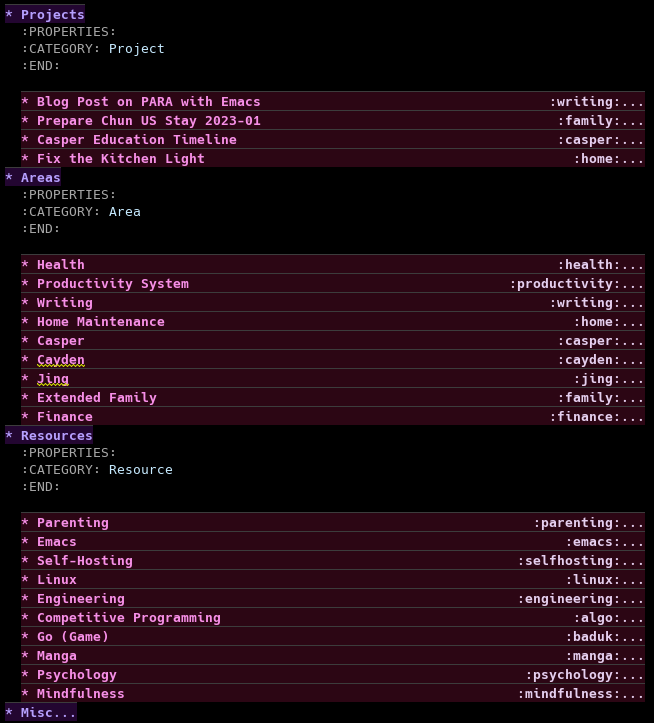
Tags and Categories
I use tags for the actual areas and resources. I assign each of them a specific tag to the corresponding subheadings. This gives me a set of controlled vocabularies for tagging projects and notes. For example, I know I should use writing instead of write or blogging for area “writing”. I don’t create tags for projects (which are short-term and grow over time) to keep my tag set small and useful2.
I use categories for the PARA top categories, Project-Area-Resource. When looking at my org agenda view, I immediately know which tasks are my top focuses (Project), which are things I need to do (Area) or interested to do (Resource). I also know which exact area or resource they belong to with the tags on the right.
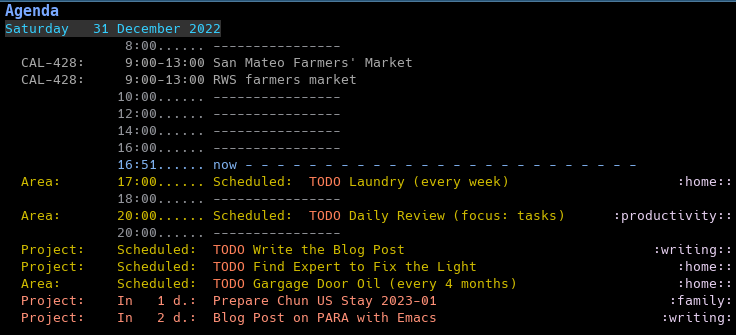
Tip: I can filter tasks by category and tag by pressing s (M-x org-agenda-filter) and clear filters with | (M-x org-agenda-filter-remove-all).
Organizing my Notes
For project notes, I add or link them directly under the corresponding org subtree in todo.org as I avoid adding project tags. When a project is completed or canceled, I convert the reusable part into the area or resource notes, and archive the project subtree to todo.org\_archive.
I place the areas and resources notes under ~/note. I tag them with the tags defined in todo.org and reserve the directory hierarchy3 for the note types. This gives me the flexibility to have multiple tags for a note.
Here is a simplified version of my org directory:
org├─ todo.org└─ note ├─ 20221125T211904--org-attach\_\_emacs.org ├─ ... ├─ meta | ├─ ... │ └─ 20200202T222222--using-org-mode\_\_emacs.org └─ reference ├─ article │ ├─ ... │ └─ 20221226T150449--creating-family-rules\_\_parenting.org └─ book ├─ ... └─ 20220907T134123--building-a-second-brain-tiago-forte\_\_pkm.orgnote/20221125T211904--org-attach\_\_emacs.orgis a regular note.note/meta/20200202T222222--using-org-mode\_\_emacs.orgis a meta note that connects other notes, like theorg-attach\_\_eamcs.orgabove.note/reference/article/20221226T150449--creating-family-rules\_\_parenting.orgis a reference note for the article “Creating Family Rules”, tagged with my resource “parenting”.note/reference/book/20220907T134123--building-a-second-brain-tiago-forte\_\_pkm.orgis a new book note for the book “Building a Second Brain” by Tiago Forte.
So far, I don’t archive notes under ~/note. If I need to, I might use the tag ARCHIVED and write some elisp to filter them.
Conclusion
Defining how I am going to organize my digital information reduces the cognitive load when working with tasks and notes. I can add or the information without thinking too much.
I love to learn how other people works and I hope this post could be interesting and helpful to you, too. If you like it, you probably also check out these:
- Tassin’s implementation which combines Org-mode and Evernote for tasks and notes respectively.
- Emacs CODE implementation which focuses on its note taking workflow with lots of details.
Search them yourself or read this great article: Project People vs. Area People - Forte Lab. ↩︎
It is suggested to use a self-defined set of tags and keep them as few as possible. ↩︎
That is why using denote with subdirectories is important for me. ↩︎
Pakistan’s ex Prime Minister Imran Khan compared the US-backed coup against him in April 2022 to the CIA plot that overthrew Iran’s elected PM Mohammad Mossadegh in 1953. He praised Tehran’s sovereignty, criticized Western colonialism, and reaffirmed support for Palestine.VIDEO: https://youtube.com/watch?v=AeRL-POPV94Sources and more information here: https://multipolarista.com/2022/12/30/pakistan-imran-khan-cia-coup-iranAnalysis of the coup in Pakistan by scholar Junaid Ahmad: https://multipolarista.com/2022/11/08/assassination-imran-khan-pakistan-us-coup
The CIA is using the intelligence agencies of a European NATO ally to launch sabotage attacks inside Russian territory, according to a report by journalist Jack Murphy.VIDEO: https://youtube.com/watch?v=m47oAKOYePESources and more information here: https://multipolarista.com/2022/12/29/cia-nato-sabotage-attacks-russiaRead Jack Murphy's article: https://jackmurphywrites.com/169/the-cias-sabotage-campaign-inside-russia
Steve Punt and Hugh Dennis present the week via topical stand-up and sketches. They're joined by Jamie MacDonald, Lucy Porter and Ed MacArthur.Jamie MacDonald shares his experience of Disability History Month, Lucy Porter examines our increasingly secular population and Ed MacArthur is a PR consultant, rebranding famous faces.The show was written by the cast with additional material from Aidan Fitzmaurice, Zoe Tomalin, Rachel E. Thorn and Cameron Loxdale.Voice actors: George Fouracres and Lola-Rose MaxwellSound: David ThomasSound assistant: Guy MarleyExecutive Producer: Richard MorrisProducer: Sasha BobakProduction Coordinator: Sarah NichollsA BBC Studios Production
It’s a Best of the Fall Tour compilation! Yes, in a compromise sure to please few and enrage many, we’ve put together a compilation of the best bits from each of our four shows on this year’s fall tour. So in a way we’re keeping our promise to not release these, since the full shows will remain locked away in the Chapo Vault, but those who couldn’t attend will get a little taste of the magic captured on those stages. FEATURING: Barack Obama teaches his speechwriters the power of jazz; Hot goss from the Haberman Trump book with Tim Heidecker; Prudies & Rod with Stavvy; and, Will finally relays the entirety of his Jason Miller lawsuit saga.
Special thanks again to Stavvy and all of our opening bands, especially 95 Bulls and Donzii who performed the two tracks featured in this ep.
Hosted on Acast. See acast.com/privacy for more information.
Torstein Johansen has an interesting post on his new Emacs configuration. He’s a long time Emacs user and his old configuration was 20 years old and 1617 lines long. After he refactored his configuration it was down to 368 lines. A lot of the refactoring was simply a matter of removing packages whose functionality had been superseded by core Emacs.
One thing he does in the video is to number each section of the configuration and then add (occur "^;; [0-9]+") at the top. Executing that expression generates a table of contents for the file. That seems like a nice feature but it’s not in his final configuration, which may mean that there’s a problem when Emacs starts.
My own configuration is currently 2461 lines long so I’m sure it could also do with some refactoring. It’s a bit over 15 years old now so there’s bound to be some cruft in there. One comfort that I took away from Johansen’s video is that he keeps almost everything in a single file.
The current conventional practice is to separate discrete functionality into separate files. Johansen finds this hard to navigate and I agree. I get a lot of pushback whenever I say that but it’s still true. It’s nice to know that at least one other person agrees with me.
If you like seeing what other people are doing with their configuration, Johansen’s video is worth watching. The video is 27 minutes, 50 seconds long so you’ll need to schedule some time for it.
This mini-episode is part of our Inside The Story series, where we highlight some of The Lever’s original reporting and speak with the journalists who wrote the story. Frank Cappello speaks with Matthew Cunningham-Cook who details their new story published by The Lever:
For years, the retirement savings of teachers, firefighters, and other government workers have been funneled by public officials to secretive Wall Street firms that charge high fees in exchange for the false promise of outsized returns. But as the stock market plummets and asset values drop, there are new fears that pensioners will be unable to access their cash, while insiders will be allowed to pull their money out before things get worse.
Now, Wall Street firms and their political allies — including a U.S. Senator with substantial private equity holdings — are trying to stop federal regulators from intervening to protect retirees by banning firms from giving some investors preferential treatment. And there are no rules requiring lawmakers with investments in private equity to disclose whether they are being given special investment preferences while they lobby to protect those asset managers.
To read the full story, click here.
If you enjoyed this story and want to support independent journalism, you can go to LeverNews.com to subscribe to our free newsletter or become a paid supporter.
The earth-shaking event where an Asian power defeated a European power in a war, leading to a revolution in Russia and a major shakeup in world affairs. We talk about the role education played in Japan’s victory; the Russian fleet that had to sail around the world; and the qualities of Tsar Nicholas that made … Continue reading "World War Civ 7: The Russo-Japanese War 1905"
Scholar Nicolai Petro discusses the overlooked influence of Ukraine's far-right nationalist movement and former German Chancellor Angela Merkel's recent admission that the Minsk Accords -- the international formula for ending the post-2014 Donbas civil war -- "was an attempt to give Ukraine time" to prepare for a conflict with Russia, rather than make peace. Petro is the author of the new book, "The Tragedy of Ukraine."Guest: Nicolai Petro. Professor of political science at the University of Rhode Island, and author of the new book: "The Tragedy of Ukraine: What Classical Greek Tragedy Can Teach Us About Conflict Resolution."Support Pushback: https://www.patreon.com/aaronmate
The West opposed the rest of a planet in United Nations General Assembly votes that called for a new international economic order based on sovereign equality, sustainable development, and biological diversity.VIDEO: https://youtube.com/watch?v=hfcvmxieug4Sources and more information here: https://multipolarista.com/2022/12/22/west-un-vote-economic-system-equality
Rasmus and Freja, two members of the Wolt Workers Group in Copenhagen, join us to talk about organizing as couriers, Danish labor law, and the union-busting practices of companies like Wolt. Sorry about my bad audio, I forgot how to podcast.
Our joint article: https://politiken.dk/debat/debatindlaeg/art9105126/Hj%C3%A6lp.-Vi-bliver-trynet-af-Wolt-og-Flink
Rasmus's Twitter account: https://twitter.com/fodsl3
And some of Rasmus's writing for the Gig Economy Project:
His current case: https://braveneweurope.com/wolt-trade-union-activist-has-account-terminated-for-taking-every-opportunity-to-criticise
Report from this past summer's elections at Lieferando in Berlin: https://braveneweurope.com/gig-economy-project-rasmus-hjorth-berlin-lieferando-couriers-works-council-election-notes-from-a-danish-courier
HOW TO SUPPORT US:
https://www.patreon.com/cornerspaeti
HOW TO REACH US:
Corner Späti https://twitter.com/cornerspaeti
Julia https://twitter.com/KMarxiana
Rob https://twitter.com/leninkraft
Nick https://twitter.com/sternburgpapi
Uma https://twitter.com/umawrnkl
Ciarán https://twitter.com/CiaranDold
In a sequel of sorts to one of our most beloved movie & holiday episodes, we enter a fantastic & amazingly realized world that could only spring from the singular genius of one of cinema’s great auteurs. Get bonus content on Patreon
Hosted on Acast. See acast.com/privacy for more information.
Just added to my radio archive (click on date for link):
October 27, 2022 Jamieson Webster, author of this article, examines what severe psychological distress among adolescents is telling us about American society • Raina Lipsitz, author of The Rise of a New Left, looks at the history, personnel, and status of today’s radicalism
The Jokyu Rebellion is one of the more minor conflicts in Japanese history; yet it also represents a tipping of the political balance of Japan that, eventually, will profoundly reshape the country. This week, we explore one of the chronicles of that conflict to see what we can learn about it, and about medieval Japan more broadly.
Show notes here.
Just added to my radio archive (click on date for link):
December 15, 2022 Intercept reporter Ryan Grim, author of this article, on the fight between workers and bosses in the rail industry • economist Sanjay Reddy on the fight between adjuncts and bosses in the neoliberal university
Hugh Dennis and Glenn Moore (standing in for Steve Punt) present the week via topical stand-up and sketches. They're joined by Alex Kealy, Athena Kugblenu and Ignacio Lopez.Athena Kugblenu looks at Shamima Begum’s citizenship appeal, Alex Kealy walks us through crises in cryptocurrency and Ignacio Lopez is an England fan singing about the meaning of the World Cup.The show was written by Steve Punt and the cast with additional material from Simon Alcock, Alfie Packham, Vicky Richards and Jade Gebbie.Voice actors: Jason Forbes and Roisin O'MahonySound: David ThomasExecutive Producer: Richard MorrisProducer: Sasha BobakProduction Coordinator: Sarah NichollsA BBC Studios Production
Melvyn Bragg and guests discuss the voyage of HMS Challenger which set out from Portsmouth in 1872 with a mission a to explore the ocean depths around the world and search for new life. The scale of the enterprise was breath taking and, for its ambition, it has since been compared to the Apollo missions. The team onboard found thousands of new species, proved there was life on the deepest seabeds and plumbed the Mariana Trench five miles below the surface. Thanks to telegraphy and mailboats, its vast discoveries were shared around the world even while Challenger was at sea, and they are still being studied today, offering insights into the ever-changing oceans that cover so much of the globe and into the health of our planet.The image above is from the journal of Pelham Aldrich R.N. who served on the Challenger Surveying Expedition from 1872-5.WithErika JonesCurator of Navigation and Oceanography at Royal Museums GreenwichSam RobinsonSouthampton Marine and Maritime Institute Research Fellow at the University of SouthamptonAndGiles MillerPrincipal Curator of Micropalaeontology at the Natural History Museum LondonProducer: Simon Tillotson
This post isn’t strictly about what can be achieved within the emacsecosystem but what can be achieved outside it while still binding tothe workflow principles of org mode.
I have yet to convert to any of the internal shells/terminal emulatorswithin emacs, I have continued to Control-Alt-T (C-M-t) term my wayaround linux; although this is becoming less frequent due to mygreater proficiency with dired
As my org journey evolves I have now realised that I have two files Irely on for my quick capturing needs. When an idea pops into my headI am usually emacs bound anyway so org-capture is always there forme. But what if I am alfresco?, and maybe, just maybe I am in aterminal! Well I could quickly switch to emacs as it is 99% likely tobe already running, but what if it is not?!
I could open emacs and then do my thing but emacs now takes a fewseconds to load up and then for me just to close it down againafterwards?! (as if I would) Isn’t there another way?, a better way?Could I idea push to an org file from the terminal with a quick flickof the fingers, could bash help me out here?, so many questions…
Well the answer is that yes, bash can help me out.
For me, any new items using org-capture are always put under theheadline, hence using file+headline in my capture template. Howwill this help?, well using the power of bash and the venerable sedcommand I can search and replace the headline but replace with anextra piece of data, namely a string of my choosing, effectivelyplacing my TODO or note at the top of the org file list!
I thus came up with the following bash scripts:
todo
#!/bin/bashif [[ ! -z $@ ]]; then sed --in-place 's/* Tasks/* Tasks\n** TODO '"$(echo ${@})"'/g' \ "/home/jdyer/DCIM/content/aa--todo.org"finote
#!/bin/bashif [[ ! -z $@ ]]; then sed --in-place 's/* Notes/* Notes\n** '"$(echo ${@})"'/g' \ "/home/jdyer/DCIM/content/aa--notes.org"fiHere is my original todo org file:

On the command line I can now enter:
todo generate art slideshowsand in a flash my org file would now be :

all nice and ready for the next time I open emacs!, and of course nowI can also add notes, or anything else of course.
My aim was for the scripts to be very simple, if you pass in no text /arguments no files will be augmented, generally the idea is just topass in a single string, maybe multiple lines could be passed using\n but that isn’t the way I wanted to use them.
Democracy Now! 2022-12-14 Wednesday
- Headlines for December 14, 2022
- Indict Us Too: Daniel Ellsberg & Cryptome's John Young Demand U.S. Drop Charges Against Julian Assange
- Slash the Pentagon Budget in Half & Abolish ICBMs: Dan Ellsberg on How to Avoid Nuclear Armageddon
- Mumia Should Be Freed: A Sitting Trial Judge in Arkansas Appeals to Philly Judge to Drop Charges
Most of Latin America has opposed the US-backed coup in Peru, standing with elected President Pedro Castillo, including Mexico, Argentina, Colombia, Bolivia, Venezuela, Cuba, Nicaragua, and several Caribbean nations. Meanwhile, the unelected regime is massacring protesters, with Washington's support.VIDEO: https://youtube.com/watch?v=0-bbzsiqFN0Report on CIA agent turned US ambassador meeting with Peru's defense minister one day before the coup: https://multipolarista.com/2022/12/14/coup-us-ambassador-peru-ciaJoint statement by Mexico, Argentina, Colombia, and Bolivia: https://multipolarista.com/2022/12/13/mexico-argentina-bolivia-colombia-peru-castillo-coupALBA's statement: https://multipolarista.com/2022/12/15/alba-peru-castillo-coup-argentina-kirchnerHonduras' statement: https://multipolarista.com/2022/12/13/honduras-coup-peru-pedro-castillo
Table of Contents
- Does it make sense to talk about Org Mode instead of Markdown?
- The export problems
- The solution: export from Org-Mode to Markdown via Pandoc with GFM option.
- The special case of exporting code blocks.
Does it make sense to talk about Org Mode instead of Markdown?
Why should I use Org-Mode to write articles to be published network inMarkdown format?
Wouldn’t it be more convenient to write the articles directly inMarkdown?
The question is more than justified and the answer is not obvious.
First, let me remind you that Org-Mode is a mode of GNU/Emacs. Whilethere are various plugins for other editors, including Vim, none of themcan match the outstanding efficiency of the original system.
So: to write in Org-Mode, it’s best to must use GNU/Emacs.
Org-Mode is a complete and extremely powerful structured writing system,although the learning curve is significantly upward.
It is a very useful resource for anyone who has to write complexdocuments, such as legal documents, scientific publications, novels.
Markdown is a language with text-format syntax much easier and immediateto learn.
However, some current CMSs directly accept Markdown format without theneed for any conversion. I am not aware, however, that it is possible topublish directly in Org-Mode format.
Org-Mode (in Emacs, of course) has a very extensive set of commands formoving, shifting, deleting chapters, and managing images and is,therefore, extremely useful in the creative and construction phase ofthe writings.
In summary: Org-Mode is a very powerful, fast and effective writingsystem for all those who write complex documents by profession orpassion.
But sooner or later, you will need to convert the material from Org-Modeto another format for printing (LaTeX) or web publishing (Markdown orHTML) (or both).
The export problems
Org-Mode has excellent and very fast built-in export capabilities with amyriad of options and configurations to various formats including LaTeX,HTML, and Markdown itself.
The export result is excellent for LaTeX, HTML, and basic Markdown.
However, basic Markdown lacks some syntactic features compared to theGFM dialect (i.e., “GitHub Flavored Markdown”).
For example, as I witnessed directly in the course of preparing one ofmy articles, Org-Mode’s internal export produces tables in HTML format(i.e., with the typical <table>, <tr> and <td> tags) instead ofthe dedicated Markdown GFM table markup code.
Using Pandoc with the standard configuration (such as“Pandoc input_file -or output_file”) the result is better but stillnot enough, as we will see in the examples below.** Some examples tomake it clearer
I report some export examples from the Org-Mode version of this articleof mine.
The following table is the “source” text version in Org-Mode:
| Function | Keystrokes ||--------------------------------+------------|| | <c> || Delete Surrounding Command | =dsc= || Delete Surrounding Environment | =dse= || Change Surrounding Command | =csc= || Change Surrounding Environment | =cse= |This is the result of exporting via Org-Mode built-in function:
<table border="2" cellspacing="0" cellpadding="6" rules="groups" frame="hsides"><colgroup><col class="org-left" /><col class="org-center" /></colgroup><thead><tr><th scope="col" class="org-left">Function</th><th scope="col" class="org-center">Keystrokes</th></tr></thead><tbody><tr><td class="org-left">Delete Surrounding Command</td><td class="org-center"><code>dsc</code></td></tr><tr><td class="org-left">Delete Surrounding Environment</td><td class="org-center"><code>dse</code></td></tr><tr><td class="org-left">Change Surrounding Command</td><td class="org-center"><code>csc</code></td></tr><tr><td class="org-left">Change Surrounding Environment</td><td class="org-center"><code>cse</code></td></tr></tbody></table>The code is pure HTML and not Markdown.
This, on the other hand, is the result of exporting with Pandoc usingthe following formula:
pandoc -s nomefile.org -o nomefile.mdFunction Keystrokes-------------------------------- ------------------Delete Surrounding Command dsc{.verbatim}Delete Surrounding Environment dse{.verbatim}Change Surrounding Command csc{.verbatim}Change Surrounding Environment cse{.verbatim}The code seems to be correct but the result on browser is very differentfrom the desired one:
Function KeystrokesDelete Surrounding Command dsc{.verbatim} Delete Surrounding Environment dse{.verbatim} Change Surrounding Command csc{.verbatim} Change Surrounding Environment cse{.verbatim}The solution: export from Org-Mode to Markdown via Pandoc with GFM option.
The solution is to convert from Org-Mode to Markdown using Pandoc butadding the GFM option to have the code “enriched” from the base version.
This is the pattern, found, after long search, on thispage:
pandoc --from=org --to=gfm org-mode-file.org > markdown.mdwhere, of course, the document names org-mode-file.org andmarkdown.md must be replaced with the real ones.
Note the “--to=gfm” option that determines the output in the MarkdownGitHub format.
Applying that pattern to the code mentioned in the previous paragraphproduces the following converted code:
| Function | Keystrokes ||--------------------------------|:----------:|| Delete Surrounding Command | dsc || Delete Surrounding Environment | dse || Change Surrounding Command | csc || Change Surrounding Environment | cse |In this way, you get perfectly formatted Markdown code even for theparts not provided in the basic version.
Note, in addition to the complete table of each character, also the“centering” of the second column.
Then, you can create the writings by taking advantage of the infinitepotential of Org-Mode and, then, exporting them to HTML or Markdown (orLaTeX) perfectly formatted for the publishing stage.
The special case of exporting code blocks.
While testing this topic I found a peculiarity in the export of sourcecode (tag src).
Simply using the combination “begin_src ... end_src” gives a result inMarkdown as if it were the “quote” format, that is, with four indentspaces (which is equivalent to prefixing “>” before each line).
In exporting via Pandoc, the same result is obtained ONLY if thefragment language is not specified.
If, however, the language is specified (for example:“#+begin_src markdown”) the export is correctly formatted as a codeblock with the same language specified in Markdown.
The names of the languages allowed by Org and Markdown are not, however,coincident.
This, however, does not preclude the correct formatting of the code whenexporting, but only the colored display of the content: if the languageindicated in Org-Mode were not provided in Markdown it would simplyresult in an uncolored fragment but, in any case, correctly exported asa “code block” and not as a “citation block.”
Thank you for your attention.
Greg Jenner is joined by Dr Emily Bell and Mike Wozniak to find out what Christmas was like with Charles Dickens. We take a walk through the many Christmases of the renowned Victorian author. You can listen to the extended version in the 'You're Dead To Me' feed on BBC Sounds.From elephants walking on ice to the family Christmas punch recipe, we take a closer look at the factors that may have influenced some of his most famous works and try to unpick what the phrase Dickensian has come to mean over the years.Written by Emma Nagouse and Greg JennerProduced by Emma Nagouse and Greg JennerAssistant Producer: Emmie Rose Price-GoodfellowResearcher: Jessica WhiteProject Management: Isla MatthewsAudio Producer: Steve HankeyThe Athletic production for BBC Radio 4
I'M SO SORRY ABOUT THE AUDIO QUALITY, our good mics over at Corner Späti Heavy Industries GmbH decided to be colonialist and CANCEL our conversation on Irish, Catalan and minority languages in general but we managed to put it out. Take that English Chauvinism, the profit motive and the French conception of state building (and whoever else is responsible for the decline of languages).
the title means "Irish, Catalan and other minority languages"
WHERE TO FIND OUR GUEST:
https://twitter.com/iarphunc
https://rupture.ie/
the article we're referring to throughout the episode is "Tá Gá le Gníomh" written by our wonderful guest, it's available in Issue 8 of Rupture Magazine and will be made available for free on the website at some point soon.
HOW TO SUPPORT US:
https://www.patreon.com/cornerspaeti
HOW TO REACH US:
Corner Späti https://twitter.com/cornerspaeti
Julia https://twitter.com/KMarxiana
Rob https://twitter.com/leninkraft
Nick https://twitter.com/sternburgpapi
Uma https://twitter.com/umawrnkl
Ciarán https://twitter.com/CiaranDold
Our good friends Liz and Brace of TrueAnon stop by to help us send off The Year of the Smile. We discuss their mini-series on Synanon, a substance rehabilitation program turned violent cult, and how it relates to all sorts of American phenomenon: from 1950’s acid tests to the modern Troubled Teen Industry. We also discuss the state of our collapsing tech/media infrastructure, the Epstein case, and why the government should begin issuing quests to citizens.
Check out TrueAnon’s excellent miniseries The Game starting here: https://soundcloud.com/trueanonpod/the-game-part-1-dopefiend,
and the rest on Patreon: https://www.patreon.com/TrueAnonPod
Tickets for the Hell on Earth launch show/party @ Littlefield in NYC 1/20/23 here: https://littlefieldnyc.com/event/?wfea\_eb\_id=479703214227
Hosted on Acast. See acast.com/privacy for more information.
The US ambassador in Peru, Lisa Kenna, worked for the CIA for 9 years, as well as the Pentagon. One day before the coup against elected left-wing President Pedro Castillo, Kenna met with Peru’s defense minister, who then ordered the military to turn against Castillo.VIDEO: https://youtube.com/watch?v=QhVdgvgCBtASource and more information here: https://multipolarista.com/2022/12/14/coup-us-ambassador-peru-ciaEn español aquí: https://geopoliticaeconomica.com/2022/12/15/embajador-eeuu-peru-cia-golpe
Click here for the full interview with Luhansk Deputy Foreign Minister Anna Soroka.
War in Ukraine did not start with Russia’s February 2022 invasion.
Ukraine has been at civil war since 2014, when the US backed a coup to overthrow President Viktor Yanukovych. When the new post-coup government cracked down on ethnic-Russian Ukrainians and their Russian culture, Ukrainians in the eastern Donbas region rose up in rebellion, leading to the creation of the Donetsk and Luhansk People’s Republics.
Anna Soroka, joining the Useful Idiots from Ukraine, is the former Deputy Foreign Minister of the Luhansk People's Republic. She joins Useful Idiots to share what it’s like being on the other side of a civil war that has now escalated into a full-blown proxy war with Russia.
Sometimes discussions about war can become abstract, but it’s important to go “behind enemy lines” and hear from real people on the other side.
It’s a perspective that you don’t get to hear at all in the NATO states. Unless you follow shows like Useful Idiots.
Plus, watch our Thursday Throwdown where Biden completes his transformation into Trump as he kills Bernie's bid to stop the Saudi war on Yemen.
It’s all this, and more, on this week’s episode of Useful Idiots. Check it out.
For $5 a month, become a Useful Idiot and support independent media.
Weeks before he was murdered, Victor Hugo Orcasita presented his wife with a letter describing his last wishes.
Orcasita, a union leader, had been pushing for better conditions at his workplace, a mine in northern Colombia owned by a subsidiary of the Alabama-based coal company Drummond. Then the death threats started coming in. He believed that the armed strangers who had started appearing around the mine’s cafeteria would soon make those threats a reality.
“He foresaw his death,” said his widow, Elisa Almarales Viloria.
On March 12, 2001, paramilitary gunmen dragged Orcasita and another union leader, Valmore Locarno, from a company bus as the men returned home from work. The gunmen shot Locarno on the spot and carried Orcasita off in the bed of their pickup truck. His body was found the next day. He’d been shot in the head, his teeth knocked out.
The miners’ union was convinced that Drummond was involved in the murders. They suspected that the company was secretly paying the paramilitary group that executed their leaders. Ultimately, a Drummond food service contractor who ran the mine’s cafeteria was convicted of plotting the murders and sentenced to 38 years in prison.
To make the case that the company was complicit in the killings, the union turned to Terry Collingsworth, a lifelong human rights attorney based in Washington, D.C.
Victims suing multinational corporations for alleged crimes committed abroad face steep odds. Collingsworth has made a specialty of these uphill battles, devoting his career to holding companies accountable in American courts for human rights abuses overseas. In his struggle with Drummond, he collaborated with activist groups, spoke out in the media, and wrote letters to Drummond’s business partners accusing the company of “hiring, contracting with, and directing” the paramilitaries who committed the murders.
Collingsworth’s decision to file suit in the United States made Orcasita’s widow hopeful that justice would prevail. For years, she had felt that justice would be impossible in Colombia due to Drummond’s political clout.
“What we were most excited about was bringing the lawsuit in Alabama,” she said. “There it would not be so easy for them to traffic their influence.”
Collingsworth lost an initial trial in 2007, when a jury found there wasn’t clear evidence tying the company to the crimes. Another of his lawsuits was dismissed for being too similar to the first. But Collingsworth continued to press his case, offering new witnesses with firsthand testimony implicating Drummond.
Then, in March 2015, the case took a surprising turn.
Drummond had returned fire in the legal fight with an unusual accusation. The company charged that Collingsworth — an advocate who recently brought a case before the U.S. Supreme Court — had led a “multifaceted criminal campaign” to extort Drummond into paying a costly settlement. This campaign, Drummond alleged, was in fact a racketeering conspiracy as defined by the Racketeer Influenced and Corrupt Organizations Act, better known as RICO.
Drummond’s charges represent a scorched-earth legal strategy in which corporations are turning the tables on attorneys and advocates who accuse them of wrongdoing. The technique was popularized by the elite corporate law firm Gibson, Dunn & Crutcher, whose clients include a who’s who of America’s most powerful companies. Representing the oil giant Chevron, Gibson Dunn convinced a judge to block one of the largest environmental verdicts ever reached by deploying a novel formula: using the civil provisions of RICO to charge opposing attorneys with racketeering.
Companies that have used RICO against their accusers say they brought the charges on themselves by committing fraud, bribery, and extortion. In Chevron’s case against environmental attorney Steven Donziger, a federal judge agreed; in the case against Collingsworth, a judge ruled that there was enough evidence of malfeasance to allow discovery. Human rights and environmental advocates contend that the true purpose of the cases is to send attorneys and activists a message: Going toe-to-toe with heavyweight corporations can lead to personal ruin.
“Companies with functionally limitless resources can come in and bigfoot like this, and no one can withstand it.”
Legal experts say some plaintiff’s attorneys made themselves vulnerable to RICO claims because they operated at the most aggressive edge of their field, overstepped ethical lines, and by their own admission made mistakes. By shifting the spotlight to these attorneys’ conduct, corporations effectively sidestepped the original allegations against them. Following these victories, other companies adopted similar theories to target advocacy groups directly.
If the goal is to hold attorneys accountable for unethical behavior, RICO is an odd choice. George Washington University law professor and international human rights attorney Ralph Steinhardt noted that RICO is a “very heavy club to swing” when there are more direct penalties, like sanctions, which punish the advocate without invalidating the entire case.
“One wonders why you would bring out the big guns of racketeering to send a message,” he said. “It’s a take-no-prisoners approach that’s intended to distract from whatever good faith allegations there may be.”
Ken White, a former federal prosecutor who specializes in First Amendment law, said responding to alleged misconduct by opposing attorneys with RICO charges is “like going after raccoons knocking over your trash cans with a tactical nuke.”
What’s missing, White says, is a universal mechanism to secure quick dismissals of baseless RICO claims. “Companies with functionally limitless resources can come in and bigfoot like this, and no one can withstand it,” White said.

Climate activists gather outside the Gibson Dunn office in New York City to protest against Chevron on June 10, 2021.
Photo: Tayfun Coskun/Getty Images
The RICO Playbook
As scientists issue dire warnings about climate change, advocates have turned to the courts and public campaigning to try to impose consequences on companies they accuse of serious attacks on the environment. Energy and extractive industry giants targeted by these efforts have been particularly eager to turn the tables by deploying this no-holds-barred strategy.
One of the world’s biggest oil companies, accused of dumping billions of gallons of toxic waste in the Amazon rainforest, won the first high-profile victory that relied on this approach. Drummond filed RICO charges in response to allegations that it financed the murder of union leaders who threatened the productivity of its coal mines. A pulp and paper company accused of destroying forests and the energy company behind the Dakota Access pipeline followed soon after, bringing RICO claims against environmental campaigners and anti-pipeline protesters.
In each of these cases, the accused racketeers were environmental and human rights attorneys, Greenpeace and other environmental groups, or Indigenous land and water rights activists.
The RICO Act, originally passed in 1970 to help prosecutors go after the mafia, includes civil provisions that allow private parties to allege a racketeering conspiracy. Most civil RICO claims are filed in business disputes, while others have been brought against political groups from anti-abortion protesters to animal rights activists. These suits require a high bar of evidence: They must prove a pattern of at least two “predicate” crimes such as bribery, fraud, or money laundering; that the perpetrators worked together in a criminal “enterprise”; and that the perpetrators acted with criminal intent.
Nonetheless, RICO claims offer powerful incentives to plaintiffs. If a judge allows the case to go forward, the defendants are subject to extensive discovery in which a well-funded corporate law firm can bury them in paperwork. If the company wins and can establish damages, those damages are automatically tripled.
“When we really think about what these suits are about, it’s fear.”
The success of early cases has helped build a body of law that opens the door for even more aggressive uses of the statute. The most recent corporate RICO cases have sought to define common public advocacy techniques such as negative media campaigns that allegedly contained false claims as predicate offenses for racketeering. The financial and reputational costs of defending these claims can make them devastating to their targets even if they ultimately fail.
“These RICO cases are easier to file than they are to win,” Steinhardt said. “Their intimidating purpose is served by their filing or their pendency.”
Deepa Padmanabha, deputy general counsel for Greenpeace USA, said that even though her team was awarded more than $800,000 in legal fees after successfully defeating RICO claims, the cost of defending the case was even higher.
Padmanabha said that two RICO suits would have cost the organization a total of more than a billion dollars if it had lost. The goal of the charges, she believes, was to caution the environmental movement that even the largest organizations were not safe from ruin.
“When we really think about what these suits are about, it’s fear,” Padmanabha said.
Corporate lawyers seem to be betting that the strategy will have staying power. In October 2020, Gibson Dunn announced a new practice in Judgment and Arbitral Award Enforcement, offering its services to creditors or debtors seeking to litigate existing judgments. The practice’s website highlights “its representation of Chevron Corporation in its successful RICO suit” and boasts that the firm “excels at defending companies and individuals against fraudulent arbitration awards and foreign judgments.”
Evan Mascagni, policy director for the Public Participation Project, an organization that fights against abusive lawsuits, said the RICO strategy threatens to overwhelm the legal system by allowing deep-pocketed companies to deploy endless resources to silence critics and defy judgments against them.
“I think if we accept this as a society, as a country, we’re saying we’re going to give incredibly powerful multinational corporations the ability to hijack our legal system,” Mascagni said.

Steven Donziger speaks during a press conference on March 19, 2014, in Quito, Ecuador.
Photo: Rodrigo Buendia/AFP via Getty Images
A Victory for Chevron
The RICO strategy was most famously deployed in 2011 by Chevron in its bitter legal conflict with attorney Steven Donziger.
At the time, Donziger was the lead lawyer pursuing massive damages against the oil company for toxic pollution in the Ecuadorian Amazon. Chevron inherited the lawsuit when it acquired Texaco, which had allegedly left hundreds of open pits of sludge in the rainforests where it operated, causing cancer deaths, miscarriages, and birth defects among the area’s mostly Indigenous residents. As the prospects of a multibillion-dollar judgment grew higher, Chevron enlisted the help of Gibson Dunn.
In February 2011, Gibson Dunn attorneys filed a civil RICO suit in New York accusing Donziger and his colleagues of running a racketeering conspiracy. They charged that Donziger and his team secretly controlled a key independent expert appointed by the Ecuadorian court to assess pollution damages. By the time of Donziger’s trial, they added the accusation that Donziger had bribed an Ecuadorian judge to allow his team to ghostwrite the judgment against Chevron.
Chevron provided hundreds of thousands of dollars in benefits to Alberto Guerra, the witness who claimed he’d facilitated the bribery and served as a liaison between Donziger’s team and the Ecuadorian judge. The benefits included relocating Guerra and his family from Ecuador to the United States, where the company supplied him with a $12,000 monthly salary. Chevron has said that it relocated Guerra to ensure his safety and that the payments were to compensate him for the cost of providing his evidence.
The company’s case was bolstered by Donziger’s own words, obtained through discovery of materials that included outtakes from a documentary film. In one clip, Donziger discussed the size of a possible judgment against Chevron and speculated that his team could “jack this thing up to $30 billion.” In draft testimony in 2013, Donziger conceded that he “did make errors along the way” but challenged the legitimacy of the proceedings against him.
As the RICO case headed for trial, Chevron made a strategic move. Roughly two weeks before the trial date, it dropped its request for damages and sought only to block enforcement of Ecuador’s $9.5 billion judgment. That meant the case would no longer be heard by a jury but decided solely by Judge Lewis Kaplan, a federal district judge in Manhattan who had ruled in the company’s favor in earlier motions.
In March 2014, Kaplan ruled in favor of Chevron, barring U.S. enforcement of the Ecuadorian judgment and holding that private parties are entitled to seek relief from foreign courts’ decisions under civil RICO — a crucial green light for the strategy that Gibson Dunn had developed.
Kaplan concluded that Donziger’s team had not only secretly written the Ecuadorian court’s ruling, but also submitted false evidence and made hidden payments to the court-appointed expert. “The wrongful actions of Donziger and his Ecuadorian legal team would be offensive to the laws of any nation that aspires to the rule of law,” Kaplan wrote in his opinion.
Critics have raised questions about irregularities in the case against Donziger. Guerra later changed key details in his testimony, including the nature of the alleged bribe agreement and the dates of trips in which he claimed to have worked on the case. Computer analysis also showed the judge in question had a running draft of the judgment saved on his hard drive for months, undermining the ghostwriting claim. Still, the case set in motion a stunning downfall for Donziger. The one-time star of the environmental bar ended up serving time in federal prison on contempt charges stemming from his refusal to comply with orders from Kaplan after the RICO decision. Meanwhile, Chevron avoided paying the multibillion-dollar judgment for the toxic sludge that remains in the Ecuadorian Amazon.
In an emailed statement, Gibson Dunn noted that an arbitration panel established through a trade agreement between the United States and Ecuador found that Texaco, Chevron’s predecessor, had complied with a pollution remediation plan approved by the Ecuadorian government, releasing the company from liability. Critics contend that the remediation plan failed to clean up the damage and did not cover claims by private plaintiffs.
In response to questions about Guerra, the firm said Donziger exaggerated the importance of his testimony and pointed to Kaplan’s statement that he would have “reached precisely the same result in this case even without the testimony of Alberto Guerra.” Gibson Dunn added that Kaplan’s RICO ruling, which was unanimously affirmed by a panel of judges on the 2nd U.S. Circuit Court of Appeals, showed that the firm’s advocacy had uncovered serious wrongdoing.
“As for Gibson Dunn’s work successfully exposing fraud by unscrupulous lawyers like Mr. Donziger who seek to rip off vulnerable people in weak legal systems overseas based on lies, this is laudable work vindicating the rule of law,” William Thomson, a partner at Gibson Dunn who was part of its Chevron team, wrote in the statement.
Donziger maintained that his contacts with the Ecuadorian expert were legal and appropriate under Ecuadorian law, and that the ghostwriting charges were fabricated.
“Chevron used a civil racketeering case and false witness testimony from a person who is an admitted liar to try to criminalize me,” Donziger told The Intercept and Type in a written statement. “They wanted to use this bogus RICO case to try to get people to forget about the human devastation Chevron caused in Ecuador.”

An open-air coal mine in Colombia’s La Guajira Department.
Photo: Jeffrey Tanenhaus
Witnesses in Dispute
About a year after Kaplan blocked the Ecuadorian judgment against Chevron, Drummond filed RICO charges against Collingsworth.
Although the company had already prevailed against several of his lawsuits, Collingsworth forged ahead with new legal actions, adding witnesses who offered firsthand testimony alleging that the coal company was complicit in the union leaders’ murders.
One of these witnesses was an imprisoned former paramilitary commander called El Tigre, or the Tiger, who testified that Drummond provided regular payments to his unit. Another key witness was Jaime Blanco, the food contractor who was ultimately convicted of the murders, who said Drummond used his company as a conduit to funnel money to the paramilitaries and directed them to commit the murders.
Collingsworth made payments to El Tigre’s family members and helped arrange financing for Blanco’s legal defense when he agreed to testify. He said the funds he provided to El Tigre’s family were security payments to help the family relocate in order to avoid violent retaliation by the paramilitaries, Autodefensas Unidas de Colombia, which the U.S. State Department designated as a terrorist group in 2001. In response to a court order, Collingsworth disclosed similar payments to relatives of three ex-paramilitary witnesses, but he failed to include the payments to El Tigre and two other ex-paramilitaries, as well as his arrangement with Blanco.
Drummond’s media office did not respond to multiple phone calls and emails requesting comment for this story, and attorneys for Drummond declined to comment.
Colombian authorities have backed up key elements of Collingsworth and El Tigre’s account. In December 2020, the Colombian Attorney General’s Office charged the current and former presidents of Drummond’s Colombian subsidiary with conspiracy in the union leaders’ murders. The 149-page charging document included a summary of a forensic analysis that found evidence of more than $3.7 million in overpayments from the subsidiary to Blanco’s company, bolstering allegations that Drummond had financed the paramilitaries.
Prosecutors also noted that numerous witnesses who did not receive security payments had testified to the same facts. The accounts of El Tigre and other disputed witnesses, they wrote, were “in harmony with and verified by other forms of proof.”
This fall, prosecutors named Drummond’s Colombian subsidiary as a “civilly responsible third party” in the case of the union leaders’ murders.
Though its Colombian subsidiary is now in the crosshairs of prosecutors, Drummond has had more success against Collingsworth in the United States.
In 2015, Drummond filed a civil RICO suit charging that Collingsworth had bribed El Tigre, Blanco, and other witnesses to falsely testify that Drummond was involved in the murders, as part of a racketeering conspiracy to strong-arm the coal producer into paying a hefty settlement. The company pointed to inconsistencies in their testimonies, noting previous statements in which they denied that Drummond had worked with the paramilitaries before they became witnesses for Collingsworth.
The case, which focused on the undisclosed payments to witnesses, was heard by a federal judge who had ruled in Drummond’s favor in earlier litigation with Collingsworth, Judge R. David Proctor of the Northern District of Alabama.
Collingsworth said in court filings that the omissions were an “inadvertent disclosure error” resulting from miscommunication with his co-counsel in Colombia. He said he had failed to include the payments in an initial disclosure and then recycled his answer repeatedly before realizing his error. He also apologized to the judge for making a “terrible mistake” in not revealing his arrangement with Blanco, which he had previously deemed to be outside the scope of required disclosures.
“Sitting here now, boy, I wish I had just disclosed it,” Collingsworth said in a phone interview. “Because it wasn’t hiding the truth or changing the testimony.”
The real question, Collingsworth said, is whether the payments to the witnesses in Colombia were ethical and necessary for their safety. The security arrangements were needed for them to testify truthfully without endangering their families, he said, noting that he reviewed all arrangements in advance with ethics lawyers and turned down witnesses who sought to exchange testimony for cash. He fiercely defends his decision to help relocate the families of former paramilitaries and submitted testimony supporting the need for security payments by expert witnesses including Javier Peña, the former Drug Enforcement Administration agent who led the mission that killed cartel leader Pablo Escobar and inspired the Netflix series “Narcos.”
“It was morally necessary to protect these families from one of the most brutal groups that roamed the earth,” Collingsworth said.
In December 2015, Proctor ruled that Drummond’s RICO case could go forward, finding that Collingsworth’s explanation for the undisclosed payments was “as weak as it is incredible.” He held that there was probable cause to believe that Collingsworth had bribed witnesses and suborned perjury, opening the door to the extensive discovery process that Chevron had effectively used against Donziger.
It was the beginning of years of legal wrangling that Collingsworth said drained the resources of his small human rights firm.
Collingsworth said he has spent some 2,000 hours — what a lawyer usually bills in a year — defending against Drummond’s charges. Even more damaging, he said, has been the impact on his professional reputation, which he says has deprived him of business opportunities and revenue.
“I have had colleagues who are in law firms tell me that they can’t collaborate with me until these charges are completely resolved in my favor, because they don’t want to be accused of associating with someone who bribes witnesses,” Collingsworth said.
Steinhardt, the human rights law professor, said the facts of the case aren’t black and white, but the charges against Collingsworth are disproportionate. “He isn’t a racketeer,” Steinhardt said.

A protester holds a poster outside the constitutional court in Quito, Ecuador, on Nov. 9, 2016, at a demonstration marking 23 of the legal battle over Texaco’s pollution.
Photo: Dolores Ochoa/AP
A Chilling Effect
The success of these cases paved the way for increasingly aggressive uses of civil RICO.
Around 2012, Greenpeace and other environmental groups launched a protest campaign against Resolute Forest Products, accusing the forestry company of destroying boreal forests in Canada. Several years later, Greenpeace and others began another campaign targeting Energy Transfer Partners (now part of Energy Transfer LP), the company behind the Dakota Access pipeline. This campaign charged, among other things, that the company was threatening Indigenous communities’ water supply and sacred sites. Greenpeace and its allies rallied their members, drove media coverage, and urged the companies’ business partners to sever ties unless the companies changed course.
The two companies filed RICO charges against Greenpeace and the other groups in 2016 and 2017. Both were represented by the firm Kasowitz Benson Torres, whose founding partner Marc Kasowitz was a longtime personal attorney for Donald Trump and filed a defamation case against one of Trump’s critics. (First Look Institute, the nonprofit that publishes The Intercept, is involved in litigation with Energy Transfer, represented by the Kasowitz firm, over records related to the Dakota Access pipeline.)
Michael Bowe, the former Kasowitz partner who brought the RICO cases, told Bloomberg in August 2017 that he was in contact with other companies considering similar actions and “would be shocked if there are not many more.” He anticipates an increase in these actions, he wrote in response to questions from Type and The Intercept, because “the online nature of activism and speech generally makes it easier and more common to widely disseminate false claims and inflict great harm.”
“The claims against Greenpeace and others are … essentially saying, ‘Your activism is racketeering.’”
The cases against Greenpeace took the RICO strategy well beyond the arguments made by Chevron and Drummond. They argued that common advocacy techniques such as naming-and-shaming campaigns and fundraising amounted to RICO offenses if the campaigns included false allegations. Greenpeace’s campaign against Resolute included an inaccurate claim that Resolute had logged in protected forests, which Greenpeace later retracted, saying it had made a mistake. Resolute accused Greenpeace of intentionally fabricating the claim in order to extort the company, calling the organization a “global fraud” that existed to maximize donations rather than protect the environment.
“The claims against Donziger aren’t claims against environmentalism as it operates,” said Joshua Galperin, an environmental law professor at Pace Law School. “But the claims against Greenpeace and others are much more broad, essentially saying, ‘Your activism is racketeering.’”
Bowe disputed this characterization. “The case is not about activism, it is about lies,” he wrote. “Legitimate activism is truthful.”
Krystal Two Bulls, an organizer who participated in the Standing Rock protests against the Dakota Access pipeline, was added as a defendant in the racketeering suit brought by Energy Transfer in 2018, after a judge found that the initial complaint was too vague to support RICO claims. The company charged that Two Bulls, a media liaison for a group of protesters called Red Warrior Camp, had sought to “provide cover for their illegal activities” by issuing public calls to action on the group’s behalf. They accused Red Warrior Camp of being a “front for eco-terrorists” who engaged in violent attacks on construction sites. News reports state that while members of the camp occupied private land to block pipeline construction, police and security guards carried out much of the violence — using water hoses, rubber bullets, and tear gas against protesters.
Two Bulls, a U.S. Army veteran and a member of the Oglala Lakota and Northern Cheyenne, was shocked when she learned she had been charged with racketeering.
“I remember thinking, what am I supposed to do with this?” she said. “I have no lawyer. I have no money for a lawyer.”
“I started to censor myself.”
Two Bulls was represented pro bono by the nonprofit law firms Center for Constitutional Rights and EarthRights International. She considers herself lucky that colleagues in the environmental movement connected her with these lawyers but recalls a heavy weight on her shoulders while the charges were pending. She felt like her presence was a liability to her fellow activists.
“It made me second guess myself and the spaces I entered,” Two Bulls said. “I started to censor myself in the things I was saying.”
Laura Lee Prather, a partner at Haynes Boone who specializes in First Amendment law, said civil RICO claims often lead to extended litigation because they depend heavily on the facts of the case. Defamation charges can be thrown out if the defendant can affirmatively show their statements were true. By contrast, a civil RICO claim usually requires a more complex defense.
“Civil RICO is much more difficult to have a court feel comfortable dismissing at any early stage,” Prather said.
Federal judges in California and North Dakota dismissed the RICO claims in both cases almost a year and a half after they were filed. In the Resolute case, the judge ruled that the company failed to prove that Greenpeace’s fundraising claims had directly caused the alleged harm it suffered. He later ordered the company to pay more than $800,000 of Greenpeace’s legal costs.
Resolute noted that other charges it has brought against Greenpeace, alleging defamation and unfair competition, were allowed to proceed and are still before the courts. “The long-running dispute with activists has been about standing up for our communities to defend our sustainable practices against misrepresentation,” Resolute spokesperson Seth Kursman said in a statement.
In the case of Energy Transfer, the judge ruled that the company failed to prove that the various actors involved in the Standing Rock protests were a coordinated “RICO enterprise.”
“While there is a common purpose among defendants — they all oppose the Dakota Access Pipeline — there is no ongoing organization, no continuing unit, and no ascertainable structure apart from the alleged RICO violations,” U.S. District Judge Billy Roy Wilson wrote in February 2019. “That is far short of what is needed to establish a RICO enterprise.”
Energy Transfer did not respond to email or telephone inquiries. A week after its RICO charges were dismissed, the company filed charges in North Dakota state court, accusing Greenpeace, Two Bulls, and others of trespass, defamation, and civil conspiracy for their role in the Standing Rock protests. The litigation is ongoing.

Dakota Access pipeline protesters face off with various law enforcement agencies on Feb. 22, 2017, in North Dakota.
Photo: Michael Nigro/Pacific Press/LightRocket via Getty Images
Protecting the Protest
The RICO attacks on Greenpeace and its allies alarmed civil society organizations, which feared that the cases would deter advocacy groups from speaking out against big corporations. In 2018, a coalition of organizations founded Protect the Protest to combat lawsuits meant to silence free speech, which are known as strategic lawsuits against public participation, or SLAPPs. These lawsuits can include RICO claims but have also proliferated in other ways. Telltale signs of a SLAPP, according to the coalition, are claims that target activities protected by the First Amendment, seek to exploit a power imbalance, and threaten to bankrupt defendants.
“Civil society is not just going to lay down and take this,” said Marco Simons, the general counsel for EarthRights International and a member of the coalition.
Simons believes the coalition’s recent work calling attention to the Greenpeace lawsuits has, for the time being, discouraged companies from attempting more RICO suits that broadly target activism. But Protect the Protest is still seeking more permanent solutions.
The coalition aims to crack down on these suits by promoting anti-SLAPP laws, which provide fast-track procedures for dismissing SLAPPs and shifting their legal costs to the party that filed them. More than half of U.S. states have some version of an anti-SLAPP law.
Ken White, the former prosecutor, said that state anti-SLAPP laws have been highly effective, both in deterring abusive lawsuits and providing a defense mechanism for their targets. But RICO is a federal law.
In September, Rep. Jamie Raskin, D-Md., introduced the SLAPP Protection Act of 2022, a federal bill that, like the state laws, would provide an expedited process for getting SLAPPs thrown out. Raskin singled out the fossil fuel industry for abusing the “legal system by deploying costly, protracted, and meritless lawsuits to target activists.”
A law providing a uniform standard for dismissing such lawsuits across federal courts would make it “much harder to abuse the system,” White said.
As advocates search for solutions, Drummond is pressing ahead with its RICO case against Collingsworth. The company subpoenaed VICE Media last year for raw audio recordings from a podcast about the union leaders’ murders. On March 7, Proctor, the judge, ruled in Drummond’s favor, ordering VICE to turn over recordings of its interviews with Collingsworth, Blanco, and another witness.
Collingsworth said that he doesn’t fear losing in court, but the looming racketeering charges have taken a toll psychologically.
“There is a question mark over my name.”
“It has caused me emotional turmoil because some people view me differently,” he said. “There is a question mark over my name.”
The coming months are expected to bring new developments in his legal battle with the coal company. Attorneys will take depositions from witnesses in Colombia for Drummond’s RICO suit and a more recent suit brought by Collingsworth. Meanwhile, Colombian prosecutors have resumed work in their case against the current and former presidents of Drummond’s Colombian subsidiary, seeking testimony from a former paramilitary leader in October. The defendants have appealed the decision to charge them with conspiring in Orcasita’s and Locarno’s murders, and the appeal must be decided before the case can go to trial, according to Ivan Otero, Collingsworth’s co-counsel in Colombia.
More than 21 years after her husband’s murder, Elisa Orcasita is still skeptical of Colombian justice but is hoping for a clean trial.
“We pray to God that there’s no more buying of anything, no more influence of anything,” she said. “That’s what we hope for as victims.”
This story was produced with support from the Fund for Constitutional Government and the H.D. Lloyd Fund for Investigative Journalism.
The post The Scorched-Earth Legal Strategy Corporations Are Using to Silence Their Critics appeared first on The Intercept.
Melvyn Bragg and guests discuss the speeches that became a byword for fierce attacks on political opponents. It was in the 4th century BC, in Athens, that Demosthenes delivered these speeches against the tyrant Philip II of Macedon, father of Alexander the Great, when Philip appeared a growing threat to Athens and its allies and Demosthenes feared his fellow citizens were set on appeasement. In what became known as The Philippics, Demosthenes tried to persuade Athenians to act against Macedon before it was too late; eventually he succeeded in stirring them, even if the Macedonians later prevailed. For these speeches prompting resistance, Demosthenes became famous as one of the Athenian democracy’s greatest freedom fighters. Later, in Rome, Cicero's attacks on Mark Antony were styled on Demosthenes and these too became known as Philippics.The image above is painted on the dome of the library of the National Assembly, Paris and is by Eugene Delacroix (1798-1863). It depicts Demosthenes haranguing the waves of the sea as a way of strengthening his voice for his speeches.With Paul CartledgeA. G. Leventis Senior Research Fellow at Clare College, University of CambridgeKathryn TempestReader in Latin Literature and Roman History at the University of RoehamptonAndJon HeskReader in Greek and Classical Studies at the University of St AndrewsProducer: Simon Tillotson
A scholarly study found that British colonialism caused approximately 165 million deaths in India from 1880 to 1920, while stealing trillions of dollars of wealth. The global capitalist system was founded on European imperial genocides, which inspired Adolf Hitler and led to fascism.VIDEO: https://youtube.com/watch?v=Ob_lIQRAnYMSources here: https://multipolarista.com/2022/12/12/britain-100-million-india-deaths-colonialism
We review the year in Podcasts, according to the New York Times. Then, Sinema flips, the Young Republicans present the Allen Dulles award, and the CIA has a mental wellness problem. Finally, some movie mindset recommendations for your holiday season.
Hell on Earth launch show/party @ Littlefield 1/20/23, tickets here: https://littlefieldnyc.com/event/?wfea\_eb\_id=479703214227
Matt w/ Talking Simpsons podcast, Live at SF Sketchfest, 1/25/23, tickets here: https://www.eventbrite.com/e/talking-simpsons-tickets-210772966617
Hell on Earth Bibliography/Reading List Here: https://www.chapotraphouse.com/hell
Hosted on Acast. See acast.com/privacy for more information.
Political scientist Dr Brian Klaas has interviewed over 500 people, from former presidents to war criminals, to uncover the nature of power: who it attracts, who gets it, how it changes us and how we can prevent its abuse.First broadcast 7 February 2022
So, there's this website, Have I Been Pwned,where you can check if your email address has appeared in a data breach.
There's also a Pwned Passwords section for checking passwords... but, typing your password on a random websiteprobably isn't such a great idea, right?
Of course, you couldread about how HIBP protects the privacy of searched passwords1,and understand how k-Anonymity works (it does),and check that the website uses the k-Anonymity API (it does),but that's waaay too much work.
Of course, we could use the API ourselves,but where's the fun in that?
Instead, we'll do it the hard way –we'll check for the password offline.
And we're not stopping until it's fast. (This is a threat.)
- The Pwned Passwords list
- A minimal plausible solution
- Problem: it's slow
- Problem: it needs tuning, it's still slow
- Failing to get to under 1 millisecond
- Getting to under 1 millisecond
The Pwned Passwords list #
OK, first we need to get password list.
Go to Pwned Passwords,scroll to Downloading the Pwned Passwords list,and download the SHA-1 ordered by hash file –be nice and use the torrent, if you can.
Note
You can also use the downloader to get an up-to-date version of the file, but that wasn't available a year ago when I started writing this.
The 16 GB archive extracts to a 37 GB text file:
$ pushd ~/Downloads$ stat -f %z pwned-passwords-sha1-ordered-by-hash-v8.7z16257755606$ 7zz e pwned-passwords-sha1-ordered-by-hash-v8.7z$ stat -f %z pwned-passwords-sha1-ordered-by-hash-v8.txt37342268646$ popd... that looks like this:
$ head -n5 ~/Downloads/pwned-passwords-sha1-ordered-by-hash-v8.txt000000005AD76BD555C1D6D771DE417A4B87E4B4:1000000000A8DAE4228F821FB418F59826079BF368:400000000DD7F2A1C68A35673713783CA390C9E93:87300000001E225B908BAC31C56DB04D892E47536E0:600000006BAB7FC3113AA73DE3589630FC08218E7:3Each line has the format:
<SHA-1 of the password>:<times it appeared in various breaches>Note
See the article mentioned in the introduction for why use a hash instead of the actual password, and what the counts are good for.
To make commands using it shorter, we link it in the current directory:
$ ln -s ~/Downloads/pwned-passwords-sha1-ordered-by-hash-v8.txt pwned.txtA minimal plausible solution #
We'll take an iterative, problem-solution approach to this.But since right now we don't have any solution,we start with the simplest thing that could possibly work.
First, we get the imports out of the way:2
| |
Then, we open the file:
| |
By opening the file early,we get free error checking– no point in reading the password if the file isn't there.
Opening it in binary mode makes searching a bit faster,as it skips needless decoding.It's minimal plausible solution,it doesn't mean we can't do some obvious things.
Next, the password:
| |
We either take it as the second argument to the script,or read it with getpass(),so your actual password doesn't remain the shell history.
After computing the password's hash, we delete it.We won't go as far as to zero it,3but at least we prevent accidental printing (e.g. in a traceback).
Let's see if it works:
$ python pwned.py pwned.txt passwordlooking for 5baa61e4c9b93f3f0682250b6cf8331b7ee68fd8$ python pwned.py pwned.txtPassword:looking for 5baa61e4c9b93f3f0682250b6cf8331b7ee68fd8The shell sha1sum seems to agree:
$ echo -n password | sha1sum5baa61e4c9b93f3f0682250b6cf8331b7ee68fd8 -To find the hash, we just go through the file line by line(remember, simplest thing that could possibly work).We put this in a function, it might be useful later on.
| |
If a line was found, we print the count:
| |
Before giving it a whirl, let's add some timing code:
| |
| |
And, it works (the code so far):
$ python pwned.py pwned.txt blockinglooking for 000085013a02852372159cb94101b99ccaec59e1pwned! seen 587 times beforein 0.002070 secondsProblem: it's slow #
...kinda.
You may have noticed I switched from password to blocking.That's because I was cheating –I deliberately chose a password whose hash is at the beginning of the file.
On my 2013 laptop, searching for password actually takes 86 seconds!
Let's put a lower bound on the time it takes to go through the file:
$ time wc -l pwned.txt 847223402 pwned.txtreal1m7.234suser0m31.133ssys0m16.379sThere are faster implementations of wc out there,but Python can't even beat this one:
$ time python3 -c 'for line in open("pwned.txt", "rb"): pass'real1m28.325suser1m10.049ssys0m15.577sSkipping #
There's a hint about that in the file name: the hashes are ordered.
That means we don't have to check all the lines;we can skip ahead until we're past the hash,go back one step, and only check each line from there.
Lines are different lengths,so we can't skip exactly X lines without reading them.But we don't need to,skipping to any line that's a reasonable amount ahead will do.
| |
So we just seek() ahead a set number of bytes.Since that might not leave us at the start of a line,we discard the incomplete line,and use the next one.
Finally, we wrap the original find\_line() with one that does the skipping:
| |
It works:
$ python pwned.py pwned.txt passwordlooking for 5baa61e4c9b93f3f0682250b6cf8331b7ee68fd8pwned! seen 9,545,824 times beforein 0.027203 secondsI found the magic 16 MiB offset by trying a bunch of different values:
offset (MiB) time (s) 1 0.05 4 0.035 8 0.030 16 0.027 <-- sweet spot 32 0.14Problem: it needs tuning, it's still slow #
While three orders of magnitude faster, we still have a bunch of issues:
- The ideal skip size depends on computer you're running this on.
- The run time still increases linearly with file size;we haven't really solved the problem,as much as made it smaller by a (large, but) constant factor.
- The run time still increases linearly with where the hash is in the file.
- To be honest, it's still kinda slow. ¯\\_(ツ)\_/¯
Binary skipping #
To make the "linear" part painfully obvious,uncomment the jumped to line.
$ python pwned.py pwned.txt password | grep -o 'jumped to .' | uniq -c 139 jumped to 0 139 jumped to 1 139 jumped to 2 139 jumped to 3 139 jumped to 4 103 jumped to 5Surely, after we've ju 44 0.000 0.000 0.000 0.000 {method 'tell' of '\_io.BufferedReader' objects}mped to 0 once,we don't need to do it 138 more times, right?
We could jump directly to a line in the middle of the file;if there at all,the hash will be in either of the halves.We then jump to the middle of that half,and to the middle of that half,and so on,until we either find the hashor there's nowhere left to jump.
Note
If that sounds a lot like binary search, that's because it is – it's just not wearing its usual array clothes.
And most of the work is already done:we can jump to a line at most X bytes from where the hash should be,we only need to do it repeatedly,in smaller and smaller fractions of the file size:
| |
The only thing left is to get the file size:
| |
It works:
$ python pwned.py pwned.txt passwordlooking for 5baa61e4c9b93f3f0682250b6cf8331b7ee68fd8pwned! seen 9,545,824 times beforein 0.009559 seconds$ python pwned.py pwned.txt passwordlooking for 5baa61e4c9b93f3f0682250b6cf8331b7ee68fd8pwned! seen 9,545,824 times beforein 0.000268 secondsThe huge time difference is due to operating system and/or disk caches– on the second run, the (same) parts of the file are likely already in memory.
Anyway, look again at the jumped to output:instead of jumping blindly through the whole file,now we're jumping around the hash,getting closer and closer to it.
$ python pwned.py pwned.txt password | grep -o 'jumped to .' | uniq -c 1 jumped to 7 1 jumped to 3 1 jumped to 7 1 jumped to 5 1 jumped to 4 39 jumped to 5$ python pwned.py pwned.txt password | grep -o 'jumped to ..' | uniq -c 1 jumped to 7F 1 jumped to 3F 1 jumped to 7F 1 jumped to 5F 1 jumped to 4F 1 jumped to 5F 1 jumped to 57 1 jumped to 5F 1 jumped to 5B 1 jumped to 59 1 jumped to 5B 1 jumped to 5A 32 jumped to 5BYou may notice we end up at the same 7F... prefix twice;this makes sense –we skip ahead by half the file size,then back,then ahead by a quarter two times.It shouldn't really change anything,the second time the data is likely already cached.
Better timing #
Given the way caching muddies the waters,how fast is it really?
This shell function averages a hundred runs,each with a different password:
function average-many { for \_ in {1..100}; do python $@ $( python -c 'import time; print(time.time())' ) done \ | grep seconds \ | cut -d' ' -f2 \ | paste -sd+ - \ | sed 's#^#scale=6;(#' | sed 's#$#)/100#' \ | bc}After a few repeats, the average time settles around 3 ms.
$ for \_ in {1..20}; do average-many pwned.py pwned.txt; done.004802.003904.004088.003486.003451.003476.003414.003442.003169.003297.002931.003077.003092.003011.002980.003147.003112.002942.002984.002934Again, this is due to caching; the more we run it,the more likely it is the pages at half, quarters, eights, sixteenths, and so onof the file size are already in memory,and the road to any line starts through a subset of those.
I wave my hands, get a 2020 laptop, and a miracle happens.It's far enough into the totally unpredictable future, now,that you can search any password in under 1 millisecond.You can do anything you want.
So, there we go.Wasn't that an interesting story?That's the end of the article.Don't look at the scroll bar.Don't worry about it.
If you came here to finda somewhat inconvenient way of checking if your password has been compromised,you can go.
Subscribe on the way out if you'd like, but take care :)
Go solve Advent of Code or something.
I'm just chilling out.
See ya.
Want to know when new articles come out?Subscribe hereto get new stuff straight to your inbox!
Failing to get to under 1 millisecond #
OK, I think they're gone.
I swear this was supposed to be the end;this really was supposed to be a short one.
Here's what a friend of mine said,that chronologically should be way later into the article,but makes a great summary for what follows:
And now that you have arrived at this point,spend a moment to ponder the arbitrary nature of 1 millisecondgiven its dependency on the current yearand the choice of your particular hardware.
After that moment, continue celebrating.
Nah, fuck it, it has to take less than 1 millisecond on the old laptop.
... so yeah, here's a bunch of stuff that didn't work.
Profile before optimizing #
Now, with the obvious improvements out of the way,it's probably a good time to stop andfind out where time is being spent.
$ python -m cProfile -s cumulative pwned.py pwned.txt "$( date )"looking for 3960626a8c59fe927d3cf2e991d67f4c505ae198not foundin 0.004902 seconds 1631 function calls (1614 primitive calls) in 0.010 seconds Ordered by: cumulative time ncalls tottime percall cumtime percall filename:lineno(function) ... 1 0.000 0.000 0.005 0.005 02-binary-search.py:8(find\_line) 1 0.000 0.000 0.005 0.005 02-binary-search.py:22(skip\_to\_before\_line) 28 0.000 0.000 0.005 0.000 02-binary-search.py:28(skip\_to\_before\_line\_linear) 86 0.004 0.000 0.004 0.000 {method 'readline' of '\_io.BufferedReader' objects} ... 71 0.000 0.000 0.000 0.000 {method 'seek' of '\_io.BufferedReader' objects} ... 44 0.000 0.000 0.000 0.000 {method 'tell' of '\_io.BufferedReader' objects} ...From the output above, we learn that:
- Most of the time is spent in readline() calls.
- Both seek() and tell() calls are almost free.
readline() is implemented in C,so there's not much we can change there.
What we can change, however, is how often we call it.
Another thing of interest is how much individual readline() calls take.
In skip\_to\_before\_line\_linear():
| |
The output is pretty enlightening:
$ python pwned.py pwned.txt asdflooking for 3da541559918a808c2402bba5012f6c60b27661cjumped to 7FF9E in 10 us at offset 18,671,134,394 <-- 1/2 file sizejumped to 3FF89 in 4 us at offset 9,335,567,234 <-- 1/4 file sizejumped to 1FFBA in 3 us at offset 4,667,783,663 <-- 1/8 file sizejumped to 3FF89 in 3 us at offset 9,335,567,322 <-- 1/4 file sizejumped to 2FFA4 in 5 us at offset 7,001,675,508jumped to 3FF89 in 4 us at offset 9,335,567,366 <-- 1/4 file sizejumped to 37F98 in 4 us at offset 8,168,621,453jumped to 3FF89 in 3 us at offset 9,335,567,410 <-- 1/4 file sizejumped to 3BF94 in 3 us at offset 8,752,094,477jumped to 3FF89 in 2 us at offset 9,335,567,498 <-- 1/4 file sizejumped to 3DF8E in 3 us at offset 9,043,831,007jumped to 3CF90 in 3 us at offset 8,897,962,782jumped to 3DF8E in 2 us at offset 9,043,831,095jumped to 3D790 in 3 us at offset 8,970,896,964jumped to 3DF8E in 2 us at offset 9,043,831,139jumped to 3DB90 in 253 us at offset 9,007,364,072jumped to 3D990 in 206 us at offset 8,989,130,552jumped to 3DB90 in 6 us at offset 9,007,364,160jumped to 3DA8F in 270 us at offset 8,998,247,402 <-- page 2,196,837jumped to 3DA0F in 189 us at offset 8,993,689,007jumped to 3DA8F in 5 us at offset 8,998,247,446 <-- page 2,196,837jumped to 3DA4F in 212 us at offset 8,995,968,274jumped to 3DA8F in 5 us at offset 8,998,247,534 <-- page 2,196,837jumped to 3DA6F in 266 us at offset 8,997,107,921jumped to 3DA5F in 203 us at offset 8,996,538,139jumped to 3DA57 in 195 us at offset 8,996,253,241jumped to 3DA53 in 197 us at offset 8,996,110,772jumped to 3DA57 in 6 us at offset 8,996,253,285jumped to 3DA55 in 193 us at offset 8,996,182,045jumped to 3DA54 in 178 us at offset 8,996,146,471jumped to 3DA54 in 189 us at offset 8,996,128,666jumped to 3DA54 in 191 us at offset 8,996,119,760 <-- page 2,196,318jumped to 3DA54 in 32 us at offset 8,996,128,710jumped to 3DA54 in 5 us at offset 8,996,124,259jumped to 3DA54 in 10 us at offset 8,996,122,057 <-- page 2,196,318jumped to 3DA54 in 4 us at offset 8,996,120,955 <-- page 2,196,318jumped to 3DA54 in 4 us at offset 8,996,120,382 <-- page 2,196,318jumped to 3DA54 in 9 us at offset 8,996,120,112 <-- page 2,196,318jumped to 3DA54 in 1 us at offset 8,996,120,470 <-- page 2,196,318jumped to 3DA54 in 1 us at offset 8,996,120,338 <-- page 2,196,318pwned! seen 324,774 times beforein 0.003654 secondsAt least half the reads are pretty fast:
- In the beginning, because searches start with the same few pages.
- At the end, because searches end on the same page (the macOS page size is 4K).
- Reads on the same page, after the first one.
So, it's the reads in the middle that we need to get rid of.
Position heuristic #
In theory, the output of a good hash functionshould be uniformly distributed.
This means that with a bit of math,we can estimate where a hash would be–a hash that's ~1/5 in the range of all possible hashesshould be at ~1/5 of the file.
Here's a tiny example:
>>> digest = '5b' # 1-byte hash (2 hex digits)>>> size = 1000 # 1000-byte long file>>> int\_digest = int(digest, 16) # == 91>>> int\_end = 16 ** len(digest) # == 0xff + 1 == 256>>> int(size * int\_digest / int\_end)355We can do this once,and then binary search a safety interval around that position.Alas, this only gets rid of the fast jumps at the beginning of the binary search(and for some reason,it ends up being slightly slower than binary search alone). (code)
We can also narrow down around the estimated position iteratively,making the interval smaller by constant factor each time.This seems to work:a factor of 1000 yields 1.7 ms,and a factor of 8000 yields 1.2 ms(both in 2 steps). (code)
However, it has other issues:
- Having arbitrary start/end offsets complicates the code quite a bit.
- I don't know how to reliably determine the factor.4
- I don't know how to prove it's correct(especially for smaller intervals, where the hashes are less uniform).To be honest, I don't think it can be 100% correct.5
Anyway, if the implementation is hard to explain, it's a bad idea.
Index file #
An arbitrary self-imposed restriction I had was thatany solution should mostly use the original passwords list,with little to no preparation.
By relaxing this a bit,and going through the file once,we can build an index like:
<SHA-1 of the password>:<offset in file>... that we can search with skip\_to\_before\_line().
Of course, we can't include all the hashes,since the index will have just as many lines as the original file.But we don't need to–by including only lines a few kilobytes apart from each other,we can seek directly to within a few kilobytes in the big file.
The only thing left to figure out is how much "a few kilobytes" is.
After my endless harping about pages and caching,the answer should be obvious: one page size (4K).And this actually gets us 0.8 ms(with a 452M index file).
Back when I wrote the code,that thought hadn't really sunk in,so after getting 1.2 ms with a 32K "block size",I deemed this not good enough, and moved on.
Binary file #
At this point, I was grasping for straws.
Since I was already on the external file slipery slope,I thought of converting the file to binary,mostly to make the file smaller – smaller file, fewer reads.
I packed each line into 24 bytes:
| binary hash (20 bytes) | count (4 bytes) |This halved the file, but only lowered the runtime to 2.6 ms :(
But more importantly, it made the code much, much simpler:because items are fixed size,you can know where the Nth item is,so I was able to use bisect for the binary search.
Getting to under 1 millisecond #
OK, what now? We've tried some things, we've learned some stuff:
- The position heuristic kinda (maybe?) works,but is hard to reason about.
- The index file gets us there in the end, but barely,and the index is pretty big.
- The binary file isn't much faster,and it creates a huge file.But, less code!
I don't know what to do with the first one, but we can combine the last two.
Generating the index #
Let's start with the script I made for the text index:
| |
The output looks like this:
$ python generate-index.py < pwned.txt 2>/dev/null | head -n5000000005AD76BD555C1D6D771DE417A4B87E4B4:000000099A4D3034E14DF60EF50799F695C27C0EC:415700000172E8E1D1BD54AC23B3F9AB4383F291CA17:8312000002C8F808A7DB504BBC3C711BE8A8D508C0F9:124530000047139578F13D70DD96BADD425C372DB64A9:16637We need to pack that into bytes.
A hash takes 20 bytes.But, looking at the values above,we only need slightly more than 3 bytes (6 hex digits)to distinguish between the index lines:
$ python generate-index.py < pwned.txt 2>/dev/null | cut -c-6 | uniq -c | head 2 000000 1 000001 1 000002 1 000004 1 000005 1 000007 1 000008 1 00000A 1 00000B 1 00000CTo represent all the offsets in the file,we need log2(35G) / 8 = 4.39... bytes,which results in a total of 9 bytes(maybe even 8, if we mess with individual bits).
But, let's make it future-proof:6 bytes for the hash buys at least 2.4 petabyte files, and6 for the offset buys 0.28 petabyte files.
| |
If you look at the text index,you'll notice we skip 4K + ~50 bytes;this results in sometimes having to read 2 pages from the big file,because not all pages have an index entry.Let's fix that by reading the first whole line after a 4K boundary instead:
| |
OK, we're done:
$ time python generate-index.py < pwned.txt > index.binreal1m2.729suser0m34.292ssys0m21.392sUsing the index #
We start off with a skeleton that's functionally identicalwith the naive "go through every line" script;the only difference is I've added stubsfor passing and using the index:
| |
| |
| |
| |
(In case you want to see the whole script.)
| |
As mentioned before,we'll use the standard library bisect moduleto search the index.
We could read the entire index in memory,as a list of 12-byte bytes. But that has at least two issues:
- It'd still be slow, even if outside the current timing code.
- Memory usage would increase with the size of the file.
Although the module documentation says they work with lists,the bisect* functions work with any arbitrary sequence;a sequence is an object that implements a couple special methodsthat allow it to behave like a list.
We'll need a object,which needs the file and its size:
| |
We can go ahead and plug it in:
| |
The first special method is \_\_getitem\_\_(), to implement a[i]:6
| |
The second special method is \_\_len\_\_(), to implement len(a):
| |
Using the index becomes straightforward:
| |
We get the first 6 bytes of the hash,find the rightmost value less than that,extract the offset from it,and seek to there.find\_lt() comes from bisect's recipes for searching sorted lists.
And we're done:
$ average-many pwned.py pwned.txt index.bin.002546Huh? ... that's unexpected...
Oh.
I said we won't read the index in memory.But we can force it into the OS cacheby getting the OS to read it a bunch of times:
$ for \_ in {1..10}; do cat index.bin > /dev/null; doneFinally:
$ average-many pwned.py pwned.txt index.bin.000421I herd you like indexes (the end) #
Hmmm... isn't that cold start bugging you? It is bugging me.
I tried it out, and if we make an index (313K) for the big index,we get 1.2 ms from a cold start.(Forcing the big index in memory doesn't get us morethan the ~500 ms we hit before,because most of that is spent reading from the big file.)
Maybe another smaller index can take us to below 1 ms from a cold start?
...
Just kidding, this is it, this really is the end.
Let's take a look at what we've accomplished:
| method | statements | time (ms, order of magnitude) |
|---|---|---|
| linear | 29 | 100,000 |
| linear+skip | 42 | 100 |
| binary search | 49 | 10 |
| binary index | 59 (72) | 1 |
For twice the code, it's 5 orders of magnitude faster!(I'm not counting bisect or the OS cache,but that's kinda the point,those already exist, they're basically free.)
I mean, we could do indexception,but to do it even remotely elegantly,I need at least five more hours,for something that's definitely not going to be twice the code.And for what? Just slightly faster cold start? I'm good.
Turns out, you can get pretty far with just a few tricks.
That's it for now.
Learned something new today? Share this with others, it really helps!
Want to know when new articles come out?Subscribe hereto get new stuff straight to your inbox!
I remember reading that Guido van Rossum thinkssorting imports by length looks cool (I know I do).In production code, though, maybe stick to alphabetical :) [return]
Which is kinda difficult to do in Python anyway. [return]
Something like
(size / 4096) ** (1 / int(log(size, 4096)))should work, but I didn't have enough patience to debug the infinite loopit caused. [return]I mean, I did cross-check it with the binary search solutionfor a few thousand values, and it seems correct,but that's not proof. [return]
We're only implementing the parts of thesequence protocol that
bisectuses.For the full protocol,\_\_getitem\_\_() would need to also implementnegative indexes and slicing.To get even more sequence methods like count() and index() for free,we can inherit collections.abc.Sequence.
Interestingly, our class will work in a
forloopwithout needing an \_\_iter\_\_() method.That's because there are actually two iteration protocols:an older one, using \_\_getitem\_\_(),and a newer one, added in Python 2.1,using \_\_iter\_\_() / \_\_next\_\_();for backwards compatibility, Python still supports the old one(more details on the logic in Unravellingforstatementsby Brett Cannon). [return]

Pasta shelves are empty at a Save Mart supermarket during the pandemic in Porterville, Calif., in 2020.
Photo: Jeremy Hogan/Getty Images
I realize this question seems extremely boring: Has the recent bout of high inflation in the U.S. been caused by insufficient supply in various areas of the economy, or too much overall demand?
But please bear with me. Because the answer illuminates and affects every single aspect of the life you’re living, right now. Would you like your town’s jagoff employers to be so desperate that they apply for you to work for them, instead of the other way around? Would you like to defuse the underlying rage in American life that seems to lead to a mass shooting every 37 seconds? Would you like $50 trillion? (Not made up, see below.) Then keep reading.
A new paper by Ira Regmi and Joseph Stiglitz makes the case that the answer is the former, i.e., insufficient supply. As they put it, “Today’s inflation comes mostly from sectoral supply side disruptions, largely the result of the COVID-19 pandemic … and disruptions to energy and food markets originating from Russia’s invasion of Ukraine. … [It] is not the result of significant excesses of aggregate demand such as might have arisen from excessive U.S. pandemic spending.” This means large, fast increases in interest rates by the Federal Reserve “will not substantially lower inflation unless they induce a major contraction in the economy, which is a cure worse than the disease.”
Regmi is program manager for the macroeconomic analysis program at the Roosevelt Institute, a progressive think tank. Stiglitz is as fancy as economists get: He won the quasi-Nobel Prize in Economics in 2001; he’s now a professor at Columbia University; and he once was chief economist for the World Bank.
Ninety-five percent of Americans are unaware of the stakes of this issue. If Regmi and Stiglitz are correct, it suggests that we can use the tools of the government to make life better for almost everyone. If they’re wrong, perhaps that’s impossible — because the Immutable Laws of Economics simply don’t allow it — and if we try to make our lives better, we will be punished for our hubris.
The paper’s math is as basic as it gets and it’s lucidly written, so it should be comprehensible for any audience, even reporters. However, Regmi and Stiglitz are far too sober and responsible to include the powerful political relevance of their work. I’m not, though, so let’s start there.
Faithful consumers of America’s elite media — TV news, the New York Times, the Washington Post — generally get the impression that everyone in the U.S. is on the same team. While we may disagree on how to get there, we all share the same economic goals: a fast-growing economy with low unemployment and a thriving middle class, one whose members keep doing better than their parents.
This is absolutely false. The people at America’s commanding heights do not want this at all. And if you look at it from their perspective, that’s easy to understand. Low unemployment means an unruly workforce with the leverage and confidence to unionize. Rising wages for employees means less money for employers. The higher inflation that tends to accompany a high-demand economy of mass affluence is effectively a massive transfer of wealth from creditors to debtors. As an Ohio business owner once told the New York Times, “I sometimes wish there was actually a higher unemployment rate.”
So the uncomfortable truth is that the top 1 percent generally prefer a slower-growing economy with higher unemployment to its opposite. This is the case even though they might be richer in absolute terms in an economy that worked for everyone. But instead they prefer to have less money with more relative power. That preference may seem strange, but this dynamic generally holds true in all organizations, from your neighborhood elementary school up to a nation state. You could call it the iron law of institutions: The people running things almost always would rather be firmly in charge of a weaker institution than be part of a stronger institution in which their power can be challenged.
America’s leaders have put a lot of work into this maleficent project over the past 50 years, and their success can be measured in just two startling statistics. First, when the federal minimum wage was established in 1938, it was worth about $5.30 in today’s dollars. Then for the next three decades, it went up hand in hand with the U.S. economy’s growing productivity until 1968, when it reached about $13 an hour. But since then, it’s not just stopped going up, it’s also fallen in real value to today’s $7.25. However, if it had continued going up with productivity, it would now be around $25. That means that a couple who both work minimum wage jobs would make $100,000 per year. We know from those first 30 years of the minimum wage that there’s no economic reason that that was impossible. It’s just been politically impossible.
Second, the ultra-establishment RAND Corporation recently calculated how much money the increasing income inequality over the past decades has cost most Americans. They looked at the U.S. income distribution in 1975, and then calculated how things would have played out over the next 43 years through 2018 if the income distribution had remained at 1975’s level. RAND’s finding: The bottom 90 percent would have taken home a cumulative $50 trillion more in pay. (And of course the top 10 percent would have taken home $50 trillion less.) Again, this was a political choice, not an economic necessity.
This is the background to the economic fallout from the coronavirus pandemic.
With the sudden eruption of Covid-19, all normal rules of American politics were suspended. The government was willing to spend truly gigantic amounts of money, particularly via the CARES Act in 2020 and the American Rescue Plan in 2021. Moreover, large tranches of that spending essentially just involved giving people money.
There are two possible stories about what happened next. This is where the Regmi and Stiglitz paper comes in.

U.S. economist and recipient of the Nobel Prize in economic sciences Joseph E. Stiglitz poses during a photo session in Paris on Sept. 15, 2022.
Photo: Joel Saget/AFP via Getty Images
The inflation of the past several years has genuinely been too high and too sustained for the well-being of the U.S. If it was caused by too much demand — i.e., the government showering Americans with cash that they then wantonly spent — this would demonstrate the dangers of profligacy. In that scenario, we should be grateful that those days of extended unemployment benefits and an expanded child tax credit are behind us. What we need now is for the Federal Reserve to continue to bludgeon the economy with interest rates hikes until unemployment goes up and Americans stop buying stuff. We can then move forward, having learned a bitter lesson about government interference in the workings of the free market.
But if the inflation was caused by insufficient supply — due to the pandemic and the war in Ukraine — the situation would look completely different. That would mean these years of higher inflation were largely unavoidable, and the firehose of government cash was the wisest possible response to an emergency. It would also indicate that regular people should consider how to best use the government’s extraordinary power to conjure up spending from thin air in future emergencies, and even non-emergencies.
Regmi and Stiglitz’s argument is well worth reading in full. But these are the highlights:
To begin with, they illustrate that there was no spike in aggregate demand over the past several years. Rather, the spending by Americans on personal consumption fell off a cliff at the beginning of the pandemic — and then rebounded to the pre-pandemic trend by mid-2021. But inflation began rising when demand was still significantly below trend. As they put it, “this simple comparison refutes the claim that excessive consumption was the central cause of excessive inflation that followed the post-pandemic recovery.” They therefore conclude that “the inflation we’ve experienced is not best understood as an excess of aggregate demand over aggregate potential supply. Rather, today’s inflation is the result of a series of microeconomic, industry-specific problems.”
They then examine these industry-specific problems. They point out that of the 7.7 percent year-over-year rate of inflation as of October 2022, almost 3 percentage points were due to increasing energy and food costs. Both sectors were strongly affected by Russia’s invasion of Ukraine, and the subsequent sanctions the U.S. placed on Russia.
Another significant source of inflation has been the car industry. In 2021, Regmi and Stiglitz say, 1.94 percentage points of inflation “were due to automobiles and car parts.” And “key to the car shortage,” they write, “was the lack of microchips, and the lack of microchips was because of a simple market failure: By and large, car manufacturers (except Tesla) had canceled chip orders at the onset of the pandemic.”
Corporate profiteering — i.e., companies using inflation as an excuse to raise prices faster than their costs — has also contributed to inflation.
The paper further argues that corporate profiteering — i.e., companies using inflation as an excuse to raise prices faster than their costs — has also contributed to inflation. This is illustrated by the fact that “firms with the most market power drove the sharp increase in aggregate markups in 2021.”
Then there have been shifts in demand — e.g., a desire toward bigger houses as people work more from home, and away from office buildings. While overall demand hasn’t increased, this causes inflation in the higher-demand sectors.
So the picture, when all is said and done, is pretty clear. The scale of the government response to the pandemic was extraordinary: Regmi and Stiglitz say that the International Monetary Fund “estimated that the fiscal stimulus related to the pandemic was 25.5 percent of the total US GDP.” Yet this spending over the past two years contributed to inflation in only a modest way at most.
This in turn tells us that we should not fear using the government’s power in bad times to prevent the economy from collapsing, and should look carefully at the role it could play in good times. Of course, that’s a lesson we could have learned long ago. After World War II, everyone had seen with their own eyes how the Keynesianism of the war had pulled the world economy out of the Great Depression. As the Polish economist Michal Kalecki wrote at the time, we had discovered we could create a more or less permanent “synthetic boom”: high wages, high worker power, and low unemployment. But we have to choose to do so. We can still make that choice, but only if we understand the reality in front of us.
The post The Pandemic and War — Not Government Spending — Caused Inflation, According to Nobel Prize Winner appeared first on The Intercept.
Nick and Ciarán talk about that Reichsbürger coup attempt sweeping the headline. The "Racing Heinrich" is a bit, we think it's an elaborate art project by Rob.
RECOMMENDED PAST EPISODES ON THIS TOPIC
The Dog From Paw Patrol Joins the KSK
Nazis With Antragsformulare
HOW TO SUPPORT US:
https://www.patreon.com/cornerspaeti
HOW TO REACH US:
Corner Späti https://twitter.com/cornerspaeti
Julia https://twitter.com/KMarxiana
Rob https://twitter.com/leninkraft
Nick https://twitter.com/sternburgpapi
Uma https://twitter.com/umawrnkl
Ciarán https://twitter.com/CiaranDold
My last post mentioned the out-of-the-box experience of Denote is not so great, especially when having notes across many subdirectories. By default, Denote searches and creates notes from the root denote-directory. I need to know the exact file location before searching for a note. I need to move note from the root directory to subdirectories after creating the note.
The good news is that, these issues are now fixed and this post talks about how.
#1 Search by Filename in Subdirectories
By default, Denote searches only in the denote-directory. To find a note hidden inside a subdirectory, the user needs to know the path to that file and navigate there. Needing to know the exact directory to be able to search for a file is counter-intuitive.
However, thanks to a recent (2022-11-18) refactoring by nobiot@, it is no longer the case! The commit makes notes inside subdirectories searchable with common Denote commands like denote-open-or-create and denote-link-*. This greatly improves the out-of-the-box experience of Denote. Just sync Denote to a newer version including this new change!
#2 Full-Text Search in Subdirectories
By default, Denote does not come with any command for full-text search.
However, it could be done easily with consult-ripgrep.
(defun consult-denote-ripgrep () "Search with ‘rg’ for files in denote-directory where the content matches a regexp." (interactive) (consult-ripgrep denote-directory ""))#3 Create Notes in Subdirectories
By default, Denote creates notes in the root denote-directory. Every time after creating a note, I need to move them manually to the right subdirectory. This is cumbersome.
However, it turned out to be my fault of not reading the official documentation, which has already suggested two ways to select a specific directory when creating a new note:
- includes
subdirectorytodenote-prompts, or - uses
M-x denote-subdirectory.
I go with (1) because it works with all Denote commands that could create a note, like denote-open-or-create and denote-link-or-create. It also allows other customizations to the prompts. For example, I prefer updating keyword later with denote-keyword-* so I removed keyword from denote-prompts.
(setq denote-prompts '(title subdirectory))Comparing with Org-roam Again
With these tweaks, I can now use Denote as my primary note-taking package.
I mentioned a concern with the link type denote: in my last post. It turns out to be not quite concerning because it is very easy to migrate to or away from this link type with some elisp. I don’t use other features like org-roam-daily, org-roam-bibtex, or org-roam-ui at all. The last step before re
Bringing you all a podcast with some important breaking news segments from today including the latest Twitter Files scandal and Democratic Senator Kyrsten Sinema defecting from the party!
To become a Breaking Points Premium Member and watch/listen to the show uncut and 1 hour early visit: https://breakingpoints.supercast.com/
To listen to Breaking Points as a podcast, check them out on Apple and Spotify
Apple: https://podcasts.apple.com/us/podcast/breaking-points-with-krystal-and-saagar/id1570045623
Spotify: https://open.spotify.com/show/4Kbsy61zJSzPxNZZ3PKbXl
Merch: https://breaking-points.myshopify.com/
Learn more about your ad choices. Visit megaphone.fm/adchoices
WE'RE UNLOCKING THIS BECAUSE EVENTS
Julia, Nick and Ciaran try to breakdown the weird German phenomenon of the "Reichsbürger" movement. While they're kooky weirdos who believe Germany is an illegitimate state and print their own money and passports, they also are well armed and want to commit terror attacks.
HOW TO SUPPORT US:
https://www.patreon.com/cornerspaeti
HOW TO REACH US:
Corner Späti https://twitter.com/cornerspaeti
Julia https://twitter.com/KMarxiana
Rob https://twitter.com/leninkraft
Nick https://twitter.com/sternburgpapi
Uma https://twitter.com/umawrnkl
Ciarán https://twitter.com/CiaranDold
A new book 'Agents of Subversion: The Fate of John T. Downey and the CIA's Covert War in China' tells the little known story of a CIA agent captured by China in the early years of Mao’s PRC, shedding light on a critical time in American foreign policy, and the subversion and repression techniques used by both countries.Guest: John Delury, author and Professor of Chinese Studies at Yonsei University in Seoul, South Korea.
We celebrate today’s important prisoner swap, and finally bring the 2022 mid-terms to a close with Raphael Warnock’s defeat of Herschel Walker in Georgia. Then, we take a look at the Qanon-addled attempt to overthrow the German government and install Heinrich XIII Prince of Reuss as kaiser. Get bonus content on Patreon
Hosted on Acast. See acast.com/privacy for more information.
Matt and Danny are joined by Patrick Wyman, host of the Tides of History podcast, to discuss the question: What if Martin Luther died young? Get bonus content on Patreon
Hosted on Acast. See acast.com/privacy for more information.
Melvyn Bragg and guests discuss one of the greatest changes in the history of life on Earth. Around 400 million years ago some of our ancestors, the fish, started to become a little more like humans. At the swampy margins between land and water, some fish were turning their fins into limbs, their swim bladders into lungs and developed necks and eventually they became tetrapods, the group to which we and all animals with backbones and limbs belong. After millions of years of this transition, these tetrapod descendants of fish were now ready to leave the water for a new life of walking on land, and with that came an explosion in the diversity of life on Earth.The image above is a representation of Tiktaalik Roseae, a fish with some features of a tetrapod but not one yet, based on a fossil collected in the Canadian Arctic.WithEmily RayfieldProfessor of Palaeobiology at the University of BristolMichael CoatesChair and Professor of Organismal Biology and Anatomy at the University of ChicagoAnd Steve BrusatteProfessor of Palaeontology and Evolution at the University of EdinburghProducer: Simon Tillotson
Melvyn Bragg and guests discuss the celebrated British poet of World War One. Wilfred Owen (1893-1918) had published only a handful of poems when he was killed a week before the end of the war, but in later decades he became seen as the essential British war poet. His works such as Anthem for Doomed Youth, Strange Meeting and Dulce et Decorum Est went on to be inseparable from the memory of the war and its futility. However, while Owen is best known for his poetry of the trenches, his letters offer a more nuanced insight into him such as his pride in being an officer in charge of others and in being a soldier who fought alongside his comrades.WithJane PotterReader in The School of Arts at Oxford Brookes UniversityFran BreartonProfessor of Modern Poetry at Queen’s University BelfastAndGuy CuthbertsonProfessor of British Literature and Culture at Liverpool Hope UniversityProducer: Simon Tillotson
Melvyn Bragg and guests discuss the rebellion that broke out in Jamaica on 11th October 1865 when Paul Bogle (1822-65) led a protest march from Stony Gut to the courthouse in nearby Morant Bay. There were many grounds for grievance that day and soon anger turned to bloodshed. Although the British had abolished slavery 30 years before, the plantation owners were still dominant and the conditions for the majority of people on Jamaica were poor. The British governor suppressed this rebellion brutally and soon people in Jamaica lost what right they had to rule themselves. Some in Britain, like Charles Dickens, supported the governor's actions while others, like Charles Darwin, wanted him tried for murder. The image above is from a Jamaican $2 banknote, printed after Paul Bogle became a National Hero in 1969.With Matthew J SmithProfessor of History and Director of the Centre for the Study of the Legacies of British Slavery at University College LondonDiana PatonThe William Robertson Professor of History at the University of EdinburghAndLawrence GoldmanEmeritus Fellow in History at St Peter’s College, University of OxfordProducer: Simon Tillotson
The Nazi-saluting fascist gangs that carried out the US-backed coup against Bolivia's democratically elected socialist President Evo Morales in 2019 are once again using violence to try to topple current leader Luis Arce, burning down farmers' unions buildings.Bolivia-based journalist Ollie Vargas discusses the violent tactics of the right-wing extremists in Santa Cruz, a bastion of separatism which has received longstanding support from Washington.VIDEO: https://youtube.com/watch?v=qIbZ-7mVN0kFollow Ollie at https://twitter.com/OVargas52Support Kawsachun News at https://kawsachunnews.com
Join our panel of astute observers as they take us on an tour of the highs and lows of 2022. Guests:James Schloeffel - founder and head writer at satirical news website The Shovel and one of the stars of the live show War on 2022.Amy Remeikis - Guardian Australia's political reporter and the author of the bestselling book, On Reckoning. Dana Morse – Federal political reporter, ABC.Rick Morton - The Saturday Paper’s senior reporter. Award-winning author of three non-fiction books- 100 Years of Dirt, On Money and My Year of Living Vulnerably.
Today someone asked in OCaml’s Discord “How do you call a variable that refersto a filename without its extension?”. I always thought there was no specificterm for this and I always named such variables filename-sans-extension (orsimilar), but it turns out I was wrong. It’s never too late to learningsomething new! But first a bit of (subjective) terminology:
/path/to/some\_file.foo- filepath/path/to- directorysome\_file.foo- filename/basenamefoo- extensionsome\_file- ???
I hope that makes things clear. Now we can proceed!
So what’s the term we’re looking for? Turns out it’s stem and it’s present in a few popular programming languages:
If I had to guess - probably it originated with C++. If someone knows the originof the stem terminology, please do share! At any rate - I kind of like it andI’ll probably use stem or the more descriptive file\_stem going forward.
That’s all I have for you today. Keep hacking!
Advising Brazil’s President-elect Lula, Ecuadorian economist and leftist presidential candidate Andrés Arauz made a blueprint for a “new regional financial architecture” to unite Latin America, including an international currency to challenge the hegemony of the US dollar and IMF.VIDEO: https://youtube.com/watch?v=4acHVf_rnJ8Sources here: https://multipolarista.com/2022/12/01/latin-america-us-dollar-currencyBrazil’s Lula proposes creating Latin American currency to ‘be freed of US dollar’ dependency: https://multipolarista.com/2022/05/04/brazil-lula-latin-america-currency-us-dollar

The B-21 Raider is unveiled during a ceremony at Northrop Grumman’s Air Force Plant 42 in Palmdale, Calif., on Dec. 2, 2022. The high-tech stealth bomber can carry nuclear and conventional weapons; it’s designed to be able to fly without a crew on board and is on track to cost nearly $700 million per plane.
Photo: Frederic J. Brown/AFP via Getty Images
The dominant political story emanating from Washington, D.C., these days centers around the battles between the Trumpist movement and the bipartisan “adults in the room” caucus — the Democratic Party and fragments of the Republican Party consisting of lawmakers and politicians who have affirmed the legitimacy of President Joe Biden’s 2020 election victory. Often obscured by the media focus on this clash is the enduring influence of a long-standing faction of the U.S. power structure: the bipartisan war caucus. Throughout the Trump and Biden administrations, the U.S. has been on an escalating trajectory toward a new Cold War featuring the prime adversaries from the original, Russia and China. The ratcheted-up rhetoric from U.S. politicians — combined with Russia’s invasion of Ukraine, the tensions between China and Taiwan, and Beijing’s major advancements and investments in weapons systems and war technology — has heralded a bonanza for the defense industry.
Congress will soon vote on a record-shattering $857 billion defense spending bill that authorizes $45 billion more than Biden requested. Included in the National Defense Authorization Act of 2023, finalized on December 6, is the establishment of a multiyear no-bid contract system through which Lockheed Martin, Raytheon, Boeing, and other weapons manufacturers are being empowered to expand their “industrial base” and business. Lawmakers determined that “providing multi-year procurement authority for certain munitions programs is essential,” in part because it will “provide the defense industrial base with predictable production opportunities and firm contractual commitments” to “increase and expand defense industrial capacity.”
The NDAA authorizes $800 million in new military aid to Ukraine, which is separate from the supplemental funding measures the U.S. has implemented since Russia’s invasion. The unprecedented flow of weapons to Ukraine has included a substantial transfer of weapons from the U.S. stockpile, amounting to approximately $10 billion worth of weapons. U.S. lawmakers have used this fact to push for expanding the scope of not only weapons procurements to “replenish” the arsenal, but also to maintain the pipeline of weapons to Ukraine and European-allied nations through at least the end of 2024. The defense industry position is that such multiyear acquisitions are preferable to emergency surge-demand scenarios, in part because such contracts allow for a long-term expansion of production facilities and increased workforce. It appears that Congress is heading in that direction.
On November 30, the Pentagon announced that the U.S. Army had awarded a $1.2 billion contract to Raytheon to produce six National Advanced Surface-to-Air Missile Systems “in support of the efforts in Ukraine.” The estimated completion date was listed as November 2025. The next day, the Defense Department announced a $431 million contract for Lockheed to produce M142 High Mobility Artillery Rocket System launchers to replenish those transferred to Kyiv. In November, Lockheed also received a $521 million contract to resupply the Guided Multiple Launch Rocket Systems given to Ukraine.
The lion’s share of major defense contracts goes to a handful of companies: Lockheed Martin, Raytheon, Boeing, General Dynamics, and Northrop Grumman. The Pentagon routinely engages in no-bid contracts or awards contracts that are, by default, single-bid contracts. What lawmakers are seeking to do with the 2023 National Defense Authorization Act, however, is to extend that practice to the refilling of weapons stockpiles. The legislation would empower the Pentagon to engage in no-bid contracts to replenish arms supplies if the weapons were transferred “in response to an armed attack by a foreign adversary of the United States.” While the legislation specifically refers to Russia’s invasion of Ukraine, it could also apply to officially designated adversaries such as China, Iran, Cuba, or North Korea. The NDAA authorizes more than $2.7 billion in new funds to “boost munitions production capacity.” Undersecretary of Defense for Acquisition and Sustainment William LaPlante recently said the Pentagon has already put into contract $4 billion worth of deals “to replenish our inventories of equipment we have sent to Ukraine.”
The war industry is clearly elated. “We spend a lot of money on some very exquisite large systems and we do not spend as much on the munitions necessary to support those,” said Raytheon’s CEO Gregory Hayes at the recent Reagan National Defense Forum. “We have not had a priority on fulfilling the war reserves that we need to fight a long-term battle.” Politico reported that discussions at the forum, which featured defense company CEOs, members of Congress, and U.S. military officials, identified China as the greatest “long-term threat.” But the China focus “was eclipsed by the need to kick into much higher gear to tackle a problem that many here didn’t imagine just a year ago: a hot proxy war with Russia in Ukraine that has sent the Pentagon and the defense industry scrambling.” Noting recent moves by Congress to increase munitions production, the U.S. Army’s top weapons buyer, Doug Bush, said, “I think we’re closer to a wartime mode, which has been something I’ve been working on to build.”
In pushing their case for expanding the weapons acquisitions process, some lawmakers are striking somber notes about the danger of depleting the U.S. arsenal. “Our nation’s ability to defend itself should never suffer because of bureaucratic policies and red tape,” declared Sen. Marco Rubio, R-Fla. “As the United States continues to lead the global military aid response to Ukraine amid Putin’s unprovoked war, it has become increasingly critical that we simultaneously ensure the sustainment of our defensive weapons stockpile while also providing the materials our allies and partners need to defend themselves,” said Sen. Jeanne Shaheen, D-N.H., who spearheaded the no-bid procurement legislation. Sen. Thom Tillis, R-N.C., asserted that the “lethal aid provided to Ukraine has diminished U.S. stockpiles and left defense contractors with uncertainty on timing and orders for backfill, negatively affecting their ability to quickly ramp up production.” Sen. John Cornyn, R-Texas, said the legislation would ensure that “helping our allies and partners doesn’t diminish our ability to protect ourselves.”
There is no actual shortage of defensive weapons in the U.S.
This rhetoric is largely a parlor game. There is no actual shortage of defensive weapons in the U.S. The “stockpile” is based on U.S. war-gaming theory and preparation for various imagined future wars and simultaneous campaigns. Ultimately, this NDAA would represent the latest narrative triumph for the hawks who falsely complained that Bill Clinton and the Democrats had gravely endangered America by “gutting” defense spending in the 1990s. Declaring war against the threats posed by nation states like Russia and China is a far better vehicle to sell large-scale defense spending than Osama bin Laden or the Islamic State group, in part because it justifies massive expenditures on the most expensive weapons systems.
While Russia’s invasion of Ukraine remains a central focus, the appetite for countering China’s own expansive weapons and technology development is on track to grow for years to come. The 2023 NDAA expands military support for Taiwan with a five-year package worth up to $10 billion in financing to purchase U.S. weapons, as well as a contingency fund of up to $100 million a year through 2032 to maintain a munitions stockpile. It also provides for running “wargames that allow operational commands to improve joint and combined war planning for contingencies involving a well-equipped adversary in a counter-intervention campaign” and exercises that “develop the lethality and survivability of combined forces against” China. Under the NDAA, the Pentagon would develop a plan “to expedite military assistance to Taiwan in the event of a crisis or conflict.” All of this is aimed at maintaining “the capacity of the United States to resist a fait accompli that would jeopardize the security of the people on Taiwan” by deterring China from using force to “invade and seize control of Taiwan before the United States can respond effectively.”
Since taking office, Biden has stewarded the multi-administration expansion of U.S. arms sales to Taiwan. In September, he approved a new round of more than $1 billion in weapons, the largest authorization Biden has made since taking office. In its October 12 National Security Strategy, the White House claimed that “Russia’s strategic limitations have been exposed following its war of aggression against Ukraine” and designated China as “the only competitor with both the intent to reshape the international order and, increasingly, the economic, diplomatic, military, and technological power to advance that objective.” It asserted that China “presents America’s most consequential geopolitical challenge.” While noting that “Russia poses an immediate and ongoing threat to the regional security order in Europe and it is a source of disruption and instability globally,” the White House report said Russia “lacks the across the spectrum capabilities of” China.
“This Isn’t Just Another Airplane”
On the evening of Friday, December 2, in a ceremony attended by senior U.S. officials, members of Congress, and industry executives, Northrop Grumman unveiled the Pentagon’s next-generation nuclear-capable strategic bomber, the B-21 Raider. The first new stealth bomber produced in more than 30 years, the Raider “will form the backbone of the future Air Force bomber force.” The $700 million bat-winged aircraft will be capable of both manned and unmanned operations, and a first flight is scheduled for 2023. The Pentagon reportedly plans to build at least 100 of the warplanes, with an estimated cost of $32 billion, including research and development, through 2027.
Defense Secretary Lloyd Austin spoke with an almost religious reverence for the nuclear bomber as a large tarp was pulled from its body in a sort of baptismal ceremony at Air Force Plant 42 in Palmdale, California. “This isn’t just another airplane. It’s not just another acquisition. It is a symbol and a source of the fighting spirit that President Reagan spoke of,” Austin said. “It’s the embodiment of America’s determination to defend the republic that we all love.” He declared that “50 years of advances in low-observable technology have gone into this aircraft. Even the most sophisticated air defense systems will struggle to detect a B-21 in the sky,” adding, “This bomber will be able to defend our country with new weapons that haven’t even been invented yet.” Prior to his nomination to be defense secretary, Austin served on the board of Raytheon.

MIM-104 Patriot short-range anti-aircraft missile systems produced by Raytheon, located at Rzeszow Airport, close to the Ukraine border on July 24, 2022 in Poland.
Photo: Christophe Gateau/picture-alliance/dpa/AP
Russian President Vladimir Putin should be given some scraps of credit for aiding the U.S. war party. His decision to invade Ukraine helped obliterate the (admittedly paltry) roadblocks to even more massive payouts to war corporations. For many D.C. politicians, the Ukraine war is not just the U.S. coming to the aid of a victim of aggression by a U.S. adversary; the endeavor also emits a strong scent of domestic political dynamics involving Donald Trump and the allegations that his 2016 election was part of a Russian Manchurian candidate operation. With Republicans taking control of the House of Representatives in January, it seems that all these factors will begin to converge in a carnival of congressional hearings. Presumptive House Speaker Kevin McCarthy has pledged to bring oversight to Ukraine expenditures. But when pressed, he has made clear that his promise to end the “blank check” for Ukraine does not alter his fundamental support for arming and aiding Kyiv.
For months, Trumpist political figures in the House, led by Georgia Rep. Marjorie Taylor Greene, have been pushing legislation to “audit” the Ukraine aid spending. While it is difficult to take Greene seriously for a volcanic flow of reasons, including her own purchase of as much as $15,000 in Lockheed Martin stock two days before the Russian invasion in February, there is a reasonable case to make for investigating the money being spent, the weapons flowing to Kyiv, and who is ultimately benefiting. “As of early November, U.S. monitors had performed just two in-person inspections since the war began in February — accounting for about 10 percent of the 22,000 U.S.-provided weapons,” according to the Washington Post. The Biden administration, the paper reported, has said it does not want to send inspectors to the front lines in Ukraine because the inspectors would likely require armed guards, potentially creating “a situation that risks being interpreted by the Kremlin as direct American involvement in the war.”
On Tuesday, Greene’s resolution, which would have required the Biden administration to hand over all documents related to Ukraine spending within 14 days, failed to pass the Democrat-controlled House Foreign Affairs Committee. Democrats, who united to block the proposal, portrayed the resolution as undermining the war effort against Russia. “This is not the time for us to be divided,” said New York Rep. Gregory Meeks, the Democratic chair of the committee. “We’ve held together with NATO and the E.U. and our allies. Let’s not fall into this trap.” While the loudest opponents of Ukraine aid on Capitol Hill have been far-right Republicans — many but not all aligned with Trump — Greene’s resolution showed that more mainstream Republicans are getting on board the audit train ahead of January when the GOP takes control of the House. Most Republicans support Biden’s Ukraine weapons transfers, with some saying they would back a Ukraine audit “because it did not claw back any current or future funding for Ukraine.”
Rep. Jason Crow, D-Colo., a supporter of the Ukraine war cause, led a successful bipartisan effort to include some oversight provisions in the NDAA. The bill would require the Pentagon’s inspector general to report to Congress any and all efforts to oversee and track the weapons and other aid delivered to Ukraine. The Senate Armed Services Committee described the authority in the bill as requiring “a report on the framework the Inspectors General have adopted to oversee U.S. assistance to Ukraine and whether there are any gaps in oversight or funding for such activities.” It requires the inspector general by next March to present congressional defense committees “with a comprehensive briefing on the status and findings of Inspector General oversight, reviews, audits, and inspections of the activities conducted by the Department of Defense responds [sic] to Russia’s further invasion of Ukraine.”
Throughout the year, Republican Sen. Rand Paul of Kentucky has been pushing for a special inspector general to oversee Ukraine spending and temporarily delayed a Ukraine spending measure in May to prove his point. “You shouldn’t shove all $40 billion out the door without any oversight,” Paul said. “And having a special inspector general, we did it in Afghanistan — it didn’t stop all the waste — it at least makes the thieves think twice about stealing the money.” In May, 57 House Republicans and 11 Senate Republicans voted against the Ukraine spending bill. No Democrats voted against the measure.
The Biden White House has shown no sign of pumping the brakes on Ukraine spending and arms transfers. Biden also has made clear he intends to push ahead with the aggressive U.S. military buildup in preparation for future conflict with China, a position with widespread backing across the aisle. With a divided Congress, the 2024 elections looming, and the Trump question hovering over it all, a lot of the Democrats’ legislative agenda will be tough to implement after the new year. But the short and long-term future looks bright for the Russia and China hawks, the defense industry, and its Democratic and Republican patrons on Capitol Hill. On these matters, bipartisanship remains alive and well. The House could vote on the NDAA as soon as this week, and the Senate is expected to swiftly follow suit to get the bill to Biden’s desk.
The post The War Caucus Always Wins appeared first on The Intercept.
For this episode we are talking to Ghraim and Max of Brödrafolkens Podd because Sweden had an election recently and have a new government. Also Ally McBeal.
FIND OUR GUESTS:
https://twitter.com/brodrafolkens
https://twitter.com/ghraim
https://twitter.com/railtragedy
HOW TO SUPPORT US:
https://www.patreon.com/cornerspaeti
HOW TO REACH US:
Corner Späti https://twitter.com/cornerspaeti
Julia https://twitter.com/KMarxiana
Rob https://twitter.com/leninkraft
Nick https://twitter.com/sternburgpapi
Uma https://twitter.com/umawrnkl
Ciarán https://twitter.com/CiaranDold
In his new book Nomads: The wanderers who shaped our world journalist Anthony Sattin chronicles the contributions that nomads have made to human progress and development and celebrates a way of life that has long been overlooked or, worse, vilified. Guest:Anthony Sattin - British journalist, broadcaster and author. His latest book is Nomads: The wanderers who shaped our world published in Australia by Hachette.
EU leaders are furious that the US is making lots of money from the proxy war in Ukraine by selling weapons and exporting expensive natural gas. Meanwhile European industries are being destroyed as high energy prices and US subsidies push its companies to go overseas.VIDEO: https://youtube.com/watch?v=N3wWaoOtVZISources in our article here: https://multipolarista.com/2022/11/28/europe-us-profits-ukraine-war-economy
It is not clear from Ivanka Trump’s Instagram record of her family’s three-day visit to the World Cup in Qatar if she or her husband, Jared Kushner, heard any of the chants and songs in support of the Palestinians voiced by Arab fans at multiple venues during the first round of matches.

Ivanka Trump with her husband, Jared Kushner, and their children at the World Cup in Qatar in November 2022.
Ivanka Trump via Instagram
But the outpouring of support — which was also expressed on huge “Free Palestine” banners displayed in the stands, and by fans who intruded on Israeli television interviews to wave Palestinian flags and berate Israeli reporters — made it clear how badly Kushner had miscalculated, as his father-in-law Donald Trump’s Middle East peace envoy, when he convinced a handful of Arab autocrats to sign economic cooperation deals with Israel that did not respect the rights of Palestinians.
Hours after 5 Palestinians were killed in the occupied West Bank, Arab fans at the World Cup in Qatar chanted (in Arabic) “With spirit and blood, we will redeem you, O Palestine” https://t.co/94S6fYrnxv
— Yumna (@yumna\_patel) November 29, 2022
In his White House memoir, “Breaking History,” Kushner claims to have orchestrated “a true turning point in history” when “five Muslim-majority countries — the United Arab Emirates, Bahrain, Kosovo, Morocco and Sudan — signed peace agreements with Israel.”
According to Kushner, whose agenda seemed to be dictated from the start by his old family friend, Benjamin Netanyahu, the agreements he brokered with nations that were never central to the conflict “have the potential to bring about the complete end of the Arab-Israeli conflict that has existed ever since the founding of the State of Israel.”
Despite Kushner’s inflated claims, it was clear from the start that there was little public support in the Arab world for any nation to make peace with Israel while millions of Palestinians still live under Israeli military rule.
Survey data from 2020, when Morocco agreed to sign the deal — in exchange for the Trump administration recognizing the kingdom’s sovereignty over the former Spanish colony of Western Sahara — showed that 88 percent of Moroccans rejected diplomatic recognition of Israel. Polls conducted the same year showed that 89 percent of Tunisians and 88 percent of Qataris agreed that “the Palestinian cause concerns all Arabs.” Just 6 percent of Saudis surveyed said they would support recognition of Israel.
"To our beloved Palestine, the most beautiful of all countries"
Morocco World Cup fans sing in solidarity with Palestine in Qatar. The North African country went on to beat Belgium today in a historic 2-0 win, their first World Cup victory in 24 years pic.twitter.com/Ir2iEtZsp3
— Middle East Eye (@MiddleEastEye) November 27, 2022
Broad support for a continued boycott of Israel was clear when the tournament kicked off, and social networks were flooded with video of fans from across the Arab world rejecting the emirate’s own tentative step toward normalizing relations with Israel: its decision to allow Israeli journalists to report on the tournament.
When approached by an Israeli channel covering the @FIFAWorldCup in Doha, this Qatari made his stance on normalisation very clear.
Qatar has refused to normalise with Israel as long as it continues its occupation of Palestine. pic.twitter.com/SIgrk3tl92
— Doha News (@dohanews) November 18, 2022
"It's Filisteen, FILISTEEN"
A Lebanese visitor to Qatar corrects Israeli journalist on his poor geography. #Qatar2022 #Lebanon #Palestine #FIFAWorldCup pic.twitter.com/anpb6DVGRh
— Robert Carter (@Bob\_cart124) November 21, 2022
The fact that even fans of Morocco, one of the five nations that signed Kushner’s “Abraham Accords,” were unwilling to appear on Israeli TV seemed to baffle one Israeli reporter. “But we have peace, huh?” the journalist yelled, as the Moroccan fans walked off and shouted support for Palestine. “You signed the peace agreement!”
A thread of World Cup fans refusing to engage with Isr@eli reporters:
1. Reporter: “BUT YOU SIGN PISS, YOU SIGN PISS, YOU SIGN PISS AGREEMENT” pic.twitter.com/QGQWnE1cDh
— Jennine (@jennineak) November 26, 2022
One of the most watched clips to come out of the World Cup’s opening round showed a Saudi fan telling a reporter for Israel’s public broadcaster, in English, “There is only Palestine! There is no Israel!”
???? ????? ???? ?????? ?? ????? ???????? "??? ???? ??????? ???? ?????? ???" …. "??? ??? ???? ?? ???" pic.twitter.com/1fLzuhRGiM
— Haitham El-Tabei ??????? (@Haithamtabei) November 26, 2022
“Israeli reporters realizing that their country is despised by Arabs is hilarious and informative,” Elizabeth Tsurkov, a research fellow at the Forum for Regional Thinking, an Israeli-Palestinian think tank based in Jerusalem, observed on Twitter. “They actually thought that if they normalize with Arab authoritarian regimes it means Arabs will forget Israeli oppression of Palestinians.”
Linah Alsaafin, a Palestinian journalist who has worked for Qatar’s state-owned broadcaster Al Jazeera, pointed out that Raz Shechnik of the Israeli news site Yedioth Ahronoth had shared a compilation of clips of his failed interviews with Arab fans — including the tense exchange with the Moroccan fans. (The interviews are almost all in English, even though Shechnik’s Twitter caption is in Hebrew.)
?? ?????, ??? ?????
?????, ?? ????? ????? ?? ?????? ????. ???? ????? ??? ?????, ?????????, ?? ??????. ??? ?? ????? ??? ???? ?? ?????? ?????? ??? ???????????. ??? ???? ???? ???? ?????, ?? ???? ??? ????? ???? ?? ?? ????? ????? ???. ?? ???????? ??????. ????? ??????? ??????, ?????> pic.twitter.com/nMTApXtBWb
— Raz Shechnik (@RazShechnik) November 26, 2022
In one revealing exchange, as Shechnik suggests that the problem is between “only governments,” not people, a man holding a Palestinian flag says, “There’s nothing called Israel. It’s only Palestine. And you just took the land from them. … Bro, there is nothing called Israel. Israel does not exist.”
In an ensuing thread on his experiences in Qatar, Alsaafin wrote, Shechnik “demonstrated his delusion in thinking Arabs in particular would be welcoming just [because] some of their governments normalised relations with Israel.”
“Israeli journalists say they were surprised at the level of enmity that they faced in Qatar at the World Cup,” Daoud Kuttab, a Palestinian journalist, added. “I am surprised that they are surprised since what they are doing daily in Palestine is all over the world media (except in Israel maybe) but every action has a reaction.”
As the Reuters Qatar correspondent Andrew Mills reported, while Qatari authorities permitted displays of support for the Palestinians, they cracked down hard on other forms of protest — like refusing to allow fans to wear rainbow-colored hats, shirts, or even watch straps into matches (to prevent shows of support for LGBTQ+ rights in a country where same-sex relationships are criminalized), and tackling and arresting Iranians who wore T-shirts with the words, “Women Life Freedom,” to support women’s rights in Iran.
One of the oddest aspects of Kushner’s boast about the Abraham Accords as a Middle East peace deal was the fact that the non-Arab nation of Kosovo was included as a signatory. Kosovo, which is in the Balkans and not the Middle East, is a former province of Serbia where ethnic Albanian Muslims make up a majority. The republic did not strike a peace deal with Israel — for the very good reason that it had never been at war with Israel — but did agree to open an embassy in Jerusalem as part of an economic deal with Serbia brokered by the Trump White House and signed in Kushner’s presence.
Even though there was only a brief mention of Israel in the agreement signed by Kosovo’s prime minister in Washington in September 2020, and the economic cooperation with Serbia it enshrined was minor, Trump described it at a campaign event that month as a “major breakthrough” that — along with the deals between Israel, Bahrain, and the UAE — might help him win the Nobel Peace Prize.
Trump on ?? – ?? deal
"We are stopping MASS KILLINGS between Kosovo and Serbia. They have been killing each other for so many [years]."
"Stop Killing', I said 'fellas, let's get together."
"You know, they've been doing it for hundreds of years frankly under different names," pic.twitter.com/JSpicEGroz
— kos\_data (@kos\_data) September 20, 2020
“We’re stopping mass killings between Kosovo and Serbia,” Trump told supporters in North Carolina, inaccurately describing an economic agreement between two nations that stopped fighting more than 20 years earlier. “They are going to stop killing.”
While Kosovo did not qualify for the World Cup, tensions over the nation’s frozen conflict with Serbia — which still refuses to recognize its independence — were in evidence at a match between the Serbian national team and that of Switzerland, which features two stars whose families are refugees from Kosovo.
Before the match, a social media photograph of the Serbian dressing room showed a flag hanging above the lockers of the players with an old map of Serbia, showing Kosovo as part of their territory, and the slogan “No surrender!”
The @FFK\_KS is a full member of @FIFAcom.
Serbia's chauvinistic rhetoric against the Rep.of Kosova through sport, and within official facilities is an aggressive act against human and sportsmanship values, and must be condemned.
Taking no measures is a loud act in itself. pic.twitter.com/XbFPxXTmGP
— Daulina (@DaulinaOsmani) November 25, 2022
During the match, which Switzerland won, with a goal from one of the Kosovan-Swiss players and a commanding performance by the other, ultranationalist Serb fans could be heard chanting death threats and slurs at ethnic Albanians.
Update: December 4, 2022, 9:20 pm ET
After this article was published, an English fan ended a live interview on Israeli television, in which he assured a reporter that England would bring the World Cup home, by saying, “But more importantly, Free Palestine!”
England Fans shouting “ Free Palestine “ in an interview with Israeli press.#ENGSEN #FIFAWorldCup #FIFAWorldCupQatar2022 #FIFAWorldCup2022 #FreePalestine pic.twitter.com/acsRVqEk7U
— Sam Yahia (@SamYahia9) December 4, 2022
The post How Jared Kushner Lost at the World Cup in Qatar appeared first on The Intercept.
Senior Crypto-correspondent Ben McKenzie stops by to catch up on the FTX collapse and SBF’s downfall. We also take a look at the general state of crypto, the fate of crypto holders, political complicity in the industry, and more.
You can pre-order Ben and Jacob Silverman’s new book on Crypto now: https://store.abramsbooks.com/products/easy-money
Get bonus content on Patreon
Hosted on Acast. See acast.com/privacy for more information.
The New York Times has found another neo-Nazi militia to fawn over in Ukraine. The Bratstvo battalion “gave access to the New York Times to report on two recent riverine operations,” which culminated in a piece (11/21/22) headlined “On the River at Night, Ambushing Russians.”
New York Times (11/21/22): “The Bratstvo battalion has undertaken some of the conflict’s most difficult missions, conducting forward spotting and sabotage along the front lines.”
Since the US-backed Maidan coup in 2014, establishment media have either minimized the far-right ideology that guides many Ukrainian nationalist detachments or ignored it completely.
Anti-war outlets, including FAIR (1/28/22, 3/22/22), have repeatedly highlighted this dynamic—particularly regarding corporate media’s lionization of the Azov battalion, once widely recognized by Western media as a fascist militia, now sold to the public as a reformed far-right group that gallantly defends the sovereignty of a democratic Ukraine (New York Times, 10/4/22; FAIR.org, 10/6/22).
That is when Azov’s political orientation is discussed at all, which has become less and less common since Russia launched its invasion in February.
‘Christian Taliban’“We need to create something like a Christian Taliban,” Dmytro Korchynsky told the Intercept (3/18/15). “The Christian Taliban can succeed, just as the Taliban are driving the Americans out of Afghanistan.”
The lesser-known Bratstvo battalion, within which the Times embedded its reporters, is driven by several far-right currents—none of which are mentioned in the article.
Bratstvo was founded as a political organization in 2004 by Dmytro Korchynsky, who previously led the far-right Ukrainian National Assembly–Ukrainian People’s Self-Defense (UNA-UNSO).
Korchynsky, who now fights in Bratstvo’s paramilitary wing, is a Holocaust denier who falsely blamed Jews for the 1932–33 famine in Ukraine, and peddled the lie that “120,000 Jews fought in the Wehrmacht.” He has stated that he sees Bratstvo as a “Christian Taliban” (Intercept, 3/18/15).
In the 1980s, the Times portrayed the religious extremists of the Afghan mujahideen—who were receiving US training and arms—as a heroic bulwark against Soviet expansionism. We all know how that worked out.
In an echo of that propaganda campaign, the Times neglected to tell its readers about the neo-Nazi and theocratic politics of the Bratstvo battalion. Why should anyone care who else Bratstvo members would like to see dead, so long as they’re operating in furtherance of US policymakers’ stated aim of weakening Russia?
Modern-day crusadeThe article’s author, Carlotta Gall, recounted Bratstvo’s Russian-fighting exploits in quasi-religious terms. Indeed, the only instances in which the Times even hinted at the unit’s guiding ideology came in the form of mythologizing the unit’s Christian devotion.
Of Bratstvo fighters embarking on a mission, Gall wrote, “They recited a prayer together, then loaded up the narrow rubber dinghies and set out, hunched silent figures in the dark.” Referring to battalion commander Oleksiy Serediuk’s wife, who also fights with the unit, Gall extolled, “She has gained an almost mythical renown for surviving close combat with Russian troops.”
The piece even featured a photograph showing militia members gathered in prayer. Evoking the notion of pious soldiers rather than that of a “Christian Taliban,” the caption read, “Members of the Bratstvo battalion’s special forces unit prayed together before going on a night operation.”
The Times also gave voice to some of the loftier aims of Bratstvo’s crusade, quoting Serediuk’s musing that, “We all dream about going to Chechnya, and the Kremlin, and as far as the Ural Mountains.” Nazi racial ideologues have long been enamored by the prospect of reaching the Urals, which they view as the natural barrier separating European culture from the Asiatic hordes.
While plotting Operation Barbarossa, Hitler identified the Urals as the eastern extent of the Wehrmacht’s planned advance. In 1943, referring to the Nazi scheme that aimed to rid European Russia of Asiatic “untermenschen” so the land could be settled by hundreds of millions of white Europeans, Himmler declared, “We will charge ahead and push our way forward little by little to the Urals.”
‘Mindset of the 13th century’Bratstvo commander Oleksiy Serediuk explained to Al Jazeera (4/15/15): “I left the Azov because it was full of pagans. Committed Christians in the Azov were not allowed to stop to pray throughout the day.”
The only two Bratstvo members named in the piece, meanwhile, are Serediuk and Vitaliy Chorny. While Chorny—who the Times identified as the battalion’s head of intelligence gathering—is quoted, his statements are limited to descriptions of the unit’s fighting strategy. Serediuk’s recorded utterances are similarly lacking in substance.
Far more illuminating is an Al Jazeera article (4/15/15) titled “‘Christian Taliban’s’ Crusade on Ukraine’s Front Lines,” which quotes both Serediuk and Chorny extensively. Serediuk, Al Jazeera reported, “revels in the Christian Taliban label.” In reference to his decision to leave the Azov battalion, the piece went on to say:
Serediuk didn’t leave the Azov because of the neo-Nazi connections, however—extreme-right ideology doesn’t bother him. What does irk him, however, is being around fighters who are not zealous in their religious convictions.
In the same piece, Chorny invoked the violently antisemitic Crusades of the Middle Ages to describe Bratstvo’s ideological foundation:
The enemy—the forces of darkness—they have all the weapons, they have greater numbers, they have money. But our soldiers are the bringers of European traditions and the Christian mindset of the 13th century.
To circumvent the Times’ exultant narrative, one has to do a certain amount of supplementary research and analysis. But even the most basic inquiry—searching “Bratstvo battalion” on Google—reveals the far-right underpinnings of the unit with which the Times embedded its reporters.
The seventh search result is a June 2022 study from the Combating Terrorism Center at West Point, which reported, “Another such far-right entity is the so-called Brotherhood (Bratstvo) ‘battalion,’ which includes Belarusian, Danish, Irish and Canadian members.”
The ninth result is an article from the Washington Free Beacon (4/6/22), which quoted a far-right Canadian volunteer as saying on Telegram that he was “fighting in the neo-Nazi ‘Bratstvo’ Battalion in Kyiv.”
SS memorabiliaThe New York Times (11/21/22) captioned this photo, “Members of the Bratstvo battalion’s special forces unit prayed together before going on a night operation.”
In a world where journalists actually practiced what they preached, someone at the paper of record surely would have noticed the Nazi insignia appearing in two photos in the piece. In this world, however, the Times either forgot how to use the zoom function—though the paper made extensive use of this capability when reporting on China’s Communist Party Congress the month before (FAIR.org, 11/11/22)—or they simply did not want to report on this ugly and inconvenient discovery.
Totenkopf insignia worn by Bratstvo member in photo above.
One soldier is seen wearing an emblem known as a “Totenkopf” in a photo of Bratstvo’s prayer circle. The Totenkopf, which means “death’s head” in German, was used as an insignia by the Totenkopfverbande—an SS unit that participated in Hitler’s war of annihilation against the Soviet Union, and guarded the concentration camps where Nazi Germany condemned millions of Jewish men, women and children to death.
Totenkopf emblem on eBay.
Individuals donning the Totenkopf also took part in the murder of millions of others in these camps, including Soviet prisoners of war, political dissidents, trade unionists, persons with disabilities, homosexuals and Romani people.
In September, Ukrainian president Volodymyr Zelenskyy posted—and then quietly deleted—a picture on social media of himself with a number of soldiers, one of whom was wearing a Totenkopf patch similar to that seen in the Times’ photo of Bratstvo’s prayer meeting. One can easily find this particular iteration on Amazon or eBay.
The New York Times described this photo as “Russian volunteer fighters preparing to go on a joint night operation with the Ukrainian Bratstvo battalion.“
The Totenkopf insignia can also be seen in this photo.
Later in the Times article, another photograph of a soldier wearing a slightly different version of the insignia appeared. Here, bathed in the light of an interior room and staring out from the very center of the image, the Totenkopf is even harder to miss. Amazon’s product description for this specific variant reads, “This gorgeous replica piece takes you back to World War II.”
Amazon promises that “this gorgeous replica piece takes you back to World War II.”
If the Times simply failed to identify the Totenkopf in two separate photos—both of which were taken by a Times photographer while he was embedded with Bratstvo, and were then featured prominently in the article—that would certainly amount to a journalistic failure.
The alternative scenario is that the Times did recognize the SS memorabilia worn by the soldiers they chose to embed with, and decided to publish the images anyway without commenting on the matter.
ACTION:Please remind the New York Times to clearly identify neo-Nazi forces when they appear in coverage, and to refrain from depicting such movements as heroes.
CONTACT:Letters: letters@nytimes.com
Readers Center: Feedback
Twitter: @NYTimes
Please remember that respectful communication is the most effective. Feel free to leave a copy of your communication in the comments thread.
The post ACTION ALERT: NYT Has Found New Neo-Nazi Troops to Lionize in Ukraine appeared first on FAIR.
Enlarge / The right membrane can make hydrogen production much easier. (credit: Andriy Onufriyenko)
With renewable energy becoming cheaper, there's a growing impetus to find ways of economically storing it. Batteries can handle short-term fluxes in production but may not be able to handle longer-term shortfalls or seasonal changes in power output. Hydrogen is one of several options being considered that has the potential to serve as a longer-term bridge between periods of high renewable productivity.
But hydrogen comes with its own issues. Obtaining it by splitting water is pretty inefficient, energy-wise, and storing it for long periods can be challenging. Most hydrogen-producing catalysts also work best with pure water—not necessarily an item that's easy to obtain as climate change is boosting the intensity of droughts.
A group of researchers based in China has now developed a device that can output hydrogen when starting with seawater—in fact, the device needs to be sitting in seawater to work. The key concept for getting it to work will be familiar to anyone who understands how most waterproof clothing works.
Read 13 remaining paragraphs | Comments
Click here for the full interview, where Kit Klarenberg reveals plots from UK operatives to blow up Ukrainian bridges, more Western destruction of peace talks, and how the US uses Britain to spread propaganda
Journalist Kit Klarenberg’s latest article at the Grayzone, “FTX partnership with Ukraine is latest chapter in shady Western aid saga,” sheds new light on the money-grabbing schemes emerging from the Ukraine proxy war.
The report details how Sam Bankman-Fried and FTX, the crypto exchange that saw its valuation implode from $32B to $0 in a single day, used a Ukraine fundraiser to raise $60 million from donors. This was followed by the mass selloff of FTX currency and a declaration of bankruptcy from the scam company. This raises the question: where did the money for Ukraine go?
Kit Klarenberg joins the Useful Idiots with the scoop.
He, along with his fellow Grayzone writers, has been the subject of multiple attacks for uncovering stories like this and his other new piece: “Leaked documents: British spies constructing secret terror army in Ukraine.” It seems that when government officials and the corporate media don’t want the truth uncovered, they don’t argue against the story but make personal attacks against the writer as character assassination.
And sadly, it works all too often.
One such corporate official, Useful-Idiot-favorite of Scary Poppins fame Nina Jankowicz, went after Klarenberg on Twitter. Kit describes the online beef in the extended episode. (turns out we can’t see those tweets because…)
Subscribe to hear the full interview, where Klarenberg reveals plots from UK operatives to blow up Ukrainian bridges, more Western destruction of peace talks, and how the US uses Britain to spread propaganda.
It’s all this, and more, on this week’s episode of Useful Idiots. Check it out.
Plus, catch our Thursday Throwdown on the near-nuclear Armageddon, Trump’s big announcement, and Aaron getting canceled by Olena Zelenska.
For $5 a month, become a Useful Idiot. Hear the extended interview and support independent media.
Nathan Blakely was a popstar. But he was useless, died, and was reincarnated. The comedy about Nathan’s adventures in the afterlife returns for a third series, starring Daniel Rigby, Ashley McGuire and guest-starring Mike Wozniak.
In the first episode of the new series, Nathan is brought back to life as the leader of a wolf pack. But there’s a catch - his pack are rubbish and aren’t brave enough to kill anything. Can Nathan transform them into ruthless hunters? And will he ever it make it back to human again?
Cast: Ashley McGuire - Carol Daniel Rigby – Nathan Hammed Animashaun – Bull Elk Tom Craine – Sniffly Ian Henry Paker – Lupo Freya Parker – Wolverina Mike Wozniak – Wolmenides
Writers: Tom Craine and Henry Paker Producer: Harriet Jaine Sound: Jerry Peal Music Composed by: Phil Lepherd
A Talkback production for BBC Radio 4
A transmission from the future, hosted by the show’s then-current hosts, Girl God.
Girl God shows at: https://linktr.ee/aprilc47
Our Ft. Lauderdale show is THIS SUNDAY, grab tickets while you can: https://www.jointherevolution.net/concerts/chapo-trap-house/
Get bonus content on Patreon
Hosted on Acast. See acast.com/privacy for more information.
A leaked confidential strategy paper shows Germany is preparing for a potential war with Russia, as it boosts its budget and plans to become the world’s third-biggest military spender.
VIDEO: https://youtube.com/watch?v=toyPvPg7Yaw
Sources here: https://multipolarista.com/2022/11/24/germany-military-war-russia
Beloved guest David J. Roth returns to the pod to break down some of our Turkeys of the Year with Kanye West and Elon Musk reaching new lows of embarrassing and goofy behavior. Then, we celebrate the impending return of a TRUE visionary with a profile exploring the alpha mindset of Mr. James Cameron.
Find more David Roth over at https://defector.com/
Get bonus content on Patreon
Hosted on Acast. See acast.com/privacy for more information.
Former banker and author Satyajit Das explains the Galbraith concept of a 'bezzle' in a warning that the effects of the loss of wealth from the markets, high interest rates and continuing global unrest will continue to be felt by the markets well into 2023.
Guest: Satyajit Das, former banker and author of several books including 2021’s A Banquet of Consequences Reloaded and 2022 Fortunes Fool: Australia’s Choices.
We should all recognize that Sam Bankman-Fried is much smarter than the rest of us. After all, outwardly he looks to be one of the biggest frauds of all time. By the age of 30 he amassed a fortune that dwarfs that of your average billionaire. He did it by running a crypto Ponzi-scheme. While claiming to be using his wealth to support philanthropies that were carefully selected to maximize human welfare, he was actually living a high life-style with his friends.
Now that the Ponzi has collapsed, the investors who trusted him look to be out of luck. And, of course there is no money for the philanthropies that he supported, many of which will are now struggling because they won’t get contributions they had been counting on.
That all looks pretty reprehensible, but maybe that’s the point. See, Sam Bankman-Fried was so committed to his philosophy of effective philanthropy that he was prepared to make himself appear to be the epitome of a despicable human being, and spend many years in prison, all to teach us that finance is a wasteful cesspool that needs to be reined in for the good of humanity. And, the place to start is his particular corner of the cesspool: crypto.
Philanthropy verse Reform: How Best to Save Humanity
The point here is straightforward. Suppose that Mr. Bankman-Fried was actually able to accumulate tens of billions of dollars through his brilliance, which he would then donate to the worthy causes he had carefully selected to have a maximum impact on human well-being. That would undoubtedly benefit some number of people in the United States and around the world.
But think for a minute about the financial sector. It has expanded enormously relative to the size of the economy over the last half century.
The broad finance, insurance, and real estate sector has more than doubled as a share of GDP over the last half-century, increasing from 5.5 percent of GDP in 1971 to 12.0 percent in 2021.[1] The additional 6.5 percent of GDP being devoted to finance in 2021 is equivalent to more than $1.4 trillion being absorbed by the sector. That comes to more than $11,800 a year for an average family.
The more narrow securities and commodity trading sector, along with investment funds and trusts, more than quadrupled as a share of GDP, rising from 0.55 percent of GDP in 1971 to 2.56 percent in 2021. This increase of 2.0 percentage points of GDP comes to more than $500 billion a year in the current economy, or almost $4,400 a year per family.
There is little to show for the massive expansion in the size of the financial sector. Finance is an intermediate good, like trucking. While both sectors are essential to the functioning of a modern economy, they don’t directly provide value to people in the way that the housing, food, or health care sectors do.
We need these sectors, but we want them to perform their economic functions as efficiently as possible. In the case of finance, those functions are facilitating payments to households and businesses and allocating capital to its best uses.
Clearly we have developed better mechanisms for paying our bills and carrying on other transactions, but the biggest developments are hardly new. Direct deposit of our paychecks and automatic payments for bills are great innovations that save lots of time for both sides of the transactions. However, these innovations date back more than four decades.
The same holds with credit cards and debit cards. The overwhelming majority of transactions are now made with these cards, but this is not especially new technology. Credit cards were already widely available in 1971, even if they were nowhere near as ubiquitous as they are today.
We can give the financial sector credit for the increase in the convenience of our system of payments, but how much is this worth? Is the time saved from using credit cards or having a direct deposit of your payments worth $11,800 a year to you? That seems a bit steep. I suspect given the option, most people would prefer an extra $11,800 in their paycheck and be given the check by hand rather than having it deposited automatically in their bank account.
How about the other part of the financial sector’s function, allocating capital to its best uses? There is no simple way to evaluate how effective our enlarged financial sector has been in allocating capital, primarily because we don’t have a counterfactual. We can’t point to an America with a smaller financial sector over the last half-century. (Steven Cecchetti and Enisse Kharroubbi did a cross-country analysis which found a larger financial sector boosted growth, but after reaching a certain size relative to the economy, it was a drag on growth.)
We can make a comparison of productivity growth in recent decades with productivity growth in the decades before the financial sector was consuming such a large share of the country’s output. In the years from the beginning of the Bureau of Labor Statistics productivity series in 1947 to 1972, productivity growth averaged 2.8 percent annually. From 1972 to 2022, productivity growth averaged just 1.8 percent.
If anything, productivity growth has slowed further as the financial sector has expanded relative to the economy. While there was a strong decade of productivity growth from 1995 to 2005, in the years from 2005 to 2019, productivity growth averaged just 1.4 percent.
The expanded financial sector may not be responsible for the slowing of productivity growth, and it’s certainly possible that it would have slowed even more without a larger financial sector. But, it is not easy to make the case that the financial sector has somehow led to faster productivity growth.
We pay for the waste in the financial sector not only through fees on financial transactions and our 401(k)s, and being front-run on our stock trades, but also through higher prices for housing and other items. Finance has created many of the great fortunes in the economy, not just Sam Bankman-Fried’s. When these people spend money buying bigger and/or more houses, it makes housing more expensive for the rest of us. They also hire people as their servants and demand workers for a wide range of activities from driving their cars to massaging their backs. Because the rich tie up so many workers meeting their luxury consumption, we have fewer people to work in child care centers or as teachers.
Sam Bankman-Fried Exposes the Corruption in Finance
So Bankman-Fried, being a genius, recognized the incredible waste and corruption in the financial sector. He knew that the best way to help humanity is to downsize the financial sector. The gains would dwarf the impact of anything he could hope to do with the money he could accumulate in his business dealings.
After all, even if he gave his entire Ponzi fortune of $15 billion to the best causes, this would be dwarfed by the good he could do by seriously downsizing the financial sector. After all, $15 billion is just over 1.0 percent of the $1.4 trillion increase in the relative size in the financial sector over the last half century. It is only 3.0 percent of the size of the increase in the relative size of just the narrow securities and commodities trading sectors.
Even if he managed to accumulate a pre-Twitter Elon Musk size fortune of $200 billion it would barely change the picture. That is less than 15 percent of the size of the bloat in the larger financial sector and just 40 percent of the bloat in the more narrow securities and commodities sector.
And, these are annual figures. The financial sector bloat is pulling these sums from the economy every year. A Musk-size fortune, accumulated over a life-time, would just be equal to 15 percent of a single year’s waste in the financial sector.
Obviously, Bankman-Fried is aware of this situation. He therefore realizes that the gains to humanity from reducing the waste in the financial sector would dwarf any benefits that he could hope to provide from the wealth he accumulates.
Bankman-Fried’s Brilliant Strategy
Recognizing the enormous waste and corruption in the financial sector, Bankman-Fried decided that the best way to attack it was by putting himself at the center of a scandal hitting finance at its most vulnerable point: the crypto craze. Most sectors of finance involve a mix of productive uses with speculation and waste. This is true of the stock and commodities markets, which do allow for businesses to raise capital and for primary goods producers to lock in prices, even if most trading is speculative in nature. Even private equity firms can occasionally turn around troubled businesses, as their supporters claim.
However, crypto does nothing for the economy. If all crypto currencies disappeared tomorrow, the only effect would be that some illicit transactions may become more risky for the people carrying them through.
This means that cracking down on crypto poses no real risks to the economy, only to crypto speculators. If we put a hefty tax on crypto trades, treating it like the gambling it is, it can raise revenue for the government and hugely reduce the amount of resources wasted in crypto trading.
Even more importantly, it can be a great foot in the door for a more general crackdown on finance. A crypto trading tax should introduce people in policy positions to the idea of taxing financial transactions (they should already be familiar with financial transactions taxes, but they aren’t), and ideally open the door to cracking down on finance more generally.
The potential benefits here are enormous. If we can just downsize the financial sector by 10 percent, it will free up more than $300 billion a year for productive purposes. That comes to more than $2,500 a year for every family in the country. As the effective philanthropy folks say, you can buy a lot of mosquito netting with $300 billion a year.
So, Bankman-Fried knew what he was doing in running a Ponzi-scheme and making himself look like one of the most despicable people alive. He may spend a lot of time in prison and be viewed with universal contempt for the rest of his life, but if his crimes lead to a crackdown on finance, he will have provided a great service to humanity.
[1] These data are taken from National Income and Product Accounts Table 6.2B, with the total share being Line 52 divided by Line 1 for 1971 and Table 6.2D, Lines 57 and 62, divided Line 1 for 2021. For the narrow securities and commodity trading sector, and holding and trust accounts, the calculation uses Line 55 and Line 59, divided by Line 1 for 1971. For 2021, it uses Line 59 and Line 61, divided by Line 1. These tables only give data on labor compensation. The implicit assumption is that the industry’s value added is proportional to labor compensation in the sector. While this will not be precisely accurate, it should be reasonably close.
The post Sam Bankman-Fried’s Truly Effective Philanthropy: Teaching appeared first on Center for Economic and Policy Research.
Hakeem Jeffries takes the reins of house leadership from Nancy Pelosi. Trump officially announces his 2024 run. Herschel walker battles monsters. I’m trying to post this on deadline before running to a family dinner so apologies for brevity.
Tons of programming and subscriber announcements, find all the updates here: https://www.patreon.com/posts/announcing-hell-74753159
Get bonus content on Patreon
Hosted on Acast. See acast.com/privacy for more information.
Everybody hates slide decks. Jeff Bezos even famously banned them from Amazon. Still, most of us who are called upon to give a presentation will make slides the center of that presentation. There are, of course, dedicated programs like PowerPoint, Keynote, and the various clones that come with packages like LibreOffice but few Emacs users are going to want to wade into that swamp.
Happily there are several Emacs packages that let you prepare slides from the comfort of your editor. David Wilson over at System Crafters has an informative video that explores one of those packages: org-tree-slide.
Based on Wilson’s video, I’d judge that the application doesn’t produce slides as nice looking as some of the other packages but it does have the advantage of not needing any other packages. You just load the org-tree-slide package and you’re good to go. The input is very simple: you just make an Org file and the headers become the slides. On the plus side, you can have images and code blocks and these get exported to the slides. Wilson shows how to control things like the font and image sizes and simple animation effects.
The video is 31 minutes, 38 seconds long so you’ll need to schedule some time. If you’re looking for a simple package to generate simple slides, this package is certainly worth taking a look at.
We’re here with our Midterms 2022 analysis. Felix’s “normal whites” thesis vindicated, GOP in disarray as weirdness on display, the future of L. Ron Santis vs. Toxic Trump…all this and more state by state, race by race coverage within. Plus, we finish on an almost psychedelically incomprehensible column from the one and only John Kass! Get bonus content on Patreon
Hosted on Acast. See acast.com/privacy for more information.
Click here for the full episode, including the extended interview with Medea Benjamin on the AOC protest and the benefits of activism.
With AOC (and the Squad by extension) being recently heckled for their support of sending weapons to Ukraine and prolonging the proxy war, Useful Idiots had anti-war activist Medea Benjamin on to explore the question: when did US progressives become pro-war?
Benjamin, known for such bold acts as announcing “Here comes the war criminal!” as Donald Rumsfeld entered the White House Correspondents Dinner, is the founder of Code Pink, a women-led grassroots organization working to end U.S. wars and militarism.
She discusses how building an anti-war movement was easier during the Iraq War, while the left now has become more divided and often in support of proxy wars like Ukraine. This, she explains, stems from US demoralization efforts:
“During the Iraq War, we were able to build a movement that got hundreds of thousands of people out into the street. The problem is, that did not change Bush’s decision to invade Iraq, and so many people were demoralized. It made people question putting their energies in front of this war machine.”
But Benjamin urges us not to give up hope.
“We have to recognize that it is our absolute responsibility right now. And I do feel as I travel around the country that there are many people recognizing the need to go in front of the offices of their representatives and protest, to educate their friends and families, I think we are in the midst of building up again.”
And, importantly, we need to “keep the pressure up on the Biden administration.”
To educate yourself, your friends, and family, Medea Benjamin’s book and short video are great learning tools. And follow Code Pink to support their activism and their coalition Peace in Ukraine.
Plus, this week we announced two new features:
- Thursday Throwdowns: Our new mini-episodes premiering each Thursday to get your exclusive dose of midweek media madness. This week, we watched the Tapper/Biden interview.
- The Absurd Arena: The Useful Idiots discussion board for people who think you can talk back to a podcast. Share your opinions and get your questions and comments read on the show.
It’s all this, and more, on this week’s episode of Useful Idiots. Check it out.
Subscribe now
Enlarge (credit: chuchart duangdaw)
While it's going to be difficult for anyone to avoid any negative effects of our changing climate, the effects are going to be disproportionately felt by those least able to afford them. And this week brings more evidence that we're already at the point where the poor are suffering from the growth in heatwaves that have come with the ever-rising global temperatures.
The work comes from UCLA, where three researchers were given access to data from the utility Southern California Edison, which serves over 15 million customers in (you guessed it) Southern California. The data indicated that low-income customers were more likely to be disconnected by the utility a couple of months after hot weather—a timing in keeping with the utility's policy of giving customers time to pay. While the effect was small, it went up with each hot day, meaning extended heat waves will cause more severe problems for the poor.
Losing power For their new paper, the researchers focused on participants in a program called the California Alternate Rates for Energy, which cuts the rate that low-income customers pay for their electricity. Keeping the lights on can be a struggle for these customers; previous studies have documented that many end up choosing between energy and food, and national surveys suggest over 10 percent of US households get a disconnection notice each year.
Read 10 remaining paragraphs | Comments
EU foreign-policy chief Josep Borrell confessed the West’s neoliberal economic model was “based on cheap energy coming from Russia,” “access to the big China market,” and low-paid Chinese workers. Europe has now lost that, and is thus in crisis.
VIDEO: https://youtube.com/watch?v=ajIRkk1FOkM
Read more here: https://multipolarista.com/2022/10/18/eu-prosperity-china-russia-energy-market
Check out our previous episode "West’s neoliberal ‘age of abundance’ is over, as war and sanctions boomerang home": https://multipolarista.com/2022/08/27/west-end-neoliberalism-abundance
Enlarge (credit: Mike Kemp/Getty Images)
At the end of September, a spot of good news: Relyvrio, a new drug for treating amyotrophic lateral sclerosis—or ALS, a neurological disorder without a cure—was approved in the United States. The ALS community rejoiced; the drug’s authorization was described as a “long-sought victory for patients.”
But the next day, the price of the medicine was revealed: $158,000 a year. This was far higher than what the Institute for Clinical and Economic Review, an independent nonprofit that analyzes health care costs, had estimated would be a reasonable price, which it deemed to be between $9,100 and $30,700.
Read 12 remaining paragraphs | Comments
The Vendidad is a strange and unique document. It's one part mythology, one part law code, and one part ritual manual. A collection of phrases and verses from a partly remembered oral tradition were composed at point A, strung together at point B, and written down at point C, all seemingly centuries apart. Dogs are great. Tortoises are not. Otters are the best. Flies are the worst. Strap in, and Do. Not. Hurt. The Water Dogs.
Head to HistoryOfPersiaPodcast.com for some pictures of my sacred "house dog."
300: Rise of An Empire Review Part 1
Part 2
In The Words of Zarathustra
Patreon | Support Page
Twitter | Facebook | Instagram
Support this podcast: https://anchor.fm/history-of-perisa/support
Professor Bush discusses his unshakable belief in having principles in place before a crisis hits, and how he and his team came up with those principles. After 9/11.
If you'd like to support this show, go to LeverNews.com/Audit to become a supporter or leave us a tip.
Click here for a rough transcript.
We're joined by Trash Future and the Bottlemen's very own Riley (@raaleh) to talk energy bills and the two Lizs. I won't speak for anyone else but I, Ciarán, had 4 beers before we started recording.
HOW TO SUPPORT US:
https://www.patreon.com/cornerspaeti
HOW TO REACH US:
Corner Späti https://twitter.com/cornerspaeti
Julia https://twitter.com/KMarxiana
Rob https://twitter.com/leninkraft
Nick https://twitter.com/sternburgpapi
Uma https://twitter.com/umawrnkl
Ciarán https://twitter.com/CiaranDold
Special Guest: Riley Quinn.
Support Corner Späti
Uma and Nick sit down with David Broder from Jacobin Magazine to talk Italian elections, Fratelli d'Italia and Giorgia Meloni.
David's book 'Mussolini's Grandchilden' will be out early 2023 and use the promo code BRODER20 to get 20% off the preorder!
David's book: https://www.plutobooks.com/9780745348025/mussolinis-grandchildren/
David's Twitter: https://twitter.com/broderly
HOW TO SUPPORT US:
https://www.patreon.com/cornerspaeti
HOW TO REACH US:
Corner Späti https://twitter.com/cornerspaeti
Julia https://twitter.com/KMarxiana
Rob https://twitter.com/leninkraft
Nick https://twitter.com/sternburgpapi
Uma https://twitter.com/umawrnkl
Ciarán https://twitter.com/CiaranDold
Support Corner Späti
When I started to use Hugo to write this blog last year, I noticed that there is an easy-hugo package of Emacs that there are many people use it. So I installed it that time, but I didn't use many of its features along the way. The only command I used was easy-hugo-current-time. I used it to update the Hugo timestamps manually as in the format of 2022-10-15T09:45:35+08:00.
Learn Smarter By Taking Rich, Hypertext Notes
- Background
As a student, I learned to take notes in Braille while in class and while learning from audio books. When reviewing the material, reading the notes was far more efficient than re-listening to the original recordings; however at the time, I had no means to easily jump to the original content when perusing my notes.
Fast-forward to the age of online computing, a complete audio desktop in the form of Emacspeak, a wealth of online resources in the form of E-Books, Audio Books, Podcasts and Blogs, all backed by Universal Search and accessible from a consistent environment. So I've been asking myself what note-taking in this environment should look like. This article summarizes the present state of what I use at present.
-
Use Case Requirements
-
All of the following should work equally well for locally stored material, e.g., downloaded E-Books from Bookshare.org or Project Gutenberg, as well as material hosted on the Internet in the form of Blogs and Podcasts.
- Create named bookmarks in E-Books (EPub, Daisy).
- Create AMarks —bookmarks that point to positions in an audio files.
- Above should be possible independent of whether the learning material is available locally, or accessed via the Internet.
- Enable the creation of hyperlinks to such bookmarks.
- Enable the easy creation of notes — organized by topic — while reading E-Books or listening to audio material.
- Enable the embedding of hyperlinks to the bookmarks mentioned earlier within these notes.
- Final experience: creation of notes should require minimal effort; when reding the notes, it should be easy to open the relevant portion of the content that underlies the notes.
being
- User Experience
3.1. Create And Browse Bookmarks In E-Books
- You can open Project Gutenberg EPubs via the Emacspeak Bookshelf — see see Emacspeak Epub.
- You can download and open Bookshare books using module Emacspeak Bookshare.
- Both of those modules open books using Emacs' built-in EWW browser.
- Module Emacspeak eww implements eww-marks, a bookmarking facility that manages bookmarks in EPub and Daisy books.
With a book open, you can:
- Create named bookmarks,
- Browse all saved bookmarks in your library,
- And open a given bookmark to continue reading.
- Bookmarks can also be stored as org-mode links for later insertion in an org-mode file, this means these hyperlinks integrate into notes taken in org-mode without any additional work.
See Org Mode Manual, Emacspeak Bookmarks, Emacspeak Bookshare, and Emacspeak EPub for relevant sections of the user manual.
3.2. Create And Browse AMarks In Audio Books
- AMarks are Emacspeak's audio equivalent of traditional bookmarks.
- An AMark encapsulates the location of the audio content, a time-offset, and a bookmark name.
- AMarks once created can be navigated to when playing that content via module Emacspeak MPlayer which provides a rich but seamless interface — here, seamless means you can play media content without switching from any on-going task, and in the context of this article, that means you can continue taking notes without explicitly switching context to the media-player.
- Emacspeak provides an AMarks Browser that lets you browse and play any AMark in your library.
- Finally, AMarks like bookmarks can be stored as org-mode links for later insertion into an org-mode file.
See Emacspeak Amarks for the user manual.
3.3. Create Bookmarks On Web Pages
See module org-capture for inspiration.
3.4. Create Audio Bookmarks In Podcasts
- Module
emacspeak-m-playeris used to play Podcasts and other forms of online audio-content, e.g., talks published on Youtube. - This module can store org-mode links to such content; storing such a link captures the current time offset into the content being played.
- These stored links can then be inserted into an org-mode file; opening those links using org-mode hyperlinking facilities lets you resume playback at the marked position.
3.5. Create On-Line Notes Using Org-Mode
- See the Org Manual for details on taking notes in org-mode.
- Insert Hyperlinks To E-Books And Audio In Org-Mode by first storing the link as described earlier.
-
Review Notes, Follow Hyperlinks To Review Original Material by opening the notes file in org-mode.
-
Conclusion: Looking Back, Looking Forward
-
This describes a flexible workflow that is built out of multiple small components.
- Illustrating various workflows as above outlines the space of possible solutions.
- Keeping the notes in org-mode ensures that the notes are long-lived, since org-mode files are essentially plain-text with an easy to parse syntax for parsing the underlying structure if needed to implement future extensions.
European Union leader Ursula von der Leyen warned China and Russia are a “global challenge” to Western hegemony. She called for weakening their influence in the Global South, cutting their access to raw materials, opposing Beijing’s Belt and Road Initiative, and expanding the EU.
VIDEO: https://youtube.com/watch?v=fW4Sc6JAJEs
Read more here: https://multipolarista.com/2022/10/13/von-der-leyen-eu-china-russia-threats
Our past report "NATO’s 2022 plan declares second cold war on Russia and China": https://multipolarista.com/2022/07/08/nato-2022-strategic-concept-russia-china
Seeking out good advice on how to be leaders of men, Josh, Dave, and Kate sit down to watch the first three lessons in George W. Bush's Master Class on Authentic Leadership.
If you'd like to support this show, go to LeverNews.com/Audit to become a supporter or leave us a tip.
For a rough transcription of this episode click here.
In one of our various irregular series, Matt's going to be taking a look at the history of Mexico and U.S.-Mexican relations through time. These eps are going to feature Matt with some guests in conversation, starting with our 19th century All-Star Matt Karp. Matt and Matt are talking about the U.S.-Mexico war, which, if you've listened to Hell of Presidents, you'll know is (at least here in the states) a kind of under-discussed foundational moment in all of the rest of our shared histories. They discuss the motivations for the war, the Mexican political perspective, the course of the conflict, root beer, the Irish, death by diarrhea, and much more.
🚨TOMORROW’S SHOW AT TOWN HALL THEATER IN NYC STARTS AT 8PM🚨
Tickets still available for NYC + Ft. Lauderdale on the 30th at chapotraphouse.com/live
Get bonus content on Patreon
Hosted on Acast. See acast.com/privacy for more information.
Journalist Ben Norton and historian Aaron Good discuss what the deep state actually is -- a top-down structure used to maintain imperialism and override popular democracy so capitalists can maximize their profits -- and what it is not -- a right-wing conspiracy scapegoating a cabal of people of a particular ethnic, religious, or identity group.
VIDEO: https://youtube.com/watch?v=2gaVtjKNWbY
PLAYLIST of the Empire and Deep State series: https://youtube.com/playlist?list=PLDAi0NdlN8hNArLl765PXe8tsTKmOciGL
You can support the American Exception podcast at https://patreon.com/americanexception
This episode is about Kanye’s continued right turn/presidential ambitions, but we get to everything from American food culture to failed conservative banking schemes to Gambo to dybbuks. “Freewheeling” as they might say.
Thanks to all who came out to the L.A. show, still spots open in NYC and Florida, these shows have been hot, hot, hot! Come thru: https://www.chapotraphouse.com/live
Get bonus content on Patreon
Hosted on Acast. See acast.com/privacy for more information.
Jeffrey Sachs joins The Grayzone's Aaron Maté and Max Blumenthal to discuss escalating nuclear rhetoric in Ukraine proxy war, the bombing of the Nord Stream pipelines, and why a diplomatic off-ramp is more urgent than ever. Sachs also addresses the investigation into the origins of Covid-19.
Guest: Jeffrey Sachs, Director of the Center for Sustainable Development at Columbia University and President of the UN Sustainable Development Solutions Network. He has also served as chair of the Lancet COVID-19 commission.
Support Pushback: https://www.patreon.com/aaronmate
Aaron Mate on Substack: https://mate.substack.com/
Russia’s Nord Stream pipelines with Germany were sabotaged mere hours before the EU opened its own Baltic Sea pipeline from Norway to Poland. US Secretary of State Antony Blinken gloated that the attacks were a “tremendous opportunity” to weaken Moscow.
VIDEO: https://youtube.com/watch?v=nhux0KbAe-s
Read our investigation, with links to all sources, here: https://multipolarista.com/2022/10/06/sabotage-nord-stream-pipelines-us-russia-cia
We take a look at Joe Biden’s baby steps on marijuana de-scheduling, then debate how Herschel Walker’s abortion hypocrisy and being denounced by his obnoxious son might affect his Senate run. Then, we’re joined by friend of the show Katie Halper to discuss her recent firing from the Hill for an op-ed critical of Israel. Will and Katie talk about what exactly went down at the Hill, the constraints on discussing Israel in the mainstream media, and how Israel functions as an apartheid state.
LAST CHANCE to get tickets for our show this Saturday, 10/8 in Los Angeles at the Theater at the Ace Hotel!! https://www.chapotraphouse.com/live
Get bonus content on Patreon
Hosted on Acast. See acast.com/privacy for more information.
A new book 'Subimperial Power - Australia in the International Arena' argues Australians ought to be told what our relationship with the United States is really about: a relationship where we eagerly and routinely act to help the US keep its imperial position at the apex of global power.
Three years ago, describing an Australian white supremacist charged with massacring 49 people in New Zealand, the New York Times (3/15/19) wrote: “On his flak jacket was a symbol commonly used by the Azov Battalion, a Ukrainian neo-Nazi paramilitary organization.”
The New York Times (10/4/22) shares a “handout photo” from a paramilitary organization that was founded to “lead the white races of the world in a final crusade…against Semite-led Untermenschen.”
What a difference a war makes! A Times story (10/4/22) in the paper’s Ukraine War news roundup began:
Commanders of Ukraine’s celebrated Azov Battalion have held an emotional reunion with their families in Turkey, Ukrainian officials said, honoring the fighters released from Russian confinement last month as part of the largest prisoner swap since the start of the war.
“Celebrated” is an odd word to describe a group whose founder urged Ukraine to “lead the white races of the world in a final crusade…against Semite-led Untermenschen (subhumans)” (Guardian, 3/13/18). Its official logo features the Wolfsangel, a runic icon adopted by the SS that’s become “a symbol of choice for neo-Nazis in Europe and the United States,” according to the ADL. (To dispel any doubt about what the symbol means, Azov used to superimpose it on a Black Sun, a Nordic design beloved by Heinrich Himmler.)
The Azov movement has linked up with other far-right groups across Europe and in the United States, including the Rise Above Movement, a violently racist group based in Southern California (New Republic, 7/9/19). Azov is “believed to have participated in training and radicalizing United States–based white supremacy organizations,” according to an FBI report (RFE/RL, 11/14/18).
But Times reporter Enjoli Liston indeed went on to celebrate the group:
The group’s defense of the Azovstal steel plant in Mariupol—the southern port city decimated by Russian forces in the first months of the war—has become a powerful symbol of the suffering inflicted by Russia and the resistance mounted by Ukraine.
The story’s headline: “Released Azov Commanders Have an Emotional Reunion With Family Members in Turkey.” The accompanying photo shows the fascistic unit’s commander sharing a joyful hug with his wife.
Not a word in the eight-paragraph story gives any hint about the ugly far-right politics of the unit, incorporated since 2014 into Ukraine’s military structure (when it was rebranded as the Azov Regiment). The Times did, however, find space to convey to the Azov fighters, from Ukrainian first lady Olena Zelenska, “Thanks from Ukraine, from the president and all the people for whom they are fighting.”
ACTION: Please tell the New York Times not to treat neo-Nazis as heroes.
CONTACT: Letters: letters@nytimes.com
Readers Center: Feedback
Twitter: @NYTimes
Please remember that respectful communication is the most effective. Feel free to leave a copy of your communication in the comments thread.
Featured image: Emblem of the 2nd SS Panzer Division (left) compared with those of the Azov Battalion (center) and Azov Regiment (right).
The post ACTION ALERT: NYT Celebrates Neo-Nazi Azov Unit appeared first on FAIR.
In this public News Brief, we discuss the nominally progressive news network's lies and omissions when covering efforts to reduce the US's unprecedented jail and prison population.
An Unexpected Visitor at The Grange. Miles turns his hand to a new BBC 1 game show, guests on the new podcast Jumpers of My Life with Seann Walsh and fights Julia Davis for a major role in a major new movie.
Starring Miles Jupp with Vicki Pepperdine, Julia Davis, Seann Walsh, Jocelyn Jee Essien, Philip Fox, Justin Edwards, Dominique Moore, Andy Zaltzman, Simon Mann and David Gower
Written by Miles Jupp & James Kettle Script edited by Graeme Garden Produced by Victoria Lloyd
A Random Entertainment Production
I have been using the Emacs X Window Manager, EXWM, for a couple of years now and I have come to depend on it for an efficient and friendly workflow for most of what I do at the computer. Before that, I had been using StumpWM for 4 or 5 years and I was already sold on tiling window managers. For someone like me who does everything in Emacs except for browsing sites that need Javascript or watching videos, EXWM seems to be the perfect setup.
The pain point with EXWM is that its development and maintenance suddenly stopped after the creator and maintainer went AWOL. There have been discussions here and there to continue the development, but, to the best of my knowledge, no initiative has really taken off.
Some well known EXWM users in the community started migrating to other WMs, like StumpWM, Herbstluftwm or or QTile. I also tried to get back to StumpWM, since I had used it for a long time, but I found the experience inferior to EXWM: having M-x everywhere and not having to use different key bindings when talking to the WM or to Emacs is a real comfort.
However, some time ago, floating windows started behaving annoyingly. For instance, when saving a file in Firefox, the file chooser application would be too high and the Save button would be below the bottom of the screen. I then would have to move the window up so that I could click. Not knowing anything about X, I wasn't able to diagnose the issue.
I ended writing a little function to resize a floating window:
``` (defun my/resize-floating-frame (width height) "Resize a floating exwm frame to WIDTHxHEIGHT" (interactive "nWidth: \nnHeight: ") (let ((floating-container (frame-parameter exwm--floating-frame 'exwm-container))) (exwm--set-geometry floating-container nil nil width height) (exwm--set-geometry exwm--id nil nil width height) (xcb:flush exwm--connection)))
```
and bound it to a key to call it with a size that would fit:
``` (exwm-input-set-key (kbd "s-x r") (lambda () (interactive) (my/resize-floating-frame 600 800)))
```
So now, instead of grabbing the mouse and manually moving the window, I could just use s-x r and hit enter, since the Save button is selected by default. This is a big win, but after a couple of days, I became tired of this and thought that this could be automated. Also, the arbitrary fixed size may not be appropriate depending on the monitor I am using.
So with a little more elisp, I wrote a function that computes the size of the window and works with a hook which is called by EXWM and the end of the setup of the floating window:
``` (defun my/adjust-floating-frame-size () "Ensure that the current floating exwm frame does not exceed the size of the screen" (let ((frame (selected-frame)) (width (frame-pixel-width frame)) (height (frame-pixel-height frame)) (w1 (elt (elt exwm-workspace--workareas 0) 2)) (h1 (elt (elt exwm-workspace--workareas 0) 3)) (w2 (elt (elt exwm-workspace--workareas 1) 2)) (h2 (elt (elt exwm-workspace--workareas 1) 3)) (max-width (round ( 0.75 (min w1 w2)))) (max-height (round (* 0.75 (min h1 h2)))) (final-height (min height max-height)) (final-width (min width max-width))) (set-frame-size frame final-width final-height t))) (add-hook 'exwm-floating-setup-hook #'my/adjust-floating-frame-size 100)
```
All this may seem complex and one could think that too much elisp-foo is needed to do all this. This is absolutely not the case. With a little effort and time, it is not difficult to navigate the source code and test things interactively to see how they behave. In this particular case, searching for hooks in the EXWM package (M-x describe-variable) and trying little code snippets on the *scratch* buffer got me there rather quickly.
This is yet another demonstration of the power of Emacs: you can modify its behavior interactively and all source code and documentation is immediately accessible. You don't need to be a skilled programmer to do that.
That's user freedom, the real meaning of software freedom.
Tags: emacs exwm bugs
The boys return from hell to look at our own hell on earth: floods, fascism in Italy, UK collapse, increasingly dastardly American police violence. We’re then joined by Séamus Malekafzali to discuss the ongoing mass protests in Iran.
Dates & Tickets to all our upcoming shows: https://www.chapotraphouse.com/live
And of course, links to our new merch: https://chapotraphouse.shop/
Get bonus content on Patreon
Hosted on Acast. See acast.com/privacy for more information.
What happens when the prime minister suddenly stops being prime minister? One day you're the most powerful person in the country, the next you're irrelevant, forced into retirement 30 years ahead of schedule and find yourself asking, 'What do I do now?'
"I can't just disappear like Gordon Brown. They say he barely gets out of bed now. Just sits there doing word-searches and eating Kit Kat Chunkies. Miserable. I hate the chunky ones." Former British Prime Minister Henry Tobin.
This week, the gang return to their old stomping ground on a mission to find their fortune.
Starring Miles Jupp, Ingrid Oliver, Emma Sidi and Justin Edwards.
Written by Paul Doolan and Jon Hunter Producer: Richard Morris Production co-ordinator: Caroline Barlow Sound recordist and designer: Jerry Peal
A BBC Studios Production
Executives at a major broadcasting company stepped in this week to block the airing of a segment on Hill TV that defended Rep. Rashida Tlaib, D-Mich., amid an ongoing controversy inside the Democratic Party.
Tlaib had been attacked by colleagues for saying, “I want you all to know that among progressives, it becomes clear that you cannot claim to hold progressive values yet back Israel’s apartheid government.”
As a co-host of the Hill TV morning show “Rising,” presenter Katie Halper on Monday made the controversy the subject of her Radar: the name “Rising” uses to brand its monologues. Each show includes two Radars, one from a left perspective and one from a right perspective, and as a former co-host of the show, I’ve recorded more than 150 of them. There is no approval process: A co-host files a script, which is loaded into a teleprompter. The monologue is then recorded, with a back-and-forth discussion and debate with the other co-host following it. The segment is then uploaded to a variety of platforms along with the rest of the show.
But Halper — who spoke publicly about the censorship Thursday evening on her livestream — said that Monday’s process was different. After the taping of the segment, producers asked co-host Robby Soave to do what’s known as a “pick up,” a fairly standard editorial addition to a segment. In this case, Soave was asked to repeat something that had already been included, namely the perspective of Anti-Defamation League CEO Jonathan Greenblatt that stood in opposition to Tlaib. Later, Halper was told the segment was being reviewed and held up. Later in the week, she was told it wouldn’t run. When she asked if she could discuss the subject in her next appearance on Hill TV, she was told her invitation had been rescinded, according to an email from an executive with Nexstar Media Group, which owns Hill TV, along with scores of local news channels and the cable channel NewsNation, which recently hired former CNN presenter Chris Cuomo.
Halper’s monologue examined Tlaib’s claim that Israel has the characteristics of an apartheid state by exploring the definition of apartheid and quoting from human rights organizations such as Israel-based B’Tselem, Human Rights Watch, and Amnesty International. She quoted former Israeli Prime Minister Ehud Barak saying that Israel could become an apartheid state if it didn’t change course, and so on.
Halper also made reference to Israeli laws that bar Palestinians from traveling freely or living in Israel proper even if they are married to an Israeli, as well as to laws that grant or exclude entry into the country specifically on the basis of religion or ethnicity.
The decision of whether to post the segment was kicked from “Rising” producers to The Hill’s Editor-in-Chief Bob Cusack. In a call with Halper on Wednesday, he framed Halper’s segment as similar to an op-ed submission, telling her that The Hill accepts some submissions and rejects other submissions, and that this right extends to Hill TV journalism as well.
Producers told Halper that perhaps a standard segment would work, but when Halper proposed to a Nexstar executive that she use her next appearance for such a segment, she was told her services would no longer be needed.
“We wanted to let you know that we will not be needing you to appear on Rising tomorrow am,” the executive told Halper Wednesday in an email she provided to The Intercept. “Please feel free to submit any unpaid invoices for your work on Rising. We wish you all the best.”
Gary Weitman, the chief communications officer for Nexstar, declined to comment.
Halper’s monologue is below:
Rep. Rashida Tlaib has been condemned by some over comments she made about Israel. Here’s CNN’s Jake Tapper reporting on what the Michigan Democrat said and the response it prompted.
I’m not a Jewish colleague of Tlaib, but I am a Jew and I am outraged. Not by Tlaib, but by the attacks on Tlaib. Rashida Tlaib is saying that Israel is an apartheid state and that people who claim to have progressive values cannot support an apartheid state. No matter how loose a definition of progressive we use, it certainly excludes supporting a racist apartheid system.
What’s outrageous is that Tlaib would be pilloried over her comments. What’s outrageous is that the Anti-Defamation League’s Jonathan Greenblatt would claim that Israel is not an apartheid government. What’s outrageous is that Jake Tapper would accept Greenblatt’s judgment as the truth and not propaganda that needed to be pushed back against.
I understand that Greenblatt and perhaps Tapper “feel” like Israel is not an apartheid state but unfortunately for them, apartheid isn’t about your feelings. It’s about facts.
So let’s look at the facts on the ground.
First of all, what is apartheid?
Apartheid is an Afrikaans word that means apartness. It was the official policy in South Africa from 1948 and 1994, allowing white South Africans, in the minority, to rule over and discriminate against the vast majority of Black South Africans.
But apartheid doesn’t just apply to South Africa. In 1973, the U.N. defined “the crime of apartheid” as including “similar policies and practices of racial segregation and discrimination as practiced in Southern Africa,” as well as any “inhuman acts committed for the purpose of establishing and maintaining domination by one racial group of persons over any other racial group of persons and systematically oppressing them.” In 1998, the Rome Statute of the International Criminal Court defined apartheid as “inhumane acts of a character” that are “committed in the context of an institutionalized regime of systematic oppression and domination by one racial group over any other racial group or groups and committed with the intention of maintaining that regime.”
These inhuman acts include, among others “infliction upon the members of a racial group or groups of serious bodily or mental harm, by the infringement of their freedom or dignity, or by subjecting them to torture or to cruel, inhuman or degrading treatment or punishment; By arbitrary arrest and illegal imprisonment of the members of a racial group or groups. … Any legislative measures and other measures calculated to prevent a racial group or groups from participation in the political, social, economic and cultural life of the country and the deliberate creation of conditions preventing the full development of such a group or groups, in particular by denying to members of a racial group or groups basic human rights and freedoms, including … the right to leave and to return to their country, the right to a nationality, the right to freedom of movement and residence, the right to freedom of opinion and expression, and the right to freedom of peaceful assembly and association. … Any measures including legislative measures, designed to divide the population along racial lines by the creation of separate reserves and ghettos for the members of a racial group or groups, the prohibition of mixed marriages among members of various racial groups, the expropriation of landed property belonging to a racial group or groups or to members thereof.”
Israel’s own laws certainly fit this definition of apartheid.
Look at the Law of Return of 1950 and tell me it’s not apartheid. The law allows any Jew, which means anyone with one Jewish grandparent, the right to move to Israel and automatically become citizens of Israel. It gives their spouses that right too, even if they’re not Jewish. Palestinians, of course, lack that right.
Lest you had any doubts about that, the Israeli Citizenship Law of 1952 deprived Palestinian refugees and their descendants of legal status, the right to return and all other rights in their homeland. It also defined Palestinians present in Israel as “Israeli citizens” without a nationality and group rights.
These laws together obviously fit into the International Criminal Court’s apartheid criteria: The Israeli laws prohibit “members of a racial group” “the right to leave and to return to their country, the right to a nationality, the right to freedom of movement and residence.”
The Citizenship and Entry into Israel Law of 2003, which was reauthorized in March of this year, makes people who live in the West Bank and Gaza Strip ineligible for the automatic granting of Israeli citizenship and residency permits that are usually available through marriage to an Israeli citizen. Not only can non-Israeli Jews not get Israeli citizenship through their Israeli spouses, but in some cases they can’t live with them in Israel.
More recently, the controversial Nation State Law established that “The fulfillment of the right of national self-determination in the State of Israel is unique to the Jewish people.” It also stipulated, “The state views Jewish settlement as a national value and will labor to encourage and promote its establishment and development.” It cancels the status of Arabic as an official language, and omits all mention of Israel as a democracy, the equality of its citizens, and the existence of the Palestinian population.
This legal obliteration of Palestinians clearly fulfills the U.N.’s definition of apartheid, dividing “the population along racial lines by the creation of separate reserves and ghettos for the members of a racial group or groups.”
These are just some of the reasons that human rights organizations have declared Israel an apartheid state. Of course it should come as no surprise that Palestinian human rights organizations have been calling Israel’s government an apartheid one for decades. Al Haq, Al Mezan’s Center for Human Rights, Adalah: the Legal Center for Arab Minority Rights in Israel, and Addameer: Prisoner Support and Human Rights Association have documented Israeli apartheid.
More recently, organizations like Human Rights Watch and Amnesty International have also conceded that Israel enacts apartheid policies.
Israel’s own human rights organization B’Tselem has declared, “The Israeli regime enacts … an apartheid regime. B’Tselem reached the conclusion that the bar for defining the Israeli regime as an apartheid regime has been met after considering the accumulation of policies and laws that Israel devised to entrench its control over Palestinians.” B’Tselem divides the way Israeli apartheid works into four areas:
“Land – Israel works to Judaize the entire area, treating land as a resource chiefly meant to benefit the Jewish population. Since 1948, Israel has taken over 90% of the land within the Green Line and built hundreds of communities for the Jewish population. Since 1967, Israel has also enacted this policy in the West Bank, building more than 280 settlements for some 600,000 Jewish Israeli citizens. Israel has not built a single community for the Palestinian population in the entire area stretching from the Mediterranean Sea and the Jordan River (with the exception of several communities built to concentrate the Bedouin population after dispossessing them of most of their property rights).
Citizenship – Jews living anywhere in the world, their children and grandchildren – and their spouses – are entitled to Israeli citizenship. In contrast, Palestinians cannot immigrate to Israeli-controlled areas, even if they, their parents or their grandparents were born and lived there. Israel makes it difficult for Palestinians who live in one of the units it controls to obtain status in another, and has enacted legislation that prohibits granting Palestinians who marry Israelis status within the Green Line.
Freedom of movement – Israeli citizens enjoy freedom of movement in the entire area controlled by Israel (with the exception of the Gaza Strip) and may enter and leave the country freely. Palestinian subjects, on the other hand, require a special Israeli-issued permit to travel between the units (and sometimes inside them), and exit abroad also requires Israeli approval.
Political participation – Palestinian citizens of Israel may vote and run for office, but leading politicians consistently undermine the legitimacy of Palestinian political representatives. The roughly five million Palestinians who live in the Occupied Territories, including East Jerusalem, cannot participate in the political system that governs their lives and determines their future. They are denied other political rights as well, including freedom of speech and association.”
Israeli officials and politicians, too, have described their own country as an apartheid state.
Former attorney general Michael Ben-Yair wrote in 2002, “we established an apartheid regime in the occupied territories immediately following their capture. That oppressive regime exists to this day.”
Zehava Galon, former chair of Israel’s Meretz party, said in 2006, Israel was “relegated” to “the level of an apartheid state.”
In 2007, Israel’s former education minister Shulamit Aloni wrote, “the state of Israel practices its own, quite violent, form of apartheid with the native Palestinian population.”
In 2008, former environment minister Yossi Sarid said, “what acts like apartheid, is run like apartheid and harasses like apartheid, is not a duck — it is apartheid.”
Even Israel’s prime ministers have used the A word. In a recently published 1976 interview, assassinated Israeli Prime Minister Yitzhak Rabin said, “if we don’t want to get to apartheid … I don’t think it’s possible to contain over the long term, a million and a half [more] Arabs inside a Jewish state.”
In 2007 yet another prime minister, Ehud Olmert, warned, “If the day comes when the two-state solution collapses, and we face a South African-style struggle for equal voting rights, then, as soon as that happens, the State of Israel is finished.” Well, Israel isn’t finished, but they do face a “South African-style struggle.”
Prime Minister Ehud Barak said in 2010, “As long as in this territory west of the Jordan river there is only one political entity called Israel it is going to be either non-Jewish, or non-democratic. If this bloc of millions of Palestinians cannot vote, that will be an apartheid state.”
Surely South African leaders who suffered, struggled, and finally destroyed apartheid in their nation understood what apartheid is. And the great South African leaders Nelson Mandela and Desmond Tutu saw Israel policies as apartheid. In 1997 Mandela said, “The U.N. took a strong stand against apartheid; and over the years, an international consensus was built, which helped to bring an end to this iniquitous system. But we know too well that our freedom is incomplete without the freedom of the Palestinians.”
In 2013, Desmond Tutu recalled being struck by the similarities between what he experienced in apartheid South Africa and what he observed in Israel.
To my friends in the Democratic Party who want to support Israel and who who want be progressives, it is important to listen to what international law, Israeli politicians and South Africans leaders and apartheid survivors say about the apartheid system in Israel. But we would all do well to look at what South Africa did with its apartheid system. Simply put, it left apartheid behind.
So the question we should be asking ourselves as progressives and Americans and some of us as Jews is not how to excoriate Rashida Tlaib for pointing out the obvious, or how to turn all criticisms of Israel as challenges to Israel’s right to exist or as expressions of anti-Semitism. Rather, the question to ask is how an apartheid-free Israel would look.
The post Hill TV Censors Segment on Rashida Tlaib’s Description of Israel as “Apartheid Government,” Bars Reporter appeared first on The Intercept.
Libertarian magicians Penn & Teller turn their gaze to the art world in TIM'S VERMEER (2013), a documentary that attempts to prove that, with just the right set of tools and a lot of money, one wealthy entrepreneur can paint a Vermeer. We discuss the bleak, empty void that is Penn & Teller's view of art.
See Luke at the Toronto International Festival of Authors on September 27 - https://festivalofauthors.ca/event/critical-conversation-new-working-class/
Check out Luke's book The Dead Center - https://www.orbooks.com/catalog/the-dead-center/
Michael and Us is a podcast about political cinema and our crumbling world hosted by Will Sloan and Luke Savage.
Hosted on Acast. See acast.com/privacy for more information.
Chapo goes to Hell and meets the various denizens there:
𖤐Satan
𖤐 Hitler
𖤐 LaVey
𖤐 Hitchens
Featuring: Henry Zebrowski, Derek & @Dril, James Adomian.
Dates & Tickets to all our upcoming shows: https://www.chapotraphouse.com/live
And of course, links to our new merch: https://chapotraphouse.shop/
Get bonus content on Patreon
Hosted on Acast. See acast.com/privacy for more information.
Editors’ Highlights are summaries of recent papers by AGU’s journal editors. Source: Journal of Geophysical Research: Planets
Ozone (O3) and water vapor (H2O) play a key role in the atmospheric chemistry of Mars. Photolysis of H2O generates ozone-destroying radicals (the HOx family), which in turn regenerate photo-dissociated CO2 in the upper atmosphere through the reaction CO + OH à CO2 + H. Therefore, the anticorrelated coupling between O3 and H2O is critical to stabilize the composition of the Mars CO2 atmosphere. While this anticorrelation has been long predicted from models, coincident orbital retrievals of both species have been lacking until recently.
Olsen et al. [2022] use measurements in solar occultation mode from the mid-infrared channel of the Atmospheric Chemistry Suite (ACS/MIR) on board the ExoMars Trace Gas Orbiter (TGO) to measure coincident profiles of O3, H2O and temperature. Then, the authors analyze the relations between these three profiles as function of elevation and time. They find that water vapor abundance is controlled by atmospheric temperature, and that, as expected, O3 and H2O are anti-correlated. Water vapor condenses when the atmosphere cools, allowing O3 to build up as the production of ozone-destroying radicals is reduced. Conversely, warmer temperatures lead to H2O enhancements and ozone loss.
Interestingly, comparisons with the LMD Mars Global Climate Model reveal that the observed O3 abundance is larger by factors between 2 and 6, indicating important differences in the rate of odd-hydrogen photochemistry on Mars as compared to that used in models. This discrepancy has important implications for the photochemical cycles of H2O and CO, as well as trace gases such as HCl and CH4, and it may arise from the use of the model without heterogeneous chemistry (i.e., without the inclusion of heterogeneous uptake of OH, HO2 and H2O2 on water ice aerosols).
In combination with previous coincident observations of O3 and water vapor H2O from SPICAM on board Mars Express (Lefèvre et al. [2021] and references therein), and from the NOMAD-UVIS instrument on board TGO (Patel et al. [2021]), the results in Olsen et al. [2022] represent a significant step in defining current model-data disagreements in our understanding of Mars’s photochemistry.
Citation: Olsen, K. S., Fedorova, A. A., Trokhimovskiy, A., Montmessin, F., Lefèvre, F., Korablev, O., et al. (2022). Seasonal changes in the vertical structure of ozone in the Martian lower atmosphere and its relationship to water vapour. Journal of Geophysical Research: Planets, 127, e2022JE007213. https://doi.org/10.1029/2022JE007213
—Germán Martínez, Associate Editor, Journal of Geophysical Research: Planets
Text © 2022. The authors. CC BY-NC-ND 3.0Except where otherwise noted, images are subject to copyright. Any reuse without express permission from the copyright owner is prohibited.
Source: Earth and Space Science
Changes in near-surface air temperatures around the world are one of the most important indicators of climate change. But to fully capture the impact rising temperatures have on people, plants, and processes at Earth’s surface, climate scientists and models must consider the temperature of the land itself as well.
Land surface temperature—literally, how warm or cool Earth is to the touch—is important because it affects almost every process at Earth’s surface from evaporation to human health. Land surface temperature is distinct from near-surface air temperature, which is typically measured by weather stations 2 meters above the ground, but the two usually track each other quite closely. With global coverage of temperature from both microwave and infrared data, satellites can help fill in gaps in near-surface air temperature data where weather stations aren’t available, such as Antarctica and the Tibetan Plateau. The data are also valuable in their own right: Land surface temperatures are used to map urban heat islands and heat disparities, check the accuracy of climate models, and assess drought severity.
However, land and air temperature measurements don’t always track each other as accurately as usual, so scientists need to check them carefully before they use them to study the climate. To determine which land surface temperature (LST) satellite data sets are the most reliable, Good et al. completed the first assessment of six different land surface temperature data sets from the European Space Agency’s Climate Change Initiative for LST project. The researchers compared those data to near-surface air temperature data to check for mismatches and looked for inconsistencies, for example, after satellite sensors were changed.
The team found that the six satellite-based land surface temperature data sets generally show similar variability to near-surface temperatures from weather stations, but satellites with microwave-based sensing slightly outperformed infrared-based sensing. Among the six data sets, MODIS (Moderate Resolution Imaging Spectroradiometer)/Aqua and Advanced Along-Track Scanning Radiometer—both infrared data sets—most reliably tracked temporal changes in near-surface air temperatures, suggesting they are currently the best candidates for long-term temperature monitoring and trend detection. The others suffered from stability problems that resulted in jumps and disconnections from the near-surface air temperature data.
Together, the findings point to the importance that long-term, satellite-based records for land surface temperature can have for understanding changes to Earth’s climate while highlighting the need for careful consideration of any data set’s consistency over time. (Earth and Space Science, https://doi.org/10.1029/2022EA002317, 2022)
—Rebecca Dzombak, Science Writer
Citation: Dzombak, R. (2022), Satellites can accurately take Earth’s temperature, Eos, 103, https://doi.org/10.1029/2022EO220423. Published on 28 September 2022.
Text © 2022. AGU. CC BY-NC-ND 3.0Except where otherwise noted, images are subject to copyright. Any reuse without express permission from the copyright owner is prohibited.
Rob, Julia and Nick sit down and talk about their time at the Eurobasket Quarterfinals in Berlin. A more laidback round of experiencing Eurovibes in the wild.
HOW TO SUPPORT US:
https://www.patreon.com/cornerspaeti
HOW TO REACH US:
Corner Späti https://twitter.com/cornerspaeti
Julia https://twitter.com/KMarxiana
Rob https://twitter.com/leninkraft
Nick https://twitter.com/sternburgpapi
Uma https://twitter.com/umawrnkl
Ciarán https://twitter.com/CiaranDold
Support Corner Späti
Ross Caputi and Scott Spaulding join us to discuss The Sacking of Fallujah, both the event and the book which Ross co-wrote. Fallujah is seen by the American empire as a great victory over the burgeoning Sunni insurgency during the early years of Operation Iraqi Freedom, but for the people of Fallujah and their descendants, it is nothing less than the entire destruction and poisoning of their people and land. Birth defects are rampant among the population, spurred by the use of heavy munitions like white phosphorus, depleted uranium, and thermobariacs, which have destroyed the environment for generations.
Ross’ book, The Sacking of Fallujah: A People’s History (Culture and Politics in the Cold War and Beyond), is a great primer on the subject, as well as a detailed microcosm of the war in Iraq and its tactics. I consider it a must-buy.
We’re now on Telegram!!!! Please come join us and talk about militarism and anti-imperialism: https://t.me/fortressonahill
Main website: https://www.fortressonahill.com
Let me guess. You’re enjoying the show so much, you’d like to leave us a review?! https://lovethepodcast.com/fortressonahill
Email us at fortressonahill@protonmail.com
Check out our online store on Spreadshirt.com. T-shirts, cell phone covers, mugs, etc.: https://bit.ly/3qD63MW
Not a contributor on Patreon? You’re missing out on amazing bonus content! Sign up to be one of our patrons today! – https://www.patreon.com/fortressonahill
A special thanks to our Patreon honorary producers – Fahim Shirazee, James O’Barr, James Higgins, Eric Phillips, Paul Appell, Julie Dupris, Thomas Benson, Janet Hanson, Tristan Oliver, Daniel Fleming, Michael Caron, Zach H, Ren Jacob, Howard Reynolds, Rick Coffey, and the Statist Quo Podcast. You all are the engine that helps us power the podcast. Thank you so much!!!
Not up for something recurring like Patreon, but want to give a couple bucks?! Visit https://paypal.me/fortressonahill to contribute!!
Fortress On A Hill is hosted, written, and produced by Chris ‘Henri’ Henrikson, Danny Sjursen, Keagan Miller, and Jovanni Reyes. https://bit.ly/3yeBaB9
Intro / outro music “Fortress on a hill” written and performed by Clifton Hicks. Click here for Clifton’s Patreon page: https://bit.ly/3h7Ni0Z
Cover and website art designed by Brian K. Wyatt Jr. of B-EZ Graphix Multimedia Marketing Agency in Tallehassee, FL: https://bit.ly/2U8qMfn
Note: The views expressed in this podcast are those of the hosts alone, expressed in an unofficial capacity, and do not reflect the official policy or position of the Department of the Army, Department of Defense, or the U.S. government.
What if data doesn’t matter? That’s the question that has been weighing on education researcher Josh Cowen. After spending two decades studying school vouchers, Cowen has concluded that the data is too stark to justify spending public dollars on private tuition. And yet school choice advocates are proposing - and increasingly winning - massive expansions of these programs. That seeming contradiction has spurred Cowen to speak out, and he hopes that other academics will join him–-before it’s too late.
The financial support of listeners like you keeps this podcast going. Subscribe on Patreon: https://www.patreon.com/HaveYouHeardPodcast or donate on PayPal: https://www.paypal.me/haveyouheardpodcast
Gemma Arrowsmith has a new sketch show on Radio 4, but will she be able to host it herself?
In the first episode, Paterson Joseph who has been drafted in to host by execs Theo and Cleo, who hope he will boost ratings. Gemma has to work out how to wrestle back control of her show, full of sketches about the Pemberley Cinematic Universe, a Musical Theatre news bulletin, and we find out who banksy really is.
Performed by: Gemma Arrowsmith, Kudzanayi Chiwawa, Dan Starkey & Thomas Nelstrop Guest host: Paterson Joseph
Written by: Gemma Arrowsmith Script Edited by: Tasha Dhanraj
Sound design: Neil Goody at Premises Studios Production Coordinator: Sarah Nicholls
The Producer was Gwyn Rhys Davies, a BBC Studios Production.
Today I would like to talk about three separate tools, and how we can combine them with the power of Emacs.
Our tools for today are:
- Fennel - a Lisp-like surface syntax for Lua that makes programming in Lua fun and more robust.
- Org Mode - a markup language and an application inside Emacs, which allows its users to create documents that include interactive pieces of code.
- LÖVE - a game engine that allows programming games in Lua.
This post is itself a program, describing how you could create similar Org documents and explore literate programming/reproducible research with Fennel, or other languages for that matter.
It’s possible thanks to Org Mode and my new package ob-fennel, which implements necessary functions for sending Fennel code blocks to the REPL process.
For a better experience, you should read this in Emacs, and you can get the original .org file from here.
If you want to follow the instructions, make sure to install Fennel and LÖVE for this to work.
Bootstrapping LÖVE First, we need to bootstrap LÖVE so it could understand Fennel code:
``` local fennel = require "fennel" table.insert(package.loaders or package.searchers, fennel.searcher)
``
We’ve requiredfennelthe library and registered thefennel.searcherfunction as one of the functions responsible to loading files.
With that, theoretically, we no longer need to write any more Lua code, and instead, we can write in Fennel, and then use plain Lua’srequire` to load the files.
Let’s create a REPL (Read Eval Print Loop) that will allow us to do interactive programming in LÖVE via its thread and event systems.
First, let’s require fennel once again, and also require love.event.
Next, we’ll do a little trick that I’ll explain later, but for now, we’ll only need to capture the module-scope value of ... into variables event and channel:
``` (local fennel (require :fennel)) (require :love.event)
(local (event channel) ...)
``
This will make sense in a moment.
Now, we need a REPL itself.
REPL consists of the prompt that asks for more input, and the loop that calls the prompt which reads some input and sends it to a channel.
Let’s define the
prompt` function first:
``` (fn prompt [next-line?] (io.write (if next-line? "" ">> ")) (io.flush) (io.read))
``
Now, we can create the infinite loop, that will read fromstdinand push the read value into LÖVE’s event system.
That’s where we’ll use the capturedeventvariable, however, we’ll need to run this loop only in a LÖVE thread, so we’ll check if thechannel` was bound:
``` (when channel ((fn loop [input] (love.event.push event input) (let [[event-type &as message] (channel:demand)] (match message [:data output] (each [_ ret (ipairs output)] (print ret)) [:error kind & data] (print (string.format "%s error: %s" kind (accumulate [msg "" _ message (ipairs data)] (.. msg (tostring message)))))) (loop (prompt (= event-type :next-line))))) (prompt)))
``` Once data appears in the channel, this function exterminates what pattern it received. It is always a table, where the first element means the kind of data, and the rest of the table is the data itself. That’s the protocol we’re going to write in a moment.
The loop check if the event-type is either :data or :error and acts accordingly.
In addition to that, there’s a third event-type :next-line which represents the situation when the REPL receives incomplete input and waits for more lines.
Let’s implement this protocol:
``` (let [thread (-> "repl.fnl" love.filesystem.read (fennel.compileString nil) (love.filesystem.newFileData :repl) love.thread.newThread) io-channel (love.thread.newChannel) coro (coroutine.create fennel.repl)] (->> {:readChunk (fn [{: stack-size}] (when (> stack-size 0) (io-channel:push [:next-line])) (coroutine.yield)) :onValues (fn [data] (io-channel:push [:data data])) :onError (fn [kind ...] (io-channel:push [:error kind ...]))} (coroutine.resume coro)) (thread:start :eval io-channel) (set love.handlers.eval #(coroutine.resume coro $)))
``
This is an asynchronous REPL, made with Lua’s coroutines.
You may wonder, how it will start theloopfunction if it was under thewhen channel` guard, but that’s exactly what this piece of code does.
First, it loads itself via love.filesystem.read and compiles Fennel code to Lua via fennel.compileString function.
Next, this compiled representation is used to create a FileData object, that is used to start a LÖVE thread with the love.thread.newThread function.
So this module will be executed twice - first when main.lua loads the file, and second, when LÖVE spawns the thread, but were not there, yet.
After we’ve created the thread we create an io-channel and the REPL coroutine.
Next, we start the coroutine by passing it a table of functions, each of which will push data to the io-channel.
Importantly, the readChunk function pauses the coroutine after every read, allowing it to run asynchronously within the main thread.
Finally, we start the thread by passing :eval which will be bound to the event variable, and io-channel which will be bound to channel.
This thread spins the loop function, which blocks the thread waiting for the input, while the main LÖVE thread continues to run.
With all of that, we can finally require the repl.fnl file in the main.lua like this:
``` require "repl"
``` Also, let’s disable vsync while we’re at it. For some reason, it makes the REPL slow on my machine. We won’t be needing it anyway:
``` function love.conf(t) t.window.vsync = 0 end
``` Now we can start hacking in real time!
Drawing plots Since we’re done with the literate programming example, let’s look at how the reproducible research can be organized. I’m sure you should be familiar with the concept of a notebook, like R Markdonw or Jupiter. We’re going to achieve something like that.
If you’re reading this file in Emacs, which you should, press the C-c C-v t shortcut, which will run the org-babel-tangle function.
After executing it, Emacs will create three files main.lua, conf.lua, and repl.fnl in the same directory as this file.
If you’re not reading this file in Emacs, then, well, get Emacs, or just believe me - it works.
Let’s plot a function via LÖVE2D and Fennel. I’m not sure if there’s a library for drawing plots with LÖVE, but it’s ain’t fun to use something like that anyways, so let’s build our own! First, we’ll need a Canvas object to draw to:
``` (local canvas (love.graphics.newCanvas 640 480))
``
Put the cursor in this source code block and press
C-c C-cshortcut (or call theorg-babel-execute-src-blockfunction withM-x`)
The empty LÖVE window will appear, and Emacs will display a message in the prompt area, with the contents something like “Please re-evaluate once Fennel is initialized”.
We won’t be needing this window, so you can minimize it - we’ll be drawing off-screen onto a canvas and then saving it as an image.
Org-mode provides us with all we’ll need to preview results without leaving Emacs.
Once Fennel is loaded, and all threads were spawned, hit C-c C-c again, and you should see "nil" in the echo area.
This means that the code was executed successfully and the canvas variable was created.
Now, let’s write a function that will draw a grid to the active canvas.
First, we’ll need a function that will calculate the grid step based on the zoom level.
Our zoom level is represented in percentages, which we’ll later convert to values by dividing by 100.
However, for our grid, we will be doing an infinite zoom with finite details.
This function computes the step between each grid line based on current zoom level.
``` (fn calc-step [zoom] (let [gscale (^ 10 (bit.bor (math.log zoom 10) 0))] (* zoom 100 (/ gscale))))
``
It’s a bit convoluted, but the key here is the bitwise
or` operator - that’s what makes our grid cycle between zoom levels properly.
We now can define the function that computes and draws the grid itself:
``` (fn draw-grid [zoom] (let [(w h) (: (love.graphics.getCanvas) :getDimensions) step (calc-step zoom)] (love.graphics.setColor [1 1 1 1]) (love.graphics.rectangle :fill 0 0 w h) (love.graphics.setLineWidth 1) (each [ [step color] (ipairs [[(/ step 10) [0.7 0.7 0.7 (/ (% step 1000) 1000)]] [(* step 1) [0.9 0.9 0.9 (- 1 (/ (% step 1000) 1000))]]])] (let [grid []] (fcollect [x (+ (/ w 2) step) w step :into grid] [x 0 x h]) (fcollect [x (- (/ w 2) step) 0 (- step) :into grid] [x 0 x h]) (fcollect [y (+ (/ h 2) step) h step :into grid] [0 y w y]) (fcollect [y (- (/ h 2) step) 0 (- step) :into grid] [0 y w y]) (love.graphics.setColor color) (each [ line (ipairs grid)] (love.graphics.line line))))))
``
This function actually draws two grids - one for unit size, and one for 1/10 of the unit size, and applies dynamic transparency based of thezoomlevel.
This way, we can create an illusion of the infinite zoom level, that
It’s a bit verbose, but all it really does is create a table of line segments from the center of the canvas in all four directions with the calculatedstep` interval.
This only draws the grid, though, we also need to draw the X and Y axis, with some markings indicating the zoom level:
``` (fn draw-axis [zoom] (let [(w h) (: (love.graphics.getCanvas) :getDimensions) step (calc-step zoom)] (love.graphics.setLineWidth 1) (love.graphics.setColor [0.3 0.3 0.3 1]) (love.graphics.line [(/ w 2) 0 (/ w 2) h]) (love.graphics.line [0 (/ h 2) w (/ h 2)]) (let [h (/ h 2) w (/ w 2)] (for [x step w step] (love.graphics.line [(+ x w) h (+ x w) (+ h 2)]) (love.graphics.print (string.format "%.1f" (/ x zoom)) (+ x w) (+ h 5))) (for [x (- step) (- w) (- step)] (love.graphics.line [(+ x w) h (+ x w) (+ h 2)]) (love.graphics.print (string.format "%.1f" (/ x zoom)) (+ x w) (+ h 5))) (for [y step h step] (love.graphics.line [w (+ y h) (+ w 2) (+ y h)]) (love.graphics.print (string.format "%.1f" (- (/ y zoom))) (+ w 5) (+ y h))) (for [y (- step) (- h) (- step)] (love.graphics.line [w (+ y h) (+ w 2) (+ y h)]) (love.graphics.print (string.format "%.1f" (- (/ y zoom))) (+ w 5) (+ y h))) (love.graphics.print 0 (+ w 5) (+ 5 h)))))
``
This function works similarly to the
draw-grid` one, except it only draws two lines intersecting at the canvas’ center, and the numbers, indicating units of measure.
Each number also has a small mark at the axis for better readability.
Finally, let’s write a function plot that will accept a function fun which it will plot on the canvas, and some additional arguments, like from, to, step.
Also, did I mention that you should press C-c C-c on each code block in this section?
It will send the code to the running LÖVE process, and we will be able to see the results dynamically.
But before we do that, let’s write a function that transforms so-called world coordinates to screen coordinates:
``` (fn world->screen-coordinates [[x y] zoom] (let [(w h) (: (love.graphics.getCanvas) :getDimensions)] [(+ ( x zoom) (/ w 2)) (+ (- ( y zoom)) (/ h 2))]))
``` Oh, and we also need a function for generating a unique file name for the output image:
``` (fn unique-fname [name suffix] (let [(base ext) (string.match name "(.*)%.(.-)$")] (if (love.filesystem.getInfo (.. base (or suffix "") "." ext)) (unique-fname name (+ (or suffix 0) 1)) (.. base (or suffix "") "." ext))))
``
Alright, here’s the
plot` function:
``` (fn plot [{:fun f : from : to : step : zoom}] (let [image (unique-fname "result.png")] (canvas:renderTo #(let [zoom (/ (or zoom 100) 100) (w h) (: (love.graphics.getCanvas) :getDimensions)] (draw-grid zoom) (draw-axis zoom) (love.graphics.setColor [1 0 0 1]) (love.graphics.setLineWidth 1) (let [points (fcollect [x from to (or step 0.1)] (world->screen-coordinates [x (f x)] zoom))] (each [i [x1 y1] (ipairs points)] (match (. points (+ i 1)) [x2 y2] (love.graphics.line x1 y1 x2 y2)))))) (: (canvas:newImageData) :encode :png image) (print (.. (love.filesystem.getSaveDirectory) "/" image))))
``
This function uses therenderTomethod of thecanvasobject.
It accepts an anonymous function, which draws the gird, the axis, sets the color of the plot to red, and finally draws the plot withlove.graphics.points.
We can execute it like that, by pressingC-c C-c` on the next code block:
``` (plot {:fun #(* $ $) :from -50 :to 50 :step 0.01 :zoom 5000})
```
This produces an image, which you should see if you call the org-toggle-inline-images function.
As you can see, it plots a simple function, but we can plot any other, like :
``` (plot {:fun #(math.tan (math.sin $)) :from -10 :to 10 :zoom 5000})
```
Or a more complex example would be generating a square wave via this formula :
``` (plot {:fun #(accumulate [res (math.sin $) _ k (ipairs (fcollect [k 3 29 2] k))] (+ res (/ (math.sin (* $ k)) k))) :from -500 :to 500 :step 0.01 :zoom 8000})
```
You get the idea.
Additionally, we can create a function that plots Org tables, like this one:
| x | y | | --- | --- | | 0 | 0 | | 2 | 2 | | 5 | 7 | | 6 | 3 | | 8 | 12 | | 15 | 20 | | 17 | -2 | | 19 | -7 | | 25 | 0 |
The function is mostly similar to plot except instead of calling a function it just goes through each table row, and builds line segments to draw:
``` (fn plot-table [{: data : zoom}] (let [image (unique-fname "result.png")] (canvas:renderTo #(let [zoom (/ (or zoom 1000) 100) (w h) (canvas:getDimensions)] (draw-grid zoom) (draw-axis zoom) (love.graphics.setColor [1 0 0 1]) (love.graphics.setLineWidth 1) (each [i row (ipairs data)] (let [[x1 y1] (world->screen-coordinates row zoom)] (match (. data (+ i 1)) next-row (let [[x2 y2] (world->screen-coordinates next-row zoom)] (love.graphics.line x1 y1 x2 y2))))))) (: (canvas:newImageData) :encode :png (string.format image)) (print (.. (love.filesystem.getSaveDirectory) "/" image))))
``
We can plot it like this, passing the table via the
:var data=lines` header property:
``` (plot-table {: data :zoom 1000})
```
You can build more complex functions, that, for example, draw several graphs on the same canvas, or draw entirely different types of graphs altogether. Though this requires defining functions for all these kinds of visualizations, and I guess this is why people tend to use other languages for the task, like R.
Inline evaluation Well, graphs are cool and all, but what about supplying values into the text directly? We can do that too, and although, we don’t really need LÖVE for that, that’s a great way to showcase the ability to run multiple instances of Fennel, using completely different environments!
For example, suppose we have some kind of a formula, that, for example, calculates the Ackermann function:
``` (fn A [m n] (if (= n 0) 0 (= m 0) (* 2 n) (= n 1) 2 (A (- m 1) (A m (- n 1)))))
``
We can define the function  using the
(fn square [n] (A 1 n)), and use it like(square 4)producing16as a result.
Or, we can define a function that computes like this:(fn two⇈n [n] (A 2 n)).
Calling it as(two⇈n 4)gives us65536`.
These code blocks are running in a separate session, using a regular Lua interpreter, instead of our LÖVE REPL.
This is done by specifying the :session header argument, and giving it a name, which instructs ob-fennel to spawn a new process.
Upon exporting, the results of the inline evaluation would update automatically which eliminates the problem of stale data in the paper.
The results always reflect the actual code they were computed with.
The power of Org The examples above are just the tip of the iceberg of what you can do with the Org package. Back when I wasn’t an Emacs user, I often found threads on the topic “why should I use Emacs?” and each of these threads contained at least one answer which just said “Org Mode”. I never understood why - what’s so good about Org that I can’t get from, say, Markdown?
Since then, I’ve switched to Emacs and started this blog, using Org Mode, Hugo, and the ox-hugo package.
Org mode has a built-in exporting engine, which can export .org files to PDF, ODT, LaTeX, Markdown, or HTML files.
The ox-hugo package adds another backend for this engine, which exports to Hugo compatible markdown, which is then used by Hugo to build this website.
And when I was starting this blog, I wasn’t sure that I made the right investment - I’ve just switched to Emacs a couple of months before, and I’m using this Org thing for writing. I was uneasy because if I would stop enjoying writing in this setup I might lose all motivation for writing altogether. But thankfully, I’ve liked the Org+Hugo combination, and it became the reason why I haven’t left Emacs since - it’s just too good as a writing experience.
Literate programming was the way I learned Org.
I’ve used it to configure Emacs because Org Mode provides a way to load .org files as Emacs Lisp files, and you can replace your init.el with init.org if you want to.
But to be honest, it’s a fun experiment, but I don’t find literate programming to be that practical.
It’s even harder to consider, given that there aren’t a lot of tools besides Emacs, that allows writing programs in this style using any language.
And you can’t just make your coworkers use Emacs all of a sudden.
Yes, there are solutions specific to a particular language, but they lack usability in my opinion.
Reproducible research was a hot topic lately, and the growing popularity of Jupiter notebooks is a great indication. Org Mode might not provide all the fancy UI elements, that Jupiter notebook has, but theoretically speaking, nothing prevents you from writing a UI in a standalone tool, like the game engine, and using it as a rendering frontend from the comfort of Emacs. This post partly shows this, although, I went a more static route with embedded images. But still, anything is possible if you have the dedication to do it.
I hope this post was an interesting read, and you’ve become interested in Emacs and Org Mode, or even in Fennel and LÖVE combo. Feel free to contact me if you have any questions on the topic. See you soon!
Elizabeth Schmidt joins Long Reads for a discussion about Somalia's modern history of politics, crisis, and foreign intervention. Elizabeth is professor emeritus of history at Loyola University Maryland and the author of six books about Africa, including Foreign Intervention in Africa After the Cold War: Sovereignty, Responsibility, and the War on Terror.
Read her piece, "US Interference in Somalia Has Been a Disaster for Somalis," here: https://jacobin.com/2022/08/somalia-siad-barre-islamists-us-military
Get a year-long subscription to Jacobin, including our new issue, "Inflation," for $20: https://bit.ly/jacobinradio
Long Reads is a Jacobin podcast looking in-depth at political topics and thinkers, both contemporary and historical, with the magazine’s longform writers. Hosted by Features Editor Daniel Finn. Produced by Conor Gillies, music by Knxwledge.
Hosted on Acast. See acast.com/privacy for more information.
What happens when the prime minister suddenly stops being prime minister? One day you're the most powerful person in the country, the next you're irrelevant, forced into retirement 30 years ahead of schedule and find yourself asking 'What do I do now?'
"I can't just disappear like Gordon Brown. They say he barely gets out of bed now. Just sits there doing word-searches and eating Kit Kat Chunkies. Miserable. I hate the chunky ones." Former British Prime Minister Henry Tobin
This week, a security breach leads to MI5 sending Henry a new personal protection officer.
Starring Miles Jupp, Ingrid Oliver, Emma Sidi, Justin Edwards and Mali Ann Rees.
Written by Paul Doolan and Jon Hunter Producer: Richard Morris Production co-ordinator: Caroline Barlow Sound recordist and designer: David Thomas
A BBC Studios Production
Click here for the full episode, including the extended interview with Ben Abelow where the expert plays political chess to show the previous and predicted moves of these cold war leaders.
Researcher and writer Dr. Ben Abelow, a scholar who lobbied Congress on nuclear arms policy, joins Useful Idiots to explain, as his new book argues, how the west brought war to Ukraine.
“The goal of the US,” Abelow says, “is not to save Ukrainians but to degrade Russia’s military until they won’t be able to fight in the future. And while some say stopping Russia is a humanitarian goal, the way one would degrade Russia’s military is to keep an extended war going and fight to the last Ukrainian.”
Abelow analyzes the history of this cold war, the aggression by each side, and the hypocrisy of the argument that Ukraine has a sacrosanct right to join NATO.
“The right to join NATO is the right to place a western military arsenal on Russia’s border. If Russia made a military alliance with Canada or Mexico, US leaders would not be talking about their right to do so.”
And on this week’s news of Putin announcing military escalation and giving a thinly-veiled threat of nuclear war, Dr. Abelow warns:
“I hope it’s taken seriously.”
These are scary times. So buckle up, cook some Nyquil chicken, and get ready for this week’s episode of Useful Idiots. Check it out now.
Subscribe now

Matt and Chris are once again joined by “Punished” Dave Weigel to look at the final matchups in the 2022 mid term elections. With the election shaping up to be a referendum on Dobbs vs. “The Economy”, do the Democrats have it in them to pull off an unexpected win? Is McConnell trying to throw the race? Do you really need a functioning brain to be a U.S. Senator? Answers to all this and more within.
Dates & Tickets to all our upcoming shows: https://www.chapotraphouse.com/live
And of course, links to our new merch: https://chapotraphouse.shop/
Get bonus content on Patreon
Hosted on Acast. See acast.com/privacy for more information.
"Why Are We Still Governed by Baby Boomers and the Remarkably Old?," inquires The New York Times. "Why Do Such Elderly People Run America?," The Atlantic wonders. "Gerontocracy Is Hurting Democracy," insists New York Magazine’s Intelligencer. "Too old to run again? Biden faces questions about his age as crises mount," The Guardian reports. Though these headlines are framed as exploratory questions, news media seem to have their minds made up: the problem with Washington is that it’s chock full of geezers. In recent years, we’ve often heard that U.S. policymaking, helmed at the federal level by seventy- and eighty-somethings like Donald Trump, Joe Biden, and Nancy Pelosi, and at the state level by the similarly aged Dianne Feinstein, Chuck Grassley and Pat Leahy, is simply growing too old and out of touch with the electorate. There’s some credence to this, of course. It’s certainly true that those occupying the most powerful positions in U.S. government, on the whole, don’t legislate to the needs of the public – whether on healthcare, policing, education – the list goes on and on. But is that really because of legislators' age? Why does age have to be the focus in this analysis, rather than policy positions and, relatedly, class interests, which exist independent of age? Who does it serve to reduce the causes of U.S. austerity politics and violence to pat, Pepsi marketing-style "generation gap" discourse? On this episode show, we detail how "generations" analysis is ineffectual and, more often than not, misses the mark. We'll discuss how fears of a "gerontocracy" can – if not in intent, in effect – malign old age itself, stigmatize the elderly and, above all, distract from what could be a substantive critical analysis of real, more profound vectors of oppression such as class, racism, sexism and anti-LGBTQ currents. Our guest in Winslow Erik Wright.
We mark Queen Elizabeth's passing by looking at towering work of royalist kitsch, THE KING'S SPEECH (2010). We discuss how this Oscar-winner humanizes the monarchy in order to uphold it.
See Luke speak at the Toronto International Festival of Authors on September 27 - https://festivalofauthors.ca/event/critical-conversation-new-working-class/
Hear Will on Canadaland - https://www.canadaland.com/podcast/815-our-royals-our-elves/
Michael and Us is a podcast about political cinema and our crumbling world hosted by Will Sloan and Luke Savage.
Hosted on Acast. See acast.com/privacy for more information.
You’ve likely encountered Python’s if __name__ == "__main__" idiom when reading other people’s code. No wonder—it’s widespread! You might have even used if __name__ == "__main__" in your own scripts. But did you use it correctly?
Maybe you’ve programmed in a C-family language like Java before, and you wonder whether this construct is a clumsy accessory to using a main() function as an entry point.
Syntactically, Python’s if __name__ == "__main__" idiom is just a normal conditional block:
``` 1if name == "main": 2 ...
```
The indented block starting in line 2 contains all the code that Python will execute when the conditional statement in line 1 evaluates to True. In the code example above, the specific code logic that you’d put in the conditional block is represented with a placeholder ellipsis (...).
So—if there’s nothing special about the if __name__ == "__main__" idiom, then why does it look confusing, and why does it continue to spark discussion in the Python community?
If the idiom still seems a little cryptic, and you’re not completely sure what it does, why you might want it, and when to use it, then you’ve come to the right place! In this tutorial, you’ll learn all about Python’s if __name__ == "__main__" idiom—starting with what it really does in Python, and ending with a suggestion for a quicker way to refer to it.
Source Code: Click here to download the free source code that you’ll use to understand the name-main idiom.
In Short: It Allows You to Execute Code When the File Runs as a Script, but Not When It’s Imported as a Module
For most practical purposes, you can think of the conditional block that you open with if __name__ == "__main__" as a way to store code that should only run when your file is executed as a script.
You’ll see what that means in a moment. For now, say you have the following file:
``` 1# echo.py 2 3def echo(text: str, repetitions: int = 3) -> str: 4 """Imitate a real-world echo.""" 5 echoed_text = "" 6 for i in range(repetitions, 0, -1): 7 echoed_text += f"{text[-i:]}\n" 8 return f"{echoed_text.lower()}." 9 10if name == "main": 11 text = input("Yell something at a mountain: ") 12 print(echo(text))
```
In this example, you define a function, echo(), that mimics a real-world echo by gradually printing fewer and fewer of the final letters of the input text.
Below that, in lines 10 to 12, you use the if __name__ == "__main__" idiom. This code starts with the conditional statement if __name__ == "__main__" in line 10. In the indented lines, 11 and 12, you then collect user input and call echo() with that input. These two lines will execute when you run echo.py as a script from your command line:
``` $ python echo.py Yell something at a mountain: HELLOOOO ECHOOOOOOOOOO ooo oo o .
```
When you run the file as a script by passing the file object to your Python interpreter, the expression __name__ == "__main__" returns True. The code block under if then runs, so Python collects user input and calls echo().
Try it out yourself! You can download all the code files that you’ll use in this tutorial from the link below:
Source Code: Click here to download the free source code that you’ll use to understand the name-main idiom.
At the same time, if you import echo() in another module or a console session, then the nested code won’t run:
``` from echo import echo print(echo("Please help me I'm stuck on a mountain")) ain in n .
```
In this case, you want to use echo() in the context of another script or interpreter session, so you won’t need to collect user input. Running input() would mess with your code by producing a side effect when importing echo.
When you nest the code that’s specific to the script usage of your file under the if __name__ == "__main__" idiom, then you avoid running code that’s irrelevant for imported modules.
Nesting code under if __name__ == "__main__" allows you to cater to different use cases:
- Script: When run as a script, your code prompts the user for input, calls
echo(), and prints the result. - Module: When you import
echoas a module, thenecho()gets defined, but no code executes. You provideecho()to the main code session without any side effects.
By implementing the if __name__ == "__main__" idiom in your code, you set up an additional entry point that allows you to use echo() right from the command line.
Read the full article at https://realpython.com/if-name-main-python/ »
[ Improve Your Python With 🐍 Python Tricks 💌 – Get a short & sweet Python Trick delivered to your inbox every couple of days. >> Click here to learn more and see examples ]
Peter reads the first chapter of his new book Don’t Think for Yourself: Authority and Belief in Medieval Philosophy, available from University of Notre Dame Press. Pre-order with the code 14FF20 from undpress.nd.edu, to get a 20% discount!
Since it was founded 23 years ago, the Center for Economic and Policy Research has sought to challenge the right-wing consensus that often rules economic policymaking in Washington, D.C. CEPR co-founder Dean Baker joins Jon Schwarz to discuss his career, his thoughts on the Biden economy, and his ideas for the future.
https://join.theintercept.com/donate/now
Hosted on Acast. See acast.com/privacy for more information.
US imperial court philosopher Francis Fukuyama once declared liberal capitalist democracy was the "end of history." Now he is openly praising the deep state.
Ben Norton is joined by political scientist Aaron Good of the American Exception podcast to analyze his fallacious arguments.
VIDEO: https://youtube.com/watch?v=Rr1a4BshPo8
You can support Aaron's show American Exception at https://patreon.com/americanexception
Both the US and British governments supported the rise of Brazil’s far-right President Jair Bolsonaro. A high-ranking British Treasury official—allegedly future Prime Minister Liz Truss—had secret meetings with the future president in 2018 to discuss “free trade, free markets and post-Brexit opportunities” (BrasilWire, 3/25/20).
The US Department of Justice was a crucial partner in the Lava Jato (“Car Wash”) investigation, which resulted in the prosecution and jailing of Brazil’s left-leaning former president Luiz Inácio “Lula” da Silva. The politically motivated legal campaign against Lula served to prevent his participation in the 2018 presidential election, in what Gaspard Estrada calls “the biggest judicial scandal in Brazilian history.”
Because of this history, and because Brazil is a hard country to explain concisely, I was weary to learn that the British and US state-affiliated media outlets BBC and PBS had co-released a documentary about Jair Bolsonaro only a few weeks before this year’s Brazilian presidential election (10/2–30/22). It didn’t fail to disappoint.
Rise of the Bolsonaros was released on August 28 on PBS, and is airing as a three-part series in Britain on BBC2. It tells the story of Brazil’s far-right president through the words of people like Steve Bannon, Bolsonaro’s son Flavio, journalists, and current or former allies of the president, including a far-right lawmaker who is merely introduced as an “anti-corruption crusader.”
Feigned objectivity
The only time a member of the Brazilian Workers Party got to speak was when Rep. Maria do Rosario was asked to describe her reaction to a misogynistic taunt from Bolsonaro.
With over 20 interviewees, the producers feign objectivity by granting a small proportion of airtime to progressive politicians. Two of the three progressive interviewees, however, are from the relatively tiny PSOL party—a nonthreatening source, given that the party is not even running a presidential candidate this year. The single representative of Lula’s Workers Party, Rep. Maria do Rosario, is given around 30 seconds to answer the following aggressively uncomfortable question: “How did you feel when Bolsonaro told you you didn’t deserve to be raped?”
The cast of journalists included some of the biggest cheerleaders for Lava Jato and Lula’s politically motivated imprisonment. Given the most airtime among the journalist interviewees was Brian Winter, who was introduced as a former Reuters chief in Brazil. The fact that Winter’s current job was not mentioned is indicative of the documentary’s editorial bias.
Winter is vice president of policy at Americas Society/Council of the Americas, the think tank founded by David Rockefeller in 1963 that was a key player in the 1973 coup against Chilean President Salvador Allende. Since then, AS/COA has worked, most recently through its media arm, Americas Quarterly—of which Winter is editor-in-chief—to promote nearly every other far-right US intervention in Latin America, including the recent regime-change efforts in Venezuela and Bolivia.
AS/COA held a closed-door meeting in New York in 2017 with US business leaders and Bolsonaro—then a presidential hopeful—evidently prompting Americas Quarterly to lend increasingly favorable coverage to the far-right demagogue. The think tank’s current list of donors reads like a who’s who of mining and agribusiness corporations, many of which have benefited immensely from the massive privatization and environmental deregulation campaigns that followed the 2016 legislative coup against President Dilma Rousseff.
Desertification = development During the Rise of the Bolsonaros opening montage, as footage of a burning rainforest appeared on screen, Winter said, “Jair Bolsonaro believes that the Brazilian Amazon is the magical path to economic prosperity.” There was no mention of Winter’s prominent role within AS/COA, which counts the agribusiness giant Cargill as one of its “elite corporate members.” This omission is especially glaring, since Cargill has been repeatedly cited as one of the main culprits in the destruction of the Amazon rainforest.
This set the tone for the film’s treatment of one of the only Bolsonaro policies that was criticized in the nearly three-hour production: illegal deforestation. Every time footage related to this issue appeared, a journalist or Bolsonaro ally arrived on screen to water it down, usually by a ratio of at least two to one.
Bolsonaro meme designer Camila Azevedo describes how deforestation is helping the Indigenous.
One example came nearly an hour in, when the issue of deforestation was first given in-depth treatment. “From the very beginning, Bolsonaro wanted to develop the Amazon economically,” BBC‘s Katy Watson said—as if it were a given that the desertification of former rain forests, the poisoning of rivers with mercury and the destruction of renewable commodity chains is good for the economy.
Similar treatment was given to Bolsanaro’s systematic persecution and dispossession of Brazil’s Indigenous communities, some of which still live with little or no contact with outsiders. APIB—a coalition of Indigenous associations from across Brazil—has already called on the International Criminal Court to investigate Bolsonaro for genocide and crimes against humanity. After Indigenous leader Maial Kayapó explained how Bolsonaro encourages violence against her people, Camila Azevedo, the Bolsonaro family’s young meme designer, pops on the screen and says: “Most Indigenous, they want land to till…. They don’t want to walk around naked for the rest of their lives.”
Rags to riches
Jair Bolsonaro gives PBS viewers a tour of his childhood home.
Bolsonaro’s early years are framed as a rags-to-riches story of rugged individualism. The story begins with the laughable claim that Bolsonaro grew up in the “badlands” of Brazil. In fact, Bolsonaro was born in Campinas, a relatively wealthy city with a metro area population of 3.7 million.
The banana-farming town of Eldorado, where they moved when he was 11, while located in one of the poorest regions of Brazil’s richest state of Sao Paulo, could hardly be called a “badlands.” Brazil’s badlands are the semi-arid back country of the Northeast, where gangs of Wild West–style outlaws called cangaceiros roamed on horseback until the 1940s.
In introducing Brazil’s sub-fascist military dictatorship (1964–85), corporate PR flack Brian Winter tells us that it was Bolsonaro’s “golden age.” Brazilian studies professor Anthony Perreira says:
If you were in one of the armed left groups, if you were a member of the Communist Party, if you were a student, and if you were engaged politically, it was a very dangerous time. But for a lot of people, it was a period of growth.
For the last 500 years, Brazil’s export commodity–based economy has been characterized by cyclical boom and bust periods. During the 21-year dictatorship, there was indeed a five-year boom period between 1968–73, but due to the government’s repression of organized labor and its efforts to suppress wages, it was accompanied by a drastic increase in income inequality. By the time the dictatorship ended, Brazil had become one of the most unequal countries in the world.
This inequality was exacerbated by the military government’s lack of commitment to public education, and its eagerness to take out massive loans from the World Bank to fund unsuccessful, environmentally devastating projects in the Amazon rainforest. Such failures led to the economic stagnation, hyperinflation and crippling foreign debt of what is now referred to as the “lost decade” of the 1980s. When Perreira says, “For a lot of people it was a period of growth,” he is clearly referring to the elites who currently finance Bolsonaro rather than the Brazilian working class, which this documentary misrepresents as constituting the president’s primary base of support.
Man of the people Bolsonaro’s petit bourgeois origins, glossed over in the film, are revealed in the story of his military career. Agulhas Negras, the elite Brazilian army academy where Bolsonaro studied after attending the Preparatory School of the Brazilian Army, has an extremely competitive admissions process. It’s not the type of place where someone who grew up in “rags” would get into, but a traditional pathway of social ascension for members of the lower-middle class.
The documentary also relates how, in September 1986, then-Captain Bolsonaro wrote an article that appeared in Veja (9/3/86), a national news magazine, complaining about military officer salaries. A journalist says Bolsonaro “couldn’t afford to buy a house,” without mentioning that he was arrested for breaking army regulations by publishing the article. The documentary frames Bolsonaro as being broke and unable to support his family, but at the time of the article, Brazilian army captains earned 10,433 cruzados per month—over 12 times the country’s minimum salary of 804 cruzados.
Brian Winter: “I was there when a reporter asked….” Where was he? At AS/COA. What was he doing there? Introducing Bolsonaro to his corporate sponsors in the mining, petroleum and agribusiness industries.
The salary may have been lower than what Bolsonaro felt he deserved, but it placed him among the roughly 10% of the national population in the upper-middle class. Accurately portraying Bolsonaro as a Brazilian elite, however, doesn’t fit with the director’s attempt to portray Lula, who grew up in a mud shack and started working in a factory at age 14, as a liberal elite, and Bolsonaro as a man of the people, the same way Fox News‘ Tucker Carlson recently did during his one-week stay in Brazil running electoral propaganda for the president (FAIR.org, 7/25/22).
Bolsonaro’s 2017 visit to New York is presented as a brilliant strategy to validate his future candidacy to the Brazilian public, to show that “important people in the US wanted to listen to what he had to say.” Interviewee Brian Winter’s role in introducing Bolsonaro to US business elites is not mentioned at all, only alluded to by his anecdote about how cleverly Bolsonaro answered a question from a US reporter at the time about his rape comments directed at Maria do Rosario.
US-style culture war Meanwhile, Steve Bannon and his far-right allies like Jason Miller have maintained communications with the Brazilian president’s family for years. In fact, the relationship between Bolsonaro’s sons and the American far right is so good that one of them attended the January 5, 2021, “war council” in Washington, DC, prior to the invasion of Capitol Hill. Bannon’s claim in the documentary that he reached out to the Bolsonaros to learn about their social media strategy seems like a blatant lie, since many of the tactics employed by Bolsonaro were clearly based on the Trump campaign’s culture war rhetoric.
The idea that Lula and Bolsonaro are at opposite ends of a US-style culture war is given disproportionate emphasis in the documentary. For example, at certain times when Lula is discussed, footage of men kissing at a pride parade appears on screen, as does an image of the former president holding a rainbow flag.
Such exaggerated treatment of Lula’s role in the cultural sphere ignores the fact that his popularity was largely driven by massive increases in spending on public health and education and successful poverty-reduction policies. Although, unlike Bolsonaro, Lula is not openly homophobic, he has faced criticism from the LGBT community for not going far enough to advance LGBT rights, and from feminists for not legalizing abortion.
Showcasing Flavio Bolsonaro’s sensitive side.
Nevertheless, the largest protests of Brazil’s working class since Bolsonaro took office had nothing to do with culture wars. The 2019 Education Tsunami protests, organized by student groups and teachers unions, brought over 2 million people into the streets of dozens of cities, and effectively stalled the Bolsonaro administration’s attempts to charge tuition at public universities.
Rio de Janeiro city councilor and anti–police violence crusader Marielle Franco, who is introduced only as an LGBT activist, was not a member of Lula’s Workers Party. Her assassination at the hands of members of a Rio de Janeiro militia, whose leader Adriano da Nobrega’s wife and mother both worked as “ghost employees” in Flavio Bolsonaro’s state congressional cabinet, is another scandal involving the Bolsonaro family that the documentary glosses over.
Instead, Flavio Bolsonaro, who appears several times in the documentary, shares humorous anecdotes about his childhood, and cries to the camera while remembering the 2018 stabbing incident involving his father, which far-right forces falsely tried to blame on Communists.
Missing Moro
Conspicuously absent: Sergio Moro, who broke the law to remove Lula from the 2018 presidential elections then went on work as Bolsonaro’s minister of justice, is not mentioned once in the documentary.
The most glaring problem in the deeply flawed Rise of the Bolsonaros is the omission of arguably the single most important player in Bolsonaro’s rise to the presidency: former Lava Jato investigation judge Sergio Moro. During a period in which the Lava Jato task force was having frequent meetings with the US Department of Justice and the FBI, Moro repeatedly broke the law by collaborating with prosecutors to discredit the Workers Party and help Bolsonaro.
The documentary doesn’t mention that Lula’s election-season arrest, on charges of committing “undetermined acts of corruption,” was made after the Brazilian supreme court, under threats from the Army, opened an exception to the Constitution to enable his imprisonment while his appeals were ongoing. Instead, it brings up frivolous charges that were dropped before his trial even started, such as “receiving 1 million euros in bribes.” The fact that Lula was ultimately released from prison after the election is written off as a “technicality.” There is also no acknowledgment that this delay was only made possible by the political bias of a crooked judge who illegally colluded with prosecutors throughout the trial.
While stating that the supreme court ruled that Lula could run for public office, the documentary omits the fact that he was fully exonerated on all charges, while the judge who imprisoned him, Sergio Moro, was found by that same court to have been tainted by judicial bias. An especially relevant piece of information left out of Rise of the Bolsonaros is the supreme court’s charge that Moro leaked fraudulent audio tapes to media in order to damage the reputation of Workers Party candidate Fernando Haddad just one week before the presidential elections, and then, in a clear conflict of interest, accepted a cabinet position in the Bolsonaro government.
Not even mentioning Moro, let alone describing the crimes he committed to empower Bolsonaro, discredits the entire documentary. Without Moro, a false impression is left that Jair Bolsonaro’s rise to power was based entirely on his family’s cunning.
Steve Bannon gets the last word.
The program ends, laying any doubts about its lack of objectivity to rest once and for all, with the narrator saying, “The fate of Brazil is in the hands of its people,” followed by a 40-second pep talk by Steve Bannon—giving the last word on the upcoming Brazilian election to one of the main advocates for overturning the last US election.
The fact that US and British state-affiliated media outlets would promote misleading narratives less than a month before the most complicated Brazilian presidential election in modern history is another sad example of the long tradition of Western media facilitating imperialist meddling in Latin American elections.
Featured image: Jair Bolsonaro and sons, pictured in Rise of the Bolsonaros.
Messages to PBS can be sent to viewer@pbs.org (or via Twitter: @PBS). Please remember that respectful communication is the most effective.
The post PBS and BBC Team Up to Misinform About Brazil’s Bolsonaro appeared first on FAIR.
Jeremy Salkeld (EnclavedMicrostate) talks with /u/PartyMoses about the life and times of robber knight Götz von Berlichingen, who fought in various conflicts in the Holy Roman Empire in the early sixteenth century, and most famously did so with a prosthetic right hand. Topics discussed include martial culture, the politics of the Holy Roman Empire in the reign of Charles V, and disability in Early Modern Europe. 49 mins.
Jeremy Salkeld (EnclavedMicrostate) talks with /u/mikitacurve about the creation and development of the Moscow Metro under Stalin, its origins in Soviet debates over urban planning, and how the art and monumentality of the underground railroad reflected the utopian ideals of the Soviet Union, even amid the ongoing Terror on the surface. 70 mins.
Click here for the full episode, including the extended interview with Matt Taibbi: Matt and Aaron ask why hasn’t Hillary Clinton been questioned for her Russiagate involvement, Matt remembers pranking General Secretary Gorbachev, and we take Matt’s new media quiz.
Once a Useful Idiot, always a Useful Idiot.
Matt Taibbi, who’s taken a hiatus from this pod to write his next book (he gives a sneak peek in the extended interview), just can’t stay out of the game. He’s back to talk about Democrats and Republicans sucking, the weird and terrible media, and the scary stories that are ignored by the mainstream.
His newest article on taint teams sheds like on a dark new phenomenon. The FBI has given itself the power to raid lawyers, take all of their documents, and then give itself permission to use the stolen documents in unrelated cases. It’s an easy way to skip getting a search warrant, and gives the government unprecedented power to bury its enemies. Matt explains the ominous story in detail.
And subscribe for the full interview: Matt and Aaron ask why hasn’t Hillary Clinton been questioned for her Russiagate involvement, Matt remembers pranking General Secretary Gorbachev, and we take Matt’s new media quiz.
Taibbi’s back this week, and you’re not gonna want to miss it. Check it out.
Subscribe now
There is a common myth that Germany’s hyperinflation led to the collapse of democracy in Germany and the rise of Hitler. That is a nice story for pushing the inflation hawks’ agenda, but it doesn’t correspond to reality.
The hyperinflation had ended by 1924 and Germany’s economy stabilized with moderate rates of inflation and unemployment. The economic event that most directly was associated with Hitler’s rise to power was the Great Depression and surge in unemployment that followed the crash of the US stock market in 1929.
This reality didn’t stop Jonathan Wiseman, in a NYT “political memo,” from invoking this myth in a piece on the political consequences of inflation.
“’From bitter historical experience, we know how quickly inflation destroys confidence in the reliability of political institutions and ends up endangering democracy,’ Helmut Kohl, the chancellor of Germany, said in 1995, harking back to the hyperinflation of the Weimar Republic.”
The piece also blames Jimmy Carter’s failed re-election effort on the inflation in 1979 and 1980.
“Four years later, Jimmy Carter’s dreams of a second term were vaporized by 13.5 percent inflation.”
While high inflation surely hurt Carter’s re-election prospects, we also had a severe recession in 1980.
The unemployment rate soared from 6.0 percent in December of 1979, to 7.8 percent in July of 1980. This was one of the fastest surges of unemployment in the country’s history. The run-up in unemployment, just months before the election, surely had a large impact on Carter’s prospects. It is very misleading to imply that it was just inflation that sank Carter.
The post NYT Spreads Myths on Inflation appeared first on Center for Economic and Policy Research.
In this edition of 'Come and See TV' the boys are joined by official Gutsy woman, Katherine Krueger to discuss Hillary and Chelsea Clinton's new AppleTV series "Gutsy." HIldawg and Chels investigate topics such as: are women funny? How to refuse hate, can women be clowns? in what amounts to vanity project that is the Democratic party equivalent of OJ's "If I Did It" memoir.
Dates & Tickets to all our upcoming shows: https://www.chapotraphouse.com/live
And of course, links to our new merch: https://chapotraphouse.shop/
Get bonus content on Patreon
Hosted on Acast. See acast.com/privacy for more information.
Friday Night Comedy returns 23 September wherever you listen to podcasts. Or listen to episodes of The News Quiz and Party's Over now, before anywhere else, first on BBC Sounds.
Thorough evaluation and expert peer review of research are at the core of academic and scientific integrity. When researchers attend a conference or cite a paper, they do so with confidence that these events and publications are operated in good faith and have undergone a trusted review process to ensure, as much as possible, that the content they distribute is sound. Scientists who present their work at these conferences similarly trust that doing so enhances, rather than detracts from, their professional reputations. Meanwhile, media outlets that report on conferences expect that not only do the proceedings offer fresh insights on new research, but also the research has been vetted for its methodology and significance.
Unfortunately, it is no longer safe to assume that a conference is genuine without doing proper background research into its organizers and sponsors.
These expectations and assumptions about the legitimacy of publications and events organized by well-intentioned, competent groups with genuine interest in advancing science were long safe. However, predatory journals began to appear in the early 2000s and have become more common over the past decade, signaling that there are unscrupulous organizations willing to push scientific integrity aside for the sake of profit. These journals offer researchers easy access to publishing, for a fee, while dismissing typical quality controls like rigorous peer review or checks for plagiarism.
More recently, there has been an increase in the occurrence of similarly predatory (or “fake”) conferences across numerous scientific disciplines, including in the Earth and space sciences. Unfortunately, it is no longer safe to assume that a conference is genuine without doing proper background research into its organizers and sponsors.
My colleagues and I have witnessed the growing trend of predatory conferences both firsthand and through discussions with clients. Our company provides technology and software solutions that help scientific conference organizers manage elements of their event planning, from participant registration to the peer review process. Admittedly, we have a vested interest in the success of legitimate conferences, with whom we do business, so the growth of predatory conferences has repercussions for us as a company. More important, however, is that these activities harm researchers who fall prey to them, and they threaten to damage public perceptions of and trust in science.
The Growing Problem of Fake Conferences For most academics, attending scholarly conferences is a conventional part of advancing one’s research and growing one’s career. For early-career researchers especially, these events are an important way to build CVs, develop professional brands, share research, and gather valuable feedback. Conferences also present unique opportunities to network with like-minded people who may later become colleagues, research partners, employers, or funders. Researchers and others in academia, industry, government, and nonprofit organizations can mingle and share ideas during formal sessions and gatherings, in hallways and lobbies between sessions, over dinner, or, more recently, in online discussions hosted as part of remote or hybrid conferences.
In short, such meetings are organized to bring together scholars whose work overlaps and to create an environment for idea-sharing and research development. This is not the case when it comes to fake conferences, which unfortunately often look and sound superficially like standard academic conferences. Their websites boast of renowned speakers, and they advertise events hosted at reputable venues and backed by high-profile sponsors.
As of 2017, there were reportedly more predatory conferences available to scientific researchers than there were genuine events held by scholarly groups.
Although the term “fake” may suggest that these are not real events, they actually do take place. However, they are typically not nearly as well organized as advertised, nor does their content live up to the billing. Participants often find ill-attended events that lack the prestigious keynote speakers advertised and have few learning or networking opportunities.
Predatory academic conferences are more common than you may think. Even as of 2017, there were reportedly more such conferences available to scientific researchers than there were genuine events held by scholarly groups that follow standard peer review processes.
In a recent study conducted over a 2-year period by the InterAcademy Partnership (IAP), of more than 1,800 researchers working in 112 countries who were surveyed anonymously, 80% reported that predatory journals and conferences either were a serious problem in their country already or were becoming a serious problem. Of those surveyed, 11% acknowledged having published in a predatory journal, 2% knowingly and 9% who were completely unaware at the time. Meanwhile, 4% acknowledged having participated in a predatory conference, with 1% attending knowingly and 3% unaware. Another 6% of respondents were uncertain whether they had attended a predatory conference.
Predatory conferences are big business, organized with the primary goal of profit generation. In particular, they are set up to scam people out of registration and publishing fees, and as a result, organizers are known to accept every proposed submission regardless of merit, as long as it is accompanied by a registration fee. The conferences thus lack the scientific and editorial integrity required of a legitimate academic meeting.
These events are being organized mostly by a relatively small number of large, international organizations, although smaller companies have recently entered the industry. Senthil Gopinath, CEO of the International Congress and Convention Association, a trade group for the association meetings industry, has commented on the scale and impact of predatory conferences: “Tens of thousands of terrible quality and sometimes fraudulent conferences are today being promoted around the world, which presents an industrial-scale challenge to bona fide associations and their quality education programs. It’s a global phenomenon, which today impacts negatively on almost every scientific discipline.”
Wasted Resources, Bad Science, and Eroded Trust Extrapolating from its recent survey results, the IAP estimated that at least 1 million researchers globally have fallen prey to predatory journals and conferences, and that these activities have wasted billions of dollars in research funding—for example, on time and materials spent on research published in predatory journals as well as on registration and travel expenses to attend predatory conferences. The IAP report also noted that significant reputational damage and emotional stress for scientists sometimes accompany the realization that they’ve been “duped or scammed.”
While researchers at all career levels are susceptible to falling prey to these predatory practices, early-career academics may be particularly at risk, lured by tempting opportunities to gain experience presenting their work and build their resumes and careers amid competitive “publish or perish” environments. These researchers, who are often struggling to find funding, waste their scarce and hard-earned money on expenses related to attending or presenting at a fake conference. Furthermore, the IAP report points out that “researchers in low- and middle-income countries were more likely to report they had used predatory practices, or not know if they had, than those in higher-income ones.” This trend could be explained by predatory conference organizers targeting countries where there are fewer opportunities for researchers, among other reasons.
The more these people’s work, lives, and decisions are undermined by bad science, the less faith they are likely to have in credible research.
The existence of predatory conferences and journals—and the unvetted science they present—risks damaging the legitimacy of academia and the scientific enterprise in the eyes of policymakers, community leaders, and those in the public who rely on scientific expertise but may not be equipped to distinguish what is or is not solid science. The more these people’s work, lives, and decisions are undermined by bad science, the less faith they are likely to have in credible research. And if they do not trust the work being published by academic sources, where will they turn for information?
The growth of predatory conferences and journals may also offer more opportunities for underqualified and underinformed commentators to pass off bad science as legitimate, whether on purpose or not. This is especially true in an era when misinformation is rampant, the trustworthiness of unbiased, reliable sources of scientific information is increasingly questioned, and anyone with a social media account can potentially build an audience of millions. In this environment, the sanctity of research-based, peer-reviewed scientific findings is vitally important.
Considering these costs to researchers and to research integrity, it’s clear the academic community must face predatory conferences head-on.
In a few isolated incidents, legal action has been taken against the organizers of predatory conferences. For example, in 2016, the U.S. Federal Trade Commission (FTC) filed charges against several companies, alleging that they lied to researchers about their conferences and publications. And in 2019, a federal court found that the companies’ claims that research submissions underwent a rigorous peer review process and review by editorial boards made up of well-respected academics were false, ordering them to pay more than $50 million to resolve the charges.
Despite the occasional legal and financial penalties doled out to predatory conference organizers for their practices, not much can be done from an institutional perspective to protect the academic community. Perhaps the most effective means to tackle the problem is for individual researchers to recognize and avoid predatory conferences for themselves.
Recognizing and Avoiding Predatory Conferences
There are steps researchers can take and telltale signs to look for that will help determine whether an event is worth their time and money.
Predatory conferences can be difficult to differentiate from legitimate conferences. However, there are steps researchers can take and telltale signs to look for that will help determine whether an event is worth their time and money. The following approaches may be especially useful:
Research the organization putting on the event. Chances are you know of the major think tanks and organizations that would organize legitimate events in your field of expertise. If a conference organizer is a private company or an organization you don’t know about, or you’re considering an event outside your primary field, do some digging. Research the organization online and search for lists of predatory conferences that have been identified. Even if the event you’re considering is not listed, if the organization hosting it has been called out for organizing predatory conferences in the past, it’s reasonable to be suspicious. You can also check the website Think. Check. Attend., which aims to help researchers judge the legitimacy and academic credentials of conferences to help them determine whether they are legitimate and worthy of pursuit.
Spend some time on the event website.Legitimate academic conferences will build a website that’s an extension of their main site. If a conference’s website URL is completely unrelated to an academic or reputable professional organization, that’s a red flag.
Consider the sponsors.Some predatory conferences will list big-name sponsors to create the appearance of a well-funded, well-planned event. But are the sponsors mentioned relevant to the topic of the conference? If you’re considering attending a conference in the Earth and space sciences but the main sponsors appear to be medical or biotechnology companies, for example, it would be a good idea to investigate further, perhaps by contacting the supposed sponsoring organizations to verify their participation.
Predatory conferences must not deter us from participating in conferences as a whole, but it is increasingly vital to do our research before sending off that registration fee.
Connect with the event organizers.If you’re skeptical about the legitimacy of an event, reach out to the organizers. Ask about their peer review process and details related to the venue and agenda. Organizers of a legitimate conference will be communicative and happy to clarify any questions you have about their event. If their reply is suspicious, or they don’t reply at all, chances are you’re better off sitting out the event.
Academic and professional conferences offer important avenues to gain experience, learn about cutting-edge research, gather feedback about one’s own work, and network with peers and potential collaborators, employers, and funders. Predatory conferences must not deter us from participating in conferences as a whole, but it is increasingly vital to do our research before sending off that registration fee. Funding for scientific and technical innovation, researchers’ reputations, and public trust in the reliability of science are all at stake.
Author Information Matthieu Chartier (matt@fourwaves.com), Fourwaves, Quebec City, Que., Canada
Citation: Chartier, M. (2022), The alarming rise of predatory conferences, Eos, 103, https://doi.org/10.1029/2022EO220449. Published on 15 September 2022. This article does not represent the opinion of AGU, Eos, or any of its affiliates. It is solely the opinion of the author.
Text © 2022. The authors. CC BY-NC-ND 3.0Except where otherwise noted, images are subject to copyright. Any reuse without express permission from the copyright owner is prohibited.
Just added to my radio archive (click on date for link):
September 8, 2022 Chilean political activist Antonia Atria explains why that country’s voters rejected a proposed new constitution • Juliana Fredman, a public interest lawyer in the Bay Area, analyzes Biden’s student debt relief plan
The boys start with a roundtable discussion of 9/11 and modern fashion trends. Then, we take a look at the New York Times new in-depth reporting on Yeshiva schools in NYC failing to teach children basic skills, and how that relates to the state & purpose of public education in general. Finally, Will has sourced an exquisite reading series on the passing of the Queen by Chicago’s own Jon Kass.
Dates & Tickets to all our upcoming shows: https://www.chapotraphouse.com/live
And of course, links to our new merch: https://chapotraphouse.shop/
Get bonus content on Patreon
Hosted on Acast. See acast.com/privacy for more information.
Table of Contents
- Preface
- Comparation Table
- Emacs: what you type is not what you see
- Short summary
Preface This article is a summary of two previous posts that you can read at these pages:
- “Vim: Study on constructing Regular Expressions to delete or reduce blank lines with Global Command”
- “Emacs: Study on constructing Regular Expressions to delete or reduce blank lines”
The topic of “regular expressions” in Vim and Emacs is well suited for a functional comparison across the four different scenarios covered in the above articles to which I refer for a description of the syntax.
Comparation Table
| Target | Vim | Emacs |
| --- | --- | --- |
| Delete “pure” blank lines | :g/^$/d | M-x flush-lines <RET> ^$ <RET> |
| Delete blank lines with whitespace | :g/^\s*$/d | M-x flush-lines <RET> ^\s-*$ <RET> |
| Reduce “pure” blank lines | :g/^$\n^$/d | M-x query-replace-regexp <RET> ^C-qC-j\{2,\} <RET> C-qC-j <RET> |
| Reduce blank lines with whitespace | g/^\s*$\n^\s*$/d | ^\(^C-q<SPC>*C-qC-j\)\{2,\} <RET> C-qC-j <RET> |
Emacs: what you type is not what you see As explained in the article on Emacs, what you type is not what you see.
Below is a brief summary table for the operation of “reducing” blank lines, the third and fourth formulas in the above table, by distinguishing the keys pressed from the characters displayed.
| Type | Visualize |
| --- | --- |
| ^C-qC-j\{2,\} <RET> C-qC-j <RET> | ^^J\{2,\} → ^J |
| ^\(^C-q<SPC>*C-qC-j\)\{2,\}<RET> C-qC-j <RET> | ^\(^ *^J\)\{2,\} → ^J |
Short summary The subject of regular expressions in Vim and Emacs shows several differences between the two editors.
I am unable to determine which implementation is the best one.
It is necessary, in any case, to consider that Emacs has a very good emulator of Vim, called Evil, that allows one to use the same regular expression language as the source editor.
Thank you for your attention.
When I worked at Facebook, I worked on making cross-region failover for source control more effective and automated.
Before my work, when we were doing a cross-region failover, we brought the whole team in a room for the day. We also brought food and coffee and ran through the commands as a group to add extra-safety and make sure we didn't cause an incident. We ran together through a list of 20 different commands to run and expectations/check about what they would do. The whole process was slow and error-prone because of how complex the commands were and the number of context dependent substitution in those commands (like the name of the regions)
In one of the most defining moment of my career, one of my colleague ran a command in the wrong terminal window during a failover and it caused an incident. The incident review that followed was really tough for me and I was scared of participating in another failover. It was the nudge I needed to automate the processes. Here is how I proceeded:
- (1) Turn the runbook into a script printing text
- (2) Replace the steps with commands gradually
- (3) Add a lot of assertion
- (4) Add a dry-run mode
- (5) (Optional) Create a model of the system
- (6) Convincing others and going live
Step 1: Turn the runbook into a script printing text
This step is key to get started. Take all the steps in your runbook, commands or not, and turn them into a script. A minimal example looks like:
``` def step(txt): print(txt) print('Press enter when done') input()
step('Create an empty file for the report') step('Check disk space on your computer') step('Add the date to the report file') step('Log in to the primary server') step('Check the disk space') ```
This shift the source of truth from a document to code. So when someone knows how to automate one of those steps, they can just replace the step call with some code to perform the check.
Step 2: Replace the steps with commands gradually
At this point you have a script that contains all the steps of your manual procedure. You can start making the script more automated by replacing the calls to step with actual code performing the steps. What's great is that you don't have to know how to automate everything to make an impact, even automating one step is making progress.
Step 3: Add a lot of assertion
Shifting from a manual workflow to an automated one causes angst. You may we worried that you are going to break the system, that it was much safer when you followed the runbook because it could "always be stopped" or was "not running too fast". Fear drives this way of thinking, and one of the way to tame your fear is to add assertions about the system. Think about every step and what could be asserted before and after the test to make sure that it ran correctly, add those to your code.
Step 4: Add a dry-run mode, make it the default
The script you wrote may be performing a really major function. For example in the case I mentioned above, the script was failing over source control function. For example in the case I mentioned above, the script was failing over source control from one region to the next. It came with major impact on several systems and it would have been a blunder to run it unintentionally. Therefore I made the script "dry-run" by default. When running in dry-run mode, your script should not perform any writes, it should not change the state of the underlying system. This way if someone runs the script by mistake it will not perform the operation.
Building a dry-run mode requires you to think for each step, which one will be a write and which one will be a read. As a shortcut you can wrap the code that run commands to be aware of the dry-run mode:
``` from dataclasses import dataclass import os import subprocess
import fire
def step(txt): print(txt) print('Press enter when done') input()
@dataclass(frozen=True) class CommandRunner: dry_run:bool=True def call(self, command): if self.dry_run: print(f"Would run {command}") else: print(f"Running: {command}") subprocess.check_output(command, shell=True)
class SourceControlFailover(object): def failover(self, dry_run=True): run = CommandRunner(dry_run) print('Create an empty file for the report') run('touch /tmp/report.csv') if not dry_run: assert os.path.exists("/tmp/report.csv") step('Check disk space on your computer') step('Add the date to the report file') step('Log in to the primary server') step('Check the disk space')
if name == 'main': fire.Fire(SourceControlFailover) ```
You can run the script with:
python script.py failover
And when you are ready for the commands to run for real:
python script.py failover --dry-run=False
Here I used the Fire python library which makes it easy to build command line tools.
Step 5: (Optional) Create a model of the system
Let's say that you automated a few steps but you are still scared of running the script, you should start testing it against a test environment (also called QA, or pre-prod environment). Another strategy you can reach out to is building a model of how the system under test behaves based on what you observed. For example you can create a model of a server and put in code the assumption you have about the system. This idea is very similar to the fake gmail service I used in my post Mail merge in 100 lines of clojure.
Step 6: Convincing others and going live
The hardest part of automating existing processes is convincing others that it will work and will be worth it. Running commands feels manually provide a false sense of safety, and giving control to automation feels extremely scary to some people. At Facebook, when I ran the script for cross region failover for the first time it felt scary, it felt like I could cause an incident and it felt like I could be making a terrible mistake.
Years later, dozens of such script written I have yet to encounter a case when it was not worth automating. I hope that the approach above can convince you to automate some of the tasks that you are performing at work, the scarier the better. Happy automating!
Mark Steel is back with the 12th series of his award winning show that travels around the country visiting towns that have nothing in common but their uniqueness. After thoroughly researching each town, Mark writes and performs a bespoke evening of comedy for a local audience.
In this second episode Mark travels to Tring in Hertfordshire, home of the Natural History Museum, former private museum of Walter Rothschild, where he goes to see the exhibit of fleas dressed as Mexicans.
In this series, Mark will also be popping to Nottingham, The Isles of Scilly, Salisbury, Newport and Paris. And for the first time, there will be extended versions of each episode available on BBC sounds.
Written and performed by Mark Steel
Additional material by Pete Sinclair Production co-ordinator Sarah Sharpe Production co-ordinator Katie Baum Sound Manager Jerry Peal Producer Carl Cooper
A BBC Studios production for BBC Radio 4
As I’ve said before, I do almost all my writing in Org-mode so entering special characters is easy. I can either use the built-in Org characters or drop into TeX input mode. But, of course, I’m not always in Org-mode. Sometimes I want a special character when entering a Git description—most often → but occasionally others—and there are other situations where I need them as well.
My solution—that I learned from Xah Lee—is to use the abbrev system that’s built into Emacs. Thus, I have the abbreviation /ra for →. The other day, I saw this post by The Emacs Cat on using abbrev for inputting special characters anywhere within Emacs. It’s basically the same system that I use except that I depend on hippie expand to resolve my abbreviations rather than having them expand automatically, which I find jarring.
The Emacs Cat begins each of the abbreviation keys with 8 to avoid having accidental expansions. That’s a good solution and one that many may prefer. Regardless of which method you employ, using abbrev-mode to enter special characters that you need frequently is a win. You can always drop back to insert-char, bound to Ctrl+x 8 Return, to enter those that you don’t use often.
Take a look at The Emacs Cat’s post for the details on how to set things up.
Jeremy Friesen over at Takes on Rules has an interesting post on using Org-mode for his workflow. The exact situation is a bit more complex but it’s best thought of a way of time tracking.
Rather than use a packaged solution like Org-roam, Friesen rolls his own using the Org-capture template system. The basic idea is that he has projects and tasks in support of those projects. As he starts work on a project, he captures that project and further tasks are all accumulated under that project.
At the end of the month he runs org-clock-report to generate a time report for all the projects and tasks. It’s a nice workflow. One could, of course, prompt for the project for each task entry but whether that’s optimal or not depends on the individual workflow. Either way, it’s a good way of capturing the details of a workflow.
Economist Michael Hudson joins Multipolarista host Ben Norton to discuss partial student debt relief in the US, inflation and the Fed, disaster capitalism in Ukraine, and China's challenge to the petrodollar.
VIDEO: https://youtube.com/watch?v=AEZBOaPKWjw
TRANSCRIPT: https://multipolarista.com/2022/09/08/michael-hudson-debt-inflation-ukraine-petrodollar
Prof. Hudson's official website: https://michael-hudson.com
Wire-tapping in the US dates back to the 1860s and where it was once seen as a dirty business that crooks were into, it is now a begrudgingly accepted tool in fighting crime.
Panel: Kyle Anzalone, Joanne Leon, Elijah Magnier, Dan Wright.
Discussion about the protests and political crisis in Iraq and the Iran deal JCPOA.
Elijah Magnier is a veteran war correspondent and political analyst with over 35 years of experience covering the Middle East and North Africa (MENA). Kyle Anzalone is the opinion editor of Antiwar.com, news editor of the Libertarian Institute, and co-host of Conflicts of Interest. Dan Wright is a writer and podcaster and the co-founder of Around the Empire.
FOLLOW Elijah on Twitter @ejmalrai. Find and support his work on his website https://ejmagnier.com where you can subscribe and donate.
FOLLOW Kyle on Twitter @KyleAnzalone_ and @Con_Interest, find his writing at Libertarian Institute and Antiwar.com and on Patreon.
FOLLOW Dan on Twitter @DSW_xyz
Around the Empire aroundtheempire.com is listener supported, independent media.
SUBSCRIBE/FOLLOW on Rokfin rokfin.com/aroundtheempire, Patreon patreon.com/aroundtheempire, Paypal paypal.me/aroundtheempirepod, YouTube youtube.com/aroundtheempire, Spotify, iTunes, iHeart, Google Podcasts
FOLLOW @aroundtheempire and @joanneleon. Join us on TELEGRAM https://t.me/AroundtheEmpire
Find everything on http://aroundtheempire.com and linktr.ee/aroundtheempire
Recorded on August 31, 2022. Music by Fluorescent Grey.
Reference Links:
The Nuclear Deal is not Ripe Yet and Israel’s Worries are Irrelevant, Elijah Magnier
Russia and Ukraine agreed to a negotiated settlement to end the conflict in April, but British Prime Minister Boris Johnson intervened to stop the peace deal, and the US and EU escalated the proxy war to try to weaken Moscow.
VIDEO: https://youtube.com/watch?v=LpJMqs1yG1A
SOURCES: https://multipolarista.com/2022/09/03/west-peace-proposal-ukraine-russia
LISTEN TO ELLEN PETERS NOW!
“It’s been said there are three kinds of people in the world, those who can count and those who can’t count.” So reads a sentence in the book Innumeracy in the Wild: Misunderstanding and Misusing Numbers, published by Oxford University Press in 2020.
The author of Innumeracy in the Wild is Ellen Peters, Philip H. Knight Chair and director of the Center for Science Communications Research at the University of Oregon. In this Social Science Bites podcast, Peters – who started as an engineer and then became a psychologist – explains to interviewer David Edmonds that despite the light tone of the quote, innumeracy is a serious issue both in scale and in effect.
As to scale, she notes that a survey from the Organisation for Economic Co-operation and Development found 29 percent of the US adult population (and 24 percent in the UK) can only do simple number-based processes, things like counting, sorting, simple arithmetic and simple percentages. “What it means,” she adds, “is that they probably can’t do things like select a health plan; they probably can’t figure out credit card debt,” much less understand the figures swirling around vaccination or climate change.
Peters groups numeracy into three (a real three this time) categories: Objective numeracy, the ability to navigate numbers that can be measured with a math test; subjective numeracy, which is “not your actual ability, but your confidence in your ability to understand numbers and to use numeric kinds of concepts;” and intuitive or evolutionary numeracy, a human being’s natural ability to do things like quickly determine if a quantity is bigger or smaller than another quantity.
That middle type of numeracy, the subjective, is measured by self-reporting. “The original reasons for developing some of these subjective numeracy scales had to do with them just being a proxy for objective numeracy,” says Peters. “But what’s really interesting is that having numeric confidence seems to free people to be able to use their numeric ability.” While freedom is generally reckoned to be good – and objective results back this up – that’s not the case for those confident about their abilities but actually bad with numbers. Similarly, those who have high ability but are underconfident also do poorly compared to high ability and high confidence individuals.
“There are some very deep psychological habits that people who are very good with numbers have that people who are not as good with numbers don’t have,” Peters explains. “It is the case that people who are highly numerate are better at calculations, but they also just simply have a better, more developed set of habits with numbers.”
Less numerate people “are kind of stuck” with the numeric information as presented to them, rather than transforming the information into something that might better guide their decisions. Peters offered the example of a person with a serious disease being told that a life-saving treatment still has a 10 percent chance of killing them. Highly numerate people recognize that that means it has a 90 percent survival rate, but the less numerate might just fixate on the 10 percent chance of dying.
Closing out the podcast, Peters offers some tips for addressing societal innumeracy. This matters because, she notes, research shows that despite high rates of innumeracy, providing numbers helps people make better decisions, with benefits for both their health and their wealth.
To download an MP3 of this podcast, right-click HERE and save.
Join the debate and discuss this episode with fellow listeners on our Multytude conversation. Multytude is a new social media app that aims to make sense of the online conversation. With support from the SAGE Concept Grant, the Multytude team is working to create a new method of qualitative research for social scientists to better understand what people are saying about the big issues of today.
For a complete listing of past Social Science Bites podcasts, click HERE. You can follow Bites on Twitter @socialscibites and David Edmonds @DavidEdmonds100.
The post Ellen Peters on Numeracy appeared first on Social Science Space.
The Joe Biden administration pledged Ukraine $39.87 billion in military aid between February and August 2022, for an average of $228 million per day, fueling a brutal proxy war causing tens of thousands of deaths.
VIDEO: https://youtube.com/watch?v=sGQFTwvHM_4
SOURCES: https://multipolarista.com/2022/08/30/us-ukraine-military-aid-proxy
Credit to researcher Stephen Semler: https://stephensemler.substack.com/p/how-much-military-aid-has-biden-sent
CIA and Western special ops commandos are in Ukraine, directing proxy war on Russia: https://multipolarista.com/2022/06/26/cia-special-ops-ukraine-proxy-war-russia
France’s President Emmanuel Macron, a former banker, warned "we are living the end of what could have seemed an era of abundance." Western wars and sanctions are boomeranging back at home. The neoliberal phase of capitalism is collapsing.
Neoliberalism has lost the key pillars it was built on: cheap energy and raw materials from Russia, cheap labor and consumer goods from China, an unsustainable bubble of household debt, low to zero interest rates, and Washington's ability to organize regime-change operations in any country where a government tried a socialistic or state-led economic model.
VIDEO: https://youtube.com/watch?v=dw84vwYS8YE
SOURCES: https://multipolarista.com/2022/08/27/west-end-neoliberalism-abundance
Rogers had a catastrophic failure in July 2022. It affected emergency services (as in: people couldn't call 911, but also some 911 services themselves failed), hospitals (which couldn't access prescriptions), banks and payment systems (as payment terminals stopped working), and regular users as well. The outage lasted almost a full day, and Rogers took days to give any technical explanation on the outage, and even when they did, details were sparse. So far the only detailed account is from outside actors like Cloudflare which seem to point at an internal BGP failure.
Its impact on the economy has yet to be measured, but it probably cost millions of dollars in wasted time and possibly lead to life-threatening situations. Apart from holding Rogers (criminally?) responsible for this, what should be done in the future to avoid such problems?
It's not the first time something like this has happened: it happened to Bell Canada as well. The Rogers outage is also strangely similar to the Facebook outage last year, but, to its credit, Facebook did post a fairly detailed explanation only a day later.
The internet is designed to be decentralised, and having large companies like Rogers hold so much power is a crucial mistake that should be reverted. The question is how. Some critics were quick to point out that we need more ISP diversity and competition, but I think that's missing the point. Others have suggested that the internet should be a public good or even straight out nationalized.
I believe the solution to the problem of large, private, centralised telcos and ISPs is to replace them with smaller, public, decentralised service providers. The only way to ensure that works is to make sure that public money ends up creating infrastructure controlled by the public, which means treating ISPs as a public utility. This has been implemented elsewhere: it works, it's cheaper, and provides better service.
A modest proposal Global wireless services (like phone services) and home internet inevitably grow into monopolies. They are public utilities, just like water, power, railways, and roads. The question of how they should be managed is therefore inherently political, yet people don't seem to question the idea that only the market (i.e. "competition") can solve this problem. I disagree.
10 years ago (in french), I suggested we, in Québec, should nationalize large telcos and internet service providers. I no longer believe is a realistic approach: most of those companies have crap copper-based networks (at least for the last mile), yet are worth billions of dollars. It would be prohibitive, and a waste, to buy them out.
Back then, I called this idea "Réseau-Québec", a reference to the already nationalized power company, Hydro-Québec. (This idea, incidentally, made it into the plan of a political party.)
Now, I think we should instead build our own, public internet. Start setting up municipal internet services, fiber to the home in all cities, progressively. Then interconnect cities with fiber, and build peering agreements with other providers. This also includes a bid on wireless spectrum to start competing with phone providers as well.
And while that sounds really ambitious, I think it's possible to take this one step at a time.
Municipal broadband In many parts of the world, municipal broadband is an elegant solution to the problem, with solutions ranging from Stockholm's city-owned fiber network (dark fiber, layer 1) to Utah's UTOPIA network (fiber to the premises, layer 2) and municipal wireless networks like Guifi.net which connects about 40,000 nodes in Catalonia.
A good first step would be for cities to start providing broadband services to its residents, directly. Cities normally own sewage and water systems that interconnect most residences and therefore have direct physical access everywhere. In Montréal, in particular, there is an ongoing project to replace a lot of old lead-based plumbing which would give an opportunity to lay down a wired fiber network across the city.
This is a wild guess, but I suspect this would be much less expensive than one would think. Some people agree with me and quote this as low as 1000$ per household. There is about 800,000 households in the city of Montréal, so we're talking about a 800 million dollars investment here, to connect every household in Montréal with fiber and incidentally a quarter of the province's population. And this is not an up-front cost: this can be built progressively, with expenses amortized over many years.
(We should not, however, connect Montréal first: it's used as an example here because it's a large number of households to connect.)
Such a network should be built with a redundant topology. I leave it as an open question whether we should adopt Stockholm's more minimalist approach or provide direct IP connectivity. I would tend to favor the latter, because then you can immediately start to offer the service to households and generate revenues to compensate for the capital expenditures.
Given the ridiculous profit margins telcos currently have — 8 billion $CAD net income for BCE (2019), 2 billion $CAD for Rogers (2020) — I also believe this would actually turn into a profitable revenue stream for the city, the same way Hydro-Québec is more and more considered as a revenue stream for the state. (I personally believe that's actually wrong and we should treat those resources as human rights and not money cows, but I digress. The point is: this is not a cost point, it's a revenue.)
The other major challenge here is that the city will need competent engineers to drive this project forward. But this is not different from the way other public utilities run: we have electrical engineers at Hydro, sewer and water engineers at the city, this is just another profession. If anything, the computing science sector might be more at fault than the city here in its failure to provide competent and accountable engineers to society...
Right now, most of the network in Canada is copper: we are hitting the limits of that technology with DSL, and while cable has some life left to it (DOCSIS 4.0 does 4Gbps), that is nowhere near the capacity of fiber. Take the town of Chattanooga, Tennessee: in 2010, the city-owned ISP EPB finished deploying a fiber network to the entire town and provided gigabit internet to everyone. Now, 12 years later, they are using this same network to provide the mind-boggling speed of 25 gigabit to the home. To give you an idea, Chattanooga is roughly the size and density of Sherbrooke.
Provincial public internet As part of building a municipal network, the question of getting access to "the internet" will immediately come up. Naturally, this will first be solved by using already existing commercial providers to hook up residents to the rest of the global network.
But eventually, networks should inter-connect: Montréal should connect with Laval, and then ">">Trois-Rivières, then Québec City. This will require long haul fiber runs, but those links are not actually that expensive, and many of those already exist as a public resource at RISQ and CANARIE, which cross-connects universities and colleges across the province and the country. Those networks might not have the capacity to cover the needs of the entire province right now, but that is a router upgrade away, thanks to the amazing capacity of fiber.
There are two crucial mistakes to avoid at this point. First, the network needs to remain decentralised. Long haul links should be IP links with BGP sessions, and each city (or MRC) should have its own independent network, to avoid Rogers-class catastrophic failures.
Second, skill needs to remain in-house: RISQ has already made that mistake, to a certain extent, by selling its neutral datacenter. Tellingly, MetroOptic, probably the largest commercial dark fiber provider in the province, now operates the QIX, the second largest "public" internet exchange in Canada.
Still, we have a lot of infrastructure we can leverage here. If RISQ or CANARIE cannot be up to the task, Hydro-Québec has power lines running into every house in the province, with high voltage power lines running hundreds of kilometers far north. The logistics of long distance maintenance are already solved by that institution.
In fact, Hydro already has fiber all over the province, but it is a private network, separate from the internet for security reasons (and that should probably remain so). But this only shows they already have the expertise to lay down fiber: they would just need to lay down a parallel network to the existing one.
In that architecture, Hydro would be a "dark fiber" provider.
International public internet None of the above solves the problem for the entire population of Québec, which is notoriously dispersed, with an area three times the size of France, but with only an eight of its population (8 million vs 67). More specifically, Canada was originally a french colony, a land violently stolen from native people who have lived here for thousands of years. Some of those people now live in reservations, sometimes far from urban centers (but definitely not always). So the idea of leveraging the Hydro-Québec infrastructure doesn't always work to solve this, because while Hydro will happily flood a traditional hunting territory for an electric dam, they don't bother running power lines to the village they forcibly moved, powering it instead with noisy and polluting diesel generators. So before giving me fiber to the home, we should give power (and potable water, for that matter), to those communities first.
So we need to discuss international connectivity. (How else could we consider those communities than peer nations anyways?c) Québec has virtually zero international links. Even in Montréal, which likes to style itself a major player in gaming, AI, and technology, most peering goes through either Toronto or New York.
That's a problem that we must fix, regardless of the other problems stated here. Looking at the submarine cable map, we see very few international links actually landing in Canada. There is the Greenland connect which connects Newfoundland to Iceland through Greenland. There's the EXA which lands in Ireland, the UK and the US, and Google has the Topaz link on the west coast. That's about it, and none of those land anywhere near any major urban center in Québec.
We should have a cable running from France up to Saint-Félicien. There should be a cable from Vancouver to China. Heck, there should be a fiber cable running all the way from the end of the great lakes through Québec, then up around the northern passage and back down to British Columbia. Those cables are expensive, and the idea might sound ludicrous, but Russia is actually planning such a project for 2026. The US has cables running all the way up (and around!) Alaska, neatly bypassing all of Canada in the process. We just look ridiculous on that map.
Wireless networks I know most people will have rolled their eyes so far back their heads have exploded. But I'm not done yet. I want wireless too. And by wireless, I don't mean a bunch of geeks setting up OpenWRT routers on rooftops. I tried that, and while it was fun and educational, it didn't scale.
A public networking utility wouldn't be complete without providing cellular phone service. This involves bidding for frequencies at the federal level, and deploying a rather large amount of infrastructure, but it could be a later phase, when the engineers and politicians have proven their worth.
At least part of the Rogers fiasco would have been averted if such a decentralized network backend existed. One might even want to argue that a separate institution should be setup to provide phone services, independently from the regular wired networking, if only for reliability.
Because remember here: the problem we're trying to solve is not just technical, it's about political boundaries, centralisation, and automation. If everything is ran by this one organisation again, we will have failed.
However, I must admit that phone services is where my ideas fall a little short. I can't help but think it's also an accessible goal — maybe starting with a virtual operator — but it seems slightly less so than the others, especially considering how closed the phone ecosystem is.
Counter points In debating these ideas while writing this article, the following objections came up.
I don't want the state to control my internet One legitimate concern I have about the idea of the state running the internet is the potential it would have to censor or control the content running over the wires.
But I don't think there is necessarily a direct relationship between resource ownership and control of content. Sure, China has strong censorship in place, partly implemented through state-controlled businesses. But Russia also has strong censorship in place, based on regulatory tools: they force private service providers to install back-doors in their networks to control content and surveil their users.
Besides, the USA have been doing warrantless wiretapping since at least 2003 (and yes, that's 10 years before the Snowden revelations) so a commercial internet is no assurance that we have a free internet. Quite the contrary in fact: if anything, the commercial internet goes hand in hand with the neo-colonial internet, just like businesses did in the "good old colonial days".
Large media companies are the primary censors of content here. In Canada, the media cartel requested the first site-blocking order in 2018. The plaintiffs (including Québecor, Rogers, and Bell Canada) are both content providers and internet service providers, an obvious conflict of interest.
Nevertheless, there are some strong arguments against having a centralised, state-owned monopoly on internet service providers. FDN makes a good point on this. But this is not what I am suggesting: at the provincial level, the network would be purely physical, and regional entities (which could include private companies) would peer over that physical network, ensuring decentralization. Delegating the management of that infrastructure to an independent non-profit or cooperative (but owned by the state) would also ensure some level of independence.
Isn't the government incompetent and corrupt? Also known as "private enterprise is better skilled at handling this, the state can't do anything right"
I don't think this is a "fait accomplit". If anything, I have found publicly ran utilities to be spectacularly reliable here. I rarely have trouble with sewage, water, or power, and keep in mind I live in a city where we receive about 2 meters of snow a year, which tend to create lots of trouble with power lines. Unless there's a major weather event, power just runs here.
I think the same can happen with an internet service provider. But it would certainly need to have higher standards to what we're used to, because frankly Internet is kind of janky.
A single monopoly will be less reliable I actually agree with that, but that is not what I am proposing anyways. Current commercial or non-profit entities will be free to offer their services on top of the public network.
And besides, the current "ha! diversity is great" approach is exactly what we have now, and it's not working. The pretense that we can have competition over a single network is what led the US into the ridiculous situation where they also pretend to have competition over the power utility market. This led to massive forest fires in California and major power outages in Texas. It doesn't work.
Wouldn't this create an isolated network? One theory is that this new network would be so hostile to incumbent telcos and ISPs that they would simply refuse to network with the public utility. And while it is true that the telcos currently do also act as a kind of "tier one" provider in some places, I strongly feel this is also a problem that needs to be solved, regardless of ownership of networking infrastructure.
Right now, telcos often hold both ends of the stick: they are the gateway to users, the "last mile", but they also provide peering to the larger internet in some locations. In at least one datacenter in downtown Montréal, I've seen traffic go through Bell Canada that was not directly targeted at Bell customers. So in effect, they are in a position of charging twice for the same traffic, and that's not only ridiculous, it should just be plain illegal.
And besides, this is not a big problem: there are other providers out there. As bad as the market is in Québec, there is still some diversity in Tier one providers that could allow for some exits to the wider network (e.g. yes, Cogent is here too).
What about Google and Facebook? Nationalization of other service providers like Google and Facebook is out of scope of this discussion.
That said, I am not sure the state should get into the business of organising the web or providing content services however, but I will point out it already does do some of that through its own websites. It should probably keep itself to this, and also consider providing normal services for people who don't or can't access the internet.
(And I would also be ready to argue that Google and Facebook already act as extensions of the state: certainly if Facebook didn't exist, the CIA or the NSA would like to create it at this point. And Google has lucrative business with the US department of defense.)
What does not work So we've seen one thing that could work. Maybe it's too expensive. Maybe the political will isn't there. Maybe it will fail. We don't know yet.
But we know what does not work, and it's what we've been doing ever since the internet has gone commercial.
Legal pressure and regulation In 1984 (of all years), the US Department of Justice finally broke up AT&T in half a dozen corporations, after a 10 year legal battle. Yet a decades later, we're back to only three large providers doing essentially what AT&T was doing back then, and those are regional monopolies: AT&T, Verizon, and Lumen (not counting T-Mobile that is from a different breed). So the legal approach really didn't work that well, especially considering the political landscape changed in the US, and the FTC seems perfectly happy to let those major mergers continue.
In Canada, we never even pretended we would solve this problem at all: Bell Canada (the literal "father" of AT&T) is in the same situation now. We have either a regional monopoly (e.g. Videotron for cable in Québec) or an oligopoly (Bell, Rogers, and Telus controlling more than 90% of the market). Telus does have one competitor in the west of Canada, Shaw, but Rogers has been trying to buy it out. The competition bureau seems to have blocked the merger for now, but it didn't stop other recent mergers like Bell's acquisition one of its main competitors in Québec, eBox.
Regulation doesn't seem capable of ensuring those profitable corporations provide us with decent pricing, which makes Canada one of the most expensive countries (research) for mobile data on the planet. The recent failure of the CRTC to properly protect smaller providers has even lead to price hikes. Meanwhile the oligopoly is actually agreeing on their own price hikes therefore becoming a real cartel, complete with price fixing and reductions in output.
There are actually regulations in Canada supposed to keep the worst of the Rogers outage from happening at all. According to CBC:
Under Canadian Radio-television and Telecommunications Commission (CRTC) rules in place since 2017, telecom networks are supposed to ensure that cellphones are able to contact 911 even if they do not have service.
I could personally confirm that my phone couldn't reach 911 services, because all calls would fail: the problem was that towers were still up, so your phone wouldn't fall back to alternative service providers (which could have resolved the issue). I can only speculate as to why Rogers didn't take cell phone towers out of the network to let phones work properly for 911 service, but it seems like a dangerous game to play.
Hilariously, the CRTC itself didn't have a reliable phone service due to the service outage:
Please note that our phone lines are affected by the Rogers network outage. Our website is still available: https://crtc.gc.ca/eng/contact/
https://mobile.twitter.com/CRTCeng/status/1545421218534359041
I wonder if they will file a complaint against Rogers themselves about this. I probably should.
It seems the federal government is thinking more of the same medicine will fix the problem and has told companies should "help" each other in an emergency. I doubt this will fix anything, and could actually make things worse if the competitors actually interoperate more, as it could cause multi-provider, cascading failures.
Subsidies The absurd price we pay for data does not actually mean everyone gets high speed internet at home. Large swathes of the Québec countryside don't get broadband at all, and it can be difficult or expensive, even in large urban centers like Montréal, to get high speed internet.
That is despite having a series of subsidies that all avoided investing in our own infrastructure. We had the "fonds de l'autoroute de l'information", "information highway fund" (site dead since 2003, archive.org link) and "branchez les familles", "connecting families" (site dead since 2003, archive.org link) which subsidized the development of a copper network. In 2014, more of the same: the federal government poured hundreds of millions of dollars into a program called connecting Canadians to connect 280 000 households to "high speed internet". And now, the federal and provincial governments are proudly announcing that "everyone is now connected to high speed internet", after pouring more than 1.1 billion dollars to connect, guess what, another 380 000 homes, right in time for the provincial election.
Of course, technically, the deadline won't actually be met until 2023. Québec is a big area to cover, and you can guess what happens next: the telcos threw up their hand and said some areas just can't be connected. (Or they connect their CEO but not the poor folks across the lake.) The story then takes the predictable twist of giving more money out to billionaires, subsidizing now Musk's Starlink system to connect those remote areas.
To give a concrete example: a friend who lives about 1000km away from Montréal, 4km from a small, 2500 habitant village, has recently got symmetric 100 mbps fiber at home from Telus, thanks to those subsidies. But I can't get that service in Montréal at all, presumably because Telus and Bell colluded to split that market. Bell doesn't provide me with such a service either: they tell me they have "fiber to my neighborhood", and only offer me a 25/10 mbps ADSL service. (There is Vidéotron offering 400mbps, but that's copper cable, again a dead technology, and asymmetric.)
Conclusion Remember Chattanooga? Back in 2010, they funded the development of a fiber network, and now they have deployed a network roughly a thousand times faster than what we have just funded with a billion dollars. In 2010, I was paying Bell Canada 60$/mth for 20mbps and a 125GB cap, and now, I'm still (indirectly) paying Bell for roughly the same speed (25mbps). Back then, Bell was throttling their competitors networks until 2009, when they were forced by the CRTC to stop throttling. Both Bell and Vidéotron still explicitly forbid you from running your own servers at home, Vidéotron charges prohibitive prices which make it near impossible for resellers to sell uncapped services. Those companies are not spurring innovation: they are blocking it.
We have spent all this money for the private sector to build us a private internet, over decades, without any assurance of quality, equity or reliability. And while in some locations, ISPs did deploy fiber to the home, they certainly didn't upgrade their entire network to follow suit, and even less allowed resellers to compete on that network.
In 10 years, when 100mbps will be laughable, I bet those service providers will again punt the ball in the public courtyard and tell us they don't have the money to upgrade everyone's equipment.
We got screwed. It's time to try something new.
Have You Heard heads to New Orleans, home to the first all-charter-school system in the country. In a provocative new book, Tulane University political scientist Celeste Lay argues that New Orleans' charter school experiment has undermined democracy, disenfranchising the very parents it was meant to empower. With school privatization on the march across the country, Lay’s account offers an urgent and timely warning.
The financial support of listeners like you keeps this podcast going. Subscribe on Patreon: https://www.patreon.com/HaveYouHeardPodcast or donate on PayPal: https://www.paypal.me/haveyouheardpodcast
In a bit of bonus content, Will interviews legendary author and screenwriter Jerry Stahl about his extremely funny and extremely dark, new book of gonzo reporting and personal memoir: Nein, Nein, Nein!: One Man’s Tale of Depression, Psychic Torment, and a Bus Tour of the Holocaust. Jerry relates his surreal experience of visiting Auschwitz, Buchenwald, and Dachau by tour bus rather than train, reviews the cafeteria and gift shop selections available at these historical sites, the friends he made along the way, and muses on moments in human history that fall in between chops of the axe.
http://www.akashicbooks.com/catalog/nein-nein-nein/"
Get bonus content on Patreon
Our GDPR privacy policy was updated on August 8, 2022. Visit acast.com/privacy for more information.
We discuss the good and bad of Joe Biden’s student debt relief plan, as well as the amazing constellation of whining and bad takes it’s produced. We also take a look at the deplatforming of Andrew Tate, which we don’t care about, and his many crimes and in-home wizard, which we do care about. But mostly, this an ep about jacking off.
New merch store! Tons of hot new merch! Get it, wear it, do NOT answer anyone’s questions about it: https://chapotraphouse.shop/
And, all our tour dates + tickets over at https://www.chapotraphouse.com/live
Get bonus content on Patreon
Our GDPR privacy policy was updated on August 8, 2022. Visit acast.com/privacy for more information.
Featuring Quinn Slobodian on his book Globalists: The End of Empire and the Birth of Neoliberalism. The story of neoliberalism’s Geneva School—including Ludwig von Mises, Friedrich Hayek, and Wilhelm Röpke—and their vision for a new global order to protect the market from democratic forces in the metropole and across the decolonizing world. An interview from archives first conducted in November 2018.
Support The Dig at Patreon.com/TheDig
Check out these Haymarket titles:
Keywords for Capitalism by John Patrick Leary haymarketbooks.org/books/1886-keywords-for-capitalism
Struggle Makes Us Human by Vijay Prashad haymarketbooks.org/books/1869-struggle-makes-us-human
Our GDPR privacy policy was updated on August 8, 2022. Visit acast.com/privacy for more information.
Mario Jason Braganza has a useful post that considers moving a headline node from one org file to another. His use case is moving items from his TODO file to his current task file as he acts on TODO items.
Org mode, of course, has an easy way of doing that. You can move nodes to another location from within the current file or to another file altogether using the org-refile command. It’s bound to Ctrl+c Ctrl+w so it’s easy to invoke.
The problem is that it can be a bit fiddly to set up. The reason for that is that you have to specify potential targets for the refiling. There are two aspects to that:
- Possible files to contain the refiled node
- Headings within the target file to contain the refiled node
Braganza explains how to set all this up. Oddly, he arrives at the exact configuration I have except that I consider more subheadings in the target file than he does. I’ve had it set up for so long I no longer remember configuring it. Lately, I’ve been using it more and more instead of just cutting and pasting nodes.
If you sometimes move nodes from your Org files and want to something move sensible than cutting and pasting, take a look at Braganza’s post to see how to set up org-refile.
Some time ago there was a discussion on the Emacs mailing list about making screenshots from Emacs. From one of the posts there I learned about the x-export-frames function, whose existence is fascinating for me. It basically allows you to make a screenshot of your Emacs frame without ay external program, in one of several formats (including pdf and png). Jean Louis provided some simple code in that post which I reproduce here (with minor changes). The frameshot command takes a picture of your current Emacs frame, puts is in the frameshot-directory directory and moves the point to its line.
Click here for the full episode, including the extended interview in which Noam Chomsky explains his worst fear if the Republicans took control of Congress, calls out politicians against forgiving student loans, and attacks the US response to climate change.
Professor Noam Chomsky has a stark prediction for the future of humanity if the US refuses to cooperate with other countries:
“It is absolutely necessary for the great powers to cooperate if there’s going to be any hope for survival,” he explains. “China, the US, Russia, they have to be cooperating on the major issues of the day: climate, nuclear war, pandemics. You work on them together or you all fall over the cliff together.”
And while cooperation sounds like a smart idea, Chomsky doubts the US will go along.
“The US orders allies to follow its rules-based international order while China calls for the UN-based international order. And the US doesn’t accept that for a very good reason: the UN rules out US foreign policy explicitly. The UN charter bans the threat or use of force in international affairs. Can you think of a US president who hasn’t engaged in a threat or use of force?”
This sparks an analysis of US censorship and how the government can suppress the truth without throwing us in gulags.
“Read things carefully that do come out: the Washington Post had a long, comprehensive article in which they reviewed in great detail the background for the war. Nothing in it about possible negotiations. They don’t want it on the agenda.”
Plus, subscribe for the extended interview in which Noam Chomsky explains his worst fear if the Republicans take control of Congress, calls out politicians who oppose forgiving student loans, and criticizes the underwhelming US response to climate change.
It’s all this, and more, on this week’s episode of Useful Idiots. Check it out.
Subscribe now
I noticed a pattern during work video calls: I found myself regularly sharing my screen and opening Notepad to capture notes and for use as a team whiteboard. While useful during the call, the result was a jumble of files with notes.txt somewhere in the name.
It occurred to me that I needed a better system. I wanted an effortless way to capture notes that had archival organization baked in. With a bit of elisp I was able to get emacs to tackle this job.
Let's walk through my solution.
I set up a new keyboard mapping for Control-x t that invokes the function project-notes-find-file-today. This function visits a file that's relevant to what I'm currently working on within emacs. Here's the code to set up the keyboard shortcut:
``` (defun my-minimal-dev-keys-hook () (local-set-key (kbd "C-x t p") 'browse-project-resource-url) (local-set-key (kbd "C-x t n") 'project-notes-find-file-today) (local-set-key (kbd "C-x t s") 'ag-project-regexp) (local-set-key (kbd "C-x t D") 'define-word-at-point))
```
Here's the definition of project-notes-find-file-today. It starts by figuring out a few key facts:
- What's the base note taking directory?
- What's today's date in YYYY-MM-DDD format?
- What's the name of the source code branch that I'm currently looking at?
- What's the name of the customer associated with these files?
Once I know this information, it's straightforward to call find-file on a path that looks like so:
``` [Notes Directory]/[Customer]/[Branch]/[Today's Date].md
```
This arrangements organizes my notes by customer, project and date and seems like a reasonable balance between creating too many and too few files.
``` (defun project-notes-find-file-today () (interactive) "Quickly open up a notes file or create one for today." (let* ((base "~/dt/i2x/project-notes/src/main") (timestamp (format-time-string "%Y-%m-%d")) (branch (current-vc-branch)) (customer (current-customer)) (dir (cond ((and branch customer) (format "%s/%s/%s" base customer branch)) (customer (format "%s/%s/misc" base customer)) (t (format "%s/internal/misc" base))))) (unless (file-accessible-directory-p dir) (mkdir dir t)) (find-file (format "%s/%s.md" dir timestamp))))
```
All that remains is to define current-customer and current-vc-branch. current-customer is pretty straightforward because I use the following convention:
``` dt/i2x/[Customer Name]/src/...
```
If I can find dt/i2x then I know the next directory name is the customer.
``` (defun current-customer () "Guess the customer we are looking at by looking at our path" (let ((d default-directory)) (if (string-match "dt/i2x/\(.*?\)/" d) (match-string 1 d) nil)))
```
current-vc-branch is a tiny bit more sophisticated. For one thing, some of my projects use Git while others use Subversion. I was surprised that there wasn't an existing elisp function to tell me which version control system managed an existing directory. Fortunately, both Git and Subversion use a well know directory I can search for to figure out which tool is active.
From there, I was able to use the built in vc-git function vc-git--symbolic-ref to find out the current git branch name. I derive the Subversion branch name by using dsvn's svn-current-url function.
``` (defun current-vc-branch () "Guess the current branch or return nil if aren't on one" (require 'dsvn) (let ((d default-directory)) (cond ((locate-dominating-file d ".git") (vc-git--symbolic-ref default-directory)) ((locate-dominating-file d ".svn") (let ((url (svn-current-url))) (cond ((string-match "/trunk\(/\|$\)" url) "trunk") ((string-match "/branches/\(.*?\)\(/\|$\)" url) (match-string 1 url)) (t nil)))) (t nil))))
```
When I run Control-x t a file is ultimately visited under dt/i2x/project-notes/main. I've arranged for that directory to be a Git repository. After my meeting or other session that inspired me to capture notes, I commit any new or modified files and do a push a remote repository. The result is that my project notes are saved in the cloud and accessible from all the devices I develop on.
And just like that, tracking on-demand project notes went from a chore to a joy.
The "série noire" continues. I ordered my first Purism Librem 13v4 laptop in April 2019 and it arrived, unsurprisingly, more than three weeks later. But more surprisingly, it did not work at all: a problem eerily similar to this post talking about a bricked Purism laptop. Thankfully, Purism was graceful enough to cross-ship a replacement, and once I paid the extra (gulp) 190$ Fedex fee, I had my new elite laptop read.
Less than a year later, the right USB-A port breaks: it would deliver
power, but no data signal (nothing in dmesg or lsusb). Two months
later, the laptop short-circuits and completely dies. And here goes
another RMA, this time without a shipping label or cross shipping, so
I had to pay shipping fees.
Now the third laptop in as many years is as good as dead. The left hinge basically broke off. Earlier this year, I had noticed something was off with the lid: it was wobbly. I figured that it was just the way that laptop was, "they don't make it as sturdy as they did in the good old days, do they". But it was probably a signal of some much worse problem. Eventually, the bottom panel actually cracked open, and I realized that some internal mechanism had basically exploded.
The hinges of the Librem are screwed into little golden sprockets that are fitted in plastic shims of the laptop casing. The shims had exploded: after opening the back lid, they litterally fell off (alongside the tiny golden sprocket). Support confirmed that I needed a case replacement, but unfortunately they were "out of stock" of replacement cases for the Librem 13, and have been for a while. I am 13 on the waiting list, apparently.
So this laptop is basically dead for me right now: it's my travel laptop. It's primary purpose is to sit at home until I go to a conference or a meeting or a cafe or upstairs or wherever to do some work. I take the laptop, pop the lid, tap-tap some work, close the lid. Had I used that laptop as my primary device, I would probably have closed and opened that lid thousands of times. But because it's a travel laptop, that number is probably in the hundreds, which means this laptop is not designed to withstand prolonged use.
I have now ordered a framework laptop, 12th generation. I have some questions about their compatibility with Debian (and Linux in general), and concerns about power usage, but it certainly can't be worse than the Purism, in any case. And it can only get better over time: the main board is fully replaceable, and they have replacement hinges on stock, although the laptop itself is currently in pre-order (slated for September). I will probably post a full review when I actually lay my hand on this device.
In the meantime, I strongly discourage anyone from buying Purism products, as I previously did. You can the full maintenance history of the laptop in the review page as well.
With only one episode left to go, the boys are joined by the hosts of one of the very great Citations Needed to enjoy the cast's bout with senior-itis. Will CJ stay on at the White House or go on to make a fortune helping a billionaire whitewash his reputation? And will he or won't he? Time is running out for Bartlett to pardon Toby.
Plus - Havinq vanquished the K-Hive, we turn our attention to Ana Kasparian.
Our Superdelegate patron tier was mad as hell that we hadn't yet discussed Sidney Lumet and Paddy Chayefsky's NETWORK (1976) and wasn't going to take it anymore. We watched an American classic and discovered that Howard Beale's famous speech isn't even the most important speech in the movie.
Michael and Us is a podcast about political cinema and our crumbling world hosted by Will Sloan and Luke Savage.
Our GDPR privacy policy was updated on August 8, 2022. Visit acast.com/privacy for more information.
As tensions rise over China and Taiwan, we look at how and why Australia has decided to go to war in the past.Text max 200 characters
Democracy Now! 2022-08-23 Tuesday* Headlines for August 23, 2022 * "A Crime of the State": Mexico's Attorney General Arrested in Case of 43 Missing Ayotzinapa Students * Tariq Ali: Terrorism Charges Against Pakistan's Former PM Imran Khan Are "Truly Grotesque" * Redrawn Districts in NY Primary Pit Progressives Against Self-Funded Millionaire & Nadler vs. Maloney
Download this show
Enlarge (credit: Dennis Fischer Photography)
Standing desks—and even biking desks—are a response to a growing body of studies showing that a sedentary lifestyle creates many health risks. Regular physical activity appears to confer a degree of protection from various problems, both physical and mental, and many results indicate that this doesn't have to be Olympic-level training. Simply walking around the apartment a few times a day appears to help.
Now, a team of researchers has looked at the opposite question: Are all forms of inactivity equal? The answer is probably not. While the details depend on the health issues involved, there's likely to be some good news for people reading this, in that computer use appears to be somewhat protective against dementia.
Get off your chair The physical risks associated with inactivity generally involve lower cardiovascular health, either directly or via obesity. Even a small amount of physical activity appears capable of limiting these impacts, although increased exercise generally seems to be even better (details vary depending on the study and the exact risk being examined).
Read 12 remaining paragraphs | Comments
A sitcom, written by Moray Hunter and starring Angus Deayton, Abigail Cruttenden, Pearce Quigley, Kate Isitt and Bennett Arron, about five, mainly single, middle aged neighbours living in flats in a converted house in North London.
Mitch (Angus Deayton) is a widower and part-time therapist who is looking to put his life back together now that he is single and living with Will (Pearce Quigley), his younger, more volatile half-brother. Mitch is currently in a new relationship with Ellie (Abigail Cruttenden) who is a somewhat shy, nervous and sensitive schoolteacher. Overly honest, frustrated actress Louisa (Kate Isitt), and socially inept IT nerd Morris (Bennett Arron) complete the line-up of mis-matched neighbours.
In the series opener, Best Upstairs Neighbour Ever, Mitch and Ellie are trying to work out ground rules for their relationship, with matters such as the frequency of present-giving, meeting up and overnight stays on the agenda. Morris meanwhile fancies a group Sunday roast, if someone else will cook it, and Will and Louisa are just trying to get used to the fact that Mitch and Ellie are now a thing.
Cast: Angus Deayton - Mitch Abigail Cruttenden - Ellie Pearce Quigley - Will Kate Isitt - Louisa Bennett Arron - Morris
Written by Moray Hunter Directed by Moray Hunter and Gordon Kennedy Script Edited by Ian Brown and James Hendrie Edited and Studio Managed by Jerry Peal Production Manager - Sarah Tombling Production Runner - Kareem Elshehawy Recorded at The Shaw Theatre, London Based on an original idea developed in association with Dandy Productions Producer - Gordon Kennedy
An Absolutely production for BBC Radio 4
Photo illustration: Elise Swain/The Intercept; Getty Images
Maybe you’ve heard of the new, vibrant philosophy called “longtermism.” It’s beloved by Elon Musk and Peter Thiel and many other Silicon Valley winners who are funding its development and promulgation.
I can’t claim to be the world’s greatest expert on longtermism. However, I have read two articles and almost a dozen tweets about it, and so am qualified to have an opinion on the internet. Here’s what it’s about:
Longtermists believe that Future Lives Matter. And if humanity doesn’t completely obliterate itself, there are going to be lots of us in the eons to come. One longtermist estimate is that “the lower bound of the number of biological human life-years … is 1034 years.”
If I remember the two weeks in sixth grade when we covered exponents, these 10,000,000,000,000,000,000,000,000,000,000,000 future human life years are 10,000,000,000,000,000,000,000 times greater than the puny 1,000,000,000,000 life years of the 8,000,000,000 people currently alive (if we assume we’ll all die at 125).
The natural conclusion here is that if we are morally serious, we must carry out mass slaughter undreamed of by Hitler if there’s even the tiniest chance that it will prevent the extinction of humanity. As one prominent longtermist puts it, “the expected value of reducing existential risk by a mere one millionth of one percentage point is at least ten times the value of a billion human lives” (italics in the original, to show that he truly means it).
Longtermists generally see three key existential risks that could cause humanity to go extinct: artificial intelligence, bioengineered plagues, and an asteroid strike. By contrast, nuclear war might or might not count, and runaway global warming wouldn’t, because at least a few people would survive it and bounce back.
You can see how this perspective would appeal to Musk in particular: If you’re contributing to getting humans off Earth to Mars (and from there across the universe), you should receive a get-out-of-jail-free card for any other deeds, no matter how hideous.
In any case, no one can deny that this kind of thought experiment is fun, especially if you’re super high. On the other hand, the entire edifice of longtermism is built on a foundation that is largely arbitrary and highly disputable, and with other starting points, you can derive pretty much any philosophy you want. So let’s do it! Here are seven other moral codes that all rational people must adopt:
Yum, Zebra-ism Let’s say there’s a 1 in a quadrillion chance that the human life span will increase by a factor of a quintillion if the only food we eat is living zebras. Is this true? Who knows, but it could be, since this subject has not been fully explored by science. Logically, we must therefore devote all our efforts to breeding enough struggling, shrieking zebras for us to consume as our sole source of nutrition. Yes, we will live our long lives drenched in zebra blood and viscera. But this is the price of seeing the world clearly.
To Serve Man-ism Conversely, imagine there’s a 1 in a quadrillion chance that there’s an intelligent alien species out there with the potential to breed a quintillion times more prodigiously than us. But they will only be able to do this if they find and eat us. This means we must immediately start broadcasting a beacon out into space with video of all of us happily sitting in a huge soup pot until we are tender and delicious. “Can’t wait to meat you!” we will say, as we point to especially succulent parts of our bodies.
Bees-ism There are currently more than 2 trillion bees alive on earth. Research shows that bees enjoy being alive 1 septillion times more than humans do. (This research is funded by bees.) A little simple math proves that billions of us must work ourselves to death to enhance the lives of the bees — the glorious, buzzing bees.
Ocean Spray-ism It is possible that we are living in a simulation. If so, it is also possible that our creator will get bored with us and shut our simulation down. Maybe the only thing that has prevented this from happening so far is the TikTok of that guy drinking Ocean Spray cran-raspberry juice on a skateboard and lip-syncing to “Dreams” by Fleetwood Mac. I know that if I were an adolescent in another dimension who’d bought The Sims: Milky Way with my allowance, I’d wait a little bit to see if humanity comes up with something that entertaining again. Let’s get all our greatest minds on this ASAP before we’re unplugged.
Paperclip-ism The danger of artificial intelligence is not just that it could be actively hostile toward us; it could destroy us even if it were simply indifferent. The classic example is the Paperclip Maximizer, an AI that concludes that the highest value in the universe is creating paper clips. It might therefore monopolize all resources and devote them to carrying out its mission, leaving us to starve in the dark, surrounded by paper clips. (The most painful irony is that such an AI wouldn’t even produce paper to clip together.) But we must accept that there’s a chance making paper clips actually is the highest value in the universe, and therefore we should build such an AI and see what happens.
Jack Off-ism There’s also a chance that the greatest joy available in the universe is mental masturbation. Certainly we know there’s literally no belief system humans won’t adopt in order to avoid dealing with the obvious problems right in front of them. We should rearrange all society so the maximum number of us can engage in a frenzy of pointless self-gratification.
Death to Heretics-ism There are 1034 human life years at risk here. If there’s even a 1 in 1033 chance that the people making jokes about longtermism will prevent its adoption, these jokesters must be hunted down and killed — for the good of our children, and their children after them, and their children’s children’s children’s children’’’’s child’r’e’n’s, etc. (I don’t like this one.)
The post Seven Philosophies Better Than Longtermism appeared first on The Intercept.
In the first episode of Your Place or Mine, comedian and writer Sarah Kendall joins Shaun Keaveny to try and convince him to go on a trip to her hometown, the coal-mining city of Newcastle, Australia. The cafe culture and oceanside bathing pools sound tempting - but will Shaun actually commit to the day-long flight?
Your Place Or Mine is the travel podcast that isn’t going anywhere - not until guests can convince Shaun Keaveny it’s worth getting off the sofa for. Each week a familiar face will try to persuade Shaun and resident geographer, historian and comedian Iszi Lawrence that jetting off to their favourite destination is worth the hassle.
Across the series listeners will be able to figuratively globe-trot to a new destination, as guests share a personal guide to their favourite place on the planet. Iszi will be on hand to check out the facts during the podcast’s metaphorical tour of its visitors’ much-loved locations.
With all the missed travel these past two years, Your Place Or Mine will explore whether getting back on a plane is too much for our wallets and limited carbon budgets, or if seeing the world and experiencing global cultures is something we can’t afford to miss.
Your Place or Mine is a BBC Audio production for BBC Radio 4 and BBC Sounds.
Producers: Proinsias O’Coinn and Jen Whyntie
Multipolarista editor Benjamin Norton responds to smears from a neoconservative think tank funded by Western governments and corporations, the Institute for Strategic Dialogue (ISD), which attacked him over his factual journalism reporting on NATO support for far-right extremists in Ukraine.
VIDEO: https://youtube.com/watch?v=cHPKpUJBfZ4
Read the Multipolarista article being attacked: https://multipolarista.com/2022/03/10/nato-arming-training-nazis-ukraine-azov
This is a clip from the Unauthorized Disclosure podcast hosted by Kevin Gosztola and Rania Khalek. Support Unauthorized Disclosure here: https://thedissenter.org/unauthorized-disclosure-podcast
Editors’ Vox is a blog from AGU’s Publications Department. Researchers are increasingly using computational notebooks to share workflows and data analyses with others. They are also used in the classroom setting, being effective tools to teach data science and other topics. Research computing services often highlight their support of notebooks as a method to interact with their services and facilitate collaboration and sharing (e.g., Princeton, Caltech). As a result, notebooks are fast becoming ubiquitous in research workflows.
Jupyter and RStudio, are two prominent development environments in the computational notebooks space. GitHub, a popular platform for collaborating on and sharing code, including notebooks, currently shows 4 Million code results for “.ipynb”, the file extension used for Jupyter, while the “.rmd” R extension used in, for example, RStudio, has 2.7 Million code results. We have seen a progressive growth in the preservation and citation of software primarily via GitHub and Zenodo, a repository maintained by CERN and OpenAire, climbing from roughly 2 Thousand records in 2014 to 73 Thousand in 2021.
Jupyter Notebooks started out as IPython, a command shell for interactive computing mainly in Python. Since its initial release in 2001, IPython has now developed into theProject Jupyter community whose goal is to “develop open-source software, open standards, and services for interactive computing across dozens of programming languages”. The RStudio integrated development environment for the R statistical programming language was initially released in 2011. Shortly after, R Markdown, an approach to embed R code chunks in Markdown documents, was introduced into the knitr package. Posit (the company previously known as RStudio) recently developed Quarto, the next generation of R Markdown. Quarto is open source with support for code written in R, Python, Julia, and Observable JavaScript.
Notebooks fuse research narratives with data, visualization, and executable code to create an interactive experience.
Notebooks fuse research narratives with data, visualization, and executable code to create an interactive experience that allows others to walk through your computational workflow and analysis. For this reason, notebooks have also been aneffective teaching tool in the classroom (e.g. Data8). Advances in notebook development have made it easier to launch a virtual platform, get started with coding, and use them while integrating them into your research workflows (e.g. OpenScapes).
At AGU, we have seen increasing interest in publishing notebooks from groups such asEarthCube, where they feature an annual call to their community to share and publish interactive workflows and analyses of research. Notebooks from the EarthCube calls are published in AGU’s preprint server, Earth and Space Science Open Archive or ESSOAr. In AGU journals, for instance, the Journal of Advances in Modeling Earth Systems (JAMES), editors have highlighted the benefits of sharing notebooks to understand the underlying models presented in papers. The Earth and Space Science journal has also seen interest in publishing notebooks as the research paper itself.
AGU will work with the computational notebooks community to design and implement a publishing workflow for computational notebooks.
AGU recently published two brief guides on publishing notebooks, Erdmann et al. (2021a,b). The guidance was co-developed with community members and continues to evolve. It also inspired the recently funded Alfred P. Sloan Foundation grant to support the advancement of notebooks as a primary research object led by AGU. Guided by a Steering Committee of experts, AGU will work with the computational notebooks community to design and implement a publishing workflow for computational notebooks over the span of 18 months starting in July 2022. Interactive functionality of notebooks is lost during publication, which is primarily still text-based. The project, called Notebooks Now! will look at maintaining the interactivity of notebooks in publishing workflows, effectively documenting reproducible workflows, expanding equitable access to computational research, and extending new forms of contributorship in the wider research community. In addition, this effort includes developing pilot solutions that will elevate notebooks as a format in scholarly publishing. You can learn more about Notebooks Now! at the project website.
In recent years, we have seen the increased use of notebooks in abstracts (presentations and posters) submitted to the AGU’s annual meetings and we are looking at ways to elevate and incentivize their use in our community. Please let us know through this form if you are interested in staying connected with these efforts and/or providing feedback.
—Christopher Erdmann (CErdmann@agu.org, 0000-0003-2554-180X), American Geophysical Union; Shelley Stall; Brooks Hanson; Laura Lyon; Brian Sedora; Matt Giampoala; Mia Ricci; and AGU’s Notebooks Now! Steering Committee
Citation: Erdmann, C., S. Stall, B. Hanson, L. Lyon, B. Sedora, M. Giampoala, and M. Ricci (2022), Notebooks Now! elevating computational notebooks, Eos, 103, https://doi.org/10.1029/2022EO225024. Published on 18 August 2022. This article does not represent the opinion of AGU, Eos, or any of its affiliates. It is solely the opinion of the author.
Text © 2022. The authors. CC BY-NC-ND 3.0Except where otherwise noted, images are subject to copyright. Any reuse without express permission from the copyright owner is prohibited.
We discuss the equal parts terrifying and stupid possibility that Trump or an associate actually tried to sell nuclear secrets to the Saudis, and all the insane ramifications for domestic and world politics. Then, we’re joined by Tom and Tarence of the Trillbillies to talk about the recent catastrophic flooding in Kentucky, and how the years of government neglect and industrial mining in the region have exacerbated the disaster. Also, prayers up for our boy Salman Rushdie.
Link to the disaster relief mutual aid mentioned in the ep: https://docs.google.com/forms/d/e/1FAIpQLSeAMXIPoChrCeYk7aMlsa0MuHFguB5CM1Gm-H8zJlYUCcllmw/viewform?fbclid=IwAR1bciEajmf80sYbS8mLDOmSZRk6tEBo1j4_cslNDP2Sggf1DkLekzdLhWU&fs=e&s=cl
Tarence’s piece in the Baffler on the flood: https://thebaffler.com/latest/flooding-in-the-sacrifice-zone-ray
Dates + Tickets for our fall tour here: https://www.chapotraphouse.com/live
Get bonus content on Patreon
Our GDPR privacy policy was updated on August 8, 2022. Visit acast.com/privacy for more information.
The US military spends more than the next 9 biggest countries combined. The expected 2023 Pentagon budget is $840 billion. Donald Trump and Joe Biden have spent $220 billion more than even cold warrior Ronald Reagan.
VIDEO: https://youtube.com/watch?v=h0BZso9Yb30
Research by Stephen Semler at https://stephensemler.substack.com
With org-mode you can keep data, code, and documentation in one file.
Suppose you have an org-mode file containing the following table.
``` #+NAME: mydata | Drug | Patients | |------+----------| | X | 232 | | Y | 351 | | Z | 117 |
```
Note that there cannot be a blank line between the NAME header and the beginning of the table.
You can bring this table into Python simply by declaring it to be a variable in the header of a Python code block.
``` #+begin_src python :var tbl=mydata :results output print(tbl) #+end_src
```
When you evaluate this block, you see that the table is imported as a list of lists.
[['X', 232], ['Y', 351], ['Z', 117]]
Note that the column headings were not imported into Python. Now suppose you would like to retain the headers, and use them as column names in a pandas data frame.
``` #+begin_src python :var tbl=mydata :colnames no :results output import pandas as pd df = pd.DataFrame(tbl[1:], columns=tbl[0]) print(df, "\n") print(df["Patients"].mean()) #+end_src
```
When evaluated, this block produces the following.
``` Drug Patients 0 X 232 1 Y 351 2 Z 117
233.33333333333334
```
Note that in order to import the column names, we told org-mode that there are no column names! We did this with the header option
:colnames no
This seems backward, but it makes sense. It says do bring in the first row of the table, even though it appears to be a column header that isn’t imported by default. But then we tell pandas that we want to make a data frame out of all but the first row (i.e. tbl[1:]) and we want to use the first row (i.e. tbl[0]) as the column names.
A possible disadvantage to keeping data and code together is that the data could be large. But since org files are naturally in outline mode, you could collapse the part of the outline containing the data so that you don’t have to look at it unless you need to.
Related posts * Org-mode as a lightweight notebook * Inline computed content in org-mode
The post Keeping data and code together with org-mode first appeared on John D. Cook.
This week, a current events episode on the leadup and immediate aftermath of the assassination of Prime Minister Abe Shinzo. Note: this episode is intended to be a continuation of Episode 364 (our last episode on Abe).
Show notes here.
Dina Khoury joins Long Reads for a two-part conversation about Iraq since the US occupation. Dina is a historian of the Middle East, and her books include Iraq in Wartime.
Read her piece for Catalyst, "Iraq After US Occupation," here: https://catalyst-journal.com/2021/09/iraq-after-us-occupation
Long Reads is a Jacobin podcast looking in-depth at political topics and thinkers, both contemporary and historical, with the magazine’s longform writers. Hosted by Features Editor Daniel Finn. Produced by Conor Gillies, music by Knxwledge.
Our GDPR privacy policy was updated on August 8, 2022. Visit acast.com/privacy for more information.
Under Ukrainian government pressure, CBS News censored its own documentary “Arming Ukraine,” which showed that just around 30% of the weapons Western governments have sent actually go to the frontlines, with widespread corruption and black markets.
VIDEO: https://youtube.com/watch?v=4MQNjmbDadg
Read more here: https://multipolarista.com/2022/08/10/cbs-censors-report-ukraine-weapons-corruption
The boys discuss the FBI raid of Mar a Lago, as well Trump’s desire for Hitlerian loyalty from his generals. Then, we contemplate what America will do without the burble and thrum of office life.
Tickets to tonight's abortion fundraiser show at Littlefield here: https://littlefieldnyc.com/event/?wfea_eb_id=387105592247
Dates + Tickets for our fall tour here: https://www.chapotraphouse.com/live
Get bonus content on Patreon
Our GDPR privacy policy was updated on August 8, 2022. Visit acast.com/privacy for more information.
Click here for the full episode, including the extended interview with Vijay Prashad on the US expanding control over South America and why Jordan Peterson needs a hug.
“The jaws of Hell have opened wide.”
Historian and author Vijay Prashad is worried about the next war that the US will provoke. Nukes in Ukraine, a new missile crisis in Taiwan, destabilizing sovereign South American nations, asserting control in Africa. All in the name of US hegemony.
He focuses in on China: what if Xi Jinping flew to Guam like Nancy Pelosi flew to Taiwan? What would the US do?
There are 29 US military bases in Africa. How many Chinese military bases are there? None.
The US is expanding NATO to bypass the UN treaty in an attempt to rule the world. Is China to blame?
Prashad, who has a new book co-authored by Noam Chomsky, analyzes the US’s increasingly dictatorial role in the world from Russia to China to Cuba to South America:
Colombia just elected a new left president. One of Gustavo Petro’s first moves was to call for an end to the US-led, so-called “war on drugs.”
Subscribe for the extended episode to hear Vijay discuss all of that, plus how capitalism has destroyed the ability of people to control their own lives; the nonsensical decision to place Cuba on the state sponsor of terrorism list; and why Jordan Peterson needs a hug.
It’s all this, and more, on this week’s episode of Useful Idiots. Check it out.
Subscribe now
Live recording from Podfest this year where Nick, Rob and Ciarán do three megarikas and then talk about the connection between Himmler and Ancient Aliens
HOW TO SUPPORT US:
https://www.patreon.com/cornerspaeti
HOW TO REACH US:
Corner Späti https://twitter.com/cornerspaeti
Julia https://twitter.com/KMarxiana
Rob https://twitter.com/leninkraft
Nick https://twitter.com/sternburgpapi
Uma https://twitter.com/umawrnkl
Ciarán https://twitter.com/CiaranDold
Support Corner Späti
Live from the Aladdin Theater in beautiful Portland, Oregon! Chapo is joined by our Women’s Auxiliary Unit of Kath Krueger & Amber Rollo and America’s #1 treats connoisseur Bill Oakley to discuss the issues of the day. Topics include: Portland’s phallocentric history, Alex Jones’ legal losses, Nancy Pelosi’s trip to Taiwan, and the recent victory for abortion rights in Kansas. Plus: can women find true fulfillment through becoming landlords? AND: a roundtable discussion of fast food culture in America featuring a tasting menu of local Portland delicacies selected by Mr. Oakley himself. Truly a value sized show!
Dates + Tickets for OUR live shows (including the Ft. Lauderdale show now rescheduled to 10/30) are here: https://www.chapotraphouse.com/live
Get bonus content on Patreon
See acast.com/privacy for privacy and opt-out information.
Jayde Adams and guest James Acaster dive into the feisty world of community apps and messageboards, sifting through the angry neighbourhood bins to find disgruntled comedy gold.
From biggest beefs to weirdest news, Jayde discovers a hotbed of (largely unintentional) hilarity with graffiti-daubed wheelie bins, stray cats, e-scooters and more.
Jayde and the production team would like to hear about what's riling up the neighbours around Britain. Are your groups kicking off? Listeners can submit screenshots of the funniest and freakiest posts and threads to welcometotheneighbourhood@bbc.co.uk.
Presenter: Jayde Adams Producer: Cornelius Mendez
An unusual production for BBC Radio 4
Just added to my radio archive (click on date for link):
August 4, 2022 Simon Kuper, Financial Timescolumnist and author of Chums,on the upper-class caste that’s been ruling Britain for a decade • James Meadway, director of the Progressive Economy Forum, on the dispiriting economics of the leader of the Labour Party, the drab Kier Starmer
Koustuv Sinha is a PhD student in machine learning and natural language processing. Because much of his time is devoted to reading research papers in his field, he’s devoted significant effort into optimizing his workflow.
The TL;DR is that he’s used Emacs and Org-mode to develop an efficient method of discovering and curating interesting papers. It starts with the discovery. For this he uses Elfeed to subscribe to various Arxiv feeds in his areas of interest. He uses the elfeed-score package to rank these papers in the approximate order of his interest in them.
When he reads an abstract in the Elfeed results that seems interesting, he fires off a process that captures the paper’s metadata to his bibliography file; grabs a copy of the paper, renaming it to the bibtext key, and storing it in a central repository; and adds it to an Org file listing the papers we wants to read.
A lot of this is accomplished by leveraging John Kitchin’s org-ref. He calls org-ref functions directly to get and store the paper’s data. It’s a nice example of reusing someone else’s codebase in your own.
Sinha provides a huge number of details in his post so be sure to take a look. If you have similar needs, this is an excellent starting point for your own workflow or even something worth stealing wholesale.
Krystal and Saagar report on Democrats legislation, China tensions rising, weapons flowing to Ukraine, gay marriage vote, Dick Cheney's ad for Liz, Monkeypox hypocrisy, & media fawning!
To become a Breaking Points Premium Member and watch/listen to the show uncut and 1 hour early visit: https://breakingpoints.supercast.com/
To listen to Breaking Points as a podcast, check them out on Apple and Spotify
Apple: https://podcasts.apple.com/us/podcast/breaking-points-with-krystal-and-saagar/id1570045623
Spotify: https://open.spotify.com/show/4Kbsy61zJSzPxNZZ3PKbXl
Merch: https://breaking-points.myshopify.com/
Tickets: https://www.ticketmaster.com/event/0E005CD6DBFF6D47
Learn more about your ad choices. Visit megaphone.fm/adchoices
Lindsey Snell, journalist at ishgal.com, crossed the Ukraine border to talk to soldiers and civilians. What she found surprised her:
There are Ukrainian forces who are “openly Neonazis, and we’re still giving them weapons and calling them something that they’re not.” All across the frontlines Lindsey found swastikas, SS symbols, and Wolfsangels. But negative news in Ukraine undermines the West’s mission to bleed Russia and sell more weapons, so corporate US media paints over it.
Lindsey also found that while the western mercenaries who flew over to kill Russians are loving the war, most of the Ukrainians she spoke to, both soldiers and citizens, want it to end.
“The corruption and lack of equipment is worse in Ukraine than anywhere I’ve been, Syria, Iraq, Libya. It’s just so bad.” And for the Ukrainians who are starving, losing their homes, and dying, “there’s no end in sight.”
What’s worse — as is the norm with guests on Useful Idiots — no one in western media will report on Lindsey’s story. “Journalists come and see how corrupt everything is and that the soldiers have nothing, but none of is is reflected in mainstream reporting. It’s very well known but it’s just not getting past the filter of western media.”
Plus, subscribe for the full interview, where Lindsey shares the story of getting kidnapped in Syria, how the war is hurting Europeans, and Turkey’s potential invasion of Syria (that you probably won’t hear about).
It’s all this, and more, on this week’s episode of Useful Idiots. Check it out.
Subscribe now
Matt discusses the history of the Taiping Heavenly Kingdom, a rebel state that existed in China from 1851-1864. The rebellion was organized around the landless Hakka people by Hong Xiuquan who, after failing his bureaucratic entrance exams, had a nervous breakdown that led him to believe he was the brother of Jesus Christ. Matt tracks the rise and fall of the kingdom, and how it fits in other proto-socialist movements, and the resonances with the Mormon history he laid out on the last two episodes of the Inebriated Past. Get bonus content on Patreon
See acast.com/privacy for privacy and opt-out information.
Topical satire show, featuring characters drawn from the worlds of celebrity and politics.
Click here for the extended episode, including the full interview where Claire and Mick discuss abortion rights in Ireland and the US, mainstream media’s constant attacks and misinformation about them, and why our government and media are too afraid to talk about Assange, the realities of the Ukraine proxy war, and US hegemony.
“Democracy is about having a say in how your country is run. Right now, that’s not happening. The way the system works, the politicians don’t feel under pressure to answer to the majority of the people.”
Mick Wallace and Clare Daly, members of the European Parliament, are Irish progressives. This means they speak out against the proxy war in Ukraine, Julian Assange’s torture, and the Syria dirty war. Elected progressives in the US are quite different.
“From what we can see,” they tell us. “You don’t have any left politics in the US. The Democrats are indistinguishable from the Republicans and Bernie would be seen as just right of center in Europe.”
And what does it take to get actual progressives like Clare and Mick in office?
“Until people take to the streets, it’s going to be very hard for any left wing party to show its head in America.”
Plus, subscribe for the extended interview where Claire and Mick discuss abortion rights in Ireland and the US, mainstream media’s constant attacks and misinformation about them, and why our government and media are too afraid to talk about Assange, the realities of the Ukraine proxy war, and US hegemony.
As Mick always says, “democracy means you can say what you like, but you’ll do what you’re told.”
And that’s this week’s episode of Useful Idiots. Check it out.
Subscribe now
Topical satire show, featuring characters drawn from the worlds of celebrity and politics.
In 1984, Godzilla rose from Tokyo Bay for the first time in nine years for THE RETURN OF GODZILLA. In 1985, an American distributor dramatically recut the movie into GODZILLA 1985. We're joined at long last by Important Cinema Club co-host Justin Decloux to discuss the many structural and ideological changes that were imposed upon Godzilla's big comeback.
Michael and Us is a podcast about political cinema and our crumbling world hosted by Will Sloan and Luke Savage.
See acast.com/privacy for privacy and opt-out information.
We’re joined by special investigator Brace Belden to look into the increasingly bizarre saga of the Black Hammer group, which recently made news as subject of a police raid, a suspicious death among their group members, criminal accusations against their leader, and now accusations of being part of a foreign influence operation. We discuss all this as well as the political value of Being Normal.
Dates + Ticket links to TrueAnon’s live shows: https://www.patreon.com/posts/tour-general-no-69113927
Dates + Tickets for OUR live shows (including the Ft. Lauderdale show now rescheduled to 10/30) are here: chapotraphouse.com/live
Streaming tickets for our Pickathon fest set at Noon (PST) next Saturday, 8/6 are available at: https://frqncy.live/pickathon/?r=52e3
Get bonus content on Patreon
See acast.com/privacy for privacy and opt-out information.
We sit down with Jacobin's Europe editor David Broder to discuss the future of Italy, Meloni, the future of the world and of course we talk shit about Argentina
FIND OUR GUEST AND HIS WORK:
https://twitter.com/broderly
https://www.nytimes.com/2022/07/22/opinion/italy-draghi-meloni-government.html
HOW TO SUPPORT US:
https://www.patreon.com/cornerspaeti
HOW TO REACH US:
Corner Späti https://twitter.com/cornerspaeti
Julia https://twitter.com/KMarxiana
Rob https://twitter.com/leninkraft
Nick https://twitter.com/sternburgpapi
Uma https://twitter.com/umawrnkl
Ciarán https://twitter.com/CiaranDold
Support Corner Späti
Featuring Matt Christman on how American history brought us to this awful present.
Support this podcast at Patreon.com/TheDig
See acast.com/privacy for privacy and opt-out information.
dired-rsyncis a great additional to my Machine Learning workflow in Emacs
Table of Contents
* File Manager GUI
* Rsync Tool in CLI
* Emacs’ Way: dired-rsync
* Setup for dired=rsync
* Enhance dired-rsync with compilation mode
For machine learning projects, I tweaked my workflow so the interaction with remote server is kept as less as possible. I prefer to do everything locally on my laptop (M1 Pro) where I have all the tools for the job to do data analysis, visualisation, debugging etc and I can do all those without lagging or WI-FI.
The only usage of servers is running computation extensive tasks like
recursive feature selection, hyperparameter tuning etc. For that I ssh
to the server, start tmux, git pull to update the codebase, run a
bash script that I prepared locally to fire hundreds of
experiments. All done in Emacs of course thanks to Lukas Fürmetz’s
vterm.
The only thing left is getting the experiment results back to my
laptop. I used two approaches for copying the data to local: file
manager GUI and rsync tool in CLI.
Recently I discovered dired-rsync that works like a charm - it
combines the two approaches above, providing a interactive way of
running rsync tool in Emacs. What’s more, it is integrated
seamlessly into my current workflow.
They all have their own use case. In this post, I brief describe those
three approaches for coping files with a focus on dired-rsync in
terms of how to use it, how to setup, and my thoughts on how to
enhance it.
Note the RL stands for remote location, i.e. a folder a in remote server, and LL stands for local location, the RL’s counterpart. The action in discussion is how to efficiently copying files from RL to LL.
File Manager GUI This is the simplest approach requires little technical skills. The RL is mounted in the file manager which acts as an access point so it can be used just like a local folder.
I usually have two tabs open side by side, one for RL, and one for LL, compare the differences, and then copy what are useful and exists in RL but not in LL.
I used this approach on my Windows work laptop where rsync is not
available so I have to copy files manually.
Rsync Tool in CLI
The rsync tool is similar to cp and scp but it is much more
power:
- It copies files incrementally so it can stop at anytime without losing progress
- The output shows what files are copied, what are remaining, copying speed, overall progress etc
- Files and folders can be included/excluded by specifying patterns
I have a bash function in the project’s script folder as a shorthand like this
copy_from_debian_to_laptop () {
    # first argument to this function
    folder_to_sync=$1
    # define where the RL is
    remote_project_dir=debian:~/Projects/2022-May
    # define where the LL is
    local_project_dir=~/Projects/2022-May
    rsync -avh --progress \
      ${remote_project_dir}/${folder_to_sync}/ \
      ${local_project_dir}/${folder_to_sync}
}
To use it, I firstly cd (change directory) to the project directory
in terminal, call copy_from_debian_to_laptop function, and use the
TAB completion to quickly get the directory I want to copy, for
example
copy_from_debian_to_laptop experiment/2022-07-17-FE
This function is called more often from a org-mode file where I kept track of all the experiments.
Emacs’ Way: dired-rsync
This approach is a blend of the previous two, enable user to enjoy the
benefits of GUI for exploring and the power of rsync.
What’s more, it integrates so well into the current workflow by simply
switching from calling dired-copy to calling dired-rsync, or
pressing r key instead of C key by using the configuration in this
post.
To those who are not familiar with copying files using dired in
Emacs, here is the step by step process:
- Open two
diredbuffer, one at RL and one at LL, either manually or using bookmarks - Mark the files/folders to copy in the RL
diredbuffer - Press r key to invoke
dired-rsync - It asks for what to copy to. The default destination is LL so press Enter to confirm.
After that, a unique process buffer, named *rsync with a timestamp suffix, is created to show the rsync output. I can stop the copying by killing the process buffer.
Setup for dired=rsync
The dired-rsync-options control the output shown in the process buffer. It defaults to “-az –info=progress2”. It shows the overall progress in one-line, clean and neat (not in MacOS though, see Issue 36). Sometimes I prefer “-azh –progress” so I can see exactly which files are copied.
There are other options for showing progress in modeline (dired-rsync-modeline-status), hooks for sending notifications on failure/success (dired-rsync-failed-hook and dired-rsync-success-hook).
Overall the library is well designed, and the default options work for me, so I can have a bare-minimal configuration as below (borrowed from ispinfx):
(use-package dired-rsync
  :demand t
  :after dired
  :bind (:map dired-mode-map ("r" . dired-rsync))
  :config (add-to-list 'mode-line-misc-info '(:eval dired-rsync-modeline-status 'append))
  )
There are two more things to do on the system side:
- In macOS, the default rsync is a 2010 version. It does not work
with the latest rsync I have on Debian server so I upgrade it using
brew install rsync. - There no way of typing password as a limitation of using process buffer so I have to ensure I can rsync without remote server asking for password. It sounds complicated but fortunately it takes few steps to do as in Setup Rsync Between Two Servers Without Password.
Enhance dired-rsync with compilation mode
It’s such a great library that makes my life much easier. It can be
improved further to provide greater user experience, for example, keep
the process buffer alive as a log after the coping finished because
the user might want to have a look later.
At the moment, there’s no easy way of changing the arguments send to
rsync. I might want to test a dry-run (adding -n argument) so I can
see exactly what files are going to be copied before running, or I
need to exclude certain files/folders, or rerun the coping if there’s
new files generated on RL.
If you used compilation buffer before, you know where I am going. That’s right, I am thinking of turning the rsync process buffer into compilation mode, then it would inherit these two features:
- Press g to rerun the rsync command when I know there are new files generated on the RL
- Press C-u g (g with prefix) to change the rsync arguments before running it for dry-run, inclusion or exclusion
I don’t have much experience in elisp but I had a quick look at source code, it seems there’s no easy of implementing this idea so something to add to my ever-growing Emacs wish-list.
In fact, the limitation comes from using lower level elisp functions. The Emacs Lisp manual on Process Buffers states that
Many applications of processes also use the buffer for editing input to be sent to the process, but this is not built into Emacs Lisp.
What a pity. For now I enjoy using it and look for opportunities to use it.
Western governments and corporations met in Switzerland to plan harsh neoliberal economic policies to impose on post-war Ukraine, calling to cut labor laws, “open markets,” drop tariffs, deregulate industries, and “sell state-owned enterprises to private investors.”
VIDEO: https://youtube.com/watch?v=rbxudlFTN1E
Read more here: https://multipolarista.com/2022/07/28/west-neoliberal-recovery-conference
The 1997 Hollywood film "Wag the Dog" perfectly predicted the propaganda tactics the US government and media would use decades later in its wars in Ukraine, Iraq, Syria, Libya, and beyond.
In this special joint episode, Multipolarista host Benjamin Norton is joined by Sina Rahmani of The East Is a Podcast to discuss the movie and how shockingly relevant it still is today.
VIDEO: https://youtube.com/watch?v=BIZFAOtD5rM
Support The East Is a Podcast at https://patreon.com/east_podcast
Follow Sina at https://twitter.com/urorientalist
We have on David Adler from the Progressive International to talk about drift-backs in the Aegean Sea that Forensic Architecture reported on (https://aegean.forensic-architecture.org/) and lighten up the episode with a little talk about Crazy Frog and Nick's new career as a 'Heat Influencer'
HOW TO FIND OUR GUEST
https://twitter.com/davidrkadler
https://progressive.international/
HOW TO SUPPORT US:
https://www.patreon.com/cornerspaeti
HOW TO REACH US:
Corner Späti https://twitter.com/cornerspaeti
Julia https://twitter.com/KMarxiana
Rob https://twitter.com/leninkraft
Nick https://twitter.com/sternburgpapi
Uma https://twitter.com/umawrnkl
Ciarán https://twitter.com/CiaranDold
Support Corner Späti
Emacs is the most user friendly piece of software ever invented by humanity. I use it for 90% of my computing task, including keeping my digital knowledge garden with notes. Several notes packages exist, with Org Roam as the most popular and fully-featured. I have used this package for a while now, but it relies on a database and has grown a feature set far beyond my needs.
Protesilaos (Prot) Stavrou is developing the Denote package that goes back to the basics of Emacs. The defining feature of this package is a file-naming convention that acts as metadata to find your notes. The basic structure is: YYYMMDDTHHMMSS--file-name-dashed__keyword1_keyword2.extension. The filename starts with a timestamp at one second resolution to ensure unique file names (unless you create more than one per second). This timestamp also acts as the unique identifier to link notes. The timestamp is followed by two dashes and the sluggified file name. Two underscores after the file name indicate the start of the keywords, separated by one underscore. This convention provides a convenient heuristics to find notes based on dates, title and keywords. Denote supports either Org mode, plain text or Markdown files.
The simplicity of Denote allows for it to be easily integrated with other Emacs packages and it can be easily extended with some Emacs Lisp code. I am working on a package to integrate it with Citar so that notes can be linked to a bibliography.
I decided to have a play with this package and considered moving away from Org Roam to the monastic simplicity of Denote. But before I decided to convert my existing knowledge base, I wanted to see how it behaves with thousands of files in a single folder. Rather then converting my existing files, I decided to generate some random files to see how it performs.
Generating Random Text Files for Emacs Denote
My coding chops in R are much better than Emacs Lisp, so I decided to write some R code to generate random text files and take Denote through its paces.
This code uses the Collins Scrabble Word list to generate random file names and keywords. Download this file to your working directory before using this code. The code reads the file and generates a set of 50 keywords. Random timestamps are set somewhere in the distant future. Each file has a template for the front matter.
``` ## Simulate n files in denote folder
## Initiation library(stringr)
n <- 10000 k <- 50
wordlist <- readLines("collins-scrabble-words-2019.txt") wordlist <- tolower(words) tag_words <- sample(words[nchar(wordlist) <= 5], k) timestamps <- Sys.time() + sample(600E6:666E6, n) template <- c("#+title: ", "#+date: ", "#+filetags: ", "#+identifier: ") denote_directory <- "~/denote-sim/" dir.create(denote_directory) ```
This next code snippet generates n Org mode files in the denote_directory folder. Titles are extracted by sampling the word list and the tags (keywords) are sampled from the 50 defined tags. The front matter includes the tile, the creation date, the keywords (called filetags in Org mode) and the identifier. The Lorem Ipsum generator in the stringr package generates some paragraphs of text. The last part of the code generates some links to random posts.
``` ## Generate n random posts
for(i in 1:n) { title <- paste(sample(wordlist, sample(2:5, 1)), collapse = "-") tags <- paste(sample(tag_words, sample(4, 1)), collapse = "") identifier <- format(timestamps[i], "%Y%m%dT%H%M%S") front_matter <- c(paste0(template[1], str_to_title(str_replace_all(title, "-", " "))), paste0(template[2], paste0("[", format(timestamps[i], "%F %a %H:%M"), "]")), paste0(template[3], paste0(":", str_replace_all(tags, "", ":"), ":")), paste0(template[4], identifier)) links_list <- vector() for (j in 1:(sample(1:5, 1))) { links_list[j] <- paste0("- ", "[[denote:", sample(format(timestamps, "%Y%m%dT%H%M%S"), 1), "]]") } content <- c(front_matter, "", stringi::stri_rand_lipsum(1), "", paste("*", str_to_title(paste(sample(wordlist, sample(1:3, 1)), collapse = " "))), links_list) filename <- paste0(denote_directory, identifier, "--", title, "__", tags, ".org") writeLines(content, filename) } ```
Generating thousands of files will take a few minutes …
Using this code I generated ten thousands notes and used this to test the Denote package to see it if works at a large scale. This tests shows that Prot's approach is perfectly capable of working with thousands of notes. Just for kicks, I also synchronised these files with an Org Roam setup. My laptop struggled with the computational load and I was unable to properly access the files as it struggled with the large number of files. So case, closed - I am moving to Denote and teach myself more Emacs Lisp to build my ideal zettelkasten.
As seen on R Bloggers
Guest: Sarah Riccardi-Swartz on Between Heaven and Russia: Religious Conversion and Political Apostasy in Appalachia published by Fordham University Press.
The post Russian Orthodox Converts in Appalachia appeared first on SRB Podcast.
Russian President Vladimir Putin visited Iran, signed a $40 billion energy cooperation agreement, and pledged to strengthen their economic and military alliance with China. Moscow and Tehran also called to drop the US dollar and use local currencies for trade.
VIDEO: https://youtube.com/watch?v=n60R8NooXa0
SOURCES: https://multipolarista.com/2022/07/23/iran-russia-dollar-china-alliance
After the corporate media spent years spreading the fake "Havana Syndrome" conspiracy theory, CIA Director William Burns admitted there is no evidence that a foreign country like Russia, China, or Cuba has attacked US spies and diplomats with "sonic attacks" or "directed energy weapons."
VIDEO: https://youtube.com/watch?v=R_BI7eiNdjE
Credit to Kawsachun News: https://kawsachunnews.com/cia-director-admits-theres-no-havana-syndrome
Our report "CIA’s ‘Havana Syndrome’ conspiracy implodes: Here are media’s worst fake news stories": https://multipolarista.com/2022/01/23/cia-havana-syndrome-conspiracy-media
Democracy Now! 2022-07-27 Wednesday* Headlines for July 27, 2022 * A Pelosi Visit to Taiwan Could Inflame Tensions Between U.S. & China, with Little Benefit to Taiwanese * Economist Jayati Ghosh: Global Debt Crisis Is Perfect Storm of Unrest, Economic Disaster, Starvation * Richard Wolff: Fed Rate Hikes Are "Body Blow" to Workers Reeling from Pandemic, Growing Inequality
Download this show
Editors’ Highlights are summaries of recent papers by AGU’s journal editors. Source: Journal of Advances in Modeling Earth Systems
The mixing between cumulus clouds and the nearby environment is one of the greatest sources of uncertainty in climate modeling. The air mass flux that crosses into a cloud is called “entrainment” and out of a cloud is called “detrainment”. Entrainment and detrainment rates are highly stochastic and complex functions of properties of cumulus clouds and the nearby environment.
Shin and Baik [2022] develop a stochastic mixing model using a machine learning (ML) technique that models the mixing process of convection. The authors found that the ML model predicts entrainment and detrainment rates better than previously proposed parameterizations, with the inputs of cloud and environment properties.
The single-column model simulations with the new mixing model produce realistic mean and variance of various shallow cumulus properties. The simulation results also suggest that most of the cloud variabilities are generated from the mixing process. This paper is an example of the cutting-edge integration of physical understanding and machine learning techniques.
Citation: Shin, J., & Baik, J.-J. (2022). Parameterization of stochastically entraining convection using machine learning technique. Journal of Advances in Modeling Earth Systems, 14, e2021MS002817. https://doi.org/10.1029/2021MS002817
—Jiwen Fan, Editor, Journal of Advances in Modeling Earth Systems
Text © 2022. The authors. CC BY-NC-ND 3.0Except where otherwise noted, images are subject to copyright. Any reuse without express permission from the copyright owner is prohibited.
It's Blowback Season 3 Day! The boys are joined by Traitor Brendan James the occluded producer and his comprador running dog Noah Kulwin to talk Korea, the forgotten war. Topics include: why Korea is forgotten while Vietnam never goes away, popular misconceptions of the North Korean people and government, the fruitiness of American general Douglas MacArthur, allegations of the American use of bio-weapons during the Korean War, and much, much more.
For all things Blowback go to: blowback.supportingcast.fm
For all our upcoming live show dates + tickets, go to: chapotraphouse.com/live
Get bonus content on Patreon
See acast.com/privacy for privacy and opt-out information.
Since the last series there’s been Sue Gray’s report, tractorgate, a war in Europe, 1970s-style inflation, Liz Truss has become foreign secretary and Michael Gove still exists. Such calamities are the life blood of satirists. The supply chain of human folly is functioning better than ever.
Performed by Jon Culshaw, Jan Ravens, Lewis MacLeod, Debra Stephenson, and Duncan Wisbey.
Written by Tom Jamieson and Nev Fountain, Laurence Howarth and others.
Produced and created by Bill Dare. Production Co-ordinator: Caroline Barlow Sound design: Rich Evans A BBC Studios Production for Radio 4
Topical satire show, featuring characters drawn from the worlds of celebrity and politics.
Adrienne Buller joins Long Reads for a discussion about "asset-manager capitalism" and the climate crisis. Adrienne is senior research fellow at Common Wealth, a progressive think tank, and co-author of the forthcoming book Owning the Future.
Read Adrienne's review of Trillions here: https://jacobin.com/2022/03/index-funds-blackrock-vanguard-stocks-ownership-democracy-concentration/
And her report for Common Wealth here: https://www.common-wealth.co.uk/reports/asset-manager-capitalism-where-next
Long Reads is a Jacobin podcast looking in-depth at political topics and thinkers, both contemporary and historical, with the magazine’s longform writers. Hosted by Features Editor Daniel Finn. Produced by Conor Gillies, music by Knxwledge.
See acast.com/privacy for privacy and opt-out information.
Mickey from Mastering Emacs has posted an excellent summary of shells & emulators in Emacs. The subject can be a little confusing—mostly centering around the difference between a shell and an emulator—so if you’ve ever been uncertain if you should be running shell, term, or ansi-term be sure to check out his post.
If you’ve used any of those you know that they all have limitations. Mickey’s post tells you how to work around some of those limitations and how to do things like change the default shell or stop the duplicate echoing of shell input. He also discusses Vterm and Eshell.
Mickey’s first recommendation is to consider whether you need a shell at all. Emacs, after all, has Dired for file manipulation, Magit for Git interaction, built-in network utilities, and the compile function to compile and test your code. Even as a long time command line guy, I’ve found that I rarely need to invoke a shell these days.
If you do need a shell, Mickey recommends either shell or eshell. These have the advantage that you’re working in an Emacs buffer so you have all the usual Emacs capabilities available for working with the text. I like Vterm because it gives a much better emulation than the others but as Mickey says, you won’t have the valuable Emacs features available for working with the buffer.
Finally, there’s a long list of comments that are also worth reading. Especially Ramin Honary’s comment on using coterm for better terminal emulation. As always with Mickey’s posts, this one is very much worth reading
The boys talk about the newest TikTok sensation, a nonstandard pink ranch-based sauce that you order on TikTok. The older men only hang around the Gen-Z community college a little bit, as it is eventually time for them to concentrate on horse race politics, and see which losers in the 2022 midterm races will get processed into pink sauce at the factory.
Tickets for our Fall tour available at: www.chapotraphouse.com/live
Get bonus content on Patreon
See acast.com/privacy for privacy and opt-out information.
Democracy Now! 2022-07-21 Thursday* Headlines for July 21, 2022 * With Congress Unwilling to Act, Pressure Grows on Biden to Declare National Climate Emergency * "It's Already Happening": Ugandan Activist Vanessa Nakate on Deadly Climate Crisis in Africa * Paper Straws Are Not Enough. Only "System Change" Can Halt Climate Crisis, Says George Monbiot * "Morons": George Monbiot Compares PM Race to Viral British TV News Clip Questioning Climate Science
Download this show
Subscribe to Bad Faith on Patreon to instantly unlock our full premium episode library: http://patreon.com/badfaithpodcast
This week, Briahna speaks to psychologist, neuroscientist, & Columbia professor Dr. Carl Hart about drugs. The author of Drug Use for Grown-Ups, Dr. Hart explains what everyone gets wrong about drugs and addiction, makes a powerful argument for decriminalization, advises Briahna on what drugs she should try first, weighs in on WNBA player Brittney Griner's imprisonment in Russia for drug charges, & offers his take on Euphoria. Stick through until the end, where he also has some thoughts on the epidemic of cop fentanyl "overdoses."
Subscribe to Bad Faith on YouTube for video of this episode. Find Bad Faith on Twitter (@badfaithpod) and Instagram (@badfaithpod).
Produced by Armand Aviram.
Theme by Nick Thorburn (@nickfromislands).
The New York Times (7/2/22) attributed a spike in mentions of Nazism at the start of Putin’s invasion of Ukraine to Putin describing Ukraine as “full of Nazis,” but did not discuss Western media comparing Putin to Hitler.
Earlier this month, a New York Times (7/2/22) report, “How the Russian Media Spread False Claims About Ukrainian Nazis,” argued that falsely branding people as Nazis is inherently propagandistic:
The lie that the government and culture of Ukraine are filled with dangerous “Nazis” has become a central theme of Kremlin propaganda about the war.
To say Ukraine is “filled” with Nazis is an obvious exaggeration, although even a relatively small number of Nazis has wielded disproportionate influence in the Ukrainian government (Kyiv Post, 3/26/19; Euronews, 8/4/21). Nevertheless, FAIR (3/7/14, 1/15/22, 1/28/22, 2/23/22) has covered the Western media’s denial of the far-right’s role in the Ukrainian 2014 coup, as well as their complicity in amplifying Ukrainian neo-Nazi publicity stunts during the war.
But if it’s true that falsely associating a government with Nazism is a manipulation worthy of condemnation, how then should one judge Western media efforts to tie Russian President Vladimir Putin to Nazi dictator Adolf Hitler?
FAIR (3/30/22) has previously noted how evidence-free caricatures in Western media of Putin as irrational (and perhaps psychotic) make diplomatic efforts to end the Ukraine crisis seem pointless. Tracing a connection between Putin and Hitler is an even more insidious attempt to make the idea of a negotiated end to the war seem like a moral outrage.
‘Striking similarities’
In the early days of the Ukraine crisis, former US ambassador to Russia Michael McFaul implied to guest host Ali Velshi on Rachel Maddow’s MSNBC show (3/11/22) that Putin was worse than Hitler, because Putin was killing his own people, while Hitler “didn’t kill ethnic Germans.” McFaul’s comments were later shared without attribution or pushback by the Maddow blog on Twitter (3/12/22)—suggesting that Maddow’s show endorsed McFaul’s comparative ranking of Putin and Hitler—before being removed following social media backlash and a correction by the Auschwitz Memorial. (Many of the Jews killed by Hitler were, of course, ethnically German, as were countless other victims of Hitler, if that makes a moral difference.)
Historian Richard J. Evans (New Statesman, 4/9/22) listed several ways Putin could be compared to Hitler, including the argument that genocide was at “the heart of the Nazi project,” and Russia’s actions in Ukraine amount to genocide because Ukrainians “are being killed because they are Ukrainians, and for no other reason.” Furthermore:
Both men had imposed dictatorial rule over their respective countries, both men suppressed dissent and eliminated independent media, both men had no hesitation in murdering people they considered a threat to their rule. Both Hitler and Putin invaded a series of neighboring countries, both used lies and disinformation to justify their actions, both used a symbol–in Putin’s case “Z,” in Hitler’s the swastika–to advertise support for their aims. Both men had no hesitation in causing death and destruction on a massive scale to further their ends.
Many of these features would seem to apply to virtually any authoritarian ruler, from Augusto Pinochet to Ferdinand Marcos—though not every dictator has a distinctive logo, were they all Hitler as well?
Political scientist Alexander Motyl wrote an op-ed for The Hill (5/3/22), “Putin’s Russia Rose like Hitler’s Germany—and Could End the Same,” that argued that the “striking similarities between Vladimir Putin’s Russia and Adolf Hitler’s Germany are not accidental,” because their “imperial mindsets, militaristic ambitions, personality cults and demonization of minorities (Jews and Ukrainians)” made it “almost inevitable that Hitler and Putin then embarked on major wars.”
“We err in limiting our fears of fascism to a certain image of Hitler and the Holocaust…But today’s Russia meets most of the criteria that scholars tend to apply. It has a cult around a single leader, Vladimir Putin,” wrote Timothy Snyder for the New York Times (5/19/22).
Historian Timothy Snyder’s New York Times op-ed (5/19/22), “We Should Say It. Russia Is Fascist,” averred that we “err in limiting our fears of fascism to a certain image of Hitler and the Holocaust,” but claimed there are similarities between “Mr. Putin’s war” and “Hitler’s main war aim” of conquering Ukraine in 1941. In any case, Snyder suggested that, as with Hitler, there was no point in negotiating with Putin, because the only way to deal with such leaders is to hand them a military defeat: “The fascist leader has to be defeated, which means that those who oppose fascism have to do what is necessary to defeat him,” he asserted, warning that if “Ukraine does not win, we can expect decades of darkness.”
‘More dangerous’ than Hitler In the London Telegraph (5/10/22), Polish Prime Minister Mateusz Morawiecki argued that Putin is “more dangerous” than Hitler (or Stalin), because not only does Putin “have deadlier weapons at his disposal, but he also has the new media at his fingertips to spread his propaganda.” While it “seems impossible that Hitler or Stalin could return in our time,” Morawiecki wrote, they apparently did so when the “inconceivable became fact when rockets fell on Kyiv, Kharkiv and other cities of a sovereign, democratic state in the heart of Europe.” (Serbia was also, like Ukraine, a sovereign state with an at least nominally elected government—but NATO rockets falling on its cities during the Kosovo War did not seem to herald the second coming of World War II–era dictators.)
Morawiecki claimed that Putin’s “Russkiy Mir” ideology is “the equivalent of 20th-century Communism and Nazism,” and a “cancer” that poses a “deadly threat to the whole of Europe.” It is “not enough to support Ukraine in its military struggle with Russia,” he declared; nothing less than rooting out this “monstrous new ideology entirely” would be satisfactory to him.
Russia’s brutal invasion of Ukraine is a violation of international law, condemned by 141 out of 193 countries in a UN General Assembly vote. But claims that Russia is committing genocide—a charge that carries automatic repercussions under international law—have to reckon with the comparison between the Ukraine invasion and the largest US military operation of the 21st century, the Iraq War. The UN’s count of civilian deaths in the first four months of Russia’s war was 4,677; the tally in the first four months of Iraq, according to Iraq Body Count, a project that monitored press accounts of civilian casualties, was 8,576.
Both numbers are horrific, and each surely underestimates the true civilian toll of these wars. But if Russia is committing genocide in Ukraine, what was the US doing in Iraq?
“I know it’s hard…to swallow that the carnage and destruction could be much worse than it is,” a US Defense Intelligence Agency analyst told Newsweek (3/22/22). “But that’s what the facts show. This suggests to me, at least, that Putin is not intentionally attacking civilians.”
If one genuinely wants to compare Putin’s brutality to Hitler’s, one has to look at the actual civilian toll of World War II. In the European theater alone, tens of millions of civilians were killed; some 14 million of these deaths were inflicted in the Soviet Union, which comprised both Russia and Ukraine. When you assert that the enemy of the day is as bad as Hitler, you’re also asserting that Hitler is no worse than the enemy of the day.
A parade of new Hitlers Political scientist Michael Parenti pointed out in Against Empire that the corporate media often demonize the leaders of Official Enemy states as an evil personification of the entire population in order to justify US aggression against them, and there are few better ways to vilify foreign leaders in the West than by making exaggerated accusations that they are Adolf Hitler reincarnate. The glib trope demonstrates how frivolously historical comparisons are thrown around to advance US geopolitical goals.
British journalist Louis Allday (Ebb Magazine, 3/15/22) compiled a list of instances where Western journalists and officials have compared foreign leaders to Hitler—with Hitler sometimes coming off better in the comparison. Hitler-like leaders include Libya’s Muammar Gaddafi, Egypt’s Gamal Abdel Nasser, Iraq’s Saddam Hussein, Yugoslavia’s Slobodan Milošević, Syria’s Bashar al-Assad and even Cuba’s Fidel Castro.
If we take all of these allegations at face value, we should all be shocked by how many Hitlers have emerged after World War II. Or one could reasonably infer that Western journalists and officials will compare any foreign leader they dislike to Hitler, trivializing the atrocities of Nazi Germany and the suffering endured by their victims. Allday argues that these flippant Hitler comparisons are “effectively tantamount to a form of Holocaust denial and even an insidious rehabilitation of Nazism.”
Diplomacy = ‘appeasement’ One inevitable feature of these Hitler comparisons is frequent reference to “appeasement” when reporting on the US’s dealings with foreign leaders. This presents any attempt at diplomatic negotiations with foreign leaders opposed by the US as a misguided or unprincipled effort to placate an irrational or evil dictator bent on expansionist conquest.
Even before Russia invaded Ukraine, as it amassed troops near its border, British Secretary of State for Defense Ben Wallace worried that “there was a whiff of Munich in the air.” This was a clear reference to what is commonly perceived to be a failed policy of diplomatic efforts to prevent World War II in the West, when European powers agreed to let Hitler annex part of Czechoslovakia in the 1938 Munich Agreement (BBC, 2/13/22).
Ian Bond (Guardian, 2/22/22), the director of foreign policy at the Center for European Reform, wrote that although Putin is “not a charismatic madman,” there are still “echoes of 1938 in current developments,” as what “Putin has in common with Hitler” is a “mystical belief in a nation stretching beyond his country’s current borders.” Bond criticized Western officials for appearing to focus on “accommodating” Putin instead of deterring him, arguing that deterrence is “impossible” if “leaders keep telling Putin what they are not prepared to do” by ruling out in advance escalation into World War III.
New York Times columnist David Leonhardt (5/9/22) made it seem as if US leaders can only choose between their “old strategy” of “appeasement,” which supposedly caused Putin to “become more aggressive,” and their “new strategy” of “confrontation,” which would risk “a fight with a nuclear power that many Americans and Europeans do not want.”
This is a false dichotomy. Although establishment Western pundits and officials like to claim that the Russian invasion was “unprovoked,” FAIR (1/28/22, 3/4/22) has pointed out that this self-serving narrative omits a record of conscious provocations against Russia via NATO expansion towards Russian borders, in violation of promises made to Soviet reformer Mikhail Gorbachev. Leonhardt falsely described the US’s previous foreign policy toward Russia as a “strategy of non-confrontation ” rather than encirclement and antagonism.
(A poll of Ukrainians conducted by the Wall Street Journal and the National Opinion Research Center—6/9-6/22—found 58% thought the US bore “some” or “a great deal of responsibility” for the current conflict, along with 55% for NATO, while 82% said the same of Russia. This majority opinion in Ukraine would be difficult to utter in an establishment US media outlet.)
According to a Wall Street Journal and the National Opinion Research Center poll, 58% of Ukrainians believe the US bears “a great deal/some responsibility” for the war in Ukraine.
Accusations of “appeasing” Russia or Putin have been raised towards influential Western officials who have either engaged in diplomacy or advocated de-escalation through negotiations. Zelenskyy has made contradictory remarks throughout the conflict, arguing that diplomacy is the only way to end the war, while also advocating for escalation through more NATO military support and setting up a “no-fly-zone.” Western media outlets (e.g., Reuters, 5/26/22; Newsweek, 5/26/22) amplified Zelenskyy’s Munich references, with no pushback, when he criticized former US Secretary of State Henry Kissinger for advocating Ukrainian territorial concessions as a path to ending the war. Zelenskyy mocked Kissinger, stating that his “calendar is not 2022, but 1938,” and suggesting that Kissinger was speaking to an audience “in Munich back then.”
Former German chancellor Angela Merkel has also had to defend her record of diplomacy with Putin numerous times from charges of “appeasement,” as Zelenskyy blamed her and former French president Nicholas Sarkozy for not doing enough to prevent the situation. Other op-eds (Politico, 5/23/22; Bloomberg, 6/9/22) denounced her as the “Neville Chamberlain of our time”–evoking the British prime minister who met with Hitler at Munich–because of her insufficiently aggressive policy.
Russia’s ‘appeasement’ history Comparisons that depict diplomacy with Russia as a reenactment of Munich gloss over Russia’s unique history with Nazi Germany. The popular narrative of “appeasement” in 1938 often omits that World War II might not have happened if Britain and France had accepted Soviet Premier Joseph Stalin’s offer to form a military alliance to preemptively attack Nazi Germany in August 15, 1939 (Telegraph, 10/18/08). Britain and France’s rejection of Stalin’s offer arguably led to the USSR signing a nonaggression treaty with Nazi Germany (also known as the Molotov/Ribbentrop Pact) on August 23, 1939; it was this agreement that set the stage for WWII, not Chamberlain’s appeasement of Hitler in Munich.
World War II is known in Russia as the Great Patriotic War, because approximately 26 million Soviet citizens died in the conflict, while around three-quarters of all Nazi wartime losses came from fighting the Red Army (Washington Post, 5/8/15). But there are other historical memories that drive Russia’s perception of threats coming from the West. Another fact seldom recalled in US media is that Russia was invaded by the US and 14 other nations in 1918, who were intervening on behalf of the White Russian Army against the Bolsheviks in the Russian Civil War (National Interest, 9/3/19; Consortium News, 7/18/18).
“The attempt to appease the aggressor ahead of the Great Patriotic War proved to be a mistake which came at a high cost for our people,” Putin said in his February 24 speech.
Indeed, Putin cited Russia’s history of being invaded by the West in the 20th century as a major reason behind the timing of his decision to preemptively invade Ukraine. In his speech announcing the “special military operation” in Ukraine, Putin invoked his own version of the “appeasement” trope in justification of military aggression:
The attempt to appease the aggressor ahead of the Great Patriotic War proved to be a mistake which came at a high cost for our people. In the first months after the hostilities broke out, we lost vast territories of strategic importance, as well as millions of lives. We will not make this mistake the second time.
Recreating empire? An oft-repeated corollary to the Western media’s frequent Hitler comparisons is that there was little point before the invasion in addressing Russia’s security concerns surrounding NATO expansion and the US’s unilateral abandonment of arms control treaties, since Putin supposedly wanted to recreate the Soviet Union or Russian Empire despite his repeated explicit denials. Putin’s alleged belief that the modern state of Ukraine has no right to exist, the argument goes, is proof of his supposed Hitlerian expansionist ambitions.
“Talk of ‘de-Nazification,’ while absurd on a factual level, is nonetheless revealing. It tells us that Putin is acting on his long-held belief that the Ukrainian government has no right to be independent. It hints at his ultimate goal: to transform Ukraine into a vassal of a new Russian empire,” wrote Zack Beauchamp for Vox (2/24/22).
The two sources Western media most cite to make this claim are Putin’s speech (2/21/22) recognizing the independence of the separatist Donbas republics, and an essay he wrote last year (7/12/21) titled “On the Historical Unity of Russians and Ukrainians.” Vox’s Zack Beauchamp (2/24/22) wrote that Putin “believes that Ukraine is an illegitimate country that exists on land that’s historically and rightfully Russian.” Ha’aretz (3/17/22) published an op-ed comparing Putin’s July essay, with its “Hitlerian motifs,” to Hitler’s Mein Kampf—particularly “the notion of an artificial and tragic division of a people that must be rectified by reunification.”
Perhaps the most frequent purveyor of this narrative is Timothy Snyder (4/18/18), who claimed that the war in Ukraine is a “colonial war”:
In a long essay on “historical unity,” published last July, [Putin] argued that Ukraine and Russia were a single country, bound by a shared origin. His vision is of a broken world that must be restored through violence. Russia becomes itself only by annihilating Ukraine.
However, when one actually reads both sources, rather than relying on secondhand sources to explain what Putin meant, it quickly becomes apparent that these are blatant misrepresentations of what Putin said. Putin’s essay “On the Historical Unity of Russians and Ukrainians” is long and convoluted, but although Putin talks about Russia and Ukraine’s shared historic, religious and linguistic heritage, and claims that “modern Ukraine is entirely the product of the Soviet era,” he also stresses that Russia has acknowledged new geopolitical realities:
Things change: Countries and communities are no exception. Of course, some part of a people in the process of its development, influenced by a number of reasons and historical circumstances, can become aware of itself as a separate nation at a certain moment. How should we treat that? There is only one answer: with respect!… The Russian Federation recognized the new geopolitical realities: and not only recognized, but, indeed, did a lot for Ukraine to establish itself as an independent country.
This point was repeated in Putin’s later speech (2/21/22), where Putin blamed the existence of the modern Ukrainian state on Vladimir Lenin and the USSR. Putin’s claim was not that Moscow should continue to govern all of Ukraine, however, but that Russia’s recognition of Ukrainian independence was an act of political generosity, in contrast to what he presented as Kyiv’s ungenerous treatment of the residents of Donbas:
Despite all these injustices, lies and outright pillage of Russia, it was our people woo accepted the new geopolitical reality that took shape after the dissolution of the USSR, and recognised the new independent states. Not only did Russia recognise these countries, but helped its CIS partners, even though it faced a very dire situation itself. This included our Ukrainian colleagues, who turned to us for financial support many times from the very moment they declared independence. Our country provided this assistance while respecting Ukraine’s dignity and sovereignty.
Putin’s efforts to justify Russia’s invasion are not based on events that happened centuries ago; his historical accounts in these two texts, however self-serving, are not linked to attempts to justify violence. Rather, the speech (2/24/22) that declared the “special military operation” did so on the grounds that the “eastward expansion of NATO” that began in 1999 is “a matter of life and death,” and a “red line” for Russia’s security that had been crossed despite several warnings.
He also maintained it was to “protect people who, for eight years now, have been facing humiliation and genocide perpetrated by the Kiev regime” in the Donbas region. Such concerns are generally dismissed as pretextual in the West, but the UN’s count of civilian deaths in the Ukrainian civil war—3,321 as of January 2019 (UN OHCHR, 9/23/21)–is comparable to the UN civilian death toll from the Russian invasion, with a tiny fraction of the international outrage.
The cost of ‘appeasement’ charges The hyperbolic comparisons between Russia and Vladimir Putin to Nazi Germany and Adolf Hitler, as well as constant accusations that anyone who attempts to negotiate with Russia for a peaceful end to the war is engaged in “appeasement,” have cost the world opportunities to de-escalate. The Biden administration has not encouraged the Ukrainian government to engage in serious negotiations with Russia (Jacobin, 5/30/22), no doubt well aware that doing so would bring more Chamberlain analogies.
Adam Johnson and Nima Shirazi, cohosts of the Citations Needed podcast (10/9/19), point out that the emotionally manipulative and thought-terminating comparisons to Hitler and Munich are designed to suggest that
every so-called dictator is a new Hitler and every negotiation, every potential negotiation even, with those countries is a new Munich, is a new abdication of world responsibility that will inevitably lead to what else: a new Holocaust.
The extreme caricatures of Putin as equal to or worse than Hitler are setting up Ukraine and the world for a grim fate. A BBC report (6/20/22) last month featured NATO Secretary-General Jens Stoltenberg urging the West to “prepare to continue supporting Ukraine in a war lasting for years,” while the head of the British Army, Gen. Patrick Sanders, asserted that the “UK and allies needed to be capable of winning a ground war with Russia.” The frequent Nazi comparisons and Munich references made by Western media paint those who would prefer a negotiated settlement to years of bloodshed, the risk of World War III and nuclear war as “appeasers” of a Hitlerian dictator with genocidal ambitions.
Featured Image: Illustration by The New York Times; Photographs by Clive Rose, Alexander Nemenov and Kirill Kudryavtsev, via Getty Images
The post Calling Putin ‘Hitler’ to Smear Diplomacy as ‘Appeasement’ appeared first on FAIR.
Part one of the Empire and the Deep State series that Multipolarista editor Benjamin Norton is co-hosting with historian Aaron Good, of the American Exception podcast. We discuss the origins of the US empire and deep state, why US foreign policy remain unchanged across administrations, and why democracy has declined with the rise of the US global dominance.
VIDEO: https://youtube.com/watch?v=i1FlXcwhsp4
American Exception website: https://americanexception.com
For early access, subscribe to Multipolarista at Patreon: https://patreon.com/multipolarista
For early access, subscribe to American Exception at Patreon: https://patreon.com/americanexception
A little bit over a year ago I switched from Gmail to Fastmail for my personal email. Looking back, I couldn’t be happier with my decision. The more I’ve used Fastmail, the more I liked it. Working with email has never been so pleasant and I’ve been writing a lot more emails as a result.
So, what has happened/changed in the past year?
- I’ve convinced my family members using
batsov.comGmail emails to move to Fastmail as well and everyone really likes it. Also, according to my brother the import from Gmail works like magic. - I’ve started to use heavily Fastmail’s calendar. It’s not as fancy as Google Calendar, but it gets the job done.
- I’ve played with deploying simple website straight from Fastmail’s “hosting” service. Basically you upload a bunch of static files and that’s it.
- I’ve been using Fastmail to setup useful domain redirects for domains I own. (try something like https://batsov.dev or https://cv.batsov.net)
- I’ve learned most of the essential Fastmail keybindings and I’m jumping around like a ninja.
- Fastmail improved their UI a bit, which addressed one of my original reservations about them. I like their beta program.
- They also released amazing integration with 1Password (another important tool in my toolbox), that allows you to generate unique disposable email addresses for various services.
- I’m now using a million Fastmail aliases for various purposes (e.g. I have one named
dev.null@whatever.netfor airport wi-fi registration). - I’ve replicated some of the features of HEY that I liked in Fastmail (e.g. the Paper Trail and the Feed). I’m still pondering if I want to do the Screener as well.1
I can also confirm that Fastmail’s support is just as good as advertised. I rarely needed it, but I always got speedy and helpful responses.
Of course, it’s never just rainbows and unicorns. I’ve had a few small issues here and there:
- Occasional lockups of the web UI (but those haven’t happened recently), that required reloading it.
- Fastmail were targeted by quite a few DDoS attacks, which resulted in some downtime and delays (nothing major, though, and no email were lost).
- I couldn’t find any 3rd party clients that support JMAP, so if you want to special Fastmail features (e.g. undo send), you have to stick to their clients (which are pretty good).
Once again I am convinced that focus in business matters. If your focus is solely email you’re likely to deliver a superb email experience to your end users.
In the end of the day the net result is that I’m effectively not using HEY and Proton Mail at all these days and I’ve pretty much forgotten about the Gmail at this point. If only I had discovered Fastmail sooner! Still, better late than never, right?
Are you ready to take the red pill and take your email experience to the next level? If so - here’s one referral link that will net you a 10% discount for the first year.
- More on the topic here - https://www.nunodonato.com/2020/06/25/a-guide-on-re-creating-heys-features/. ↩
Support Pushback: https://www.patreon.com/aaronmate
A recent article in The Guardian parroted a US state-funded group's evidence-free allegations that The Grayzone’s Aaron Maté -- who has reported extensively on the OPCW’s Syria cover-up scandal -- is "the most prolific spreader of disinformation" about Syria among a "network" of "conspiracy theorists."
Aaron called Guardian reporter Mark Townsend on the phone to ask him to substantiate these defamatory claims, and why he didn’t reach out before printing them.
Guest: Mark Townsend. Reporter for The Guardian who wrote the story, “Network of Syria conspiracy theorists identified” — now updated with Aaron Maté’s response. https://www.theguardian.com/world/2022/jun/19/russia-backed-network-of-syria-conspiracy-theorists-identified
Note: to reduce repetition, the recording of the phone call between Aaron and Mark Townsend has been shortened. Townsend was contacted for comment prior to publication of this segment, but did not respond.
We're talking about the economy, things are getting bad and things were bad before and only now must we retvrn to Jvncker
HOW TO SUPPORT US:
https://www.patreon.com/cornerspaeti
HOW TO REACH US:
Corner Späti https://twitter.com/cornerspaeti
Julia https://twitter.com/KMarxiana
Rob https://twitter.com/leninkraft
Nick https://twitter.com/sternburgpapi
Uma https://twitter.com/umawrnkl
Ciarán https://twitter.com/CiaranDold
Support Corner Späti
Democracy Now! 2022-07-19 Tuesday* Headlines for July 19, 2022 * Nearly 400 Officers Raced to Uvalde School Shooting. Why Did It Take 77 Minutes to Confront Gunman? * Peter Beinart: The Israel Lobby Is Spending Millions to Defeat Progressive Democrats in Primary Races * Legal Scholar Kimberlé Crenshaw: We Must Reclaim Critical Race Theory from Right-Wing Fearmongering
Download this show
Peter chats with the hosts of three great philosophy podcasts: Elucidations, Hi-Phi Nation, and the Unmute Podcast.
What did an ordinary day in the Inca empire look like? How did the Inca count using knots? And why were stones so sacred to the civilization? In conversation with Emily Briffett, Bill Sillar answers listener questions on the mighty empire which dominated swathes of land in South America.
See acast.com/privacy for privacy and opt-out information.
@PFTCommenter joins us for a tour around the wide world of sports! We talk the new Saudi golf tour LIV, Cletus the NFL transformer, gambling tips, the horniness of Yankee greats, and the future of sports media. PLUS Rep. Clay Higgins speaks directly to the cartels.
Tickets for our Fall tour available at: www.chapotraphouse.com/live
Get bonus content on Patreon
See acast.com/privacy for privacy and opt-out information.
In June 2022 a small activist group in Boston created mapliberation.org, a project mapping primarily policing institutions in Massechussetts and their connections to corporations, organizations, and politicians who are implicated in the prison-industry complex, in throwing people out of their homes to create investment opportunities, in grabbing Indigenous land, in colonizing Palestinian land, and other … Continue reading "AER 112: BDS Boston makes a map and chaos ensues"
The biggest player in the Scramble for Africa was England. Second place to France, third to Germany. But there were many other European powers at the Berlin Conference in 1884 and the plunder of Africa was shared among even the smallest of European countries. Who and how, in this episode of the Scramble for Africa.
The people of Japan have been shocked by the assassination of former Prime Minister of Japan, Shinzo Abe. Still an enormously influential figure in Japanese politics, he is also being mourned across the globe as a great international leader. Political violence is rare in Japan, but Japan expert Roger Pulvers puts this assassination in an historical context.
Support Pushback: https://www.patreon.com/aaronmate
In a live interview with CNN, former senior US official John Bolton admitted that he has "helped plan coups d’etat" in a number of foreign countries, including Venezuela.
Fulton Armstrong, a former senior US intelligence official, has a unique perspective on Bolton's coup confession. In 2002, Bolton unsuccessfully tried to have Armstrong removed from his post after the US intelligence community refused to back Bolton's allegations of an advanced Cuban biological weapons program.
Armstrong joins Aaron Maté to discuss his personal experience with Bolton and perspective on the legacy of US coup plots that Bolton candidly admitted to.
Guest: Fulton Armstrong. Former National Intelligence Officer for Latin America -- the U.S. Intelligence Community's most senior analyst. Also a former CIA analyst and senior staffer on the Senate Foreign Relations Committee. Currently a Lecturer at American University's School of International Service.
16 July 2022 A lifehack for your shell
I'm a fan of the unzip command line utility that ships with macOS. I give it a .zip file and it unzips it for me. No flags or arguments to remember (for my typical usages anyway). Most importantly, I've fully internalized the unzip command into muscle memory, probably because of its perfect mnemonic.
But then there's .tar, .tar.gz, .tar.xz, .rar, and a whole world of compression archives, often requiring different tools, flags, etc. and I need to remember those too.
Can't remember where I got this "life hack" from, but it suggests something along the lines of…
Once you find a lost item at home, place it in the first spot you looked.
Great, I'll find things quickly. Win.
Now, I still remember a couple of unarchiving commands from memory (looking at you tar xvzf), but I've noticed the first word that pops into mind when extracting is always unzip.
There's the great atool wrapper out there to extract all kinds of archives (would love to hear of others), but unlucky for me, its name never comes to mind as quickly as unzip does.
With "life hack" in mind, let's just create an unzip eshell alias to atool. Next time I need to unarchive anything, the first word that comes to mind (unzip!) will quickly get me on my way…
``` alias unzip 'atool --extract --explain $1'
```
Or if you prefer to add to your Emacs config:
``` (eshell/alias "unzip" "atool --extract --explain $1")
```
While I'm fan of Emacs eshell, it's not everyone's cup of tea. Lucky for us all, aliases are a popular feature across shells. Happy unzipping!
Bonus
Since I'm a keen on using "unzip" mnemonic everywhere in Emacs (not just my shell), I now have a DWIM shell-command for it:
``
(defun  dwim-shell-command-unzip ()
   "Unzip all marked archives (of any kind) using
atool '."
(interactive)
(dwim-shell-command-on-marked-files
"Unzip" "atool --extract --explain ' '"
:utils "atool"))
```
UPDATE:
Lobste.rs has great comments. Thanks all:
Aliases missing on remote machines
Concerns about aliases not available on remote machines. Valid. Certainly brings challenges if you can't modify the environment on the remote machine. The severity would depend on how frequently you have to do this. Fortunately for me, it's infrequent.
Additionally, if accessing remote machine via eshell, this is a non-issue. You get to transparently bring most of your environment with you anyway.
Unzip keyword is overloaded
The alias is overloading the unzip command. I know. It's a little naughty. Going with it for now. I used to use "extract" (also in comments), which I still like but somehow "unzip" still wins my memory race. There's also "x" (nice option), which seems to originate from prezto. I could consider unzipp, unzip1, or some other variation.
Not sure how I missed this, but there's also an existing alias for atool: aunpack. Could be a great alternative.
Pause before extracting archives
Valid point. In my case, the pause typically happens before I invoke the alias.
Littering
If the archive didn't have a root dir, it can litter your current directory. Indeed a pain to clean up. For this, we can atool's --subdir param to always create subdirectory when extracting.
Alias to retrain
Neat trick: alias unzip = “echo ‘use atool’” to help retrain yourself. Reminds me of Emacs guru-mode.
atool alternatives
Nice to see other options suggested dtrx ( comment), archiver ( comment), unar ( comment), bsdtar from libarchive ( comment), unp, patool, and the tangentially related zgrep ( comment).
This is a swapcast with Kristaps Andrejsons, host of the Eastern Border podcast. We talk about life in Latvia, what it’s like to be a small former Soviet republic country with a big neighbor like Russia, and the Ukraine war from a Baltic perspective. In a bonus segment we discuss the increase in NATO troops in Europe and the Baltic countries.
Kristaps Andrejsons is an historian and a podcaster from Riga, Latvia, He hosts a podcast called Eastern Border about the politics and the history of the eastern Europe and the USSR and the Baltic region but which is now mostly focused on the war in neighboring Ukraine.
FOLLOW Kris and the podcast on Twitter at @Eastern_Border and find the podcast on podcast apps and Youtube and the website theeasternborder.lv.
Around the Empire aroundtheempire.com is listener supported, independent media.
SUBSCRIBE/FOLLOW on Rokfin rokfin.com/aroundtheempire, Patreon patreon.com/aroundtheempire, Paypal paypal.me/aroundtheempirepod, YouTube youtube.com/aroundtheempire, Spotify, iTunes, iHeart, Google Podcasts
FOLLOW @aroundtheempire and @joanneleon. Join us on TELEGRAM https://t.me/AroundtheEmpire
Find everything on http://aroundtheempire.com and linktr.ee/aroundtheempire
Recorded on June 29, 2022. Music by Fluorescent Grey.
Reference Links:
- Baltic Citizens Worry They’re Next on Russia’s Menu: Moscow’s aggression has stirred old fears in its neighbors, Kristaps Andrejsons
- Russia and Ukraine Are Trapped in Medieval Myths: A shared past underpins—and worsens—the conflict.
- Putin’s Speech Laid Out a Dark Vision of Russian History: There’s no room for Ukraine in the Russian leader’s distorted telling of the past.
- Eastern Border Podcast: War in Ukraine: Famine
In Robert Kuttner’s new book, “Going Big: FDR’s Legacy, Biden’s New Deal, and the Struggle to Save Democracy,” he explains how we got to our present political inflection point, how high the stakes are, and what comes next. Kuttner — who co-founded the Economic Policy Institute as well as The American Prospect — joins Jon Schwarz to discuss.
https://join.theintercept.com/donate/now
See acast.com/privacy for privacy and opt-out information.
Before he was an archconservative, David Mamet wrote a great play and movie about a group of salesmen grinding in a system where morality does not exist. Our Superdelegate patron tier has voted for us to discuss GLENGARRY GLEN ROSS (1992). Fuck you - THAT'S our name. PLUS: We say goodbye to Boris.
Michael and Us is a podcast about political cinema and our crumbling world hosted by Will Sloan and Luke Savage.
See acast.com/privacy for privacy and opt-out information.
Japan's longest serving prime minister, Shinzo Abe tried to rewrite the genocidal history of the fascist Japanese empire. And he and his Nazi-collaborating grandfather enjoyed staunch Western support.
After World War II, the US government pardoned and recruited many of the fascists who had led imperial Japan, like Abe's grandfather Nobusuke Kishi, putting in power war criminals who had committed genocide in China, Korea, and Southeast Asia, carrying out biological warfare, human experimentation, and mass sexual slavery.
Benjamin Norton discusses how Japan's political system still today is a one-party right-wing regime run by descendants of these fascist war criminals.
VIDEO: https://youtube.com/watch?v=5WWJ3EOmPkY
SOURCES: https://multipolarista.com/2022/07/09/fascism-japan-shinzo-abe-empire
Get bonus content on Patreon
See acast.com/privacy for privacy and opt-out information.
Democracy Now! 2022-07-14 Thursday* Headlines for July 14, 2022 * As Biden Visits Israel, Palestinians Urge U.S. Not to Build Jerusalem Embassy on "Stolen Property" * Family of Slain Palestinian American Journalist Shireen Abu Akleh to Biden: Hold Israel Accountable * "Shameful": Biden's Trip to Saudi Arabia for More Oil Ignores Human Rights Abuses, Khashoggi Murder * "Reinfection Wave": Ed Yong on BA.5 Omicron Variant Spread Amid Mask Mandate Rollbacks, Funding Cuts
Download this show
In the roaring 1920s, local and international performers flocked to Cairo to sing and dance in nightclubs, hotels and music halls in front of bustling crowds quaffing champagne and zabib. Extraordinary and trailblazing women were centre stage at the time and went on to shape Egyptian culture.
The boys mourn the loss of former Japanese PM Shinzo Abe and reflect on his life and career and speculate as to why someone smoked his ass with a 2-liter pepsi and pack of Mentos. They then discuss Elon "Mr. Too Damn Follow Through" Musk's backing out of buying Twitter, Hunter Biden's latest antics, and President Brandon's cratering approval rating. Get bonus content on Patreon
See acast.com/privacy for privacy and opt-out information.
Melvyn Bragg and guests discuss the abrupt transformation of stars after shining brightly for millions or billions of years, once they lack the fuel to counter the force of gravity. Those like our own star, the Sun, become red giants, expanding outwards and consuming nearby planets, only to collapse into dense white dwarves. The massive stars, up to fifty times the mass of the Sun, burst into supernovas, visible from Earth in daytime, and become incredibly dense neutron stars or black holes. In these moments of collapse, the intense heat and pressure can create all the known elements to form gases and dust which may eventually combine to form new stars, new planets and, as on Earth, new life.
The image above is of the supernova remnant Cassiopeia A, approximately 10,000 light years away, from a once massive star that died in a supernova explosion that was first seen from Earth in 1690
With
Martin Rees Astronomer Royal, Fellow of Trinity College, Cambridge
Carolin Crawford Emeritus Member of the Institute of Astronomy and Emeritus Fellow of Emmanuel College, University of Cambridge
And
Mark Sullivan Professor of Astrophysics at the University of Southampton
Producer: Simon Tillotson
It's an extremely discouraging political moment for our neighbors in the United States, so we decided the time was right to finally examine one of the quintessential cinematic articulations of American exceptionalism, FORREST GUMP (1994). Is life, in fact, like a box of chocolates? We investigate.
"The Man Who Loved Presidents: On John Meacham" by Thomas Frank - https://harpers.org/archive/2021/07/jon-meacham-thomas-frank-soul-of-america/
"Tom Hanks Explains It All" by David Marchese - https://www.nytimes.com/interactive/2022/06/13/magazine/tom-hanks-interview.html
Michael and Us is a podcast about political cinema and our crumbling world hosted by Will Sloan and Luke Savage.
See acast.com/privacy for privacy and opt-out information.
Sri Lanka owes 81% of its external debt to US and European financial institutions and Western allies Japan and India. China owns just 10%. But Washington blames imaginary “Chinese debt traps” for the nation’s crisis, as it considers a 17th IMF structural adjustment program.
VIDEO: https://youtube.com/watch?v=U52tT5hgtSk
SOURCES here: https://multipolarista.com/2022/07/11/debt-trap-sri-lanka-west-china
What would Emacs be without Emacs Lisp? Elisp is there to help you with the bugbears that bedevil your daily life.
And I think that’s great! Knowing elisp greatly expands your capabilities in Emacs. But, but, maybe you don’t know it — it’s yet another thing to learn. You may not have the time or the inclination. That’s especially true if you just want to customize or automate simple tasks.
Not everyone who uses Emacs is a programmer. It has a wide audience, and that’s a really good thing, too. But that also ratchets up the difficulty if you have to pick up a programming language – possibly your first ever – to get simple things done. It’d be nice if you didn’t have to do that for simpler tasks. That’s where keyboard macros enter the frame. In Emacs they are very powerful, and as I’ll show you in a moment, more than capable of great feats of automation.
Keyboard macros are misunderstood, and they can do an awful lot more than most people think they can do. They’re amazing for text editing. But they can do so much more than that. And the reason for this knowledge gap – even in people possessing much Emacs-fu – is that it’s hiding its capabilities in plain sight. That, and the siren song of elisp: it calls out to all of us, but you need not heed its call if you just want to do simple automation!
Emacs’s keyboard macros can do pretty much everything you can do, except make human decisions about what to do next – but even here Emacs’s macro system has a few tricks up its sleeve.
Because Emacs is able to record and play back nearly anything in a keyboard macro, you can leverage that to do things you wouldn’t normally think a keyboard macro should do, like:
Modifying your window layout
Like your windows split a certain way, with certain buffers in certain places? Why not record a macro to do it for you. You can make it resize the windows, too.
And if you need it, you can create several macros. Each one turns your window layout into something specialized and specific to your immediate needs. You can mix in some frame and tab action, too!
Just make sure you start with a call to C-x 1 to reset the windows back to one when you start the recording.
Heck, you can even tell your macro to store the idealized window configuration in a register before it stops, if you’d rather recall your setup from one of those. (Window configurations are registers and they don’t persist between Emacs sessions.)
Visit files and Special Buffers
Combined with custom window layouts, you can have Emacs open a particular file in each window. Open up a magit buffer, maybe M-x calendar, or something else entirely.
Speed up interactions with Org mode Do you regularly open up the Org mode agenda, only to apply filters and settings? Sure, you can customize it, but maybe you can get by with a macro.
Call up a Shell and execute commands in it
Make it run C-u M-x shell (or Eshell, or Vterm, or…) and run some commands that you frequently need to do.
Or just call out to M-x comint-run or M-x compile for those one-off programs that you want to run. The possibilities are endless.
Search & replace common terms
If you find yourself having to bulk edit buffers, you can record a macro to do this for you. Maybe you have to make multiple passes, or you actually have to do some text editing with a macro. (Yes, it’s obviously great at that too.)
Why not combine it with tools like M-x rgrep or Xref to find text matches across a large swathe of files, and use M-g M-n in a keyboard macro to bulk edit? Record the macro so it does one file, and then play it back and watch as it churns its way through the list of matches in your *Grep* buffer.
OK, so those are just some of the things you can do with keyboard macros. And you know what, this approach will solve 80% of those annoying “I wish I knew elisp so I could solve this one problem” questions that frequently dog newer Emacs users. Window management is especially hard for beginners, particularly for those who come from IDEs with fixed layouts.
What keeps people from using macros for serious work is the mistaken impression that macros are impermanent and go away when Emacs does. By default they are impermanent, but you can tell Emacs to persist them with a couple of commands. More on that in a second. That makes ’em far more useful for repeat use.
But let me just quickly get the macro basics out of the way if you’re new to them.
Keyboard Macro BasicsIf you’re new to them, here’s a very quick table to get you started. I’m just scratching the surface here. You can do a lot of crazy stuff with them. Just know that keyboard macro commands are named either kmacro- or they contain the word kbd. Many kmacro- commands are bound to the prefix key map C-x C-k. Explore it with C-x C-k C-h.
| Key Binding | Description |
| --- | --- |
| F3 | Starts macro recording, or inserts counter value |
| F4 | Stops macro recording or plays last macro |
| C-x ( and C-x ) | Starts and stops macro recording |
| C-x e | Plays last macro. Give prefix arg to repeat arg times |
You can optionally give a prefix argument to C-x e or F4 to make it repeat the macro that many times. Use 0 to tell Emacs to run the macro until it gets an error signal. A macro plays back until it encounters an error (end of buffer, end of matches in *Grep* if you advance with M-g M-n, and so on.) Watch out if you’re waving C-g around in a macro — it terminates the recording!
If you call F3 when you’re recording, it’ll insert a number from a counter and increment it. Use a universal arg (C-u) and it’ll repeat the last number without incrementing it. You can pass a numeric arg to F3 to start the recording with a different number.
This feature’s obviously great for numerating lists.
But call F3 with C-u twice and you’ll instead append to your last macro.
You can do way more than this, but that’s the gist of it.
Naming and Saving Keyboard MacrosIn order to persist a macro you have to name it first. You do that with C-x C-k n, or M-x kmacro-name-last-macro. Recorded macros enter a macro ring – much like the kill, history or undo rings – but I recommend you name them if you think you’ll use them again later. Much easier than trying to find it again with C-x C-k C-n and C-x C-k C-p. Try running a named macro by invoking it with M-x.
I strongly urge you to name your macros sensibly – ideally with a prefix. I use mp-.
To persist it, you can ask Emacs to spit out an interactive function (a command) that is a like-for-like Elisp representation of the macro. To do this call M-x insert-kbd-macro. Emacs will ask for a named macro and insert a code-generated, interactive function at point. I recommend you insert it in your init.el file. It’s already named and evaluated at this point.
One thing that annoys me, and maybe it annoys you too, is the inconsistent command naming. The logical answer is because the kbd-named commands predate the kmacro- ones by many years.
The naming scheme is inconsistent and it lacks a key binding. So let’s fix that:
(require 'kmacro)
(defalias 'kmacro-insert-macro 'insert-kbd-macro)
(define-key kmacro-keymap (kbd "I") #'kmacro-insert-macro)
Much better. Now you can find it again easily under kmacro- and it also has as its own key: C-x C-k I.
There’s also a way to bind macros to keys (with C-x C-k b) or registers (with C-x C-k x) but they won’t persist. I recommend that you instead just call M-x global-set-key or M-x local-set-key if you want commands temporarily bound to keys, notwithstanding the register stuff, which is a great feature, if you are already familiar with it. But the global/local set key commands have the added advantage that you can bind keys to any command you like, and not just keyboard macro commands.
Interactive Keyboard MacrosOne neat, little feature is the ability to insert a macro query flag when you are recording a macro. A macro query is only triggered when you play it back. Emacs detects the query and pauses execution and cedes control back to you. To use it, type C-x q when you’re recording. There is no visual indicator when you type it, though.
On playback you are then asked to pick from one of these options when the macro reaches the query flag:
| Query Key Binding | Description |
| --- | --- |
| y | Continues as normal |
| n, DEL | Skips the rest of the macro |
| RET | Stops the macro entirely |
| C-l | Recenters the screen |
| C-r | Enters recursive edit |
| C-M-c | Exits recursive edit |
That makes it excellent for what I call interactive macros that require user input. You can place the macro query anywhere you like — even in a prompt, like query replace regexp with C-M-%. You can even prefill the prompt; Emacs will remember that also.
As the table shows, you’ve a number of options when control is ceded to you. I like C-r as it breaks out of the macro into a recursive edit session. Recursive editing is Emacs’s way of letting you pause something mid-way through, only to resume it later as though you were never gone. You can nest recursive editing levels more or less as much as you’d reasonably like.
You can even run a whole new macro inside a recursive editing step. You can even run the same one! It’s macros all the way down.
Emacs takes you back from whence you came when you back out of a recursive edit level with C-M-c. It’ll pick up where you left off when you entered it. You can tell you’re in a recurive editing step if you see [ ] in your mode line. ESC ESC ESC breaks out of all of them, if you just want to bail out now.
Lossage & Step-Editing MacrosWhen you type stuff Emacs keeps a record of it. Check it out: C-h l. You can turn parts of your lossage into a keyboard macro also with C-x C-k l. You can edit the buffer and use C-c C-c to commit the contents to a macro that you can then play back.
You can also edit the last macro you have set with C-x C-k C-e. Occasionally useful if you’re doing something complex and you made a slight mistake. It works the same as the lossage interface. Heck, you can create brand new macros this way also, if you’re crazy enough.
The pièce de résistance is the ability to step-wise edit a macro with C-x C-k SPC. Much like a debugger, you step through each playback step and you can decide what you want to do each step of the way.
The step editor is loosely modeled on the query replace interfaces (like M-% and C-M-%) so if you have some familiarity with that, your knowledge applies here too.
| Step Edit Key | Description |
| --- | --- |
| C-h | Show inline help |
| SPC, y | Act (apply) current command |
| n, d, C-d | Skip and delete current command |
| TAB | Repeatedly act (apply) this command and all similar ones |
| !, c | Continue playing back the macro |
| C-k | Skip and delete rest of macro |
| q, C-g | Cancel step editing |
| u, U | Undo once / Undo all |
| i, r | Inserts / Replaces a series of commands until you enter C-j |
| I, R | Inserts / Replaces a single command |
Stepping and editing is a supremely powerful feature that you should at least know about, even if you never use it. I find buffer editing a macro a bit easier to do as it’s easy to make a mistake step editing your macro, and before you know it you’re step editing your step edited macros. But the power of being able to step through and correct errors and insert or replace missing commands is undeniably powerful, and I’ve not even included all the commands you can use!
ConclusionMacros are great. And you don’t need elisp to get started either. Being able to configure your window layout with a quick keyboard macro is actually a bit of a super power. If you want to do that in a way that is persistent and stable and easily interchangeable you don’t have many options beyond elisp; maybe the frameset library; and third-party packages.
And that’s to say nothing, of course, of the ability of keyboard macros to edit text. They’re definitely amazing at that also. But I think it’s all too easy to only look at them in that light. And if you’re new or unfamiliar with Elisp then it’s an easy way to supercharge your Emacs by recording how you want it done.
Oh, and believe me, I haven’t even scratched the surface of what you can do with keyboard macros in Emacs. So, if you do something cool with macros, I’d love to hear about it!
First thing is to set up emms.
I could simply enable all the emms features in one line,
``` (with-eval-after-load 'emms (emms-all))
```
But above setup makes filtering tracks very slow because it's too heavy weight.
So I use below setup,
``` (with-eval-after-load 'emms ;; minimum setup is more robust (emms-minimalistic)
;; `emms-info-native' supports mp3,flac and requires NO cli tools (unless (memq 'emms-info-native emms-info-functions) (require 'emms-info-native) (push 'emms-info-native emms-info-functions))
;; extract track info when loading the playlist (push 'emms-info-initialize-track emms-track-initialize-functions)
;; I also use emms to manage tv shows, so I use mplayer only (setq emms-player-list '(emms-player-mplayer)))
```
Play mp3&flac in "~/Dropbox/music",
``` (defun my-music () "My music." (interactive) (emms-stop) (when (bufferp emms-playlist-buffer-name) (kill-buffer emms-playlist-buffer-name)) (emms-play-directory-tree "~/Dropbox/music") (emms-shuffle) (emms-next))
```
Sometimes I need focus on challenge programming tasks and emms should play only Mozart&Bach.
``` (defvar my-emms-playlist-filter-keyword "mozart|bach" "Keyword to filter tracks in emms playlist. Space in the keyword matches any characters. \"|\" means OR operator in regexp.")
(defun my-strip-path (path strip-count) "Strip PATH with STRIP-COUNT." (let* ((i (1- (length path))) str) (while (and (> strip-count 0) (> i 0)) (when (= (aref path i) ?/) (setq strip-count (1- strip-count))) (setq i (1- i))) (setq str (if (= 0 strip-count) (substring path (1+ i)) path)) (replace-regexp-in-string "^/" "" str)))
(defun my-emms-track-description (track) "Description of TRACK." (let ((desc (emms-track-simple-description track)) (type (emms-track-type track))) (when (eq 'file type) (setq desc (my-strip-path desc 2))) desc))
(defvar my-emms-track-regexp-function #'my-emms-track-regexp-internal "Get regexp to search track.")
(defun my-emms-track-regexp-internal (keyword) "Convert KEYWORD into regexp for matching tracks." (let ((re (replace-regexp-in-string "|" "\\|" keyword))) (setq re (replace-regexp-in-string " +" "." re))))
(defun my-emms-track-match-p (track keyword) "Test if TRACK's information match KEYWORD." (let* ((case-fold-search t) (regexp (funcall my-emms-track-regexp-function keyword)) s) (or (string-match regexp (emms-track-force-description track)) (and (setq s (emms-track-get track 'info-genre)) (string-match regexp s)) (and (setq s (emms-track-get track 'info-title)) (string-match regexp s)) (and (setq s (emms-track-get track 'info-album)) (string-match regexp s)) (and (setq s (emms-track-get track 'info-composer)) (string-match regexp s)) (and (setq s (emms-track-get track 'info-artist)) (string-match regexp s)))))
(defun my-emms-show () "Show information of current track." (interactive) (let* ((emms-track-description-function (lambda (track) (let ((composer (emms-track-get track 'info-composer)) (artist (emms-track-get track 'info-artist))) (concat (if composer (format "%s(C) => " composer)) (if artist (format "%s(A) => " artist)) (my-emms-track-description track)))))) (emms-show)))
(defun my-emms-playlist-filter (&optional input-p) "Filter tracks in emms playlist. If INPUT-P is t, `my-emms-playlist-random-track-keyword' is input by user." (interactive "P") ;; shuffle the playlist (when input-p (setq my-emms-playlist-filter-keyword (read-string "Keyword to filter tracks in playlist: "))) (with-current-buffer emms-playlist-buffer-name (goto-char (point-min)) (let* ((case-fold-search t) track) (while (setq track (emms-playlist-track-at)) (cond ((my-emms-track-match-p track my-emms-playlist-filter-keyword) (forward-line 1)) (t (emms-playlist-mode-kill-track))))))
(emms-random) ;; show current track info (my-emms-show))
```
As you can see, a little EMMS api knowledge could go a long way.
If you want to study EMMS API by practice, run M-x emms-playlist-mode-go, then M-x eval-expression RETURN (emms-playlist-track-at) to get the information of the track at point.
Here is my real world emms setup where you can see below code,
``` (defvar my-emms-track-regexp-function (lambda (str) ;; can search track with Chinese information (my-emms-track-regexp-internal (my-extended-regexp str))) "Get regexp to search track.")
```
So I can use Pinyin to search track's Chinese information. I don't know any other multimedia manager can do the same thing.
While Crikey's Bernard Keane has welcomed the decision to drop the prosecution of Witness K's lawyer Bernard Collaery, he says there is unfinished business which should be the subject of a federal ICAC.
The people of Japan have been shocked by the assassination of former Prime Minister of Japan, Shinzo Abe. Still an enormously influential figure in Japanese politics, he is also being mourned across the globe as a great international leader. Political violence is rare in Japan, but Japan expert Roger Pulvers puts this assassination in an historical context.
One of the most significant whistleblowers of our time, 91-year-old Daniel Ellsberg, whose leak of the Pentagon Papers exposed US government lies and helped end the Vietnam War, speaks out in defence of Julian Assange and free speech. He argues that the only way for Julian Assange to get out of Belmarsh Prison, even to live, is for the Australian government to advocate now on his behalf.
On this week’s episode of Lever Time: David speaks with Democratic strategist Mark Longabaugh about what a potential Biden 2024 presidential run could mean for the future of the Democratic Party (7:46). Then, he’s joined by the hosts of 5-4 Pod for an in-depth conversation about how the Supreme Court methodically legalized corruption, culminating in the recent decision in FEC v. Ted Cruz For Senate (32:24). Finally, David chats with president of Planned Parenthood, Alexis McGill Johnson, to discuss the overturning of Roe and the organization’s plan for dealing with the fallout (1:02:25).
If you'd like access to Lever Time Premium, which includes extended interviews and bonus content, head over to LeverNews.com to become a supporting subscriber.
If you’d like to leave a tip for The Lever click the following link. It helps us do this kind of independent journalism. levernews.com/tipjar
A rough transcript of this episode is available here.
PlannedParenthood.org
AbortionFinder.org
Subscribe to Bad Faith on Patreon to instantly unlock our full premium episode library: http://patreon.com/badfaithpodcast
Last week, Sam Adler-Bell's provocative New York Magazine piece on the problem with contemporary "wokeness" discourse launched a thousand Twitter threads and response pieces. Many were critical, but does he have a point? Is there something toxic about how resistant some on the left are to talking to people who don't already agree with us? And if the goal is to reach a wider audience, doesn't that require us to use different language than we do when preaching to the choir? At what point does changing our language implicate the underlying morals and values? And does abandoning woke language mean abandoning the populations it's meant to serve? Pascal Robert of This is Revolution & Freddie deBoer of his eponymous blog join Briahna to talk Lizzo's lyric change, that NPR tweet about "menstruating people," the viral "What Is a Woman" film, and more.
Subscribe to Bad Faith on YouTube for video of this episode. Find Bad Faith on Twitter (@badfaithpod) and Instagram (@badfaithpod).
Produced by Armand Aviram.
Theme by Nick Thorburn (@nickfromislands).
It's a long one! We talk G7, Spain and then wind Nick up to talk about the recent NATO summit in Madrid. Also, offically welcome Uma to the show!
HOW TO SUPPORT US:
https://www.patreon.com/cornerspaeti
HOW TO REACH US:
Corner Späti https://twitter.com/cornerspaeti
Julia https://twitter.com/KMarxiana
Rob https://twitter.com/leninkraft
Nick https://twitter.com/sternburgpapi
Ciarán https://twitter.com/CiaranDold
Support Corner Späti
Click here for the full episode, including the extended interview with Professor Wolff on how to stop inflation.
Finally! A Marxist economist you can show to your parents and say “See?”
Class is in session with economics Professor Emeritus Richard Wolff. He’s here to teach us about inflation, what steps could be taken to tame it, and why the hell no one’s doing anything about it.
He doesn’t want to scare you with the alarming future our leaders are pushing us toward, but if he didn’t, he’d be lying. So buckle in for a fantastic lecture in which Wolff uses economic history to shine a light on the dark road ahead.
And subscribe for the full interview, where Professor Wolff shares what can stop inflation: “I’m gonna give you two things that we could do that will get us through the worst of it; one from a conservative Republican and one from a progressive Democrat.” Can you guess who?
Plus, Biden wants you to earn the right to not get shot, Laura Ingraham discovers that mass shootings are because the kids are all smoking weed, and another Kamala stoned moment.
It’s all this, and more, on this week’s episode of Useful Idiots. Check it out.
Subscribe now
Democracy Now! 2022-07-08 Friday* Headlines for July 08, 2022 * Assassination: Former Japanese PM Shinzo Abe Shot Dead. Will Killing Push Japan Further to the Right? * As Brittney Griner Pleads Guilty in Russia, Biden Pressured to Help Free "State-Sponsored Hostage" * U.S. Accused of Whitewashing Israel's Killing of Shireen Abu Akleh Ahead of Biden's Middle East Trip
Download this show
The boys tip a hot ‘n frothy pint farewell to the boy Boris. Then, Will is joined by journalist Ollie Vargas to discuss the current rising tide of leftist leadership in Central and South America, including energy independence, nationalization of resources, the future of oil and narcotics trade, and the possibility of countering American hegemony in the region.
Find Ollie’s new podcast here: https://linktr.ee/latinamericareview
And we’ve got 25% off everything in our merch store here: shop.chapotraphouse.com
Get bonus content on Patreon
See acast.com/privacy for privacy and opt-out information.
While condemning China and Russia as “threats” to “democracy,” British Foreign Secretary Liz Truss refused to admit that Saudi Arabia is authoritarian, declined to condemn the monarchy’s execution of 81 people in one day, and would not acknowledge a single human rights abuse.
VIDEO: https://youtube.com/watch?v=ZX3ZEt4SahM
Read more at https://multipolarista.com/2022/07/06/liz-truss-uk-saudi-arabia-authoritarian
TMR is an Emacs package that provides facilities for setting timers using a convenient notation. Lots of commands are available to operate on timers, while there also exists a tabulated view to display all timers in a nice grid.
- Package name (GNU ELPA):
tmr - Official manual: https://protesilaos.com/emacs/tmr
- Change log: https://protesilaos.com/emacs/tmr-changelog
- Git repo on SourceHut: https://git.sr.ht/~protesilaos/tmr
- Mirrors:
- GitHub: https://github.com/protesilaos/tmr
- GitLab: https://gitlab.com/protesilaos/tmr
- Mirrors:
- Mailing list: https://lists.sr.ht/~protesilaos/tmr
The general theme of this release is that TMR became simpler, better, and more robust. Daniel Mendler provided lots of patches and is now recognised as co-author of the package together with Damien Cassou and me (Protesilaos). With the exception of documentation changes and other accompanying tweaks, all of the following are courtesy of Daniel Mendler. Consult the git log for the minutia.
- Timers can also be set using an absolute time input. For example,
21:45will set a timer from now until the specified time. The familiar ways of starting timers with relative values, work as they did before. This is part of a wider internal revision to make the parsing of input more strict. - TMR no longer maintains distinct feature sets between its minibuffer
and tabulated interfaces. What works in one context, works equally in
the other. All commands that were formerly available only in the
tmr-tabulated-mode(accessed viatmr-tabulated-view) are now implemented anew to provide the requisite minibuffer capabilities. When called from inside thetmr-tabulated-mode, the commands operate on the timer at point. Otherwise they prompt for completion among the available timers (where relevant). This covers all operations for creating, cloning, [re-]describing, rescheduling, and removing timers. Thetmr-tabulated-mode-mapis updated thus:
``
(defvar tmr-tabulated-mode-map
  (let ((map (make-sparse-keymap)))
    (define-key map "k" #'tmr-remove)
    (define-key map "r" #'tmr-remove)
    (define-key map "R" #'tmr-remove-finished)
    (define-key map "+" #'tmr)
    (define-key map "t" #'tmr)
    (define-key map "*" #'tmr-with-description)
    (define-key map "T" #'tmr-with-description)
    (define-key map "c" #'tmr-clone)
    (define-key map "e" #'tmr-edit-description)
    (define-key map "s" #'tmr-reschedule)
    map)
  "Keybindings for
tmr-tabulated-mode-map'.")
```
Similarly, our sample key bindings are these:
``` ;; OPTIONALLY set your own global key bindings: (let ((map global-map)) (define-key map (kbd "C-c t t") #'tmr) (define-key map (kbd "C-c t T") #'tmr-with-description) (define-key map (kbd "C-c t l") #'tmr-tabulated-view) ; "list timers" mnemonic (define-key map (kbd "C-c t c") #'tmr-clone) (define-key map (kbd "C-c t k") #'tmr-cancel) (define-key map (kbd "C-c t s") #'tmr-reschedule) (define-key map (kbd "C-c t e") #'tmr-edit-description) (define-key map (kbd "C-c t r") #'tmr-remove) (define-key map (kbd "C-c t R") #'tmr-remove-finished))
``
* The tabulated view now shows the remaining time for all timer objects.
This is how thetmr-tabulated-view` buffer is formatted:
``` Start End Remaining Description 10:11:49 10:11:54 ✔ 10:11:36 10:31:36 19m 35s 10:11:32 10:26:32 14m 31s Yet another test 10:11:16 10:21:16 9m 14s Testing how it works
``
* All timer objects are refactored to expose a properly formatted
completion table. The completion category istmr-timer. In
practical terms,embark` (and other standards-compliant packages) can
operate on them. The manual provides sample glue code for Embark:
``` (defvar tmr-action-map (let ((map (make-sparse-keymap))) (define-key map "k" #'tmr-remove) (define-key map "r" #'tmr-remove) (define-key map "R" #'tmr-remove-finished) (define-key map "c" #'tmr-clone) (define-key map "e" #'tmr-edit-description) (define-key map "s" #'tmr-reschedule) map))
(with-eval-after-load 'embark (add-to-list 'embark-keymap-alist '(tmr-timer . tmr-action-map)) (cl-loop for cmd the key-bindings of tmr-action-map if (commandp cmd) do (add-to-list 'embark-post-action-hooks (list cmd 'embark--restart))))
```
The Embark Wiki is updated accordingly.
* The new user option tmr-confirm-single-timer governs how TMR should
behave while operating on the sole timer. If non-nil (the default),
TMR will always use the minibuffer to select a timer object to operate
on, even when there is only one candidate available. If set to nil,
TMR will not ask for confirmation when there is one timer available:
the operation will be carried out outright. The default value is
optimal for use with Embark.
* The existing user option tmr-description-list is revised to accept
either a list of strings (the old approach) or a symbol of a variable
that holds a list of strings. In the latter case, this can be the
tmr-description-history, which is a variable that stores the user’s
input at the relevant minibuffer prompt. We have made this the new
default value, as it grows naturally to reflect one’s usage of TMR.
Minibuffer histories can persist between sessions if the user enables
the built-in savehist library. Sample configuration:
``` (require 'savehist) (setq savehist-file (locate-user-emacs-file "savehist")) (setq history-length 10000) (setq history-delete-duplicates t) (setq savehist-save-minibuffer-history t) (add-hook 'after-init-hook #'savehist-mode)
``
* Fixed an edge case where awhen-let*form did not return the
expected value. Thanks to Nathan R. DeGruchy for the patch. The
patch is below the ~15 line threshold and thus does not require
copyright assignment to the Free Software Foundation.
* Named the mailing list address as theMaintainer:` of Denote.
Together with the other package headers, they help the user find our
primary sources and/or communication channels. This change conforms
with work being done upstream in package.el by Philip Kaludercic. I
was informed about it here:
https://lists.sr.ht/~protesilaos/general-issues/%3C875ykl84yi.fsf%40posteo.net%3E.
* Updated the manual to reflect the aforementioned.
Torstein Krause Johansen runs Emacs in terminl mode on Linux. He likes to have several terminal sessions and switch between them. Previously, he used tmux to multiplex those terminal sessions onto a single screen but then tmux started crashing on him and he didn’t have the time or inclination to track down the problem.
Instead, he realized that he could do everything he wanted from within Emacs. That had the advantage of using the same key bindings that he was already using in Emacs and, less importantly, he didn’t have to worry about keeping the Emacs and tmux color schemes in sync. To accomplish that, he use vterm, multi-vterm, the built-in Emacs shell command, and a bit of custom Elisp, that he calls spawn-shell that allows him to create shells in named buffers the way he would in tmux.
Johansen has a video that explains how he does all this using just the packages and code above. It’s a really nice set up for those who like to run Emacs in terminal mode, of course, but even if you’re running Emacs in GUI mode, you can use the same strategy to provide multiple named shells all running from within Emacs. That’s pretty much what I do and it works well for me.
The video is short, only 5 and a quarter minutes so you can watch it pretty much any time you like. The slides are available but probably not too useful unless you want to copy the spawn-shell code. Definitely worth a few minutes of your time.
In September 1904 several Nama scouts slipped away from the Germans after the battle of Waterberg and the genocide of the Herero, to warn their leader, Hendrik Witbooi, of what the Germans were capable of. Hendrik Witbooi then called all the Nama leaders to war, a war where they used guerrilla tactics to confound the … Continue reading "Scramble for Africa 20: Germany (pt3) genocides the Nama, 1908"
The devastating story of the Herero genocide, complete with von Trotha’s extermination order, Samuel Maharero’s resistance, the battle at the Waterberg, and the concentration camps at Swakopmund and elsewhere. We’re using Erichsen and Olusoga 2011, The Kaiser’s Holocaust: Germany’s Forgotten Genocide and the Colonial Roots of Nazism.
We begin the story of Germany in the Scramble for Africa with the question: was Germany really as bad as their enemies say they were? (spoiler: worse) We talk about Bismarck’s reluctance to own colonies, about why he started to change his mind as Germany caught a growing colonial fever; we talk about the harrowing … Continue reading "Scramble for Africa 18: Germany in the Scramble pt1 – from Karl Peters to the war on Mkwawa and the Wahehe"
We start with a quick history of France’s theft of Congo-Brazzaville, centering on Brazza himself and ending with the Toque-Gaud Trial. Then on to the nearly early start of WWI – the Fashoda Crisis between Britain and France. Finally, we give the floor to Aime Cesaire to give us some commentary on what French colonialism … Continue reading "Scramble 17: Brazza, Fashoda, and Cesaire’s Discours – France in the Scramble concluded"
Clickbait title aside, this episode continues to follow the French as they Scramble for Africa. In this case, how France managed to steal the enormous island of Madagascar from its powerful African rulers. We of necessity do tell the story of Queen Ranavalona, but also the outrageous deeds of the French military, the dastardly things … Continue reading "Scramble for Africa 16: Female Caligula DESTROYS Madagascar!"
Back in the Old Days ASCII was king and it was pretty much impossible to faithfully render any language that required diacritical marks or non-Latin characters. So essentially you could render English but anything else was iffy. All that changed with Unicode and especially UTF-8, which solves the compatibility issue by having ASCII and its representation as a subset.
These days, practically every application supports at least UTF-8 and Emacs is no exception. As you can see by typing Ctrl+h h, Emacs can faithfully render any language you’re apt to meet. That raises the question of how you enter those characters.
Mickey from Mastering Emacs has a nice post on how to do that with particular emphasis on dealing with diacritical marks. For me, the easiest way to deal with diacritical marks and the like is to use the TeX input method. It allows you to enter text pretty much as you would with TeX or LaTeX. But there are other input methods that essentially give you a keyboard for whatever language you need. For one-offs, I tend to use John Kitchen’s ivy-insert-org-entity that I stole from his Scimax code. It’s perfect for putting in a single diacritical or a special symbol such as the above.
Use org-extra-emphasis library, when you need more Emphasis Markers in Emacs Org mode (or) How to produce Geronimo Stilton-esque Books with Emacs Org mode Limitations of emphasis markers in Emacs Org mode Emacs Org mode provides following limited set of emphasis markers —*, /, _, =, ~, + — for typesetting a span of text(1). … Continue reading Use `org-extra-emphasis’ , when you need more Emphasis Markers in Emacs Org mode
The crew discusses the massive news of the Supreme Court’s decision to overturn Roe. We talk about the overt evils and incompetent failures that got us to this point, the immediate reactions from various parties, and what may lie in the future.
Get bonus content on Patreon
See acast.com/privacy for privacy and opt-out information.
Just added to my radio archive (click on date for link):
June 23, 2022 David Roediger, author of The Sinking Middle Class, on the uses of that term in US politics • Paisley Currah, author of Sex Is as Sex Does, on trans politics
The chief of the UK Army, Patrick Sanders, told his troops to prepare for World War III with Russia. Benjamin Norton discusses how Western imperialists are threatening nuclear apocalypse to try to save their declining empires.
VIDEO: https://youtube.com/watch?v=MKO1v65OSt0
Multipolarista host Ben Norton speaks with historian Aaron Good about his book "American Exception: Empire and the Deep State," detailing the breakdown of democracy, the criminality that lies at the heart of US government policy, and the corporate interests driving it.
VIDEO: https://youtube.com/watch?v=mY82b8hC7JQ
This is the first part in a joint series between Multipolarista and Aaron's podcast American Exception.
You can get the book here: https://skyhorsepublishing.com/9781510769137/american-exception
Follow Aaron on Twitter at https://twitter.com/Aaron_Good_
The CIA and special operations forces from Britain, France, and Canada are physically in Ukraine, helping direct the proxy war on Russia, overseeing weapons, training, and intelligence. Some Ukrainian fighters have US flag patches.
VIDEO: https://youtube.com/watch?v=R3szI4GRmqU
Read more here https://multipolarista.com/2022/06/26/cia-special-ops-ukraine-proxy-war-russia
Continuing the trend of playing around with copying stuff from Emacs to the system clipboard, today I’d like to talk about a command I wrote a few days ago.
Marcin Borkowsi has a nice post on how to capture the current file’s location and copy it to the system clipboard. It’s just what you need for sharing information about data in a file with a colleague. By file location he means the path to the file and the line number within that file.
That doesn’t seem too hard but there are some wrinkles. First of all you want the absolute line number within the file not just the number of the line visible in the buffer. That’s pretty easy but the second problem is a bit trickier.
Sometimes, just the name of the file is not enough. It may be that two files within a project have the same name but lives under a different subdirectory. Your first thought is probably to capture the full path to the file but that isn’t optimal either. As Borkowski says, there’s no point in showing the full path on his machine. What’s needed is the path relative to the current project.
That means the path relative to the current VC repository. It’s pretty easy to get that with the vc-root-dir function. Borkowski has some code that captures the file path and line number and copies it to the system clipboard. It’s simple and can be copied and used as is or modified to meet your particular needs.
The post is definitely worth a read if only to discover how to deal with the various issues.
UPDATE [2022-06-26 Sun 14:40]: Added missing link to Borkowski’s post.
Ocean eddy visualization (Karsten Schnieder)
Two opinion pieces (Slingo et al., and Hewitt et al.) and a supportive Nature Climate Change editorial were published this week, extolling the prospects for what they call “k-scale” climate modeling. These are models that would have grid boxes around 1 to 2 km in the horizontal – some 50 times smaller than what was used in the CMIP6 models. This would be an enormous technical challenge and, while it undoubtedly would propel the science forward, the proclaimed benefits and timeline are perhaps being somewhat oversold.
The technical wall to climb
A hard technical wall climb
Climate model resolution has always lagged the finest-scale weather model resolution which, for instance, at ECMWF is now around 9km. This follows from the need to run for much longer simulation periods (centuries, as opposed to days) (a factor of ~5000 more computation), and to include more components of the climate system (the full ocean, atmospheric chemistry, aerosols, bio-geochemistry, ice sheets etc.) (another factor of 2). These additional cost factors (~10000) for climate models can be expressed in the resolution, since each doubling of resolution leads to about a factor of 10 increase in cost (2 horizontal dimensions, half the timestep, and a not-quite proportionate increase in vertical resolution and/or complexity). Thus you expect climate model resolutions to be around 24 times larger than current weather models (and lo, 16*9km is ~144km).
For standard climate models to get to ~1 km resolution then, we need at least a 106 increase in computation. For reference, effective computational capacity is increasing at about a factor of 10 per decade. At face value then, one would not expect k-scale climate models to be standard before around 2080. Of course, special efforts can be made to push the boundaries well before then and indeed these efforts are underway and referenced in the papers linked above. But, to be clear, many things will need to be sacrificed to get there early (initial condition ensembles, forcing ensembles, parameter ensembles, interactive chemistry, biogeochemical cycles, paleoclimate etc.) which are currently thought of as essential in order to bracket internal and structural uncertainties.
Both the Slingo and Hewitt papers suggest some shortcuts that could help – machine learning to replace computationally expensive parameterizations for instance, but since part of the attraction in k-scale modeling is that many parameterizations will no longer be needed, there is a limited role there for this. More dedicated hardware has also been posited instead of using general purpose computing and that has historically helped (temporarily) in other fields of physics. Unfortunately, the market for climate modeling supercomputers is not large enough to really drive the industry forward on its own, and so it’s almost inevitable that general purpose computing will advance faster than application-specific bespoke machines.
The ‘ask’ is therefore considerable.
Potential breakthroughs
Increasing resolution in climate models has, historically, allowed for new emergent behaviour and improved climatology. However, the big question in climate prediction is the sensitivity to changing drivers and this has not shown much correlation (if any) with resolution. Conceptually, it’s easy to imagine cases where an improved background climate sharpens the predictions of change, e.g. in regions with strong precipitation gradients. Similarly, one can imagine (as the authors of Hewitt et al. do) that the sensitivity of ocean circulation will be radically different when mesoscale eddies are explicitly included. Indeed, the worth of these models will rely almost entirely on these kinds of new rectification effects where the inclusion of smaller scales makes the larger scale response different. If the k-scale models produce similar dynamic sensitivities of the North Atlantic overturning circulation or the jet stream position as current models, that would be interesting and confirming, but I think would also be slightly disappointing.
There are real and important targets for these models at regional scales. One would be the interaction of the ocean and the ice sheets in the ice shelf cavity regions around Antarctica, but note we are still ignorant of key boundary conditions (like the shape of the cavities!), and so more observations would also be needed. In the atmosphere, the mesoscale organization of convection would clearly be another target. Indeed, there are multiple other areas where such models could be tapped to provide insight or parametrizations for the more standard models. All of this is interesting and relevant.
Missing context?
But neither of the comments nor the editorial discuss the issue of climate sensitivity in the standard sense (the warming of the planet if CO2 is doubled). The reason is obvious. The sensitivity variations in the existing CMIP6 ensemble are both broader than the observational constraints and are mostly due to variations in cloud micro-physics which would still need to parameterized in k-scale models. Thus there is no expectation (as far as I can tell) that k-scale models would lead to models converging on the ‘right’ value of the climate sensitivity. Similarly, aerosol-cloud interactions are the most important forcing uncertainty and, again, this is a micro-physical issue that will not be much affected by better dynamics. Since these are the biggest structural uncertainties at present (IMO), we can’t look to k-scale models to help reduce them. Note too, that it will be much longer before k-scale models are used in the paleo-climate configurations (e.g. Zhu et al., 2022) that have proved so useful in building credibility (or not) for the shifts predicted by current climate models.
More subtly, I often get the impression from these kinds of articles that progress in climate modeling has otherwise come to a standstill. Indeed, in the Slingo et al. paper, they use Fieldler et al. (2020) (in Box 1) to suggest that rainfall biases in response to El Niño have ‘remained largely unchained over two decades’. However, Fieldler et al. actually say that “CMIP5 witnessed a marked improvement in the amplitude of the precipitation signal for the composite El Niño events. This improvement is maintained by CMIP6, which additionally shows a slight improvement in the spatial pattern”. This result is consistent with results from just the US models (Orbe et al., 2020), where the correlations related to ENSO and PDO have markedly improved in the latest round of models.
Pattern correlations for specific modes of variability for three generations of GISS, GFDL, DOE and NCAR models (from Orbe et al., 2020).
Perhaps this is a glass half-full issue, and while I agree there is a ways to go, the models have already come far. Based on previous successes, I assume that this progress will continue even with the normal process of model improvement.
A hybrid way forward?
Some modeling groups will continue to prioritize higher model resolution and that’s fine. We may even see cross-group and cross-nation initiatives to accelerate progress (though it probably won’t be as rapid as implied). But we are not going to be in a situation where these efforts can be the only approaches for many decades. Thus, in my view, we should be planning for an integrated effort that supports cutting edge higher resolution work, but that also improves the pipeline for parameterisation development, calibration and tuning for the standard models (which will be naturally increasing their resolution over time though at a slower rate). We should also be investing in hybrid efforts, where for instance, the highest resolution operational weather model ensemble (currently at 18km resolution) could be run with snapshots of ocean temperatures and sea ice from 1.5ºC or 2ºC worlds derived from the coupled climate models. Do these simulations give different statistics for extremes than the originating coupled climate model? Can we show that the hybrid set-up is more skillful in hindcast mode? We could learn an enormous amount using existing technology with only minimal additional investment. Indeed, these simulations could be key ‘proof of concept’ test that could support some of the more speculative statements being used to justify a full k-scale effort.
And so…
Back in 1997, the Japanese Earth Simulator came online with similar ambitions to the aims outlined in these papers. Much progress was made with the technology, with the IO, and with the performance of the climate model. Beautiful visualizations were created. Yet I have the impression that the impact on the wider climate model effort has not been that profound. Are there any parameterizations in use that used the ES as the source of the high resolution data? (My knowledge of how the various Japanese climate modeling efforts intersect is scant, so I may be wrong on this. If so, please let me know).
I worry that these new proposed efforts will be focused more on exercising flashy new hardware than on providing insight and usable datasets. I worry that implicit claims that climate model prediction will be as improved by higher resolution as weather forecasts have been will backfire. I also worry that the excitement of shiny new models will lead to a neglect of the workhorse climate model systems that we will still need for many years (decades!) to come.
Over the years, we have heard frequent claims that paradigm-shattering high resolution climate models are just around the corner and that they will revolutionize climate modeling. At some point this will be true – but perhaps not quite yet.
References 1. J. Slingo, P. Bates, P. Bauer, S. Belcher, T. Palmer, G. Stephens, B. Stevens, T. Stocker, and G. Teutsch, "Ambitious partnership needed for reliable climate prediction", Nature Climate Change, vol. 12, pp. 499-503, 2022. http://dx.doi.org/10.1038/s41558-022-01384-8 2. H. Hewitt, B. Fox-Kemper, B. Pearson, M. Roberts, and D. Klocke, "The small scales of the ocean may hold the key to surprises", Nature Climate Change, vol. 12, pp. 496-499, 2022. http://dx.doi.org/10.1038/s41558-022-01386-6 3. "Think big and model small", Nature Climate Change, vol. 12, pp. 493-493, 2022. http://dx.doi.org/10.1038/s41558-022-01399-1 4. J. Zhu, B.L. Otto‐Bliesner, E.C. Brady, A. Gettelman, J.T. Bacmeister, R.B. Neale, C.J. Poulsen, J.K. Shaw, Z.S. McGraw, and J.E. Kay, "LGM Paleoclimate Constraints Inform Cloud Parameterizations and Equilibrium Climate Sensitivity in CESM2", Journal of Advances in Modeling Earth Systems, vol. 14, 2022. http://dx.doi.org/10.1029/2021MS002776 5. S. Fiedler, T. Crueger, R. D’Agostino, K. Peters, T. Becker, D. Leutwyler, L. Paccini, J. Burdanowitz, S.A. Buehler, A.U. Cortes, T. Dauhut, D. Dommenget, K. Fraedrich, L. Jungandreas, N. Maher, A.K. Naumann, M. Rugenstein, M. Sakradzija, H. Schmidt, F. Sielmann, C. Stephan, C. Timmreck, X. Zhu, and B. Stevens, "Simulated Tropical Precipitation Assessed across Three Major Phases of the Coupled Model Intercomparison Project (CMIP)", Monthly Weather Review, vol. 148, pp. 3653-3680, 2020. http://dx.doi.org/10.1175/MWR-D-19-0404.1 6. C. Orbe, L. Van Roekel, �.F. Adames, A. Dezfuli, J. Fasullo, P.J. Gleckler, J. Lee, W. Li, L. Nazarenko, G.A. Schmidt, K.R. Sperber, and M. Zhao, "Representation of Modes of Variability in Six U.S. Climate Models", Journal of Climate, vol. 33, pp. 7591-7617, 2020. http://dx.doi.org/10.1175/JCLI-D-19-0956.1
The post Mmm-k scale climate models first appeared on RealClimate.
How to view GitHub Pull Request branches locally in the cloned repo, and more importantly, how to do that automatically from within Emacs.
Table of Contents * Locally creating a branch for a PR * Getting references to all Pull Requests * Automatically adding PR refs * Summary * References
I have a few public projects in git repos, but I don’t get that much traffic in Pull Requests (PR)
Gitlab calls these Merge Requests or MRs.
. So when I need to add additional commits to a PR, I would just add the PR author’s remote to my local repo, check out their PR branch, add my own commits and then merge that to my project’s main branch.
As these occurrences were few and far apart, I didn’t have a need to view the PR branches directly from within Emacs/Magit. Though, I somehow knew that each GitHub Pull Request’s HEAD got assigned a git reference. But I didn’t need to use that knowledge until today 😃.
Today, when discussing PR # 20 on Prot’s Denote package’s GitHub mirror
Prot uses SourceHut as the primary git forge for his Emacs packages. But I am glad that he doesn’t mind the activity in Issues and Pull Requests on the GitHub mirror.
, he wrote this comment:
Now I just need to figure out how best to incorporate your changes into the
org-idbranch so I can add the final bits. I am not too familiar with the PR workflow …
.. and that inspired this post today.
Locally creating a branch for a PR #
From the GitHub docs, the git command to create a local branch for a
PR is this:
``` git fetch origin pull/ID/head:BRANCHNAME
``
I have thedenotepackage cloned from its GitHub mirror. So the
**origin** remote’s **url** ishttps://github.com/protesilaos/denote`.
Make sure that the remote name used in this command is pointing to a GitHub repo, and not a mirror forge like GitLab or SourceHut.
When I ran the below command, I got a new branch pr-20 pointing to the latest commit of that PR:
``` git fetch origin pull/20/head:pr-20
``` Awesome!
.. But that wasn’t good enough
.. Now I wanted more
.. I didn’t want to manually create a branch for each PR.
Getting references to all Pull Requests #
Now that I was on that quest of “I want more”, it didn’t take me long to re-discover this 7-year old nugget by Oleh Krehel. Here are the relevant bits from that post:
- Open the local repo’s
.git/configfile. - Find the
[remote "origin"]section - Modify it by adding this one line with pull refs. This is the same for all GitHub repositories.
``` [remote "origin"] url = https://github.com/USER/REPO.git fetch = +refs/heads/:refs/remotes/origin/ fetch = +refs/pull//head:refs/pull/origin/
```
With that edit in place, when I did l a (show
the log for all git references), followed by f a
(fetch all the remotes) in the Magit, I could see the references to
the denote repo’s PRs!
Figure 1: Viewing PR references from denote package’s GitHub repo
.. But that still wasn’t good enough
.. I didn’t want to manually edit the .git/config in each repo.
Automatically adding PR refs #
Of course, I wasn’t the first one to think of this!
Another Emacs veteran Artur Malabarba had already had this covered
also around 7 years back. Coincidentally, that post was written as a
response to that same blog post by Oleh where he shared the above
.git/config tip.
In that post, Artur shares an Emacs Lisp function that uses Magit
functions like magit-get, magit-get-all and magit-git-string to
auto-add the fetch = +refs/pull/*/head:refs/pull/origin/* line in
the .git/config. This magic happens after checking that the origin
remote points to a GitHub repo, and if that line doesn’t already
exist.
Here, I am lightly modifying the function shared in that post so that the origin remote name is not hard-coded
The reason is that sometimes, I name the original remote as upstream and my fork as fork, and I might have no remote named origin.
. Credit for the main logic in this code still goes to Artur.
``` (defun modi/add-PR-fetch-ref (&optional remote-name) "If refs/pull is not defined on a GH repo, define it.
If REMOTE-NAME is not specified, it defaults to the `remote' set for the \"main\" or \"master\" branch." (let ((remote-name (or remote-name (magit-get "branch" "main" "remote") (magit-get "branch" "master" "remote"))) (remote-url (magit-get "remote" remote-name "url")) (fetch-refs (and (stringp remote-url) (string-match "github" remote-url) (magit-get-all "remote" remote-name "fetch"))) ;; https://oremacs.com/2015/03/11/git-tricks/ (fetch-address (format "+refs/pull//head:refs/pull/%s/*" remote-name))) (unless (member fetch-address fetch-refs) (magit-git-string "config" "--add" (format "remote.%s.fetch" remote-name) fetch-address)))) (add-hook 'magit-mode-hook #'modi/add-PR-fetch-ref)
```
Code Snippet 1:
Function to auto-add GitHub PR references to the repo's .git/config
Summary #
With the above snippet added to your Emacs config and evaluated, each
time you visit a repo cloned from GitHub in the Magit Status buffer
(M-x magit-status), the PR refs will get auto-added to that repo’s
.git/config if needed.
After that, you can easily view the commits from all the PRs by doing
l a f a.
References #
- oremacs – Some git/magit/github tricks
- endlessparentheses – Automatically configure Magit to access Github PRs
- GitHub – Checking out PR branches locally
Author and journalist Jefferson Morley joins the boys to talk about his new book “Scorpions' Dance: The President, the Spymaster, and Watergate” which examines the CIA’s role in Watergate and the ensuing power struggle between Nixon and his DCI Richard Helms. Morley breaks down “The Cuban Thing” and “who shot John”, as well as the the past, present and future of The Agency and the fun and colorful biographies of CIA all-stars Howard Hunt and James Jesus Angleton.
Visit https://jfkfacts.org/ for more info
Find Jefferson’s books here: https://jeffersonmorleybooks.com/
Find Jefferson on Twitter here: https://twitter.com/jeffersonmorley
Tickets to our upcoming live shows + our summer merch sale can be found over on www.chapotraphouse.com
Get bonus content on Patreon
See acast.com/privacy for privacy and opt-out information.
Will the California nuclear power plant blow up, taking most of Southern California with it? Or will the problem just go away? Who could possibly guess?
Also, Josh challenges Dan Pfeiffer to a steel cage wrestling match.
Top UK scientist Kevin Anderson gets real about our “transition” to climate horror. New full interview by Nick Breeze from the ClimateGenn podcast. Alex reviews new science: can we stabilize Earth?
Multipolarista host Benjamin Norton speaks with Venezuelan journalist Jesús Rodríguez Espinoza, editor of independent news outlet the Orinoco Tribune, about the victory of left-wing candidate Gustavo Petro in Colombia's presidential election, the easing of a few US sanctions, and Venezuela's 20-year cooperation agreement with Iran.
VIDEO: https://youtube.com/watch?v=wpouWfsvLYI
Read the Orinoco Tribune at https://orinocotribune.com
On this week’s episode of Lever Time: David speaks with Alex Lawson, the executive director of Social Security Works, to discuss Lindsey Graham’s recent comments on entitlement reform and whether the Biden administration will capitulate to Republicans. He’s then joined by Andrew Perez, whose recent Lever story explored a free medical clinic filling critical health care gaps in Sen. Manchin’s home state of West Virginia, after the corporate Democrat blocked Medicare expansion. Finally, Julia Rock interviews climate organizer Pete Sikora, a campaign director for New York Communities for Change, about New York Dems’ recent efforts to kill a renewable energy bill.
If you'd like to support the independent journalism we're doing, head over to LeverNews.com to become a supporting subscriber.
If you’d like to leave a tip for The Lever click the following link. We really appreciate your support :) levernews.com/tipjar
Head over to SheetsGiggles.com/LEVER to get 15% off your order!
Australia is acquiring eight nuclear powered submarines from the United States under AUKUS. The agreement is still being worked out but what are the pros and cons of stepping across the nuclear threshold?
Long before the "metaverse" loomed over us, David Cronenberg's EXISTENZ (1999) imagined a completely immersive virtual environment that is even less cozy than our own. We discuss the film's porous boundary between reality and unreality, and explain why Cronenberg is one of the few Canadian filmmakers who really "gets" Canada. PLUS: Looking back at a moral panic over right-wing art from the early '90s.
Michael and Us is a podcast about political cinema and our crumbling world hosted by Will Sloan and Luke Savage.
See acast.com/privacy for privacy and opt-out information.
Nick and Ciarán return to talk shite about Bera, the posting Habsburg, Russian Fast Food, the German Greens and Draghi looking like shit.
ANNOUNCEMENTS:
We have a live show on Sunday July 17th at Noisy Rooms, Revaler Str. 99, 10245 Berlin, Patrons will get a discount on entry to our show
More details will be available here as it is part of the Podfest Berlin https://www.podfestberlin.com/
ALSO We are lowering our Patreon tier down to a $3 a month as due to our schedules we currently, sadly, can't make a bonus once a week, we will make a bonus when we can and things like Gladio Radio and Cyberpunk 2020 will happen on the bonus feed when they're available. We will return to our usual weekly bonus in Jan 2023 at the latest (hopefully before then) we understand if you delete your subscription but if you stick with us we'll do our best to make it worth your while.
HOW TO SUPPORT US:
https://www.patreon.com/cornerspaeti
HOW TO REACH US:
Corner Späti https://twitter.com/cornerspaeti
Julia https://twitter.com/KMarxiana
Rob https://twitter.com/leninkraft
Nick https://twitter.com/sternburgpapi
Ciarán https://twitter.com/CiaranDold
Support Corner Späti
Democracy Now! 2022-06-21 Tuesday* Headlines for June 21, 2022 * Colombia Elects 1st Leftist President Gustavo Petro & 1st Black VP Francia Márquez. Can They Deliver? * Colombia's Incoming VP Francia Márquez in Her Own Words: "A New Form of Government Is Possible” * Gustavo Petro Promised a "New Progressivism." Now He's Set to Be Colombia's First Leftist President
Download this show
Revelations, reflections and laughs abound in this touching performance from the legendary comedian, who is undergoing cancer treatment and reeling from recent controversy.
Janey Godley is a force of nature across the country, particularly in her hometown of Glasgow.
This performance, her first live appearance in over six months, is a landmark moment in her life and her career. Time in recovery and isolation has given her a new perspective on how she lives her life, how fragile people can be, and that maybe she does care about what others think of her.
Recorded live in Glasgow at Websters Theatre.
Written by Janey Godley Produced by Richard Melvin
A Dabster production for BBC Radio 4
Three-time Edinburgh Comedy Award nominee and self-effacing national treasure Josie Long returns to the R4 airwaves to turn her sharp but affectionate eye on the state of the nation – and world, and planet – as we begin to emerge from two years of upheaval.
‘What’s Next?’ was a slogan stencilled all over major cities by climate change campaigners during the pandemic. It’s a fair question. In this stand-up masterclass – adapted from one of the most lauded Edinburgh Fringe shows in recent years – Josie considers the responsibility we have to our children with the planet in the parlous state it is.
She has become a mother herself (the first person ever, to her knowledge, to have not one, but two babies) and, through the prism of new parenthood, there is a lot to be alarmed about - corrupt governments, melting icecaps, health-food entrepreneurs making unsubstantiated claims about dates. And yet, in among all the existential crisis of the world in 2022, Josie finds hope and humanity.
A memoir of life-altering experiences broadened out into a manifesto for the direction we take now, post-pandemic, What’s Next deals surehandedly with both the personal and the global, showcasing the talents of a comic with an unusual and much-cherished ability to straddle the playful and the profound.
She may not have all the answers to our many societal crises, but nobody poses the questions in quite such an impassioned and entertaining way.
Written and performed by Josie Long
Produced by Siren Turner and Lianne Coop
An Impatient production for BBC Radio 4
Benjamin Norton discusses the historic victory of left-wing candidate Gustavo Petro in Colombia's June 19 presidential election, who he and his running mate Francia Márquez are, and what it means for the country, Latin America, and the world.
VIDEO: https://youtube.com/watch?v=RORUdBlmmss
Written analysis: https://multipolarista.com/2022/06/19/colombia-gustavo-petro-election
The attachment of rural communities to their local schools is intense. But that commitment may be fraying in a time of culture war, education populism and teacher shortages. Have You Heard visits western Kansas where rural school advocates are passionate about their local schools even as they fear for their future. Special guests: Matthew Clay, Krysten Clay, Stephanie Wick and Scott Gregory.
The financial support of listeners like you keeps this podcast going. Subscribe on Patreon: https://www.patreon.com/HaveYouHeardPodcast or donate on PayPal: https://www.paypal.me/haveyouheardpodcast
Just added to my radio archive (click on date for link):
June 16, 2022 Ellora Derenoncourt, co-author of this paper, on the racial wealth gap, 1860–2020 • David Gelles, author of The Man Who Broke Capitalism,on Jack Welch, CEO of GE from 1981–2001
I was just watching Prot's explanation of his new package denote, a very elegant note-taking system with a stress on simplicity and, as the author puts it, low-tech requirements. Now, those are excellent qualities in my book, and i think i'd quickly become a denote user if it weren't for the fact that i already have a homegrown set of utilities following a similar philosophy. Inevitably, they differ in some details, as is to be expected from software that has grown with me, as Prot's with him, during more than a decade, but they are similar in important ways.
I've had in mind writing a brief note on my notes utilities for a while, so i guess this is a good time for it: i can, after showing you mine, point you to a polished package following a similar philosophy and sidestep any temptation of doing anything similar with my little functions :)
As you'll see in a moment, in some ways, my note taking system is even simpler than Prot's, while in others i rely on more sophisticated software, essentially meaning that where denote is happy to use dired and filenames, i am using grep over the front-matter of the notes. So if you loved the filename-as-metadata idea in denote, you can skip the rest of this post!
These are the main ideas around which i built my note-taking workflow:
- Personally, i have such a dislike for non-human readable identifiers, that
i cannot even stand those 20221234T142312 prefixes (for some reason, i
find them quite hard to read and distracting). When i evolved my notes
collection, i wanted my files to be named by their title and nothing more.
I am also pretty happy to limit myself to org-mode files. So i wanted a
directory of (often short) notes with names like
the-lisp-machine.org,david-foster-wallace.orgorcombinator-parsing-a-short-tutorial.org.1 - I like tags, so all my notes, besides a title, are going to have attached a list of them (denote puts them in the filename and inside the file's headers; i'm content with the latter, because, as you'll see in a moment, i have an easy way of searching through that contents).
- I'm not totally averse to hierarchies: besides tagging, i put my notes in a subdirectory indicating their broad category. I can then quickly narrow my searches to a general theme if needed2.
- As mentioned, i want to be able to search by the title and tag (besides
more broadly by contents) of my notes. Since that's all information
available in plain text in the files,
grepand family (via their emacs lovely helpers) are all that is needed; but i can easily go a step further and use other indexers of plain text like, say, recoll (via my consult-recoll package). - It must be easy to quickly create notes that link to any contents i'm
seeing in my emacs session, be it text, web, pdf, email, or any other.
That comes for free thanks to org and
org-capture. - I want the code i have to write to accomplish all the above to be short and sweet, let's say well below two hundred lines of code.
Turns out that i was able to write a little emacs lisp library doing all the
above, thanks to the magic of org-mode and consult: you can find it over at my
repo by the name of jao-org-notes.el. The implementation is quite simple and
is based on having all note files in a parent directory (jao-org-notes-dir)
with a subfolder for each of the main top-level categories, and, inside each
of them, note files in org mode with a preamble that has the structure of this
example:
```
+title: magit tips
+date: <2021-07-22 Thu>
+filetags: git tips
```
The header above corresponds to the note in the file emacs/magit-tips.org.
Now, it's very easy to write a new command to ask for a top-level category and
a list of tags and insert a header like that in a new file: it's called
jao-org-notes-open-or-create in my little lib, and with it one can define a
new org template:
``` ("N" "Note" plain (file jao-org-notes-open-or-create) "\n- %a\n %i" :jump-to-captured t)
```
that one can then add to org-capture-templates (above, i'm using "N" as its
shortcut; in the package, this is done by jao-org-notes-setup, which takes the
desired shortcut as a parameter). I maintain a simple list of possible tags
in the variable jao-org-notes--tags, whose value is persisted in the file
denoted by the value jao-org-notes-tags-cache-file, so that we can remember
newly-added tags; with that and the magic of emacs's completing read, handling
tags is a breeze.
Now for search. These are text files, so if i want to search for contents, i
just need grepping, for instance with M-x rgrep or, even better, M-x
consult-ripgrep. That is what the command jao-org-notes-grep does.
But it is also very useful to be able to limit searches to the title and tags
of the notes: that's what the command jao-org-notes-open does using consult
and ripgrep by the very simple device of searching for regular expressions in
the first few lines of each file that start with either #+title: or
#+filetags: followed by the terms we're looking for. That's something one
could already do with rgrep alone; what consult adds to the party is the
ability of displaying the matching results nicely formatted:
Links between notes are simply org file: links, and having a simple
"backlinks" command is, well, simple if you don't want anything fancy3.
A command to insert a new link to another note is so boring to almost not
meriting mention (okay, almost: jao-org-notes-insert-link).
And that's about it. With those simple commands and in about 160 lines of code i find myself comfortably managing plain text notes, and easily finding contents within them. I add a bit of icing by asking Recoll to index my notes directory (as well as my email and PDFs): it is clever enough to parse org files, and give you back pointers to the sections in the files, and then issue queries with the comfort of a consult asynchronous command thanks to consult-recoll (the screenshot in the introduction is just me using it). It's a nice use case of how having little, uncomplicated packages that don't try to be too sophisticated and center on the functionality one really needs makes it very easy to combine solutions in beatiful ways4.
Footnotes:
1
I also hate with a passion those :PROPERTIES: drawers and other
metadata embellishments so often used in org files, and wanted to avoid them
as much as possible, so i settled with the only mildly annoying #+title and
friends at the beginning of the files and nothing more. The usual caveat that
that makes it more difficult to have unique names has proven a non-problem to
me over the years.
2
Currently i use work, books, computers, emacs, letters, maths, and
physics: as you see, i am not making a great effort on finding the perfect
ontology of all knowledge; rather, i just use the first broad breakdown of the
themes that interest me most at the moment.
3 Just look for the regular expression matching "[[file:" followed by the name of the current file. I find myself seldom needing this apparently very popular functionality, but it should be pretty easy to present the search results in a separate buffer if needed.
4 Another example would be how easy it becomes to incorporate web contents nicely formatted as text when one uses eww as a browser. Or how how seamless it is taking notes on PDFs one's reading in emacs, or even externally zathura (that's for a future blog post though! :)).
Tags: emacs
Multipolarista host Benjamin Norton is joined by Beijing-based journalist Ian Goodrum to discuss the Chinese government's campaign against inequality, its crackdown on billionaires, and its push for what it calls "common prosperity."
VIDEO: https://youtube.com/watch?v=TiJ2-Uw_0tA
Follow Ian on Twitter at https://twitter.com/isgoodrum
Just added to my radio archive (click on date for link):
June 2, 2022 Forrest Hylton on the first round of the Colombian presidential election, which was bad news for the leftist Petro • Olúfẹ́mi Táíwò, author of Elite Capture,on how the ruling class has debased identity politics, and how we could reconstitute it
Just added to my radio archive (click on date for link, and apologies for the late posting):
May 26, 2022 Heather Berg, author of Porn Work,on relations of production in sex work • Kevin Young and Leonard Seabrooke, co-authors of this paper, on the contrasting collegial styles of the Chicago and Charles River schools of economics
On the inaugural episode of Lever Time, David speaks with civil rights lawyer and founder of Civil Rights Corps, Alec Karakatsanis, about how police in the US are not legally obligated to protect its citizens. Then, The Lever's Julia Rock discusses her reporting on the landmark climate justice lawsuit Juliana v. United States in which a group of teenagers are suing the federal government for the right to a livable planet. And renowned comedian and filmmaker Judd Apatow joins us to talk about his new HBO documentary, George Carlin's American Dream.
If you'd like access to Lever Time Premium, which includes extended interviews and bonus content, head over to LeverNews.com to become a supporting subscriber.
Head over to SheetsGiggles.com/LEVER to get 15% off your order!
On this week’s episode of Lever Time: David is joined by author and professor Roger Stahl to discuss the “military-entertainment complex” as it relates to the recent success of Top Gun: Maverick (3:10). Then The Lever’s Matthew Cunningham-Cook stops by to talk through his recent piece about how the Biden administration is hiking the price of Medicare premiums and funneling the money to private insurers (35:58). Finally, in light of the national trend of corporate interests flooding Democratic primaries with campaign cash, David sits down with Elisabeth Epps — a progressive candidate running for a house seat in the Colorado state legislature — to talk about the monied interests attempting to crush her campaign (50:58).
If you'd like access to Lever Time Premium, which includes extended interviews and bonus content, head over to LeverNews.com to become a supporting subscriber.
If you’d like to leave a tip for The Lever click the following link. We really appreciate your support :) levernews.com/tipjar
Elisabeth Epps’ campaign website: https://www.elisabethepps.com/
On this week’s episode of Lever Time: David exposes the major problem with the January 6 hearings and how they may result in a better outcome for Republicans than Democrats. Then he’s joined by economics professor Joshua William Mason and The Lever’s Julia Rock to discuss Julia’s recent piece about how the Federal Reserve is planning to curb inflation… by lowering workers’ wages. Finally, due to the cataclysmic failures of the two-party system, David discusses the reality of third parties in the U.S. To do so, he interviews Philadelphia City Councilmember Kendra Brooks, and former Vermont Lieutenant Governor David Zuckerman, both of whom have run successful campaigns as third party candidates.
kendraforphilly.com
zuckermanforvt.com
If you’d like access to Lever Time Premium, which includes extended interviews and bonus content, head over to LeverNews.com to become a supporting subscriber.
If you’d like to leave a tip for The Lever click the following link. We really appreciate your support :) levernews.com/tipjar
Enlarge (credit: NIH)
For billions of years after the origin of life, the only living things on Earth were tiny, primitive cells resembling today’s bacteria. But then, more than 1.5 billion years ago, something remarkable happened: One of those primitive cells, belonging to a group known as the archaea, swallowed a different one—a bacterium.
Instead of being digested, the bacterium took up permanent residence within the other organism as what biologists call an endosymbiont. Eventually, it integrated fully into its archaeal host cell, becoming what we know today as the mitochondrion, the crucial energy-producing component of the cell.
Its acquisition has long been viewed as the key step in what is arguably the most important evolutionary leap since the origin of life itself: the transition from early primitive cells, or prokaryotes, to the more sophisticated cells of higher organisms, or eukaryotes, including ourselves.
Read 26 remaining paragraphs | Comments
Click here for the full episode, including the extended interview with Max on leaked emails, Bellingcat, and 60 minutes.
In secret meetings and leaked emails, Paul Mason and Nina Jankowicz work to silence journalists who don’t promote the approved message. In public, they complain that journalists bully them, and do vile things like publish past things they’ve said.
And who does Youtube side with? The supercalifragicensors.
The Grayzone’s Max Blumenthal is here to explain.
Leaked emails show that Paul Mason, a prominent UK journalist, privately discussed plans to collaborate with UK intelligence to “deplatform” independent journalists like The Grayzone and target UK’s Corbynite, anti-war left. As #Masongate trends on Twitter, Mason nonetheless got his wish: YouTube removed Max and Aaron’s livestream about it.
So, fellow Useful Idiots, listen, learn about Mason, and then tweet the hell out of #Masongate.
And hear the full interview where Max discusses deeper censorship plots, leaked emails, and a shameless 60 Minutes promotion.
Plus, Aaron just got accused of being a top Russian-influenced Twitter account for such offenses as “promoting a general mistrust in institutions and elites.” It gets crazier every week.
It’s all this, and more, on this week’s episode of Useful Idiots. Check it out.
Subscribe now
Will and Chris talk to DEVO’s Jerry Casale about all things de-evolution, including media, advertising, punk rock, state violence, record industry hacks, Ohio, freaking out your audience, and whether or not humanity can escape de-evolution, or if we’re doomed to repeat until we fail.
Check out the new vinyl release of Jerry’s solo LP: https://www.geraldvcasale.com/products/12-inch-lp-gatefold-red-vinyl?variant=42652243525819
And the video for the I’m Gonna Pay You Back single mentioned in the interview: https://www.youtube.com/watch?v=8kv2UMoynOw
Get bonus content on Patreon
See acast.com/privacy for privacy and opt-out information.
Catherine Liu, author of Virtue Hoarders, joins The Jacobin Show for a discussion about the multicultural neoliberalism of California. Daniel Bessner also joins the podcast to discuss NATO and recent bids by Finland and Sweden to join the military alliance.
0:00 Jen's segment on guns and gun reform
25:00 interview with Danny
40:45 interview with Catherine
Subscribe to Jacobin for just $10: https://jacobinmag.com/subscribe/?code=JACOBINYT
Music provided by Zonkey: https://linktr.ee/zonkey
The Jacobin Show offers socialist perspectives on class and capitalism in the twenty-first century, the failures of liberalism, and the prospects of rebuilding a left labor movement in the US. This is the podcast version of the show from June 1, 2022.
See acast.com/privacy for privacy and opt-out information.
Democracy Now! 2022-06-15 Wednesday* Headlines for June 15, 2022 * "Conspiratorial Mindset": From Nixon to Trump, Lessons for Jan. 6 Hearing 50 Years After Watergate * AFL-CIO Elects 1st Woman Pres. & African American Sec.-Treasurer. Will It Organize Amazon, Starbucks? * Biden to Visit Saudi Arabia After Vowing to Treat Kingdom as a "Pariah" for Human Rights Violations
Download this show
In the Biden era, progressive groups in Washington have increasingly found themselves paralyzed by internal tumult at the very moment when their efforts are needed to push the more ambitious elements of the president’s agenda through Congress. Behind the scenes, the leaders of these groups express frustration with the organizational culture wrought by their younger employees and fear of becoming embroiled in a “callout” scandal. Ryan Grim talks with The Intercept’s Nausicaa Renner about his new story on the subject.
[Phone rings.]
Loretta J. Ross: Hello?
Ryan Grim: Hey, Professor Ross. This is Ryan Grim calling. How you doing?
LJR: Hi, how you doing? Please call me Loretta.
[Deconstructed theme sting.]
RG: That’s Loretta Ross speaking. She’s an iconic and iconoclastic movement leader for decades; the kind of co-creator of the term reproductive justice and one of the leading activists in the field. I spoke to her for an article that is now out at The Intercept, that she described like this:
LJR: So, I hear you’re writing about the callout culture, and got a lot of people in the nonprofit industrial complex who are being destabilized because of it, but they don’t want to speak on the record.
RG: And I’m gonna be joined today to talk about it by my editor, Nausicaa Renner, who I’m going to mostly turn the microphone over to.
So Nausicaa, welcome to Deconstructed.
Nausicaa Renner: Thank you for having me. And thank you for being here.
RG: [Laughs.] Yes. It’s my pleasure!
NR: So I’m really excited to talk to you about this today. It’s one of those pieces that you work on. And you’re like: This is a theory of everything. This explains what’s happening in the progressive nonprofit world to a tee, but it’s also a story that really hasn’t been told by anyone, I think, because a lot of people don’t want to talk on the record about it. They don’t want to speak out publicly. It’s kind of a taboo subject.
So I wanted to start out by asking you: Do you agree with that assessment? And how did you start to kind of see the pattern and piece this together?
RG: So — yes and no. A lot of people have talked about this kind of general theme. And if you narrow the theme down to say, callout culture or cancel culture, it’s basically been fodder for endless internet debates, disputes, fights, what have you; more serious attempts at probing what’s going on had been done by Loretta Ross herself, in a widely read New York Times article back in 2019, where she said: I’m a Black feminist. And I think we need to call people in rather than call people out.
Adrienne Maree Brown, who is an abolitionist, a former executive director of the radical Ruckus Society, wrote a piece in July 2020. The title was: “unthinkable thoughts: call out culture in the age of covid-19.” It was widely read kind of in the abolition, police abolition, prison abolition spaces, and on the left. So it’s not at all like people haven’t probed this topic. But I think what we’re bringing to the fore for the first time, is the effect that it’s having on progressive institutions in Washington.
And so I think, for so long, this has been an abstract conversation. Like: Is cancel culture a real thing? Is cancel culture not a real thing? If it is a real thing, is it just an excuse for people who want to be racist, and transphobic, and misogynistic, and not be criticized and not be held accountable for it? And you go round and round with these debates. But what this brings out is that while all of that has been going on, organizations have been just utterly and completely imploding. And this may be a good thing; it may be a bad thing. It’s not a value judgment to say that they are collapsing as a result of this cultural conflict that’s going on inside these organizations.
And so we spoke to — or I spoke to — more than a dozen current and former heads of major nonprofit advocacy organizations to get their take on what has been going on over the last couple of years. And many of these people have been leaders in this field for decades, and have been supporters of the kinds of movements that have transformed into the pushes against them, like many of them have fallen victim to the forces that they helped unleash.
NR: We should say that, although I would think that you and I are neutral about it, a lot of the people that you spoke to are very upset.
RG: And I’m not so sure how neutral I am, either. I have to acknowledge my place in this universe. And one reason that I could write this story, in fact, is the fact that I’m now 44 years old, so there’s a generational component to it. I’ve been in Washington for a long time now, which makes you very likely to be white, because the diversifying of the progressive space only really began in earnest, say 10 years ago. Pre-2011, pre-2012 a lot of these institutions and a lot of the media [was] just completely white dominated — to a degree that is striking, if you go back and look at the staff photos or anything like that, and so there has been genuine progress made on that front.
But because I’ve been doing this for so long, I know these people. I know the people who have risen up through the ranks of these organizations. I’ve known them, many of them, since they were in their 20s or so. And so because this is such a forbidden topic, the fact that I have known them for so long, I think enabled them to kind of speak openly and trust that the fact that they spoke openly would not become public, it would not be used against them, either in their current jobs, which are outside of what they used to do, or, in many cases, they’re still running these organizations. And so they just certainly are not just going to talk openly, because it would just invite more turmoil.
NR: I think we should give people a more detailed sense of what we’re talking about. Do you want to describe what happened at the Guttmacher Institute?
RG: Yeah, this is a good case study. And there are a couple of different things that happened at Guttmacher. But we begin the story with a Zoom meeting that was hosted in, what, the first week of June 2020.
NR: June 2020. So two months, three months after lockdown started.
RG: Right. And so this was all reported in an outlet that I actually hadn’t heard of before, which is called Prism, which is focused — it seems like exclusively — on covering social justice organizations or social justice activism. And the story was written based on a ton of sources, from inside Guttmacher, staff inside Schumacher, who shared this with Prism. And essentially what happened across institutions — whether you’re talking about nonprofits or for-profits or educational institutions, you name it — June 2020, was a time of serious reckoning with white supremacy. Nobody who lived through that time period is going to forget that. There were huge and positive developments that emerged from that reckoning.
It began, for many organizations on Zoom, because this was still at the height of the lockdown. And so the D.C. office of Guttmacher huddles together in a Zoom; a woman named Heather Boonstra, who was the vice president of something or other, who was basically lobbying that type of thing for Guttmacher — which is an abortion rights kind of research and advocacy organization, but with a real emphasis on research — she hosts this meeting and she says: I want to ask everybody how they’re “finding equilibrium.” Like, how are people feeling?
And the staff starts very quickly talking about — which is all non-Black, as the article makes clear — internal workplace issues. They say that we ought to be loosening deadlines for workers at Guttmacher; we ought to be giving workers time off with pay without cause — people who need as much time off as they need should be able to take it.
And eventually, the article made clear that Boonstra pushes back and says, “Look” — and maybe you have the quote in front of you — but she says something like: I’m here to talk about George Floyd, and all of the African-American men who are being beaten up by society and basically what can Guttmacher do to be a part of this kind of social reckoning that’s going on right now. You guys are all talking about your workplace problems; you’re being self centered.
Like, she hits them pretty hard.
NR: Looking back, just to pause on the timing of it: The beginning of Covid was so incredible, because it simultaneously eliminated all of our freedom, but it also kind of demonstrated that society can really turn on a dime in a way that I don’t think that I was aware of before — like, everything can change in a week. And so there was that.
And then George Floyd came in, and it was sort of like: Yes, this is the moment of change. But because we were all at home, and because we were all so focused on the ways that our individual lives are changing, it’s not the whole story here for sure. But I feel like I see a lot of that.
RG: And you add into that the many weeks of lockdown. And deeper into the lockdown, people became more accustomed to what locking down meant, and people started also then developing rituals and ways to meet outside — people started breaking the lockdown and socializing again — but for a substantial amount of time, through April and May, there were many, many people in the liberal space, in particular (because we should be clear that like within two weeks, in red areas of the country, the lockdown was more or less over) following those lockdowns, as rigorously as people did, created also a lot of pent-up anxiety. Because there is, at the same time, you have — and particularly in New York, people say they’ll never forget the sound of sirens, just constantly taking people to their deaths, morgues running out of space for bodies — and so you have isolation topped with existential anxiety. Nobody knew where this was headed. Like people understood that the fatality was worse for the elderly, which doesn’t mean there’s nothing there, but there are also lots of stories of people in their 30s and 40s getting intubated and dying. And so you couple all that with this absolutely searing video of this monstrosity, this murder of George Floyd, and you have people asking: Well, what can I do? Like, what can I do about this?
NR: And I remember that the George Floyd protests, those were some of the first times that I went out under lockdown. And it was like, it felt very exhilarating, and also scary to be so close to people in front of the White House, like seeing all of this energy kind of bubbling up. It was pretty incredible.
RG: And this is also the moment where the public health officials lost a lot of the more skeptical people around the country, when they started saying that racism — systemic racism — is more harmful to your health than COVID, so therefore, that’s why these rallies are okay. But the anti-lockdown rallies were not OK. Turns out being outdoors was pretty safe.
NR: Yeah — we didn’t know that!
RG: We knew-ish, but didn’t know as much as we know now, but yes.
NR: So just to get back to Guttmacher, how did the staff then react to what Boonstra was saying?
RG: So the staff leveled a number of complaints, saying that this was basically creating a hostile and toxic work environment. And the HR department, with the support of the board, launched an investigation into this. The investigation eventually concluded that Boonstra was not at fault, that the organization was not at fault here. That this was a difference of opinion. We could read — I’ll read their statement.
And they said: “What we have learned is that there is a group of people” and this was a statement to Prism — “with strong opinions about a particular supervisor, the new leadership and a change in strategic priorities.” The new leadership, by the way, was a Black woman, lifelong activist, Dr. Herminia Palacio.
And so they said: “Those staff have a point of view. Complaints were duly investigated, and nothing raised to the level of abuse or discrimination. Rather, what we saw was distrust, disagreement, and discontent with management decisions they simply did not like,” — which is kind of a perfect framing of the management’s view of a lot of these controversies.
And the Prism reporter was able to reach out to Pamela Merritt, who is another Black woman who’s another leading reproductive justice activist who is on the board of Guttmacher. And they note that this interview happened while the Supreme Court was hearing oral arguments in Dobbs v. Jackson Women’s Health Organization, which is the case that the five Republicans on the Court are eventually going to use to overturn Roe. And she gave an extraordinarily delicate response to them. And I think in the delicacy, you can sense some of the kind of energy and fear that’s behind a lot of this. I’ll read the whole thing. She says:
“I have been in this movement space long enough to respect how people choose to describe their personal experience and validate that experience, even if I don’t necessarily agree that that’s what they experienced.” And then she adds, “It seems like there’s a conflation between not reaching the conclusion that people want and not doing due diligence on the allegations, which simply is not true.”
It’s just a beautifully parsed and respectful way of saying: You did not suffer the things that you’re saying you suffered. You’re saying there wasn’t an investigation. There was an investigation; it just didn’t find what you wanted to find, and so you’re complaining about that.
NR: And I realize that you’re upset.
RG: And I realize that you’re upset, and that’s valid, and that’s legitimate. But I don’t agree that the things that you say happened to you happened to you.
NR: But it didn’t end there, right? Now we’re into: Roe v. Wade is probably about to be overturned, most likely. And what’s happened since then. Has Guttmacher been organizing around it? Where are they now?
RG: Right and to set the context even further back, so in 2017, Guttmacher was getting some staff complaints about its coalition work with the ACLU which was getting its own complaints from staff because of its defense of the Unite the Right rally’s right to have a march in Charlottesville, Virginia in 2017, which led to at least one woman that was killed, a counter-demonstrator was killed. And they were also objecting to Guttemacher’s association with say Planned Parenthood, NARAL Pro-Choice America, which they saw as emblematic of kind of white feminism, and that they wanted to bring more reproductive justice organizations into the fold and give Guttmacher more of a reproductive justice lens to its work. And so they brought in diversity consultants, they conducted interviews with more than 100 employees, they put in place new practices and procedures that predated the blow-up after George Floyd.
All of this comes to a head in December of 2021, when the Prism article finally comes out, all this is kind of cheered on by this organization called ReproJobs, which is interesting in its own right, which has a very widely read Twitter feed and Instagram feed on on the left, and advocates for worker rights within the reproductive justice and abortion rights movement. In December, that story breaks, they begin to start organizing a union. On May 2, they’ve finally announced that they have collected enough cards, enough signatures, and they’re gonna go forward and demand voluntary recognition. That very night is when Politico reports that Roe is being overturned. That didn’t slow things down.
The last month has been a tense fight between Guttmacher staff and Guttmacher management over the terms of unionization. It’s a long story, but the staff has rejected voluntary recognition because management insisted that they pledge not to strike in exchange for recognizing the union. And so here we are.
NR: And there was a point in working on this piece when you were like: Is this a story? Isn’t this just like the caricature of the left, that the left is always navel-gazing, and thinking about itself, and thinking about its own structure and workshopping its own process?
And that is, to some extent true, but I think it seems to be worse now. And the real difference is that there’s a very small window of opportunity in Congress that we have right now, that is going to be — likely, hopefully not, but likely — closing soon.
And a quote that I wanted to pull out, is from a progressive congressional staffer, who said: “I’ve noticed a real erosion of the number of groups who are effective at leveraging progressive power in Congress. Some of that is these groups have these organizational culture things that are affecting them. Because of the organizational culture of some of the real movement groups that have lots of chapters, what they’re lobbying on isn’t relevant to the actual fights in Congress. Some of these groups are in Overton mode when we have a trifecta.”
And then they go on to pull out Sunrise, which is doing a Green New Deal pledge. And the aid says: The climate bill is still on the table. What are you doing? You should be lobbying around that, basically.
RG: Right. So, right, what Overton mode means is you’re making maximalist demands that you know aren’t going to be met by the institutions of power, but they’re going to expand what is possible in the future.
NR: Right. It’s about changing the public’s tolerance for radical policy.
RG: Right. And the aid is saying: That’s all well and good. And they’re saying, like: Look, if there were endless resources, then that would be great. But there is literally a climate bill on the table right now that is being negotiated. And we are months away from losing our majority, perhaps for 10 years or more.
And the aid also mentioned at the height of the negotiations last summer over Build Back Better, that the Sierra Club vanished from the private and public conversation, because they were so caught up in turmoil that the entire institution’s energy was all being directed inward. And this is at a time where the climate movement is saying we have 10 years left to turn this thing around. And we might have just a couple months left on a Democratic trifecta. And they’re all just utterly consumed by these internal debates.
NR: Which is where the anger comes from. And it gets framed as an employees-versus-management, typical sort of battle, but there’s actually a lot more there, I think.
[Musical interlude.]
RG: And I talked with Mark Rudd about this for this story, because I wanted to look back — not to pretend like this is necessarily the first time that this has ever happened.
And a couple of people that I spoke to for this story mentioned that after 1968, after Richard Nixon was elected president, you had this kind of collapse and demobilization of the left. There was still a war to protest. But the demonstrations against the war never reached their peak, which they hit around 1965 or so. You had major organizations like Students for a Democratic Society dissolve themselves and turn themselves into a terrorist organization, the Weather Underground, which Mark Rudd was a part of. Like, he helped to dissolve SDS: He was active in SDS, helped dissolve it, and then joined the Weather Underground as a domestic terrorist. And he was a fugitive for seven years after the townhouse blew up, and ended up serving a short prison sentence himself.
And so these things do go in waves. And so as a movement loses focus, as there’s less leadership, as there’s dissatisfaction, disenchantment, you do see a lot more infighting. And so in ’69, ’70, and through the ’70s you did see a ton of this. Loretta Ross told me that she remembers calling it “trashing.” There’s a famous article from the late 1970s in Ms. Magazine, by Jo Freeman, called “Trashing,” which was the first to really analyze this. Trashing is the ’70s-era version of what we would now call calling out, or canceling, or whatever else.
And so it’s fair to say that there are new things happening because we didn’t have Slack, we didn’t have Twitter, the world is different, we didn’t have the climate apocalypse — looming climate apocalypse — that we have now. But it’s also fair to say that there are some similarities to what has happened before. And one of the things that Mark argues, and this goes to the point that you were just making about these groups being in Overton mode, when there are actual wins on the table to possibly be had, his argument, and I heard this from a lot of people as well, is that there’s something about the left, and its hostility or its skepticism of coercion, that just makes it allergic to power, that it just doesn’t want to be in power. As one person said: If you’re not uncomfortable all of the time, then you’re not in a coalition.
Because being in a coalition means that you are in coalition with people who disagree with you on some things, because if they didn’t disagree with you on some things —
NR: They would be in the same group.
RG: [Laughs.] They would be in your group! Right! And so if you’re never feeling discomfort, you don’t have a coalition. If you don’t have a coalition, you don’t have power. And he says it this way:
Mark Rudd: We’re all engaged in something which is much bigger than any one group. And we’re all — on all sides of it including the privileged and the oppressed — we’re all sort of players in this historical drama. And so the most sophisticated of the oppressed, I think, are the people who recognize the need for solidarity and coalition building for power. My guess is that basically nobody on the left wants power. We’re allergic to it. It’s not in our DNA.
RG: Mhmm.
MR: We don’t like coercion. We don’t like hegemony.
NR: And I think this is part of the problem, too, is that people are looking at their workplaces. And I think one of the organization leaders said something to this effect, but they want their workplace to be everything for them. Like they don’t see that your political hearth, your movement home, as some people say, is not the same as — necessarily — where you get a paycheck from every month, or hopefully, more often than every month. [Laughs.] But I think the quote said something like: They want it to have healing sessions, and they want it to be their therapy, and —
RG: Oh, I found it here. And, yeah, this executive director was saying something that was echoed by a ton of others. And I think plenty of staff would say: Yes, this is right. This isn’t exactly how I would couch it.
But he said: “A lot of staff that work for me, they expect the organization to be all the things: a movement, OK, get out the vote, OK, healing, OK, take care of you when you’re sick, OK. It’s all the things,” he said. ANd then he said: “Can you get your love and healing at home, please? But I can’t say that, they would crucify me.”
And he’s saying that he wants people to see this as a workplace, and as a job where people are collectively working together to accomplish the mission of the organization. And that rhymes in an interesting way with an anecdote that I included from the 2020 Bernie Sanders campaign. Ahead of the Iowa caucus, in that year, there was a kind of staff uprising there over all sorts of different issues, which I’ve written about before. And the uprising ended up being squashed by other workers. And partly because the workers had a union. The people leading the uprising had to get a majority vote; they didn’t have a majority. The majority of the workers in Iowa said: No, our purpose here is to win the Iowa caucuses. Like, the future of the world depends on this. What are you doing? And, also, by the way, this job ends — we know when this job ends. After the caucus. And so why are you going to throw away the chance to change the future of the world over the next several weeks of working conditions?
And so when Bernie Sanders got wind of this uprising, which was not the first of the uprisings, he relayed to his leadership staff, he said, “Stop hiring activists.”
NR: It’s so funny.
RG: And that’s from Bernie Sanders. And he said: Just hire people that want to do the job. We pay well. We treat people well. It’s a good cause. Get people who want to do the job. Stop hiring activists.
NR: Yeah, I was kind of struck in reading the iterative drafts of this how the solution in the piece — or maybe not the solution, but kind of the ray of hope in the piece — is that workplaces will return to being just workplaces. And that leaders will start stepping in and saying: No. There is no space for this kind of thing.
RG: I don’t think it will be the leaders, though, that can accomplish this, I think it has to be the other workers.
And one person I spoke to used the analogy of a demonstration. So you have a non-violent demonstration, you’ve got thousands of people there, a handful of anarchists show up and they start to pick up rocks, and throw rocks at police, or they throw rocks at cars, whatever they’re up to. And they’re not going to listen to the police telling them to stop throwing rocks. They’re also not going to listen to the lead organizer of the rally. [Rev.] Al Sharpton can come down there and tell them to stop throwing rocks. They’re not going to stop throwing rocks. The way they stop throwing rocks is if the entire crowd turns on them and says —
NR: Like, shames them.
RG: Stop!
NR: Yeah.
RG: This is not why we’re here. This is not your neighborhood. We are here for x goal. This is undermining our goal. Stop. And when that happens, those anarchists or feds, half the time they’re feds, they stop because of the pressure of the crowd.
And so in places where you have had these uprisings or these callouts kind of tamp down, it’s almost always been because the rest of the staff has said no, this is not what we’re here to do. There was an example of this happening at Sunrise in June of 2021, where a high-ranking Black employee was fired, actually, and made lots of public allegations about racism at Sunrise. And the head of Sunrise, Varshini Prakash, kind of pushed back and said: Look, love you. You didn’t show up for work for three months. We tried to get in touch with you. This is not about race.
A public pushback is a part of what works in some of these situations. But by itself, it’s absolutely not sufficient. What ended up happening was that every Black employee of Sunrise decided to sign a statement denouncing those claims that he had made, saying that absolutely there’s work to be done at Sunrise, by no way saying that Sunrise was perfect on all of these questions, but saying that these particular allegations by this particular employee were not with merit. And that basically ended it.
Fox News tried to have fun with it, as Fox News does. The right, New York Post, Fox, others absolutely love to lubricate these crises. But without the crowd, without the staff joining in, they don’t fly.
NR: I think that’s a great point. And actually, not to put everything on the pandemic, but I think that as we start to leave behind the quarantine and lockdown especially, and go back to work, go back to the office, Jonathan Smucker, who wrote “Hegemony How-To: A Roadmap for Radicals,” a great organizing theorist, told you that in-person organizing is really one way out of this.
RG: Yeah. And another executive director said that one thing that he was thinking of doing is having his staff start participating directly in get-out-the-vote operations, get them out of their houses, out of their apartments, and talking to ordinary people. As he put it, so many had come straight from college into their organization, and that there’s something about face-to-face interactions with colleagues and also face-to-face interactions with ordinary people, on whose behalf your organization exists and is fighting, as a reminder of what you’re in this for?
NR: Right. When you’re speaking on behalf of an organization, when you’re representing the goals of the organization, then the tone completely changes.
RG: Right.
NR: And one thing that might not be clear to people who are looking at this just through the lens of how can we make our organizations internally just in terms of racial equality, something that people might not see is that Black leaders and leaders of color are not necessarily immune from this kind of staff criticism, and Black leaders themselves are very critical of what’s been going on.
RG: Right. Right. And as one put it to me, he’s constantly worried about those types of allegations that he said people will say: OK, yes, it’s true, he’s black. But he’s anti-Black because he just fired x black people in the organization. Or: Yes, it’s true, he’s Black, but he’s propping up structures of white supremacy, because that’s what’s hegemonic in our culture.
And it is absolutely true that people of color can participate in white supremacy and can be people who are furthering those types of inequities. All of this is true, which makes this conversation and resolving all of these controversies so much more difficult.
NR: Well, also, in the example of Guttmacher, the staff, which we don’t totally know the breakdown, but from the Prism article, it sounds like very majority white staff, at least in Washington, were the ones who are criticizing the new leadership of a Black woman.
RG: Yeah. And one Black executive director told me: Yeah, the ones who are the most vocal when it comes to race at my organization are white. That is a throughline. And multiple people talked about how, oftentimes, they’re just smuggling in efforts to protect themselves from performance reviews that they’re nervous about. And that’s when it gets really dicey.
NR: Yeah, very jaded and cynical.
RG: And so Loretta Ross speaks to this a lot. Actually, interestingly, by the way, Loretta has launched a for-profit consulting firm.
NR: Oh, really? She’s a DEI consultant now?
RG: A reverse DEI consultant in a way. She’s a champion now of what she calls “call-in culture.” When you have a controversy, when you have somebody offended, when you have something going on, you call it in, and she has an entire paradigm about how you resolve those without —
NR: Right, without alienating people —
RG: — right, massive callouts and just blowing up your entire organization. And so, a year ago, she saw that this was just getting worse and worse at organizations. And she told me that ever C-suite — well, we can play that right here, actually.
LJR: Well, it’s just not the nonprofit world, though, to be clear.
RG: Right. Mhmm.
LJR: I started a for-profit consulting firm last year with three other partners, because every C-suite that’s trying to be progressive is undergoing the same kind of callout culture.
RG: I also asked her what kind of pushback she’s gotten from people. And this is what she said.
LJR: The number one thing people fear is that I’m giving a pass to white people to continue to be racist. Because most Black people say, ‘I am not ready to call in the racist white boy.’ They think it’s a kindness lesson or a civility lesson, when it’s really an organizing lesson that we’re offering, because if someone knows if someone has made a mistake, and they know they’re going to face a firing squad for having made that mistake, they’re not gonna wanna come to you and be accountable. It is not gonna happen that way. And so the whole callout culture contradicts itself because it thwarts its own goal.
NR: So the bottom line is basically that the energy of these groups is a good energy. Like, people want to make positive change. But the energy is just being directed in the wrong way.
RG: Well, the proof is in the output, the proof is in the product. The progressive movement institutions in Washington have more or less ceased to function. They’re becoming un-leader-able, unmanageable.
And so if you believe that organizations are necessary to obtaining and wielding power, then you have to find a way for organizations to be able to function. If you don’t want power, then you don’t.
And so let’s end, like we started, with Loretta Ross. In our interview, she noted to me that she was a veteran of COINTELPRO, which was, for people who don’t know, that was the FBI scheme, FBI scam, that that would infiltrate left organizations with the explicit purpose of calling out members of those organizations, and then creating enough dissension that they completely became unable to function.
Loretta put it in these terms:
LJR: And there was COINTELPRO back then.
RG: Mhmm.
LJR: It was part of, I mean, we had so many people planted within our movements, to use gossip and the creation of dissent as a way to destabilize us from within. I mean, so we not only have the tendency, but we also were under attack as well. I said as a survivor of COINTELPRO, if you’re more wedded to destabilizing an organization than unifying it, part of me is gonna think you’re naive and the other part of me is gonna think you’re a plant, and neither one of those is going to look good on you.
RG: Well, Nausicaa, thank you so much for being here on Deconstructed.
NR: It was great to talk to you.
RG: And thank you for the terrific edit.
[End credits music.]
RG: That was Nausicaa Renner and Loretta Ross.
Deconstructed is a production of First Look Media and The Intercept. Our producer is Zach Young. Laura Flynn is our supervising producer. The show was mixed by William Stanton. Our theme music was composed by Bart Warshaw. Betsy Reed is The Intercept’s editor in chief.
And I’m Ryan Grim, D.C. bureau chief of The Intercept. If you’d like to support our work, go to theintercept.com/give — your donation, no matter what the amount, makes a real difference.
And if you enjoy this podcast, be sure to also check out Intercepted, as well as Murderville, which is now in its second season.
If you haven’t already, please subscribe to the show so you can hear it every week. And please go leave us a rating or a review — it helps people find the show. If you want to give us additional feedback, email us at Podcasts@theintercept.com. Thanks so much.
See you soon.
The post The Implosion of Progressive Organizing appeared first on The Intercept.
Stavvy stops by to discuss his new YouTube stand-up special and, of course, help answer advice questions submitted to other publications. This edition features a particularly insane mix of advice seekers and includes lazy first graders, animal apparel charity fraud, and the mischievous spirit of the Fox.
Watch Stav’s special right now for free at: https://youtu.be/eNpkhX85yf0
Everything in our store is 25% off now through the end of July: https://shop.chapotraphouse.com/
And finally, keep your eyes on Patreon for information on presale tickets for our August 4th show at the Aladdin Theater in Portland, OR.
Get bonus content on Patreon
See acast.com/privacy for privacy and opt-out information.
Introduction When doing analysis with Jupyter Notebooks, you will frequently find yourself generating ad-hoc Excel reports to distribute to your end-users. After time, you might end up with dozens (or hundreds) of notebooks and it can be challenging to remember which notebook generated which Excel report. I have started using Excel document properties to track which notebooks generate specific Excel files. Now, when a user asks for a refresh of a 6 month old report, I can easily find the notebook file and re-run the analysis. This simple process can save a lot of frustration for your future self. In this brief article will walk through how to set these properties and give some shortcuts for using VS Code to simplify the process.
Background How often has this happened to you? You get an email from a colleague and they ask you to refresh some analysis you did for them many months ago? You can tell that you created the Excel file from a notebook but can’t remember which notebook you used? Despite trying to be as organized as possible it is inevitable that you will waste time trying to find the originating notebook.
The nice aspect of the Excel document properties is that most people don’t change them. So, even if a user renames the file, the properties you set will be easily visible and should point the way to where the original code sits on your system.
Adding Properties If you’re using pandas and xlsxwriter, adding properties is relatively simple.
Here’s a simple notebook showing how I typically structure my analysis:
``` import pandas as pd from pathlib import Path from datetime import datetime
today = datetime.now() report_file = Path.cwd() / 'reports' / f'sales_report_{today:%b-%d-%Y}.xlsx'
url = 'https://github.com/chris1610/pbpython/blob/master/data/2018_Sales_Total_v2.xlsx?raw=True' df = pd.read_excel(url)
```
The important point is that I try to always use a standard naming convention that includes the date in the name as well as a standard directory structure.
Now, I’ll do a groupby
to show sales by month for each account:
``` sales_summary = df.groupby(['name', pd.Grouper(key='date', freq='M')]).agg({ 'ext price': 'sum' }).unstack()
```
Here’s what the basic DataFrame output looks like:
The final step is to save the DataFrame to Excel using the pd.ExcelWriter
context manager
and set the document properties:
``` with pd.ExcelWriter(report_file, engine='xlsxwriter', date_format='mmm-yyyy', datetime_format='mmm-yyyy') as writer: sales_summary.to_excel(writer, sheet_name='2018-sales') workbook = writer.book workbook.set_properties({ 'category': r'c:\Users\cmoffitt\Documents\notebooks\customer_analysis', 'title' : '2018 Sales Summary', 'subject': 'Analysis for Anne Analyst', 'author': '1-Excel-Properties.ipynb', 'status': 'Initial draft', 'comments': 'src_dir: customer_analysis', 'keywords': 'notebook-generated' })
```
Once this is done, you can view the properties in a couple of different ways.
First, you can hover over the filename and get a quick view:
You can also view the details without opening Excel:
You can view the properties through Excel:
As you can see from the example, there are a handful of options for the properties.
I encourage you to adjust these based on your own needs. For example, I save all of my
work in a notebooks directory so it’s most useful to me to specify the src_dir
in
the Comments
section. This will quickly point me to the right directory and the Authors
property lets me know which specific file I used.
Observant readers will notice that I used this as an example to show how to adjust the date formats of the Excel output as well. As you can see below, I have adjusted the Excel output so that only the month and year are shown in the header. I find this much easier than going in and adjusting every example by hand.
Here’s what it looks like now:
Using VS Code Snippets If you find this helpful, you may want to set up a snippet in VS Code to make this easier. I covered how to create snippets in this article so refer back to that for a refresher.
Here is a starter snippet to save the file to Excel and populate some properties:
``` "Write Excel": { "prefix": "we", "body": [ "# Excelwriter", "with pd.ExcelWriter(report_file, engine='xlsxwriter', date_format='mmm-yyyy', datetime_format='mmm-yyyy') as writer:", "\t$1.to_excel(writer, sheet_name='$2')", "\tworkbook = writer.book", "\tworkbook.set_properties({'category': r'$TM_DIRECTORY', 'author': '$TM_FILENAME'})", ], "description": "Write Excel file" }
```
One nice benefit of using the snippet is that you can access VS Code variables such as
$TM_DIRECTORY
and $TM_FILENAME
to pre-populate the current path and name.
Conclusion When working with Jupyter Notebooks it is important to have a consistent process for organizing and naming your files and directories. Otherwise the development process can get very chaotic. Even with good organization skills, it is easy to lose track of which scripts generate which outputs. Using the Excel document properties can be a quick and relatively painless way to lay out some breadcrumbs so that it is easy to recreate your analysis.
Let me know in the comments if you have any other tips you’ve learned over the years.
Click here for the full episode, including the extended interview with Glenn Greenwald on Jan 6, Ukraine, and Biden’s failures.
There’s a whole lot of terrible stuff going on which means Glenn Greenwald has a whole lot to say:
•Biden’s failure at the Summit of the Americas: Latin American leaders are boycotting Biden’s summit because he refused to invite the dictatorships of Cuba, Nicaragua, and Venezuela. Meanwhile, Biden’s packing for his big trip to the dictatorship of Saudi Arabia…
•Jan 6 in Prime Time: “I don’t think dramatizing this three-hour protest from 18 months ago will do very much at all other than underscore the fact that this is the only strategy the Democrats have.”
•More Russiagate developments: “When I heard that first ad where Hillary Clinton had that sinister music playing and said, ‘What is this relationship between Donald Trump and the Russians?’ to me it just immediately sounded like the kind of McCarthyite toxicity I had spent many decades abhorring.”
Subscribe to hear the full interview with Glenn where we deep dive on January 6, play Trump vs Bernie vs Chomsky, and hear about Glenn’s animal shelter run by unhoused people in Rio.
It’s all this, and more, on this week’s episode of Useful Idiots. Check it out.
Subscribe now
Beginning programmers are often surprised by floating point arithmetic inaccuracies. If they use Python, many will often write posts saying that Python is "broken" when the see results as follows:
```
0.1 + 0.2
0.30000000000000004
``` This particular result is not limited to Python. In fact, it is so common that there exists a site with a name inspired by this example (0.30000000000000004.com/), devoted to explaining the origin of this puzzling result, followed by examples from many programming languages.
Python provides some alternatives to standard floating point operations. For example, one can use the decimal module to perform fixed point arithmetic operations. Here's an example.
```
from decimal import Decimal, getcontext
getcontext().prec = 7
Decimal(0.1) + Decimal(0.2)
Decimal('0.3000000')
print(_)
0.3000000
``` While one can set the precision (number of decimals) with which operations are performed, printed values can carry extra zeros: 0.3000000 does not look as "nice" as 0.3.
Another alternative included with Python's standard library is the fractions module: it provides support for rational number arithmetic.
```
from fractions import Fraction
Fraction("0.1") + Fraction("0.2")
Fraction(3, 10)
print(_)
3/10
``` However, the fractions module can yield some surprising results if one does not use string arguments to represent floats, as was mentioned by Will McGugan (of Rich and Textual fame) in a recent tweet.
```
from fractions import Fraction as F
F("0.1")
Fraction(1, 10)
F(0.1)
Fraction(3602879701896397, 36028797018963968)
``` In the second case, 0.1 is a float which means that it carries some intrinsic inaccuracy. For the first case, some parsing is done by Python to determine the number of decimal places to use before converting the result into a rational number. A similar result can be achieved using the limit_denominator method of the Fraction class:
```
F(0.1).limit_denominator(10)
Fraction(1, 10)
``` In fact, we do not have to be as restrictive in the limitation imposed on the denominator to achieve the same result
```
F(0.1).limit_denominator(1_000_000_000)
Fraction(1, 10)
``` While we can achieve some "more intuitive" results for floating point arithmetic using special modules from Python, the notation that one has to use is not as simple as "0.1 + 0.2". As Raymond Hettinger often says: "There has to be a better way."
Using ideasAs readers of this blog already know, I created a Python package named ideas to facilitate the creation of import hooks and to enable easy experimentation with modified Python syntax. ideas comes with its own console that support modified Python syntax. It can also be used with IPython (and thus with Jupyter notebooks).
Using ideas, one can "instruct" python to perform rational arithmetic. For example, suppose I have a Python file containing the following:
```
simple_math.py
a = 0.2 + 0.1
b = 0.2 + 1/10
c = 2/10 + 1/10
print(a, b, c)
```
I can run this with Python, getting the expected "unintuitive" result:
```
py simple_math.py
0.30000000000000004 0.30000000000000004 0.30000000000000004
``` Alternatively, using ideas, I can execute this file using rational arithmetic:
```
ideas simple_math -a rational_math
3/10 3/10 3/10
``` Using a different import hook, I can have the result shown with floating point notation.
```
ideas simple_math -a nicer_floats
0.3 0.3 0.3
``` Instead of executing a script, let's use the ideas console instead, starting with "nicer_float"
```
ideas> 0.1 + 0.2
0.3
ideas> 1/10 + 2/10
0.3
For "nicer\_float", I've also adopted the Pyret's notation: floating-point number immediately preceded by "~" are treated as "approximate" floating points i.e. with the regular inaccuracy.
ideas> ~0.1 + 0.2
0.30000000000000004
``` And, as mentioned before, I can use ideas with IPython. Here's a very brief example
``` IPython 8.0.0b1 -- An enhanced Interactive Python. Type '?' for help.
In [1]: from ideas.examples import rational_math
In [2]: hook = rational_math.add_hook()
The following initializing code from ideas is included:
from fractions import Fraction
In [3]: 0.1 + 0.2
Out[3]: Fraction(3, 10)
``` Final thoughts Given how confusing floating point arithmetic is to beginners, I think it would be nice if Python had an easy built-in way to switch modes and do calculations as done with ideas in the above examples. However, I doubt very much that this will ever happen. Fortunately, as demonstrated above, it is possible to use import hooks and modified interactive console to achieve this result.
Samir Sonti argues that the causes of current inflation are supply side issues and if the Fed chooses to fight it by raising interest rates, it will only hurt workers. Jen explores the world of "anticapitalist investing". Jared Abbott comes on to talk about what makes the US public transportation system exceptionally bad.
Samir Sonti's article in the latest issue: https://jacobin.com/2022/06/what-you-...
Jared Abbott's article: https://jacobin.com/2022/06/american-exceptionalism-off-the-rails
0:00 interview with Samir
21:12 Jen's segment on "anticapitalist investing"
27:21 interview with Jared
Subscribe to Jacobin for just $10: https://jacobinmag.com/subscribe/?code=JACOBINYT
Music provided by Zonkey: https://linktr.ee/zonkey
The Jacobin Show offers socialist perspectives on class and capitalism in the twenty-first century, the failures of liberalism, and the prospects of rebuilding a left labor movement in the US. This is the podcast version of the show from June 8, 2022.
See acast.com/privacy for privacy and opt-out information.
We spend the majority of this episode discussing the Chesa Boudin recall, liberal views on crime, homelessness, housing and the reality of bad vibes in urban politics. We also look at Nellie Bowles’ piece in the Atlantic declaring San Francisco a “failed city”. Also: Amy Coney Barrett Catholic sex cult, Nexium & online media drama. Get bonus content on Patreon
See acast.com/privacy for privacy and opt-out information.
Our Superdelegate patron tier has voted for us to discuss Mike Judge's workplace satire OFFICE SPACE (1999), and it leads us down a long rabbit hole of remembering bad work experiences. PLUS: We take a fond look back on the all-time classic Man of the Year (2006)
Michael and Us is a podcast about political cinema and our crumbling world hosted by Will Sloan and Luke Savage.
See acast.com/privacy for privacy and opt-out information.
In this episode France seizes the territories of the Tukolors (overthrowing Sultan Ahmadu), battles Samori Toure, and fights a long war with King Benanzin of Dahomey. Some observations about the differences between France’s notions of colonialism and those of the British, in whose footsteps the French colonizers hoped to follow.
After a bit of comparing and contrasting French colonialism with the British type, Dave tells us about the French Foreign Legion; Then we’re on to a key piece in France’s Scramble for Africa, the theft of Tunis from the Bey, Muhammad Sadok. In the process, the French colonizers insisted they were saving Sadok Bey from … Continue reading "Scramble for Africa 14: France saves Sadok Bey of Tunis from a nonexistent threat and steals the country 1881"
This year marks the 200th anniversary of the Frenchman Jean-François Champollion’s decipherment of hieroglyphs and 100 years since the British archaeologist Howard Carter found King Tutankhamen’s tomb filled with all those bewitching treasures in the Valley of the Kings. To celebrate, three Ancient Egyptian scholars dust off their boots and down tools to discuss their incredible discoveries and what life is like as a contemporary archaeologist.
Melvyn Bragg and guests discuss two of China’s greatest poets, Li Bai and Du Fu, who wrote in the 8th century in the Tang Era. Li Bai (701-762AD) is known for personal poems, many of them about drinking wine, and for finding the enjoyment in life. Du Fu (712-770AD), a few years younger, is more of an everyman, writing in the upheaval of the An Lushan Rebellion (755-763AD). Together they have been a central part of Chinese culture for over a millennium, reflecting the balance between the individual and the public life, and one sign of their enduring appeal is that there is rarely agreement on which of them is the greater.
The image above is intended to depict Du Fu.
With
Tim Barrett Professor Emeritus of East Asian History at SOAS, University of London
Tian Yuan Tan Shaw Professor of Chinese at the University of Oxford and Professorial Fellow at University College
And
Frances Wood Former Curator of the Chinese Collections at the British Library
Producer: Simon Tillotson
Enlarge / Google's Sycamore processor. (credit: Google)
People have performed many mathematical proofs to show that a quantum computer will vastly outperform traditional computers on a number of algorithms. But the quantum computers we have now are error-prone and don't have enough qubits to allow for error correction. The only demonstrations we've had involve quantum computing hardware evolving out of a random configuration and traditional computers failing to simulate their normal behavior. Useful calculations are an exercise for the future.
But a new paper from Google's quantum computing group has now moved beyond these sorts of demonstrations and used a quantum computer as part of a system that can help us understand quantum systems in general, rather than the quantum computer. And they show that, even on today's error-prone hardware, the system can outperform classical computers on the same problem.
Probing quantum systems To understand what the new work involves, it helps to step back and think about how we typically understand quantum systems. Since the behavior of these systems is probabilistic, we typically need to measure them repeatedly. The results of these measurements are then imported into a classical computer, which processes them to generate a statistical understanding of the system's behavior. With a quantum computer, by contrast, it can be possible to mirror a quantum state using the qubits themselves, reproduce it as often as needed, and manipulate it as necessary. This method has the potential to provide a route to a more direct understanding of the quantum system at issue.
Read 17 remaining paragraphs | Comments
Operating systems, GUI toolkits and competing editors come and go, but Emacs is forever!
– Unknown
Yesterday it was announced that the once popular Atom editor is going to be discontinued at the end of this year.
I’ve often said that one of the great advantages of Emacs is that it has stood the test of time1 and will likely be with us for a very long time to come. During the 25 years I’ve been into computers and programming I’ve seen a lot of editors and IDEs rise and fall:
- Komodo
- Eclipse
- NetBeans
- TextMate
- LightTable
And now Atom. Any investment you’ve made to master those tools and build additional plugins for them has been mostly wasted in the end.
This list also serves to illustrate that just being an open-source project doesn’t mean much, if there’s no real community around the project and the bulk of the development is driven by commercial interests. The moment when such projects lose their backing they typically stagnate and die. It’s not like community project don’t meet their demise from time to time as well, but they are definitely much more resilient than the typical company-driven OSS project.
Emacs is a true community-driven project and I’m certain that it will outlive many more trendy editors until all is said and done.2 If you’re playing the long game, you better pick the right tools for it.
In Emacs we trust! M-x forever!
- It first appeared way back in 1976! ↩
- Same goes for our evil nemesis
vim. ↩
Between a piece on “the left’s” positions on Ukraine, the NYT’s coverage of the death of Al Jazeera journalist Shireen Abu Akleh, and Rebecca Traister’s new profile of Dianne Feinstein, the theme of today’s episode is “looking the truth in the face and ignoring the most obvious conclusion.” Get bonus content on Patreon
See acast.com/privacy for privacy and opt-out information.
What is a quickly-made, low-effort documentary like ONE NATION UNDER TRUMP (2016) good for? Not a lot. But one thing that this ridiculous pro-Trump hagiography provided us with was a chance to marinate for long, unbroken stretches of time in the 45th president's rhetorical style. We made some unexpected discoveries about how his distinctive way of speaking led him to the presidency.
Michael and Us is a podcast about political cinema and our crumbling world hosted by Will Sloan and Luke Savage.
See acast.com/privacy for privacy and opt-out information.
Putin's invasion of Russia has breathed new life into the alliance Trump considered 'obsolete'. As Sweden and Finland are poised to become the latest members, it's worth considering what the purpose of NATO actually is and whether it has made, and will continue to make, the world a safer place.
The April data on consumption expenditures left many people, including economics reporters, confused about consumer behavior. The basis of the confusion was a reported decline in the saving rate in April to 4.4 percent. It had been running over 8.0 percent in 2021.
However, this reported decline in the saving rate is deceptive. The saving rate is measure as the share of disposable income that is not spent. Disposable income, in turn, is defined as personal income (wages, government transfer payments, interest, dividends etc.) minus taxes.
The saving rate can fall either because consumption rises rapidly or disposable income falls. It turns out that the story we currently have of a declining saving rate is the latter, disposable income has been rising very slowly.
But the trick here is that the slow growth in disposable income is not due to slow growth in personal income. Rather, the slow growth in disposable income is the result of a big increase in taxes. In April, people paid taxes at an annual rate of $3,089 billion.[1] This is up by more than 40.0 percent from the $2,205 billion paid in taxes back in 2019, before the pandemic.
There has been no big increase in tax rates in the last three years, so that would not explain this huge jump in tax collections. The more likely explanation is that people have made large gains in the stock market over this period. They are cashing out some of these gains and paying capital gains taxes on them.
Capital gains income does not count as income in the national accounts. This means that when people sell stock at a gain, and then pay income tax on it, we would see this as a decline in disposable income. If consumption is unchanged, the GDP accounts would be showing a drop in the saving rate.
There is a simple way to adjust for this problem. We can just look at saving as a percent of personal income, ignoring the amount paid in taxes. If we look at this figure for April of 2022, it comes to 19.2 percent. That is down from the 19.5 percent rate for the four years prior to the pandemic, but I’m not sure that drop would warrant a big story about people spending down their savings.
[1] This refers to income and payroll taxes, it does not count taxes like sales taxes or excise taxes on items like alcohol and cigarettes.
The post Contrary to What You Read in the Paper, People Are Not Spending Down Their Savings appeared first on Center for Economic and Policy Research.
Historian and author Dr. Gerald Horne joins The Grayzone's Aaron Maté and Max Blumenthal for a live stream on the political and historical context behind the recent wave of mass shootings in the US; new revelations of the imperial plunder of Haiti; and the state of US hegemony amid a spiraling proxy war against Russia in Ukraine.
Guest: Dr. Gerald Horne, Moores Professor of History and African American Studies at the University of Houston. Author of more than three dozen books, including "The Counter-Revolution of 1836: Texas Slavery, Jim Crow and the Roots of U.S. Fascism."
Derek Davison & Danny Bessner from the American Prestige pod join us to discuss TOP GUN: MAVERICK. We discuss the essential dryness of modern films, how Top Gun propagandizes the insane destructive uselessness of our military, and how we can see America’s destiny in Tom Cruise’s career.
Will guested on American Prestige this week to discuss the original Top Gun. That episode will be out soon on their feed. Find all things AP over at: www.americanprestigepod.com
Get bonus content on Patreon
See acast.com/privacy for privacy and opt-out information.
We talked about France’s colonization of Algeria back in Civilizations Episode 15 (in August 2020). We revisit it now, as France’s entry point into the Scramble for Africa. Algeria was France’s template for colonizing Africa and many of the dynamics of France’s African colonial crimes can be seen developing in Algeria. We end up focusing … Continue reading "Scramble for Africa 13: France in the Scramble – the Algeria Precedent and Abdelkader’s Resistance"
An update on the dynamic situation in Pakistan. Fan favorite Waqas Ahmad (@worqas on twitter) is back to talk about the massive march and nationwide protest of May 25 in Pakistan, which ousted Prime Minister Imran Khan called. Imran Khan called the protest off on May 26 in the face of escalation and repression, giving … Continue reading "AER 111: Imran Khan’s Long March in Pakistan"
Peter Singer is probably the most famous living philosopher. He recently won the million-dollar Berggruen Prize and promptly gave all that money to charity. His positions on this, on animals, poverty, altruism, and much else besides are underpinned by his consequentialism. Here, in conversation with Nigel Warburton he explains his consequentialism and its implications.
This week we talk about Finland and Sweden joining NATO in a super cool, democratic and reasonable way. We have on the gang from Brödrafolkens Podd to explain their fascinating culture and we ask the question, can you really do fucked up shit in Africa without paying for it in Kruggerrands?
FIND OUR GUESTS
https://twitter.com/brodrafolkens
https://twitter.com/railtragedy
https://twitter.com/aolbain
https://twitter.com/ghraim
HOW TO SUPPORT US:
https://www.patreon.com/cornerspaeti
HOW TO REACH US:
Corner Späti https://twitter.com/cornerspaeti
Julia https://twitter.com/KMarxiana
Rob https://twitter.com/leninkraft
Nick https://twitter.com/sternburgpapi
Ciarán https://twitter.com/CiaranDold
Support Corner Späti
We do a public company audit over our failure to obtain PPP loans for our podcast business like our more industrious competitors. Then, a few current events including Trump at the NRA convention, Swedish hospitality habits, and the bloody shambles of indignities around the Queen’s platinum jubilee. Finally, a reading series from Biden-world about the president’s frustration that he just can’t seem to catch a break! Get bonus content on Patreon
See acast.com/privacy for privacy and opt-out information.
Someone or other is having an affair or something, and there's a nuclear war brewing between China and Russia or somesuch shit... Also, even after all those farewell tears AND a new Diesel Boots song... we have a brand new Psaki Bomb. How is this even possible!
Colombia's presidential candidate Gustavo Petro of the left-wing Pacto Histórico coalition won round one of the May 29 elections in a landslide. He will compete against a far-right hundred-millionaire real estate mogul, Rodolfo Hernández, in a runoff vote on June 19.
Multipolarista editor Benjamin Norton speaks with members of the anti-imperialist Troika Kollective in Colombia to discuss the election and the political situation in the country.
VIDEO: https://youtube.com/watch?v=SfIJ9uf40sU
Troika Kollective website: https://troikakollective.com
Support our work on Patreon at https://patreon.com/multipolarista
This week, DMs Are Open sees show hosts Athena Kugblenu and Ali Official dissecting the big stories alongside Akafi Ali, Abi Clarke and Stuart Laws. Tune in for sketches, one-liners and voice notes about the Love Island pre-occupied with recycling, football louts in a board meeting, and how opera singers take on video game classics.
Written by: YOU, the public! Script Editors: Catherine Brinkworth & Nathan Darcy-Roberts Producers: Sadia Azmat and Rajiv Karia Production Coordinator: Sarah Nicholls Sound Editor: Sean Kerwin Sound Engineer: Neil Goody - Premises Studios
A BBC Studios Production
We’re joined by Molly Lambert to discuss her new podcast HeidiWorld, the story of “Hollywood Madam” Heidi Fleiss. It’s a story that touches on celebrity, the cops, media show trials, and the porous boundaries between the sex trade and the entertainment industry, obviously a story with many current parallels. We also discuss the hosts’ dicks.
Find Heidiworld here: https://podcasts.apple.com/us/podcast/heidiworld-the-heidi-fleiss-story/id1615634639
And on Patreon here: https://www.patreon.com/HEIDIWORLD
Get bonus content on Patreon
See acast.com/privacy for privacy and opt-out information.
We turn towards the cultural side of the post-9/11 era, looking at films, tv and music that defined the times, as well as the crushing, mawkish sentimentality that stifled debate and drove calls to war. And we finish the Kim Du Toit reading series from last week, then offer you another seminal 9/11 reading series from The Baseball Crank. Plus, Felix has a mini-dissertation on how 9/11 and our subsequent foreign wars and national hysteria are reflected in the development of hip-hop over the last two decades. Get bonus content on Patreon
See acast.com/privacy for privacy and opt-out information.
Matt guides us through the history of the Mormons, the most American religion. Get bonus content on Patreon
See acast.com/privacy for privacy and opt-out information.
We celebrate 20 years of 9/11 by taking a 2-part look at the political and cultural insanity of the era immediately following the attacks. Today, we look at the hysterical jingoism, veneration of idiotic leaders, politically enforced censorship, and the seminal war-blogger classic “The Pussification of the Western Male”
We’ll continue on Thursday’s ep with looks at TV, Film and Culture from the era, plus another canonical 9/11 reading series. Stay tuned!
Get bonus content on Patreon
See acast.com/privacy for privacy and opt-out information.
Normal! Natural! Healthy! Sane! It’s an episode on the California primaries! Friend of the show Josh Androsky stops by to give you everything you need to know to vote responsibly in the upcoming elections in California. But fear not, non-Golden State residents, this episode has laffs for you as well: bumbling Dems, insane Republicans, cop buffoonery, a cavalcade of goofy names! Plus, Josh’s argument for building local power as a possible hope for escape from our dismal political reality.
Tickets to the Rally for LA, Tues 5/31 featuring Matt Christman, Los Dug Dug’s, Bill Corbett, Adam Conover, Jamie Loftus and more: bit.ly/rallyforla
Get bonus content on Patreon
See acast.com/privacy for privacy and opt-out information.
Enlarge (credit: Jupiter Images | Getty)
It was a monumental day for the environmental movement more than 30 years ago when all 198 countries in the world agreed on something for the first and only time ever. They signed on to the Montreal Protocol, making a pact to phase out a roster of chemicals that damage the Earth’s ozone layer. Chief among these were the chlorofluorocarbons (CFCs) and hydrochlorofluorocarbons used by the cooling and refrigeration industry. Alternatives, such as hydrofluorocarbons (HFCs), were quickly found.
But in recent years, scientists have come to realize that the Montreal Protocol of 1987 might have traded an immediate problem for a long-term one. Though HFCs don’t cause the same damage to the ozone layer as CFCs do, the chemicals have warming potentials hundreds to thousands of times higher than that of CO2—making their growing global use a cause for concern.
The 20th-century industrial revolution saw a major boom in the air-conditioning and refrigeration industry in Europe and North America. Now, as developing nations boost their economies, countries such as China, India, and Nigeria are seeing skyrocketing demand for these appliances.
Read 50 remaining paragraphs | Comments
In this livestream, former CIA officer and longtime antiwar activist Ray McGovern joins Aaron Mate and Max Blumenthal on new revelations of Hillary Clinton's direct involvement in Russiagate lies, the demise of DHS Minister of Truth Nina Jankowicz, how Bernie Sanders backed a giant giveaway to the arms industry in the form of Ukraine aid, and the latest on the Russian-Ukrainian war.
Globe, Arizona, is an old mining town in Gila County, about 90 miles east of Phoenix, dotted with canyons and gorges and 33 bridges, most constructed in or before the 1960s. Last July, Cyrus Coron, a thin, bleach-blond man with orange-tinted wraparound sunglasses, was about to pilot his Airgas National Carbonation bulk gas truck onto a particularly skinny overpass, running downhill on an 8 percent grade. As he dropped in, a red light in the shape of an engine lit up on the dashboard, with one word superimposed on it: “STOP.”
When that flashed, drivers knew the truck would soon stall. The problem was a faulty engine sensor that would often trip in winding hills and valleys, forcing a restart of the truck. When Coron and his colleagues would tell the manager of their Airgas branch about the issue, he might schedule an inspection, but would almost never take the truck out of service. The branch had no backup vehicle, and between 30 and 45 deliveries of food-grade carbon dioxide had to be made throughout Arizona every day.
There was no shoulder on the downhill road, and orange cones narrowed the bridge to two lanes, with no space to pull over. After crossing the V-shaped ravine, the road immediately veered to the right and climbed up the other side of the canyon. Coron was traveling at about 55 miles per hour. He figured he needed a working engine for eight more seconds to get over the bridge, make the right turn, and pull off onto the shoulder.
8, 7, 6 —
The stall would kill the power steering; Coron wouldn’t have the physical strength to negotiate that sharp right in a heavy truck.
5, 4, 3 —
He spun the wheel as the turn approached.
2, 1 —
The truck stalled just as Coron reached the shoulder. “If it happened literally one or two seconds earlier, I would not have been able to make that right-hand turn,” he told me over Zoom. “I don’t know if I would have had the physical ability to pull the steering wheel to stay in the lane or if I would have actually entered into oncoming traffic and killed myself.”
He told the story with a flat tone; for Coron, the near-death experience was just another day exposed to risk. Heavy-duty trucking saw the second-most fatalities of any profession in 2020, the last year studied, only narrowly behind construction, a sector with 3 million more workers. With nearly two decades of experience in the industry, Coron was used to being seen as a disposable part.
“People like me, we encounter that shit on a regular basis,” he said. “We have a nihilistic sense of humor about it. And it’s not a good thing. You shouldn’t be accustomed to what is not acceptable.”
What was really not acceptable to Coron was that he and his colleagues had been complaining for months to management about that “STOP” engine light. After reaching a safe spot to wait for a tow truck, Coron fired off an email with a picture of the scene. “Using a driver’s personal safety to test out whether or not the issue has been fixed is reckless,” he wrote.
The engine wasn’t the only problem, Coron said. Years earlier, Coron’s truck failed a pre-trip brake inspection; a copy of the inspection records an “ongoing unaddressed air leak.” When he reported it, the manager instructed him to leave the truck running during deliveries to keep the air pressure in the brakes from falling. At that point, Coron refused to drive the vehicle. Drivers knew it often took that kind of escalation to get a mechanic.
The Federal Motor Carrier Safety Administration conducts 3 million truck inspections annually, and Airgas actually has a pretty good safety record by the agency’s metrics. But with hundreds of millions of truck trips, regulators see just a fraction of what’s on the road. Coron said he was only pulled over for inspection with an Airgas vehicle twice in five years.
“A clean truck does not get inspected,” he told me. “Every weekend, every fucking truck in that yard gets fucking washed and cleaned. The ones that you’ll see with the worst records are the smaller operations that don’t pay for their shit to get cleaned on a regular basis.” In other words, Airgas literally whitewashed its safety issues. To hear Coron tell it, that wasn’t the only example.
Coron has done everything he can to raise attention to the problems at the company, from the inside and outside. Through emails, pictures, recordings of conference calls with upper management, and thousands of delivery tickets, Coron has captured a portrait of serious neglect at Airgas, the largest distributor of packaged gas in the United States, with over 1 million customers.
He also sent filings to three state and federal agencies, according to submissions reviewed by The American Prospect and The Intercept: a regional office of the Food and Drug Administration, the Arizona Department of Agriculture, and the Arizona Attorney General’s Office. All of his documentation has now been posted on a website, Airgasfraud.com, as Coron goes public with what he has been trying to tell the government for years.
Based on Coron’s information, not only were Airgas National Carbonation employees in Phoenix expected to drive dangerous vehicles, but they were also delivering unknown quantities of gases to customers while being ordered to issue inaccurate delivery tickets and purity tests to cover that up. In Coron’s retelling, these practices violated federal regulations and may have led to customers paying for products they did not receive.
Coron’s allegations were corroborated by another former ANC driver, Jim Bascone. “ANC was grossly understaffed and undertrucked, almost everywhere,” Bascone said in an interview. “That was the underlying issue.”
Though Coron’s evidence focuses mostly on carbon dioxide deliveries in Phoenix, there are several indications of wider problems. In a conference call last September, Eric Page, at the time Airgas’s senior compliance officer and today the chief financial officer for Airgas Safety, told Coron, “We have had conversations at the highest levels of leadership, the highest levels, about this issue [with the truck equipment].” Two top executives, Dennis Harris and Matt Sebuck, were fired in 2020, “because they’re not watching the fundamentals of the business, and that is the repair of the trucks.” But nothing changed, Coron said.
“ANC was grossly understaffed and undertrucked, almost everywhere. That was the underlying issue.”
Airgas spokesperson Kim Menard confirmed that the company investigated some of Coron’s allegations last year and “took appropriate action in response.” Menard said Airgas operates business “in accordance with high standards of professional and ethical conduct” and encourages whistleblowers to come forward with information about improper behavior, including through a confidential hotline. After being told about the allegations in this story, Menard said some of them were new to the company and that it has initiated a new investigation to review the matter. “Any required actions to remedy issues will be promptly implemented,” Menard said.
The situation reflects the uneven power relationship between the roughly 2 million heavy and tractor-trailer truck drivers in the U.S. and the companies they work for. Truckers who need steady work feel pressure to comply, no matter the repercussions to their safety or to customers. “The driver has the right to say no,” said Thomas Corsi, a professor of logistics at the University of Maryland. “But then the driver can be fired.”
Coron claims that he was retaliated against for trying to bring issues to management’s attention, threatened with more hazardous shifts and written up for disciplinary action. Airgas said it “does not permit any form of retaliation.” For unrelated reasons, Coron’s no longer at Airgas.
The documentary evidence, which spans five years of employment, is meticulously arranged. Coron sees it as his shield. “If I don’t have a record, it’s my word against their word,” he told me. “I’m white trash. I’m not credentialed. I’m a liar until I can prove that I’m not lying.”
Stand tanks storing bulk carbon dioxide.
Photo: Pablo Robles
Coron started at Airgas in 2016, after jobs toiling in the oil fields for Halliburton in Wyoming, hauling diesel fuel to copper mines for Sinclair Oil in Utah, and managing hazardous waste disposal for Clean Harbors in Phoenix. For Airgas, he worked out of region W-6, which covered part or all of five states in the Southwest. Though his branch was in Phoenix, his manager supervised remotely from Las Vegas. The job entailed delivering food-grade carbon dioxide. Restaurants and truck stops and breweries need CO2 for soda and beer, and it’s also used in water treatment, health care, manufacturing, and agriculture (particularly cannabis production). Deliveries were made on demand and often guaranteed to customers within 24 hours. The Phoenix branch had just three drivers and two trucks to pull that off.
Coron expected Airgas to be hyperprofessional. “I thought it would be buttoned up because it’s so damn big,” he said. Airgas was founded in 1982 and formed through over 500 mergers, as it boasts on its website. One division sells gases, another sells welding helmets and MIG guns, another sells saw blades and other construction products, and still another sells safety items like first-aid kits. In 2016, Airgas was purchased by a French conglomerate named Air Liquide, which vies with Linde for the title of the world’s largest industrial gas company. Air Liquide had 23.3 billion euros (about $24.6 billion) in revenues in 2021.
The corporation’s byzantine structure, with numerous divisions and management layers, meant that there were no standard protocols for workers, Coron said. Accounting procedures, software, maintenance rules, and compliance benchmarks were confused and inconsistent.
Coron quickly saw this play out with his CO2 deliveries. On a typical day, drivers were supposed to fill their trucks at a stand tank, which could hold up to 28,000 pounds of gas. They were to test the CO2 for purity and then drive out to service customers. At the delivery sites, they would measure totals in customer tanks through an electronic meter on the truck. They would take pictures of the meter at the beginning and end of delivery, placing those onto a digital ticket that was automatically forwarded to customers, who were charged per pound of CO2.
The problem, Coron explained, is that none of the equipment required to do this job functioned consistently — not the stand tanks, not the truck gauges or meters, and not the testing equipment.
“The meter stopped working,” Coron wrote in an email to his manager, Luis Reyes, on September 23, 2019. “The volume gauge on the truck has never worked.”
Four months later, he emailed again: “This meter is malfunctioning on a daily basis. What will it take to get the parts ordered & installed?”
Then a month later: “Meter stopped working again for the umpteenth time.”
There are dozens of emails like this in Coron’s files: notices from Coron and his Phoenix branch colleague Bascone that the meters (which register how much gas is delivered to a customer) and volume gauges (which record how much gas is left in the truck) were faulty, uncalibrated, inaccurate, or just plain broken.
Last year, Coron took a video of a digital meter display on the truck showing 0 pounds of CO2 released, even as the hose connected from the truck to a tank is hopping, indicating gas moving through it.
The stand tank volume gauge was also broken, often reading as full regardless of the amount inside. (“The Phoenix drivers have been complaining to Luis about this for years,” Coron wrote in an August 2021 email.) One result was that the branch periodically ran out of CO2, because its supplier wouldn’t deliver to the stand tank if it read as full. The only way to find out if it was empty was to run the pump dry and burn it out; replacement pumps cost thousands of dollars.
But inaccurate counts were not limited to Phoenix. Monthly loss reports from 2019 to 2021 show discrepancies of up to 200 percent between the amounts loaded onto trucks and the amounts delivered to customers. One November 2019 report showed an overall net loss of 37.9 percent. That’s well beyond normal boil-off rates in CO2 tanks.
In a separate report in February 2021, a 52,000-pound stand tank in San Diego was listed as being short by 37,450 pounds. A truck in Renton, Washington, with a 7,500-pound capacity was short 17,061 pounds. A separate 7,000-pound truck in Oklahoma City was short 12,584 pounds. “Anything out of the main office was a mess,” Bascone said. “You had someone wearing six hats in charge of inventory.”
In demanding an explanation for these discrepancies, Reyes did not blame the broken equipment. “I understand truck meters need to be calibrated and Stand Tank gauges aren’t correct but I believe some amounts entered … are way off (Driver Error?),” he wrote in an August 2020 email.
“That’s literally corporate America all in one fucking short sentence,” Coron told me. “Broken meter, broken gauge, nothing on the truck works — it’s your fault.”
The roots of the problem were illuminated in an August 2020 message sent to Airgas National Carbonation branches from Hubert Booth, a fleet and compliance manager. “I have received several requests for meters today,” Booth wrote. “New meters are $6,000 to $8,000 depending on how much of the system you replace and the labor.”
Instead of incurring that expense, Booth said, Airgas would repair broken parts — although he noted that some of the meters were so old that the parts “have been discontinued.” Even if the refurbished meters were fixed, they wouldn’t stay fixed; for example, the repaired turbines would “stick” instead of turning as gas is released.
“You would send them back the old meter, they would send back another one more beat up,” Bascone explained. “We got one meter in [that] hadn’t been calibrated in 11 years.”
Attached to Booth’s email were manuals directing drivers how to troubleshoot and fix the meters themselves. But truckers aren’t certified mechanics, and expecting them to fix equipment didn’t work. In reply to Coron’s September 2019 email about the broken meter, Bascone, whose acerbic humor comes through, suggested: “maybe bang it with the orange hammer.” When Reyes directed instead to check the wiring connections, Bascone deadpanned, “I think the hammer is the better way to go.”
With no way to accurately gauge how much CO2 was being dispensed, the Phoenix branch had two options: take the trucks off the road until the meters were fixed or continue to deliver gas while guessing at the amounts. Which decision was made can be seen in over 2,800 delivery tickets from 2017 to 2021, which Coron kept.
All of them are missing the before-and-after meter pictures that confirm how much CO2 was delivered and therefore the amount owed. Some tickets show the meter reading at 0 pounds before delivery and a picture of a logbook after. Some have blank squares where the pictures should be. Coron and Bascone claim that this was a widespread practice and that Airgas would have “tens of thousands” more of these tickets from Phoenix deliveries.
According to them, drivers would make up numbers for the “total quantity delivered” line on the tickets, hypothesizing from past performance. If the meter was running 30 percent off, they would add 30 pounds per 100 to the order. Bascone once joked, “I hold the route sheets up to my forehead and come up with a number.” Reyes told drivers to use the volume gauges on the customer tanks, but they were often busted too.
The mismeasurement meant that thousands of customers were not necessarily getting what they were charged for. It’s impossible to know whether they were being overcharged or undercharged; that depends on how accurate the drivers’ guesses were. Bascone believed that his figures were reasonably accurate. But one ticket, from February 2020, may be instructive. It shows that Airgas delivered 8,022 pounds of CO2 to Alsco, a large laundry services company in Phoenix. That’s impossible: The trucks only carried 7,000 pounds.
An “impossible ticket.”
Obtained by The Intercept
Airgas prices of CO2 were not consistent and depended on contracts struck between sales agents and customers. The gas could be less than $1 per pound or as high as $6. As a dominant supplier of industrial gas, Airgas set the market rates itself. So an overcharge of 1,022 pounds could translate to less than $1,000 in improper payment or as much as $7,000. With tens of thousands of records over years, that could add up. In his complaint to the Arizona Attorney General’s Office, Coron estimated customer overpayments in Phoenix at above $500,000.
For the first couple of years, Coron says he received verbal instructions from his manager to estimate delivery tickets. But later on, there are specific instances of the supervisor telling him to do so in writing.
In September 2019, Coron told Reyes that he was “literally making up #’s on deliveries.” Reyes told the drivers to “estimate the amount and take a pic of the [customer] tank if possible.” In March 2020, Reyes said the same thing: “Estimate readings based on prior fills.” In a separate email, he said, “Don’t use the meter readings for now until we figure out how to correct this.” At no time did Reyes instruct drivers not to deliver until problems were fixed. Customers were not informed on delivery tickets that the totals were estimates.
Coron alleges that during a March 2020 phone call, Reyes told him to put his finger in front of the camera lens he used to take pictures of the meters. Many of the delivery tickets going back to 2017 show black or red squares: If the flash was on, the finger over the lens would read as red. “It just looks like a glitch,” Coron said. “So that nobody can be blamed for what’s happening.” Bascone confirmed that “[drivers] just covered up the lens” to finish the delivery ticket.
There’s after-the-fact evidence of this happening in an August 2021 email, in which Reyes tells drivers that the meters were fixed for the time being. “In the future, if the meter goes out, don’t cover the screen when taking a picture of the meter but take a picture of the bulk tank contents gauge before and after a fill and note on the comments that the meter isn’t working properly,” Reyes wrote. (Reyes left the company last fall and could not be reached for comment.)
It was difficult for customers to notice what was going on, Coron explained. Deliveries were often made when businesses were closed, either early in the morning or late at night. Delivery tickets were supposed to be sent electronically to an email on file, but those emails were not regularly updated, and many companies didn’t have emails listed at all, Coron claimed.
Nevertheless, some customers did occasionally complain that their CO2 tanks would run out earlier than expected after a refill. Coron told Eric Page, the Airgas senior compliance officer, on their conference call that he had heard from a couple of customers about this. Page responded unwittingly with a completely different issue, one that Coron says he never saw: “During Covid … some of the bars and restaurants on account were getting billed for the same amount, but they weren’t open, they weren’t using CO2,” Page acknowledged.
The Prospect and The Intercept attempted to contact 70 businesses across Arizona that were listed on the delivery tickets, roughly 2.5 percent of the total Coron supplied. Most of the 11 businesses that responded said they rarely, if ever, saw delivery drivers.
One customer, a Shell gas station in Phoenix, said that Airgas prices had gone up recently and that “we have had a couple of emergency deliveries because we’ve had our gas run out” faster than expected. A Chick-fil-A in Prescott Valley also experienced shortages, overbilling, and underdelivery, to the extent that it found a different CO2 supplier. A McDonald’s in Florence, a Sonic in Phoenix, and a Fuddruckers in Mesa also had CO2 run out suddenly. Another Fuddruckers in Phoenix talked about issues with overbilling and underdelivery, though both Fuddruckers employees chalked it up to internal issues at the restaurant.
An employee at Marco’s Pizza in Flagstaff said they had experienced no problems, but that there wouldn’t be much recourse if they did. Speaking of Airgas, the employee said: “They’re the only game in town.”
A carbon dioxide delivery to a commercial building.
Photo: Cyrus Coron
Coron made other allegations related to federal regulations. For example, from 2019 to 2020, Reyes put Phoenix drivers “on call” for $21 per day, answering outage emails and calling customers to schedule deliveries. If this forced drivers to work during their mandated off-duty rest period, that would violate Department of Transportation hours-of-service rules. “You’re talking about office work, that would be a violation,” said Dale Watkins, a regulatory affairs manager with the Owner-Operator Independent Drivers Association. “When you’re off duty you’re not supposed to be doing anything.” In addition, because some of the CO2 that Airgas delivered was used in beverages, it fell under regulation from the Food and Drug Administration. Following the “good manufacturing practice” guidelines for production and distribution, Airgas required food-grade CO2 to be tested for purity before delivery to customers. Drivers were instructed to hook up a Zahm & Nagel testing device as the truck was filled at the stand tank and fill out a form confirming a successful test. Airgas had drivers sign annual forms saying that they were trained to do testing and that they followed all protocols.
But drivers never were given the proper equipment to perform the test, Coron said. Sometimes the Zahm & Nagel kit was not in the truck. And the hose connecting the kit to the truck, an item that costs no more than $9, was lacking. A metal device that attaches to the testing port on the stand tank was also missing, so drivers couldn’t test at the stand tank.
“We were told it was Airgas’s policy to test each load. But it ended there.”
“Phoenix does not and has not tested a single CO2 load on truck #303672 since it arrived in Phoenix,” Coron wrote in an email to superiors in January 2018. “Truck #307243 hasn’t tested a single CO2 load since it arrived in Phoenix. … These are the only trucks we use.”
Bascone backed this up. “We were told it was Airgas’s policy to test each load,” he said. “But it ended there. They didn’t supply the equipment. Nobody was in charge of it.”
In September 2021, a regional operations manager, Vincent Wise, told drivers that a new Zahm & Nagel device would soon be shipped to Phoenix. In the same email, however, he admitted that other parts had not been ordered, meaning tests still could not be conducted. “I ask that you work with the Ops Manager … to see if we can source one,” Wise, himself the operations manager, wrote.
Instead of shutting down deliveries until testing equipment was made available, drivers were instructed to fill out the testing forms anyway, according to Coron. “We always wrote down 99.9 percent [pure], always,” he told me. “If it was less than that then you couldn’t make the delivery.” Bascone said that drivers would just transfer the purity figures from the supplier to the Airgas form.
“Is it acceptable for me to continue not testing bulk CO2 loads & write on the loading document that the test was actually performed and document testing results that don’t actually exist?” Coron asked in a 2018 email. He did not receive an answer, and loads continued to be delivered.
There is no indication that impure CO2 was delivered, nor were there any complaints of illnesses from drinking impure soda.
When Coron told higher-ups at Airgas National Carbonation about this, some were unaware that purity testing was even done on the CO2 loads. “I know that we test shit because I’m the one that tests it,” Coron said. “The people on top literally do not know the fundamentals about the business.”
“The people on top literally do not know the fundamentals about the business.”
The Airgas website touts that its food-grade gases comply with the Food Safety Modernization Act and other purity specifications. It adds that food-grade gas is tested “throughout the supply chain — from production to delivery.”
The FDA food-grade gas recommendations include that “training be provided annually and that manufacturers keep training records.” Those records were kept by the Phoenix branch and were available for review by FDA regional officers during audits. But in a 2018 email to a safety and compliance manager, Coron wrote, “All 3 of us drivers in Phoenix are untrained on the current testing protocol.” So for at least some of his employment, training wasn’t kept up.
Experts were unclear on the specifics of food-grade gas requirements, though Peter Lurie, a former FDA official who is now the executive director of the Center for Science in the Public Interest, said that the internal training records would be key. Lurie said it is always a problem when records reviewed by the FDA are not accurate. “I would think falsifying an attestation that ultimately came into the agency’s hands, that strikes me as criminal activity.”
From his earliest days with Airgas, Coron attempted to get upper management interested in safety and compliance issues in Phoenix. He showed me email exchanges with eight different compliance managers, senior vice presidents, and even the former president of Airgas National Carbonation, Dennis Harris.
In late 2017, Coron approached ANC Vice President Matt Sebuck and ANC safety compliance manager Scott Burgess. Coron was invited to a conference call with Harris and Burgess in early 2018, but after the call, Coron’s 2017 annual review asserted that he had “regress[ed]” over the year and included a number of negative comments. “Cyrus isn’t always content with management decisions on resolving issues. … Cyrus spends too much time writing long emails to management and Customer care. … Cyrus sought immediate resolution with upper management without consulting [Reyes, his supervisor] on several issues.” The review was signed by Reyes and Sebuck.
Coron added that Reyes made verbal threats to fire him, though the company never did so. I asked him why. “Those emails to corporate were crazy fucking detailed,” he responded. “Those weren’t like rando complaints. They knew that I had that.”
Despite the leverage, nothing changed in Phoenix. Years of back-and-forth complaints culminated in a phone call between Coron and Reyes in February 2020, which Coron memorialized in an email. “He gave me the ultimatum, if I did not stop questioning his judgment on safety issues … and ‘complaining’ about overcharging customers … then he would change my shift to a night shift, with the expectation that it would ‘force’ me to ‘quit.’” A night shift job is more dangerous, so Coron kept his mouth shut for a while.
But soon he started writing upper management again. Wise, the regional operations manager and Reyes’s supervisor, responded to specific concerns but never wrote Coron about his broader claims. Sean Eggett, a safety and compliance official, never wrote back. Amber Vanderkooy, vice president of operations at Airgas National Carbonation, never wrote back. Coron actually met with Mike Pelaez, another safety and compliance official, that June, and there were follow-up calls and emails. Pelaez thanked Coron for his feedback and ensured him that it would remain confidential. “This helps, but a quick fix is never quick,” Pelaez said after one email in August, two months after the initial contact.
Around the same time, Reyes and Wise wrote up Coron over allegedly not following safety protocols during a CO2 delivery at a McDonald’s in Chandler, Arizona. An “anonymous source” sent photos of Coron “inside the truck cab” during delivery, they said, with no safety cones around the truck. Coron disputes the characterization; how a random bystander would know to send photos of an Airgas employee in Arizona to a remote manager in Las Vegas was not explained.
Nevertheless, Reyes and Wise insisted that Coron sign a “coaching action form” confirming the write-up. The form was contradictory: It said that Coron acknowledged the failure to comply with protocols yet added, “Your signature does not indicate that you agree with the statement made.” Coron felt trapped. “I needed the job, my wife is in school full time,” he said. “I don’t have the luxury of going two weeks without a paycheck.” He signed the form.
Finally, Coron escalated to Page, Airgas’s senior director of compliance and controls, who got back immediately and promised to start an investigation. Coron gave him access to all of his files, and on September 3, 2021, Coron, Page, and Page’s colleague held an unusually candid hourlong conference call.
Page seemed aware of the meter calibration, inventory, and accounting issues. “There is definitely a sentiment that you’re absolutely right,” he said. “That’s why a couple [senior managers] were fired last year.”
“Dennis Harris and Matt Sebuck?” asked Coron.
“Yeah,” Page confirmed.
Would an isolated problem at one branch bring down such senior officials?
“I guarantee you that this is not just a one-off,” Coron told Page. “You’re only hearing from me because I’m a driver who comes from a highly regulated background where I’ve never seen this before so I’m not cool with it.”
Page did not question that assertion. His message was that management was interested in shaping up the organization. He told Coron that they would finish their investigation and expose it publicly throughout Airgas National Carbonation within the next couple of weeks. “I can tell you that the leadership at National Carbonation, especially the new president,” Page said, “recognize that things were ignored and they’re playing catch-up. They don’t know what’s out there, they’re still uncovering kind of the hidden secrets and the mess. … We’ll get to the bottom of it.”
Page and his colleague asked Coron for emails and files for about three weeks. Coron never heard anything after that.
A carbon dioxide delivery truck.
Photo: Cyrus Coron
Coron also went outside the organization. Last September, he contacted the Denver FDA office that conducts compliance audits for the Phoenix branch. He spoke with Stephanie Chastagner, who confirmed some level of purity testing requirements and told Coron that the office would commence an investigation. The Prospect and The Intercept contacted the office, and FDA spokesperson Stephanie Caccomo replied, “The FDA does not confirm or comment on any potential investigations, per policy. We are not able to provide any information in this case.” Coron then tried the Arizona Department of Agriculture’s Weights and Measures Services Division. After an initial phone call, he sent them information about the faulty meters and inaccurate deliveries. Associate Director Kevin Allen told The Prospect and The Intercept that the department “attempted to reach out to Airgas to witness a meter test and calibration, however we were unable to coordinate due to COVID-19 protocols.”
Once Coron got back in touch, the department suggested that he contact the consumer fraud division in the state attorney general’s office. Coron filed an online complaint, citing consumer fraud of over $500,000, and followed up with a unit manager in the consumer information section. While the office declined to initiate a criminal investigation, the case was assigned to a special investigator with the consumer section, Richard Perez, whom Coron met with in October 2021, giving him all the files on a thumb drive. Perez promised to follow up, but Coron hasn’t heard from him since last fall.
The attorney general’s office hasn’t responded to a request for comment.
By this time, Coron was on long-term leave from Airgas. He had picked up Covid from a co-worker and went on short-term disability when the symptoms didn’t go away. “Straight up, I had long Covid,” he told me. “I thought it was bogus until I actually had it.” He would get bouts of brain fog, and random parts of his body would suddenly go numb. Combined with the pressures of long workdays and the retaliation he was experiencing, it was too much. “I went to a neurologist,” Coron explained, “and the guy said, ‘You’ve got to get your ass out of a fucking truck, dude.’”
He never returned to Airgas. In January, he got a new job outside the trucking industry.
Although removed from Airgas, Coron wants the public to understand what is happening there and the structures that make corporate wrongdoing widespread. “Because I’m white trash, I don’t like people who expect me to break the law, it makes me really mad,” he told me. He sketched a vision of business school graduates in suits seeking market share, making decisions that push criminality down the ladder.
“I swear to God it’s like a class thing,” he added. “The level of criminality from the college class, they’re taught to be predators. Lazy-ass predators, but predators nonetheless.”
Jeffrey Dewey, Isabelle Gius, and Alex Weatherhead contributed reporting.
The post A Carbon Dioxide Delivery Driver’s Long Journey to Expose Airgas appeared first on The Intercept.
Benjamin Norton discusses the historic announcement by Brazil’s left-wing leader Lula da Silva that, if he wins the October 2022 presidential elections, “we are going to create a currency in Latin America,” called the Sur (“South”), to combat “the dependency on the dollar.”
Read more here: https://multipolarista.com/2022/05/04/brazil-lula-latin-america-currency-us-dollar
VIDEO: https://youtube.com/watch?v=bRTr8o8EYiE
Helllllloooo babies! Just as we anticipated, Eric Adams explores a run for president in 2024, so we look at the possibility of New York’s mayor taking his vibe revolution national. We also look at some juicy financial drama going on over at Black Rifle Coffee Company, plus, Tom Friedman’s sad, ominous lunch with the President.
Catch us a Pickathon August 6th, tickets at: www.pickathon.com
Democracy Now! 2022-05-24 Tuesday* Headlines for May 24, 2022 * Debt, Coups & Colonialism in Haiti: France & U.S. Urged to Pay Reparations for Destroying Nation * Biden Says U.S. Will Defend Taiwan as China Accuses U.S. of Forming "Indo-Pacific Version of NATO"
Download this show
For a while I tried to use org-mode to schedule appointments and keep track of my calendar. But eventually I gave up. I never found an effective way to coordinate with others. I still use Emacs to mark non-calendar-blocking events like market half days. My phone can easily keep track of regular events like birthdays. But recurrent events with more complicated rules are a pain. For example, crude oil futures expire the third business day before the 25th day of the month if the 25th is a business day, or the fourth prior day if the 25th is a holiday.
Roland Ennos believes that we take trees for granted, and that in fact wood and trees have played a significant role in human evolution. From when we lived in trees to using wood to create tools, fire, houses, boats and paper, wood has proved the most versatile of materials.
The new guidelines could save the equivalent of billions of metric tons of carbon dioxide emissions by 2050, but the U.S. could prove slow to adopt them.By Phil McKenna
A secretive vote in the arcane and Byzantine world of international safety standards late last month may lead to a dramatic reduction in greenhouse gas emissions from home heating and cooling systems in the coming years.
One of the reasons I am not a heavy smartphone user is privacy concerns. However, the truth is that I have a smartphone and I use it, so clearly being aware of a problem and not acting on it is not going to fix it any time soon.
This is why I have finally decided to move on a different operative system for my Fairphone 2. After researching the right OS for my needs, I landed on DivestOS. I won’t go into the technical details underneath the software because the website is fairly rich in this regard. Let’s see the practicals, instead.
First of all, I backed up the important data on my phone. This means PGP keys,
OTP settings, and everything else that Google was not already saving for me. I
then downloaded the required fp2 images from Device
Downloads. After
that, I moved to the
Bootloader/Installation page
and went through the Prerequisites section by making sure USB debugging was
enabled on my phone and by running the following command on my laptop:
``` sudo apt install android-tools-adb android-tools-fastboot
```
Since DivestOS is a fork of LineageOS, I preferred to follow the Install LineageOS on FP2 steps instead of the ones over at the Fastboot section of the Bootloader/Installation page. Why? Because I am a newbie at smartphone flashing and I wanted clear instructions on how to proceed.
The installation went smoothly. I then set up the few apps I need, making sure everything from my VPN to basic email was working as expected. The only problem I soon discovered is PosteID, which is the app I use to handle SPID, the digital identity system the Italian government offers to access online administration services. Luckily, there is a workaround to avoid the PosteID app which relies on good old SMS for part of the authentication process. It’s limited to 8 messages every 3 months, but that is enough for me.
When I started this de-googling project I knew I was sacrificing comfort in favour of more control over my digital life. How much the whole operation is worth only time will tell.
Quick introduction to Org mode’s
:LOGBOOK:feature and how I use it to record time-stamped notes for blog post updates.
Table of Contents
* Prior forms of adding post updates
* Introducing :LOGBOOK:
* Adding notes to :LOGBOOK:
* :LOGBOOK: Notes Example
* References
Most of my blog posts are mainly to serve as documentation for my future self
This post will serve to remind me how to get the :LOGBOOK: notes
working once again in case I end up with some issue there.
. So when I get a chance, I try to fix outdated stuff in my old blog posts. And along with the act of updating things, adding brief notes describing those updates comes naturally to me.
Prior forms of adding post updates #
As I author my posts in Org mode, I can easy enter a date stamp using
the org-time-stamp command (bound by default to C-c . RET) and
follow that by the update note.
While that worked, that approach bothered me because those notes
didn’t have consistent format across multiple posts. For example, I
might type the update as “*Update (<time stamp>)*: <note>” in one post, while I might type the same in a
description list form in another: “- <time stamp>) :: <note>”.
To solve the consistency problem, I came up with this Org macro:
```
+macro: update - $1 :: $2
```
Code Snippet 1:
{{{update(..)}}} Org Macro
This worked mostly … except when the update text needed to be a bit
longer, like a paragraph. It didn’t look elegant in that case. Also,
if the text had a comma character in there, it needed to be escaped
with a backslash (\).
Introducing :LOGBOOK: #
So when I learned
A little bit of history .. I learned about the :LOGBOOK: drawer when
Adam Porter mentioned it in ox-hugo Issue # 203 back in
September 2018. I wanted to use that feature, but I didn’t have time
and/or know-how on how exactly I would parse those Org Drawers in
ox-hugo until very recently (May 2022)!
about the Org :LOGBOOK: drawer, it solved all those problems: (i)
consistency in adding notes (ii) easy to add update notes – in fact
much easier (iii) easy to type long form notes (iv) no comma escaping
needed.
Org Drawers look like this:
``` Content before the drawer :DRAWERNAME: Content inside the drawer :END: Content after the drawer
```
Code Snippet 2: Org Drawers
and they can be inserted anywhere in your Org content using the
org-insert-drawer command (bound by default to C-c C-x d).
:LOGBOOK: is a special kind of drawer that’s auto-inserted by Org
mode when certain actions are detected, like changing the TODO state
of a subtree, or
adding a note . That latter action is what this blog post is about.
Adding notes to :LOGBOOK: #
You need to enable this feature using one of these methods:
- Set the
org-log-into-drawervariable to a non-nil value (typicallyt) in your Emacs config, or as a file-local variable, or in your project’s.dir-locals.el(⭐ my preference). - Set
#+startup: logdrawerto enable this for the whole Org file. - To enable this feature for only selected subtrees, set the
:LOG_INTO_DRAWER: tproperty in the subtree (or one of its parent subtrees).
Once this is set, call the org-add-note command (bound by default to
C-c C-z). That will open a window with ∗Org Note∗ buffer where-in
you will type your post update and then C-c C-c to save it to the
subtree’s :LOGBOOK: drawer. If that drawer didn’t exist already, it
will be created directly under the subtree’s heading.
The note will get recorded in this format by default under the current subtree:
```
* Subtree title
:LOGBOOK:
- Note taken on
```
Code Snippet 3:
Default format of a :LOGBOOK: note
As you see, you only type the note text, and the time-stamp is inserted automatically.
:LOGBOOK: Notes Example #
Here are the update notes from one of my posts:
``` :LOGBOOK: - Note taken on <2018-08-26 Sun> \ Mention =org-babel-demarcate-block=, tweak the =org-meta-return= advice. - Note taken on <2018-08-23 Thu> \ Use ~M-return~ instead of ~C-return~ for splitting blocks and support upper-case blocks (though I [[* Converting Org keywords to lower-case][don't prefer those]]!). :END:
```
Code Snippet 4:
Examples of post update notes added to the :LOGBOOK: drawer
You can see how they rendered at the top of the Splitting an Org block into two post.
If you are an ox-hugo user following the subtree-based export
flow, and would like to export :LOGBOOK: notes in a similar
fashion, check out the ox-hugo Manual: Drawers page for details.
References #
- Org Info: Drawers
- Org Info: Tracking TODO state changes
This is an anecdotal post on how I found myself installing GNU Guix on Sunday, even though my OS competence is such that installing Debian was a little challenge. The moral of this story is: moving towards software freedom even for the non-expert gives so many customizable options that I hope more people will talk about and experience this freedom.
In a nice followup to yesterday’s post on Hippie Expand, deltille asks for clarification on the Emacs’ completion methods. His post was in response to Mickey’s article about hippie expand. Detille is a new Emacs user and is confused about when to use the various expansion Emacs mechanisms—there’s a lot of them—for completion.
Mickey jumps in with an excellent overview of the various methods and why you might want to use one or the other. To my mind, there’s a pretty bright line. If you want syntax-aware editing mediated by an LSP process then you should use completion-at-point or whatever your LSP package uses. If, like me, you’re mainly concerned with just minimizing typing, hippie-expand is the best bet. You can configure it to sequentially try any of the other methods. I use it many times a day and love it.
That leaves templates. If you want to expand a keyword into some text, perhaps with substitutions, then Yasnippet is a very nice solution. Mickey has some other recommendations but unless you have some special needs, Yasnippet is a good answer.
If, like many people, you’re confused by the plethora of completion/expander methods, take a look at this reddit post and Mickey’s answer.
Dinesh D'Souza believes he has uncovered shocking proof that the Democratic Party stole the 2020 election in 2000 MULES (2022), a documentary so shoddy that even right-wing media is hesitant to publicize it. We follow the trail of Dinesh's conspiracy theory to its inevitable endpoint: a contempt for democracy itself. PLUS: we discuss the billionaire whose name is on everyone's lips, Elon Musk.
Michael and Us is a podcast about political cinema and our crumbling world hosted by Will Sloan and Luke Savage.
See acast.com/privacy for privacy and opt-out information.
James Zimring explains why our inability to fully understand and process fractions, percentages and numbers has profound ramifications not only for our lives and wellbeing but also in the way we think.
What is "socialism with Chinese characteristics," and how does it differ from Western neoliberal capitalism? Economist John Ross, who has taught in China and written books about its economy, explains.
VIDEO: https://youtube.com/watch?v=2wJwhkRz4Lk
Follow John on Twitter: https://twitter.com/JohnRoss43
Click here for the full episode, including the extended interview with Lev Golinkin on disinformation, weapons manufacturers, and Aaron’s fight with a Nazi denier.
The Nation’s Lev Golinkin has an important message that most people in mainstream news can’t seem to wrap their heads around:
“Russia is committing war crimes. That is true. And not everyone who is fighting Russia is a good guy. That is also true.”
And some of these bad guys are Nazis.
Lev, who sees his home country being terrorized by Russia while also by it’s own neo-Nazi extremists, brings a new perspective to the war that is rarely shared.
And why is his voice stifled? Because of disinformation launderers like Nina Jankowicz, Orwellian head of Biden’s (now-paused) Disinformation Board, who have a pro-war agenda, whitewash Nazism, and smear anyone who disagrees with them.
Read Lev’s articles at the Nation, read his memoir, and watch Useful Idiots. It’s the last stand against the supercalifragicensors.
And become a Substack subscriber to see the full interview where we discuss disinformation, weapons manufacturers, and Aaron’s fight with a Nazi denier.
It’s all this, and more, on this week’s episode of Useful Idiots. Check it out.
Subscribe now
I’ve previously talked about using Hippie Expand to expand text. It’s great; if you’ve not used it, you should give it a try. But it’s just one of many different ways of expanding the text at point and turning it into something else.
The most basic of these systems in Emacs is abbrev. Abbrev is, as its name may slyly allude to, intended for abbreviations or unconditional text replacements. It works as you type: you don’t need to do anything to trigger it, provided you’ve told abbrev to replace one word with another, either globally or locally to a particular major mode. Because abbrev silently expands stuff with no fanfare, that makes it great for auto-corrections.
Many moons ago, I borrowed Wikipedia’s list of most common misspellings and turned them into abbrev entries. It’s a total game changer. And the best thing about it is that it silently replaces the matches. Sure, it’s no replacement for a spell checker, but it’s good enough to catch a lot of common keyboard fumbles.
There are two ways of creating abbrev entries, and two ways of defining where they trigger. Abbrev entries trigger either in the major mode you define the abbrev in, or globally in all major modes.
In order to add abbrev entries you need to decide if you want to do it the inverted way – where you place point at the end of the word you want to replace – or the other way around.
| Key Bind | Purpose |
| C-x a g | Define an abbrev globally |
| C-x a l | Define an abbrev locally |
| C-x a i g | Define an inverted abbrev globally |
| C-x a i l | Define an inverted abbrev locally |
You also need to enable it, as it’s not by default:
(setq-default abbrev-mode t)
I prefer the inverted approach as I’m more likely to catch the mistake in the buffer and then use C-x a i g to enter the correct word. Emacs commits the new abbrev and fixes your word at point. This workflow works well for fix-as-you-go typos.
If you find yourself wanting to prevent abbrev from expanding the word at point, you can insert a literal space with C-q SPC. That circumvents the abbrev trigger mechanism that one time.
Emacs will ask you when you exit if you want to save your abbrevs. But you can call M-x abbrev-edit-save-buffer to explicitly save it, and M-x edit-abbrevs to open the file directly for editing. I recommend you M-x customize-group abbrev as there’s a number of interesting settings you can tweak, like the filename for the abbrevs, and whether you want it to handle word casing.
As it’s designed for whole-word expansions, abbrev is therefore not able to expand your abbrev entries if they’re part of a larger word. There is a way to do this – using M-' as a marker to indicate that abbrev should expand anyway – but I find it more trouble than it’s worth.
Let’s quickly go over one (of many) ways you can import Wikipedia’s word list.
Importing the Common Misspellings Word ListAs the link above shows, the word list looks like this:
...
countrie's->countries, countries', country's
...
manoeuverability->maneuverability
manouver->maneuver, manoeuvre
...
As you can see, the word list may offer up alternatives. Some of them with grammatical inflections or regional spelling variations.
If you don’t want to manually sift through which ones you prefer, I recommend you just delete the ones with multiple matches:
C-x hto mark the whole buffer.M-x flush-lines RET , RETto flush anything with a,on the line.
And… done.
To load the remaining entries into your abbrev table, I would recommend a keyboard macro:
- Place point at the beginning of the buffer with
M-<. F3to start macro recording.- Search for
->with isearch (C-s) and pressRETat the first match. - Your point is now after
->, so<backspace>twice to delete it. - Type
C-kto kill to the end of the line. (This obviously needs tweaking if you havekill-whole-lineset… but this is yet another reason why you should never do that.) - Type
C-x a i gto correct the preceding word. At the prompt, pressC-yto yank the previously-killed word into the buffer. PressRETto accept. - Stop macro recording with
F4. - Type
C-0 C-x eto execute the macro forever, until it reaches the end of the buffer. It might take 5-10 seconds.
You’re done. Don’t forget to save the changes and enable M-x abbrev-mode to test that it works.
I’ve got several functions that do some sort of processing on Org files. Many of them were written years ago when I was just starting with Org-mode and as a result, they often take a naive approach to, say, locating Org top level headers. My typical solution was to do a regular expression search on something like ^\\*[ *].
There are, of course, better ways and Kaushal Modi over at A Scripter’s Notes shows us one of them. If you want to loop through all Org headers and do something to each entry, Org has a function just for that, org-map-entries. This mapping function will loop through each Org entry and call a function (with no arguments) that can assume the point is at the beginning of the heading.
You can filter the entries to look at by things such as tags, properties, or the level of the header. You can filter on the absence or presence of a tag or tags, or for any tags or properties satisfying a regular expression.
Modi ends his post with an example of adding a property to each heading. The org-map-entries function is versatile and useful and makes dealing with Org files programmatically a bit easier. If you do any Elisp programming involving Org files, be sure to take a look at Modi’s post.
Guest: Peter Lee. We discuss two of Peter’s recent China Threat Report episodes titled Death By Oil: US Warplanning in the Pacific and The Escalation Solution with a focus on Taiwan. In a bonus segment, we talk about the escalation in Ukraine, timely catastrophes and why Peter now considers himself a “catastrophist”.
Peter Lee has decades of experience in East Asia both as a businessman and as a writer. He produces Peter Lee’s China Threat Report and has been published at Asia Times, CounterPunch at his own blog, China Matters. FOLLOW @chinahand. SUBSCRIBE to Peter Lee’s China Threat Report.
FOLLOW @chinahand. SUBSCRIBE to Peter Lee’s China Threat Report.
Around the Empire aroundtheempire.com is listener supported, independent media.
SUBSCRIBE/FOLLOW on Rokfin rokfin.com/aroundtheempire, Patreon patreon.com/aroundtheempire, Paypal paypal.me/aroundtheempirepod, YouTube youtube.com/aroundtheempire, Spotify, iTunes, iHeart, Google Podcasts
FOLLOW @aroundtheempire and @joanneleon. Join us on TELEGRAM https://t.me/AroundtheEmpire
Find everything on http://aroundtheempire.com and linktr.ee/aroundtheempire
Recorded on May 6, 2022. Music by Fluorescent Grey.
Reference Links:
Death By Oil: US Warplanning in the Pacific, Peter Lee, China Threat Report
The Escalation Solution, Peter Lee, China Threat Report
Friend of the show Tim Heidecker stops by to mix it up on primary election results, George W. Bush goofs, Jojo Deep and Roger Hard, Elon Musk fuck ups, and the unknowable nature of comedy.
See Tim live on tour this Summer, dates and ticket links here: https://www.timheidecker.com/live
In an article published Thursday, economist Jeffrey Sachs called for an independent investigation of information held by U.S.-based institutions that could shed light on the origins of the Covid-19 pandemic. Writing in the Proceedings of the National Academy of Sciences, Sachs and his co-author, Neil Harrison, a Columbia University professor of molecular pharmacology and therapeutics, said that federal agencies and universities possess evidence that has not been adequately reviewed, including virus databases, biological samples, viral sequences, email communications, and laboratory notebooks. Sachs and Harrison also highlighted a tantalizing scientific detail that may be an indication that SARS-CoV-2, the coronavirus that causes Covid-19, originated in a laboratory: a sequence of eight amino acids on a critical part of the virus’s spike protein that is identical to an amino acid sequence found in cells that line human airways.
Sachs and Harrison are hardly the first to suggest that SARS-CoV-2 might have been created in a lab. Since its genetic sequence was first published in February 2020, scientists have puzzled over the furin cleavage site, an area on the virus’s spike that allows it to be cleaved by a protein on the membrane of human cells and makes the coronavirus particularly dangerous to people. Once split, the virus releases its genetic material into the cell and reproduces. While attaching to cells and spike cleavage is part of how all coronaviruses work, SARS-CoV-2 is the only one of its class, sarbecoviruses, that can use furin for the cleavage.
As with past discussion of a possible lab origin of SARS-CoV-2, this latest theory has already been met with considerable pushback. Even some scientists who are open to the idea that a lab accident could have sparked the pandemic remain unconvinced by the particular trail of evidence laid out by Sachs and Harrison.
The journal article offers a scientific road map for how this unusual sequence of amino acids could have made its way into the furin cleavage site, or FCS, of the virus. Sachs and Harrison acknowledge that the sequence could have arisen naturally. But they also lay out another possibility: that scientists might have purposefully inserted this particular string of amino acids into a bat coronavirus in the course of their work. They focus particularly on scientists who submitted an unfunded grant proposal to a division of the Defense Department called the Defense Advanced Research Projects Agency, or DARPA, laying out plans to insert a furin cleavage site into a bat coronavirus.
“We do not know whether the insertion of the FCS was the result of natural evolution — perhaps via a recombination event in an intermediate mammal or a human — or was the result of a deliberate introduction of the FCS into a SARS-like virus as part of a laboratory experiment,” Sachs and Harrison write. “We do know that the insertion of such FCS sequences into SARS-like viruses was a specific goal of work proposed by the EHA-WIV-UNC partnership within a 2018 grant proposal (“DEFUSE”) that was submitted to the US Defense Advanced Research Projects (DARPA).”
EHA is a reference to EcoHealth Alliance, a nonprofit research group based in New York City that has received more than $118 million in grants and contracts from federal agencies. WIV, or the Wuhan Institute of Virology, is a Chinese research organization that collaborated with EcoHealth Alliance in the past and was listed as a subcontractor on the DARPA grant. UNC is mentioned because Ralph Baric, a molecular biologist at the University of North Carolina, Chapel Hill, was to have conducted part of the work pitched to DARPA. The grant proposal touted Baric’s “two-decade track record of reverse engineering [coronavirus] and other virus spike proteins.”
The intent of the DARPA proposal was to prevent emerging pathogenic threats, but the work, if conducted, could have created a novel virus capable of infecting humans. “We will introduce appropriate human-specific cleavage sites and evaluate growth potential in [a type of mammalian cell commonly used in microbiology] and [human airway epithelial cell] cultures,” the proposal stated.
Several scientists interviewed about the DARPA proposal in September told The Intercept that scientists often begin research before seeking funding and thus that some of the experiments described in the proposal could have already been completed. But when asked about that possibility in an interview, Peter Daszak, the president of EcoHealth Alliance, rejected it: “The DARPA proposal was not funded. Therefore, the work was not done. Simple.”
A Rational Choice As Sachs and Harrison note, the part of a protein on the cell membrane that shares its amino acid sequence with the bat coronavirus is critical for lung function. Known as an epithelial sodium channel-alpha, or ENaC-alpha, it is found in human airway cells, as well as in human kidneys and colons. Intriguingly, like SARS-CoV-2, ENaC-alpha, which facilitates the absorption of fluid in cells, is also activated by the unusual furin cleavage site. Harrison, a physiologist affiliated with Columbia’s Department of Molecular Pharmacology and Therapeutics, studies ion channels, the larger category to which ENaC-alpha belongs.
Other scientists have already pointed out the match between the amino acid series in the furin cleavage site of SARS-CoV-2 and the ENaC-alpha found in human airways. In 2020, a team from the biomedical company Nference suggested that the overlap between the virus and the sequence found in human lungs is part of the reason that Covid-19 is so damaging to the respiratory system. Those scientists described the sequence as having evolved naturally.
Sachs and Harrison, in contrast, suggest that researchers may have inserted the string of amino acids into a bat coronavirus precisely because of its known importance to lung function. “For a research team assessing the pandemic potential of SARS-related coronaviruses, the FCS of human ENaC — an FCS known to be efficiently cleaved by host furin present in the target location (epithelial cells) of an important target organ (lung), of the target organism (human) — might be a rational, if not obvious, choice of FCS to introduce into a virus in order to alter its infectivity, in line with other work performed previously,” they write.
Such a choice, they point out, would have been in keeping with another viral research project on which EcoHealth Alliance, the Wuhan Institute of Virology, and UNC’s Baric collaborated: a 2014 grant from the National Institute of Allergy and Infectious Diseases that involved increasing the transmissibility and pathogenicity of bat coronaviruses.
Ralph Baric, a researcher at the University of North Carolina’s Gillings School of Global Public Health, in Chapel Hill, N.C., on Feb. 14, 2020.
Photo: Christopher Janaro/Bloomberg via Getty Images
Growing List of Coincidences The intriguing theory of viral engineering hinges on two observations: that the amino acid sequences match and that experts in both the ENaC-alpha furin cleavage site and the insertion of genetic sequences into bat coronaviruses happen to work at the same academic institution: the University of North Carolina, Chapel Hill.
Baric, whose work aims to prevent and create treatments for viral outbreaks, has previously inserted segments of DNA and RNA into viruses and created an infectious clone of SARS using his own patented “No See’m” method of inserting genetic materials without a trace. He has also collaborated on coronavirus research with scientists from a center for lung studies at UNC-Chapel Hill who are knowledgeable about ENaC-alpha. In one 2016 study, the scientists created a new virus using the spike of a bat coronavirus that had been isolated and characterized by the Wuhan Institute of Virology. The experiment found that the new virus “replicated efficiently” in human airway cells that were cultured in a lab.
In another paper, published a year earlier, Baric, along with the Wuhan Institute of Virology’s Shi Zhengli and a lung expert at UNC-Chapel Hill’s lung institute, described creating a hybrid virus using a SARS-like virus from a bat and a “mouse-adapted” coronavirus. The new virus caused mice to get sicker than those exposed to the original virus. The goal of these experiments was to prepare for the possibility that a virus might jump naturally from animals to humans, as SARS had in 2003. But even before the pandemic, the experiment drew criticism from other scientists, who were concerned because the researchers had created a virus that was able to spread in humans.
Sachs and Harrison note that the scientists who co-authored the DARPA grant proposal would have been aware of research on coronavirus furin cleavage sites, including one 2006 experiment in which a furin cleavage site was inserted into a coronavirus. “The research team would also have some familiarity with the FCS sequence and the FCS-dependent activation mechanism of human ENaC, which was extensively characterized at UNC,” they write.
“The list of coincidences is getting verrrrrrrrrrry long.”
Still, both the overlap in the amino acid sequence and the fact that experts in the furin cleavage site of the ENaC-alpha and insertion of genetic material into bat coronaviruses work at the same university could be coincidental, as Harrison and Sachs acknowledge. Some virologists, though, say that the coincidence strains credulity.
“Could be,” Richard Ebright, a molecular biologist at Rutgers University, wrote in an email to The Intercept when asked about the possibility that these things are both chance occurrences. “But the list of coincidences is getting verrrrrrrrrrry long.”
Ebright, a proponent of investigating the origin of SARS-CoV-2 and of investigating both natural-spillover and research-related-spillover, whom Harrison and Sachs thank “for helpful commentary on the manuscript,” spelled out some of the other Covid coincidences that he considers questionable, including its initial outbreak in a city that, well before 2019, had already been pegged as a biosafety risk. Ebright also noted Wuhan’s 1,000-mile distance from the nearest wild bats that carry the type of SARS-related coronaviruses that caused the pandemic. And he pointed to the particular coding of the amino acids in the furin cleavage site of SARS-CoV2.
“The sequence encoding the FCS of the pandemic virus contained two consecutive CGG arginine codons,” Ebright explained in his email. (A codon, or a combination of three nucleotides, supplies the genetic code for a single amino acid, though most amino acids can be represented by multiple different codons. Each nucleotide is represented by a letter — for RNA, either A, C, U, or G.) “This codon usage is unusual for a natural bat SARS-related coronaviruses (for which fewer than 1 in 30 arginine codons are CGG) but is optimal for humans (for which most arginine codons are CGG codons).”
Still, Ebright said that at first he didn’t see the identical amino acid sequences as particularly suspicious. “I had known for more than a year that there was a perfect match to an eight-amino acid sequence present in human ENaC. What I had not known was that the sequence was known to be a functional furin cleavage site and that it was a sequence extensively studied at UNC,” he said. “The crucial point that the ENaC sequence was a known functional site, not just that there happens to be a match to a protein that happens to be in humans. … That suddenly turned it from what I thought to be largely irrelevant to being a logical and obvious choice to proceed.”
Ralph Baric and the University of North Carolina did not immediately respond to requests for comment.
The Wuhan Institute of Virology in Wuhan, China, on June 24, 2021.
Photo: Kyodo via AP Images
Name Calling Other scientists dismiss the idea that the ENaC sequence might have been purposefully inserted into a coronavirus. Scientists who are already convinced that the new coronavirus emerged naturally are unlikely to be persuaded by Sachs and Harrison’s article, which appears in the opinion section of the esteemed journal. Over the past year, many scientists involved in the debate over the origins of the pandemic have settled into an increasingly acrimonious, coarse, and unyielding opposition.
Some proponents of the natural origin theory became particularly dismissive of those open to the possibility of a lab leak after the February release of two pre-print studies mapping the early spread of the virus at the Huanan market in Wuhan. Angela Rasmussen, one of a team of virologists who worked on the project, described it on Twitter as “dispositive evidence of a zoonotic origin” that will “drive those with personal interest in the lab leak hypothesis out of their goddam minds.” In another tweet, Rasmussen referred to proponents of the lab-leak theory as a “pack of ghouls, who through gullibility, stupidity, & conspiracist thinking have decided this is their thing despite zero expertise.”
Although the pre-prints had not been peer-reviewed and may have simply illustrated the spread of the virus rather than its original outbreak, the New York Times ran a front-page story about them that quoted an epidemiologist as saying that the origins debate “has been settled with a very high degree of evidence.” The story, which was announced by a push notification from the paper, also noted a lack of direct evidence for a lab leak.
Meanwhile, Kristian Andersen, another co-author of the pre-prints and a virologist at the well-regarded Scripps Research Institute, used the “poop” emoji to criticize a deeply researched article by Katherine Eban about EcoHealth Alliance. On Twitter, Andersen tarred Eban, New York Times columnist Zeynep Tufekci, and others reporting on biosafety issues that could have led to the release of SARS-CoV-2 as “deep in conspiracy theories” and on the other side of “a clear split” from journalists who dismiss the possibility of a lab origin, whom Andersen referred to as “science-based.”
Even some scientists who have been vocal about the possibility that the pandemic may have been sparked by research have expressed skepticism about the theory suggested by Harrison and Sachs. “The pandemic virus might have been genetically engineered. However, this could have been done in various ways not limited to the specific theory by Harrison and Sachs. I’m not convinced that their hypothesis is the most plausible one,” said Alina Chan, a scientist who laid out a number of possible routes for how the coronavirus might have emerged through research-related incidents in her recent book “Viral: The Search for the Origin of Covid-19.”
“There’s no need for them to go hunting inside the human protein catalogue to look for cleavage sites to put into viruses.”
While she is open to the possibility that the furin cleavage site might have been purposefully inserted into the coronavirus, Chan said there was no reason to think that researchers would mine humans for such material. “These scientists literally had access to hundreds of SARS-like viruses and sequences,” said Chan, referring to the vast collection of coronaviruses from bats and other animals that researchers amassed at the Wuhan Institute of Virology. “There’s no need for them to go hunting inside the human protein catalogue to look for cleavage sites to put into viruses.”
Jack Nunberg, a virologist at the University of Montana, was also not immediately persuaded by the theory of engineering suggested by Sachs and Harrison. “It’s possible,” Nunberg said of the idea that the ENaC segment was inserted into a bat coronavirus as part of research designed to gauge the pandemic potential of a virus. “But I don’t find their evidence on ENaC compelling because furin cleavage sites have a lot of common amino acids, and therefore it may just have happened by chance.”
Others say that the article adds noteworthy information to the public conversation about the origins of the pandemic. “The defenders of the natural origin indicate that the virus on which this type of experiment could have been done — the backbone — has never been published and that specialists in the furin cleavage sites would have chosen a more commonly used furin cleavage site like RARR rather than PRRAR. The Proceedings of the National Academy of Sciences article contradicts this argument and indicates that specialists knew that the RRAR’SVAS site was efficiently cleaved by furin,” Etienne Decroly, director of virology research at the Aix-Marseille Université in France, wrote in an email to The Intercept.
Decroly added, “It is impossible to decide on the basis of the information currently available and it is urgent that the WHO Special Advisory Group for the Origins of Novel Pathogens investigate this question.”
On the suggestion of an investigation, Nunberg is in agreement. “You can’t argue with that,” he told The Intercept. “Who’s going to argue for burying one’s head in the sand?”
For their part, Sachs and Harrison emphasize that they’re not saying laboratory manipulation was involved in the emergence of the pandemic virus, only “that it could have been.” They also give a nod to other possibilities, including that an airborne virus might have infected a laboratory worker. Rather than argue that any of these conceivable scenarios happened, they present the clues of the matching amino acid sequences to argue for an independent and transparent scientific investigation of the U.S.-based evidence related to the origins of the virus.
Among the institutions that Sachs and Harrison list as possibly having “knowledge of the detailed activities that were underway in Wuhan and in the United States” are the National Institutes of Health; the Defense Threat Reduction Agency, which has provided grant funding to EcoHealth Alliance; the Department of Homeland Security; DARPA; the U.S. Agency for International Development, which funded the $200 million PREDICT program that catalogued potential pandemic viruses; and the University of California, Davis, which participated in that program.
The authors suggest that EcoHealth Alliance and UNC may have particularly important untapped resources. “The exact details of the fieldwork and laboratory work of the EHA-WIV-UNC partnership, and the engagement of other institutions in the US and China, has not been disclosed for independent analysis,” they write. “The precise nature of the experiments that were conducted, including the full array of viruses collected from the field and the subsequent sequencing and manipulation of those viruses, remains unknown.”
Peter Daszak, one of the members of the World Health Organization team investigating the origins of the Covid-19, on a balcony at a hotel in Wuhan, China, on Feb. 6, 2021.
Photo: Hector Retamal/AFP via Getty Images
A Reversal The publication in the prestigious Proceedings of the National Academy of Sciences marks a reversal of sorts for Sachs, the chair of the Lancet Covid-19 Commission who, in November 2020, appointed Daszak, the EcoHealth Alliance president, to lead a task force to investigate the origins of the pandemic. Earlier that year, Daszak had signed on to a public statement published in The Lancet on behalf of scientists who said they “condemn conspiracy theories suggesting that COVID-19 does not have a natural origin.”
Yet that early certainty about the pandemic’s origins — and the sense of shared civic responsibility among members of the Lancet task force — soon disintegrated. In February 2021, emails revealed that Daszak coordinated the public statement in The Lancet tamping down suspicions of a lab leak. And by June 2021, Sachs was expressing his openness to the possibility of a lab origin, writing that NIH-funded research at the Wuhan Institute of Virology “deserves scrutiny under the hypothesis of a laboratory-related release of the virus.” Three months later, he disbanded the task force that had been organized to “carefully scrutinize the origin of the SARS-CoV-2 virus” in the hopes of preventing future disease outbreaks, explaining that he had concerns that several members of the commission had conflicts of interest because of their ties to EcoHealth Alliance.
After leading the mainstream scientific inquiry into the origins of the pandemic, Sachs is now skewering it. “A steady trickle of disquieting information has cast a darkening cloud over the agency,” he and Harrison write of the NIH, going on to accuse the entire federal government of not doing enough to explore the possible role of its grantees in the emergence of SARS-CoV-2 and investigate “overlooked details” such as the matching amino acid sequences.
Noting that the NIH has insisted that “the pandemic virus could not have resulted from the work sponsored by” the agency, Sachs and Harrison write that “blanket denials from the NIH are no longer good enough.”
Update: May 19, 2022
This article has been updated to clarify the opinions expressed by Richard Ebright and Alina Chan.
The post Jeffrey Sachs Presents Evidence of Possible Lab Origin of Covid-19 appeared first on The Intercept.
When you are creating an application, you will usually want to be able to tell your application how to do something. There are two popular methods for accomplishing this task. You can make your application accept command-line arguments or you can create a graphical user interface. Some applications support both.
Command-line interfaces are helpful when you need to run your code on a server. Most servers do not have a monitor hooked up, especially if they are Linux servers. In those cases, you might not be able to run a graphical user interface even if you wanted to.
Python comes with a built-in library called argparse that you can use to create a command-line interface. In this article, you will learn about the following:
- Parsing Arguments
- Creating Helpful Messages
- Adding Aliases
- Using Mutually Exclusive Arguments
- Creating a Simple Search Utility
There is a lot more to the argparse module than what will be covered in this article. If you would like to know more about it, you can check out the documentation.
Now it's time to get started with parsing arguments from the command-line!
Parsing Arguments
Before you learn how to use argparse, it's good to know that there is another way to pass arguments to a Python script. You can pass any arguments to a Python script and access those arguments by using the sys module.
To see how that works, create a file named sys_args.py and enter the following code into it:
```
sys_args.py
import sys
def main(): print('You passed the following arguments:') print(sys.argv)
if __name__ == '__main__': main() ```
This code imports sys and prints out whatever is in sys.argv. The argv attribute contains a list of everything that was passed to the script with the first item being the script itself.
Here's an example of what happens when you run this code along with a couple of sample arguments:
$ python3 sys\_args.py --s 45
You passed the following arguments:
['sys\_args.py', '--s', '45']
The problem with using sys.argv is that you have no control over the arguments that can be passed to your application:
- You can't ignore arguments
- You can't create default arguments
- You can't really tell what is a valid argument at all
This is why using argparse is the way to go when working with Python's standard library. The argparse module is very powerful and useful. Let's think about a common process that a command line application follows:
- pass in a file
- do something to that file in your program
- output the result
Here is a generic example of how that might work. Go ahead and create file_parser.py and add the following code:
```
file_parser.py
import argparse
def file_parser(input_file, output_file=''): print(f'Processing {input_file}') print('Finished processing') if output_file: print(f'Creating {output_file}')
def main(): parser = argparse.ArgumentParser('File parser') parser.add_argument('--infile', help='Input file') parser.add_argument('--out', help='Output file') args = parser.parse_args() if args.infile: file_parser(args.infile, args.out)
if __name__ == '__main__': main() ```
The file_parser() function is where the logic for the parsing would go. For this example, it only takes in a file name and prints it back out. The output_file argument defaults to an empty string.
The meat of the program is in main() though. Here you create an instance of argparse.ArgumentParser() and give your parser a name. Then you add two arguments, --infile and --out. To use the parser, you need to call parse_args(), which will return whatever valid arguments were passed to your program. Finally, you check to see if the user used the --infile flag. If they did, then you run file_parser().
Here is how you might run the code in your terminal:
$ python file\_parser.py --infile something.txt
Processing something.txt
Finished processing
Here you run your script with the --infile flag along with a file name. This will run main() which in turns calls file_parser().
The next step is to try your application using both command-line arguments you declared in your code:
$ python file\_parser.py --infile something.txt --out output.txt
Processing something.txt
Finished processing
Creating output.txt
This time around, you get an extra line of output that mentions the output file name. This represents a branch in your code logic. When you specify an output file, you can have your code go through the process of generating that file using a new block of code or a function. If you do not specify an output file, then that block of code would not run.
When you create your command-line tool using argparse, you can easily add messages that help your users when they are unsure of how to correctly interact with your program.
Now it's time to find out how to get help from your application!
Creating Helpful Messages
The argparse library will automatically create a helpful message for your application using the information that you provided when you create each argument. Here is your code again:
```
file_parser.py
import argparse
def file_parser(input_file, output_file=''): print(f'Processing {input_file}') print('Finished processing') if output_file: print(f'Creating {output_file}')
def main(): parser = argparse.ArgumentParser('File parser') parser.add_argument('--infile', help='Input file') parser.add_argument('--out', help='Output file') args = parser.parse_args() if args.infile: file_parser(args.infile, args.out)
if __name__ == '__main__': main() ```
Now try running this code with the -h flag and you should see the following:
``` $ file_parser.py -h usage: File parser [-h] [--infile INFILE] [--out OUT]
optional arguments: -h, --help show this help message and exit --infile INFILE Input file --out OUT Output file ```
The help parameter to add_argument() is used to create the help message above. The -h and --help options are added automatically by argparse. You can make your help more informative by giving it a description and an epilog.
Let's use them to improve your help messages. Start by copying the code from above into a new file named file_parser_with_description.py, then modify it to look like this:
```
file_parser_with_description.py
import argparse
def file_parser(input_file, output_file=''): print(f'Processing {input_file}') print('Finished processing') if output_file: print(f'Creating {output_file}')
def main(): parser = argparse.ArgumentParser( 'File parser', description='PyParse - The File Processor', epilog='Thank you for choosing PyParse!', ) parser.add_argument('--infile', help='Input file for conversion') parser.add_argument('--out', help='Converted output file') args = parser.parse_args() if args.infile: file_parser(args.infile, args.out)
if __name__ == '__main__': main() ```
Here you pass in the description and epilog arguments to ArgumentParser. You also update the help arguments to add_argument() to be more descriptive.
When you run this script with -h or --help after making these changes, you will see the following output:
``` $ python file_parser_with_description.py -h usage: File parser [-h] [--infile INFILE] [--out OUT]
PyParse - The File Processor
optional arguments: -h, --help show this help message and exit --infile INFILE Input file for conversion --out OUT Converted output file
Thank you for choosing PyParse! ```
Now you can see the new description and epilog in your help output. This gives your command-line application some extra polish.
You can also disable help entirely in your application via the add_help argument to ArgumentParser. If you think that your help text is too wordy, you can disable it like this:
```
file_parser_no_help.py
import argparse
def file_parser(input_file, output_file=''): print(f'Processing {input_file}') print('Finished processing') if output_file: print(f'Creating {output_file}')
def main(): parser = argparse.ArgumentParser( 'File parser', description='PyParse - The File Processor', epilog='Thank you for choosing PyParse!', add_help=False, ) parser.add_argument('--infile', help='Input file for conversion') parser.add_argument('--out', help='Converted output file') args = parser.parse_args() if args.infile: file_parser(args.infile, args.out)
if __name__ == '__main__': main() ```
By setting add_help to False, you are disabling the -h and --help flags.
You can see this demonstrated below:
$ python file\_parser\_no\_help.py --help
usage: File parser [--infile INFILE] [--out OUT]
File parser: error: unrecognized arguments: --help
In the next section, you'll learn about adding aliases to your arguments!
Adding Aliases
An alias is a fancy word for using an alternate flag that does the same thing. For example, you learned that you can use both -h and --help to access your program's help message. -h is an alias for --help, and vice-versa
Look for the changes in the parser.add_argument() methods inside of main():
```
file_parser_aliases.py
import argparse
def file_parser(input_file, output_file=''): print(f'Processing {input_file}') print('Finished processing') if output_file: print(f'Creating {output_file}')
def main(): parser = argparse.ArgumentParser( 'File parser', description='PyParse - The File Processor', epilog='Thank you for choosing PyParse!', add_help=False, ) parser.add_argument('-i', '--infile', help='Input file for conversion') parser.add_argument('-o', '--out', help='Converted output file') args = parser.parse_args() if args.infile: file_parser(args.infile, args.out)
if __name__ == '__main__': main() ```
Here you change the first add_argument() to accept -i in addition to --infile and you also added -o to the second add_argument(). This allows you to run your code using two new shortcut flags.
Here's an example:
$ python3 file\_parser\_aliases.py -i something.txt -o output.txt
Processing something.txt
Finished processing
Creating output.txt
If you go looking through the argparse documentation, you will find that you can add aliases to subparsers too. A subparser is a way to create sub-commands in your application so that it can do other things. A good example is Docker, a virtualization or container application. It has a series of commands that you can run under docker as well as docker compose and more. Each of these commands has separate sub-commands that you can use.
Here is a typical docker command to run a container:
docker exec -it container\_name bash
This will launch a container with docker. Whereas if you were to use docker compose, you would use a different set of commands. The exec and compose are examples of subparsers.
The topic of subparsers are outside the scope of this tutorial. If you are interested in more details dive right into the documentation.
Using Mutually Exclusive Arguments Sometimes you need to have your application accept some arguments but not others. For example, you might want to limit your application so that it can only create or delete files, but not both at once.
The argparse module provides the add_mutually_exclusive_group() method that does just that!
Change your two arguments to be mutually exclusive by adding them to a group object like in the example below:
```
file_parser_exclusive.py
import argparse
def file_parser(input_file, output_file=''): print(f'Processing {input_file}') print('Finished processing') if output_file: print(f'Creating {output_file}')
def main(): parser = argparse.ArgumentParser( 'File parser', description='PyParse - The File Processor', epilog='Thank you for choosing PyParse!', add_help=False, ) group = parser.add_mutually_exclusive_group() group.add_argument('-i', '--infile', help='Input file for conversion') group.add_argument('-o', '--out', help='Converted output file') args = parser.parse_args() if args.infile: file_parser(args.infile, args.out)
if __name__ == '__main__': main() ```
First, you created a mutually exclusive group. Then, you added the -i and -o arguments to the group instead of to the parser object. Now these two arguments are mutually exclusive.
Here is what happens when you try to run your code with both arguments:
$ python3 file\_parser\_exclusive.py -i something.txt -o output.txt
usage: File parser [-i INFILE | -o OUT]
File parser: error: argument -o/--out: not allowed with argument -i/--infile
Running your code with both arguments causes your parser to show the user an error message that explains what they did wrong.
After covering all this information related to using argparse, you are ready to apply your new skills to create a simple search tool!
Creating a Simple Search Utility Before starting to create an application, it is always good to figure out what you are trying to accomplish. The application you want to build in this section should be able to search for files of a specific file type. To make it more interesting, you can add an additional argument that allows you to optionally search for specific file sizes as well.
You can use Python's glob module for searching for file types. You can read all about this module here:
- https://docs.python.org/3/library/glob.html
There is also the fnmatch module, which glob itself uses. You should use glob for now as it is easier to use, but if you're interested in writing something more specialized, then fnmatch may be what you are looking for.
However, since you want to be able to optionally filter the files returned by the file size, you can use pathlib which includes a glob-like interface. The glob module itself does not provide file size information.
You can start by creating a file named pysearch.py and entering the following code:
```
pysearch.py
import argparse import pathlib
def search_folder(path, extension, file_size=None): """ Search folder for files """ folder = pathlib.Path(path) files = list(folder.rglob(f'*.{extension}'))
if not files:
    print(f'No files found with {extension=}')
    return

if file\_size is not None:
    files = [
            f
            for f in files
            if f.stat().st\_size >= file\_size
            ]

print(f'{len(files)} *.{extension} files found:')
for file\_path in files:
    print(file\_path)
```
You start the code snippet above by importing argparse and pathlib. Next you create the search_folder() function which takes in three arguments:
path- The folder to search withinextension- The file extension to look forfile_size- What file size to filter on in bytes
You turn the path into a pathlib.Path object and then use its rglob() method to search in the folder for the extension that the user passed in. If no files are found, you print out a meaningful message to the user and exit.
If any files are found, you check to see whether file_size has been set. If it was set, you use a list comprehension to filter out the files that are smaller than the specified file_size.
Next, you print out the number of files that were found and finally loop over these files to print out their names.
To make this all work correctly, you need to create a command-line interface. You can do that by adding a main() function that contains your argparse code like this:
``` def main(): parser = argparse.ArgumentParser( 'PySearch', description='PySearch - The Python Powered File Searcher', ) parser.add_argument('-p', '--path', help='The path to search for files', required=True, dest='path') parser.add_argument('-e', '--ext', help='The extension to search for', required=True, dest='extension') parser.add_argument('-s', '--size', help='The file size to filter on in bytes', type=int, dest='size', default=None)
args = parser.parse\_args()
search\_folder(args.path, args.extension, args.size)
if __name__ == '__main__': main() ```
This ArgumentParser() has three arguments added to it that correspond to the arguments that you pass to search_folder(). You make the --path and --ext arguments required while leaving the --size argument optional. Note that the --size argument is set to type=int, which means that you cannot pass it a string.
There is a new argument to the add_argument() function. It is the dest argument which you use to tell your argument parser where to save the arguments that are passed to them.
Here is an example run of the script:
$ python3 pysearch.py -p /Users/michael/Dropbox/python101code/chapter32\_argparse -e py -s 650
6 *.py files found:
/Users/michael/Dropbox/python101code/chapter32\_argparse/file\_parser\_aliases2.py
/Users/michael/Dropbox/python101code/chapter32\_argparse/pysearch.py
/Users/michael/Dropbox/python101code/chapter32\_argparse/file\_parser\_aliases.py
/Users/michael/Dropbox/python101code/chapter32\_argparse/file\_parser\_with\_description.py
/Users/michael/Dropbox/python101code/chapter32\_argparse/file\_parser\_exclusive.py
/Users/michael/Dropbox/python101code/chapter32\_argparse/file\_parser\_no\_help.py
That worked quite well! Now try running it with -s and a string:
$ python3 pysearch.py -p /Users/michael/Dropbox/python101code/chapter32\_argparse -e py -s python
usage: PySearch [-h] -p PATH -e EXTENSION [-s SIZE]
PySearch: error: argument -s/--size: invalid int value: 'python'
This time, you received an error because -s and --size only accept integers. Go try this code on your own machine and see if it works the way you want when you use -s with an integer.
Here are some ideas you can use to improve your version of the code:
- Handle the extensions better. Right now it will accept
*.pywhich won't work the way you might expect - Update the code so you can search for multiple extensions at once
- Update the code to filter on a range of file sizes (Ex. 1 MB - 5MB)
There are lots of other features and enhancements you can add to this code, such as adding error handling or unittests.
Wrapping Up
The argparse module is full featured and can be used to create great, flexible command-line applications. In this chapter, you learned about the following:
- Parsing Arguments
- Creating Helpful Messages
- Adding Aliases
- Using Mutually Exclusive Arguments
- Creating a Simple Search Utility
You can do a lot more with the argparse module than what was covered in this chapter. Be sure to check out the documentation for full details. Now go ahead and give it a try yourself. You will find that once you get the hang of using argparse, you can create some really neat applications!
The post How to Create a Command-line Application with argparse appeared first on Mouse Vs Python.
The documentary WHITE NOISE (2020) follows three very prominent members of the alt-right (you'll be familiar with all of them, folks) as their fortunes rise and fall during the Trump era. We discuss the ethics of interviewing/"platforming" ideological enemies, the differing aesthetic styles of various alt-right personalities, and what happens to political "scenes" during periods of eclipse. PLUS: Luke takes stock of the Canadian Conservative leadership race, and Liam Neeson makes a movie about the U.S./Mexico border.
Michael and Us is a podcast about political cinema and our crumbling world hosted by Will Sloan and Luke Savage.
See acast.com/privacy for privacy and opt-out information.
The West Wing finally steps up and challenges Seinfeld - this week's episode is a show about nothing. But don't worry - Will Menaker is here to help us fill the void.
Hosts: Joanne Leon and Kelley Lane. Guest: Sam Husseini. We talk about his recent article, Albright's Funeral -- The Sword and the Cross Come Together and more. In a bonus question, we talk about the convergence of neoliberal and neoconservative actors in the foreign policy establishment and the Biden administration.
Sam Husseini is a Washington, DC metro based independent journalist who has been piercing through the establishment’s falsifications for 25 years. His more recent work includes the possible lab origin of the pandemic (which he started writing about in its early days) and the Kings Bay Plowshares 7 trial. In the 1990s and 2000s he covered the Yugoslavia Wars, sanctions policy against Iraq and the Iraq war. He has rigorously questioned officials including Colin Powell, Mike Pence, Nancy Pelosi, Saudi Amb. Turki bin Faisal al-Saud and many others.
FOLLOW Sam on Twitter at @samhusseini and subscribe to his Substack. Find his past writings at http://husseini.org/ and his artwork at https://bethatempty.org/.
Around the Empire aroundtheempire.com is listener supported, independent media.
SUBSCRIBE/FOLLOW on Rokfin rokfin.com/aroundtheempire, Patreon patreon.com/aroundtheempire, Paypal paypal.me/aroundtheempirepod, YouTube youtube.com/aroundtheempire, Spotify, iTunes, iHeart, Google Podcasts
FOLLOW @aroundtheempire and @joanneleon. Join us on TELEGRAM https://t.me/AroundtheEmpire
Find everything on http://aroundtheempire.com and linktr.ee/aroundtheempire
Reference Links:
Albright's Funeral -- The Sword and the Cross Come Together
Autopsy Of A Disaster: The U.S. Sanctions Policy On Iraq, Institute for Public Accuracy
After six and a half seasons, the entirely white writers of the West Wing FINALLY do an episode that touches on racial issues, and it ROCKS even harder than you'd expect it to.
Multipolarista host Benjamin Norton and journalist Robbie Martin discuss how neoconservative US imperialists like Fox News host Tucker Carlson (a CIA applicant) and Republican Florida Governor Ron DeSantis cynically tried to rebrand as "right-wing populists," while pushing war on China, Iran, Cuba, Venezuela, and Palestine.
These bogus "populists" portrayed Donald Trump as an "anti-war" president, while he killed top Iranian and Iraqi officials, imposed suffocating sanctions on Cuba and Venezuela, waged a hybrid war on China, bombed the hell out of Afghanistan, expanded the war on Yemen, strongly supported apartheid Israel and Saudi Arabia, militarily occupied Syria and Iraq to take their oil, and tore up arms control agreements with Russia.
VIDEO: https://youtube.com/watch?v=_QHoW8Vf8wg
Follow Robbie on Twitter at https://twitter.com/FluorescentGrey
In a more serious episode, we talk to author and journalist Nick Bryant about his 2009 book “The Franklin Scandal: A Story of Powerbrokers, Child Abuse & Betrayal.” We’ve mentioned the Franklin Credit Union scandal in passing on the show before, but it begins with the collapse of the Franklin Credit Union in Omaha, Nebraska in 1988 due to rampant corruption and embezzlement of its manager, Lawrence E. King, Jr. Soon after, King was accused, along with GOP lobbyist Craig Spence, of orchestrating a massive child prostitution ring, shuttling minors between Omaha and D.C., and using their solicitation to blackmail high ranking political figures. Bryant’s work examines the evidence behind this, and we discuss the scandal, the victims, the cover up, intelligence agency connections of its perpetrators, and the crucial links between intelligence-led sexual political blackmail operations of the past with the Epstein case today.
Follow Nick on Twitter here: @nick__bryant
Find more info, Nick’s book and Nick’s blog on his website here: nickbryantnyc.com
Mike Bubbins is a good bloke, a good husband and a good Dad, but he never quite feels like he fits in. Not in an odd way, he's keen to point out. It's just he dresses like he lives in the 70s, his house looks like a 70s film set, and he drives a 70s Ford Cortina.
So yeah, in other words, in an odd way.
He's not done bad for a lad who failed his A-Levels, became a PE teacher (see 'failed his A-levels’), worked as an Elvis impersonator, and then signed up for a writing course but got the wrong day and turned up for a stand-up comedy course instead. Because it was raining, and his wife had already dropped him off, he decided he might as well stay.
Eleven years later, he presents his debut Radio 4 show.
We've all been through a lot, emotionally and psychologically, with the extraordinary events of the pandemic. In the middle of the biggest crisis the world has witnessed since the war, we all had to assess who we were, what our priorities were, what our core relationships are and how robust they really are.
Luckily, Bubbins isn't interested in any of that. He wasn't even involved in the pandemic. Because he lives in the 70s. In this show, he aims to take us back to a time before Covid and other complexities - a much simpler time.
Written and performer by Mike Bubbins, recorded at Mach Festival, 2022. Produced by Siren Turner and Lianne Coop. An Impatient production for BBC Radio 4
Economist Michael Hudson discusses the decline of the US dollar, the sanctions war on Russia, his concept of "free-trade imperialism," and financial parasitism.
We talk about these concepts explored in his new book "The Destiny of Civilization: Finance Capitalism, Industrial Capitalism or Socialism."
VIDEO: https://youtube.com/watch?v=qlUSqQ8U8T8
As Indian Prime Minister Narendra Modi navigates the country's delicate relationship with China, and defends India's position of neutrality on the Russia/Ukraine war, the country's position in the world is more important than ever.
Author John Zubrzycki has looked to the past to understand the politics of the present in India.
A new youtube channel, the Cadre Journal, has been publishing hour-long in-depth interviews with Communist party activists and others on and largely from the Global South. I was happy to be invited on to talk to them about the history of the US in the DR Congo and Rwanda. Check out their channel – they’re … Continue reading "AER 107: Interviewed by the Cadre Journal about the DR Congo and Rwanda"
Elephant 6 was more than a record label, it was an artistic movement that included the bands Neutral Milk Hotel, Apples in Stereo and Olivia Tremor Control among many others. Hosts Jim DeRogatis and Greg Kot talk with Adam Clair about his book on Elephant 6, "Endless Endless." Plus Jim and Greg also review new albums by Jack White and Sharon Van Etten.
Join our Facebook Group: https://bit.ly/3sivr9T
Become a member on Patreon: https://bit.ly/3slWZvc
Sign up for our newsletter: https://bit.ly/3eEvRnG
Make a donation via PayPal: https://bit.ly/3dmt9lU
Send us a Voice Memo: Desktop: bit.ly/2RyD5Ah Mobile: sayhi.chat/soundops
Featured Songs:
The Apples in Stereo, "Seems So ," Tone Soul Evolution, spinART, 1997
Jack White, "Taking Me Back," Fear Of The Dawn, Third Man, 2022
Jack White, "What's The Trick?," Fear Of The Dawn, Third Man, 2022
Jack White, "Hi-De-Ho (feat. Q-Tip)," Fear Of The Dawn, Third Man, 2022
Jack White, "Shedding My Velvet," Fear Of The Dawn, Third Man, 2022
Sharon Van Etten, "I'll Try," We've Been Going About This All Wrong, Jagjaguwar, 2022
Sharon Van Etten, "Anything," We've Been Going About This All Wrong, Jagjaguwar, 2022
Sharon Van Etten, "Darkness Fades," We've Been Going About This All Wrong, Jagjaguwar, 2022
Sharon Van Etten, "Far Away," We've Been Going About This All Wrong, Jagjaguwar, 2022
Sharon Van Etten, "Headspace," We've Been Going About This All Wrong, Jagjaguwar, 2022
Sharon Van Etten, "Come Back," We've Been Going About This All Wrong, Jagjaguwar, 2022
Neutral Milk Hotel, "Two Headed Boy," In The Aeroplane Over The Sea, Merge, 1998
Olivia Tremor Control, "Define A Transparent Dream," Music from the Unrealized Film Script: Dusk at Cubist Castle, Elephant 6, 1996
Neutral Milk Hotel, "Holland, 1945," In The Aeroplane Over The Sea, Merge, 1998
The Music Tapes, "Saw Pingpong and Orchestra," Music Tapes for Clouds and Tornadoes, Merge, 2008
Neutral Milk Hotel, "Engine (Live)," Engine (Live), N/A, N/A
Circulatory System, "Yesterday's World," Circulatory System, Cloud, 2001
We start off taking a moment to appreciate the immediate prescience of our Monday ep with Mr. McKenzie while discussing this week’s rapid crypto collapse. Then, it’s the more depressing news of ongoing reactions to the potential overturn of Roe v. Wade, this time looking at the media revulsion to protesting judge’s houses, as well as wondering how far Americans will allow themselves to be pushed. Finally, we find some hope in the potential for universal ascendance of human consciousness offered by James Cameron’s Avatar 2.
Smartphone apps constantly harvest your location data. That information is shared with advertisers, typically without your knowledge or informed consent. There are no laws in the U.S. prohibiting the sale or resale of that private data. And companies like phone-tracking firm Anomaly Six exploit that. So do government agencies.
This week on Intercepted, Intercept reporter Sam Biddle and Tech Inquiry’s Jack Poulson discuss their reporting on Anomaly Six and the company's pitch to a social media monitoring company, Zignal Labs. Anomaly Six proposed that their joint efforts would permit the U.S. government to effortlessly spy on its adversaries. To show off its vast surveillance capabilities, Anomaly Six demo'd its software by spying on the CIA and NSA. Biddle and Poulson talk about the Wild West of personal data brokers, how the advertising industry feeds the surveillance industry, and just why the apps on your phone made it easy for Anomaly Six to build a tool it claims can spy on billions of devices. join.theintercept.com/donate/now
See acast.com/privacy for privacy and opt-out information.
The Monkees were a prefabricated pop band who didn't play their own instruments and didn't get much respect. But in 1968, they teamed with director Bob Rafelson and a young writer named Jack Nicholson to take charge of their image with HEAD (1968), a corrosive satire that asks: what do the Monkees have in common with the Vietnam War?
Donate to an abortion fund: https://www.thecut.com/article/donate-abortion-fund-roe-v-wade-how-to-help.html
Michael and Us is a podcast about political cinema and our crumbling world hosted by Will Sloan and Luke Savage.
See acast.com/privacy for privacy and opt-out information.
Using Dan Hicks’s 2020 book The Brutish Museums: The Benin Bronzes, Colonial Violence and Cultural Restitution, Justin tells the story of how the British destroyed Benin, stole their stuff, and put it in museums. It’s part of the story of the British Scramble for West Africa, but we give it its own episode to show … Continue reading "Scramble for Africa 12b: The British Sack Benin in 1897"
Democracy Now! 2022-05-11 Wednesday* Headlines for May 11, 2022 * Palestinian American Reporter Shireen Abu Akleh Killed in Israeli Raid in Jenin, "Brave" Truth Teller * Nobel Peace Laureate Maria Ressa on Return of the Marcos Dynasty & Social Media Disinformation * "On Our Side": NLRB Sues Starbucks to Reinstate "Memphis 7" Workers Illegally Fired for Union Drive * "They Just Fired Me": Meet the 2 Terminated Amazon Warehouse Workers Fighting Attempt to Crush Union
Download this show
Author, anti-crypto advocate (and yes, film & TV star) Ben McKenzie stops by to talk Cryptocurrency. We discuss the lies & fraud at the center of Crypto, the use of celebs to boost the scheme, and his experiences traveling to the Miami Bitcoin conference and a Bitcoin mining server farm to research his forthcoming book.
Keep an eye out for Ben and Jacob Silverman’s forthcoming book. You can find some of their recent writing on the topic in Slate here: https://slate.com/author/ben-mckenzie
Benjamin Norton is joined by Pakistani scholar Junaid S. Ahmad to discuss how Pakistan's elected Prime Minister Imran Khan was overthrown in a US-backed coup aimed at reversing his independent foreign policy – like his close alliance with China, improved relations with Russia and Iran, and staunch support for Palestine.
PART 1 OF 2
(This was first published on April 12, 2022.)
VIDEO: https://youtube.com/watch?v=XGh-aO2Xuic
Benjamin Norton continues his discussion with Pakistani scholar Junaid S. Ahmad about Pakistan's Prime Minister Imran Khan, his history, and how he challenged the two-party system that dominated the country for decades until being overthrown in a US-backed soft coup this April.
Part 2 of 2
(This was originally published on April 14, 2022.)
VIDEO: https://youtube.com/watch?v=prtjx1_hMAM
In the early days of the pandemic, the theory that Covid-19 may have originated in a virology lab was often dismissed as a xenophobic right-wing conspiracy theory. Over the intervening months and years, new information has cast a different light on the idea. Reporters Katherine Eban, Mara Hvistendahl, and Sharon Lerner join Ryan Grim to discuss the lab-leak theory.
https://join.theintercept.com/donate/now
See acast.com/privacy for privacy and opt-out information.
Over the past several years, as the nation has reckoned with racism, misogyny, and other forms of bigotry, progressive institutions and campaigns have sought to construct mechanisms for resolving internal conflicts with an eye toward a more just society. The process of restorative justice shifts the focus away from mere punishment and retribution. It brings the victim and the perpetrator together in conversation, talking out why the aggrieved was wronged and how the assailant can take accountability before not just the person who was directly harmed, but also in some cases before the entire affected community.
Nobody was better positioned to model such a process than Brandy Brooks, a racial equity and environmental justice consultant running for an at-large seat on the Montgomery County Council in Maryland. She’s the founder and CEO of Radical Solutions LLC, a consulting firm that offers “training, coaching and consulting for progressive organizing leaders who are working on multiracial, cross-class, movement-building electoral and issue campaigns.” The firm’s “focus [is] on supporting and centering the leadership of women and femmes of color.”
On March 14, Brooks learned that she herself was the subject of a complaint of a hostile work environment from a member of her campaign staff. What made the process feel especially difficult — but also resolvable through a restorative justice process — was the source of the complaint: a person she considered a longtime close friend. We’ll call them Sam.
Serving on the county council is a serious job — its nine members set policy for a county of roughly a million residents — but bordering a city that serves as the world’s power center, it is not, without being unkind, a position that Washington’s power brokers spend much time thinking about. Still, it would be a foot in the door for the rising democratic socialist movement in the area, positioning Brooks for a future run for county executive, a statewide position, or even Congress. She was a contender from the start, having run previously in 2018. The top four finishers in the Democratic primary go on to win council seats, and she fell 1.5 percentage points short, or less than 6,000 votes, of making the cut.
In 2020, as Brooks explored a second campaign for a council seat in the well-to-do suburb of Washington, D.C., she naturally turned to her closest friends and family to form a “kitchen cabinet” of advisers. First among them were her sister and mother, followed by Sam.
Sam, who uses they/them pronouns, is, like Brandy, a fixture of the Montgomery County activist scene. They have worked for local labor unions for years, and served on the steering committees of both the MoCo branch of Democratic Socialists of America and the umbrella chapter, Metro D.C. DSA. Brandy, a tenants rights activist in addition to her work as a racial and environmental justice consultant, first met Sam in 2017 and developed a close friendship beginning in 2018. Sam volunteered for Brandy’s 2018 campaign, while working professionally for a county executive candidate. (Though they spoke publicly at a widely attended DSA meeting, Sam asked the Washington Post not to use their name. The Intercept reached Sam, but they declined multiple opportunities to be interviewed, and we’re also not publishing their name. Brooks’s recollections are central to this article, but The Intercept reviewed all key documents and messages and talked to multiple people who knew them both.)
“They’ve just been really super, super close friends, and even like playful physical close friends,” said one mutual friend of Brandy and Sam, who asked to remain anonymous because of the fraught situation.
The Campaign In December 2021, Sam told Brandy they were excited to fill out the questionnaire for the DSA endorsement. The region’s DSA chapters have quickly built themselves into a political force through the dint of their shoe-leather work on behalf of candidates they support: phone banking, door knocking, and otherwise putting in crucial volunteer hours in races often decided by just a few thousand votes. Given Sam’s standing in the organization, and the fact that Brandy was also a member, the endorsement was a slam dunk.
With Sam’s help, Brandy put together an unusually broad coalition for a democratic socialist. She earned the backing of the powerful Montgomery County Education Association; CASA Action, an immigrant rights group; and Jews United for Justice. The small campaign staff quickly formed a union, with Sam serving as shop steward.
Text messages the two exchanged over the years provide a window into the type of witty banter mixed with emotional connection that characterizes so many friendships forged in the political world, whether it was rehashing a day trip to the beach at Sandy Point State Park on the Chesapeake Bay, or joking about reality TV shows or movies they both watched, or gossiping about other local political figures.
Brooks shared years’ worth of the messages with The Intercept on the condition that Sam’s not be reproduced. Tracing them through the years, it would be hard for an outside reader to distinguish between when Sam was on the campaign as an unpaid member of the kitchen cabinet (starting in December 2020), a part-time deputy campaign manager (June 2021), and a full-time deputy campaign manager (January 2022). The banter and emotional depth remained roughly the same, with ups and downs.
In the fall, a plumbing leak kept Brandy out of her home for six weeks, and she went through an emotionally rough patch. Sam invited Brandy during that time for a day trip to Sugarloaf Mountain in western Maryland, but the day before it, Brandy offered Sam an out, telling them she was feeling down and was “not going to be engaging or fun company.”
A screenshot of a text message Brandy Brooks sent to Sam on Oct. 9, 2021.
Brandy suggested instead that they just play board games in her hotel. “I’m kind of in that mode where I want to talk with someone else deeply about the hard things in our lives and cry together and hold hands and just be really vulnerable with one another. And I want to respect that might not be your vision of how you want to spend Sunday afternoon,” she said in a text that later appeared in the Washington Post.
Sam bowed out, and Brandy invited over a female friend for the type of evening she was looking for: tears, hand-holding, and self-exploration. That Sunday night, just after midnight — technically Monday morning — Sam reached back out to start a long conversation about the virtues of wool dryer balls.
Sam later said — to the Washington Post and others — that they understood the request for mutual crying and hand-holding as an unwanted romantic advance. Without invalidating Sam’s perspective, a mutual friend said that she had seen Brandy say similar things to people of all genders, not meant in a romantic way. “That’s how she interacts with her very close friends, and I felt it was really taken out of context,” the friend said.
As the head of the campaign, she had suggested something inappropriate either way, Brandy has since acknowledged. That the relationship was already unprofessional is not in dispute, and Sam hadn’t even joined the campaign full-time yet.
That happened in January, and the two also talked about a potential job in the event of a victory. “Either I asked or they indicated that they would have an interest in working in my council office and I was like, ‘OK, what kind of things would you be interested in doing?’ And they talked about doing policy work, which is what they were doing on the campaign already. And we talked about the position of chief of staff, and we talked a little bit about this, and I said, ‘Yeah, you know, I would definitely be interested in exploring this with you. And we should keep talking about this,’” Brandy said. “And that was our conversation, maybe 15 minutes.”
On January 18, Brandy and Sam talked about how working together full time would affect their friendship, with Brandy lamenting they’d be able to spend much less time together socially.
Sam agreed with the concerns and cautioned that they should remember that the campaign was temporary but their friendship would endure, Brandy said — a sentiment that is confirmed and repeated in messages they exchanged.
After nearly two years of a pandemic, the mood in the campaign office was warm and close, people on the campaign told The Intercept, and the closeness between Brandy and Sam was often on display. “We would goof around and joke and laugh and make memes and be sarcastic with each other,” Brandy said. Sam “had a stuffed animal that we would toss around and play with and they would make faces at me with. And as good friends also do, we hugged each other. They gave me back rubs.”
“And then there are also things that in the face of a campaign environment, when you’re in that kind of proximity, where we would be sitting really close, next to each other — and neither of us would move away from that situation.”
On January 24, Brandy and Sam had lunch at a Chipotle in Rockville, a check-in that evolved into one of their long discussions that ranged widely from the personal to political to emotional to professional and back again.
“We were talking about being glad that we’re friends with each other, and that we can talk and have these deeper conversations. And one of the things that I said is, it’s often harder for me to be in emotionally vulnerable relationships, because I feel a lot of vulnerability and a lot of anxiety about that. And then I also said, I think that’s increased, unfortunately, in cases where I experience romantic and sexual attraction.”
In context, it was clear she was talking about Sam, and she instantly wished she could take it back. “I regretted it as immediately as I said it, because it wasn’t planned. It was something I blurted out. And I was like, ‘Oh, my God, this is like, not the time or place for this conversation.’ And then I kind of tried to shut down that part of the conversation and move on to other stuff, because I felt really embarrassed that I had said it.” Brandy asked Sam not to respond and changed the subject.
In hindsight, she said, giving voice to her feelings flowed from her approach to relationships. “One of the things that I try to do is be really intentional in my friendships and my working relationships. And when there’s an issue or a thing going on, to try and name it,” she said. “I didn’t know if they knew [my feelings] or not. I think I had a thought that they might, especially with some of the kinds of contacts that we both exchanged in the office.”
She never went beyond merely sharing her feelings and never asked Sam out nor otherwise made any physical advance. “I fully knew they were in a relationship with someone else. I wasn’t asking them to not be in that relationship. I wasn’t asking them to be in a relationship with me. I wasn’t asking them to have any kind of sexual contact with me,” she said.
As she reflected on their relationship, realizing things had crossed a line, Brandy told Sam they needed to draw boundaries — that the professional and social blend needed to be filtered out.
They set up time to talk on February 7. “I think maybe we need to consider our relationship more of a comradeship, where it’s about the work and we that value each other as organizers and we have so much we want to accomplish in the public realm. Maybe the personal stuff just isn’t the right fit,” Brandy recalls telling Sam. They also communicated by text about the same idea.
Sam pushed back, Brandy recalled. “They said they didn’t like that binary, that they blended friendship and working relationships and didn’t want to separate it.” Indeed, blending friendship and working relationships is a central component of progressive organizations such as DSA, where happy hours, canvassing, and phone-banking are all social as well as political activities. Successful community building can hardly be done absent socializing, and all successful movements have been cauldrons in which lifelong friendships and other relationships are forged. But they have also been the birthplace of animosities that can last for generations.
A few days later, on February 11, Sam responded, saying they no longer wanted Brandy to communicate with them outside of work. To Brandy, it looked like Sam was wounded by her attempt to draw a boundary and responded by drawing a firmer and brighter one. But Sam also routinely broke it, sending memes and other missives to Brandy at off hours. Brandy said she abided by the agreement, but said it seemed like Sam was only honoring it when they felt like it.
According to Brandy, she told Sam that the firm boundary married with frequent incursions across it felt like a “betrayal of trust” — another phrase that would later appear in the Washington Post. After Sam sent Brandy and Michelle Whittaker, Brandy’s sister and campaign manager, a goofy meme after 8:00 p.m. one evening, Brandy reminded them of the boundary they had drawn. Brooks said Sam apologized and thanked her for the reminder. “I indicated to them that I wasn’t OK with setting this really hard boundary, which felt really hard and hurtful to me, and then continuing to try and engage me emotionally in a way that felt really good. They were trying to use my emotions, but not be in a mutual relationship with me. And so it felt like a betrayal of our friendship.”
More hourslong, emotionally fraught conversations followed. In one, Brandy talked about her tortured relationship with men or people who present as masculine, and Sam told her that suggesting they presented as masculine “wasn’t affirming of their gender identity.” Brandy apologized.
The next day, in another long conversation, Brandy again said that they needed to stick to professional boundaries. According to Brandy, Sam asked two questions. First, did she regret hiring them? And second, was the chief of staff job still on the table?
To the first, Brandy said absolutely not. Sam is a well-regarded and well-connected organizer in Montgomery County, and the work they’d done to bring endorsers on board the campaign had helped build the broad-based coalition behind Brandy that was poised to elect the first countywide democratic socialist representative in the contemporary era.
To the second question, she recalled saying, “I don’t know. It was a question before, I think it would be an even bigger question, given how difficult these last few weeks have been for us. So it’s something that we would have to really talk about, before we made that decision.” This answer has since become central to a public indictment of Brooks, who is accused of rescinding a job offer in retaliation for a staff member rejecting her romantic advances. But Brandy said she had never made a firm job offer and also never took it off the table.
“I didn’t say, ‘No, you can’t have this,’” she said. “At no point during this was their current job in jeopardy.”
Brandy Brooks speaks in support of housing justice in Montgomery County, M.D., in 2021.
Photo: Courtesy of Brandy Brooks Power Posse
Hope for a Just Resolution On March 14, Sam came to Whittaker, Brandy’s sister and campaign manager, to make a complaint of a hostile work environment. Whittaker asked if they wanted to file a formal complaint, and they said no. Whittaker took steps to cease contact between Brandy and Sam and recommended mediation to them both.
They both agreed, and the campaign brought on the Conflict Resolution Center of Montgomery County to mediate two sessions. The pair came to an agreement, one they both signed, which rested on Brandy drafting an “accountability statement” that she would read to her full staff and kitchen cabinet — only after Sam had approved it.
Versions of restorative justice have roots in a variety of Indigenous cultures on multiple continents, but in the contemporary era in North America it began percolating around the 1970s. Mediation, conversation, and accountability are at the core of restorative justice. Progressive institutions, meanwhile, are badly in need of more effective and more just conflict-resolution mechanisms in an era of increasing hostility and toxicity amid a crisis of mental health. The movement is attempting to reconcile sometimes competing values: On the one hand, the abolition of prison and the deconstruction of the carceral state, a radical move away from strictly punitive or retributive justice. On the other hand, an all-out assault on racism, misogyny, and other forms of bigotry — a crusade that, in its more vulgar form, is derided as cancel culture. Restorative justice offers the promise of reconciling those two values, while also allowing communities to emerge from conflict and crisis stronger and healthier, rather than riven with animosities or left with a feeling that one party was wronged.
Mediation gave both Sam and Brandy a space to share the ways in which they felt they had been harmed by the other, and it was a place where Brandy was able to see from the perspective of Sam the way she had put them in an untenable situation by not immediately drawing professional boundaries. Whether those boundaries ought to have been drawn when Sam joined as a kitchen cabinet informal adviser, or later when they came on as part-time staff, the conclusion was clear: The interactions had been inappropriate, and Brandy took responsibility.
It seemed like the kind of thing a sophisticated progressive movement invested in the concept of restorative justice could handle through good-faith mediation.
The sessions helped Brandy craft her statement of accountability. At the second mediation, Brandy read a draft of her statement to Sam, who told her, according to Brandy, that it was beyond what they had expected, and they accepted it without amendments. The two jointly signed a mediation agreement on March 22, 2022. “[Sam] and Brandy Brooks agree to keep mediation discussion and written products confidential except for a limited circle of close advisers,” reads the agreement. “[Sam] affirms that the campaign and Brandy Brooks handled this situation in good faith with a clear intention of restorative justice and will not make any further requests of Brandy Brooks or the campaign pertaining to the complaint of March 14.”
She read it aloud to staff on March 26. “Brandy spoke for a grueling 10 minutes about how sorry she was,” said one of the roughly nine staffers in the room.
“One person cried. Everyone else who made a comment put it in chat and thanked her for a transparent process. [Sam] then said thank you everyone for coming together and listening to this.”
Brandy shared the statement with me, wanting to counter the charges that were circulating about her handling of the situation, and it is shared below — minus a bullet that involves Sam’s personnel records and a portion that is deeply private to Brooks, the inclusion of which was unnecessary to make its point. “This is a deeply personal document, meant to be shared in confidence with my close community,” she said. “I’m sharing it now because of how thoroughly the letter and spirit of the mediation agreement has been broken by the other party, and to be clear how seriously I took my responsibility to be accountable.”
Over the past 15 months, since the end of December 2020, I have been working with friends and colleagues to build out my campaign. One of those colleagues, who I consulted and engaged in the process from the outset, [Sam] was a non-binary socialist and labor organizer who also lives in the County. [Sam] and I first met each other in 2017 during my first run for office, and in 2018 began a personal friendship as well. I invited [Sam] to be part of my Kitchen Cabinet in December 2020, and hired them as a staff in the spring of 2021.
On Monday, March 14, 2022, [Sam] outlined for Michelle documentation of a harmful workplace environment caused by me. Michelle informed me of the issues raised and immediately made arrangements around campaign meetings and work activities so that [Sam] and I had no further contact with one another. It is my understanding that Michelle suggested voluntary mediation to [Sam] as an option for seeking to resolve the situation and that [Sam] consented to voluntary mediation; Michelle also made the same recommendation to me, and I accepted. That same day, Michelle contacted the Conflict Resolution Center of Montgomery County to handle our mediation.
The following agreements resulted from our mediation sessions on March 18 and March 21:
- Brandy and [Sam] will not communicate without a 3rd party present, and will only discuss professional issues for the next 12 months at least.
- Brandy Brooks will convene a meeting of her staff and kitchen cabinet at which she will read in full the statement shared with [Sam] in mediation, without amendment.
- [Sam], if able, will attend that meeting.
- Brandy Brooks will also be responsible for seeking to ensure all staff and kitchen cabinet attend the original meeting, or, failing that, a follow up meeting, with [Sam] notified and in attendance.
- Brandy Brooks will share a copy of her statement with [Sam] in pdf format, via email, with Michelle Whittaker copied.
- [Sam] and Brandy Brooks agree to keep mediation discussion and written products confidential except for a limited circle of close advisers.
- [Sam] affirms that the campaign and Brandy Brooks handled this situation in good faith with a clear intention of restorative justice and will not make any further requests of Brandy Brooks or the campaign pertaining to the complaint of March 14.
Per these agreements and my own desire to pursue a healing process for both [Sam] and myself, this statement shares my accountability for the workplace incidents that led [Sam] to experiencing sexual harassment.
I made a grave error in not putting an immediate stop to the escalating pattern between [Sam] and me of exchanging physical affection in the workplace. It is clear now, and ought to have been manifestly clear to me at the time as a supervisor responsible for the wellbeing of my employees, that this behavior should have been halted; it was my responsibility as a supervisor to do so. In addition to creating a damaging pattern between a supervisor and an employee, where power dynamics and lack of full consent could not help but to be experienced by [Sam], it was also creating deep emotional confusion and distress for me.
Although I was aware of the fact that these interactions were resulting in feelings of romantic and sexual attraction that I did not feel were healthy, as well as the fact that I was repeatedly welcoming of these interactions and unwilling to stop them, the powerful emotional validation that these interactions provided became an overriding need, and I continued to both permit and engage in them.
In many aspects of my life, I consistently struggle with the belief that I am not good enough — not worth being loved, listened to, or followed. The extreme public vulnerability of running for office exacerbates these fears; while at surface levels I am able to project a high degree of confidence and sometimes actually believe in myself and my leadership, I have not conquered these fears at their root. They most frequently manifest as regular self-doubt with periodic bouts of depression and suicidal ideation, but in this case the harm was externalized through my relationship with [Sam].
Beyond our physical interactions, [Sam] and I also engaged in deeply personal conversations outside and inside the workplace. These conversations included discussion of our perspectives on childbearing, our relationships to our parents and friends, and our dating histories and current dating situations. These conversations occurred in personal social contexts on the phone on nights and weekends or while riding public transit together after work; however, there were also conversations that occurred as social chat during canvassing events and deeper conversations during mentorship meetings in the office. In particular, a conversation on January 24 clearly crossed boundary lines by combining a performance check-in, deeply personal conversations held in a highly public setting, physical contact, and a confession of romantic and sexual feelings; regardless of intent, this conversation constituted sexual harassment.
It’s impossible to state how deeply I regret these interactions. Reflecting on them grieves me deeply. The actions I both took and failed to take have resulted in the destruction of both a deeply valued professional relationship and a friendship that was important to me, and both of those losses are profound. I have expressed my deep regret to [Sam] directly in mediation, and I apologize for how I have caused them harm.
This experience has led me to understand how clearly and deeply gendered trauma from past familial and other relationships continues to impact me. It’s something that I had recognized as impacting romantic relationships, but failed to recognize how it could operate within professional relationships — and especially a supervisory relationship — to create an extremely toxic dynamic. I was also very naïve about how power and privilege dynamics around positional and perceived power, age, gender identity and expression, and sexuality all remain operative in a workplace, regardless of how close a friendship existed prior to the employment relationship or how collaborative a work culture we sought to create within the campaign.
It’s difficult not to simply respond to all of this with shame and self-loathing. However, I believe that shame and self-loathing from a sense of past abandonment due to my perception that I am not worth enough for people to love me are the root of how we got to this situation, and resolution requires a different path. To start, I acknowledge the seriousness of this trauma and its impacts on me and others, and I will take the following actions and precautions:
- I will refrain from physical contact with staff members, with the exception of my mother and sister, regardless of any personal relationships we may have outside of the office.
- During the remainder of the campaign, with the exception of my sister and mother, I will not discuss any sensitive personal issues with staff members or with volunteers outside of my Kitchen Cabinet and Sanity Circle.
- If I wish to discuss sensitive personal issues pertaining to my emotional or mental health, my experience of romantic and sexual relationships, my gender trauma, or any topic that invites emotional intimacy with any members of my Kitchen Cabinet or my Sanity Circle, I need to inform them of the nature of the conversation in advance and ask for their express consent.
- I will share this document with my staff, active Kitchen Cabinet members, and Sanity Circle members.
I do not believe that people who have committed sexual harassment are irredeemable or unfit for leadership. Trauma affects each of us in many ways, and I believe in trauma-informed practice with the goal of healing and restoration, not casting people out of the community. I believe the keys to this are:
- Creating ways for people to be honest and reflective, without shame, about the traumas they have experienced and the impacts that those traumas have had and continue to have on themselves and others;
- Creating restorative justice spaces where people can acknowledge, be accountable for, and repair harms they have done without fearing that such acknowledgement will automatically result in them being removed from or shunned by their communities (personal or professional);
- Ongoing community training around trauma-informed and restorative justice practices within communities so that we know how to create and hold these spaces and shift from existing models of retribution and throwing people away.
This is what I wish to create and model for myself and for others. It feels particularly important for me because of the way that anti-Blackness operates in our willingness to recognize people’s trauma and support them in navigating it rather than punishing and discarding them. Black people are automatically considered by our society to be dangerous and criminal in their character. This manifests in a wide variety of ways, including but not limited to: fearing to raise issues or offer critical feedback to Black people in the workplace; requiring Black people to exhibit perfect behavior in order to be worthy of support and punishing them more severely than others who exhibit damaging behavior; and reducing Black people to their worst moments or faults. Black people are also often treated as if they do not experience harm or pain, whether physical or emotional, at a severity that may account for either their struggles to show up or their need for support.
Additionally, when it comes to Black women’s sexuality, they are either expected to be asexual carers (the “Mammy” stereotype) or, if they display sexuality, considered an immoral seductress (the “Jezebel” stereotype). The mere existence of Black women’s bodies and sexuality are regarded as problematic unless they are tightly controlled and only accessed as others deem beneficial to them — regardless of the cost to the woman herself. I name these things because I believe that they both impacted the development of this situation and may impact people’s response to this document, and I want us to be honest when that is showing up.
These are complex, incredibly challenging conversations that are ultimately about us fighting against oppression on multiple fronts. They are not easy, and I don’t know how well we will accomplish restorative justice in this case. But I hope that this process offers us all some insight about what our collective liberation can look like.
Shortly afterward, Brandy and the campaign began to field calls from people who had endorsed her, or others in the progressive community, saying they had heard damning stories about her behavior on the campaign, specifically that she was offering jobs to staff in exchange for sexual favors, and retaliating when the overtures were rejected. Montgomery County’s rumor mill was running wild, and Brandy tried to tamp down the speculation.
Sam, meanwhile, stepped away from the campaign, according to campaign sources. Brandy, citing personnel rules, wouldn’t discuss the departure. “When we first entered mediation, I’d hoped we could find a way to continue working together. To not only lose a close friend but also a key staff member was very hard, for me personally and for the campaign,” Brooks said.
On the night of April 7, a Thursday, Brandy’s campaign learned that the local Jews United for Justice chapter was discussing the situation and considering dropping their endorsement. The next day, Brandy called her endorsers to let them know as much as she could: There had been a complaint of a hostile workplace environment, and it had been resolved in mediation.
On Saturday, April 9, Brandy got a call from a member of the Metro D.C. DSA steering committee, its leadership body, inviting her to join a call on Tuesday, April 12, to respond to what they said were disturbing allegations they’d been hearing.
That Monday, Brandy did a second reading of her accountability statement to two kitchen cabinet members who had missed the first meeting. Sam was present for that too and told Brandy afterward that the statement was no longer acceptable and more accountability was needed. Brandy said she offered to reenter mediation, but Sam told her the only way they’d do so would be if Brandy withdrew completely from the race. It’s an open question what, exactly, prompted Sam’s change of heart, but Brandy calling her endorsers to tamp down the rumor mill may have played a role. Brandy said Sam couched her departure from the campaign not as a demand but simply a necessity. “I’m not asking you to do this, I’m just saying this is the only way,” was the posture, according to Brandy.
Dropping out, Brandy responded, was not an option, for a number of reasons, including her faith that her campaign was best positioned to serve the million people of Montgomery County she would represent. Beyond that, the campaign was publicly financed to the tune of $175,000 from local taxpayers. Ending the campaign early would mean Brandy would be personally on the hook for that amount, plus interest.
Supporters of presidential candidate Sen. Bernie Sanders, I-Vt., attend a caucus watch party organized by Metro D.C. Democratic Socialists of America, on Feb. 3, 2020, in Washington, D.C.
Photo: Mario Tama/Getty Images
A Show Trial Brooks was told on Tuesday evening at the Metro DC DSA steering committee meeting that the committee would be voting soon on whether to recommend its membership unendorse her campaign, and would halt work on her behalf for the time being. The committee told her it was aware of evidence that she had confessed to sexual harassment — presumably a reference to her accountability statement — and Brooks again took responsibility for what she had done but denied actively seeking sex or retaliating in any way. Losing their ground support would be hard, Brooks knew, and a public denunciation would be difficult to overcome. “Out of respect for the privacy of those who informed us, and in accordance with mediated agreements, we cannot provide additional detail, but want to affirm that the evidence gave us significant concern,” a statement Metro DC DSA would release on April 14 explained.
Our full statement on the Brandy Brooks campaign: https://t.co/Yloo91c6kY pic.twitter.com/O0LQDSm6V9
— Metro DC DSA (@mdc_dsa) April 14, 2022
On Wednesday, DSA convened a meeting of other local progressive organizations — including Jews United for Justice and CASA Action, the immigrant rights group, among others — which some of those who attended saw as an attempt to organize a mass rescinding of the endorsement. “The purpose of the meeting was to inform our coalition partners that we were beginning our unendorsement process, and explaining what that looked like as a membership organization. It was not to get everyone on board with unendorsing at the same time, as Metro DC DSA had not yet made that decision,” said Carl Roberts, a spokesperson for Metro D.C. DSA.
Brooks’s campaign posted a statement Wednesday afternoon saying that “increasingly inaccurate and malicious reports of my behavior are spreading within our community,” a reference to rumors that Brandy was attempting to trade job offers for sexual favors.
Starting today, I am taking a period of two weeks to care for myself and reflect with my trusted advisors about an ongoing issue.
My team and I are seeking to be as transparent as possible in light of this sensitive personnel matter. You can reach out via email or phone. pic.twitter.com/PpqR6RihgR
— Brandy Brooks for County Council (@brandy4moco) April 13, 2022
The next day, DSA members put forward a resolution to unendorse Brooks, arguing that the only way for her to be held accountable was for her to end her campaign. “Whereas,” reads the resolution, “evidence has been brought forward that while an internal campaign mediation process was undertaken in an attempt to seek accountability from the candidate for the harm caused, the outcomes of the process were insufficient and it is our belief that true accountability cannot occur amidst an ongoing campaign for office.”
A steering committee meeting was held that evening to discuss the resolution. Sam spoke at the steering committee meeting, laying out the allegations. One attendee asked by chat if Brandy, as a long-serving DSA member, was entitled to due process. “Endorsement is a privilege, not a right of membership,” a steering committee member said in response. Brandy was not so privileged.
From the time DSA’s steering committee met with Brandy and the time that members, supported by the steering committee, put forward a resolution calling for her to end her campaign, two days had elapsed.
Much of the public condemnation of Brooks was organized around the straightforward power dynamic at work between a boss and an employee. While the dynamic was painted as black and white in this instance, in others, the left has been able to construct increasingly sophisticated power maps that get at the gradations of power differentials at play in different relationships. Race and gender are significant factors, yet there’s no evidence DSA examined the potential for implicit bias at work against Brandy or in the favor of Sam.
“We’re disappointed to now see her twist the language of abolition and restorative justice to try to deflect from her actions,” DSA’s public statement read.
“My work to be vulnerable and accountable and transparent, and show up the way that we want our leaders to show up, absolutely got weaponized,” Brooks said.
While it’s true Brandy was Sam’s employer and admitted to creating a hostile workplace for them, the power dynamics aren’t as straightforward as a rigorous boss-employee analysis would conclude. If power is considered to be held by the person who can destroy, and therefore exert control over, the other without harming themselves, the well-connected senior staffer on a short-term campaign for a relatively unknown candidate holds significant power. As the liaison between the campaign and outside endorsers, and as a high-level activist in both the Montgomery County branch and the larger Metro DC DSA chapter, Sam held in their hands the power to control the narrative around what happened, likely dooming the campaign, and to heavily influence Brandy’s personal and professional reputation in the long run. Sam would have known that as a Black woman, Brandy would face a much more hostile public as she attempted to move forward from any scandal. And while Brandy indeed held employment sway over Sam through the primary on July 19, or through the general election in November, Sam, given their relationships, quickly landed a new job.
That the dynamic between the two on the campaign was inappropriate isn’t in dispute. But in real-time and in hindsight, it seemed like the kind of thing a sophisticated progressive movement invested in the concept of restorative justice could handle through good-faith mediation. Indeed, if something like this can’t be resolved through such a process, what can? Instead, Brooks’s agreement to enter mediation became the very evidence against her and formed the foundation of the DSA’s resolution for unendorsement. “I cannot emphasize enough that Brandy Brooks admitted to sexually harassing her employee in a meeting before her entire staff. Those facts are not in dispute,” posted one DSA member who co-sponsored the resolution on Twitter.
“My work to be vulnerable and accountable and transparent, and show up the way that we want our leaders to show up, absolutely got weaponized,” Brooks said. “There’s a lot here that has to do with how we weaponize Black women’s emotions and bodies all the time. And when I think about why it’s so hard for women and people of color, for Black women in particular, to decide to step into these leadership spaces, it’s this. This claim is being made, that for six months, someone was in a nonconsensual social relationship with me. And what that claim implies is that not only am I responsible for any actions that I took, but that I’m responsible for every call and text and action and touch that they made. Because I somehow forced them to do it. And it made me think about the stereotypes, these cultural stereotypes that we have about Black women, and there’s this way that I’m being cast as this Jezebel, with voodoo power to compel people to take actions that they don’t, that they aren’t in control of, and don’t have responsibility for. And it’s such a combination of terrible, awful stereotypes that are weaponized against Black women that it almost takes my breath away.”
Enter the Washington Post The next day, the Washington Post entered the fray, with a story by Rebecca Tan, a former Vox writer, headlined, “Brandy Brooks pauses campaign amid sexual harassment allegations.”
The story was immediately devastating to Brooks’s campaign. In fact, only one allegation had been leveled:
Brandy H.M. Brooks, a progressive activist running for Montgomery County Council, is taking a two-week break from her campaign amid allegations that she sexually harassed a member of her campaign staff. She said she behaved inappropriately with an employee but denied perpetuating a “pattern of sexual harassment.” She says she does not plan to withdraw from the election.
Brooks, 45, said she told a full-time paid member of her campaign staff that she had a “romantic and sexual attraction” to them in January, adding at the time that she did not want them to respond because she wasn’t ready to be rejected.
The now former employee, who is 27 and uses they/them pronouns, said Brooks’s behavior continued for months and that Brooks eventually told them that she did not know if they could continue working together, though she had earlier indicated that if elected, she would consider them for her chief of staff. …
“For her to say there’s no pattern is completely false,” said the former employee. “This was a pattern of abuse and manipulation that centered about sexual harassment.”
The Post had interviewed Brooks and had access to her accountability statement and the mediation agreement showing Sam had initially found the agreement acceptable. In survivor justice circles, a “pattern of sexual harassment” is understood to mean multiple accusers, though only one was quoted anonymously in the article. (In insisting on a “pattern,” Sam, quoted in the Post, accuses Brandy of a pattern of behavior toward them, not a pattern toward multiple people.)
The Post, which leaned heavily into their age differential of 45 and 27, including it in the second paragraph, referenced Brandy’s text in October, while Sam was part-time, offering to cancel the Sugarloaf trip if Sam wasn’t in the mood for an overly emotional day. Readers of the Post would no doubt have found the text disturbing out of the context of their yearslong close relationship, evidence the Post referenced only fleetingly, writing, “The former employee had been friends with Brooks since 2018 and was among the first people she asked to join her campaign last year.”
The article embedded DSA’s full statement against Brandy and made multiple references to power dynamics, while omitting the reality that Sam was a longtime figure in both the MoCo DSA branch and the regional umbrella. Instead, DSA’s response was presented as merely the concerns of those committed to social justice.
The Post also made much of Sam’s claim that losing the chief of staff job amounted to retaliation. But Brandy thoroughly denied rescinding the offer. There had never been a firm offer, merely the willingness to entertain the possibility. When approached by Sam again, she had continued to insist that it remained a possibility, if a more distant one. The accountability statement that Sam signed off on as more than sufficient included no reference whatsoever to retaliation.
“When we entered mediation I had hoped one of the outcomes would be finding a way for us to continue working together,” she said.
At a public DSA member meeting on April 21, Sam spoke again, thanking everyone for their support and noted that even “elected officials” had reached out to support them. “[Sam] has hated all the elected officials forever. That was the first time [Sam] has ever spoken positively about them,” said one DSA member, a supporter of Brandy’s who joined the call. “There’s a reason they’re reaching out to [Sam]. They’re running for office.”
One member, noting that he had done employment law previously, said that he was concerned about the process and wanted more evidence in order to make a decision. He was cut off. “How dare you ask who the aggrieved person is?” a former Brandy staffer and ally of Sam’s cut in. “The evidence is all there in the Washington Post article.”
Nobody spoke on Brandy’s behalf.
On April 25, the Post weighed in again: “Brandy Brooks says she has no plans to withdraw Montgomery council bid.” This time, the Post called organizations and prominent people who had endorsed her and asked if they would be distancing themselves. The Post even pressured a renters group she’s part of, though the group told the Post they weren’t weighing in:
Brooks, a longtime tenant, continues to serve as a board member at the Montgomery County Renters Alliance, executive director Matt Losak said. The harassment allegations, he added, are “an issue between her and her campaign.”
The Post also referenced the mediation agreement. “Brooks, in turn, has accused the employee of violating the terms of a mediation agreement that they both signed earlier this year. (They said they have not.),” the paper reported.
On the night of April 25, DSA’s vote concluded, and the chapter overwhelmingly moved to unendorse Brooks, saying in a statement:
The vote followed multiple internal discussions in the chapter that began after the Steering Committee was notified on April 9 of credible allegations of sexual harassment and retaliation by Brandy Brooks towards one of her former campaign employees. We were also informed that Brandy walked back the accountability process that the campaign had internally set up. The Steering Committee met with Brandy Brooks on April 12 where she did not deny the allegations. Following this meeting, a Washington Post article was released on April 15 where Brandy is quoted confirming the allegations of sexual harassment and professional retaliation against the aggrieved party, including the rescinding of a job offer.
Those claims are either contested or untrue. Mediation documents show the process was completed to the satisfaction of both parties. Brooks did not “confirm the allegation” of “professional retaliation” in the Washington Post and continues to deny the charge. If DSA has evidence to the contrary, the organization has not presented it.
Jews United for Justice has suspended its campaigning for Brooks, and the local teachers union, which had endorsed Brooks, unendorsed her this week. CASA Action rescinded its endorsement. DSA has never explained how “Brandy walked back the accountability process,” nor has it presented evidence to back up the vague claim.
The campaign against Brandy continues. On April 26, a local activist emailed Sam’s defunct campaign account, which automatically forwarded the missive to the main campaign inbox. “If you get a sec, could you give me a call?” the activist asked. “Just want to get straight on future options vis-a-vis Brandy.”
Future options for Brandy, at the moment, appear increasingly foreclosed, as the public condemnation has not just hampered what looked to be a front-running campaign, but has badly damaged other areas of her professional and personal life. What future options Sam is considering against Brandy remain unclear. “What exactly is the definition of ‘accountability’ and ‘restorative justice’ that such efforts would be based on?” Brandy wondered.
DSA declined to comment, referring instead to its public statement announcing the unendorsement. “We are proud to be part of such a strong democratic organization,” the statement reads, “with clear processes for both endorsement and the revocation of endorsement.”
Correction: May 8, 2022, 4:16 p.m.This story has been updated to clarify the unendorsement process by DSA. The story originally referred to Montgomery County DSA as a chapter — it is a branch of Metro DC DSA. And it initially said that five days had elapsed between the time DSA steering committee first reached out to Brooks and when it called for her to drop out of the campaign. To be clear, the steering committee first called Brooks on Sunday, met with her on Tuesday, and by Thursday had joined members in recommending a resolution of unendorsement that insisted she end her campaign. A full chapter vote started the following week.
The post The Implosion of a Democratic Socialist Campaign appeared first on The Intercept.
Quick tip on how to create git patch files in Emacs using Magit.
Table of Contents * Single-file patch * Multi-file patch * More Resources
Recently I came across few instances where people were asking questions related to creating patches for contributions to Emacs and Org mode repos here and then here. I was in the same shoes back then when I was about to make my first contribution to Emacs. And so I thought of sharing this tip on how to use Magit to create patch files.
If you have been using both Emacs and git, you might have already heard about the awesome Magit package. If you haven’t 😲, check out this screenshot-annotated review of what Magit is. With that out of the way, and assuming that you already have it installed
(use-package magit :ensure t)
, here’s how to create a patch file using Magit ..
Single-file patch #
- Commit your changes to the git repo first.
- Bring up the Magit Log view. From the Magit status buffer, you
would type
llto show the log of the current branch. - Move the point to the commit that you want to send as a patch file,
and hit
WccRET.- The last
RETselects the commit the point is on, in the ∗magit-log∗ buffer. - If the first line of the commit log of the selected commit is
“Update docstrings for shortdoc.el”, you’ll see a patch file
named
0001-Update-docstrings-for-shortdoc.el.patchcreated in your git repo root. - You can now email this patch file as an attachment to bug-gnu-emacs@gnu.org (if contributing to Emacs) or to emacs-orgmode@gnu.org (if contributing to Org mode).
- The last
Multi-file patch #
If you need to create a multi-file patch i.e. patch files for a series of commits, select those commits in the ∗magit-log∗ buffer
The commit selection process is the same as how you would select
text in any Emacs buffer. For example, if I want to create a series
of 5 patches, I would go to the latest commit in the series, hit
C-SPC and then C-n 4 times to select 5 rows of commits.
, and then use the same W c c binding.
More Resources #
Here are the official contribution guides for Emacs and Org mode:
- How to contribute to Emacs – Emacs CONTRIBUTE document
- How to contribute to Org – Worg
Here are some more resources that got shared in the Emacsverse recently (within the past year as of writing this):
- <2022-04-23 Sat> Contributing patches to Org – Ihor Radchenko
- <2022-04-09 Sat> Primer on formatting Git patches with Emacs (Magit) – Protesilaos Stavrou
- <2021-08-17 Tue> Contributing to Emacs – Colin Woodbury
Multipolarista editor Benjamin Norton is joined by Mexican professor and activist Renata Turrent to discuss how the progressive government of President Andrés Manuel López Obrador (AMLO) nationalized Mexico's lithium, an important resource needed to create electronic technologies, while also reversing privatization of oil by corrupt past neoliberal governments.
(This was originally published on April 29, 2022.)
VIDEO: https://youtube.com/watch?v=-xmfX3fb7SQ
Click here for the full episode, including the extended episode with Mnar Adley, proof that Nancy Pelosi doesn’t care about Roe v. Wade, and a bonus Biden Stoned Moment.
MintPress News’ Mnar Adley has bravely reported on Israel, Ukraine, and national security agents running TikTok. In response, PayPal shut down MintPress’s account and threatened to take their money.
PayPal has begun doing this with multiple independent media outlets who don’t fall in lock-step with the Biden administration’s policies. And it’s gone nearly unreported. Google “PayPal” and you’ll mainly see why you should buy their stock today (!).
And as the MintPress name gets attacked, notice that the people calling MintPress News “fake news” are the ones tampering with the Wikipedia page to slander their name.
Check out the site and read their journalism for yourself. And hurry, because the way censorship has been trending, you may not be able to read them for long.
Plus, Rep. Gaetz and Justice Alito lead Republicans in the Roe v. Wade decision, Biden and Pelosi refuse to do anything about it, and in case anyone forgot, Amazon doesn’t care about its workers.
It’s all this, and more, on this week’s episode of Useful Idiots. Check it out.
Plan C for safe, at-home abortion access: https://www.plancpills.org/
Subscribe now
We confront the grim reality of the end of Roe, and living in a country increasingly dominated by a seemingly insurmountable authoritarian conservative legal regime. But as we imagine what a functional Democratic party might do to protect these rights, we also look at how a functional party apparatus does work. Specifically, the GOP’s unified, brutal, and increasingly hilarious disciplining of one Madison Cawthorn, who in addition to several other potentially career-ending scandals, is today being smeared for Cousin Perversions.
In which we discuss the second round of the NBA playoffs, whether basebrawls are regressive acts of violence or progressive expressions of workers' rights, how Liverpool Football Club is like the USSR, and the NFL draft. Jonah also breaks Matthew's brain by setting him straight on a Godfather 2 misunderstanding.
Follow the Jacobin Sports Show on Twitter: @JacobinSports
Email us: jacobinsports@gmail.com
Democracy Now! 2022-04-27 Wednesday* Headlines for April 27, 2022 * Juan González: In Surprise Move, Gorsuch Challenges U.S. Colonialism in SCOTUS Ruling on Puerto Rico * Can Biden Undo Trump's "Remain in Mexico" Policy That Forced Asylum Seekers into Dangerous Conditions? * "Putin Is Bluffing": Historian Alfred McCoy on How to End Ukraine War with Solutions Beyond Sanctions
Download this show
Democracy Now! 2022-04-27 Wednesday* Headlines for April 27, 2022 * Juan González: In Surprise Move, Gorsuch Challenges U.S. Colonialism in SCOTUS Ruling on Puerto Rico * Can Biden Undo Trump's "Remain in Mexico" Policy That Forced Asylum Seekers into Dangerous Conditions? * "Putin Is Bluffing": Historian Alfred McCoy on How to End Ukraine War with Solutions Beyond Sanctions
Download this show
Ayşe Zarakol on her book Before the West: The Rise and Fall of Eastern World Orders. How centuries of Asian empires from Genghis Khan to Timur and the early Ming Dynasty through the Ottomans and Mughals built dominant world orders and, ultimately, shaped the rise of Europe—and how that all might shape how we think about the crisis in the world order today.
Support The Dig at Patreon.com/TheDig
Check out phenomenalworld.org
See acast.com/privacy for privacy and opt-out information.
Australian land and British institutions mix uncomfortably in Peter Weir's PICNIC AT HANGING ROCK (1975). We speculate from our Canadian vantage points why this story has become one of the iconic documents of Australia's national identity. PLUS: the boys cannot stop talking about Bob Dylan!
"Picnic at Hanging Rock: What We See and What We Seem" by Megan Abbott - https://www.criterion.com/current/posts/3202-picnic-at-hanging-rock-what-we-see-and-what-we-seem
Michael and Us is a podcast about political cinema and our crumbling world hosted by Will Sloan and Luke Savage.
See acast.com/privacy for privacy and opt-out information.
In the latest episode of Kung Fu Yoga with Carl Zha, we talk about the bombing at Karachi University where a suicide bomber killed herself, three Chinese teachers, and a driver. The Baloch Liberation Army claims responsibility. We ask: what does bombing Chinese teachers in Karachi have to do with Baloch liberation? What is going … Continue reading "Anti Empire Radio 110: Karachi University Bombing – Balochistan and China"
The boys discuss Elon Musk buying twitter, then turn their attention to a Vanity Fair article exploring Peter Thiel and the NEW new alt-right. Is this finally the hip new version of conservatism that will win the youth to the right, or does everyone just want cool friends in the metaverse? We get to the bottom of it.
Listen to the patreon-only interview here: https://www.patreon.com/posts/prof-richard-65362957
Economist Richard Wolff talks about Ukraine, Russia, sanctions, and why this moment is similar to World War One.
Richard Wolff is the host of #EconomicUpdate, Professor of Economics Emeritus at @UMassAmherst, visiting professor at The New School, founder of @democracyatwrk and the author of several books including Democracy at Work, Understanding Marxism, and Capitalism Hits the Fan: The Global Economic Meltdown and What to Do About It. He's been called "America's most prominent Marxist economist" by The New York Times.
Delta is a syntax-highlighting pager for git, diff, and grep output.
Set up is as simple as copying its sample setup.
I wrote a shell script my-pager which can use both less and delta as pager,
```
!/bin/bash
@see https://stackoverflow.com/questions/19408649/pipe-input-into-a-script
if [ -x "$HOME/.cargo/bin/delta" ]; then cat | $HOME/.cargo/bin/delta "$@" else cat | less -F -X fi
```
Here is my extra delta setup in ~/.gitconfig (Delta reads settings from ~/.gitconfig),
``` [core] pager = ~/bin/my-pager [interactive] diffFilter = ~/bin/my-pager --color-only [merge] conflictstyle = diff3 [diff] colorMoved = default [delta "default"] file-decoration-style= blue box hunk-header-decoration-style = purple ol [delta] features = default navigate = true # use n and N to move between diff sections
```
Screenshot,
On April 20, 2022, the podcaster Katie Halper presented Richard Wolff, Professor of Economics Emeritus at UMassAmherst, and Visiting Professor at New School, New York City, with a very different view on Ukraine. How is the war affecting the status of the US as dominant Empire, and how will the sanctions on Russia change all global economic relations. This is an excerpt from a 45 minute presentation – beginning with the history of the world wars. Professor Richard Wolff is the author of several books including Democracy at Work, Understanding Marxism, and Capitalism Hits the Fan. He hosts the weekly radio program Economic Update. Thanks to podcaster Katie Halper for excerpts from her interview. She is a comedian, writer, filmmaker, and political commentator. [ . . . ] Read More
He is not appreciated... the boys are joined by Pod About List to talk Father Stu, the new movie from Hollywood Catholic powerhouses Mark Wahlberg, Mel Gibson, and Mel Gibson's girlfriend.
Donate to Marie Newman
https://marienewmanforcongress.com/
Pod About List Tour Dates and tickets
https://www.swagpoop.com/shows
The ouster of Imran Khan continues to play out. We’re asking: 1. Was it a coup? 2. How can we understand Imran Khan’s foreshortened time in government and his ruling coalition? 3. How important are these events for the people of Pakistan – are they just elite maneuvering or do they have deeper implications? 4. … Continue reading "AER 109: Imran Khan’s ouster in Pakistan – coup or reconfiguration of power?"
Was Imran Khan ousted in a US-backed regime change, or is Imran Khan crying conspiracy over a routine non-confidence vote? Was the memo real or exaggerated? Are the mass protests a sign of a cult-like following or a repudiation of a sleazy change of power? Was Imran Khan not a part of the very establishment … Continue reading "Anti-Empire Radio 108: Pakistan – I think it was a coup!"
Talking to Gabriel Rockhill, professor and director of the Critical Theory Workshop. Ever wonder why the CIA thought it was worthwhile to sponsor European left-wing academic theories? We talk about Derrida, Foucault, Arendt, and why even if you think obscure academic theory isn’t important, you might be mistaken. Author or editor of nine books, Rockhill … Continue reading "AER 105: Are your favorite academic theorists really CIA spooks? With Gabriel Rockhill"
More than a decade later it is well past time to look at how the Syrian Civil War really started – with a US-orchestrated regime change campaign with continuities going back to European colonialism and with continuous US regime change efforts against Syria from 1949 on. I’m talking with William Van Wagenen, who has written … Continue reading "Anti-Empire Radio 106: How the US started the war on Syria in 2011, with William van Wagenen"
We're talking about Hungary this week, using the election as an excuse to talk about the country that invented Teqball(!)
WHERE TO FIND OUR GUEST:
https://twitter.com/istvan_szilard
https://www.youtube.com/c/Partiz%C3%A1nm%C3%A9dia
findf their podcast "Mi a teendő?" here https://feeds.transistor.fm/partizan
HOW TO SUPPORT US:
https://www.patreon.com/cornerspaeti
HOW TO REACH US:
Corner Späti https://twitter.com/cornerspaeti
Julia https://twitter.com/KMarxiana
Rob https://twitter.com/leninkraft
Nick https://twitter.com/sternburgpapi
Ciarán https://twitter.com/CiaranDold
Support Corner Späti
While I am a big fan of Org-mode, I admit that I don’t try to use it for everything. Having used it for over ten years now I am aware that it is not the answer to everything – not even everything related to time-management. That said, it has quite a few unique features which make it very well suited to some specific needs. Some time ago, I decided to make a very simple fuel consumption calculator. A natural choice for most tech-savvy people would be to use a spreadsheet. I thought, why not use Org-mode? So, I came up with this table.
Following a much-publicised split, legendary Norwegian dance music icons Lars Larsson and Ulrik Untersson have reunited on the airwaves. Accompanied by producer Pete Santini, they’re taking up their roles as BBC Radio Four’s Heads of Electronic Music. But can they put their differences aside and come together to host a banger of a show? No. No they cannot.
A brand new sitcom created and written by Barney Fishwick and Will Hislop. Starring Barney Fishwick, Will Hislop, Arnab Chanda, Emma Sidi, Rob Carter and Sophie Bentinck. Original songs produced by Jack Martin.
Producer - Pete Strauss Production Co-Ordinator - Katie Baum Executive Producer - Julia McKenzie
BBC Radio Fjord is a BBC Studios Production.
Just added to my radio archive (click on date for link):
April 14, 2022 Wanda Bertram of the Prison Policy Initiative on the demographics of the million people in state prisons (with a coda on the fight around cash bail in New York) • historian James Chappel, author of this article, on postliberalism, notably the reactionary Catholic law prof Adrian Vermeule (a contributing editor of the would-be left–right hybrid magazine, Compact)
Click here for the full episode, including an explosive extended interview with Scott Ritter.
Former US Marine Corps intelligence officer and Chief UN Weapons Inspector Scott Ritter resigned his post in protest of US war mongering.
Immediately, he was mocked by Joe Biden. And when the FBI came after him, well, as he puts it, it went something like:
So when he joined the Useful Idiots to discuss Joe Biden, he (like many of our recent guests), didn’t have much nice to say.
“The marine in me says he stinks. He went to war knowing it was a lie and his chief of staff told me he knew it was a lie. And yet he held a hearing that lied to the American people about a threat that put marines, soldiers, sailors, and airmen’s lives at risk. People died. And not just our people, Iraqis. They didn’t deserve this, but they got it.
“And the person that gave it to them? Joe Biden. He’s the President of the United States today, and I have zero use for the man. That’s about as honest as I can get.”
He details Biden’s terrible approach to the war in Ukraine and the simple steps he’d need to end the whole thing and reach peace. But of course, Biden’s gonna Biden.
And hear the extended episode where Ritter shares some explosive takes and seething views of the government whose war crimes have led to countless deaths.
Oh, and if you want to win our hearts, take advice from Scott Ritter with quotes like:
“You guys probably get far more viewers than CNN does, so you’re far more influential.” He’s right, especially after CNN+ officially shut down this week (thanks to viewers like you).
Plus, Biden’s Trumpian approach to Assange, an MSNBC pundit joins the war, and Katie and Wilson debate whether Ted Cruz meant that Mickey would be “going at it” with Pluto or with Goofy.
It’s all this, and more, on this week’s episode of Useful Idiots. Check it out.
Subscribe now
Click here for the full episode, including an extended interview with Dr. Charisse Burden-Stelly.
Dr. Charisse Burden-Stelly, professor at Carlton College, coordinating committee member of the Black Alliance for Peace, and author of many books including the upcoming Black Scare/Red Scare, has had it with liberals pretending to care about regular people.
Biden promises to help people with student loans while prosecuting bankrupt people in courts. Obama pretended to fight for civil rights while shutting down protests in Ferguson. Kamala Harris claims to help migrants while blaming them for underlying causes and telling them not to come. Liberal media calls to aid Nazis in Ukraine while ignoring genocides in other countries.
And just this month we got the newest liberal win:
“Ketanji Brown Jackson said Bush and Rumsfeld should be tried for war crimes, but that’s easy to say in retrospect. She didn’t say Joe Biden should be tried for war crimes, or Obama, or Kamala Harris.”
And to all the people who do criticize Obama, she’s not cheering them on either.
“Obama’s an easy target now, but where were your antennas in the moment?”
The scholar goes through a history of liberal lies and war crimes and comes to the stark conclusion that “liberalism has always been amenable to fascism.”
Plus, Dr. Charisse shares her reading list of books by Black scholars, and when it comes to controversies over CRT and the 1619 Project and other issues of race, she only has one piece of advice: just read Gerald Horne.
It’s all this, and more, on this week’s episode of Useful Idiots. Check it out.
Subscribe now
Due to extraordinary circumstances, there is not the typical Thursday show out today or the premium newsletter for it. Instead we have put segments together for a Thursday mini show! In the show, Krystal and Saagar talk about the Crypto billionaires becoming political players, media attacks on Jon Stewart, Trump endorsing JD Vance in Ohio, a Congressman revealing DC corruption, Sen. Dianne Feinstein's mental decline, and Kyle Kulinski the attacks towards Noam Chomsky!
To become a Breaking Points Premium Member and watch/listen to the show uncut and 1 hour early visit: https://breakingpoints.supercast.com/
To listen to Breaking Points as a podcast, check them out on Apple and Spotify
Apple: https://podcasts.apple.com/us/podcast/breaking-points-with-krystal-and-saagar/id1570045623
Spotify: https://open.spotify.com/show/4Kbsy61zJSzPxNZZ3PKbXl
Merch: https://breaking-points.myshopify.com/
Learn more about your ad choices. Visit megaphone.fm/adchoices
I often want to share bits and pieces of my journal.org file with others, mostly for reading and some times for comments. The file contains different subtrees for each day, with notes on a specific topic as a subtree. A couple or so years ago, I wrote a wrapper around @defunkt’s excellent gist.el to post org-mode subtrees as a Gist and to be able to update them when I edit the subtrees.
I often want to share bits and pieces of my journal.org file with others, mostly for reading and some times for comments. The file contains different subtrees for each day, with notes on a specific topic as a subtree. A couple or so years ago, I wrote a wrapper around @defunkt’s excellent gist.el to post org-mode subtrees as a Gist and to be able to update them when I edit the subtrees.
Ever since I read Abo-abo’s post on using wgrep to edit multiple files, I’ve been a huge fan of using grep to search for some regular expression in multiple file, write enable the results buffer with wgrep, make changes to the results, and save those changes back to the original files. Although there are multiple workflows to accomplish this. they all involve using one of the grep commands to search for the regexp in multiple files, modifying the grep results, and then saving the results back to the files. This is an extraordinarily powerful technique that’s easy to generalize.
Tony Aldon has a post that offers another variation on the theme. It’s basically the same except that he uses rg.el to perform the grep duties. It’s very similar to what I do except that I use counsel-rg (part of the ivy swiper package) to do the searching.
Regardless of the details, the grep/wgrep paradigm is a powerful one and definitely worth knowing. It can make a complex refactoring utterly simple. The takeaway from all the posts on the matter is that you can use whatever flavor of grep you like and just write enable the grep results buffer to make changes that are reflected back to the original files.
We just noticed it happens to be a midterms year, so your favorite presidential podcasting duo of Chris and Matt have teamed back up to relaunch our beltway insider series. We’re joined by campaign reporter extraordinaire Dave Weigel to break down the key races to watch, track the trends to follow, and generally put drills to our temples as we attempt to once again engage in American Electoral Politics.
If you want to catch us a Pickathon near Portland, OR in August, tickets here: https://pickathon.com/
The 1969 documentary WHAT'S LEFT? captures the Canadian left (and more specifically, Canada's New Democratic Party) being pulled in two directions: by an emerging, student-led generation of radical activists, and an older political class that has either grown pragmatic or complacent depending on who you ask. We discuss the history of the Canadian left, and what has both changed and remained the same in the 50+ years since the film. PLUS: We catch an acute case of Fantastic Beasts and Where to Find Them fever!!!
Watch the documentary What's Left? here: https://www.youtube.com/watch?v=JRzNoaEw3xM
Michael and Us is a podcast about political cinema and our crumbling world hosted by Will Sloan and Luke Savage.
See acast.com/privacy for privacy and opt-out information.
Derek Taylor over at DistroTube has a nice video up on ERC, the builtin Emacs IRC chat client. IRC is, of course, invisible to most of the general public and maybe even some of the younger nerds. It’s a very old chat protocol that predates the Web and was popular back when Usenet was still an important way of sharing information. It’s sort of like the old Unix talk application but it’s run on a remote server and supports multiple people.
The #Emacs channel, for example is a place where Emacs users and developers can hang out, ask questions, and discuss matter important to the community. Sort of like Twitter but without the crazy people.
Taylor first gives a demonstration of vanilla ERC without any configuration. It’s surprisingly useful that way and probably more than adequate for occasional users. Then he goes over his, fairly minimal, configuration and shows the difference it makes in a session.
Most of his configuration just involves setting up some useful defaults—such as his nickname, IRC server, and the like—to make signing onto a session a bit simpler. It’s probably easier for new users to simply fire up ERC without worrying about configuration. The configuration can come later when they decide to become regular users.
The video is 14 minutes, 51 seconds so it should be relatively easy to fit in. If you’ve been curious about IRC and are an Emacs user, Taylor’s video is an excellent way to learn enough to try it out.
Update [2022-04-16 Sat 17:45]: pubic → public
Tracking Emacs development is always nice, because I get to explore new things as soon as they are made available. Yesterday Lars Ingebrigtsen introduced a new command: restart-emacs.
Let’s C-h f restart-emacs RET to check what we are dealing with:
Kill the current Emacs process and start a new one. This goes through the same shutdown procedure as ‘save-buffers-kill-emacs’, but instead of killing Emacs and exiting, it re-executes Emacs (using the same command line arguments as the running Emacs).
It sounds useful, doesn’t it? So I quickly devised a new command to let me decide whether I want to quit Emacs or re-launch it:
``` (defun mu-quit-or-restart (&optional restart) "Quit Emacs or restart it with RESTART." (interactive "P") (if restart (restart-emacs) (save-buffers-kill-terminal t))) (keymap-global-set "C-x C-c" #'mu-quit-or-restart)
```
This little command should be obvious: C-x C-c does the usually
killing, whereas C-u C-x C-c re-executes Emacs. This will come in
handy when I upgrade packages, because I tend to restart Emacs after that and
being able to do it quickly is a great thing indeed.
Note that keymap-global-set may not be available if you are not following the
Emacs master branch. Rely on global-set-key in that case.
Doug speaks with Wanda Bertram of the Prison Policy Initiative about the demographics of the million people in state prisons and the fight around cash bail in New York. Plus, Doug talks to historian James Chappel about his recent article "Inside the Postliberal Mind" which reviews a new book by reactionary Catholic law professor Adrian Vermeule.
Behind the News, hosted by Doug Henwood, covers the worlds of economics and politics and their complex interactions, from the local to the global. Find the archive here: https://www.leftbusinessobserver.com/Radio.html
See acast.com/privacy for privacy and opt-out information.
Garjola Dindi has a very interesting post on using Calibre from within Emacs. Dindi already read his books from within Emacs using nov.el for Epubs and pdf-tools for PDFs but because he manages his library with Calibre, he had to leave Emacs and open Calibre to handle administrative chores on his library.
Recently, he (re)discovered calibredb.el and realized that he could use it to handle those administrative tasks without leaving Emacs. Calibredb.el wants to use ebook-reader and evince to open books so Dindi had a make a simple adjustment for that. Otherwise, everything worked out of the box.
I do almost all of my reading on an iPad so this doesn’t come up for me even though I have used Calibre on my laptop in the past. I sometimes read technical books on my laptop but I usually just fire up pdf-tools directly to do it. Dindi reminded me, though, that there’s a lot of benefit to reading technical material on a laptop: it’s easy to take notes with Org-mode and to leave bookmarks or other links into the book you’re reading.
The downside is that I haven’t been very diligent about organizing my books so I always have to go searching for them. That’s exactly the problem that Calibre solves, of course, so Dindi’s post has inspired me to consider reinstalling Calibre and getting my library in shape. At least for technical books, that makes a lot of sense.
Python's place in climate research is an important one. In this episode, you'll meet Joe Hamman and Ryan Abernathey, two researchers using powerful cloud computing systems and Python to understand how the world around us is changing. They are both involved in the Pangeo project which brings a great set of tools for scaling complex compute with Python.
Links from the show
Joe Hamman: @HammanHydro
Pangeo: pangeo.io
xarray: xarray.dev
Pangeo Forge: pangeo-forge.org
fsspec: filesystem-spec.readthedocs.io
Step-by-Step Guide to Building a Big Data Portal: medium.com
Coiled: coiled.io
Pangeo Gallery: gallery.pangeo.io
Pangeo Quickstart: pangeo.io
JupyterLite: jupyterlite.readthedocs.io
Jupyter: jupyter.org
Pangeo Packages: pangeo.io
Pangeo Discourse: discourse.pangeo.io
Watch this episode on YouTube: youtube.com
Episode transcripts: talkpython.fm
--- Stay in touch with us ---
Subscribe on YouTube: youtube.com
Follow Talk Python on Twitter: @talkpython
Follow Michael on Twitter: @mkennedy
Sponsors
SignalWire
Sentry Error Monitoring, Code TALKPYTHON
Talk Python Training
Jen Pan takes a look at the politics of the pentagon budget and Daniel Zamora discusses how American-style identity politics somehow found a way of suffusing the ideological debates around the French election. Then, Jen sits down with Cedric Johnson to discuss why the defund movement failed, and why the Left should prioritize a politics of increased social spending to eliminate the very basis of what Johnson terms "stress policing" of working-class communities.
Subscribe to Jacobin for just $10: https://jacobinmag.com/subscribe/?code=JACOBINYT
Music provided by Zonkey: https://linktr.ee/zonkey
The Jacobin Show offers socialist perspectives on class and capitalism in the twenty-first century, the failures of liberalism, and the prospects of rebuilding a left labor movement in the US. This is the podcast version of the show from April 13, 2022.
See acast.com/privacy for privacy and opt-out information.
Luke and Will delve into the world of right-wing legend Tom Clancy and his signature character Jack Ryan with the blockbuster film adaptation of THE HUNT FOR RED OCTOBER (1990). PLUS: Winston Churchill predicts the future!
Michael and Us is a podcast about political cinema and our crumbling world hosted by Will Sloan and Luke Savage.
See acast.com/privacy for privacy and opt-out information.
Grace talks to Kojo Koram, who teaches in the School of Law at Birkbeck College and is the author of Uncommon Wealth: Britain and the Aftermath of Empire, about why the government is trying to change the curriculum to include a more 'balanced' perspective on Britain's empire. We ask who actually benefited from the days of formal empire, how imperialism continues to this day, and why the right are so keen to keep the culture wars alive.
A World to Win is a podcast from Grace Blakeley and Tribune bringing you a weekly dose of socialist news, theory and action with guests from around the world. Thanks to producer Sarah Hurd for filling in this week and to the Lipman-Miliband Trust for making this episode possible.
See acast.com/privacy for privacy and opt-out information.
Guest: Tom Luongo. We continue and update our conversation from Episode 229 Central Bank Wars about the financial war underlying the conflicts and crises around the world right now. We discuss the global financial infrastructure, LIBOR and it’s replacement, SOFR, the Federal Reserve, the great power wars, the hot war in Ukraine, and more. In a long bonus episode we talk about whether Russia and China are part of the Great Reset and “in on it”, so to speak, taking into consideration some arguments from both sides of that question. And more.
Tom Luongo is a former research chemist, amateur dairy goat farmer, anarcho-libertarian, and obstreperous Austrian economist. His specialty is connecting geopolitics and finance/investment and he publishes the Gold Goats, and Guns newsletter and podcast and whose work can be found on sites like Zerohedge, Lewrockwell.com, Bitcoin Magazine and Newsmax Media.
FOLLOW Tom at @TFL1728. Find his work at the Gold, Goats ‘n Guns website, on Youtube, Odysee, Patreon and other platforms.
Around the Empire aroundtheempire.com is listener supported, independent media.
SUBSCRIBE/FOLLOW on Rokfin rokfin.com/aroundtheempire, Patreon patreon.com/aroundtheempire, Paypal paypal.me/aroundtheempirepod, YouTube youtube.com/aroundtheempire, Spotify, iTunes, iHeart, Google Podcasts
FOLLOW @aroundtheempire and @joanneleon. Join us on TELEGRAM https://t.me/AroundtheEmpire
Find everything on http://aroundtheempire.com and linktr.ee/aroundtheempire
Recorded on March 31, 2022. Music by Fluorescent Grey.
Reference Links:
- ATE Ep 229 Central Bank Wars feat Tom Luongo
- GGG Podcast Episode #75 – Davos and the Week That Changed Everything Part 1
- GGG Podcast Episode #76 – Davos, Ukraine and the Week That Changed the World Part II
- SOFR v. LIBOR: Have We Been Missing Something About the Fed’s Upcoming “Policy Error?”, Tom Luongo
- The Putin Interviews, Oliver Stone
- Tom Luongo: Can Russia Kill the Great Reset? Palisades Gold Radio
Today I published an article in
Gusto Engineering Blog. It is about how I manage my working memory with
a single plaintext file: wm.txt. And later the workflow evolved into a
wm.org file and leverage all the power of org-mode!
Feel free to check out the article!
We catch up on the year of elections in Bulgaria and the "post-political" parties that have emerged. We have Madlen Nikolova on to talk about of this and more.
OUR GUEST:
https://twitter.com/NikolovaMadlen
https://newleftreview.org/sidecar/posts/115
HOW TO SUPPORT US:
https://www.patreon.com/cornerspaeti
HOW TO REACH US:
Corner Späti https://twitter.com/cornerspaeti
Julia https://twitter.com/KMarxiana
Rob https://twitter.com/leninkraft
Nick https://twitter.com/sternburgpapi
Ciarán https://twitter.com/CiaranDold
Support Corner Späti
We’re getting absolutely zooted on microplastics for today’s ep, then looking at Bill Clinton’s “if I didn’t do it” article in the Atlantic on his true intentions behind NATO expansion in the 90’s, and another piece on what the Democrats can do to recapture Gen Z for the midterms.
Chris McCausland asks a panel of comedians to live in an audio only world, deciphering brainteaser sound cues for points and pride whilst trying not to muck about too much along the way.
In this pilot episode, contestants try and figure out exactly what it is that they’re watching on the tele and which celebrity is talking to them with a mouthful of cake.
The competing comedians are Mark Maier, Amy Gledhill, Marlon Davis and Eleanor Tiernan.
Producer: Richard Morris Production co-ordinator: Beverly Tagg Sound editor: David Thomas
Theme music 'Colour me Groovy' by The Rich Morton Sound
Recorded at the Backyard Comedy Club, Bethnal Green
Sam Wallace has an interesting post on how he takes research notes. He’s a Mathematics PhD student so he reads lots of papers that he has to take notes on as well as class notes and his own research projects. The post is an explanation of how he leverages Emacs and Org-mode to organize his notes and workflow.
He mainly uses Org-mode, reinforced with CDLaTeX, to take his notes. His approach was inspired by Gilles Castel’s post, My Mathematics PhD research workflow, which is similar but uses Vim instead of Emacs to tie everything together. I’ve written about Castel and his astounding Mathematics note taking procedures before.
The interesting thing about Wallace’s workflow is that although he uses some external tools and packages, such as Zotero, Org-noter, and ivy-bibtex, it mainly rests on Org-mode. Org is an excellent way of organizing notes and research no matter what field you’re in but Org’s built-in LaTeX support augmented by CDLaTeX for efficient entry makes it particularly well suited for Mathematics.
If you’re a PhD student or researcher, you really should take a look at Wallace’s and Castel’s posts. They’ve both got a lot of good ideas on how to get organized.
In the second part of this series drawing on themes discussed in Satyajit Das' new book Fortune's Fool: Australia's Choices we discuss the challenges facing China’s economy, and where this leaves Australia, given our current economic dependence on China.
Over the next few months, we'll be discussing some of the economic choices and challenges facing Australia, drawing on themes discussed in Satyajit Das' new book Fortune's Fool: Australia's Choices. This month, we take a look at the social and economic faultlines that have been exposed by the Covid-19 pandemic, and some of the trends that we're seeing in the domestic economy as a result of several challenging headwinds.
Mark Crail tackles popular internet search queries and listener questions about the history of Britain’s trade union movement and its attempts to secure better conditions for the country’s workers. He talks to Jon Bauckham about the 19th-century origins of the unions, their connection with the Labour Party, and their role in strikes through the centuries.
See acast.com/privacy for privacy and opt-out information.
In an effort to shine a light on stories the mainstream media avoids, Josh and Dave discuss the recent Academy Awards, and a thing that happened at them. Plus - did not see this coming - The West Wing comes down on the wrong side of Intelligent Design.
Also - Is this the final Psaki Bomb?????
In the previous tutorials, we've looked at packaging your PyQt5 applications for Windows and macOS -- turning them into EXE Installers and macOS bundles respectively. But to make your application truly cross-platform you should also provide installers for Linux. In this tutorial we'll look at how to do just that, first using PyInstaller to bundle our application into a executable app and then using a tool called fpm to convert that into a Linux package.
This tutorial is broken down into a series of steps, using PyInstaller to build first simple, and then more complex PyQt5 applications into Linux executables. You can choose to follow it through completely, or skip to the parts that are most relevant to your own project.
We finish off by building an Ubuntu .deb package, the usual method for distributing application on that systems. Thanks to the magic of fpm the instructions will also work for other Linux distributions, such as Redhat .rpm or Arch .pacman.
You always need to compile your app on your target system. So, if you want to create an Ubuntu package do this on Ubuntu.
Example Ubuntu Package
If you're impatient, you can download the Example Ubuntu Package first.
Requirements
PyInstaller works out of the box with PyQt5 and as of writing, current versions of PyInstaller are compatible with Python 3.6+. Whatever project you're working on, you should be able to package your apps. This tutorial assumes you have a working installation of Python with pip package management working.
You can install PyInstaller using pip.
bash
``` pip3 install PyInstaller
```
If you experience problems packaging your apps, your first step should always be to update your PyInstaller and hooks package the latest versions using
bash
``` pip3 install --upgrade PyInstaller pyinstaller-hooks-contrib
```
The hooks module contains package-specific packaging instructions for PyInstaller which is updated regularly.
Install in virtual environment (optional) You can also opt to install PyQt5 and PyInstaller in a virtual environment (or your applications virtual environment) to keep your environment clean.
bash
``` python3 -m venv packenv
```
Once created, activate the virtual environment by running from the command line —
bash
``` call packenv\scripts\activate.bat
```
Finally, install the required libraries. For PyQt5 you would use —
python
``` pip3 install PyQt5 PyInstaller
```
Getting Started It's a good idea to start packaging your application from the very beginning so you can confirm that packaging is still working as you develop it. This is particularly important if you add additional dependencies. If you only think about packaging at the end, it can be difficult to debug exactly where the problems are.
For this example we're going to start with a simple skeleton app, which doesn't do anything interesting. Once we've got the basic packaging process working, we'll extend the application to include icons and data files. We'll confirm the build as we go along.
To start with, create a new folder for your application and then add the following skeleton app in a file named app.py. You can also download the source code and associated files
python
``` from PyQt5 import QtWidgets
import sys
class MainWindow(QtWidgets.QMainWindow):
def __init__(self):
    super().__init__()

    self.setWindowTitle("Hello World")
    l = QtWidgets.QLabel("My simple app.")
    l.setMargin(10)
    self.setCentralWidget(l)
    self.show()
if name == 'main': app = QtWidgets.QApplication(sys.argv) w = MainWindow() app.exec()
```
This is a basic bare-bones application which creates a custom QMainWindow and adds a simple widget QLabel to it. You can run this app as follows.
bash
``` python app.py
```
This should produce the following window (on Ubuntu).
Simple skeleton app in PyQt5
Building a basic app Now we have our simple application skeleton in place, we can run our first build test to make sure everything is working.
Open your terminal (shell) and navigate to the folder containing your project. You can now run the following command to run the PyInstaller build.
python
``` pyinstaller app.py
```
You'll see a number of messages output, giving debug information about what PyInstaller is doing. These are useful for debugging issues in your build, but can otherwise be ignored. The output that I get for running the command on my system is shown below.
bash
``` $ pyinstaller app.py 85 INFO: PyInstaller: 4.10 85 INFO: Python: 3.9.7 88 INFO: Platform: Linux-5.13.0-39-generic-x86_64-with-glibc2.34 89 INFO: wrote /home/martin/pyinstaller/linux2/no-datas/pyqt5/app.spec 91 INFO: UPX is not available. 91 INFO: Extending PYTHONPATH with paths ['/home/martin/pyinstaller/linux2/no-datas/pyqt5'] 236 INFO: checking Analysis 240 INFO: Building because inputs changed 240 INFO: Initializing module dependency graph... 243 INFO: Caching module graph hooks... 255 INFO: Analyzing base_library.zip ... 2008 INFO: Processing pre-find module path hook distutils from '/home/martin/.local/lib/python3.9/site-packages/PyInstaller/hooks/pre_find_module_path/hook-distutils.py'. 2013 INFO: distutils: retargeting to non-venv dir '/usr/lib/python3.9' 4231 INFO: Caching module dependency graph... 4348 INFO: running Analysis Analysis-00.toc 4379 INFO: Analyzing /home/martin/pyinstaller/linux2/no-datas/pyqt5/app.py 4403 INFO: Processing module hooks... 4403 INFO: Loading module hook 'hook-PyQt5.py' from '/home/martin/.local/lib/python3.9/site-packages/PyInstaller/hooks'... 4559 WARNING: Hidden import "sip" not found! 4559 INFO: Loading module hook 'hook-xml.etree.cElementTree.py' from '/home/martin/.local/lib/python3.9/site-packages/PyInstaller/hooks'... 4560 INFO: Loading module hook 'hook-heapq.py' from '/home/martin/.local/lib/python3.9/site-packages/PyInstaller/hooks'... 4562 INFO: Loading module hook 'hook-distutils.py' from '/home/martin/.local/lib/python3.9/site-packages/PyInstaller/hooks'... 4568 INFO: Loading module hook 'hook-xml.py' from '/home/martin/.local/lib/python3.9/site-packages/PyInstaller/hooks'... 4627 INFO: Loading module hook 'hook-PyQt5.QtWidgets.py' from '/home/martin/.local/lib/python3.9/site-packages/PyInstaller/hooks'... 4709 INFO: Loading module hook 'hook-difflib.py' from '/home/martin/.local/lib/python3.9/site-packages/PyInstaller/hooks'... 4711 INFO: Loading module hook 'hook-multiprocessing.util.py' from '/home/martin/.local/lib/python3.9/site-packages/PyInstaller/hooks'... 4712 INFO: Loading module hook 'hook-sysconfig.py' from '/home/martin/.local/lib/python3.9/site-packages/PyInstaller/hooks'... 4713 INFO: Loading module hook 'hook-encodings.py' from '/home/martin/.local/lib/python3.9/site-packages/PyInstaller/hooks'... 4759 INFO: Loading module hook 'hook-PyQt5.QtGui.py' from '/home/martin/.local/lib/python3.9/site-packages/PyInstaller/hooks'... 4807 INFO: Loading module hook 'hook-lib2to3.py' from '/home/martin/.local/lib/python3.9/site-packages/PyInstaller/hooks'... 4820 INFO: Loading module hook 'hook-pickle.py' from '/home/martin/.local/lib/python3.9/site-packages/PyInstaller/hooks'... 4827 INFO: Loading module hook 'hook-PyQt5.QtCore.py' from '/home/martin/.local/lib/python3.9/site-packages/PyInstaller/hooks'... 4853 INFO: Loading module hook 'hook-distutils.util.py' from '/home/martin/.local/lib/python3.9/site-packages/PyInstaller/hooks'... 4862 INFO: Looking for ctypes DLLs 4897 INFO: Analyzing run-time hooks ... 4900 INFO: Including run-time hook '/home/martin/.local/lib/python3.9/site-packages/PyInstaller/hooks/rthooks/pyi_rth_subprocess.py' 4903 INFO: Including run-time hook '/home/martin/.local/lib/python3.9/site-packages/PyInstaller/hooks/rthooks/pyi_rth_pkgutil.py' 4905 INFO: Including run-time hook '/home/martin/.local/lib/python3.9/site-packages/PyInstaller/hooks/rthooks/pyi_rth_multiprocessing.py' 4910 INFO: Including run-time hook '/home/martin/.local/lib/python3.9/site-packages/PyInstaller/hooks/rthooks/pyi_rth_inspect.py' 4912 INFO: Including run-time hook '/home/martin/.local/lib/python3.9/site-packages/PyInstaller/hooks/rthooks/pyi_rth_pyqt5.py' 4916 INFO: Looking for dynamic libraries 6561 INFO: Looking for eggs 6561 INFO: Python library not in binary dependencies. Doing additional searching... 6596 INFO: Using Python library /lib/x86_64-linux-gnu/libpython3.9.so.1.0 6604 INFO: Warnings written to /home/martin/pyinstaller/linux2/no-datas/pyqt5/build/app/warn-app.txt 6625 INFO: Graph cross-reference written to /home/martin/pyinstaller/linux2/no-datas/pyqt5/build/app/xref-app.html 6643 INFO: checking PYZ 6645 INFO: Building because name changed 6645 INFO: Building PYZ (ZlibArchive) /home/martin/pyinstaller/linux2/no-datas/pyqt5/build/app/PYZ-00.pyz 6923 INFO: Building PYZ (ZlibArchive) /home/martin/pyinstaller/linux2/no-datas/pyqt5/build/app/PYZ-00.pyz completed successfully. 6926 INFO: checking PKG 6926 INFO: Building because name changed 6927 INFO: Building PKG (CArchive) app.pkg 6959 INFO: Building PKG (CArchive) app.pkg completed successfully. 6962 INFO: Bootloader /home/martin/.local/lib/python3.9/site-packages/PyInstaller/bootloader/Linux-64bit-intel/run 6963 INFO: checking EXE 6963 INFO: Building because name changed 6964 INFO: Building EXE from EXE-00.toc 6969 INFO: Copying bootloader EXE to /home/martin/pyinstaller/linux2/no-datas/pyqt5/build/app/app 6970 INFO: Appending PKG archive to custom ELF section in EXE 6979 INFO: Building EXE from EXE-00.toc completed successfully. 6981 INFO: checking COLLECT 6982 INFO: Building COLLECT COLLECT-00.toc 8674 INFO: Building COLLECT COLLECT-00.toc completed successfully.
```
If you look in your folder you'll notice you now have two new folders dist and build.
build & dist folders created by PyInstaller
Below is a truncated listing of the folder content, showing the build and dist folders.
bash
``` . ├── app.py ├── app.spec ├── build │ └── app │ ├── localpycos │ ├── Analysis-00.toc │ ├── COLLECT-00.toc │ ├── EXE-00.toc │ ├── PKG-00.pkg │ ├── PKG-00.toc │ ├── PYZ-00.pyz │ ├── PYZ-00.toc │ ├── app │ ├── app.pkg │ ├── base_library.zip │ ├── warn-app.txt │ └── xref-app.html └── dist ├── app │ ├── lib-dynload │ ├── PyQt5 │ ... │ ├── app │ └── libQt5Core.so.5 └── app.app
```
The build folder is used by PyInstaller to collect and prepare the files for bundling, it contains the results of analysis and some additional logs. For the most part, you can ignore the contents of this folder, unless you're trying to debug issues.
The dist (for "distribution") folder contains the files to be distributed. This includes your application, bundled as an executable file, together with any associated libraries (for example PyQt5) and binary .so files.
Everything necessary to run your application will be in this folder, meaning you can take this folder and "distribute" it to someone else to run your app.
You can try running your app yourself now, by running the executable file, named app from the dist folder. After a short delay you'll see the familiar window of your application pop up as shown below.
Simple app, running after being packaged
In the same folder as your Python file, alongside the build and dist folders PyInstaller will have also created a .spec file. In the next section we'll take a look at this file, what it is and what it does.
The Spec file
The .spec file contains the build configuration and instructions that PyInstaller uses to package up your application. Every PyInstaller project has a .spec file, which is generated based on the command line options you pass when running pyinstaller.
When we ran pyinstaller with our script, we didn't pass in anything other than the name of our Python application file. This means our spec file currently contains only the default configuration. If you open it, you'll see something similar to what we have below.
python
```
-- mode: python ; coding: utf-8 --
block_cipher = None
a = Analysis(['app.py'], pathex=[], binaries=[], datas=[], hiddenimports=[], hookspath=[], hooksconfig={}, runtime_hooks=[], excludes=[], win_no_prefer_redirects=False, win_private_assemblies=False, cipher=block_cipher, noarchive=False)
pyz = PYZ(a.pure, a.zipped_data, cipher=block_cipher)
exe = EXE(pyz, a.scripts, [], exclude_binaries=True, name='app', debug=False, bootloader_ignore_signals=False, strip=False, upx=True, console=True, disable_windowed_traceback=False, target_arch=None, codesign_identity=None, entitlements_file=None )
coll = COLLECT(exe, a.binaries, a.zipfiles, a.datas, strip=False, upx=True, upx_exclude=[], name='app')
```
The first thing to notice is that this is a Python file, meaning you can edit it and use Python code to calculate values for the settings. This is mostly useful for complex builds, for example when you are targeting different platforms and want to conditionally define additional libraries or dependencies to bundle.
Once a .spec file has been generated, you can pass this to pyinstaller instead of your script to repeat the previous build process. Run this now to rebuild your executable.
bash
``` pyinstaller app.spec
```
The resulting build will be identical to the build used to generate the .spec file (assuming you have made no changes). For many PyInstaller configuration changes you have the option of passing command-line arguments, or modifying your existing .spec file. Which you choose is up to you.
Tweaking the build So far we've created a simple first build of a very basic application. Now we'll look at a few things we can do to tweak our build.
Naming your app
One of the simplest changes you can make is to provide a proper "name" for your application. By default the app takes the name of your source file (minus the extension), for example main or app. This isn't usually what you want.
You can provide a nicer name for PyInstaller to use for your executable file (and dist folder) by editing the .spec file to add a name= under the EXE and COLLECT blocks.
On Linux you will want to use a name with no spaces (use hyphens instead).
python
``` exe = EXE(pyz, a.scripts, [], exclude_binaries=True, name='hello-world', debug=False, bootloader_ignore_signals=False, strip=False, upx=True, console=False ) coll = COLLECT(exe, a.binaries, a.zipfiles, a.datas, strip=False, upx=True, upx_exclude=[], name='hello-world')
```
The name under EXE is the name of the executable file, the name under COLLECT is the name of the output folder. Usually you would want these to be the same.
Alternatively, you can re-run the pyinstaller command and pass the -n or --name configuration flag along with your app.py script.
bash
``` pyinstaller -n "hello-world" app.py
or
pyinstaller --name "hello-world" app.py
```
The resulting executable file will be given the name hello-world and the unpacked build placed in the folder dist\hello-world\.
The name of the .spec file is taken from the name passed in on the command line, so this will also create a new spec file for you, called hello-world.spec in your root folder.
If you've created a new .spec delete the old one to avoid getting confused!
Application with custom name "hello-world"
Application icon
One simple improvement we can make is to change the application icon which is shown while the application is running. We can set this icon in the code directly. To show an icon on our window we need to modify our simple application a little bit, to add a call to .setWindowIcon().
python
``` from PyQt5 import QtWidgets, QtGui import sys
class MainWindow(QtWidgets.QMainWindow):
def __init__(self):
    super().__init__()

    self.setWindowTitle("Hello World")
    l = QtWidgets.QLabel("My simple app.")
    l.setMargin(10)
    self.setCentralWidget(l)

    self.show()
if name == 'main': app = QtWidgets.QApplication(sys.argv) app.setWindowIcon(QtGui.QIcon('penguin.svg')) w = MainWindow() app.exec()
```
Here we've added the .setWindowIcon call to the app instance. This defines a default icon to be used for all windows of our application. You can override this on a per-window basis if you like, by calling .setWindowIcon on the window itself.
If you run the above application you should now see the icon appears on the dock.
Window showing the custom penguin icon
You can use a PNG file instead of SVG, but if using PNG make sure that the icon is large enough not to appear blurry due to scaling.
Even if you don't see the icon, keep reading!
Dealing with relative paths There is a gotcha here, which might not be immediately apparent. To demonstrate it, open up a shell and change to the folder where our script is located. Run it with
bash
``` python3 app.py
```
If the icons are in the correct location, you should see them. Now change to the parent folder, and try and run your script again (change <folder> to the name of the folder your script is in).
bash
```
cd ..
python3
```
Window with icon missing.
The icons don't appear. What's happening?
We're using relative paths to refer to our data files. These paths are relative to the current working directory -- not the folder your script is in. So if you run the script from elsewhere it won't be able to find the files.
One common reason for icons not to show up, is running examples in an IDE which uses the project root as the current working directory.
This is a minor issue before the app is packaged, but once it's installed you don't know what the current working directory will be when it is run -- if it's wrong your app won't be able to find anything. We need to fix this before we go any further, which we can do by making our paths relative to our application folder.
In the updated code below, we define a new variable basedir, using os.path.dirname to get the containing folder of __file__ which holds the full path of the current Python file. We then use this to build the relative paths for icons using os.path.join().
Since our app.py file is in the root of our folder, all other paths are relative to that.
python
``` from PyQt5 import QtWidgets, QtGui import sys, os
basedir = os.path.dirname(file)
class MainWindow(QtWidgets.QMainWindow):
def __init__(self):
    super().__init__()

    self.setWindowTitle("Hello World")
    l = QtWidgets.QLabel("My simple app.")
    l.setMargin(10)
    self.setCentralWidget(l)
    self.show()
if name == 'main': app = QtWidgets.QApplication(sys.argv) app.setWindowIcon(QtGui.QIcon(os.path.join(basedir, 'penguin.svg'))) w = MainWindow() app.exec_()
```
Try and run your app again from the parent folder -- you'll find that the icon now appear as expected, no matter where you launch the app from.
With this added to your script, running it should now show the icon on your window and taskbar. The final step is to ensure that this icon is correctly packaged with your application and continues to be shown when run from the dist folder.
Try it, it wont.
The issue is that our application now has a dependency on a external data file (the icon file) that's not part of our source. For our application to work, we now need to distribute this data file along with it. PyInstaller can do this for us, but we need to tell it what we want to include, and where to put it in the output.
In the next section we'll look at the options available to you for managing data files associated with your app.
Data files and Resources
So far we successfully built a simple app which had no external dependencies. However, once we needed to load an external file (in this case an icon) we hit upon a problem. The file wasn't copied into our dist folder and so could not be loaded.
In this section we'll look at the options we have to be able to bundle external resources, such as icons or Qt Designer .ui files, with our applications.
Bundling data files with PyInstaller
The simplest way to get these data files into the dist folder is to just tell PyInstaller to copy them over. PyInstaller accepts a list of individual file paths to copy over, together with a folder path relative to the dist/<app name> folder where it should to copy them to.
As with other options, this can be specified by command line arguments, --add-data
bash
``` pyinstaller --add-data "penguin.svg:." --name "hello-world" app.py
```
You can provide --add-data multiple times. Note that the path separator is platform-specific, on Linux or Mac use : while on Windows use ;
Or via the datas list in the Analysis section of the spec file, shown below.
python
``` a = Analysis(['app.py'], pathex=[], binaries=[], datas=[('penguin.svg', '.')], hiddenimports=[], hookspath=[], runtime_hooks=[], excludes=[], win_no_prefer_redirects=False, win_private_assemblies=False, cipher=block_cipher, noarchive=False)
```
And then execute the .spec file with
bash
``` pyinstaller hello-world.spec
```
In both cases we are telling PyInstaller to copy the specified file hand.ico to the location . which means the output folder dist. We could specify other locations here if we wanted. On the command line the source and destination are separated by the path separator :, whereas in the .spec file, the values are provided as a 2-tuple of strings.
If you run the build, you should see your .svg file now in the output folder dist ready to be distributed with your application.
The icon file copied to the dist folder
If you run your app from dist you should now see the icon on the window, and on the taskbar as expected.
The penguin icon showing on the dock
The file must be loaded in Qt using a relative path, and be in the same relative location to the EXE as it was to the .py file for this to work.
Bundling data folders Usually you will have more than one data file you want to include with your packaged file. The latest PyInstaller versions let you bundle folders just like you would files, keeping the sub-folder structure. For example, lets extend our app to add some additional icons, and put them under a folder.
python
``` from PyQt5.QtWidgets import QMainWindow, QApplication, QLabel, QVBoxLayout, QPushButton, QWidget from PyQt5.QtGui import QIcon import sys, os
basedir = os.path.dirname(file)
class MainWindow(QMainWindow):
def __init__(self):
    super().__init__()

    self.setWindowTitle("Hello World")
    layout = QVBoxLayout()
    label = QLabel("My simple app.")
    label.setMargin(10)
    layout.addWidget(label)

    button = QPushButton("Push")
    button.setIcon(QIcon(os.path.join(basedir, "icons", "lightning.svg")))
    button.pressed.connect(self.close)
    layout.addWidget(button)

    container = QWidget()
    container.setLayout(layout)

    self.setCentralWidget(container)

    self.show()
if name == 'main': app = QApplication(sys.argv) app.setWindowIcon(QIcon(os.path.join(basedir, "icons", "penguin.svg"))) w = MainWindow() app.exec_()
```
The icons (both SVG files) are stored under a subfolder named 'icons'.
bash
``` . ├── app.py └── icons └── lightning.svg └── penguin.svg
```
If you run this you'll see the following window, with an icon on the button and an icon in the dock.
Window with two icons, and a button.
The paths are using the Unix forward-slash / convention, so they are cross-platform for macOS. If you're only developing for Windows, you can use \\
To copy the icons folder across to our build application, we just need to add the folder to our .spec file Analysis block. As for the single file, we add it as a tuple with the source path (from our project folder) and the destination folder under the resulting dist folder.
python
```
-- mode: python ; coding: utf-8 --
block_cipher = None
a = Analysis(['app.py'], pathex=[], binaries=[], datas=[('icons', 'icons')], # tuple is (source_folder, destination_folder) hiddenimports=[], hookspath=[], hooksconfig={}, runtime_hooks=[], excludes=[], win_no_prefer_redirects=False, win_private_assemblies=False, cipher=block_cipher, noarchive=False) pyz = PYZ(a.pure, a.zipped_data, cipher=block_cipher)
exe = EXE(pyz, a.scripts, [], exclude_binaries=True, name='hello-world', debug=False, bootloader_ignore_signals=False, strip=False, upx=True, console=False, disable_windowed_traceback=False, target_arch=None, codesign_identity=None, entitlements_file=None ) coll = COLLECT(exe, a.binaries, a.zipfiles, a.datas, strip=False, upx=True, upx_exclude=[], name='hello-world')
```
If you run the build using this spec file you'll see the icons folder copied across to the dist folder. If you run the application from the folder, the icons will display as expected -- the relative paths remain correct in the new location.
Alternatively, you can bundle your data files using Qt's QResource architecture. See our tutorial for more information.
Creating a Linux Package (Ubuntu deb) So far we've used PyInstaller to bundle the application into a Linux executable, along with the associated data files. The output of this bundling process is a folder. However, in order to share this application with other people and allow them to install it, we need to create a Linux package. Packages are distributable files which allow users to install software on their Linux system, as well as setting up things like application entries in the dock/menu.
On Ubuntu (and Debian) packages are named .deb files, on Redhat .rpm and on Arch Linux .pacman. These files are all different formats, but thankfully the process for building them is the same: using a tool named fpm.
In this tutorial we'll work through the steps for creating a Linux package, using an Ubuntu .deb file as an example. However, you will be able to use the same steps for your own system.
Installing fpm
The fpm tool is written in ruby and requires ruby to be installed to use it. Install ruby using your systems package manager, for example.
bash
``` $ sudo apt-get install ruby
```
Once ruby is installed, you can install fpm using the gem tool.
bash
``` $ gem install fpm --user-install
```
If you see a warning e.g. You don't have /home/martin/.local/share/gem/ruby/2.7.0/bin in your PATH you will need to add that to your path in your .bashrc file.
...and that's it. Once the installation is complete, you're ready to use fpm. You can check it is installed and working by running:
bash
``` $ fpm --version 1.14.2
```
Checking your build
In a terminal, change to the folder containing your application source files & run a PyInstaller build to generate the dist folder. Test that the generated build runs as expected (it works, and icons appear) by opening the dist folder in the file manager, and double-clicking on the application executable.
If everything works, you're ready to package the application -- if not, go back and double check everything.
It's always a good idea to test your built application before packaging it. Then if anything goes wrong, you know where the problem is!
Now let's package our folder using fpm.
Structuring your package
Linux files are used to install all sorts of applications, including system tools. Because of this they are set up to allow you to place files anywhere in the Linux filesystem -- and there are specific correct places to put different files. For a bundled package like ours, we can -- thankfully -- put our executable and associated data files all under the same folder (in /opt). However, to have our application show up in the menus/search we'll also need to install a .desktop file under /usr/share/applications.
The simplest way to ensure things end up in the correct location is to recreate the target file structure in a folder & then tell fpm to package using that folder as the root. This process is also easily automatable using a script (see later).
In your projects root folder, create a new folder called package and subfolders which map to the target filesystem -- /opt will hold our application folder hello-world, and /usr/share/applications will hold our .desktop file., while /usr/share/icons... will hold our application icon.
bash
``` $ mkdir -p package/opt $ mkdir -p package/usr/share/applications $ mkdir -p package/usr/share/icons/hicolor/scalable/apps
```
Next copy (recursively, with -r to include subfolders) the contents of dist/app to package/opt/hello-world -- the /opt/hello-world path is the destination of our application folder after installation.
bash
``` $ cp -r dist/hello-world package/opt/hello-world
```
We're copying the dist/hello-world folder. The name of this folder will depend on the application name configured in PyInstaller.
The icons
We've already set an icon for our application while it's running, using the penguin.svg file. However, we want our application to show it's icon in the dock/menus. To do this correctly, we need to copy our application icons into a specific location, under /usr/share/icons.
This folder contains all the icon themes installed on the system, but default icons for applications are always placed in the fallback hicolor theme, at /usr/share/icons/hicolor.
Inside this folder, there are various folders for different sizes of icons.
bash
``` $ ls /usr/share/icons/hicolor/ 128x128/ 256x256/ 64x64/ scalable/ 16x16/ 32x32/ 72x72/ symbolic/ 192x192/ 36x36/ 96x96/ 22x22/ 48x48/ icon-theme.cache 24x24/ 512x512/ index.theme
```
We're using the scalable folder, since our icon is an SVG (Scalable Vector Graphics). If you're using a specifically sized PNG file, place it in the correct location -- and feel free to add multiple different sizes, to ensure your application icon looks good when scaled. Application icons go in the subfolder apps.
bash
``` $ cp icons/penguin.svg package/usr/share/icons/hicolor/scalable/apps/hello-world.svg
```
Name the destination filename of the icon after your application to avoid it clashing with any others! Here we're calling it hello-world.svg.
The .desktop file
The .desktop file is a text configuration file which tells the Linux desktop about a desktop application -- for example, where to fine the executable, the name and which icon to display. You should include a .desktop file for your apps to make them easy to use. An example .desktop file is shown below -- add this to the root folder of your project -- with the name hello-world.desktop, and make any changes you like.
ini
``` [Desktop Entry]
The type of the thing this desktop file refers to (e.g. can be Link)
Type=Application
The application name.
Name=Hello World
Tooltip comment to show in menus.
Comment=A simple Hello World application.
The path (folder) in which the executable is run
Path=/opt/hello-world
The executable (can include arguments)
Exec=/opt/hello-world/hello-world
The icon for the entry, using the name from hicolor/scalable without the extension.
You can also use a full path to a file in /opt.
Icon=hello-world
```
For more information on creating .desktop files see this documentation.
Now the hello-world.desktop file is ready, we can copy it into our install package with.
bash
``` $ cp hello-world.desktop package/usr/share/applications
```
Permissions
Packages retain the permissions of installed files from when they were packaged, but will be installed by root. In order
for ordinary users to be able to run the application, you need to change the permissions of the files created.
We can recursively apply the correct permissions 755 - owner can read/write/execute, group/others can read/execute. and 644, owner can read/write, group/others can red to the contents of our executable folder and icons/desktop files.
bash
``` $ find package/opt/hello-world -type f -exec chmod 755 -- {} + $ find package/usr/share -type f -exec chmod 644 -- {} +
```
Building your package
Now everything is where it should be in our package "filesystem", we're ready to start building the package itself.
Enter the following into your shell.
bash
``` fpm -C package -s dir -t deb -n "hello-world" -v 0.1.0 -p hello-world.deb
```
The arguments in order are:
-Cthe folder to change to before searching for files: ourpackagefolder-sthe type of source(s) to package: in our casedir, a folder-tthe type of package to build: adebDebian/Ubuntu package-nthe name of the application: "hello-world"-vthe version of the application: 0.1.0-pthe package name to output: hello-world-deb
For more command line arguments, see the fpm documentation.
You can create other package types (for other Linux distributions) by changing the -t argument.
After a few seconds, you should see a message to indicate that the package has been created.
bash
``` $ fpm -C package -s dir -t deb -n "hello-world" -v 0.1.0 -p hello-world.deb Created package {:path=>"hello-world.deb"}
```
Installation The package is ready! Let's install it.
bash
``` $ sudo dpkg -i hello-world.deb
```
You'll see some output as the install completes.
python
``` Selecting previously unselected package hello-world. (Reading database ... 172208 files and directories currently installed.) Preparing to unpack hello-world.deb ... Unpacking hello-world (0.1.0) ... Setting up hello-world (0.1.0) ...
```
Once installation has completed, you can check the files are where you expect, under /opt/hello-world
bash
``` $ ls /opt/hello-world app libpcre2-8.so.0 base_library.zip libpcre.so.3 icons libpixman-1.so.0 libatk-1.0.so.0 libpng16.so.16 libatk-bridge-2.0.so.0 libpython3.9.so.1.0 etc.
```
Next try and run the application from the menu/dock -- you can search for "Hello World" and the application will be found (thanks to the .desktop file).
Application shows up in the Ubuntu search panel, and will also appear in menus on other environments.
If you run the application, the icons will show up as expected.
Application runs and all icons show up as expected.
Scripting the build
We've walked through the steps required to build an installable Ubuntu .deb package from a PyQt5 application. There isn't that much too it, but if you have to do it more than once it'll quickly get quite tedious and prone to mistakes. To avoid problems I recommend scripting this with a simple bash script & fpm own automation tool.
In this section I'll give you scripts that automate the build we've done for our Hello World application.
package.sh
Save in your project root and chmod +x to make it executable.
sh
```
!/bin/sh
Create folders.
[ -e package ] && rm -r package mkdir -p package/opt mkdir -p package/usr/share/applications mkdir -p package/usr/share/icons/hicolor/scalable/apps
Copy files (change icon names, add lines for non-scaled icons)
cp -r dist/hello-world package/opt/hello-world cp icons/penguin.svg package/usr/share/icons/hicolor/scalable/apps/hello-world.svg cp hello-world.desktop package/usr/share/applications
Change permissions
find package/opt/hello-world -type f -exec chmod 755 -- {} + find package/usr/share -type f -exec chmod 644 -- {} +
```
.fpm file
fpm allows you to store the configuration for the packaging in a configuration file. The file name must be .fpm and it must be in the folder you run the fpm tool.
Our configuration is as follows.
sh
``` -C package -s dir -t deb -n "hello-world" -v 0.1.0 -p hello-world.deb
```
You can override any of the options you like when executing fpm by passing command line arguments as normal.
Executing the build With these scripts in place our application can be packaged reproducibly with the commands:
bash
``` pyinstaller hello-world.spec ./package.sh fpm
```
Feel free to customize these build scripts further yourself to suit your own project!
Wrapping up
In this tutorial we've covered how to build your PyQt5 applications into a Linux executable using PyInstaller, including adding data files along with your code. Then we walked through the process of creating a Ubuntu .deb package to distribute your app to others. Following these steps you should be able to package up your own applications and make them available to other people.
For more, see the complete PyQt5 tutorial.
This is the third part of a series of articles dealing with the type annotation system in Python, type hints for short. The second part discussed a set of beginner examples and highlighted the benefits of using type hints.
This article series is aimed at newcomers to type hints and wants to help you get started.
In this third part, I will continue discussing slightly more advanced examples to further deepen your knowledge about type hints. Each example will cover a certain topic and look at type hints from a slightly different perspective. Most examples will end with a tip or best practice to help you improve your type hint skills!
Meaningful empty variables
A variable might be initialized as an empty container or None because its actual content is assigned later in the code. For example, this might be the case for the variable holding the return value of a function. Typically, this variable is initialized right at the beginning of a function’s body and its value is assigned multiple times throughout the code. When the function’s return value is correctly type annotated, this will be no problem because you already know the type of the return value thanks to the type hint in the function header (remember the -> annotation?). However, if the return type is not properly annotated, you will not know for sure. Same, if the variable in question is not the return value but some local variable that was neither documented in the function’s docstring nor via an inline comment, you can hardly know what it is going to hold. Let’s assume you encounter the following variable assignment somewhere early in the code:
countries = {}
All you know about the variable countries is that it is a dictionary because it was initialized as such. But you have no clue about what the structure of this dictionary looks like. What is the intended purpose of this variable? Does it hold only countries? Unlikely, because it is a dictionary, so it must be intended to provide some mapping between a key and its value. The interesting question, though, is, what this relationship looks like. What are the keys and what are the values, how complex is this dictionary? You cannot tell until you find the lines of code where the variable is actually assigned a value and being used.
Now, let us help the reader by annotating this variable:
countries: dict[str, tuple[str, int]] = {}
Does this change your understanding of the variable? I hope so! With the proper type hints, you know exactly what to expect from this dictionary: That its keys will be strings (likely the name of the countries) and that its values will be two-element tuples, the first element being a string (maybe the country’s capital) and the second element being an integer (maybe the country’s population). Of course, you will not know what the types stand for just from reading the type hints, but you will gain a better understanding of how this dictionary is structured and how it will be used later in the code. And the fact that its values are tuples tells you something about the values: they are expected to be a fixed (immutable) pair of two elements, so it has to be data that is valid for all countries (like capital and population). In this example, type hints help to reduce ambiguity and uncertainty about the structure and use of variables.
This is the first example where the type annotation is done for a variable outside of a function definition. In fact, you can type annotate everything in Python, not only function parameters. However, as you interact more often with functions or methods than with their actual implementation, type hints are most valuable at places that are often visited.
Nevertheless, let me give you some more examples about variable type annotations outside of functions that might be useful.
class MyClass:
    # You can optionally declare instance variables in the class body
    attr: int
    ...
Here the type hint is useful given that the actual value for attr might be set much later, either in the __init__() method or even later. Before type hints, we used to put the type hint in a comment, but as comments are ignored by static type checkers and are not standardized, it is much better to use a type hint as that is its purpose.
Type hints are even more useful in combination with a dataclass:
``` from dataclasses import dataclass
@dataclass class Point: x: int y: int ```
Although Python does not prevent you from initializing a Point instance with the wrong types, so Point("1", "2") will not throw an error, the dataclass decorator will use the type hint information for some internal magic like auto-generating a __init__(self, x: int, y: int) method with the right type annotations for each parameter. You can even use typing.ClassVar to express that a variable is a class variable instead of an instance variable. In this case, again, Python does not prevent you from accessing this variable through an instance (p.points instead of Point.points) but it will prevent the class variable from being added to the parameter list of the __init__ method!
``` from dataclasses import dataclass from typing import ClassVar
@dataclass class Point: x: int y: int points: ClassVar = 0 ```
Meaningful type aliases By now, you have seen a fair amount of type hints and I have to admit that readability is not always improved when types get more complicated and thus longer type hints are necessary, most of all with nested and multiple types. So, instead of accepting ever longer type hints, you can improve both readability and meaning a lot by introducing your own type names. This is possible because type annotations are just Python objects and can be assigned to variables.
Look at the following example:
``` Vector = List[float] Matrix = List[Vector] Scalar = float
def dot(v: Vector, w: Vector) -> Scalar: """Computes the dot product of two vectors.""" ...
def magnitude(v: Vector) -> Scalar: """Returns the magnitude (or length) of a vector.""" ...
def shape(A: Matrix) -> tuple[int, int]: """Returns (no. rows, no. columns) of a matrix.""" ...
def identity_matrix(n: int) -> Matrix: "Returns the n x n identity matrix.""" ... ```
By introducing the speaking names Vector, Matrix and Shape as new types, the type hints not only provide information about their parameters but also inform about the domain and build a coherent domain language. Now you are able to think of the dot function no longer as a function that takes two list of floats and produces a single number but as an operation between two vectors that produces a scalar. And the magnitude of a vector is, again, a scalar, representing its length. And because the shape of a matrix has two elements it follows that a matrix must be some object that has two dimensions.
By assigning new and meaningful names to existing type definitions you can further increase the readability and comprehensibility of your code and better communicate your intends to the reader.
Update for Python 3.10: Since Python 3.10 (and thanks to PEP 613) it is possible to use the new TypeAlias from the typing module to explicitly declare a type alias. This solves some problems with the old syntax, which, strictly speaking, is a global expression and is only interpreted as type alias if used correctly. With TypeAlias , you can rewrite the example to
``` from typing import TypeAlias
Vector: TypeAlias = list[float] Matrix: TypeAlias = list[Vector] Scalar: TypeAlias = float ```
This requires an additional import, which might feel like a burden, but it increases readability, clearly states your intent and improves the capability of static type checkers.
Avoid confusion about multiple types
If you need to allow multiple types, you can use typing.Union, e.g. Union[str, int] which tells the reader that a variable can be either a string or an integer. This might be useful whenever it is not possible to require a single type or you want to provide some convenience to the users of your function or class. However, it is best to avoid multiple types in favor of clarity and to use other mechanism like single dispatch or a more general variable type like a dictionary.
Look at the following example:
def send_email(address: Union[str, List[str]], body: str):
  ...
It seems that the authors of the send_email function wanted to be less strict about the type of the address parameter. Instead of always requiring it to be a list, they also foresaw the possibility or necessity to allow a single string. We can immediately understand this type hint as follows: When there is only a single address you want to send an email to, you can pass this address to the function as it is, but if you have multiple addresses, you can also pass the whole list and the function will take care of it. Nice to have this information directly encoded in a type hint, isn’t it?
If you wonder how your favorite editor handles the case of multiple types, at least for VSC I can tell you that it’s clever and suggests all methods for both strings and lists. Not what I was expecting but certainly appreciated!
Avoid confusion about None
None is one of our best friends and can be really nasty at the same time! It is best practice to initialize optional parameters with a default value of None so you can check against None before you use the attribute and avoid the problem of some nasty bugs, e.g. when using an empty list as default (see [7]). However, this does not prevent the user of your function from passing None to any of the parameters, even the required ones! This happens regularly, mostly when chaining functions and passing through return values. So what can you do to spot this? Use typing.Optional when you want to allow None, otherwise it will be a type error.
Let’s return to the example of sending an email, this time a little mote elaborated:
def send_email(
    address: Union[str, List[str]],
    sender: str,
    cc: Optional[List[str]],
    bcc: Optional[List[str]],
    subject="",
    body: Optional[List[str]]=None,
) -> bool:
    ...
There are a few parameters that have an Optional type hint, namely cc, bcc and body. With no type hints at all, a static type check would not give you any error when passing None to any of the parameters, because by default a parameter without a type hint has the type Any, which is also fulfilled by None. When adding a type hint without Optional, None is no longer a valid option and your type checker will inform you about the incompatible type. So for example when passing None as value for sender you get: Argument 2 to send_email has incompatible type None; expected str.
To explicitly allow for None you can add Optional to the type hint, which allows both the actual type and the special value None. Now, calling the function with None for the body parameter is not a problem any more because Optional[List[str]] is a shortcut for Union[List[str], None] and thus allows for None values.
A slightly different example is the following: Imagine you want to call the max function with some list of numbers. However, some of the numbers might actually be None values due to some error during the recording process (e.g. sensor values). This is a problem because the max function does not handle None values well and instead throws a TypeError.
```
max([1,None,3]) TypeError: '>' not supported between instances of 'NoneType' and 'int' ```
This is hard to see without a static type checker. However, if there is a variable list_of_numbers that is correctly annotated with List[Optional[float]], indicating that some numbers might be missing, Pylance will inform you about a problem with passing this variable to the max function: “No overloads for max match the provided arguments Argument types: (list[float | None]).
So type hints successfully prevented you from running into a runtime error because of a hidden None value in some of the attributes.
This concludes the third part of this series. You should have learned about annotating not yet fully initialized variables, instance and class variables and how to deal with multiple types at once as well as the special None value. I think this are enough examples, so the next part of this series will deal with how to actually check type hints.
I hope you have enjoyed reading the article! If you have any questions, comments or suggestions, don’t hesitate to contact me via the PyBites Slack, LinkedIn or GitHub. You can also leave your comment right on this page.
Let me know if you want to read more about this topic or any other topic, for that matter.
Resources Resources are covering the complete article series about type hints. Not all resources were referenced in this part.
[1] PEP 484 — Type Hints
[2] PEP 483 — The Theory of Type Hints
[3] Python Type Checking (Guide) — Real Python
[4] Typing module documentation
[5] Mypy documentation
[6] Typing cheat sheet – Pysheeet
[7] Null in Python: Understanding Python’s NoneType Object — Real Python
Luke and Will discuss AKIRA (1988), the groundbreaking anime classic. We hash over the film's vision of a future-dystopia, finding elements both unique to 1988 and applicable to all times. PLUS: the new Amazon union in Staten Island, and checking the pulse of right-wing politics on Canada.
Michael and Us is a podcast about political cinema and our crumbling world hosted by Will Sloan and Luke Savage.
See acast.com/privacy for privacy and opt-out information.
Will talks to president of the Amazon Labor Union Chris Smalls about the successful effort to unionize the JFK8 Amazon fulfillment center on Staten Island. Then, the boys discuss the current rash of conservative outrage over gender and sexuality, and Felix makes a plea for special exemptions from new Twitter board member Elon Musk.
Melvyn Bragg and guests discuss the study of earthquakes. A massive earthquake in 1755 devastated Lisbon, and this disaster helped inspire a new science of seismology which intensified after San Francisco in 1906 and advanced even further with the need to monitor nuclear tests around the world from 1945 onwards. While we now know so much more about what lies beneath the surface of the Earth, and how rocks move and crack, it remains impossible to predict when earthquakes will happen. Thanks to seismology, though, we have a clearer idea of where earthquakes will happen and how to make some of them less hazardous to lives and homes.
With
Rebecca Bell Senior lecturer in Geology and Geophysics at Imperial College London
Zoe Mildon Lecturer in Earth Sciences and Future Leaders Fellow at the University of Plymouth
And
James Hammond Reader in Geophysics at Birkbeck, University of London
Producer: Simon Tillotson
Palestinian teacher Shahd Abusalama and her lawyer Giovanni Fassina on academic freedom and resisting Israel lobby smear campaigns.
The great Homer Simpson once said, "What is mind? No matter. What is matter? Never mind." In that spirit, we watched Andrei Tarkovsky's masterpiece SOLARIS (1972), which imagines outer space as a manifestation of our inner life. PLUS: checking in on that most important issue of our time, the Oscars.
Michael and Us is a podcast about political cinema and our crumbling world hosted by Will Sloan and Luke Savage.
See acast.com/privacy for privacy and opt-out information.
Anton Jäger joins Long Reads for a discussion about modern Belgium and its recent history. The country's image as a harmonious center of European integration, as host of the European Union and NATO, has given way to talk of outright separation between Flanders in the north, and Wallonia in the south. Anton is a Belgian historian of political thought who’s written for a number of publications, including Jacobin and New Left Review.
Read his recent article "From Post-Politics to Hyper-Politics" here: https://jacobinmag.com/2022/02/from-post-politics-to-hyper-politics
Long Reads is a Jacobin podcast looking in-depth at political topics and thinkers, both contemporary and historical, with the magazine’s longform writers. Hosted by Features Editor Daniel Finn. Produced by Conor Gillies, music by Knxwledge.
See acast.com/privacy for privacy and opt-out information.
Just added to my radio archive (click on date for link):
March 10, 2022 Alexander Zaitchik, author of Owning the Sun, on how the pharmaceutical industry became such a high-priced racket • Zongyuan Zoe Liu, co-author of this article, on sanctions and the global pre-eminence of the US dollar
Keith Lowe talks to Matt Elton about the ways in which today’s conflict between Russia and Ukraine can be traced back to the Second World War and decisions made in the years that followed.
Keith will be giving a five-part masterclass series on the aftermath of the Second World War beginning on 4 March – find out more at historyextra.com/masterclass.
See acast.com/privacy for privacy and opt-out information.
Winston Churchill looms large in the modern imagination. Everyone from Fidel Castro to George W Bush have cited him as an exemplar in times of crisis. Historian Geoffrey Wheatcroft talks to Spencer Mizen about the world’s fixation with the wartime leader, arguing that this obsession is neither healthy, nor necessarily merited.
(Ad) Geoffrey Wheatcroft is the author of Churchill’s Shadow: An Astonishing Life and a Dangerous Legacy (Vintage, 2021). Buy it now from Waterstones:
https://go.skimresources.com?id=71026X1535947&xcust=historyextra-social-viewingguide&xs=1&url=https%3A%2F%2Fwww.waterstones.com%2Fbook%2Fchurchills-shadow%2Fgeoffrey-wheatcroft%2F9781847925732
See acast.com/privacy for privacy and opt-out information.
This week, President Joe Biden is visiting European nations — including Poland — as the war in Ukraine rages on. This follows on the heels of Biden pledging to send $800 million worth of weapons to Ukraine, on top of an additional $13.8 billion approved by Congress. This week on Intercepted: associate editor Maia Hibbett discusses the details behind the U.S. support for Ukraine with investigative reporter Ken Klippenstein and associate reporter Sara Sirota. As Klippenstein and Sirota explain, the U.S. has been sending ISR — or intelligence, surveillance, and reconnaissance — assistance to Ukraine, without being fully involved in the conflict. The aid, however, could be seen as an escalation to the conflict, despite major news organizations and think tanks pushing for an even more aggressive stance. Klippenstein and Sirota explain that the way out of the conflict is to assist in diplomacy between Ukraine and Russia — not add fuel to the fire. join.theintercept.com/donate/now
See acast.com/privacy for privacy and opt-out information.
Rob and Nick pack up their converted diesel, top off the gas tank with sunflower oil and travel around Europe giving little updates on how European countries are reacting to the Russian invasion that may have been overlooked by others.
HOW TO SUPPORT US:
https://www.patreon.com/cornerspaeti
HOW TO REACH US:
Corner Späti https://twitter.com/cornerspaeti
Julia https://twitter.com/KMarxiana
Rob https://twitter.com/leninkraft
Nick https://twitter.com/sternburgpapi
Ciarán https://twitter.com/CiaranDold
Support Corner Späti
Democracy Now! 2022-03-28 Monday* Headlines for March 28, 2022 * "Reckless & Damaging": Could Biden's Suggestion of Regime Change in Moscow Endanger Peace Talks? * Rep. Ro Khanna Says Biden's Proposed Billionaire Tax Is a "First Step" in Addressing U.S. Inequality * Nonwhite Refugees Fleeing Ukraine War Held in Detention Centers in Poland, Estonia, Austria * Jamaica Moves to Become a Republic as Calls Grow for Slavery Reparations Following U.K. Royal Visit
Download this show
Support Pushback: https://www.patreon.com/aaronmate
Chas Freeman, a retired senior US diplomat, analyzes Russia's invasion of Ukraine, the US role, and the geopolitical fallout. "Everything we are doing, rather than accelerate an end to the fighting and some compromise, seems to be aimed at prolonging the fighting," Freeman says.
Guest: Chas Freeman. Veteran U.S. diplomat and public servant who has served in many senior positions, including as Assistant Secretary of Defense for International Security Affairs, U.S. Ambassador to Saudi Arabia, Director for Chinese Affairs at the U.S. Department of State, and as the principal US interpreter during President Nixon’s historic visit to China in 1972.
Support Pushback: https://www.patreon.com/aaronmate
The Grayzone's Max Blumenthal and Aaron Mate speak live with ex-UN weapons inspector and military expert Scott Ritter about the Russia-Ukraine war. Ritter provides a detailed analysis of the battlefield that stands in stark contrast to the rose-colored perspective of most Western analysts, and offers his perspective on the political follies that drove the conflict.
Guest: Scott Ritter. Former UN Weapons Inspector and Marine Corps Intelligence Officer.
Dr Christian Cooijmans answers listener questions on the medieval world of the Franks. Speaking to David Musgrove, he discusses long-lasting Frankish dynasties, renowned rulers and the Franks’ connections with the wider world.
See acast.com/privacy for privacy and opt-out information.
Sometimes pandas.read_html doesn't work for scraping website data, but you can try using requests and BeautifulSoup to do it yourself.
The post Using requests and BeautifulSoup in Python to scrape data appeared first on wrighters.io.
27 March 2022 Plain Org v1.2.1 released
Plain Org v1.2.1 is now available on the App Store. The update receives minor features, bug fixes, and improvements.
If you haven't heard of Plain Org, it gives you access to org files on iPhone while away from your beloved Emacs.
I love org markup, but we (iPhone + org users) are a fairly niche userbase. If you're finding Plain Org useful, please help support this effort by getting the word out. Tell your friends, tweet, or blog about it.
On to v1.2.1 release notes…
Render LOGBOOK
State transitions and LOGBOOK drawers are now recognized and rendered as such.
Either of the following snippets are rendered as togglable LOGBOOK drawers.
``` * TODO Feed the fish - State "DONE" from "TODO" [2022-03-11 Fri 12:23]
```
``` * TODO Feed the cat :LOGBOOK: - State "DONE" from "TODO" [2022-03-11 Fri 12:23] :END:
```
Add task to top/bottom
Up until now, tasks were always appended to the bottom of things. This didn't work so well if you like seeing recent items bubbling up to the top.
This version adds a new setting: Settings > Add new tasks to > Top/Bottom, giving you the choice.
Note: Top is the new default value, please change this setting if you'd like to keep the previous behaviour.
Checking for changes
Local file changes aren't always detected via state change notifications, so additional checks are now in place to offer reloading files.
Open inactive files
After adding new tasks via iOS's share sheet, if the item was added to a file other than the active one, offer to open that instead.
Other improvements
- Color keyword red/green depending on #+TODO: position.
- Round-trip planning order (SCHEDULED, CLOSED, DEADLINE).
- Improve tag alignment to match org mode behaviour (best effort, sorry).
- Improve vertical spacing prior to lists.
- Improve share sheet reliability.
- Fix opening local links from list items.
- Fix indent for list items without previous content.
- Fix race condition in adding TITLE and ID to new files.
- Fix incorrect keyword color selection in search toolbar.
- Fix menu inadvertently closing.
- Fix menu tapping for iPad.
We spoke with founder and editor of BNE Intellinews, Ben Aris, on the sanctions on Russia, Russia's economic role in the world and Europe and the big question, is there any coming back from this? Also Nick says MOFA and Rob thinks its funny (correct).
WHERE TO FIND OUR GUEST:
https://www.bne.eu/
https://twitter.com/bneeditor
HOW TO SUPPORT US:
https://www.patreon.com/cornerspaeti
HOW TO REACH US:
Corner Späti https://twitter.com/cornerspaeti
Julia https://twitter.com/KMarxiana
Rob https://twitter.com/leninkraft
Nick https://twitter.com/sternburgpapi
Ciarán https://twitter.com/CiaranDold
Support Corner Späti
You can view the information that various websites — like Facebook, Google, and LinkedIn, to name a few — have about you by submitting a data request. A corporate data request is a curiously asymmetrical notion: These companies don’t request your information, they just take it (sometimes even if you don’t use their services), yet you have to request your own information from them. It’s a bit like if you have a stalker who’s been shadowing you around, meticulously documenting everywhere you go, everyone you talk to, and everything you do, who’s now handing you a form to fill out if you want to see the boxes of files they’ve been keeping on you. I decided to request my data from Amazon, which courteously affords me the opportunity to join the ranks of the numerous third parties that can also get my data from Amazon.
The Roach Motel The first thing I learned is that Amazon is in no hurry to give you your data, nor does it really encourage you to ask for it in the first place. I couldn’t even figure out how to navigate to the request page without turning to a search engine. In fact, Amazon seems keen to discourage data requests, as making one is a labyrinthine endurance test of being bounced from one webpage to the next, waiting for weeks, and then downloading, extracting, and combing through dozens of files. Requesting your data from Amazon is an exhausting procession that feels a little bit like a text adventure game designed by Franz Kafka.
Once you’ve actually made it to the preliminary “Request Your Personal Information” page, Amazon suggests that you can also access “a lot of your personal information in Your Account.” This is the first iteration of a refrain that you will run into multiple times throughout the protracted data request process, repeated every step of the way.
Amazon’s “Request My Data” selection menu.
Screenshot: The Intercept
After you click on “Request My Data,” you’re taken to a page with a drop-down menu where you can “select the data that you want,” with the option “Request All Your Data” in the 16th position, at the very bottom of the menu. And in case you’ve forgotten that you can also see some of your data in your account settings, Amazon offers a helpful reminder: “Don’t forget you can access a lot of your data instantly, as well as update your personal information, from Your Account.”
Once you submit your request, you’re taken to the “Data Request Creation” page, which thanks you and informs you that “You’re almost done…” but now need to click a verification link in your email. Amazon at this point makes some intonations about how this email verification step is necessary because your privacy and security are the company’s top priority, though considering that when your data is available you’ll need to check your email anyway, it’s not clear how checking your email twice adds any security. And by the way, in case you’ve forgotten already, Amazon also reminds you on this page that “You can access a lot of your data instantly, as well as update your personal information, from Your Account.”
Amazon’s “Data Request Creation” message.
Screenshot: The Intercept
At this point, you’ll need to pop over to your email and click the “Confirm Data Request” link. Doing so will take you to the “Data Request Confirmation” page, which informs you that Amazon has “received and [is] processing your request to access your personal data.” This feels a little strange, as you don’t recall ever making Amazon jump through this many hoops when it wanted to access your data. (This page again reminds you that you can get “a lot of your data … from Your Account.”)
The “Data Request Confirmation” page also informs you that you may be in for a bit of a wait. Though Amazon says that it will “provide your information to you as soon as we can,” “soon” is apparently meant to be interpreted on a monthly time scale, as the page further states that “usually, this should not take more than a month.” Though of course, “in exceptional cases, for example if a request is more complex or if we are processing a high volume of requests, it might take longer.” This protracted time frame forms an intriguing juxtaposition to the otherwise universal emphasis on speed that facilitates shopping on Amazon. “If you have to click multiple buttons, if you have to wait for too long, if you have to answer a lot of information — all of those things create friction, and friction exponentially kills the joy of shopping,” Nadia Shouraboura, a former member Amazon’s management board, said in the 2014 CNBC documentary “Amazon Rising.”
Amazon’s “Data Request Confirmation” message.
Screenshot: The Intercept
Given Amazon’s obsession with speed and eliminating friction to foster faster consumerism, the dawdling data solicitation process seems like it just might be intentional, designed to dissuade requests. A far simpler explanation comes through an invocation of Hanlon’s razor, the old adage to “never attribute to malice that which is adequately explained by stupidity.” Amazon whistleblowers cited by Politico have said that the company “has a poor grasp of what data it has, where it is stored and who has access to it.” If that’s the case, then it stands to reason that it can take a month or more for Amazon to process a data request. As former Amazon chief information security officer Gary Gagnon succinctly put it in an interview with Reveal, “we have no fucking idea where our data is.”
Asked whether the company takes a long time to fulfill data requests because it doesn’t have a good grasp on where customer data is kept, Amazon spokesperson Jen Bemisderfer said the company “strongly reject[s] the assertion that we don’t keep track of customer data. Producing [customer data] reports requires that we know where data is stored. Amazon maintains multiple and complementary tools and processes to systematically identify where personal data is stored and how it flows.”
Bemisderfer did not directly address a question about whether Amazon intentionally makes the data request process difficult, instead writing, “We are committed to providing customers with access to their information and are always looking for ways to improve the customer experience.”
It ultimately took about 19 days for Amazon to fulfill my data request, in stark contrast to its reported median time of 1.5 days to process a data request, as per the company’s California Consumer Privacy Act disclosure for 2020. There was no option for expedited Amazon Prime data delivery and no button equivalent to an instantaneous Buy Now (née 1-Click) option when selecting my data. When the data was finally ready, Amazon sent me an email expressing outright jubilation at the fact that it had managed to find my information, stating: “We are happy to confirm that we have completed your data request.” And since it’d been a few weeks, Amazon also understandably thought that I could use another reminder that I could “find all the available information” related to my Amazon profile (“including reviews”) on my profile page.
Amazon’s “Your personal data is ready to download” email.
Screenshot: The Intercept
Clicking the link to download the data in the arrival email in turn took me to the “Download your Amazon Data” page, which once again (for the sixth and, mercifully, final time) helpfully reminded me that “You can access a lot of your data instantly, as well as update your personal information, from Your Account.”
On the data download page, under the veneer of endless consumer choice, I was presented with a total of 74 separate zip files that had to be downloaded individually (though enterprising users have built scripts to help automate the process). This turn toward extreme granularity is doubtlessly not unappreciated by the ever-discerning consumer who, despite explicitly requesting all of their data from the drop-down menu earlier in the request process, may nonetheless now only wish to download the cryptic Advertising.1.zip and Advertising.3.zip but may studiously want to avoid Advertising.2.zip, and is therefore thankful to be spared the burden of being saddled with two additional kilobytes of extraneous data.
The Amazon data download page that Nikita Mazurov received.
Screenshot: The Intercept
Amazon is here employing a kind of reverse dark pattern: Instead of irksome layout gimmicks designed to trick users into inadvertently doing things (like subscribing to mailing lists), Amazon is using an irksome layout pattern to discourage you from downloading all of your data. Specifically, this is kind of a “roach motel” model reminiscent of when Yahoo presented users with more than 300 buttons to individually press to opt out of third-party data collection from its partners. Except in Amazon’s case, you have to go through this process to merely view your data, not opt out of it.
“You Can Access a Lot of Your Data” Once you’ve gone through and painstakingly downloaded all of the zip files, you need to extract the contents of each one either using a program included with your operating system or (if you can’t find one already on your computer) a free tool like 7-Zip. The extracted data is predominantly in the form of CSV files, which can be opened in a spreadsheet editor like Calc, included with the free office productivity suite LibreOffice. (Microsoft Excel will work too.)
While Amazon’s reminders that you can access “a lot” of your data by looking around your account and profile settings is doubtlessly true (given that “a lot” is a nebulous quantifier), what becomes apparent when looking over your requested Amazon data is that the company collects a lot of information that you cannot view in those settings.
In skimming over this trove, one thing became very clear right away: Amazon sure seems to love to retain information. Though the company states that it is legally required to keep certain data like order history, other information like search keywords seems to be retained at Amazon’s discretion. The company intricately logs chat and email interactions you’ve had with buyers, sellers, and Amazon; your cart history; your orders, returns, and reviews; and your searches (for the past three-and-a-half years), or at least those made while logged into your account. The spreadsheet that lists your search history (Retail.Search-Data.Retail.Customer.Engagement.csv in Retail.Search-Data.zip) contains 65 fields with information like search terms, your IP address, how many search results you clicked on, how many search results you added to your basket, and how many search results you ended up buying. The file also includes fields with unclear titles. For instance, one column marked “Shopping Refinement” sporadically lists cryptic strings of numbers like “26,444,740,832,600,000” for various search queries.
Aside from keeping a meticulous ledger of all your site activity, Amazon also takes the liberty of holding on to data you may have had the mistaken impression you deleted. If you click “Remove” on any address you have stored in the “Your Addresses” portion of your Amazon account, this in fact only removes the address from that page, not from Amazon’s records. Addresses that you have removed from your account are merely labeled as “Is Address Active: No” in Retail.Addresses.pdf (within Retail.Addresses.zip). On its “Add and Manage Addresses” customer service page, Amazon makes no mention of the fact that deleted addresses are only deleted from being visible to you on your account page and are not actually deleted from Amazon’s servers. Given that account recovery security questions for various services can be along the lines of “What’s the name of the first street you lived on?” or the fact that people sometimes use their old house or apartment numbers as their PINs, gaining access to a user’s comprehensive list of old addresses can be particularly advantageous for someone who has access to your Amazon account and wants to expand their reach.
Amazon’s advertising data on you is inexplicably divided across three zip files. Advertising.3PAudiences.csv (in Advertising.1.zip) lists “Audiences in which you are included via 3rd Parties.” It’s not explained how Amazon acquires this third-party audience data, but according to this dataset I apparently am a homeowner, in possession of a luxury sedan and SUV, and in the 45 to 54 age range. This was all news to me, as I am none of those things. It genuinely feels good to know that Amazon is wasting resources on harvesting inaccurate audience demographic information from third parties.
The two Advertising.AdvertiserAudiences.csv files (in Advertising.1.zip and Advetising.2.zip), meanwhile, list “Advertisers who brought audiences in which you are included.” It’s not clear what this field actually means — for instance, if “brought” is a typo for “bought” — but at any rate, my data is apparently somehow linked to a total of 167 advertisers, including Carrington College, Clever Cutter, Fitbit, HCA Healthcare, the Leukemia & Lymphoma Society, and something called Animal Friends. Three Canadian banks — Bank of Montreal, Royal Bank of Canada, and Scotiabank — are disproportionately represented in this list of advertisers that have hoovered up my data; I don’t know why, though I did several times order gifts to Canada.
There are also zip files dedicated to other Amazon services like Alexa, Amazon Games, Amazon Music, Kindle, and Prime Video. I don’t make use of those, so mine were empty, though it does at this point come as no surprise that Amazon keeps track of, for example, how long you watch individual Prime Video offerings and which country you are in when viewing them, or which books you read on your Kindle, down to which pages you look at.
Overall, from my Amazon data request I learned that I never did find a good “DIY plasma ball kit” or a decent “summer watermelon recipes” book, but I am decidedly happy that Amazon thinks I’m a 45 to 54-year-old luxury sedan-driving homeowner and that multiple Canadian banks have a competing interest in me.
Minimizing Data Exposure There are numerous steps one could take to minimize the amount of information Amazon is able to collect. You could be sure that you’re using ad-blocking software like uBlock Origin to reduce the chance of advertisers tracking your browsing habits and buying or selling that information. You can also peruse Amazon through the private mode in your browser, or at least while being logged out of your Amazon account. And if you don’t want Amazon to have your IP address, home address, phone number, and credit card information, you could always use a virtual private network for browsing, a Post Office box for shipping, a temporary burner phone number for account verification, and a temporary or virtual credit card number. It may also not be an entirely bad idea to periodically start fresh, via Amazon’s ever-helpful “Request the Closure of Your Account and the Deletion of Your Personal Information” page.
The post I Want You Back: Getting My Personal Data From Amazon Was Weeks of Confusion and Tedium appeared first on The Intercept.
Minor Automation to Facilitate End of Week Reporting At Forem, one of my responsibilities is writing up an end of week status report for the projects assigned to my team. Sometimes I delegate that responsibility (if there’s someone with more information for the week’s update).
I’ve found that I enjoy writing these reports. I spend about thirty minutes per project writing up the report. During that time I gather what’ve we done, what we’re planning to do next week, and write up any risks to the project.
Earlier this week, Allison, our head of engineering, provided an adjusted template to help facilitate writing consistent reports for tracking issues.
I figured I’d go ahead and automate Emacs 📖 to help me use that template.
Forem End of Week Status Update
The following emacs-lisp creates a buffer, from an existing template, to help kick off writing my end of week status reports.
``` (defvar jf/forem-eow-template "~/git/forem-internal-eng/.github/epic-progress-update.md" "The location of the template to use for end of week reporting.")
(cl-defun jf/forem-prepare-end-of-week-status-update (&key (template jf/forem-eow-template)) "Create a buffer for writing up an Engineering End of Week Status Update.
TODO: Consider pulling down the latest version of that template." (interactive) (let ((body (with-temp-buffer (insert-file-contents template) (buffer-string))) (eow-buffer (get-buffer-create "Forem EoW Update*"))) (switch-to-buffer eow-buffer) (erase-buffer) (markdown-mode) (hammerspoon-edit-minor-mode) (insert body) (beginning-of-buffer) (kill-line) (insert (concat "## " (format-time-string "%Y-%m-%d")))))
```
Details The above code:
- copies the contents of the template
- creates a new buffer titled
*Forem EoW Update* - sets it as Markdown type content
- enables Hammerspoon (see below)
- pastes the contents into the new buffer
- sets the first line to today’s date
I use Hammerspoon and the editWithEmacs.spoon to help me use Emacs for editing Emacs text areas. I wrote about that in Send Anything in OS X to Emacs for Editing.
.
Conclusion This little bit of automation ensures that I’m using the consistent template and am writing using my favorite computer tool. It’s a quick bit of automation, but one that I need to leverage at least once a week for the foreseeable future.
The dramatic conclusion of our Rise of the Unblooded saga. Our heroes infiltrate the Alabaster Palace, confront the Mad King, and unveil the truth of their bloodlines.
Guided by DM Patches (@senator_gun)
Written by DM Patches & Jack Walden (@meanunclejack)
Series art by Artyom Trakhanov (@vor_bokor)
Democracy Now! 2022-03-25 Friday* Headlines for March 25, 2022 * Yanis Varoufakis: The West Is "Playing with Fire" If It Pushes Regime Change in Nuclear-Armed Russia * Start of a New Cold War? U.S. Hawks "Want to Jack up the Military Budget and Use Ukraine as an Excuse” * Meet Francia Márquez, the Afro-Colombian Land Defender Running to Be Colombia's First Black VP
Download this show
As President Biden heads to Europe for talks with NATO allies, G7 leaders and European Union leaders, we continue our conversation with Ukrainian sociologist Volodymyr Ishchenko.
Democracy Now! 2022-03-22 Tuesday* Headlines for March 22, 2022 * Ketanji Brown Jackson Vows to Uphold Equal Justice Under Law at Historic SCOTUS Confirmation Hearing * "Absolute Hellscape": Human Rights Watch Decries Russian Bombing & Siege of Mariupol * Ukrainian Pacifist in Kyiv: All Sides Have Fueled the War. Only Comprehensive Peace Talks Can End It
Download this show
Democracy Now! 2022-03-21 Monday* Headlines for March 21, 2022 * "Russia & China, Together at Last": Historian Al McCoy Predicts Ukraine War to Birth New World Order * "U.S. Hypocrisy on Ukraine": Biden Admin Remains Silent on Morocco's Occupation of Western Sahara * Exclusive: Sahrawi Activist Sultana Khaya Speaks from Moroccan-Imposed House Arrest in Western Sahara
Download this show
A new Sunday night stand-up special from celebrated comedy star, George Fouracres (Daphne, Pls Like, Raised by Wolves) who tells his story of growing up living with his Grandad and brothers in Wolverhampton.
Expect tales of wearing a bowtie on childhood trips to McDonalds (always dress for dinner), being woken up at 4:30am by his Grandad’s screeching mynah bird in the kitchen and really really wanting to become a priest. This is the story of George's love for the Black Country and how his eccentric upbringing has made him a true Black Country ‘Gentlemon’.
Producer: Richard Morris Production co-ordinator: Beverly Tagg
A BBC Studios Production
For the entire discussion, bonus content & to help make the show happen, please join us on Patreon at: https://www.patreon.com/thekatiehalpershow
Direct link to this broadcast's Patreon podcast (patreon-only content begins at 29min09sec, start there to pick-up where you left off)
Journalist and historian Vijay Prashad (https://twitter.com/vijayprashad) talks about the current conflict in Ukraine and the history that got us there, especially the role of NATO. He also discusses what the Left should be doing right now.
Then join our callin where Katie will be taking some of your questions [https://www.callin.com/room/ukraine-what-should-the-left-do-about-it-hxuXjCtKXb]
Vijay Prashad is an Indian historian, editor and journalist. He is a writing fellow and chief correspondent at Globetrotter (https://independentmediainstitute.org/globetrotter/). He is the chief editor of LeftWord Books (https://mayday.leftword.com/) and the director of Tricontinental: Institute for Social Research (https://t.co/evQYuwZXRJ). He is a senior non-resident fellow at Chongyang Institute for Financial Studies, Renmin University of China (http://en.rdcy.org/). He has written more than 20 books, including The Darker Nations and The Poorer Nations. His latest book is Washington Bullets, with an introduction by Evo Morales Ayma.
She's a Democrat. He's a Republican. They're speechwriters on warring campaigns... But can they fall in love??? That's the premise of the Michael Keaton/Geena Davis romcom SPEECHLESS (1994), which drew inspiration from the real-life romance between Clinton strategist James Carville and Bush advisor Mary Matalin. We discuss a movie that could only have been made in the '90s.
"John Cleese Had Thoughts on Slavery at SXSW and It Was Super Cringey" by James Hibberd - https://www.hollywoodreporter.com/news/general-news/john-cleese-sxsw-panel-1235109668/
"Bedfellows Make Strange Politics" by Gore Vidal - https://www.nytimes.com/1994/09/18/books/bedfellows-make-strange-politics.html
Michael and Us is a podcast about political cinema and our crumbling world hosted by Will Sloan and Luke Savage.
See acast.com/privacy for privacy and opt-out information.
The latest report from the Intergovernmental Panel on Climate Change outlines disruption and decline in agricultural production and increased stress in rural communities in Australia.
We cap off this season of This is Sus with a show both host and guest actually enjoyed. Felix is joined by his brother Sam to discuss the gay soap sitcom Queer As Folk (2000).
Part 3 of our fantasy adventure series in the world of Dungeons & Dragons. The boys make their way through the Black City, and on to the Alabaster Palace in the Capital.
Guided by DM Patches (@senator_gun)
Written by DM Patches & Jack Walden (@meanunclejack)
Series art by Artyom Trakhanov (@vor_bokor)
You might have heard of org-mode headers IDs. By default, these are Universally Unique Identifiers (UUIDs). In this post, I want to talk about what they are, why I use them (and you should, too), and how to make them into slugs - human-readable IDs that make sense. This will be a bit of a long explanation of what I discovered in org-mode, so buckle up..!
What are UUIDs and why Should I Care? The org-mode manual doesn’t exactly point at header IDs unless you know where to look. Because of this, a casual user of org-mode might overlook these powerful organizational tools.
Referencing to a header as itself in a link in org-mode, such as myorfile.org/myproject/subproject-task is risky because we refile headers all the time. The org-mode workflow is built on moving headers around: from capture templates to a generic project to journal entry, these move from their original files and parent headers on a regular basis. This means that any links using a path like the one above will break1.
For this reason, we have header IDs. They require that we include org-id in our init (as part of org-mode’s modules), and then we can generate them for any header by calling org-id-get-create: “create an ID for the current entry and return it. If the entry already has an ID, just return it.”
By default, org-id-get-create creates a string of random numbers and letters: our UUID. Now, every time we want to reference the header, we link to the UUID instead of the header’s path, like so: [[id:our UUID here][description here]].
This is great, but the problem with these UUIDs is that they are a string of random characters that make no sense to us. There’s no way a header with an ID like 05576976-a33c-11ec-9da6-020017000b7b tells us anything. We will return to this problem in a bit, because first I want to discuss another great (and perhaps overlooked) org-mode feature that makes this even more problematic.
Referencing to files with Org-Attach
Org-mode comes with a built-in attachment mechanism called org-attach. You can summon it with C-c C-a when inside or-mode under a header. Org-attach was one of the features I always knew existed but never used, and I suspect the reason for that is the same for many others.
The problem is that we already have a system to navigate and organize our files ingrained deep into our mind, be it Finder, Windows Explorer, or whatever GUI version is on your Linux distro. For us dedicated Emacs users, there’s of course the excellent Dired, which blows them all out of the water.
What’s more though, org-attach is using some seemingly weird system to store our files deep in folders that don’t make sense to us, and the only way to find them later is to use org-attach again to summon these attachments. At least, that’s what I thought.
Assuming you haven’t tweaked around with your org IDs, org-attach will nest an attachment under three folders. First, the default “data” folder, which is where all the attachments are stored. Second, under it, a folder with the first two characters of the header’s UUID. Then, third, a folder with the rest of that UUID as its name.
This is a bit confusing, so let’s break it down a bit. Again, the following workflow assumes you don’t have any settings affecting org-attach. Launch Emacs -q if you have any doubts:
- Go visit an org file, and navigate to one of its headers.
- Summon org-attach with
C-c C-a. This will bring up a menu. For now, just use the first option,a. - Next, org-attach will ask you which file you want to attach. Navigate to one and select it. Don’t' worry, this will create a copy; the original will stay where it is.
- Standing on the header you just worked with, which should now have an :ATTACH: tag, summon org-attach again, but this time call option
F, which will open the directory the file is in with Dired.
What you’re going to see is that you’re inside your org file’s folder, inside a data folder, and then inside a weird two-letter folder, and then inside a long string of the rest of the UUID. Something like this: /home/user/orgfiles/data/ab/f4b2cf-4b38-45ec-9333-346b42861d24.
With this default org-attach behavior in place, no wonder you’d prefer to use other methods to store your files. That’s too bad because you’re missing out on org-mode’s excellent ability to organize your projects with their files attached right to them.
This is a huge miss. Think of all the data you can organize this way if you could only make these folders make sense. Well… You guessed it. you can. It just needs a bit of tweaking.
From Org-IDs to Timestamp Slugs By now, you can probably see where I’m going with this (and if not, you’ve guessed from the sub-title). timestamp org-mode header IDs.
The idea is simple: change how these IDs are created in org-mode by modifying org-id-method. By default, its value is a UUID, which was explained previously. We can change it to ts2: (setq org-id-method 'ts). That’s it. The next time we’ll create an ID using org-id-get-create, it will produce something like 20220315T083403.413614. Still a bit confusing to read, but much better than UUIDs! year, month, date, followed by T for time, and then the current time down to the fraction of the second. I believe it’s broken down to these tiny time fragments to reassure a unique ID.
This will set up our unique IDs as timestamp3, but we still need to configure org-attach to use it. Because org-mode is set up to use UUIDs by default, org-attach is set to create directories that are meant to work with UUID. The functions that create directories for org-attach are defined in another function, org-attach-id-to-path-function-list. Specifically, it points to two functions: org-attach-id-uuid-folder-format and org-attach-id-ts-folder-format. You can go into org-attach.el and see that they break down the folder structure in a pretty straightforward way: the UUID function (which is the one used by default) takes the first two characters of the UUID and makes a parent folder out of those (as seen above), while the ts function takes the first six. The first six characters make sense because they include the year and the month.
By default, if we use the above example of 20220315T083403.413614 as a timestamp, we will get the following directory structure:
/home/user/orgfiles/data/20/220315T083403.413614. Not very useful: you will need to keep using org-mode until the year 2100 for a new sub-folder to be created! This is exactly what happened to me, and it required some head-scratching and diving into org-attach to figure out. I tried to mess around with the functions in org-attach directly, but that didn’t go well until someone on IRC pointed me at what I missed: what needs to be changed is org-attach-id-to-path-function-list. It is as simple as changing the order of the functions on this list, so org-attach will know to use the function first.
Together with org-id-method, which we defined above, we can write the whole thing like so:
``` (setq org-id-method 'ts) (setq org-attach-id-to-path-function-list '(org-attach-id-ts-folder-format org-attach-id-uuid-folder-format))
``
Now when you use org-attach, it will use the ts function and create the following directory (to use the example above):/home/user/orgfiles/data/202203/15T083403.413614. This makes much more sense. You could also build your own function that would look likeorg-attach-id-ts-folder-format, but perhaps using the first 4 characters, to create a parent directory for the year only. You will just need to make sure your custom function shows up first inorg-attach-id-to-path-function-list`.
A few Extra Things I mentioned I used an excellent package called org-super-links. In a nutshell, this package automates creating org-IDs, linking them to an org-header, and creating a backlink from that header to the one linking from it. You should read Karl’s post about it and how he uses it to get a better idea than what I’m letting on here if you haven’t yet. As a matter of fact, if you want to get some more background, read the previous post mentioned above and you’ll see I’ve been trying to change org-IDs into timestamp slugs for a while. So much so, in fact, that I wrote my own function to do that for me until I discovered org has a system built-in already. As it goes with Emacs though, there’s no wrong answer. The previous attempt took me deeper into elisp, which was a fun learning experience in itself.
With org-super-links, the process above is quicker, since I don’t need to bother with org-id-get-create. I just search for the header I want to link to, and everything’s created automatically: an ID for the header I’m on, an ID for the header I’m linking to, a link linking to that ID at my marker, and a backlink at the header I am linking to pointing back to the header I’m on. You’d probably need to read that last one again. The bottom line is that if you’re serious about header IDs, you should probably take a look at that wonderful package.
Another post that’s been floating around since 2016 by Matthew Lee Hinman approaches org-mode IDs from a different angle, that of publishing to HTML. In the post, Hinman explains that if you use IDs in your org-file, you will also benefit when you export it to an HTML file: the header links you will use will link where you need them to go, and that’s even after you moved headers around.
I’m actually using HTML more and more at work when I want to explore my org-mode files into KB articles that go into wikis. This is especially helpful with you include a table of contents: the headers the TOC will connect to will not break if you use IDs. This is maybe a bit more of a niche use, but having a TOC in a how-to article makes a lot of sense, and org-mode creates one for you automatically because it’s amazing like that. I don’t understand why will anyone want to use something like Word and transfer these docx files over to a wiki by copy-pasting and seeing all the spaces and broken bullet lists and…. ugh. OK OK, Emacs is not exactly something your coworkers all know about. But with something like what I just described above, doesn’t it make you feel sorry for them sometimes?
Footnotes
- As a matter of fact, I think breaking links to headers and losing information is one of the reasons for org-roam’s popularity. Of course, the new versions come up with a lot more than just linking notes across a huge database, but at its core, this is why people started adopting it. ↩︎
- Emacs documentation specify a third method, org: “Org’s own internal method, using an encoding of the current time to microsecond accuracy, and optionally the current domain of the computer. See the variable ‘org-id-include-domain’.” This generates what seems to be a random string of text that is also not human-friendly. I’m not sure about the computer’s domain part, but this might be interesting for folks who have several computers on a domain using emacs. ↩︎
- giving headers unique IDs as timestamps is useful also because it leaves “clues” to help locate lost information later. For example, when you create a project with this unique ID, and later on you forgot what it was, you can use the date to clue you in. It gives you another layer of search on your agenda (“202203” for example) to show all the projects created in March, provided you create an ID for each project, which you totally should. Because this is a simple text string, you can also use this outside of Emacs with other scripts to automate tasks that will look for this ID. It opens a world of options now that you have a range of unique IDs that you understand in your head, AKA, slugs. Also, it just looks better. ↩︎
Last time I
mentioned that I helped making it possible for Eglot to use jdtls, the Python
helper script packaged with Eclipse JDT to start the language server with sane
defaults. The only problem I had during my work on this is that jdtls requires
Python 3.9 or later, why my Ubuntu 20.04 machine comes with the 3.8.10 version.
Since changing the default Python on Ubuntu can bring pain1, I decided to
have Emacs work with Python 3.9 only for my Java projects.
First, I installed the required Python packages:
``` $ sudo apt install python3.9 python3-9-venv
```
Then, in my Java project root directory I ran:
``` $ python3.9 -m venv env
```
Finally, I had to tell Emacs how to interact with this new Python environment.
In the root directory of my project I added a .dir-locals.el file with the
following content:
``` ((nil . ((buffer-env-command . ">&2 . \"$0\" && env -0") (buffer-env-script-name . "env/bin/activate") (python-shell-virtualenv-root . "./env"))))
```
I am using Augusto Stoffel’s buffer-env
to pick up the activate script and run it automatically for me. Checking the
Python version with M-! /usr/bin/env python3 -V RET told me I was
doing the right thing. Keep in mind that you don’t have to set
buffer-env-command like I do. Here I am setting it back to its default value
because I changed it in my init.el to specifically deal with direnv. Anyway,
with everything in place Eglot correctly interfaced with jdtls for a smooth
Java developing experience.
A note to myself: I will probably need to revisit this setup as soon as I move to the new Ubuntu LTS which, I guess, will provide a more recent Python by default.
Notes
- Trust me on this. ↩
How could I not know about this? It’s been in Emacs since Emacs 19.31 so it’s been around for at least 26 years. In case you, too, aren’t familiar with it, Bhaskar Chowdhury has a video that explains and demonstrates it.
The TL;DR is that Webjump allows you to call your default browser and jump to any of several preconfigured Web sites directly from Emacs. Webjump comes with several sites already defined but you can, of course, add your own or otherwise edit the list. You can even specify a function to build a site’s URL for complicated situations. See the National Weather Service entry in the default list for an example of this.
I get similar functionality with bookmark+. I’ve been using it for years since I read about it on abo-abo’s blog. It allows you to set a bookmark for any Website you like. I use it to quickly open the Irreal site all the time. Of course, bookmark+ is a separate package while Webjump is built in.
If you already have bookmark+ installed and don’t need complex processing, like the National Weather Service example, I’d just stick with that. It’s quick and easy and doesn’t involve a menu. If your needs are more complex or you don’t want to install another package, Webjump is flexible and simple to use.
Support Pushback at Patreon: https://www.patreon.com/aaronmate
Former senior advisor the Secretary of Defense Col. Doug Macgregor joins Max Blumenthal and Aaron Maté for a live discussion of the Russia-Ukraine war and his time in the Trump administration when an Afghan withdrawal was sabotaged and conflict with Iran and Syria continued.
Guest: Douglas Macgregor, retired US Army Colonel and former Pentagon senior advisor.
At long last, we begin the dreaded FINAL SEASON of The West Wing. Will Josh & Dave make it across the finish line? Only time will tell.
Support Pushback at Patreon: https://www.patreon.com/aaronmate
As the wife of key Russiagate figure George Papadopoulos, attorney Simona Mangiante Papadopoulos had a front-row seat to the Trump-Russia saga. Mangiante discusses the role of Russiagate in sabotaging diplomacy with Russia and fueling the post-2014 proxy war in Ukraine, as well her new documentary film, "Ukraine: The Everlasting Present."
Guest: Simona Mangiante Papadopoulos. Attorney and former EU legal advisor.
Join Aaron on Callin today, Sunday March 13, at 5pm ET: https://www.callin.com/room/16-us-russia-trade-dangerous-allegations-in-QtoGDesQtZ
Aaron's article discussed in this segment: https://mate.substack.com/p/as-durham-closes-in-fbis-trump-russia?s=w
David Edgerton joins Long Reads for a discussion about the making of the modern British nation. David is a professor at King’s College London, where his work concentrates on twentieth-century history, global science, and technology. His most recent work is The Rise and Fall of the British Nation, one of the most ambitious reinterpretations of modern Britain for many years.
Long Reads is a Jacobin podcast looking in-depth at political topics and thinkers, both contemporary and historical, with the magazine’s longform writers. Hosted by Features Editor Daniel Finn.
Produced by Conor Gillies, music by Knxwledge.
See acast.com/privacy for privacy and opt-out information.
Thirty years into the great charter experiment, the question of just how public these schools are remains unresolved. We’re joined by Wagma Mommandi and Kevin Welner, author of a new book on how charter schools control access and shape enrollment. Mommandi, a former Washington DC public school teacher, and Welner, who directs the National Education Policy Center at the University of Colorado Boulder, make the case that charter advocates and policy makers have consistently tilted the rules that govern charter schools towards privateness. That has major implications for equity as we move towards a system where schools choose students.
And in our In the Weeds segment for Patreon subscribers, we discuss a hot new charter school trend and a very old cause: patriotic education and the dream of reengineering youngsters to be little conservatives. Subscribe on Patreon to join the fun. https://www.patreon.com/HaveYouHeardPodcast
Democracy Now! 2022-03-14 Monday* Headlines for March 14, 2022 * Brent Renaud, First U.S. Reporter Killed in Ukraine, Praised for His Humanity & Exposing Horrors of War * In Belarus, Russia's Partner in Ukraine Invasion, There Is "No Possibility" of Dissent on War
Download this show
Simon Rich is a one-man comedy phenomenon, described by The Guardian as "the funniest man in America" and with credits including The Simpsons, Pixar movies and Saturday Night Live. He created the hit sitcom Miracle Workers starring Steve Buscemi and Daniel Radcliffe, and his debut movie An American Pickle was released in 2020, starring Seth Rogen.
Now Simon returns to Radio 4 with a third series of his charmingly absurd stories, performed by a top-drawer British cast. Featuring parenting pirates, a baby detective, an unlikely retelling of Beauty And The Beast, and a super monster being promoted into management, this is unlike anything else you’ll hear this year.
Starring Mat Baynton, Ed Eales-White, Kieran Hodgson, Cariad Lloyd, Claire Price and Adjani Salmon Produced by Jon Harvey and Clarissa Maycock Editor: David Thomas Executive Producer: Polly Thomas A Naked production for BBC Radio 4
Felix and Will discuss the 2021 NBC sci-fi drama La Brea, in which everyone’s looking for the hole.
Briana and Katie join Josh and Dave to wrap up The Hillary Thing by watching Hillary and Huma discuss the meaning of life.
Plus: That amazing victory speech!
Plus plus: Lee Camp stops by to talk about the demise of RT, and how opposing war makes you a Commie.
Some Batman movies have been called fascist, but THE BATMAN (2022) breaks new ground for the franchise by being lib. We wouldn't be a left-wing culture podcast if we didn't occasionally pick a new Batman movie from the lowest branch on the tree, so come join us as we chart the latest developments in the Caped Crusader's political evolution.
Michael and Us is a podcast about political cinema and our crumbling world hosted by Will Sloan and Luke Savage.
See acast.com/privacy for privacy and opt-out information.
After eight years of civil war in the Donbas triggered by the US-backed, far-right-led Maidan coup and fueled by US weapons, Ukraine is now under a catastrophic Russian assault. Scholar Nicolai Petro on the tragedy of Ukraine.
Guest: Nicolai Petro. Professor of political science at the University of Rhode Island, editor of "Ukraine in Crisis," and the author of the forthcoming "The Tragedy of Ukraine." He is also a member of the board of the American Committee for U.S.-Russia Accord.
Enlarge / A health care worker carries test tubes while on duty in the bacteriological laboratory at the Lviv Regional Laboratory Centre of the State Sanitary and Epidemiological Service, Lviv, western Ukraine. (credit: Getty | Future Publishing)
The World Health Organization has advised officials in Ukraine to destroy any high-risk pathogens housed in public health laboratories in order to prevent their release amid the Russian onslaught, according to a report by Reuters.
The agency said that it has worked with Ukrainian officials for years to promote security practices at its laboratories to prevent "accidental or deliberate release of pathogens." As part of that longstanding work, "WHO has strongly recommended to the Ministry of Health in Ukraine and other responsible bodies to destroy high-threat pathogens to prevent any potential spills," the agency said in an email to Reuters. The WHO did not clarify when it made that recommendation or if it was carried out.
The news follows Senate testimony on Tuesday by Victoria Nuland, US Undersecretary of State for Political Affairs, who said that the US is "quite concerned" that Russian troops will seek out Ukraine's biological research laboratories to seize control of any potentially dangerous samples.
Read 6 remaining paragraphs | Comments
We’re back from the first leg of our tour of the South and here to look at the responses to war in Ukraine brewing in the foreign policy op-ed world. We’ve got reading series by Shadi Hamid in the Atlantic and our old friend Max Boot in WaPo, both asking “well, yes, American foreign intervention has been very bad in the past, but maybe this time it would be very good?”
Tickets to Houston, Dallas and New Orleans shows still available at: https://www.chapotraphouse.com/live
We check in on two of our favorite fun lovin’ goofballs, Chicago Mayor Lori Lightfoot and New York City Mayor Eric Adams. Lori got herself in a bit of trouble by claiming to have the biggest dick in Chicago, and we turn to our old friend columnist John Kass for incisive takes on how she can win back over the small-dicked Italian demo. Then, Eric Adams managed to successfully convene the Drill summit, how this bodes well for his - and the Democrats - political future.
Tickets to Houston, Dallas and New Orleans shows still available at: https://www.chapotraphouse.com/live
Democracy Now! 2022-03-08 Tuesday* Headlines for March 08, 2022 * On International Women's Day, Ukrainian LGBTQI Activist Describes Russian Siege as Millions Flee * The Silencing of Dissent: Russia's Memorial Human Rights Center Faces Closure Amid Putin's Crackdown * Ilhan Omar on Ending War, Global Refugees, Russia Sanctions & Why More Saudi Oil Is Not the Answer
Download this show
For the full discussion, extra content & to help make this program possible, please join us on Patreon at: https://www.patreon.com/thekatiehalpershow
Direct link to this full discussion: https://www.patreon.com/posts/chris-hedges-on-63210770
Pulitzer Prize–winning Journalist Chris Hedges talks about Russia, Ukraine, Nato expansion and his experience on the ground reporting from Eastern Europe during the fall of the Soviet Union. Then Phyllis Bennis, of the Institute of Policy Studies, talks about what needs to happen next.
Chris Hedges is a Pulitzer Prize–winning journalist who was a foreign correspondent for fifteen years for The New York Times, where he served as the Middle East Bureau Chief and Balkan Bureau Chief for the paper. He previously worked overseas for The Dallas Morning News, The Christian Science Monitor, and NPR. He is the host of the Emmy Award-nominated RT America show On Contact.
Link to Chris' article on Russia/ Ukraine “Chronicle of a War Foretold” at Sheer Post - https://scheerpost.com/2022/02/24/hedges-the-chronicle-of-a-war-foretold/
Included in the full discussion at: https://www.patreon.com/posts/chris-hedges-on-63210770, along with the rest of the discussion with Chris Hedges, Katie also speaks with Phyllis Bennis.
Phyllis Bennis is a fellow of the Institute for Policy Studies, where she directs the New Internationalism project. Her books include Before & After: US Foreign Policy and the War on Terror. In 2001 she helped found the U.S. Campaign for Palestinian Rights, and now serves on the national board of Jewish Voice for Peace. Her latest piece on Ukraine appears in Foreign Policy in Focus.
Link to Phyllis' latest piece: https://fpif.org/putins-invasion-of-ukraine-is-illegal-and-wrong-respond-with-diplomacy-not-war/
Just added to my radio archive (click on date for link):
March 3, 2022 Anatol Lieven on Russia’s invasion of Ukraine • Alyssa Giachino and Derek Seidman, among the authors of this report, on private equity and fossil fuels
Looking for the latest episode? New episodes of In Our Time will now be available first on BBC Sounds for four weeks before other podcast apps.
If you haven’t already, you can download the BBC Sounds app to listen to the In Our Time podcast first.
BBC Sounds is also available in lots of other places. Find us on your voice device or smart speaker, on your connected TV, in your car, or at bbc.co.uk/sounds.
The latest episode is available on BBC Sounds right now.
BBC Sounds – you can find exclusive music mixes, live BBC radio and more podcasts like this one.
Irreal regulars know that I’m a huge fan of Christopher Wellons’ Elfeed. It’s an Emacs-based RSS reader that allows you to manage and read your RSS feeds from within Emacs. If you’re already an Emacs user, there’s no reason not to be using it.
Ramces Red has a post that explains how and why to use elfeed. Ramces covers the installation and configuration of Elfeed. Other than specifying which feeds you want to follow, you can get away with no configuration at all but Elfeed allows extensive customization. There’s also a thorough and flexible tagging mechanism that you can use to sort posts according to interest.
To me, the most useful thing Elfeed brings to RSS is the ability to store the feeds forever. They all go into a database that is searchable by date and content. Even years later, you can search and find an entry and as long as the original post is still online, you can revisit it.
The one thing that his post doesn’t mention is that you can maintain your list of feeds in Org-mode. To do that you need to load elfeed-org. After that, it’s easy to add or delete entries from your feed even if you aren’t an Elisp expert.
I can’t recommend Elfeed enough. Take a look at Ramces’ post to see why.
To Govern the Globe: World Orders and Catastrophic Change
Today we speak with University of Wisconsin history professor Alfred McCoy about his new book “To Govern the Globe: World Orders and Catastrophic Change.” The United States of America has been governing the globe now for 80 years, since World War II. This is about to end. By 2030, China will have the world’s largest economy and hold more riches than the U.S., which is deeply in debt.
The America we know will change drastically as a world power just as the previous world powers, the British, and before them the Dutch, and before them the Spanish and the Portuguese, all saw their empires end.
Climate change will upend the world. It has already started. The effects of climate change on the population of the world, especially China, will be catastrophic. The great coastal city of Shanghai, where 18 million people reside, will sink, uprooting millions of the 400 million Chinese people in the North China Plain.
What can we learn from the demise of the great world powers in the past? Where is the United States headed and how soon? What might be done to ameliorate this dire future? Only a prodigious historian could undertake to answer these questions.
Guest – Alfred W McCoy holds the Fred Harvey Harrington chair of history at the University of Wisconsin. He has written 20 books, including “The Politics of Heroin in Southeast Asia,” for which he became well-known, and recently, “In the Shadows of the American Century.”
—-
Encroaching Fascism In The United States
An American form of fascism is unfolding in our country. What exactly is it and what can we do to fight it?
We see a massive political effort to legitimatize and normalize white minority rule. Things are happening rapidly. A year ago our capital was attacked pursuant to a plan to reverse the results of the election. Soon the Supreme Court will likely overrule the almost 50 year precedent set by Roe v Wade on the question of a woman’s right to control her own body. Voting rights have been and will continue to be extremely restricted particularly in communities of color. Irrational and magical thinking has been legitimatized. More than 900 thousand people have unnecessarily died of Covid. There has developed in our country a culture of cruelty manifested by Trump, but initiated in CIA torture and detention camps for Muslim men and boys in Abu Ghraib and Guantánamo.
It didn’t start after 9/11 with the wars against Afghanistan and Iraq. It goes back further than that. America has been prosecuting wars abroad during our entire lifetimes. The provocations against Russia regarding NATO military encroachment on its borders are the latest chapter in almost continual and seemingly endless wars. A lesson of history since Greek and Roman times is that you can’t have imperialism abroad and democracy at home.
Guest – Professor Henry A. Giroux currently holds the McMaster University chair for a Scholarship in the Public Interest in the English and Cultural Studies Department. He has written many books, most recently The Public in Peril: Trump and the Menace of American Authoritarianism and American Nightmare: Facing the Challenge of Facism.
———————-
Recorded at the BBC Radio Theatre, this week Andy Zaltzman is joined by Mark Steel, Sindhu Vee, Daniel Finkelstein and Lucy Porter to discuss war in Ukraine and the international reaction. Last in the series.
Hosted by Andy Zaltzman Chairs script by Andy Zaltzman Additional Material from Alice Fraser, Mike Shephard, Cameron Loxdale, Jade Gebbie and Peter Tellouche. Production Co-ordinator: Katie Baum Sound Editor: Marc Willcox
The Producer is James Robinson, and it is a BBC Studios Production.
A mashup of our recent live shows in Atlanta and Nashville. We start with a Hateful 8 rundown of some of Georgia’s most notorious political figures. Then, we’re joined by very special guests Tarence and Tom of the Trillbillies to present our original spec script “Kentucky Swap: A Justified Story”. Then, it’s back to Atlanta for Will to read a special message concerning his Southern heritage.
If you don’t already, listen to Trillbilly Worker’s Party here:
https://soundcloud.com/user-972848621-463073718
and subscribe to the Trillbillies podcast here: https://www.patreon.com/trillbillyworkersparty
& a very special thank you to the god Walton Goggins for contributing line readings to these shows.
Russia’s invasion of Ukraine can fairly be called many things, but “unprovoked” (Roll Call, 2/24/22) is not one of them.
Many governments and media figures are rightly condemning Russian President Vladimir Putin’s attack on Ukraine as an act of aggression and a violation of international law. But in his first speech about the invasion, on February 24, US President Joe Biden also called the invasion “unprovoked.”
It’s a word that has been echoed repeatedly across the media ecosystem. “Putin’s forces entered Ukraine’s second-largest city on the fourth day of the unprovoked invasion,” Axios (2/27/22) reported; “Russia’s unprovoked invasion of Ukraine entered its second week Friday,” said CNBC (3/4/22). Vox (3/1/22) wrote of “Putin’s decision to launch an unprovoked and unnecessary war with the second-largest country in Europe.”
The “unprovoked” descriptor obscures a long history of provocative behavior from the United States in regards to Ukraine. This history is important to understanding how we got here, and what degree of responsibility the US bears for the current attack on Ukraine.
Ignoring expert advice
The story starts at the end of the Cold War, when the US was the only global hegemon. As part of the deal that finalized the reunification of Germany, the US promised Russia that NATO would not expand “one inch eastward.” Despite this, it wasn’t long before talk of expansion began to circulate among policy makers.
In 1997, dozens of foreign policy veterans (including former Defense Secretary Robert McNamara and former CIA Director Stansfield Turner) sent a joint letter to then-President Bill Clinton calling “the current US-led effort to expand NATO…a policy error of historic proportions.” They predicted:
In Russia, NATO expansion, which continues to be opposed across the entire political spectrum, will strengthen the nondemocratic opposition, undercut those who favor reform and cooperation with the West [and] bring the Russians to question the entire post-Cold War settlement.
Diplomat George Kennan (New York Times, 5/2/98) said NATO expansion would be “a tragic mistake.”
New York Times columnist Thomas Friedman (5/2/98) in 1998 asked famed diplomat George Kennan—architect of the US Cold War strategy of containment—about NATO expansion. Kennan’s response:
I think it is the beginning of a new cold war. I think the Russians will gradually react quite adversely and it will affect their policies. I think it is a tragic mistake. There was no reason for this whatsoever. No one was threatening anybody else.
Of course there is going to be a bad reaction from Russia, and then [the NATO expanders] will say that we always told you that is how the Russians are—but this is just wrong.
Despite these warnings, Poland, Hungary and the Czech Republic were added to NATO in 1999, with Bulgaria, Estonia, Latvia, Lithuania, Romania, Slovakia and Slovenia following in 2004.
US planners were warned again in 2008 by US Ambassador to Moscow William Burns (now director of the CIA under Joe Biden). WikiLeaks leaked a cable from Burns titled “Nyet Means Nyet: Russia’s NATO Enlargement Redlines” that included another prophetic warning worth quoting in full (emphasis added):
Ukraine and Georgia’s NATO aspirations not only touch a raw nerve in Russia, they engender serious concerns about the consequences for stability in the region. Not only does Russia perceive encirclement, and efforts to undermine Russia’s influence in the region, but it also fears unpredictable and uncontrolled consequences which would seriously affect Russian security interests.
Experts tell us that Russia is particularly worried that the strong divisions in Ukraine over NATO membership, with much of the ethnic Russian community against membership, could lead to a major split, involving violence or at worst, civil war. In that eventuality, Russia would have to decide whether to intervene; a decision Russia does not want to have to face.
A de facto NATO ally
As Russia threatened to invade Ukraine over the threat of NATO expansion, NATO’s response was to emphasize that Ukraine would some day join the alliance (New York Times, 12/16/21).
But the US has pushed Russia to make such a decision. Though European countries are divided about whether or not Ukraine should join, many in the NATO camp have been adamant about maintaining the alliance’s “open door policy.” Even as US planners were warning of a Russian invasion, NATO Secretary General Jens Stoltenberg reiterated NATO’s 2008 plans to integrate Ukraine into the alliance (New York Times, 12/16/21). The Biden administration has taken a more roundabout approach, supporting in the abstract “Kyiv’s right to choose its own security arrangements and alliances.” But the implication is obvious.
Even without officially being in NATO, Ukraine has become a de facto NATO ally—and Russia has paid close attention to these developments. In a December 2021 speech to his top military officials, Putin expressed his concerns:
Over the past few years, military contingents of NATO countries have been almost constantly present on Ukrainian territory under the pretext of exercises. The Ukrainian troop control system has already been integrated into NATO. This means that NATO headquarters can issue direct commands to the Ukrainian armed forces, even to their separate units and squads….
Kiev has long proclaimed a strategic course on joining NATO. Indeed, each country is entitled to pick its own security system and enter into military alliances. There would be no problem with that, if it were not for one “but.” International documents expressly stipulate the principle of equal and indivisible security, which includes obligations not to strengthen one’s own security at the expense of the security of other states….
In other words, the choice of pathways towards ensuring security should not pose a threat to other states, whereas Ukraine joining NATO is a direct threat to Russia’s security.
In an explainer piece, the New York Times (2/24/22) centered NATO expansion as a root cause of the war. Unfortunately, the Times omitted the critical context of NATO’s pledge not to expand, and the subsequent abandonment of that promise. This is an important context to understand the Russian view of US policies, especially so given the ample warnings from US diplomats and foreign policy experts.
The Maidan Coup of 2014 A major turning point in the US/Ukraine/Russia relationship was the 2014 violent and unconstitutional ouster of President Viktor Yanukovych, elected in 2010 in a vote heavily split between eastern and western Ukraine. His ouster came after months of protests led in part by far-right extremists (FAIR.org, 3/7/14). Weeks before his ouster, an unknown party leaked a phone call between US officials discussing who should and shouldn’t be part of the new government, and finding ways to “seal the deal.” After the ouster, a politician the officials designated as “the guy” even became prime minister.
The US involvement was part of a campaign aimed at exploiting the divisions in Ukrainian society to push the country into the US sphere of influence, pulling it out of the Russian sphere (FAIR.org, 1/28/22). In the aftermath of the overthrow, Russia illegally annexed Crimea from Ukraine, in part to secure a major naval base from the new Ukrainian government.
The New York Times (2/24/22) and Washington Post (2/28/22) both omitted the role the US played in these events. In US media, this critical moment in history is completely cleansed of US influence, erasing a critical step on the road to the current war.
Keeping civil war alive In another response to the overthrow, an uprising in Ukraine’s Donbas region grew into a rebel movement that declared independence from Ukraine and announced the formation of their own republics. The resulting civil war claimed thousands of lives, but was largely paused in 2015 with a ceasefire agreement known as the Minsk II accords.
Anatol Lieven (The Nation, 11/15/21): “US administrations, the political establishment, and the mainstream media have quietly buried…the refusal of Ukrainian governments to implement the solution and the refusal of the United States to put pressure on them to do so.”
The deal, agreed to by Ukraine, Russia and other European countries, was designed to grant some form of autonomy to the breakaway regions in exchange for reintegrating them into the Ukrainian state. Unfortunately, the Ukrainian government refused to implement the autonomy provision of the accords. Anatol Lieven, a researcher with the Quincy Institute for Responsible Statecraft, wrote in The Nation (11/15/21):
The main reason for this refusal, apart from a general commitment to retain centralized power in Kiev, has been the belief that permanent autonomy for the Donbas would prevent Ukraine from joining NATO and the European Union, as the region could use its constitutional position within Ukraine to block membership.
Ukraine opted instead to prolong the Donbas conflict, and there was never significant pressure from the West to alter course. Though there were brief reports of the accords’ revival as recently as late January, Ukrainian security chief Oleksiy Danilov warned the West not to pressure Ukraine to implement the peace deal. “The fulfillment of the Minsk agreement means the country’s destruction,” he said (AP, 1/31/22). Danilov claimed that even when the agreement was signed eight years ago, “it was already clear for all rational people that it’s impossible to implement.”
Lieven notes that the depth of Russian commitment has yet to be fully tested, but Putin has supported the Minsk accords, refraining from officially recognizing the Donbas republics until last week.
The New York Times (2/8/22) explainer on the Minsk accords blamed their failure on a disagreement between Ukraine and Russia over their implementation. This is inadequate to explain the failure of the agreements, however, given that Russia cannot affect Ukrainian parliamentary procedure. The Times quietly acknowledged that the law meant to define special status in the Donbas had been “shelved” by the Ukranians, indicating that the country had stopped trying to solve the issue in favor of a stalemate.
There was no mention of the comments from a top Ukrainian official openly denouncing the peace accords. Nor was it acknowledged that the US could have used its influence to push Ukraine to solve the issue, but refrained from doing so.
Ukrainian missile crisis
The Washington Post‘s Hitler analogy (2/24/22) is a bit much, considering that the Ukrainian government provides veterans benefits to militias that actually participated in the Holocaust (Kyiv Post, 12/24/18).
One under-discussed aspect of this crisis is the role of US missiles stationed in NATO countries. Many media outlets have claimed that Putin is Hitler-like (Washington Post, 2/24/22; Boston Globe, 2/24/22), hellbent on reconquering old Soviet states to “recreat[e] the Russian empire with himself as the Tsar,” as Clinton State Department official Strobe Talbot told Politico (2/25/22).
Pundits try to psychoanalyze Putin, asking “What is motivating him?” and answering by citing his televised speech on February 21 that recounted the history of Ukraine’s relationship with Russia.
This speech has been widely characterized as a call to reestablish the Soviet empire and a challenge to Ukraine’s right to exist as a sovereign nation. Corporate media ignore other public statements Putin has made in recent months. For example, at an expanded meeting of the Defense Ministry Board, Putin elaborated on what he considered to be the main military threat from US/NATO expansion to Ukraine:
It is extremely alarming that elements of the US global defense system are being deployed near Russia. The Mk 41 launchers, which are located in Romania and are to be deployed in Poland, are adapted for launching the Tomahawk strike missiles. If this infrastructure continues to move forward, and if US and NATO missile systems are deployed in Ukraine, their flight time to Moscow will be only 7–10 minutes, or even five minutes for hypersonic systems. This is a huge challenge for us, for our security.
The United States does not possess hypersonic weapons yet, but we know when they will have it…. They will supply hypersonic weapons to Ukraine and then use them as cover…to arm extremists from a neighbouring state and incite them against certain regions of the Russian Federation, such as Crimea, when they think circumstances are favorable.
Do they really think we do not see these threats? Or do they think that we will just stand idly watching threats to Russia emerge? This is the problem: We simply have no room to retreat.
Having these missiles so close to Russia—weapons that Russia (and China) see as part of a plan to give the United States the capacity to launch a nuclear first-strike without retaliation—seriously challenges the cold war deterrent of Mutually Assured Destruction, and more closely resembles a gun pointed at the Russian head for the remainder of the nuclear age. Would this be acceptable to any country?
Media refuse to present this crucial question to their audiences, instead couching Putin’s motives in purely aggressive terms.
Refusal to de-escalate
As the threat of war loomed, Secretary of State Antony Blinken (Twitter, 1/27/22) framed the issue of NATO expansion as “Kyiv’s right to choose its own security arrangements and alliances”—as though NATO were a public accommodation open to anyone who wanted to join.
By December 2021, US intelligence agencies were sounding the alarm that Russia was amassing troops at the Ukrainian border and planning to attack. Yet Putin was very clear about a path to deescalation: He called on the West to halt NATO expansion, negotiate Ukrainian neutrality in the East/West rivalry, remove US nuclear weapons from non proliferating countries, and remove missiles, troops and bases near Russia. These are demands the US would surely have made were it in Russia’s position.
Unfortunately, the US refused to negotiate on Russia’s core concerns. The US offered some serious steps towards a larger arms control arrangement (Antiwar.com, 2/2/22)—something the Russians acknowledged and appreciated—but ignored issues of NATO’s military activity in Ukraine, and the deployment of nuclear weapons in Eastern Europe (Antiwar.com, 2/17/22).
On NATO expansion, the State Department continued to insist that they would not compromise NATO’s open door policy—in other words, it asserted the right to expand NATO and to ignore Russia’s red line.
While the US has signaled that it would approve of an informal agreement to keep Ukraine from joining the alliance for a period of time, this clearly was not going to be enough for Russia, which still remembers the last broken agreement.
Instead of addressing Russian concerns about Ukraine’s NATO relationship, the US instead chose to pour hundreds of millions of dollars of weapons into Ukraine, exacerbating Putin’s expressed concerns. Ukrainian President Volodymyr Zelenskyy didn’t help matters by suggesting that Ukraine might begin a nuclear weapons program at the height of the tensions.
After Putin announced his recognition of the breakaway republics, Secretary of State Antony Blinken canceled talks with Putin, and began the process of implementing sanctions on Russia—all before Russian soldiers had set foot into Ukraine.
Had the US been genuinely interested in avoiding war, it would have taken every opportunity to de-escalate the situation. Instead, it did the opposite nearly every step of the way.
In its explainer piece, the Washington Post (2/28/22) downplayed the significance of the US’s rejection of Russia’s core concerns, writing: “Russia has said that it wants guarantees Ukraine will be barred from joining NATO—a non-starter for the Western alliance, which maintains an open-door policy.” NATO’s open door policy is simply accepted as an immutable policy that Putin just needs to deal with. This very assumption, so key to the Ukraine crisis, goes unchallenged in the US media ecosystem.
‘The strategic case for risking war’
John Deni (Wall Street Journal, 12/22/21): “There are good strategic reasons for the West to stake out a hard-line approach, giving little ground to Moscow.”
It’s impossible to say for sure why the Biden administration took an approach that increased the likelihood of war, but one Wall Street Journal piece from last month may offer some insight.
The Journal (12/22/21) published an op-ed from John Deni, a researcher at the Atlantic Council, a think tank funded by the US and allied governments that serves as NATO’s de facto brain trust. The piece was provocatively headlined “The Strategic Case for Risking War in Ukraine.” Deni’s argument was that the West should refuse to negotiate with Russia, because either potential outcome would be beneficial to US interests.
If Putin backed down without a deal, it would be a major embarrassment. He would lose face and stature, domestically and on the world stage.
But Putin going to war would also be good for the US, the Journal op-ed argued. Firstly, it would give NATO more legitimacy by “forg[ing] an even stronger anti-Russian consensus across Europe.” Secondly, a major attack would trigger “another round of more debilitating economic sanctions,” weakening the Russian economy and its ability to compete with the US for global influence. Thirdly, an invasion is “likely to spawn a guerrilla war” that would “sap the strength and morale of Russia’s military while undercutting Mr. Putin’s domestic popularity and reducing Russia’s soft power globally.”
In short, we have part of the NATO brain trust advocating risking Ukrainian civilians as pawns in the US’s quest to strengthen its position around the world.
‘Something even worse than war’
What would be worse than thousands of Ukrainians dying? According to this New York Times op-ed (2/3/22), “a new European security architecture that recognizes Russia’s sphere of influence in the post-Soviet space.”
A New York Times op-ed (2/3/22) by Ivan Krastev of Vienna’s Institute of Human Sciences likewise suggested that a Russian invasion of Ukraine wouldn’t be the worst outcome:
A Russian incursion into Ukraine could, in a perverse way, save the current European order. NATO would have no choice but to respond assertively, bringing in stiff sanctions and acting in decisive unity. By hardening the conflict, Mr. Putin could cohere his opponents.
The op-ed was headlined “Europe Thinks Putin Is Planning Something Even Worse Than War”—that something being “a new European security architecture that recognizes Russia’s sphere of influence in the post-Soviet space.”
It is impossible to know for sure whether the Biden administration shared this sense that there would be an upside to a Russian invasion, but the incentives are clear, and much of what these op-eds predicted is coming to pass.
None of this is to say that Putin’s invasion is justified—FAIR resolutely condemns the invasion as illegal and ruinous—but calling it “unprovoked” distracts attention from the US’s own contribution to this disastrous outcome. The US ignored warnings from both Russian and US officials that a major conflagration could erupt if the US continued its path, and it shouldn’t be surprising that one eventually did.
Now, as the world once again inches toward the brink of nuclear omnicide, it is more important than ever for Western audiences to understand and challenge their own government’s role in dragging us all to this point.
Featured image: Wikimedia map of NATO expansion since 1949 (creator:Patrickneil).
The post Calling Russia’s Attack ‘Unprovoked’ Lets US Off the Hook appeared first on FAIR.
Click here for the extended episode, including the full interview with Daniel Bessner and Derek Davison.
For a while, pundits have been predicting the decline of American superpower. Although some decline is inevitable, don’t expect Russia’s invasion of Ukraine to precipitate it.
As the American Prestige podcast’s Daniel Bessner and Derek Davison explain, the US ability to invade another country and commit war crimes that would merit US sanctions if it was any other country, and without any backlash, underscores America’s overwhelming strength.
“What would these scholars, who say Russian students should be kicked out of schools and that there are no good Russians, have thought if in 2003, scholars in Russia said there are no good Americans because we invaded Iraq? They would have been aghast.”
“They can’t process the thought that those situations are analogous. We’re virtuous and everyone else is evil.”
With the war ramping up, US ghoulishness runs rampant. Hillary Clinton, Condoleezza Rice, and Nancy Pelosi all giggle at the brink of war while Bucky is left to take the fall.
It’s all this, and more, on this week’s episode of Useful Idiots. Check it out.
Subscribe now
This week, it's all about sexism and ambition. Ashley Stevens & Meagan Day join us as Hillary explains how she managed to persevere in the face of the horrific misogyny of sexist pigs like Bernie Sanders. Also, some war stuff, more COVID ranting, and Josh's head explodes.
Arne Babenhauserheide has an interesting post on how he listens to podcasts in Emacs using Elfeed and EMMS. It’s a perfect workflow: the podcast episodes are collected from RSS and listed with Elfeed and those he wants to listen to are queued by simply typing A next to the entry in Elfeed. That queues up the entry in EMMS. Babenhauserheide has a step-by-step guide to the workflow in the post.
There’s a tiny bit of configuration to do but it’s just a few lines. Best of all, everything happens from within Emacs and you can do other work while you’re listening if you like.
I don’t generally listen to podcasts but if I did, I’d certainly try this method out. The nice thing about it is that it’s simple to set up and try out. If you decide you don’t like it, it’s easy to back out the changes. Of course, you’ll want Elfeed regardless because it’s the absolute best RSS reader. I don’t use EMMS because
- I’m too lazy to set it up
- I don’t usually listen to music while I’m working so I just depend on iTunes. (See #1.)
If you’re an Emacs user who listens to podcasts, be sure to take a look at Babenhauserheide’s post. The section on Elfeed/EMMS is short and will take less than a minute to read.
I have a very large, static site with 10+ years of stuff about my boat. Most of it is pretty boring. http://www.itmaybeahack.com/TeamRedCruising/
I started with iWeb. It was very -- well -- 2000-ish look and feel. Too many pastels and lines and borders.
In 2012, I switched to Sandvox. I lived on a boat back then. I don't have reliable internet. Using blogger.com, for example, required a sincere commitment to bandwidth. I moved ashore in 2014 and returned to the boat in 2020.
Sandvox's creator seems to be out-of-business.
What's next?
Give up on these fancy editors and switch to a static site generator. Write markdown. Run the tool. Upload when in a coffee shop with Wi-Fi.
What site generator?
See https://www.fullstackpython.com/static-site-generator.html for some suggestions.
There are three parts to this effort.
- Extract the goodness from iWeb and Sandvox. I knew this would be real work. iWeb's site has too much javascript to be easy-to-parse. I have to navigate the underlying XML database. Sandvox is much easier to deal with: their published site is clean, static HTML with useful classes and ids in their tags.
- Reformat the source material into Markdown. I've grudgingly grown to accept Markdown, even through RST is clearly superior. Some tools work with RST and I may pandoc the entire thing over to RST from Markdown. For now, though, the content seems to be captured.
- Fixup internal links and cross references. This is a godawful problem. Media links -- in particular -- seem to be a nightmare. Since iWeb resolves things via Javascript, the HTML is opaque. Fortunately, the database's internal cross-references aren't horrible. Maybe this was exacerbated a poor choice of generators.
- Convert to HTML for a local server. Validate.
- Convert to HTML for the target server. Upload to a staging server and validate again. This requires a coffee shop. Not doing this with my phone's data plan.
Steps 1 and 2 aren't too bad. I've extracted serviceable markdown from the iWeb database and the published Sandvox site. The material parallels the Site/Blog/Page structure of the originals. The markdown seems to be mostly error-free. (Some images have the caption in the wrong place,  isn't as memorable as I'd like.)
Step 3, the internal links and cross-references, has been a difficult problem, it turns out. I can, mostly, associate media with postings. I can also find all the cross-references among postings and fix those up. The question that arises is how to reference media from a blog post?
MyntI started with mynt. And had to bail. It's clever and very simple. Too simple for blog posts that have a lot of associated media assets.
The issue is what to write in the markdown to refer to the images that go with a specific blog post. I resorted to a master _Media directory. Which means each posting has ![caption][../../../../_Media/image.png) in it. This is semi-manageable. But exasperating in bulk.
What scrambled my brain is the way a mynt posting becomes a directory, with an index.html. Clearly, the media could be adjacent to the index.html. But. I can't figure out how to get mynt's generator to put the media into each post's published directory. It seems like each post should not be a markdown file.
Also, I can trivially change the base URL when generating, but I can't change the domain. When I publish, I want to swap domains only, leaving the base URL alone. I tried. It's too much fooling around.
PelicanNext up. Pelican. We'll see if I can get my media and blog posts neatly organized. This http://chdoig.github.io/create-pelican-blog.html seems encouraging. I think I should have started here first. Lektor is another possibility.
Since my legacy sites have RSS feeds, it may be sensible to turn Pelican loose on the RSS and (perhaps) skip steps 1, 2, and 3, entirely.
Benjamin Carp tackles listener questions and popular search queries on the conflict that saw colonists in North America rise up and declare independence from the British. He speaks to Elinor Evans about the causes of the war, key battles, and how the revolution is mythologised today.
See acast.com/privacy for privacy and opt-out information.
Fifty years ago this month, US president Richard Nixon embarked on a trip to China – a visit that marked a key moment in the thawing of relations between the two nations. Rana Mitter talks to Matt Elton about the 1972 visit, and how it changed the course of the Cold War.
See acast.com/privacy for privacy and opt-out information.
Objective This article will explore how to use AsciiMath to typeset Math equations in HTML documents produced from Org mode files. In other words, by the end of this artcile, you will be able to accomplish this … Motivation In previous articles(1,2), I talked about how to use Starmath as a math dialect in the … Continue reading How to use AsciiMath, instead of LaTeX, to typeset Math equations in HTML export
Just added to my radio archive (click on date for link):
February 24, 2022 Christopher Leonard, author of The Lords of Easy Money,on the damage done by over a decade of hyper-easy monetary policy from the Fed • Lea Ypi, a political philsopher and author of Free,on growing up in the last days of Communist Albania and the early days of its neoliberal successor
Ever Improving my Personal Note Taking Process This past week, I’ve been migrating my blogging workflow towards an Org-Mode-first workflow. By that I mean I’m writing my blog posts using Org-mode 📖 and exporting the content to Hugo for building Take on Rules.
Why This Added Layer of Effort? The short answer to “why this added layer of effort” is because of Org-Roam and Org-Transclusion. But those are technical implementations. First I want to talk about the functional issues I’ve encountered.
I write a lot of notes. For work, I keep a daily list of tasks I’ve worked on. I also write meeting notes
And I write notes to think through a technical approach. For all of that, I use Org-mode. For commit messages and interactions with GitHub, I use Markdown.
For play, I write session reports, poetry, thoughts about games, reviews, and so on. Up until recently, I’ve written most of that with Markdown.
In other words, I had two different formats for my non-programming writing. That alone isn’t a reason to change; and is one reason I previously had not.
Yet this bifurcation sat as a mental irritant, even though it was not quite a problem to solve. A year ago someone told me that at some point I’d be migrating to Org-Mode for blogging. So credit to them for seeing that future. I chose to sit with this mental friction, to better understand the problem I was experiencing.
What Changed? A slow moving confluence of moments brought about this change.
When I was facilitating the New Vistas in the Thel Sector campaign, I wrote notes using Org-Mode and Org-Roam and exported my notes to Markdown. At the time, I would then finesse the export. This involved scrubbing links to “private” notes. My
Game Master (GM 📖) notes if you will.
I was also new to Emacs and not yet comfortable with emacs-lisp.
As that campaign spun down, I started writing functions to help me compose Markdown blog posts. These functions lean heavily on yasnippet and later custom emacs-lisp.
In all of this, I wasn’t ready to address the mixture of “public” and “private” notes paired with the idea of yet another content migration. I have migrated this blog’s page generation from Wordpress
Fast forward to , and I’m playing in two Burning Wheel Gold (BWG 📖) games. I’m facilitating the Mistimed Scroll campaign. I am about 5 session reports behind on this campaign
. And I’m playing in Burning Locusts. In both campaigns, one of the fellow players is also an Emacs enthusiast.
When they shared their DOT notation graph representating the relationships in Graphviz, I followed with Using PlantUML to Model RPG Relationship Maps. They then wrote Burning Plants.
That exchange was another brain-worm that nudged me revisit my blogging process.
Why? Because Org-Roam’s Org-Roam UI can generate an interactive graph based on nodes. And more importantly, I had found and was playing games with a fellow gamer that was interested in Emacs, relationship graphs, note taking, and many other shared interestes. The kind of gamer who I’d love to meet for coffee and just talk about games and theory.
Sidebar for a Glossary Before I go further, I want to briefly work through some graph terms.
Node a chunk of descriptive information Edge a reference from one Node to another Node
In Org-Roam, when I create Node A and add a link to Node B, that creates an edge A -> B. In Org-Roam, Node A references Node B and Node B has a back link to Node A.
Org-Roam also exposes the concept of :ROAM_REFS:. Let’s say I add Node C to my notes. For Node C lets set its :ROAM_REFS: to include “https://orgmode.org”. Now, anytime I link to “https://orgmode.org” in my notes, Node C will have a back link to that reference.
In other words, :ROAM_REFS: let me create proxies for external concepts.
As I learned about that, I started exporting my blog’s posts to my Org-Mode directory. The original reason for export into Org-Mode was because I have also been writing more technical blog posts that I wanted to reference in my private note-taking; a confluence of labyrinthine moments.
But, I was treating my blog as the primary source of knowledge. And that runs contrary to the actual model. My thoughts are private, and in speaking them, they become public. But I digress a bit.
Back to taking Session Notes
With my blog now “imported” into my Org Mode ecosystem.
Not migrated just imported via some Ruby scripts and Pandoc antics. Critical in this import is that I would generate a node ID and a :ROAM_REF: entry. Thus creating the connection between public URL and private node identity.
I started thinking about the directional flow of information.
This is when I again revisited Ox-Hugo. I was looking to scratch the itch of resolving the directional flow of knowledge, and the Do I need to re-write my whole blog in Org? page gave me confidence to spend a bit of time exploring.
I started with a Literate Programming approach and wrote my takeonrules.org export functions. I also mentally framed this whole thing as an experiment; something I would test and observe and rollback if necessary.
The main concept being that I wanted to correct the flow of information (e.g., private to public). When exporting a node, I did not want to export links to private nodes. It is okay to export the text but I don’t want to export broken links.
And my experiment worked.
But Wait, There’s More As I solve one problem, I become aware of more opportunities that arise with the new state. And I owe you, dear reader, information about Org-Transclusion.
Once I had the export working, I started looking at the graphical structure of my notes in Org-Roam UI. And as structured, each game session node (e.g. the node I publish to my blog) had lots of edges. After all, I was writing all of these notes in one node.
My custom export process assumes that I’m exporting one file which has one Org-Roam node; an implementation detail that has thus far been adequate
Which node has the reference impacts the back links. To make it concrete; my session notes incorporate Non-Player Characters (NPCs 📖), and while back links from the NPC to their sessions is nice, I’m often more interested in the scenes in which they were present.
Around this time, I also got the wild idea of “How might I, a player in Burning Locusts share my notes with the game facilitator, such that they could overlay their notes on my notes. I spent a bit of time thinking through that in my Burning Locusts Campaign Data repository. You can also see a snapshot of the campaign data.
Which brings me to Org-Transclusion. I started reworking this in my to be published Burning Locusts: Session 7 notes. At the time of writing this I linked to my internal notes, but you dear reader, will not have such a link until I both re-export this post and publish the session notes.
What I’ve now chosen to do is to create a node for each scene. And transclude those nodes into my session report. In a way, my session report is an index of scenes. Here’s what that session report looks like:
``` :PROPERTIES: :ID: 4E332C1F-57FA-47D3-B303-A4B21AF3BA3B :SESSION_REPORT_DATE: 2022-02-16 :SESSION_REPORT_GAME: BURNING-WHEEL-GOLD :SESSION_REPORT_LOCATION: via Discord and Roll20 :END:
+title: Burning Locusts: Session 7
+SUBTITLE: Arson, Ambush, and Art Sales
+FILETAGS: :session-report:burning-locusts:rpg:burning-wheel:
- TODO More Happenings at Adriano’s Party
+transclude: [[file:20220225---adriano-faraldo-s-party.org::*Session 7][Session 7]] :only-contents
- TODO Aftermath of the Ambush at Adriano’s
+transclude: [[id:1226FDD8-E7D3-4AF1-9958-5DC0ABE721FF][Aftermath of the Ambush at Adriano’s]]
- DONE Background Events Resolved After Adriano’s Party
+transclude: [[id:6AC158C5-2279-4A80-916F-E087F5B6FF2D][Background Events Resolved After Adriano’s Party]]
- DONE Frederico Meets with the City Clerk
+transclude: [[id:8761371C-B4C2-4E06-8C13-135BB0780382][Frederico Meets with the City Clerk]]
- DONE Antonius and Maccio Have a Conversation Regarding the Arsonist
+transclude: [[id:7DABFA0F-5200-46E0-A494-F9EBFD23CBAD][Antonius and Maccio Have a Conversation Regarding the Arsonist]]
- DONE Frederico and Antonius Seek a Fence
+transclude: [[id:0BEFCA44-8DA4-4167-A727-07F676F6EBD1][Frederico and Antonius Seek a Fence]]
- TODO Closing Scene
I have minimal memory of this, as it was very much a denouement.
```
For transclusions to “register” as back links, I removed (keyword "transclude") from the org-roam-db-extra-links-exclude-keys variable.
I submitted an issue to org-transclusion describing the behavior without this adjustment
You’ll also note that I repeat the header with the label of the transclusion. I wouldn’t need to do this, if I moved the header into the file. But I prefer this method.
Conclusion Riffing on Clarke, and as I’ve said before, “Any sufficiently advanced hobby is indistinguishable from work.”
I have a lot of tooling for helping me write Markdown blog posts, and nothing that I’ve done invalidates that. Instead I’ve extended my workflow to allow me to now better take and share session notes. If I’ve learned anything in my 2 years with Emacs 📖, all aspects of my computer life benefit when I experiment with writing and knowledge management.
For example, when I’m writing my daily work activity log and am working with someone on that activity, I add a reference to those coworkers. Yes, there’s a node for each person I interact with at work
. This way, if I need to recall information, I have the back link available as a tool to assist on that recollection.
Postscript
As I finished writing this post, I realized that another catalyst in this change was adopting a Literate Programming approach. I spent time moving my Emacs configuration to use org-babel-tangle, which allows for a mixture of prose and code. Which is not to confuse the prose with code comments.
It turns out that taking the time to write through an observed problem with prose tools while also having access to coding context all in the same file helps me better think through these problems.
Felix is joined by musician Nate Ruess to discuss Nashville (2012) and figure out if it’s possible to make a good show about music or nah.
Check out Nate on the Clayne Cast here: https://soundcloud.com/user-607262935/clayne-cast-episode-1
Click here for the full episode, including an extended interview with Branko Marcetic about Ukraine, Epstein & more, plus a chat about Vaush.
Note: This episode was recorded before Russia invaded Ukraine. The interview with Branko Marcetic provides a lot of useful context on how we got here.
When we look at the progression of this war, the Biden administration and cable news hosts will tell you that Mastermind Putin foresaw this six moves back in his chess game, and that the only thing we could’ve done was impose more sanctions earlier.
They won’t tell you about the US escalating tensions for years, stoking the 2014 coup and aiding neo-Nazi forces for its own benefit.
Now, two war-mongering countries, both with bloated militaries, whose people are neglected in favor of entrenched elites, whose politicians profit from war, are back to causing destruction.
And Ukraine is stuck in the middle.
Jacobin’s Branko Marcetic joins us to break down everything happening in the region and the steps that led to Russia’s deadly attack. See the extended episode for the full discussion on Ukraine plus a look at his in-depth reporting on Jeffrey Epstein’s death.
It’s a dark day, but Useful Idiots will always keep speaking the truth. Join us as we follow the news and keep the people of Ukraine in our thoughts.
It’s this week’s episode of Useful Idiots. Check it out now.
Subscribe now
Just added to my radio archive (click on date for link):
February 17, 2022 Toronto-based activist and organizer John Clarke on the politics and personnel behind the Ottawa convoy • Dave Zirin on racism in the NFL (and Brian Flores’s lawsuit over it) • Justine Medina on working at Amazon and trying to unionize it
In another Superdelegate-selected episode, we discuss THE PEOPLE VS. LARRY FLYNT (1996), the hagiographic biopic of the Hustler Magazine publisher and First Amendment warrior. We discuss Flynt's politics and the implications of his brand of civil libertarianism. PLUS: would you like to live in a town run by Disney?
"Announcing Storyliving by Disney": www.youtube.com/watch?v=4CVucnt46ww
Michael and Us is a podcast about political cinema and our crumbling world hosted by Will Sloan and Luke Savage.
See acast.com/privacy for privacy and opt-out information.
We all know about the Trumpers’ big lie: somehow millions of votes were stolen from their hero, but the liberals were so smart in their steal that Trump’s team can’t produce any evidence. That one rightly draws contempt from anyone not in the cult, but what about the big lie that the vast majority of intellectuals seem to accept?
Regular readers know what I am talking about. The big lie is that the massive rise in inequality over the last four decades was somehow the result of the natural workings of the market. The standard position among policy types is that the rise in inequality was simply the result of the development of technology and the process of globalization.
We saw this view on full display in a generally interesting column in today’s NYT by Thomas Edsall. The piece looks at the growth in support for Trump, and right-wing populism more generally, among non-college educated white workers. It cites a number of academics who identify this development as a result of being left behind by economic developments, while Blacks and other minorities are perceived as having increased opportunities.
The key point, that is repeatedly misrepresented in this piece, is that the harm to the working-class in the last four decades was the result of deliberate policy, not something that just happened. For example, the first quote from an academic tells readers:
“Education has emerged as a clear cleavage in addition to more traditional indicators of social class. The highly educated fare better in a more globalized world that puts a premium on human capital.”
Note that we are told as a matter of fact that a globalized world leads to a larger wage premium for more educated workers. This is undoubtedly true when the people designing the course of globalization deliberately structured it to put less-educated workers in rich countries in direct competition with low-paid workers in the developing world.
It would likely not be true if globalization had been designed to put doctors, dentists, lawyers, and other highly paid professionals in direct competition with their lower paid counterparts in the developing world. (Yes, we can have testing requirements to ensure they meet rich countries’s standards. Even elites are smart enough to design mechanisms for accomplishing this task.)[1] In other words, we are given as a fact that globalization had to hurt less-educated workers, as opposed to this outcome being a policy choice by the people who crafted trade agreements over the last four decades.
We get another repetition of the big lie a little further down when Edsall discusses the work of Lee Hartwich, Julia C. Becker, and S. Alexander Haslam which finds that neoliberalism can “reduce well-being by promoting a sense of social disconnection, competition, and loneliness.”
It warns of these harms from exposure to neoliberal ideology, which according to Edsall, “they describe as the belief that ‘economies and societies should be organized along the principles of the free market.’”
Edsall is writing this in the middle of a pandemic which has created dozens of billionaires because of government-granted patent monopolies on vaccines, treatments, and other items needed to combat the pandemic, even as millions lost their jobs and struggled with illness.
These government-granted monopolies are antithetical to a free market. They are a government policy to promote innovation, and arguably a very poor one in the case of the pandemic. But the more basic point is that it is a lie to claim that the neoliberal ideology described by Hartwich, Becker, and Haslam is one that holds that economies and societies should be organized along the principles of the free market. In fact, the ideology is consistent with all sorts of government interventions that have the effect of redistributing income upward.
On the whole, Edsall’s piece does a very good job laying out evidence that US trade policy has been a major factor in breeding the resentments that have led to the rise of Trump and support for racist and authoritarian policies more generally. But a key feature missing from this discussion is the fact that the worsening of the plight of non-college educated workers, to the benefit of more educated workers, was by design. There was nothing inherent to the logic of globalization or development of technology that led to this outcome.
Perhaps one factor in the resentment of white non-college educated workers is that they are repeatedly lied to about the causes of their relative decline in well-being. It might be good if it was more generally acknowledged that they are faring more poorly because we structured policy so that they would fare more poorly. In other words, it was not something that just happened, it was something the elites did to them.
[1] To preempt an obvious complaint, this need not be a brain drain story where the most educated workers leave developing countries. We can design mechanisms where rich countries share their gains by paying to educate two or three professionals for every one that arrives from a developing country. As it stands, many professionals from developing countries already move to rich countries, but there is no compensation.
The post The Big Lie of the Elites appeared first on Center for Economic and Policy Research.
Who actually killed Martin Luther King Jr? The answer may surprise you. Author, journalist and activist Eugene Puryear fills us in. Eugene Puryear is the author of "Shackled and Chained: Mass Incarceration in Capitalist America," a journalist at Breakthrough News and the host of the Punch Out podcast.
Hear our patreon-only chat with Eugene about the latest in Ethiopia, what he learned when he went there, his father's role in the Civil Rights Movement, and the worst Happy MLK tweets here https://www.patreon.com/posts/patreon-with-khs-61390129
Katie Halper, Briahna Joy Gray and historian Daniel Bessner break down Whoopi Goldberg's recent comments about the Holocaust, Jews, race and more as well as her non-apology, which actually raises some interesting questions about race, racism, identity politics and more.
Daniel Bessner is the co-host of the American Prestige podcast and Hanauer Honors Associate Professor of History at the University of Washington.
Briahna Joy Gray co-hosts the podcast Bad Faith, she is the former National Press Secretary for Bernie Sanders, as well as the former Senior Politics Editor for The Intercept.
Shannon Fogg answers listener questions on the collaborationist regime created following France’s defeat by Nazi Germany
In the latest episode in our series on history’s biggest topics, Professor Shannon Fogg answers listener questions on the collaborationist French regime that was created following the country’s defeat by Nazi Germany. In conversation with Rob Attar, she examines the origins of Vichy France, explores its relationship with Nazi Germany and reveals what life was like for those who lived under Vichy rule.
See acast.com/privacy for privacy and opt-out information.
We ring in our 600th episode by taking our movie reviews international. We watched Wolf Warrior (2015) and Wolf Warrior II (2017), two entries in the emerging genre of Chinese action blockbusters. What can these films tell us about the new Chinese century? Does belt and road translate to the cinema? Can Xi thought defeat the neoliberlized menace of CGI blood and lead to the return of true action filmmaking? Is it based to get silly with your homies? All these answers and more await you.
Tickets going fast for our southern tour, get yours here: chapotraphouse.com/live
I found this gem: pocket-reader.el. It is one of those low-key packages that just works. Kudos to alphapapa!
pocket-reader.el does what it says: It allows you to read Pocket articles on Emacs. If you use Firefox, it's handy because Pocket is built in on Firefox. All you have to do is sign up a Pocket account and authorize pocket-read.el.
Then you are just a button click away from saving articles and reading them later.
(image source: pocket-reader.el)
This setup requires you change your habit to the Read-it-Later flow. If you are not familiar, Tiago Forte has a good post explaining this flow.
It feels liberating for me to know that an app remembers the interesting long-form writings, and I can come back any time in the future, on Emacs!
What's interesting is, pocket-reader.el integrates well with elfeed, as I can save an elfeed entry to pocket, and read it later like any other web articles.
Happy reading!
In 1978 a Japanese film crew came to 11-year-old Tudur Owen’s farm on Anglesey to make a programme about his life for a TV show called Children of the World. Then a Patagonian gaucho turned up. As did a man claiming to be a geology student called Hector. But were they all what they seemed?
Written and narrated by Tudur Owen with additional voices from Lisa-Jên Brown, Richard Harrington, Gwenno Hodgkins and Yuriko Kotani.
Script editor: Gareth Gwynn Production co-ordinator: Katie Baum Sound design: David Thomas Producer: Richard Morris
A BBC Studios Production
We discuss one of the least sentimental films about death and family, Ingmar Bergman's CRIES AND WHISPERS (1972), and provide a possible political reading of Sweden's most famous auteur. Michael and Us is a podcast about political cinema and our crumbling world hosted by Will Sloan and Luke Savage.
See acast.com/privacy for privacy and opt-out information.
Mainstream human rights organization Amnesty International has come out publicly and said that "Israeli authorities must be held accountable for committing the crime of apartheid against Palestinians," and that Israel's "cruel system of domination" amounts to a "crime against humanity."
We discuss this report with Ali Abunimah, journalist and editor of the Electronic Intifada.
VIDEO: youtube.com/watch?v=-wfk4QVPwP8
Follow Ali on Twitter at: twitter.com/AliAbunimah
Electronic Intifada website: electronicintifada.net
There is only one truly bipartisan issue in the United States Congress these days: increasing military spending. Every year it passes, and every year we spend trillions of dollars on weapons and soldiers. Money that could be spent on education, homelessness, and infrastructure all goes to the war chest.
The Nation’s Katrina vanden Heuvel joins the Useful Idiots to warn of the dangers of the US escalating tensions with Russia over Ukraine.
It’s not about helping Ukraine, she explains. It’s about money and power.
We’re at war to show that NATO matters. We’re at war to save Biden’s sinking poll ratings. We’re at war so politicians, lobbyists, and pundits can make money.
“That is not a good reason for a soldier to be away from his family. They’re being used for symbolic fodder.”
And while anti-war groups are speaking up to stop this, mainstream media is a lot louder. CNN, Fox News, and the New York Times are helping shape the propagandist narrative that a Russian invasion is imminent and US troops and weapons are needed to stop it.
So don’t listen to them. Let’s find the facts and figure out for ourselves: are there peaceful solutions?
Plus, attempted cancellations of Joe Rogan and Whoopi Goldberg, Trump’s biggest protest this country has ever seen, and please, don’t inject stuff into your penis.
It’s all this, and more, on this week’s episode of Useful Idiots. Check it out.
And stay tuned for the full interview with Katrina vanden Heuvel on Monday at 7am.
Subscribe now
Continuing from episode 557 - Mormons, pt. 1, Matt guides us through the history of the Mormons after the death of Joseph Smith. We continue to track how the development of Mormonism reflects and refracts the development of American capitalism.
Tickets for our upcoming southern live shows at: chapotraphouse.com/live
Andy Zaltzman is joined by Elis James, Ola Labib, Zoe Lyons and Ed Balls to give an un-redacted update on the week’s news.
The panel look at Partygate and Johnson's precarious position in No.10, find out what the Levelling Up whitepaper can teach us about the birth of civilisation, and discover how little we know about trees.
Hosted by Andy Zaltzman Chairs script by Andy Zaltzman Additional Material from Alice Fraser, Benjamin Partridge, Ray Badran and Tasha Dhanraj Production Co-ordinator: Katie Baum Sound Editor: Marc Willcox
The Producer is Gwyn Rhys Davies, and it is a BBC Studios Production.
Andy Zaltzman and the News Quiz satirise the week's news from the UK and beyond.
This week Andy is joined by Nish Kumar, Rachel Fairburn, Neil Delamere and Isabel Hardman. They try to make sense of a week of war mongering and cake ambushes.
Chair's Script: Written by Andy Zaltzman Additional Material: Written by Alice Fraser, Heidi Regan, Rhiannon Shaw and Tasha Dhanraj. Production Coordinator: Katie Baum Sound Editor: Marc Willcox Producer: James Robinson
A BBC Studios Production
An in-depth interview on the historical and political-economic context of the Ukraine crisis with Ukrainian sociologist Volodymyr Ishchenko.
Read Volodymyr's work:
truthout.org/articles/ukrainians-are-far-from-unified-on-nato-let-them-decide-for-themselves/
ponarseurasia.org/how-maidan-revolutions-reproduce-and-intensify-the-post-soviet-crisis-of-political-representation/
lefteast.org/ukraine-in-the-vicious-circle-of-the-post-soviet-crisis-of-hegemony/
lefteast.org/contradictions-post-soviet-ukraine-failure-ukraine-new-left/
Tony Wood on Russia: thedigradio.com/podcast/russia-beyond-putin-with-tony-wood/
Support The Dig at Patreon.com/TheDig
See acast.com/privacy for privacy and opt-out information.
The boys look at the phenomenon of literary Felixes, plus discuss a few current censorship debates. Plus, we’re joined once again by lawyer Steven Donziger, who is now back under house arrest after the Department of Corrections sent him home from Jail. We discuss the end stages of case, his corporate prosecution, and the future for the people of Ecuador in their case against Chevron.
Information on Steven’s case and ways to support collected at https://www.freedonziger.com/
Tickets for our upcoming southern live shows at: chapotraphouse.com/live
Democracy Now! 2022-02-01 Tuesday* Headlines for February 01, 2022 * Ukrainians Doubt a Russian Invasion Is Imminent as U.S. Peace Groups Urge Biden to Halt Escalation * Germany Refuses to Send Arms to Ukraine Despite Pressure from U.S. & NATO * "It's Not About Security": Belgian Peace Activist Says NATO Has Outlived Its Purpose
Download this show
This month, Toby Buckle, host of the Political Philosophy Podcast, returns to talk about John Stuart Mill’s liberty principle!
(Also sometimes called the ‘harm principle’.)
The occasion for the episode is the recent release of Toby’s cool new book, What is Freedom?, which is out now from Oxford University Press. Get it while it’s hot!
John Stuart Mill is probably one of the most influential intellectuals of the 19th century, having penned treatises on markets, logic, feminism, utilitarianism, and freedom of speech that people continue to pick up and read today. In this episode, we talk about how he had one foot in the free market-oriented tradition of liberalism and another in the more social justice-oriented type of liberalism, how he was raised under the world’s most ambitious parenting/education regime, and how he had a lifelong collaboration with Harriet Taylor. We also introduce what gets called his ‘liberty princple’.
The idea behind the liberty principle is that we want as much freedom for each person as possible: they should have the ability to set their own agenda and carry it out. But we also need to limit it somewhat, because if everyone was completely unconstrained in how they set their agenda and carried it out, they’d interfere with each other. We’d have one person’s freedom detracting from other people’s freedom. So in order to achieve the perfect equilibrium we want, the thing to do is aim for sort of a greatest lower bound: every person should be allowed to do whatever they want for whatever reason they want, only stopping shy once they reach the point where doing whatever they want would harm another person. It might seem like an obvious principle to us now, but arguably that’s because we’re all living in the shadow of Mill!
Part of the background context for this principle is a worry about paternalism. There’s a natural tendency for Person A to prevent Person B from doing what they want because Person A thinks it’s obvious that what Person B wants to do right now is harmful to them. The liberty principle tells us that that’s not a good reason to have laws prohibiting some course of action. We should only have a law prohibiting some course of action if allowing that course of action would interfere with other people’s freedom. That way, Mill argued, we keep the decision about whether to pass a law prohibiting something grounded in empirical facts about what would actually happen if it were passed. He also wanted to emphasize that each person has the right to be their own arbiter of what kinds of risk they will assume.
I hope you enjoy our discussion! It was a fun one.
Further ReadingIf you’d like to hear more along the lines of what Toby and I discuss in this episode, you can do no better than to take a look at Mill’s exquisite On Liberty, which you can get for free here:
https://www.gutenberg.org/ebooks/34901
And if you missed the link up at the top, definitely check out Toby’s edited volume, which gathers together a number of the interviews from his own podcast. The overarching theme is what freedom is and what it can be.
What is Freedom?: Conversations with Historians, Philosophers, and Activists, Toby Buckle
Happy reading!
Matt Teichman
See acast.com/privacy for privacy and opt-out information.

.svg)



In Oxford during the Second World War four women philosophers came to prominence. Elizabeth Anscombe, Philippa Foot, Iris Murdoch, and Mary Midgley were friends and met to discuss their ideas, particulary about ethics. Benjamin Lipscomb, author of a recent book about them, The Women Are Up To Something, speaks to David Edmonds in this episode of the Philosophy Bites podcast.
Leonard Harris explains how Locke's value theory was the basis for his aesthetics and theories of democracy and race.
As we kick off an election year, a timely collection of Australian political essays has been released. They include analysis of Labor's loss of the 'unlosable' 2019 election.
Guest: Kit Klarenberg. Kit Klarenberg returns to the show, again with leaked documents related to information and psychological warfare. We discuss his Grayzone article titled: “Leaked files expose Syria psyops veteran astroturfing BreadTube star to counter Covid restriction critics.” In this case a state-sponsored influence operation was created to undermine critics of coronavirus policies and they’re covertly using at least one prominent YouTube personality as their media conduit for elite, establishment, imperial narratives. In a bonus question we talk about strategies for finding genuine media sources and channels.
Kit Klarenberg is an investigative journalist who explores the role of intelligence services in shaping politics and perceptions and he has been published by numerous media outlets including The Grayzone, Cradle, Electronic Intifada, RT and more.
FOLLOW @KitKlarenberg, follow his work on his substack https://substack.com/profile/29599137-kit-klarenberg
Around the Empire aroundtheempire.com is listener supported, independent media.
SUBSCRIBE/FOLLOW on Rokfin rokfin.com/aroundtheempire, Patreon patreon.com/aroundtheempire, Paypal paypal.me/aroundtheempirepod, YouTube youtube.com/aroundtheempire, Spotify, iTunes, iHeart, Google Podcasts
FOLLOW @aroundtheempire and @joanneleon. Join us on TELEGRAM https://t.me/AroundtheEmpire
Find everything on http://aroundtheempire.com and linktr.ee/aroundtheempire
Reference Links:
- Leaked files expose Syria psyops veteran astroturfing BreadTube star to counter Covid restriction critics, Kit Klarenberg, Grayzone
- ProDemocracy Pod: Episode 19: Breadtube Exposed with Kit Klarenberg and Caleb Maupin
- Around the Empire: Ep 210 Information Warfare Networks feat Kit Klarenberg & Mohamed Elmaazi
Support Pushback at Patreon: https://www.patreon.com/aaronmate
The US is pouring more weapons into Ukraine amid bellicose threats against Russia and the US-backed Saudi war on Yemen continues to massacre civilians. But not everyone sees a downside: “I fully expect we’re going to see some benefit from it,” Raytheon CEO Greg Hayes said this week of these and other flashpoints.
Andrew Cockburn, Washington editor of Harper’s Magazine and author of “The Spoils of War: Power, Profit and the American War Machine,” discusses the US arms industry’s role in promoting and profiting from today’s global conflicts, from Ukraine to Yemen to Syria.
Cockburn also looks back on his groundbreaking 1988 PBS documentary, made with his wife Leslie Cockburn, “Guns, Drugs, and the CIA,” about the agency’s role in the global drug trade.
Guest: Andrew Cockburn. Washington editor for Harper’s Magazine. His latest book is “The Spoils of War: Power, Profit and the American War Machine.”
Melvyn Bragg and guests discuss one of the outstanding French writers of the twentieth century. The novels of Sidonie-Gabrielle Colette (1873 - 1954) always had women at their centre, from youth to mid-life to old age, and they were phenomenally popular, at first for their freshness and frankness about women’s lives, as in the Claudine stories, and soon for their sheer quality as she developed as a writer. Throughout her career she intrigued readers by inserting herself, or a character with her name, into her works, fictionalising her life as a way to share her insight into the human experience.
With
Diana Holmes Professor of French at the University of Leeds
Michèle Roberts Writer, novelist, poet and Emeritus Professor of Creative Writing at the University of East Anglia
And
Belinda Jack Fellow and Tutor in French Literature and Language at Christ Church, University of Oxford
Producer: Simon Tillotson
“But if Obama knew,” Aaron and Katie ask Status Coup’s Jordan Chariton, “why didn’t he go to Flint and bust Wall Street and the Republicans for poisoning the city? It would’ve been an easy political win.”
“If Obama didn’t go after Wall Street for tanking the global economy,” responds Chariton, “what makes you think he would’ve done anything to go after them for a fraud financial deal that led to a city being poisoned?”
Today, Chariton is breaking stories in Flint about Obama’s complicity, Wall Street’s greed, a state-government coverup, and the continued pandemic of Flint residents who are still dying.
“I talk to people who are still getting rashes, whose hair falls out in the shower, whose children are growing with learning disabilities, people with early development of Parkinson’s. If you just look at the cherry-picked data, it seems like everything’s fine. These people are still in an 8 year pandemic. It’s not over.”
But why don’t we hear about it? No one wants to run the story.
“The hardest part of investigative journalism should be breaking the story, not getting outlets to pick it up.” Chariton laments. “But the amount of time and money is not worth the amount of clicks for the New York Times and CNN. Some, like Mother Jones, even asked: ‘Is there a connection to Trump?’”
And, darker still, when he publishes his reports himself, it’s hard for people to see them. Youtube refuses to send video notifications even to his subscribers and they dampen every video and livestream. It’s the reason we couldn’t put “Flint” in the title and why Jordan thinks it might be easier to just start making videos about who’s feuding in the political punditry world.
So go subscribe to Status Coup on Youtube. It’s real journalism that you will miss if you look anywhere else.
One silver lining, however, is that the children of Flint may be reassured that the US Government just sent 200,000 pounds of new weapons to Ukraine. So they’ve got that going for them.
It’s all this, and more, on this week’s episode of Useful Idiots. Check it out.
Plus, watch the ad-free episode here, and stay tuned for the full interview with Jordan on Monday at 7am. Peace out, Useful Idiots.
Subscribe now
When I need to send a formal (or at least not handwritten) letter, I want to do it in LaTeX, and if I do something in LaTeX, I want to do it in Org and then export it. LaTeX’s letter class is made for this purpose (see also this), but making it work in Org takes a small bit of configuration and some attention to how the letter is set up. Here’s how I made it work.
First, you need to tell Org about the letter class, because it’s not one of the defaults. Letters don’t have chapters or sections so you just specify the document class.
(with-eval-after-load 'ox-latex
  (add-to-list 'org-latex-classes '("letter" "\\documentclass{letter}"))
  )
Here’s the Org file with the sample letter I used. It’s from chapter five of Dracula by Bram Stoker. I removed some of the content of the letter to keep things shorter. It looks very plain here because there’s no syntax highlighting in this web page to fancy it up.
```
#+title: Comment out, or do not use
+date: Wednesday
+options: toc:nil
+latex_header: \usepackage[osf]{Baskervaldx}
+latex_class: letter
+latex_header: \signature{Lucy}
+latex_header: \address{17, Chatham Street}
+latex: \begin{letter}{[s.l.]}
+latex: \opening{My dearest Mina,---}
I must say you tax me very unfairly with being a bad correspondent. I wrote to you /twice/ since we parted, and your last letter was only your /second/. Besides, I have nothing to tell you. There is really nothing to interest you. Town is very pleasant just now, and we go a good deal to picture-galleries and for walks and rides in the park. As to the tall, curly-haired man, I suppose it was the one who was with me at the last Pop. Some one has evidently been telling tales. That was Mr. Holmwood. He often comes to see us, and he and mamma get on very well together; they have so many things to talk about in common. We met some time ago a man that would just /do for you/, if you were not already engaged to Jonathan. He is an excellent /parti/, being handsome, well off, and of good birth. He is a doctor and really clever. Just fancy! He is only nine-and-twenty, and he has an immense lunatic asylum all under his own care.
+latex: \closing{Sincerely,}
+latex: \ps{P.S. I need not tell you this is a secret. Good-night again.}
+latex: \end{letter}
```
It looks like this in Emacs (the image is linked to a larger one).
Screenshot of Emacs editing this file
Some notes:
- Don’t use a title. If you want one for your own reference, comment it out.
- The table of contents needs to be turned off.
- I found it safest to use the
#+latex:way of including LaTeX fragments. It doesn’t mess up the syntax highlight or the exporting. - The letter class needs some options to go in the header and some in the body, as shown here.
- The “[s.l.]” is for sine loco, Latin for “no location.” (Library cataloguers used to use this when no place of publication was known.) This is where the recipient’s address would go; there isn’t one in this letter, but I wanted to show how to set it up.
- The letter class has lots of other options. They work like the ones shown.
The only extra thing I’ve added is the Baskervald X typeface, which is LaTeX’s Baskerville. I really like it. The [osf] option turns on text figures: notice how the 7 in “17” descends below the 1.
When exported (C-c C-e l o, the command for “export to PDF and open the file;” C-c C-e is “export,” l is “to LaTeX,” o is “then open the PDF”) the letter looks like this.
The full letter
This is the text block, larger so easier to see.
Close up of the text block
It looks very nice. Now I have a good template to use for formal letters.
The Washington Post (11/26/21) placed an article on “tensions between Ukraine and Russia” under the heading “Asia.” As the Post (4/7/14) has noted, “The less Americans know about Ukraine’s location, the more they want US to intervene.”
As tensions began to rise over Ukraine, US media produced a stream of articles attempting to explain the situation with headlines like “Ukraine Explained” (New York Times, 12/8/21) and “What You Need to Know About Tensions Between Ukraine and Russia” (Washington Post, 11/26/21). Sidebars would have notes that tried to provide context for the current headlines. But to truly understand this crisis, you would need to know much more than what these articles offered.
These “explainer” pieces are emblematic of Ukraine coverage in the rest of corporate media, which almost universally gave a pro-Western view of US/Russia relations and the history behind them. Media echoed the point of view of those who believe the US should have an active role in Ukrainian politics and enforce its perspective through military threats.
The official line goes something like this: Russia is challenging NATO and the “international rules-based order” by threatening to invade Ukraine, and the Biden administration needed to deter Russia by providing more security guarantees to the Zelensky government. The official account seizes on Russia’s 2014 annexation of Ukraine’s Crimean peninsula as a starting point for US/Russian relations, and as evidence of Putin’s goals of rebuilding Russia’s long-lost empire.
Russia’s demand that NATO cease its expansion to Russia’s borders is viewed as such an obviously impossible demand that it can only be understood as a pretext to invade Ukraine. Therefore, the US should send weapons and troops to Ukraine, and guarantee its security with military threats to Russia (FAIR.org, 1/15/22).
The Washington Post asked: “Why is there tension between Russia and Ukraine?” Its answer:
In March 2014, Russia annexed Crimea from Ukraine. A month later, war erupted between Russian-allied separatists and Ukraine’s military in the eastern Ukrainian region of Donbas. The United Nations human rights office estimates that more than 13,000 people have been killed.
But that account is highly misleading, because it leaves out the crucial role the US has played in escalating tensions in the region. In nearly every case we looked at, the reports omitted the US’s extensive role in the 2014 coup that preceded Russia’s annexation of Crimea. Focusing on the latter part only serves to manufacture consent for US intervention abroad.
The West Wants Investor-Friendly Policies in Ukraine
David Leonhardt (New York Times, 12/8/21) explains it all: “Putin believes that Ukraine — a country of 44 million people that was previously part of the Soviet Union — should be subservient to Russia.”
The backdrop to the 2014 coup and annexation cannot be understood without looking at the US strategy to open Ukrainian markets to foreign investors and give control of its economy to giant multinational corporations.
A key tool for this has been the International Monetary Fund, which leverages aid loans to push governments to adopt policies friendly to foreign investors. The IMF is funded by and represents Western financial capital and governments and has been at the forefront of efforts to reshape economies around the world for decades, often with disastrous results. The civil war in Yemen and the coup in Bolivia both followed a rejection of IMF terms.
In Ukraine, the IMF had long planned to implement a series of economic reforms to make the country more attractive to investors. These included cutting wage controls (i.e., lowering wages), “reform[ing] and reduc[ing]” health and education sectors (which made up the bulk of employment in Ukraine), and cutting natural gas subsidies to Ukrainian citizens that made energy affordable to the general public. Coup plotters like US Assistant Secretary of State Victoria Nuland repeatedly stressed the need for the Ukrainian government to enact the “necessary” reforms.
In 2013, after early steps to integrate with the West, Ukrainian President Viktor Yanukovych turned against these changes and ended trade integration talks with the European Union. Months before his overthrow, he restarted economic negotiations with Russia, in a major snub to the Western economic sphere. By then, the nationalist protests were heating up that would go on to topple his government.
After the 2014 coup, the new government quickly restarted the EU deal. After cutting heating subsidies in half, it secured a $27 billion commitment from the IMF. The IMF’s goals still include “reducing the role of the state and vested interests in the economy” in order to attract more foreign capital.
The IMF is one of the many global institutions whose role in maintaining global inequities often goes unreported and unnoticed by the general public. The US economic quest to open global markets to capital is a key driver of international affairs, but if the press chooses to ignore it, the public debate is incomplete and shallow.
The US Helped Overthrow Ukraine’s Elected President During the tug of war between the US and Russia, the Americans were engaged in a destabilization campaign against the Yanukovych government. The campaign culminated with the overthrow of the elected president in the Maidan Revolution—also known as the Maidan Coup—named for the Kiev square that hosted the bulk of the protests.
As political turmoil engulfed the country in the leadup to 2014, the US was fueling anti-government sentiment through mechanisms like USAID and National Endowment for Democracy (NED), just as they had done in 2004. In December 2013, Nuland, assistant secretary of state for European affairs and a long-time regime change advocate, said that the US government had spent $5 billion promoting “democracy” in Ukraine since 1991. The money went toward supporting “senior officials in the Ukraine government…[members of] the business community as well as opposition civil society” who agree with US goals.
The NED is a key organization in the network of American soft power that pours $170 million a year into organizations dedicated to defending or installing US-friendly regimes. The Washington Post‘s David Ignatius (9/22/91) once wrote that the organization functions by “doing in public what the CIA used to do in private.” The NED targets governments who oppose US military or economic policy, stirring up anti-government opposition.
The NED board of directors includes Elliott Abrams, whose sordid record runs from the Iran/Contra affair in the ’80s to the Trump administration’s effort to overthrow the Venezuelan government. In 2013, NED president Carl Gershman wrote a piece in the Washington Post (9/26/13) that described Ukraine as the “biggest prize” in the East/West rivalry. After the Obama administration, Nuland joined the NED board of directors before returning to the State Department in the Biden administration as undersecretary of state for political affairs.
One of the many recipients of NED money for projects in Ukraine was the International Republican Institute. The IRI, once chaired by Sen. John McCain, has long had a hand in US regime change operations. During the protests that eventually brought down the government, McCain and other US officials personally flew into Ukraine to encourage protesters.
US Officials Were Caught Picking the New Government
Assistant Secretary of State Victoria Nuland (BBC, 2/7/14) picks the new Ukrainian president: “I think Yats is the guy who’s got the economic experience, the governing experience.”
On February 6, 2014, as the anti-government protests were intensifying, an anonymous party (assumed by many to be Russia) leaked a call between Assistant Secretary of State Nuland and US ambassador to Ukraine Geoffrey Pyatt. The two officials discussed which opposition officials would staff a prospective new government, agreeing that Arseniy Yatsenyuk—Nuland referred to him by the nickname “Yats”—should be in charge. It was also agreed that someone “high profile” be brought in to push things along. That someone was Joe Biden.
Weeks later, on February 22, after a massacre by suspicious snipers brought tensions to a head, the Ukrainian parliament quickly removed Yanukovych from office in a constitutionally questionable maneuver. Yanukovych then fled the country, calling the overthrow a coup. On February 27, Yatsenyuk became prime minister.
At the time the call leaked, media were quick to pounce on Nuland’s saying “Fuck the EU.” The comment dominated the headlines (Daily Beast, 2/6/14; BuzzFeed, 2/6/14; Atlantic, 2/6/14; Guardian, 2/6/14), while the evidence of US regime change efforts was downplayed. With the headline “Russia Claims US Is Meddling Over Ukraine,” the New York Times (2/6/14) put the facts of US involvement in the mouth of an official enemy, blunting their impact on the audience. The Times (2/6/14) later described the two officials as benignly “talking about the political crisis in Kiev” and sharing “their views of how it might be resolved.”
The Washington Post (2/6/14) acknowledged that the call showed “a deep degree of US involvement in affairs that Washington officially says are Ukraine’s to resolve,” but that fact rarely factored into future coverage of the US/Ukraine/Russia relationship.
Washington Used Nazis to Help Overthrow the Government
Ignoring the fascist element in Ukrainian politics has been corporate media policy for some time now (FAIR.org, 3/7/14).
The Washington-backed opposition that toppled the government was fueled by far-right and openly Nazi elements like the Right Sector. One far-right group that grew out of the protests was the Azov Battalion, a paramilitary militia of neo-Nazi extremists. Their leaders made up the vanguard of the anti-Yanukovych protests, and even spoke at opposition events in the Maidan alongside US regime change advocates like McCain and Nuland.
After the violent coup, these groups were later incorporated into the Ukrainian armed forces—the same armed forces that the US has now given $2.5 billion. Though Congress technically restricted money from flowing to the Azov Battalion in 2018, trainers on the ground say there’s no mechanism to actually enforce the provision. Since the coup, the Ukrainian nationalist forces have been responsible for a wide variety of atrocities in the counterinsurgency war.
Far-right influence has increased across Ukraine as a result of Washington’s actions. A recent UN Human Rights council has noted that “fundamental freedoms in Ukraine have been squeezed” since 2014, further weakening the argument that the US is involved in the country on behalf of liberal values.
Among American neo-Nazis, there’s even a movement aimed at encouraging right-wing extremists to join the Battalion in order to “gain actual combat experience” in preparation for a potential civil war in the US.
In a recent UN vote on “combating glorification of Nazism, neo-Nazism and other practices that contribute to fueling contemporary forms of racism,” the US and Ukraine were the only two countries to vote no.
As FAIR (1/15/22) has reported, between December 6, 2021, and January 6, 2022, the New York Times ran 228 articles that refer to Ukraine, but none of them reference the pro-Nazi elements in Ukraine’s politics or government. The same can be said of the Washington Post’s 201 articles on the topic.
There’s a Lot More to the Crimean Annexation The facts above give more context to Russian actions following the coup, and ought to counter the caricature of a Russian Empire bent on expansion. From Russia’s point of view, a longtime adversary had successfully overthrown a neighboring government using violent far-right extremists.
The Crimean peninsula, which was part of Russia until it was transferred to the Ukrainian Soviet Republic in 1954, is home to one of two Russian naval bases with access to the Black and Mediterranean seas, one of history’s most important maritime theaters. A Crimea controlled by a US-backed Ukrainian government was a major threat to Russian naval access.
The peninsula—82% of whose households speak Russian, and only 2% mainly Ukrainian—held a plebiscite in March 2014 on whether or not they should join Russia, or remain under the new Ukrainian government. The Pro-Russia camp won with 95% of the vote. The UN General Assembly, led by the US, voted to ignore the referendum results on the grounds that it was contrary to Ukraine’s constitution. This same constitution had been set aside to oust President Yanukovych a month earlier.
All of this is dropped from Western coverage.
The US Wants to Expand NATO
A pair of maps from Der Spiegel (11/26/09) illustrates NATO’s drive toward Russia’s borders.
In addition to integrating Ukraine into the US-dominated economic sphere, Western planners also want to integrate Ukraine militarily. For years, the US has sought the expansion of NATO, an explicitly anti-Russian military alliance. NATO was originally billed as a counterforce to the Warsaw Pact during the Cold War, but after the demise of the Soviet Union, the US promised the new Russia that it would not expand NATO east of Germany. Despite this agreement, the US continued building out its military alliance,growing closer and closer to Russia’s borders and ignoring Russia’s objections.
This history is sometimes admitted but usually downplayed in corporate media. In an interview with the Washington Post (12/1/21), professor Mary Sarotte, author of Not One Inch: America, Russia and the Making of Post-Cold War Stalemate, recounted that after the Soviet collapse, “Washington realized that it could not only win big, but win bigger. Not one inch of territory needed to be off-limits to full NATO membership.” The US “all-or-nothing approach to expansionism…maximized conflict with Moscow,” she noted. Unfortunately, one interview does little to cut through the drumbeat of pro-NATO talking points.
In 2008, NATO members pledged to extend membership to Ukraine. The removal of the pro-Russian government in 2014 was a giant leap towards the pledge becoming a reality. Recently, NATO Secretary General Stoltenberg announced that the alliance stands by plans to integrate Ukraine into the alliance.
Bret Stephens in the New York Times (1/11/21) maintained that if Ukraine wasn’t allowed to join the organization, it would “break the spine of NATO” and “end the Western alliance as we have known it since the Atlantic Charter.”
The US Wouldn’t Tolerate What Russia Is Expected to Accept
“A successful invasion of Russia…could embolden Russia” to engage in “cyberattacks, election meddling and influence campaigns,” says USA Today‘s “expert” (print edition, 1/26/22).
Much has been written about the Russian buildup on the Ukraine border. Reports of the buildup have been intensified by US intelligence officials’ warnings of an attack. Media often echo the claim of an inevitable invasion. The Washington Post editorial board (1/24/22) wrote that “Putin can—and will—use any measures the United States and its NATO allies either take or refrain from taking as a pretext for aggression.”
But Putin has been clear about a path to de-escalation. His main demand has been for direct negotiations to end the expansion of the hostile military alliance to his borders. He announced, “We have made it clear that NATO’s move to the east is unacceptable,” and that “the United States is standing with missiles on our doorstep.” Putin asked, “How would the Americans react if missiles were placed at the border with Canada or Mexico?”
In corporate media coverage, no one bothers to ask this important question. Instead, the assumption is that Putin ought to tolerate a hostile military alliance directly across its border. The US, it seems, is the only country allowed to have a sphere of influence.
The New York Times (1/26/22) asked: “Can the West Stop Russia From Invading Ukraine?” but shrugs at the US dismissal of Putin’s terms as “nonstarters.” The Washington Post (12/10/21) reported: “Some analysts have expressed worry that the Russian leader is making demands that he knows Washington will reject, possibly as a pretext for military action once he is spurned.” The Post quoted one analyst, “I don’t see us giving them anything that would suffice relative to their demands, and what troubles me is they know that.”
Audiences have also been assured that Putin’s reaction to Western expansionism is actually a prelude to more aggressive actions. “Ukraine Is Only One Small Part of Putin’s Plans,” warned the New York Times (1/7/22). The Times (1/26/22) later described Putin’s Ukraine policy as an attempt at “restoring what he views as Russia’s rightful place among the world’s great powers,” rather than an attempt to avoid having the US military directly on its border. USA Today (1/18/22) warned readers that “Putin ‘Won’t Stop’ with Ukraine.”
But taking this view is diplomatic malpractice. Anatol Lieven (Responsible Statecraft, 1/3/22), an analyst at the Quincy Institute, wrote that US acquiescence to a neutral Ukraine would be a “golden bridge” that, in addition to reducing US/Russia tensions, could enable a political solution to Ukraine’s civil war. This restraint-oriented policy is considered fringe thinking in the Washington foreign policy establishment.
The Memory Hole
John Deni (Wall Street Journal, 12/22/21): “The West ought to stand firm, even if it means another Russian invasion of Ukraine,” because even though “the human toll will be extensive… the long-term damage suffered by Moscow…is likely to be substantial as well.”
All of this missing context allows hawks to promote disastrous escalation of tensions. The Wall Street Journal (12/22/21) published an opinion piece trying to convince readers there was a “Strategic Advantage to Risking War In Ukraine.” The piece, by John Deni of the US Army War College, summarized the familiar hawkish talking points, and claimed that a neutral Ukraine is “anathema to Western values of national self-determination and sovereignty.”
In a modern rendition of Zbigniew Brzezinski’s Afghan Trap, Deni asserted that war in Ukraine could actually serve US interests by weakening Russia: Such a war, however disastrous, would “forge an even stronger anti-Russian consensus across Europe,” refocusing NATO against the main enemy, result in “economic sanctions that would further weaken Russia’s economy” and “sap the strength and morale of Russia’s military while undercutting Mr. Putin’s domestic popularity.” Thus escalating tensions is a win/win for Washington.
Few of the recent wave of Ukraine pieces recount the crucial history given above. Including the truth about US foreign policy goals in the post-Cold War era makes the current picture look a lot less one-sided. Imagine for one second how the US would behave if Putin began trying to add a US neighbor to a hostile military alliance after helping to overthrow its government.
The economic imperative for opening foreign markets, the NATO drive to push up against Russia, US support for the 2014 coup and the direct hand in shaping the new government all need to be pushed down the memory hole if the official line is to have any credibility. Absent all of that, it is easy to accept the fiction that Ukraine is a battleground between a “rules-based order” and Russian autocracy.
If Biden is Chamberlain, as Marc Thiessen (Washington Post, 12/10/21) suggests, then Putin is of course Hitler.
Indeed, the Washington Post editorial board (12/8/21) recently compared negotiating with Putin to appeasing Hitler at Munich. It called on Biden to “resist Putin’s trumped-up demands on Ukraine,” “lest he destabilize all of Europe to autocratic Russia’s advantage.” This wasn’t the only time the paper has made the Munich analogy; the Post (12/10/21) ran a piece by former George W. Bush speechwriter Marc Thiessen headlined “On Ukraine, Biden Is Channeling His Inner Neville Chamberlain.”
In the New York Times (12/10/21), Trump NSC aide Alexander Vindman told readers “How the United States Can Break Putin’s Hold on Ukraine,” and urged the Biden administration to send active US troops to the country. A “free and sovereign Ukraine,” he said, is vital in “advancing US interests against those of Russia and China.” Times reporter Michael Crowley (12/16/21) also framed the Ukraine standoff as another “Test of US Credibility Abroad,” after that credibility was supposedly damaged after ending the war in Afghanistan.
In a New York Times major feature (1/16/21) on Ukraine, the US role in bringing tensions to this point was completely omitted, in favor of exclusively blaming “Russian Belligerence.”
As a result of this coverage, the interventionist mentality has trickled down to the public. One poll found that, should Russia actually invade Ukraine, 50% of Americans support embroiling the US in yet another quagmire, up from just 30% in 2014. Biden, however, has said that no US troops will be sent to Ukraine. Instead, the US and EU have threatened sanctions or support for a rebel insurgency should Russia invade.
The past few weeks have seen several failed talks between the US and Russians, as the US refuses to alter its plans for Ukraine. The US Congress is rushing a “lethal aid” package to send more weapons to the troubled border. Perhaps if the public were better informed, there would be more domestic pressure on Biden to end the brinkmanship and seek a genuine solution to the problem.
The post What You Should Really Know About Ukraine appeared first on FAIR.
Journalist Rania Khalek discusses her reporting trip to Cuba, where she got a firsthand look at its socialist health system, under the brutal US blockade.
PART 1 OF 2
VIDEO: youtube.com/watch?v=LZ4Q9zIB2xA
Follow Rania's reporting at BreakThrough News: breakthroughnews.org
And follow Rania at twitter.com/RaniaKhalek
A follow-up to our episode [349 - The Righteous Falwells (9/12/19)], we look at a new in-depth profile of Jerry Fallwell Jr., perhaps one of the most singularly emblematic individuals of our era.
TICKETS TO OUR SOUTHERN TOUR LIVE SHOWS AT: https://www.chapotraphouse.com/live
TICKETS TO OUR PUBLIC AUSTIN SHOW, WEDS 3/16 AT LONG PLAY LOUNGE EAST: https://www.eventbrite.com/e/chapo-trap-house-live-at-long-play-lounge-east-austin-tickets-256475865217
- Here Come State Tax Cuts to Benefit the Wealthy
- Tense Inauguration in Honduras
- Congress Hates Kid
From Hecklers in Victoria BC, Rachel Schaefer talks about when bathroom etiquette goes wrong, and from Winnipeg last October, Matt Wright warns you about about your Fitbit steps!
One of the classic Unix idioms is to search all files in a file hierarchy for some regular expression with a find/grep pipeline. For example, to search the lisp directory and all of its subdirectories for file containing the mapcar function, one could use
``` find ~/lisp -name "*.lisp" -exec grep -H mapcar {} \;
```
That pipeline finds every .lisp file in the hierarchy and runs grep on it looking for mapcar.
I, at least, don’t do this type of thing very much anymore because there are so many easier ways of doing so, especially from within Emacs.
Nonetheless, it’s still possible to usefully combine find and grep from within Emacs to build a Dired buffer of all the files that contain the matching regex. This tweet by
Mickey tells you how:
You can combine the utils
grep’ withfind’ in #emacs with:M-x find-grep-dired
Pick a directory and a pattern and you’ll get a dired listing of the matching files.
You can use the dired listing like you would any other dired buffer.
— Mickey Petersen (@mickeynp) January 19, 2022
There’s a bit more to the command so you should take a look at the on-line documentation if you have a use for it.
The incomparable Mickey has a few words to say on Bad Emacs Advice. Mickey and I have been using Emacs for approximately the same amount of time and although we are both still learning, we agree that there’s some well meaning but bad advice about learning Emacs. Mickey identifies the four hot sports for bad advice:
- Turn off the menu and tool bars
- Ignore the Emacs manual
- Don’t bother with the tutorial
- Don’t use the Custom Interface
In a nice example of serendipity, I learned a couple of new things from Mickey’s post on Emacs advice. The first is that you can access the menu system from the keyboard with Meta+```. that’s probably not useful for any but the most hardcore antimouse GUI user but it’s very useful if you’re using Emacs in terminal mode.
The second revelation is that can find out what a menu item does in exactly the same you find out what a key combination does: Simply precede the menu mouse click with Ctrl+h k.
Mickey’s advice strikes me as sound. Whether or not you use the menu bar when you gain a bit of experience, it’s undoubtedly true that it can be a big help in learning Emacs. Some say the same about the tool bar but I’ve never found it useful: it’s ugly, doesn’t help you learn the shortcuts, and doesn’t have any functionality that the menu bar doesn’t. As for the manual and tutorial, advice to ignore them seems particularly ill advised to me. Why wouldn’t you want to avail yourself of comprehensive documentation on the workings of Emacs?
As for the Customize Interface, I used it a lot in my early Emacs days but don’t use it at all now except for those automatic package things that Emacs insists on inserting into the Custom Configuration and even then I exile it to custom.el so it doesn’t pollute my init.el.
I agree with Mickey about his take on bad Emacs advice. Take a look at his post to see what you think.
“I was a racketeer; a gangster for capitalism." So declared famed Marine Corps officer Smedley Butler in 1935, at the end of a long career spent blazing a path for American interests in Cuba, Nicaragua, China, The Philippines, Panama, and Haiti. In a new book on Butler’s career, Gangsters of Capitalism, Jonathan Katz details Butler’s life and explains how it dovetails with the broader story of American empire at the turn of the century.
See acast.com/privacy for privacy and opt-out information.
The great Canadian filmmaker Guy Maddin was assigned to make a documentary about his hometown of Winnipeg, Manitoba. He made MY WINNIPEG (2007), a hilarious, surreal dreamscape that combines autobiography, history, and fiction into a free-flowing meditation on a city and a home. We discuss the film's treatment of truth, memory, and the Canadian identity. PLUS: Luke discusses the glamorous life of being a published book author.
Michael and Us is a podcast about political cinema and our crumbling world hosted by Will Sloan and Luke Savage.
Preorder Luke's book The Dead Center- https://www.orbooks.com/catalog/the-dead-center/
"Manitoba History - February 19, 1942: If Day" by Michael Newman - http://www.mhs.mb.ca/docs/mb_history/13/ifday.shtml
Guy Maddin's "The Heart of the World" - https://vimeo.com/115997353
See acast.com/privacy for privacy and opt-out information.