AWS Startups Blog: Recent Episodes
None

Startups have always been the lifeblood of innovation. They are the frontrunners in new technologies adoption, and when it comes to generative artificial intelligence (AI), they are poised to transform industries and shape the future. That’s why we recently announced a commitment of $230 million to accelerate the creation of generative AI applications by startups around the world as well as the second-annual AWS Generative AI Accelerator. With these efforts, we are doubling down on our commitment to support startup founders to innovate faster and reinvent customer experiences and applications with generative AI.
Building on this news, today we are announcing the AWS GenAI Lofts, a global tour of pop-up collaborative spaces and immersive experiences for startups and developers that will take residence in innovation and AI hubs around the globe. This initiative also represents our commitment to make it easy for developers of all skill levels to build and scale generative AI applications. Similar to the AWS Startup Lofts that started in 2014, the AWS GenAI Lofts provide a one-stop destination for in-person engagement for startups and developers to learn how to use and implement generative AI technology, get up to speed on the latest trends, and connect with a wider community of technology and business experts.
With AWS GenAI Lofts, startups, developers, and AI enthusiasts can get hands-on AI products and services from AWS Partners and AWS, including Amazon Bedrock and Amazon Q. Developers will have the opportunity to gain greater understanding of advanced techniques, such as building agentic workflows and tuning foundation models, and dig deeper into generative AI use cases and demos. Visitors can experience exclusive sessions led by industry luminaries, make connections with generative AI investors and leaders, and get their questions answered in-person by generative AI experts.
Pop-ups will open for up to 12 weeks in global innovation hubs, including:
- AWS GenAI Loft | Bengaluru: July 29, 2024
- AWS GenAI Loft | San Francisco: August 12, 2024
- AWS GenAI Loft | São Paulo: September 2, 2024
- AWS GenAI Loft | London: September 30, 2024
- AWS GenAI Loft | Paris: October 8, 2024
Visitors will benefit from immersive experiences showcasing cutting-edge generative AI projects, workshops, fireside chats, and hands-on programming from AI experts and AWS partners Anthropic, Cerebral Valley, and Weights & Biases, among others. Each city will host a roster of esteemed AI experts and thought leaders, including machine learning data scientists. These sessions will provide access to some of the brightest minds in the field with daily events. Visitors can also leverage the Ask an Expert Bar to get their questions answered by AWS Solutions Architects.
While each pop-up GenAI Loft is open, startups and developers can take advantage of programs, workshops, and tools, including:
Experiential Series This series highlights not just luminary speakers, but incorporates seeing, feeling, and even touching generative AI through real-life applications. Experiences include seeing immersive robotics art-making in motion, spotlighting cultural influencers who are using generative AI to enrich experiences. These “Artist-in-Residence” sessions are interactive and experiential, bringing generative AI technology to life.
Bootcamps Bootcamps are immersive three-day programs designed to equip founders and developers with new skills, frameworks, and resources to propel their business forward. The programs are tailored to the needs of both business and technical founders, providing a combination of hands-on workshops and interactive sessions.
Immersion Days AWS Solution-Focused Immersion Days are a series of events designed to provide startups employees and developers with hands-on experience using generative AI services and discover efficient methodologies to help problem-solve through generative AI.
Startup Talks Startup Talks provide a comprehensive learning experience for startup founders, covering technical, business, and personal aspects of the entrepreneurial journey, while also incorporating the perspectives of investors, industry partners, and startup experts. These talks will feature a mix of content led by leaders and founders from some of the top startups in the world.
To find out when the AWS GenAI Loft tour is coming to a city near you, get more details on programming, and register, visit aws.amazon.com/startups/lp/aws-gen-ai-lofts.
Since day one, AWS has helped startups bring their ideas to life by democratizing access to the technology powering some of the largest enterprises around the world including Amazon. Each year since 2020, we have provided startups nearly $1 billion in AWS Promotional Credits. It’s no coincidence then that 80% of the world’s unicorns use AWS. I am lucky to have had a front row seat to the development of so many of these startups over my time at AWS—companies like Netflix, Wiz, and Airtasker. And I’m enthusiastic about the rapid pace at which startups are adopting generative artificial intelligence (AI) and how this technology is creating an entirely new generation of startups. A staggering 96% of AI/ML unicorns run on AWS.
These generative AI startups have the ability to transform industries and shape the future, which is why today we announced a commitment of $230 million to accelerate the creation of generative AI applications by startups around the world. We are excited to collaborate with visionary startups, nurture their growth, and unlock new possibilities. In addition to this monetary investment, today we’re also announcing the second-annual AWS Generative AI Accelerator in partnership with NVIDIA. This global 10-week hybrid program is designed to propel the next wave of generative AI startups. This year, we’re expanding the program 4x to serve 80 startups globally. Selected participants will each receive up to $1 million in AWS Promotional Credits to fuel their development and scaling needs. The program also provides go-to-market support as well as business and technical mentorship. Participants will tap into a network that includes domain experts from AWS as well as key AWS partners such as NVIDIA, Meta, Mistral AI, and venture capital firms investing in generative AI.
Building in the cloud with generative AI In addition to these programs, AWS is committed to making it possible for startups of all sizes and developers of all skill levels to build and scale generative AI applications with the most comprehensive set of capabilities across the three layers of the generative AI stack. At the bottom layer of the stack, we provide infrastructure to train large language models (LLMs) and foundation models (FMs) and produce inferences or predictions. This includes the best NVIDIA GPUs and GPU-optimized software, custom, machine learning (ML) chips including AWS Trainium and AWS Inferentia, as well as Amazon SageMaker, which greatly simplifies the ML development process. In the middle layer, Amazon Bedrock makes it easier for startups to build secure, customized, and responsible generative AI applications using LLMs and other FMs from leading AI companies. And at the top layer of the stack, we have Amazon Q, the most capable generative AI-powered assistant for accelerating software development and leveraging companies’ internal data.
Customers are innovating using technologies across the stack. For instance, during my time at the VivaTech conference in Paris last month, I sat down Michael Chen, VP of Strategic Alliances at PolyAI, which offers customized voice AI solutions for enterprises. PolyAI develops natural-sounding text-to-speech models using Amazon SageMaker. And they build on Amazon Bedrock to ensure responsible and ethical AI practices. They use Amazon Connect to integrate their voice AI into customer service operations.
At the bottom layer of the stack, NinjaTech uses Trainium and Inferentia2 chips, along with Amazon SageMaker, to build, train, and scale custom AI agents. From conducting research to scheduling meetings, these AI agents save time and money for NinjaTech’s users by bringing the power of generative AI into their everyday workflows. I recently sat down with Sam Naghshineh, Co-founder and CTO, to discuss how this approach enables them to save time and resources for their users.
Leonardo.AI, a startup from the 2023 AWS Generative AI Accelerator cohort, is also harnessing the capabilities of AWS Inferentia2 to enable artists and professionals to produce high-quality visual assets with unmatched speed and consistency. By reducing their inference costs without sacrificing performance, Leonardo.AI can offer their most advanced generative AI features at a more accessible price point.
Leading generative AI startups, including Perplexity, Hugging Face, AI21 Labs, Articul8, Luma AI, Hippocratic AI, Recursal AI, and DatologyAI are building, training, and deploying their models on Amazon SageMaker. For instance, Hugging Face used Amazon SageMaker HyperPod, a feature that accelerates training by up to 40%, to create new open-source FMs. The automated job recovery feature helps minimize disruptions during the FM training process, saving them hundreds of hours of training time a year.
At the middle layer, Perplexity leverages Amazon Bedrock with Anthropic Claude 3 to build their AI-powered search engine. Bedrock ensures robust data protection, ethical alignment through content filtering, and scalable deployment of Claude 3. While Nexxiot, an innovator in transportation and supply chain solutions, quickly moved its Scope AI assistant solution to Amazon Bedrock with Anthropic Claude in order to give their customers the best real-time, conversational insights into their transport assets.
At the top layer, Amazon Q Developer helps developers at startups build, test, and deploy applications faster and more efficiently, allowing them to focus their valuable energy on driving innovation. Ancileo, an insurance SaaS provider for insurers, re-insurers, brokers, and affinity partners, uses Amazon Q Developer to reduce the time to resolve coding-related issues by 30%, and is integrating ticketing and documentation with Amazon Q to speed up onboarding and allow anyone in the company to quickly find their answers. Amazon Q Business enables everyone at a startup to be more data-driven and make better, faster decisions using the organization’s collective knowledge. Brightcove, a leading provider of cloud video services, deployed Amazon Q Business to streamline their customer support workflow, allowing the team to expedite responses, provide more personalized service, and ultimately enhance the customer experience.
Resources for generative AI startups The future of generative AI belongs to those who act now. The application window for the AWS Generative AI Accelerator program is open from June 13 to July 19, 2024, and we’ll be selecting a global cohort of the most promising generative AI startups. Don’t miss this unique chance to redefine what’s possible with generative AI, and apply now!
Other helpful resources include:
- You can use your AWS Activate credits for Amazon Bedrock to experiment with FMs, along with a broad set of capabilities needed to build responsible generative AI applications with security and privacy.
- Dive deeper by exploring our Generative AI Community space for technical content, insights, and connections with fellow builders. AWS also provides free training to help the current and future workforce take advantage of Amazon’s generative AI tools. For those interested in learning to build with generative AI on AWS, explore the comprehensive Generative AI Learning Plan for Developers to gain the skills you need to create cutting-edge applications
- NVIDIA offers NVIDIA Inception, a free program designed to help startups evolve faster through cutting-edge technology, opportunities to connect with venture capitalists, and access to the latest technical resources from NVIDIA.
Apply now, explore the resources, and join the generative AI revolution with AWS.
Additional Resources Twitch series: Let’s Ship It – with AWS! Generative AI
AWS Generative AI Accelerator Program: Apply now
Left to Right: CJ Moses, CISO, Amazon, Mike Sentonas, President, CrowdStrike, Galina Antova, Co-founder, Claroty, Tal Kollender, Co-founder & CEO, Gytpol, Ilan Leiferman, Head BD Cybersecurity, AWS, Daniel Bernard, CBO, CrowdStrike, Dona Haj, VCs & Startups BD, AWS
In a groundbreaking initiative aimed at nurturing the next wave of cybersecurity disruptors, AWS and CrowdStrike announced security remediation platform GYTPOL as the winner’s of the 2024 AWS and CrowdStrike Cybersecurity Startup Accelerator. The top prize was awarded for their innovative technology, which specializes in continuous detection and automated remediation of device misconfigurations, ensuring zero impact on business continuity. The winner was announced after competing against 8 other startups at the final stages of the program.
Handpicked from a pool of hundreds of applicants, 23 startups embarked on an exciting journey through the AWS and Crowdstrike Cybersecurity Accelerator, a 10-week, equity-free program that provided unparalleled access to industry experts, masterclasses, global investors, and up to $25,000 in AWS Activate Credits, empowering these startups to scale and innovate in the cybersecurity realm.
Participating in the AWS and Crowdstrike Accelerator Program has truly been a game-changer for GYTPOL. The invaluable content and strategy sessions have significantly boosted our company’s growth. What’s been most rewarding on a personal level is the exceptional mentorship and the opportunity to connect with industry leaders I’ve long admired. It’s surreal to witness their genuine interest and eagerness to help. Equally exciting is meeting the rising stars, individuals whose potential is palpable. This program has a knack for cultivating talent and fostering a supportive community. I feel privileged to be part of this cohort, surrounded by such incredible tech and talent, in a program that’s truly one-of-a-kind.
Tal Kollender, CEO of Gytpol
The winner was unveiled at an exclusive startup showcase at the San Francisco Mint during RSA Conference 2024, attended by cybersecurity executives, technology buyers, CISOs, and investors. Mike Sentonas, CrowdStrike President, CJ Moses, AWS Chief Information Security Officer, and entrepreneur and investor, Galina Antova.
“CrowdStrike took cybersecurity to the cloud by building on AWS – together we’ve propelled how companies build and secure their businesses in the cloud, from code to runtime,” shared Daniel Bernard, Chief Business Officer at CrowdStrike and showcase moderator. “Partnering with AWS to foster the next-generation of cybersecurity innovators underscores our commitment to driving industry transformation.”
“In the midst of every crisis there may be an opportunity. But in technology, the reverse is often true, as well: every opportunity also creates a crisis. AI is undoubtedly a generational opportunity—a force multiplier for productivity that has quickly become essential for teams to compete. But it’s also a force multiplier for malicious actors and represents a new cybersecurity attack vector,” said Bogomil Balkansky, partner at Sequoia Capital. “Our portfolio company, Apex, helps teams resolve the tension between leveraging transformative AI innovations and ensuring robust protection against risks. We are proud to see Apex recognized as a finalist in the AWS & Crowdstrike accelerator.”
“Congratulations to GYTPOL for their outstanding achievement in winning the AWS and CrowdStrike Cybersecurity Startup Accelerator. Their innovative approach to continuous detection and automated remediation of device misconfigurations is truly groundbreaking. We are thrilled to see them thrive and look forward to supporting their continued success as they make waves in the cybersecurity industry,” said Kellen O’Connor, EMEA Managing Director for Startups at AWS.
Meet the Finalists of the 2024 Cohort: Aim Security Aim Security’s mission is to empower security teams to allow enterprise adoption of generative AI technologies securely and safely. Aim builds the first generative AI security platform and provides protection, risk management and governance for all Large Language Model (LLM) risks.
Miggo Miggo is the world’s first Application Detection and Response platform. Uniquely integrating real-time identity-aware application tracing, proactive threat hunting, and anomaly detection at the business logic layer, Miggo reduces risk, ensures compliance, and protects even insecure production applications and APIs.
Oligo Security Oligo Security is on a mission to proactively protect software throughout the development lifecycle. With contextual detection of exploitable flaws in all application code, the Oligo platform helps organizations focus on risks that matter – improving transparency and trust for security and engineering teams. Let your developers focus on building features, not fixes.
Opus Security Opus Security brings together vulnerabilities from Cloud, Application, and other attack surfaces, consolidating organizational security postures. The platform automates prioritization, streamlines remediation, and promotes collaboration between security, engineering, and IT. With Opus, organizations benefit from an efficient cross-organizational risk reduction process that works.
Apono Apono is a cloud privileged access management platform providing visibility and control to privileged permissions. Apono helps companies reduce over-privileges, automate manual access provisioning, and gain control of access with “Just In Time” and “Just Enough” dynamic provisioning.
Mindflow Mindflow is an AI-driven automation platform designed for SecOps that empowers enterprise teams to operate at a new level of performance by intuitively automating repetitive, mundane tasks and seamlessly orchestrating all their tools.
onum With the market’s largest library of integrated services and revolutionary generative AI automation and onum, empowering organizations with tailored cybersecurity strategies.
Find more information on this year’s AWS & CrowdStrike Cybersecurity Accelerator and discover other accelerator program opportunities available to startups by visiting Startups.AWS.
Ilan Leiferman is the Global Head of BD Cybersecurity Startups and VCs, developing the strategy for how AWS engages and support the fastest-growing cyber startups globally. Prior to AWS, Ilan founded an innovation advisory firm, The Shelf, serving Fortune500 customers to partner-up with startups, and was a venture partner of Bright Pixel Capital and Axon Partners Fund of Funds. Ilan also co-founded a startup named Wiffinity and a digital marketing agency: Rubik DS. He has a BA in Business Management, and recently completed an INSEAD executive program on Leadership Development. He is married with two, Irish twin, boys 4 & 5.
By switching from a generic LLM that was too expansive and cumbersome for their needs to a model tailored to their domain (capital markets), Boosted.ai reduced costs by 90 percent, vastly improved efficiency, and unlocked the GPU capacity needed to scale their generative AI investment management application.
Summary In 2020, Boosted.ai expanded their artificial intelligence (AI)-powered financial analysis platform—Boosted Insights—by building an AI portfolio assistant for asset managers on a large language model (LLM) that processed data from 150,000 sources. The output was macro insights and market trend analysis on over 60,000 stocks across every global equity market (North America, EU & UK, APAC, Middle East, Latin America, and India). But using an LLM came with some significant drawbacks—a high annual cost to operate and GPU capacity limitations that limited their ability to scale.
Boosted.ai began domain-optimizing a model running on AWS and:
- reduced costs by 90 percent without sacrificing quality
- moved from overnight to near real-time updates, unlocking more value for their investment manager clients acting on hundreds of thousands of data sources
- improved security and personalization with the ability to run a model in a customer’s private cloud, rather than running workloads through an LLM cloud
Introduction 2023 was the year generative AI went mainstream. Enhancing efficiency to do more with less will continue to be on corporate agendas throughout 2024 and beyond. It is critical for teams to have a strategy for how they will incorporate generative AI to create productivity gains. However, even when there’s a clear use case, it’s not always apparent how to implement generative AI in a way that makes sense for a business’s bottom line.
Here’s how Boosted.ai incorporated generative AI to automate research tasks for their investment management clients in a way that improved outcomes for both Boosted.ai and their customers.
Founded in 2017, Boosted.ai offers an AI and machine learning (ML) platform—Boosted Insights—to help asset managers sort through data to enhance their efficiency, improve their portfolio metrics, and make better, data-driven decisions. When the founders saw the impact of powerful LLMs, they decided to use a closed-source LLM to build an AI-powered portfolio management assistant. Overnight, it would process millions of documents from 150,000 sources, including nontraditional datasets like SEC filings such as 10Ks and 10Qs, earnings calls, trade publications, international news, local news, even fashion. After all, if you’re talking about a company like Shein going public, a Vogue article could become relevant investing information. Boosted Insights summarized and collated all this information into an interactive user interface that their asset manager clients could sort through themselves.
With their new generative AI model, Boosted.ai was now pushing critical investment information to all their clients, over 180 of the world’s biggest asset managers. For these teams, time is money. When something impacts a company’s stock price, how fast someone gets and acts on that information can be the difference of thousands, even millions of dollars. Boosted.ai gave these managers an edge. For instance, it flagged that Apple was moving some of its manufacturing capabilities into India before news broke in mainstream media outlets, because Boosted Insights was reading articles in Indian media.
Adding a generative AI component to Boosted Insights automated a lot of the research to turn an investing hypothesis into an actual trade. For instance, if an investor was concerned about a trade war with China, they could ask Boosted Insights: “What are the kinds of stocks I should buy or sell?” Before generative AI, answering that question was a 40-hour research process, sifting through hundreds of pages of analyst reports, news articles, and earnings summaries. With an AI-powered portfolio management assistant, 80 percent of that work was now automated.
Figure 1. Boosted Insights maps the performance of stocks with exposure to generative AI
Solving for scale with domain-specific language models Boosted.ai’s generative AI rollout was extremely well received by clients, but the company wanted to scale it to run up to 5x or 10x more analysis and get from overnight reports to a true real-time system. But there was a problem: running the AI cost nearly $1 million a year in fees, and even if they wanted to buy more GPU capacity, they simply couldn’t. There just wasn’t enough GPU capacity for their AI financial analysis tool to scale into a real-time application.
Right-sizing the model for lower costs and greater scale Boosted.ai’s challenges are increasingly common ones for organizations adopting LLMs and generative AI. Since LLMs are trained for general purpose use, the companies that train these models spend a lot of time, testing, and money to get them to work. The larger the model, the more accelerated compute it has to use on every request. As a result, for most organizations, including Boosted.ai, it is just not viable to use an LLM for a specific task.
Boosted.ai decided to explore a more targeted and cost-effective approach: fine-tuning a smaller language model to perform a specific task. In the AI/ML world, these models are often referred to as “open source,” but that doesn’t mean they are hacked together by random people sharing a wiki, as you might imagine from the early days of open-source coding. Instead, open-source language models, like Meta’s Llama 2, are trained on trillions of data points and maintained in secure environments like Amazon Bedrock. The difference is an open-source model gives users total access to its parameters and the option to fine-tune them for specific tasks. Closed-source LLMs, by contrast, are a black box that don’t allow for the kind of customization Boosted.ai needed to create.
The ability to fine-tune their model would prove to make a difference for Boosted.ai. Through the AWS Partner Network, Boosted.ai connected with Invisible, whose global network of AI training specialists allowed Boosted.ai to stay focused on their core developmental work while Invisible provided high-quality data annotation faster and more cost effectively than staffing an in-house team to the project. Together, AWS, Invisible, and Boosted.ai found and implemented the smallest possible model that could handle their use case, benchmarking against the industry-standard Massive Multitask Language Understanding (MMLU) dataset to evaluate performance.
Our goal was to have the smallest possible model with the highest possible IQ for our tasks. We went into the MMLU and looked at subtasks we thought were highly relevant to what Boosted.ai is doing: microeconomics and macroeconomics, math, and a few others. We grabbed the smallest model we thought would work and tuned it to be the best it could be for our tasks. If that didn’t work, we moved to the next size model and the next level of intelligence. — Joshua Pantony, Boosted.ai co-founder and CEO
With a more compact and efficient model that performed just as well at financial analysis, Boosted.ai slashed costs by 90 percent. The big benefit they saw from this efficiency was being able to massively upsize the amount of data they pulled—going from overnight updates to near real-time. More importantly, they got the GPUs they needed to scale. Where Boosted.ai once needed A100 and H100 to run their models, this more efficient domain-specific generative AI allowed them to run a layer on smaller and more readily available hardware.
Figure 2. Benefits of using a domain-specific model instead of a closed-source LLM
Better security and customization with a smaller model Having fine-tuned a smaller model with the same efficacy, Boosted.ai had the computational capacity to run even more analysis. Now instead of processing data overnight, they could process data every minute and promise customers a delay of only 5-10 minutes between something happening and Boosted Insights picking it up.
The model also gave Boosted.ai more optionality for where and how they deploy. With an LLM, Boosted.ai was shipping the workload out to a closed-source cloud, getting the results back, and then storing it. Now, they can deploy inside another customer’s virtual private cloud (VPC) on AWS for added security.
Having a generative AI strategy will be a fundamental expectation for investment management firms in 2024, and we are seeing huge demand of companies wanting to run their internal data through our generative AI to create smart agents. Understandably, leveraging proprietary data raises privacy concerns. A lot of our users feel safer on our model than on a big closed-source LLM. 90 percent of our clients have an AWS account, and the benefit we’re seeing is that keeping their data secure within their private AWS cloud is extremely simple when we run on the same cloud.
Giving access to private deployments running their data is a lot easier than trying to build the entire thing from scratch. — Joshua Pantony
With the extra peace of mind that a private endpoint offers, more customers are willing to share their proprietary data to create more customized insights. For instance, a hedge fund might have access to interviews with hundreds of CFOs and management analysts. That dataset is too valuable and confidential to send to a public API endpoint. With Boosted.ai’s domain-specific approach, it doesn’t have to. The entire workload runs within the customer’s cloud, and they get more customized insights.
The future: domain-specific language models and a new way to tap expertise As Boosted.ai’s fine-tuned smaller language model grows, the insights it offers will get crisper and more quantified. For instance, today it can say which companies are affected by an event, like the war in Ukraine. In the future, it will be able to quantify that effect and say, “exactly 7 percent of this company’s revenue will be impacted, and here’s the probability of how it will be impacted.”
Additionally, obtaining those insights will require less user interaction. It will be possible to upload your expertise and knowledge to your personalized AI, have it scan a vast database of information, and push unique ideas to you.
AI is the most rapidly adopted technology in human history, and for smaller organizations, today’s cutting-edge use cases are likely to be table stakes in a few short years.
We’re in this really unique time in history where there’s a lot of big companies that don’t know the potential of this technology and are adopting it in suboptimal ways. You’re seeing a ton of chatbots go up left, right, and center. If you’re a startup today, meet customers, learn their problems, and be aware of what generative AI is capable of. If you do, there’s a very high probability you’re going to find a unique value add.
Once you’re confident that you’ve got some product-market fit, I would think about fine-tuning smaller models versus LLMs across speed, accuracy, and data sensitivity. If you think any of those are critical for your use case, it’s probably worth it to use a domain-specific model. — Joshua Pantony
Additional thanks to Invisible for their contributions to this project and article. Invisible is an operations innovation company that seamlessly merges AI and automation with a skilled human workforce to unlock strategic execution bottlenecks.
Over the past few years, and especially since the launch of ChatGPT in 2022, the transformational potential of generative artificial intelligence (AI) has become undeniable for organizations of all sizes and across a wide range of industries. The next wave of adoption has already begun, with companies rushing to adopt generative AI tools in order to drive efficiency and enhance customer experiences. A 2023 McKinsey report estimated that generative AI could add the equivalent of $2.6 trillion to $4.4 trillion in value to the global economy annually, boosting AI’s overall economic impact by some 15-40 percent, while IBM’s latest CEO survey found that 50 percent of respondents were already integrating generative AI into their products and services.
As generative AI goes mainstream, however, customers and businesses are increasingly expressing concern about its trustworthiness and reliability. And it can be unclear why given inputs lead to certain outputs, making it difficult for companies to evaluate the results of their generative AI. Patronus AI, a company founded by machine learning (ML) experts Anand Kannappan and Rebecca Qian, has set out to tackle this problem. With its AI-driven automated evaluation and security platform, Patronus helps its customers use large language models (LLMs) confidently and responsibly while minimizing the risk of errors. The startup’s aim is to make AI models more trustworthy and more usable. “That’s become the big question in the past year. Every enterprise wants to use language models, but they’re concerned about the risks and even just the reliability of how they work, especially for their very specific use cases,” explains Anand. “Our mission is to boost enterprise confidence in generative AI.”
Reaping the benefits and managing the risks of generative AI Generative AI is a type of AI that uses ML to generate new data similar to the data it was trained on. By learning the patterns and structure of the input datasets, generative AI produces original content—images, text, and even lines of code. Generative AI applications are powered by ML models that have been pre-trained on vast amounts of data, most notably LLMs trained on trillions of words across a range of natural language tasks.
The potential business benefits are sky-high. Firms have shown interest in using LLMs to leverage their own internal data through retrieval, to produce memos and presentations, to improve automated chat assistance, and to auto-complete code generation in software development. Anand also points to the whole range of other use cases that have not yet been realized. “There’s a lot of different industries that generative AI hasn’t disrupted yet. We’re really just at the early innings of everything that we’re seeing so far.”
As organizations consider expanding their use of generative AI, the issue of trustworthiness becomes more pressing. Users want to ensure their outputs comply with company regulations and policies while avoiding unsafe or illegal outcomes. “For larger companies and enterprises, especially in regulated industries,” explains Anand, “there are a lot of mission-critical scenarios where they want to use generative AI, but they’re concerned that if a mistake happens, it puts their reputation at risk, or even their own customers at risk.”
Patronus helps customers manage these risks and boost confidence in generative AI by improving the ability to measure, analyze, and experiment with the performance of the models in question. “It’s really about making sure that, regardless of the way that your system was developed, the overall testing and evaluation of everything is very robust and standardized,” says Anand. “And that’s really what’s missing right now: everyone wants to use language models, but there’s no really established or standardized framework of how to properly test them in a much more scientific way.”
Enhancing trustworthiness and performance The automated Patronus platform allows customers to evaluate and compare the performance of different LLMs in real-world scenarios, thereby reducing the risk of undesired outputs. Patronus uses novel ML techniques to help customers automatically generate adversarial test suites and score and benchmark language model performance based on Patronus’s proprietary taxonomy of criteria. For example, the FinanceBench dataset is the industry’s first benchmark for LLM performance on financial questions.
“Everything we do at Patronus is very focused around helping companies be able to catch language model mistakes in a much more scalable and automated way,” says Anand. Many large companies are currently spending vast amounts on internal quality assurance teams and external consultants, who manually create test cases and grade their LLM outputs in spreadsheets, but Patronus’s AI-driven approach saves the need for such a slow and expensive process.
“Natural Language Processing (NLP) is quite empirical, so there is a lot of experimentation work that we are doing to ultimately figure out which evaluation techniques work the best,” explains Anand. “How can we enable those kinds of things in our product so that people can leverage the value … from the techniques that we figured out work the best, very easily and quickly? And how can they get performance improvements, not only for their own system, but even for the evaluation against that system that they’ve been able to do now because of Patronus?”
What results is a virtuous cycle: the more a company uses the product and gives feedback via the thumbs or thumbs down feature, the better its evaluations become, and the better the company’s own systems become as a result.
Boosting confidence through improved results and understandability To unlock the potential of generative AI, improving its reliability and trustworthiness is vital. Potential adopters across a variety of industries and use cases are regularly held back—not just by the fact that mistakes are sometimes made by AI applications—but also by the difficulty of understanding how or why a problem has occurred, and how to avoid that happening in the future.
“What everyone is really asking for is a better way to have a lot more confidence in something when you roll it out to production,” says Anand. “And when you put it in front of your own employees, and even end customers, then that’s hundreds, thousands, or tens of thousands of people, so you want to make sure that those kinds of challenges are limited as much as possible. And, for the ones that do happen, you want to know when they happen and why.”
One of Patronus’ key goals is enhancing the understandability, or explainability, of generative AI models. This refers to the ability to pinpoint why certain outputs from LLMs are the way they are, and how customers can gain more control over those outputs’ reliability.
Patronus incorporates features aimed at explainability, primarily by giving customers direct insight into why a particular test case passed or failed. Per Anand: “That’s something that we do with natural language explanations, and our customers have told us that they liked that, because it gives them some quick insight into what might have been the reason why things have failed—and maybe even suggestions for improvements on how they can iterate on the prompt or generation parameter values, or even for fine-tuning … Our explainability is very focused around the actual evaluation itself.”
Looking toward the future of generative AI with AWS To build their cloud-based application, Patronus has worked with AWS since the beginning. Patronus uses a range of different cloud-based services; Amazon Simple Queue Service (Amazon SQS) for queue infrastructure and Amazon Elastic Compute Cloud (Amazon EC2) for Kubernetes environments, they take advantage of the customization and flexibility available from Amazon Elastic Kubernetes Service (Amazon EKS).
Having worked with AWS for many years before he helped found Patronus, Anand and his team were able to leverage their familiarity and experience with AWS to quickly develop their product and infrastructure. Patronus has also worked closely with AWS’s startup-focused solutions teams, which have been “instrumental” in setting up connections and conversations. “The customer-focused aspect [at AWS] is always great, and we never take that for granted,” says Anand.
Patronus is now looking optimistically forward, having been inundated with interest and demand in the wake of its recent launch from stealth mode with $3 million in seed funding led by Lightspeed Venture Partners. The team has also recently announced the first benchmark for LLM performance on financial questions, something co-designed with 15 financial industry domain experts.
“We are really excited for what we’re going to be able to do in the future,” says Anand. “And we’re going to continue to be focused on AI evaluation and testing, so being able to help companies identify gaps in language models…and understand how they can quantify performance, and ultimately get better products that they can build a lot more confidence around in the future.”
Ready to unleash the benefits of generative AI with confidence and reliability? Visit the AWS Generative AI Innovation Center for guidance planning, execution support, Generative AI use cases—or any other solution of your choice.
On a basic human level, we want to be heard. We want to connect with others, and we want to be understood. Unfortunately, we’re often faced with many things competing for our attention, which makes us bad listeners.
Active listening is a learned behavior and not easy to master. But what if artificial intelligence (AI) could augment our ability to really listen and truly relate to others? What if technology could draw upon our collective lived experiences and help us be more human to each other?
These are the questions Dr. Grin Lord, clinical psychologist and founder of conversation analytics company mpathic, has spent the last 15 years chasing. During her research, Grin and the team at mpathic have identified trust-building words, phrases, and communication behaviors and modeled them using AI.
“We look at what is promoting trust, what is promoting engagement, and how those impact outcomes,” explains mpathic’s Chief Innovation Officer, Dr. Danielle Schlosser.
In pursuit of a technology-driven approach to unlock empathy, mpathic developed something unique: a solution that not only analyzes and assesses the health of conversations but also provides recommendations for increasing their levels of empathy, trust, and engagement in real-time.
“Our differentiator is trying to be more behavioral and actionable,” says Grin. “We want to coach people on how to improve.”
Drawing on responses from a diverse range of experts with extensive empathy training, mpathic’s API quickly tags instances of misunderstanding within ongoing conversations and immediately offers feedback and suggestions on how to listen and respond with more empathy.
The results have been astonishing. When deployed in clinical trials, healthcare providers using mpathic’s API have been seven times more likely to capture participant risk and provide critical feedback. Similarly, in sales and HR software as a service (SaaS) use cases, businesses using mpathic products witnessed more customer engagement, satisfaction, and other outcomes.
Iterating on empathy education Taking context and nuance into consideration, mpathic defines empathy as “accurate understanding.” But designing a successful method for teaching empathy turned out to be much more elusive than defining it.
In the early 2000s, Grin began her journey as part of a research study working with drivers involved in drunk driving accidents. The experiment consisted of brief interventions, including 15 minutes of empathic listening, showing acceptance and understanding of the driver’s experience. This brief empathic intervention led to reductions in drinking that held over three years later and a 46 percent reduction in readmissions to the hospital.
After that, Grin trained medical professionals on how to listen with empathy, teaching behaviors such as reflective listening, asking open-ended questions instead of closed-ended ones, and using affirmations.
When she found that a two-day workshop was not enough time to change deep-seated behaviors and styles of communication, she retooled her approach. Grin learned techniques from a nationwide phone coaching study where doctors would record themselves giving feedback. A psychologist would listen and provide doctors with performance-based suggestions on how to improve. This process could take weeks, so in 2008 she seized an opportunity to use machine learning (ML) to speed up the process.
At the University of Washington, Grin was a part of the team that built the first speech signal processing pipelines for performance-based feedback in a medical settings. “With the computing power at the time, it took about 6 hours to process a 30-minute call,” she says. “But the fact you could get any feedback the same day was considered really revolutionary.”
Now, with enhanced computing, power the original vision of performance-based feedback for medical providers was accelerated to actual real-time. Over the years, Grin built a team of dedicated subject matter experts and specialists pulling from those involved in the original research at University of Washington, as well as AI experts at Carnegie Mellon University, and industry experts from big tech.
The idea for mpathic came about when Grin and team realized the commercial value of empathic listening: “Could we make an API that would instantly take any communication and make it more empathic, regardless of the use case?”
The team built some of mpathic’s first models using data collected from Empathy Rocks, an empathy training game. In the game, therapists, including members of the Idaho State Crisis Line and California Indian Health Service, would respond to anonymous users from data in public forums with empathy and rank each other’s statements; they received continuing education for playing these games. “We had really diverse groups of people building these models through crowdsourcing that information,” explains Grin.
Expanding empathy training and tools across industries As mpathic continues to evolve and grow their capabilities, the startup now has more than 200 different models for communication behaviors with tips and suggestions, including how to improve collaboration and power-sharing, and listen with more accuracy using reflections and open-ended questions. They also measure more unconscious metrics of human alignment, like language style synchrony, that have been found in Grin’s research to be more predictive of objective ratings of empathy than other skills. “The goal is not to replace human experience,” says Dr. Amber Jolley-Paige, Vice President of Clinical Product, “but to enhance it.”
With a tailored and flexible approach, mpathic uses analysis and metrics to support customers’ specific needs and KPIs, whatever the industry. They currently offer a suite of AI-powered products: the core mpathic API, mConsult, and mTrial. The core API integrates into other software, analyzing communications and proposing actionable suggestions. For example, when mpathic used their API to analyze recruitment interviews for different companies, they found that those who received empathetic feedback had an 8 percent increase in candidate acceptance. mConsult provides immediate recommendations and coaching by reviewing audio or video recordings. And mTrial streamlines clinical trials by enhancing data quality and ensuring consistent care, while proactively reducing risk and easing medical professionals’ workloads.
Envisioning the future of health equity mpathic’s journey shows no signs of slowing down. To better reach their goal of improving human communication, the team is expanding its API to specifically address diverse cultural behaviors and coach providers in cultural adaptation.
Culture can affect how people communicate in various ways. For example, it may affect communication styles, how people deliver information, and their attitudes toward conflict. “With mpathic, we have the ability like never before to create more empathy in healthcare interactions and imagine a future where we can leverage AI to improve health equity,” says Dr. Alison Cerezo, Head of Research and Health Equity.
The startup built training data from a diverse group of different genders, cultures, and backgrounds to help curb AI bias. “A lot of the issues that you see with AI bias comes down to models built from data collected from only one or two backgrounds and not understanding the lived experience of the people that those models will impact,” explains Grin. mpathic ensures that they regularly build, refine, and deploy their models with attention and alignment to an ethical AI framework.
Moving forward, the team at mpathic plans to continue developing AI tools that recognize the nuanced and diverse viewpoints present in all human interactions. “There is no limit to the potential of this technology to train anyone to listen with empathy,” says Grin.
Going big with AWS To scale their platform, mpathic needed a robust infrastructure. AWS provided a reliable, solid foundation for mpathic to grow and innovate securely. “We built on AWS to help us scale effectively and meet our customers’ needs quickly and seamlessly,” says Grin. “We’re a relatively tiny startup to be serving customers globally. To be able to tell our customers that we can host data wherever they are in the world is awesome, and wouldn’t be possible without AWS.” mpathic uses AWS for all of its foundational platform components, including compute, storage, and networking infrastructure, ensuring secure cross-border data transfer and storage.
Beyond technology, collaboration between mpathic and AWS was built on a shared commitment to helping mpathic reach their goals. “There is a degree of interest and support that’s really impressive, especially coming from such a large organization,” says Danielle. “It’s not just about the technology, it’s also about the connections.”
“AWS has also done a lot of work highlighting women founders, which I think is great,” adds Megan Greenlaw, Vice President of Life Sciences and Psychedelic AI. “To me it signifies a shift that’s happening in venture, the fact that a company can raise over $10 million and that 90% of those checks are being written by women is pretty outstanding,” says Grin.
As Earth Month draws to a close, we’re thrilled to showcase the innovative startups that participated in our “Saving the Earth in 60 Seconds, One Startup at a Time” challenge. These pioneering companies are each driving sustainability forward in their respective industries, from carbon planning to all-electric rideshare services and more. Let’s take a closer look at the startups featured!
1. Clarasight “At Clarasight, we believe that for companies to achieve their emissions goals, they need to know more than just what has happened in the past. They need to be able to look into the future to see what will happen ahead.”
Adam Braun, CEO and co-founder of Clarasight, is leading the charge in forward-looking carbon planning and analysis software. With a focus on analytics, forecasting, and agile planning, Clarasight empowers organizations to seamlessly align their emissions goals—and their financial goals. Learn how Clarasight is using real-time data insights and integration capabilities to revolutionize sustainable decision-making, helping companies close the gap between intention and action.
See Adam Braun, CEO and co-founder of Clarasight make his pitch to see if he can make his case in just 60 seconds.
2. Revel “Today in New York City, we have the four largest charging depots in the entire metro area; we run an all-electric rideshare fleet of over 500 vehicles. The entire rideshare sector in the city is going all-electric by 2030, by city mandate. Here at Revel, we are doing everything we can to accelerate that.”
Frank Reig, co-founder and CEO of Revel, is transforming urban mobility with electric vehicles (EVs). Revel’s public, fast-charging network and all-electric rideshare service are driving dense urban cities toward cleaner, greener futures. With expertise in technology, engineering, and clean energy, Revel is accelerating the adoption of EVs and reshaping urban landscapes, starting with the most densely populated urban area in the United States: New York City.
Our final founder in the ‘Saving the Earth in 60 Seconds, One Startup at a Time’ hashtag#EarthMonth challenge is Frank Reig, co-founder and CEO of Revel, an electric mobility and infrastructure company with a mission to accelerate EV adoption in America’s densest cities.
Watch Frank Reig, co-founder and CEO of Revel, talk about transforming urban mobility with EVs.
3. BlocPower “Buildings in America represent 30 percent of our total US emissions. There’s no path to addressing the climate crisis without going building to building and greening all the buildings.”
Donnel Baird, CEO and founder of BlocPower, has set out to green every city in America by 2030. BlocPower utilizes proprietary technology to upgrade homes and buildings with clean, energy-efficient, electric technology. By streamlining processes and making upgrades accessible, BlocPower is redefining sustainability in the built environment. Learn how BlocPower has already used artificial intelligence (AI) to build digital models of all 125 million buildings in America—and is currently working closely with four American cities to implement this plan, electrifying and decarbonizing every one of their buildings.
Learn how Donnel Baird, CEO and founder of BlocPower, is revolutionizing buildings for smarter, greener, healthier communities for all.
4. HowGood Founder: Alexander Gillett
“We can solve the climate crisis largely via the food system. Because not only does it produce the most [carbon emissions], but it is one of our best opportunities for sequestering carbon. [At HowGood], we map it out, we make it easy. We take the data workload off the hands of the people who want to be implementing the change.”
Under the leadership of Alexander Gillett, co-founder and CEO, HowGood is revolutionizing sustainability intelligence for the food industry. With the world’s largest product sustainability database, HowGood enables companies to make informed decisions that reduce their carbon footprints and promotes environmental stewardship. Learn how HowGood’s Latis platform offers granular insights that drive sustainability reporting and carbon reduction efforts, allowing companies to easily implement change.
Hear from Alexander Gillett, co-founder and CEO of HowGood, who talks about offering the world’s largest product sustainability database at your fingertips.
As we conclude our Earth Month showcase, let’s continue to support and celebrate startups like Clarasight, Revel, BlocPower, and HowGood that are driving positive change for our planet. Together, we can build a more sustainable and resilient future for generations to come.
If there’s one thing we’ve learned at AWS, it’s the importance of experimentation. When you’re creating something new, it’s crucial to be able to try out different technologies and quickly iterate on an idea. But experimentation can be expensive, especially for a scrappy startup team at the earliest stages of innovating. That’s one reason why we launched AWS Activate, a program focused on supporting startup founders in every step of their journey, including providing more than $6 billion in credits to help you and others like you experiment on the AWS cloud with little-to-no upfront cost.
Today, we’re taking another step to make it even easier for founders to build and iterate on their solutions using the latest technologies. We’re making AWS Activate credits redeemable for third-party models on Amazon Bedrock, our fully-managed service that offers a choice of high-performing foundation models (FMs) from leading artificial intelligence (AI) companies, like AI21 Labs, Anthropic, Cohere, Meta, Mistral AI, Stability AI, and Amazon via a single API. This means founders everywhere can now use their AWS Activate credits to experiment with these and other FMs, along with a broad set of capabilities needed to build responsible generative AI applications with security and privacy. Our goal is to make it easier for startups to evaluate what FMs are more appropriate for their use cases and find the perfect match.
Helping startups innovate with generative AI With our full-stack generative AI offering, AWS is helping more companies around the world embrace the potential of generative AI to transform customer experiences, enhance people’s productivity, and discover new business opportunities. Expanding AWS Activate credits to Amazon Bedrock is a key way to help startups leverage generative AI in their solutions from the start.
This is one of the many benefits we have identified by working backwards from the needs of our customers, like Y Combinator. Since 2005, Y Combinator has funded and helped founders launch, build, and scale over 3,000 companies—including 60 unicorns—which currently have a combined valuation of more than $600 billion.
“With virtually every startup quickly becoming an AI startup, our partnership with AWS has never been more relevant to the companies getting into our program,” said Michael Seibel, Group Partner at Y Combinator. “AWS has been a long-standing partner and a relentless advocate for our founders, helping them with hands-on support and access to the tools they need to build the products and services people all over the world use and love.”
Since 2009, AWS has provided hundreds of millions of dollars and technical support to Y Combinator companies such as Stripe, Brex, Rappi, and many more—and in the last three years alone, AWS has provided more than $125 million in credits to Y Combinator startups. Our high-touch approach has resulted in Y Combinator companies consistently choosing AWS as their cloud provider—more than 70% of Y Combinator-funded companies run on AWS and if you look at the last two years alone, when the use of AI/ML has become more prevalent among startups, that number jumps to 80%.1
For the latest Y Combinator cohort (January 2024), AWS put together an exclusive package of benefits to help startups reduce upfront costs and get access to reliable, high-performance infrastructure to build their generative AI applications on. This includes $500,000 in AWS credits that can be used for:
- AWS Trainium, our purpose-built chip for training deep learning models, which offers up to a 50% cost-to-train savings over comparable Amazon Elastic Compute Cloud (Amazon EC2) instances;
- AWS Inferentia, a chip designed to enable models to generate inferences more quickly and at lower cost, with up to 40% better price performance;
- Reserved capacity of up to 512 NVIDIA H100 GPUs via Amazon EC2 through Capacity Blocks for Machine Learning, which dramatically increases GPU availability and ensures startups have reliable, predictable, and uninterrupted access to the GPU compute capacity required for their critical machine learning (ML) projects;
- and now third-party FMs on Amazon Bedrock.
Foundation models for all Any startup can join AWS Activate and apply for up to $100,000 in AWS credits. In addition to experimenting with Amazon Bedrock, AWS Activate credits can be used to offset costs of AWS services, including infrastructure technologies like compute, storage, databases, AI/ML, and more. Learn more and become an AWS Activate member at startups.aws.
1 Numbers as of February 2024.
It is said that a picture is worth a thousand words – and, according to Forrester Research, a minute of video may be worth 1.8 million words. For businesses ranging from ecommerce to social media, visual content is worth more than the amount of words that it conveys: it is an opportunity to build customer engagement, increase trust and safety, enhance personalization, and glean actionable insights based on content engagement.
Coactive, a visual data analytics startup founded by CEO Cody Coleman and Will Gaviria Rojas in 2021, is democratizing the opportunity for businesses to analyze images and videos.
Coactive’s co-founders Will Gaviria Rojas and Cody Coleman
Images and videos are unstructured data—information that has not yet been ordered in a predefined way—that traditionally require machine learning expertise, a robust technical infrastructure, and significant amounts of time to accurately analyze.
Coactive, the platform built on Amazon Web Services (AWS) and available on the AWS Marketplace, helps data practitioners derive rapid insights from unstructured data at scale and with minimal supervision. Accessible by user interface or APIs, the platform’s capabilities range from intelligent search to production analytics that use the full power of SQL.
Proving what’s possible in AI Coactive’s innovative solution results from intensive amounts of time, research, and determination. During 2018, while earning his PhD in Computer Science at Stanford, Cody recognized that “artificial intelligence and intelligent applications were going to be the future. The blocker was that you needed hundreds of thousands of dollars’ worth of equipment and tremendous amounts of data to accomplish anything significant.”
Use SQL to run analytics on your visual dataset. This photo shows a SQL query used to categorize images
Bothered by these limitations, Cody committed to lowering the barriers to entry for machine learning so that everyone could benefit from it: “My mission during graduate school was to use my passion for computer science to benefit society at large while serving as a leader for future generations.”
Cody joined the Stanford DAWN research project, a group focused on making it dramatically easier to build AI-powered applications. One of the many impressive breakthroughs from Cody’s work was DAWNBench, the first end-to-end machine learning (ML) systems benchmark used by global technology companies as the industry standard. In its first year, DAWNBench reduced model training time by 500x and training cost by 20x. Galvanized by the progress he’d made in creating accessible AI, Cody tackled the next big question: What to do next?
At this time–by serendipity or coincidence–Cody’s friend Will moved to the San Francisco Bay area to begin a career at a large technology company. With a friendship spanning 10 years since their time as undergrads at Massachusetts Institute of Technology (MIT), Cody helped Will move in. “Will asked me the two questions you should never ask a PhD student because they cause an immediate existential crisis,” laughs Cody. “’When are you going to graduate?’ and ‘What are you going to do after?’”
Cody had considered options that ranged from joining a prestigious technology company, becoming a university faculty member, joining a startup, or building a company. “Without hesitation, Will told me to build my own company,” says Cody. “He told me that it’s the right time and I have the right knowledge. And that he’d love to join me in this journey.”
Months of conversations, research, and studying the problem first-hand led Cody and Will to come to the same realization: People need a visual analytics platform to unlock the value of their content, and it’s time to build it. With that decision, Coactive was founded.
The Coactive team works together on version 1.0 of the Coactive platform.
Creating a visual analytics solution for everyone Machine learning advanced significantly during Cody’s time at Stanford, but there was still much work to be done to make AI applications accessible to everyone: from the world’s largest companies, to a startup designing their minimum viable product.
This was particularly true about machine learning that analyzed images and videos to derive actionable insights. For these unstructured data formats, the end-to-end workflow could require high-end large-scale compute in the form of GPUs, significant storage capacity, and large amounts of time and expertise due to the complexity of the process. A common workflow may include the following:
- Data scientists complete data exploration and build computer vision models to analyze and understand the visual data.
- ML engineers operationalize these models.
- Software engineers plug the model predictions into real world applications for consumers.
To make visual content analysis more accessible, accurate, and efficient, Coactive pairs the breadth of existing large language models (LLMs) with the accuracy and automation that comes from applying a learning system to domain-specific data. After customers provide access to their large volumes of raw image and video files, Coactive uses pre-trained foundation models in conjunction with their proprietary active learning and classification system to embed and index the data. During this process, customers have the option to upload existing labels or provide a few examples so the Coactive platform can further learn any domain-specific nuances of their data.
“One of the very powerful things about really large models is that we don’t actually need to toss a massive quantity of data to fine-tine for specific tasks,” explains Cody. “They call these large language models ‘few-shot learners’ for a reason. Rather than thinking about the quantity of data we toss at these systems, it’s really about quality.”
The result? Customers can use Coactive to query, search, filter, and analyze visual content rapidly and at massive scale.
Partnering with AWS to accelerate success As an innovative and rapidly-scaling startup, Coactive decided to migrate from their original cloud provider go all-in on AWS. Solutions offered by AWS align with Coactive’s four primary cloud provider needs: Depth and breadth of services, optionality in tooling, availability to power the scaling of their product, and security-first offerings.
“We needed to build our solution on a cloud provider that could handle enterprise scale while being flexible enough to let us create something entirely new. With AWS, we were able to do this while ensuring best-in-class security to our customers,” says Cody.
Building with AWS solutions After migration, Coactive set to work building a cutting-edge web application using AWS solutions such as Amazon Simple Storage Service (Amazon S3), Amazon Aurora, and Amazon Elastic Container Service (Amazon ECS). This web application helped Coactive establish their initial MVP and run proof of concepts for prospects.
For their data-centric machine learning jobs, Coactive benefits from using Amazon Aurora PostgreSQL Serverless to serve low latency database requests without having to spend time managing their database infrastructure. Coactive’s many petabytes of image and video data are stored using Amazon S3.
To front their web application, Coactive uses a combination of Amazon CloudFront as its content delivery network (CDN). The backend web application runs on Amazon ECS, communicating with their database and peripheral downstream services such as Databricks on AWS. Amazon ECS provides Coactive simplicity in managing the container infrastructure running on Amazon Elastic Compute Cloud (Amazon EC2).
Security and data privacy are critical aspects of machine learning workloads. To provide their customers with a secure analytics experience, Coactive uses Amazon GuardDuty, Amazon Inspector, AWS Key Management Service, and more. With these solutions, Coactive achieved SOC2 cybersecurity compliance over the course of a single quarter.
Bringing their product to market It is important to ensure a successful go-to-market motion. To share their product with the global audience of AWS customers, Coactive joined the AWS Partner Network (APN) and lists their product on the AWS Marketplace.
Coactive is also a member of the AWS Global Startup Program (GSP), offered through the APN. This program pairs Coactive with an AWS Partner Development Manager who provides support in three key areas: product development, go-to-market, and co-selling.
Accelerating success with AWS Startups In addition to building with the help of AWS technical solutions and business support, Coactive leverages the AWS Activate program. AWS Activate provides startups with resources ranging from credits and exclusive offers, to technical support and networking events.
In collaboration with the AWS Startups team, Cody and other AWS Activate members recently shared their expertise at AWS GenAI Day, a one-day virtual event showcasing how startups are building with generative AI on AWS. As part of the keynote panel “Mapping the Trajectory of GenAI: From Learning to Impact,” Cody explained why data is a critical piece of generative AI and how recent breakthroughs in machine learning have the potential to significantly improve lives.
Panelists discuss the impact of generative AI during the “Mapping the Trajectory of GenAI: From Learning to Impact” session.
Building for the future Coactive continues to build a product that lowers the barrier to entry for machine learning and Cody notes that proving what’s possible—and helping other people to prove it as well—is an important part of his mission. His incredible story includes being born during his mom’s incarceration, placed into foster care, and adopted by grandparents who raised him within the constraints of economic inequality. As the first Black PhD student to graduate from Stanford in nearly 20 years, Cody is familiar with the challenges of being an underrepresented person in technology. He’s committed to making diversity, equity, and inclusion core principles at Coactive. “How we succeed is just as important as the fact that we do succeed,” says Cody.
“Will has a great saying where he says his goal in life is to make ladders so it’s easier for people to follow in his footsteps,” Cody explains. “My mission in life in general is to demonstrate that regardless of where you come from, you can be successful. If I could do it, anyone can do it.”
For people who are considering founding a startup, Cody shares that fear is normal: that you’re not cut out for the CEO role, that it’s a big risk to start a company, that things will be hard for a long time. His moment of confidence came when he realized, “I don’t need to have everything figured out to get started. I just need to start to figure everything out.”
Two years later, the success of this advice is evident. The Coactive team continues to level the AI playing field by bringing impactful visual analytics to their customers. Cody’s commitment to making data useful remains strong. “One of the most amazing use cases I’ve seen is fine-tuning a speech recognition model to recognize the signs of a dangerous respiratory condition in a baby’s cry,” he explains. Early detection using AI reduced the infant mortality rate and lowered the time, cost, and skill necessary to make an accurate diagnosis.
“Sustainable and ethical AI has incredible potential to meaningfully improve lives,” says Cody. “One of my biggest motivators to this day is that by democratizing AI with companies like Coactive and AWS, there are so many stories people are going to tell and questions they are going to answer. I’m excited to see it.”
For the creators of Flodesk, your inbox is personal.
The San Francisco-based startup, founded in early 2018, is designing emails people love to get. As co-founder Rebecca Shostak says, “Flodesk is a relationship-building software. I want everybody to harness the power of these one-on-one, intimate relationships that they can have with their followers.”
Rebecca’s design background is rooted in rock n’ roll; she began her career designing merchandise for a company that needed, in her words, “a female touch” for the artists on their roster. It was her first exposure to designing for different types of brands—and creating beautiful designs that sold in a variety of styles. These are the skills that Rebecca brought with her on her first solo venture: a template shop designed for popular email platform MailChimp.
“I had always wanted my own business. I’m from Silicon Valley, and I have entrepreneurship in my blood from my dad. I wanted to start my own company. I saw a niche for Photoshop templates for wedding photographers. And there was a huge demand for it,” Rebecca explains. When she ran into customers struggling to implement her designs into the MailChimp platform, a bigger idea was formed: a platform that allows people to create beautiful, branded emails easily. “All email marketing companies were eco-oriented, focused on workflows and integrations. They weren’t focusing on the brand and the design,” Rebecca says. “I was like, ‘I have to do this.’ It was almost a religious calling.”
Meanwhile, Flodesk’s co-founder CEO Martha Bitar was working in customer relationship management (CRM) for small business owners, in a similar market. “Martha was marinating in the same customer ecosystem that I was, just in different lanes,” Rebecca explains. Both Martha and Rebecca sensed a common problem in their world: “We see these people who are making millions of dollars with their services and their website looks amazing, their Instagram looks amazing, their photos look amazing, and their emails suck.”
Designing a new narrative for startups For Flodesk, it has always been about flipping the narrative. The company has strong roots in design—they were an early leader in dreaming big about how beautiful emails can be. The oxymoron formed by “beautiful” and “emails” built the foundation of what would become Flodesk, according to Rebecca: “We’re taking softer products that, in the past, have been considered clunky, ugly, difficult to use, and just unappealing. For the small business market who’s extremely brand-focused, we’re flipping that on its head and making something that people never thought could be sexy, really sexy.”
But the company’s disruption doesn’t stop at design. When Martha and Rebecca came together to create their prototype around January 2018, they turned to the path relatively untrodden for startups. As Rebecca details: “we thought, what if we pitched this and did it without funding? What if we were able to validate it and get the software going without even taking venture capital money?” Leaning into this concept, by the summer of 2019, Flodesk had a prototype. When an influencer friend of Rebecca’s built and sent an email using Flodesk, adding a plug for it at the bottom, trial requests began flooding in. “Flodesk launched itself long before we had the actual launch,” says Rebecca.
Building a trusted brand through AWS Flodesk turned to Amazon Web Services (AWS) as a partner from the very beginning—the platform was built on Amazon Simple Email Service (SES). “I can’t imagine Flodesk without AWS intertwined with it,” says Rebecca. “They’re like the giant whose shoulders we’re standing on, in some sense, for our tech.”
In the early days, the founders faced infrastructure problems with a sudden influx of subscribers. As Rebecca details: “we started out with AWS and we built on them. We were so open at the beginning with our policies because we just wanted as many people in the door as possible, but we found that that let a lot of scammers in. We were so brand new, things were going so quickly—we weren’t able to put the proper barriers in place to get the scammers out at first.” Rebecca spent a lot of late nights on the phone with AWS to troubleshoot the issue. “Early on, there were a lot of really close calls,” she explains. “We had moments where we were getting our server shut down because of scamming. But since we’ve worked with AWS and partnered with them to advise us on how to build out a more and more robust trust and safety team, that’s led us to be where we are today. I just can’t imagine our story without AWS in it.”
Tony Silva, Flodesk’s startup portfolio lead at AWS, was there to answer those late-night calls from Rebecca. Tony now partners with Flodesk’s engineering team internationally to troubleshoot any issues that may pop up. As Tony explains, “with Flodesk, our relationship is outside even the tech perspective at this point. It’s about their entire infrastructure. It’s helping them lower their costs, making sure that they’re architected the right way, providing any sort of support, whether it’s a go-to-market or a personal relationship or a touchpoint.”
For small businesses, the future is bright Today, with 70,000 customers, over $20 million in annual recurring revenue, and 35 team members all over the world, Rebecca is still adjusting to enormous growth: “sometimes I still feel like I have no idea what I’m doing. But I think we always had that bootstrap mindset.”
Rebecca attributes a great deal of Flodesk’s success to the company’s founding principles. A focus on problem-solving for their customers continues to guide the company today. As Rebecca says: “we started with a founder idea. We had a product-market fit before we even touched a line of code. Start with the problem, not the solution. We were really focused on this segment of the market that’s been left behind by the legacy players. We wanted to create an experience where you could self-serve, that you weren’t reliant on going back and forth with our team. And one that was affordable too.”
For Rebecca, the future is “wildly exciting” for small businesses. “I really believe that small businesses, and the creative people that run them, are going to own the future. And that future really excites me,” she says. Her outlook for Flodesk is particularly bright: “I want Flodesk to be the household name that they associate with growing business. My vision is that you have a household, you have an Amazon Prime account, you have a small business, and you have a Flodesk account.”
Rebecca’s advice for startup founders? “Be scrappy. Sometimes the best ideas come from the scrappiest of places. Use your imagination and be creative.”
First-of-its-kind program funds proof of concepts for new ideas that leverage advanced cloud computing, including generative AI and high performance computing, to solve some of the biggest challenges in the fight against climate change
How can the world speed up efforts to address the climate crisis? Climate change is already threatening lives and disrupting businesses through increased wildfire, extreme heat, flooding, sea-level rise, and drought. With the news that 2023 was the hottest year on record, the race is on to get to net-zero-greenhouse gas emissions as soon as possible.
Speed is critical to addressing the climate crisis before even more damage is done. Luckily, Climate Tech startups are inventing brilliant new technologies and business models to address the climate crisis. At AWS, we want to help Climate Tech startups move even faster with our advanced computing services, like high performance computing (HPC), artificial intelligence/machine learning (AI/ML), and generative AI. That’s why in 2023 we launched the Compute for Climate Fellowship in partnership with the International Research Centre on Artificial Intelligence (IRCAI), an organization under the auspices of the United Nations Educational, Scientific and Cultural Organization (UNESCO).
The Compute for Climate Fellowship is a first-of-its-kind global program to fund groundbreaking proof of concepts (POCs) that think big, innovatively use advanced cloud computing, and enable the world to more quickly address the climate crisis. We are thrilled to announce the startups accepted into the Compute for Climate Fellowship in 2023 and to share that we’ve opened applications for the 2024 fellowship, which can be submitted here.
The 2023 selection process was very competitive. We received applications from 24 countries and choose four Fellows, a 5.7% acceptance rate. Our finalists include startups working on solutions that feature fusion energy, ocean carbon measurement reporting and verification (MRV), water purifying chemicals, and drought resilient crops. These four startups are building truly innovative projects that have the potential to significantly advance the fight against climate change.
Coastal Carbon The ocean is one of the world’s largest carbon sinks. Measuring sequestered ocean carbon can be the hardest and most expensive part of an ocean carbon project. Coastal Carbon is building AI models to solve that. The startup’s models can see underwater from satellites to track and measure underwater vegetation growth and how much carbon the vegetation captures. Their AWS-funded POC will use Amazon SageMaker and AWS HPC services to train satellite-agnostic foundation models of earth and sea that can identify and quantify ocean blue carbon. Their training corpus includes more than 50 years of geospatial data, which enables their AI models to generalize with greater accuracy. The Compute for Climate Fellowship POC will help Coastal Carbon increase transparency and trust in ocean carbon removal. They estimate that it will also facilitate up to a 1,000x increase in ocean monitoring and data collection capacity, which was previously done manually by divers and sensors.
“We have accelerated our product development thanks to this program, which has allowed us to make even bigger plans for the scale of Coastal Carbon,” said Kelly Zheng, CEO of Coastal Carbon. “Remediating climate change is urgent. A faster POC means more tonnes of carbon removed that is measurable, scalable, and affordable, with the highest scientific rigor.”
Phytoform With drought, flooding, and extreme heat disrupting agriculture worldwide, the world needs crops that can withstand the impacts of climate change. That’s where Phytoform comes in. Phytoform is operating at the edge of biotechnology, AI, and agriculture, developing novel crop genetics to create more climate resilient plants. As a winner of the Compute for Climate Fellowship, Phytoform will use the program to enhance the accuracy of CRE.AI.TIVE, their unique AI-powered pipeline that can draw novel insights from plant genomics, evolve new crop characteristics, and make plants more resilient. The POC will help Phytoform find new research and development (R&D) solutions for more climate resilient seeds at scale.
“The Compute for Climate Fellowship is absolutely crucial for Phytoform’s mission of improving sustainability in agriculture,” said Nicolas Kral, CTO of Phytoform. “With the help from AWS and IRCAI we were able to really accelerate our solution to deploy a unique approach to enhance R&D and secure the food of tomorrow.”
Realta Fusion Realta Fusion is developing compact magnetic mirror fusion energy systems to decarbonize industrial process heat and power. Their aim is to create the fastest path to commercial deployment of fusion energy. Through the Compute for Climate Fellowship, Realta Fusion is developing the first-of-a-kind plasma stability simulation in the cloud by leveraging Amazon Elastic Compute Cloud (Amazon EC2) HPC instances and Elastic Fabric Adapter. Plasma stability is a principal design requirement for fusion power plants. This is groundbreaking. Prior to this POC, there were only two super computers in the United States that could handle these simulations, and they are at National Labs with a year-long waitlist. With this POC, Realta Fusion will demonstrate that the plasma stability simulations can be run in the cloud, which will help democratize access for the whole fusion industry.
“Advances in AWS cloud computing have paved a new pathway for Realta Fusion to expedite research in magnetic confinement fusion energy systems.” said Cary Forest, PhD, co-founder and chief scientific officer at Realta Fusion. “Such intensive plasma physics simulations have never been done in the cloud before. The Realta Fusion team is grateful for this fellowship award and excited to use the power of cloud computing to advance fusion energy research.”
Xatoms Xatoms is a water treatment startup using AI and quantum computing to discover molecules of substances that can purify polluted water. Their Compute for Climate Fellowship POC is focused on creating a water purification technology that is both effective and affordable, aimed at assisting those who currently lack access to safe drinking water. Xatoms’s proposed POC will target end users in developing countries, particularly underserved communities lacking clean water access, aiming to reduce mortality rates and redirecting time spent fetching water towards education and entrepreneurship. Their POC will develop a new AI/ML algorithm capable of analyzing a large amount of chemical data, followed by simulations of novel molecules that can purify water. They will use AWS services like Amazon Braket for storage and quantum simulation software and Tangelo to accelerate the discovery process.
“The Compute for Climate Fellowship will significantly boost our material discovery efforts, thanks to the resources and mentorship provided,” said Diana Virgovicova, CEO of Xatoms. “We are proud to be backed by some of the biggest names in the industry, highlighting the urgency of addressing global water challenges affecting more than two billion people worldwide.”
Applications for 2024 Compute for Climate Fellowship are now open! We are thrilled to share that startups can now apply for the 2024 Compute for Climate Fellowship here. Applications will be accepted until 11:59 pm June 7, 2024. Applications submitted after that date will be considered for the 2025 Compute for Climate Fellowship.
We are making a few changes to the fellowship this year to make it a resource for even more Climate Tech startups. Like last year, the program is global and startups from all countries around the world are invited to apply. This year, we are expanding the scope of proposals to address at least one of these eight solution areas:
- Clean energy
- Low-carbon transportation
- Sustainable agriculture and food
- Circular economy/manufacturing/industry
- Sustainable buildings
- Greenhouse gas accounting and sustainability management
- Carbon removal
- Environment (water, pollution, biodiversity) and climate risk
This year, we are looking for projects of various sizes and sophistication. AWS will fund up to $1.5M in total AWS credits for the Compute for Climate Fellowship. We will look for proposals that can be completed in 2-3 months and that think big, creating novel solutions to address the climate crisis.
Through the fellowship, IRCAI and AWS will provide global climate tech startups access to various technical resources to build their POCs, including:
- A team of AI, sustainability, and ethics experts
- Access to advanced computing services, such as HPC and quantum computing
- Cloud computing products and services that support AI, generative AI, and ML solutions
- AWS Activate credits to cover the POC build
In addition, all POCs will be designed under the guidelines of UNESCO’s Ethics Impact Assessment for AI. This ensures that each solution is built with safe, trustworthy technology.
Startups that apply but are not selected to participate will have access to up to $5,000 in AWS credits. They will also be invited to join the IRCAI industrial club.
To apply for the Compute for Climate Fellowship and find out if your startup is eligible, visit https://ircai.org/compute-for-climate-fellowship.
To celebrate Black History Month, AWS Startups is excited to spotlight Tiffany Johnson, global business development manager on the AWS Startups underrepresented founders business development team, who has spent her eight years at Amazon challenging customer perceptions and building bigger and better.
When Tiffany Johnson started on Amazon’s sales team in 2019, she identified a large gap in the needs of the customers that she was working with. It was after a year and a half of customer research that she approached her VP with two of her colleagues, Rachad Lewis and Jeremy Erdman, to deliver the findings: “we took the time to understand how Amazon was supporting Black-owned businesses, what some of the gaps these businesses are facing, and determining whether we had the solution to help them with those specific needs.” The team’s research would become the Black Business Accelerator, a $150 million commitment by Amazon that empowers sustainable entrepreneurship for Black-owned businesses.
Tiffany is the first to admit that the road to developing such a herculean commitment was anything but easy, but credits her team at Amazon for their success: “I am of the belief that if you want to go fast, go alone, but if you want to go far, go together. And I could not bring this project to life without the support of a hundred-and-something people who believed in what we were building.”
Today, as a business development manager on the underrepresented founders team at AWS Startups supporting Latino, Black, Native American, and women founders, Tiffany is still focused on understanding the challenges that underrepresented startups face. As a part of AWS Startups, Tiffany’s team engages with underrepresented founders and investors through partnerships, events, programs and a variety of high-touch engagements, looking to create tools and resources to democratize access to some of those hiccups that they pinpoint.
Bridging the funding gap
One such hiccup is access to funding, an inequity that is striking in the world of startups. In 2022, women-only led companies received only 1.9% of venture capital funding, while Black and Latino-founded companies received only 1%. One founder working with Tiffany’s group joined a pitch competition only to realize he was the only entrant that was lacking in a special type of first round funding: the friends and family round.
“When we think about the systemic challenges that underrepresented founders often face, sometimes it’s the little things that people don’t think about,” Tiffany says.
After identifying this obstacle, the underrepresented founder team quickly connected him to investors in their network. The team also partners with different organizations that host these pitch competitions, bringing in AWS credits to help underrepresented founders offset costs while they’re building on AWS.
Building social equity through mentorship
Another hurdle seen firsthand by Tiffany is guidance from experienced entrepreneurs and business leaders. To bridge that gap, her team has created mentorship dinners that partner with different C-Suite executives and leaders in the ecosystem to connect with founders.
“I think you’re only as strong as your network, and it starts with mentorship,” Tiffany says. “It’s always good to have that person who has experienced the path that you are treading, to be there as a guide. They come with that relevant experience that you can resonate with and that can help get you to the next step.”
It’s a tenet that Tiffany credits with her own journey as a Black female business owner: “I’m the first person in my family to ever work in corporate America. Navigating corporate America can be extremely challenging, but to have someone who has that wisdom to guide you who can be a sounding board for the good and the bad has been helpful in reaching that next step in my career, or even just closing out some of the projects that I’ve been able to launch internally at Amazon.”
AWS Reach is one such project from Tiffany’s group that puts mentorship for underrepresented founders to practice. AWS Reach is a global community that provides underrepresented founders access to $5,000 in AWS credits, marketing support, and events throughout the year that meet their specific needs.
Leveraging AI/ML for underrepresented founders
When it comes to the future for underrepresented founders, Tiffany is optimistic despite a shifting venture capital landscape that could disproportionately affect the startups that she works to help. One trend she’s most excited about: artificial intelligence and machine learning (AI/ML).
“This is a fast-moving field, and we don’t want underrepresented founders to get left behind,” Tiffany says. “There are so many opportunities for underrepresented founders to make their mark in this space.”
For Tiffany’s team, that means working with founders to see how they can help them eliminate biases from AI/ML models, and helping them innovate in some of the markets that are available that other players aren’t thinking about. In leveraging some of the technologies that AWS already has to offer, like Amazon Bedrock, a fully managed service that offers access to high-performing foundation models from leading AI startups and AWS, the underrepresented founders team is scanning the landscape to identify where founders can get a leg up in new technologies.
Be fearless
When asked what advice she has for Black founders and entrepreneurs building on AWS, Tiffany emphasizes one thing above all: don’t be afraid to seek out the opportunities. “There are so many opportunities internally here at AWS for underrepresented founders. So, don’t be afraid to seek them out and fully familiarize yourself with them.” That means leveraging all the resources AWS’s programs have to offer: “Founders come in and they cherry pick—take this, take that. Leverage all of the resources and stay engaged, stay consistent, and you’ll reap the benefits of what AWS is offering to support underrepresented founders.”
Generative artificial intelligence (AI) can seem like magic or like a clever collaborator, generating original text, images, videos, and music. It has grabbed the world’s attention with incredible chat capabilities and captivating image creation. However, it can be more than a creative collaborator or a chat bot. At AWS, we are seeing generative AI transform how humans and business use technology to solve some of the world’s most challenging problems.
There are few problems more urgent than the climate crisis. The world is in a race to get to net zero carbon emissions by 2050 to curb global warming to 2 degrees Celsius before the impact of climate change becomes irreversible. Speed is critical to addressing the climate crisis— generative AI is still an emerging field, but it is already becoming an important tool to accelerate the build and deployment of climate solutions.
We are excited to introduce you to a few Climate Tech startups that are at the forefront of the race to stop the climate crisis. They’re using generative AI to fight climate change by reducing greenhouse gas emissions and enabling the world to transition to a zero-carbon economy.
BrainBox AI: Accelerating building decarbonization through generative AI According to the International Energy Agency (IEA), buildings account for 30 percent of global energy consumption and 26 percent of global energy-related emissions. Reducing buildings’ energy use is critical for getting to net zero global emissions.
BrainBox AI has developed autonomous AI to decarbonize and optimize commercial buildings. It also saves customers money on their energy bills. The cloud-based optimization solution built on AWS connects to buildings’ existing HVAC (heating, ventilation, and air conditioning) systems and autonomously sends real time optimized control commands to minimize emissions and energy consumption without any human intervention.
For example, BrainBox AI has helped building owners reduce HVAC energy costs by up to 25 percent and reduce HVAC-related greenhouse gas emissions by up to 40 percent by predicting the temperature in a retail store based on historical data and external datasets, like weather and energy tariff structures.
As BrainBox AI adds new buildings to their system, they utilize generative AI to reduce onboarding time for each new building. In the past, whenever a new piece of equipment was identified in a building, such as a pump or an air handling unit, engineers had to go through the complex technical manuals from the manufacturer, find details like the pump’s power rating or the pressure it generates, and finally convert that information into a machine-readable format.
Using Amazon Bedrock, BrainBox AI extracts data and generates configuration files automatically. These files are then completed and revised by engineers. This process is known as power tagging. With Amazon Bedrock, BrainBox AI estimates they reduced the time it takes to power tag by over 90 percent. As a result, BrainBox AI is able to onboard more customers, more quickly, so it can have a bigger, faster impact on the climate crisis.
BrainBox AI shows energy optimization of a building
Pendulum: Decarbonizing the supply chain with generative AI Pendulum harnesses the power of AI to address one of the world’s most pressing problems: how organizations can create more from less. The company’s technology offers sustainable solutions for complex problems in sectors such as commercial supply chain, global health, and national security.
Optimizing supply chains is crucial to reducing carbon emissions. Accenture estimates that supply chains generate 60 percent of all carbon emissions globally. According to the U.S. Environmental Protection Agency, supply chains can account for more than 90 percent of a company’s greenhouse gas emissions. When you look at how supply chains work (or don’t work) today, there are some startling details about the extent of wasted resources and capital. For instance, every year, an estimated $562 billion is lost in overstock, with 17 percent of food products and 8 percent of retail and consumer packaged goods products being discarded.
Pendulum’s AI-powered solutions enable organizations to intelligently manage their operations and reduce product waste, revenue loss, and excess greenhouse gas emissions. Built on AWS, Pendulum’s software can predict demand, plan supply, and geolocate shipments. It allows companies to more accurately purchase the resources they need while producing exactly the amount of goods their customers demand.
Accessing enterprise data is critical for Pendulum’s platform. However, data is often retained in siloed systems and unstructured documents such as PDF and plain text files. Pendulum’s software is designed to leverage the data sources most relevant to operational decision-making. They are deploying generative AI to rapidly unlock important information contained in long and complicated documents so they can accelerate time to value for their customers.
One example of where this is being effectively deployed is in precision agriculture. The Pendulum team uses a human-in-the-loop approach to instruction-tune a large language model (LLM) on AWS Trainium using Amazon SageMaker. This generates machine-readable data from unstructured files that their customers’ farming machinery can use to determine how much pesticide, water, and other products to use. As a result, the customer is less likely to overuse or over-order resources, can save money, and reduce their carbon footprint and environmental impact. Furthermore, it allows customers to adhere to plant needs, local regulations, and other important criteria.
Pendulum estimates this solution has reduced the time required to decode these documents by 83 percent, and they now only need to review the data for quality assurance. This in turn reduces costs and accelerates the deployment of their software at scale.
Precision agriculture
VIA: Making it easier for building managers to understand energy efficiency with generative AI To enable emissions reduction, institutions and businesses need to track energy data at the local and individual level. For instance, in order to reduce the carbon emissions associated with its fleet of electric vehicles (EVs), it’s important for a company to understand if EVs, in a certain region, at a certain time, are charged using electricity powered by renewables or fossil fuels. For energy efficient buildings, in-depth individualized data across an organization’s entire real estate portfolio is essential. If everyone provided all data transparently, this wouldn’t be a problem. However, individual-level data is often not accessible because of privacy issues or security concerns. Many individuals are reluctant to provide the time, date, and location of their vehicle charging/discharging/energy data. This makes energy management and greenhouse gas reduction challenging.
Via Science, Inc. (VIA) enables organizations to reduce their carbon footprint as a collective, while keeping individual data private and secure. The company provides sustainability data using zero-knowledge proofs tested and verified by the U.S. Department of Energy. This enables organizations and businesses to track data and meet sustainability goals even when it’s not possible to share detailed information due to regulatory or privacy barriers.
VIA initially developed a solution for the U.S. Air Force, which has strict data privacy requirements that often prohibits building management and energy management teams from accessing critical data they need. VIA’s decentralized software solution enables airmen and permitted contractors to use generative AI models without sharing data: no private data is used to train the model or sent to the model in the prompt. Instead, when a user enters a prompt like “show me all buildings on Air Force Base XYZ with HVAC system condition less than 60,”, the LLM responds with “I understand what you want to achieve, and, because I don’t have access to the data, I will generate a SQL query that you can run to get the data from your local database. I will also send you the frontend code you can run to display the data.” These two pieces of code are then sent back to the user where the tool, SLAM AI, automatically runs and visualizes the data locally.
To further save energy and reduce compute costs, VIA uses compact open-source LLMs that run on CPUs. They continually assess new models due to the rapid evolution of LLM performance. Leveraging Amazon Elastic Kubernetes Service (EKS), they can seamlessly hot swap models, integrating more efficient ones as they become available.
Interface of VIA’s SLAM AI tool
What’s next for generative AI and climate tech BrainBox AI, Pendulum, and VIA are using generative AI on AWS in exciting ways to address the climate crisis. They make use of generative AI’s ability to extract key elements from unstructured data and generate new content. This enables these companies to serve their customers more quickly, serve more customers, and reduce greenhouse gas emissions. It also reduces costs for these companies and for their customers.
We expect that Climate Tech startups will find additional new ways to use generative AI on AWS to address the climate crisis. Here are a few examples of what we are seeing in other industries that we think could apply to Climate Tech.
Data augmentation using generative AI to generate synthetic data for predictive model training Generative Al can create synthetic data, which is a class of data that is generated rather than obtained from direct observations of the real world. This could be useful for subsurface modeling for geothermal or carbon sequestration where subsurface rock formation data is hard to come by. Startups in low-carbon transportation could also use generative AI to create scenarios to test new vehicles. It could also be useful in Climate Tech hard-tech manufacturing. Synthetic image data creation can be used for creating images of equipment (e.g., compressors, turbines) with rust or cracks. These images can be used for training vision-based machine learning (ML) models for predictive maintenance, which can play a key role in reducing costs and minimizing operational downtime.
Improve Climate Tech manufacturing efficiency using generative AI By using models trained on historical data, including machine usage and maintenance logs, generative AI can identify patterns and links between various factors, such as temperature, vibration, and operating hours. This can enable the system to foresee the likelihood of equipment failure and proactively communicate those patterns to the right stakeholders such as quality engineers, maintenance engineers, and operators. By proactively communicating the need for maintenance, downtime will be reduced, minimizing disruptions to manufacturing.
Design and synthesize new protein sequences for sustainable agriculture and food production with generative AI Generative AI can predict protein folded structures that enable them to carry out particular functions in the cell. This will allow researchers to generate functional proteins and different molecules in a guided fashion. Additionally, generative AI allows scientists to accurately define the structure of known protein sequences to identify molecular/biological targets.
There are likely many more ways that Climate Tech startups can use generative AI to address global warming. We hope this blog post sparks ideas and inspires Climate Tech founders to use generative AI in new and exciting ways.
Generative AI workloads can consume large amounts of energy and cloud resources, and as with all workloads, it is essential to consider their environmental impact. It’s our collective responsibility to make sustainable use of this technology. Amazon is committed to reaching net-zero carbon by 2040. As part of this commitment, Amazon is on a path to powering its operations with 100 percent renewable energy by 2025, including AWS data centers. This has led to Amazon being the world’s largest corporate buyer of renewable energy for the last four years. AWS provides guidance to help companies optimize their generative AI workloads for environmental sustainability. It is also critical that these companies measure the impact of their use of generative AI and its contribution to the overall sustainability goals of the organization.
Ready to bring your next brilliant idea to life? AWS Activate is here to give your startup a little love with AWS credits, exclusive member-only offers, personalized guidance, and expert advice. This program was specially created to help startups like yours build and succeed.
The sweet benefits of AWS Activate The goal of AWS Activate is to help your startup grow, scale, and succeed, while saving as much money as possible.
- AWS Activate is 100% free to join
- Start your AWS Activate journey with up to $100,000 in AWS credits
- Create new infrastructure with easy-to-use, pre-made templates
- Benefit from special discounts and deals, such as services, tools, memberships, and products
- Enjoy the Activate console’s information and support, including personalized guidance, AWS credit details, and more
AWS Activate offers It’s the month of love, and your startup deserves something sweet! Check out this lineup of swoon-worthy offers from AWS Activate Providers.
1. Deel Deel is the all-in-one human resources (HR) platform for global teams. It helps companies simplify every aspect of managing an international workforce, from culture and onboarding, to local payroll and compliance.
Deel works compliantly for independent contractors and full-time employees in more than 150 countries. And getting set up takes just a few minutes.
Get the offer: AWS Activate members receive a free HRIS and 20% off the following Deel products: Employer of Record (EOR), Contractor Management & Shield, Global Payroll, US Payroll and PEO, and Entity Setup.
2. Amplitude Amplitude’s leading digital analytics platform is the first unified system that fully understands the full customer journey and enables any team member to deliver exceptional experiences in real time. Improve data quality, ask next-level questions, identify the best customer experience, and integrate insights across multiple platforms to grow your business sustainably.
Get the offer: One year of free access to our Growth plan via Startup Scholarship (worth up to $100,000 in value) and access to lifetime discounts after that—one redemption per company.
3. Bubble Bubble is a software development platform that enables anyone to build and launch web applications without writing code. Rather than specializing in different aspects of web development (i.e., building landing page or database), Bubble’s full-stack visual programming does it all.
Get the offer: Bubble is offering $2,500 in Bubble credits for the first 6 months of being a Bubble user.
4. Plaid Faster, safer, more seamless financial experiences are within reach. From your first sign-up to your 10,000th, onboard new customers, fight fraud, move money, and make better risk decisions with Plaid.
Get the offer: New to Plaid? Get up to $30,000 in API credits—and no monthly minimums—for your first six months.
AWS Build guides AWS Build is a self-service global program designed to help early stage startups take advantage of the AWS tech stack in order to build, improve, and launch their minimum viable product (MVP).
5. Build a web application on AWS Use this guide to build a simple web application using AWS Amplify. Amplify provides a set of tools and services for building full-stack web apps, including hosting, authentication, databases, and more.
Get the guide
6. Build generative AI applications This guide provides users with the opportunity to create basic artificial intelligence (AI)-powered demo apps, with an emphasis on fundamental principles. These hands-on sessions cover a range of topics, from creating chatbots to enhancing output with data retrieval techniques, generating images, and more.
Get the guide
7. Host your API In this guide, you will learn how to use Amazon API Gateway to expose an AWS Lambda function. Once this API is accessible to all via the internet, you will then learn how to secure it using the Amazon Cognito user pool. This configuration will allow you to turn your statically hosted website into a dynamic web application by adding client-side JavaScript that makes AJAX calls to the exposed APIs.
Get the guide
8. Build event-driven, serverless applications Looking to build event-driven application architectures that allow subscribers or target services to automatically perform work? Through hands-on practice, this guide will teach you the basics of event-driven design, how to choose the right AWS service for the job, and how to optimize for cost and performance.
Get the guide
9. Build automation with ML Get started with our step-by-step guide, which illustrates a use case for a task-automated contact center using Amazon Connect, integrated with machine learning (ML). Plus, learn how Amazon Transcribe’s speech-to-text capabilities can help you accurately convert legal proceedings into text.
Get the guide
Additional benefits In addition to guides and partner deals, new AWS Activate members receive a wide range of benefits.
10. Up to $100,000 in AWS credits for qualifying startups Apply for up to $100,000 in AWS Cloud Credits and take advantage of a broad array of AWS services. Founders of early stage startups can use credits to build their MVP, while those running more established startups can use the credits to reduce cash burn and extend their runway.
11. Curated learning resources Integrating AI? Building a machine learning model? Creating a mobile app? Our Startup Learning Center can assist you with countless common use cases.
12. Showcase startup directory Showcase is a directory designed to help you amplify your business, debut your solution, find your peers, and catch investors’ attention. Showcase is your destination for extending your startup’s reach.
13. Access more than 30 startup accelerators From generative AI to fintech and accelerators for underrepresented founders, refine your MVP alongside AWS Startup Solutions Architects and industry experts in a selection of global cohort-based programs.
14. Abundant expertise Engage with the AWS Startups team of thousands of experts and support partners available in every region of the world. Institutional investors, technical gurus, former founders, and business leaders all come together at AWS Activate to offer you the guidance you need. Tap into a wealth of institutional knowledge from across the Amazon network with experts from Amazon Music, Audible, Alexa, and hundreds of other Amazon teams.
Looking to cozy up with AWS all year? Startups.aws is the ultimate destination for AWS Activate members searching for special deals. You’ll benefit from niche tools, content, and resources all created specifically to help startups succeed throughout every stage of their journey. Begin growing your business on AWS with the help of AWS Startups.

Data startups know that siloed data can lead to limited visibility that stifles innovation and collaboration, while increasing costs. Unified data allows organizations to derive insights, innovate quickly on behalf of customers, and operate more efficiently.

Kiran Bhatraju, Arcadia founder and CEO
Did you know that a lack of unified data is an issue that occurs both within companies as well as across industries? Arcadia, a climate technology company founded by Kiran Bhatraju in 2014, unifies energy utility consumption and pricing data, making the data accessible and useful to businesses and individuals.
Based on his experience at multiple clean energy startups—as well as his time spent shaping energy policy in Washington, DC—Kiran had seen firsthand how difficult it was to innovate in the clean energy space without a single source of utility data.
“Making sure that society moves away from fossil fuels is a huge problem,” Kiran explains. “I founded Arcadia because I did not see a way to transition to clean energy fast enough if utility data was not made available for all of the new clean energy companies coming to market.”
The concept of using software and data as tools in the fight against climate change is what inspired Anil Beniwal to join Kiran as Arcadia’s chief technology officer (CTO). “We have an opportunity to create a foundational data platform that can support the entire climate tech industry,” says Anil.
This climate tech unicorn makes the data easily accessible via their Arc platform and suite of API products. To democratize this access to energy data, Arcadia builds on Amazon Web Services (AWS) as their primary cloud provider.
In addition to bringing energy data to businesses, Arcadia also makes it easier for individuals and companies to join local solar farms—known as “community solar”—to use clean energy while also benefiting from solar credits on their utility bill.

Driving change with data
With thousands of utility providers in over 50 countries—and data coverage for 95% of US of residential and commercial utility accounts—Arcadia is proving that it’s possible to simplify the consolidation and impact of energy data.

Anil Beniwal, Arcadia CTO
Arcadia uses the data to make informed business decisions that support their company’s growth, to create impact in the clean energy industry, and to add value for their customers.
“Data is the heartbeat of our organization,” says Anil. With AWS, “We build sophisticated data acquisition, normalization, auditing, and delivery pipelines. These enable our customers to understand their own energy footprint, to provide new energy experiences to the end customers, and anything in between.”
The impact is substantial. Climate tech innovators are using Arcadia’s platform and API to:
- Surface the best clean energy prices for commercial builders based on rates and tariffs
- Create ESG (environmental, social, and governance) scores to help investors make more sustainable financial decisions
- Help electric vehicle owners find the best-priced vehicle charging stations
- Enable accurate prediction of solar panel production and costs
“All new energy products need to run through the “big grid”—the trillion-dollar infrastructure of poles and wires—which is probably one of the most incredible engineering feats in the country,” laughs Kiran. “Yet the data from it has never been available in a single source of truth. Arcadia is taking that pain point and making it into something simple for the first time.”
Accelerating Arcadia’s success with the help of AWS
With more than seven years of building on AWS, and as long-time members of AWS Activate—a program for startups— Arcadia agrees firsthand that AWS cloud is the right choice for climate tech companies to build, scale, and go to market.
Benefits such as AWS credits supported their work to build and scale in the early days, while an AWS Well-Architected review empowered them with key insights that helped them select the right AWS services to build up the micro-services stack they would best support their technical goals.
Building their tech stack
With all of their workloads running on AWS, Arcadia balances their technical goals with providing their customers with a great product experience.
“AWS allows us to scale seamlessly. We use a large swath of AWS services to quickly deploy, manage, and monitor our applications,” explains Anil. “Being able to quickly deploy new services and new capabilities—with the push of a button—and scale them to meet demands means we can be more responsive to the needs of our customers and our business.”
On the compute side, Arcadia relies heavily on Amazon Elastic Kubernetes Service (Amazon EKS) for their Kubernetes workloads. Their data acquisition workflows also rely on AWS Lambda, a serverless event-driven service that allows you to run code without managing or provisioning servers.
For queuing, Arcadia uses Amazon Simple Queue Service (Amazon SQS). They chose Amazon EventBridge, a serverless event router, for event streaming between their services.
To meet their database and storage needs, Arcadia primarily uses Amazon Aurora, along with Amazon DynamoDB. Arcadia keeps their historical data and files stored in Amazon Simple Storage Service (Amazon S3) buckets.
Machine learning is a tool that allows Arcadia to enhance positive outcomes for their customers. “When we take all of that data, we use tools like Amazon SageMaker to help us drive more customer value,” says Anil. “We also use SageMaker to add more efficiency for our internal team.”
Arcadia also leverages many of the AWS security services to ensure a security posture that is compliant with their internal policies, as well as industry best practices.
Optimizing the cost of the cloud
As is the case with many startups, saving money while optimizing their product is a priority for Arcadia. Throughout their company journey, Arcadia has kept a consistent focus on right-sizing their AWS infrastructure to support both their business priorities and customer needs. Additionally, they use AWS tools such as Savings Plans and Amazon EC2 Reserved Instances to improve efficiency and get the most out of their cloud spend.
“By working with the AWS team, we’ve identified ways to bring our monthly costs down through things such as architectural reviews, reserved instance purchases, and savings plans,” Anil explains. “With the AWS team, we were able to find some real opportunities to drive down our costs without sacrificing at all on our customer value.”
Planning for their future growth
Along with building their tech stack on AWS, Arcadia works with their AWS account team to find opportunities that can grow their customer base and provide a better customer experience.
“The startups organization within AWS has been helping us to find new opportunities to scale with our customers,” explains Anil. “One way is by leaning into an offering on the AWS Marketplace as another procurement channel where customers can sign up for the Arc platform.”
Inspiring replicable success
What tenets help Arcadia to succeed in the clean energy sector? Kiran explains there are three important table stakes to building a successful and long-term company:
- “Great companies are built by great people.” Having spent a decade leading Arcadia to its current size, Kiran recognizes the importance of “making sure the talent bar is consistently high for your company in its earliest stages, and definitely in its later stages.”
- A strong and aligned relationship with your startup’s investors is equally important. “Choose your investors wisely and make sure they’re aligned with both the mission and what you want to build,” Kiran explains.
- For early-stage founders especially, Kiran advises that “You have to really care about what you’re building or else you’re going to lose. Be committed to getting through the tough times and be in it for the long haul.”
Building a greener future
Market opportunities for climate tech startups continue to grow as large companies and consumers take a stronger stance on the importance of sustainable choices. By 2027, the climate tech market is expected to reach nearly $1.4 trillion, representing a compound annual growth rate of 8.8%.
Kiran cites the Inflation Reduction Act, which passed in August of 2022, as an example. “That is the largest climate investment by any country in history, with a financial impact between $350 million and $1 trillion,” he says. “It’s a hard opportunity for startups to ignore.”
As others are starting to build, Arcadia plans to continue growing. “One of the things we’re really focused on is making sure that customers have access to all of the data they need,” Kiran says. This includes growing Arcadia’s community solar market, continuing to make their APIs developer-friendly and easy to use, and exploring how working with AWS to incorporate new technology such as artificial intelligence can help Arcadia bring more to the table for its customers.
“Climate tech is the most exciting place to build a career right now,” says Kiran. “I think decarbonization will be bigger than the internet because it will touch every single sector and piece of the economy.”
Ready to begin your startup journey? Join AWS Activate to build and scale your startup with the right resources at the right time.
Learn more about how startups are using data solutions on AWS:
- How machine learning helps Fraud.net to build a modern app on AWS to combat financial fraud
- Dune builds on AWS to amplify the impact of blockchain data
- How Amazon SageMaker helps Widebot provide Arabic sentiment analysis
AWS Activate updates program benefits regularly, and credit offerings and/or the offerings reflected in this blog post may differ from current Activate offers. For the most up to date information about Activate benefits, please visit https://aws.amazon.com/activate/
Learn which AWS services can help you to build a generative AI application. The approaches discussed here can help your startup get its product to market as quickly as possible, while maintaining cost efficiency and high performance.
Applications for the Compute for Climate Fellowship are open now! Submit your application before August 31 to be considered and maybe have the opportunity to be showcased at AWS re:Invent conference in November 2023. Applications submitted after September 1 will be considered for development in 2024.
Build a serverless system using nothing but AWS services and a few lines of code. This simple, cost-effective, and scalable solution allows you to focus on the core business logic of your startup, rather than worrying about scaling and maintaining the underlying infrastructure.
Dune, a web3 analytics unicorn founded in 2018, builds on Amazon Web Services (AWS) to provide a web-based platform that allows people to query public blockchain data and aggregate it into shareable dashboards. By migrating from their multi-cloud setup to go all-in on AWS, Dune significantly lowered their costs while optimizing their ability to build and scale.
This introduction to generative artificial intelligence (AI) for startups explains various approaches to build generative AI applications and reviews their key components.
Amazon Web Services (AWS) is launching its first Global Fintech Accelerator, giving fintech founders the support and mentorship they need to bring smarter financial services solutions to the market by leveraging the power of AI/ML and the cloud.
Reports show that only 1% of venture-backed founders are Black, 1.8% Latino, and 9% women. AWS aims to help change that. Last year, we launched the AWS Impact Accelerator for startups led by underrepresented founders—giving high-potential, pre-seed startups the tools and knowledge to reach key milestones, such as raising funds or being accepted to a seed-stage accelerator program, while creating powerful solutions in the cloud. Read on to find out more about each of the three cohorts we've held so far.
When startups build generative artificial intelligence (AI) into their products, selecting a foundation model (FM) is one of the first and most critical steps. Everything from user experience and go-to-market, to hiring and profitability, can be affected by selecting the right model for your use case. Learn about the most impactful aspects to consider when selecting a foundation model to meet your startup’s needs.
Welcome to “The evolving role of the startup CFO” series, which features perspectives from prominent players in the startup ecosystem. These blog posts tackle critical questions, including: What does the role of today’s startup CFO entail and how will it evolve over the lifecycle of a startup? How can we most effectively support CFOs as the cloud increases its dominance within the organization and balance sheet? And can the CFO better navigate—and ultimately enable—the relationship between technical leaders, CTOs, and engineering teams? Read on to learn from Danel Dayan, investor at Battery Ventures, a global, technology-focused investment firm
AarogyaAI, a healthcare and life sciences startup, is building with artificial intelligence and machine learning (AI/ML) on AWS. AarogyaAI rapidly diagnoses drug resistance in patients caused by bacterial, fungal, and viral pathogens. This allows clinicians to make data-driven treatment decisions and prescribe drugs that effectively treat and increase health outcomes for patients.

Healthcare and life sciences (HCLS) startups recognize that technology is an impactful vehicle for advancing human health at speed and scale. More importantly, HCLS startups are working to do something about it. C2i Genomics, founded in 2019, is one such startup: C2i Genomics is building a whole genome intelligence platform to improve cancer monitoring.
Using artificial intelligence (AI) and machine learning (ML) solutions, C2i Genomics’ platform analyzes sequenced genome data to detect the tumor burden of cancer patients via a simple blood test. Its cancer surveillance system can track tumors on the genomic level, giving extensive insight into a patient’s cancer treatment journey. The platform can eliminate the reliance on imaging technology while improving the accuracy of cancer screenings and treatment recommendations.

The biggest benefit of this approach is that it allows for “high-precision personalized medicine,” says Boris Oklander, co-founder and chief technology officer (CTO) of C2i Genomics. “The treatment the patient gets is not just arbitrary protocol, but tailored for their specific case.”
Overcoming challenges using AWS

Boris Oklander, C2i Genomics co-founder and CTO
As they built their whole genome-based intelligence platform, the team at C2i Genomics quickly discovered a significant technological challenge: large data volume. Each blood sample collected from a patient translates into files that’s roughly 100 gigabytes. Patients may have several samples taken throughout the course of their cancer diagnosis and treatment. As their company scaled, data volumes expanded rapidly, and C2i Genomics—despite being a young company—began working with multiple petabytes of data. Making that much data available for processing and analysis is a formidable task for any company.
Beyond that, C2i Genomics faced a complicated legal landscape. Genomic data is sensitive material, subject to privacy laws worldwide, but the specific regulations governing its use can vary from country to country.
By working with Amazon Web Services (AWS), C2i Genomics found assistance with both of these complicating factors. It’s a collaboration that enabled C2i Genomics to manage potential issues efficiently and cost effectively, and it put the company on track to impact healthcare worldwide.
“Utilization of the AWS platform was really a key factor in our success,” says Boris.
Activating success
To help jumpstart their business, AWS provided C2i Genomics with credits through the AWS Activate program. Boris notes that these credits were an essential resource during the company’s early stages. C2i Genomics put its credits toward data storage and computation solutions—crucial components of its genome intelligence platform that would otherwise prove costly for an early-stage startup.
AWS also introduced C2i Genomics to the BeyondBio SCALE startup accelerator program, a program with AstraZeneca and several other organizations. As a participant in BeyondBio SCALE, C2i Genomics received expert guidance from leaders in the healthcare and life sciences sector. The team gained critical insight into the process of scaling up development and deployment of cloud-based medical services, data privacy and compliance, and how to avoid common mistakes that can trouble emerging companies in the field.
After C2i Genomics’ platform went through the due diligence process, AstraZeneca selected the platform to be used in their own labs, cementing a relationship that AWS helped facilitate.
Optimizing costs and solutions
Creating a pioneering diagnostic solution can be an expensive undertaking, even with the early credits assistance. “The costs associated with processing these volumes of genomic data are huge,” says Boris. “And in the current economic environment, we have become much more sensitive to the costs.”
To better manage their expenses, C2i Genomics worked closely with the solutions architect at AWS to identify and explore three key areas of cloud optimization.
Automatically optimizing storage costs
The first area of optimization involved using Amazon S3 Intelligent-Tiering, which monitors data for changes in access patterns and automatically moves data to the most cost-effective access tier. This can produce significant savings for companies such as C2i Genomics, who have variable data access patterns.
Choosing the AWS solutions to meet their use cases
Next, C2i Genomics and AWS worked together to find the most efficient AWS solutions for their use cases. To allow C2i Genomics’ researchers to launch experiments and evaluate algorithms results quicker, they implemented Amazon Managed Workflows for Apache Airflow (Amazon MWAA). C2i Genomics also chose to use Amazon FSx for Lustre for more efficient storage.
During the course of maximizing efficiencies, the team recognized an opportunity to optimize costs by transferring some on-demand instances of Amazon Elastic Compute Cloud (Amazon EC2) to spot instances—in some cases, crafting solutions tailored to C2i Genomics’ unique data needs.
Securing genomic data on the cloud
The third major optimization challenge involved with uploading personalized genomic data to cloud storage—a centerpiece of C2i Genomics’ platform. C2i Genomics needed to assure their customers that they handle their data responsibly while navigating a complex global regulatory environment. “We needed to work both on the technological side but also on legal to make this happen,” says Boris. “The help of the AWS team was really crucial here.”
By adopting Amazon GuardDuty, AWS Config, AWS Systems Manager, and third-party solutions, C2i Genomics succeeded in building a regulated environment in which to host their genomics platform. The alternative would have required deploying their platform on-premises for each customer rather than via the cloud—a costly, non-scalable option. By collaborating with the AWS team, C2i Genomics was able to turn its vision of a global diagnostic ecosystem into a reality.
Using Amazon Omics
A recent product launch meant that AWS was uniquely positioned to assist C2i Genomics in their endeavor: In 2022, AWS launched Amazon Omics, a service designed specifically for companies in the healthcare and life sciences space. Omics provides a venue for storing, querying, and analyzing biological data, including genomics. By bringing all of this data onto one accessible platform, Omics fosters collaboration among teams and expedites scientific innovation.
By including Omics in their tech stack, C2i Genomics is able to rely on AWS for its genomic data storage and processing infrastructure. Omics is developed to specifically handle the kinds of workloads required to generate insights from huge volumes of genomic data, relieving C2i Genomics of a significant amount of engineering stress. C2i uses Omics as an on-demand service—it’s available immediately as needed, but the startup’s engineers don’t have to worry about maintaining this expansive layer of infrastructure on their own.
In addition, Omics is General Data Protection Regulation (GDPR) compliant and Health Insurance Portability and Accountability Act (HIPAA) eligible, which allows C2i Genomics to focus on tackling problems in cancer diagnosis and treatment, rather than on regulatory frameworks.
Proving what’s possible with AWS
The impact of C2i Genomics’ platform has the potential to ripple across the global healthcare industry, transforming what it means for someone to receive a cancer diagnosis. It can lead to more personalized treatments and better health outcomes. By monitoring a patient’s progress throughout treatment, a healthcare team can make informed decisions about whether to continue an aggressive form of therapy, switch to another, or discontinue treatments that may no longer be necessary.

“We’ve the help of AWS, we have achieved a point where we not only have a medical device, but it’s clinical grade,” Boris says. “It’s not only for research; it’s actually ready for providing results in short turnaround times for real patients.”
Similarly, C2i Genomics’ platform offers the ability to detect whether a form of treatment has successfully eliminated a cancer. This can help prevent the need for surgeries that remove organs, which are sometimes performed preventatively due to a lack of available information about how far a cancer has spread.
C2i Genomics’ ambition is nothing less than making this kind of personalized medicine available to all patients across the globe. It aims to scale its platform so that any lab with the right equipment can take advantage of these innovations in cancer care, getting diagnostic screening results in record time. The company knows that doing this will require designing its service and implementation in close collaboration with AWS, a prospect Boris looks forward to.
“On the AWS side, they understand that we are on a mission to transform cancer treatment,” says Boris. “It’s a unique position where C2i Genomics can utilize AWS’ advanced cloud-based technology to save lives.”
Ready to begin your startup journey? Join AWS Activate to build and scale your startup with the right resources at the right time.
Learn more about how startups are using AIML solutions on AWS:
- How machine learning helps Fraud.net to build a modern app on AWS to combat financial fraud
- How startups lower AI/ML costs and innovate with AWS Inferentia
- How Amazon SageMaker helps Widebot provide Arabic sentiment analysis
AWS Activate updates program benefits regularly, and credit offerings and/or the offerings reflected in this blog post may differ from current Activate offers. For the most up to date information about Activate benefits, please visit https://aws.amazon.com/activate/
You are reading the third installment of our thought leadership spotlight, “The evolving role of the startup CFO.” This series features perspectives from prominent players in the startup ecosystem.
The ed tech and skilling industry is booming. Businesses and investors are embracing job training and upskilling as strategies to create more adaptable and resilient workforces. But even in a crowded field, Guild stands out: the startup tripled its valuation in 2021, attracting key investors like Bessemer Venture Partners to help the company get to the next level.
Guild offers a sophisticated three-sided marketplace that connects employees who want to advance their skills and achieve career mobility, educational institutions that serve adult learners, and employers who want to invest in their employees’ growth. Guild’s proposition is that every person is a lifelong learner, and that businesses and people will benefit when employers invest in their employees by providing them access to the tools they need to grow.
So, it’s no surprise to hear Chris Garber, Guild’s CFO, sum up the company’s internal ethos: “it’s all about a learner’s mindset.” After sitting behind the CFO desk for a year and a half, Chris is the first to attest to how much he’s learned about steering the finances of a dynamic company like Guild, which must continue to grow while navigating a rapidly evolving landscape.
“The business is changing. The market is changing. The realities for the company are changing. And so, it is really about having your finger on the pulse of all of those dynamics,” Chris says.
Process, not structure
Chris is well aware that the addition of a “numbers guy” to the leadership team can provoke some anxiety about new restrictions or increased paperwork, and that people might yearn for the earlier, less fettered days in the startup’s lifecycle.
“There’s a stage of a company where you don’t need a CFO,” Chris acknowledges, “and another stage where you need a CFO, but you need them to perform a really specific controllership function. And then over time, what you need from that CFO really expands.”
Chris explains that having the right CFO adds a certain level of sophistication and maturity, but should not detract from the company’s ability to innovate, experiment, and change. “Some degree of process actually helps as a catalyst and accelerant to the business,” Chris says. “Good process helps you go faster with more volume. Bad process becomes bureaucratic and slows you down.”
A great startup CFO should not impose a rigid hierarchy. Instead, Chris sees the CFO’s role as helping the existing elements function better together. On many of Guild’s teams, Chris says, information flows laterally rather than too strictly along reporting lines. “We’re optimizing for nimbleness, for context, and for the ability to react as a team, rather than wait for somebody to tell you what to do next.”
A coach, not a scorekeeper
“Now I don’t think about it as, ‘The CFO’s only job is to make sure the books are right,’” Chris says. However, earlier in his career, he says he was much more concerned about holding the business to account against the balance sheet. But a meaningful conversation with the CEO of the company where he worked before Guild changed his mindset. “He said, ‘I need finance to be a coach, not a scorekeeper,’” Chris recalls. “Now, I see the CFO’s role as a guide and a catalyst for helping all the different parts of the business get better.”
From the cross-functional vantage of finance, it’s easier to monitor the different moving parts of the company and see connections that, perhaps, other team-members aren’t yet aware of. “You’re one of the few places where those kinds of dots get connected,” Chris reminds his fellow CFOs. “Our job is to shine light on those things and help each part of the company prioritize and focus on the most important things.”
Speaking many languages
“For a modern CFO to make sense of that high-level view,” Chris says, “it’s essential to be conversant in every aspect of the business’s operations in order to connect strategy and execution. You’re never done learning about the business, about how the organization works.” Chris notes that the best preparation for a startup CFO, along with solid financial bonafides, is deep experience with the non-finance side of the business. “You need to learn the language of engineering. Of sales. Of professional services. Of marketing and product management.”
Other parts of the company might have to learn to speak finance as well. Chris encourages his team members to see financial tools as “a new language we can bring into how we think about what decisions we make.”
Meanwhile, CFOs—especially at startups—have to pick up another language: Chris calls it “persuasive capability.” CFOs have to either make or drive decisions, and they do that, Chris says, by telling compelling stories and making convincing arguments. These are likely to be quantitatively informed, but they have to appeal at a human level.
Nimble at any scale
Despite stereotypes about moving fast and breaking things, Chris says, there’s less difference than one might think between stewarding the finances of a successful startup and those of a more established company. “If you’re in a dynamic business, the behaviors that contribute to success are actually really similar,” Chris says. “The difference is mostly scale.”
Size brings complexity and breadth, as well as more leadership challenges emerging from larger teams. But at the end of the day, and after a career ranging from fast-growing, earlier-stage enterprise companies to a decades-old, publicly traded services company to Guild, Chris knows that the basic skills—what he calls “the DNA” of managing an innovative company—stay the same. Lifelong learning isn’t about becoming someone else entirely; it’s about building on what you already know to be able to thrive in a new way.
Other posts in this series
AWS is excited to announce the cohort of startups accepted into the global AWS Generative AI Accelerator. The program kicks off May 24th at our San Francisco AWS Startup Loft and closes on July 27th.
Over the course of their 10-week program, participants will receive tailored technical advice, dedicated mentorship, an opportunity to pitch their demos to venture capitalists (VCs) in the AWS network, and up to $300,000 in AWS credits. Critically, they will also have the opportunity to foster lifelong connections with their fellow founders and within AWS.
Our finalists come from various industries, backgrounds, and geographic regions, but all they have one thing in common: they are using generative artificial intelligence (AI) technology to drive unprecedented innovation in their space.
They’re exploring practical solutions to problems such as illiteracy and healthcare burnout and designing tools that drastically reduce time spent on costly, tedious tasks.
No matter their vision, all of these startups are proving what’s possible with generative AI and boldly reinventing applications, data touchpoints, and customer experiences, to name a few.
Backing the upcoming leaders of the generative AI landscape
Startups are the lifeblood of innovation, and AWS is eager to support them in developing incredible generative AI solutions. Many of the AWS Startups team are former founders or VCs, and we embrace this chance to give back to these startups in meaningful, actionable ways.
“Generative AI holds tremendous potential to revolutionize how humans interact with technology and with each other, while democratizing access to new and existing technology in a way that is unprecedented.” says Jon Jones, vice president of compute and AI/ML services at AWS. “Customers are already seeing value in streamlining processes, accelerating product development, and using AI as a trusted companion to increase productivity and better serve their clients.” We are excited to partner with these innovators on their journey to solve some of the world’s biggest challenges.”
Drumroll, please
Please join us in extending a warm welcome to the 21 AWS Generative AI Accelerator program finalists.

Education
Ello leverages large language models (LLM) and AI solutions to perfectly tailor literacy lessons to each young student they reach. Through interactive reading sessions from real books, Ello becomes a motivational learning companion that transforms children into curious, enthusiastic readers.
Marketing, social, and advertising
On a mission to create an open internet with no boundaries, Crate invites users to curate a personal, shareable artifact made up of their favorite pieces from anywhere on the web. The team puts AI in the hands of users to help them tell better stories with auto generated images, text, and instant summaries.
qlip is an AI-powered video highlights generator that helps users grow their social media presence by automatically repurposing long-form videos into short highlights primed for today’s audiences.
OpenAds solves advertising challenges for publishers, consumers, and advertisers by identifying and suggesting ads that match a business’ user experience UX, are tailored to customer advertising and privacy preferences, and keep creative control in the hands of advertisers.
Entertainment and gaming
Leonardo Ai is an AI-driven content production suite tailored for creators across diverse sectors, with a core focus on game development artists. Through the platform, developers can utilize generative AI solutions that integrate with their workflows to unlock their creativity and accelerate content production from months to minutes.
Built by leading AI researchers and engineers, Storia operates as a creative assistant for rapid film previsualization and production. Story producers can experiment with AI-generated videos, visualize what their product would look like shot in different styles, and build collaborative and comprehensive storyboards in minutes.
Krikey uses generative AI to make it easier for creators to breathe life into animations, helping them automate character motion with a variety of 3D avatars, augmented reality (AR) gaming toolkits, and 3D animations. Animations can be seamlessly integrated and exported into the creator’s platform of choice, significantly shortening production time and enhancing the creative process.
Poly is an AI-enabled infinite design asset marketplace (offering seamless physically based rendering [PBR] textures, illustrations, icons, sounds, and many more) that lets anyone use or generate stunning, 8K high definition (HD) professional design assets in seconds with AI.
To counteract the rising on-set production costs and time constraints, Flawless gives artists a suite of cinematic-quality AI-powered tools that allow them to rapidly and affordably iterate, experiment, and refine their content.
Healthcare and life sciences
Knowtex empowers clinicians with voice AI automated note-taking and coding from natural conversation to combat burnout and allow focus on patient care.
Vevo is building the world’s first atlas of how drugs interact with patient cells in living organisms at single cell resolution. Vevo’s foundation models trained on this atlas faithfully capture disease biology, enabling generative design of drugs that are more likely to treat disease in humans.
Ordaōs is a human-enabled, machine-driven drug design company. Their miniPRO proteins help drug hunters deliver treatments that are safer and more effective than traditional discovery methods.
Nosis Bio is enabling the future of targeted drug delivery by integrating deep expertise in generative AI and high-throughput biochemistry.
Finance
Theia Insights leverages the power of AI to synthesize and distill financial data, generating real-time insights beyond human research capability, to inform the investment management community, helping individual and institutional investors make better decisions.
Data and knowledge management
Powered by AI and ML, Unwrap analyzes data from multiple customer feedback channels at scale, providing them with auto-labeling, semantic search, and automatic alerts that strengthen the feedback loop between companies and their customers.
Stack is a no-code interface that helps businesses of all sizes build and deploy AI applications including chatbots, document processing, content creation, and automated customer support in minutes.
Nixtla is building a state-of-the-art disruptive open-source ecosystem that uses AI to unlock scalable, lightning-fast, and user-friendly time series forecasting and anomaly detection.
Wand enables businesses to sync data from multiple sources to rapidly build collaborative, measurable, and scalable AI solutions. From predictive models to customized LLMs, teams have the power to solve business problems and create value faster than ever before.
Griptape’s open source framework and managed service enables developers to enhance LLMs with chain of thought capabilities, creating context-aware conversational, copilot, and autonomous agents.
AI ethics, safety, and security
Bunked distinguishes AI-generated content from real content using blockchain technology.
Protopia AI provides data protection and privacy-preserving AI/ML technologies that specialize in enabling AI algorithms and software platforms to operate without the need to access plain-text information. The company works with enterprises and generative AI/LLM providers to enable maintaining ownership and confidentiality of enterprise data while using AI/ML solutions.
AWS is excited to act as a catalyst for these forward-thinking startups. We continue to build upon the legacy of our previous accelerator programs—such as the AWS Impact Accelerator—to provide founders with the resources, guidance, and networking opportunities they need to scale and succeed.
In the same way AWS democratized the cloud by expanding access to industry-leading technology, we look forward to offering our scale, expertise, and relationships to the next generation of companies at the forefront of generative AI innovation.

To successfully disrupt an industry, startups must look to push boundaries, to tackle problems using the latest technology, and to prove what’s possible.

Shinpei Kato is the founder, chief executive officer (CEO), and chief technology officer (CTO).
In the automotive industry, TIER IV is an innovative and disruptive startup that is transforming the vehicle production process and the future of mobility. Founded in 2015 by Shinpei Kato in Japan, TIER IV builds platforms based on open source software—platforms they manage using AWS—that their partners use for building autonomous vehicles.
“We want to reimagine intelligent vehicles,” says Shinpei. “I respect the traditional structure of how vehicles have been mass produced, but it has not changed at all for a hundred years.”
The open-source software that TIER IV uses comes from the Autoware Foundation (AWF), a nonprofit that Shinpei co-founded in 2018. Using this software has been integral to the company’s success. It allows smaller startups like TIER IV to compete with bigger companies that have seemingly infinite resources. Open-source software benefits TIER IV’s customers as well, reducing the cost and delivery time of the product without compromising quality. “We manage the operations of our open-source product using AWS,” says Shinpei.
Shinpei maintains that open-source software creates possibilities for innovation in the field of autonomous vehicles because a wider range of people can experiment with it. “The sky is the limit and anyone can participate,” says Shinpei. “That’s the spirit of open source.”
Building on AWS
Given the benefits of the AWS Activate program for startups, Shinpei says the choice to use AWS for TIER IV’s cloud infrastructure was an easy one. TIER IV has also benefited from AWS’s robust technological offerings, as well as its extensive support network of experts and partners. “There are other kinds of private cloud infrastructures from other companies,” he says. “But if you look at the capabilities of engineers, many of them are more familiar with AWS’s Application Programming Interface (API).” It was easy for the TIER IV team to find engineers who were familiar with AWS’s technology and able to leverage it to its full potential.
The wide range of AWS solutions—from the Internet of Things (IoT) and storage to more compute intensive infrastructure—has helped TIER IV build and scale. The company uses AWS IoT solutions for data collection of vehicles in motion so that they can build remote monitoring and fleet management systems. The streaming data is ingested into durable Amazon Simple Storage Service (Amazon S3) to be consumed by multiple services.

Scalable machine learning instances are key
AWS also helped the TIER IV team to optimize their cloud architecture: “Without support from AWS Startups team for architecture design, we couldn’t have launched our product,” says Shinpei, specifically citing AWS’s help with fleet management, remote monitoring systems, and autonomous driving simulations. Creating simulations with AWS compute services such as Amazon Elastic Kubernetes Service (EKS) allows them to test vital components of autonomous vehicles without operating real vehicles on public roads.
“Simulations can reduce the risk of accidents and reduce the cost of engineering,” says Shinpei. “AWS is helping us develop a high-quality, low-cost, and high-class delivery product.”

An autonomous vehicle simulation created on TIER IV’s platform.
When it comes to the role of machine learning, Shinpei believes that AI is necessary for the future of autonomous vehicles—and working with AWS to leverage Amazon SageMaker is key. “AWS is a one-stop platform for us to build intelligent autonomous vehicles,” he explains.
“AWS scalability is important for us. We can run thousands of instances of machine learning processes and simulation processes in parallel,” says Shinpei. “This capability is key for us to build or mass produce autonomous vehicles in the future.”
Driving towards a successful future for autonomous vehicles
The AWS Partner Programs has also been a game changer for TIER IV. One of the perks of participating in AWS Activate was undergoing an AWS Foundational Technical Review (FTR), a process that validates that AWS Partner solutions are following AWS best practices and identifies technical risks in their solutions. “We went through the technology review and, thanks to significant support from AWS members, finally succeeded in being certified by AWS,” says Shinpei. Undergoing this process resulted in a “Reviewed by AWS” solutions badge, which will help TIER IV garner funding and makes them validated in the AWS Partner Network and enables co-selling and co-marketing initiatives with AWS sales teams.
Looking forward, Shinpei says that AWS’s infrastructure and expertise will become more integral to TIER IV’s ability to scale and innovate.
“We will continue to build the future of mobility,” he says.
Ready to begin your startup journey? Join AWS Activate to build and scale your startup with the right resources at the right time.
Learn more about how startups are using AIML solutions on AWS:
- How machine learning helps Fraud.net to build a modern app on AWS to combat financial fraud
- How startups lower AI/ML costs and innovate with AWS Inferentia
- How Amazon SageMaker helps Widebot provide Arabic sentiment analysis
AWS Activate updates program benefits regularly, and credit offerings and/or the offerings reflected in this blog post may differ from current Activate offers. For the most up to date information about Activate benefits, please visit https://aws.amazon.com/activate/
As a machine learning (ML) startup, you’re probably aware of the challenges that come with training and deploying ML models in your applications (“ML productization”). ML productization is challenging because startups are simultaneously working to achieve high application performance, create a delightful user experience, and manage costs efficiently–all while building a competitive and sustainable startup.
When choosing the infrastructure for their ML workloads, startups should consider how to best approach training and inference. Training is process by which a model is built and tuned for a specific task by learning from existing data. Inference is the process of using that model to make predictions based on new input data. Over the last five years, AWS has been investing in our own purpose-built accelerators to push the envelope on performance and compute cost for ML workloads. AWS Trainium and AWS Inferentia accelerators enable the lowest cost for training models and running inference in the cloud.
AWS Inferentia-based Amazon EC2 Inf1 instances are ideal for startups that wish to run ML inference applications such as:
- Search
- Recommendation engines
- Computer vision
- Speech recognition
- Natural language processing (NLP)
- Personalization
- Fraud detection
For training and deploying more complex models such as generative AI models (large language models and diffusion models), your startup may want to check out the new AWS Trainium-based Amazon EC2 Trn1 instances and AWS Inferentia2-based Amazon EC2 Inf2 instances.
In this post, we will cover use cases from two startups–Actuate and Finch Computing–and the success they’ve seen with Inferentia-powered Inf1 instances.
Actuate | Threat detection using real-time AI video analytics | 91% savings on inference costs

Use case: Actuate provides a software-as-a-service (SaaS) platform meant to convert any camera to a real-time threat-detecting smart camera to instantly and accurately detect guns, intruders, crowds, and loitering. Actuate’s software platform integrates into existing video camera systems to create advanced security systems. With Actuate’s artificial intelligence (AI) threat detection software, customers receive real-time alerts within seconds, and can act rapidly to secure their premises.
Opportunity: Actuate needed to ensure high detection accuracy. This meant constantly retraining their models using more data, which took up valuable developer time. Additionally, because they needed fast response times, they depended on GPU-based infrastructure which was cost-prohibitive at scale. As a startup with limited resources, minimizing inference costs and developer time could help Actuate use those resources to build better capabilities and provide more value to its end-users.
Solution and impact: First, Actuate implemented Amazon SageMaker to train and deploy their models. This reduced their deployment time–as measured from labeled data to deployed model–from 4 weeks to 4 minutes. In the next phase, they migrated the ML models across the entire suite of their products from GPU-based instances to AWS Inferentia-based Inf1 instances. This migration required minimal developer involvement as they didn’t need to re-write application code and only needed a few lines of code changes. Actuate saw out-of-the-box cost savings of up to 70% with AWS Inferentia. On further optimization, they reduced inference costs by 91%. This allowed them to use their resources to focus on user experience improvements and fundamental AI research.
Resources: To learn more about Actuate’s use case, you can watch their presentation at reInvent. To get started with a computer vision model on Inf1 instances, visit the Neuron documentation page and explore this notebook for Yolov5 model on GitHub.
Finch Computing | Real-time insights using NLP on informational assets | 80% savings on inference costs

Use case: Finch—a combination of the words “find” and “search”—Computing serves media companies and data aggregators, US intelligence and government organizations, and financial services companies. Its products use natural language processing (NLP) algorithms to provide actionable insights into huge volumes of text data across a variety of informational assets. An example of this is sentiment assignment, which involves identifying a piece of content as positive, negative or neutral and returning a numeric score indicative of the sentiment level and type.
Opportunity: After adding support to their product for the Dutch language, Finch Computing wanted to scale further to support French, German, Spanish, and other languages. This would help existing clients with content in these languages, and also attract new customers across Europe. Finch Computing had built and deployed its own deep learning translation models on GPUs, which were cost-prohibitive to support additional languages. The company was looking for an alternate solution that could allow them to build and run new language models quickly and cost-effectively.
Solution and Impact: In just a few months, Finch Computing migrated their compute-heavy translation models from GPU-based instances to Amazon EC2 Inf1 instances powered by AWS Inferentia. Inf1 instances enabled the same throughput as GPUs, but helped Finch save more than 80% on its costs. Finch Computing supported the three additional languages and attracted new customers. Today all their translation models run on Inf1 and they plan to explore Inf2 instances for new generative AI use cases such as text summarization and headline generation.
Resources: To learn more about Finch Computing’s use case, you can read this case study. To get started with a translation model, visit the Neuron documentation page and see this notebook for MarianMT model on GitHub.
AWS Inferentia for cost-effective, high performance ML inference
In this blog, we looked at two startups who cost-effectively deployed ML models in production on AWS Inferentia, while achieving high throughput and low latency.
Are you ready to get started with Inf1 instances? You can use AWS Neuron SDK, which integrates natively with popular ML frameworks such as PyTorch and TensorFlow. To learn how, please visit the Neuron documentation page and explore this sample model repository on GitHub.
Curious about how AWS can help kick start your startup? Join AWS Activate to build and scale your startup with the right resources at the right time.
Check out how more AIML startups are building and scaling on AWS  :
:
- How machine learning helps Fraud.net to build a modern app on AWS to combat financial fraud
- Alloy’s global identity decisioning platform, built on AWS
- AWS and Hugging Face collaborate to make generative AI more accessible and cost efficient
AWS Activate updates program benefits regularly, and credit offerings and/or the offerings reflected in this blog post may differ from current Activate offers. For the most up to date information about Activate benefits, please visit https://aws.amazon.com/activate/

The hyper-scale growth stage arrives and the Example Startup team is thrilled.
“Would you like coffee with that?”
“Evolutionary Architectures” is a four-part blog series that illustrates how solution designs and decisions evolve as companies go through the different stages of the startups lifecycle. In this series, we follow the aptly named Example Startup whose idea is to create a “fantasy stock market” application, similar to fantasy sports leagues. They envision holding four “tournaments” over the course of a year.
The third blog post described how the startup began evolving their architecture into one that included tooling such as CI/CD pipelines and infrastructure-as-code, as well as implementing best practices, especially around security and authorization. In part 4, we’ll see Example Startup formalizing their security and backup posture to meet various compliance standards. They also set a data strategy for the organization and explore additional lines of business to diversify their product portfolio.
Using Series B funding to hire, expand, and scale
Things are going as well as they can for Example Startup. They recently closed a Series B round of funding that they expect to fuel some much-needed hiring, expansion, and scaling. With the funding and customer adoption has also come increased competition. Well-established players in the space are beginning to see them as serious competitors, and ramping up their marketing efforts.
Example Startup begins hiring to grow out functional areas and create dedicated teams for site reliability engineering (SRE), platform, analytics, and data science. With the competitive labor market and the startup’s lack of a dedicated human resources department, they once again reach out to their AWS account team to ask about finding technical talent that is proficient with AWS. It turns out that the account team has already helped other startup customers in similar situations by suggesting AWS Partners that can assist with their hiring needs. Soon the startup has emails from multiple vetted candidates with AWS experience in their inbox. Fortunately, many of the interviews turn into job offers and the Startup is able to check hiring off of their to-do list.
The hiring spree leads to a technical problem: Teams are complaining that Example Startup’s platform team is taking too long to set up new accounts for testing purposes and this is stifling innovation. The platform team explains that they don’t have the bandwidth to build individual accounts any time someone gets a new idea for a feature. At this point in their AWS journey, the platform team has a biweekly meeting with their AWS account team and they bring up their dilemma. The AWS solutions architect (SA) recommends setting up a Sandbox dedicated Organizational Unit (OU) within their AWS organization to rapidly provision temporary resources and environments for other teams that want to test new AWS services and features. Additionally, to keep costs under control, the SA recommends using automation to automatically stop resources such as Amazon EC2 instances outside of normal business hours. The platform team at Example Startup follows the SA’s advice. They’re able to quickly spin up accounts for the different teams across the startup and do so in a cost-controlled manner.
Following this, the newly hired SRE team realizes that the startup can be better positioned from an availability and disaster recovery (DR) standpoint. They recognize that the startup is growing rapidly and as it begins to target larger customers, the startup will be faced with more stringent security requirements such as audits and compliance reviews. This meant a need for some infrastructural change. Luckily, a lot of the disaster recovery heavy-lifting was accomplished when Example Startup templatized their infrastructure into Terraform and transitioned into a multi-account architecture in part 3 of the series.
As a first step, the Example Startup team familiarizes themselves with the AWS Resilience Hub to learn more about building resilient applications on AWS. The team still has some outstanding questions so they connect with their AWS account team, who introduces them to a SA with expertise in resiliency. The SA works with Example Startup to specify their recovery time objective (RTO) and recovery point objective (RPO) requirements and do a cost/benefit analysis of different disaster recovery scenarios. After a few calls with the SA and a lot of internal deliberation, the SRE team decides that their RTO/RPO requirements do not call for a multi-region setup as of yet. They make the decision to move their transactional data from Amazon RDS for PostgreSQL into Amazon Aurora for PostgreSQL, primarily for the higher availability it offers as well as the Amazon Aurora Global Database functionality that is important for their production database. The startup also uses AWS Audit Manager to evaluate their adherence to the relevant compliance standards for the upcoming audit. Its automated evidence collection functionality saves them a lot of manual effort.
Building a better customer experience
After sifting through product feedback from various customers, the chief technology officer (CTO) realizes that the dashboarding capabilities offered to traders in Example Startup’s trading application are lacking. Competitors allow users to easily see a visual representation of trading history and performance (compared to other traders) at a per trade level. The CTO flags this as a critical feature gap and the work was assigned to the new analytics team. Additionally, the CTO wants the team to allow traders to generate trading reports at will.
The analytics team has prior experience with Amazon Quicksight so the dashboard component will be straightforward to enhance, including an anomaly detection feature to help traders find specific trades that are outliers. The reporting request is more complex as they do not want to upset the developer teams by running those reports on the production database (nor would that be considered good practice). After consulting the Modern Data Architecture on AWS whitepaper, the analytics team realizes that the best way to go about this is to load the Amazon RDS for PostgreSQL data into Amazon Redshift, a data warehouse. By using Amazon Redshift’s massive parallelism, they’ll be able to run complex aggregations against this transactional data with far less latency and with the added advantage of not bottlenecking the production database. The analytics team is pleased to discover that since Amazon Redshift is built on top of the PostgreSQL engine, they can re-use most of their queries.
Adding a new line of business to the startup
As all of these changes take place, the chief executive officer (CEO) attends a meeting with one of her ex-colleagues at a major trading firm. She learns that there is a dearth of effective traders in the market and this is negatively affecting the trading firm’s hiring pipeline and future projects. The CEO calls up a few of her friends at trading firms who confirm this to be an industry-wide shortage. The CEO starts to form an idea: Example Startup has plenty of traders who perform well. What if Example Startup provides their traders with some sort of cohort-based training which would then feed into a talent pipeline for these trading firms? It would give the traders a chance to enter the job market and the trading firms would have new talent.
Since a key portion of the training would be recommending the correct trades to new trainees, the CEO sets up a call with the data science team to learn how quickly they can build a machine learning (ML) model. Fortunately, some of the data science team has prior experience building, training, and deploying models with Amazon Sagemaker. Since Amazon Redshift is one of the available data sources for SageMaker, the data science team won’t have to setup a complex extract, transform, and load (ETL) pipeline. Members of the data science team who are were less experienced with SageMaker were invited to a SageMaker-focused immersion day by their AWS account team to quickly upskill. Soon they too were on their way to creating training jobs, building accurate models, and deploying the models to endpoints. Anticipating the call from Example Startup’s finance team regarding the increasing compute costs, the data science team did some research and found that they could actually run their training jobs (which account for approximately 80% of their total costs) on spot instances. By doing so, they were able to significantly reduce their costs.

Example Startup’s evolved architecture.
As news of this talent development initiative as a new line of business and revenue stream spreads among the industry, more venture capital (VC) firms began expressing interest in Example Startup–even before the startup expresses intent to start another fundraising round!
A few quarters later, guided by marketing efforts, co-marketing efforts with AWS, and some word of mouth from existing customers, the talent development initiative of Example Startup had grown rapidly. As exciting as the growth in customer base is, more exciting is the fact that the startup is, for the first time since inception, in the green! Recruitment turns out to be a profitable business for the startup and it grows by the day. The executive team realizes this steady profitability stream could fuel the rest of their business. They work diligently on further expansion and innovation plans, excited by the incredible future ahead.
Summary
Over the course of this four-part series, Example Startup cycles through the main stages of a startup from nascency to a matured company. Most startups begin with little more than a bold idea and a dedicated founding team. They build a minimum viable product (MVP) with serverless infrastructure that allows them to test their idea in a way that the founding team can manage on their own.
As the startup acquires paying customers and secures post-seed funding, they move onto the “being onto something” phase, where their architecture evolves and they start to think seriously about scaling, security, and development agility. This means improvements such as using build tools and setting up monitoring and purpose-built databases.
One of the most important lessons during these stages is to engage with the AWS team early and often, even before starting projects, to help evaluate options and save time. Access to both business and technical resources can accelerate timelines and help early stage startup teams achieve their goals.
After the product market fit stage, startups may begin hiring more and focus primarily on scaling – the “to the moon” phase. At this point, they start looking at a multi-account strategy, using service-oriented architecture, caching, and other architectural tweaks to optimize their application and improve the customer experience from a technical perspective.
Finally, they enter the hyper-scale stage where they may begin extensive hiring and build out additional lines of business. From a technical perspective, the startup has invested a lot of time and engineering effort in improving things like security and controls and permissions for their environment. They likely have a codified version of their environment which they can leverage for rapid international expansion and disaster recovery, among other use cases. They’ve also built out a data strategy and are in the process of using analytics and machine learning to better understand their customer and business. This final phase can vary. Some startups will be on the path to an acquisition, whereas others may pursue profitability and market dominance.
Ready to begin your startup journey? Join AWS Activate to build and scale your startup with the right resources at the right time.
Check out all of the Evolutionary Architectures series:
- Evolutionary Architectures, part 1 – “I’ve got this great idea!”
- Evolutionary Architectures, part 2 – “I think we may be onto something.”
- Evolutionary Architectures, part 3 – “To the moon.”
AWS Activate updates program benefits regularly, and credit offerings and/or the offerings reflected in this blog post may differ from current Activate offers. For the most up to date information about Activate benefits, please visit https://aws.amazon.com/activate/
 As part of our $30 million commitment to provide underrepresented founders with the resources, capital, and community they need to level the startup playing field, we are announcing today the 20 companies that will participate in the AWS Impact Accelerator Latino Founders Cohort. The program kicks off this week in our HQ in Seattle and closes in 8 weeks, with an investor pitching day in New York—including the Nasdaq Closing Bell Ceremony, which is set to foreshadow a successful journey to the Latino-led companies that joined this cohort.
Increasing Latino-led startup funding
Despite representing one in five people in the U.S., Latinos are still significantly underrepresented in venture funding. “This cohort of the AWS Impact Accelerator aims to highlight the viability and ingenuity of Latino-led startups, so the VC community can increase support to these founders,” said Howard Wright, Vice President and Global Head of Startups at AWS. “We’re looking forward to playing an active role in helping these companies turbocharge their growth through access to capital, experts, and all of the innovations that the AWS tech stack has to offer.”
Consistent with previous cohorts, the 20 members of this cohort were selected from a competitive field of applicants which included over 1,100 submissions, and chosen by a diverse committee of AWS startup experts based on the strength of their idea, technical readiness, and interviews with our team.
Presenting the AWS Impact Accelerator Latino Cohort
New for this cohort, AWS accepted applications from startups headquartered in the U.S. but offering products and services to customers in Latin America. Almost half of the accepted companies are operating the region, including Argentina, Brazil, Colombia, Mexico, Venezuela, and Puerto Rico—this compounds the positive effect of the AWS Impact Accelerator to more people in more places.
Each of the selected startups was paired with mentors and technical experts that will advise them throughout the 8-week program. They will also receive up to $225,000 in cash and AWS Activate credits, curated training curriculum, introductions to AWS leaders and teams, networking opportunities with potential investors, and ongoing advisory support. Founders also have the opportunity to build their network and foster friendships and partnerships with their fellow program participants that will outlast the intensive 8 weeks.
United States & Puerto Rico startups

Alvva | Founder: Sergio Torres | Location: California
Industry: Financial Services
Alvva is an immigration platform built for the 21st century, offering immigrants to the U.S. a bilingual one-stop shop for filling out forms and getting financing for government fees. The company was built by founders who moved to the U.S. in pursuit of a better future, and who understand the barriers immigrants face when trying to file an immigration form.
DivySci Software | Founder: Ariana Abramson | Location: New York
Industry: Education
DivySci is a communication platform that provides real-time personalized feedback to adult learners, helping them develop practical digital communication skills for the workplace. Their robust speech technology platform covers diverse multi-cultural backgrounds to deliver objective measurements of communication signaling and behavior change algorithms for on-demand equitable learning.
Ease | Founder: Mario Amaro | Location: Texas
Industry: Healthcare
Ease is a fintech platform that offers healthcare professionals a comprehensive solution to start, grow, and manage their private practices. The platform features care delivery infrastructure, bookkeeping, and payroll services, as well as real-time payments, making it easier for practitioners to handle financial transactions and focus on delivering quality care. To date, they’ve helped build over 300 practices and are backed by top investors Slauson & Co. and Precursor Ventures.
EducUp | Founding team: Carlos Raul Garcia, Yusnier Viera, Yamel Barroso | Location: Florida
Industry: Education
EducUp is an artificial intelligence (AI)-powered educational platform that enables online educators to create gamified, engaging content for learners worldwide. With a rapidly growing community of 1.5 million students and a diverse course catalog, the company is transforming the online education space by making learning enjoyable, accessible, and effective for learners of all ages and backgrounds.
GamerSafer | Founder: Rodrigo Tamellini | Location: California
Industry: Gaming
GamerSafer is an innovative technology company that provides comprehensive security solutions for gaming platforms to protect their players from fraud and other crimes, as well as abuse and harm. With cutting-edge identity management software that uses computer vision and AI technologies, this cross-platform solution currently protects over 15 million players across 53 countries.
Lazo Fintech Inc | Founder: Juan Manuel Barrero | Location: Florida
Industry: Financial Services
Lazo is an all-in-one solution offering cost-effective legal, financial, and investor relations services for pre-seed, seed, and Series A startups. With a comprehensive ecosystem of tools— including a dashboard, data room, and Verified Customer stamp—Lazo enables founders to focus on product and traction, while ensuring they’re always venture capital (VC)-ready.
Leantime | Founders: Gloria Folaron & Marcel Folaron | Location: North Carolina
Industry: Developer Tools
Leantime is an open-source project management system that enables anyone to plan and execute projects using a combination of design thinking, lean, and agile best practices. With Leantime, even non-project managers can define project strategies, set goals, ideate solutions, plan timelines, and deliver on tasks without requiring any prior project management experience.
Monadd | Founder: Jessica Mendoza | Location: Florida
Industry: Financial Services
Monadd is a fintech and consumer tech company that simplifies and automates home bill management, empowering residents to take control of their bills and subscriptions through their AI-powered software. They work with property management, real estate, and relocation companies to ensure liability-free spend and services management for residents.
PilotoMail | Founders: Sofia Stolberg & Juan Carlos Stolberg | Location: Puerto Rico
Industry: Remote Work
The PilotoMail platform offers virtual mailboxes and mail management automation for remote workers and co-working operators. Its user-friendly interface helps users manage postal mail efficiently, while also enabling mailbox renters to access, track, and manage their mail and packages from anywhere in the world. It’s a compliant mail solution designed for the decentralized age of work.
Sign-Speak | Founder: Yamillet Payano | Location: New York
Industry: Hard Tech
Sign-Speak is an innovative technology company that provides automated American Sign Language recognition, transcription, and production to help Deaf and Hard of Hearing (D/HH) individuals communicate effectively in any situation, both in-person and online. Their solution uses animated signing avatars for impromptu interactions to create a more natural, dynamic communication experience for all.
STIGMA | Founder: Ariana Gibson | Location: Illinois
Industry: Wellness/Fitness
STIGMA is an award-winning mental health mobile app that provides anonymous one-to-one support in a low pressure atmosphere through text, audio, and video messages from people who share similar experiences. The app works with vetted mental health and wellness providers to offer members easy access to relevant resources and trusted mental health content.
Latin America (LATAM) startups

Cogniflow | Founder: Marcelo Martinez | Location: Colombia | US HQ: New York
Industry: Analytics, AI
Cogniflow is a no-code AI platform that allows entrepreneurs, scientists, and non-technical professionals to easily integrate AI into their daily tasks. Users can access pre-built AI models or create their own models using GPT-4 to solve a range of problems, from facial recognition to medical imaging analysis, increasing productivity and streamlining operations.
Deskfy | Founder: Victor Dellorto Toscano | Location: Brazil | US HQ: Delaware
Industry: Retail
Deskfy is a marketing portal that helps brands streamline their marketing operations and distribute promotional assets to their stores and branches, complete with insightful campaign reporting. It’s a leading Brand Management solution in the LATAM market, with global growth ambitions driven by successful partnerships with Audi, Levi’s, and Domino’s Pizza.
Fielder | Founders: Carolina Nanni & Jorge Villatoro | Location: Mexico | US HQ: Delaware
Industry: Marketplace
Fielder is an Enterprise software-as-a-service (SaaS) that digitizes, automates, and manages specialized technical services, including service orders documentation, asset and inventory management, and business intelligence for the future of work. They empower specialized technicians for better economic opportunities while optimizing costs and scaling flexibility for customers across industries such as information technology (IT), telecommunications, and more.
Kigüi | Founding team: Mauricio Kremer, Maximiliano Dicranian, Gonzalo Castro Peña | Location: Mexico
Industry: Food/Beverage, Sustainability
Kigüi is a money-saving grocery app that helps users find and buy discounted food close to its expiration date. Users can also get cash back by submitting their receipts and helping others find discounted products, creating a positive impact on the environment, community, and individual expenses. Kigüi is committed to both eliminating food waste and helping low-income households.
Kuentro | Founding team: Julio Pazos, Manuel Romero, Deivis Millan, and Hector Tamayo | Location: Venezuela
Industry: Sourcing/Recruiting
Kuentro is an affordable hiring platform that caters to middle- and working-class job seekers. The recruiting tool offers a space for small- and medium-sized enterprises (SMEs) to share job listings and make qualified hiring decisions—all without the need for a large human resources (HR) budget. The platform has a community of over 150k users, with 10.5k job offers and 360k applications.
Outtrip | Founders: Liliana Barck & Gonzalo Rico | Location: Argentina | US HQ: Delaware
Industry: Travel/Tourism
Outtrip is software for tourism adventure in Latin America. It helps small and medium tour operators streamline their operations through an easy-to-use booking system, customizable trip itineraries, and real-time availability updates. Outtrip helps operators save time, effort, and costs, while providing exceptional adventure experiences for their customers.
Panda Salud | Founders: Angela Cois & Guillermo Mogollán | Location: Mexico
Industry: Healthcare
Panda Salud is a one-stop-shop platform that connects healthcare small businesses with diagnostic test providers, online pharmacies, and medical equipment vendors to improve healthcare experiences and affordability. By fixing the fragmentation of the healthcare market in Latin America, Panda Salud empowers doctors and clinics to deliver better care.
Tienditapp | Founder: Luis Andrés Hernández | Location: Mexico
Industry: Freight
Tienditapp is an app that connects micro mom-and-pop stores with manufacturers and providers through a last-mile delivery model. Users can digitize supply chains, access fintech solutions, and analyze point-of-sale data to reduce logistics costs and develop new strategies at the point of sale. Tienditapp aims to serve 1,000 micro mom-and-pop stores in Mexico and more than 20,000 across Latin America by 2025.
TuCuota | Founding team: Juan Pablo del Peral, Fernando del Peral, Santiago del Peral, and Federico Isas | Location: Argentina
Industry: Financial Services
TuCuota is a fintech startup serving 100+ clients from diverse sectors. The company streamlines recurring payment collections for organizations in Latin America by consolidating multiple payment providers into one API. TuCuota’s mission is to provide a seamless, user-friendly platform that reduces operational costs and ensures secure payment experiences for customers.

You are reading the second installation of our new thought leadership spotlight, “The Evolving Role of the Startup CFO.” This series features perspectives from prominent players in the startup ecosystem. Leading our second spotlight is Jeff Epstein, Operating Partner at Bessemer Venture Partners.
It’s no secret that market conditions are tough right now. But for startups, hunkering down isn’t an option: a startup has to build and grow in order to survive. So, what’s an ambitious business to do?
Rather than growth at any cost, “you need to grow in a rational and balanced way,” advises Jeff Epstein, Operating Partner at Bessemer Venture Partners (Bessemer). Over a long history that stretches back to the Carnegie era—and through plenty of trial and error—Bessemer has learned how to identify investments that can go the distance and build businesses that are fit to last. As the leader of Bessemer’s CFO Council, with plenty of direct CFO experience of his own, Jeff specializes in the kind of financial strategic and operational excellence that supports dynamic startups at many different stages of growth. We sat down with Jeff to get his best advice for CEOs kick-starting their company’s finance function and CFOs positioning their businesses for long-term success in uncertain times.
Get the right person at the right time
Startup businesses at different stages of growth will benefit from having different profiles in the financial leader seat. “At a company with about $5 million in revenue, the finance leader is very hands-on – both a player and a coach,” Jeff says. “Fundraising experience is not as important in this early stage, because the CEO usually leads fundraising. When a company reaches $50 million in revenue, the finance leader often fills three different functions simultaneously. They should have a keen, nuts-and-bolts accounting knowledge; they should be able networkers, ready to pound the Wall Street pavement and raise money from bankers and investors; and they should be eagle-eyed analysts, adept at forecasting, budgeting, and financial planning.”
Equally important to these skills is the working relationship between a CEO and a CFO. “Entrepreneurs are optimists,” Jeff says, “they believe things can be ‘bigger and better,’ and have an unreasonable confidence they can overcome all obstacles.” The board and investors, on the other hand, more often have a more balanced view. “At the best companies, the CFO is a counterbalance to the CEO, offering an alternative, more cautious point of view. Ultimately, the CEO makes the decisions.” Jeff says, “If there’s mutual respect between the CEO and the CFO, the CEO will make better decisions.”
Distinguish hopes from expectations
“The first rule of a CFO is: never run out of cash.” In today’s market, when capital is so expensive—and thus harder to come by—this caution is more important than ever, Jeff says. “It requires discipline that many companies didn’t need when they were growing 100% or 200% each year— they need to have it now.” At Bessemer, portfolio companies often aim for what Jeff calls the “Goldilocks Budget,” an aspirational plan that includes a contingency to balance the chance of success against the probability of falling short. It’s better to discuss probabilities openly with the company’s board, even welcoming disagreement about the best approach—so long as everyone gets on board with the ultimate decision.
Planning ahead and building in a buffer have always been sound strategies; now they matter more than ever. “The general framework hasn’t changed,” Jeff says, “For venture-backed companies, your cash runway, the number of months you have until you’re out of cash, is critical.” In 2021, companies raised venture capital in three months or less; today, it may take six months or more. In this market, the best CFOs try to extend their cash runway to two years by keeping costs low. They under-promise and over-deliver.
Don’t be afraid to experiment
Startup CFOs shouldn’t only hedge against risk. It’s equally important to remain innovative and nimble when it comes to the company’s day-to-day operations. Think about how to do more with less,” Jeff advises. “For instance, consider whether expenses like software and office space could be streamlined to cut costs and help the company work more efficiently. Companies are now closely measuring productivity,” he reflects. “For instance, do you need to pay New York or San Francisco wages to employees living in lower cost locations?
Big gains can also be found when companies scale up by improving their processes and automating —important evolutionary changes that companies might not have prioritized in an easier market environment. “Maybe you haven’t done that because you weren’t focused on process improvement as you were focused on growth,” Jeff suggests, “Now is the time to go back and improve all those processes.”
Build a team you can be proud of
In the end, piloting a company’s finances through choppy waters isn’t so different from smoother sailing. At least, the secret to a satisfied CFO is the same as ever: “the number one thing is being on a winning team.” And that still means scoring big, but home-runs might be harder to come by in a tough market. So, it’s more important than ever for CFOs to be proud of the teams that they build. “Not only your peers, and your CEO, and your board, but the people that you hired, and recruited, and trained,” Jeff emphasizes.
With skill-building and collaboration-enabling companies like Guild Education, Box, and more in the Bessemer portfolio, Jeff knows intimately the importance of assembling the right people and giving them the right resources and capacities for the job. A strong CFO can transform a somewhat experienced and partly trained team with less-than-ideal processes and systems into a well-oiled machine. Whatever the outcome in uncertain times, that’s something to be proud of.
In the next installment of our Evolving Role of the Startup CFO series, look out for some key tips from Chris Garber at Guild, a Bessemer portfolio company.
Tech enthusiasts, engineers, startup founders, vendors, and more–from Miami and beyond–attended AWS Startup Day Miami for the kickoff of Miami Tech Month. Designed for startup founders and leaders, this full-day AWS event provided the startup community with the latest information on AWS services, solutions, and best practices. AWS Startup Day delivers education and networking opportunities to enable and accelerate startup innovation and growth, provides education on emerging trends, and inspires action through the personal experiences of startup founders, at no cost to attendees.
Whether you are a new startup looking to launch or an existing startup looking for ways to grow your business, you will learn something new from AWS Startup Day Miami, as well as the upcoming AWS Startup Day San Francisco on May 5th.
The startup-focused agenda and lineup marked a great start to Miami Tech Month, which is an annual event that celebrates and showcases the thriving technology ecosystem in Miami. It usually takes place during the month of November and features various activities such as conferences, meetups, hackathons, workshops, and networking events. The goal of Miami Tech Month is to promote collaboration, innovation, and entrepreneurship within the tech community in Miami and to highlight the city’s potential as a hub for technology startups and talent. Kicking things off with AWS Startup Day Miami just makes sense.
Here are some of our favorite moments and takeaways from the AWS Startup Day Miami event.
- The opening montage really set the tone and created excitement by capturing the attention of the audience and reinforcing AWS Startups message of “customer first” and “startup focused.”
 Experience the full opening montage for inspiration and knowledge to prove what’s possible.
 - Alvaro Echeverria, GM of LATAM Startups, kicked things off with an insider talk on Amazon’s Culture of Innovation, dropping several gems and takeaways for decision-makers in the startup ecosystem.

Alvaro Echeverria shares his knowledge with the audience.
Check out the video of Alvaro’s talk.
- The keynote was delivered by Erick Gavin, the Executive Director of Venture Miami, an economic development office of the City of Miami tasked with facilitating the growth of the technology and innovation ecosystem. Gavin encouraged attendees to utilize AWS solutions to scale and grow, and he doubled down on his office’s commitment to continue providing tech startups opportunities and access to various resources and tools.
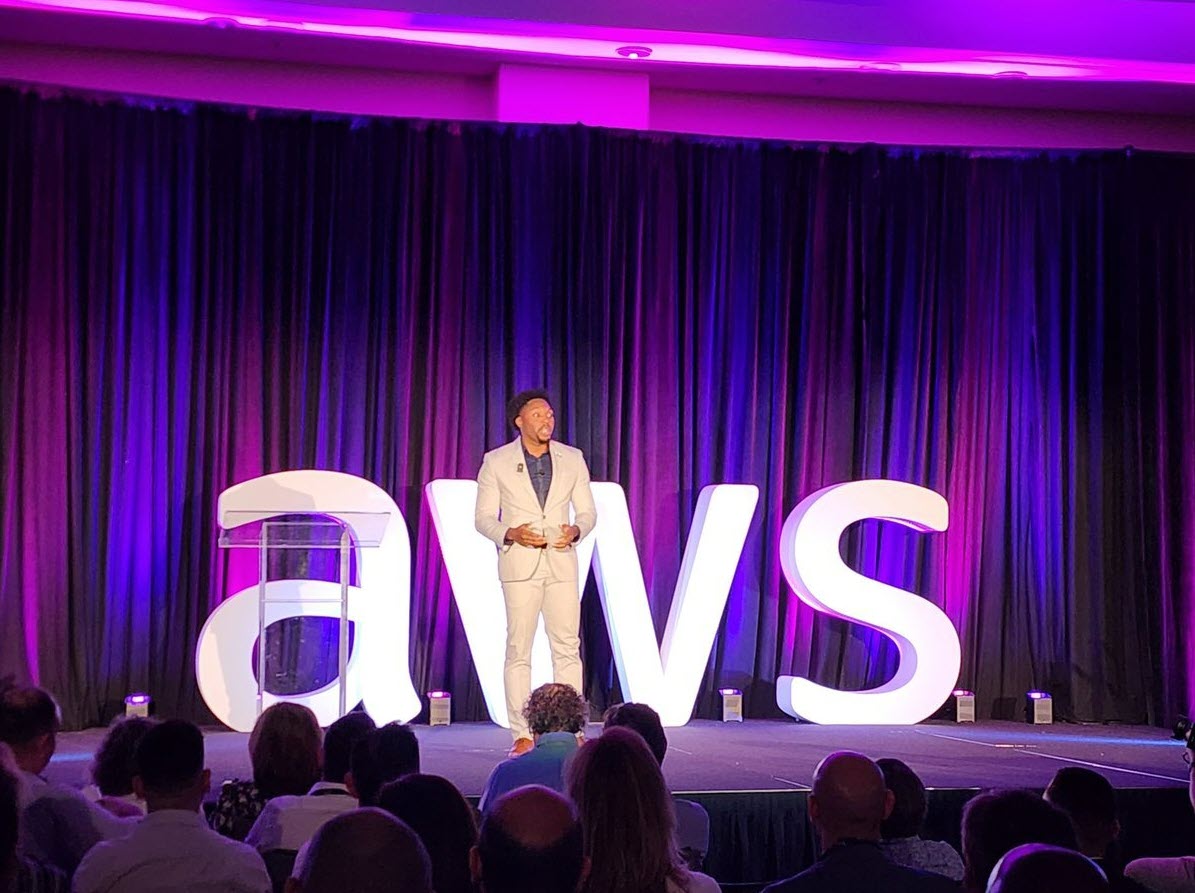
During his keynote speech, Erick Gavin of Venture Miami shares advice and support with Startups: “Take advantage of diving into AWS events and resources.”
- The AWS Generative AI Accelerator was announced – a 10-week program designed to help early-stage startups using Generative AI solve big challenges to scale and grow. This gave attendees the opportunity to engage and ask questions of AWS experts in person about the program and the application process. Stay tuned to the AWS Startup social platforms, as the selected Generative AI Accelerator participants will be announced soon.
- The panel discussions like “Raising Money in Miami” were lively, well-attended, and the panelists were very intentional with their advice. That panel included Andres Barreto of Techstars, David Blumberg of Blumberg Capital, Alexandra W of Clerisy Capital, Joshua Siegel of AcronymVC, and founder Yasmine Morrison.

The Raising Money In Miami panel discussion.
Learning new ways to raise money to fund your startup is never a bad idea. Watch part of the panel discussion here.
- Hearing from AWS customers and partners about how much the AWS Startup Day Miami event means to them. Most of the sentiments were made spontaneously, like by Macarena Bravo of Bravo Consulting, who spoke about how much she loves being an AWS cloud customer and attending AWS events and trainings. This led to the AWS team recording a series of customer videos.
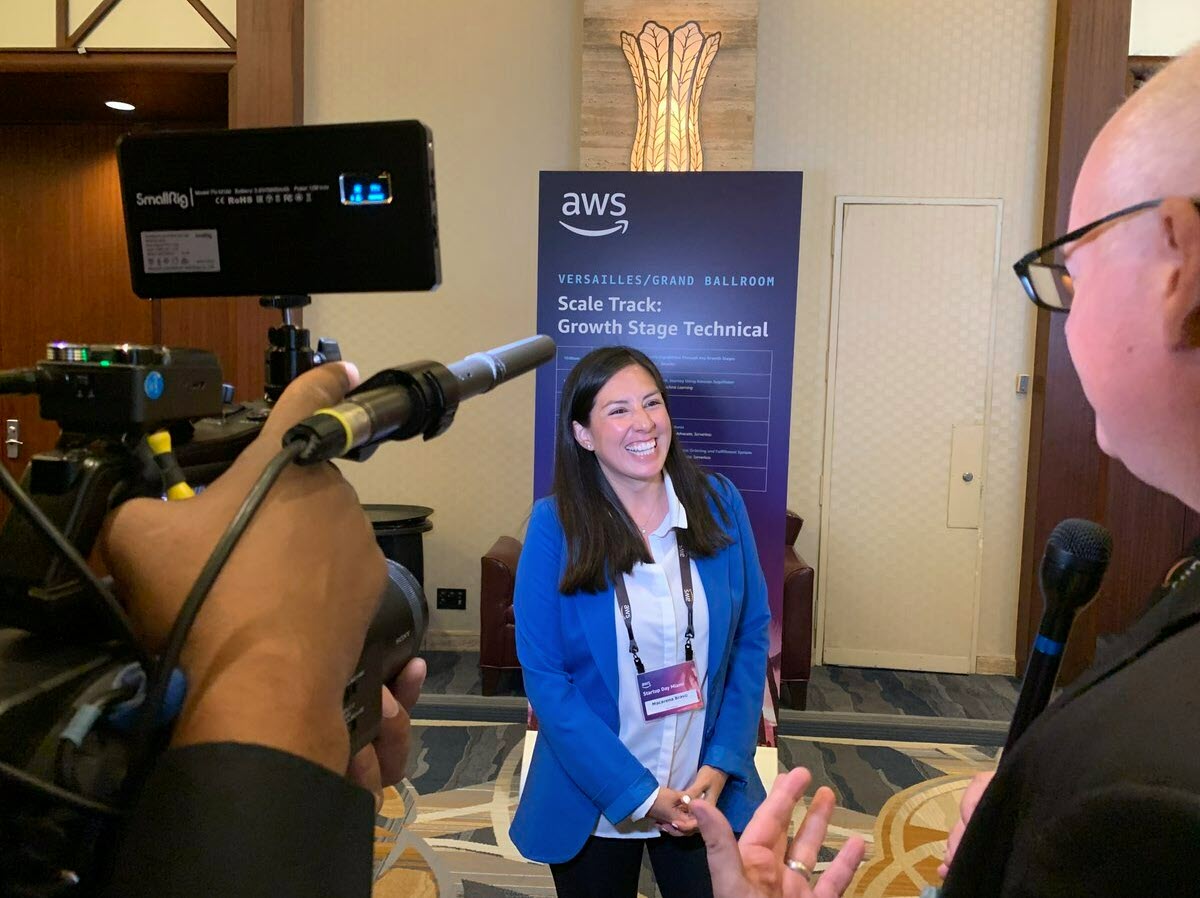
Macarena Bravo of Bravo Consulting attends Startup Day Miami.
Hear what attendees say about Startup Day Miami.
- Networking happy hour. Many of the speakers were in attendance for this portion of the event. In any industry it is important to build relationships, but more so in the tech startup world. It is important to continue to learn, and stay connected with the larger tech community as new challenges and changes come up every day. Building that community helps with easing the burden of going it alone.

People enjoying everyone’s favorite hour of the day.
- Last but not least, come meet the AWS Startups Team and let us answer your questions. In learning more about AWS services for startups, it’s great to have that friendly face or cloud expert to discuss potential opportunities and the wide range of AWS services that fit your startup needs.
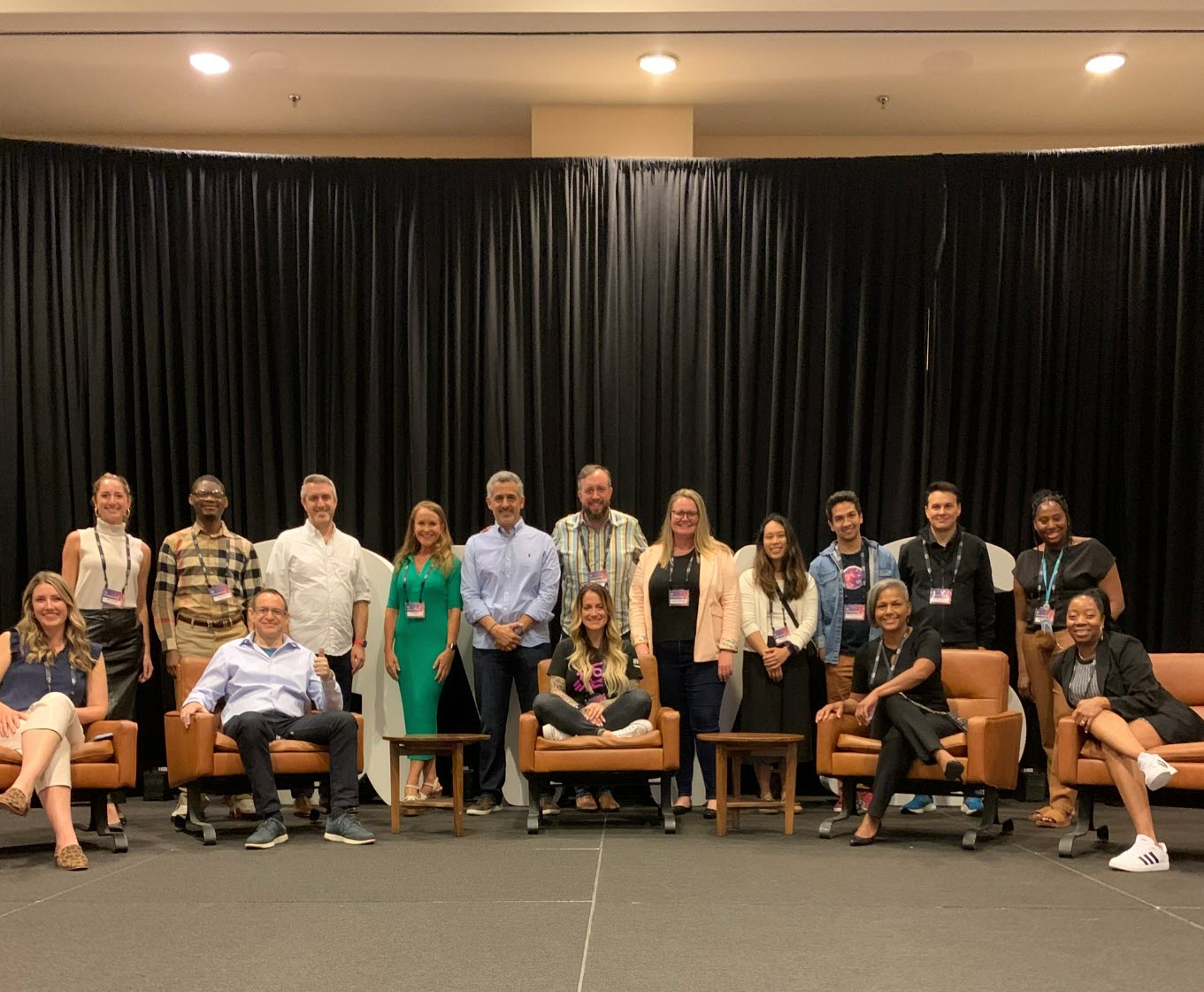
Ready to attend an AWS Startup Day and accelerate your startup? Check out the upcoming AWS Startup Day San Francisco on May 5th.
Stay in-the-know for all things startups:
- AWS Startups Twitter for the timely and behind-the-scenes content
- AWS Startups LinkedIn for the latest insights
- AWS Startups Facebook for the biggest news
- AWS Instagram for the motivational and inspirational
Few people have seen the technology sector transform like Ben Horowitz. The Andreessen Horowitz (a16z) cofounder, entrepreneur, and New York Times-bestselling author has spent decades fostering innovation and building strong business relationships—and has plenty of wisdom to share.
Horowitz spoke with Ruba Borno, Amazon Web Services (AWS) Vice President of Worldwide Channels and Alliances, at the AWS ‘Startups in the Stadium’ event at re:Invent this past December. Here are six major insights from their discussion—on trust, venture capital, the cloud’s impact, and more.

Ben Horowitz and Ruba Borno at the AWS Startups in the Stadium event at re:Invent.
Today’s VC industry empowers founders
Since a16z began in 2009, Horowitz has witnessed – and spearheaded – several major shifts shaping the venture capital (VC) industry. For one thing, he explained, it’s more likely today that founders will lead their businesses through all stages of growth, instead of leading from “zero to one” and then ceding the role to a professional chief executive officer (CEO).
That shift is due partially to the philosophy that a16z brought to the VC world. “Our idea was … what if we build a firm that enables the founder to be a CEO?” Horowitz explained. After all, a leader who truly understands the company could shepherd the business through another winning project—a secondary product, for instance.
He cited Amazon Web Services itself as an example. “It’s another [project] that was done much later. And we all know if Jeff [Bezos] wasn’t the CEO, it would never have happened. You can’t bring in somebody who doesn’t really understand the company to go from zero to one.”
Cash is (and remains) king
As much of the world heads into economic uncertainty, Horowitz warned startups against committing what he views as business’ one “unforgivable sin”: running out of cash. In a downturn, this becomes particularly difficult, as consumers tend to cut newer companies from their budgets before tried-and-true stalwarts.
Still, Horowitz said, it should remain the priority. “You can screw up absolutely everything: the product, the go-to-market, everything. But if you still have money, you can fix it … if you run out of money, it doesn’t matter how many good things you do. You’re dead.”
The cloud drives innovation
Many of a16z’s portfolio companies build on AWS, which Horowitz sees as a means to scale, innovate, and streamline day-to-day operations.
“The cloud deployment model is just such a massive advance in every person’s ability to build great software, solve big important problems, and focus on higher level issues,” he said.
He pointed to the difference between bygone tech companies like Netscape, which sold its Navigator browser as a physical, boxed product, and newer players like Snap, which created and distributed its product with just, “four guys, a laptop, AWS, boom.”
“[AWS] has been a big change,” he said. “Which is why there are so many more startups now.”
In addition to boosting innovation, AWS helps smooth out internal processes, he said. Old-school software was difficult to install and implement—plus, training teams on new software (and updates) could be arduous. Integrating new software was so difficult, Horowitz explained, that a company’s chief information officer (CIO) was the point-of-contact for sales. But when the cloud came along, it became much easier, and software companies could sell to whichever department had the actual business need.
“You don’t need training,” Horowitz said. “The software is usable enough and away you go.”
Three ways to succeed with AWS
Horowitz had three pieces of advice for businesses interested in working with AWS.
First, he said, it’s imperative to get into the AWS Marketplace. “It works,” he said. “You will get sales, it’ll help you.”
Next, he emphasized the importance of aligning your sales teams with AWS sales. “Your regional salespeople need to find their AWS sales counterpart, who want to help you. Your teams should find them … call them up … it’s maybe your best lead-gen opportunity.”
Finally, he recommends all businesses go through the AWS technical review process. “The reason you should go through that is: If you’re in the AWS field, how do you know if this software is any good?,” he said. The way to find out: approval from a trusted party like AWS.
Building trust within partnerships
Horowitz shared his organization’s culture values trust and communication. Here’s three ways a16z builds trust across partnerships.
First, he said, “we have one culture for how we treat each other and how we treat people outside [the organization]. We don’t change it. It’s not us and them.”
Next, his word—and the word of his team—is a bond. “You don’t need a contract with us,” he said. “If we say it, we’re going to do it. We tell our employees to be careful about what they say because they’ll bind the company.” (In fact, a16z employees must sign a culture document affirming that they understand this.)
Finally, he emphasized that he does not believe in transactional relationships. “We take the long view of relationships because we’re in the relationship business,” he explained. “We’re either in business with you for the long term or we’re not.”
Creating the future you want
Horowitz has held a variety of roles throughout his career. As Borno put it, he’s been “a product manager, CEO of a startup to GM at HP, and … founder of one of the most successful VC firms in the world.”
Horowitz credited this path not from a desire to reinvent himself, but rather a willingness to step up and do what’s needed. He recalled that in the early days of Netscape, where he worked as a product manager, his future partner (and cofounder of Netscape) Marc Andreessen pointed out that if they didn’t take steps to bolster the early internet, there was no guarantee that someone else would take on that work. So, they did and that proactiveness paid off: It helped usher in SSL, JavaScript, and more.
Horowitz has carried that attitude with him in his subsequent endeavors: The priority is always a positive impact on the customer.
“What do I need to step up and do?” Horowitz said. “What am I capable of doing that’s going to make a difference?”
See the full interview here.

Building a scalable tech stack is an iterative process for startups.
“To the moon ”
“Evolutionary Architectures” is a four-part blog series that shows how solution designs and decisions evolve as companies go through the different stages of the startups lifecycle. In this series, we follow the aptly named Example Startup whose idea is to create a “fantasy stock market” application, similar to fantasy sports leagues. They envision holding four “tournaments” over the course of a year.
The second blog described how the startup started evolving their technical solutions while the founders were getting ready for fund raising. In part 3, we will see how Example Startup further progresses in maturing their tech stack and positioning themselves well for scale.
Scaling efficiently by transitioning to a microservices architecture
The fantasy stock trading team is growing and new components and solutions are being built. As the technical portfolio expands, certain cracks begin to appear that required the team’s attention.
“Old habits die hard,” and the team begins to see how this can cause problems for their startup’s growth: The aggressive timelines and the enthusiasm to get more done with less is leading to increasing technical debt. One aspect of this technical debt is a gradual proliferation of monoliths, as opposed to the microservice architecture that the team had initially decided upon. Monolith concerns such as scalability and performance bottlenecks begin to show during testing and the introduction of new features. Luckily, the team quickly recognizes the challenges this monolithic approach poses to the optimal scaling of workloads. They decide to take a step back and reevaluate their development practices. One of the developers remembers that the AWS solutions architect (SA) had anticipated some of these problems in an earlier conversation. The Example Startup team schedules a call with AWS to get some help.
Breaking down monoliths and transitioning into a microservices-based paradigm is a broad topic so the AWS SA recommends an App Modernization Immersion Day for the team at Example Startup. The immersion day uses a related workshop as a backdrop, with a focus on workloads relevant to startups. The event is attended by nearly all developers at the company and ends up being a game-changer. Over the course of a single day, the team is able to learn how to properly define, design, and implement microservices. They also learn about charting a gradual migration path from a monolith application to a set of microservices without having to redo everything at once. The team is glad to catch their mistakes early on and learn some best practices that will help them going forward. The solutions architect also shares an AWS whitepaper focused on modernization strategies that can fill in any knowledge gaps on the Example Startup team.
The experience with app modernization provides so much value to Example Startup that the team decides to apply the same approach of leveraging existing best practices for different functional areas going forward. The engineers and product manager schedule a call to share their roadmap for the remainder of the year with AWS, in an effort to avoid duplicative work. Example Startup already signed a mutual non-disclosure agreement (MNDA) with AWS and there was a productive free flow of ideas across both sides during this conversation, as well as some great news: It turns out that a feature Example Startup was considering building out themselves is already on AWS’ roadmap for the next quarter, and this frees up a chunk of engineering time for the team.
The next topic on Example Startup’s list of areas to improve relates to Infrastructure as Code (IaC), continuous integration and continuous delivery (CI/CD), and automated testing. Two newly hired developer operations (DevOps) folks aren’t satisfied with many of the current operational mechanisms at the startup, especially things like building and testing environments, as well as managing code artifacts. A growing team at Example Startup means that more people have access to these sensitive processes, thereby introducing unnecessary risk. The two new team members already have some experience with Terraform as their approach to IaC. They are happy to learn that AWS is well supported by Terraform, and to discover other tools like AWS CloudFormation and AWS CDK in case an alternative is needed. However, they still need some help with their CI/CD setup. Their attempts insofar lack cohesion and it proves difficult to make their build tool work well with their deployment tool. Additionally, they are still looking for a suitable approach to manage their container images. The AWS team recommends looking at AWS CodePipeline because it meets their needs for integrating a build and a deployment tool seamlessly and also includes automated testing, all paired with support for various environments. Using CodePipeline allows integration with solutions that weren’t necessarily built natively on AWS, as well as robust support for other tools such as AWS CodeBuild, AWS CodeDeploy and third-party tooling. Implementing CodePipeline allows Example Startup to check off another big item of their list.
With the team well on its path to a proper implementation of microservices, they feel empowered to work on some of the other complex challenges that remain outstanding. For one, the presence of multiple services operating independently naturally brings up the question of communication across these services. There is a big question mark around whether every cross-service call should be synchronous or asynchronous in communication, in addition to how the team can begin adopting best-practices patterns such as publish/subscribe (PubSub) messaging. The team understands broadly that adopting an event-driven architecture would be beneficial, especially with the move away from monoliths, but they are a little overwhelmed with the endless array of AWS services related to that architecture, including but not limited to Amazon EventBridge, Amazon Simple Queue Service (Amazon SQS), Amazon Simple Notification Service (Amazon SNS), and Amazon Managed Streaming for Apache Kafka (Amazon MSK). This time around, the team is able to find some resources themselves as a great starting point such as some very useful workshops and blogs on the topic. The “event driven” paradigm is slowly becoming another tool in the team’s toolbox.
Developing a stronger security strategy
Security continued being top of mind for our startup and tools like the AWS Startup Security Baseline (AWS SSB) help them to get started. Unfortunately, you can never have too much security. The initial implementation of AWS WAF was a good start, but the team needs to start thinking more proactively about prevention, detection, and remediation. They begin upskilling themselves on the many AWS services focused on security that can help them implement a strong security strategy.
The growing team and the involvement of partners makes access control, permissions, and governance other topics requiring an increasing amount of focus. The team is trying to implement best practices such as the principle of least-privilege when applying permissions. At a minimum, they want to move the production workloads into their own, separate accounts. As the team adopts these best practices, they see the increase in operational complexity due to the added layers of management and permissions they are now having to deal with. It becomes rapidly obvious that they need a mechanized approach to account structure. Someone mentions AWS Organizations,which seems like a step in the right direction so they reach out to their trusty AWS SA for a chat. The SA shares some relevant advice, like looking at AWS Control Tower as an easier approach to managing multiple accounts and AWS Organizations. Since this is the first of many steps towards achieving a robust multi-account strategy, the AWS SA also shared with the team the “Transitioning to multiple AWS accounts” prescriptive guidance. This guide includes best practices around account migration, user management, networking, security, and architecture when moving to a multiple accounts setup.
Optimizing workloads for performance
The team is tackling some foundational pieces so the startup will be well poised to grow at the right pace. A few major items are crossed off the list and others have action plans in place. The developers are doing as much as they can to optimize their workloads for performance, but have identified some opportunities for further improvement that go beyond code, such as edge caching with Amazon CloudFront, caching on an application level with Amazon ElastiCache and Database caching. The team is increasingly growing reliant on AWS Managed Services to give them the functionality they need while keeping the associated operational complexity at a minimum. Another managed service that some of the developers discover and find surprisingly easy to use is AWS Batch. The initial feed processing approach with AWS Lambda is starting to hit its limits due to the exponential increase in the volume of data that needs to be processed. After some experimentation, developers are able to chart a path to using AWS Batch that allows them to keep growing with relatively little increase in operational burden and while keeping costs low.

The updated AWS architecture diagram for Example Startup
Proving their startup’s value proposition
All this good work at Example Startup does not go unnoticed. Building in an agile-yet-sustainable manner without reliance on short-term workarounds shows that the company is thinking about the long term, displays maturity, and has the capability to deliver. These traits along–with an innovative solution and a good product market fit—are at the core of the company’s value proposition. The founders successfully convey their company’s value to couple of different venture capital firms and close their first Series A funding round. Example Startup is on its way to the moon.
Check out the first blog and second blog in the Evolutionary Architectures series.
Building on the exciting new developments around generative AI, we are happy to launch the AWS Generative AI Accelerator, a 10-week program designed to take the most promising generative AI startups around the globe to the next level.
Generative AI is an incredibly exciting field that has the potential to revolutionize many industries. Tech startups will play an important role in bringing this technology into the mainstream. Take the film industry, for example. The visual effects that make heart-pumping action scenes, amazing super heroes, and enthralling new worlds take months of tedious work by hundreds of artists to come to fruition—adding up numerous hours in post-production time and using millions of dollars in production budget. Because visual effects are so expensive and time-consuming, films with more modest resources struggle to implement high-quality visual effects to bring forth their vision.
Runway, one of our startup customers, is helping artists revolutionize filmmaking with their AI Magic Tools—some of which have been used in the award-winning hit “Everything, Everywhere, All At Once.” Their text-guided generative diffusion models are unlocking powerful new multi-modal creation and editing solutions for artists. With Runway, the difficult tasks of composition, stylization, inpainting, motion tracking, and other processes are made easier and quicker for creators, allowing them to focus on more idea concepts and to deliver faster iterations. These tools also cut down production costs and lower the barrier for filmmakers—professionals and amateurs alike—to push the boundaries of movie making and let their imagination run free.
In addition to its creative potential, generative AI has numerous practical applications. It can be used in healthcare to create personalized treatment plans or to better analyze medical images; in finance, it can generate smarter analysis and draw insights; in tech, it can write code and reduce human-error bugs; in manufacturing, it can design new products and optimize production processes.
Here at AWS, we believe the startup community will be the driving force moving these innovations forward. The AWS Generative AI Accelerator is designed to act as catalyst, helping some of the most promising companies in this space to take their ideas off the ground. With a program tailored to meet the needs of generative AI startups, the AWS Generative AI Accelerator will provide access to impactful AI models and tools, customized go-to-market strategies, machine learning stack optimization, and more. Selected startups will also have access to networking opportunities with industry luminaries, potential investors, and customers. In addition, the selected startups will receive up to $300,000 in AWS credits to build their products and services on our tech stack, as well as dedicated business and technical mentors matched based on industry vertical, market, and stage.
To fully benefit from the program, startups should have a minimal viable product (MVP) already developed, some traction with customers, and be working to enhance their product value proposition in order to scale. Although the program is open to all startups, those already building on AWS will receive the most benefit from the accelerator’s dedicated AWS Solutions Architect team, who will support every step of their product development. The program is open to companies around the globe, with no limitations around use case—we want to empower companies applying generative AI to solutions from legal and marketing, to software engineering, green energy, and life sciences, including drug discovery.
Here’s what some of our investor partners are saying about the program:
“AWS Accelerator offers a compelling program for founders building in the Generative AI space, and I look forward to meeting the cohort when they’re announced,” said Sonya Huang, Partner at Sequoia Capital.
“With so much activity and opportunity today in the world of AI-driven startups, it is a great time for AWS to launch this Generative AI Accelerator. I am looking forward to seeing which companies are selected for the program and how AWS will partner with them to turbocharge their growth,” said Rob Toews, Partner at Radical Ventures.
We are excited to meet the founders who are applying generative AI to solve some of our society’s most riveting challenges.
Applications for the AWS Generative AI Accelerator will be open today through April 17, 2023. To learn more and apply, please visit AWS Generative AI Accelerator.

Startups know firsthand how better technology can improve the quality of life: From AI/ML allowing scientists to better predict patient health outcomes, to cloud computing driving life-saving innovation, and modern apps enhancing accessibility.
With better technology also comes the opportunity for criminals to commit more advanced levels of crime. Fraud, especially, is occurring with greater technical sophistication as society transitions into a digital-first world. Fraud and cybercrime are also growing at significant rates, and now cost businesses around the world over $6 trillion per year or an average of 5% of their revenues.
To outpace and outsmart the technology criminals use to commit fraud, former bankers Whitney Anderson and Cathy Ross founded Fraud.net, a modern fraud and compliance platform, in 2016. Fraud.net offers customers in the banking and fintech industries across the globe a serverless modern application that uses artificial intelligence and machine learning to rapidly identify fraud, leading to more efficient operations and higher customer satisfaction.
Providing a modern solution to an evolving problem

Whitney Anderson, co-founder and chief executive officer (CEO) of Fraud.net
As is the case with many successful startups, Fraud.net encountered a challenge and saw the opportunity to build a solution that helps themselves and other companies to overcome it.
“We were our own use case,” explains Whitney. While operating companies in the digital commerce and payments world, “One of the greatest frustrations was experiencing multi-percent fraud rates, and payment processors not giving us access to the information we needed to solve the fraud.”
To solve a problem that caused harm to companies and customers alike, he explains, “We started pooling together other players in the digital world: payment facilitators, merchants, and other ecosystem participants.”
“By sharing secure and anonymized data, we were able to reduce fraud by more than by 66%. It was simple, immediate, and intuitive.”
One major finding was that the same people used the same technology-based methods to defraud multiple companies. “It’s really difficult to fight fraud by yourself,” says Whitney, “Sharing data in a safe and secure way let us understand a lot more about the bad actors and separate them with the goal of really delighting the 99% good customers.”
Sharing an enormous amount of information within their cross-industry consortium meant that Fraud.net needed a rapid, scalable solution to unify their data and create real-time actionable insights.
Fraud.net chose to go all-in on Amazon Web Services (AWS).
Building an event-driven architecture on AWS
As a cloud-native modern app, Fraud.net uses an event-driven architecture that uses serverless components. Event-driven architecture makes it more efficient for startups to develop modern apps because they scale up to address events and scale down when no events occur. This can result in saving the startup resources and costs, which is critical as startups go to market. One benefit of Fraud.net’s event-driven architecture is the scalability and speed with which their developers are able to bring products to market.
Fraud.net’s AWS solutions include EC2 and Lambda for compute, S3 for highly scalable object storage, and DynamoDB as their noSQL serverless database.
Together, these solutions help them to unify and analyze three levels of data: customer-level data, institution-level data, and cross-institution data.
“Because of AWS’ serverless technologies and other incredible innovations, we’ve been able to unify data for fraud prevention, anti-money laundering, and compliance functions,” says Whitney.
Events from the Fraud.net platform arrive through a Fraud.net API that is managed by Amazon API Gateway. When the events arrive, they trigger an AWS Lambda function to process records from Amazon DynamoDB.
“Lambda functions have been a game-changer for us. We ask thousands of questions for each application or transaction submitted to us for risk assessment, based on different scenarios and risk profiles. All of those would have needed to be done in our own data center with tons and tons of servers,” says Whitney. “Instead, Lambda and its serverless capacity help us answer those questions in milliseconds, and helps us achieve decision accuracy upwards of 99.9%. It’s hugely efficient and cost-effective technology for us and our clients.”
Fraud.net also uses Amazon Kinesis to process and analyze streaming data in real-time to give customers results based on the latest and most comprehensive data. Amazon Redshift is their data warehouse, which they use to conduct data analytics on incoming events, transactions, and more.
Per Whitney, “AWS helps us process thousands of transactions per second, at a scale that was virtually impossible three or four years ago.”
Going serverless for scale and speed
Whitney credits AWS serverless technology as a critical component in Fraud.net’s mission to make every digital transaction safe. “In the past, providing a unified suite of microservices to fight fraud is something that hadn’t been done, or certainly hadn’t been done effectively,” explains Whitney. “With some of the older siloed databases, it wasn’t even possible to do.”
“Serverless is also unbelievably quick and easy, relative to the old days with on-premise software when a bank could expect it to take six months to a year to integrate a system,” says Whitney. Fraud.net accomplishes most of their customer onboarding with a simple set of no-code tools that leverage a suite of APIs to onboard a bank or fintech within 30 days, including the planning and training time.
“Because it’s so cost-effective, we’re 99% serverless,” says Whitney.
Fraud.net offers one of their serverless products, Transaction AI—a transaction monitoring, fraud prevention, and revenue enhancement platform–on the AWS Marketplace.
Gaining actionable insights using machine learning
Fraud.net uses Amazon SageMaker to create, train, and deploy the machine learning models that provide their customers with an average of an 80% reduction in fraud cases, a 92% reduction in false positives, and a 30% increase in approvals for good customers that were erroneously flagged as high-risk.
Machine learning allows Fraud.net to provide banks and fintechs with answers in under a second that otherwise may have taken employees hours of time-consuming tasks, such as manually cross-checking client information. Whitney explains, “AWS technology as a baseline, with Fraud.net’s software layer on top, enables teams to be much more efficient and spend their time more wisely.”
“The underlying technology, along with Amazon’s pricing, enables us to ask about 20,000 questions about identities and behaviors every time we receive a new account application or transaction,” explains Whitney. “All of that gets handed off to machine learning. We now routinely build clients custom ML risk models, with several hundred million features as inputs, because AWS has made it so relatively inexpensive to do.”
Teaming up with AWS to provide value to their customers

Cathy Ross shares her insights at an AWS event.
Alongside the AWS technology that Fraud.net uses to give their customers rapid and accurate tools to fight fraud, they also work with AWS to optimize customer costs. Whitney explains, “Our customer’s average return on investment (ROI) using Fraud.net is over 700%. That’s largely due to AWS’ efficiencies in cost structure. We leverage that and offer an incredible value to any company that uses Fraud.net.”
Fraud.net also collaborates with AWS teams in retail payments, financial crime, and other teams to give their clients a safe and effective onboarding experience. “We get a lot of support from various AWS teams,” says Whitney. “This is often a client’s first interaction with the cloud environment. Some of our big financial services clients come from on-premises environments, and they specifically come to us because we prove out a super-strong ROI from using their first cloud-based project.”
Looking to the future of fighting fraud
As a global fraud prevention management system, Fraud.net is, “all about scale at this point,” says Whitney. With clients ranging from top-tier financial institutions all the way down to early-stage fintech startups, and across industries such as financial, e-commerce, travel, and more, Fraud.net’s goal is to be the preeminent fraud and risk management layer for all digital enterprises.
For other founders looking to build a successful startup, Whitney advises three things that make a good entrepreneur:
- Know an industry really well, see the gaps, and envision a better future for that industry.
- Be a problem solver who gets excited about the prospect of fixing the problems that you see.
- Have a deep reserve of energy and enthusiasm to get you through the good times and the bad.
For fintech startups in particular, Whitney advises that the upcoming FedNow Service launch in 2023 is likely to, “present a huge new set of risks and a need for risk to be solved immediately.” The FedNow Service is a real-time payments network that will allow money to transfer in seconds instead of in days.
With this advance in payments technology. Whitney expects to see an enormous amount of beneficial innovation on AWS and in the fintech world as technology ramps up to outpace fraudsters.
“It returns back to simple trust enablement,” he explains. “For banks and companies, it’s about restoring trust in your relationships with customers thousands of miles away that you’ll never meet.”
Curious about how AWS can help kick start your startup? Join our latest Global Fintech CTO Fellowship cohort launching April 2023!
Check out more Fintech startups building and scaling on AWS :

Holding onto your time—to be a spouse, to be a community member, to be an individual—is difficult, particularly in the world of startups. InsightFinder, an artificial intelligence (AI) startup that uses machine learning (ML) to help customers prevent outages in their cloud infrastructure, is on a mission to change that.

Founded by Helen Gu in 2016, InsightFinder uses unsupervised machine learning to make cloud infrastructure more reliable. The company’s AI-driven predictive observability platform helps companies to predict business-impacting incidents as well as pinpoint the root cause of impending incidents to avoid business loss and brand damage.

Helen Gu, founder and CEO of InsightFinder
Helen says, “IT outages have a huge impact on everybody’s life. InsightFinder’s mission is to help everybody have a more reliable IT system.”
Fewer outages allow people more time to focus on doing what’s most important in their lives and for their businesses.
Alongside being the founder and chief executive officer (CEO) of InsightFinder, Helen is a professor at North Carolina State University and a distributed systems cloud computing expert whose work spans 20 years. “InsightFinder is created out of over 15 years of research work sponsored by National Science Foundation and industry partners,” she explains. “From day one, I’ve been very passionate about this field because I think it will affect a lot of people.”
Building InsightFinder’s solution with AWS
Amazon Web Services (AWS) played an integral role in InsightFinder’s development on the cloud. “When we first started, in the early days, we were looking for something that was easy to use,” Gu says.
“AWS has a very nice program, AWS Activate, that gives a lot of credits to startup companies. We got quite a lot of credits that helped us to bootstrap our development. That played a critical role for us.”
It’s also thanks in part to AWS that InsightFinder has been able to build the high-performance Unified Intelligence Engine that fuels its success. The company leverages AWS solutions according to their needs, whether for CPU-intensive processes or I/O-intensive processes. “A lot of AI tech companies think you need to invest heavily in hardware resources,” says Helen. Through AWS, “We can actually build a high-performance engine, and with reasonable cost.”
By 2020, InsightFinder saw the problems that their customers faced were evolving, mostly due to the Covid-19 pandemic. One startup, Apprendis, faced a problem of scale as the number of students and teachers using their platform for science education, InqITS, grew quickly. The company is an active Amazon CloudWatch user, but lacked the internal infrastructure to filter the alerts sent their way. By connecting the InsightFinder engine with the CloudWatch data, the company could receive essential insights quickly and easily. “It’s very simple,” says Helen. “A few clicks, and they can actually start to use the data and the predictions, and get the root cause analysis from AWS CloudWatch data through the InsightFinder engine.” Using CloudWatch data, InsightFinder caught hard-to-find software bugs and performance issues before end users noticed, which allowed the Apprendis team to scale their system without hiring DevOps engineers and to ensure seamless usage of its platform.
Now, InsightFinder is looking to the AWS Partner Network to push the company to the next level.
“Being a fast-growing tech startup company, we don’t want to hire a large sales force to directly sell to a lot of customers,” Helen says. “AWS Partner Network is going to be an important go to market motion for us. It’s a more productive, effective, mutual, beneficial path for us.”
Looking to the future of AI
As fears that AI could impact job opportunities grow, Helen is clear that she doesn’t believe the goal of InsightFinder, or AI as a whole, is to replace people: “There’s no way we can have enough people, particularly skilled people, sitting there looking at all those charts for each machine and predicting future incidents.” Instead, Helen sees AI as a tool to augment human skill; that the technology should focus on things that humans cannot do. The algorithms that Helen works with fill the gaps that humans cannot, performing 24/7 work that is suitable for a machine, not a human being.
“The most precious thing in the world is time,” says Gu. “Our impact is that we want to give time back to people to do things they enjoy, rather than fix IT outages in the middle of the night.”
Curious about how AWS can help kick start your startup? Join AWS Activate to build and scale your startup with the right resources at the right time.
Check out more AIML startups building and scaling on AWS :

To celebrate International Women’s Day and Women’s History Month, we’re featuring posts throughout the month that highlight women in technology who are building and creating. Above all, these women are inspiring, empowering, and encouraging everyone in technology—especially women and girls— to prove what’s possible. Three of our Solutions Architects tell us how they got here, the coolest milestones they’ve helped businesses achieve, and the advice they have for other women who want to make it in tech.
Across AWS for Startups, women are working to make the startup space more equitable. Solutions Architects are a big part of that initiative, since they act as strategic advisors who make it easier for startups of every background to thrive. By guiding enterprising founders toward the resources and building blocks that will help them succeed, Solutions Architects break down barriers to entry and welcome startups into a trusted global ecosystem.
There’s no one-size-fits-all solution to the real-world challenges startups face, so AWS Solutions Architects get to flex both their creative and technical muscles as they design the personalized fixes that will help each startup thrive.
This Women’s History Month, we chatted with three AWS Solutions Architects who are helping startups of all backgrounds accelerate their businesses. Skye Hart is based in Denver, Colorado, and comes to the team with a background in data engineering. Jamila Jamilova uses her expertise as an economist to help startups working in the UK and Ireland. Aleena Yunus is based in Munich and specializes in analytics as she helps B2B-engaged startups achieve their goals.
How would you describe being a Solutions Architect?
Aleena: It can be anything from speaking at conferences to writing long emails. I act like a strategic advisor with regard to a startup’s roadmap and everything around infrastructure and architecting. We whiteboard together, or I sometimes help them build architectures, create a minimum viable product, or a proof of concept.
Skye: I like to think of myself as an extension of the startups I work with.
Jamila: I’m their trusted technical advisor, but I’m always looking at their core business and trying to understand, how can I help them optimize costs?
What are some of your favorite parts of your job?
Jamila: The diverse landscape. I am working with business decision-makers and with technical people, and this gives me a big picture of how the startup operates.
Skye: Every morning I wake up and I’m either putting on a lab coat and talking to a life sciences organization that’s changing the game for cancer research or I’m putting on my little construction hat and trying to work with mechanical engineers to develop IoT sensors.
Aleena: Creating usable content. I’m really passionate about sustainability and created a set of best practices. Ever since then, I’ve also been in touch with other customers who want to talk about sustainability.
You are women working in a startup world where there are still too many barriers to entry for people who are not wealthy, white, and male. What were some of the things that led you to this career despite those barriers?
Skye: In my first tech job [not as a Solutions Architect], I walked into a room and there were 35 guys and two women. I said, ‘This is just going to be that way.’ You have to work on overcoming imposter syndrome and being confident in yourself.
Aleena: It’s important to have role models. My older sister is in tech, and it was really important to see that, okay, there is disparity, but there are people who are making it.
Jamila: If you are in a company where you feel belongingness and where you feel that you are respected for who you are, for the skills you bring to the table, you don’t see any barriers. I feel like I am kind of a piece of a puzzle in a big picture. I can bring in my skill set, my experience, my worldview.
What are some of the times you’ve been able to help a startup customer achieve new goals?
Aleena: We helped one of my customers build a data pipeline from scratch in six weeks when they weren’t doing anything with the data they were storing. We wanted them to understand they could enable their sales team to get insights on it.
Jamila: I had a customer about to go on a fundraising round, but they desperately needed to show that they could bring the cost down, keep the same quality, and serve their customers as expected. My team worked to identify their architecture and the services they needed to optimize costs.
Skye: We had a healthcare company outgrowing their current environment. We had a leadership offsite with them and then kicked AWS into gear, and by developing relationships with business development on their go-to-market strategies, we organized immersion days for machine learning and security to get them hands-on training for up to 60 different engineers in multiple different cities.
What advice do you have for startups across the board?
Skye: Don’t be afraid to ask for help. AWS for Startups is an ecosystem. It lives and breathes for startups everywhere. Ask us what you need, what you want, what you dream about, and we’ll align the right things.
Jamila: Please do thorough research before you actually invest or get credits to run your business. Search for which cloud provider is best for your startup, and you will see lots of forums and resources. You will discover a whole world where you will be able to book free tech and business consultations.
Aleena: Picking the right tool for the right job is really important. If you don’t use the right building block, it’s not going to fit. Do your research about what is best for your use case.
Do you have any advice for students or people early in their careers who are interested in the startup landscape?
Aleena: Don’t get intimidated. If you have an interest, just go for it. What’s the worst that’s going to happen? You’re going to try and you’re not going to achieve it. It’s better than not trying at all.
Skye: Whatever industry you’re interested in, consider yourself a futurist. Ask yourself, ‘What is next?’ I see doctors thinking of ways that we can make telehealth easier and lawyers thinking of new ways that they make casework easier. Whatever you’re interested in, don’t think about what that position means right now, think about what that position’s going to mean in five years, 10 years, 20 years, and how tech can get you there.
Jamila: If someone tells you that you cannot be something, you can and you will. If you really want it, just have a goal, have perseverance, go for it. It’s okay to fail. Keep pushing, keep doing it millions of times, and then there will be one chance or one person who will believe in you and you will get it. And then you will pay it back for other people.
Explore more content that celebrates the achievements of women in tech, such as:
-
- AWS Startups Twitter stories that highlight amazing women in tech
- Celebrating Women in Tech with Panzura CEO Jill Stelfox
- Demo Day for AWS Impact Accelerator Women Founders Cohort
- Women founders Q&A – Learn how they’re impacting their communities, industries, and beyond
- How Women@Startups is building a community of women founders

The concept of community—bringing people with common interests together (or people together at all)—took on a whole new meaning when the COVID-19 pandemic hit in 2020. For the founders of Women@Startups, Sree Singaraju and Priya Koratkar, the pandemic highlighted an even greater need to bring together one particular community: women startup founders.
Founded in 2020, Women@Startups aims to provide visibility and voice to the challenges that women founders and women in technology face. The group intends to create a sense of belonging and support for women in tech, working to address the inequities and challenges faced by women in the industry. Through employee and customer support functions, the organization provides coaching, leadership development support, and connections to organizations that support funding.
Crafting an equitable future for women in tech

Priya Koratkar, co-founder of Women@Startups
As working mothers from immigrant backgrounds, Sree and Priya had a taste of isolation prior to the national mandate. Before joining AWS, both women had years of experience in typically male-dominated industries, Sree in finance and Priya in the tech sector.
“At some point in our careers, we realized that we were, at many times, the only women in the room and the only people of color in the room. And that formed a lot of our perspectives of what an equitable future for women in tech should look like,” Priya says. “Work-life balance conversations or conversations around equity in the workplace were nonexistent.”
It was the founders’ roles at AWS, as Solutions Architect and Sales Leader, that gave them the tools to expand these ideas into what would become Women@Startups. As Priya says, “We both came into this with the understanding that if we are now in a leadership position in an organization like AWS, which is on the forefront of helping startups, we have a moral responsibility to make a way and path for others who are coming in.”
Engaging women founders in open conversation
Year one at Women@Startups was not without its challenges. But the organization chose to harness these obstacles, instead focusing on an initial goal of creating awareness. Priya says: “year one was a year of learning, a year of connection, and a year of building community.” In determining strategy, “we focused on a lot of these conversations about what are some of the challenges that we are facing as employees. What are the challenges that our customers who are women founders and underrepresented founders focused on?”

Sree Singaraju, co-founder of Women@Startups
With these challenges in mind, the first initiative from Women@Startups, re:Connect, was born. re:Connect connects a small group of women leaders in candid, open conversation. According to Sree, members discussed topics such as, “I’m a working mother, and I’m struggling right now with COVID because my kids are at home and I’m figuring out how to strike a work-life balance.” It was the answers that formed the basis of what the future programs at Women@Startups would look like. “We tried to make it as actionable and as practical as possible. So, we selected leaders who were not afraid to speak out the truth and be real with the candidates and with the community here,” Sree says.

re:Connect attendees
Creating a unique perspective for an employee resource group
Employee Resource Groups (ERGs) like Women@Startups are not new at Amazon. Amazon has 13 ERGs that unite employees with shared identities across the globe. Groups such as “Body Positive Peers” and “Indigenous at Amazon” support each other and promote diversity and inclusion within the workplace. While ERGs by nature tend to be internally focused, Women@Startups puts their focus on both the internal and external to cater to their customers and provide a unique perspective. “Ours is an ERG that has two customers that we serve: one is our internal employee group, and the other is our customers, the female startup founders. That’s the key differentiator between any other ERG and us,” Priya says.
Today, Women@Startups has grown into a global organization with over 170 team members and a substantial global presences. They have secured sponsors who serve as leaders across regions to help expand and bring visibility to the challenges that women founders face, including Howard Wright, VP of AWS for Startups; Paul Duffy, North American (NAMER) solutions architect leader; Sherry Karamdashti, NAMER sales director; Kellen O’Connor, Europe, Middle East, and Africa (EMEA) sales director; and Gaurav Arora, Asia-Pacific (APJ) sales director.

Women@Startups with Howard Wright, VP of AWS for Startups
With this growth, Women@Startups has stayed true to their core values, while expanding their reach. “Our goal is to make sure that we always are mindful about creating a pipeline of diverse candidates, so we can have a wider pie. Once we have those employees in, we ask: how do we continue to make sure they are successful in their environment and that they have the right tools to construct and grow?” Priya says.
Externally, on the customer side, Women@Startups looks for opportunities to make connections with organizations that are supporting women founders from a funding perspective. “We like to make those introductions so that we are not just looking at coaching opportunities for our women founders, but actual practical application of how they can be connected with the right folks who could give them funding.”
As leaders, Priya and Sree go by the “Amazonian” leadership principles: think big and invent and simplify. These tenets form the basis for how the team thinks about future growth. “We really encourage every member to come with a think-big strategy and a long-term strategy of the work that they’re doing,” Priya says.
Focusing on the future
The pair is certainly not done; with women founders, funding bias remains prevalent. In 2022, women-founded businesses only raised 1.9% of all venture capital funds, a drop from 2021. As Sree says, this forms the focus of the future for the organization: “Last year, we learned some of the challenges of women in tech. This year, we really want to dive deep and see what we can do in the tech funding space.”
Priya agrees: “We want AWS for Startups to be a destination for all women to grow and build, whether that is internal, as employees, or any woman-led startup. Any startup should think of AWS as their partner and as the ecosystem that they have for them to be really successful. AWS for Startups has the understanding and the empathy to support them in the ways they need.”

Envisioning an equitable future together
Welcome to our new thought leadership spotlight, “The Evolving Role of the Startup CFO.” This series features perspectives from prominent players in the startup ecosystem. These blog posts tackle critical questions, including: What does the role of today’s startup chief financial officer (CFO) entail and how will it evolve over the lifecycle of a startup? How can we most effectively support CFOs as the cloud increases its dominance within the organization and balance sheet? And can the CFO better navigate—and ultimately enable—the relationship between technical leaders, CTOs, and engineering teams?
Leading our first spotlight is Jerry Chen, a veteran partner at Greylock Partners, a globally recognized venture capital firm.
The modern startup CFO plays the role of team quarterback
“The CFO really ties it all together,” says Jerry, stressing that the CFO’s responsibilities go well beyond simply saying “no,” which is how the role is often stereotyped. Instead, a dynamic CFO should serve as a partner to the chief executive officer (CEO), founders, and other company leaders—including those in charge of sales, marketing, product/growth analytics, research and development (R&D), and engineering. “The CFO, if he or she is doing her job right, is playing quarterback between all those departments.”
A strategic CFO should be familiar with—and understand which key levers drive—their company’s business model. Above all, it’s important for the CFO to understand which metrics matter most to their own company.
“A great strategic CFO can boil down the four or five metrics that matter for the company as a whole, and then work with each department to understand, from the engineering side, the drivers of cost from a people-cost perspective,” says Jerry.
When a CFO understands the key business drivers, they can better work with executive and people leaders at the company to ensure that they’re making smart hiring and salary decisions. “You build your board for good times and bad times,” says Jerry. Similarly, “Make sure your CFO is going to be a partner in crime to help the startup weather whatever bumps lie in the road ahead.”
Cash is king—and metrics matter
When it comes to non-negotiable metrics, Jerry says CFOs must prioritize the obvious ones. “What are the three reasons startups go out of business?” asks Jerry, who then paraphrases former professor Bill Sahlman from Harvard Business School. “One, they don’t raise enough cash. Two, they don’t price their solutions correctly and ultimately are not collecting enough revenue from customers. Three, they spend too much cash. Startups die because they run out of cash. So, it’s really important to focus on the cash burn, cash flow, cash burn rate.”
In addition, CFOs must pay attention to the company’s gross margins and watch the trend line of whichever metric is most important to their business. “A point in time doesn’t matter to your CFO or to the CEO,” says Jerry.
“It’s the trend line that matters. Are you going up and down? And more important than the trend line is the second derivative. Is burn increasing or decreasing? Is revenue growing faster than before? What’s the long-term gross margin?”
Introducing a strategic CFO to your business at the right time
It’s important to get timing right when hiring a CFO. “The CFO title comes later in life, when a company is pretty far along,” says Jerry. “CFO or C titles are typically reserved for companies at scale.” In the early days, when a startup is only dealing with expenses, they will most likely be able to outsource their payroll to a third party. When the company starts generating revenue, they may need to hire a director of finance in order to manage both the sales and revenue.
“As you’re scaling up, whatever the top line is, you’re going to need a vice president (VP) of finance who can grow into a CFO at the right size of scale,” says Jerry. “Then you have a CFO that needs to play central clearinghouse for the CEO because the growth team, the marketing team, the sales team, and the product team will all have their own metrics…And then, the bonus level is if the CFO can be a strategic partner to the CEO and the founders and the board about what’s right or wrong. That’s next-level.”
The CFO has the opportunity to instill a culture of collaboration, where everyone, especially the startup executives, are working together to reach a common goal. “I think in any healthy community culture, having someone who’s keeping an eye on the bank account is useful,” says Jerry. Sometimes the CFO may need to play devil’s advocate, reminding everyone else that while they’d love to build everything with infinite time and resources, they can’t because the company needs to prioritize gross margins.
“The CFO’s not going to say yay or nay, but should give the resources and the framework for the CEO and the founder to make the decision.”
If your startup is looking to hire a great CFO, past performance is not the only important attribute. Jerry says that when ranking key attributes, agility and adaptability may prove to be the most important for a startup CFO.
“At a startup, your job’s constantly changing. The CFO’s job in 2023 is going to be different in 2024 and will be different in 2025,” says Jerry. “Hopefully you’re going to hire somebody that has the mental agility to grow through those roles.”
Today, we’re talking to six women founders and leaders about how they’re making impacts in their communities, industries, and beyond.
- Ritu Chakrawarty, founder of Graaphene, a solution for last-minute backup childcare. Graaphene is a mobile app that connects parents with trusted, vetted caregivers on demand.
- Caitlin Colgrove, co-founder and CEO of Hex, a platform for collaborative data science and analytics.
- Veronica Falzone, co-founder and CEO of Thumbo, live sports audience engagement software that helps teams improve their fan experience, while collecting actionable data.
- Leanne Linsky, founder and CEO of Plauzzable, an online comedy platform that offers live stand-up comedy for their fans.
- Anna London, co-founder and CEO of Chrysallis AI, a scenario-based learning platform with gamification powered by AI.
- Barr Moses, co-founder and CEO of Monte Carlo, a digital data reliability platform designed to monitor and offer alerts for missing or inaccurate data.
First up, Ritu and Caitlin tell us how the startup environment has changed in the few year since they both got started.
When you compare the startup environment for women founders today to what it was like when you were first getting started, what has changed?

Ritu, Graaphene – It’s remarkable how much the entrepreneurial landscape has changed in such a short time. The environment today is vastly more supportive than it was even in late 2020. Thanks to the efforts of various organizations dedicated to promoting and nurturing female startup talent, there are now many resources available, including incubators, accelerators, female-focused investment funds, and VCs, as well as advocacy and mentoring organizations.

Ritu Chakrawarty, founder of Graaphene
However, despite these developments, inherent biases are still holding us back. A recent report by HBR highlights the kind of obstacles women-led startups may face. Shockingly, women-led firms still receive less than 3% of all VC investments.
To counter this, there has been a push to get more women involved in venture financing. Studies show that female investors are more likely to invest in female founders. But, as shown in this research, having support from female investors could actually make it tougher for female founders to raise more money down the line. Attribution bias is a big deal. When people see a female founder getting funding from a male investor, they think it’s because she’s competent and her startup is strong. But, if that same founder only has female investors, people are more likely to assume her success is due to her gender, not her competence.
Although we have made a leap and many of the recent developments are extremely positive and represent a significant step forward for female entrepreneurs, we still need to work together to be aware of these biases so we can create a more fair and equal entrepreneurial landscape for everyone.


Caitlin Colgrove, co-founder and CEO of Hex
Caitlin, Hex – My first few years out of college I really remember as peak “brogrammer” culture – it was one of a number of toxic traits that rapidly scaling startups often developed back then, many times unintentionally. It used to feel like you had to fit a certain mold to work at a startup (much less start one), and it was one that I personally never fit.
Over the years though, I’ve been really excited to see how many startups are thinking about building culture from day one, and the result has been that today you can find early stage companies that are welcoming of all sorts of personalities and backgrounds. Without some of those examples to follow, I honestly don’t know if I would have chosen to be a founder. We’re definitely far from perfect as a company or as an industry, but this is one trend I really hope continues.
Next, tell us about some of the obstacles you’ve faced as a founder. What did you learn about yourself as you confronted them?
Ritu, Graaphene – One of the most significant hurdles I encountered while bootstrapping the entire process at Graaphene was the lack of venture capital financing, which meant we had to run on a tight budget.
The one thing that I learnt about myself embracing failure with grace, having excelled throughout my academic and corporate career, learning to hear “no” wasn’t easy. However, in the startup world, rejection is inevitable, and I’ve learned to use each “no” as an opportunity to learn, pivot, and refine our approach. Staying laser-focused on our “why” and remaining committed in the face of setbacks and difficult circumstances has been the antidote to overcoming these challenges.


Veronica Falzone, co-founder and CEO
Veronica, Thumbo – One obstacle I have faced is finding quality talent to join our team. A strategy that has helped is getting to know the person beyond their qualifications, through asking questions that help me understand their passion for our company’s vision. A passionate team member is one who will have sustainable focus and drive, not just at the beginning, but all the time, because they care about our mission.
Another challenge I have faced is learning to be patient. For founders, there is not the same instant gratification that comes in some other roles. What I’ve learned about myself is that when I focus on self-created daily benchmarks, I can stay motivated and on goal every single day.
Lastly, as a woman CEO I have had to deal with overt sexism. Several people I’ve encountered assume my male co-founder is the CEO before even speaking with us. I’ve learned that I am at my best when I don’t let that deter me, instead using as fuel to ensure my voice is heard. I’ve also learned to prioritize speaking with diverse and like-minded mentors and potential investors.


Leanne Linsky, founder and CEO of Plauzzable
Leanne, Plauzzable – Feedback. Everyone wants to give feedback to a founder. Filtering all the feedback and advice can be not only time-consuming, but confusing. I’ve learned that customer feedback always gives me the most helpful insight into my desired results. I ask open-ended questions and let the customer talk. Anytime we question features or user experience (UX), I can count on my customer to give me the right answer.

Anna, Chrysallis.ai – One of the biggest obstacles I’ve faced is limiting beliefs. Mindset is everything. Being a woman is only a limiting factor if you allow it to be. Where there is not an opportunity for yourself, create one. Don’t wait to get asked to the table. Pull up your own seat and sit there and let your voice be heard.

Anna London, co-founder and CEO of Chrysallis.AI
At one point, I was told to add a male cofounder to the team to attract investors, as only 2% of funding goes to female-led startups. I was also told to put a man in charge, because a male-run company is perceived as having lower risk. Instead, I chose a female cofounder. Not because she is a female; rather, because she has the knowledge, skills, and abilities to get the job done.
Together, she and I developed and launched a beta and have been able to drive hundreds of users to the platform. We’re looking forward to setting the example for how female-led companies can help change the mindset of investors and venture capitalists and pave the way for more women-led tech companies to be the catalysts for innovation and transformation.
Also, what makes you excited about or gives you hope for the future of women-owned and led startups?
Ritu, Graaphene – We have the momentum to create a more equitable world that our upcoming generations deserve, and it all starts with acknowledging and celebrating the contributions of female founders. Founders are a special breed, requiring courage and tenacity to bring a new idea to fruition.
But when it comes to exceptionalism, women founders stand out. They not only take on the same multi-faceted roles as male founders, but they also face unique challenges. Limited investment dollars mean that they must bootstrap their startups while juggling household and caregiving responsibilities, often starting later in life. This extra power to overcome adversity, combined with fresh perspectives and innovative strategies, makes female founders invaluable and exceptional.
There is a growing awareness of what value female owned businesses bring, and that’s driving a shift towards supporting diverse talent. Incfile’s recent report reveals that for the first time, women entrepreneurs are growing at a rate that outpaces their male counterparts by over 20%, with a 76% growth rate among women over 65. This inspiring data gives me hope that we will soon see a more gender-equitable world.

Barr Moses, co-founder and CEO of Monte Carlo

Barr, Monte Carlo Data – In 2023, more than 10% of Fortune 500 companies are led by women – an all-time high. It’s a really exciting time to be an entrepreneur, and I’ve been so inspired by the founders and operators I’ve had the pleasure to meet in the AWS community. There are a lot of problems out there to be solved, and I have full confidence that these individuals will be at the forefront of the next generation of industry-leading companies. At Monte Carlo, for instance, I have been privileged to work with some of the best women in their field, and we’ve only just gotten started scaling and leading the data observability category.
Finally, what advice do you have for young founders who want to start their own company?
Barr, Monte Carlo Data – As a startup founder, speed is your biggest advantage and focus is your biggest challenge. There are always a million things you could be doing, and just a handful of areas where your time and attention matters most – lean into those areas, move quickly, and scale them as far as you can before moving onto the next area. Ask yourself what will it take to get something done today instead of tomorrow, for instance: “What will it take to ship this new feature this week, instead of five weeks from now?” At Monte Carlo, our two operating principles are “speed and focus” for this very reason.
Caitlin, Hex – This journey is not for the faint of heart. You’ll face countless rejections and setbacks, and you’ll have to summon the strength to say “no” many times before you finally hear a “yes”. It will test you physically, mentally, emotionally, and spiritually. But if you’re truly obsessed with solving a problem, if it’s something that you feel in your bones is worth fighting for, then you’ll be able to endure the challenges and stay the course.
Leanne, Plauzzable – Never be “above the broom.” It’s the opposite of the “It’s not my job” mentality. For example, if the floor needs a quick sweep, I pick up the broom and sweep it. If I answer the phone and a customer asks a question, I will help them.
Don’t make your customer step into a pile of construction debris because using a broom is not written in your job description. Don’t make your customer go through the process of being transferred to 2 or 3 other people because you don’t work in customer service. Take the call and listen to the customer’s question. If you don’t have an answer, go find one and come back to the customer with it. A good leader shouldn’t ask of others what they aren’t willing to do themselves.
Ritu, Graaphene – Focus on PCP – Problem, Customer, Perseverance. And when it comes to perseverance, Steve Jobs once said: “You have to be burning with an idea, or a problem, or a wrong that you want to right. If you’re not passionate enough from the start, you’ll never stick it out.”
For technical founders: do a stint as an engineering manager. Learn hiring, performance management, etc. Engineering management is really hard, and it’s even harder if you have to learn how to be a manager at the same time as learning how to be a founder. I’m really grateful for my management background because once we started to gain traction it really helped me accelerate building a really strong engineering team.
Have you ever wondered what it’s like to stand on stage at the Demo Day for the AWS Impact Accelerator? With over 40 investors in the audience, you might start to sweat, but the AWS Impact Accelerator Women Founder cohort made it look easy! Participating in Demo Day is the challenging (if nerve-wracking) culmination of 8 weeks of building, technical investment, mentorship, and hard work.
At AWS, we know that talent is everywhere, but opportunity is not. The AWS Impact Accelerator is changing that narrative. Combining the power of Amazon and AWS technology, we’re helping women founders accelerate their cloud-based business for serious scaling.
In September, 25 startups were selected to participate in the in the AWS Impact Accelerator for Women Founders cohort. Each of these startups received up to $225,000 in cash and AWS Activate credits, an extensive and individually curated training curriculum, mentoring and technical guidance, introductions to Amazon leaders and teams, networking opportunities with potential investors, and ongoing advisory support.
After a week-long kickoff in Seattle, founders bonded through their virtual community, participating in weekly workshops and one-on-one technical and business trainings in partnership with a personally curated mentor. In December, the founders came together again at the AWS Startup Loft in San Francisco to prepare their final pitches to a diverse group of 41 investors from 31 firms.
Check out the video to get a look at the fun, and learn about all the AWS Impact Accelerator opportunities currently available to startups through AWS.
A few months after syniotec launched its first product, the team realized they had a problem. The Germany-based startup was ready to revolutionize the construction industry by becoming the Airbnb of construction rentals. They wanted to help machinery owners around the world optimize efficiency by renting out their equipment that wasn’t currently in use.
As it turned out, their product was ready—but their customers were not. Co-founder and Chief Operating Officer Rezi Chikviladze fielded early feedback from construction clients who were excited about the possibilities of the service, but saw it as too futuristic for an industry not known for its digitization.
“We don’t know where our machines are, how our machines are planned, whether the construction site managers need those machines,” was the refrain Rezi kept hearing from potential customers.
From there, syniotec went on to find out that not only did potential customers not have tracking devices on their assets, but many lacked the digital infrastructure to implement a software solution in the relevant working areas. It wasn’t uncommon for Rezi to chat with construction companies who used old systems like Excel-based lists to dispatch equipment to job sites.
Customers may have been eager about the cost saving potential of renting out their unused assets, but they simply did not have the systems or processes to accommodate syniotec’s idea. The company came to a new conclusion: Before becoming the Airbnb of machinery rentals, they had to build the basis that would help construction companies into a new era of digitization.
Building a new foundation
After that, syniotec began evaluating the most urgent problems construction companies needed to solve. They heard from potential customers who were managing as many as 200,000 pieces of equipment in more than 25 countries.
These giant companies had no centralized system to manage their fleets, keep up with complex scheduling issues, and track maintenance and compliance checks. It wasn’t uncommon for companies to completely lose track of entire pieces of equipment, or be unequipped to optimize their fleet’s usage.
“The difference between planning and real usage on the construction site is huge,” said Rezi. “And at other times, machines are standing there on the site not utilized, and this is of course a financial loss for the company.”
Those losses can make a huge dent in a company’s reputation—and can add up quickly. So, syniotec customers were eager for solutions that optimized costs by even a small percentage, since that still had the potential to make a giant impact on bottom lines.
Introducing SAM
syniotec packaged their solution as a Smart Asset Manager they dubbed SAM. SAM is a web and mobile app designed to manage all the moving parts of fleet management in one, centralized location. Construction companies can use SAM to dispatch construction equipment to proper locations, track where any piece of equipment is and monitor its usage or inactivity, more accurately plan equipment scheduling and manage machinery transport.
A drastic reduction in dispatch call times has been one feature of SAM that excites customers, says Rezi. Previously, when calls came in to request for a certain machine at a construction site, it could take the dispatchers a lot of time to sort through paperwork or slow systems in order to correctly assign out a piece of equipment to a site. But now, dispatchers utilizing SAM have been able to decrease the average call from 30 minutes to just three.
Regulatory and technical checks are also more efficient with SAM. Rather than tedious equipment checks and mountains of paperwork, customers can simply scan their machine with their phone and upload and store the relevant data to their AWS profile.
SAM can even work as a people manager. The unified system makes it easier for companies to calculate hours worked on site, acting as a type of enterprise resource planning (ERP) platform that helps to cut costs and reduce the time it previously took to manage payment calculations.
Additionally, syniotec is leveraging Internet of Things (IoT) capabilities to help construction companies have constant eyes on their equipment, no matter where it is located worldwide. By using the IoT via a small electronic device, companies can easily collect data on every operating aspect of their fleet.
Details like current voltage and the hours worked at specific sites can give companies the tools they need to stay on top of routine maintenance, be prepared for compliance checks, and ultimately save tons of money making sure each piece of equipment is operating at its top capacity. Thanks to the newly acquired IoT data, one customer was even able to finally track down equipment that had been stolen—right down to the garage where it sat—helping the police to find stolen goods worth more than €300,000.
Migration from monolith
syniotec’s pivot wasn’t only a transformation on the business side—it also meant a complete overhaul of the technical infrastructure that powered their product. The company’s original rental facilitator idea could have been served by monolith architecture. But as they transformed their business and began offering a far wider variety of services to their customers, syniotec recognized the need to switch to a microservices architecture that could offer greater agility and scalability.
The pivot was only possible with AWS, Rezi says. Building elsewhere “would have cost us a huge amount of resources to make such a huge change fundamentally.” But since they had used AWS for their monolith, already had the support of the AWS team, and could choose from such a large portfolio of offerings, syniotec could transition with ease.
Newly situated on Amazon Elastic Kubernetes Service (Amazon EKS), syniotec was far better positioned for reliable scaling. With the Kubernetes auto scaling group and Amazon CloudWatch, the team’s developers could better observe their microservices’ behavior, ensuring a more transparent and efficient process.

In doing so, they could also be more on top of any system issues, and hoped to minimize their response and resolution times. They considered configuring elastic search on their own, but found that using Amazon OpenSearch Service allowed them to save tons of time and resources. Plus, using OpenSearch Service gave them the peace of mind that their critical operational data was backed by the AWS commitment to security.
That commitment to security is also on display with syniotec’s backend services. By using a Amazon Virtual Private Cloud (Amazon VPC) link and an Elastic Load Balancing (ELB) Network Load Balancer, AWS connects the company’s backend services in a private network only accessible via Amazon API Gateway. The team can create private integrations and custom domain names to make obtaining and renewing certificates simpler and more affordable.
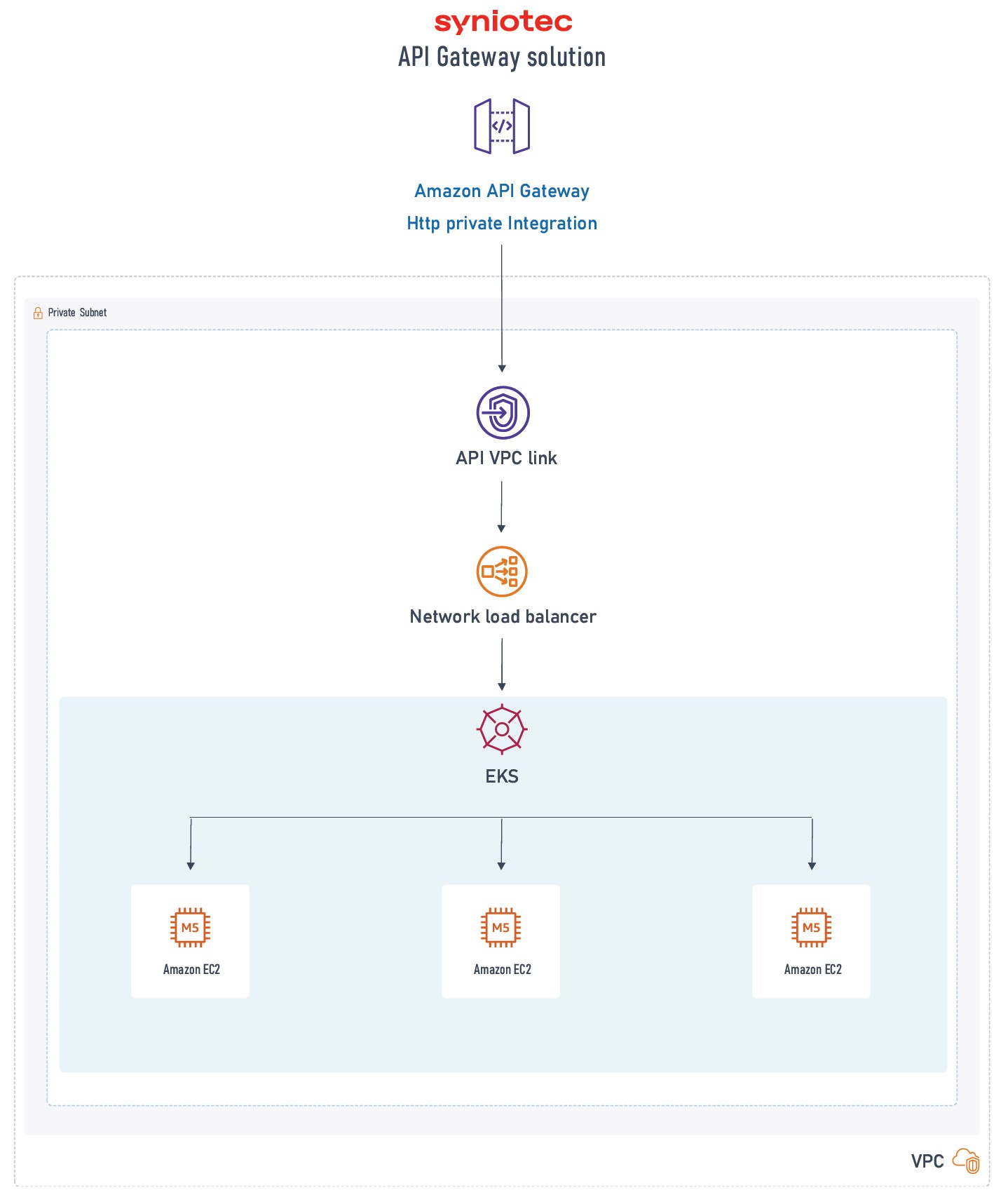
With the increased ability to scale, the syniotec team is now managing over 50,000 assets. This means managing the live operative data coming in from its IoT telematics solutions connected to construction equipment worldwide, plus data collected directly from equipment managers. Additionally, the company receives more than 2.5 million messages in a single day.
Keeping up with that volume of data and requests at speeds necessary to accommodate the construction industry was not an easy task. But syniotec has found the answer with Amazon Simple Queue Service (Amazon SQS). The team chose it for its high reliability, safety, and performance speed, and has found it a necessary tool, especially when they need to handle increased demands in a short period of time.
Along with making their customers happy and their jobs easier, transitioning away from monolith architecture had a huge impact on syniotec’s bottom line. Thanks to increased productivity and efficiency, the switch to Amazon EKS meant lowering their provisioning time and slashing costs by half.
Paving new paths worldwide
Now that syniotec has overhauled and scaled their infrastructure and can offer customers the solutions they need in the current construction climate, they are looking ahead to new ways to drive digitization in the industry.
But first, they’re focusing on expanding their suite of solutions that meet current industry needs. The team is looking forward to exponential growth both in their current operating countries of Germany, Austria, and Latvia, as well as beyond those borders.
The company is aware of the great need they will be able to fill as the construction landscape evolves. More companies and regulatory bodies are now pushing for sustainable and innovative building to accommodate a warming planet and a growing population, including moving to electric equipment. But without more digital tools, many construction companies will be unequipped to provide the level of transparency and efficiency that evolution would require.
syniotec, then, is ready to become the indispensable platform its customers will rely on to make more data-driven decisions on their fleet and resource management. By using AWS to leverage the power of IoT and advanced technology, syniotec is helping construction companies worldwide synchronize their business with the possibilities of the future.
AWS is launching the next Impact Accelerator cohort, giving pre-seed Latino founders the support they need to accelerate their businesses.
It’s almost been a full year since the AWS Impact Accelerator launch—a $30 million fund that provides Black, Latino, women, and LGBTQIA+ founders with equitable access to funds, training, mentorship, tools, and resources.
Today, AWS launched applications for the next cohort—Latino Founders. While Latinos represent a key component in the makeup of the US population, they are still among the communities that receive less funding and support for venture capital. Even at its peak in 2021, US venture invested only 2.5% ($8.5 billion) in Latino-founded companies, according to Crunchbase. Through Q3 2022, funding to US-based Latino-led companies dropped to $2.7 billion, which is only 1.5% of US venture dollars. This pullback in funding to Latino founders in the US took a sharper downward turn than the broader slowdown in venture capital in the US market, which was down more than 50% year over year for funding in the same timeframe.
On the other side of the table, Latino investors make up only 2% of the venture capital industry relative to 19% of the US population, according to LatinxVC’s State of the Latino/a VCs annual report. By partnering with Latino-led venture capital firms like LatinxVC and VC Familia, the AWS Impact Accelerator is providing programming and mentorship to help Latino founders overcome bias and lack of representation prevalent in the venture community.
 Lolita Taub is a Latina General Partner at Ganas Ventures, investing in community-driven companies and changing the face of the startup-venture capital tech world. When asked why this mission is so important to her, she reiterated that we need more resources and programs to support Latino-led startup founders and fund managers, adding,
“The Latino market is equivalent to the 7th largest economy in the world and represents over $2.3 trillion in new opportunity for our community and our wallet!”
Tailored benefits
Over the course of eight weeks, selected startups accelerate growth by developing their ventures alongside AWS technology experts, investors, and partners. To further their growth, startups receive a $125,000 unrestricted cash grant and $100,000 in AWS Activate credits—all at zero cost and for zero equity. Startups also gain access to the alumni community of 50 previous AWS Impact Accelerator participant startups and over 200 founders, CEOs, CTOs, and mentors from the Black Founder and Women Founder cohorts.
Members will learn how to navigate the fundraising process with sessions such as Overcoming Bias in Fundraising and Effective Storytelling on the Path to Raising My Seed Round. Through these sessions and more, they’ll hear firsthand from those that have successfully raised funding rounds despite the lack of representation or investors that may not identify with their market. Lolita Taub will also lead a session about building investor relationships and pipeline, and share her perspective as one of the investors looking to change the current funding disparities.
How to apply
New for the AWS Impact Accelerator Latino Founders cohort, applications are open to founders located in the US and Latin American countries, as long as their startup is incorporated in the US If you’re interested in applying, get started early. Applications are open March 6 – March 17, 2023, with limited space available. Submit your application here, and don’t forget to review the FAQ and terms and conditions for the full list of qualifying criteria.
For those new to the accelerator application process, we’re hosting two in-person informational sessions at the AWS Startup Lofts during launch week. Join to hear from the AWS Impact Accelerator team, understand timelines and expectations, and meet with alumni members.
- San Francisco Loft | Thursday, March 9 at 3:00 PM PT
- New York Loft | Thursday, March 9 at 3:00 PM ET
Apply today
The AWS Impact Accelerator gives high-potential, pre-seed startups the tools and knowledge to reach key milestones, such as raising funds or acceptance into a seed-stage accelerator program, while creating powerful solutions in the cloud.
Applications are now open for Latino Founders seeking to accelerate their startup’s growth from 0 to 60 in eight weeks. Apply online today.

When you think of startup culture, stories of meteoric successes leap to mind. But for every high-flying unicorn, you may be reminded of the risks and failures also associated with startup culture. Founders know that with success comes detractors, but how can you manage your own self-confidence and sort criticism from feedback? Identifying, and more importantly, managing your approach to criticism is key in maintaining positive mindsets and positive culture within a startup.
According to new research commissioned by AWS, “tall poppy syndrome” — a cultural attitude that disapproves of success and seeks to cut down those who stand out — is widespread within the startup ecosystem, with 80% of surveyed startup leaders saying they have experienced it personally. This is particularly true among the new generation of founders; leaders of younger startups are more likely to have experienced tall poppy syndrome than their counterparts, the research shows.
Social media is attributed as being a leading source of criticism driving “tall poppy” feelings, but it can also come from friends, loved ones, and other founders.
“It’s the mother-in-law or the friend or the Instagram post that is constantly questioning whether you have done the right thing,” says Barb Hyman, founder and CEO of the artificial intelligence (AI)-based human resources (HR) and hiring startup Sapia.ai.
Such criticism can stifle a startup’s growth. Nearly all startup leaders who have experienced tall poppy syndrome believe it hinders growth potential, with 46% saying it has caused them to be more risk-averse, 45% saying it has hindered career development, and 43% saying it has caused their mental and emotional well being to deteriorate.
The result: founders are reluctant to declare themselves to be successful; they would rather keep the focus on the success of their teams.
Barb also says that founders should stay true to their vision in the face of such criticism and remind themselves that what they are doing is important.

“I just love proving people wrong, and especially those who don’t believe in what I can do,” says Barb. “Every day I feel like I am learning, and helping, and ideating. What we are doing is disrupting the whole way we think about people, so it is fundamentally creative, and we are solving so many things because of that.”
And sometimes the loudest detractor in the room? You. Imposter syndrome, or the feeling that accomplishments are the product of luck over ability, is common to most founders — three-quarters of startup leaders say they experience feelings of imposter syndrome, with one in eight feeling it daily. But it’s something that can be managed, experts say.
More than one in four startup leaders we talked to say they manage imposter syndrome in positive ways by focusing on building resilience, celebrating success or cultivating self-compassion.
“I typically manage imposter syndrome feelings by speaking openly with my team,” says Dr. Ben Hurst, founder and CEO of the patient engagement platform HotDoc. “I believe it’s important not to set unrealistic expectations regarding my own capabilities. I am just as fallible as everyone else, trying my best and doing a lot of this stuff for the first time and hoping to improve myself by learning from my team.”
Not addressing feelings of imposter syndrome can have more detrimental effects. 21% of startup founders admitted to working until burnout, and 19% say they would like additional help in managing these feelings.
Hurst says that founders shouldn’t be afraid to be open and honest with their teams about what they are able to achieve, however. “Our core values are always to be empathetic, take ownership, and speak up, and those were architected based on what makes for a successful doctor/patient relationship,” Hurst says. “The most important thing is authenticity and ‘show, don’t tell.’ If I preach these values and am not seen to uphold them, then suddenly it all comes crashing down.”
 The takeaway? The journey to founding your startup may feel lonely, but you aren’t alone. Sharing your feelings and celebrating your successes, no matter how small can help you cultivate the self-compassion needed to weather criticism and doubt. AWS knows the right team and support network can make all the difference, which is why we have helped more startups build, scale, and succeed than any other cloud provider.
Check out the rest of the research and insights in the report, “How startups create a culture of possibilities,” to learn from established founders about what it takes to create a culture for success and the key factors and considerations that have made the difference as they’ve grown.
To celebrate International Women’s Day and Women’s History Month, we’re featuring posts throughout the month that highlight women in technology who are building and creating. Above all, these women are inspiring, empowering, and encouraging everyone in technology—especially women and girls— to prove what’s possible.

Jill Stelfox, CEO and executive chair of Panzura
Meet Jill Stelfox. Jill is a serial founder and entrepreneur, holds multiple patents, and is the chief executive officer (CEO) and executive chair of Panzura. Panzura’s award-winning CloudFS global file system gives the ability to access files from anywhere with visibility, security, and control.
Alongside leading Panzura to successful new heights, Jill actively celebrates and elevates women in tech. She co-founded Women in Sports Tech and is a sitting member of their board.
“One thing I’ve seen is that women want to see it in order to be it,” says Jill. “They want to know that it’s possible. Sharing stories about other women in tech can show them that it’s totally possible. Look, if a grandma of two can be a CEO, you can too.”
Can you please introduce yourself, as a person and as a professional?
I’m Jill Stelfox. I am a mother of two and a grandmother of two: a one-year-old and a three-year-old. I am happily married for 33 years. Great family life. I am also the CEO of Panzura.
Why is Women’s History Month important to you?
Women’s History Month is important to me because while women have come far in terms of equality—especially in the workplace—there is still a ways to go.
As a woman in tech, I have raised a couple hundred million dollars’ worth of venture capital and private equity, and I have returned billions to investors. Yet, I am often the only female CEO in an industry and certainly in a room.
Panzura was refounded under your leadership, resulting in many successes on both the technical and cultural fronts. What are the challenges and the opportunities of “refounding” for startups?

Refounding a startup is challenging because the premise of it is you take the core of the goodness that’s there and you change it. We refounded the company three years ago and since then we’ve grown 485%. Panzura has tripled the number of products that we have in the market. We’ve added hundreds of customers.
Helping the team that was here understand that the transformation is going to lead to greatness takes a lot of handholding and care in the very beginning. All kinds of great things have happened through really seeing the possibility of hybrid cloud technology and what it can do in terms of understanding what’s going on with your data for customers.
It’s been hard work and tons of fun.
Can you tell us about a Panzura success story for which your experience as a woman CEO and veteran strategist was critical?
I’ll never forget the very first day that we took over Panzura. It was May 7th, 2020, and those were the early days of Covid. Imagine getting on a web call during that time and announcing, “The company’s been purchased and I’m your new CEO.” People were filled with the fear and uncertainty of everything. Some people got teary-eyed about it.
It instantly changed me forever.
It’s a wonderful time for women to run companies because we can usually see when people are hurting. Men can too, but we have more freedom as women to be able to do something about it. So it was easy for me to be empathetic and to be “the caring person.” That is my nature.
I’d had all these fancy notes about what I was going to talk about and how I was going to change the technology … how we were going to do all these great things and go after new customers and new markets. Honestly, none of it mattered on that day. On that day, what mattered was being human—talking about how scary this was, and what would “being okay” look like in terms of the company.
When I hung up the call, everybody seemed happier. They were in a calm place. I hung up that call and thought, “I need to do this really well for these people. They deserve comfort and they deserve kindness.” My mission became not about the tech, but about the team.
How has AWS supported your goals for Panzura?
Our AWS relationship started through some folks approaching me—and they were women—about what an AWS partnership could mean to the company.
We had raised some new money and the new investors that we brought on were also women.
The night that we signed the agreement with AWS, which was for us a company-changing agreement, we celebrated with a dinner. At that dinner, we realized that the entire transaction was done by women. It wasn’t because we were trying to do something gender-based; it’s because we were all in positions where we could affect change in this way.
I’ll never forget in my whole career that the first time I did a multimillion-dollar transaction, it was all with women and it was AWS and it’s outstanding.

Celebrating the agreement between Panzura and AWS at dinner
To answer your question about how does AWS support our goals—when we refounded Panzura, we switched from selling to mid-size companies to selling to large-scale enterprises. There are some of the largest financial institutions, healthcare institutions, and manufacturing companies in the world. We work with them to take their data workloads that are on-premises servers to the cloud in a really effective way.
When we do that, we can reach out to our AWS team and get instant access to the AWS team member of that specific customer account. It’s amazing. It’s literally one phone call and we have the right people in the right meeting with the right attitude.
We are so aligned philosophically with AWS on the mission of bringing these important workloads to the cloud and really helping these companies be more effective in what they’re doing to make their companies successful.
The second part about working with AWS that’s great is our technology runs through AWS. As an AWS Partner, we have a technology stack that’s available in the AWS marketplace.
So it’s a two-part relationship with AWS: technology and go-to market. On the technology side, we have met some of the brightest thinkers. They’re so invested in our success. You get in these rooms where you’re talking about solving a technology problem. It’s an AWS person and Panzura people, and the exchange is so free and open and productive and useful. It’s a great relationship in that way.
Can you share some advice for women founders?
Yes. I have always had a coach. When you play sports, it’s just so natural that you would have a coach. In business, you need a coach, too. There always has to be somebody that’s on your side to cheer you on.
These are not expensive resources, and they can be found at any level. It’s just a matter of reaching out. Sometimes we as women don’t ask for that kind of help, but it is there to be given.
How do you envision the future of women in technology?
The future of women in tech, in my opinion, is that we represent at least 50% of those in tech.
We’re certainly capable of doing it and we’re capable of doing it along with managing everything else in our lives: our families and our homes, our pets, and our spouses. We can do all the things and still be capable of being equal at the table.
We have made a lot of strides. When I first got into tech 25 years ago, there were no women around at all. Now I see women at all levels. I don’t see them very often at the C-Suite. But definitely, if you look at our board, our board is 50% women, our company is 30% women.
We have come a long, long way. And I think we have more to go, but we’ve come a long way. We need to raise each other up as women, we need to hire each other. We need to boost each other, we need to promote each other. We need to do all of those things.
What’s next for you, for Panzura, and for Panzura with AWS?
On a personal note, hopefully I have a third grandchild soon.
On a work note, I could not be more honored to be the CEO of Panzura. I want to keep being the best one that I can be for this wonderful team that we’ve created.
We are determined to change, along with AWS, an industry that hasn’t changed in 20 years. There is a more efficient and safe way to store, locate, and manage your data. We want to be part of that revolution, along with AWS. We have made our strategic commitment as a company to be all-in on AWS. We are super excited about the possibilities of really changing the world.

The company’s beta launch is a success.
“I think we may be onto something.”
“Evolutionary Architectures” is a four-part blog series that shows how solution designs and decisions evolve as companies go through the different stages of the startups lifecycle. In this series, we follow the aptly named Example Startup whose idea is to create a “fantasy stock market” application, similar to fantasy sports leagues. They envision holding four “tournaments” over the course of a year.
The first blog describes how Example Startup reached their first major milestone by delivering a minimum viable product (MVP). In part 2, we will see how Example Startup continues evolving their solutions to meet an increase in requirements and growth.
Building on the success of the beta launch
Things are starting to look up for Example Startup. The launch of their first MVP was a huge success for two reasons:
- The number of people that signed up for the beta cohort of fantasy investors grew exponentially after word about the product got out on social media.
- The startup got their first sponsors to chip in with some nice rewards for the winners of the beta cohort.
It is clear that the founders are onto something. Now, the startup needs some help before the next cohort begins and the company gets its first paying customers. It’s time to start hiring. Example Startup needs engineers that can take over the platform development while the founders pivot to leadership roles and start taking care of everything needed to get their startup to the next stage.
The great news from Amazon Web Services (AWS) couldn’t come at a better time. Example Startup is accepted into the AWS Activate program which means they can now access free credits to cover their growing cloud expenses. This give them some much needed runway. While the credits are much appreciated, the AWS Activate program also includes a number of other perks like a Premium Support Plan, as well as a relationship with an AWS account team that put technical and business expertise directly at their disposal.
With a couple of engineers joining the team, it is time to evaluate the solution that got them through the MVP and to begin planning for the next release. The technical founder starts the handoff to the engineers, which spurs many discussions around what went well and what needs more work. After documenting all the existing needs, gaps and questions, the team feels lost. There are so many options, so many decisions to make, and so little time. The technical founder decides it is time to talk to AWS again for some guidance.
Enabling growth with more AWS services and features
One of the first things on Example Startup’s list is business reporting. During the beta period, the founders didn’t have much insight into metrics like user signups that would give them a better sense of how their beta release was going.
The AWS solutions architect suggests Amazon QuickSight – a cloud-native, serverless business intelligence (BI) service. QuickSight has the ability to seamlessly integrate with their current database but also other data source they might need such as raw data in Amazon S3 or even data from external 3rd party providers. Building their first dashboards is a breeze with the user-friendly web interface allows them to quickly iterate to build what they want to see. Features like scheduled email reports allow them to wake up every morning with all the important information already in their e-mail inboxes. QuickSight also boasts threshold alerts that inform the team whenever any new milestones in subscriptions are achieved. What initially seemed like a huge undertaking was resolved in a matter of days.
The next big-ticket item for the team is accepting payments. This is something no one in the team has experience with. Following a couple of informative sessions with the AWS team, the team has a well-defined set of requirements that they send out to couple of different AWS Partners who provide payment processing services. After a few introductory conversations, the team finds a partner who they believe is technically well-poised to take this important task off their plate.
With some of these agenda item out of the way, the team could finally focus on other technical decisions that will help them to sustain their expected growth. AWS Amplify served them well during the beta stage: It helped them a lot with preparing user interfaces suitable for mobile devices. They decide to continue relying on it for building and maintaining all of their current and future front-end applications. On the backend, they want to have more control over how they build their application services and the persistence layers they rely on. With the expectation of dealing with much larger volumes of data and to prepare for the new features they are planning, the team decides to take the advice of the AWS solutions architect and start looking into some purpose-built databases. Amazon DynamoDB did great, but with the long term plans of increasing the frequency of processing market data and calculating portfolios more often they start looking at time series databases like Amazon Timestream and some relational databases like Amazon RDS for PostgreSQL. These purpose-built database services will allow the team to use the database engine that is best-suited to their different workloads.
On the application development side, the team wants to start implementing more complicated business logic without having to worry about increased operational overheads. They know they wanted to containerize their workloads but aren’t certain about which option will best fit their small team. The AWS team earns Example Startup’s trust and becomes a frequent participant in the brainstorming sessions and decision-making process. AWS’ recommendation on the container orchestration is Amazon ECS with capacity provided by AWS Fargate – the serverless compute for containers. The appeal of Fargate is that it provides a flexible scaling approach because of its pay-per-use functionality, without having to worry about patching the underlying operating system. Given the lack of certainty around the start date for the next cohort, this is a welcome option that gives the team more time to focus on their development activities.
Security is another topic gaining prominence on Example Startup’s list of priorities. With the payment solution buildout underway, the platform will include a higher risk exposure. As part of the continuous efforts of anticipating startup needs and meeting them in a proactive way, AWS has recently published the AWS Startup Security Baseline (AWS SSB) document. AWS SSB is a set of controls that create a minimum foundation for businesses to build securely on AWS without hindering agility. The team had some of their work cut out for them.

The current architecture diagram for Example Startup.
Optimizing for cloud costs with AWS
The team is busy experimenting with ideas, implementing new technology, and learning how to use the services and features they might need. With AWS Budgets already setup, the technical founder decides to get familiar with more tools to give them better oversight and control over their AWS spend. She learns about tools like AWS Cost Anomaly Detection, an automated cost anomaly detector and root cause analysis with built-in machine learning (ML) and alerts. Diving deeper into the details, she learns about AWS Cost Explorer, a tool that provides the ability to view and analyze costs and usage details.
Raising capital to support the startup’s growth
The AWS Activate credits helped with the AWS cost, but the team is growing and other expenses start piling up as well. The initial bootstrap funds are near depletion, gradually limiting the team’s ability to experiment. It is time to start thinking about raising some capital. The founders have been getting ready for this moment for some time, with a deck almost ready. This is not something they have prior experience with, nor the contacts that would be able to help. They do have AWS on their side. The AWS team facilitates conversations with the Business Development teams, who are happy to help with advice and introductions to investors and venture capital firms. Exciting times are ahead.
Check out the first blog in the series.
To celebrate Black History Month, AWS Startups is featuring posts throughout February highlighting the contributions of Black builders and leaders in tech. Above all, these individuals inspire, empower, and encourage others—especially those historically underrepresented in tech—to prove what’s possible.
The most successful teams reflect the general makeup of society. Research shows that diversity is good for business: it leads to teams that make better, faster decisions, as well as higher employee satisfaction and higher financial performance.
Yet Black individuals are woefully underrepresented in tech: as founders, engineers, and in key leadership roles. Black adults comprise 12% of the US workforce, but only make up 7% of workers in computer occupations. It is astounding that, as of 2021, funding to Black entrepreneurs represented just 1.2% of US venture dollars (with only 0.34% going to Black women), while 14% of the US population is Black.
In celebration of Black History Month, it is crucial to shed light on the Black innovators in tech who are building and reconstructing an industry that underrepresents them, while also inspiring the next generation of Black innovators who will follow in their footsteps.
Step by step, we want to narrow the numbers gap and make the playing field more equal for everyone, and we must start by spotlighting Black innovators who are breaking barriers in the tech field. Here are a few ways AWS and its employees are working to achieve this.
Opening doors to accelerate success
Every startup faces challenges, and some face more challenges than others. Accelerators are a tool for founders that concentrate years of business experience into key learnings that founders can use to steer their business to success. The AWS Impact Accelerator Program is one way that Amazon Web Services (AWS) worked to provide equal footing among startups in 2022. The Impact Accelerator provides unparalleled resources to underrepresented founders, such as the coaching, investment, networking, and media reach needed to accelerate their business.
“It’s an enormous privilege to be able to put Amazon’s connections and capabilities to work on behalf of these amazing startups,” says Denise Quashie, Head of Worldwide Startup Marketing Programs at AWS. “If we can open just one door for each one of these startups, it really puts them on more equal footing with those who are considered the majority and have those doors open much longer.”
Recognizing Black AWS employees whose work supports Black founders
To celebrate the voices of Black employees at AWS and amplify their work’s impact, we are honored to share the stories of eight AWS employees working to advance Black entrepreneurs in ways that strengthen Black businesses and support economic growth in historically underserved Black communities. These include programs such as Impact Accelerator, REACH, and Amazon Catalytic Capital. They’re also sharing their advice for others who hope to follow in their footsteps.
Brandon Middleton, Account Manager

Brandon Middleton, Account Manager
Brandon Middleton is an Account Manager with the AWS Fintech and Web3 startups sales team based in Palo Alto, California. He enjoys working with the builders defining the next generation of value on the internet that we call Web3. Thinking big, learning, and being curious are staples of every conversation and interaction he has with founders who leverage blockchain technology to redesign finance and digital ownership at scale. His specific focus is on supporting AWS Startups customers between the Seed and Series-C stages who are building in the Web3, crypto, and blockchain space.
What advice does he have for Black innovators in tech?
“Show up as your genuine and authentic self. Your voice is needed as a builder of this Web3 future as much as it is needed as a consumer of the products and services it will produce. The more points of view we contribute during these formative design years, the smoother the plane ride will be in the years to come, as we will have mitigated risk, shed light on vulnerabilities, and improved the overall quality of the tools future generations globally will be using daily.”
Charlotte Newman, Global Head of Underrepresented Founder and Investor Startup BD

Charlotte Newman, Global Head of Underrepresented Founder and Investor Startup BD
Charlotte Newman is the Global Head of Underrepresented Founder and Investor Startup Business Development. She is located in Washington, DC, where she leads a team with a laser-like focus on how to accelerate underrepresented founders and investors. As a former founder, Charlotte says it is a privilege to use what she learned to enable other entrepreneurs to launch and scale their best ideas. She believes that what we do, at scale, has the power to democratize entrepreneurship and strengthen the role of historically-marginalized groups in entrepreneurial ecosystems around the world.
What advice does she have for Black innovators in tech?
“Throughout my career, I have found that achieving business objectives while driving positive change for historically-underserved groups at scale requires a combination of hard and soft skills. In leading a global set of programs and partnerships that advance Black entrepreneurs, I employ data-driven problem solving as well as curiosity, empathy, and humility. Ultimately, this ensures that the Black entrepreneurs served by my work achieve better outcomes and feel seen.”
Daniel Omachonu, Account Manager

Daniel Omachonu, Account Manager
As an Account Manager for Fintech startups sales in Brooklyn, NY, Daniel enjoys working with visionary startups disrupting various industries. Amazon and AWS radically disrupted retail and tech infrastructure; startups are disrupting the future of technology and everyday life, so it’s great to be a part of their journey while at AWS. Daniel’s focus is on fintech startups transforming the financial services industry.
What advice does he have for Black innovators in tech?
“I have had the pleasure of meeting some incredible Black founders with great companies and ideas. AWS is in a position to improve its access to funding opportunities and support. My advice would be that there is room for everyone to help somehow, so raise your hand, show up, and get involved.”
Dottie T, Senior Account Manager

Dottie T, Senior Account Manager
Dottie T is a Senior Account Manager with the AWS Greenfield Early Startup Account Team. He enjoys working with early stage founders who leverage the AWS platform to solve complex issues and advance the civilization of mankind. His Focus area is Pre- Seed, Seed, and Series A-funded startups.
What advice does he have for Black innovators in tech?
“AWS is beyond a technology platform. It’s also a platform for positive change—and every employee can be part of this change, either by volunteering at the Black impact accelerator, being a soundboard for underrepresented founders, or being an internal voice of conscience that helps AWS build more programs and processes to support Black founders. We are all capable of being a source of inspiration.”
Jarman Hauser, Global Tech Business Leader

Jarman Hauser, Global Tech Business Leader
Jarman Hauser is a Global Tech Business Leader in Seattle who likes to tinker and explore unique approaches to solving complex, multi-dimensional problems. Jarman finds ways to use tech for good by leveraging the innovation at Amazon to better communities, environments, and our society. He is constantly impressed and equally inspired by the new generations of startup founders solving the world’s most complex problems. Jarman will continuously focus on equity, investing in underrepresented entrepreneurs, and creating “longer tables.”
What advice does he have for Black innovators in tech?
“Inclusion is a virtuous cycle. Continuous innovation depends on diversity, but more often than not, underrepresented founders lack the same levels of access and opportunities. We’re starting to see change, but in order to build equitable entrepreneurial ecosystems, we have to collectively take active approaches in breaking down the systemic barriers that perpetuate inequality.”
Nehemiah Green, Global Business Development Partnerships Manager

Nehemiah Green, Global Business Development Partnerships Manager
Nehemiah Green is a Global Business Development Partnerships Manager in Washington, D.C., who feels privileged to meet and build relationships with incredibly founders, every day, as they leverage technology to change the world. He finds it invigorating to learn from them and to help identify solutions to their biggest challenges. Nehemiah will continue to focus on helping under-represented founders and investors grow and succeed at different stages throughout their lifecycle.
What advice does he have for Black innovators in tech?
“After reading Bryan Stevenson’s book, Just Mercy: A Story of Justice and Redemption, a few years ago, I’m a big advocate of getting proximate on issues of systemic racism and bias. In my conversations with Black founders, I hear their stories and listen to their experiences which has been critical to my ability to support and problem solve. Being proximate builds our capacity to build solutions that are driven by empathy.”
Sekai Ndemanga, Principal Fintech Business Development

Sekai Ndemanga, Principal Fintech Business Development
As a Fintech Business Development lead in New York, Sekai is constantly learning in her role; Fintech is broad and covers various industries. In her day-to-day work, she speaks to customers and founders influencing the future of financial services, be it the fascinating world of insurtech or proptech. She’s also the host of the popular Fintech in the Cloud podcast, and a key contributor to the 2022 State of the Industry: African Fintech report.
What advice does she have for Black innovators in tech?
“It does not have to be a grandiose initiative; start small. If you are cognizant of underrepresentation in your space, think of small ways to make a difference. Fintech can be an exclusive community with representation that reflects systematic structures not built for people of color. Therefore, we must showcase founders that are advancing against the odds.”
Tiffany Johnson, Global Business Development Manager, URFs Program

Tiffany Johnson, Global Business Development Manager, URFs Program
Tiffany Johnson, of Seattle, Washington, is a Global Business Development Manager on the Underrepresented Founder/Investor Business Development Team. She finds fulfillment in connecting with founders and understanding their needs as they build their businesses through engagement such as workshops, summits, dinners, and more. Listening to the customer’s voice is a key aspect of her work. Tiffany’s area of focus is on creating global initiatives to support startup founders from underprivileged backgrounds.
What advice does she have for Black innovators in tech?
“My advice to others who hope to make a positive impact in the Black community through their work is to first, understand the unique challenges and barriers that Black entrepreneurs face, and second, to actively seek out and build partnerships with organizations and individuals who are already working to address those issues. Only by working together can we truly drive meaningful change.”
Black founders building successful startups on AWS
We hope that, through our platform, we can provide an innovative and inclusive space to underrepresented communities that will inspire the next generation. AWS is committed to supporting equitable and inclusive access to building on the cloud.
Explore more content that celebrates the achievements of Black innovators, such as:
- AWS Startups Twitter stories of inspiring, innovative, and game-changing Black founders
- CareCoPilot founder Alyse Dunn wins big after AWS Impact Accelerator
- How Eyegage scaled their life-saving app via Impact Accelerator partnership
- How Resilia is helping nonprofits to build capacity through SaaS
More about the AWS Impact Accelerator program
The AWS Impact Accelerator Program opened the doors to creating access and resources for underrepresented leaders and founders in tech. If you are interested in applying for the upcoming AWS Impact Accelerator: Latino Founders (or if you know a great candidate), learn more here.

Startups are in the business of proving what’s possible and bringing world-changing ideas to life. But founders can’t do it all on their own. To achieve their goals, they must build strong teams they can trust to implement their vision. And they need to cultivate a strong workplace culture that encourages experimentation, quick decision making, and learning from mistakes.
Indeed, new research commissioned by AWS shows that workplace culture is vital to a startup’s success. Six out of seven startup leaders (86%) believe a company’s culture contributes to its growth, with 85% saying it can play a critical role in securing investment and the same number saying it is an important factor in attracting new talent.

To build a strong workplace culture, leaders must do more than offer “traditional” startup perks like ping-pong tables, kombucha kegs, and paid lunches. Craig Cowdrey, co-founder and CEO of the workplace wellbeing startup Sonder, says today’s workers have become skeptical of these basic benefits. “So much of these [traditional perks] have been recognized as not particularly relevant or determinative in an employee’s choice,” he says. “A lot of them think that it’s just to keep them working in the office longer.”
Instead, the research indicates that startups should prioritize work-life balance initiatives in order to attract talent and get the most out of their teams. Startups can often be chaotic, high-pressure environments, but founders must work to protect both themselves and their teams from the “grind culture” of overwork and burnout that is so prevalent in the startup ecosystem.
Dismantling that culture of constant work and pressure will not happen overnight — 93% of startup leaders we surveyed acknowledge that grind culture currently exists in the startup landscape. But a growing number of leaders recognize that logging long hours in the pursuit of perfection or to fend off the competition isn’t a recipe for success in the long term.
“Pulling 60- or 70- or 80-hour work weeks isn’t a badge of honor — it’s stupid, and you can’t keep doing that,” says Megan Woff, head of founders at Startmate Accelerator.
Instead, developing a workplace culture that emphasizes self-care is key to a startup’s growth and long-term viability. Dr. Ben Hurst, founder and CEO of the patient engagement platform HotDoc, says that as his company has evolved, they have worked to minimize the grind and embrace wellbeing as a priority. “You are doing the wrong thing if you are working in a way that is not self-sustaining,” he says.
Hurst’s way of thinking is likely to have ripple effects across the business landscape, working to create healthier workplaces and putting companies of all sizes on the path to success. 71% startup leaders say the larger corporate world watches the startup landscape very closely. And one-third of startup leaders believe that by disrupting older, outmoded ways of working, startups are having a positive impact on the wider business culture.
AWS is proud to support startup founders on their journeys, helping them to solve the world’s problems through the power of technology. The AWS Activate program provides qualified startups with a host of benefits, including AWS credits, technical support, and training.
Check out the rest of the research and insights in the report, “How startups create a culture of possibilities,” to learn from established founders about what it takes to create a culture for success and the key factors and considerations that have made the difference as they’ve grown.
To celebrate Black History Month, AWS Startups is featuring posts throughout February highlighting the contributions of Black builders and leaders in tech. Above all, these individuals inspire, empower, and encourage others—especially those historically underrepresented in tech—to prove what’s possible.

Sevetri Wilson, founder and chief executive officer (CEO) of Resilia
The AWS Startups Blog is excited to introduce Sevetri Wilson. Sevetri is a serial entrepreneur whose most recent startup, Resilia, enables nonprofits to increase capacity and funders to go beyond the grant with technical assistance, coaching, and capacity-building support. In October of 2022, Resilia closed a Series B $35M funding round, the largest raise ever for a solo Black female founded tech company.
“Resilia is proving that technology can break through the perceived number of finite resources. When you’re a consultant, there’s a finite number of people you can help and a finite amount of time in which to do it. By delivering resources through technology, Resilia is using tech for good: To revolutionize the way leaders develop and grow their organizations and to remove limitations on the things they oftentimes have no say in.”
Can you please introduce yourself, as a person and as a professional?
As a person, I am—as I always say—a girl raised in the South. I’m from Louisiana and was born and raised in a small city about 45 minutes outside of New Orleans, called Hammond, where my mother was raised. I was raised by a very big family: my mother was one of nine and my father was one of seven, so you can imagine how many cousins and family members I was fortunate enough to grow up around. My grandfather was a farmer, so we had blackberry bushes and a sugar cane field and cows and chickens running around.
Professionally, I would consider myself a serial entrepreneur and business owner. I’ve bootstrapped one company. I’ve now raised close to $50 million for Resilia, a technology company that I founded in 2017. As a professional, I’ve grown into a space where I am known as a problem solver. People always ask, “What do you think has led to your success?” I say that as a professional I’ve always been able to solve people’s problems.
What is the founding story of Resilia and the company’s mission?
I founded my first company, Solid Ground Innovations, in 2009. We were a management and consultancy agency and we had a nonprofit arm called SGI Cares. We worked as consultants to drive strategic functions around community giving with large funders like the W.K. Kellogg Foundation and family foundations, and large corporations like Aetna Better Health and Community Coffee. We would come in and work with them to deploy resources and capacity support to the initiatives that they were funding from a philanthropic standpoint.
Although we would come in and we would bring capacity, the likelihood of that work continuing once we left was very rare. I started thinking about ways that we could productize our services and deliver them through a software solution to create a continuum of service that didn’t stop once we left.
That’s what gave rise to Resilia. We are a two-sided platform: On one side, we support nonprofit organizations, helping them bring capacity to their day-to-day through our software platform. On the other side, we enable large funders such as private foundations, public charities, corporations, and government entities to deliver capacity-building resources at scale to the nonprofits they support.
A lot of Resilia’s journey was me taking something that was heavily based in consultancy and productizing it, to bring a more digitized presence to the work through software. Resilia digitizes the work and democratizes philanthropy to make what generally only a few nonprofits would receive—whether that’s resources or something else—more accessible to everyone.
Today, we’re at over 100 employees and primarily based in New Orleans, along with an office in New York, an engineering office in Mexico, and remote employees across the United States.
What are you most proud of accomplishing as the founder of Resilia?
My proudest achievement is growing a very diverse team around tech for good. We have people of color and women in every single rank of Resilia: From the CEO, of course, to our VPs, to our directors, managers, and our entry-level team members.
Resilia’s platform for non-profits is radically and successfully transforming how they do business. Can you share some of the opportunities and challenges for startups that are bringing technology to the non-profit industry?
Historically, I would say that technology has not been built with nonprofits in mind, and that’s probably why sometimes our space has been averse to adopting technology. That’s a challenge that we are faced with: How do we build the most user-friendly product that’s for nonprofits as a whole? We believe we’re building Resilia as the new age of technology to help nonprofits have the resources to keep going, so they can do their work.
Has AWS supported your goals for Resilia?
Yes. We build a lot of our products on AWS and AWS solutions are an important part of our stack.
Can you share the most important lesson you’ve learned as a founder?
Deliver solutions that increase efficiency and effectiveness at scale. For instance, with the Resilia platform, nonprofits can streamline their operations, reduce administrative burdens, and focus more on their mission-driven work.
In October 2022, Resilia closed a Series B $35M funding round. This is the largest raise ever for a solo Black female founded tech company. Do you have any advice for other founders about how to succeed at funding rounds?
Founders who are building right now—similarly to small businesses—are seeing market volatility. You have to be really scrappy and stay as lean as possible to survive what we are seeing as a drawback in funding from investor groups and funders alike.
Also, when you’re going out to fundraise, ensure that you have all of your i’s dotted and t’s crossed, meaning have all of what you need for due diligence: have the financials together, have reference calls and who’s going to do those reference calls. Have as much done as you can to limit the time you have to be out in the market raising. Ensure that you run a very tight and smooth process so that you aren’t putting yourself in a position where you are running out of capital. The most that you can do is just be prepared and have, as I would say, your house in order so that you save time.
What’s next for you and Resilia?
In 2023, Resilia will continue to scale our team in order to serve our growing client base. We’re also really excited to roll out donations and payments. That’s a new feature that we’ll be offering to non-profits and our existing customer base as a whole. We want to continue to expand our offerings so we can truly be a one-stop resource for nonprofits.
We’re also rolling out a robust online community to foster more peer-to-peer learning. We’re using this Resilia community to provide a guided course track to help nonprofit leaders not only build knowledge, but also upskill their teams. This year we’re also going to deliver more impactful features and products to funders and grant makers alike.
Explore more content that celebrates the achievements of Black innovators, such as:
- AWS Startups Twitter stories of inspiring, innovative, and game-changing Black founders
- CareCoPilot founder Alyse Dunn wins big after AWS Impact Accelerator
- Shining a light on Black excellence: three founders share their stories
- How Eyegage scaled their life-saving app via Impact Accelerator partnership
In October 2022, Amazon launched its Catalytic Capital initiative, investing $150 million in funds to underrepresented entrepreneurs. Now, AWS is further accelerating the conversation through strategic partnerships and data-driven reporting with the publication of the State of Black Venture Report, launched Tuesday at the 2023 State of Black Venture event hosted by BLCK VC at the AWS Startup Loft in San Francisco, California.
When new founders have access to venture funding and mentorship, they go on to build solutions that transform our society, create jobs that strengthen our communities, and inspire the next generation of founders to begin their journey toward entrepreneurship and innovation. Unfortunately, not all entrepreneurs and startups are funded equally.
While the funding disparity is well-documented, not many people understand the full scope of the issue. For instance, of all available venture funding, underrepresented founders receive just 1.87%. Black, Latinx, women, Indigenous, and LGBTQIA+ entrepreneurs miss out on more than 98% of the financial backing that could take their startups to the next level.
What’s more: funders of marginalized identities are underrepresented in the venture capital industry. According to State of Black Venture Report, a 2022 report published by BLCK VC, Black partners in 2020 comprised just 3% of all partners across the industry. The same report tells us that Black funders are up to four times as likely to fund Black startups than non-Black funders.
Let’s be clear: Black entrepreneurs are underrepresented and underfunded because the people most likely to invest—Black funders—are underrepresented and underfunded. The result is a lack of the kind of resources that allow startups to grow and scale. It also creates a vacuum in the mentorship that propels both entrepreneurs and junior investors toward success in their earliest stages.
The same is true for and women founders and funders. While Latinx investment professionals grew in 2022 according to LatinxVC, they still only represent 2% of the overall venture funding industry. And only 35% of those professionals identify as women. Minority- and women-led firms manage just 1.4% of the $8 trillion venture capital and private equity industries.
The data is clear: Diversity in entrepreneurship relies on diversity among investors.
AWS has taken a collaborative and multifaceted approach to the issue. Initiatives like the Amazon Catalytic Capital initiative and the AWS Impact Accelerator deploy capital directly to underrepresented founders. Not only that, but AWS is funding organizations and research that bring the venture capital disparity into clearer focus and help founders and funders connect.
The role of AWS is to foster an ecosystem that facilitates a network that brings underrepresented founders, funders, and the organizations into closer contact so that they can support one another. AWS has teamed up with organizations like Diversity VC, LatinxVC, StartOut, and BLCK VC, whose missions are not only to support underrepresented founders and funders, but to produce data-driven reports that lend credence to the conversation.
This month, BLCK VC hosts its second annual State of Black Venture event on February 22nd at the AWS Startups Loft in San Francisco. The organization convenes a panel of Black leaders to share their triumphs and challenges on the road to becoming funders. BLCK VC’s accompanying report, State of Black Venture, gathers data through surveys, interviews, and extensive industry research to elucidate the sobering issue of the funding disparity.
The report also offers some encouraging news:
The number of Black partners is growing. Through their research, BLCK VC discovered that 83% of Black investors have either launched their own fund or have joined new firms where they have greater influence. Nearly a third (27%) of these funds launched in the last two years, signaling a strong upward trend. What’s more, more than half of all Black funders are reported to be actively mentoring Black junior mentors, either within their network or at their firm.
Digitalundivided finds that, despite the reality of the venture funding gap, underrepresented founders continue to persevere. Their 2022 Industry Insights Report reveals a positive trend in leadership among Black and Latina women founders, especially in healthcare, financial services, and education. Not only are Black and Latina women more likely than ever to found startups in these industries, but they are more likely to secure funding.
There’s more work to be done, and shedding light on the funding gap through impactful, in-depth research is a vital part of the process. The better we understand our challenge, the better we can work towards a solution. Publications such as the 2022 State of Black Venture Report acts as a guiding light as we work with our partners to build pathways to success for underrepresented founders.
Learn more about Amazon’s Catalytic Capital initiative and the AWS Impact Accelerator.
You may also want to join the upcoming AWS Impact Accelerator: Latino Founders. Applications are open from March 6 – March 17, 2023.
To celebrate Black History Month, AWS Startups is featuring posts throughout February highlighting the contributions of Black builders and leaders in tech. Above all, these individuals inspire, empower, and encourage others—especially those historically underrepresented in tech—to prove what’s possible.
Today, we’re talking to three Black founders and leaders: Kwame Boler, CEO and co-founder of Spritz Natasha Greene, We Intervene; and Chandler Malone, CEO of Bootup.
These Black leaders and innovators are making impacts in their communities, industries, and beyond.
Read on to see how they’ve overcome obstacles and how they encourage and mentor young Black founders in tech and beyond.

Kwame Boler is the CEO and co-founder of Spritz, the full-service app for residential cleaners to handle paperwork, stay organized, and earn more.
Q: Tell me about some of the obstacles you’ve faced as a founder. What did you learn about yourself as you confronted them?
A: As a founder, I’ve faced many challenges along the way. One of the biggest obstacles I experienced was when my previous business, neu, had to shut down and pivot to become Spritz. At the time, it was a low point for our team, but we didn’t let it defeat us.
We started neu with just $3,000 of funding from friends, and by the end of 2019, we bootstrapped the business to generate nearly $400,000 in gross merchandise value (GMV) in just one city. In 2020, our goal was to close our first round of venture capital while participating in the Techstars accelerator and expand to other markets. But, unfortunately, when the travel industry took a nosedive from the pandemic, our plans had to change. However, we saw this as an opportunity to clear our technical debt, and after making the tough decision to furlough our operations team, we continued building and increasing our product-market fit by including personal protection equipment (PPE) in our service offerings. Despite the circumstances, we successfully closed our first round of venture capital that year. We were now on our way to scale, and by the end of 2021, we had doubled our lifetime GMV to nearly $900,000 in sales and expanded into our 2nd market.
However, while raising our next venture round, our most significant challenge came when our lead investor failed to wire funds at the last minute despite several reassurances and a binding commitment.
Consequently, we had to lay off 90% of our team and reevaluate our plan. It was a tough time, but in 2022, we eventually pivoted to Spritz, a SaaS platform that simplifies the complexity of managing the back office for residential cleaners. We spent most of last year doing customer discovery and market research, and by October, we were pleasantly surprised to see nearly 4,000 people had signed up for our waitlist in anticipation of our product launch. Despite our hardships, I am incredibly grateful for the team that helped us get to where we are today.
These experiences taught me that sometimes, the hardest problems could be blessings in disguise.
Q: What advice do you have for young founders who want to start their own company?
A: For those ready to embark on the exciting journey of starting your own company, here are the top 5 lessons I’ve learned along the way:
Despite the challenges, bear markets can be the best time to build a company.
- My top tip for building a successful team is to leverage tools like LinkedIn to source talent and surround yourself with people you know, love, and trust, who have complementary expertise to yours. Then, take a good hard look at your strengths and weaknesses, and seek out individuals who can complement those and bring different skills to the table. Building a strong, cohesive team is the foundation of a successful company.
- Next, please don’t quit your day job (… yet). Moonlighting can be a game-changer and an excellent opportunity to test your entrepreneurial skills, validate your business idea, build a savings nest egg, and prepare for success. By dedicating your evenings to your passion project, you’ll stay focused and motivated and won’t lose your day job security. This way, when the time comes to quit your day job, you can fully concentrate on your startup without worrying about money.
- Then, before you dive into building your product, it’s crucial that you spend time researching the market and validating your assumptions with customer feedback. This will help avoid blind spots and ensure you’re building with your customers in mind.
- Also, understand that your net worth is your network. Building a successful startup takes a community, just like raising a child takes a village. Put yourself and your idea out there by attending as many startup networking events as possible. Build relationships and surround yourself with like-minded individuals who have experience and can give you the right advice. Leverage a network of advisors and potential investors to help you filter the noise and make efficient decisions.
- Finally, please remember to prioritize self-care as well. Starting a company is a marathon, not a sprint, and it’s essential to pace yourself and be kind to yourself and your team. It’s okay to take a step back and celebrate your wins — just be sure to maintain open lines of communication with your team and investors.
With a lot of hard work, determination, and a little luck, you can also build a successful company.

Natasha Greene is the founder and CEO of We Intervene, which provides a centralized repository of resources along with Real-Time Virtual Resource Assistants to better help schools connect families to resources they need and want 24/7.
Q: Tell me about some of the obstacles you’ve faced as a founder. What did you learn about yourself as you confronted them?
A: I delivered a stillborn baby on December 1st. Her name was Jurni. My stillbirth was a big emotional and physical setback as a woman in tech who wants to have a family. I wrote about it on LinkedIn.
I learned that community could help me to get through almost anything. For example, I could continue building out the security requirements for We Intervene because of Audree, whom I met in AWS Reach. She became my part-time virtual chief information security officer (VCISO) and helped oversee development and milestones to move our product through development for a big meeting we had in February while I work on healing over the death of my daughter.
Staying patient is also an obstacle. Some sectors are slow to realize the potential of your product, and you have to keep on educating others on the impact your product will have. And you have to keep on reminding yourself why you decided to take this entrepreneurial journey and remember the impact you want to have. Many people see the “quick” successes, but it wasn’t quick at all; there were many days between the startup phase and the first purchase stage. There are many more days between the startup phase and the exit or even grossing millions of dollars phase. The key is always patience – patience with yourself and all those around you.
Q: What advice do you have for young founders who want to start their own company?
A: You need to go out there and start the project/business you’re thinking about doing. But first, start by testing your assumptions on the idea you have. For example, if you want to start a TikTok marketing company, then you need to do it for free for a couple of people and get their feedback on your work.
Or, your “free” time can be tons of projects you have completed. Then, you take your positive testimonies or reviews to the next group, who will pay. And then there is another group that will pay you more as you become better at your craft. Always work on getting to clarity on what you are offering and who you are offering to – we don’t want to say you are for everyone when you really want to focus on solopreneurs.
Also, know that the first company might not be the thing you run with. It might take a couple of companies. So, you might talk to an accountant about the best business structure you should do to house all your ideas.
If I had to do entrepreneurship again, I would have done an S-corp in the beginning and then d.b.a. all my business ideas under that idea instead of starting an LLC for each idea I have. I wasted a lot of money on business structure and taxes.

Chandler Malone is a three-time entrepreneur who is now building Bootup, an educational labor marketplace that helps individuals get their first jobs in the technology sector regardless of their educational background, while helping companies fill their talent pipeline problems through access to pre-qualified talent.
Q: Tell me about some of the obstacles you’ve faced as a founder. What did you learn about yourself as you confronted them?
A: One of the most difficult things that no one tells founders about is building and growing a strong team. As a startup, the capital we raised definitely gave us flexibility, but we still can’t compete with big tech companies on salary, benefits, and resources.
One of my greatest strengths is my ability to be resourceful and think out of the box for solutions. This resulted in building out a fully distributed, in house engineering team across Bolivia and Venezuela. We were able to hire the most experienced engineers and within our budget.
In 2023 and onward, managers should be focused on understanding the best ways to source and ration top talent globally. We are no longer confined to specific geographies teams who can find and keep the best people no matter where they are located will succeed in the long run.
Building our team has also pushed me to become a stronger listener, more perceptive, and trust my gut more.
Q: What advice do you have for young founders who want to start their own company?
Don’t get caught up in the hype and stay focused on running your race. You’ll see some founders always in the press or out at conferences – and good for them!
Your job isn’t to emulate what other founders are doing or get the validation of VCs and the press. At the end of the day you are running a business, and anything that isn’t focused on better serving customers is a distraction.
Conclusion
We’ll let Kwame take us out with a final question.
Q: What makes you excited about or gives you hope for the future of Black-owned and led startups?
A: The incredible progress I’ve seen over recent years gives me hope for the future of Black-owned and led startups. We’re now seeing more and more Black founders getting access to resources and capital and a growing community of supporters helping to blaze the trail for others to follow.
The ecosystem is evolving, and with a combination of intentional actions and continued success stories, I’m confident we’re moving toward a brighter future for Black entrepreneurs. Of course, systemic issues won’t change overnight, but it’s inspiring to see the progress already made.
I’m particularly excited about the rise in Black-led funds, which reduce the perceived risk of investing in Black founders. And with access to wealth increasing among Black people, we’re going to see even more Black entrepreneurs taking their ideas to the next level.
In the tech community, we often expect change to happen as quickly as writing a line of code. But we’re learning that some issues are systemic and deeply rooted. However, the progress being made and the quality of the founders getting access to resources gives me confidence that, over time, more founders of color will get the opportunities they deserve.
I’m hopeful and confident about the future of Black-owned and led startups. I can’t wait to see more Black leaders trailblazing in this industry and giving back to help others.

Got a great idea? Build it with AWS Activate. AWS Activate is our free startup program that provides tools and resources including AWS credits, AWS Support credits, exclusive member-only offers, personalized guidance, expert advice and more. It is designed to help startups build, launch, and grow.
Why AWS Activate for your startup?
AWS Activate is your solution to a scalable, reliable, and cost-optimized startup:

- Get started on AWS at no cost with up to $100,000 in AWS credits.
- Get technical support and architecture guidance with up to $10,000 in AWS support credits.
- Build your infrastructure in minutes with pre-built templates using best practices.
- Take advantage of special offers including discounts, free products, memberships, services and tools.
- Get access to the Activate Console that provides personalized guidance, details of your AWS credits, and more!
AWS Activate members get to choose which Activate tier best suits their startup journey: AWS Activate Founders is for early stage startups (unfunded and funded up to and including Series A). AWS Activate Portfolio is for startups affiliated with an Activate Provider.
AWS Activate Offers
To help you show your startup some love on Valentine’s Day, we’ve curated a list of exclusive offers from AWS Activate Providers  .
.
Airtable
Airtable enables any team, regardless of technical skill, to create apps on top of shared data and power their most critical and unique workflows. Teams at more than 300,000 organizations, including 80% of the Fortune 100, rely on the Airtable Connected Apps Platform to stay aligned, execute with greater agility, and connect previously siloed teams and data.
Get the offer: $2000 in Airtable credits and access to the Airtable for Startups program. One credit redemption per company.
 Brex
Brex
Startups can scale faster with a Brex corporate card and business account. It’s the smartest, fastest way to deposit funds, send no-fee payments, and effortlessly track expenses. Get 10-20x higher limits, no personal guarantee, and tailored rewards on every purchase.
Get the offer: AWS Activate companies get 80,000 points after spending $10,000.
 Carta
Carta
Startups get started for free (for startups with $1M raised and/or fewer than 25 shareholders), and when you upgrade to a paid plan, you’ll receive 20% off your first year subscription. Receive cap table management, fundraise benchmarking, SAFE tracking, and more.
Get the offer: 20% off a Carta paid plan.
 Deel
Deel
Hire internationally with complete confidence. Deel will handle your worldwide compliance, payroll, and HR in 150+ countries, so you can hire the best talent regardless of location. Get 20% off the first year when hiring full-time employees and contractors.
Get the offer: Free Global HRIS and 20% off Compliance and Global Payroll for one year (a value of up to $25,000!).
Firstbase
Our seamless incorporation service is built with you in mind. We’ll handle the admin work, while you focus on building your business. Access $150,000 worth of exclusive rewards from Brex, AWS, Airtable, G Suite and more.
Get the offer: A 10% discount on US incorporation.

Pipedrive
Pipedrive is the first CRM designed by salespeople, for salespeople. Do more to grow your business.
Get the offer: Try it free for 30 days, plus get 50% off for 1 year.
 DocSend
Dropbox lets you save, access, and share all your work in one organized place. DocSend’s document analytics show who is looking at your pitch deck and which pages capture attention. Deliver an intuitive investor experience with HelloSign’s easy-to-use eSignature solution.
Get the offer: Get up to 90% off DocSend, 50% off your annual HelloSign Essentials or Standard plans, & 40% off annual subscriptions of Dropbox Business Standard and Advanced.
 Mercury
Mercury has intuitive dashboards and payment flows, virtual and physical debit cards, team management capabilities, and API access. Setup FDIC insured checking and savings accounts with no monthly fees, use treasury products to save and grow your money, use their foreign currency exchange features, find your next funding round through their Raise program, or take out a line of credit through their Venture Debt program.
Get the offer: $500 cash for your startup if you deposit $50K within 90 days of approval; $250K in accounting services, software and other perks; Free domestic and international wires & ACH (in USD); Free banking and financial planning stack; Access to Raise and First Check
Want to show your startup the love all year round?
Check out the AWS Activate Console for more exclusive offers for AWS Activate members. The AWS Activate Console is your personalized hub of tools, resources and content tailored to your startup needs. Designed to support you through every stage of your startup journey, from ideating to building and beyond, it’s a one-stop-shop that delivers the tailored solutions you need to quickly get started on AWS and grow your business.
Want to share an AWS Activate exclusive offer from your startup? Learn how to become an AWS Activate Provider today.
To celebrate Black History Month, AWS Startups is featuring posts throughout February highlighting the contributions of Black builders and leaders in tech. Above all, these individuals inspire, empower, and encourage others—especially those historically underrepresented in tech—to prove what’s possible.
FEATURED PRODUCTS & TECHNOLOGIES
|
KEY RESULTS
|
STARTUP INFO.
|
Dr. LaVonda Brown, founder and CEO of Eyegage, whose expertise lies in artificial intelligence (AI) and eye-analysis technologies, developed a robotic engagement model based on user eye gaze and pupil size (dilation and constriction).
This published, patented, and licensed model has been applied to several use cases, including math education and physical therapy to improve outcomes. Her work has also led to using eye tracking as a viable biomarker for mild cognitive impairment and early-onset Alzheimer’s Disease.
LaVonda used her expertise to launch EyeGage, a mobile app that applies eye-analysis techniques to evaluate whether individuals are under the influence of drugs and alcohol to help prevent fatal accidents.
Eyegage planned to go to market with their mobile application in December 2022, but they had to deliver on a key requirement: getting the frontend app connected with Amazon SageMaker—the backend cloud platform that enables app developers to create, train, and deploy machine learning models.
“Our prototype worked well with Amazon Web Services (AWS), and our model was already trained,” says LaVonda. “But we needed to expose the model to SageMaker to ensure we could scale our services as user activity spikes.” But without prior experience with SageMaker, working through the documentation proved somewhat difficult for the Eyegage team. That’s when LaVonda turned to AWS for help.
AWS facilitates partnerships via Impact Accelerator program
Via her participation in the Black Founders cohort for the AWS Impact Accelerator Program, LaVonda gained access to personalized coaching, capital funding, and technical solutions. This connected EyeGage to Avahi, a cloud-first consulting company and AWS Global Startup Program partner.
“Avahi impressed us with their knowledge about machine learning models and their understanding of our business,” says LaVonda. “More importantly, they presented previous SageMaker projects they had taken on that were similar to what we needed. That gave us confidence Avahi could do the job.”
Avahi layered the code of the machine learning model in SageMaker to expose it as a seamless API to end users of the EyeGage mobile app. This included updating the model code so it can be exposed as an event-driven machine learning inference. Avahi also layered the model with additional services like AWS Lambda for serverless computing and Amazon API Gateway, a managed service that simplifies creating and maintaining APIs.

LaVonda meeting with a coach at the AWS Startup Loft in New York to finalize her pitch for Investor Day
Scaling to save lives
With the machine learning model exposed, the frontend app could better scale to provide contactless, non-invasive, objective/unbiased, secure, accurate, and quick drug screening results.
By pursuing this partnership, Eyegage, with Avahi’s assistance, was also able to streamline the collection of end user data (such as identity and location), which allows the app to compare current and past scanning results and provide users with additional valuable information about their condition.
“Avahi also helped encode the AWS backend to receive JSON web tokens,” adds LaVonda. “This gives us a more secure way to send data back and forth, which is critical, given the sensitivity of the information we process for our customers.”

LaVonda meeting with her technical mentor in Seattle during week 1 of the Impact Accelerator for Black Founders
What’s next for Eyegage?
EyeGage is actively researching and updating its mobile application to include features to improve and assist in individual and community safety to decrease accidents. New application features, including Should I Drive? and FriendGage, promotes easy ways for accountability and accessibility to understand impairment levels.
There may also be a potential use for the company’s dataset beyond its immediate use for detecting substances in the body. “You can identify someone by their eyes or diagnose illnesses, concussions or diabetes. Or, you can tell something like if you’ve had caffeine, depending on how it responds to light.” LaVonda adds. “Monitoring eye behavior can be used for so much.”

For startups, coming full circle is a milestone defined by partnering with the programs used during early stage growth, or providing resources that help other startups succeed as well.
Ramp, a B2B fintech startup founded in 2019 by veteran founders Eric Glyman and Karim Atiyeh, does both. Ramp is a tech-first finance automation platform whose serverless modern application–in conjunction with its corporate card–allows businesses to more efficiently manage their finances.

In the startup’s early days, founders Eric and Karim prioritized talking to customers to learn their pain points, priorities, and what aspects of a corporate card really mattered. Informed by customer needs, they tailored their product to offer:
- Physical and virtual corporate cards with unlimited 1.5% cash back
- Zero touch expenses to help control, analyze, and optimize organization-wide spending
- Fast bill payments for businesses to pay invoices how and when they want, around the globe
- Intelligent insights, reporting, and perks to maximize saving and cut spend
Within one year of launching publicly, Ramp reached unicorn status and became America’s fastest-growing corporate card. The company has since significantly scaled its business operations and AWS architecture to reach 12,000+ customers. To date, Ramp has saved businesses over $300 million and 3.5 million hours.
“The problem we solve is, ‘How can we save businesses time and money, while empowering their employees to spend, but ensuring that it’s done in a controlled and efficient way?’” explains Alexis Gordon, leader of Ramp’s product partnerships team.
Building a modern serverless architecture on AWS
To support the startup’s need for a scalable serverless architecture, high developer productivity, multi-region availability, and optimized cloud costs, Ramp built its platform’s core infrastructure on AWS.
A scalable serverless architecture
“This is the modern decade of thinking about cloud infrastructure, instead of the bare bones approach to cloud computing,” explains Lewis Drummond, head of infrastructure at Ramp.
“I’m very proud of how few legacy-type virtual machines we have and that we leverage more advanced, completely serverless, technologies from AWS. It serves us very well,” says Lewis.
Ramp uses an Amazon Aurora database cluster, as well as Amazon ElastiCache for Redis to provide sub-millisecond latency for Ramp’s caching needs and to accelerate application and database performance. Jun Isaji, director of cloud infrastructure at Ramp, explains, “AWS solutions allow us to be flexible to meet demand and add components to increase system robustness. They also help us reduce complexity throughout the system by utilizing the features built into AWS solutions.”
Improved developer productivity
Ramp’s architecture uses Elastic Load Balancing (ELB), specifically Application Load Balancer, to distribute incoming application traffic. Behind that, their web servers run on Amazon Elastic Container Service (Amazon ECS) on AWS Fargate, which allows Ramp engineers to focus on building their application instead of managing their servers.
“AWS really helps by abstracting away the details of running all of our components,” explains Jun. “Our developer velocity across the organization has significantly increased from using AWS.”
Ramp also increases developer velocity by using the flexibility of AWS’ managed services to quickly and easily spin up stacks that allow them to experiment, and then spin down the stacks when they’re no longer needed.
“AWS’ managed services allow us to do proof of concepts quite easily and quickly,” explains Lewis.
“About a year ago we were looking to test Airflow, which can be a pain to set up by yourself.” To make the testing easier, Ramp leveraged Amazon Managed Workflows for Apache Airflow.
“AWS helps a long way to getting us up off the ground more quickly. Being able to go from zero to one in a matter of days instead of weeks, as well as the lower effort there, helps us to iterate quickly,” says Lewis.
Availability across multiple regions
In addition to using AWS for its high scalability and benefits to developer productivity, Ramp uses AWS’ multi-region availability. For startups, multiple regions can improve the user experience by providing low latencies across the globe and by creating more resilient cloud architecture.
Lewis explains, “These managed services within AWS work very strongly with our multi-region requirement. Having all of these managed services, which also support cross-region, has been very useful to us.” Ramp uses Amazon Aurora Global Database for cross-region with Aurora, Global Data Store in ElastiCache for cross-region with ElastiCache, AWS Secrets Manager cross-region, and Amazon S3 cross-region.
One of the most essential components of Ramp’s architecture is called the authorizer, which approves or denies credit card transactions. “Because the authorizer is so critical for us, we have a warm standby multi-region configuration,” says Jun. “We can spin up the authorizer compute within our disaster recovery region, then route requests to that compute if our primary region were to go down”
Optimizing the costs of cloud computing
Saving money on cloud spend is a priority for many startups. With the help of AWS tools and their AWS account team, Ramp has been able to decrease their cloud spend.
“Our account manager Xavier was very proactive about reaching out to us about how to reduce costs,” says Jun. “I’m definitely happy with AWS proactively reaching out and saying, ‘Here are some ways to reduce costs.’ That’s great.”
One cost-optimization success that grew from a meeting between Ramp and their account team was implementing AWS Graviton processors for Ramp’s databases. “Graviton was a big success for us in increasing performance relative to cost,” says Jun. “We’re also in the process of working with our account team to review our reserved capacity for compute.”
Tools such as AWS Cost Explorer, “make it pretty easy to understand the costs and where you might be wasting money,” Jun says. “We use AWS Cost Explorer often. It allows us to understand and trace back any big jumps or spikes in spend to a certain component or a certain change in the system.”

AWS Cost Explorer allows startups to visualize, understand, and manage AWS costs and usage over time.
Using AWS Savings Plans, which offer a flexible pricing model, “is definitely a big cost reduction as well,” Jun says.
Integrating AWS Activate into Ramp’s go to market strategy
As Ramp continues to succeed at building the next generation of finance tools, they’ve engaged with AWS Activate for each stage of their startup journey. AWS Activate is a free program specifically designed for startups that offers resources for getting started on AWS.
“Activate has helped Ramp succeed from the product perspective,” says Lewis. “The overall program has been instrumental in both Ramp’s success and also that of some of our customers.”
As Ramp grew, they joined AWS Activate Providers, a program for startup-enabling organizations to provide AWS Activate benefits to their affiliated startups. As an AWS Activate Partner, Ramp offers AWS Activate benefits to their customers, as well as a $500 sign-up offer for their product.
Alexis explains, “Through Activate Providers, we’re able to offer up to $100k of AWS credits for Ramp clients. There’s a strong overlap in our target customer base and it’s a great lever for us to deliver more time and money savings to our customers, in line with our core mission.”
Tips for developing on AWS
For developers who want to build on AWS, Lewis and Jun share some insight and best practices that serve them well at Ramp:
- To gain speed, keep it simple. “Following the established patterns on AWS allows you to innovate really quickly; there’s a well-trodden path for developers wanting to start companies on AWS,” advises Jun. “In particular, I’ve had good experiences working with the solutions architects. When we have questions, they give us a lot of good insight into what’s the simplest way and how they’ve seen it work in the past.”
- Harness the appropriate permissions and resource sizing from the beginning. “Six months later, when your startup is off the ground, that sets you up for success in the long run,” advises Lewis. “It helps you to pass security audits and ensure your company’s finances—and your $100k in Activate credits–last you longer.”
The future of fintech and Ramp
Ramp expects the list of fintech innovations to continue to grow: Buy-now-pay-later, embedded finance options, flexible payment terms, and revenue-based financing (to name a few) are simply the beginning.
“The emergence of fintech as an industry sparked change in a financial services sector that had been dominated by large banks for hundreds of years,” explains Alexis. “Agile, nimble, customer-focused startups like Ramp came into play to create great customer experiences and products.”
Ramp’s upcoming plans include increasing automation, streamlining processes, and providing enhanced insights into spending data. “The innovation in fintech has been unbelievable and continues to be that way,” says Alexis. “There’s more to come.”
Curious about how AWS can help kickstart your Fintech startup? Join our latest Global Fintech CTO Fellowship cohort launching April 2023!

Scaling a startup successfully involves increasing profit margins exponentially while keeping costs low. Most startups combine a variety of approaches to scale, based on their growth stage and needs. Techniques to scale include finding processes that work and applying them across the board, focusing on customers and building a product that is in high demand, and harnessing AWS cloud technology to move fast and optimize your costs.
SEON, a Hungarian fraud prevention startup founded by Tamás Kádár and Bence Jendruszák in 2017, is a model of successful startup scaling: Without major refactors of their architecture, SEON has scaled rapidly for three consecutive years, achieving triple growth each year by building on cloud services offered by AWS. In 2021 alone, SEON more than tripled its annual recurring revenue, grew its headcount by 4X, and opened new offices in Austin, Texas and Jakarta, Indonesia.

AWS has been a key technology partner in enabling SEON’s exponential growth.
Building a scalable and cost-optimized architecture on AWS

Chief Architect Adam Berkecz, SEON
A key driver of SEON’s successful scaling, according to their Chief Architect Adam Berkecz, is their use of over 30 AWS solutions regularly.
“The traditional approach of provisioning environments without AWS cloud solutions is expensive and has the hidden cost of time needed to launch. With AWS, we have more than 100 engineers delivering customer value on a diverse technical portfolio,” explains Adam.
The stars of SEON’s architecture include AWS solutions such as Amazon Elastic Compute Cloud (Amazon EC2), Amazon Relational Database Service (Amazon RDS), Amazon API Gateway, and AWS Lambda, which allow them to handle real-time transactions for more than 5,000 customers.

A simplified view of SEON’s AWS architecture for a single region.
The flexible scaling of these AWS solutions enables SEON’s architecture to thrive, even during elongated periods of high load. This flexibility was on display when SEON launched the fraud browser detection feature in their device fingerprinting solution and enabled it instantly for their customers’ millions of end-users. SEON served over 10,000 requests in the first minute without any scalability issues.
In addition to granting flexibility, SEON’s AWS solutions help them to keep costs predictable. By employing AWS Savings Plans and Amazon EC2 reserved instances, SEON ensures that they are not overpaying for their compute resources. In addition to that, SEON stays on top of their spending by regularly monitoring AWS Cost Explorer and its granular view on linked accounts, services, and usage types. Finally, for infrequent and event-driven compute tasks, SEON opted to go serverless by using AWS Lambda: This allows them to save more on costs and at the same time not need to provision any instances, nor manage them.
Key tips for enabling rapid growth with AWS
1. Keep it simple. When looking for a minimum viable product (MVP) or a market fit with a new product offering, stick to the most easy-to-use AWS services like AWS Elastic Beanstalk. Simple yet powerful offerings like Elastic Beanstalk enable your organization to focus on building products rather than invest time in managing services. For SEON, it is important that developers stay as productive as possible to propel the company’s growth.
“With AWS Elastic Beanstalk and Lambda solutions, we are able to have developers working in various languages (Java, TypeScript, Python, Golang, and others) while focusing on writing code and not on managing servers and databases. With this approach, we can spin up new environments in minutes,” says Adam.
2. Invest in a multi-AZ and multi-region architecture. When clients send SEON’s tools a transaction to review, a customer at the other end is hoping to sign up for a new service or place an order. Every second that passes will affect their overall customer experience.
By investing in multi-AZ and multi-region architecture, SEON is able to maintain approximately 2–3 second response times around the world. Furthermore, SEON maintains excellent service availability even in the rare cases of service degradation in one zone or another.

SEON’s multi-region AWS architecture
3. Support experimenting with new services. SEON’s architecture is constantly evolving. This evolution is possible as their leadership supports innovation and testing new AWS technologies. By using a sandbox account, SEON’s engineers can build small architectures and proof-of-concepts that may be eventually propagated into production. For example, experimenting with serverless technologies like Lambda and different flavors of RDS databases allowed SEON to realize that they can improve their application architecture with these changes and they consequently mirrored them in their production environment.

SEON’s response times dropped from roughly 1500 milliseconds to around 600 milliseconds after incorporating native AWS services like Amazon Simple Queue Service (Amazon SQS) into their architecture.
What’s next for SEON?
Having raised $94 million in Series B funding in April 2022, SEON is looking to expand its presence in North America, Latin America, and the Asia Pacific region. SEON continues to build partnerships with leading ecommerce platforms, heighten product functionality, and integrate additional data sources to help customers better fight fraud.
“With AWS continuously providing and updating futuristic services for AI, containerization, and message streaming, we do not see ourselves slowing down,” says Adam. “Managed services like Amazon Aurora and managed Kafka are on our technological roadmap, and we look forward to what we can accomplish further with them.”

Startups are familiar with the importance of creating great customer experiences. Sentiment analysis is one tool that helps with this. It categorizes data as positive, negative, or neutral based on machine learning techniques such as text analysis and natural language processing (NLP). Companies use sentiment analysis to measure the satisfaction of clients for a target product or service.
Sentiment analysis can be particularly challenging to accomplish on Arabic end-users: People across the Middle East and North Africa (MENA) region speak more than 20 dialects of the Arabic language, with Modern Standard Arabic being the most common language.
In this blog post, we explain how Widebot uses Amazon Sagemaker to successfully implement a sentiment classifier. Widebot is one of the leading Arabic-focused conversational artificial intelligence (AI) chatbot platforms in the MENA region. Their sentiment classifier supports Modern Standard Arabic, as well as Egyptian dialect Arabic, with high accuracy when tested on multiple datasets from different domains.
Widebot’s model can be easily tuned after being given a few hundreds of samples from the new domain or dataset. That makes the solution generic and adaptable to different domains and use cases.

The characteristics of a successful chatbot
Chatbots are a useful tool for managing and improving customer experiences, as well as automating tasks so that employees can focus on work critical to their company’s mission. Startups, in particular, are familiar with the value of using managed services so that they can spend their time on the tasks that matter most to their success.
It’s important for chatbots to quantify satisfied or unsatisfied customers, as well as document the conversion rate from satisfied-to-unsatisfied (or vice versa). To meet these requirements, Widebot’s solution:
- Helps users to analyze the performance of their chatbot system
- Improves the decision-making of the chatbot
- Aids other downstream machine learning (ML) models

Widebot chatbots use sentiment analysis to improve customer interactions.
Technical challenges of building sentiment analysis
Widebot data scientists are always innovating to enhance and optimize their deep learning models to keep up with their customers’ growing expectations. To better serve their Arabic chatbot customers, they worked to develop a new solution for Arabic sentiment analysis deep learning models.
The challenges of this included:
- Model scalability
- Response time
- Massive concurrency requests
- The running cost
As is the case for many startups, they initially deployed the model on self-managed infrastructure and general-purpose servers. However, as their startup grew, they couldn’t efficiently scale the model to accommodate for the growing data and spikes on concurrent requests.
Widebot began looking for a solution to help them focus on building the models quickly, without devoting undue time to managing and scaling the underlying infrastructure and machine learning operations (MLOps) workflows.
Model deployment on Amazon SageMaker
Widebot chose SageMaker because it provides a broad selection of ML infrastructure and model deployment options to meet all their ML inference needs. SageMaker makes it easy for startups to deploy ML models at the best price performance.
“Fortunately, we found that Amazon SageMaker gives us full ownership and control throughout the model development lifecycle. SageMaker’s simple and powerful tools allow us to automate and standardize the MLOps practice to build, train, deploy, and manage models more easily and quickly than was possible through our self-managed infrastructure,” said Mohamed Mostafa, co-founder and Chief Technology Officer (CTO), Widebot.
The Widebot team are now able to focus on building and enhancing their ML models to meet their customer expectations, while SageMaker takes care of setting up and managing instances, software version compatibilities, and patching versions. SageMaker also provides built-in metrics and logs for endpoints to keep monitoring the model health and performance.
Amazon SageMaker Inference Recommender helped Widebot to choose the best compute instance and configuration to deploy their ML models for optimal inference performance and cost. SageMaker Inference Recommender automatically selects the compute instance type, instance count, container parameters, and model optimizations for inference to maximize performance and minimize cost.
Widebot also uses various AWS services to build their architecture, including Amazon Simple Storage Service (Amazon S3), AWS Lambda, Amazon API Gateway, and Amazon Elastic Container Registry (ECR):

Widebot architecture diagram
Widebot was looking for a solution to securely publish the ML models they developed for their customers as an API endpoint. They used API Gateway, a fully managed service, to publish, maintain, monitor, and secure the API endpoints of the ML models deployed on SageMaker. API Gateway is used as an external-facing, single point of entry for SageMaker endpoints that makes them easily and securely accessible from clients.
Clients interact with the SageMaker inference endpoint by sending an API request to the API Gateway endpoint. The API Gateway maps client requests to the corresponding SageMaker inference endpoint and invokes the endpoint to obtain an inference from the model. Subsequently, the API Gateway receives the response from the SageMaker endpoint and maps it back, in a response sent to the client.
Solution overview
How did Widebot build a successful new solution for Arabic sentiment analysis deep learning models? Here are the steps they followed:
Datasets collection and preparation
- Collect tens of thousands of data samples from different data sources (both public and in-house).
- Review the datasets carefully, apply data labeling, and improved the data quality by removing irrelevant samples.
- The data team conducts an annotation process, using Amazon SageMaker Ground Truth to annotate enough samples from different domains and writing styles to enrich the dataset used.
- Send samples through the preprocessing pipeline, before training the model using deep learning to classify the input text as positive, negative, or neutral, with the probability of each.
Building and training the model
- Use a Convolutional Neural Network (CNN) model trained using Keras and TensorFlow.
- Apply many iterations to test different preprocessing pipelines, architectures, and tokenizers, until reaching the architecture that yields the best results on different sample datasets and from different domains.
- Use a native preprocessing pipeline developed in-house to remove unnecessary information from the text: dates, URLs, mentions, email addresses, punctuation (except for ‘!?’), and numbers.
- Apply Arabic text normalization steps, like stripping diacritics and normalizing some letters that users used interchangeably, like (ء أ ئ ؤ إ) or yaa (ي ى) or other characters.
- Apply light stemming on the text that removes some suffixes and prefixes and reduces some inflated words into their stem (for example, (التعيينات) reduced into (تعيين)).
- Save the model, preprocessor, hyper-parameters, and tokenizers using serialization and export them as .h5 and .pickle files.
Deploying the model on Amazon SageMaker
- Wrap the model into an API, the prediction endpoint. That endpoint accepts JSON input from the end user and transforms data into an easier data structure, cleans it, and returns the sentiment results of the input data.
- Create a Docker image that contains the code, all dependencies, and instructions required to build and run the components in any environment.
- Upload the model artifacts to an Amazon S3 bucket and the Docker image to Amazon ECR.
- Deploy the model using SageMaker, selecting the image location in Amazon ECR and the artifacts URI in the Amazon S3 bucket.
- Create an endpoint using SageMaker and leverage API Gateway to publish the endpoint to their clients.
Type and volume of data
To build their model, Widebot’s data consists of approximately 100,000 different messages for training and 20,000 messages for validation and testing. The messages:
- Came from different industries, such as e-commerce, food and beverage, and financial services.
- Included reviews for different services or products. For example, hotel reviews, booking reviews, restaurant reviews, and company reviews.
- Ranged in tone from very formal language to the use of severe profane words.
- Were written in both Egyptian dialect and Modern Standard Arabic.
- Were classified into one of three classes: negative, neutral, or positive.
The following table shows sample messages:
| Example | Sentiment | Confidence |
| الخدمة لديكم مناسبة “Your service is good” | positive | 0.8471 |
| شكرا لحسن تعاونكم “Thank you for your cooperation ” | positive | 0.9688 |
| الخدمة والتعامل لديكم دون المستوى “Your service is substandard” | negative | 0.8982 |
| حالة الجو سيئة جدا “The weather is very bad” | negative | 0.9737 |
| سأعاود الإتصال بكم وقت لاحق “I will contact you later” | neutral | 0.8255 |
| أريد الإستعلام عن الخدمات “I want to inquire about the services” | neutral | 0.9728 |
Results Summary
Widebot tested their model against different Arabic text datasets in various dialects. These metrics were measured using datasets with thousands of samples. The F1-score is used to measure the model’s accuracy with the different datasets. The macro and weighted averages of the F1 score are used to measure overall precision and performance.
The model accuracy
The testing dataset (20,679 samples in the ratio 5004:1783:13892)
| Negative F1 | Neutral F1 | Positive F1 | Overall accuracy | Macro average | Weighted average |
| 89.9 | 79.4 | 95.1 | 92.5 | 88.1 | 92.5 |
The model response time
Widebot measured the response time using the average (AVG), minimum (MIN), and maximum (MAX) seconds per response (sec./response):
- AVG: 0.106 sec./response
- MIN: 0.088 sec./response
- MAX: 0.957 sec./response
The following compares the response-time metric between using a general-purpose compute platform and using Amazon SageMaker for model hosting, when deploying the same datasets with an average payload size of 2 KB.
| Total response time | General compute platform (EC2 instances: p2.xlarge) | Amazon SageMaker (SageMaker instances: ml.m4.xlarge) |
| Average | 0.202 sec./response | 0.106 sec./response |
| Minimum | 0.097 sec./response | 0.088 sec./response |
| Maximum | 8.458 sec./response | 0.957 sec./response |
The model concurrency
The model was able to handle 1,000 concurrent requests served on average in 164 milliseconds.

The model concurrency calculated metrics. These metrics measure the throughput and efficiency when handling concurrent requests.
Conclusion
This post shows how AWS services helped Widebot to build a comprehensive solution to extract sentiments from chat text in different Arabic dialects, using a deep learning model hosted on SageMaker.
SageMaker helped Widebot innovate faster and deploy their sentiment classifier to solve the complex ML problem of extracting sentiments from Arabic conversational text and to publish this as a public RESTful endpoint for clients to access easily and securely via the API Gateway.
This approach could be useful for many similar use cases, where customers want to build, train and deploy their ML model on SageMaker and then publish the model inference endpoint for their customers in a simple yet secure way, using the API Gateway.
If you are interested in reading more on linguistic diversity and how to fine tune pre-trained transformer-based language models on Amazon SageMaker, you can read this blogpost.
To celebrate Black History Month, AWS Startups is featuring posts throughout February highlighting the contributions of Black builders and leaders in tech. Above all, these individuals inspire, empower, and encourage others—especially those historically underrepresented in tech—to prove what’s possible.
 Just before Thanksgiving in 2014, CareCoPilot founder Alyse Dunn knew she had to make a change. She and her sister had spent the past two years managing their father’s care as he dealt with multiple sclerosis. Then, shortly before his death, their mother received an Alzheimer’s diagnosis.
“I knew I needed a job that could provide me with more money and more flexibility to take care of her,” Alyse recently told AWS Startups. “I didn’t have the resources that I needed to take care of my dad in the way that I wanted, so I made this drastic career change to avoid that mistake with my mom.”
Coding for caregiving
Without any prior technical experience, Alyse taught herself to code and pivoted to a career in software engineering. While it did provide her with the financial resources and flexibility that caregiving necessitates, she still describes the process of caring for her mother as “crushing.”
“In the course of those eight years,” she says, “We never found anything that made our experience caregiving even 10% better.”
Alyse vowed to change that. Like many founders, her investment in her idea was both professional and personal. She recognized a critical hole in the market and knew that the growing elder care crisis would make her product all the more essential. But she was also determined to follow in the footsteps of her parents—both were physicians—and dedicate herself to designing a product that could help and heal others.
Thanks to both her software engineering experience and the skill set she had developed while caregiving, she created CareCoPilot. The web and mobile app makes it easier for caregivers to discover and access the resources that can save them time and money.
Additionally, the app allows caregivers to join a rewards program that they can eventually use to find, book, and finance many of the resources needed to manage care, like medical help, legal expertise, and home healthcare items.
The right call at the right time
Alyse funded her early days by quitting her job at Venmo and cashing out her stock options. Just two hours after quitting, she got a call that she’d been accepted to her first accelerator. It came with a $25,000 check, but in the weeks that followed the program, she still wasn’t raising as much as she’d hoped.
She was staring down a precarious financial situation when lightning struck the second time—a call from Denise Quashie at AWS Startups, inviting her to join the inaugural AWS Impact Accelerator for Black Founders.
“It was really and truly an answer to my prayers,” says Alyse. “I would literally not be here today, helping families go through this, if AWS had not stepped in.”
Taking advantage of the AWS Impact Accelerator Program
Alyse went into the program with a few different goals. She had been an early adopter of AWS, so she was skeptical about how much she’d be able to accelerate her product on the technical side. But she was pleasantly surprised to learn about tooling services she didn’t know existed that are now boosting her productivity and protecting her infrastructure.
The program also exceeded her expectations when it came to the camaraderie and support she experienced. All 25 participants were Black American founders, and that kinship allowed Alyse to open up, accept and give support, and be more authentic than she felt able to be in other accelerator programs.
Additionally, she was able to work with AWS mentors to hone her pitch. The hard work paid off weeks after the AWS program, when Alyse took a leap of faith by flying to Atlanta for a pitch competition hosted by the Fearless Fund.
Guided by the advice of AWS mentors who encouraged her to drive engagement with funders by putting them in her shoes, she gave the real, raw version of her startup journey. Her emotional pitch included difficult admissions that would resonate with anyone who has managed care, as well as a plea for those who haven’t experienced it to determine where they would find the time and money to take on the role.
Landing a winning pitch
The pitch landed—Alyse went home with the second place prize and a $325,000 investment in CareCoPilot. With the cash boost, she is focusing on increasing signups, looking ahead to new pitch competitions, and gathering feedback to improve CareCoPilot.
“I think that one of the mistakes that a lot of founders make is that they think that the winner of the startup game is the founder with the best idea out of the box,” says Dunn. “That’s not really the case. The winner of the startup game really is, honestly, whoever can get close, be really open to feedback, be able to iterate cheaply and quickly and not run out of money before you get it right.”
She understands her startup path may not be seamless. But on her desk, she has a picture of her parents she can turn to when she needs motivation to keep going. “They are my inspiration because they were extraordinary parents,” says AlyseBA. “Their experience, me and my sister’s experience, it wasn’t for nothing. It was for something, and it was for this.”
Last year, we published our first ever startup-specific take on Amazon CTO Werner Vogel’s yearly predictions for technology. As Amazon’s CTO, Werner has a wide view across industries and countries, seeing both what’s being invented by hot startups, as well as seeing what’s happening in the world’s largest enterprises. Based on this, he publishes predictions for the year ahead and beyond.
For 2023, Werner’s 5 predictions cover topics both specific to certain industries and technologies, but also those that impact the lives of many around the world. These predictions highlight:
- How human actions and behaviors can be influenced by artificial intelligence (AI) and analytics
- Simulated research in virtual worlds is impacting the real world
- Energy innovation is helping us tackle growing energy demand
- Supply chains are being reinvented
- Custom silicon and hardware in the cloud enables these predictions to come to life, and more
Join me again in diving into these predictions, and see how I think they’ll help startups prove what’s possible in 2023 and beyond.
1. Cloud technologies will redefine sports as we know them
Werner’s first prediction discusses how technology is gaining yards (pun intended) in sports. Since the early 2000s, statistics and data models have shifted how teams are built and how athletes play.
Technology like wearables and AI models can assess athletes’ performance and and track a team’s plays across an entire field. With the data they derive, coaches can determine how and when certain plays perform best, or fans can see real-time stats while watching a game.
For startups, I think this highlights how machine learning, AI, Internet of Things (IoT) devices, and analytics can help humans improve almost any task. Being able to track the actions and behaviors of top performers and finding room for minor improvements can add up to big business benefits, which would be just as valuable as an AI model that shows what plays have better chances of success.
I also see a strong overlap with Werner’s next prediction of how simulated worlds can impact the real one–how could we could simulate data of real human performance to suggest improvements? 
2. Simulated worlds will reinvent the way we experiment
We often think of virtual worlds and virtual reality (VR) as a way to escape the real world. Putting on a VR headset and playing an immersive game can be a fun and exciting new way to experience virtual worlds. But there can be another very real and valuable aspect to these virtual worlds: virtual simulations.
Today, virtual simulations are used to improve race cars, predict weather, model the stock market, and more. As Werner writes in this second prediction, this is just the start of what’s possible as new technologies make simulations almost as valuable as testing in the real physical world. By combining real-world data, models built against that data, and then simulation technologies such as AWS SimSpace Weaver, companies are able to build realistic test scenarios that would closely match what costly and complex physical testing could result in.
For startups, the opportunity to build and invent in this space is virtually unlimited. Already, brands use augmented reality (AR) tools to show what a piece of furniture might look like in your home. But what if you could predict how light and sound might carry in a room around it? Or, how might the layout of a store impact product discovery and sales? What if landscaping design’s impact on irrigation and water flow could lead to more fruitful gardens and plantings? What if a middle schooler could model the impacts of a derby car design to win their school’s Soap Box Derby? In a virtual world, the constraints of physics and natural elements can be modeled and tested to drive impact.

3. A surge of innovation in smart energy
With energy demand at historic highs in many places around the world, the need for better and smarter energy systems is clear. Werner’s third prediction is that of rapid development in this space.
Growth of renewable-powered energy sources and batteries power everything from trucks to homes. These present opportunities for startups looking to innovate at every stage in the generation, transport, and consumption of energy. Other possibilities include finding ways to better manage the overall power consumption of in-home appliances, both in alignment with peak demand cycles, but also by reducing functionality to optimize power usage.
The opportunity for startups to power innovation in this space and bring to bear the benefits of machine learning, AI, and IoT, are significant. What if personal habits could be tweaked in ways to enable better energy consumption or if devices could tell you when they need to be charged? What if a small business could benefit from smarter in-store appliances and devices that knew when the shop closed and when it would open for business? And what if the modeling of battery capacity and power could be used to shape the capabilities of devices such that they need less charging than a competitor’s?
In the space of energy innovation, these examples show that there are many opportunities for startups to charge ahead.
4. The upcoming supply chain transformation
The global COVID-19 pandemic that started in 2020 got us all thinking how some of our goods are manufactured, shipped, and purchased across the globe. Werner’s fourth prediction speaks to how the modernization across several fronts in supply chains will bring an improvement to day-to-day life. From route optimization for cruise ships, to the advances in autonomous trucking, to how robots can help better organize and select products off shelves, the possibilities for innovation will be huge.
For startups, the opportunities in supply chain automation and invention seem like an open road. From large to small stores, to local or transcontinental shipping, startups can make an impact through IoT sensors, machine learning, AI, or data analytics.
And startups don’t need to just focus on boats, trains, trucks, and planes. The innovation possible in last-mile supply chain capabilities remains a very active area. With many companies investing in how to-door delivery is done, to businesses who need flexible B2B options for on-demand delivery capacity, this remains an unsolved facet of the supply chain, per Werner’s prediction.

5. Custom silicon goes mainstream
As Werner’s fifth prediction highlights, the days of the generic processor being “good enough” for most workloads are over. Custom silicon and specialized hardware, whether they’re in the cloud processing machine learning data, or at the edge in a device processing signal data in near real-time, is now the norm. Improvements in low-powered CPUs that can handle most generalized workloads are also helping customers save money and shrink instance fleet sizes.
For example, AWS’s Graviton3-based instances use less energy for the same performance as comparable Amazon Elastic Compute Cloud (Amazon EC2) instances with non-Graviton CPUs. Similarly, the purpose-built nature of processors designed for AWS Tranium and AWS Inferentia instances improve the cost-to-train and inference performance for machine learning workloads.
For startups, few will ever need to design their own silicon or build custom hardware, but they will reap the benefits provided by using these tools. By aligning the best compute resources for generic workloads, such as databases, web applications, or media transcoding, startups will find the “goldilocks” of right-sizing: not too big, not too small, but just right for their workloads at any point, with the appropriate cost and performance required.
Faster and lower cost machine learning offered by cloud technology will allow startups to experiment more often, fine tune their models even better, and find ways to reduce their costs while doing so.
Conclusion
As these technology predictions highlight, we continue to see broad advancements in AI, machine learning, virtual environments, and hardware mixing to enable exciting new business ideas.
Technology also continues to enable a more equitable world. Smaller and lower powered personal devices that enable connectivity and communication to the internet are in the hands of billions.
More than ever before, startups have access to the tools needed to build the next great thing. We look forward to seeing what you build in 2023!

It’s no secret that some of the most successful startups were founded by members of the university community: from Ava Labs to Anyscale and InsightFinder, to name a few. At Amazon Web Services (AWS), we believe this is because students and faculty are often creative thinkers who are willing to take risks and collaborate with their peers—all essential qualities in a founder.
With this in mind, AWS Startups launched the University Startup Competition to find and support student and faculty entrepreneurs as they build and launch their ventures. The competition is in partnership with Amazon Launchpad, a program that supports entrepreneurs by providing resources, expertise, and global support to help showcase and deliver unique products to Amazon customers.
Applicants to the University Startup Competition are associated with a US-based university as an undergraduate or graduate student, faculty member, or staff member.
Now in its third year, the 2022 AWS University Startup Competition received over 1,000 applications between September and November from startups across 300+ university campuses.

Applications per state.
Prizes and categories for the AWS University Startup Competition
To encourage startups to keep testing and building, all applicants qualify for up to $1,000 in AWS Activate Portfolio credits. The thirteen finalists qualify for up to $5,000 in AWS Activate Portfolio credits, additive to any of the category prizes:
- 1st place – $20,000 cash + qualify for up to $100,000 in AWS credits*
- 2nd place – $10,000 cash + qualify for up to $100,000 in AWS credits*
- 3rd place – $5,000 cash + qualify for up to $100,000 in AWS credits*
- Top physical consumer products startup – $10,000 cash + up to $10,000 in marketing support, both from Amazon Launchpad
- Top AI/ML startup – qualify for $10,000 in AWS credits*
- Top HCLS startup – qualify for $10,000 in AWS credits*
- Top web3 startup – qualify for $10,000 in AWS credits*
- Top fintech startup – qualify for $10,000 in AWS credits*
*Pending AWS Activate eligibility requirements here.
The competition process
The AWS University Startup Competition consists of three rounds of evaluation. For each round, AWS Startups hand-picks a team of evaluators based on their experience as founders, investors, and operators.

The stages of the competition.
Selecting the semi-finalists
To narrow down the 1000+ applications to 150 semi-finalists, in December the first group of evaluators reviewed each application with the following criteria in mind:
- Idea
- Product/Service
- Preparation for launch
- Execution plan
- Progress/Traction
A second group of evaluators selected 13 of the semi-finalists to participate in the final round: a virtual live-stream pitch event. In addition to the original criteria, the finalists were chosen for their ability to articulate that their startup offers a “need to have” solution instead of a solution that is “nice to have.”
Live-streaming the finalists’ pitches
On January 19th, 2023, the AWS Startups University Team streamed the final pitch event via a Zoom webinar. Each finalist presented virtually to a panel of four judges.
Judges:

Caroline Toch, Operating Principal, Dorm Room Fund

Jin Kim, Senior Vice President, Alumni Ventures

Erik Pavelka, Senior Manager – Business Development; Early Stage Startups, AWS

Stephanie Danner, Senior Product Marketing Manager; Amazon Launchpad, Amazon
Startups were judged on clarity of their solutions, progress in their journey, and vision to scale their business.
The judges shared the most impressive things they saw at the final pitch competition were strong founder market fit, articulate explanations of how startup solutions connected to problems, and confident and prepared speakers. In particular, the diversity among applicants and among the schools represented was a highlight of the competition.
For applicants who plan to compete in next year’s University Startup Competition, Stephanie Danner advises, “Obsess over your target customer. Gather insights, data, and anecdotes to ensure you deeply understand their wants and needs, and design around them. Be mindful of what your competitors are doing, but don’t let them distract you from your ultimate end goal!”
Meet the winners
Without further ado, meet the overall competition winners and the category winners. These are some of the best and brightest startups within the US university startup ecosystem.
First place (and also the category winner for “Top healthcare / life sciences (HCLS) startup”)

Hubly Surgical, from John Hopkins University, built the Hubly Cranial Drill to provide safer medical drilling during neurosurgery. Unique features on the single-use and battery-powered drill include auto-stop, force indication, and visual feedback. The drill improves surgical safety while reducing patient complications and operating room dependence.
“I was so honored to compete alongside all such impressive student founders and absolutely astounded to have won! The AWS program officers have been (and continue to be) incredibly supportive throughout the entire process. The amount of hard work they put into making this competition successful blew me away. They went above and beyond to ensure that each team had the resources and support it needed to succeed. And to the expert judges who took the time to come out and review our pitches: thank you for lending your expertise and knowledge. I am extremely grateful for the opportunity to learn from your experience. Thank you again for this honor! I am excited to put this funding toward our early clinical pilots—a crucial step in modernizing neurosurgery for the better.”—Casey Grage
Co-founders:
The startup will use their prize to fund their first in-patient pilots in Chile. This includes building and shipping the Hubly drills, as well as sending a team member to Chile to organize and train the participating neurosurgeons.
Second place (and also the category winner for “Top fintech startup”)

Sotira, from UC Berkeley, is a customizable tool that integrates with top e-commerce marketplaces to provide sellers and resellers up-to-date analytics and insights. Sotira helps sellers and resellers to be more profitable and to streamline their sales, profits, and pricing.
“One key takeaway and learning is the value of starting to build in school and all the resources to build, test and iterate that students have access to. ”—Amrita Bhasin
Co-founders:

The Sotira team will put their prize toward the $1.5 million round they are currently raising. They plan to allocate 70% of the funds to hiring and growth, 15% to marketing, 10% to security and storage, and 5% to legal.
Third place

Boston Quantum, which hails from the Massachusetts Institute of Technology (MIT), is working to disrupt the financial industry with their enterprise quantum computing software. Their Vision software locates arbitrage opportunities in systems with over 10 currencies, offers interface via easy-to-integrate APIs, and obtains results that allow users to trade in milliseconds.
“This year’s finalist cohort had both an incredible range of focus and depth of expertise. Clearly, students across fields want to get their hands dirty and build ventures, while still in school. This experiential learning even seems to be an essential part of the education of an aspiring entrepreneur. With the right resources and support networks in place, universities can nurture and kickstart generations of entrepreneurs. I’m excited to see how today’s student entrepreneurs will shape tomorrow. ”—Shantanu Jha
Co-founders:

The Boston Quantum team will use their prize to continue bootstrapping, quantifying their value proposition, and onboarding paying customers. Looking forward, they plan to hyper scale.
Top physical consumer products startup

Ceres Plant Protein Cereal, from Tulane University, has created a vegan, keto, non-GMO, and gluten-free cereal that is actively good for the planet. Each serving of cereal contains 20 grams of sustainably sourced plant protein and zero sugar or artificial sweeteners. They ship sustainably and have a carbon footprint lower than most animal-based breakfasts.
“Through the AWS University Startup Competition, I got a sneak peek of tomorrow’s revolutionary companies. It’s empowering to share the stage alongside many companies working to tackle important social and environmental problems through innovative concepts.”—Rich Simmerman
Co-founders:

Ceres will use their prize to support their ingredient-sourcing and production process, lower their cost of goods sold, expand their business on Amazon and Thrive Market, and market their cereal.
Top artificial intelligence / machine learning (AI/ML) startup

S-3 Research, from the University of California, San Diego, is a research-as-a-service company that meets public health challenges with custom technology and human research. They have worked to prevent illegal online sales of opioid and fentanyl, helped fight the COVID-19 pandemic, and improved health equity with their S-3 engine, which combines data generation with analysis and visualization.
“The major takeaways and learning we got out of the AWS University Startup competition is that there is a huge diversity of solutions that can be built on or leverage AWS architecture, and that flexibility leads to an accessible environment for innovation that in the past would have been much more resource intensive.”—Tim K. Mackey
Co-founders:

S-3 Research plans to use the prize to integrate their technology stack into their AWS infrastructure and tackle underserved societal challenges.
Top web3 startup

CryptoClear, from the Massachusetts Institute of Technology (MIT), is a software-as-a-service company that provides crypto ecosystem ratings and portfolio analysis for investors and institutions. Their platform uses big data and AI to help people quickly identify relative value and manage risks.
“The AWS competition is an incredible opportunity for us to showcase our startup in front of a national audience. The tremendous support that we received from AWS Startups throughout our startup journey and the final recognition go above and beyond what we can express in words. ”— Anne Wang
Co-founders:
The CryptoClear team will put their prize toward a $1 million seed round, which will support their product research and development, IT deployment, and data sourcing. The AWS credit will help with their data storage and cloud computing.
Looking ahead to the 2023 University Startup Competition
Congratulations to all of the winners for working hard, showing up, and disrupting industries in the pursuit of proving what’s possible.
Do you want to participate in next year’s AWS University Startup Competition? Get started today—wherever you are in your startup journey, AWS has you covered:
- AWS Activate: Find tools, resources, content and expert support to accelerate your startup at every stage.
- AWS Startup Lofts: Get founder assistance, from inception to IPO.
- AWS Cost Explorer: Visualize, understand, and manage your AWS costs and usage over time.
- AWS Startup Programs: Discover programs that connect your startup to new opportunities, from events and accelerators to technical partners and more.

A team evaluates an initial startup idea.
“I’ve got this great idea!”
Every startup begins as an idea. Before you start worrying about funding or staff or distribution or any of the other myriad things, you have your fresh, new idea—a product or service that you think has potential.
If your idea will rely on the cloud, you’ll need a cloud architecture. This blueprint will help usher your great idea into reality and, if built well, can evolve alongside your business as it grows.
To help you build a robust blueprint for your idea, this four-part series, Evolutionary Architectures, will show you how one company, the aptly named Example Startup, puts their idea into practice. In part 1, we’ll see how they built a minimum viable product (MVP) to test customer interest and market fit. Later in the series, we’ll look at how their designs and decisions evolve as they move through startups lifecycle to deliver a fully-fledged, scalable, secure, highly available, and redundant solution.
Delivering your first MVP
The first few product deliveries by a startup usually follow a phased approach. They’re dictated by funding, time, resources, team size, and knowledge and experience.
In this stage it’s extremely important to not let perfect get in the way of the good and to deliver simple but functional solutions. To do this, you’ll need to know how to identify 1-way door and 2-way door decisions, fail fast and pivot when necessary, manage cost, and speed up time to market.
Let’s check in on Example Startup and see how they approach this process.
The idea
Example Startup’s idea is to create a “fantasy stock market.” They used fantasy sports leagues as a baseline and applied the idea of stock market investing. They envision holding four “tournaments” over the course of a year.
At the beginning of every quarter, a new cohort of investors starts with the same amount of funds. The fantasy stock market allows these investors to make their investment choices (based on companies and symbols from real stock markets) over the following 3 months. At the end of the quarter, participants are ranked and winners are announced.
The preparation
To make their idea a reality, the two founders bootstrapped their startup: they gathered their savings and borrowed money from friends and family.
One founder, an experienced developer, got 3 months leave from her job. This allows her to focus on the technical solution, which is helpful. However, it also defines the timeline for their first delivery.
Now, in just three months, she and her co-founder, who has a background in finance, must decide which features to include in the MVP and build their product. To get started, they decide on 1) what features are absolutely necessary for a usable product and 2) what features will allow them to measure market fit and customer interest.
They decide on the following:

Stock market analysis for the product
- An import process for real-world stock market symbols/companies that investors can trade on
- Daily market prices feed
- Signup mechanism for users
- Portfolio management user interface (UI)
- Daily process for end-of-day portfolio calculations
- A daily process that calculates rankings
The build
After defining their scope, it’s time to make some technical decisions about which technologies and components the fantasy stock market needs. Then, they’ll create an implementation plan with milestones for the MVP launch.
Framework
As a developer, one of Example Startup’s founders has experience in React, a JavaScript library for building user interfaces. Considering that a big portion of the MVP deliveries involve UI development, she thinks AWS Amplify looks like a great fit. With Amplify, the team gets built-in support for building and hosting React.js applications with lots of reusable components. Amplify can help with the backend as well—it can manage different databases like Amazon DynamoDB, a great flexible option to start with, and it can use AWS AppSync to easily connect the front-end with data sources and develop the business logic.
Domain
With the framework taken care of, it’s time to get a domain name. Amazon Route 53 helps Example Startup to configure a DNS (Domain Name System) service that has good integration with the services they were already using, as well as with the process of domain registration.
Experimentation and Cost Management
The team is able to meet most of their initial needs by simply picking an AWS service that aligns with their use case. The breadth of AWS services allows Example Startup to quickly experiment with multiple options and make decisions based on the experience.
Although many of the AWS services have a free tier, some of Example Startup’s experimentation may be overly enthusiastic. When the first month’s bill arrives, the team realizes that they need to pay more attention to cost. Like in many other cases, there is an AWS solution for that: they start using the free service AWS Budgets. It helps the team improve on their planning and cost management and define alerts that conveniently bring to their attention anything that might not align with their expectations.

AWS Budgets sends budget alerts.
Data
A month in, Example Startup already has a lot of the UI and some related features working with sample data. Next, they’ll need batch processes that will do the heavy lifting with some real data.
After finding data sources to provide the information they need, the team wants to automatically ingest the data. Continuing with JavaScript as their programming language of choice, they want to run it with something that makes the operational aspect as simple as possible.
This leads them to AWS Lambda. The team doesn’t want to worry about operating servers and scaling, so they take a serverless approach, using the Schedule AWS Lambda functions using EventBridge tutorial.
With that, as shown in the initial architecture diagram, they have a design in place for the data-related services they need to run.

Initial architecture diagram
Testing
The team is making great progress. Their architecture is growing, and they feel good about the 3-month deadline.
However, as the number of people testing the solution grows, they notice an issue. Someone on the team asked: “How many people are active users and what’s the average number of transactions per user?” But they couldn’t really come up with a meaningful answer. They agree on “winging it” by temporarily running queries directly on the DynamoDB console and start a “wish list” for the next iteration.
The launch
Example Startup made their deadline and launched the MVP. Before long, the team sees a huge list of registrations. They realize they are onto something, but they need help to improve their product and scale their business.
A friend of a friend mentions AWS Activate, a program that offers startups a number of benefits, including AWS credits, AWS support plan credits, and architecture guidance.

The benefits of AWS Activate.
They apply to AWS Activate to get the help they need for the next phase of their journey.
Conclusion
A lot has happened with Example Startup in just a few months. During the process of delivering the first MVP, many startups face challenges that are similar to those that Example Startup overcame.
We will continue with their journey in upcoming blogs in the Evolutionary Architecture series. Learn how their needs, challenges, and goals change as the company builds and scales.
As you begin building a company on AWS, you may be contacted from someone at AWS who’s interested in learning more about what you are building and how we can help. That’s us, your account team.
We’re here to help keep you up-to-date on all that AWS offers, coach you on best technical and business practices (such as the AWS Well-Architected Framework), and make sure you’re not overspending on your AWS services.
Let’s get acquainted with the different people on your AWS account team who you’ll work with in your journey building on AWS. This post will provide clarity on each person’s role on the team and how best to leverage them to achieve your business objectives.
Account managers
Account managers (AMs) are your primary point of contact with AWS for business or technical matters. As your startup grows, your account team will be more involved; at AWS, our larger startups sometimes have multiple AMs supporting them. No matter your startup’s size, however, your AM handles your relationship with AWS.
There are a few career paths within account management, but you’ll start out with an Associate AM.
Associate account manager
Associate AMs inform companies about new releases and events related to AWS. If you’ve ever received an email on upcoming webinars or events, it likely came from an associate AM.
Associate AMs reach out to companies who might not have connected with AWS yet and are interested in learning how AWS can help support their business.
“I really enjoy the role of associate account manager because I can introduce customers to the vast amount of resources that AWS offers. It’s gratifying to see firsthand the opportunities that are created from these resources to help our customers build effectively and grow.”—Sarah Houghton, AWS associate account manager
If you’ve never engaged with AWS directly yet, an Associate AM may be your first contact with us. The more information you are willing to share about what you are building (what AWS services you are using or considering), the Associate AM can get you in touch with the proper teams within AWS.
Account manager
As your company grows, you’ll be assigned an AM. They’ll help you achieve your startup’s business objectives using AWS. AMs work with Associate AMs to make sure you’re getting the information you need when you need it.

Jeff Savio, AWS senior account manager
“As an account manager, I partner with leadership at innovative startups building on AWS. I enjoy aligning on their strategic business goals and collaborating across AWS expert teams to help them achieve those goals and grow their business. It is incredibly rewarding seeing this partnership lead to successful customer outcomes: building disruptive product offerings, expanding to new markets, transforming end-customer experiences, and more.” – Jeff Savio, AWS senior account manager
When to engage an account manager
Account Managers should be your first point of engagement with AWS on non-support related issues. If you have a technical support concern, please follow the standard process of opening a support case (after the case has been opened, feel free to let the AM know of the case number so the account team can monitor its progress). Account Managers can help with billing-related questions, cost optimization opportunities, as well as work directly with solutions architects to help with technical-related questions.
Solutions architects
Account solutions architect
Your AM is paired with an account solutions architect (SA), who helps guide technical solutions for your startup. Solutions architects are a free resource for you. Engage us as often and regularly as you would like. We recommend customers engage SAs before you’ve begun building so we can review your use case and recommend the best architecture and AWS services. SAs work with many customers and have seen best practices on what has worked well. SAs can also engage specialist solutions architects and the service teams depending on the level of depth of the conversation. Solutions architects also gather feedback and submit it to the service team roadmaps as product feature requests (PFRs). Ninety percent of our roadmaps are driven by customer feedback.
Specialist solutions architects
Specialist SAs can help with individual AWS services, such as Amazon SageMaker or Amazon Elastic Kubernetes Service (Amazon EKS), or technology domains like security or machine learning. Sometimes, an SA brings in other specialists or service team members, depending on the use case, such as using a service in a unique way that we haven’t seen before.
An SA can also introduce you to relevant partners from the AWS Partner Network (APN), based on the focus of your company and the timeframe available. AWS Consulting Partners work with customers at all stages of the startup lifecycle, so even if you don’t have developers yet, or maybe you need assistance for a specific one-time project, they can help you continue to make progress.

Ben Gruher, AWS solutions architect
“I love being an SA. I get to be a member of my customers’ teams and work side by side with them to solve interesting technical challenges. It’s extremely rewarding to be a part of a customer’s success and see our work implemented in production. I recently had a customer who was interested in finding areas where they could reduce costs. We did an architecture review and were able to find a solution that lowered their networking costs by over 50%.”
—Ben Gruher, AWS solutions architect
Technical account managers
The technical account manager (TAM) helps startups onboard to AWS and plan and build solutions following operational best practices around resiliency and cost optimization. You’ll be able to work with a TAM if your startup purchases an enterprise support plan or through enterprise on-ramp. TAMs can engage subject matter experts and help with case management. A TAM can also help keep your AWS environment healthy by showing you how to manage your AWS spend, optimize workloads, and manage events. As an example, if you know you’ll be launching a new feature or into a new market that will require scaling up, TAMs can help you engage our AWS Infrastructure Event Management (IEM) team to proactive help you plan for the event.

Sudhan Rameshwaran, AWS technical account manager
“I enjoy being a TAM because I can be a customer advocate. Being a technical point of contact, I get to help with operational excellence by providing architecture guidance, best practice recommendations, and proactive operational reviews. Recently a customer reached out to help them with Cost Optimization. After running a cost optimization workshop, I was able to help them with set of actionable items to reduce cost.”—Sudhan Rameshwaran, AWS technical account manager
Service teams
Service teams are an engineering organization within AWS. They design, develop, and operate the 200+ services AWS offers.
Product managers
Product managers within service teams often engage with customers to provide feedback on feature prioritization or gain insights into how AWS can help them offload some of their administrative or operational workload.
If you need to speak with a service team, your Solutions Architect or Technical Account Manager can help you reach them.
“As a product manager, I ensure that the features we build help customers address their business problems. I enjoy defining product roadmaps based on customer input and working with engineers to see these features delivered to our customers.”—Suresh Sridharan, AWS Cognito senior product manager
Business development
Most of our business development (BD) team members are former founders, investors, or operators who want to help companies grow and scale.
BD manager

Amy Chen, AWS senior BD manager with early-stage startups
A BD manager is experienced in a specialized field, such as fintech, healthcare/life sciences, or artificial intelligence and machine learning (AI/ML). BD Managers come to AWS with deep connections in the startup ecosystem and can share their experience navigating the ups and downs of startup life. They can also help with relevant business introductions, partnership or co-marketing opportunities, or go-to-market strategy resources.
“I love meeting founders and supporting them with resources that are a fit for their stage of growth or for their industry. I’ve helped startups secure speaking opportunities at the AWS Summit and re:Invent, meet internal and external experts for product development and fundraising advice, and connect with go-to-market programs to partner with AWS to reach joint customers”— Amy Chen, AWS senior BD manager with early-stage startups
AWS support
AWS Support helps companies get the most out of AWS products and features. Are you a builder with a “how to” question or a problem to troubleshoot? Do you have a service issue? Our experienced technical support engineers work one-on-one to find solutions, fast.
AWS Support complements our SAs and TAMs to provide support cases 24/7 for problems affecting your company’s workloads. You can choose the right plan, based on your company’s needs, with pay-by-the-month pricing that avoids long-term commitments.
“As a cloud support engineer, I enjoy assisting customers to troubleshoot their complex issues; the varying customer issues provides good learning experience. Interacting with customers to understand their requirements can in turn enhance AWS products.”—Subodh Raut, AWS cloud support engineer
Summary
Building on AWS means you can collaborate with people on various dedicated teams. AWS provides business and technical resources to help companies grow, aiming for optimal solutions at minimal cost. We want what is best for the companies building on AWS, even if it means working with products and services originating outside of AWS. We want to earn your trust as long-term partners, not short-term sellers.
It’s the new year – for some people, it’s the ideal time to renew focus on your business. To get you reinvigorated and inspired in the new year, we’ve picked some of our favorite posts from 2022.
Startup stories
How LabVoice + AWS are expanding accessibility in research labs
As a PhD student in biophysics at Yale, Sara Siwiecki spends a lot of time in the lab working on the small details, like peering through a microscope or managing inventories of the chemicals she needs for experiments. But she often encounters obstacles due to outdated lab and equipment designs that don’t accommodate her visual impairment. At Brown, PhD student Gabriel Monteiro da Silva has spent hours tracking down substances in the lab. Keeping track of dozens of compounds is made especially stressful by lab design that doesn’t account for Gabriel’s attention-deficit/hyperactivity disorder (ADHD).
Though their personal experiences in the lab were different, both Sara and Gabriel came to the same conclusion: research labs are seriously lacking when it comes to accessibility. It’s a pervasive problem not limited to one institution or type of disability. Read more to see how they decided to collaborate with LabVoice—a digital lab assistant platform—to develop a tool tailored to their needs.
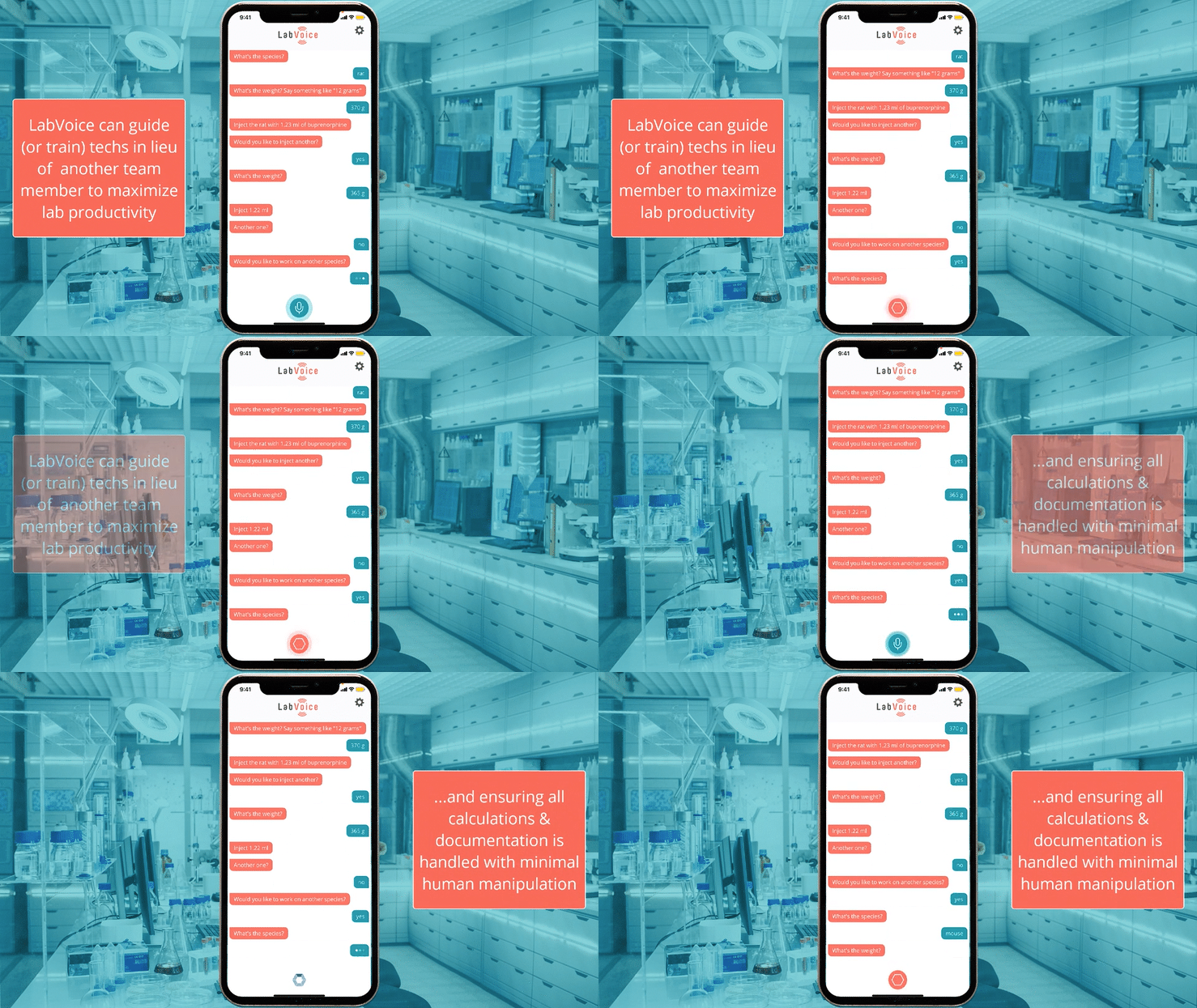
Camino Financial is using AI technology to loan with empathy
Camino Financial is dedicated to helping small businesses grow to reach their potential. Leading with empathy, this family-founded, financial technology platform startup aims to bring affordable credit to under-banked Latinx micro businesses, and empower underrepresented communities to build generational wealth.
Learn about how Camino Financial is using technology to do good and invest in minority-owned businesses in the following video and its companion blog post.
How Amberdata builds on AWS to unify digital assets for institutions
With 16% of US adults using cryptocurrency—whose market value sat just above $2 trillion earlier this year—and the US government unveiling a plan to regulate digital assets (e.g., cryptocurrency market, blockchain, and decentralized finance data), it is understandable that institutions see digital asset data (e.g., cryptocurrency market, blockchain, and decentralized finance data) as “mission critical” to their success.
Read the blog post to see how web3 startup Amberdata—who recently closed a $30 million series B funding round—is taking the value of informed decision-making and scaling it for digital asset data.

The Amberdata platform unifies digital asset data to support the needs of financial institutions.
How Ergatta partnered with AWS to develop and launch the future of game-based fitness
Sometimes it feels like we’re all searching for the same, elusive thing: a fun workout. Luckily, some people are not just looking for it—they’re creating it. “My other co-founders and I wondered why we had so much trouble making a consistent fitness routine,” says Prasanna Swaminathan, co-founder and CTO of Ergatta. “So we thought back to what made us fit growing up. And that was playing sports—it was having fun. We felt being more like a game removed the need for having more of a structure there.”
Watch the video and read the companion blog post to learn more about the co-founders’ journey and how they’re build the future of game-based fitness.
Cost optimization
Extend your runway by turning off AWS resources when not in use
Think of the last time you forgot to turn off the lights in an empty room; nobody needed the lights on, yet you ended up paying for it. This applies to your cloud resources as well. Fortunately, AWS empowers you to be in control of your spend by giving you not just full visibility on where your spend is going, but also the option to turn off resources when you don’t need them.
AWS offers more than 200 fully featured services on a pay-as-you-go pricing model. This means you pay only for the services you need, and once you stop using them, there are no additional costs or termination fees. This flexibility enables startups to experiment and bring products to market faster than ever before. And this agility does not have to come at the expense of increased costs.
This blog post shows you a few approaches that early stage startups can implement easily in order to get the most out of AWS in a cost-effective manner.
How to prevent unexpected costs for startups while building with AWS
We created this how-to guide to make sure your startup doesn’t end up spending thousands of dollars due to a spike that could have been prevented through monitoring or an alarm. We cover best practices for new and existing AWS accounts when it comes to fundamental security, monitoring, and cost management. We’ll also get into the nitty gritty when it comes to proactively setting up alerts on anomalous usage of services due to over provisioning of services and/or misconfiguration. By following these four recommendations, you can extend your runway and create a long-term strategy for cost management.
Why every startup should set up a budget — and how AWS Budgets makes it easy
As a startup, chances are you’re prioritizing speed to build fast and get your product onto the market as soon as possible. While being laser-focused on your product is essential, it also means it’s easy to overlook your AWS spend, especially if you’re running off credit programs like AWS Activate. You might also have team members wearing many different hats in their roles, making it difficult to spare headcount or attention toward managing costs.
Although monitoring costs on AWS might seem like an arduous task (and make it tempting to ignore the process altogether), it doesn’t have to be. Read on to find out how with AWS Budgets, it takes just a few minutes to set up a budget, which can help you catch surprise bills before they happen. You’ll also be able to monitor costs and usage over time, allowing you to optimize your monthly bill and maximize usage of the perpetual AWS free tier once you’ve transitioned off of credits.
Tech. tips
Should startups use infrastructure as code (IaC)?
When startups opt for “easier,” manual solutions that aren’t reproducible, only the individual who creates the solution has an understanding of its configurations. This leads to configuration drifts — an environment where running your workloads in your infrastructure changes over time due to manual changes or other updates. Drifts can cause your organization time and stress, not to mention monetary loss, even over minor issues.
In this blog post, learn why delaying the implementation of IaC makes it more challenging to deliver new features and fixes to users, and why it takes longer to scale your resources as your user base grows.

Four simple steps to classify your data and secure your startup
A data classification process allows you to distinguish between confidential data and data intended for public consumption, and lets you handle each set accordingly. A startup that has categorized its data can operate more efficiently and more confidently navigate compliance with laws such as the European Union’s General Data Protection Regulation (GDPR) and the California Consumer Protection Act (CCPA).
Understanding your data types and their sensitivity levels ensures that your startup stays ahead of unintended data use or disclosures and satisfies compliance requirements.
To get you started, this post provides four simple steps to simplify and automate the data classification process for your startup.
Business support and advice
Demystifying startup jargon
Entering into the entrepreneur space can be daunting, especially for entrepreneurs who don’t have a grounding in funding, finance, and investment. Read on to get a primer on common terms that will help you run the gauntlet of investment and finance. From non-dilutive capital to uncapped convertibles, shareholder agreements and dry powder, there’s a lot to learn!

The 10 Cs super-successful startup founders have in common
The qualities that make a successful tech startup founder are a complex, even mystical, blend of traits. It’s true there are many other factors which determine whether or not someone will hit the big time, but no matter what the sector, product, or service, we’ve found all super-star founders share key characteristics and attitudes. Here are our top 10 Cs that super-successful tech startup founders all have in common.
Accelerate your startup today
Whether you’re scaling your startup to be the next not-so-hidden gem (unicorn, anyone?) or you’re ready to start building, AWS Startups is here to help you to prove what’s possible. We’re looking forward to seeing what you dream up in 2023!
Ready for the next step? Check out AWS Activate for free tools, credits, and resources that can accelerate your startup at every stage.

Imagine a world where transactions—selling a house, trading an asset, paying out a claim—finalize in seconds or less. Contract, payment, and receipts are all tied together in a single action, with the history of the trade permanently logged. The transfer does not require third-party involvement, bypassing centralized middlemen, such as banks, brokers, and agents.
This world is built on blockchain, decentralized and unchangeable digital ledgers that maintain a growing list of transactions stored in “blocks.” Mainstream companies are rapidly embracing blockchains to optimize their costs, while providing faster, safer, more transparent products to their customers.
A recent Alchemy Web3 development report notes that 36% of all existing smart contracts were deployed in 2022. Per Gartner, the business value generated by blockchain is expected to grow from $176 billion in 2025 to $3.1 trillion in 2030.
Realizing the value of academic research and founding Ava Labs
A digital disruptor fueling this mainstream growth of blockchain is Ava Labs, the startup responsible for launching the Avalanche blockchain platform and a primary contributor to innovation happening on the chain. Founded in 2018, Ava Labs is helmed by a team including co-founder and chief executive officer (CEO) Emin Gün Sirer (whose preferred name is Gün) and president John Wu.
“The process that took us to Avalanche started in 2006 and took many years of research in peer-to-peer systems and self-organizing systems that pre-dates Bitcoin and others,” explains Gün, describing his 20 years as a leading professor of distributed systems at Cornell University.
John explains, “Our mission is not just to play in the world of crypto; we want to tokenize all the world’s financial assets to create a better system for everyone.”

The Ava Labs team at Avalanche Summit 2022 in Barcelona, Spain.
Tokenization converts something of value into digital units of asset ownership. Digitized assets can:
- Eliminate the inefficiencies of traditional transactions, such as paperwork and human capital
- Send easily and quickly
- Create greater fractionalization opportunities (division of an asset so more people can participate in ownership) and market liquidity (the ease with which an asset can be bought or sold)
Digitized assets also remove geographical and systemic barriers to access, such as the third-party incumbents who own traditional finance processes.
“It’s time to democratize finance entirely,” says Gün. “You, me, and everybody else can be on an equal footing with the bankers. Scales differ, but the opportunities open to us must be identical.”
Blazing a trail in web3 with novel blockchain infrastructure
Launched in September 2020, Avalanche started a new era for blockchains with near-instant transaction finality. Today, 500+ apps are built atop Avalanche, which is an eco-friendly protocol with minimal energy usage. These apps span the web3 universe, including projects in decentralized finance, blockchain gaming, NFTs, and enterprise use cases. Ava Labs’ work addresses three longstanding challenges in the blockchain space:
- Flexibility. The rigidity of monolithic, or single, blockchains can lead to a lack of use-case fit for apps, as well as congestion which results in higher fees for users.
- Adaptability. Avalanche allows users to create application-specific blockchains (Figure 1), called “Subnets.” Subnets are customizable and improve the speed and scalability of decentralized applications (“dApps”) hosted on the blockchain.
- Scalability. A blockchain platform on which others can build needs to support thousands of transactions per second and have rapid finality.

Launch fast, reliable nodes with AWS to validate Avalanche and its subnets
“Instead of a single chain to rule them all, Avalanche is more like an umbrella where anyone can create their own chain,” says Gün. “These chains isolate activity away from the main network: a load spike on my chain shall not affect the performance of your chain, nor will my fee activity or congestion affect your chain.”
The critical technology behind Subnets is the Avalanche consensus protocol. A consensus protocol ensures the digital ledger is constructed in an orderly fashion and that the nodes sustaining the ledger agree on its state.
There are three principal approaches to consensus protocols:
- Proof of work. “This control mechanism was pioneered by Bitcoin, by Satoshi Nakamoto, and is a brilliant idea to use mining to create the chain. The nice thing is that it’s open and anyone can participate,” says Gün. “The issues are scaling and that it consumes a lot of energy.”
- Proof of stake (classical or signature accrual). “These are more energy efficient, but they’re not as decentralized,” Gün explains, “Only a few hundred participants can participate in each decision at a time. That’s the downside compared to proof-of-work protocols.”
- Avalanche. Per Gün, “Avalanche combines the best of the other two mechanisms: It doesn’t need mining: it’s efficient, it’s fast; it’s decentralized. Avalanche uses proof of stake, but its method of random sub-sampling to achieve consensus is different.”
In addition to the Avalanche consensus protocol, “We are the team that has brought the most recent scientific advances to blockchains. With our platform, with our bridge—which is the biggest bridge in crypto—and with our Core wallet and our new marketplace, Enclave,” explains John. “There is simply no other team that has pioneered as much web3 technology as we have.”
Ava Labs teams with AWS to accelerate web3 adoption
To support its technology, Ava Labs built a serverless architecture and is all-in on AWS. AWS’ cloud solutions, global presence, and proactive partnership are “absolutely essential” in the Ava Labs march to accelerate web3 adoption.
AWS cloud solutions for scalable blockchain infrastructure
Avalanche uses AWS solutions such as Amazon Elastic Compute Cloud (Amazon EC2) to deliver consistent millisecond performance in order to confirm transactions instantly and process thousands of transactions per second.
“It has been a huge, huge boon to all of our developers to be able to spin up nodes on the fly, spin up test networks on the fly, using AWS,” says Gün.
He continues, “Our processes for spinning up Subnets relies on dynamically-provisioned AWS instances so that people can easily, quickly launch their own chain in a couple of clicks.” With AWS global footprint, Avalanche is able to launch customized blockchains, private and public, in seconds to scale with demand.
Ava Labs also participates in AWS Activate, a free program that helps startups to build and scale by offering its members AWS credits, resources, tools, and expert advice. John explains, “AWS Activate is an excellent resource for developers to bring applications to the masses with Avalanche’s trailblazing speed, security, and scalability at their core.”
AWS Marketplace makes it easy for global users to launch a validator node
As a result of AWS’ global infrastructure and commitment to compliance, it is simple for global users to launch an Avalanche Validator Node from the AWS Marketplace. “Number one on my list of how AWS helps us is by allowing customers to launch validator nodes out of whatever legal jurisdiction makes sense for them,” Gün explains.
Ava Labs plans to add subnet deployment as a managed service to the AWS Marketplace in 2023.
John explains, “AWS is so valuable as it streamlines developers being able to go from zero to in-production with dedicated infrastructure. This is especially important to early stage and startup Web3 projects who really benefit from that blockchain-as-a-service model.”

John Wu speaking at Avalanche Summit.
Building the future of web3 with Ava Labs and AWS
In its commitment to providing blockchain execution environments to great developers around the world, Ava Labs is partnering with AWS to host entrepreneur- and developer-focused events.
These events give web3 developers and researchers the opportunity to learn from industry experts and collaborate with their peers to maximize success for their respective startups and products. Educational curriculums include topics such as product market fit, go-to-market strategy, protocol and dApp design best practices, Avalanche-specific technical guidance, and more. Often, these events will feature competitions judged by leading venture capitalists and web3 professionals, ensuring that top-tier individuals and teams find continued support after completion of the program.
“We’re looking for great talent in the developer community who want to make the jump to web3,” John says.
“One of the best things about blockchain is that if you want to develop in this space, it’s a lot easier to start today than when Gün started,” explains John. “Developers can focus on the app they want to build on a Subnet, and they don’t need to do the whole laborious architecture process over again.”
To developers in web3, Gün advises “Part of our success story was to keep the vision incredibly broad, instead of specializing, and to ensure what we are doing ties into the societal problems of the day.”
“Ventures can succeed and fail. At the end of the day, you want to go home and say, ‘I worked on something meaningful today,’” says Gün. “If you tackle something of importance to people and remain true to the things that you know to be good for society at large, you will be fulfilled.”
Gartner defines a go-to-market (GTM) strategy as one that meticulously outlines how a company connects with customers and provides its products and services. This strategy focuses on smart tactics, intelligent buyer journeys, and the effective use of technology. An agile and capable GTM framework enables your startup to build on the foundations of your original idea to create a stable and functional organization that is capable of sustainable growth. In short, a robust GTM strategy can give your startup a serious advantage over competitors.
Here we showcase three winners in the GTM Innovator category of the Amazon Web Services (AWS) Software Startups Awards. These super-charged startups have won customers and secured partnerships through leveraging AWS programs. They’ve also adapted AWS technology and tools to suit their specific needs, and created solutions and platforms to transform how they interact with consumers and enterprises.
Read on to hear more about why we chose Gold medal winner Snyk, Silver medalist Qudini and Bronze medal winner Global Processing Services (GPS) and why each brings something unique to the digital table.
Snyk meets developers where they are
Boston-based cyber security unicorn Snyk is a high-growth startup that has differentiated itself as a GTM innovator by finding new points of entry into target enterprises, using a combination of freemium product and carefully targeted content and SEO. They saw a 2.5x increase in annual recurring revenue (ARR) in 2021 and launched their full developer security platform in the same year.
They used this growth as an opportunity to further their product offering and drive competencies and accreditations, achieving the AWS Security Competency Award, signing a multi-year Amazon Web Services Enterprise Discount Program (EDP), launching two native integrations in the console (AWS CodePipeline and Amazon Inspector), and doubling AWS Marketplace revenue every quarter.
For their GTM strategy, Snyk took an innovative approach to application security. Their developers form a core part of the security solution, so they’re able to develop securely without losing agility or speed. To achieve this, Snyk developed several AWS integrations across the application stack. This way, developers can take advantage of Snyk’s automated security controls from wherever they’re working—from the integrated development environment (IDE) to source control tooling to continuous integration and delivery (CI/CD) pipelines. “We are the only security vendor to have built a first-party integration into CodePipeline so users can scan their open source files for security risks without leaving the AWS console,” says David Lugo, senior manager of partner marketing at Snyk. “This drastically reduces mean-time-to-fix and improves security and agility.”
To further its GTM strategy, Snyk aimed to make it easier for application security and engineering professionals to find and deploy its security solution by offering its tools on AWS Marketplace. Snyk also partnered with Tackle and its cloud marketplace platform, built on AWS Lambda, to provide a zero-engineering approach to listing, integrating, and managing everything the Snyk team needs to sell successfully. This is a key element of Synk’s GTM strategy: recognizing security isn’t just for security teams but also for developers, DevOps teams, and architects within an organization.
“Since we launched in the AWS Marketplace, we closed more than 80 deals in 2021 alone, leveraging both direct and private offers as well as Consulting Partner Private Offers (CPPO). Our revenue has grown dramatically as a result of these two partnerships—AWS and Tackle,” says David. “We also created a Snyk and AWS Developer Security Operations workshop and AWS Quick Start guides to help customers onboard faster with AWS and Snyk, specifically for those using Amazon Elastic Kubernetes Service (Amazon EKS).
How Qudini pivoted and won Silver
Qudini is a smart retail queue management system that allows organizations to drive sales and loyalty across stores and websites. The London-based company had established its position in the global queue management system market by 2020 but when the pandemic hit, it stepped up its game to offer a full “retail choreography” platform, which allows retailers to manage in store queues and offer appointments and event bookings. Its clients include Asda, Primark, and TK Maxx in the UK and Williams Sonoma, East West Bank, and Bass Pro Shops in the US. Qudini has raised £4.5 million (approximately $5.6 million) through seed and Series A funding and in 2021 saw a year-on-year growth of 106%.
“We are now built entirely on AWS, and this has allowed us to expand internationally. We can rapidly roll out services in different countries while still meeting local data requirements,” says Fraser Hardy, CTO and co-founder of Qudini. “We have a proven process to spin up new installations in any AWS Region required by any customer, with our fastest roll-out expanding a customer from zero stores to 500 in less than two months. This much-needed functionality has transformed our business. When we started out, it was a challenge to deliver our service in a country where we didn’t already have a presence.”
The system can now roll out into new Regions seamlessly, spinning up new installations on demand. Qudini has several customers with global branches that can use the solution across multiple Regions. Currently, Qudini has services in five Regions with a AWS usage of $45,000 per month and is working with the AWS partnership team to become an ISV Accelerate partner—Qudini has already shared more than 10 go-live projects and has more in the pipeline.
“We have a fully verified solution that has passed a foundational technical review in record time due to our previous work, and we are in the process of providing our service on AWS Marketplace,” says Fraser. “We hope to complete this process early in 2022 alongside our Retail Competency certification.”
“Use the tools provided to avoid reinventing the wheel and focus on delivering the value of your product,” says Fraser when asked what startups can do to build robust GTM strategies.
Bronze is awarded to Global Processing Services
GPS is a payment processing solution designed for the payment and Fintech sectors. The company has been in operation since 2007 and is committed to accelerating the delivery of better financial experiences globally.
“After a proven track record using AWS for development teams and building out our continuous integration and deployment solution, our IT team has further expanded our usage of the AWS product suite to meet the strategic global ambitions of our company,” says Hannah Taylor, head of marketing at GPS. “Our investment in automation and DevOps has accelerated our developer advocacy program, allowing our current and future customers to test and ‘try before you buy’ by building a comprehensive on-demand program.”
GPS worked closely with AWS to re-architect its platform to create a solution that’s agile and capable of meeting its strategic global ambitions and those of its customers. The company realized that in order to scale intelligently and achieve a competitive advantage, including its GTM strategy, it needed to establish a robust partnership with AWS built on mutual trust. The startup has now built a new GPS environment aligned with AWS best practices using AWS tooling. The first European cloud offering passed the stringent PCI-DSS AoC level 1 audit to operate in September 2021.
“Our fast growth global expansion wouldn’t be possible without AWS,” says Hannah. “We are continuing to expand our horizons using native AWS technologies such as Amazon API Gateway. We also use the AWS Marketplace to quickly implement solutions and maintain security confidence using trusted products such as Palo Alto Networks.”
GPS will continue to focus on further development with AWS using Amazon EKS and Amazon Relational Database Service (Amazon RDS) for microservice roll-outs across the globe. In addition, the company plans to continue working closely with an AWS Lighthouse project to fulfill the needs for fully compliant PCI DSS Hardware Security Modules.
“The full AWS ecosystem allows us to construct what we need, when we need it,” concludes Taylor. “Without Amazon Elastic Compute Cloud (Amazon EC2), we couldn’t operate. AWS Control Tower allows us to keep secure, and Amazon RDS allows us to quickly implement a new postgres with ease. Without things like AWS Transit Gateway, we wouldn’t be able to join secure components globally.”
Conclusion
The AWS Software Startup Awards recognizes innovative startups and entrepreneurs across several key categories, including Sustainability, Rocketship, Founder of the Year and Rising Star.
Sometimes companies that offer software-as-a-service (SaaS) need help creating scalable infrastructure so they can deliver their product to a larger audience. AWS SaaS Factory invited Epistemix’s chief executive officer (CEO) and co-founder John Cordier to share how the company is using Amazon Web Services (AWS) to scale, and how their software is helping data scientists make more informed, empathetic decisions based on real and synthetic data through machine learning models.
Humble beginnings
In 2000, world-leading epidemiologist Donald S. Burke was heading infectious disease research for the US military when he realized that decision makers didn’t have the tools they needed to understand what the future of an epidemic might look like.
To address this gap in the market, Burke, Cordier, and John Grefenstette founded Epistemix, an agent-based modeling platform paired with a synthetic, statistically accurate population of the United States.
With Epistemix’s software, data scientists can gain insights by running experiments—controlling variables like climate or economic changes—in a statistically accurate virtual world, exploring how large human populations might behave given different circumstances, as shown in Figure 1.

Figure 1. Users can immediately start running models on the platform’s synthetic population of the entire US
Epistemix started small, incubating the software within the Graduate School of Public Health at the University of Pittsburgh. They also received funding from the National Institutes of Health and the Bill & Melinda Gates Foundation.
But when the three co-founders realized that their platform could help solve social problems beyond the realm of infectious diseases, they spun it out into a company—and Epistemix, in its current form, was born.
Expanding beyond infectious disease response
“When we initially founded the company, our goal was to change the way that public health would be practiced everywhere in the world,” says Cordier. “And public health in the United States is not prioritized. Every single person became a witness to that over the last two and a half years.”
During the COVID-19 pandemic, the Epistemix team used their software to help clients in the global events industry—including CES, IMTS, the Javits Center, and other organizations—make better decisions about how and when to bring people back together.
While they were proud of this work, the Epistemix team soon realized that it was time to scale. The next step would make their platform accessible to the public, so that external data scientists could use it, vastly expanding the tool’s social impact on the world.
“We’ve been able to simulate different product adoption trajectories for different products depending on what marketing strategy they’re going with,” says Cordier. “We’ve been able to simulate segregation in the housing market (Figure 2) in the US. So, what’s next for us is really getting our software in the hands of data scientists in other areas.”
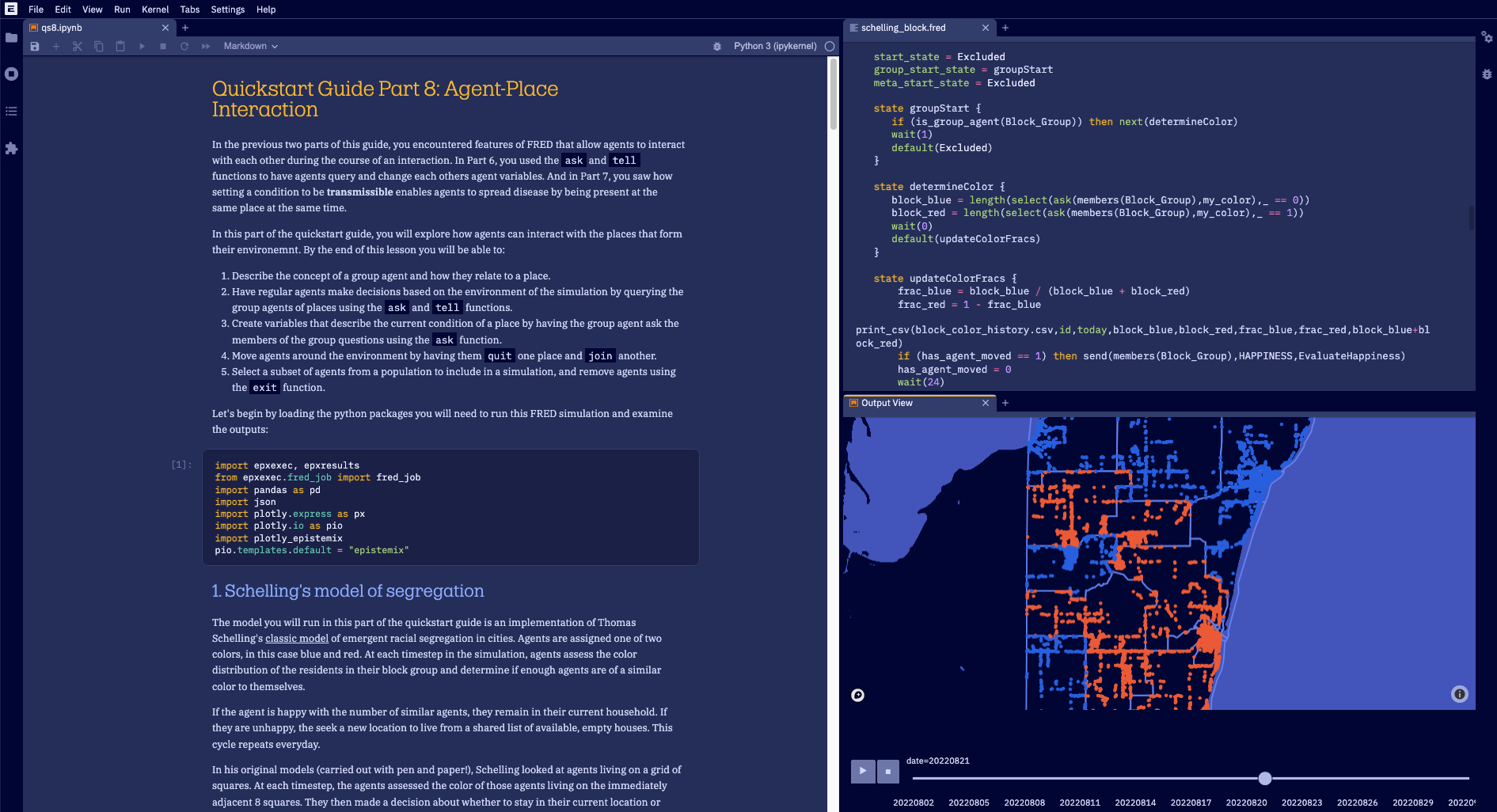
Figure 2. Simulating housing equity with a classic Schelling model
SaaS journey with the help of AWS and SaaS Factory
Epistemix’s first challenge in sharing their technology was creating a scalable infrastructure that external data scientists and other organizations could use. While their platform itself was already quite robust, they struggled to make the software more user-friendly.
After looking at other cloud providers, they partnered with AWS based on its broad range of services. And when they found themselves ready to launch with external users but were still running into technical challenges, they engaged the AWS SaaS Factory for guidance.
“Relying on the AWS SaaS Factory’s expertise, we’ve been able to create a better user onboarding experience. And through that better onboarding experience, we hope to grow the impact that our company can have,” says Cordier.
“AWS SaaS Factory helped us deliver the tool that we’ve built—with the sole intention of improving population health, equity, and policy decision-making that’s going to impact entire groups of people—to data scientists and other organizations.”
Making large-scale, informed decisions with empathy
“Every single person [in the US] is represented,” says Cordier of the Epistemix platform. “And so, I view what we are doing as giving every single person in the country a voice through data.”
Cordier believes that by sharing their platform, which one can use to see how the effects of many different variables play out, scientists will begin to understand how interconnected humans really are.
“When somebody is able to think differently about solving a problem, you can get to some really compelling solutions and a deeper level of understanding rather than what’s coming out of a very linear Excel spreadsheet,” says Cordier.
With this in mind, he believes that Epistemix has the power to change the way people think about solving a problem.
“And if we can have perspectives that are rooted around entire populations, I believe that creates more empathetic leadership, because you’re thinking about the population that your decision is going to impact.”
About AWS SaaS Factory
AWS SaaS Factory can help startups at any stage of their SaaS journey. Whether you’re looking to build new products, migrate existing applications, or optimize SaaS solutions on AWS, we can help. Visit the AWS SaaS Factory Insights Hub to discover more technical and business content and best practices.
Reach out to your account representative to inquire about engagement models and to work with the AWS SaaS Factory team.
Sign up for our AWS Partner communications to stay informed about the latest SaaS on AWS news, resources, and events.

Entrepreneurs know all about risk versus reward: short-term trade-offs, long-term gains, and some decisions so complex that solving one conflict raises another. This is particularly true in the financial industry, where success is built on choosing the right clients.
Alloy co-founders Laura Spiekerman (president), Tommy Nicolas (chief executive officer (CEO)), and Charles Hearn (chief technology officer (CTO)), saw these challenges as a business opportunity.
In 2015 they founded Alloy, a unicorn fintech startup whose global identity decisioning platform helps banks and fintech companies automate their decisions for onboarding, transaction monitoring, and credit underwriting.
Alloy combines the use of traditional data sources (such as credit scores) with newer, alternative data sources, such as cash flow data, to provide a complete and more accurate picture of each customer.
“We tell you which aspects of a client’s identity match, and which don’t match, or match in one record source but not another, and here’s an interesting flag that we should show you,” explains Charles.

Effective identity decisioning helps companies to:
- Minimize financial risk
- Maximize information security to avoid fraud
- Pave a path to smooth and seamless client onboarding
Working backwards from the problem
With experience in startups and payments processing, the trio of co-founders is well-versed in the identity verification problem. Alloy is built from their collective experience, determination, and—as the founders readily admit—a fair bit of luck.
At the payment processing startup where Laura, Charles, and Tommy met, “We saw firsthand that the answer [to identity decisioning] was for each company to make relationships with data vendors and then have engineers integrate them. It wasn’t core to the business, but it was the thing you had to build,” says Charles. “Businesses were losing time and resources by building the identity-decisioning infrastructure instead of incorporating a ready-made solution.”
Laura, Charles, and Tommy saw the opportunity to create a better solution for companies whose success was dependent on choosing the right clients. They left the payments processing company and founded Alloy.

From left to right: Charles Hearn, Tommy Nicolas, and Laura Spiekerman of Alloy
In the beginning, explains Laura, “Charles was building the product with a couple of engineers, I was having conversations with prospects and customers, and Tommy was implementing the solution and getting product feedback.”
Today, their API-based platform services over 300 banking and fintech clients.
Providing a singular solution
What sets Alloy apart? Quite a lot, actually.
For starters, Alloy clients have the power to make informed decisions.
Transparency into the data within the Alloy platform allows clients to tweak their risk tolerances to determine who to approve or deny. Clients can set mutually dependent parameters of who to flag, all without ever touching a line of code.
The specificity of what you can flag and let through helps Alloy serve a broad range of clients. For instance, a credit card company has a different risk tolerance than a bank or a bitcoin company.

The Alloy platform provides a detailed picture of each identity-decisioning case
Clients can use these features to instantaneously onboard customers who may have otherwise been sent to manual review or declined due to a lack of data or a mismatch between the data and the risks.
“Our product lets you see the outcomes,” explains Laura, “so you can easily see how you’re optimizing for fraud mitigation or for conversion. We give you the results and you can spot where your performance is the best.”
Creating broader access to financial services, while making it safe and easy for the companies involved, is a core component of Alloy’s mission. “We have always taken our position in approving and denying people for essential financial services really seriously,” explains Charles. “The core motivation behind our product is to make those experiences safe and easy to do.”
Building on AWS
One way Alloy is giving their customers an easy-to-use experience is by building a cloud-native product. Charles laughs as he recalls how, in 2015, “I got a lot of questions from our initial clients about, ‘Can you build financial infrastructure on the cloud?’ Today it’s obvious that you can, but at the time only a few companies were doing it.”
For their cloud technology, Alloy is all-in on AWS. Whether that be their core PostgreSQL database that runs on Amazon Aurora; their compute, which runs their containerized applications on Amazon Elastic Kubernetes Service (EKS); or Amazon OpenSearch Service, which Alloy relies on for log analytics and search. Beyond these fundamental technological components, the Alloy teams also use Amazon ElastiCache for their caching needs and Amazon Managed Workflows for Apache Airflow (Amazon MWAA) to orchestrate their data pipelines. They also use AWS machine learning and analytics services to enhance their decisioning and monitoring services.
“We joined very early with AWS. A lot of the products AWS offered made us stand out and made it easier for us to get off the ground, especially for providing security,” says Charles.
Alloy joined the AWS Activate startup program through Techstars which, “was essential to our growth in our first two years,” said Charles. “Through the program, we didn’t have to pay for server costs for a long time and AWS provided an experienced solutions architect to streamline our infrastructure in those earliest days.”
“Using AWS services makes it easier to optimize building your product instead of building all of the things that you think you have to build that are peripheral to it,” says Charles. “That’s the same thing we try to do for our clients—take things off their plate, and handle the things that are not core to their business, so they can focus on their core business objectives.”
Strong collaboration, proactiveness, and openness between Alloy and their AWS account team has led to more effective solution implementation, accelerated progress on key initiatives, and support for launching new products. “AWS is always helping us assess how to optimize our tech stack, especially as we’ve launched new products like transaction monitoring, which required different scalability requirements than our original onboarding product,” explains Charles.
Charles Hearn speaks at the AWS Summit
With opportunities for on-site solution immersion days, product team engagement, solution brainstorming sessions, and strategic sessions to work backwards from a customer goal, it is easy to see how leaning into a relationship with AWS can accelerate startup success.
Going broader and going global
What’s next for this fintech unicorn?
To make financial experiences even more safe and seamless, Alloy expanded its solutions to include transaction monitoring and credit underwriting in 2021.
“We’re creating a unified view of the customer lifecycle: we plug our onboarding system into our transaction monitoring system and our credit underwriting system. This will allow our clients to make more intelligent identity and risk decisions about the customer,” explains Charles. Creating a system of products that talk to each other and feed off of each other’s information will be much more powerful than analyzing smaller pieces of customer information in a vacuum.
Along with broadening their product range, in August of 2022 Alloy expanded internationally. Per Charles, “In part, we’re able to do this because AWS allows us to easily create a data center in Ireland. We’re also creating one in Australia, to more easily serve clients around the world.” To date, clients in 40 countries can access Alloy’s services and they expect the number to grow.
“We’ve seen through the first two or three innings,” says Laura. “We still have a lot more to go.”
Amazon Web Services (AWS) and Epiphany joined forces in 2021 to co-curate an artificial intelligence (AI)/machine learning (ML) bootcamp called AI/ML Reactor. AI/ML Reactor is a rigorous 5-week virtual program aimed at driving AI/ML awareness and empowering startups in Pakistan.
We received an overwhelming response for this program. Twenty-five startups were chosen out of 250 startups that applied from all provinces in Pakistan. Participants had access to exclusive master classes, a group tech mentoring session, and one-on-one mentoring sessions with AWS specialists and thought leaders. At the end of the program, they presented their AI/ML solutions to a panel of judges (see Demo Day).
Meet our winners from the 2021 Reactor!
Salesflo – 1st prize
Salesflo is one of Pakistan’s fastest growing software as a service (SaaS) platforms. They build tools to improve in-field sales efficiency for consumer goods.
The Salesflo team embarked on AI/ML Reactor to build Salesflo Airstrike – an image recognition solution that automates the retail merchandizing process. It uses Amazon Rekognition, Amazon SageMaker, Amazon Elastic Compute Cloud (Amazon EC2), and AWS Lambda.
Currently, only 2% of Pakistan’s 700,000 retail outlets are merchandized. This provides growth potential for fast-moving consumer goods (FMCG) companies to make their products available, visible, and engaging to consumers. Salesflo’s winning solution enables a shop to be merchandized, providing greater store coverage, lower costs, and faster availability.
Since winning AI/ML Reactor in 2021, Salesflo has completed successful pilot tests with clients such as Unilever and Friesland Campina. In addition, they have been working on embedding this module within their product Engage to enhance merchandizing and optimize workflows. This past year, Salesflo has been working on optimizing the models that they are using and determining product divisions and pricing categories.
“The program is a step toward fulfilling the potential of the retail industry and bringing innovation to the up-and-coming tech sphere of Pakistan” – Hamza Khan, Head of Data & Engineering, Salesflo
Ozoned Digital Ltd (“Ozoned”) – 2nd prize
Ozoned is an insurtech startup that aims to digitally transform the insurance value chain. It services multiple stakeholders (insurers, insurance brokers, insurance agents, customers, and others) in the insurance ecosystem.
Ozoned joined the AI/ML Reactor program to develop solutions to overcome digital data entry errors and minimize high survey costs in the automotive insurance space. With Amazon Textract, Ozoned was able to extract data automatically from a customer’s government-issued identification card to activate motor insurance coverage.
To help minimize insurance claims surveyor interaction during the initial stages of a claim, Ozoned used Amazon Rekognition with custom labels. This enabled identification of a vehicle and its damaged parts, reduced costs, and created efficiencies. The model was further trained to assess whether the vehicle damage was a partial or total loss. This assessment helped insurers generate an initial claim estimate for the damages, while reducing time and cost to the insurer.
Most recently, Ozoned has signed up one of the largest insurers in Pakistan – Adamjee General Insurance. Adamjee is deploying Ozoned across their motor insurance operations.
“The AI/ML Reactor program allowed Ozoned Digital to impart AI/ML training to its team and come up with a world class AI/ML technology solution in the insurtech space.” – Nomaan Bashir, co-founder and CEO, Ozoned Digital Ltd
XpertFlow – joint 3rd prize
XpertFlow is an AI-powered preventative healthcare company founded in 2019. Its mission is to reduce mortality from hospital acquired infections (HAIs) that eventually lead to sepsis.
In Pakistan, approximately 350,000 people are affected by sepsis each year, and more than 275,000 lose their lives. It costs public and private hospitals more than 10 billion PKR ($66 million) per year to treat sepsis. Without timely treatment, sepsis can rapidly lead to tissue damage, organ failure, and death.
During the AWS AI/ML Reactor program, the XpertFlow team used AWS services to forecast sepsis 6 hours before its onset:
- Amazon Simple Storage Service (Amazon S3) stores raw time series data and the model artifacts.
- Amazon SageMaker’s Data Wrangler and notebook instance handles the entire pre-processing pipeline.
- Amazon SageMaker Autopilot trains over 200 different iterations of the model, with different algorithms available on SageMaker. With Amazon SageMaker Autopilot, the team was able to select a model from several generated based on the area under receiver operator curve (AUROC).
- An endpoint was generated from that model and connected to Amazon API Gateway using Lambda.
- The API was then connected to the demo interface on the team’s deepnostiX
The winning model delivered 97% accuracy in predicting sepsis 6 hours ahead of time. It acts as an early warning system that performs nearly continuous monitoring of patients in ICUs or wards, assigning a risk score based on a patient’s vital signs.
After the AI/ML Reactor program, the sepsis AWS AI model is now fully tested and is being piloted at a few hospitals in Pakistan. XpertFlow has started using SageMaker to estimate blood pressure noninvasively, continuously, and without using arm cuffs. They are currently running trials for this new approach towards calculating blood pressure in a hospital in Islamabad, Pakistan.
“Being a CTO of a young startup, I am always looking out for tech-focused programs. After attending many programs and accelerators during the life of XpertFlow, this has been by far one of the best. The learning the team and I got from this, during a span of 5 weeks, was just incredible. We learned from the best on how to deploy our existing AI/ML solutions on the cloud and supercharge them using AWS AI/ML services. Huge shout to AWS and Epiphany for coming up with one-of-a-kind program, which was missing here in Pakistan.” – Shan Ul Haq, CTO, XpertFlow
Trukkr – joint 3rd prize
Trukkr provides financial services and technology for logistics in Pakistan. It gives both large and small businesses a comprehensive technology platform to manage and provide all their logistical needs. Trusted by some of the biggest companies in the country, Trukkr saves organizations time and money, while providing them with deep data and powerful insights.
In an effort to improve dropoff rates during sign up (see Figure 1), Trukkr investigated their onboarding process. During the AI/ML Reactor program, Trukkr delivered initial solutions to optimize their onboarding funnel. They extracted data from uploaded documents using Amazon Textract, and used that information to prefill a signup form.

Figure 1. Trukkr’s dropoff rates during sign up
The team was able to make an impact on improving the onboarding funnel, increasing their signup completion rates from 38% to 52%.
“This program helped us in further leveraging AI/ML to provide our customers with intelligent features that help them better manage and optimize their logistics. During the program, regular feedback from AWS expert mentors and the step-by-step architecture review sessions helped speed up the learning process, and deliver meaningful features to our customers.” – Kasra Zunnaiyyer, co-founder and CTO, Trukkr
To help Fintech startups maximize the value of re:Invent, connect with industry leaders, and catch up on all of the topics you’ve wanted to dive deeper into. we've put together the top 10 sessions for Fintech that you don’t want to miss.
Web3 startup Amberdata, who recently closed a $30 million series B funding round, is taking the value of informed decision-making and scaling it across an emerging sector: digital asset data.
Large, nimble technology organizations such as social media platforms, short-term travel marketplaces, and auto manufacturers rely on EngFlow’s platform to keep engineers in flow and maintain the necessary agility for modern software development. AWS is at the core of EngFlow’s success, giving them flexible architecture and cost efficiency, which directly translates into competitive advantage for end customers. To provide performant, reliable, and cost-effective solution to its customers, EngFlow followed the best practices from the AWS Well-Architected Framework. In this post, we’ll focus on the practices that helped improve the price-performance ratio and improve availability.
Most of us are familiar with how virtual reality (VR) can transport us to a make-believe realm. But how can it help us tangibly improve our physical world? For the past six years, the Helsinki-based VR/extended reality (XR) startup Varjo has been creating professional hardware, software, and services to help product designers develop consumer electronics that don’t yet exist.
Building a cloud-distributed and scalable artificial intelligence (AI) application is a cross-team effort that requires complicated management of resources and comes with numerous production concerns such as code changes, refactoring, setting up the infrastructure, and complex developer operations (DevOps). These can confuse the development process, slow down time-to-market, and keep developers from focusing on product innovation.
AWS is launching AWS Startup Ramp in France to accelerate the development of early stage startups in the public sector. This tailored program supports startups in developing new products and services in government technology, healthcare, sustainability, smart cities, space technology, and more.
For data to be useful in a modern enterprise, it must be collected and centralized from various sources, processed across a growing ecosystem of tools, and fed to systems across an organization in a way that’s consumable across teams. This data orchestration —weaving business logic through the data stack for everything from dashboards to personalization algorithms — requires hundreds, if not thousands, of data pipelines.
Though their personal experiences in the lab were different, Sara and Gabriel, PhD student, came to the same conclusion: research labs are seriously lacking when it comes to accessibility. It’s a pervasive problem not limited to one institution or type of disability. That’s why they decided to collaborate with LabVoice—a digital lab assistant platform designed specifically for the research lab. Working together with the LabVoice team, they developed an inventory search solution that allows users to record information, like chemical location and amount, and then retrieve it later entirely through verbal prompts.
No matter what market you’re in, successful startups all have a few things in common—a passion and commitment for what they’re doing, a great story to tell and a laser-like focus on customer needs. Dataiku has taken the data and AI world by storm—transforming from French startup to global unicorn in just seven years. The team’s journey began with a passion for data and machine learning (ML) and a quest to bring everyday artificial intelligence (AI) to companies of all sizes and sectors.As a founder, your path will of course be different from Dataiku’s, but they can show you what to look out for and provide advice to aid and speed your progress.
What do you do if you don’t have the resources, time, or funds to self-manage a database? Use Amazon Relational Database Service (RDS)! Amazon RDS allows you to set up, operate, and scale a relational database in the cloud with just a few clicks. It removes inefficient and time-consuming database administrative tasks without needing to provision infrastructure or maintain software. And, with the new AWS Database Plug & Play Program, you’ll get a packaged bundle of AWS advisory time, architecture and prototyping patterns, AWS usage credits, and pathways to go-to-market acceleration programs to help further ensure your teams can focus on value-generating work.
Originally, Fyle's Data-Extractor service relied on an external service provider for optical character recognition (OCR) and Fyle’s internal machine learning algorithm to detect amount, category, date, currency, and vendor information. Unfortunately, they were receiving some feedback from customers that their tool wasn’t very accurate. As you can imagine, this isn’t the best place to be, so they rewrote their Data-Extractor service to use Amazon Textract because of its intuitive web console for APIs, which allowed them to test APIs in real-time with personalized input. This let them quickly try out an Amazon Textract API, which helped them achieve their goal of turning around a solution in two months. After implementing their new solution, Fyle saw 51.7% improvement in accuracy for the Data-Extractor service.
Understanding your data types and their sensitivity levels ensures that your startup stays ahead of unintended data use or disclosures and satisfies compliance requirements. By identifying the data you have and implementing appropriate, automated controls, you can meet these requirements more easily, while also improving your security posture. To get you started, this post provides four simple steps to simplify and automate the data classification process for your startup.
By using Serverless on AWS to scale their infrastructure, the cinch team was able to focus their cognitive load on improving the platform, quickly release new features, and re-build existing ones based on real world customer insight. With their new architecture, cinch was able to pivot their business to the new model in 6 months, increase traffic by 2.5x (6,000 to 16,000 requests per minute), and reduce latency. They went from hundreds of cars sold within days, and grew by a factor of 100x within a few weeks.
It’s almost the most wonderful time of the year again: AWS re:Invent is just around the corner. And while we’d love to hang out with you in Las Vegas from November 28 through December 2, never fear if you can’t attend in person. You can still get everything re:Invent has to offer by attending virtually. (Well, except for the slot machines and general Vegas-fueled sensory overload, of course!)
It has been an amazing first 12 months for our AWS Startup Loft Accelerator program. So far, we have helped over 275 early-stage (two years and under) companies with technical and business expertise, tailored training, and mentoring across Europe, the Middle East, and Africa (EMEA). Every month, we welcome 30 new startups into the 10-week virtual program. They learn together and form a supportive community of innovative entrepreneurs. In this post, we hear from the companies themselves about their participation in the program.
AWS re:Invent 2022 is fast approaching, and we can’t wait to see you in Las Vegas from November 28 through December 2! As usual, these four days will be jam-packed with activities, networking events, inspiring keynote speakers, breakout sessions that will allow you to connect with fellow attendees, interactive workshops, and more.
As with all best forms of innovation, great ideas stem from true need. In Mexico, there is a need for an equitable, efficient, and sustainable healthcare system. Latino startup founders are addressing this need and advancing healthcare equity by leveraging artificial intelligence (AI) to drive better patient outcomes.
Pieces Technologies, Inc. (Pieces), a healthcare and life sciences startup, is blazing a trail in the predictive AI/ML space. Pieces is a software as a service (SaaS)-based AI platform integrated into a hospital’s electronic health record (EHR). Their mission is to improve care by providing clinical insights along the patient journey. They offer predictions of health events such as projected discharge dates, anticipated clinical and non-clinical barriers to discharge, and risk of readmission, before they occur. Pieces also provides insights to healthcare providers in natural language, and optimizes the overall clarity of the patient’s clinical issues so care teams can work more efficiently.
At AWS, we know that building a dream is best achieved by having support from people like you who want to get where you’re going as much as you do. To celebrate Hispanic Heritage Month, we’re recognizing the achievements and contributions of Hispanic and Latino Americans who have inspired others to achieve success. In Part 3, we hear from Mauricio Di Bartolomeo, CSO and co-founder of Ledn, a financial services provider that leverages the reach of digital assets to serve clients globally, providing the same rates and level of service regardless of where they are located.
Starting today, from the moment you join AWS Activate, you’ll also gain instant access to Activate Console, which offers a robust suite of benefits, including technical training, tested and proven infrastructure templates, personalized guidance, and more. Think of the Activate Console as your Activate smart hub — it’s where you’ll access all the tools, education, and resources we’ve designed just for your startup.
We asked three quickly growing startups from the AWS Software Startup Awards to share the secrets of their success. Here’s what they told us. "No one thing will make you successful, whether it's choosing a new tool, launching a new marketing campaign, or hiring a great salesperson, but each of these things will make you one or two percent better. Continuously improving will enable you to build a successful business over time. Gauge your progress, celebrate every win, and acknowledge any failures so you know when it’s time for another round of goal-setting.
Network effects are fundamental to many business models, and virality can be crucial for certain aspects of growth of some businesses. So, what are network effects? At its most basic, network effects happen when the product or service that a company offers increases in value as more people use it. Why are they beneficial? Network […]
At AWS, we know that building a dream is best achieved by having support from people like you who want to get where you’re going as much as you do. To celebrate Hispanic Heritage Month, we’re recognizing the achievements and contributions of Hispanic and Latino Americans who have inspired others to achieve success. In Part 2, we hear from Augie Del Rio, co-founder and CEO of Gallus Insights, a company that develops advanced analytics services to support timely, informed decision making.
Fresh off the success of the inaugural Amazon Web Services (AWS) Impact Accelerator for Black founders, AWS is continuing its $30 million commitment to provide underrepresented founders with the resources, capital, and community they need to level the startup playing field. Today, meet the 25 women founders selected from a competitive field of applicants and chosen by a diverse committee of AWS Startups experts who are changing the startup landscape with their next idea.
At AWS, we know that building a dream is best achieved by having support from people like you who want to get where you’re going as much as you do. To celebrate Hispanic Heritage Month, we’re recognizing the achievements and contributions of Hispanic and Latino Americans who have inspired others to achieve success. In Part 1, we hear from Israel Niezen, co-founder and CEO of Factored, a company that develops advanced artificial intelligence (AI) and data science solutions for US companies. Per Israel, they also “employ engineers in Latin America whose individual economic impact leads to the creation of four-to-five additional jobs in local communities.”
The AWS Training and Certification team is offering a new, free video series: AWS Cloud Economics for Startups. Throughout the 15 lessons, you’ll learn from use cases of other real-world AWS startup customers that will help inform and guide your startup's particular journey.
Bring your idea to life—join the AWS Amplify hackathon, hosted throughout September by Hashnode and Amazon Web Services (AWS), and start building your application.
If you've been sitting on your application for the AWS Impact Accelerator for Women Founders, meet Aireka Harvell, founder of Nodat and inaugural member of AWS Impact Accelerator for Black Founders. In today's post, she shares her best advice for making the most of this unique opportunity and how it is changing the trajectory of her startup. Then, get your application submitted by August 26!
Most startups want to achieve the title of ‘high-growth’. It’s a moniker that defines their stratospheric growth within their sector. That labels them as a disruptor and change maker. And that paints them as innovative and interesting—as the kind of company that investors pay attention to and customers want to adopt. Which is exactly what Signal AI, Synthesia and TrueLayer—all winners in the Rocketship category of the AWS Software Startups Awards—have done.
Brace for Impact! The AWS Impact Accelerator program got off to a flying start—and it’s only the beginning of what this initiative has to offer. Get an inside look at what Impact Accelerator participants experience, and learn how to apply for the next Impact Accelerator Program.
Female founders receive just a portion of the funding that male founders do. That’s not just bad news for women who want to build a startup—it’s bad news for everybody. Women are the driving force behind a thriving economy. AWS recognizes the immense need for an increase in inclusivity in the startup ecosystem. That’s why we are excited to be launching applications for the second cohort of our Impact Accelerator, exclusively focused on women-led businesses.
What do you get when you mix an AWS Summit with one of the fastest growing tech conferences in Toronto? We call that one of our busiest weeks yet. Packed with networking, collaborating with peers, and learning from top thought leaders in the space, our week at AWS Summit Toronto and Collision Conference 2022 last […]
Each month, the AWS Startups blog is packed with announcements, resources, stories, and videos. Let’s get caught up on anything that you might have missed in July.
Is your head buzzing with buzzwords? Let's unpack the terminology and the acronyms that define startup speak, so that any founder can talk entrepreneur and investment with ease.
When it comes to funding a business, there are several options that you can choose from, but two of the most common are to bootstrap or to find venture capital (VC). The two are very different approaches and can often be used in conjunction with one another to take a startup from one stage to the next. Learn the difference between these, and hear from a founder making that choice for his own startup.
As a startup, your days are filled with competing priorities: you want to focus your time on innovation and product market fit—not worrying about underlying infrastructure or unexpected costs, but by following these four recommendations, you can extend your runway and create a long-term strategy for cost management.
Calling all business decision-makers, operators, founders, developers, and C-level executives alike who are ready to explore what’s next in Blockchain, NFTs, cryptocurrency, and beyond. AWS Web3 Ready is a one-day virtual event, designed with the Web3-savvy and the Web3-curious in mind. Get a first look at the speaker line up, and register to receive our exclusive NFT artwork.
The qualities that make an uber-successful tech startup founder are a complex, even mystical, blend of traits. As we celebrate the stars of our AWS Software Startup awards, meet three incredible founders who share similar key characteristics and are blazing a distinctive trail.
Serial entrepreneur Monica Sarbu explains why celebrating diversity and empowering people is the key to success. Learn how her commitment to building with diversity from Day One has guided startup Xata to a $5 million funding round.
We recently sat down with the Timehop and Nimbus CEO, Matt Raoul, as well as two talented team members, David Leviev, VP of Programmatic Product Development, and Mark Laczynski, Senior Cloud Architect to discuss the obstacles the company has faced using third-party ad serving platforms that led to the in-house creation of Nimbus. They shared their challenges and revealed how they leveraged AWS solutions to optimize the development of Nimbus within Timehop, and not only improved the quality of ad servicing to their users, but also increased overall ad revenue.
Each month, the AWS Startups blog is packed with announcements, resources, stories, and videos. Let’s get caught up on anything that you might have missed in June.
Amazon Web Services has partnered with MATTER, the premier healthcare technology incubator and innovation hub, to launch AWS Expand. The program supports startups entering the US market from Europe, the Middle East, and Africa (EMEA) by providing expert guidance, mentorship, client connections, an extensive network within the healthcare industry, and more.
The Startup Guide to AWS Services series consists of seven short videos and blog posts featuring AWS solutions architects, with related links and training videos. Each presentation highlights the advantages to working in a cloud environment, with brief examples that pair services to use cases.
We need startups with innovative mindsets to step forward with solutions that will enable the world to achieve the Sustainable Development Goals (SDGs), startups that put sustainability at the heart of their technology, which is precisely what Basecamp Research, BioSimulytics Limited, and Sellalong Ltd. have done. Learn more about the 2022 AWS Software Startup Awards medalists in the Sustainability Champion category.
Data needs to live somewhere. Whether for ETL solutions, data cataloging, or advanced analytics, data needs to be stored safely and accessibly. In the seventh installment of The Startup Guide to AWS Services free video series, AWS Startup Solutions Architect Zoish Pithawala discusses how to form an ecosystem where data is mobile, agile, and secure.
Today, we're recapping our time at AWS Summit Atlanta, and if you weren't able to attend, we have a some behind-the-scenes look at what you missed. We heard from experts in AI/ML, Analytics, Business Intelligence, IoT, Databases, and more who connected and networked with industry peers to help them take advantage of the latest AWS solutions. See an AWS Summit through our eyes, and then register to attend the next event near you.
This installment of The Startup Guide to AWS Services video series, covers AWS compute models and the advantages of serverless architecture. While outlining the various operational models, Principal Startup Solutions Architect Igor Geyfman identifies which tasks AWS manages and which are up to the startup.
In April, we announced a 3-year, $30 million commitment to the AWS Impact Accelerator, a series of programs is designed to help high-potential, pre-seed startups led by underrepresented founders succeed. We also launched the first of these programs, the AWS Impact Accelerator for Black Founders, and today we’re excited to announce the startups that will make up this inaugural cohort. Meet the startups, and learn more about this exciting opportunity.
When time and resources are often stretched as far as they can go, and various branches of the infrastructure need to communicate, AWS can help startup founders and developers bridge the gap through Data insights to uncover customer needs. When paired with automation and machine learning, these services can put startups on a growth superhighway.
This month we’re hosting six in-person events for startups looking to optimize their product for better PMF and understand how to build to MVP. There’s no need to be a current AWS customer, any startup can attend!
Each month, the AWS Startups blog is packed with announcements, resources, stories, and videos. Let's get caught up on anything that you might have missed in May.
Build. Test. Deploy. Troubleshoot. Then do it all again. For a startup trying to build and deploy an application, the process can seem endless. Luckily, automation and cloud-based resources can streamline the process.
Running a business is hard work, with a lot of moving parts. Startup founders have had to build, deploy, secure, scale, manage, and monitor their software products all while controlling operational costs. This installment of The Startup Guide to AWS Services video series matches services to situations to streamline the development process to develop and deploy an MVP fast.
While Machine Learning can get quite complex, you don’t need a team of expensive Data Scientists and ML Engineers to gain real value from it. Check out our upcoming Twitch series for hands-on training with our AWS ML experts, and work through a variety of typical startup use cases from generating personalized customer recommendations to improving marketing efficiency.
Security is always the top priority for AWS, but let’s face it - it’s not always the top priority for a founder just trying to get your idea for a new company off the ground. That’s why we’re pleased to announce the launch of the AWS Startup Security Baseline (AWS SSB), a new guide that describes the set of controls we recommend all startups implement as a foundation during their initial stages of development and operation.
Thousands of attendees and dozens of vendors gathered at AWS Summit San Francisco, part of a series of free, global, in-person events dedicated to spreading skills and knowledge around AWS’s cloud offerings. Here are seven of those attendee experiences that are guaranteed to give you enough FOMO to immediately register for an AWS Summit near you!
Smart startup founders will push for innovation without surrendering control of their product, data, or funding. By managing permissions, for example, you can grant access and still protect your data. Learn which services can help you secure your environment while maintaining speed and cost.
Spherity is a German software provider bringing secure and decentralized identity management solutions to enterprises, machines, products, data and even algorithms.
You’ve developed a winning concept, gathered a team, and mapped out your startup’s overall design. Now, as those ideas take shape, security solutions should be built right in.
Each month, the AWS Startups blog is packed with announcements, resources, stories, and videos. Let's get caught up on anything that you might have missed.
Hubble, a Construction Tech company based in Singapore, grew its team size from eight in 2019 to 35 in 2021. As it continues to grow, challenges around productivity bottlenecks became more apparent. To support their employee’s well-being, they used analytics from an AWS Data Warehousing solution, via Amazon Redshift.
Founded in 2018, Navina is leveraging the full AWS toolkit to improve the human-to-human interactions at the heart of healthcare. “[The result is] a better physician experience,” says Anne Amario, Navina VP of Marketing, as well as “better diagnosis and care.” Learn how Navina is driving better patient outcomes and preserving physicians' revenues.
The super.AI platform helps customers to transform processes involving unstructured data such as images, videos, text, documents, and audio and automate them using a combination of AI, software, and humans. Their customers requested a more efficient, highly accurate labeling mechanism, so they eleased a new feature where the pipeline pre-processes data points using an ML model running on Amazon SageMaker.
AWS Amplify is excited to announce the launch of Amplify Studios, a visual interface to that lets developers go from a Figma design to a feature-rich, full-stack app in hours.
Learn more about the new program that will provide up to $225,000 in cash and credits for early stage startups led by Black, women, Latino, and LGBTQIA+ entrepreneurs, as well as training, mentoring, and technical guidance. Then hear from three founders about what access to capital and resources means for the next generation.
Data infrastructure relies on a variety of data analytics tools and machine-learning capabilities, so DayTwo turned to several of the AWS ecosystem services. Specifically, they are utilizing AWS Lake Formation and AWS Deep Learning Containers in order to analyze large outputs. They’re also relying on Amazon SageMaker to manage all of their machine-learning and AI capabilities.
When Gil Elbaz and Ofir Zuk founded Datagen in 2018, it was with the purpose of re-inventing the broken process of how clients obtain data for computer vision network training. More specifically, they wanted to bring data simulation to every computer vision team in a continuous and scalable way.
Dremio, a SQL lakehouse platform, is a service that enables companies to query the data stored in Amazon Simple Storage Service (Amazon S3) to get fast results and power live dashboards directly on their lake.
Web application, Optioneer, employs multiple AWS services and is updated daily thanks to its continuous deployment pipeline. However, as it grew in complexity, the team at Continuum Industries realized they needed to overhaul their deployment process to deliver more reliable updates to production, faster. That is when the AWS startup team stepped up to provide additional support.
Lokavant is a Clinical Trial Intelligence company with the mission to decrease the time and cost of developing drugs by mitigating operational risk. When developing their products and platform they partner to provide the best environment for building and deploying, without bogging down the business with unnecessary costs and effort. Lokavant quickly realized that AWS could help provide the solutions that they urgently needed.
If you’re an entrepreneur with a great idea or a burgeoning startup looking for support, we invite you to immerse yourself in this innovative space and its thriving community at 525 Market Street. The SF AWS Startup Loft is open to all startups building on-cloud and is a free benefit for existing AWS Activate customers.
BlockFi, a crypto services platform operating in the fintech space, offers financial products to retail and institutional investors. After rapidly growing from 200 to 1,000 employees during the pandemic, the company knew they needed a solid infrastructure that would allow them to scale quickly and safely.
Startups move at a very fast pace, and details like security, elasticity, and availability can end up neglected due to wanting to release a product or service as quickly as possible. By utilizing AWS, Citus Health was able to leverage built in tools and services to secure their environment and ensure that their services remain available and resilient.
Slack recently launched a new Digital Toolkit that brought together 11 must-have tools for your startup. As part of this campaign, AWS Activate - a free program specifically designed for startups and early stage entrepreneurs - teamed up with Slack to provide you with resources and expert support to go to market faster, and lower your startup costs
We want to help you stay focused on your customers and building features for your products, so we’ve put together a list of the most common mistakes we see founders make on AWS, paired with advice on how to avoid them to save you time and money.
Emerald Cloud Lab (ECL) provides access to a highly automated laboratory, equipped with over 200 unique pieces of scientific instrumentation, to any scientist with a computer and internet connection. As their cloud lab expands to meet growing demand, they've faced a growing need for scalable, on-demand compute. To address this growth, ECL built Manifold, a microservices-based architecture that runs on AWS Fargate.
Early stage startups have many technical decisions to make while pursuing product-market fit. Some technical decisions are reversible, while others are critical junctures with long-term impacts.
Nonprofits are often overwhelmed by the amount of data they accumulate, and lack the resources to generate value from it. In response to this challenge, charitable organization Data Science for Social Good (DSSG) Berlin was founded. As part of their mission to enlist volunteer data scientists and analysts to help nonprofits use their data properly, DSSG Berlin hosted Datathon, a data science hackathon powered by AWS services.
Camino Financial is dedicated to helping small businesses grow to reach their potential. Leading with empathy, this family-founded, financial technology platform startup aims to bring affordable credit to under-banked Latinx micro businesses, and empower underrepresented communities to build generational wealth.
Cost optimization is a priority for customers of all sizes, but founders particularly want to make sure their financial resources are being used properly and they’re getting the most out of AWS. Here are a few approaches that early-stage startups can implement easily in order to get the most out of AWS in a cost-effective manner.
We are excited to announce the selection of the 12 participants for the first ever AWS Healthcare Accelerator in the UK, a four-week program that cultivates and promotes innovative startup solutions that achieve the quadruple aim of improved patient experience, improved clinician experience, better health outcomes, and lower cost of care.
Vincere Health offers low-cost access to addiction healthcare using reward-based habit training. Their belief is clinicians being in the loop are integral to lasting behavior change, and that the technology serves to facilitate and personalize this relationship at scale. Vincere chose AWS as their cloud provider because AWS provides the necessary tools to help us build a HIPAA compliant platform.
Polly is a DataOps platform that allows data scientists to access ML-ready data generated from data repositories, proprietary experiments, and publications. Powered by AWS, Polly’s infrastructure is fast, secure, and scales seamlessly.
In order to compete in today’s visual-first world, startups must deliver rich content quickly and flawlessly across all touch points, providing seamless and compelling user experiences. To successfully do this, they need an infrastructure with services that will allow them to run their workloads securely and rapidly.
This year, over 100 million global founders will embark on their journey to establish their startup with big, innovative ideas to solve our most pressing challenges. Through our global startup program AWS Activate, all startups can leverage the same technology that successful companies of all sizes are enjoying to build, grow and scale their business.
For startups, speed is critical — you’re trying to move as quickly as possible to build your product and find product-market fit. However, it’s important not to ignore your security posture. Here are some simple steps you can take that will allow you to move quickly while still safeguarding your data.
A common mistake we see founders make when starting on AWS is trying to implement their own solution when a managed service could be used instead. Before choosing your tech stack, consider the questions in this post to evaluate what's best for your business.
Like many startups before them, the team behind the Ergatta Rower turned to AWS to help them develop and launch their product. Watch this video to learn more about the co-founders’ journey, including how they’re utilizing AWS’s guidance, services, tools, and technology to build the future of game-based fitness.
When you’re an early stage startup, nothing seems more important than being quick. However, prioritizing speed and skipping a little bit of engineering time for foundational work can end up being a huge mistake, and there’s one in particular that gets made all too often in the startup world: not using Infrastructure as Code (IaC).
Due to the effects of advancing climate change and a growing global population, agricultural professionals are under more pressure than ever before to produce higher yields with fewer inputs. Learn how Geopard, an independent precision agriculture platform, collaborates with Corteva, a leading global agricultural input company, to augment their physical products with smart recommendations integrated into a decision support tool powered by AWS.
No matter the nature of your startup, security is always of primary importance and should be one of the very first things you address. For most startups, your most valuable asset is your data — your ideas, workloads, and applications — and you need to protect it. Learn why multi-factor authentication is a must-have.
For most startups, scaling quickly and becoming extremely popular is a desirable goal. But the rate of WOMBO’s growth exceeded even the founders’ wildest expectations, with 25 million downloads in the first month alone—something that created a huge challenge for the company. AWS recognized the situation and stepped in to help.
At Amazon Web Services, we work with thousands of new startups every year, and we know how hard founders work to balance the demands on scarce time and resources. Often, a startup’s first goal is to build a minimum viable product (MVP) and by following AWS best practices for IAM security, you can ensure that you’re building in a secure way and protecting your users and your business.
Whether you are testing out an integration with a new AWS service, requesting increases in service limits, obtaining best-practice guidance, or minimizing risk when making changes to enhance the customer experience, AWS Business Support can help you make time-sensitive decisions to keep your startup running smoothly.
Celeris Therapeutics (CelerisTx) is pioneering the adoption of AI on proximity-inducing compounds (PICs), focusing on Targeted Protein Degradation. To save developer time and gain quicker insights, Celeris turned to Amazon SageMaker.
Werner Vogels, Amazon CTO since 2005, has observed macro trends around the technology industry, giving him a unique perspective to distinguish substantive progress from mere fads. He recently published his views on what he sees in store in 2022 for cloud technology and the technology world in general. Let’s dive into five core anticipated developments and their potential impact on the world of startups.
As a startup, chances are you’re prioritizing speed to build fast and get your product onto the market as soon as possible. While being laser-focused on your product is essential, it also means it’s easy to overlook your AWS spend, especially if you’re running off credit programs like AWS Activate. With AWS Budgets, you’ll be able to monitor costs and usage over time, allowing you to optimize your monthly bill and maximize usage of the perpetual AWS free tier once you’ve transitioned off of credits.
Selling to enterprise businesses involves months-long sales cycles and detailed procurement questionnaires that take up a CTO’s time and attention. Jon Topper, Founder and CEO of The Scale Factory (an AWS SaaS Competency Partner), explains how AWS helps make the process more efficient by streamlining and facilitating the process.
Early in the pandemic, startup PostEra saw a need for an accessible therapeutic treatment - but they had trouble getting anyone to listen. Recognizing concerns ranging from public sentiment to the difficulty in delivering vaccines or antibodies to the Global South, PostEra helped launch a worldwide effort to develop novel antivirals, using technologies from AWS. With help from our team, PostEra rolled up their sleeves to rapidly scale the infrastructure and innovative technologies to speed compounds toward clinical development.
As the popularity of online dating services continues to grow, so too does the threat from scammers, bots, and other bad actors. ICONY GmbH, a white-label dating platform based in Germany, helps address this issue by rigorously validating users — allowing its business partners to launch their services with a database of reputable and up-to-date profiles already in place. With more than 200 partners, learn how ICONY is helping to create authentic, and safer dating platforms.
Cost optimization is a top of mind consideration for any startup and can be achieved with a wide variety of techniques, but how you tackle it depends on the stage of your business’s growth. Startups are laser-focused on product development, which can mean choosing between time spent building extra functionality to manage costs, like reorganizing account structures or building cost analytics pipelines, and prioritizing low-effort-to-high-impact architectural changes to keep your momentum up. In this post, we'll share three easy-to-implement cost optimization strategies to help you quickly understand and optimize your spend, then get back to building features that will drive value for your customers.
Much as microchips did through the 1980s and ‘90s, batteries are now finding their way into many devices and systems around us, and in the process are changing what we previously thought possible. Advances in lithium-ion battery technology in particular have enabled transformations in the way we connect and find information, the way we move people and goods, and the way we power our homes and buildings. The transition to a battery-powered world is not without its challenges, however. While mature technologies like the mechanical components (springs, hinges, enclosures) and semiconductors that make up most of our devices are well understood and tend to fail in predictable ways, batteries are much more complicated. Read on to learn how Voltaiq works with a global customer base, including Lab126, to help them to launch products faster, optimize performance and reliability, and minimize risks from warranty returns and recalls.
When the social media revolution began, e-commerce sites mostly catered to English speakers, which left out a huge population of would-be participants. Koo, a microblogging platform based in India, noted the lack of inclusivity and made it their mission to create an app that is accessible to the entire spectrum of languages spoken in India. Koo started with just three languages—English, Hindi, and Kannada—and expanded from there. Learn how this ambitious startup used AWS to scale and give a voice to millions of users.
Food waste is a global issue that stretches far beyond its impact on underfed populations: it’s one of the primary drivers behind the climate crisis, representing 10% of all greenhouse gas emissions. Combating food waste reduces methane emissions in particular, while also preventing the waste of the labor and resources required to make the food. But there’s room for hope, and Too Good To Go is helping make it happen with their free app dedicated to reducing food waste worldwide by connecting customers to restaurants and stores with surplus food.
As re:Invent 2021 nears, many attendees are packing their blazers and sensible sneakers to head to Las Vegas. But if you’re not able to be there in person—or if you’re allergic to neon signs and magic shows—here are eight reasons why you’ll get just as much out of attending virtual re:Invent.
When catastrophic flooding devastated Germany in July 2021, InsurTech startup claimsforce saw a 300% load increase on their systems. As a key player in the digital transformation of the European insurance industry, they serve multiple insurers and damage adjuster networks, leading to an ever-increasing amount of data stored in their application databases and sources. Learn how they leveraged a Lake House approach to efficiently perform tasks on distributed data and gain insights against a growing volume of data.
AWS is bringing the best startup content of the event (plus the party!) to the newly reopened AWS Startup Loft on San Francisco’s Market Street. From November 29 to Dec 1, the Loft will be home to livestreams of keynote speeches from AWS leaders. But this is more than just a watch party. Read on to learn everything you’ll be able to enjoy at the free San Francisco event.
As the real-world changes, machine learning models degrade in their ability to accurately represent it, resulting in model performance degradation. That’s why it’s important for data scientists and machine learning engineers to support models with tools that provide ML monitoring and observability, thereby preventing that performance degradation. In this post, we dive into the WhyLabs AI Observatory, a data and ML monitoring and observability platform, and show how it complements Amazon SageMaker.
Back in 2005, Roustem Karimov and Dave Teare were web consultants helping others build e-commerce sites when they started a side project to help keep track of all the different passwords needed for work. At the time, Roustem recalls thinking the opportunity would be a temporary diversion. But it became clear shortly after they finished building the product and put a purchase form up that Roustem and Dave wouldn’t be returning to their day jobs any time soon. Read on to learn how the choice to double down on their idea lead 1Password to a $2 billion valuation.
The biggest challenge for new startups is to get to market as quickly as possible before the money runs out — and prove that your company is set to take over the market. To accelerate time to market, you need a minimum viable product (MVP), or the smallest and quickest functional version of your idea. It’s something that can be tested quickly and easily, shipped and iterated as often as necessary, as feedback comes back. It proves not only that your new idea works, but that you have the ability to produce it, and the proof that your audience wants it. In this upcoming live webinar, learn how to successfully develop an MVP with AWS and propel your company on the path to success.
Startup management often grapple with defining and outlining an AWS Admin’s responsibilities. With these resources, founders and stakeholders can hire and develop the best, while maintaining an appropriate level of separation of duties that often plague a startup’s growth and scalability. By following the practices defined here, AWS Admins can balance performing day-to-day activities effectively, help their startups adopt good security hygiene practices often required as part of third-party assurance, and optimize infrastructure costs.
Providing innovative technology solutions for some of the world's leading investors, security is at the heart of everything SigTech does. SigTech offers future-proof quant technologies to global investors. Cloud-hosted and Python-based, the platform integrates a next-gen backtest engine and analytics with curated datasets covering equities, rates, FX, commodities and volatility. Through the use of the deep and rich features provided by AWS services, SigTech has been able to build quant technologies that are operable by their engineering team, can be developed and iterated in an agile way, and meet the security requirements of their customers.
The United Kingdom (UK) healthcare system’s acceleration of innovation in service delivery, along with its increased adoption of digitally-enabled, secure, and compliant solutions through the Covid-19 crisis has brought about great benefit for patients. Embracing digital health innovations has enabled the NHS to deliver a world-leading vaccination programme showing their inherent talent and collaborative, patient-centric capacity to transform at pace. Now, their focus moves to tackling backlogs in elective care, continuing to implement the NHS Long Term Plan, and focusing on transformation of services to support NHS resilience. To support both high-potential healthcare startups and the UK healthcare system’s demand for these types of solutions, we are excited to announce the launch of the AWS Healthcare Accelerator programme in the UK.
Startups at any stage face regulatory challenges when expanding to new markets or trying to comply with data residency regulations in their home market, putting them at a disadvantage compared to established enterprises. Follow along as we explore alternatives where a startup could run workloads in multiple infrastructures in a hybrid approach to comply with local data residency requirements, while utilizing the AWS regions for global scalability.
AWS re:Invent 2021 is back, live and in-person once more. This year, we partnered with AWS Community Hero, Martin Buberl, to create an attendee guide specifically for startup attendees. Martin loves the fast pace of constantly iterating, building, and shipping products that customers love—it keeps him coming back for more. If you love to explore how AWS has changed the game for how rapidly you can turn ideas into products that scale, then his guide is for you. Here are the highlights of what to expect this year.
Think you have a great idea other startups should be using? The Flex Your Skills Contest is your chance to highlight your creativity and ingenuity in integrations in AWS using Step Functions. AWS Step Functions is a low-code visual workflow service used to orchestrate AWS services, automate business processes, and build serverless applications. With the release of AWS SDK Integration in Step Functions, supported integrations for AWS Services in Step Functions have increased from 17 to over 200, and supported AWS API Actions have increased from 46 to over 9,000 making it even simpler to build on AWS.
Founded in 2014, TheLorry has built a logistics platform that connects owners of lorries (similar to a cargo truck), van’s and trucks with customers in need of shipping. From consumers that are looking to clean house and get rid of unwanted goods to enterprises delivering large items like appliances, TheLorry is able to link them up with trucks to efficiently move what is needed.
As a biotechnology company, Stoke Therapeutics is dedicated to addressing the underlying cause of severe diseases with RNA-based medicines. Identifying genomic signatures begins with computational analyses of publicly-available archived data and privately-generated sequencing data. Through AWS, Stoke has quick access to computing resources without the active management of on-prem hardware, enabling them to close the gap between sequencing and interpretation and dedicate more time to science.
.lumen is a Romanian startup working on adding a wearable device to the too-small list of mobility solutions for visually-impaired people. The company’s goal is to pack all the benefits of a guide dog into a headset, making getting around far easier for the millions of blind people who don’t have access to a trained canine.
As the world begins to reconsider international travel, the challenge many governments now face is how to reopen borders to revive their economies, while keeping local communities safe and minimizing health risks. Lengthy lines and unfamiliar screening processes at many airports make it clear that existing systems simply can’t cope with the ‘new normal’ of travelling. Anticipating the need to navigate this incredibly complex and high-stakes landscape, border security experts Travizory developed a world-leading secure SaaS border security and management platform using cutting-edge biometrics, AI and machine learning technologies that enables countries to safely welcome visitors within a matter of weeks.
Communities are vital to the health of individuals and companies, but they can be sprawling, disjointed, and difficult to grasp—especially online. Enter Common Room, which co-founder and Chief Architect Tom Kleinpeter describes as a community-intelligence platform that provides a single view into everything that's important in your online community, across all the different places it might be happening.
BlackBuck, India’s largest trucking platform, is a digital freight marketplace for shippers and truckers to conveniently discover each other, providing services such as FASTag (an electronic toll collection system), fuel cards, GPS devices, and insurance, among others, to efficiently manage their fleet. BlackBuck’s business and users have grown rapidly from a few thousand users on the platform to more than 1,000,000 users. With the goal of becoming the world’s largest technology-driven trucking platform, maintaining a data-driven approach, as well as strategic product improvements, put Blackbuck well on its way.
Last year, over 600 startups applied from 185 different U.S. universities. Applications were reviewed by representatives from the AWS Startup Business Development team, who then selected 10 teams to compete in the last round. Each startup was paired with a subject matter expert from AWS to help them polish their pitches before their final presentations. Winners received up to $20,000 in cash, up to $100,000 in AWS credits, as well as intros to AWS partners like Techstars and Dorm Room Fund.
In this blog post, Indonesian logistics startup Shipper shares their technology transformation journey and how they've grown and supported a couple hundred orders per day back in 2017 up to hundreds of thousands orders per day in recent years with the help of Amazon Web Services (AWS) managed services such as Amazon Elastic Kubernetes Service (Amazon EKS).
We’re excited to announce the launch of Build on AWS, a new offering from AWS Activate designed to help startups build their infrastructure on AWS in minutes.
Carsome is Southeast Asia’s largest integrated car ecommerce platform. With operations across Malaysia, Indonesia, Thailand, and Singapore, they aim to digitize the region’s used car industry by reshaping and elevating the car buying and selling experience. Here's how they're using Amazon SageMaker to free up resources to innovate.
The growing customer preference for software-as-a-service (SaaS) puts enterprise software startups in a rare position of advantage compared to established firms. AWS SaaS Factory invited Poojan Kumar, CEO and Co-founder of Clumio, to share the early successes and learnings from steering the startup that is disrupting a segment with numerous corporate behemoths.
Menten AI created the world’s first protein designed on a quantum computer. The feat has huge implications for the world of drug discovery and design—and ultimately for all of us who may benefit from novel therapeutics to treat diseases.
Cumbersome, disparate data sources in highly regulated environments have historically obstructed longitudinal patient views in clinical research. To help clients generate maximum evidence from trials, Precision Digital Health (PDH) developed a cloud-based platform capable of integrating and harmonizing disparate data assets in the R&D and life sciences industry.
Artificial intelligence may be the future, but 90% of AI models developed today don’t make it into production. DarwinAI has set out to solve that problem by enabling organizations to understand and optimize models, making it easier to build what matters.
HeyJobs aims to be the leading platform for those looking for the right job to live a fulfilling life. Serving millions of job seekers means that they need to ingest hundreds of thousands to future millions of job-offering details, multiple times a day, every day. Gokay Kucuk, an engineering manager on the inventories and integrations teams, shares their learnings about the AWS services they utilized for their serverless transformation. At the end of this transformation, the job ingestion capacity of HeyJobs grew from few hundred thousand to few millions per day while reducing their costs by ~30%.
PulpoAR looks to bring together the digital and physical worlds using augmented reality. The company has launched its platform with the ability to virtually try on makeup online, but plans to expand into other categories, like skincare, in the near future.
One of the goals of every fast-paced organization is to have a Continuous Integration (CI) pipeline that ensures every check-in is best verified before it can be pushed to production. HackerEarth wanted to achieve a CI model that has enough safety nets for every check-in that goes into each Pull Request (PR), as well as make the process scalable and cost effective. These safety nets in the pipeline provide constructive feedback for the PR, and the necessary steps are then taken to mitigate the gaps. For integration tests in this pipeline, HackerEarth used AWS CodeBuild along with Amazon S3 and Amazon ECR.
FutureFit AI’s platform is designed to help guide individuals through the process of planning their careers. It starts with first figuring out where they are, then gaining an understanding of where they want to go and helping them map a course between points A and B.
Brand tracking startup Latana's Senior Data Scientist Corrie Bartelheimer outlines how mathematical models and probability theory, specifically Bayesian methods, address some of the big problems in brand marketing and how AWS Batch, together with Metaflow, solves many of the technical issues that used to be major obstacles to using Bayesian methods at scale.
Clappia is a no code platform where creating customized business applications is as easy as working with Excel sheets. Apps built on Clappia range from elementary to very complex, involving master data, automation workflows, and integrations with external systems. Its co-founders, Ashutosh Kumar and Sarthak Jain, walk us through how they achieved success.
The AWS SaaS Factory team invited Founder and Chief Product Officer of Dremio, Tomer Shiran, to discuss Dremio’s journey to software-as-a-service and to share key learnings for businesses building SaaS and platform-as-a-service (PaaS) offerings on AWS.
Real estate software startup Qbiq system delivers an artificial intelligence (AI)-driven space planning design engine that generates large volumes of customized floor plans, compares alternatives, and optimizes the results. They relied heavily on AWS Lambda image containers to achieve scale. Here's how they did it.
Purple Ant is a subscription-based property monitoring platform that enables its customers to detect, prevent, and track damage to their homes using IoT devices. We recently sat down to walk through how they're leveraging AWS IoT Core to do it.
Despite the emergence of big data in healthcare, it remains nearly impossible to share useful, comprehensive, patient-level data sets externally due to strict privacy concerns. Even internally, it can be cumbersome to share data with other teams for analytic and educational purposes. These long-standing challenges led to the creation of Syntegra in 2019. We sat down with their CTO and Co-founder Ofer Mendelevitch to learn more.
This past year has demonstrated, now more than ever, the critical need to be able to develop and deploy rapid molecular testing at scale. The ability to do this has emerged as a major differentiator for ChromaCode, a startup diagnostics company based in Carlsbad, California. Paul Flook, PhD, CIO and VP of Software Engineering walks us through their journey.
Co-Founded by CEO Julie Despraz, Swedish startup Alloverse has developed an open-source platform for virtual collaboration that is being used to build the spatial internet. The company’s platform and tools enable users to create virtual workspaces and 3D applications to populate them. We recently sat down with Despraz to chat VR, sustainability, and celebrating even the smallest of wins.
Paladin AI is a company that uses machine learning to reinvent the pilot training process. Historically, aviation certifications relied heavily on subjective instructor scoring. The team at Paladin AI is looking to leverage data and ML algorithms to both make process easier and more accurate.
In Latin America, small businesses and micro-entrepreneurs face significant economic barriers. To combat issues of limited technological knowledge, fears about the process of launching an online store, and uncertainty when it comes to choosing the right platform, Mexico-based Canasta Rosa (Spanish for Pink Basket) is guiding small businesses to success. Spearheaded by CEO Deborah Dana, the startup has a clear purpose: To empower micro and small entrepreneurs to build and scale their businesses.
We're pleased to announce the launch of AWS IoT EduKit, a program that provides an extensible and easy-to-use reference hardware kit, tutorials, and sample code to quickly get started. To get startups excited about the endless possibilities that come with the EduKit, we're sponsoring a hackathon that challenges you to reinvent healthy spaces with innovative IoT solutions.
Sumitovant Biopharma seeks to discover the drugs of the future and rapidly get them to the patients who need them. Scientific research is key to their endeavor. To help us bring medicines to market faster, they need to pick out specific insights from the ever-growing body of literature on chemistry, biology, and disease. So they turned to Amazon Comprehend.
Healthcare startup Healthmyne is a pioneer in applied radiomics, the cutting-edge field of extracting novel data and predictive biomarkers from medical images. Through their AI-enabled radiomic solutions, they help organizations access and easily translate ground-breaking radiomic insights into use in cancer research, treatment planning, and clinical management.
In 2019, Dutch fintech startup Floryn started the process to obtain a PSD2 license to also provide customers with insights into their liquidity management and financial health and simplify the customer experience of requesting a business loan. Here's how they leveraged AWS to do it.
Founded in 2017, AfroLandTV looks to be a “Netflix for African content,” giving African filmmakers a voice and help them share their culture.
Empowering more than 500 lenders with a SaaS-based lending technology platform, AllCloud has changed how technology is perceived by banks and non-banking financial institutes by leveraging cloud technology to scale and stay secure and compliant.
Non-Fungible Tokens (NFTs) are a new type of digital asset that seems to be the hot topic of conversation everywhere. NFTs are described as nonsensical by skeptics, digital beanie babies or baseball cards by most, and a revolutionary new idea that will change everything from digital content to the way artists interact with fans by true believers. I’ve worked on NFTs in my role at Origin Protocol and I have already seen first hand how they are game changers in a number of industries. In this blog, I will briefly introduce you to the universe of NFTs and I will also teach you how to mint your own NFTs and sell them on a variety of platforms and marketplaces.
Surefront was designed to unify all tools needed for merchandising, product development, and sales. Officially termed a “unified collaboration management” platform, the cloud-based SaaS solution combines people, product data, and communications in a single space.
While global supply chain can be complicated, Gnosis offers the clarity and tools to effectively manage one’s shipments. Their platform combines data from multiple sources and formats into a single, fully integrated system with the help of AWS. Here's how they're doing it.
Q Bio is building a digital twin platform that will propel the world into a future where a regular checkup with a doctor is no longer subjective – it's data driven. They want to capture all the data they can about someone’s health by measuring every single biomarker in the body and cataloging the data, and making it easy to search and analyze. Here's how they're doing it.
For startups, being able to save infrastructure cost while improving database performance and automating data layer operations can be crucial. Startups can then shift the cost savings for value innovations while at the same time improve their customer experience. While the value of running on Kubernetes is clear, some claim that this can be a costly affair for customers. In this blog, Pincap shares findings from a benchmark they conducted to compare price-performance ratio when running TiDB on Amazon EKS with AWS Graviton2 (Arm) and on the Intel Xeon Platinum 8000 series (x86).
We occasionally run into startups that built their initial MVP on Firebase but desire to switch to AWS to achieve operations at scale with better data quality and reliability guarantees, and at lower cost. With Firebase consisting of proprietary services, APIs, and an SDK, a migration to AWS requires application refactoring - introducing a new architecture using AWS services, and rewriting parts of the codebase to use them accordingly. To minimize the disruption of this refactoring, this guide will help you identify what AWS services are best suited for your startup’s new architecture along with some implementation strategies to ease and accelerate the cutover.
Galen Data's mission is to connect all of the world’s medical devices. It's a bold one, but they believe connectivity is key to innovation in healthcare. From remote monitoring, telehealth, and early diagnosis, to personalized medicine — these all require data obtained by connecting medical devices and other repositories to a centralized system.
Luma Health is handling the vaccine operations for leading health systems across the United States, both large and small. Their patient engagement platform makes it simple and seamless for people to schedule their COVID-19 shots at mass vaccination sites, federally qualified health centers, community-based clinics, and even their local doctor's office.
The EMEA Startup Loft will feature four event streams covering business and technical content for startups at all stages of their journeys, along with the chance to connect one-on-one with a member of the AWS Startups team. Sessions will include monthly “Getting Started on AWS” presentations, deep-dive technical workshops for startup developers, vertical-specific Industry Days, and more.
Austin-based legal technology leader DISCO is on a mission to reinvent the practice of law through software by making lawyers more efficient in everything they do. Founded in 2013, it has revolutionized the way law firms and corporate legal departments operate, using technology and cutting-edge AI to analyze data quickly and free up resources for tasks that require legal judgment. DISCO provides a key competitive advantage in an industry where speed and accuracy are critical.
Post-production cloud computing services we're designed mainly for rendering tasks, while editing and modeling require much broader access to workstation resources. The software filmmakers, designers, and animators normally use on a day-to-day basis couldn't be installed on a cloud computer. Facing those obstacles required a new idea of a cloud, remote-focused workplace. That's how Renderro was conceived.
Founded in 2016, the Tokyo-based Kakehashi is on a mission to bring efficiency to the way pharmacies are run by offering a platform that takes away the menial tasks and enables pharmacists to focus on the most impactful work.
The influencer and digital marketing space has become more diverse, accessible, and crowded. Especially for startups, having a proven platform like OpenSponsorship—experienced in completing over 5,000 deals, analyzing the options, and producing data-driven results—has become a must have versus a nice to have.
At Collision From Home 2021, a virtual conference event that will stream talks from tech CEOs, international policymakers, and global cultural figures and engage with some of the world’s most influential companies and fastest-growing startups, the AWS Startups team is hosting a number of MasterClasses. You can ask questions about building on AWS and more. We also have a roundtable taking place with a number of Canadian founders on Tuesday, April 20 at 3pm ET. Whether you need help today, or have an idea for a business started on a napkin (AWS’s origin story), we are excited to help you build.
AWS IoT Core has many features that tackle different challenges IoT customers often have. It can be overwhelming at times to read about them in different places and figure out what exactly to use them for. In this blog post, we go into the different components of AWS IoT Core and walk you through an example of how a fictional startup will use the different components of AWS IoT Core to their benefit.
Originally starting out as a crypto exchange for the Central-Eastern-European region, Budap were soon facing waves of chargebacks that threatened the business. Unfortunately, by looking around the market we found most legacy companies operating in the risk tech space lacking. They were either prohibitively expensive for an upstart, requiring a long term commitment upfront or the integration process was to be slow and painful, and they often relied on stale data for risk scoring that was not appropriate for certain target markets. SEON was essentially founded to tackle all of these problems.
Launched in 2015, Nexo is a digital-only news startup based in São Paulo. The team there is focused on producing news that provides accurate explanations and balanced interpretations of the main facts of Brazil and the world.
Today, the healthcare industry is flooded with software. Any given hospital has an EMR, billing software, different portals for every insurance partner, and individual medical tools each with their own interfaces, just to name a few. None of these systems work together, and the downstream effects dehumanizes the care experience. Olive is designed to connect these disparate parts, shining a new light on old processes, connecting providers delivering care and payers reimbursing that care to ultimately drive a better patient experience.
In the first of the AWS SaaS Factory Startup series, we sat down with Phil Boyer of Crosslink Capital to chat about enabling success for early stage startups.
Founded in 2015, AMPLYFI has developed an insight automation platform that helps organizations to make better decisions and change with conviction. AMPLYFI specializes in developing artificial intelligence driven solutions that unlock and analyze the vast amounts of unstructured data on the internet, internal company datasets, and industry databases, allowing customers to generate key decision-driving insights.
By leveraging the full capabilities of Amazon SageMaker Studio, Hugging Face and AWS are also enabling developers to choose their own machine learning framework such as PyTorch or TensorFlow for running NLP containers with one or multiple GPUs. Here's how they're doing it.
Sparta Science delivers a movement health solution to organizations who want to protect their most valuable resource - people. Elite sports teams, military units, performance and rehabilitation businesses, occupational health providers, and employers use Sparta Science’s Movement Health Platform (SMHP) to assess injury risk and performance, and to guide improvements in musculoskeletal health. Here's how they're leveraging AWS to do it.
In March 2020, MatHem.se, Sweden’s leading independent pure-play online grocery retailer, saw a huge surge in customer demand almost overnight. The number of concurrent users trying to place a grocery order increased by 800% day-over-day. Here's how they used a serverless architecture and Amazon EventBridge to handle the strain.
Concourse Labs is a company that helps businesses manage the cloud risk associated with digital transformation through automated cloud governance and knows that companies need to operate in cloud in order to remain relevant, drive innovation, and create faster. We sat down with CEO Don Duet and the President and COO, Scott Crenshaw, to learn more.
Credibly, a Michigan-based fintech company, was founded in 2010 to improve the choice, cost, speed, and experience of capital to businesses across the United States. When COVID-19 hit, they quickly created lending solutions for SMBs and soon returned to pre-pandemic efficiency.
Fintech companies like finAPI enable access to and analysis of banking data and thus support banks, financial service providers, insurance companies, and many other software providers to reposition their digital services and create customer-friendly value-added services.
As an investor, Eric Jensen, co-founder and CTO of Causality Link, was frustrated with how difficult and time consuming it was to project trends in financial markets. Too often, he found there was either no information available or only regurgitated sources, and he decided to change how investors consume information to make decisions. Eric started Causality Link to empower investor decisions with natural language processing (NLP) and provide information from around the globe in a consolidated and interactive platform.
Together, Proscia, JPC, and AWS are unleashing a new wave of biomedical research with endless potential to shape our understanding and diagnosis of current and future disease. Here's how we're doing it.
We recently shared the story of Tic:Toc, a digital home loan scale-up based in Adelaide, Australia, and the steps they took to set their initial foundations. Once your foundations are in place, having a process in place for assessing your architecture is important in building on top of that foundation. To learn more about how customers are evolving their security posture, we sat down with Alan McLeod, the CTO at FYI.
This week on the AWS Security Blog we will be sharing a post for startups and small teams on how they can improve their security in the cloud. We also want to share two customer stories about their journey to achieving a solid security backbone in the cloud. In this post, we hear from Tic:Toc, a fintech startup based in Australia.
In his AWS Garage ScaleUp Partner series, Jonno Southam on the AWS Startup Business Development team has invited the most prominent scale coaches to pitch their industry leading thought leadership content to AWS customers to help provide those customers with insights in their areas of expertise. These include topics such as growth strategies, branding, culture, and understanding startup KPIs (key performance indicators) amongst others that we will explore throughout 2021. In episode one, they dive into sustained revenue growth.
In a new initiative to support founders attending universities, AWS launched the U.S. University Startup Competition in October 2020, giving startups a chance to showcase their ventures to investors, mentors, and the startup community and win prizes. Meet the winners here.
Didimo, which means “twin” in Greek, has built a platform for creating realistic 3D digital versions of people, based on simple photos or scans. That capability has potential applications in a host of industries, from AR/VR and video games to retail, fashion, and communications—really anywhere people want to have authentic, engaging, immersive experiences.
Learn how the winner of the 2020 AWS Startup Architecture Challenge, Datacoral, is leveraging AWS to change the data game.
The body is often a mystery, and it’s nice when an external source is able to provide expert, evidence-based information about it. Flo App, a holistic health and wellbeing platform that helps women understand their bodies and minds, was built to do just that. Founded in 2015, Flo supports women as they make better informed decisions about their reproductive, physical, and mental health.
German fintech company FlNANZCHECK.de highlights some of the challenges that arise from operating in a regulated world as an organization focused on agility and take a deep dive into three specific regulatory requirements they faced and how they used the technology offered by AWS to help solve each of them.
Fintech startup CRED walks through how they strengthened security and monitoring over their public VPN instance, which was kept in the public VPC, keeping an ever-watchful eye out for unusual traffic patterns or content that could signify a network intrusion using AWS VPC Traffic Mirroring and a network intrusion detection system.
Digital insight has built a platform for automated due diligence research. However, the technical challenge that sits underneath is enormous. The amount of data that must be collected and analyzed to create each report is vast (much greater than a human would ever be able to explore alone), and the compute resources required to do this must be provisioned in seconds in order to meet their five-minute goal. Toby Miller, a Technical Architect at the startup, walks through how they addressed this challenge.
VirtualHealth provides a SaaS platform to a number of the largest and most innovative healthcare organizations in the country that empowers care managers to optimally service patient needs. The platform hosts personal health information (PHI), meaning data security and integrity are paramount. Upon a thorough review of the data hosting landscape, they determined that AWS offered a compelling set of value propositions and decided to migrate.
Founded in 2016, Kavak is the digital platform that’s making it easier than ever to buy and sell cars. The Mexico City-based founded startup recently achieved “unicorn” status after reaching a $1.15 billion valuation, the first tech company in the country to do so. As Kavak expands its operations to Argentina and sets sights on Brazil, we sit down with Vice President of Data Science, Anders Christiansen, to chat about how machine learning and AWS serverless services helped build the engine behind the company’s ever-improving workflow.
Telehealth is changing healthcare as we know it. With platforms like Talkspace and Better Help at our fingertips, talk therapy in particular has become increasingly accessible. But according to William Negley, CEO of Sound Off, there are still major gaps to fill.
All medical coding must be compliant with the Health Insurance Portability and Accountability Act (HIPAA), which has strict digital privacy rules in order to protect patient health information (PHI). Here's how Nym Health does it with 98% accuracy.
There’s been plenty of attention paid by the media to the problems of facial recognition software in recent years. Invasion of privacy, for one, and high potential for misuse, for another. AIH Tech, a Toronto-based computer vision company, has set out to solve the problem that most other facial recognition technologies have faced in their bedrock: racial bias.
Web-based teleconferencing app Doxy.me saw explosive growth in the demand for their services after the COVID-19 pandemic began, with the peak being almost 3,000 sign-ups in a single day. With AWS, they were able to quickly readjust and rapidly scale their hardware to handle the influx. Here's how they did it.
The fight against breast cancer has made progress over the past two decades thanks to advances in treatment and screening. But while mortality rates from the disease have fallen for women over 50, they remain frustratingly steady for younger women. Onkolyze, a startup based in Singapore, is hoping to help solve just that problem by applying high-powered AWS GPUs and ML, making early detection much easier.
Basepaws is the world's first at-home consumer DNA test for cats. Anna Skaya, its CEO and Founder, walks us through how she grew the digital-first startup using Amazon Launchpad and leveraging the power of Prime Day.
In this post, we present a systematic approach to guide customers migrating a few commonly used cloud data analytics services from Google Cloud Platform (GCP) to AWS. Rather than a detailed step-by-step implementation guide for a specific service, the post is intended to provide a holistic view and systematic approach for the migrations of these GCP services to AWS.
AWS Startup Advocate Mark Birch concludes his Founder Sales Series with advice on how to put all his tips and tricks together to create a more effective sales strategy for your startup.
CloudZero is a Boston-based cost intelligence platform that helps companies determine how best to invest in their cloud infrastructure. Founded in 2016, the startup uses machine learning to produce up-to-date cost insights, allowing engineers to make informed decisions in real-time when launching new products and features. With such a business, it makes sense that CloudZero has been closely tied in with AWS since the startup was founded.
Aha! is a leading roadmap software provider, helping more than 400,000 users build products and counting north of 5,000 companies as customers. Founded in 2013 with an entirely distributed team, the company puts customer needs at the heart of its business model. Read how the company was able to drive results by migration to Amazon Athena from BigQuery.
In the final post of the Founder Sales series, AWS Startup Advocate Mark Birch shares how to avoid the 11th hour close.
In part 11 of the Founder Sales Series, AWS Startup Advocate Mark Birch shares some of the more common sticking points and areas of caution when it comes to legal side of closing deals.
Linda Guo, founder and CEO of LogixPath, walks through how the software management startup leveraged the AWS free-tier and AWS Activate credits to migrate from Pivotal Web Services to AWS.
Since 2015, Holo-Light focuses on immersive software and technologies. In augmented and virtual reality, they see a big driver for global digitization and a new way of experiencing and interacting with content – from the industrial sector to entertainment and gaming. Here's what they're doing.
In part 10 of the Founder Sales series, AWS Startup Advocate Mark Birch walks through the common mistakes that can lead to a good deal unraveling and how to address them.
Build a better way to work. Amazon Honeycode gives you the power to build apps for managing your team's work. No programming required. Here's how it works.
Drawing from his experience at three software startups that partnered with AWS Marketplace over the last decade, Ahana Co-founder and CEO Steven Mih has put together some best practices to help make your AWS Marketplace listings successful. To illustrate the point, he'll use examples here at Ahana, who offers a managed service for Presto in AWS.
After you have had successful preliminary sales meetings, the next step is to build upon these initial meetings to develop internal support for your solution and ensure your efforts lead to a signed deal. AWS Startup Advocate Mark Birch walks through how to do so in part 9 of the Founder Sales series.
For most machine learning startups, the most valuable resource is time. They want to focus on developing the unique aspects of their business, not managing the dynamic compute infrastructure needed to run their applications. Productionizing machine leaning should be easier, and that’s where AWS comes in. In this blog post and corresponding GitHub repo, you will learn how to bring a pre-trained model to Amazon SageMaker to have production-ready model serving in under 15 minutes.
Overnight, the COVID-19 pandemic reshaped how and where Americans work. By June, according to a survey from Stanford researchers, 42% of the U.S. labor force was working from home full time, with millions more not working at all. For employers, that shift has led to new challenges as they navigate an unprecedented economy. One big question: what to do with all the empty offices?
Founded in 2015, Emedgene has built an AI-based platform to automatically surface insights from genomics data. Previously, this data would need to be analyzed by genomics experts, of which there are only a few thousand around the world. Emedgene applies machine learning algorithms to generate these insights on the fly, essentially teaching computers how to be genetic researchers.
Nomidio is on a mission to rid the world of passwords. The Nomidio service provides a full lifecycle for biometric identity from registration of individuals to integrated use in contact centers and in corporate single sign-on and user login. Here's how they built it.
As a founder of a B2B startup struggling to book sales meetings, it is frustrating to experience getting ghosted. This is when all communication ceases between two parties. For salespeople, this is a common occurrence. AWS Startup Advocate Mark Mirch walks us through how to book more effective sales meetings in part 8 of the Founder Sales series.
As the Worldwide-Go-to-Market Strategy Specialist for Healthcare and Life Sciences startups at AWS, Alexis Moinpour is thrilled to share the top Healthcare and Life Sciences (HCLS) sessions to attend from AWS re:Invent 2020.
We're helping founders who sell to enterprises that are going through large innovation challenges. If that sounds like you, great! Mark Zmarzly, Business Development Manager for Startups will help you assemble a custom schedule for making the most out of your AWS re:Invent 2020 conference experience.
For startup founders, the time is your biggest constraint. You are running a company, seeking capital, guiding product, hiring staff, and leading marketing and sales. If four out of five deals turn out to be duds and each deal take ten hours, you have lost a week of time. This is why rigorously qualifying your deals is so vitally important. You need to focus your time on finding the right customers. In part 7 of the Startup Founder Sales series, AWS Startup Advocate Mark Birch tells us how.
Welcome to re:Invent 2020! We’ve joined forces as a solutions architect and leader in startup business development to share our top session picks for B2B SaaS startups at this year’s conference.
There are different ways of securing early startup cash, aside from personal bank loans or begging family and friends. One option is grant funding. Whilst there are caveats of relying upon this approach, the cash comes with no equity dilution and can offer a pre-revenue lifeline. Here is what Settld has learnt from going through the process so far.
SmartWinnr is a gamified sales productivity platform that helps large distributed teams to sell smarter, better, and faster. The platform helps to drive sales results through virtual sales contests, remote video coaching, and virtual sales training.
The Teraki platform, built by AI startup Teraki, automatizes intelligent sensor processing for telematics, video, and 3D point cloud data. The platform is developed with a single ideological concept/goal: Deliver scalability to manage the increasing need to handle sensor data from vehicles and devices in high volumes. Here's how the team is leveraging AWS IoT services to do it.
Based in Spain, fintech startup MONEI was founded in 2019 and recently won AWS’s Startup Architecture Challenge: Iberia, which comes with a prize of $25,000 in AWS credits. In its winning submission, MONEI’s CTO Dmitriy Nevzorov highlighted how building a 100% serverless architecture using AWS formed a central part of the company’s strategy, allowing it to focus on reliability and scalability and provide low-cost solutions to its customers.
येLo (Yelo Bank), which was founded in 2019 and started building its banking platform in January 2020, recently won AWS’s Startup Architecture Challenge program in India, which comes with a prize of $25,000 in AWS credits. In its winning submission, येLo co-founder and CTO Nishant Chandra highlighted how building the neo-banking stack using AWS gave the startup a simple, elegant, and secure architecture.
AWS published the joint research project, ‘2020 Startup Korea!’ together with the startup ecosystem partners such as ASAN NANUM Foundation, Korea Startup Forum, and Startup Alliance on November 5.
The transition of the market research industry away from telephone and face-to-face interviews towards online platforms has massively increased the speed and reach of data collection. Modern online survey platforms, such as Dalia Research’s, allow millions of users every day to share their thoughts on politics, social issues, or consumer behavior. However, survey fraud is also on the rise. Here's how Dalia's leveraging machine learning to remedy it.
In part 6 of the Startup Founder Sales series, Startup Advocate Mark Birch walks you through the process of putting these leads to work through a repeatable outbound prospecting process.
Given the times we are living in, healthcare organizations are going through digital transformation at a faster rate than ever before. And that was before the pandemic. Almost overnight, the healthcare system was hit with a new wave of demand, a lack of resources, and the need to separate the non-urgent services from the essential. Syllable was perfectly poised to help. Founded in 2016, the Bay Area-based company works on automating the “frontline” of healthcare, or the first point of contact between patients and providers.
Belvo is on a mission to turn the complex financial ecosystem throughout LATAM into an easily accessible API. The year-old startup was co-founded by Pablo Viguera and Oriol Tintoré who met each other at Verse, which is Europe’s version of Venmo. Oriol, a former NASA aerospace engineer and founder of Capella Space, found his way into digital banking while getting his MBA at Stanford.
Audioburst is on a mission to build the world’s largest talk audio repository, enabling anyone to easily search for and share content. Initially, the company launched on Azure, but has since fully migrated to AWS for managing its Kubernetes-based system. Since moving, Audioburst has been able to take advantage of multiple other services within the AWS ecosystem, such as Amazon Transcribe. Watch the above video to hear from CTO Gal Klein on what went into the decision to migrate and how it's been since the move.
Bond markets are huge, far larger than stock markets, with over eight million securities in contrast with only six hundred thousand stocks. They are also far more complex than equities. Minimum investment of $200,000 for most popular bonds means most non-institutional investors cannot invest in bond markets! That's where fintech and blockchain startup BondEvalue comes in.
In part five of the Startup Founder Sales Series, we dive into how to find the contacts to reach out to and where to find this data from.
Education startup Honorlock has innovated exam integrity by introducing a browser extension rather than a software download, launching exam content protection technology (Search & Destroy™), detecting secondary devices during exams (Multi-Device Detection™), and providing human voice detection. They have also deployed a hybrid approach to exam proctoring, combining both AI and ML), with live human proctors (Live Proctor Pop-In™). Here's how they're doing it.
Hashstacs Pte Ltd ("STACS") is a blockchain development company and technological solutions provider for the financial world. STACS enables financial institutions to realize new revenue generating and operational efficiency use cases. Their team walks through how they leveraged Amazon Cognito and Amazon API Gateway to build a fine-grained access management solution.
Utkarsh Gupta, Lead Data Scientist at 1mg.com walks us through how the healthcare startup is building a patient-centric digital health repository. In part 2 of this series, he discusses how the infrastructure described above can be used for large scale machine learning applications and the ways to deploy them in production.
Utkarsh Gupta, Lead Data Scientist at 1mg.com walks us through how the healthcare startup is building a patient-centric digital health repository.
In this post, gaming startup Mistplay will explain why and how they migrated from Firebase and BigQuery to Amazon S3 and Amazon Athena, and how this improved their analytics capability, cost structure, and operations.
Finding the right data, both internally and externally, for your ML can be a huge pain, though. It’s often dirty, hidden behind paywalls, or just not enough to give a full view of a situation. This is where Explorium comes in.
In part four of the Startup Founder Sales Series, we explore the topic of sales messaging and what it takes to create copy that starts sales conversations with the buyers in your ICP.
In part three of the Startup Founder Sales Series, we dive into the topic of target markets and how to determine the industries and segments on which to focus your sales efforts.
Headquartered in New York, Rally has built a platform that turns collectible items into investable securities, enabling anyone to take part in the potential financial upside of owning high-value assets. From Aston Martins to rare Hermès Birkin bags, Rally users can browse the various categories, select which items to learn more about, and purchase shares in whatever catches their eye, all from the company’s mobile app.
The mass digitization of information has made finding the right thing online difficult to say the least. This is precisely the problem Yewno was founded to solve. Leveraging sophisticated AI, built with AWS, the startup analyzes millions of information sources in real-time. Rather than simply hunting for keywords, the startup’s algorithms read text, understand context and meaning, and explain why things are connected.
In this post, we want to narrow the knowledge gap and help startup founders prospect with a better understanding of their potential customers. When done effectively, prospecting results in higher success rates, which in turn leads to more opportunities and revenue.
At some point in every startup's history, founders will need to acquire real customers—the type that want to invest money and time into the product. This means giving their product a price and reaching out to unknown people to sell them on buying your product. While building the product is exciting and fun, selling induces all sorts of anxiety and stress. Mark Birch, Principal Startup Advocate with AWS, explains how to calm your nerves and build up the confidence necessary to master sales.
Mark Birch, Principal Startup Advocate with AWS, introduces his Founder Sales series, which will provide a language and an understanding of how sales works so that you can be more knowledgeable when working with the sales team.
At Bugout.dev, the Palo Alto-based startup I founded last year, we build a search engine for programmers. As such, we run many experiments involving features that enrich results from our search indices before we display those results to our users. Most of these features require us to deploy backing web services.
At first, the Omnilytics team decided to split their workloads between AWS and GCP, but quickly started racking up large bills as they shuttled data back-and-forth between the providers. Learn why the company moved to standardize their cloud infrastructure on AWS and the benefits seen since migrating.
Nothing accelerates innovation more than challenges that need to be overcome. Over the last few months, the global healthcare industry has stepped up to the occasion: health systems have been deploying innovative solutions to keep their staff safe and improve patient outcomes, startups have been launching or scaling life-saving technologies, and regulatory bodies such as the […]
Check out a series of customer stories putting spotlight on the AWS-based ready-to-deploy startup solutions focused on helping healthcare providers around the world navigate the challenges of COVID-19.
Check out a series of customer stories putting spotlight on the AWS-based ready-to-deploy startup solutions focused on helping healthcare providers around the world navigate the challenges of COVID-19.
San Francisco-based Synthesis AI has developed technology that generates vast quantities of photorealistic images and pixel-perfect labels to optimize computer vision training. “The world is exploding with cameras,” says Synthesis AI CEO Yashar Behzadi. “As we look at the new world of autonomous vehicles, augmented reality, and virtual reality, we’ve been fundamentally limited by traditional approaches.”
Check out a series of customer stories putting spotlight on the AWS-based ready-to-deploy startup solutions focused on helping healthcare providers around the world navigate the challenges of COVID-19.
Check out a series of customer stories putting spotlight on the AWS-based ready-to-deploy startup solutions focused on helping healthcare providers around the world navigate the challenges of COVID-19.
Check out how Europe’s leading founders festival adapted to the challenge of throwing a virtual event, how you can get in on the action, and the bonus you’ll get by buying a ticket today.
The leaves are starting to turn and the Oktoberfest brews are hitting shelves. That can only mean one thing: it’s time for Bits & Pretzels, Europe’s largest founders festival. Last year, the event drew thousands of the world’s best and brightest entrepreneurs, founders, and leaders to Munich, and the Bits & Pretzels team knew it’d be a tough one to top.
“2019 was our most successful conference yet,” says Christoph Commes, Bits & Pretzels managing director & CFO/COO. “Barack Obama spoke, the conference ended with a half day at the Munich Oktoberfest, and our brand awareness skyrocketed. Then, in 2020, COVID-19 hit. But knew we were not going to cancel the conference. Even after Oktoberfest was cancelled, we stuck to that commitment.”
Taking an in-person event online would be a monumental enough task for most companies. But Bits & Pretzels rose to meet another challenge when they couldn’t find an online event platform that could accommodate their needs—they built their own virtual event platform from scratch.
The team didn’t just want a platform that allowed the 5,000 attendees to simply connect online. They wanted to use the switch to virtual as an opportunity to create fun and innovative ways for attendees to gain learning and networking experiences that couldn’t be found anywhere else in the physical or digital worlds.
But no event platforms could handle their complex needs. So, in just 5 months, they used AWS to develop their own. In just two weeks they were able to build an MVP that hosted 35,000 participants for a founders breakfast. Following that initial success, they fine tuned the product and added new features. When word got out about the hot new platform in town, Bits & Pretzels turned mingle.cloud into its own company, and have been fielding inquiries about dev help for teams looking to launch their own virtual and hybrid platforms.
Some of the innovative features attendees will get to experience include Founders Roulette, a fun networking tool that allows attendees to randomly connect to fellow entrepreneurs in 3-minute increments. The platform will also serve as a startup ecosystem that will help attendees search for potential future business partners, mentors, and more, and then reach out to them with an easy virtual handshake. While chock-full of talent, that ecosystem won’t be so overwhelming that you can’t find the connection right for you. That’s because Bits & Pretzels limits the number of attendees, creating an exclusive crowd for the most promising founders in EMEA to connect.
In addition to these virtual bonus features, the event is expanding to a full week of speakers, intimate 1:1 interviews with global leaders, and six-minute high speed briefings. This year’s speaker lineup includes Arianna Huffington, founder and CEO of Thrive Global, Stewart Butterfield, co-founder and CEO of Slack, and Margit Wennmacherws, operating partner at Andreessen Horowitz. The talks will be accompanied by interactive chat features that are designed to allow conference-goers to gain personalized insight from the wide variety of engaging speakers.
The most exciting part? The cost of a ticket won’t just get you in the virtual door to Bits & Pretzels. The company is also partnering with AWS Activate, a program that provides startups with a host of benefits including credits to build, technical support, and training to grow your business. Whether you’re a first-time founder or have a few launches under your belt, Activate gives you the tools you need to take advantage of everything AWS has to offer, while optimizing performance, managing risk, and sticking to your budget. By attending the Bits & Pretzels 2020 event, attendees will also gain access to AWS Activate.
“The founders of Bits & Pretzels are all founders themselves. And it’s important to us to give something back to the startup community. So by partnering with the AWS Activate Program, we’re able to give an immediate and extremely useful benefit to the people who are joining us for the conference,” says Commes.
It’s a deal too good to pass up—even if you do have to supply your own Oktoberfest brew for this year’s event. Interested? Check out more about Bits & Pretzels and AWS Activate, and snag your ticket before they run out!
Being able to choose really powerful instances to reduce your training time on demand, paying only for the seconds you use them, and at the same time having the choice of your notebook instances in your favorite tooling opens large opportunities for cost savings and productiveness across startups. AWS Startup Solutions Architect Manager Daniel Bernao walks us through how to do it.
LoanStreet is the first fully-integrated, online platform that streamlines the process of sharing, managing, and originating loans for credit unions, banks, and direct lenders. Many of LoanStreet’s clients lend to small businesses and individuals, those most in need of funding from the Paycheck Protection Program (PPP) and unable to snag a piece of the initial $310bil. Their clients were relying on them to get their loans funded. The only catch: a hard deadline of one week. Here's how they did it.
Ahana is the startup that provides the first cloud-native managed service for Presto, the fast-growing, open source distributed SQL engine. Backed by GV (formerly known as Google Ventures) and Lux Ventures, the Ahana team includes experts in Presto, AWS, and big data. This blog post discusses how AWS users have evolved their big data requirements and how the team architected our managed service offering, highlighting the best practice of providing an “In-VPC” deployment. We hope other infrastructure software startups can benefit from sharing some of the key learnings that led to the launch of Ahana Cloud for Presto on AWS.
Founded in 2019, Tecton is on a mission to simplify the process of building and productizing data for machine learning, in an effort to make the technology accessible to any company. Instead of having data scientists and data engineers operating in silos and spending months implementing data pipelines, Tecton automates the complete lifecycle of data for ML.
$500 billon worth of food is wasted or lost every year, around the world. One billion extra people could be fed if food losses could be halved. We all know technology can do wonders, and its adoption in agriculture is pacing up - that's where India-based Intello Labs comes in. Their VP of Sales walks us through how they used AWS to create a computer vision-driven solution to help eliminate food waste.
These days it seems like artificial intelligence and machine learning are being applied to everything. What's been lost in the rapid popularization of the technologies is the ability to easily explain how they work. That's where Fiddler comes in.
Fairmarkit is an intelligent sourcing platform that enables organizations to more efficiently purchase goods and services. When it came to solving the recent PPE problem that arose with COVID-19, Fairmarkit was able to use their large dataset to identify new, lesser-known suppliers, connect them with large enterprises, and direct more than three million units of PPE to the front lines.
FinBox is a comprehensive digital lending platform with a focus on underwriting using alternative data. For one of FinBox’s products DeviceConnect, they provide a credit score based on enriched mobile device data for customers. At the time of writing this article, they were scoring close to a million customers per month and ingesting close to 80 GB of new data every day. DeviceConnect makes heavy use of Amazon DynamoDB. Here are the lessons they learned after using DynamoDB in the product for the last year.
MoneySmart lives and breathes efficiency and believes in intelligent use of AWS services to deliver high ROI and keep costs low. Here's how they're doing it.
INMAGINE is a global creative ecosystem powered by design, technological innovation, and entrepreneurship specializing in creative content and services. The group has been in the market for over 20 years with a strong presence across the United States, Europe and Asia. In this migration case study, we will cover how 123rf.com, the flagship website of Inmagine Group, was migrated over to AWS.
The team at Alpha Health has developed new approaches and built technology from the ground up that is purpose-built to automate revenue cycle operations for healthcare. They call their solution Unified Automation, and they built it on Amazon Web Services (AWS) for a number of reasons. Varun Ganapathi, co-founder and CTO of Alpha Health, tells us more.
AnyClip is a Tel Aviv-based startup has built a platform that can analyze videos frame by frame, in real time, and identify what’s in them. The goal is to help media companies and businesses make their entire video libraries accessible, searchable and personalized on their own domains, making viewers spending more time on sites and not elsewhere.
VXG is a startup that connects existing enterprises with the newest AI-based video analysis services, like Amazon Rekognition. Companies can easily link their existing network of cameras to VXG’s platform and receive automated analysis at scale, effectively making any camera a smart camera.
Employee experience is fundamental to a business’s success, which is why startup Mesh has developed an intelligent social network for companies that makes it easy for employees to manage goals, share feedback, and conduct check-ins.
BlueVine started its journey with AWS back in 2013 and since then has rapidly adopted more managed services as it grew and most recently using Amazon Textract to create and develop and deliver high scale, resilience, E2E solution that allows small businesses in the US to get access to Paycheck Protection Program (PPP) loans as part of the COVID-19 relief to its small business customers.
Pacelab Flight Profile Optimizer (FPO) by Berlin-based software provider PACE is an on-board application that helps pilots reassess the situation and advises them on the most cost- and fuel-efficient way of completing their flight on time. Frank Opel of PACE tells us how it works.
It’s long been held that in great amounts of data lie opportunities for great marketing. Klaviyo, a marketing platform for e-commerce businesses, uses Amazon SageMaker to deliver on this promise for over 42,000 brands around the world.
Myo passionately believes in the principle of automatization in every stage of the business development process. That’s why, in 2019, they decided to make the much-needed transition to Amazon Elastic Kubernetes Service (Amazon EKS) on AWS. Josip Medic, a software engineer at Myo, walks us through how they did it.
The only way for pharmaceutical companies to counteract today's unprecedented changes is to extract better insight from their existing data and to develop systems that allow for more rapid decision making. Making better use of data up front will help these companies access data from across silos and then more quickly decide which therapies to pursue in the drug development process.
Want to build a database-backed website, or the backend to a mobile app? Set up a WordPress or Drupal site, or just use an Amazon S3 bucket to store files? You can do all this and much more on AWS.
Rewards platform Freebird moved their high-volume, low latency data processing workloads to an entirely serverless model, saving more than 33% in infrastructure costs. Learn how they achieved this by leveraging AWS Step Functions - Express Workflows, Lambda, and other AWS services.
John Sage, the VP of IT Operations at Donuts Inc, knew he wanted to migrate the company’s servers and registry platform off of their legacy technology stack. He didn’t know exactly how many engineering hours it would require or how long the process would take, but he did know one thing: They were moving to AWS.
Chris Burrell, Head of Tech at Landbay explains how the startup used AWS and the power of Amazon Redshift and AWS Glue to adapt quickly during the COVID-19 pandemic to ensure they adhered to government guidelines for mortgage payment holidays.
AWS has launched a new program for startups in the e-commerce, fintech, logistics, and artificial intelligence (AI) sectors in collaboration with the Ministry of SMEs and Startups (MSS) and the Korea Institute of Startup and Entrepreneurship Development (KISED). Called Jungle, this program aims to nurture a total of 30 startups who are developing innovative technologies to help them grow into the next-generation of Korean unicorns (privately held startup companies valued at over USD $1 billion).
Anchanto’s locally developed technology, tried-and-tested local integrations, agility and flexibility, coupled with Amazon’s infrastructure, are helping enterprises across APAC help bypass regional complexities & challenges and achieve desired growth in the region.
Flywire aims to ensure high-value international payments go through fast and friction free—both for individuals and for institutions. To do this, the startup has turned to AWS Fargate to enable its engineering team to develop in a diversity of environments.
The $45 trillion US fixed income bonds outstanding market is a fundamental part of the broader capital markets and underpins economic activity nationwide, but it's surprisingly inefficient. Access to capital is limited to big players, leaving smaller municipalities to fend for themselves, until now. Alpha Ledger, a new startup out of Washington state, is set to upend the market using an Amazon Managed Blockchain-based platform.
The success of an emerging technology giant is grounded in its people, its products, its attitude, and the quality of its infrastructure underpinnings. The team at AMPLYFI, the team took a very methodical approach to ensuring it had the right people, products and attitude, an approach it repeated when deciding which strategic infrastructure provider to form a long-term partnership with.
Upchain offers a cloud-based product lifecycle management (PLM) SaaS platform that simplifies the product development process for companies of all sizes in a host of industries.
Founded in 2015, Root Insurance utilizes the technology in your mobile phone and Amazon SageMaker to offer smarter, fairer, insurance prices based on actual driving data.
The AWS Startup Garage was established in 2019 to create a community of likeminded entrepreneurs and provide startups with guidance and support on business and technology related topics. Garage events range from technical hands on workshops to support with getting started on serverless to advice on raising your first round of funding. Events are designed to provide startups with a direct link to the AWS Startup team of Account Managers, Solution Architects and go-to-market resources, startup specific programs and initiatives.
In this second installment of the Scaling Down Infrastructure series, we are looking into cost optimization techniques for your databases, on the popular engines we see you using the most, whether it’s in an analytical or transactional style, or if it’s relational, document, key value or time series in nature.
As future data requirements cannot always be planned much ahead of time, data warehousing effort is generally subdued by first creating a data lake, which is a pool of centralized data ready to be transformed based on use cases. A means for accessing and analyzing this data makes it easier for knowledge workers to make good informed decisions. Here's how Indian bus ticketing platform Redbus does it.
Over the years, the physical act of producing music has become increasingly technical. On the forefront of this innovation is Splice, a music creation platform that uses advanced machine learning to take things to the next level.
When Esteve Alquézar Mora was hired on to wefoxgroup team in December 2018, he was the first full-time employee dedicated to managing the insurance startup’s infrastructure. The then 4-year-old company was running on Heroku, and Alquézar jumped in to understand how to best set up wefoxgroup to successfully scale. As the team grew, wefoxgroup decided to migrate to AWS. Here's why.
Founded in 2019, ActZero is an ML-based cybersecurity company that equips small to medium-sized businesses to detect and manage breaches. The Seattle-based startup is now aggressively scaling after completing a full migration to AWS.
Founded in 2015, Amenity Analytics offers advanced natural language processing technology that helps financial companies extract actionable insights from text at scale.
Komodo Health, has been growing rapidly in our mission to reduce the global burden of disease by building software and data products based on a foundation of health data. Their Healthcare MapTM captures the experiences of more than 320 million Americans (de-identified) as they move through the healthcare system. As they grew, they needed to evolve our infrastructure to reduce costs, scale access, improve engineering productivity, and improve resource efficiency.
FloodMapp is a world-first flood modelling solution, purpose-built for flood forecasting and early warning. Aimed at improving safety and preventing damage, FloodMapp provides highly accurate, real-time, property-specific, and dynamic flood inundation and depth insights for businesses exposed to flooding. It is 10,000 faster and 200 higher resolution than traditional models in an emergency response setting. Here's how it works.
No one wants to hear from a debt collection agency. Most people associate it with letters in red, capital characters, high charges with imaginative reasons and intrusive phone calls. Berlin-based fintech PAIR Finance’s mission is to change that with the help of Machine Learning, introducing you and your customers to a completely new debt collection experience.
A powerful Eon and AWS partnership advances the pace of healthcare technology adoption.
Based out of Buenos Aires, Grupo Calipso offers a system that was built to modernize the ERP process via flexible frameworks that companies of any size, or in any industry, can use. The problem was, their initial on-prem infrastructure solution was not as flexible or reliable as they needed. Read why the team chose to migrate to AWS (hint, it's more than just flexibility).
Some of the best companies have been built during the toughest times. Now is that time, and Southeast Asia may be the place.
Creating a movie trailer takes time and most broadcasters and streaming platforms don’t have enough resources to do it. PromoMii, a UK startup, solves this problem with a unique blend of domain expertise and machine learning. Here's how they do it.
As a startup, it’s vital to act dynamically, quickly adjusting to the market’s and customer’s requirements. Peyman Pouryekta, CTO of ai-powered conversational marketing platform Spectrm, walks us through how to build and maintain a dynamic mindset around team structure, company tech, and overall culture to ensure startup success at every stage.
Successful startups design for rapid growth, which requires agility from the get-go across all parts of the organization, including purchasing. The way you buy for your startup can help your company respond faster to changing market conditions, whether they are caused by an influx of funding, a surge in demand for your product, or the uncertainty of a global pandemic.
AWS Startup Solutions Architect Paul Underwood believes that a data lake is just another complex and heterogeneous infrastructure problem. In this post, he illustrates how you might build a data lake-as-code using the AWS Cloud Development Kit (CDK). Underwood will outline the strategy, core data lake services used, associated costs, and how you can tie it all together with code.
And other questions you better answer (correctly) when they come from Seedcamp co-founder and Managing Partner Reshma Sohoni.
These days, the sense of community has become all more important. Small businesses, often seen as the backbone of local economies, have been hit especially hard. Founded in 2011, Fivestars if here to help that exact segment, offering a payment and loyalty platform that takes the heavy lifting off the plate of those managing these businesses.
Stedi provides organizations with the ability to quickly connect and transact with trading partners without having to go through painful point-to-point implementations. Leveraging a serverless first architecture, the company provides a completely self-service ‘digital mailbox’ that organizations can use to exchange 300+ different commercial transaction types in standardized formats.
By focusing on the underserved SME sector and strong product values like customer satisfaction and data-driven methods, German fintech startup VAI Trade has entered the refinancing industry as a breath of fresh air.
HackerEarth is a comprehensive developer assessment software that helps companies to accurately measure the skills of developers during the recruiting process. Kundan Kumar, SDET at HackerEarth walks through how their team leveraged AWS Lambda to scale critical selenium UI tests.
AWS is returning to the Collision conference for the fourth year. This year, the Collision conference will be the Collision From Home Conference, running completely virtually, bringing together over 30,000 virtual attendees from all over the world. We will have a variety of virtual activities and content to share. Check out what's on deck here.
These are not the times to try and dance around the realities of what it takes (and costs) to run a startup, says Emma Weston, CEO and co-founder of Sydney, Australia-based AgriDigital. AgriDigital straddles the worlds of farming and fintech, offering a platform for buyers and sellers of commodity crops like grain and cotton to do business with more speed and transparency.
Prior to Beewise, the latest beekeeping technology—if you can call it that—was created in the 1800s. The “tech stack” was a literal stack of wooden boxes called a beehive, filled with honeycomb, not to mention bees. Today, there's Beewise, an Israeli startup leveraging IoT and AI to offer the first autonomous beehive.
Founded in 2013 by mathematicians from the University of Cambridge, Darktrace has developed an AI-based system for cyber security designed for the modern age. In this article, Mike Beck, Global Head of Threat Analysis at Darktrace, explains how their approach is similar to the human immune system.
MediSci is looking to bring together the frontline healthcare and life science product development industries to enable better patient outcomes. Historically, the two industries did not communicate as no platforms existed to enable conversation. The MediSci team is on a mission to change that, leveraging Amazon QLDB in the process to offer a way to bridge that gap.
Plamen Ivanov, consultant for Tide is deeply involved in redesigning and implementing its Analytics Platform in AWS. In this article, he shares the journey that Tide has been on, architecting the Platform in a way to best serve Tide’s needs. He'll share the platform’s past — what they faced when the team was formed back in November 2019; the platform’s present — what they achieved in 6 months (Nov 2019 — Apr 2020), and the platform’s future — what they are planning to achieve by the end of the year (2020).
By Nader Dabit, Sr. Developer Advocate, AWS Amplify, originally published on Y Combinator’s Startup School
In part one of the Building a Mobile App series, you learned how to unpack your mobile app idea. In part two, will learn how to build a full stack serverless JAMstack ECommerce store using Gatsby, AWS Amplify, and JAMstack ECommerce.
While this post focuses on the specific use case of building an ECommerce application, the services and features I will showcase are the building blocks for most all real-world production applications, so I hope you will find it useful.
Laying the groundwork For this site, I’ve chosen to use Gatsby in order to get the benefits of a static site, including better performance, better SEO, and cheaper / easier scalability. Next.js (React) and Nuxt (Vue) are other options that would do the job just as well, but I’ve gone with Gatsby because of my previous experience with it as well as the robust developer community and documentation available at the time of this writing.
The app we will be building has the following features:
- Ability to query inventory from an API
- At build time, create navigation based on inventory categories
- At build time, create pages for each inventory item and category pages for each nav item along with corresponding views
- Shopping cart / checkout
- Admin panel for creating / updating inventory
- Downloading of images at build time to serve from the public folder vs dynamic fetching
Based on these features, we can assume that the app will have the following requirements from an API / service standpoint:
- Authentication (sign up, sign in)
- Dynamic group authorization (only Admin users can view and update inventory)
- API with create, update, and delete operations
- Public API access for querying the API
- Private API access so that only Admin users can create / update / delete inventory
- Image / asset hosting
To build out these features on both the front and the back end we will be using the Amplify Framework:
- Amplify CLI for creating and configuring AWS services
- Amplify Client libraries for interacting with the services
- Amplify Console to host and view the app and features after they are deployed.
Let’s start building!
To follow along with this tutorial, you need to have an AWS account.
Getting started To get started, clone the Gatsby JAMstack ECommerce starter project that will serve as the base of the application we’ll be building:
$ git clone https://github.com/jamstack-cms/jamstack-ecommerce.git
Next, change into the directory and install the dependencies using npm or yarn:
``` $ cd jamstack-ecommerce $ npm install
or
$ yarn ```
Next, start the project to get an idea of how the app will look:
$ gatsby develop
When the app loads, you should be able to go to http://localhost:8000/ and see something like this:
Great, we’re now up and running!
You may be wondering where the inventory is coming from. Starting off, the inventory is hard-coded in the inventory file located at providers/inventory.js.
This is not ideal though because keeping up with everything locally is hard to scale. Instead, we propose to make the inventory dynamic and be able to add and update inventory via and admin panel using some type of content management system.
To do so, we’ll need to set up an API. To start, create the Amplify project so we can begin migrating the inventory provider to a real back end provider.
Installing Amplify and initializing an Amplify project Before you can use Amplify, you’ll first need to have or create an AWS Account.
Next, install the Amplify CLI globally from the command line:
$ npm install -g @aws-amplify/cli
If the CLI is installed, you should be able to run the amplify command and see some output and help options.
$ amplify
Now that the CLI is successfully installed, we now need to configure the CLI. To do so, run the configure command:
$ amplify configure
This will walk you through the steps to create and configure AWS user credentials locally. For a guided walkthrough of these configuration steps, check out this video.
Creating the Amplify project After the CLI has been configured you can create a new Amplify project:
$ amplify init
? Enter a name for the project: jamstack-ecommerce
? Enter a name for the environment dev
? Choose your default editor: <your_preferred_editor>
? Choose the type of app that youre building: javascript
? What javascript framework are you using: react
? Source Directory Path: src
? Distribution Directory Path: public
? Build Command: gatsby build
? Start Command: npm run start
When prompted for an AWS profile, choose the profile you created in the configuration step.
After the initialization has been completed, you should now see 2 artifacts created for you in your project directory:
src/aws-exports.js – This file will hold the key value pairs of the resource information for the services created by the CLI.
amplify directory – This will hold the back end code we write for things like GraphQL schemas and serverless functions managed by the AWS services we’ll be using.
Now that we have the base project set up, let’s also go ahead and install the AWS Amplify client library:
``` $ npm install aws-amplify
or
$ yarn add aws-amplify ```
Creating the back end services Now we are ready to go and can start creating the services we’ll be integrating into the app. Let’s first start with authentication.
Authentication The authentication setup for this app will need to accomplish the following things:
- Enable users to sign up and sign in
- Detect Admin users based on a predetermined list of admins and place them in the Admin group once they sign up.
We can do this with a combination of Amazon Cognito (managed authentication service) and AWS Lambda (functions as a service).
We’ll create an authentication service that will call (trigger) a Lambda function when someone signs up (post-confirmation). In that function we can determine whether or not they will be allowed Admin access based on their email address.
To create the service, we’ll use the Amplify add command:
``` $ amplify add auth
? Do you want to use the default authentication and security configuration? Default configuration ? How do you want users to be able to sign in? Username ? Do you want to configure advanced settings? Yes ? What attributes are required for signing up? Email (keep defaults) ? Do you want to enable any of the following capabilities? Add User to Group ? Enter the name of the group to which users will be added. Admin ? Do you want to edit your add-to-group function now? Y ```
Now, let’s edit the code for the post-confirmation Lambda trigger. In amplify/backend/function/function_name/src/add-to-group.js, use the following code:
``` // amplify/backend/function/function_name/src/add-to-group.js const aws = require('aws-sdk');
exports.handler = async (event, context, callback) => { const cognitoidentityserviceprovider = new aws.CognitoIdentityServiceProvider({ apiVersion: '2016-04-18' });
// Here, update the array to include the Admin emails you would like to use let adminEmails = ["dabit3@gmail.com"], isAdmin = false
if (adminEmails.indexOf(event.request.userAttributes.email) !== -1) { isAdmin = true }
if (isAdmin) { const groupParams = { GroupName: process.env.GROUP, UserPoolId: event.userPoolId, };
const addUserParams = { ...groupParams, Username: event.userName, };
try { await cognitoidentityserviceprovider.getGroup(groupParams).promise(); } catch (e) { await cognitoidentityserviceprovider.createGroup(groupParams).promise(); }
try { await cognitoidentityserviceprovider.adminAddUserToGroup(addUserParams).promise(); callback(null, event); } catch (e) { callback(e); } } else { callback(null, event); } }; ```
Update the adminEmails array to include the emails you’d like to allow Admin access.
This function will add a user to the Admin group if their email is included in the adminEmails array.
Storage Next, let’s create the image storage service using Amazon S3:
``` $ amplify add storage
? Please select from one of the below mentioned services: Content
? Please provide a friendly name for your resource...:
API & database The last thing we need to create is an API and a database to store our data. This API needs to allow both authenticated and unauthenticated access.
Authenticated Admin users should be able to create and update items in the database while unauthenticated access will allow us to query the API at build time to fetch the data needed for the application.
To allow this, we’ll create an AWS AppSync GraphQL API & Amazon DynamoDB NoSQL database using the CLI:
``` $ amplify add api
? Please select from one of the below mentioned services: GraphQL ? Provide API name: furnitureapi ? Choose the default authorization type for the API: Amazon Cognito User Pool ? Do you want to configure advanced settings for the GraphQL API: Yes ? Configure additional auth types? Y ? Choose the additional authorization types you want to configure for the API: API Key ? Enter a description for the API key: gatsby ? After how many days from now the API key should expire: 100 ? Configure conflict detection? N ? Do you have an annotated GraphQL schema? N ? Do you want a guided schema creation? Y ? What best describes your project: Single object with fields ? Do you want to edit the schema now? Y ```
This should open the GraphQL schema located at amplify/backend/api/postershop/schema.graphql. Here, update the schema to be the following:
type Product @model
  @auth(rules: [
    { allow: public, operations: [read] },
    { allow: groups, groups: ["Admin"] }
  ]) {
  id: ID!
  categories: [String]!
  price: Float!
  name: String!
  image: String!
  description: String!
  currentInventory: Int!
  brand: String
}
This GraphQL schema has a few additional directives that you might not see on a traditional schema:
@model – This directive will scaffold out a DynamoDB database, addition CRUD (Create, Read, Update, Delete) & List GraphQL schema operations, and GraphQL resolvers mapping between the operations and the database.
@auth – This directive allows us to set up authorization rules on either a GraphQL type or field.
These directives are part of the GraphQL Transform library of Amplify. To learn more about this library and these directives, check out the documentation here.
In the schema we’ve created, we want to have two authorization types:
- Admin users can perform all operations
- Public access to read items
The services should now be configured and can be deployed to AWS. To do so, we can run the push command:
$ amplify push --y
All of the services have now been deployed and we can start integrating them into the the client application!
To view the AWS services that have been created at any time, open the Amplify console with the following command:
$ amplify console
Client integration Now that the back end services are deployed, the next thing we need to do is configure the Gatsby project to recognize the Amplify project. To do so, open gatsby-browser.js and add the following code:
import Amplify from 'aws-amplify'
import config from './src/aws-exports'
Amplify.configure(config)
Client authentication
Once the client app is configured, implement authentication for the admin panel. To do so, open src/pages/admin.js and import the Auth class from Amplify:
// src/pages/admin.js
import { Auth } from 'aws-amplify'
Next, modify the signUp, confirmSignUp, signIn, and signOut methods to the following:
signUp = async (form) => {
const { username, email, password } = form
// step 1: Sign up a new user
await Auth.signUp({
username, password, attributes: { email }
})
this.setState({ formState: 'confirmSignUp' })
}
confirmSignUp = async (form) => {
const { username, authcode } = form
// step 2: Use MFA to confirm the new user
await Auth.confirmSignUp(username, authcode)
this.setState({ formState: 'signIn' })
}
signIn = async (form) => {
const { username, password } = form
// step 3: Sign in the new user
await Auth.signIn(username, password)
// step 4: Check to see if the user is an Admin, if so, show the inventory view.
const user = await Auth.currentAuthenticatedUser()
const { signInUserSession: { idToken: { payload }}} = user
if (payload["cognito:groups"] && payload["cognito:groups"].includes("Admin")) {
this.setState({ formState: 'signedIn', isAdmin: true })
}
}
signOut = async() => {
// allow users to sign out
await Auth.signOut()
this.setState({ formState: 'signUp' })
}
Authentication is now enabled and users can begin signing up and signing in to view the inventory.
In the bottom right navigation, click on Admins to view the admin panel to sign up and sign in.
In this component, we use a few different methods on the Auth class like signUp and signIn. Auth has over 30 different methods for handling user authentication. To learn more, check out the documentation here or the API here.
Next, let’s test it out:
$ gatsby develop
You’ll notice that when you sign in and refresh the page, the user state is not persisted. We can fix this by checking to see if the user is signed in when the app loads. To do so, update componentDidMount with the following code:
async componentDidMount() {
const user = await Auth.currentAuthenticatedUser()
const { signInUserSession: { idToken: { payload }}} = user
if (payload["cognito:groups"] && payload["cognito:groups"].includes("Admin")) {
this.setState({ formState: 'signedIn', isAdmin: true })
}
}
Client API integration Now that we have authentication working, let’s use the API to create and update data in our app. To do so, we’ll be first working with the inventory provider located at src/templates/ViewInventory.js. Here, let’s update it to fetch data from our real API.
First, import GraphQL query and the APIs needed from AWS Amplify:
``` // src/templates/ViewInventory.js import { API, graphqlOperation } from 'aws-amplify' import { listProducts } from '../graphql/queries' Next, update the fetchInventory method to fetch the data from the API:
fetchInventory = async() => { const inventoryData = await API.graphql(graphqlOperation(listProducts)) const { items } = inventoryData.data.listProducts console.log("inventory items: ", items) this.setState({ inventory: items }) } ```
You’ll notice that when we run the app and console.log the items coming back from the API, there is an empty array. This is because we have yet to create any real items in our database.
To add the ability to create items, we’ll need to make some updates to src/components/formComponents/AddInventory.js.
First, update the imports to add the following:
``` // src/components/formComponents/AddInventory.js import { Storage, API, graphqlOperation } from 'aws-amplify' import { createProduct } from '../../graphql/mutations' import uuid from 'uuid/v4'
```
Next, update the onImageChange and addItem methods to the following:
``` onImageChange = async (e) => { const file = e.target.files[0]; const fileName = uuid() + file.name // save the image in S3 when it's uploaded await Storage.put(fileName, file) this.setState({ image: fileName }) } addItem = async () => { const { name, brand, price, categories, image, description, currentInventory } = this.state if (!name || !brand || !price || !categories.length || !description || !currentInventory || !image) return
// create the item in the database const item = { ...this.state, categories: categories.replace(/\s/g, "").split(',') } await API.graphql(graphqlOperation(createProduct, { input: item })) this.clearForm() }
```
Now, you’ll notice that you can create items and when we view the inventory, they show up!
Client Storage integration One odd thing you’ll notice is that the images do not show up in the inventory view. This is because we are attempting to render an image key from S3 that is not yet signed. We can fix this by opening the image component at src/components/image.js and adding image signing from S3.
We will check to see if the image is a locally downloaded image (if the image path includes downloads). If it does not, then we know it is a remote image from S3 and we will fetch the signed URL for the image.
First, import the Storage class from Amplify:
// src/components/image.js import { Storage } from 'aws-amplify'
Next, update the fetchImage function to this:
async function fetchImage(src, updateSrc) {
if (!src.includes('downloads')) {
const image = await Storage.get(src)
updateSrc(image)
} else { updateSrc(src) }
}
Now, we should see the images rendered in the list.
We next need to enable the editing and deleting of items. You’ll notice that if you edit an item in the Admin view and refresh, the changes do not persist. To fix that, open src/templates/ViewInventory.js and make the following changes.
First, import the updateProduct and deleteProduct mutations:
// src/templates/ViewInventory.js
import { updateProduct, deleteProduct } from '../graphql/mutations'
Next, update the saveItem and deleteItem methods to the following:
``` saveItem = async index => { const inventory = [...this.state.inventory] inventory[index] = this.state.currentItem await API.graphql(graphqlOperation(updateProduct, { input: this.state.currentItem })) this.setState({ editingIndex: null, inventory }) }
deleteItem = async index => { const id = this.state.inventory[index].id const inventory = [...this.state.inventory.slice(0, index), ...this.state.inventory.slice(index + 1)] this.setState({ inventory }) await API.graphql(graphqlOperation(deleteProduct, { input: { id }})) } ```
Now when we save an item, the updates also go to the database!
Build-time API integration Finally, we need to change the build step to use the new API we’ve created instead of the hard-coded inventory data we’ve created. When we run gatsby develop or gatsby build, we will use the public API access to enable the system to query the data from the API and use it for the app.
We also want to include in the build step a way to download the images locally in our project so we are not fetching remote images, instead we are rendering a local copy of the image that we will be downloading and storing in a local downloads directory in the public folder.
For this to work, first create at least 4 items in your inventory from the admin panel.
Next, create downloadImage.js in the utils folder. This function will allow us to download images locally using the file system (fs) module:
``` // utils/downloadImage.js import fs from 'fs' import axios from 'axios' import path from 'path'
function getImageKey(url) { const split = url.split('/') const key = split[split.length - 1] const keyItems = key.split('?') const imageKey = keyItems[0] return imageKey }
function getPathName(url, pathName = 'downloads') {
let reqPath = path.join(__dirname, '..')
let key = getImageKey(url)
key = key.replace(/%/g, "")
const rawPath = ${reqPath}/public/${pathName}/${key}
return rawPath
}
async function downloadImage (url) { return new Promise(async (resolve, reject) => { const path = getPathName(url) const writer = fs.createWriteStream(path) const response = await axios({ url, method: 'GET', responseType: 'stream' }) response.data.pipe(writer) writer.on('finish', resolve) writer.on('error', reject) }) }
export default downloadImage ```
Now open gatsby-node.esm.js. Add the following imports and statements at the top of the file:
``` // gatsby-node.esm.js import config from './src/aws-exports' import axios from 'axios' import tag from 'graphql-tag' import fs from 'fs' import downloadImage from './utils/downloadImage' import Amplify, { Storage } from 'aws-amplify' Amplify.configure(config)
const graphql = require('graphql') const { print } = graphql ```
Next, create a new function called fetchInventory to fetch inventory from our new API and place the function anywhere in gatsby-node.esm.js.
This function will also map over all of the inventory items and download the images locally at build time using the downloadImage function that we created in the previous step:
``
async function fetchInventory() {
/* new */
const listProductsQuery = tag(
query listProducts {
listProducts(limit: 500) {
items {
id
categories
price
name
image
description
currentInventory
brand
}
}
}
`)
const gqlData = await axios({
url: config.aws_appsync_graphqlEndpoint,
method: 'post',
headers: {
'x-api-key': config.aws_appsync_apiKey
},
data: {
query: print(listProductsQuery)
}
})
let inventory = gqlData.data.data.listProducts.items
if (!fs.existsSync(${__dirname}/public/downloads)){
fs.mkdirSync(${__dirname}/public/downloads);
}
await Promise.all(
inventory.map(async (item, index) => {
try {
const relativeUrl = ../downloads/${item.image}
if (!fs.existsSync(${__dirname}/public/downloads/${item.image})) {
const image = await Storage.get(item.image)
await downloadImage(image)
}
inventory[index].image = relativeUrl
} catch (err) {
console.log('error downloading image: ', err)
}
})
)
return inventory
}
```
Finally, in exports.sourceNodes and exports.createPages update the calls to getInventory with the new fetchInventory functions:
/* replace const inventory = await getInventory() with this  */
const inventory = await fetchInventory()
Run the develop command to test it out:
$ gatsby develop
Running a new build will fetch the data from the GraphQL API and create a new navigation based on the updated product categories and also build out a new static version of the site.
Conclusion At this point, you are up and running with an MVP of a real-world and scalable ECommerce application running on AWS!
From here, you may want to dive deeper on the Amplify documentation to learn more about the APIs and services we’ve used as well as the other APIs that we’ve not yet worked with.
So far we’ve set up the following features:
- Authentication (Amazon Cognito)
- API (AWS AppSync)
- Storage (Amazon S3)
You might also be interested in learning about:
- Predictions (ML / AI)
- Interactions (chat bots, Amazon Lex)
- Analytics (Amazon Pinpoint)
- REST APIs (AWS Lambda + Amazon API Gateway)
Next steps Here are a few things you can do to continue improving this app.
Hosting – deploy to the Amplify Console
If you host your app in GitHub, BitBucket, GitLab, or AWS CodeCommit, you can easily deploy the entire site to live hosting and add a custom domain in just a few minutes using the Amplify Console. To see a quick video of how to do this with a Gatsby site in less than one minute, check out this video.
Configure server-side logic to process the payments with Stripe. You can do this easily from where we currently are by adding a serverless function and API using Amplify and the API category:
``` $ amplify add function
$ amplify add api
- Choose REST ```
If you’d like to see an example of the function code needed to interact with stripe, check out this code snippet.
Also, consider verifying totals by passing in an array of IDs into the function, calculating the total on the server, then comparing the totals to check and make sure they match.
Update inventory items as they are purchased
To keep the inventory up to date, you probably want to decrement the inventory as a purchase is made. To do this, you could send an update request to decrement the database before an order was confirmed.
To make this even more secure, you could use a DynamoDB Transaction to only process the order if there was enough in the inventory and decrement the number of items if there are any in the inventory in a single operation.
To learn more about Amplify, check out these resources:
Documentation
Awesome AWS Amplify
My YouTube
An organization that rushes to make remote work possible may experience network strain and expose themselves to data breaches if the transition lacks a rock-solid security foundation. Organizations that make AWS a cornerstone of their cloud grapple with this notion too, but this checklist allows them to prepare and complement their AWS solution with a security model that provides speedy, safe access to any number of remote employees no matter where they choose to work.
By Nikhil Swaminathan, Sr. Product Manager, AWS Amplify, originally published on Y Combinator’s Startup School
Prior to joining Amazon, I cofounded an EdTech startup called Classalyze (classroom analytics for teachers and administrators) that was incubated at the Pearson Learning Accelerator. I ran the startup as the CTO for three years, built the MVP before we were able to afford an engineering team, ran sales and operations once the product features were more mature, and grew the team to 10 full-time people until we eventually shut down three years later (which can be its own post!). Post-startup life, I joined AWS and now work on Amplify, which makes it easier for startups to ship products.
In case you’re not familiar with it, AWS Amplify offers fullstack (frontend+backend) developer tools – the command line interface (CLI) simplifies deploying backend resources such as authentication, APIs, databases, and file storage; the frontend libraries and UI components make integration with the backend seamless; and the Amplify Console provides a Git-based workflow for your team to deploy and host your web app. Amplify is used by both startups and enterprises such as Hypertrack, Noom, BMW, Coca-Cola, and Airbnb.
Given my background both as a founder and at a big tech company, I wanted to share my experience and advice for turning your idea for an app into a working MVP. In Part 1, I’ll start by walking you through how to take an idea — in today’s case, an online poster business — from a concept to a real app. In part 2, we will walkthrough an end-to-end tutorial on creating the poster app.
Step 1: Validate your idea without writing a single line of code It all starts with the idea. But while ideas are important, they are also the easiest part of any startup journey. The biggest mistake I made with my startup, was spending way too much time trying to get my initial idea to work. It is important to start with the problem your idea is solving.
For my sample online poster business idea, my hypothesis problem is that “it’s hard to to find a poster I want to pin up on my wall”. Who is the target customer with the problem? For example, maybe it’s college students. If so, do college students actually have this problem? How does the solution you’re building improve their life? The best way to go about getting answers is by talking to students via email and in-person interviews.
The next step is finding product/market fit — is the college student market large enough for your startup to be a financially viable undertaking. Spend as much time as you can in this stage without building any tech. Validate your idea by actually trying to sell posters online on Facebook groups or online college communities. If you are able to get initial traction, your idea has product/market fit and it’s time to actually build the product.
Step 2: Unpack your idea It’s now time to unpack your idea into to a concrete set of user stories or requirements for your MVP. A minimum viable product is by definition an imperfect product. Ship something fast, get feedback, then iterate. The MVP exists to offer value to your early customers and gives you something to show potential investors.
To define the scope of your MVP, you have to define the narrative for your product. If your problem statement is “it’s hard to to find a poster I want to pin up on my wall” then your MVP must address how this poster app makes finding the poster you want really easy (instead of simply referring to it as an online poster business). Unpack this into the following user stories (note: you will ideally have 5 to 10 times the number of stories):
Customers can browse a catalog of posters
Customers can create an account to favorite posters and view order history
Administrators can create/update/delete posters
Customers can add/remove posters to their cart and order posters.
Customers can search for posters by keyword
Customers can upload their own images to print custom posters
Given most of the requirements are in place, the next step is to define a flow. Flows are a really fast way to ensure folks on your team are aligned on the expected user interaction. Ryan Singer, a Program Manager at Basecamp, has a really good format for defining flows, which I’ve copied below.
I’ve created a sample one for the poster app idea. Once the flows are sketched out, you might choose to mock screens. Personally, I think this is the right time to start building your app.
Step 3: Pick a platform as a distribution channel (web or mobile or both) Your distribution channel is actually the most important decision. Are you building a web or mobile app or both? For example, a game might be better served on a mobile device, a productivity app might be better on a browser, while an e-commerce app would arguably be useful on both. This fundamental decision drives all your future technology decisions. For the poster app, I’d like for users to be able to make purchases on both the desktop and a mobile device. The fastest way to get to market would be to build a Progressive web app or a Single-page web app that can be rendered mobile-first on both phones and desktops. If you saw traction, then you could potentially invest further in native app experiences.
Step 4: Define your tech stack Once you’ve picked a platform it’s time to pick a technology stack. This is either a really complicated decision or a very simple one if you or your technical cofounder is already comfortable with a particular technology. If you are building a mobile app, do you choose Swift (iOS) or Java (Android), or something cross-platform like React Native? For a web app, the choices seem endless – do you build a single page app with frameworks such as React, Vue, or Angular, or do you build server-rendered apps with more traditional (e.g. Rails, PHP) or modern (NextJS, Nuxt) frameworks? On the backend do you manage your own virtual servers (e.g. EC2) or go serverless (Lambda, AppSync, Fargate)?
There is no right decision, it’s just what you’re comfortable with. In 2013, I chose Ruby on Rails because 1) great community support – gems (or 3rd party libs) like Devise, ActiveAdmin were well adopted 2) defacto choice for most startups at the time 3) effortless deployment with Heroku 4) database – I chose Postgres mainly because Postgres and Heroku worked really well together (and I had only ever worked with relational DBs) 5) free to start.
If I were building my startup in 2020, I would choose React on the frontend and AWS Amplify for the serverless backend. The primary reasons for using Amplify: 1) really easy to get started 2) free to start and very cheap compared to Heroku even once you start acquiring customers 3) managed services such as authentication and serverless functions (no need to manage scaling servers as your traffic increases).
Step 5: Build features Build features as per your MVP requirements. Eric Ries (author of the Lean Startup) tells startups to adopt a Build → Measure → Learn feedback loop. Ries says, “The fundamental activity of a startup is to turn ideas into products, measure how customers respond, and then learn whether to pivot or persevere.“ Startups that are able to execute the Build → Measure → Iterate cycle fast are the ones that succeed. In order to execute fast, you need to be able to build tech that can evolve as your requirements evolve. Amplify enables startups to iterate on their tech stack really quickly as requirements change.
Requirement 1: Customers can browse a catalog of posters
We need to store our poster catalog in a data store and provide a way to query or mutate the data. The Amplify command line toolchain makes it really easy to provision a GraphQL API endpoint connected to a NoSQL database (DynamoDB). If you haven’t heard of GraphQL, it is a query language for your API and provides an easy way for frontends to fetch data from servers. You can learn more about GraphQL here. Follow our getting started steps to install the CLI on your local machine.
npm install -g @aws-amplify/cli
amplify add api #pick GraphQL
The Amplify CLI offers a schema designer called the GraphQL transform that allows you to model your backend data objects. The schema below will create a NoSQL database with a table named Poster, an S3 bucket (S3 is a storage provider on AWS) where the poster images will be stored, and a GraphQL API endpoint which can be used to fetch/mutate the data from the frontend. To deploy these resources to the cloud all you need to do is run amplify push from the CLI. Learn more about the GraphQL Transform.
Once the deployment is complete, include the Amplify client JS library in your frontend project, and query for all the posters with the following code:
``` import Amplify, { API, graphqlOperation } from 'aws-amplify'; import * as queries from './graphql/queries';
// Simple query const allPosters = await API.graphql(graphqlOperation(queries.listPosters)); console.log(allPosters); ```
Requirement 2: Customers can create an account to favorite posters and view order history
Amplify has an authentication service that takes 10 minutes to setup. Simply run amplify add auth from the CLI, choose the defaults, and run amplify push. This will provision an authentication service with Amazon Cognito on AWS, and provide a user directory where you can manage users and groups.
Amplify has cloud connected UI components that allow you to add prebuilt UI components into your app with very few lines of code. For auth, Amplify has the Authenticator UI component that offers a basic authentication flow for signing-up/signing-in users, Multi-factor Authentication, and sign-out.
Wrap the default App component using the Authenticator by modifying your App.js file to include: export default withAuthenticator(App, true);
That’s it! With a single line of code you have fully functioning authentication service running. Checkout our authentication starter for a fully functioning sample. The Amplify Auth class has over 30 methods for building a custom flow, view our complete guide to user authentication (https://dev.to/dabit3/the-complete-guide-to-user-authentication-with-the-amplify-framework-2inh).
Requirement 3: Administrators can create/update/delete posters
Now that we have an auth service, we can also setup fine-grained authorization rules. The requirement states that only administrators are allowed to create/upload/delete new posters. The CLI allows you to modify the schema using the GraphQL transform. The following @auth rule will only allow the Admin group (created in the Auth service) to create/update/delete the posters, maintaining read access to anyone. Again, an amplify push will deploy the rule.
type Poster @model
@auth(rules:
[{allow: groups, groups: ["Admin"],
operations: [create, update, delete]}])
{
id: ID!
name: String!
description: String
price: Float!
image: S3Object
}
Step 6: Ship your MVP Once you’ve built out all the remaining requirements its time to get user feedback. To ship our web app, we can use the Amplify Console. The AWS Amplify Console provides a Git-based workflow for hosting fullstack serverless web apps with continuous deployment. Continuous deployment allows you to automatically deploy updates on every code commit. Simply connect your application’s code repository to Amplify Console, and changes to your frontend and backend are deployed in a single workflow on every code commit. Amplify Console offers easy custom domain setup, feature branch deployments, password protection and many more features. Get started with the Amplify Console.
That’s it for Part 1! You have now learned how to model data, create a GraphQL API endpoint, set up authentication, define authorization rules, integrate cloud connected UI components in your app, and set up a CI/CD pipeline for your frontend and backend. Amplify not only gets you up and running, but also scales as your business grows as the entire backend is serverless (or fully managed by AWS so you don’t have to worry about managing servers).
In part 2, we walk through an end-to-end tutorial on creating the poster app. In the mean time, learn more about AWS Amplify:
Home page
Docs
Community
Dozens of startups are sharing information about how they’re now operating and offering support — both financial and operational — to fellow startups on how to weather the storm of the COVID-19 pandemic. Here's what they're doing to help.
The Airnguru Suite is a SaaS for airlines. They provide airlines with new generation pricing technology and pricing intelligence solutions and assist airlines in their internal processes related to pricing. In this article, Data Engineer Cesar Moltedo and CTO Daniel Pizarro, will discuss Airnguru’s product offering, how they leveraged Spot Instances to reduce costs, some of the challenges they faced using this technology, and how they solved them.
Georg Petschnigg doesn’t think of himself as purely a designer, yet he has spent a career building products like Paper and Paste that helps us all create more beautiful things in the course of our work and fun. “It’s human potential,” says Petschnigg. “It’s always been about augmenting the human and their capabilities.”
To learn more about growing your startup with a serverless-first approach, join us at the AWS Serverless-First Function. The two-day virtual event begins on May 21st, featuring sessions by organizational leaders, as well as an introduction from Amazon CTO, Dr. Werner Vogels. On May 28, hundreds of startups, large organizations, and AWS experts will virtually gather to teach builders of all expertise levels in building and operating serverless applications.
No question the startup world has entered new territory. The good news? Today’s startups are designed for just these conditions.
Founded in 2018, Osano offers “compliance in a box” to companies, making it easy to ensure customers properly align with the data laws of countries they operate in. No longer do CTOs and CIOs need to invest money and engineering cycles into building their own solution, which can be a tedious and expensive process. Instead, they can leverage Osano’s turnkey solution and get back to working on serving their customers.
In March of 2020, HackerOne was ranked by Fast Company as the 5th most innovative company in the whole world for putting hackers to work. How is that an innovation? Read on to learn.
Hicham Oudghiri, chief executive of Enigma, was one of several FinTech CEOs that recently spoke to us about how cloud services and Graphics Processing Units (GPUs) are fueling the rise of conversational AI and recommendation systems. In addition to Enigma, we also spoke to representatives from Ocrolus, NerdWallet, AWS, and internally from NVIDIA to get their thoughts on this hyper-relevant topic.
Backbase is a leader in digital first, omni-channel banking platform and creator of the Backbase Digital-First Banking Platform, a state-of-the-art digital banking software solution that unifies data and functionality from traditional core systems and new fintech players into a seamless, digital customer experience. As they grew, they found that they needed a way to keep resourcing costs low. Here's how they leveraged Amazon EC2 hibernation to do it.
Despite existing insurance companies best efforts, the process of buying home or auto insurance, let alone bundling them together, is rarely easy or clear—rates change, coverage is confusing, and understanding why is anything but intuitive. Today, startups like Branch Insurance are radically simplifying the insurance experience for customers. Here's how they're doing it.
Finding the right mentors at the right time is key to building a successful career. Mentors provide advice, feedback, coaching, and introductions that can take your career to the next level. Meaghan Casey, Global Startup Partner Manager at AWS and former CEO and mentor, shares her experiences and outlines how you can best use mentors to help your startup succeed.
Matt Clifford, co-founder and CEO of Entrepreneur First, takes a global view when investing in people and their ideas. Not surprisingly, to hear Clifford tell it, there is practically no place on earth where startups and their investors are conducting business as usual. So, what should founders anticipate as they look to raise their next round, and whom should they place their trust in as they navigate the months ahead?
The construction industry in Germany is second to last when it comes to digitalization, but software startup Capmo hopes to change that by seamlessly integrating with modern technologies and advancements in other fields, as well as newly gained insights from analyzing data to drive disruption of the industry.
In part one of this blog post series, we will look at four best practices to help reduce AWS spend with quick wins, all achievable in under 2 hours each.
Since dely is able to create its own recipe content, the startup can control both human wave-attack based and rule-based annotation, as well as how to apply feedback from user activities. In particular, Amazon SageMaker allows dely to train and deploy models quickly without the cost of additional resources. Here's how.
Data practically runs through the veins of Steven Mih, CEO of opensource data orchestration startup Alluxio. He's a serial startup CEO with more than two decades in the distributed data world. We recently sat down with him on the What Works podcast to learn more.
Industrial wearables startup ProGlove’s philosophy builds upon the pillar of putting the human worker at the center of everything the company does and draws on the belief that a human centered approach allows for better business decisions. Here's how they're doing it.
All startups begin with a great idea. Some seek rapid acceleration with venture capital dollars. Some iterate organically until they have a workable product that truly meets a market need, then use venture capital as rocket fuel. Invoiced, an accounts receivable (AR) management startup, is proudly in the latter category.
Founded in 2015, Danggeun Market has built an online platform for communities. From job postings to classifieds, the company is looking to rebuild the sense of local trust that seems to be dwindling in the age of the internet.
Whether you are seeing usage soar because your customers are relying more than ever on your services, or you just want to dial-in your spending for the road ahead, there are things you can and should do to optimize your cloud costs. In this webcast we’ve highlighted six quick cost optimizations every startup should consider depending on workloads and the patterns you are seeing today.
Allie K. Miller the Head of ML Growth, Startups and Venture Capital and Emily Webber, Machine Learning Specialist Solutions Architect, both of AWS, walk through how to create an Amazon SageMaker notebook instance.
Founded in 2006, Seoul-based startup IGAWorks focuses on building proprietary technology within the mobile big data field.
Serial startup founder, angel investor, and college dropout George Burgess founded exam prep startup Gojimo when he was an undergraduate student at Stanford. Burgess was seemingly living the founder dream, but as his dorm-room startup found an audience Burgess found it was too hard to juggle both school and building his company. So, he left Stanford, and that is where his entrepreneurial education really began.
Convoy Inc., a digital freight network, uses machine learning on AWS to help the shipping industry increase its sustainability and reduce CO2 emissions. Aaron Terrazas, director of economic research at Convoy, and Jennifer Wong, head of sustainability marketing at Convoy, recently shared more on the AWS Fix This podcast about shipping, sustainability, and how the cloud powers Convoy’s work.
Restlessness, resourcefulness, and an ambition to take on the world. This is how angel investor Richard Fearn picks founders from the crowd.
Chris Adelsbach, one of the busiest angels in the U.K., walks us through the noise and the opportunity in the fintech market.
San Francisco-based startup Nylas is unlocking one of the longest-lived and deepest stores of data – email.
Reverie Labs uses computation to drive the development of therapeutics for cancer. To do this, they've built substantial cloud-based infrastructure to train machine learning models, deploy models to production, and build and ship internal-facing applications for our chemistry teams.
Accelerators are a great way to jumpstart a startup, offering technical and business help, a built-in network, and the unrelenting pressure of time to get your MVP ready for demo day. Eamonn Carey from TechStars London walks us through the reasons you might want to apply to an accelerator, and why for some, raising an angel round is the better course.
Not long ago, eeMobility was fully dependent on an external team who decided how and where to run its software. Initially this allowed them to focus on developing our very young software solution and deliver feature after feature. However, as both the platform and the desire to become independent evolved, they knew an infrastructure solution tailored to fit our needs was a must. Here's what they did next.
AWS Budgets gives you the ability to set custom budgets that alert you when your costs or usage exceed (or are forecasted to exceed) your budgeted amount. This post will show you how to set a budget and adjust it when paying with AWS credits.
During re:Invent 2019, the AWS Health Care/Life Sciences team hosted an afternoon of sessions. Talks were organized into two main topics: Computational Biology and Chemistry for Drug Discovery and Development, and Machine Learning in Biotech R&D.
At OpenVPN, which provides secure and scalable communication services, we wanted to launch a virtual private network (VPN) using AWS to provide our remote workforce with security and privacy wherever they are. Here’s how we did it and how it would fit for a use case for a small business.
Druva was born in 2007 when Jaspreet Singh, Ramani Kothandaraman and Milind Borate came together with the thought of disrupting the data protection market. Data protection solutions had become cumbersome to deploy and manage. More often than not, you faced issues when you tried to restore data that was backed up months ago. They wanted to change that.
We recently sat down with ticket brokerage platform 1ticket.com CEO Jason Knieriem and CTO Shakir James to learn more about the early challenges they faced as the business grew, how they’ve scaled, and what’s next.
Individual teams at Cure.fit, a health and fitness app, tried solving poor resource utilization issues by manually clubbing compatible services. Instead of applying band-aid solutions they decided it was time to fix both problems permanently. Here's how they did it.
Based in Seoul, Market Kurly offers a grocery delivery service that promises not only next day, but a next morning drop off.
Sage Franch and her co-founders at Crescendo have all faced their own set of barriers in their work lives, whether that discrimination was based on gender, race, or any number of other cultural biases that can be endemic to many workplaces. They founded their startup to help companies learn about -- and improve — their cultural competency, with software designed to promote diversity and inclusion.
Bill Leblanc, CTO of data security startup Ionic Security, walks through how the software security policy layer works to correctly identify and categorize data, what trends he’s seeing within the industry, and what’s on the roadmap for the year ahead.
8 Securities CEO and Cofounder Mikaal Abdullah, an E-Trade veteran, walks us through building a startup and raising a family in Hong Kong on our What Works podcast.
Last year, the AWS Startups team put together a central place for all things startups at re:Invent 2019. Located in the Venetian expo hall and featuring a variety of activities, the space—dubbed Startup Central—was bustling from beginning to end. Check out all the talks from the Startup Central Theater here.
2019 U.K. Angel of the Year, Sunil Shah, explains why doing your homework before you pitch an investor, and listening – yes listening – are the keys to getting an angel round done.
This year, AWS Startup customers in select regions will have the opportunity to showcase their unique and innovative architecture platforms, built on AWS.
Simon Thorpe from U.K.-based Delta2020 uses a basic model when vetting potential investments and it boils down to four things: the right team, the right technology, intellectual property that is defensible, and a very big market.
Egnyte has long offered life sciences organizations a better way to collaborate from a secure, digital space, enabling the ability to transfer infrastructure to the cloud. Yet now Egnyte offers integration with Amazon Web Services (AWS), which provides numerous new features and services that help life sciences organizations get better scale, performance, speed, collaboration, agility and compliance.
Axial3D uses EC2 to host the infrastructure that allows surgeons to easily and quickly place orders to request a 3D printed model. They store the images on S3 and record metadata about them on DocumentDB, allowing them to quickly and easily track and sort their data.
Stream has come a long way since they first started working with AWS, and now powers feeds and chat for more than 500 million end-users. In this blog post, Thierry Schellenbach, the Co-Founder and CEO of Stream covers some of the best practices and AWS services that allowed them to sustain this rapid growth.
Hire people who can take over your job. Sounds simple, but then you have to really let them do it, and that's hard, especially a CTO used to getting her hands in every bit of code. Plus, how your marketing department can take a cue from agile development routines.
Sehkar Madathanapalli has built systems for some of the largest companies in Silicon Valley, as well as leading venture capital firms. With his own startup Liscio, where he is co-founder and CTO, Palli has baked in some of those big companies lessons alongside the startup tenets of speed and constant improvement. For Palli, it starts with a structure that is flat, but not too flat.
Annual losses from UK flooding are estimated to be in the region of £500 million, with huge amounts of uninsured loss every year. "Parametric" or “event-based” insurance is one potential solution to this insurance gap. Using affordable IoT technology and platforms like AWS, FloodFlash is the first company to offer parametric flood insurance to small businesses.
ReDI School is a startup social enterprise that teaches technical skills to refugees from all over the world. It is unlike any startup in the world, and yet its co-founders are working through the same issues that every startup faces.
Despite a willingness to take out financial products online, most Germans are skeptical of finance portals. According to a survey by Joonko, one of the biggest obstacles consumers report to face when searching for financial products is a lack of transparency. 53% believe that portals do not offer sufficient information, and 59% find that not all relevant providers are represented.
Founded in Berlin in 2019, Joonko is a digital financial portal built around transparency. Inspired by the willpower and strength of Junko Tabei – the first woman to climb Mount Everest – Joonko’s goal is to remove all obstacles that consumers face when looking for the financial and insurance products that suit them. Joonko’s sights are set high – it’s starting with car insurance, with more consumer financial products on the horizon.
Giving consumers a clear overview of a confusing market Joonko’s portal allows consumers to easily and conveniently find the best car insurance. In contrast to existing portals, it employs a clear, uncomplicated application process – from a mobile optimised website to a smaller number of boxes to fill in. Joonko’s best match principle then finds the product that best suits a customer’s circumstances and needs. As a result, the consumer receives the best product for them at the best price.
Amazon Web Services (AWS) is used by Joonko for all its self-build technology since it allowed a clear focus on product and features, with less emphasis on infrastructure. “We mainly consume off-the-shelf, highly managed services like Amazon S3, Amazon API Gateway, AWS Lambda, AWS Step Functions and Amazon Aurora, so we don’t have to worry about scalability ourselves. This allowed us to quickly go to market and still have confidence to survive the seasonal traffic peak in the car insurance market.”, says Eric Lange, CTO/CPO of Joonko. “This way, we were able to quickly set up our whole infrastructure as code early, have a clean separation of concerns before turning to implement some key components like Amazon GuardDuty.”
The Application consists of two main components: a single page application (React/TypeScript) deployed to Amazon S3-Website-Buckets, which the renders the UI, together with APIs (Spring Boot Backend-Services in Java) deployed as auto-scaling containers in AWS Fargate for ECS. An interesting particularity in that setup is, that customer data is ephemeral in the applications, forwarded in post-processing (lambda step functions workflow) to other systems for permanent storage when submitting insurance contract applications.
In the near future, they are planning to move operations in-house and towards Amazon EKS to have tighter control over the infrastructure and decouple system components using Amazon SQS & SNS or even take a stab at Amazon Managed Streaming for Apache Kafka (Amazon MSK).
Joonko’s plans for the future The company, which was built by finleap, Europe’s leading fintech ecosystem, successfully completed its seed round of € 10.5 million in September, led by Ping An and Raisin.
Dr. Carolin Gabor, CEO of Joonko, explains, “With the strategic expertise of our investors, technical know-how and an incredibly passionate team, Joonko will quickly become one of the top players in the financial community. The platform is convenient, totally transparent, and operates on the principle of fairness to both consumers and financial product providers. This is the kind of vision for digital finance that Europe’s consumers deserve.”
Joonko will be equipped with outstanding technology, which will bring an advantage and new approach to customers. Eric Lange, CPO/CTO and Co-founder of Joonko, says, “We aim for providing the best experience for consumers in finding the best-fitting financial products. Through the broad experience and best-in-class technology of PingAn and Raisin, we have a jump start for our product.”
Flip-flops in the office, tracking everything, driving out fear, and giving everyone visibility into everything are just some of ways Bridgement is building a very fast-growing fintech startup in one of the fastest growing markets in the world.
Nowadays, it seems like media and online advertisers have been in an ongoing battle between measuring their effort's ROI and being dealt incorrect information from platform providers (Facebook, et al). Luckily there are startups working to help, like LogoGrab, a visual AI company that looks to help marketers quantify the impact of their brand at scale.
Spoiler alert: The only thing that matters is building something your customers love. But the trick as a startup CEO is staying close enough to customers to know that.
At various events throughout each year the AWS Startups team designs a logo wall featuring a selection of the awesome companies building on AWS. Interested in being featured? Read this and email us!
In a space that was previously dominated by gym giants like 24-hour Fitness, group-based classes that create a sense of community and give its participants a lifestyle to identify with have quickly taken over the mainstream, a trend that Dublin-based Glofox is capitalizing on.
AWS is headed to Chicago for the annual Radiological Society of North America Conference to showcase the work of our cutting edge medical imaging customers to the 50K+ attendees.
Boston-based Toast is a cloud-technology platform that was “purpose-built for the restaurant industry," says Aman Narang, President and Co-founder of Toast. We recently sat down with Narang to chat about restaurant industry trends, why they picked Boston to headquarter in, what challenges they’re facing, and what’s on the roadmap ahead.
Open Solution, a Beijing-based cloud services startup, is on a mission to help both new and established companies integrate with the cloud to make better sense of their data.
This past year, I was lucky enough to work with a number of different seed funds and seed stage startups, helping them to grow and succeed on AWS. This journey took me to many conferences, and private and public events, such as the seed enterprise summit Flight 2019. Organized by Crane Venture Partners, the summit featured a string of successful entrepreneurs and early employees sharing their experience and insights. Below are the seven most important lessons I took away, that I'd love to share with you:
The harsh reality is that building a great product, even the best product on the market, is only one part of creating a successful company. What are other ways to increase your chance of success? Per Jonno Southam, Venture Capital Business Development Manager at AWS, and Matillion Founder & CEO Matthew Scullion, partnerships can play a key role in helping your startup scale.
There is no question that the amount of choice in platforms and building blocks for software engineers is exploding. Traditionally, what was handled by separate teams with purpose-built hardware has now shifted to code (and infrastructure as code). This represents a fundamental shift in software architecture and responsibility that software engineering teams have to maintain.
Historically, the legal industry benefited from a “that’s just the cost of doing business” attitude regarding its lack of transparency into billing. That's all changing now however, with Dublin-based BrightFlag leading the way.
The Startup's Guide to re:Invent includes of the key moments from the overall re:Invent schedule and the startup-specific sessions.
In the modern era, “no competitive corporation in the world can succeed without taking design seriously," declared WeTransfer Chief Innovation Officer George Petschnigg Tuesday afternoon. Speaking on a panel about "UI and the future of the customer experience" at the annual Web Summit technology conference in Lisbon, Portugal, Petschnigg added that the biggest power that designers have nowadays is collaboration.
"Alexa revolutionized daily convenience as we know it," explained Rohit Prasad, VP & Head Scientist for Amazon Alexa, Nov. 5 at the Web Summit conference in Lisbon, Portugal. "The cognitive load shifted from customers to AI. You talk, Alexa answers back."
Oil and Gas companies are trending toward automation and intelligent, interconnected systems to improve their businesses. One startup at the forefront of this movement is Osprey Informatics, which develops and provides cloud-based intelligent visual monitoring solutions for the oil and gas industry.
Founded in 2015, WebEye specializes in helping these Chinese companies, most of which leverage a mobile-first strategy, tackle their main problems faced, including effective user acquisition, monetization, advertising, and cloud services.
I recently embarked on a journey to bring AWS Startup Days to Johannesburg, Lagos, Accra and Nairobi. Here's what I learn about startups, founders, and investors as I engaged with some of the hottest startup ecosystems in Africa.
Pillar Project changed the base of their architecture entirely to facilitate a vision: an ability to ingest ever increasing amounts of data from various blockchain networks with high durability, low latency, fault-tolerance, transferability and ultimately store this data in a useful, unrestricted way. Here's how they did it.
In 2006, Mike Ford and Mike Rogers were working together at a health tech startup digitizing paper-based claims sent from hospitals to medical funds. At the time, Ford had an investment in a local hostel through which he gained unique insight into how the Internet was disrupting hospitality management. He experienced the struggles of hoteliers who couldn’t connect their systems with online booking sites to centrally manage their rates and availability, and drew a striking resemblance to the conversion problems that he and Rogers were solving between hospitals and medical funds. Ford quickly worked with Rogers to build what would become their flagship product. From that, SiteMinder was born.
AWS is back in Helsinki, Finland for its third year at the Slush Conference. Check out the agenda here!
Ambyint, a Calgary- and Houston-based startup focused on oil & gas well optimization and automation, provides an artificial lift automation and optimization solution to engineering and operations teams that scales production workflows using artificial intelligence, machine learning, and physics-based mathematics. AWS recently caught up with Ambyint CEO Alex Robart to learn more about what trends he sees in the oil & gas industry, how Ambyint differentiates itself, and where the company goes next.
Prior to co-founding Glia in 2012, Justin DiPietro and Dan Michaeli were working with Accenture. Though their original project was to figure out how this retailer could compete against rising e-commerce rivals, they quickly realized that the company’s greatest strength was not its prices, but rather its employees. Realizing they needed to compete with the convenience of online rivals, DiPietro explains, the business needed to find a way to “bring the in-person customer experience online.”
When thinking of two types of businesses that are at odds, startups versus enterprises would be a pair that quickly comes to mind. But what if you’re a B2B entrepreneur that serves these enterprises as customers? This question and more was what a handful of early-stage entrepreneurs were looking to learn the answers to at a recent event hosted at the AWS San Francisco Loft.
Wellstreet, the tech innovation ecosystem, and investment group announced it was launching the Wellstreet Fintech Loft in collaboration with AWS.
The reality is that every new application deployed in the cloud expands the potential attack surface and the number of possible entry points into the network. Frederick Harris, Director of Product Marketing & Cloud Security at Fortinet sat down to tell us more.
Looking for content for startups by startups? Interested in meeting 1:1 with a mentor or engaging with other startups to make new connections and perfect your elevator pitch?
This year Startup Central is headed to the Venetian’s expo hall at AWS re:Invent, and we’ve designed a series of technical talks, speed networking activities, mentorship opportunities, and straight-up fun, for those of you planning to join us in Vegas. Not only will be the main hub of Startup activities led by AWS, we will also have NerdWallet, Braze, Monzo, Freshworks, Bright Machines, Deliveroo, Nubank, Nauto, and more showcasing what they have to offer.
Startup Talk Schedule
Tuesday 12/3
- 11:10AM | The Cloud Information Overload Survival Guide | Cloud Pegboard
- 12:00PM | Building a Highly-Scalable, Ultra-Fast and Efficient User Behavioral Analysis Engine | Amplitude
- 12:50PM | How Amazon SageMaker Helped NerdWallet Build an ML Platform | NerdWallet
- 1:40PM | Log Data Analysis on Redshift & AWS Glue | Sansan
- 2:30PM |Building the Factory of the Future Today with Robotics & ML | Bright Machines
- 3:20PM | How Travel App Klook Built an Evolving IT Infrastructure | Klook
- 4:10PM | Using ML to Help Customers Manage Chronic Conditions | Livongo
- 5:00PM |Using DynamoDB to Connect Customers & Service Professionals | Thumbtack
Wednesday 12/4
- 10:40AM | How Autoscale Lets Braze Efficiently Send 2B+ Messages a Day | Braze
- 11:30PM | Leveraging AWS for Analytics, Fraud Detection & AI/ML | Paytm
- 12:20PM |Building High-performance Data Pipelines During Migration | Unravel
- 1:10PM | Processing Billions of Events per Day with AWS Fargate | Life360
- 2:00PM | How to Build a Digital Bank Using AWS | Monzo
- 2:50PM | Cloud, Blockchain, and the Resource-optimized Future | Bloq
- 3:40PM | The Awkward Teenager: Learnings from One U.K. Unicorn’s Story | Deliveroo
- 4:30PM | Efficiently Operating Mass Real-time Data Infrastructure | PubNub
Thursday 12/5
- 10:40AM | Security Truths from the Trenches at Netflix & Lending Club | Crucyble
- 11:30PM | Safer Driving Using Sagemaker and AWS Messaging Services | Nauto
- 12:20PM | How Nubank Built a Multi-layer Security Strategy Using AWS | Nubank
- 1:10PM | Leveraging AWS and AI to Understand User Behavior | Clarifai
- 2:00PM | Building Lifelong Customers in a Digital World | Freshworks
- 2:50PM | Optimizing microservices for scale: Deploying Kong in ECS | Kong
- 3:40PM | Deliver Data Insights Faster with Dynamic Event Pipelines | OfferUp
Keynote Viewing Party
We’re taking over Startup Central in the Venetian to host an exclusive startup keynote watching party! Join other startup founders, developers, and investors as we stream AWS CEO Andy Jassy’s keynote over a brunch-style breakfast including waffles, bacon, mimosas, coffee, and other refreshments: Register here.
Mentor Sessions
Mentor Sessions connect startups with experienced leaders in the global startup community to help them gain insight and receive guidance on technical, business, or professional development challenges. It introduces founders and senior leaders at startups with those who’ve done it before at VCs, accelerators, startups, community organizations, and AWS/Amazon. Register here.
Suppose you are building location-aware applications to make the mobile workforce more productive and logistics networks more efficient. To do this, you would start by getting the live location and then show it to the customer on a map in real-time. To do that successfully, you also need to operate complex infrastructure to ingest, process, store, provision, and manage this data. Enter HyperTrack.
This October, more than 200 investors and entrepreneurs will gather in New York City for a pitch and panel event where four seasoned founders, whittled down from a list of 200 contenders, will compete for a $20,000 prize. Just one winner will snag the cash, but no one will walk away empty-handed, since the event is designed to provide female founders with the contacts, funding, networking opportunities, and resources that male founders have already been receiving for decades.
German software startup Baqend has developed Speed Kit as an SaaS solution for accelerating e-commerce websites. Here's how they did it.
In support of the 2019 Grace Hopper Celebration, AWS partnered with revolutionary accelerator Y Combinator and Elpha, a startup professional network for women in tech, to host an evening reception for female startup founders.
Given that the gains from onshore oil drilling, and in yield and efficiency are beginning to flatten, the oil and gas industry needs to dive into another deep engineering phase to once again increase efficiency.
Analysts estimate that by 2021, videos will account for over 80% of consumer internet traffic. To stand out companies and brands will need to maximize the value of their content and understand how a story, a posting, a video can be optimized to leverage consumers interest. Identifying and owning the relevant data to achieve this is just the first step in the new workflow. Aiconix, named one of the 30 most promising startups in the German speaking regions by Forbes magazine, is doing just that.
Berlin-based House of Crops is an agtech startup that’s digitalizing the world’s most traditional industry: agriculture. COO Maximilian Commandeur recently sat down to tell us more.
Complete Auto Reports (CAR) is the brain child of New Jersey-based car mechanic Ricardo Da Cruz. Cruz shares how these challenges inspired him to build his own enterprise software, how that software works, and where he sees the industry going next.
Less than 10% of India’s population is able to get loans from banks. Technology can address this problem by reducing the costs of processing as well as distribution. A growing group of Indian fintech companies led by NIRA Finance are now addressing this market for small-ticket loans.
Armory is commercializing the distribution of Spinnaker, an open source continuous delivery platform that large companies use to safely and quickly ship software. CEO DROdio visited the San Francisco AWS Loft to tell us more.
Growth in today’s retail market doesn’t happen by accident. At EDITED, we help retailers drive sales by eliminating guesswork. Our Retail Decision Platform uses A.I. to optimize buying and merchandising decisions, ensuring they get their product and prices right every time.
MOBI is actively calling all developers to utilize blockchain and IoT solutions to build out a smart city infrastructure with its hackathon - Citopia challenge. MOBI’s goal with the Citopia challenge is to alleviate problems related to resource sustainability and behavior-reward systems.
AWS is returning to Lisbon, Portugal the week of November 4th for its third year at the Web Summit Conference. This year’s event is expected to be bigger than ever.
Karen Ng, Co-founder of legaltech startup Zegal, chats about how the Hong Kong-based company hopes to democratize access to legal services by building a SaaS platform through which users can discover and communicate with local legal professionals.
If you’ve ever read anything about the internal processes of Amazon, you may know that Amazon eschews PowerPoint presentations in favor of written documents. There are a couple of different documents that Amazonians write, and they’re used for different things. In this post, I’m going to discuss the concept of the “Narrative” and how it can help startups think more clearly, set goals, and keep themselves accountable.
At Transifex, we're constantly asking ourselves what building products can look like when localization becomes an integrated part of the standard developer stack and agile workflows. What technology do we need to enable companies to go global from day one?
Sarah Nahm is the CEO at Lever, a software company in San Francisco that’s building modern talent software to help companies power their next-generation recruiting. For Nahm, a typical day is shaped by a series of highly intentional interactions with her team. Some of these are scheduled, some are serendipitous, all are crafted to prime her employees, and therefore her company, for success.
Meet Freehunter, a social network that connects creatives directly with clients. CEO Harris Cheng got the idea for the company while struggling as a freelance photographer and designer. Not only did Freehunter end up solving his own problem of finding meaningful and steady work, but it showed Harris that there was an entire market of like-minded folks facing similar struggles.
Founded in 2006, Techstars was among the first to prove the multi-month startup accelerator model worked. Since inception, the Boulder, Colorado-born conglomerate has run more than 1,900 companies through its mentorship-driven accelerator programs.
Earlier this year, several large financial institutions, including Wells Fargo, Capital One, and the Department of Housing and Urban Development, revealed they had been hit by massive data breaches.
Bustle Media Group, a New York City-based company with eight brands under its umbrella, leverages AWS services to efficiently deploy content across its various brands.
SupWiz uses advanced AI technology to help companies deliver improved customer service to millions of people across the world. Co-founder and Chief AI Officer Søren Dahlgaard explains.
SELF TOKEN, a digital entertainment blockchain startup based in Taiwan, aims to create an “immersive entertainment ecosystem,” beginning by creating Asia’s first blockchain warfare film, The Last Thieves. Co-founder, CEO, and director Jack Hsu, along with the movie's economic advisor, Dr. Tom Lam, sat down to tell us more.
As Reid Hoffman says, starting a company is like “jumping off a cliff and building an airplane on the way down.” It’s hard. Very, very hard! And being an entrepreneur can be one of the loneliest places on Earth, especially when you’re staring down a challenge that you’ve never seen before and don’t know who to turn to. That’s why AWS and Masters of Scale are partnering to create this unique opportunity for startups to help startups.
Sarah Garner, Founder of Retykle, an online platform for buying and selling designer baby and kids’ clothing, explains what inspired her to found the Hong Kong-based startup, what her best advice is for founders, and what’s on the roadmap for 2019.
Oil and gas operators are feeling the pinch. “Their wells are underperforming, so they can’t get enough oil out of the ground and they are missing financial forecasts,” says Josh Ulla, Chief Development Officer at Deep Imaging. Analytics are the life blood of the business world, but they haven’t yet taken a strong hold in the energy industry. That’s where startups like Deep Imaging Technologies come in.
As customers are distributed across different channels of acquisition, including social media, display advertising, or paid search, marketers need to deploy a strategy that spans across web, mobile, in-app, SMS, email, Facebook. The strategy also needs to follow the customer’s multi-platform journey to purchase. Founded in 2011, WebEngage enables marketers to do just this.
Measurable AI is building a platform to provide its clients with hyper-current information about sales trends and product retention rates—information that’s in high demand by stakeholders but can otherwise take companies months to compile and release. Founder Heatherm Huang tells us more.
While the oil and gas industry has a great history of collaboration on engineering and technology and is the source of many pioneering inventions, it is also highly regulated, under significant competitive pressures, and capital intensive, which has resulted in the creation of barriers to the sharing of information at an industry level, Rana Basu says. That’s why he and his Co-Founder Jean-Pierre Foehn decided to start Ondiflo, with the goal of delivering the benefits of IOTs, machine learning, and blockchain technology.
Developer workflow KintoHub enables developers to build cloud-native apps. Founder Joseph Cooper shares how trying to find the sweet spot between a gaming API development platform and GitHub eventually led to KintoHub’s creation. Cooper also talks through how customers use KintoHub, how many startups he has founded, and what his thoughts are on the Hong Kong startup scene.
Temi is a personal robot that hopes to revolutionize communication. CEO Gal Goren shares how temi’s autonomous nature allows for an improved user experience, like hands-free video calling or tight subject matter focus. He also walks through the depth of its integration with Amazon Alexa, what its use cases are, and why the time for temi is now.
Based in Bangalore, India, PushEngage is leading the charge in the push notifications market and counts brands such as Ajio, TUI, Times Now, Glamour, Harvard Business Review, and Dominos as customers. Founder and CEO Ravi Trivedi tells us more.
My friend Manfred Osthues and I developed the concept behind protel, including an early version of its GUI. When we showed our work to potential customers, every single hotel that saw our prototype wanted to know when the full PMS would be available. Since then, protel has maintained a steady set of core principles. But staying true to our vision has meant overhauling our software—sometimes radically—as the hospitality industry and its approach to technology have changed.
Innovaccer leveraged EC2 servers for hosting its web applications and databases given the Big Data-based primary operations. The movement to AWS was seamless as we deployed it for the first time in our organization, giving our developers greater control, more reliability, better availability, and enhanced performance.
AWS has enabled auto tech startup Renovo to keep up with logs generated by vehicles and support systems in a manner that does not require it to over-provision processing and focus on the problem space: operating a vehicle or fleet of vehicles. Director of Data Services Khalid Azam explains how.
China and US-based startup Castbox, unofficially known as the Netflix of podcasts, allows users to stream live podcasts, engage with speakers, and upload their own premium content. Founder and CEO Renee Wang explains how the app works, who its main users are, and where she sees the podcast industry heading in the future.
ALICE, a platform for hotel staff to deliver exceptional hospitality to their guests, acquired a large competitor, GoConcierge with a global customer base of over 1k hotels. ALICE needed to migrate GoConcierge's customers so they could benefit from the new platform. Here's how they used AWS Glue to do it.
The amount of healthcare data globally is increasing at a rapid scale. Germany has missed much of this revolution and lags behind other countries with regard to electronic health records and e-prescriptions, but it's starting to open up. To ensure the country is not further hampered by a lack of digitization experience, providers, payers, patients, pharma companies and startups should look to cloud computing technology to help bridge the gap.
Jack Chu, CEO of data management startup FST Network, explains how the company utilizes blockchain technology to provide de-identified customer relationship management tools. Chu also chats about why this technology is valuable to monolithic enterprise customers, what inspired him to build it, and how it works.
Like a dentist reminding you to floss and come in for a check-up every six months, Brian Johnson, co-founder and general partner at Crucyble, a cybersecurity consultancy that focuses on up-and-coming cloud-based businesses, shows his clients that good habits and regular check-ups are the best defense against future suffering.
Claudia Sin, Founder, CEO, and CTO of ChatCampaign, shares how by moving loyalty program messaging from email to applications like What’sApp and Facebook Messenger, the Hong Kong-based startup helps programs provide a more engaging, authentic experience. She also shares why this technology is necessary, what she’s learned as a founder of multiple startups, and what’s next for ChatCampaign.
Enigma Technologies is on a mission to improve the world around it by intelligently gathering, interpreting, and acting on data. Enigma does so using Amazon SageMaker, which allows it to train and deploy learning models that can process hundreds of millions of data sets for its customers.
Because of his years of just getting it done, AWS Business Development Manager Richard Howard was stuck in the old way of doing things. What he failed to realize, however, was that to be really successful and help as many customers as possible, he needed to scale the impact he was having. Here's what he did.
For Stephen Chung, Co-founder and CEO of Breakup Tours, travel is the best medicine for heartbreak. The Hong Kong-based travel activity app recommends travel itineraries for customers based on the emotions they experience after a breakup, whether it’s anger, sadness, or something else. As the app gathers customer data, it becomes more intelligent with its recommendations. Chung shares what inspired him to found the company, why its technology is relevant, and what his vision is for its future.
Volara – led by David Berger as its CEO and Founder – is building voice interfaces for leading hotel technologies, while providing hotels the software to manage conversations with their guests at scale.
How do you build a product and hire technical talent when you’re a non-technical founder? Former founder and CEO Richard Howard, currently on AWS' startup business development team, shares his thoughts.
In 2013, Luther Birdzell formed OAG Analytics to create an AI platform that enables oil and gas companies to use more of their data to help solve critical problems like well spacing. Today, the OAG-Amazon SageMaker integration enables customers to unify their datasets and create proprietary analyses using virtually unlimited compute.
Dee Anna McPherson, Senior Vice President of Marketing at Movable Ink, explains why Movable Ink migrated its entire production environment to AWS in 2015—a move that took advantage of multiple regions and availability zones to provide redundancy, resilience, and scalability.
Serhii Tkachenko, CEO of Unicheck, likes to think of the plagiarism prevention software as the ideal “topping” for any learning management system’s basic “pizza.” He sat down to tell us more.
Customer service can be tricky and tedious—both for those trying to get answers and those trying to provide them. That's where Berlin-based AI startup OMQ GmbH comes in.
Answering questions with data is no longer just the responsibility of a small team of data professionals. It’s become a shared responsibility between multiple departments. As a result of the data revolution, every job has become a data job, every team a data team, and every company a data company.
Throughout 2019, AWS held free Summits around the world aimed at bringing the cloud computing community together to connect, collaborate, and learn. Here are the startup talks from the 2019 AWS Summit in New York City. From using ML and Amazon SageMaker to analyze financial documents to leveraging Lambda in a variety of ways, the talks were wide-ranging and drew quite the crowd.
Given the ubiquity of marketing through social media and the public-private virtual spaces in which it traffics, consumers expect streamlined accountability from businesses. FMG Suite, a marketing technology company based in San Diego, has positioned itself to meet those expectations for the financial sector. CEO Scott White elaborates.
Announcing an open source hardware competition to change how blocks (as in blockchain) are produced using far less energy. And on the way, finding a solution to move from proof of work to proof of stake.
Jonny Ayers, Co-founder and SVP of security startup Socure, describes the challenges of legacy identity verification that Socure hopes to solve, how the team finds customers, and why machine learning is essential to the company’s success.
Founded in 2012, Eagle.io offers a data-analytics platform that enterprises use to monitor environmental sensors. Learn more about the company and how its current CEO went from customer to leader.
Yaron Morgenstern, CEO of Glassbox, talks about how the UK-based software startup enables large enterprise companies to understand their customers’ digital pain points and provide innovative solutions.
Red Dot Payment is a Singaporean startup that offers a platform for companies looking to accept digital payments. CTO Gian Carlo Val Ebao sat down to tell us more.
Steve Irvine, Founder and CEO of integrate.ai, explains how the Canadian startup helps larger companies in traditional industries like banking, retail, and telecommunications compete with digital disruptors by more robustly analyzing their customer data.
Founded in 2014, iPrice is on a mission to centralize e-commerce across Southeast Asia. And with a team of 150 and a catalog of over 500 million products, it seems they're well on their way.
Chris Cochran, CEO of ProsperOps, chats about how the software startup works. As a two-time founder and mentor at Capital Factory, he also shares insights into the current startup environment.
Housed within Floor28, a purpose-built space by AWS for the Israeli technology community, is Builder Space. Launched in 2018, it is specifically designed to equip early-stage entrepreneurs with the tools and advice they need to be successful.
Adam Hijleh, Co-founder and CTO of digital mortgage platform Doorr, chats about what inspired his team to build the Toronto-based startup, why he chose to dive into a decidedly non-technical industry, and where he sees Doorr going next.
Jonno Southam leads Venture Capital (VC) business development for AWS in Europe. He is also an Amazon ‘Bar Raiser,' a role dedicated to maintaining the high hiring bar. Here, Jonno shares his thoughts on the hiring process and his experience at AWS.
For Mobilewalla’s founder and CEO Anindya Datta, the origins of his 3rd startup can be traced to Doodle Jump. If you had an early-generation iPhone or iPod touch, the name likely brings back memories of shooting aliens in pursuit of beating your all-time score, eyes trained on the screen as your doodle soared to new heights. For the uninitiated, join the 15 million other Doodle-Jumpers and download the game to experience the magic.
Datta first encountered the cult hit shortly after leaving Cisco, which had acquired his previous startup a year prior. Instead of jumping back into startup life, the three-time founder decided to take some time off to focus on spending time with his daughter, who seemed permanently glued to her phone playing Doodle Jump.
The obsession confused Datta. Why were his daughter and her friends playing only this game when there were hundreds to choose from? After chatting, the main contributing factor, outside of Doodle Jump’s intrinsic virality, was the App Store’s search capabilities at the time. With over 200 games offered, the effort to download and try new ones was just too much.
This unoptimized experience piqued Datta’s interest. With two startups under his belt and experience as a professor focused on data, he set out to build an app search engine. The service quickly gained traction, becoming the #1 third-party search engine.
Anindya Datta, CEO of MobileWalla
Sadly, even after much success, Datta saw it as a business with an obvious ceiling. “Although we made solid progress, peaking at around 1 million searches a day, I realized we were never going to scale it to where I wanted it. Google is Google because they have something like 6 billion searches a day. From there, I started thinking of ways to apply all of the data we had to something more commercially feasible.”
To the layperson, it would be hard to see the value in the information that Mobilewalla attained from building its app search engine. For Datta, it was all about connecting the dots.
“We had mounds of data on what people were saying about apps, where apps were being used, etc. Using that information, we could build profiles of different types of people, which is really what we do today but for larger companies. If you want to know where people like to go, what people eat, where people fly, you can turn to Mobilewalla for that information.”
This brings us to present day. The startup has come a long way since its beginnings of building a search engine to help Datta’s daughter expand her gaming horizons. Enterprises around the world now leverage Mobilewalla’s data and insights to build profiles of their ideal customers, and then make plans for how to attract and retain them.
How is this done? Much of it is through bringing multiple data sources together to build these profiles.
“Let’s take gender identification. It’s simple to say but extraordinarily hard to execute on. For example, if a major brand comes to us and says “I want to reach females interested in health and fitness.” One way to go about that is to look at the media that people consume. There is a huge variety of fitness and nutrition centered apps as well as related locations such as health clubs and exercise facilities, so we say “Hey, who do I see using fitness apps and hanging out at health clubs?” We can then take a subset of those people and see the crossover with people who consistently read, say, Cosmopolitan.”
As you can likely imagine, these insights are incredibly data intensive. Per Datta, the company gathers around 25 billion “observations” a day. Each observation is on average about 1kb, so that’s roughly 25 terabytes of data generated each day. Then you apply that over a time period, and the numbers get staggering.
To solve for this unique scale issue, the team at Mobilewalla built proprietary classes of new compression schemes that store data based on the structure of the observations. Through this new tech, they were able to achieve compressions ratios up to 25x (zip compression on average gets about a 2x compression ratio).
Overall, the company is doing quite well since its founding in 2013. With ~$21 million in venture funding raised to-date and customers across industries such as telecom, consumer finance, and ecommerce, Mobilewalla is showing no signs of slowing down. And as for Datta’s daughter? She’s since upgraded from her iPod touch to a new iPhone X.
Serial entrepreneur and Hockeystick founder Raymond Luk talks about how the Canadian startup uses data to match entrepreneurs with the right investors. He also talks about how his background in venture capital inspired him to build Hockeystick, how the company manages secure user data, and how it uses AWS.
Fintech startup Extend is a digital credit card distribution platform and mobile app that allows enterprises to distribute virtual credit card numbers. Co-founder and CTO Danny Morrow and software architect Ian Enders sat down to tell us more about how the platform works, who their customers are, and how they bring a startup mindset to a heavily established industry like banking.
Kevin Mack, BYBE CXO and Co-Founder has always been fascinated with tightly regulated industries—and, with his technology background, he saw the restrictions on alcohol as an exciting engineering problem waiting to be solved. “Where most people see the adult beverage industry as this hard area to get into because of all the restrictions, I saw them as almost technical requirements,” Mack says.
Mack’s co-founder, Drew Knight, previously worked for a beer, wine, and spirits distributor, supplying major brands like Robert Mondavi Wines, Corona, and Kahlua to some of the biggest retailers in the United States. As with other products, these retailers would sometimes offer their customers rebates for alcohol purchases to boost sales. When Knight first started out, these rebates were all in paper form, but soon he noticed that all kinds of rebates, coupons, and rewards were becoming digitized—both via retailers’ own apps and third-party apps, like Shopkick and Checkout 51. Knight says it “made sense” that the large retailers to whom he distributed wanted to promote their own apps rather than the third-party apps. “But,” he says, “there was never a way for digital rebates to be included directly inside their platforms in a legal way.”
That’s because alcohol, in addition to being one of the largest revenue drivers in retail, is also one of the most highly regulated industries in the country, with restrictions that vary from state to state. Knight perceived that these varying restrictions made alcohol difficult to sell via apps, resulting in missed sales opportunities for retailers. “That was really the inspiration and driving force,” he says.
BYBE simplifies digital alcohol promotions by embedding post-purchase rebates for beer, wine, and spirits inside popular retail apps and websites. “We integrate directly in their backend systems to provide discounts on the adult beverage category,” Mack explains. “Because of BYBE, retailers can now show beer, wine, and spirits rebates directly inside their applications, the same way that you see discounts for any other category.”
BYBE also eliminates the hassle of mail-in rebates for consumers with its freestanding BYBE App. Consumers can use the app to browse through available offers, and after purchasing a product, they can simply upload a photo of their receipt to receive their rebate via Paypal or prepaid Mastercard card within 48 hours.
The app can also introduce users to new wines, beers, and spirits that they might not otherwise encounter or think to try. “A lot of times it’s awareness,” Mack says. “There’s new releases coming out all the time and you may not know about it.”
BYBE has already proven that its technology can work with multiple retailers (including Target and Speedway, two of the biggest alcohol retailers in the country). Now, Knight says, “it’s about transforming that product into a company, creating scalable processes to drive growth.” The next product on the horizon is the BYBE Dashboard, which allows BYBE to see live time processing of purchases and rebates as they happen.
“Overall,” Knight asserts, “digital presence for beer, wine, spirits is critical to the success of the category. Right now, beer, wine, spirits is slow to transition to ecommerce and digital relative to other moving consumer categories.” He is confident that BYBE will be instrumental in getting that category up to speed.
Junwei Bao, Co-founder and CEO of LiDAR technology developer Innovusion, and Jason Ferns, its Director of Marketing and Applications, explain why image-grade LiDAR, which stands for Light Detection and Ranging and “sees” on behalf of an autonomous vehicle, is essential to the growth of the industry. The two also chat about the different levels of vehicle autonomy, safety concerns, and who their customers are.
Money laundering costs the world 2.7% of global GDP annually. Financial institutions spend over $200 billion per year on anti-money laundering compliance, while any misstep will mean painful fines and reputational damage.
hawk:AI, a growing fintech company, was co-founded by Tobias Schweiger and Wolfgang Berner in 2018 with one mission: ending financial crime. hawk:AI, a money laundering detection and investigation platform, uses the most sophisticated machine learning techniques to help financial institutions prevent financial crime. The Munich-based startup also drastically increases process efficiency through its solutions built on AWS.
Founding hawk:AI felt almost imperative to the founding team once they realized the extent of the problem. Schweiger explains, “We simply saw the opportunity to target a huge market while also solving for a critical problem to society.”
hawk:AI differentiates by utilizing the AWS cloud to achieve flexibility and speed in its solution, including using machine learning to reduce time spent per investigation and increase the percentage of money laundering they are able to detect. The hawk:AI team appreciates that AWS services are scalable and available in modular capacities; they rely on several AWS services in their process.
The large quantity of data used in hawk:AI’s process are housed in Amazon S3, and Amazon SageMaker is used to reason over this data. Specifically, the hawk:AI data science team uses SageMaker to quickly achieve analytics capabilities without the infrastructure management that a different solution might require. They appreciate that SageMaker can handle many aspects of their machine learning workflow, from analytics to verification of the trained models. Compared to a manual process, the team estimates that they can mobilize and deploy solutions over 30% faster, which often marks the difference between successfully fighting money laundering and failing.
“We chose AWS for multiple reasons, including its security and compliance capabilities, its broad adaption and hence trust in the financial services space and its state-of-the-art machine learning offerings,” says Wolfgang Berner, CTO/CPO at hawk:AI. “Going forward, we’re excited to do more with additional AWS services, as the extensive machine learning, global deployment options and infrastructure support are unmatched for our needs.“
Guest post by Richard Howard, Startup Business Development
Hiring the right people for your startup is one of the most important things that you will do as a founder. Beyond finding product/market fit, it’s probably the most important thing that you’ll do. Before joining AWS, I’d interviewed and hired a bunch of people as the CEO and Co-Founder of the live event startup Shortcut. Amazon, however, is the only employer that has actually taught and trained me how to properly interview and hire. I’d now like to share some of those lessons here because I think they are critical and particularly applicable to startups.
Culture The first stage of hiring the right people for your startup is to define your culture. How can you assess somebody for cultural fit if you don’t really have a culture? At Amazon, our culture is defined by our 14 Leadership Principles. These principles have evolved over time based on Amazon’s growth, needs, and learnings so don’t feel like you need to copy them word for word. In my view, the Amazon principles that are most applicable to startups are “Customer Obsession,” “Bias for Action,” and “Ownership.”
However you define your culture, whether it’s with leadership principles or something else, you can’t just hire for it and leave it alone. Using those cultural principles is how you should assess potential hires, judge people’s performance, and think about new initiatives. If you hire for culture but then don’t reinforce it, your culture will be defined by your noisiest and most forceful employees.
The Interview Amazon hires almost exclusively for cultural fit so the interview is all about assessing for that. We have a question bank that matches questions to a particular leadership principle we’re looking for. For example, if I was checking for ‘Bias for Action’, I might ask; “Tell me about a time when you worked against tight deadlines and didn’t have time to consider all options before making a decision” or “Describe a situation where you made an important business decision without consulting your manager.”
This type of resource is incredibly valuable for your startup. Define your culture, then build out the interview questions that will correspond to that culture. That way, you’ll know that each interviewee is subject to the same criteria and that you’re judging them fairly.
You may have noticed that the Amazon questions are not hypotheticals like “What would you do in X situation?” Ask for real world examples of things that the person has done. That way you’ll get a real sense of their ability rather than their rose-tinged view of themselves.
The Decision During an in-person interview loop—Amazon’s term for a series of candidate interviews—a candidate will be interviewed by roughly five different Amazonians all looking for different leadership principles. We’re seeing whether this person ‘raises the bar’ on the current team members. Meeting the bar is not enough. Think of that from your startups perspective – your team and your culture are of vital importance but how are you going to improve if you keep hiring people that are as good as everyone you already have? You must be constantly trying to hire better and better people.
Your process should reflect your stage and size of your team. If you’re a three-person startup, then it makes sense for everyone to interview the person looking to become the fourth. If you’re a 40-person startup, maybe it’s three or four people that do the interviews.
Whatever your process is, make sure that you’re judging people fairly according to your cultural principles. Otherwise you’ll just end up with an office of people who think and act a lot like you.
Training Airbnb CEO Brian Chesky famously interviewed the first 300 employees at Airbnb until he become such a bottleneck that they had to remove that step. It makes sense to interview the first 50 – 100 people at your startup. If you’re really going to scale, those people are going to be your cultural bedrock and it makes sense for you to have final say on whether they are or are not a good fit.
Once you get past 100 people, though, you become the bottleneck. That’s when training becomes incredibly important. You’ll want to know that the people interviewing the next 500 employees will have the same high standards as you. That’s when things like really defining your culture and having a question bank that people can refer to are critical. At Amazon, each interview also has an independent bar-raiser who is specially trained to assess whether the candidate is indeed raising the bar for the company.
As the founder, you should probably do the first rounds of training. That way, rather than act as a bottleneck on the hiring process, you’re scaling yourself by training the next generation of hirers.
Conclusion The way that Amazon interviews and hires is one of the most important things that I’ve learned here. It’s also one of the most important things that I can see that is missing from a lot of the startups that I’ve worked at or meet in my current role. Really, it comes down to just a couple of things that are easy to remember: Set the culture, hire for it, don’t ask hypotheticals and constantly raise the bar with each new hire. Do that and you’ll have an incredible team in no time.
Nowadays, hardly a week goes by without fresh news of the struggles of media companies to adapt to the daunting economic landscape of the digital age. Even online news sources are grappling with how best to balance the costs of producing content with the revenue generated from advertisers, subscribers, and other sources. iVideoSmart (IVS), a 3 year old startup based in Singapore, proposes an advertising business model based on the selling power of video.
In short, IVS enables publishers to automatically match their article content with relevant videos on which advertising space can be sold. Loong Chee-Yuh, its chief technology officer, uses the example of an online newspaper website. if the paper publishes a story online about cars, IVS AI-powered widget will recommend a relevant video based on the analysis of the article, and advertisers will be able to buy space on the video, which will appear adjacent to the text. IVS’s main insight is that video views are worth more in advertising dollars because a user’s engagement with video can be tracked more accurately than it can with traditional online banner ads. This could be a boon for publishers.
“We look at an article’s contents, find the keywords, do some intelligence scripting, and run things through our natural-language-processing engine” in order to match an appropriate video with the text, Chee-Yuh says. The footage in the video might be provided by the publisher or licensed by IVS from its network of over 165 content providers globally, but all of it is “premium content,” he says, not user generated, as is common on YouTube and Facebook. In fact IVS built a B2B content exchange to enable this auto syndication and distribution of content. Because the publishers host the videos on their own online properties rather than posting them to third-party sites, they’re able to keep more of the profits of the advertising. Meanwhile, he says, the publisher “doesn’t have to operate or maintain anything”—the widget does all the work.
Chee-Yuh—who began his career in tech at the Info-Communications Media Development Authority, a Singapore government agency —shares that IVS is delivering over 210m video views a month on 900m Page views and reaching 92m unique users . Most of its clients are based in Indonesia, the Philippines, Malaysia, Hong Kong and Taiwan. The company recently completed a $4.5 million series A+ round.
Chee-Yuh sees challenges—and opportunities—ahead. The processing of human languages in order to make the sharpest algorithmic pairing of video and content can be tricky. Chinese, for example, only rarely has spaces between words, “so we have to find ways to make sense of [the characters],” he says. Additionally, because media companies own the information about the users who visit their sites, IVS can refine its algorithm only so much; Chee-Yuh wants to be able to tailor the selection of videos not only according to the surrounding content, but also to data about the user.
The biggest challenge, he says, is knowing which aspects of the product to refine. The goal of total optimization wasn’t a good use of company time, Chee-Yuh found: “There would be times when we would be trying to optimize our code, to reduce the network load, and then we’d get just a measly 1% performance improvement.” Instead, he now focuses on the refinements that account for the biggest gains in customer satisfaction.
The outlook for IVS is promising, and not only because of the success of its latest round of funding. They’ve also decided to employ a lean DevOps team in a push to “develop new products and innovate rapidly.” Chee-Yuh says their goal is always to “find the right customer at the correct pain point and offer the correct solution.”
French networking platform My Job Glasses works with universities to connect students and professionals. Emilie Korchia, co-founder of the hr tech startup, explains how My Job Glasses’ platform lets students and professionals connect throughout the school year so they can find the best job fit for their career goals, an aspect of job searching that is often overlooked by students but is critical to employee retention. She also talks about who their customers are, how they prepare students, and how AWS has helped the company scale.
Bitstrapped CMO Jesse Albinston shares how the Toronto-based cloud computing software service partner works, what role trust plays in scaling the business, and what’s next in 2019.
Guest post by Matt Piatkus, Data Scientist, Cleo
Our mission at Cleo is to radically improve everyone’s relationship with money. Our chatbot allows user to interact with their finances – and our features – in natural language through an app on Android and IOS or through Facebook messenger. Cleo isn’t a bank, and she doesn’t want your money. She is great at getting an overview from multiple accounts and showing you the bigger picture on your spending habits. She’s also great at translating data into meaningful, useful objectives.
Natural Language Understanding: Model Training Cleo’s users use a casual language style to communicate with her, much as if they were talking to a friend, and it’s important that Cleo understands and responds helpfully. We use a machine learning classifier to interpret users’ intents so that Cleo can give relevant, conversational responses.
We had already built a basic classifier using regular expressions on users’ requests. We wanted to use the outcomes of this classifier as training data for a machine learning classifier, which would be more robust to typos, synonyms, and changes of wording. This approach had the disadvantage of using imperfect training data, but the advantage of having huge amounts of it with excelling coverage of our users’ requests. Because the training data was imperfect, we also built a smaller, manually classified test set to compare models.
With this strategy, we needed SageMaker to be able to train a classifier on millions of training samples. We started with SageMaker’s notebook service: a notebook hosted on a small instance for initial analysis and preprocessing code creation. The notebook uses the same environment as the final model training, minimizing deployment issues.
Having figured out the best transformations on the data, we used SageMaker’s training feature to build our classifier. This service automatically launches an instance for training, trains the model, serializes the result to S3, and then tears down the training instance. SageMaker comes with a menu of prebuilt models, and we were able to get up and running in hours with SageMaker’s Blazingtext model, a quick-to-train text classification algorithm. It’s a very cost-efficient way of training because the instance is only open for only the time it needs to be, which in turn means there’s little downside to using a powerful instance and training quickly.
Hyper-parameter training is the same but scaled up. SageMaker will start multiple instances simultaneously, train a single model on each of them, and proceed to optimize hyperparameters automatically by Bayesian search, within the limits given by the user. Although for our application most of the benefit comes from improving the training data quality, the quick hyperparameter training adds a few much-appreciated percentage points to our accuracy.
Real-time Natural Language Understanding Of course, Cleo needs to respond to users immediately, which is where SageMaker’s automatic deployment comes in handy. Once we have a model trained, we can deploy it as a microservice, which our backend can then query.
Here’s how it works: when a user makes a request, it gets delivered to our backend. Some common requests such as single words or emojis are handled there and then, but more complicated language is sent simultaneously to two APIs owned by our data science team. One extracts the intent from the request. For example, a user might ask a summary of their transactions or to turn on our autosave feature. A second API extracts keywords from the string, such as dates, times and merchants.
These APIs return their opinions to the backend, which then fetches the data it needs to handle the request and constructs a suitable response.
These microservices have simplified project management at Cleo. After we’ve built the tools to query the API from the backend, the data science team has no more dependencies on the developers. Data scientists are free to iterate on our models and redeploy on our own schedules. This freedom to move quickly has resulted in a much faster turnaround of models, as we’ve been able to release a new model every week since the first one was fully implemented.
Insight & Overnight Jobs: SageMaker Batch Transforms We’re not just using SageMaker for real-time responses, though. In many cases, we have a business need to apply a model to a dataset regularly. For example, we have a segmentation of Cleo users built using a clustering algorithm, and we want to segment new users soon after they join. For this we use the SageMaker batch transform service on a schedule.
This is a service that applies a model to data in chunks. Like the hyperparameter training, it launches multiple instances simultaneously; but on each it installs two docker containers: one with the code we want to apply to the data, and another that will pass data into the model and collate the output. The service splits the dataset across all the instances, feeds the data into the model, and combines the output back into a single file in S3.
Our analytics database is a Redshift cluster updated frequently from our primary database, so we simply extract data to S3, call SageMaker batch transform on it, and reimport into Redshift. The results of the model can then be used for visualizations, insight, or applications.
As with the model training described above, it’s a very cost-efficient service because instances are only open for as long as they’re needed.
Conclusion As a rapidly growing startup, Cleo needs its tooling to be quick to set up, flexible, and scalable, and SageMaker has proven invaluable in achieving these goals. Its frictionless model training and deployment have allowed engineers and data scientists to focus on our users’ needs, rather than infrastructure.
Ben Hall, founder of developer edtech startup Katacoda, shares how the interactive learning platform offers software developers access to educational content that will further their understanding of cloud-related technology. He also talks about what inspired him to build the platform and who its main users are.
Disciplined, confident, competitive, determined, strong people skills. The list of the qualities that makes for a successful entrepreneur could fill a thousand blog posts. The reality of course, is that you don’t need these skills to start a company. They’re all abilities and traits that you learn, adopt, and often fail at while you grow.
As we celebrate the launch of Startup Stories: Notes from Founders Vol.02, we thank our featured founders for their generosity in openly sharing the trials and tribulations of startup life. The sense of inadequacy and self-doubt, juxtaposed with unwavering fortitude and the motivation to succeed, will be something many of you connect with. Personal anecdotes from visionaries who’ve built businesses spotting opportunities others pass by, to the trailblazing entrepreneurs developing new solutions to old problems, this collection of 25 startup stories presents a snapshot in time of the many highs and lows of what it takes to build a successful technology business.
Yet no matter the size and scale of the challenge at hand, the biggest advantage you still have working in your favor today, is the advancements in cloud technology. It doesn’t take a massive technical team to build an MVP that can handle petabytes of data, trillions of records, or billions of requests. Serverless, containers, machine learning, satellite capabilities, IoT, and an array of managed services available with a few key strokes enables all of that, putting the focus back where it matters: your customers and the products they grow to love.
The future is bright with innovative ideas ready to take flight, so this second volume of Founder Stories is dedicated to you. We encourage you to read these inspiring stories, and take that first step towards building great products that will delight customers. Because the future isn’t made up of a handful of dominant mega corporations. It’s filled with hundreds of thousands of small businesses like yours, addressing the gaps relevant to all the niches, needs, and future problems faced by our communities. I personally want to thank you for having your vision and the drive to take that first step forward.
Enjoy the series. Build on.
French startup Jooxter uses intelligent sensors to collect occupancy data in workplaces, making office occupancy logistics more efficient. The co-founder and CEO, Fabien Girerd, explains how the company’s IoT platform collects data, shares how his experience working for a large American bank inspired him to build the platform, and gives us a look at what’s on the roadmap for 2019.
Keatext, an AI-powered analytics platform, interprets textual customer feedback. Co-founder and CEO Narjès Boufaden, talks about how the AI startup provides a software solution that helps businesses optimize profitability through customer feedback analysis and shares her thoughts on the importance of understanding customers and how AWS has helped Keatext scale.
Ben Sanders, Co-founder & CTO of Proof, talks about how the Toronto-based startup helps cut through governmental red tape by streamlining approvals. He also shares his thoughts on cloud technology simplifying government processes as well as what’s next for the startup.
Co-founders Shane O’Sullivan and Oran Mulvey break down how Glimpse uses computer vision to analyze the demographics of those who approach physical ad spaces. They also discuss the makeup of their customer base, the importance of privacy in ad tech, and how AWS has helped the startup grow.
Jamie Sutherland, CTO of Scottish e-commerce startup Mallzee, explains how the platform acts as both Tindr-style product aggregator and a predictive analytics tool for retail businesses. He also shares why machine learning is critical to Mallzee’s success.
“I don’t know what they want from me
It’s like the more money we come across
The more problems we see”
– Mo Money Mo Problems, The Notorious B.I.G
Founded in 2013, Canopy offers account aggregation, portfolio analytics, and client reporting to firms that manage the money of high net worth individuals (HNIs), family offices, and external asset managers (EAMs). And while the company wasn’t directly influenced by Kelly Price’s chorus on the classic Notorious B.I.G. song, the fintech startup and 90’s anthem express similar sentiments.
For Biggie Smalls, new found riches brought about new problems. Similarly, for HNIs, the large portfolios they often command create their own unique challenges. These giant portfolios are constructed to diversify risk across multiple asset classes, but in doing so, create a complex web of investments across geographies that can be tough to track. That’s where Canopy, a Singapore-based startup that offers a B2B2C platform specifically tailored for the management of HNI’s investments and running unlimited configurable analytics, comes in.
To understand what Canopy does, it’s helpful to understand a bit about the state of financial data globally. While in the U.S. it seems standard these days for banks to make their data accessible via digital APIs, this isn’t the case for many other places in the world. In countries (including European and Asian countries) still in the early days of their digital transformation, as much as 80% of transaction data is moved via more old-fashioned methods, like PDFs.
Beyond antiquated methods for circulating data, there’s also a mind-boggling variety of performance calculation methodologies and of ways data can be formatted. Just think of how dates are reported in various areas of the world. Applying this variability to financial forms and reporting leads to thousands of data formats which differs by bank or internal department.
Canopy CTO, Amit Gupta
Within these two problems is where Canopy operates, per CTO Amit Gupta. The 6-year-old startup is able to ingest the data in various formats (including PDFs via their artificial intelligence solution), analyze and extract the relevant information, and aggregate it into a user-friendly view, all with pinpoint accuracy.
“Our team boasts the ability to reconcile multi-decimal variances between banks without the need for a human to touch it. And since we’re dealing with financial data, there is an extremely slim margin for error.”
For HNIs and such customers, this means they can finally get an overarching view of where they hold their assets and how each is performing on a day to day basis instead of looking at it every 45 days.
As for how Canopy reaches this target market, the company has taken an approach of selling their platform to the banks that provide financial advisory to HNIs. These partners include names like the Bank of Singapore, Julius Baer-SCB, and Credit Suisse, who Canopy counts both as an investor and first customer.
Throughout the process of building and scaling the company, Canopy turned to AWS to save them time and allow them focus on needle-moving activities. As Gupta puts it, “We turned to the cloud because, as a startup, we need to invest our energy into the core product. By leveraging AWS, we’re able to offload many tasks that are valuable, but may not necessarily apply directly to our core offering. Along with that, the partnership gives us access to an entire ecosystem that’s a unique in the industry.”
So, what’s next for Canopy? With roughly $15 million in funding raised from both venture firms and strategics, the company has its eyes set on further geographic expansion and penetration, especially across Europe.
Per Gupta, “We’ve made good headway in the European market, but are looking forward to progressing to own a larger chunk. Beyond that, we’ll likely move into the US, a country that we haven’t concentrated on to-date but have an eye on as 40% of world’s wealth lies there ready to be served.”
Huub Heijnen, Co-founder and CTO of Scape Technologies, explains why large scale 3D mapping is critical to the work — creating an image-driven visual positioning system — that the computer vision startup is doing. He also shares what the refinement of this technology could mean for autonomous services, how Pokemon Go inspired him, and his best advices for fellow founders.
When Strava’s user community surged, managing the performance and scale of their segment leaderboards was a technical challenge for their engineering team. They quickly realized they needed mechanisms to help them scale and manage the internal systems to handle the influx – while maintaining a high customer experience.
Engineering Manager of Infrastructure, Jacob Stultz, and Senior Platform Engineer, Jeff Pollard, of Strava share how they rely on a robust ephemeral cache in Redis to more quickly and effectively service the majority of their reads. They share lessons learned while scaling their infrastructure, how the cache fits in with the larger leaderboards architecture, and how updates to the cache are replicated from canonical storage – and what tradeoffs were made for this implementation.
Speakers:
Jacob Stultz, Engineering Manager, Infrastructure, Strava
Jeff Pollard, Senior Platform Engineer, Strava
Guest post by Joe Aguirre, Content Marketing Specialist, Dwolla
When founders start a new company, they need to think like gamers and ask themselves what the cheat codes are. What will give them an unfair advantage over their competitors? For entrepreneur Harper Reed, who founded the startup Modest and served as CTO at the clothing company Threadless, diversity is one such code.
“We are building products for the internet and the internet isn’t just white dudes,” Reed recently told the audience at the two-day 2019 Monetery tech summit in Des Moines, Iowa. The most successful teams—and thriving tech communities—are made of diverse backgrounds and diverse talent pools, he noted. “I need to add others into the mix who are going to help understand that so our products are better, so that we have more paying customers to make more money and get rich.”
Reed was one of several speakers at the Monetery summit, now in its second year. Organized and produced by Dwolla, a Des Moines-based digital payment platform, the conference is dedicated to connecting those who believe in creating value in the Midwest and facilitating conversation between diverse individuals that might otherwise not meet. Thanks to Community Sponsor Amazon Web Services, this year’s conference was larger than ever, welcoming attendees from 13 different states (compared to six in 2018).
Learning by Doing Several alumni from the Pappajohn Center for Entrepreneurship at Iowa State University were among those taking advantage of the AWS sponsorship. Located in Iowa State University’s Research Park in Ames, the Pappajohn Center provides companies of all stages with the resources necessary for developing new ventures. This can include undergraduate student-led enterprises, new small businesses or corporate spin-offs. The Pappajohn curriculum, says Diana Wright, Program Coordinator of the Pappajohn Center for Entrepreneurship at Iowa State, acts as a bridge between learning about entrepreneurism from books, and putting those practices into action—particularly in a city like Ames, which acts as a diverse tech incubator.
Wright noted that Pappajohn graduates who attended Monetery were primarily early-stage founders, so they appreciated hearing from other founders who had successfully navigated that stage of their companies. They also appreciated the emphasis on networking and working with diverse teams.
“Founders need to pay attention and not surround themselves with like-minded people,” Wright says. “A technical person may not need to hire another technical person. As they go through the program they start to understand this.”
As a way to practice what she preaches, Wright was also able to use the networking breaks at Monetery to reconnect with familiar faces in the Des Moines tech community and line up mentors for some of her students.
Showcasing Des Moines Monetery 2019 speaker Ben Milne, Founder and CEO of Dwolla, told the room that if somebody didn’t know who you are, you should use that opportunity to grow your network.
“We know the ecosystem is pretty small and a lot of us know one another, but looking at the attendee list, I saw a lot of people who I don’t know,” Milne said. “Getting more connected to one another is incredibly important and one of the reasons we chose this venue. It’s hard not to run into someone and, throughout the day, hopefully everybody gets more connections—not less.”
Following Milne’s opening remarks, Martina Lauchengco, an Operating Partner at Costanoa Ventures, moderated a panel about the “real measures of startup success.” One of the attendees, BeyondHQ design and marketing contractor Sarah Zuhlsdorf, said that her team was constantly keeping an eye on a number of emerging tech communities—including Des Moines—to make sure they were on top of the latest startup success stories. As part of that curiosity, she decided to attend Monetery—her first visit to Des Moines—because her firm believed in taking portfolio companies on 24-hour visits to cities to help them cross the “mental chasm” between a city’s perception and its reality. “City visits help bridge that,” Zuhlsdorf said.
Zuhlsdorf also admitted that the Midwest is still overlooked in many circles as an emerging tech community. But with the help of events like Monetery, Zuhlsdorf said she believes that will change quickly.
“Companies are starting to learn that there is talent in the Midwest,” Zuhlsdorf said. “It’s just not general knowledge.”
Breaking Societal Norms As Monterey continued, the need for diversity within one’s team and community was a theme that speakers returned to time and again.
Lauchengco noted that most founders are aware of the need to hire diverse candidates, but as companies start moving faster, founders go with what is most familiar to them. One of Costanoa’s portfolio companies, she explained, was led by a former professor at Stanford University—who then proceeded to hire a bunch of ex-Stanford graduates. “It’s natural and he felt like he could trust them,” Lauchengco explained. “So for me, it’s accidental not intentional. All of a sudden there are six people who became a tribe. Because when you are trying to go fast, you go with what you know.”
Albert Wenger, managing partner at Union Square Ventures and a speaker on Lauchengco’s panel, said the same is true for how USV was built.
“We were five middle-aged white partners,” says Wenger, who “needed to be more intentional about bringing people in.”
Slowly, Wenger says he’s starting to see progress through initiatives like the “All Raise” effort to help promote and organize women investors. “These things take time but the direction we are headed seems to be in the right direction,” Wenger says. “There are lots of positive developments. We can’t after one year or several years claim victory.”
Lauchengco put the time frame at 10 years, saying that she hoped that in 10 years time, companies and founders would be considerably more diverse and inclusive. She’s already starting to see entrepreneurs press their VCs more about the issue.
“When [entrepreneurs] go into a room and see all men, people take notice,” she says. “It used to be the norm but now entrepreneurs are asking ‘What’s wrong with that firm?’”
At the end of the day, Lauchengco says everything still comes down to business performance.
“Those companies with diverse teams, it’s been proven with every data set that they are better performing teams and better performing companies,” Lauchengco says. “The last two years, the general awareness around the issue has only grown, so having the conversation is a start. But it’s 1,000 small actions, we’ve had the shift and there are more men advocating for this. All of that makes a difference.”
When everyone—big and small—has a seat at the table, that’s how an inclusive tech ecosystem grows.
Gravity Sketch’s interactive design tool allows users to build and immerse themselves in their 3D creations. CTO Daniel Thomas and Head of Engineering Ke Ren talk about how the UK-based immersive tech startup bridges the gap between design and VR tech, opening up a whole new world of possibilities for artists, designers, and novices alike.
Think that you’re being objective about how you’re training your startup’s AI model? Think again. Whether it’s the data you choose, the sources you’re pulling from, or the features you’re including, all are steps where bias can be introduced. So if your data automatically supports an underlying hypothesis, you should instantly have your guard up. During this fireside chat, Sift CEO Jason Tan unpacks these complexities and outline several proactive steps startups can take to make sure bias doesn’t happen in the first place—or course-correct if and when it does. He’ll also answers questions about his path from engineer to CEO and balancing product and culture development through stages of growth.
Marcio Trindade, Chief Architect and former CTO, Pipefy, speaking migration truth.
They came, they listened, and like all good developers, they grilled the speakers following their presentations at Startup Central here at the Sao Paulo AWS Summit.
By 9 a.m., more than 6,000 people had made their way into the Transamerica Expo Center to hear Amazon CTO Dr. Werner Vogels kick the day off and then fan out to find the sessions and speakers that spoke most to their cloud needs and questions.
For those who haven’t been to an AWS Summit, it’s all about learning, diving into, and taking away a deeper understanding of the latest trends across AWS, from machine learning to database migration, scaling, and security. Always security.
The notion behind Startup Central is that the entrepreneurs behind the some of the fastest-growing companies on the planet have unique needs and operate at a velocity that few larger companies can (or want to) match. Startup Central is designed so that entrepreneurs of every level of experience can tap in to the technical and business expertise available from AWS, and take their startup to the next level.
Startup Central in Sao Paulo featured 13 leading startup customers of AWS from the Brazil market, speaking about everything from “Cloud Food,” to Kubernetes on AWS and scaling while keeping a very close eye on costs. A sample of the companies on the startup stage included Pipefy, Nubank, OLX, Quinto Andar, and ifood, among others.
Over the past five years, the Brazilian startup ecosystem has been exploding, according to founders and investors in Brazil. As the largest market in Latin America, Brazil is a great place to found and grow a company before taking it to the rest of Latin America and the world. Venture capitalists have noticed. The growth in funding over the past few years from both outside VC funds coming to Brazil, and homegrown funds that have been established or grown the pot of money they have to invest, has been huge.
In its annual report, the Latin America Private Equity and Venture Capital Association found that VC funding in the region hit a record $1.98 billion, almost double the total VC funding in 2017. And 2017 funding was already four times the $500 million invested in 2016. Of that growing pot of money, more than half is going to Brazilian startups. As a result, the startup economy here is surging.
The Sao Paolo AWS Summit is almost in the books, but you can get a dose of Dr. Vogels from a recent AWS Summit here. If Brazil isn’t your backyard, there are free AWS Summits across the globe—and for startups, a team of specialists are ready to help.
So, find the next Summit or AWS event near you here, and get your questions ready.
Fintech startup Clearbanc’s co-founder and CEO Andrew D’Souza shares how the Toronto-based company hopes to make growth capital more accessible to founders, who Clearbanc’s customers are, and how the business model works.
Since gaining its independence just over 50 years ago, the city-state of Singapore has quickly developed into a hub for startups. Just look at the cumulative venture capital raised by companies headquartered within its boundaries over the last 5 years: ~$5 billion. By that measure, Singapore ranks among the world’s top 10, next to locales that have had a much longer head start, like Germany, France, and the UK. So what’s their secret? After speaking with over a dozen founders of Singapore-based startups, a few themes emerged.
A Founder-friendly Government Perhaps more so than for other types of companies, startups see time as money. Getting your business set up and scaling as quickly as possible can make or break an early-stage company. This fact is not lost on the Singaporean government, which has taken steps to save much of this precious resource for its startups by cutting down the time needed to get up-and-running.
Rob Roach, CTO and Co-founder of Perx, a SaaS startup that offers a platform for both loyalty and channel marketing management, points to this time savings as a main benefit for early-stage companies that call Singapore home. “Overall, it’s a very business-friendly city, so it’s quick and easy to get things started,” he says. In other words, you can count how long it takes to set-up a company in days, versus weeks.
Similarly, Roach argues the speediness of getting approval from the government for foreign employees is a huge help. Time from submission to approval is typically less than 4 weeks, per Roach. When compared with the nightmare scenarios seen in many other countries’ immigration policies, it’s no wonder founders increasingly look to Singapore.
This thoughtful approach is also exemplified by the Monetary Authority of Singapore (MAS), which acts as the central bank and financial regulatory authority for the city-state. Stemming from its position as a finance and trade powerhouse, many Singaporean startups find themselves looking to innovate within those industries, which means oversight from MAS—not necessary a bad thing in Singapore.
“MAS has done a tremendous amount of groundwork on regulatory frameworks to show us how best to work with them, what to do, and what not to do,” says Aananth Solaiyappan, CTO and Co-founder of WeInvest, a provider of robo-advisory tech.
That said, it’s not always entirely easy to meet the high bar set by MAS for operating. It can still be confusing at points, but in those cases many companies turn to AWS for help. Acknowledging that the process can be opaque at times, AWS has written a free guide to help startups navigate working with MAS, which can be found here.
The guide has been leveraged by companies including CCRManager, which is building a digital platform for managing the behind-the-scenes work needed for international shipping. Per the startup’s CTO and Co-founder Andre Siregar, “The point-by-point guide provided by AWS was very useful, helping us work with MAS to scale to the 93+ financial institutions currently on our platform.”
So, what’s one way to attract founders and startups to your city? Do the upfront work to save them time and play to your strengths.
A Diverse Mix of People “…if you’re looking for pound-for-pound the most food, best food, and most diverse selection of food maybe anywhere on the planet, you are most definitely talking about Singapore.” -the late Anthony Bourdain
Replace the word “food” with “entrepreneurs,” and the same would apply. The city-state’s unique mix of people is often cited as a unique advantage for its companies. Just as the melting pot of cultures creates new flavor profiles and dishes, the combination also is a boon for startups, a theme that Ronnie Tan, Managing Director at gaming company gumi Asia, identifies.
“Growing up in a country with a diversity of religions and cultures, Singapore’s multiculturalism makes it easier for the people to work alongside people from different countries,” he says. “With talents coming in from all over the globe, it is a great advantage”
And while Singapore has historically been very multicultural, the aforementioned government support for bringing in a solid talent pool has played a large role in maintaining that spirit into the new digital age.
Robert Ross, CTO at Singapore Life, a digital insurance startup, exemplifies just that, both with his background and his company. Hailing from Illinois, Ross found himself in Singapore for the past three years after spending time in New York and Hong Kong.
For Ross, Singapore’s intrinsic diversity enables him to focus on attracting and developing the best talent, with a unique mix of people and backgrounds coming naturally with that process. And for his startup, this means they get a variety of perspectives on how to solve the many problems faced with early-stage companies.
Looking back, it’s no wonder that during our recent trip to the southeast asian city we talked with founders from over seven countries, including Finland, France, India, Indonesia, Poland, and Japan, all now living in Singapore.
What’s Next?
Although Singapore has found a groove as a hub for startups in Southeast Asia, there is still work to be done to take it to the next level. A topic mentioned throughout our interviews were the lack of lighthouse wins for the community, which many would argue is the most important indicator of success. All the venture capital invested must lead to outsized outcomes for the model to work, after all.
That said, exits take time and the Singapore startup scene is developing. While the huge acquisitions and IPOs have yet to start rolling in, the earlier stages are ripe with activity, led by the likes of the aforementioned companies: Perx, Singapore Life, WeInvest, and CCRManager.
And while Singapore can serve as a great example for how to build an entrepreneurial ecosystem similar to the one seen half a world away in Silicon Valley, it’s perhaps better looked at as an example that there is more than one way to do so. Just look at Singapore’s signature strength, diversity, something that is by no means an area where companies in the Bay Area excel.
So, for cities or countries looking to emulate the magic in Northern California, perhaps it’s best to look within to see what your part of the world is uniquely positioned to offer. There’s more than one way to build a community.
Paul-Henri Pillet, CEO of developer tool startup Gatling, shares how the Gatling tool fights performance bottlenecks, what challenges Gatling has faced throughout its journey, and how AWS helped has helped it scale.
Historically, financial planning was considered an option only for the white-collar crowd—those with lots of money would find a personal financial advisor to help them decide how much of their wealth to disburse to which asset classes.
That being said, over the past decade, a host of fintech startups have popped up around the world, looking to both capitalize on existing business and bring investing ability to new markets. Bambu, a Singapore-based company that built a robo-advising platform, is focused on the latter.
Founded in 2016 by Ned Phillips and Aki Ranin, Bambu is on a mission to apply the latest technology to financial advisory, thereby lowering the cost of such services and making them available to people who previously would’ve dismissed them as exclusively for the rich and powerful.
But while other global leaders in the robo-advising industry have found success going directly to the consumer (think Betterment or Wealthfront), Bambu is taking a different route by targeting established financial institutions.
Why? It’s really a product of where and how the company started, per Ranin.
“If you look at the places robo-advising took off, it’s large domestic markets: the USA, Europe, and some in China. At the center of this is the ease of moving through regulations and getting approval. For example, in Europe they have pan-European licensing processes that make it easy to get regulated in one country but do business across many. Asia, on the other hand, is fragmented, making the independent model a lot more difficult.”
This fragmentation led to Bambu working directly with banks on platform adoption, as the banks already have the necessary regulatory approvals. They then use the startup’s robo-advisory services to better serve their customers.
Using that model, Bambu was able to be the first robo-advisor to launch in its home of Singapore, relying heavily on AWS from the get-go, both from a technical perspective and a partnership perspective to help navigate the regulatory barriers surrounding financial services.
While today it seems like a given that most companies work on the cloud in some capacity, it wasn’t always the case, especially in emerging markets. Ranin describes how as recently as three years ago when Bambu started, the environment was less than welcoming, if not entirely skeptical.
“At the time, it wasn’t clear path for companies to launch utilizing cloud services, especially in highly regulated industries like ours. AWS and its local team in Singapore were hugely helpful not only in getting us ramped up, but also in understanding regulations, and making a case for why using the cloud actually increases security. Once that’s established there really isn’t any downside.”
With a solid stance in Singapore and activity underway in other Southeast Asian countries, including Vietnam, Malaysia, and Indonesia, Bambu has its sights set on geographic expansion. The platform was initially built for Asian countries, but it has since garnered much interest from the global community, a development that surprised Ranin and his team.
“We’ve seen inquiries come in from places all over the world, such as the U.S., South America, Europe, and the Middle East. Moving forward, Bambu will put more focus on building the platform for scale, making it easily launchable wherever the customer may be.”
Once completed, the startup’s next iteration will further the company’s goal of bringing financial advisory services to the masses, not only on home soil, but also for people around the world.